
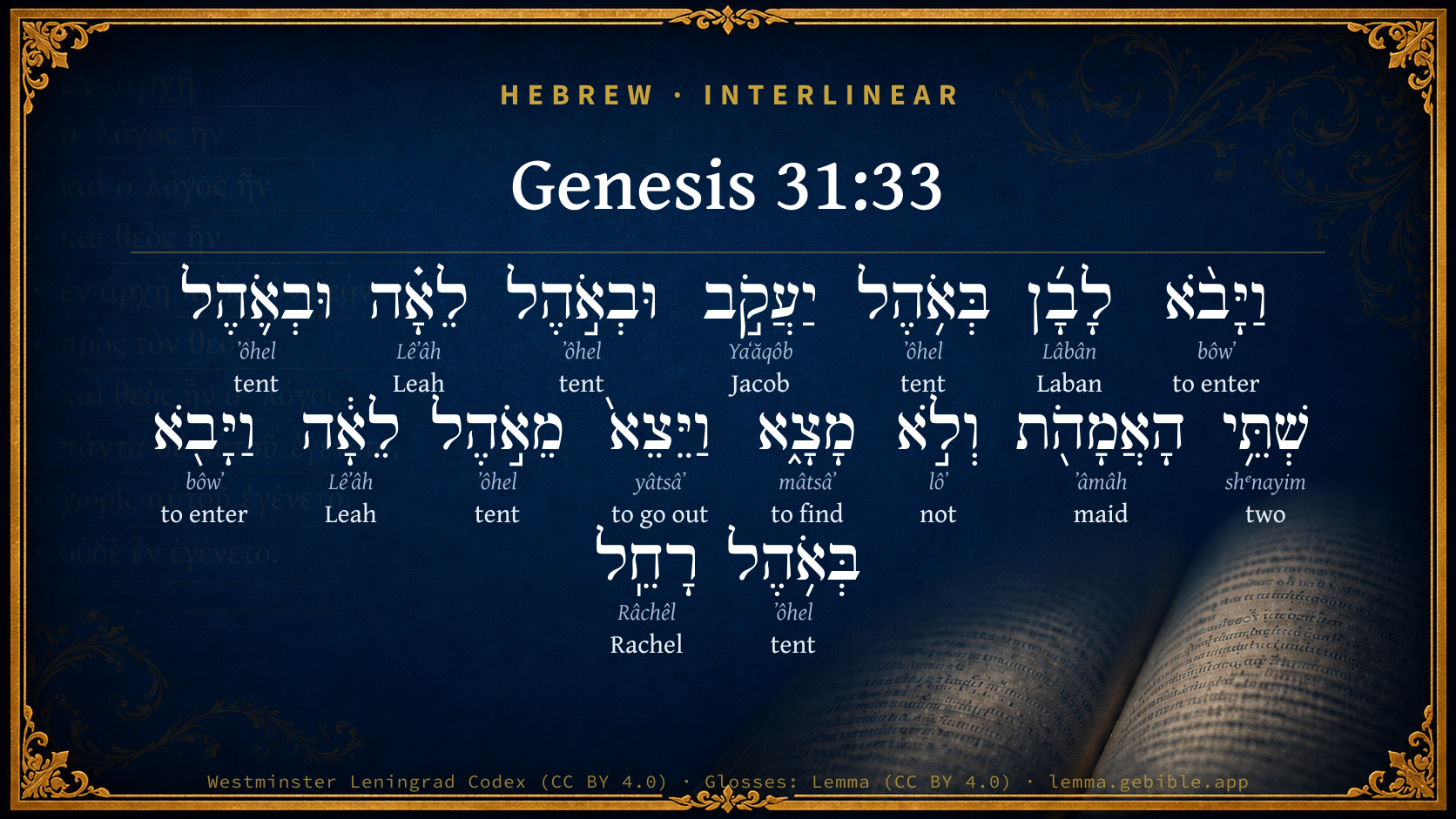
Genesis 31:33

Hebrew (Westminster Leningrad Codex) Genesis 31:33 appears in the Hebrew Old Testament. The text above is from the Westminster Leningrad Codex. Each word links to its Strong’s number, a concise gloss, and parsing drawn from the Open Scriptures Hebrew Bible morphology. Click any word for its full Brown-Driver-Briggs (BDB) entry.
Download image
Cite this verse

Genesis 31:33 (World English Bible). Public Domain. Lemma interlinear Bible study tool, https://lemma.gebible.app/v/genesis/31/33.

Show BibTeX & RIS
BibTeX
RIS
English Translation
Laban went into Jacob's tent, into Leah's tent, and into the tent of the two maid-servants; but he didn't find them. He went out of Leah's tent, and entered into Rachel's tent.
World English Bible · Public Domain
Download a study sheet

One document with this verse’s original text, its word-by-word gloss line, the meaning frame, cross-references with their text, attributed commentary, and full source and license credits — printable, and it pastes into notes with its structure intact.

This verse Autodidact and up

Study sheet (.html) Plain text (.txt)

A passage Seminary Student

Up to 50 verses in one chapter. A passage sheet keeps up to 6 commentary sources and 12 cross-references per verse, in the order this page ranks them, and says so on the sheet whenever that leaves anything out. Ask for a single verse and you get the Autodidact verse sheet above.

Everything on this page stays free to read, with no account — the sheet is a download of what is already on screen, not access to it.

Want to remove ads? Support Godless Engineer
Compare translations 3

The same verse in 3 English versions, stacked beneath the original-language interlinear above. Click any original word for its lexicon entry.

Each is an independent rendering of the whole verse — the interlinear is not word-aligned to these translations.

Highlighted words mark where these versions differ — a whole-verse word diff, not a word-by-word alignment.

  • World English Bible Public Domain
    Laban went into Jacob's tent, into Leah's tent, and into the tent of the two maid-servants; but he didn't find them. He went out of Leah's tent, and entered into Rachel's tent.
  • King James Version Public Domain
    And Laban went into Jacob's tent, and into Leah's tent, and into the two maidservants' tents; but he found them not. Then went he out of Leah's tent, and entered into Rachel's tent.
  • unfoldingWord Literal Text CC BY-SA 4.0
    Then Laban went into the tent of Jacob and into the tent of Leah and into the tent of the two slave women, but he did not find. Then he came out of Leah’s tent and went into Rachel’s tent.

unfoldingWord Literal Text — © unfoldingWord, licensed CC BY-SA 4.0. Word-aligned USFM3 via Door43 (git.door43.org/unfoldingWord/en_ult).

Versions to compare (up to 4)

3 of 4 selected

Show all 18 translations

Every available English version of this verse, each an independent rendering of the whole verse.

  • World English Bible Public Domain
    Laban went into Jacob's tent, into Leah's tent, and into the tent of the two maid-servants; but he didn't find them. He went out of Leah's tent, and entered into Rachel's tent.
  • Berean Standard Bible Public Domain
    So Laban went into Jacob’s tent, then Leah’s tent, and then the tents of the two maidservants, but he found nothing. Then he left Leah’s tent and entered Rachel’s tent.
  • Majority Standard Bible Public Domain
    So Laban went into Jacob’s tent, then Leah’s tent, and then the tents of the two maidservants, but he found nothing. Then he left Leah’s tent and entered Rachel’s tent.
  • King James Version Public Domain
    And Laban went into Jacob's tent, and into Leah's tent, and into the two maidservants' tents; but he found them not. Then went he out of Leah's tent, and entered into Rachel's tent.
  • American Standard Version (1901) Public Domain
    And Laban went into Jacob's tent, and into Leah's tent, and into the tent of the two maid-servants; but he found them not. And he went out of Leah's tent, and entered into Rachel's tent.
  • Revised Version (1885) Public Domain
    And Laban went into Jacob’s tent, and into Leah’s tent, and into the tent of the two maidservants; but he found them not. And he went out of Leah’s tent, and entered into Rachel’s tent.
  • Geneva Bible (1599) Public Domain
    Then came Laban into Iaakobs tent, and into Leahs tent, and into the two maides tentes, but founde them not. So hee went out of Leahs tent, and entred into Rahels tent.
  • Douay-Rheims (1899) Public Domain
    So Laban went into the tent of Jacob, and of Lia, and of both the handmaids, and found them not. And when he was entered into Rachel's tent,
  • Young's Literal Translation Public Domain
    And Laban goeth into the tent of Jacob, and into the tent of Leah, and into the tent of the two handmaidens, and hath not found; and he goeth out from the tent of Leah, and goeth into the tent of Rachel.
  • Literal Standard Version CC BY-SA 4.0
    And Laban goes into the tent of Jacob, and into the tent of Leah, and into the tent of the two handmaidens, and has not found; and he goes out from the tent of Leah, and goes into the tent of Rachel.
  • Unlocked Literal Bible CC BY-SA 4.0
    Laban went into Jacob's tent, into Leah's tent, and into the tent of the two female servants, but he did not find them. He went out of Leah's tent and entered into Rachel's tent.
  • unfoldingWord Literal Text CC BY-SA 4.0
    Then Laban went into the tent of Jacob and into the tent of Leah and into the tent of the two slave women, but he did not find. Then he came out of Leah’s tent and went into Rachel’s tent.
  • Darby Bible Public Domain
    And Laban went into Jacob's tent, and into Leah's tent, and into the two handmaids' tents, and found nothing; and he went out of Leah's tent, and entered into Rachel's tent.
  • World Messianic Bible Public Domain
    Laban went into Jacob’s tent, into Leah’s tent, and into the tent of the two female servants; but he didn’t find them. He went out of Leah’s tent, and entered into Rachel’s tent.
  • Webster's Bible Public Domain
    And Laban went into Jacob's tent, and into Leah's tent, and into the two maid-servants' tents; but he found them not. Then he went out of Leah's tent, and entered into Rachel's tent.
  • Free Bible Version CC BY-SA 4.0
    Laban searched the tents of Jacob, Leah, and the two personal maids, but didn't find anything. He left Leah's tent and went into Rachel's tent.
  • Bible in Basic English Public Domain
    So Laban went into Jacob's tent and into Leah's tent, and into the tents of the two servant-women, but they were not there; and he came out of Leah's tent and went into Rachel's.
  • JPS Tanakh (1917) Public Domain
    And Laban went into Jacob's tent, and into Leah's tent, and into the tent of the two maid-servants; but he found them not. And he went out of Leah's tent, and entered into Rachel's tent.

Literal Standard Version (2020), Covenant Press — licensed CC BY-SA 4.0. Text via the HelloAO Bible API (eBible.org). Unlocked Literal Bible (unfoldingWord) — licensed CC BY-SA 4.0. Text via the HelloAO Bible API (eBible.org). unfoldingWord Literal Text — © unfoldingWord, licensed CC BY-SA 4.0. Word-aligned USFM3 via Door43 (git.door43.org/unfoldingWord/en_ult). Free Bible Version, Dr. Jonathan Gallagher — licensed CC BY-SA 4.0. Text via the HelloAO Bible API (eBible.org).

Word by word

More ways to search: Search by grammar → Find every occurrence → Compare this word →

Practice this passage: Drill this verse → Learn its vocabulary →

לֵאָ֗ה
Lêʼâh
H3812
“Leah”
Noun, Proper
Part of Speech
Noun
Type
Proper
Full BDB Definition

Origin: from H3811

TWOT: None

Leah = "weary" - daughter of Laban, first wife of Jacob, and mother of Reuben, Simeon, Levi, Judah, Issachar, Zebulun, and Dinah
  1. וַיָּבֹ֨א bôwʼ H935 “and · to enter” Conjunction + Verb, Qal, Sequential Imperfect, 3rd Person, Masculine, Singular
  2. לָבָ֜ן Lâbân H3837 “Laban” Noun, Proper
  3. בְּאֹ֥הֶל ʼôhel H168 “in/at · tent of” Preposition + Noun, Common, Masculine, Singular, Construct
  4. יַעֲקֹ֣ב Yaʻăqôb H3290 “Jacob” Noun, Proper
  5. וּבְאֹ֣הֶל ʼôhel H168 “and · in/at · tent of” Conjunction + Preposition + Noun, Common, Masculine, Singular, Construct
  6. וּבְאֹ֛הֶל ʼôhel H168 “and · in/at · tent of” Conjunction + Preposition + Noun, Common, Masculine, Singular, Construct
  7. שְׁתֵּ֥י shᵉnayim H8147 “two” Adjective, Cardinal number, Feminine, Dual, Construct
  8. הָאֲמָהֹ֖ת ʼâmâh H519 “the · maids” Particle, Definite Article + Noun, Common, Feminine, Plural, Absolute
  9. וְלֹ֣א lôʼ H3808 “and · not” Conjunction + Particle, Negative
  10. מָצָ֑א mâtsâʼ H4672 “to find” Verb, Qal, Perfect, 3rd Person, Masculine, Singular
  11. וַיֵּצֵא֙ yâtsâʼ H3318 “and · to go out” Conjunction + Verb, Qal, Sequential Imperfect, 3rd Person, Masculine, Singular
  12. מֵאֹ֣הֶל ʼôhel H168 “from · tent of” Preposition + Noun, Common, Masculine, Singular, Construct
  13. לֵאָ֔ה Lêʼâh H3812 “Leah” Noun, Proper
  14. וַיָּבֹ֖א bôwʼ H935 “and · to enter” Conjunction + Verb, Qal, Sequential Imperfect, 3rd Person, Masculine, Singular
  15. בְּאֹ֥הֶל ʼôhel H168 “in/at · tent of” Preposition + Noun, Common, Masculine, Singular, Construct
  16. רָחֵֽל Râchêl H7354 “Rachel” Noun, Proper

About this verse

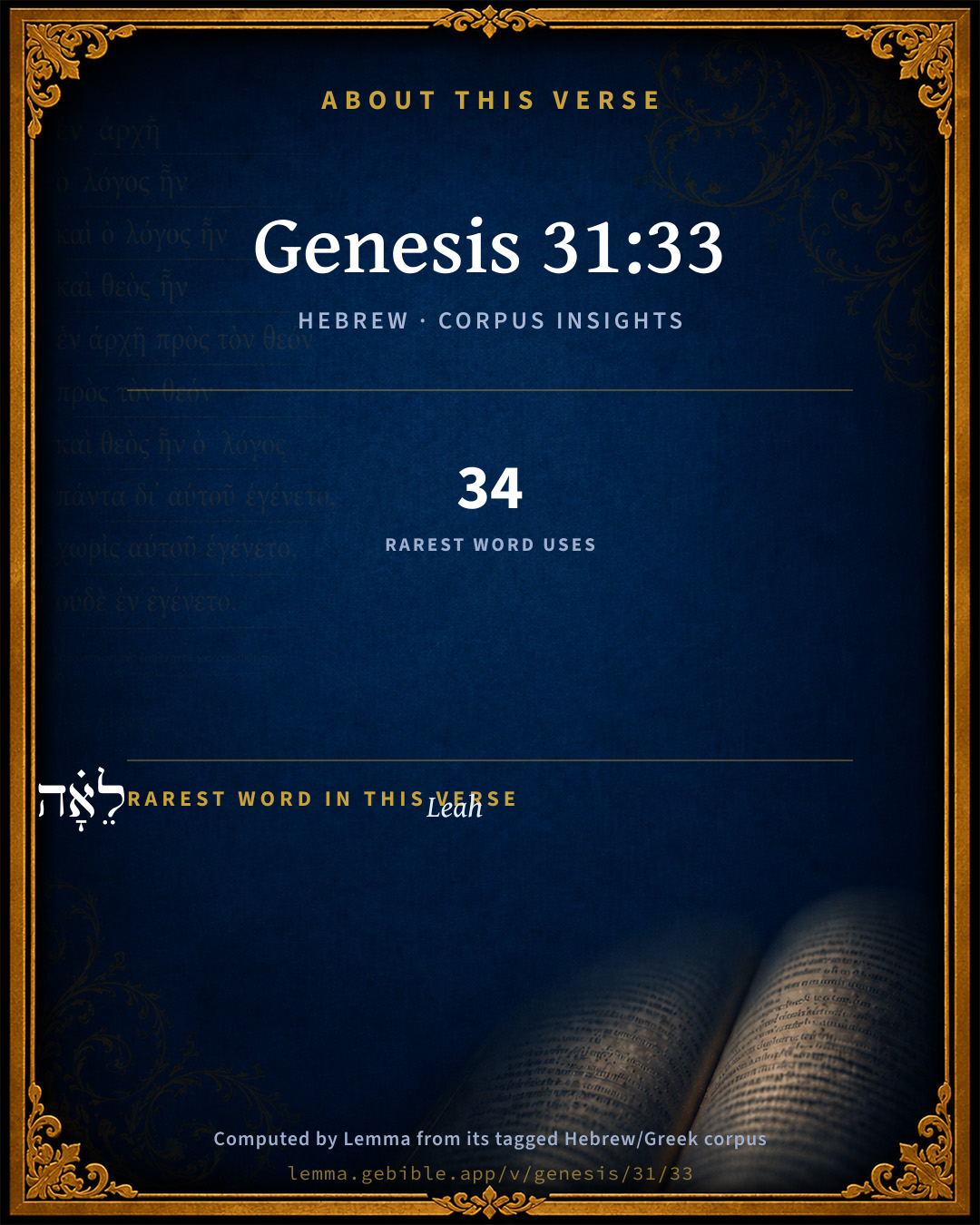
These counts appear in no published source. They are computed here, from the morphology-tagged text and Lemma’s own curated glosses. What Lemma adds →

17
words
11
distinct lemmas
Pentateuch
section

Shared distinctive vocabulary

לֵאָ֗ה Leah H3812 occurs in 32 verses of the Hebrew Bible. Also found in:

Grammatical profile

  • 4 verbs
  • 11 nouns
  • 1 adjective
  • 1 particle

Verb forms

  • וַיָּבֹ֨א Qal · Sequential Imperfect
  • מָצָ֑א Qal · Perfect
  • וַיֵּצֵא֙ Qal · Sequential Imperfect
  • וַיָּבֹ֖א Qal · Sequential Imperfect

Repetition

Words recur within this verse — often emphatic in Hebrew:

  • בְּאֹ֥הֶל tent H168 ×5
  • וַיָּבֹ֨א to enter H935 ×2
  • לֵאָ֗ה Leah H3812 ×2

Hebrew & Septuagint length

In English translation the verse runs 32 words from the Hebrew and 52 from the Septuagint (LXX English) — the Septuagint runs noticeably longer here. See the side-by-side →

A rough comparison of the two English renderings, which tokenize alike — not a word-level alignment.

Word counts can differ between the Hebrew and the Greek without any difference in meaning — e.g. the Hebrew direct-object marker אֵת has no separate Greek word, and Greek often adds the article ὁ.

Cross-references

2

Topical passages linked to Genesis 31:33 in the Treasury of Scripture Knowledge — connected by theme and wording, ordered by reader-vote popularity; previews shown in the World English Bible.

  • Genesis 24:28 The young lady ran, and told her mother's house about these words.
  • Genesis 24:67 Isaac brought her into his mother Sarah's tent, and took Rebekah, and she became his wife. He loved her. Isaac was comforted after his mother's death.

Cross-references courtesy of OpenBible.info (CC BY 4.0).

Hebrew and Greek witnesses Masoretic Hebrew ↔ Greek Septuagint

The same verse in the two great witnesses to the Old Testament, shown verse-for-verse.

Here the Septuagint runs noticeably longer than the Hebrew — LXX2012 (modern English Septuagint) 52 words vs World English Bible 32. A rough length comparison of the two English translations, not a word-level alignment — read both below.

These are two independent witnesses, not word-aligned to each other, and the Septuagint is shown in lemma (dictionary) form.

Hebrew Genesis 31:33 Masoretic · Westminster Leningrad Codex

וַיָּבֹ֨א לָבָ֜ן בְּאֹ֥הֶל יַעֲקֹ֣ב וּבְאֹ֣הֶל לֵאָ֗ה וּבְאֹ֛הֶל שְׁתֵּ֥י הָאֲמָהֹ֖ת וְלֹ֣א מָצָ֑א וַיֵּצֵא֙ מֵאֹ֣הֶל לֵאָ֔ה וַיָּבֹ֖א בְּאֹ֥הֶל רָחֵֽל

Laban went into Jacob's tent, into Leah's tent, and into the tent of the two maid-servants; but he didn't find them. He went out of Leah's tent, and entered into Rachel's tent.

World English Bible · Public Domain

Greek LXX Genesis 31:33 Septuagint · lemma form

εἰςἔρχομαι δέ λαβαν ἐρευνάω εἰς ὁ οἶκος λεια καί οὐ εὑρίσκω καί ἐκἔρχομαι ἐκ ὁ οἶκος λεια ἐρευνάω ὁ οἶκος ἰακώβ καί ἐν ὁ οἶκος ὁ δύο παιδίσκος καί οὐ εὑρίσκω εἰςἔρχομαι δέ καί εἰς ὁ οἶκος ραχηλ

And Laban went in and searched in the house of Lea, and found them not; and he went out of the house of Lea, and searched in the house of Jacob, and in the house of the two maidservants, and found them not; and he went also into the house of Rachel.

LXX2012 (modern English Septuagint) · Public Domain

On this verse, The Cambridge Bible for Schools and Colleges discusses the Septuagint’s reading. Read the note in Commentary ↓

Hebrew: Westminster Leningrad Codex (CC BY 4.0). Greek: Septuagint (public domain); English from LXX2012 (modern English Septuagint) (Public Domain). How the Septuagint differs from the Hebrew →

Targum (Aramaic paraphrase)

2

The Targum is the ancient Jewish Aramaic paraphrase of the Hebrew Scriptures — an interpretive translation, not the Hebrew text itself. Onkelos (literal) and Pseudo-Jonathan (expansive) render the Torah, and Jonathan the Prophets. Coverage is partial: where no permissively-licensed English translation exists for a verse, only the Aramaic is shown. This is verse-level text, not a word-by-word alignment to the Hebrew.

  1. Targum Onkelos Torah (Genesis–Deuteronomy)
    וְעַל לָבָן בְּמַשְׁכְּנָא דְיַעֲקֹב וּבְמַשְׁכְּנָא דְלֵאָה וּבְמַשְׁכְּנָא דְּתַרְתֵּין לְחֵינָתָא וְלָא אַשְׁכַּח וּנְפַק מִמַּשְׁכְּנָא דְלֵאָה וְעַל בְּמַשְׁכְּנָא דְרָחֵל

    (no public-domain English translation for this verse)

    Targum Onkelos — Aramaic: “Onkelos Genesis” (public domain); “Onkelos Exodus” (public domain); “Onkelos Leviticus” (public domain); “Onkelos Numbers” (public domain); “Onkelos Deuteronomy” (public domain). English: “Sefaria Community Translation” (CC0 1.0 (public-domain dedication)); “J.W. Etheridge. The Targums of Onkelos and Jonathan Ben Uzziel on the Pentateuch. London: Longmans, Green, 1862” (public domain). Text via Sefaria.

  2. Targum Pseudo-Jonathan Torah (Genesis–Deuteronomy)
    וְעַל לָבָן בְּמַשְׁכְּנָא דְיַעֲקב וּמַשְׁכְּנָא דְלֵאָה וּבְמַשְׁכְּנֵהוֹן דְתַרְתֵּין לְחֵינָתָא וְלָא אַשְׁכַּח וּנְפַק מִמַשְׁכְּנָא דְלֵאָה וְעַל בְּמַשְׁכְּנָא דְרָחֵל

    And Laban went into the tent of Jakob, and into the tent of Leah, and into the tent of the two concubines, but found not. And he went out from the tent of Leah, and entered the tent of Rahel.

    Targum Pseudo-Jonathan — Aramaic: “Targum Jonathan on Genesis” (public domain); “Targum Jonathan on Exodus” (public domain); “Targum Jonathan on Leviticus” (public domain); “Targum Jonathan on Numbers” (public domain); “Targum Jonathan on Deuteronomy” (public domain). English: “The Targum of Jonathan ben Uzziel, trans. J. W. Etheridge, London, 1862” (public domain). Text via Sefaria.

Commentary

Notes on Genesis 31:33 from classic Christian and Jewish commentators (each source and its license shown beneath its notes). The classic Christian expositions comment on the surrounding passage and are grouped to its opening verse, so a note may address several verses; the Jewish commentaries on the Tanakh (Rashi and others) are per-verse, so they appear only where the commentator wrote on this verse.

Lemma curates 59 commentaries, every one of them public domain or Creative Commons licensed, each selected and text-cleaned for this edition rather than reprinted as found. About our sources →

Trapp's Complete Commentary

John Trapp

Gen 31:33 And Laban went into Jacob’s tent, and into Leah’s tent, and into the two maidservants’ tents; but he found [them] not. Then went he out of Leah’s tent, and entered into Rachel’s tent.

Ver. 33. And Laban went into Jacob’s tent.] Hypocrites are suspicious of others better than themselves, and impudently inquisitive: Curiosi ad cognoscendam vitam alienam, desidiosi ad corrigendam suam; as Augustine hath it. Those that are most inquisitive about other men’s manners, are most careless of their own.

John Trapp, A Commentary or Exposition upon All the Books of the Old and New Testament (1647–1656) — public domain. Text from a community e-Sword module.

Tyndale Open Study Notes

Tyndale Open Resources

31:33-35 Laban searched for the idols but found nothing. Laban never dreamed that a woman having her monthly period would desecrate the idols by sitting on them (cp. Lev 15:19-24).

Tyndale Open Study Notes — © Tyndale Open Resources, licensed CC BY-SA 4.0. Text via the HelloAO Bible API.

The Cambridge Bible for Schools and Colleges

gen. ed. J. J. S. Perowne

33. tent] Four tents are mentioned, one occupied by Jacob, one each by Leah and Rachel, and one by handmaidens. LXX renders by οἶκον = “house.”

The Cambridge Bible for Schools and Colleges (gen. ed. J. J. S. Perowne; Cambridge University Press, 1878–1918) — public domain. Text from a community e-Sword module.

John Gill's Exposition

And she said to her father,.... As he approached nearer to her, having searched her tent all over:

let it not displease my lord that I cannot rise up before thee: she addresses him with great honour and respect; calling him her lord, being her father, though an unkind one, and entreats him not to be displeased that she did not rise up and yield that obeisance to him which was due from her to a father:

for the custom of women is upon me; her menstrues; which before the law of Moses were reckoned a pollution, and such persons were not to be touched or come near unto, and everything they sat upon was unclean, and not to be touched also; Lev 15:19,

and he searched; all about her, and around her; but did not oblige her to get up, nor could he imagine that ever the images could be under her in such circumstances:

but found not the images; and so left off searching; nor do we find that he searched the flock for any of his cattle there, knowing full well Jacob's honesty and integrity.

John Gill's Exposition of the Whole Bible (1746–1763) — public domain (CC PDM 1.0). Text via the HelloAO Bible API.

Matthew Poole's English Annotations

The men and women’s tents were distinct and separate. See Gen 18:2; 24:67.

Matthew Poole's English Annotations on the Holy Bible (1683–1685) — public domain. Text from a community e-Sword/MySword module.

The Pulpit Commentary

And Laban went into Jacob"s taut, and into Leah"s tent, and into the two maid-servants" tents; the clause affords an interesting glimpse into the manners of the times, showing that not only husbands and wives, but also wives among themselves, possessed separate establishments)but he found them not. Then went he out of Leah"s tent (he probably commenced with Jacob"s and those of the hand-maids, and afterwards passed into Leah"s), and entered into Rachel"s tent last, because she was the favorite. Cf. Gen_33:2, in which a similar partiality towards Rachel is exhibited by Jacob (vide Thomson"s "Land and Book," 1. 370).

The Pulpit Commentary (1880–1919), ed. H.D.M. Spence-Jones & Joseph S. Exell — public domain. Text from a community e-Sword module.

Keil & Delitzsch

C. F. Keil & F. Delitzsch

Laban looked through all the tents, but did not find his teraphim; for Rachel had put them in the saddle of her camel and was sitting upon them, and excused herself to her lord (Adonai, Gen 31:35), on the ground that the custom of women was upon her. "The camel's furniture," i.e., the saddle (not "the camel's litter:" Luther), here the woman's riding saddle, which had a comfortable seat formed of carpets on the top of the packsaddle. The fact that Laban passed over Rachel's seat because of her pretended condition, does not presuppose the Levitical law in Lev 15:19., according to which, any one who touched the couch or seat of such a woman was rendered unclean. For, in the first place, the view which lies at the foundation of this law was much older than the laws of Moses, and is met with among many other nations (cf. Bhr, Symbolik ii. 466, etc.); consequently Laban might refrain from making further examination, less from fear of defilement, than because he regarded it as impossible that any one with the custom of women upon her should sit upon his gods.

Keil & Delitzsch — Biblical Commentary on the Old Testament (1861–1891) — public domain (CC PDM 1.0). Text via the HelloAO Bible API. (Old Testament only.)

unfoldingWord translationNotes

Door43 World Missions Community

the two female servants

This refers to Zilpah and Bilhah.

he did not find them

"he did not find his idols"

translationWords

Laban

Jacob

tent

Leah

servant

Rachel

unfoldingWord translationNotes — © Distant Shores Media and the Door43 World Missions Community, licensed CC BY-SA 4.0. Source: git.door43.org/Door43/en_tn.

Rashi

Rabbi Shlomo Yitzchaki (Rashi)

באהל יעקב INTO JACOB’S TENT — This was Rachel’s tent also, for Jacob was constantly with her. For the same reason Scripture says (46:19) “the sons of Rachel Jacob’s wife”, whilst in the case of the other wives it does not state “Jacob’s wife” (Genesis Rabbah 74:9).

ויבא באהל רחל AND HE CAME INTO RACHEL’S TENT — When he left Leah’s tent he returned again to Rachel’s tent before he searched the tent of the two maid-servants. Why did he feel compelled to do all this? Because he knew full well that she was meddlesome (Genesis Rabbah 74:9).

Rashi on the Tanakh — English translations: “The Judaica Press complete Tanach with Rashi, translated by A. J. Rosenberg” (CC BY 4.0); “Pentateuch with Rashi's commentary by M. Rosenbaum and A.M. Silbermann, 1929-1934” (public domain); “The Metsudah Tanach series, Lakewood, N.J” (CC BY 4.0); and “The Book of Joshua, Metsudah Publications, 1997” (CC BY 4.0). Text via Sefaria.

Ramban (Nachmanides)

Rabbi Moshe ben Nachman (Ramban / Nachmanides)

IN THE TENT OF JACOB AND IN THE TENT OF LEAH. Rashi comments: “In the tent of Jacob — this was Rachel’s tent, for he was constantly with her. And so also Scripture says, The sons of Rachel Jacob’s wife, while in the case of the other wives it does not say ‘Jacob’s wife.’ And he entered into Rachel’s tent. When Laban left Leah’s tent he returned again to Rachel’s tent before he searched the tent of the two maid-servants. And why did he feel compelled to do all this? Because he knew her to be inclined to touch everything.” But in line with the plain meaning of Scripture, it is not correct for the same tent to be called by two names, [i.e., “the tent of Jacob” and “the tent of Rachel”] in one verse.And Rabbi Abraham ibn Ezra said that Laban entered into the tent of Jacob, the tent of Leah, and the tent of the two maid-servants [the singular form “tent” being used] since one tent served both. Afterwards he came back a second time to Leah’s tent, and after that he entered into Rachel’s tent. But this too is incorrect.Rabbi Abraham ibn Ezra further wrote: “The feasible interpretation appears to me to be that Scripture followed here a way of brevity and delayed mentioning the tent of Rachel in order to state concerning all of the others, but he found them not, as they were not there. Scripture then returns and explains that when he went out of Leah’s tent he came into Rachel’s tent where the teraphim were.” That is the correct interpretation.It is true that there were separate tents for all of the wives for this was due to the righteous man’s regard for modesty. Thus each one of the wives had a separate tent so that one should not know when he came to the other. It is also a matter forbidden by Torah law, as the Sages have mentioned in Tractate Niddah. And Jacob had a special tent, in which he would eat at his table with his children and people of the household. And the reason why Scripture mentions Jacob’s wife in connection with Rachel in my opinion, according to its simple sense, is that she is mentioned in that chapter among the concubines. For this reason Scripture does not say so in the Seder Vayishlach Yaakov, for there it mentions Leah and Rachel and then the maid-servants.

Ramban (Nachmanides) on the Tanakh — English translation: “Commentary on the Torah by Ramban (Nachmanides). Translated and annotated by Charles B. Chavel. New York, Shilo Pub. House, 1971-1976” (CC BY 4.0). Text via Sefaria.

Ibn Ezra

Rabbi Abraham ibn Ezra

The tents (literally, “the tent”) of the two handmaids. The two of them shared one tent. Alternatively, he entered the tent of one of the two handmaids. He left Leah’s tent. After he left the tents of the handmaids he returned to Leah’s tent. Alternatively, Scripture delayed mentioning that he entered Rochel’s tent immediately upon leaving Leah’s in order to conclude with Rochel’s subterfuge.

Ibn Ezra on the Tanakh — English translations: “Sefaria Community Translation” (CC0 1.0 (public-domain dedication)); “Yalkut, Sifsei Chachomim Chumash, Metsudah Publications, 2009” (CC BY 4.0); and “Commentary of Ibn Ezra on Isaiah - trans. by M. Friedlander, 1873” (public domain). Text via Sefaria.

Lesson kit

Teaching starters — assembled from the data on this page, not authored interpretation. Every prompt links to the verse data it draws on. Edit before teaching.

Genesis, in the Pentateuch, opens this verse with 17 words (11 distinct Hebrew lemmas). Its most distinctive word is Lêʼâh (“Leah”). The Greek Septuagint runs longer here. A historical commentator’s framing appears above. Read the whole chapter for the surrounding context.

Discussion questions

  1. How does “Leah” (Lêʼâh) shape what this verse is saying?
  2. Genesis 29:16 shares the word «Leah» with this verse. How do the two illuminate each other?
  3. “tent” occurs 5× in this one verse. What is the effect of the repetition?
  4. Compared with the Hebrew, the Septuagint runs longer here. What questions does that raise?
  5. These translations render this verse differently; the difference is in the English rendering, not the original. What questions does that raise?
  6. The verb «וַיָּבֹ֨א» is Qal Sequential Imperfect. How does its form color the action?
  7. Reading how Trapp's Complete Commentary and Tyndale Open Study Notes read this verse, where do the two commentators agree and where do they part?

Things to notice

Reading settings

Reading text

Shown beneath each verse's original-language words.

Old Testament
Old Testament edition

Read the OT as the Masoretic Hebrew (MT) or the Greek Septuagint (LXX).

English shown for the Greek Septuagint (in the Hebrew ↔ Greek comparison).

Comparing translations? Open the Compare panel on any verse page to stack up to four side by side.