Genesis 42:15

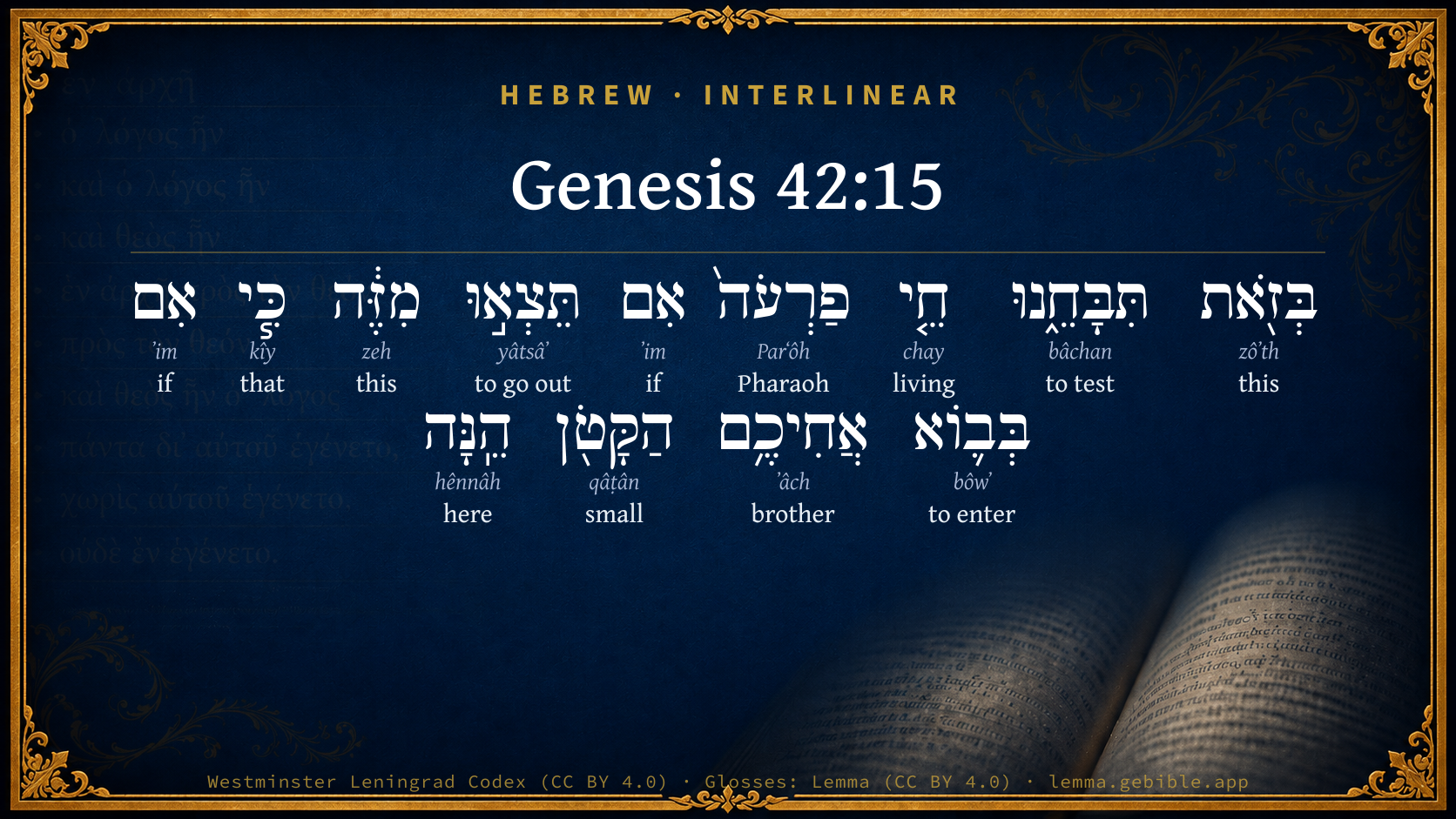
Hebrew (Westminster Leningrad Codex) Genesis 42:15 appears in the Hebrew Old Testament. The text above is from the Westminster Leningrad Codex. Each word links to its Strong’s number, a concise gloss, and parsing drawn from the Open Scriptures Hebrew Bible morphology. Click any word for its full Brown-Driver-Briggs (BDB) entry.
Download image
Cite this verse

Genesis 42:15 (World English Bible). Public Domain. Lemma interlinear Bible study tool, https://lemma.gebible.app/v/genesis/42/15.

Show BibTeX & RIS
BibTeX
RIS
English Translation
Hereby you shall be tested. By the life of Pharaoh you shall not go forth from here, unless your youngest brother come here.
World English Bible · Public Domain
Highlights
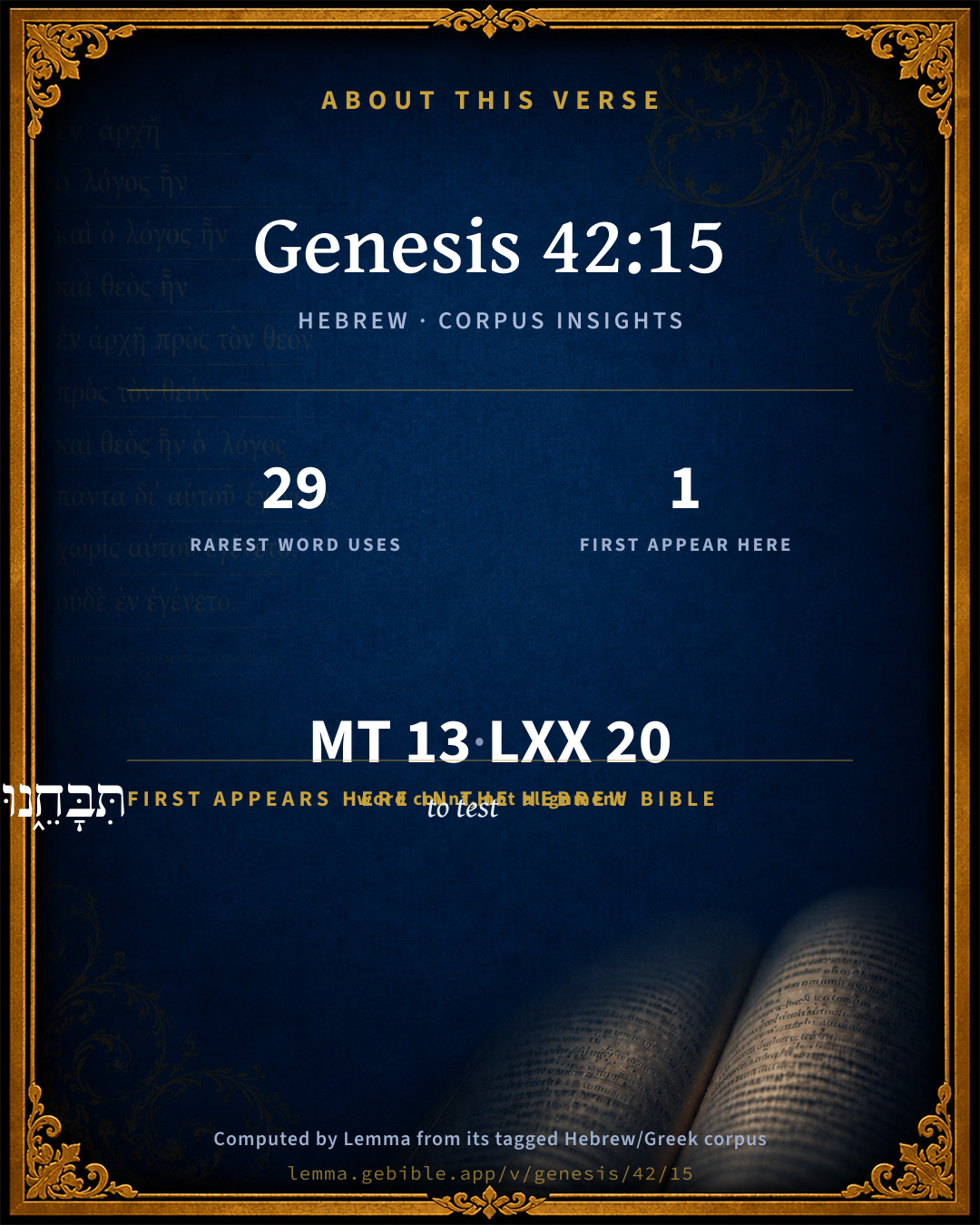
  • 1 first appearance in the Hebrew Bible
Full analysis ↓
Download a study sheet

One document with this verse’s original text, its word-by-word gloss line, the meaning frame, cross-references with their text, attributed commentary, and full source and license credits — printable, and it pastes into notes with its structure intact.

This verse Autodidact and up

Study sheet (.html) Plain text (.txt)

A passage Seminary Student

Up to 50 verses in one chapter. A passage sheet keeps up to 6 commentary sources and 12 cross-references per verse, in the order this page ranks them, and says so on the sheet whenever that leaves anything out. Ask for a single verse and you get the Autodidact verse sheet above.

Everything on this page stays free to read, with no account — the sheet is a download of what is already on screen, not access to it.

Want to remove ads? Support Godless Engineer
Compare translations 3

The same verse in 3 English versions, stacked beneath the original-language interlinear above. Click any original word for its lexicon entry.

Each is an independent rendering of the whole verse — the interlinear is not word-aligned to these translations.

Highlighted words mark where these versions differ — a whole-verse word diff, not a word-by-word alignment.

  • World English Bible Public Domain
    Hereby you shall be tested. By the life of Pharaoh you shall not go forth from here, unless your youngest brother come here.
  • King James Version Public Domain
    Hereby ye shall be proved: By the life of Pharaoh ye shall not go forth hence, except your youngest brother come hither.
  • unfoldingWord Literal Text CC BY-SA 4.0
    By this you will be tested: the life of Pharaoh, you will not leave from this unless your youngest brother comes here.

unfoldingWord Literal Text — © unfoldingWord, licensed CC BY-SA 4.0. Word-aligned USFM3 via Door43 (git.door43.org/unfoldingWord/en_ult).

Versions to compare (up to 4)

3 of 4 selected

Show all 18 translations

Every available English version of this verse, each an independent rendering of the whole verse.

  • World English Bible Public Domain
    Hereby you shall be tested. By the life of Pharaoh you shall not go forth from here, unless your youngest brother come here.
  • Berean Standard Bible Public Domain
    And this is how you will be tested: As surely as Pharaoh lives, you shall not leave this place unless your youngest brother comes here.
  • Majority Standard Bible Public Domain
    And this is how you will be tested: As surely as Pharaoh lives, you shall not leave this place unless your youngest brother comes here.
  • King James Version Public Domain
    Hereby ye shall be proved: By the life of Pharaoh ye shall not go forth hence, except your youngest brother come hither.
  • American Standard Version (1901) Public Domain
    hereby ye shall be proved: by the life of Pharaoh ye shall not go forth hence, except your youngest brother come hither.
  • Revised Version (1885) Public Domain
    hereby ye shall be proved: by the life of Pharaoh ye shall not go forth hence, except your youngest brother come hither.
  • Geneva Bible (1599) Public Domain
    Hereby ye shall be proued: by the life of Pharaoh, ye shall not goe hence, except your yongest brother come hither.
  • Douay-Rheims (1899) Public Domain
    I shall now presently try what you are: by the health of Pharao you shall not depart hence, until your youngest brother come.
  • Young's Literal Translation Public Domain
    by this ye are proved: Pharaoh liveth! if ye go out from this -- except by your young brother coming hither;
  • Literal Standard Version CC BY-SA 4.0
    by this you are proved: [as] Pharaoh lives, if you go out from this—except by your young brother coming here;
  • Unlocked Literal Bible CC BY-SA 4.0
    By this you will be tested. By the life of Pharaoh, you will not leave here, unless your youngest brother comes here.
  • unfoldingWord Literal Text CC BY-SA 4.0
    By this you will be tested: the life of Pharaoh, you will not leave from this unless your youngest brother comes here.
  • Darby Bible Public Domain
    By this ye shall be put to the proof: as Pharaoh lives, ye shall not go forth hence, unless your youngest brother come hither!
  • World Messianic Bible Public Domain
    By this you shall be tested. By the life of Pharaoh, you shall not go out from here, unless your youngest brother comes here.
  • Webster's Bible Public Domain
    By this ye shall be proved: By the life of Pharaoh ye shall not go forth hence, except your youngest brother shall come hither.
  • Free Bible Version CC BY-SA 4.0
    “This is how your story will be checked. I swear on Pharaoh's life that you'll never leave this country unless your younger brother comes here.
  • Bible in Basic English Public Domain
    But in this way will you be put to the test: by the life of Pharaoh, you will not go away from this place till your youngest brother comes here.
  • JPS Tanakh (1917) Public Domain
    Hereby ye shall be proved, as Pharaoh liveth, ye shall not go forth hence, except your youngest brother come hither.

Literal Standard Version (2020), Covenant Press — licensed CC BY-SA 4.0. Text via the HelloAO Bible API (eBible.org). Unlocked Literal Bible (unfoldingWord) — licensed CC BY-SA 4.0. Text via the HelloAO Bible API (eBible.org). unfoldingWord Literal Text — © unfoldingWord, licensed CC BY-SA 4.0. Word-aligned USFM3 via Door43 (git.door43.org/unfoldingWord/en_ult). Free Bible Version, Dr. Jonathan Gallagher — licensed CC BY-SA 4.0. Text via the HelloAO Bible API (eBible.org).

Word by word

More ways to search: Search by grammar → Find every occurrence → Compare this word →

Practice this passage: Drill this verse → Learn its vocabulary →

תִּבָּחֵ֑נוּ
bâchan
H974
“to test”
Verb, Niphal, Imperfect, 2nd Person, Masculine, Plural
Part of Speech
Verb
Stem
Niphal
Form
Imperfect
Person
2nd Person
Gender
Masculine
Number
Plural
Full BDB Definition

Origin: a primitive root

TWOT: 230

to examine, try, prove - (Qal) - to examine, scrutinise - to test, prove, try (of gold, persons, the heart, man of God) - (Niphal) to be tried, proved - (Pual) to make a trial
  1. בְּזֹ֖את zôʼth H2063 “in/at · this” Preposition + Pronoun, Demonstrative, Feminine, Singular
  2. חֵ֤י chay H2416 “living” Adjective, Adjective, Masculine, Singular, Absolute
  3. פַרְעֹה֙ Parʻôh H6547 “Pharaoh” Noun, Proper
  4. אִם ʼim H518 “if” Conjunction
  5. תֵּצְא֣וּ yâtsâʼ H3318 “to go out” Verb, Qal, Imperfect, 2nd Person, Masculine, Plural
  6. מִזֶּ֔ה zeh H2088 “from · this” Preposition + Pronoun, Demonstrative, Masculine, Singular
  7. כִּ֧י kîy H3588 “that” Conjunction
  8. אִם ʼim H518 “if” Conjunction
  9. בְּב֛וֹא bôwʼ H935 “in/at · to enter” Preposition + Verb, Qal, Infinitive Construct
  10. אֲחִיכֶ֥ם ʼâch H251 “brother · your” Noun, Common, Masculine, Singular, Construct + Suffix, Personal, 2nd Person, Masculine, Plural
  11. הַקָּטֹ֖ן qâṭân H6996 “the · small” Particle, Definite Article + Adjective, Adjective, Masculine, Singular, Absolute
  12. הֵֽנָּה hênnâh H2008 “here” Adverb

About this verse

These counts appear in no published source. They are computed here, from the morphology-tagged text and Lemma’s own curated glosses. What Lemma adds →

13
words
12
distinct lemmas
Pentateuch
section

First appearance in Scripture

This word makes its first canonical appearance in the Hebrew Bible here:

  • תִּבָּחֵ֑נוּ to test H974

Shared distinctive vocabulary

תִּבָּחֵ֑נוּ to test H974 occurs in 28 verses of the Hebrew Bible. Also found in:

Grammatical profile

  • 3 verbs
  • 2 nouns
  • 2 adjectives
  • 2 pronouns
  • 3 conjunctions
  • 1 adverb

Verb forms

  • תִּבָּחֵ֑נוּ Niphal · Imperfect
  • תֵּצְא֣וּ Qal · Imperfect
  • בְּב֛וֹא Qal · Infinitive Construct

Repetition

A word recurs within this verse — often emphatic in Hebrew:

  • אִם if H518 ×2

Hebrew & Septuagint length

In English translation the verse runs 23 words from the Hebrew and 21 from the Septuagint (LXX English) — closely comparable.

A rough comparison of the two English renderings, which tokenize alike — not a word-level alignment.

Word counts can differ between the Hebrew and the Greek without any difference in meaning — e.g. the Hebrew direct-object marker אֵת has no separate Greek word, and Greek often adds the article ὁ.

In the original languages it is 13 Hebrew tokens and 20 Greek tokens — but the two are counted differently (Hebrew bundles its prefixes and suffixes into one token; the Greek is in lemma form), so that isn’t a like-for-like length.

Cross-references

17

Topical passages linked to Genesis 42:15 in the Treasury of Scripture Knowledge — connected by theme and wording, ordered by reader-vote popularity; previews shown in the World English Bible.

  • 1 Samuel 17:55 When Saul saw David go forth against the Philistine, he said to Abner, the captain of the host, Abner, whose son is this youth? Abner said, As your soul lives, O king, I can't tell.
  • Genesis 42:7 Joseph saw his brothers, and he recognized them, but acted like a stranger to them, and spoke roughly with them. He said to them, "Where did you come from?" They said, "From the land of Canaan to buy food."
  • Genesis 42:12 He said to them, "No, but you have come to see the nakedness of the land."
  • Genesis 42:16 Send one of you, and let him get your brother, and you shall be bound, that your words may be tested, whether there is truth in you, or else by the life of Pharaoh surely you are spies."
  • Genesis 42:20 Bring your youngest brother to me; so will your words be verified, and you won't die." They did so.
  • Genesis 42:30 "The man, the lord of the land, spoke roughly with us, and took us for spies of the country.
  • Genesis 42:34 Bring your youngest brother to me. Then I will know that you are not spies, but that you are honest men. So I will deliver your brother to you, and you shall trade in the land.'"
  • Genesis 43:3 Judah spoke to him, saying, "The man solemnly warned us, saying, 'You shall not see my face, unless your brother is with you.'
  • Genesis 44:20–34 We said to my lord, 'We have a father, an old man, and a child of his old age, a little one; and his brother is dead, and he alone is left of his mother; and his father loves him.'
  • Deuteronomy 6:13 You shall fear Yahweh your God; and him shall you serve, and shall swear by his name.
  • 1 Samuel 1:26 She said, Oh, my lord, as your soul lives, my lord, I am the woman who stood by you here, praying to Yahweh.
  • 1 Samuel 20:3 David swore moreover, and said, Your father knows well that I have found favor in your eyes; and he says, Don't let Jonathan know this, lest he be grieved: but truly as Yahweh lives, and as your soul lives, there is but a step between me and death.
  • Jeremiah 5:2 Though they say, As Yahweh lives; surely they swear falsely.
  • Jeremiah 5:7 How can I pardon you? your children have forsaken me, and sworn by them that are no gods: when I had fed them to the full, they committed adultery, and assembled themselves in troops at the prostitutes' houses.
  • Matthew 5:33–37 "Again you have heard that it was said to them of old time, 'You shall not make false vows, but shall perform to the Lord your vows,'
  • Matthew 23:16–22 "Woe to you, you blind guides, who say, 'Whoever swears by the temple, it is nothing; but whoever swears by the gold of the temple, he is obligated.'
  • James 5:12 But above all things, my brothers, don't swear, neither by heaven, nor by the earth, nor by any other oath; but let your "yes" be "yes," and your "no," "no;" so that you don't fall into hypocrisy.

Cross-references courtesy of OpenBible.info (CC BY 4.0).

Hebrew and Greek witnesses Masoretic Hebrew ↔ Greek Septuagint

The same verse in the two great witnesses to the Old Testament, shown verse-for-verse.

These are two independent witnesses, not word-aligned to each other, and the Septuagint is shown in lemma (dictionary) form.

Hebrew Genesis 42:15 Masoretic · Westminster Leningrad Codex

בְּזֹ֖את תִּבָּחֵ֑נוּ חֵ֤י פַרְעֹה֙ אִם תֵּצְא֣וּ מִזֶּ֔ה כִּ֧י אִם בְּב֛וֹא אֲחִיכֶ֥ם הַקָּטֹ֖ן הֵֽנָּה

Hereby you shall be tested. By the life of Pharaoh you shall not go forth from here, unless your youngest brother come here.

World English Bible · Public Domain

Greek LXX Genesis 42:15 Septuagint · lemma form

ἐν οὗτος φαίνω νή ὁ ὑγίεια φαραώ οὐ μή ἐκἔρχομαι ἐντεῦθεν ἐάν μή ὁ ἀδελφός σύ ὁ νέος ἔρχομαι ὧδε

herein shall you⌃ be manifested; by the health of Pharao, you⌃ shall not depart hence, unless your younger brother come here.

LXX2012 (modern English Septuagint) · Public Domain

Hebrew: Westminster Leningrad Codex (CC BY 4.0). Greek: Septuagint (public domain); English from LXX2012 (modern English Septuagint) (Public Domain). How the Septuagint differs from the Hebrew →

Targum (Aramaic paraphrase)

2

The Targum is the ancient Jewish Aramaic paraphrase of the Hebrew Scriptures — an interpretive translation, not the Hebrew text itself. Onkelos (literal) and Pseudo-Jonathan (expansive) render the Torah, and Jonathan the Prophets. Coverage is partial: where no permissively-licensed English translation exists for a verse, only the Aramaic is shown. This is verse-level text, not a word-by-word alignment to the Hebrew.

  1. Targum Onkelos Torah (Genesis–Deuteronomy)
    בְּדָא תִּתְבַּחֲרוּן חֵי פַרְעֹה אִם תִּפְקוּן מִכָּא אֶלָּהֵין בְּמֵתֵי אֲחוּכוֹן זְעֵירָא הָכָא

    (no public-domain English translation for this verse)

    Targum Onkelos — Aramaic: “Onkelos Genesis” (public domain); “Onkelos Exodus” (public domain); “Onkelos Leviticus” (public domain); “Onkelos Numbers” (public domain); “Onkelos Deuteronomy” (public domain). English: “Sefaria Community Translation” (CC0 1.0 (public-domain dedication)); “J.W. Etheridge. The Targums of Onkelos and Jonathan Ben Uzziel on the Pentateuch. London: Longmans, Green, 1862” (public domain). Text via Sefaria.

  2. Targum Pseudo-Jonathan Torah (Genesis–Deuteronomy)
    בַּהֲדָא מִילָא תִּתְבָּחֲרוּן חַיֵי דְפַרְעה אִין תִּפְקוּן מִיכָּא אֱלָהֵן בִּדְיֵיתֵי אֲחוּכוֹן קַלִילָא הָכָא

    By that word you shall be proved. (By) the life of Pharoh you shall not go hence unless your youngest brother be brought hither.

    Targum Pseudo-Jonathan — Aramaic: “Targum Jonathan on Genesis” (public domain); “Targum Jonathan on Exodus” (public domain); “Targum Jonathan on Leviticus” (public domain); “Targum Jonathan on Numbers” (public domain); “Targum Jonathan on Deuteronomy” (public domain). English: “The Targum of Jonathan ben Uzziel, trans. J. W. Etheridge, London, 1862” (public domain). Text via Sefaria.

Commentary

Notes on Genesis 42:15 from classic Christian and Jewish commentators (each source and its license shown beneath its notes). The classic Christian expositions comment on the surrounding passage and are grouped to its opening verse, so a note may address several verses; the Jewish commentaries on the Tanakh (Rashi and others) are per-verse, so they appear only where the commentator wrote on this verse.

Lemma curates 59 commentaries, every one of them public domain or Creative Commons licensed, each selected and text-cleaned for this edition rather than reprinted as found. About our sources →

Trapp's Complete Commentary

John Trapp

Gen 42:15 Hereby ye shall be proved: By the life of Pharaoh ye shall not go forth hence, except your youngest brother come hither.

Ver. 15. By the life of Pharaoh.] Joseph, that he might seem enough an Egyptian, swears heathenishly; Egyptians, partly of flattery, and partly of superstition, used to swear by the life, or, as the Greek here hath it, by the health of their king. The Spaniards, in the pride of their monarchy, are grown also now to swear by the life of their king. {a} The Hebrews write, to this day, that he which falsely swears by the king’s head, in a money matter, shall be put to death; as Pererius upon this text tells us. This grew, doubtless, of that cursed custom of deifying their kings; as Antiochus surnamed Yεος; and Caligula would be styled Dominus Deus: as at this day the Pope’s parasites call him Dominum Deum nostrum papam. To be sworn by, is an honour peculiar to God. {Isa 65:16 Jer 4:2} That of Paul {1Co 15:31} is not an oath, but an obtestation; or, a taking of his afflictions for Christ to witness. That of the spouse {Son 3:5} is not an oath, but an adjuration: for he chargeth his church’s enemies not to trouble her; and if they do, roes and hinds shall testify against them; which would not do so had they but reason. This of Joseph, likewise, is by some said to be not an oath, but an earnest asseveration: {b} as who should say, As true as Pharaoh liveth; or, So Pharaoh live. Be it what it will, Joseph cannot altogether be excused for conforming himself to the Egyptians. The place had somewhat tainted him; and he might well take up that of the prophet Isaiah, "Woe is me! for I am a man of unclean lips"; and why? "for I dwell amidst a people of unclean lips." {Isa 6:5} Courts and great places are ill air for zeal to breathe in: it is hard for such not to remit somewhat of their former fervour, and contract filth of sin, which is as catching as the plague. As sheep among thorns lose part of their fleece; so do the saints part of their goodness among the wicked.

{a} Sandys’s Relation of West. Relig.

{b} Non est forma iuramenti, sed asseverationis seriae, et obtestationis domesticae.

John Trapp, A Commentary or Exposition upon All the Books of the Old and New Testament (1647–1656) — public domain. Text from a community e-Sword module.

Joseph Benson's Commentary

Gen 42:15. By the life of Pharaoh — As sure as Pharaoh lives, or as I value the life of Pharaoh. A solemn protestation, as Judah, who heard it, and must have understood its meaning, explains it to his father, Gen 43:3; The man did solemnly protest unto us. It seems, however, to have been the form of an oath in use among the Egyptians, as afterward the Romans used to swear by the name and life of their emperors. And it is no wonder that Joseph was carried by the stream of the general practice of the court, especially as the law of God concerning the appropriation of oaths unto God, that men are to swear only by his name, or are only to appeal to him for the truth of what they affirm, was not yet delivered.

Joseph Benson's Commentary on the Old and New Testaments (1811–1818) — public domain. Text from a community e-Sword module.

Tyndale Open Study Notes

Tyndale Open Resources

42:15-17 Joseph put the brothers in jail for three days to see if they had a conscience functioning about what they had done (42:21-23). The brothers had similarly thrown Joseph into a cistern-prison while they decided what to do with him (37:24).

Tyndale Open Study Notes — © Tyndale Open Resources, licensed CC BY-SA 4.0. Text via the HelloAO Bible API.

Geneva Bible (1599)

Geneva Bible translators

The Egyptians which were idolaters, used to swear by their king’s life: but God forbiddeth to swear by any but him: yet Joseph dwelling among the wicked smelleth of their corruptions.

Geneva Bible (1599) marginal notes — public domain. Text via Bolls.life.

Jamieson, Fausset & Brown

Robert Jamieson, A. R. Fausset & David Brown

By the life of Pharaoh--It is a very common practice in Western Asia to swear by the life of the king. Joseph spoke in the style of an Egyptian and perhaps did not think there was any evil in it. But we are taught to regard all such expressions in the light of an oath (Mat 5:34; Jam 5:12).

Jamieson, Fausset & Brown — Commentary Critical and Explanatory on the Whole Bible (1871) — public domain (CC PDM 1.0). Text via the HelloAO Bible API.

Adam Clarke's Commentary

Verse 15. By the life of Pharaoh] חי פרעה chey Pharaoh, Pharaoh liveth. As if he had said, As surely as the king of Egypt lives, so surely shall ye not go hence unless your brother come hither. Here therefore is no oath; it is just what they themselves make it in their report to their father, Ge 43:3: the man did solemnly protest unto us; and our translators should not have put it in the form of an oath, especially as the original not only will bear another version, but is absolutely repugnant to this in our sense of the word.

Adam Clarke's Commentary on the Bible (1810–1826) — public domain. Text from a community e-Sword/MySword module.

John Calvin's Commentaries

15. By the life of Pharaoh. From this formula of swearing a new question is raised; for that which is commanded in the law, that we should swear only by the name of God, had already been engraven on the hearts of the pious; since nature dictates that this honor is to be given to God alone, that men should defer to his judgment, and should make him the supreme arbiter and vindicator of faith and truth. If we should say that this was not simply an oath, but a kind of obtestation, the holy man will be, in some degree, excusable. He who swears by God wishes him to interpose in order to inflict punishment on perjury. They who swear by their life or by their hand, deposit, as it were, what they deem most valuable, as a pledge of their faithfulness. By this method the majesty of God is not transferred to mortal man; because it is a very different thing to cite him as witness who has the right of taking vengeance, and to assert by something most dear to us, that what we say is true. So Moses, when he calls heaven and earth to witness, does not ascribe deity to them, and thus fabricate a new idol; but, in order that higher authority may be given to the law, he declares that there is no part of the world which will not cry out before the tribunal of God, against the ingratitude of the people, if they reject the doctrine of salvation. Notwithstanding, there is, I confess, in this form of swearing which Joseph uses, something deserving of censure; for it was a profane adulation, among the Egyptians, to swear by the life of the king. Just as the Romans swore by the genius of their prince, after they had been reduced to such bondage that they made their Caesar equal to gods. Certainly this mode of swearing is abhorrent to true piety. Whence it may be perceived that nothing is more difficult to the holy servants of God than to keep themselves so pure, while conversant with the filth of the world, as to contract no spots of defilement from it. Joseph, indeed, was never so infected with the corruptions of the court, but that he remained a pure worshipped of God: nevertheless we see, that in accommodating himself to this depraved custom of speaking, he had received some stain. His repetition of the expression shows, that when any one has once become accustomed to evil, he becomes exceedingly prone to sin again and again. We observe, that they who have once rashly assumed the license of swearing, pour forth an oath every third word, even when speaking of the most frivolous things. So much the greater caution ought we to use, lest any such indulgence should harden us in this wicked custom.

John Calvin's Commentaries (1540-1563) — public domain. Text from the Calvin Translation Society English edition (1840s-50s) via the Christian Classics Ethereal Library (ccel.org). Calvin's coverage is partial (roughly two-thirds of the Bible); uncommented books and verses are honest gaps, never fabricated. The 19th-century editor's footnotes and remarks are omitted so the notes are faithfully Calvin's own voice.

Ellicott's Commentary for English Readers

(15) By the life of Pharaoh.—It was common in ancient times to swear by the king’s life (see 1Sa_17:55; 2Sa_14:19 ), and even by the life of Jehovah (2Sa_15:21; 2Ki_2:2; 2Ki_2:4; 2Ki_2:6). It is only in the stricter morality of the Gospel that such oaths are forbidden (Mat_5:33-37).

A Bible Commentary for English Readers, edited by Charles John Ellicott (1878–1897) — public domain. Text from a community e-Sword module.

The Cambridge Bible for Schools and Colleges

gen. ed. J. J. S. Perowne

15. by the life of Pharaoh] An Egyptian form of oath, in the sense of “as sure as Pharaoh is alive to punish, or avenge.” Dillmann says, “the oath is very suitable here, as the Egyptians honoured their kings, ὡς πρὸς ἀλήθειαν ὄντας θεούς (Diod. i. 90),” i.e. as truly divine. The oath by the life of the king is found in an Egyptian inscription of the 20th century b.c.

The Cambridge Bible for Schools and Colleges (gen. ed. J. J. S. Perowne; Cambridge University Press, 1878–1918) — public domain. Text from a community e-Sword module.

John Gill's Exposition

If ye be true men,.... As you say you are:

let one of your brethren be bound in the house of your prison; agree among yourselves which of you (for one of you must) remain in prison where you are: and the rest being set at liberty:

go ye, carry corn for the famine of your houses; Joseph, though he dealt with them after this manner to get what knowledge he could of his family, and to get sight of his brother, yet was concerned for the good of them and theirs, lest they should be in extreme want through the famine, and that they might have a speedy supply of corn, was not willing to detain them any longer.

John Gill's Exposition of the Whole Bible (1746–1763) — public domain (CC PDM 1.0). Text via the HelloAO Bible API.

Haydock's Catholic Bible Commentary

Health. This oath implies, that he is willing that even Pharao, whom he so much revered, should perish, if he did not execute what he said: (Haydock) or, as Pharao is now in health, so true it is you should not all depart, till your youngest brother come. (Calmet)

George Leo Haydock (1774–1849), Haydock's Catholic Family Bible and Commentary, 1859 edition — public domain. Excludes Psalms (Douay-Rheims chapter numbering differs from Protestant) and Deuterocanonical books (Catholic canon only).

Matthew Poole's English Annotations

By the life of Pharaoh, as sure as Pharaoh lives. It seems to be the form of an oath in use among the Egyptians, as afterwards the Romans used to swear by the name, genius, health, and life of their emperors. Compare 1Sa 1:26; 17:55; 2Ki 2:2; Eze 33:11. And it is not strange that Joseph through human infirmity was carried by the stream of the general practice of the court, especially when the law of God was not yet delivered concerning the appropriation of oaths unto God.

Matthew Poole's English Annotations on the Holy Bible (1683–1685) — public domain. Text from a community e-Sword/MySword module.

Whedon's Commentary on the Bible

Daniel D. Whedon

15. By the life of Pharaoh — Joseph thus speaks like a true Egyptian, who was accustomed to swear by the life of the king.

Daniel D. Whedon (gen. ed.), Commentary on the Old and New Testaments (1874–1909) — public domain. Text from a community e-Sword module.

Rashi

Rabbi Shlomo Yitzchaki (Rashi)

חי פרעה BY THE LIFE OF PHARAOH — If Pharaoh lives! Whenever he swore for the sake of appearance (literally, falsely) he swore by Pharaoh’s life (Genesis Rabbah 91:7).

אם תצאו מזה YE SHALL NOT GO FORTH FROM THIS i.e. from this place.

Rashi on the Tanakh — English translations: “The Judaica Press complete Tanach with Rashi, translated by A. J. Rosenberg” (CC BY 4.0); “Pentateuch with Rashi's commentary by M. Rosenbaum and A.M. Silbermann, 1929-1934” (public domain); “The Metsudah Tanach series, Lakewood, N.J” (CC BY 4.0); and “The Book of Joshua, Metsudah Publications, 1997” (CC BY 4.0). Text via Sefaria.

Lesson kit

Teaching starters — assembled from the data on this page, not authored interpretation. Every prompt links to the verse data it draws on. Edit before teaching.

Genesis, in the Pentateuch, opens this verse with 13 words (12 distinct Hebrew lemmas). Its most distinctive word is bâchan (“to test”). A historical commentator’s framing appears above. Read the whole chapter for the surrounding context.

Discussion questions

  1. How does “to test” (bâchan) shape what this verse is saying?
  2. The word “to test” first appears here in Scripture. What is being introduced at this debut?
  3. Genesis 42:16 shares the word «to test» with this verse. How do the two illuminate each other?
  4. “if” occurs 2× in this one verse. What is the effect of the repetition?
  5. These translations render this verse differently; the difference is in the English rendering, not the original. What questions does that raise?
  6. The verb «תִּבָּחֵ֑נוּ» is Niphal Imperfect. How does its form color the action?
  7. Reading how Trapp's Complete Commentary and Joseph Benson's Commentary read this verse, where do the two commentators agree and where do they part?

Things to notice

Reading settings

Reading text

Shown beneath each verse's original-language words.

Old Testament
Old Testament edition

Read the OT as the Masoretic Hebrew (MT) or the Greek Septuagint (LXX).

English shown for the Greek Septuagint (in the Hebrew ↔ Greek comparison).

Comparing translations? Open the Compare panel on any verse page to stack up to four side by side.