
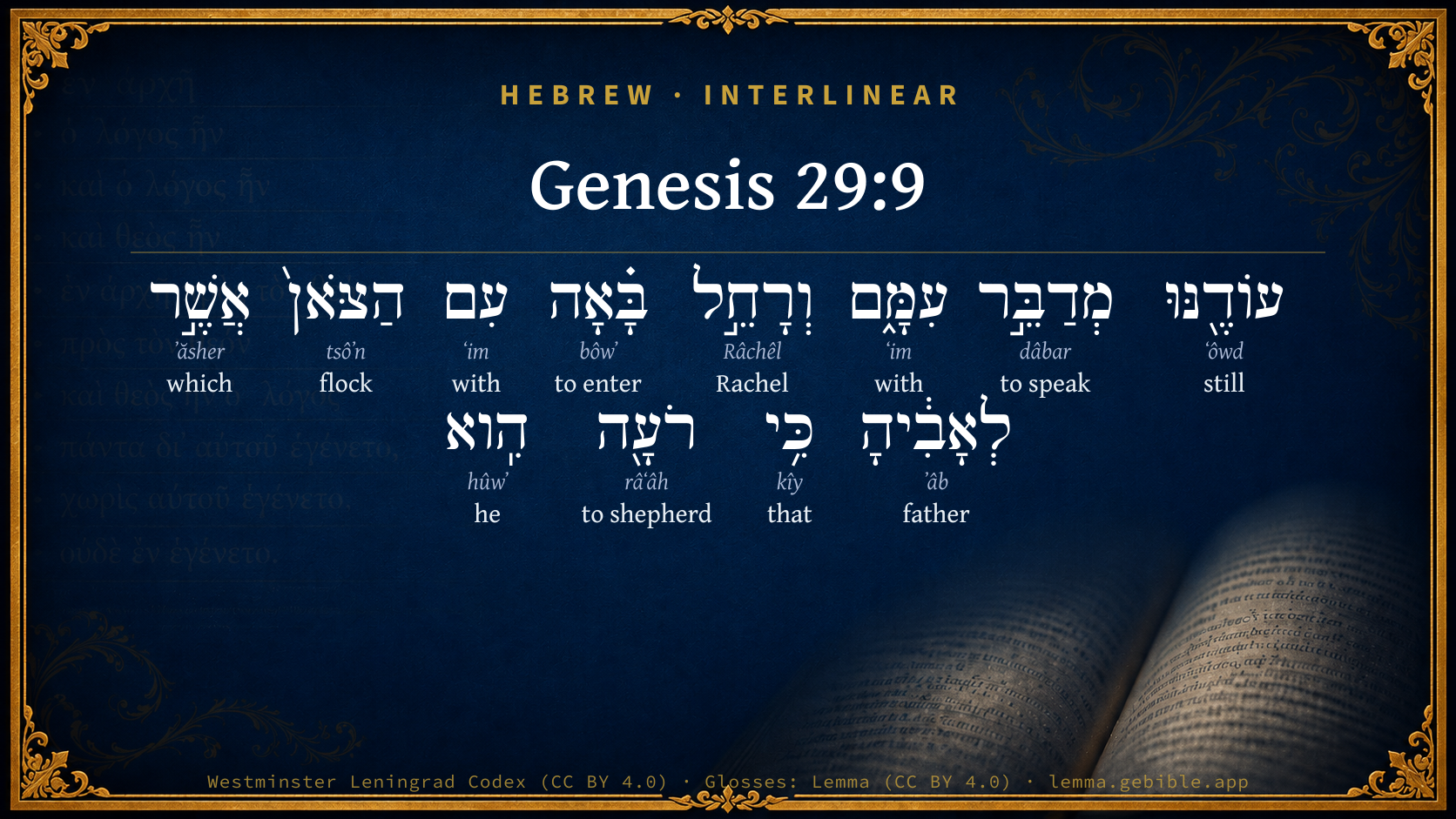
Genesis 29:9

Hebrew (Westminster Leningrad Codex) Genesis 29:9 appears in the Hebrew Old Testament. The text above is from the Westminster Leningrad Codex. Each word links to its Strong’s number, a concise gloss, and parsing drawn from the Open Scriptures Hebrew Bible morphology. Click any word for its full Brown-Driver-Briggs (BDB) entry.
Download image
Cite this verse

Genesis 29:9 (World English Bible). Public Domain. Lemma interlinear Bible study tool, https://lemma.gebible.app/v/genesis/29/9.

Show BibTeX & RIS
BibTeX
RIS
English Translation
While he was yet speaking with them, Rachel came with her father's sheep, for she kept them.
World English Bible · Public Domain
Download a study sheet

One document with this verse’s original text, its word-by-word gloss line, the meaning frame, cross-references with their text, attributed commentary, and full source and license credits — printable, and it pastes into notes with its structure intact.

This verse Autodidact and up

Study sheet (.html) Plain text (.txt)

A passage Seminary Student

Up to 50 verses in one chapter. A passage sheet keeps up to 6 commentary sources and 12 cross-references per verse, in the order this page ranks them, and says so on the sheet whenever that leaves anything out. Ask for a single verse and you get the Autodidact verse sheet above.

Everything on this page stays free to read, with no account — the sheet is a download of what is already on screen, not access to it.

Want to remove ads? Support Godless Engineer
Compare translations 3

The same verse in 3 English versions, stacked beneath the original-language interlinear above. Click any original word for its lexicon entry.

Each is an independent rendering of the whole verse — the interlinear is not word-aligned to these translations.

Highlighted words mark where these versions differ — a whole-verse word diff, not a word-by-word alignment.

  • World English Bible Public Domain
    While he was yet speaking with them, Rachel came with her father's sheep, for she kept them.
  • King James Version Public Domain
    And while he yet spake with them, Rachel came with her father's sheep; for she kept them.
  • unfoldingWord Literal Text CC BY-SA 4.0
    He was still talking with them when Rachel came with the sheep that to her father, because she was tending them.

unfoldingWord Literal Text — © unfoldingWord, licensed CC BY-SA 4.0. Word-aligned USFM3 via Door43 (git.door43.org/unfoldingWord/en_ult).

Versions to compare (up to 4)

3 of 4 selected

Show all 18 translations

Every available English version of this verse, each an independent rendering of the whole verse.

  • World English Bible Public Domain
    While he was yet speaking with them, Rachel came with her father's sheep, for she kept them.
  • Berean Standard Bible Public Domain
    While he was still speaking with them, Rachel arrived with her father’s sheep, for she was a shepherdess.
  • Majority Standard Bible Public Domain
    While he was still speaking with them, Rachel arrived with her father’s sheep, for she was a shepherdess.
  • King James Version Public Domain
    And while he yet spake with them, Rachel came with her father's sheep; for she kept them.
  • American Standard Version (1901) Public Domain
    While he was yet speaking with them, Rachel came with her father's sheep. For she kept them.
  • Revised Version (1885) Public Domain
    While he yet spake with them, Rachel came with her father’s sheep; for she kept them.
  • Geneva Bible (1599) Public Domain
    While he talked with them, Rahel also came with her fathers sheepe, for she kept them.
  • Douay-Rheims (1899) Public Domain
    They were yet speaking, and behold Rachel came with her father's sheep: for she fed the flock.
  • Young's Literal Translation Public Domain
    He is yet speaking with them, and Rachel hath come with the flock which her father hath, for she `is' shepherdess;
  • Literal Standard Version CC BY-SA 4.0
    He is yet speaking with them, and Rachel has come with the flock which her father has, for she [is] shepherdess;
  • Unlocked Literal Bible CC BY-SA 4.0
    While Jacob was still speaking with them, Rachel came with her father's sheep, for she was tending them.
  • unfoldingWord Literal Text CC BY-SA 4.0
    He was still talking with them when Rachel came with the sheep that to her father, because she was tending them.
  • Darby Bible Public Domain
    While he was still speaking to them, Rachel came with her father's sheep, for she was a shepherdess.
  • World Messianic Bible Public Domain
    While he was yet speaking with them, Rachel came with her father’s sheep, for she kept them.
  • Webster's Bible Public Domain
    And while he was yet speaking with them, Rachel came with her father's sheep: for she kept them.
  • Free Bible Version CC BY-SA 4.0
    While he was still talking with them Rachel arrived with the flock she was looking after for her father.
  • Bible in Basic English Public Domain
    While he was still talking with them, Rachel came with her father's sheep, for she took care of them.
  • JPS Tanakh (1917) Public Domain
    While he was yet speaking with them, Rachel came with her father's sheep; for she tended them.

Literal Standard Version (2020), Covenant Press — licensed CC BY-SA 4.0. Text via the HelloAO Bible API (eBible.org). Unlocked Literal Bible (unfoldingWord) — licensed CC BY-SA 4.0. Text via the HelloAO Bible API (eBible.org). unfoldingWord Literal Text — © unfoldingWord, licensed CC BY-SA 4.0. Word-aligned USFM3 via Door43 (git.door43.org/unfoldingWord/en_ult). Free Bible Version, Dr. Jonathan Gallagher — licensed CC BY-SA 4.0. Text via the HelloAO Bible API (eBible.org).

Word by word

More ways to search: Search by grammar → Find every occurrence → Compare this word →

Practice this passage: Drill this verse → Learn its vocabulary →

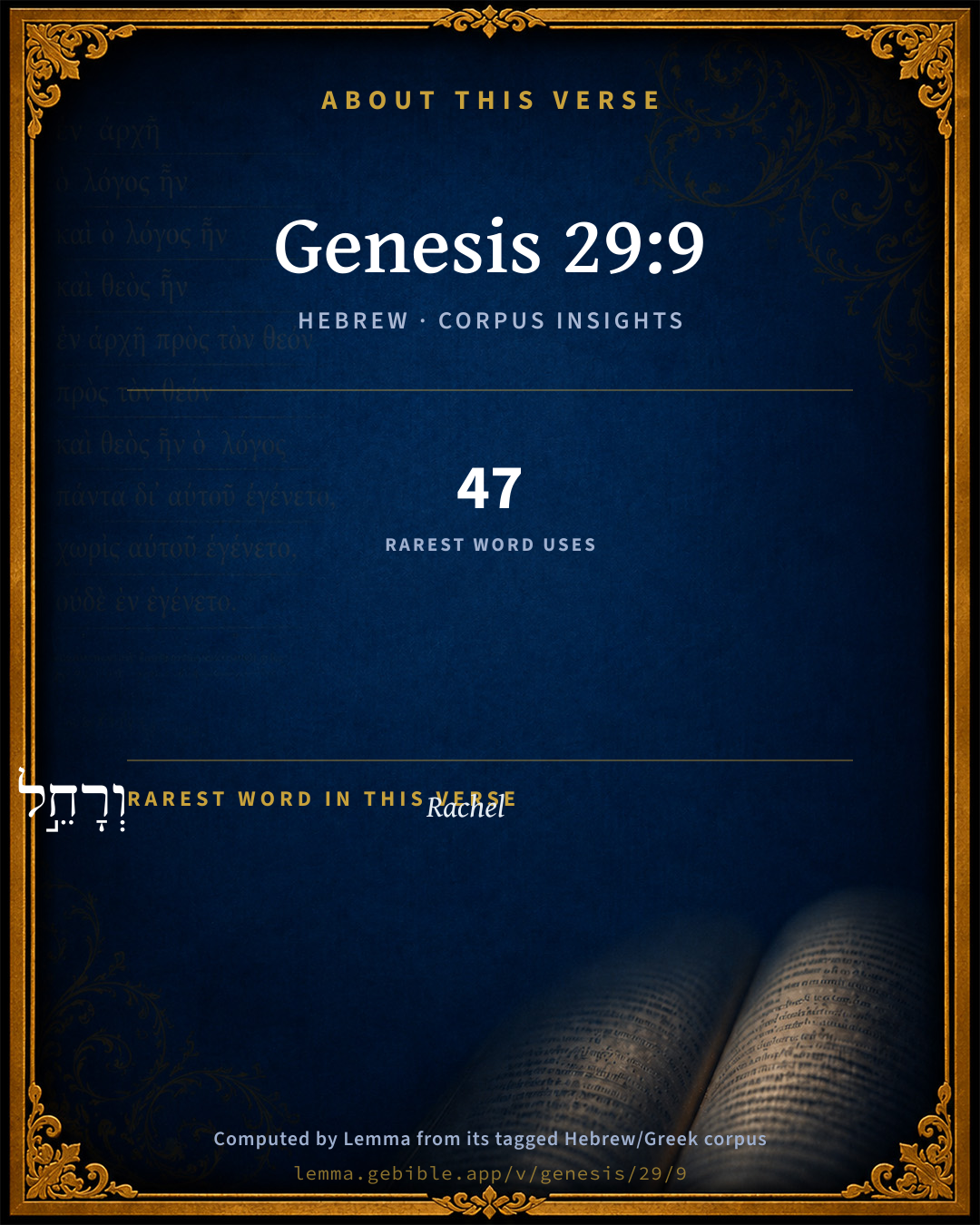
וְרָחֵ֣ל
Râchêl
H7354
“and · Rachel”
Conjunction + Noun, Proper
Part of Speech
Conjunction + Noun
Type
Proper
Full BDB Definition

Origin: the same as H7353

TWOT: None

Rachel = "ewe" - daughter of Laban, wife of Jacob, and mother of Joseph and Benjamin
  1. עוֹדֶ֖נּוּ ʻôwd H5750 “still · his” Adverb + Suffix, Personal, 3rd Person, Masculine, Singular
  2. מְדַבֵּ֣ר dâbar H1696 “speaking” Verb, Piel, Participle Active, Masculine, Singular, Absolute
  3. עִמָּ֑ם ʻim H5973 “with · them” Preposition + Suffix, Personal, 3rd Person, Masculine, Plural
  4. בָּ֗אָה bôwʼ H935 “to enter” Verb, Qal, Perfect, 3rd Person, Feminine, Singular
  5. עִם ʻim H5973 “with” Preposition
  6. הַצֹּאן֙ tsôʼn H6629 “the · flock” Particle, Definite Article + Noun, Common, Both, Singular, Absolute
  7. אֲשֶׁ֣ר ʼăsher H834 “which” Particle, Relative
  8. לְאָבִ֔יהָ ʼâb H1 “to/for · father · her” Preposition + Noun, Common, Masculine, Singular, Construct + Suffix, Personal, 3rd Person, Feminine, Singular
  9. כִּ֥י kîy H3588 “that” Conjunction
  10. רֹעָ֖ה râʻâh H7462 “shepherding” Verb, Qal, Participle Active, Feminine, Singular, Absolute
  11. הִֽוא hûwʼ H1931 “he” Pronoun, Personal, 3rd Person, Feminine, Singular

About this verse

These counts appear in no published source. They are computed here, from the morphology-tagged text and Lemma’s own curated glosses. What Lemma adds →

12
words
11
distinct lemmas
Pentateuch
section

Shared distinctive vocabulary

וְרָחֵ֣ל Rachel H7354 occurs in 44 verses of the Hebrew Bible. Also found in:

Grammatical profile

  • 3 verbs
  • 3 nouns
  • 1 pronoun
  • 2 prepositions
  • 1 conjunction
  • 1 adverb
  • 1 particle

Verb forms

  • מְדַבֵּ֣ר Piel · Participle Active
  • בָּ֗אָה Qal · Perfect
  • רֹעָ֖ה Qal · Participle Active

Repetition

A word recurs within this verse — often emphatic in Hebrew:

  • עִמָּ֑ם with H5973 ×2

Hebrew & Septuagint length

In English translation the verse runs 17 words from the Hebrew and 26 from the Septuagint (LXX English) — the Septuagint runs noticeably longer here. See the side-by-side →

A rough comparison of the two English renderings, which tokenize alike — not a word-level alignment.

Word counts can differ between the Hebrew and the Greek without any difference in meaning — e.g. the Hebrew direct-object marker אֵת has no separate Greek word, and Greek often adds the article ὁ.

Cross-references

4

Topical passages linked to Genesis 29:9 in the Treasury of Scripture Knowledge — connected by theme and wording, ordered by reader-vote popularity; previews shown in the World English Bible.

  • Exodus 2:15–16 Now when Pharaoh heard this thing, he sought to kill Moses. But Moses fled from the face of Pharaoh, and lived in the land of Midian, and he sat down by a well.
  • Exodus 2:21 Moses was content to dwell with the man. He gave Moses Zipporah, his daughter.
  • Song of Solomon 1:7–8 Tell me, you whom my soul loves, Where you graze your flock, Where you rest them at noon; For why should I be as one who is veiled Beside the flocks of your companions? Lover
  • Genesis 24:15 It happened, before he had done speaking, that behold, Rebekah came out, who was born to Bethuel the son of Milcah, the wife of Nahor, Abraham's brother, with her pitcher on her shoulder.

Cross-references courtesy of OpenBible.info (CC BY 4.0).

Hebrew and Greek witnesses Masoretic Hebrew ↔ Greek Septuagint

The same verse in the two great witnesses to the Old Testament, shown verse-for-verse.

Here the Septuagint runs noticeably longer than the Hebrew — LXX2012 (modern English Septuagint) 26 words vs World English Bible 17. A rough length comparison of the two English translations, not a word-level alignment — read both below.

These are two independent witnesses, not word-aligned to each other, and the Septuagint is shown in lemma (dictionary) form.

Hebrew Genesis 29:9 Masoretic · Westminster Leningrad Codex

עוֹדֶ֖נּוּ מְדַבֵּ֣ר עִמָּ֑ם וְרָחֵ֣ל בָּ֗אָה עִם הַצֹּאן֙ אֲשֶׁ֣ר לְאָבִ֔יהָ כִּ֥י רֹעָ֖ה הִֽוא

While he was yet speaking with them, Rachel came with her father's sheep, for she kept them.

World English Bible · Public Domain

Greek LXX Genesis 29:9 Septuagint · lemma form

ἔτι αὐτός λαλέω αὐτός καί ραχηλ ὁ θυγάτηρ λαβαν ἔρχομαι μετά ὁ πρόβατον ὁ πατήρ αὐτός αὐτός γάρ βόσκω ὁ πρόβατον ὁ πατήρ αὐτός

While he was yet speaking to them, behold, Rachel the daughter of Laban came with her father's sheep, for she fed the sheep of her father.

LXX2012 (modern English Septuagint) · Public Domain

On this verse, Haydock's Catholic Bible Commentary discusses the Septuagint’s reading. Read the note in Commentary ↓

Hebrew: Westminster Leningrad Codex (CC BY 4.0). Greek: Septuagint (public domain); English from LXX2012 (modern English Septuagint) (Public Domain). How the Septuagint differs from the Hebrew →

Targum (Aramaic paraphrase)

2

The Targum is the ancient Jewish Aramaic paraphrase of the Hebrew Scriptures — an interpretive translation, not the Hebrew text itself. Onkelos (literal) and Pseudo-Jonathan (expansive) render the Torah, and Jonathan the Prophets. Coverage is partial: where no permissively-licensed English translation exists for a verse, only the Aramaic is shown. This is verse-level text, not a word-by-word alignment to the Hebrew.

  1. Targum Onkelos Torah (Genesis–Deuteronomy)
    עַד דְהוּא מְמַלֵל עִמְהוֹן וְרָחֵל אָתַת עִם עָנָא דִי לַאֲבוּהָ אֲרֵי רָעִיתָא הִיא

    (no public-domain English translation for this verse)

    Targum Onkelos — Aramaic: “Onkelos Genesis” (public domain); “Onkelos Exodus” (public domain); “Onkelos Leviticus” (public domain); “Onkelos Numbers” (public domain); “Onkelos Deuteronomy” (public domain). English: “Sefaria Community Translation” (CC0 1.0 (public-domain dedication)); “J.W. Etheridge. The Targums of Onkelos and Jonathan Ben Uzziel on the Pentateuch. London: Longmans, Green, 1862” (public domain). Text via Sefaria.

  2. Targum Pseudo-Jonathan Torah (Genesis–Deuteronomy)
    עַד דַהֲוָה מְמַלֵיל עִמְהוֹן וְרָחֵל אָתַת עִם עָנָא דִלְאָבוּהָ אֲרוּם רָעִיתָא הִיא בְּהַהוּא זִמְנָא אֲרוּם הֲוָה מַחֲתָא דַיְיָ בְּעָנָא דְלָבָן וְלָא אִשְׁתַּיְירוּ מִנְהוֹן אֱלָהֵן קַלִילִין וְתָרִיךְ רַעֲיָא דִילֵיהּ וּמַה דְאִשְׁתַּאֲרוּ שַׁוִי קֳדָם רָחֵל בְּרַתֵּיהּ

    While they were speaking with him, Rahel came with her father's sheep; for she was a shepherdess at that time, because there had been a plague from the Lord among the sheep of Laban, and but few of them were left, and he had dismissed his shepherds, and had put the remaining (flock) before Rahel his daughter.

    Targum Pseudo-Jonathan — Aramaic: “Targum Jonathan on Genesis” (public domain); “Targum Jonathan on Exodus” (public domain); “Targum Jonathan on Leviticus” (public domain); “Targum Jonathan on Numbers” (public domain); “Targum Jonathan on Deuteronomy” (public domain). English: “The Targum of Jonathan ben Uzziel, trans. J. W. Etheridge, London, 1862” (public domain). Text via Sefaria.

Commentary

Notes on Genesis 29:9 from classic Christian and Jewish commentators (each source and its license shown beneath its notes). The classic Christian expositions comment on the surrounding passage and are grouped to its opening verse, so a note may address several verses; the Jewish commentaries on the Tanakh (Rashi and others) are per-verse, so they appear only where the commentator wrote on this verse.

Lemma curates 59 commentaries, every one of them public domain or Creative Commons licensed, each selected and text-cleaned for this edition rather than reprinted as found. About our sources →

Matthew Henry's Commentary

Here we see, 1. Rachel's humility and industry: She kept her father's sheep (Gen 29:9), that is, she took the care of them, having servants under her that were employed about them. Rachel's name signifies a sheep. Note, Honest useful labour is that which nobody needs be ashamed of, nor ought it to be a hindrance to any one's preferment. 2. Jacob's tenderness and affection. When he understood that this was his kinswoman (probably he had heard of her name before), knowing what his errand was into that country, we may suppose it struck his mind immediately that his must be his wife. Being already smitten with her ingenuous comely face (though it was probably sun-burnt, and she was in the homely dress of a shepherdess), he is wonderfully officious, and anxious to serve her (Gen 29:10), and addresses himself to her with tears of joy and kisses of love, Gen 29:11. She runs with all haste to tell her father; for she will by no means entertain her kinsman's address without her father's knowledge and approbation, Gen 29:12. These mutual respects, at their first interview, were good presages of their being a happy couple. 3. Providence made that which seemed contingent and fortuitous to give speedy satisfaction to Jacob's mind, as soon as ever he came to the place which he was bound for. Abraham's servant, when he came upon a similar errand, met with similar encouragement. Thus God guides his people with his eye, Psa 32:8. It is a groundless conceit which some of the Jewish writers have, that Jacob, when he kissed Rachel, wept because he had been set upon in his journey by Eliphaz the eldest son of Esau, at the command of his father, and robbed of all his money and jewels, which his mother had given him when she sent him away. It was plain that it was his passion for Rachel, and the surprise of this happy meeting, that drew these tears from his eyes. 4. Laban, though none of the best-humoured men, bade him welcome, was satisfied in the account he gave of himself, and of the reason of his coming in such poor circumstances. While we avoid the extreme, on the one hand, of being foolishly credulous, we must take heed of falling into the other extreme, of being uncharitably jealous and suspicious. Laban owned him for his kinsman: Thou art my bone and my flesh, Gen 29:14. Note, Those are hard-hearted indeed that are unkind to their relations, and that hide themselves from their own flesh, Isa 58:7.

Matthew Henry's Commentary on the Whole Bible (1708–1710) — public domain (CC PDM 1.0). Text via the HelloAO Bible API.

Trapp's Complete Commentary

John Trapp

Gen 29:9 And while he yet spake with them, Rachel came with her father’s sheep: for she kept them.

Ver. 9. For she kept them.] Leah might be left at home, for the tenderness of her eyes. A man is to see that all under his roof have a fit employment; as the master gave each servant his task, his talent, {Mat 25:15} according to his various abilities, secundum peritiam et potentiam . And everyone hath some excellency or other in him, can we but find and improve it. God hath dispensed his gifts diversely, for the common benefit. And as, in the same pasture, the ox can find fodder, the hound a hare, the stork a lizard, the fair maid flowers: so there is none so worthless, but something may be made of him; some good extracted out of the unlikeliest. Yea, wisdom is such an elixir, as by contaction (if there be any disposition of goodness in the same metal) it will render it of the property.

John Trapp, A Commentary or Exposition upon All the Books of the Old and New Testament (1647–1656) — public domain. Text from a community e-Sword module.

Joseph Benson's Commentary

Gen 29:9. For she kept them — Having, no doubt, servants under her who performed the meaner and more laborious offices, and whom it was her place to oversee. When Jacob understood that this was his kinswoman Rachel, (for he had probably heard of her name before,) knowing what his errand was into that country, we may suppose it occurred to his mind immediately, that this must be his wife. As one already smitten with an honest, comely face, (though it is likely sun-burnt, and she in the homely dress of a shepherdess,) he is wonderfully officious, and ready to serve her, (Gen 29:10,) and addresses himself to her with tears of joy and kisses of love, Gen 29:11. She runs with all haste to tell her father, for she will by no means entertain her kinsman’s address without her father’s knowledge and approbation, Gen 29:12. These mutual respects at their first interview were good presages of their being a happy couple. Providence made that which seemed contingent and fortuitous to give a speedy satisfaction to Jacob’s mind, as soon as ever he came to the place he was bound for. Thus God guides his people with his eye, Psa 32:8. Laban, though none of the best-humoured men, bid him welcome, was satisfied with the account he gave of himself, and the reason of his coming in such poor circumstances. While we avoid the extreme on the one hand of being foolishly credulous, we must take heed of falling into the other extreme of being uncharitably jealous and suspicious.

Joseph Benson's Commentary on the Old and New Testaments (1811–1818) — public domain. Text from a community e-Sword module.

Jamieson, Fausset & Brown

Robert Jamieson, A. R. Fausset & David Brown

While he yet spake with them, Rachel came--Among the pastoral tribes the young unmarried daughters of the greatest sheiks tend the flocks, going out at sunrise and continuing to watch their fleecy charges till sunset. Watering them, which is done twice a day, is a work of time and labor, and Jacob rendered no small service in volunteering his aid to the young shepherdess. The interview was affecting, the reception welcome, and Jacob forgot all his toils in the society of his Mesopotamian relatives. Can we doubt that he returned thanks to God for His goodness by the way?

Jamieson, Fausset & Brown — Commentary Critical and Explanatory on the Whole Bible (1871) — public domain (CC PDM 1.0). Text via the HelloAO Bible API.

Adam Clarke's Commentary

Verse 9. Rachel came with her father's sheep] So we find that young women were not kept concealed in the house till the time they were married, which is the common gloss put on עלמה almah, a virgin, one concealed. Nor was it beneath the dignity of the daughters of the most opulent chiefs to carry water from the well, as in the case of Rebekah; or tend sheep, as in the case of Rachel. The chief property in those times consisted in flocks: and who so proper to take care of them as those who were interested in their safety and increase? Honest labour, far from being a discredit, is an honour both to high and low. The king himself is served by the field; and without it, and the labour necessary for its cultivation, all ranks must perish. Let every son, let every daughter, learn that it is no discredit to be employed, whenever it may be necessary, in the meanest offices, by which the interests of the family may be honestly promoted.

Adam Clarke's Commentary on the Bible (1810–1826) — public domain. Text from a community e-Sword/MySword module.

Ellicott's Commentary for English Readers

(9) Rachel came with her father’s sheep.—Comp. Exo_2:16; and so in modern times Mr. Malan saw “the sheik’s daughter, the beautiful and well-favoured Ladheefeh, drive her flock of fine patriarchal sheep” to a well for water in this very region (Philosophy or Truth, p. 95). As forty years at least elapsed between this meeting of Jacob and Rachel and the birth of Benjamin, she must have been a mere child at this time.

A Bible Commentary for English Readers, edited by Charles John Ellicott (1878–1897) — public domain. Text from a community e-Sword module.

John Gill's Exposition

And while he yet spake with them,.... While Jacob was thus discoursing with the shepherds:

Rachel came with her father's sheep; to water them at the well. She was within sight when Jacob first addressed the shepherds, but now she was come to the well, or near it, with the sheep before her:

for she kept them: or "she was the shepherdess" (d); the chief one; she might have servants under her to do some parts of the office of a shepherd, not so fit for her to do; it may be Laban's sons, for some he had, Gen 31:1; were not as yet grown up, and Leah, the eldest daughter, having tender eyes, could not bear the open air, and light of the sun, nor so well look after the straying sheep; and therefore the flock was committed to the care of Rachel the younger daughter, whose name signifies a sheep. The Jews say (e), that the hand of God was upon Laban's flock, and there were but few left, so that he put away his shepherds, and what remained be put before his daughter Rachel, see Gen 30:30; and some ascribe it to his covetousness that he did this; but there is no need to suggest anything of that kind; for keeping sheep in those times and countries was a very honourable employment, and not below the sons and daughters of great personages, and still is so accounted. Dr. Shaw (f) says it is customary, even to this day, for the children of the greatest Emir to attend their flocks; the same is related of the seven children of the king of Thebes, of Antiphus the son of Priam, and of Anchises, Aeneas's father (g).

(d) "quia pastor illa", Montanus, "pastrix", Schmidt. (e) Targ. Jon. in loc. Pirke Eliezer, c. 36. (f) Travels, p. 240. No. 2. Ed. 2. (g) Hom. II. 1. ver. 313. II. 6. ver. 424. II. 11. ver. 106.

John Gill's Exposition of the Whole Bible (1746–1763) — public domain (CC PDM 1.0). Text via the HelloAO Bible API.

Haydock's Catholic Bible Commentary

She. Hebrew He, ipsa. Eva is put for Eia, the letters being similar, chap. iii. 15. (Haydock) --- Other copies agree with the Vulgate and the Septuagint (Calmet)

George Leo Haydock (1774–1849), Haydock's Catholic Family Bible and Commentary, 1859 edition — public domain. Excludes Psalms (Douay-Rheims chapter numbering differs from Protestant) and Deuterocanonical books (Catholic canon only).

Matthew Poole's English Annotations

Having probably other shepherds under her, who did the meaner offices, whom she was to oversee.

Matthew Poole's English Annotations on the Holy Bible (1683–1685) — public domain. Text from a community e-Sword/MySword module.

Whedon's Commentary on the Bible

Daniel D. Whedon

9. Rachel came — Her coming roused in Jacob’s soul all the tender emotions of home, kindred, loves, and hopes.

With her father’s sheep — Note the primitive custom of the daughters of an Eastern chieftain leading the sheep to water. Compare the account of Moses and the daughters of Jethro. Exo_2:15-22.

Daniel D. Whedon (gen. ed.), Commentary on the Old and New Testaments (1874–1909) — public domain. Text from a community e-Sword module.

The Pulpit Commentary

And while he yet spake with them (literally, he yet speaking with them), Rachel came with her father"s sheep: for she kept them or, she was a shepherdess, the part. h; ro being used as a substantive (Gesenius, "Lex.," sub. nom.).

The Pulpit Commentary (1880–1919), ed. H.D.M. Spence-Jones & Joseph S. Exell — public domain. Text from a community e-Sword module.

John Wesley's Explanatory Notes

She kept her father's sheep - She took the care of them, having servants under her that were employed about them when he understood that this was his kinswoman (probably he had heard of her name before) knowing what his errand was into that country, we may suppose it struck into his mind immediately, that this must be his wife, as one already smitten with an honest comely face (though it is likely, sun-burnt, and she in the homely dress of a shepherdess) he is wonderfully officious, and ready to serve her, ver. 10, and addresses himself to her with tears of joy, and kisses of love, ver. 11, she runs with all haste to tell her father, for she will by no means entertain her kinsman's address without her father's knowledge and approbation, ver. 12. These mutual respects at their first interview were good presages of their being a happy couple. Providence made that which seemed contingent and fortuitous to give a speedy satisfaction to Jacob's mind as soon as ever he came to the place he was bound for. Abraham's servant, when he came upon a like errand, met with the like encouragement. Thus God guides his people with his eye, Psalm xxxii, 8. It is a groundless conceit which some of the Jewish writers have, that Jacob when he kissed Rachel wept, because he had been set upon his journey by Eliphaz the eldest son of Esau, at the command of his father, and robbed him of all his money and jewels, which his mother had given him when she sent him away: it is plain it was his passion for Rachel, and the surprise of this happy meeting that drew these tears from his eyes. Laban, though none of the best humoured men, bid him welcome, was satisfied in the account he gave of himself, and of the reason of his coming in such poor circumstances. While we avoid the extreme on the one hand of being foolishly credulous, we must take heed of falling into the other extreme of being uncharitably jealous and suspicious. Laban owned him for his kinsman, ver. 14. Thou art my bone and my flesh. Note, Those are hard-hearted indeed that are unkind to their relations, and that hide themselves from their own flesh, Isaiah lviii, 7.

John Wesley, Explanatory Notes Upon the Whole Bible (1754–1765) — public domain. Text via the GEBible commentary corpus.

Kretzmann's Popular Commentary

Paul E. Kretzmann

Jacob Meets Rachel

v. 9. And while he yet spake with them, Rachel came with her father’s sheep; for she kept them. Rachel was a shepherdess of her father, just as the virgin daughters of the Arabians are to this day.

v. 10. And it came to pass, when Jacob saw Rachel, the daughter of Laban, his mother’s brother, and the sheep of Laban, his mother’s brother, that Jacob went near, and rolled the stone from the well’s mouth, and watered the flock of Laban, his mother’s brother. The joy which Jacob felt in reaching his destination in safety after his long, lonely, and dangerous journey through the desert and his delight in meeting his cousin so soon, gave him unusual, heroic strength.

v. 11. And Jacob kissed Rachel, and lifted up his voice, and wept. His age and relationship made such an intimate greeting altogether proper, and even now bridal affection may have arisen in his heart, for that was one of the purposes of his journey, to take one of the daughters of Laban for his wife.

v. 12. And Jacob told Rachel that he was her father’s brother, in the wider sense, that of a close relative, and that he was Rebekah’s son; and she ran and told her father. Rachel was now, in turn, overjoyed, a fact which caused her to seek her father with all haste.

v. 13. And it came to pass, when Laban heard the tidings of Jacob, his sister’s son, that he ran to meet him, and embraced him, and kissed him, and brought him to his house, thus offering him a hearty welcome. And he told Laban all these things, all that was necessary to explain his journey.

v. 14. And Laban said to him, Surely thou art my bone and my flesh. He was satisfied with the account as given by Jacob, for it proved conclusively that the latter was his nephew. And he abode with him the space of a month, thus becoming acquainted both with the family and with the circumstances of the family. Thus the Lord had guided the steps of Jacob, just as He watches over the steps of all His children on earth. In spite of many hardships and privations they usually manage to find a home and friends, the Lord thus giving evidence of His fatherly care.

Paul E. Kretzmann, Popular Commentary of the Bible (1921–1924) — public domain. Text from a community e-Sword module.

unfoldingWord translationNotes

Door43 World Missions Community

his mother's brother

"his uncle"

the well's mouth

Here "mouth" is a way of referring to an opening. AT: "the well" or "the opening of the well" (See: Idiom)

translationWords

Jacob

Rachel

ewe

Laban

flocks

unfoldingWord translationNotes — © Distant Shores Media and the Door43 World Missions Community, licensed CC BY-SA 4.0. Source: git.door43.org/Door43/en_tn.

Ramban (Nachmanides)

Rabbi Moshe ben Nachman (Ramban / Nachmanides)

FOR SHE WAS A SHEPHERDESS. The intent of this is to relate that Laban’s sheep had no shepherd other than Rachel, since her father turned over the flock to her alone. She alone tended them all the days, and Leah did not go with the flock at all. The matter was thus unlike that of the daughters of Jethro, where all seven daughters tended the flock simultaneously, as it is said, And they came and drew water. Perhaps due to Leah’s eyes being tender, the rays of the sun would have hurt her, or because Leah was older and of marriageable age, her father was more concerned about her. Jethro however was honored in his community and he was the priest of the country, and he was confident that people would be afraid of approaching his daughters. It may be that Laban was more modest than Jethro for Abraham’s family was proper and modest, but Rachel was yet young and there was no concern for her. This is the sense of the verse, And Jacob kissed Rachel. It may be as Rabbi Abraham ibn Ezra said that where the Hebrew word for “kissing” is followed by the letter lamed — [as here: Vayishak Yaakov l’Rachel, instead of the word eth] — it means not on the mouth, but that he kissed her on her head or on her shoulder.

Ramban (Nachmanides) on the Tanakh — English translation: “Commentary on the Torah by Ramban (Nachmanides). Translated and annotated by Charles B. Chavel. New York, Shilo Pub. House, 1971-1976” (CC BY 4.0). Text via Sefaria.

Radak

Rabbi David Kimhi (Radak)

עטדנו...באה. the word באה this time is in the past tense so that this time its stress is on the first (last but one) syllable.

Radak on the Tanakh — English translations: “Sefaria Community Translation” (CC0 1.0 (public-domain dedication)); “Eliyahu Munk, HaChut Hameshulash” (CC BY 4.0); “Rabbi Mike Feuer, Jerusalem Anthology” (CC BY 4.0); and “R. David Kimhi on the first book of Psalms, Translated by R.G. Finch, London, 1919” (public domain). Text via Sefaria.

Lesson kit

Teaching starters — assembled from the data on this page, not authored interpretation. Every prompt links to the verse data it draws on. Edit before teaching.

Genesis, in the Pentateuch, opens this verse with 12 words (11 distinct Hebrew lemmas). Its most distinctive word is Râchêl (“Rachel”). The Greek Septuagint runs longer here. A historical commentator’s framing appears above. Read the whole chapter for the surrounding context.

Discussion questions

  1. What does “Rachel” (Râchêl) contribute to the verse as a whole?
  2. Genesis 29:6 shares the word «Rachel» with this verse. How do the two illuminate each other?
  3. “with” occurs 2× in this one verse. What is the effect of the repetition?
  4. Compared with the Hebrew, the Septuagint runs longer here. What questions does that raise?
  5. These translations render this verse differently. What is at stake in choosing one wording over another?
  6. The verb «מְדַבֵּ֣ר» is Piel Participle Active. How does its form color the action?
  7. Reading how Matthew Henry's Commentary and Trapp's Complete Commentary read this verse, where do the two commentators agree and where do they part?

Things to notice

Reading settings

Reading text

Shown beneath each verse's original-language words.

Old Testament
Old Testament edition

Read the OT as the Masoretic Hebrew (MT) or the Greek Septuagint (LXX).

English shown for the Greek Septuagint (in the Hebrew ↔ Greek comparison).

Comparing translations? Open the Compare panel on any verse page to stack up to four side by side.