
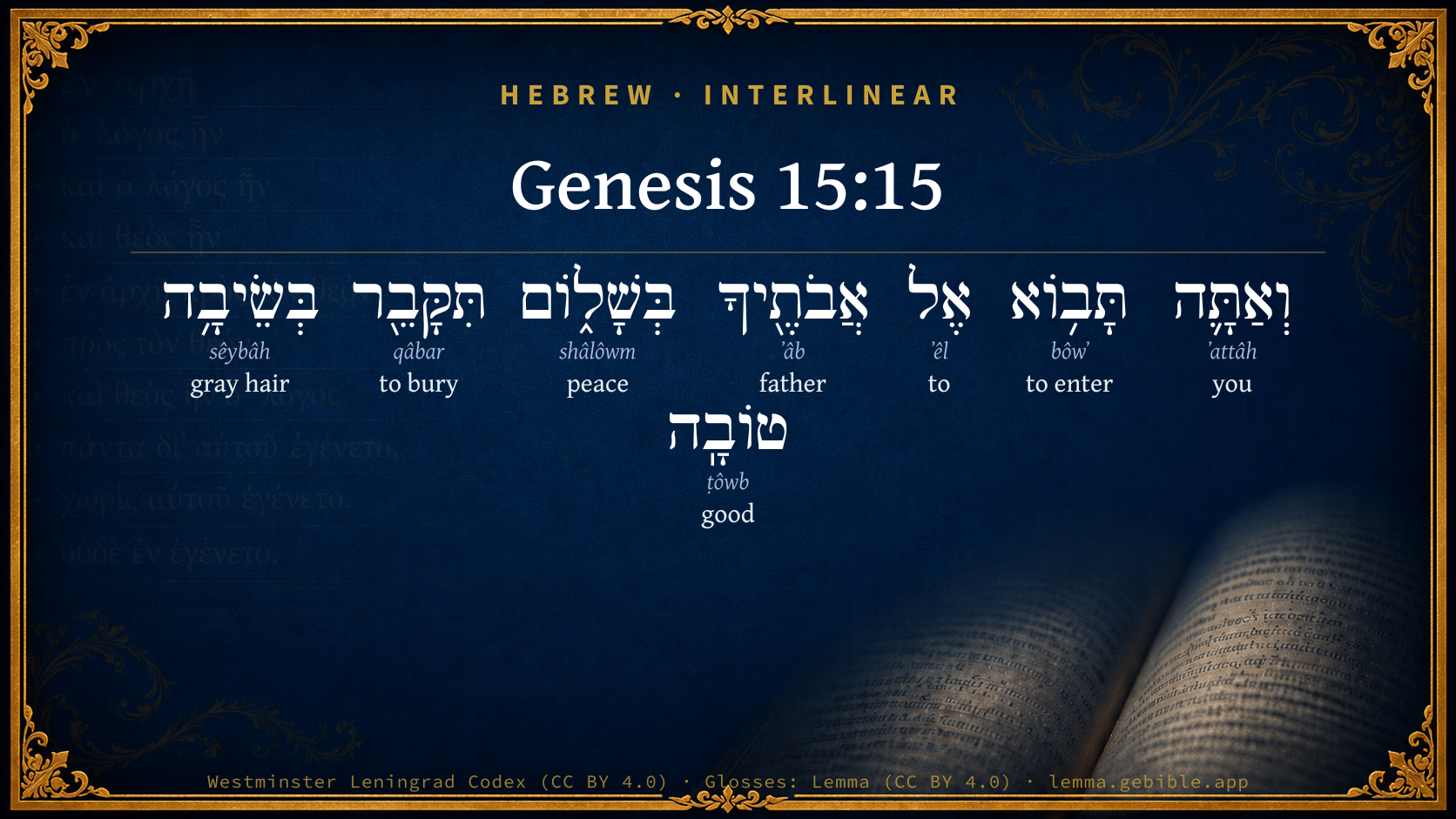
Genesis 15:15

Hebrew (Westminster Leningrad Codex) Genesis 15:15 appears in the Hebrew Old Testament. The text above is from the Westminster Leningrad Codex. Each word links to its Strong’s number, a concise gloss, and parsing drawn from the Open Scriptures Hebrew Bible morphology. Click any word for its full Brown-Driver-Briggs (BDB) entry.
Download image
Cite this verse

Genesis 15:15 (World English Bible). Public Domain. Lemma interlinear Bible study tool, https://lemma.gebible.app/v/genesis/15/15.

Show BibTeX & RIS
BibTeX
RIS
English Translation
But you will go to your fathers in peace. You will be buried in a good old age.
World English Bible · Public Domain
Highlights
  • 3 first appearances in the Hebrew Bible
Full analysis ↓
Download a study sheet

One document with this verse’s original text, its word-by-word gloss line, the meaning frame, cross-references with their text, attributed commentary, and full source and license credits — printable, and it pastes into notes with its structure intact.

This verse Autodidact and up

Study sheet (.html) Plain text (.txt)

A passage Seminary Student

Up to 50 verses in one chapter. A passage sheet keeps up to 6 commentary sources and 12 cross-references per verse, in the order this page ranks them, and says so on the sheet whenever that leaves anything out. Ask for a single verse and you get the Autodidact verse sheet above.

Everything on this page stays free to read, with no account — the sheet is a download of what is already on screen, not access to it.

Want to remove ads? Support Godless Engineer
Compare translations 3

The same verse in 3 English versions, stacked beneath the original-language interlinear above. Click any original word for its lexicon entry.

Each is an independent rendering of the whole verse — the interlinear is not word-aligned to these translations.

Highlighted words mark where these versions differ — a whole-verse word diff, not a word-by-word alignment.

  • World English Bible Public Domain
    But you will go to your fathers in peace. You will be buried in a good old age.
  • King James Version Public Domain
    And thou shalt go to thy fathers in peace; thou shalt be buried in a good old age.
  • unfoldingWord Literal Text CC BY-SA 4.0
    And you, you will go to your fathers in peace; you will be buried at a good old age.

unfoldingWord Literal Text — © unfoldingWord, licensed CC BY-SA 4.0. Word-aligned USFM3 via Door43 (git.door43.org/unfoldingWord/en_ult).

Versions to compare (up to 4)

3 of 4 selected

Show all 18 translations

Every available English version of this verse, each an independent rendering of the whole verse.

  • World English Bible Public Domain
    But you will go to your fathers in peace. You will be buried in a good old age.
  • Berean Standard Bible Public Domain
    You, however, will go to your fathers in peace and be buried at a ripe old age.
  • Majority Standard Bible Public Domain
    You, however, will go to your fathers in peace and be buried at a ripe old age.
  • King James Version Public Domain
    And thou shalt go to thy fathers in peace; thou shalt be buried in a good old age.
  • American Standard Version (1901) Public Domain
    But thou shalt go to thy fathers in peace; thou shalt be buried in a good old age.
  • Revised Version (1885) Public Domain
    But thou shalt go to thy fathers in peace; thou shalt be buried in a good old age.
  • Geneva Bible (1599) Public Domain
    But thou shalt goe vnto thy fathers in peace, and shalt be buried in a good age.
  • Douay-Rheims (1899) Public Domain
    And thou shalt go to thy fathers in peace, and be buried in a good old age.
  • Young's Literal Translation Public Domain
    and thou -- thou comest in unto thy fathers in peace; thou art buried in a good old age;
  • Literal Standard Version CC BY-SA 4.0
    and you come to your fathers in peace; you are buried in a good old age;
  • Unlocked Literal Bible CC BY-SA 4.0
    But you will go to your fathers in peace, and you will be buried in a good old age.
  • unfoldingWord Literal Text CC BY-SA 4.0
    And you, you will go to your fathers in peace; you will be buried at a good old age.
  • Darby Bible Public Domain
    And thou shalt go to thy fathers in peace; thou shalt be buried in a good old age.
  • World Messianic Bible Public Domain
    but you will go to your fathers in peace. You will be buried at a good old age.
  • Webster's Bible Public Domain
    And thou shalt go to thy fathers in peace; thou shalt be buried in a good old age.
  • Free Bible Version CC BY-SA 4.0
    But as for you, you will die in peace and be buried, having lived a good long life.
  • Bible in Basic English Public Domain
    As for you, you will go to your fathers in peace; at the end of a long life you will be put in your last resting-place.
  • JPS Tanakh (1917) Public Domain
    But thou shalt go to thy fathers in peace; thou shalt be buried in a good old age.

Literal Standard Version (2020), Covenant Press — licensed CC BY-SA 4.0. Text via the HelloAO Bible API (eBible.org). Unlocked Literal Bible (unfoldingWord) — licensed CC BY-SA 4.0. Text via the HelloAO Bible API (eBible.org). unfoldingWord Literal Text — © unfoldingWord, licensed CC BY-SA 4.0. Word-aligned USFM3 via Door43 (git.door43.org/unfoldingWord/en_ult). Free Bible Version, Dr. Jonathan Gallagher — licensed CC BY-SA 4.0. Text via the HelloAO Bible API (eBible.org).

Word by word

More ways to search: Search by grammar → Find every occurrence → Compare this word →

Practice this passage: Drill this verse → Learn its vocabulary →

About this verse

These counts appear in no published source. They are computed here, from the morphology-tagged text and Lemma’s own curated glosses. What Lemma adds →

8
words
8
distinct lemmas
Pentateuch
section

Notable vocabulary

The rarest word here is בְּשֵׂיבָ֥ה gray hair H7872 — appearing just 19 times in the whole Hebrew Bible.

First appearance in Scripture

These words make their first canonical appearance in the Hebrew Bible here:

  • בְּשָׁל֑וֹם peace H7965
  • תִּקָּבֵ֖ר to bury H6912
  • בְּשֵׂיבָ֥ה gray hair H7872

Shared distinctive vocabulary

בְּשֵׂיבָ֥ה gray hair H7872 occurs in 19 verses of the Hebrew Bible. Also found in:

Grammatical profile

  • 2 verbs
  • 3 nouns
  • 1 adjective
  • 1 pronoun
  • 1 preposition

Verb forms

  • תָּב֥וֹא Qal · Imperfect
  • תִּקָּבֵ֖ר Niphal · Imperfect

Hebrew & Septuagint length

In English translation the verse runs 18 words from the Hebrew and 15 from the Septuagint (LXX English) — closely comparable.

A rough comparison of the two English renderings, which tokenize alike — not a word-level alignment.

Word counts can differ between the Hebrew and the Greek without any difference in meaning — e.g. the Hebrew direct-object marker אֵת has no separate Greek word, and Greek often adds the article ὁ.

In the original languages it is 8 Hebrew tokens and 13 Greek tokens — but the two are counted differently (Hebrew bundles its prefixes and suffixes into one token; the Greek is in lemma form), so that isn’t a like-for-like length.

Cross-references

23

Topical passages linked to Genesis 15:15 in the Treasury of Scripture Knowledge — connected by theme and wording, ordered by reader-vote popularity; previews shown in the World English Bible.

  • Job 5:26 You shall come to your grave in a full age, Like a shock of grain comes in its season.
  • Genesis 25:7–9 These are the days of the years of Abraham's life which he lived: one hundred seventy-five years.
  • 2 Chronicles 34:28 Behold, I will gather you to your fathers, and you shall be gathered to your grave in peace, neither shall your eyes see all the evil that I will bring on this place, and on the inhabitants of it. They brought back word to the king.
  • Numbers 27:13 When you have seen it, you also shall be gathered to your people, as Aaron your brother was gathered;
  • Daniel 12:13 But go you your way until the end be; for you shall rest, and shall stand in your lot, at the end of the days.
  • Judges 2:10 Also all that generation were gathered to their fathers: and there arose another generation after them, who didn't know Yahweh, nor yet the work which he had worked for Israel.
  • 1 Chronicles 29:28 He died in a good old age, full of days, riches, and honor: and Solomon his son reigned in his place.
  • Job 42:17 So Job died, being old and full of days.
  • Ecclesiastes 12:7 And the dust returns to the earth as it was, And the spirit returns to God who gave it.
  • Acts 13:36 For David, after he had in his own generation served the counsel of God, fell asleep, and was laid with his fathers, and saw decay.
  • Genesis 35:29 Isaac gave up the spirit, and died, and was gathered to his people, old and full of days. Esau and Jacob, his sons, buried him.
  • Genesis 49:29 He charged them, and said to them, "I am to be gathered to my people. Bury me with my fathers in the cave that is in the field of Ephron the Hittite,
  • Genesis 23:19 After this, Abraham buried Sarah his wife in the cave of the field of Machpelah before Mamre (the same is Hebron), in the land of Canaan.
  • Genesis 49:31 There they buried Abraham and Sarah, his wife. There they buried Isaac and Rebekah, his wife, and there I buried Leah:
  • Genesis 50:13 for his sons carried him into the land of Canaan, and buried him in the cave of the field of Machpelah, which Abraham bought with the field, for a possession of a burying-place, from Ephron the Hittite, before Mamre.
  • Numbers 20:24 Aaron shall be gathered to his people; for he shall not enter into the land which I have given to the children of Israel, because you rebelled against my word at the waters of Meribah.
  • 1 Chronicles 23:1 Now David was old and full of days; and he made Solomon his son king over Israel.
  • Psalms 37:37 Mark the perfect man, and see the upright, For there is a future for the man of peace.
  • Ecclesiastes 6:3 If a man fathers a hundred children, and lives many years, so that the days of his years are many, but his soul is not filled with good, and moreover he has no burial; I say, that an untimely birth is better than he:
  • Genesis 23:4 "I am a stranger and a foreigner living with you. Give me a possession of a burying-place with you, that I may bury my dead out of my sight."
  • Matthew 22:32 'I am the God of Abraham, and the God of Isaac, and the God of Jacob?' God is not the God of the dead, but of the living."
  • Isaiah 57:1–2 The righteous perishes, and no man lays it to heart; and merciful men are taken away, none considering that the righteous is taken away from the evil [to come].
  • Hebrews 11:13–16 These all died in faith, not having received the promises, but having seen them and embraced them from afar, and having confessed that they were strangers and pilgrims on the earth.

Cross-references courtesy of OpenBible.info (CC BY 4.0).

Hebrew and Greek witnesses Masoretic Hebrew ↔ Greek Septuagint

The same verse in the two great witnesses to the Old Testament, shown verse-for-verse.

These are two independent witnesses, not word-aligned to each other, and the Septuagint is shown in lemma (dictionary) form.

Hebrew Genesis 15:15 Masoretic · Westminster Leningrad Codex

וְאַתָּ֛ה תָּב֥וֹא אֶל אֲבֹתֶ֖יךָ בְּשָׁל֑וֹם תִּקָּבֵ֖ר בְּשֵׂיבָ֥ה טוֹבָֽה

But you will go to your fathers in peace. You will be buried in a good old age.

World English Bible · Public Domain

Greek LXX Genesis 15:15 Septuagint · lemma form

σύ δέ ἀποἔρχομαι πρός ὁ πατήρ σύ μετά εἰρήνη θάπτω ἐν γῆρας καλός

But you shall depart to your fathers in peace, nourished in a good old age.

LXX2012 (modern English Septuagint) · Public Domain

Hebrew: Westminster Leningrad Codex (CC BY 4.0). Greek: Septuagint (public domain); English from LXX2012 (modern English Septuagint) (Public Domain). How the Septuagint differs from the Hebrew →

Targum (Aramaic paraphrase)

2

The Targum is the ancient Jewish Aramaic paraphrase of the Hebrew Scriptures — an interpretive translation, not the Hebrew text itself. Onkelos (literal) and Pseudo-Jonathan (expansive) render the Torah, and Jonathan the Prophets. Coverage is partial: where no permissively-licensed English translation exists for a verse, only the Aramaic is shown. This is verse-level text, not a word-by-word alignment to the Hebrew.

  1. Targum Onkelos Torah (Genesis–Deuteronomy)
    וְאַתְּ תֵעוֹל לְוָת אַבָהָתָךְ בִּשְׁלָם תִּתְקְבַר בְּסֵיבוּ טָבָא

    (no public-domain English translation for this verse)

    Targum Onkelos — Aramaic: “Onkelos Genesis” (public domain); “Onkelos Exodus” (public domain); “Onkelos Leviticus” (public domain); “Onkelos Numbers” (public domain); “Onkelos Deuteronomy” (public domain). English: “Sefaria Community Translation” (CC0 1.0 (public-domain dedication)); “J.W. Etheridge. The Targums of Onkelos and Jonathan Ben Uzziel on the Pentateuch. London: Longmans, Green, 1862” (public domain). Text via Sefaria.

  2. Targum Pseudo-Jonathan Torah (Genesis–Deuteronomy)
    וְאַתְּ תִּתְכְּנֵשׁ לְוַת אַבְהָתָךְ בִּשְׁלָם תָּנוּחַ נַפְשָׁךְ וְתִתְקְבֵר בְּסֵבוּ טָבָא

    And thou shalt be gathered to thy fathers, thy soul shall rest in peace, and thou shalt be buried in a good old age.

    Targum Pseudo-Jonathan — Aramaic: “Targum Jonathan on Genesis” (public domain); “Targum Jonathan on Exodus” (public domain); “Targum Jonathan on Leviticus” (public domain); “Targum Jonathan on Numbers” (public domain); “Targum Jonathan on Deuteronomy” (public domain). English: “The Targum of Jonathan ben Uzziel, trans. J. W. Etheridge, London, 1862” (public domain). Text via Sefaria.

Commentary

Notes on Genesis 15:15 from classic Christian and Jewish commentators (each source and its license shown beneath its notes). The classic Christian expositions comment on the surrounding passage and are grouped to its opening verse, so a note may address several verses; the Jewish commentaries on the Tanakh (Rashi and others) are per-verse, so they appear only where the commentator wrote on this verse.

Lemma curates 59 commentaries, every one of them public domain or Creative Commons licensed, each selected and text-cleaned for this edition rather than reprinted as found. About our sources →

Trapp's Complete Commentary

John Trapp

Gen 15:15 And thou shalt go to thy fathers in peace; thou shalt be buried in a good old age.

Ver. 15. Thou shalt go to thy fathers.] The "spirits of just men made perfect"; all the court of heaven shall meet thee, and welcome thee into their society. That brave Panegyris, Heb 12:22-23.

In peace.] So Josiah did, according to the promise, though he died in battle. {2Ch 34:28} God made war to be peace to him. {a}

In a good old age.] Heb., With a good hoar head, which is "a crown," when "found in the way of righteousness". {Pro 16:31}

{a} Bellum, cui nos instamus, pax est, non bellum. - Zuingl. apud Melch. Adam.

John Trapp, A Commentary or Exposition upon All the Books of the Old and New Testament (1647–1656) — public domain. Text from a community e-Sword module.

Joseph Benson's Commentary

Gen 15:15. Thou shalt go to thy fathers — At death we go to our fathers, to all our fathers that are gone before us to the state of the dead, to our godly fathers that are gone before us to the state of the blessed. The former helps to take off the terror of death, the latter puts comfort into it. Thou shalt be buried in a good old age — Perhaps mention is made of his burial here, where the land of Canaan is promised him, because a burying-place was the first possession he had in it.

Joseph Benson's Commentary on the Old and New Testaments (1811–1818) — public domain. Text from a community e-Sword module.

Adam Clarke's Commentary

Verse 15. Thou shalt go to thy fathers in peace] This verse strongly implies the immortality of the soul, and a state of separate existence. He was gathered to his fathers- introduced into the place where separate spirits are kept, waiting for the general resurrection. Two things seem to be distinctly marked here:

1. The soul of Abram should be introduced among the assembly of the first-born; Thou shalt go to thy fathers in peace.

2. His body should be buried after a long life, one hundred and seventy-five years, Ge 25:7. The body was buried; the soul went to the spiritual world, to dwell among the fathers - the patriarchs, who had lived and died in the Lord. See Clarke on Gen 25:8.

Adam Clarke's Commentary on the Bible (1810–1826) — public domain. Text from a community e-Sword/MySword module.

John Calvin's Commentaries

15. And thou shalt go to thy fathers in peace. Hitherto the Lord had respect to the posterity of Abram as well as to himself, that the consolation might be common to all; but now he turns his address to Abram alone, because he had need of peculiar confirmation. And the remedy proposed for alleviating his sorrow was, that he should die in peace, after he had attained the utmost limit of old age. The explanation given by some that he should die a natural death, exempt from violence; or an easy death, in which his vital spirits should spontaneously and naturally fail, and his life itself should fall by its own maturity, without any sense of pain, is, in my opinion, frigid. For Moses wishes to express that Abram should have not only a long, but a placid old age, with a corresponding joyful and peaceful death. The sense therefore is that although through his whole life, Abram was to be deprived of the possession of the land, yet he should not be wanting in the essential materials of quiet and joy, so that having happily finished his life, he should cheerfully depart to his fathers. And certainly death makes the great distinction between the reprobate and the sons of God, whose condition in the present life is commonly one and the same, except that the sons of God have by far the worst of it. Wherefore peace in death ought justly to be regarded as a singular benefit, because it is a proof of that distinction to which I have just alluded. Even profane writers, feeling their way in the dark, have perceived this. Plato, in his book on the Republic, (lib.1) cites a song of Pindar, in which he says, that they who live justly and homily, are attended by a sweet hope, cherishing their hearts and nourishing their old age; which hope chiefly governs the fickle mind of men. Because men, conscious of guilt, must necessarily be miserably harassed by various torments; the Poet, when he asserts that hope is the reward of a good conscience, calls it the nurse of old age. For as young men, while far removed from death, carelessly take their pleasure; the old are admonished by their own weakness, seriously to reflect that they must depart. Now unless the hope of a better life inspires them, nothing remains for them but miserable fears. Finally, as the reprobate indulge themselves during their whole life, and stupidly sleep in their vices, it is necessary that their death should be full of trouble; while the faithful commit their souls into the hand of God without fear and sadness. Whence also Balaam was constrained to break forth in this expression,

‘Let my soul die the death of the righteous,’ (Numbers 23:10.)

Moreover, since men have not such a desirable close of life in their own power; the Lord, in promising a placid and quiet death to his servant Abram, teaches us that it is his own gift. And we see that even kings, and others who deem themselves happy in this world, are yet agitated in death; because they are visited with secret compunctions for their sins, and look for nothing in death but destruction. But Abram willingly and joyfully went forward to his death, seeing that he had in Isaac a certain pledge of the divine benediction, and knew that a better life was laid up for him in heaven.

John Calvin's Commentaries (1540-1563) — public domain. Text from the Calvin Translation Society English edition (1840s-50s) via the Christian Classics Ethereal Library (ccel.org). Calvin's coverage is partial (roughly two-thirds of the Bible); uncommented books and verses are honest gaps, never fabricated. The 19th-century editor's footnotes and remarks are omitted so the notes are faithfully Calvin's own voice.

Ellicott's Commentary for English Readers

(15) Thou shalt go to thy fathers in peace.—Abram’s ancestors had died in Babylonia, but the phrase, used here for the first time, evidently involves the thought of the immortality of the soul. The body may be buried far away, but the soul joins the company of its forefathers in some separate abode, not to be absorbed, but still to enjoy a personal existence. (Comp. Gen_25:8.) A similar, but more exact, distinction between the body and the spirit is drawn in Ecc_12:7.

A Bible Commentary for English Readers, edited by Charles John Ellicott (1878–1897) — public domain. Text from a community e-Sword module.

The Cambridge Bible for Schools and Colleges

gen. ed. J. J. S. Perowne

15. go to thy fathers] i.e. depart in death to join thy forefathers in the place of departed spirits, i.e. Sheôl. Cf. Gen_47:30, “when I sleep with my fathers”; Gen_49:33, “was gathered unto his people.”

a good old age] See for the fulfilment of this promise, Gen_25:7-8. To live to a good old age and to depart this life in peace, was, as is shewn in the typical lives of the patriarchs, regarded as the reward of true piety. Cf. Job_5:26, “Thou shalt come to thy grave in a full age, like as a shock of corn cometh in its season”; Pro_9:11; Pro_10:27.

The Cambridge Bible for Schools and Colleges (gen. ed. J. J. S. Perowne; Cambridge University Press, 1878–1918) — public domain. Text from a community e-Sword module.

John Gill's Exposition

And in the fourth generation they shall come hither again,.... The seed of Abram were in the land of Canaan before their descent into Egypt; and it is here predicted and promised, that they should come thither again, as they did, in the fourth generation of those that descended thither; for Moses and Aaron were the fourth from Levi, or Eleazar from Kohath, and Caleb from Judah; or rather this was in the fourth age or century from the birth of Isaac, when the four hundred were up before mentioned, men living at that time about an hundred years: Grotius interprets this of the fourth generation of the Amorites, because of what follows:

for the iniquity of the Amorites is not yet full; and therefore as yet would not be turned out of the land, and the seed of Abram could not till then inherit it: wicked people have a measure of iniquity to fill up, which is known of God; some are longer, some are quicker in filling it up, during which time God waits patiently and bears with them; but, when it is completed, he stays no longer, but takes vengeance on them, Mat 23:32. The Amorites were only one of the nations of the Canaanites, but were a very strong and powerful one, and are put for them all, and are the rather mentioned, because Abram at this time dwelt among them; and it seems as if there were some good men among them, such as the confederates of Abram might be, and they were not arrived to that depth of wickedness they afterwards would and did, and which brought on their ruin, and so made way for the posterity of Abram to inherit their land. Ben Melech interprets it of the punishment of the sin of the Amorites, the time for that was not come to dispossess them of their land.

John Gill's Exposition of the Whole Bible (1746–1763) — public domain (CC PDM 1.0). Text via the HelloAO Bible API.

Matthew Poole's English Annotations

To thy fathers, i.e. either,

1. Into heaven, where thy godly progenitors are gone; or,

2. Into the state of the dead, where all thy fathers are gone before thee. This may seem more probable, at least in this place, partly, because this or the like phrase is indifferently used concerning good and bad men; see Gen 25:8; Psa 49:19; partly, because this phrase is so expounded, Act 13:36, He, i.e. David, was laid to his fathers, and (for that is) saw corruption; partly, because some of Abraham’s fathers, and particularly Nahor, his grandfather, who lived and died an idolater, cannot with any warrant from Scripture be presumed to be gone to the place of blessedness in their souls. Free from those afflictions which shall come upon thy posterity after thy decease.

Matthew Poole's English Annotations on the Holy Bible (1683–1685) — public domain. Text from a community e-Sword/MySword module.

Whedon's Commentary on the Bible

Daniel D. Whedon

15. Go to thy fathers — A profound expression, suggestive of reunion in another and immortal life. Comp. Gen_25:8; Gen 39:29; Gen_49:33. To go to one’s father or people implies that they were somewhere living still. That the words do not here mean being buried in the ancestral tomb is evident from the fact that Abram was not buried with his father; and then, in all the passages cited above, the burial is mentioned as subsequent and distinct.

A good old age — One hundred and seventy-five years old; Gen_25:7-8.

Daniel D. Whedon (gen. ed.), Commentary on the Old and New Testaments (1874–1909) — public domain. Text from a community e-Sword module.

The Pulpit Commentary

And thou shalt go to thy fathers in peace (cf. Gen_25:8 Gen_35:29 Gen_49:33) Not a periphrasis for going to the grave (Rosenm since Abram s ancestors were not entombed in Canaan; but a proof of the survival of departed spirits in a state of conscious existence after death (Knobel, Murphy, Wordsworth, "Speaker s Commentary," Inglis), to the company of which the patriarch was in due time to be gathered. The disposal of his remains is provided for in what follows.

Thou shalt be buried in a good old age.

The Pulpit Commentary (1880–1919), ed. H.D.M. Spence-Jones & Joseph S. Exell — public domain. Text from a community e-Sword module.

John Wesley's Explanatory Notes

Thou shalt go to thy fathers - At death we go to our fathers, to all our fathers that are gone before us to the state of the dead, to our godly fathers that are gone before us to the state of the blessed. The former helps to take off the terror of death, the latter puts comfort into it. Thou shalt be buried in a good old age - Perhaps mention is made of his burial here, where the land of Canaan is promised him, because a burying-place was the first possession he had in it. Old age is a blessing, if it be a good old age: theirs may be called a good old age,

1. That are old and healthful, not loaded with such distempers as make them weary of life:

2. That are old and holy, whose hoary head is found in the way of righteousness, old and useful, old and exemplary for godliness, that is indeed a good old age.

John Wesley, Explanatory Notes Upon the Whole Bible (1754–1765) — public domain. Text via the GEBible commentary corpus.

Rashi

Rabbi Shlomo Yitzchaki (Rashi)

ואתה תבוא BUT THOU SHALT COME etc. Thou shalt not behold all this.

אל אבותיך UNTO THY FATHERS — His father was an idolator and yet it (the text) announced to him that he (Abraham) would go to him! But this teaches you that Terah repented of his evil ways (Genesis Rabbah 30:4).

תקבר בשיבה טובה THOU SHALT BE BURIED IN A GOOD OLD AGE — He announced to him that Ishmael would repent during his (Abraham’s) life-time (Genesis Rabbah 38:12). Esau, too, did, not become degenerate during Abraham’s life-time. It was just for this reason (in order that he might not witness Esau’s evil conduct) that Abraham died five years before his proper time, for the very day when he died Esau rebelled against God (Genesis Rabbah 63:12).

Rashi on the Tanakh — English translations: “The Judaica Press complete Tanach with Rashi, translated by A. J. Rosenberg” (CC BY 4.0); “Pentateuch with Rashi's commentary by M. Rosenbaum and A.M. Silbermann, 1929-1934” (public domain); “The Metsudah Tanach series, Lakewood, N.J” (CC BY 4.0); and “The Book of Joshua, Metsudah Publications, 1997” (CC BY 4.0). Text via Sefaria.

Ramban (Nachmanides)

Rabbi Moshe ben Nachman (Ramban / Nachmanides)

AND THOU SHALT COME TO THY FATHERS IN PEACE. And thou shalt not behold at this. Thus the language of Rashi.This is not correct according to Rashi’s own interpretation, namely, that the decree, thy seed shall be a stranger in a land not their own, took effect as soon as Abraham had a child. Thus, soon after Isaac was born it states, And Abraham sojourned (‘vayagar’) in the land of the Philistines; has the same root letters as geir (stranger), thus suggesting that Abraham lived as a “stranger” in a land which was not his own. And Isaac sojourned in Gerar., 26:6. The verse however states, vayeshev (and he “dwelled”), and not vayagar. In Rashi a different verse is quoted: Sojourn (‘gur’) in this land. (Ibid., Verse 3.) Now gur has the same root as vayagar. (See preceding note.) Now if so, Abraham was also included in the decree! But the meaning of the verse, And thou shalt come to thy fathers in peace, is that “no punishment will come to you from Me even though I decree on your children punishments of servitude and affliction.”

Ramban (Nachmanides) on the Tanakh — English translation: “Commentary on the Torah by Ramban (Nachmanides). Translated and annotated by Charles B. Chavel. New York, Shilo Pub. House, 1971-1976” (CC BY 4.0). Text via Sefaria.

Radak

Rabbi David Kimhi (Radak)

ואתה תבא אל אבותיך בשלום, you will die in peace, i.e. you will not witness in your lifetime any of the upsetting developments of which I have spoken to you. As far as the word אבותיך is concerned, this is a common expression used by most people as a metaphor making death sound less negative. Expressions such as ויאסף אל עמיו, "he was gathered in to his people" in Genesis 49,33, or והאסף אל עמיך, "be gathered in to your people" in Deuteronomy 32,50 all express similar sentiments. Some commentators (quoted by Rashi) claim that the wording proves that Terach, Avraham's father had discarded idolatry and accepted monotheism prior to his own death. This is problematic, seeing that we find in Chronicles II 34,28 that kind Yoshiyahu is told by G'd הנני אוסיפך אל אבותיך, and we know that his father Amon died as an unrepentant sinner. תקבר בשיבה טובה, you will see sons and grandsons before you die.

ודור רביעי ישובו הנה, the fourth generation, starting with those who descended to Egypt, which was the place of their exile, will return to this their land that they migrated from. This prediction was fulfilled, seeing that Kehat who was one of Yaakov's grandsons went down to Egypt, and the children of Moses and Aaron who were the fourth generation were among those who entered the land of Canaan under the leadership of Joshua.

Radak on the Tanakh — English translations: “Sefaria Community Translation” (CC0 1.0 (public-domain dedication)); “Eliyahu Munk, HaChut Hameshulash” (CC BY 4.0); “Rabbi Mike Feuer, Jerusalem Anthology” (CC BY 4.0); and “R. David Kimhi on the first book of Psalms, Translated by R.G. Finch, London, 1919” (public domain). Text via Sefaria.

Lesson kit

Teaching starters — assembled from the data on this page, not authored interpretation. Every prompt links to the verse data it draws on. Edit before teaching.

Genesis, in the Pentateuch, opens this verse with 8 words (8 distinct Hebrew lemmas). Its most distinctive word is sêybâh (“gray hair”). A historical commentator’s framing appears above. Read the whole chapter for the surrounding context.

Discussion questions

  1. What does “gray hair” (sêybâh) contribute to the verse as a whole?
  2. 3 words here appear for the first time in Scripture. What is being introduced at this debut?
  3. Genesis 25:8 shares the word «gray hair» with this verse. How do the two illuminate each other?
  4. These translations render this verse differently; the difference is in the English rendering, not the original. What questions does that raise?
  5. The verb «תָּב֥וֹא» is Qal Imperfect. How does its form color the action?
  6. Reading how Trapp's Complete Commentary and Joseph Benson's Commentary read this verse, where do the two commentators agree and where do they part?

Things to notice

Reading settings

Reading text

Shown beneath each verse's original-language words.

Old Testament
Old Testament edition

Read the OT as the Masoretic Hebrew (MT) or the Greek Septuagint (LXX).

English shown for the Greek Septuagint (in the Hebrew ↔ Greek comparison).

Comparing translations? Open the Compare panel on any verse page to stack up to four side by side.