
Genesis 34:27

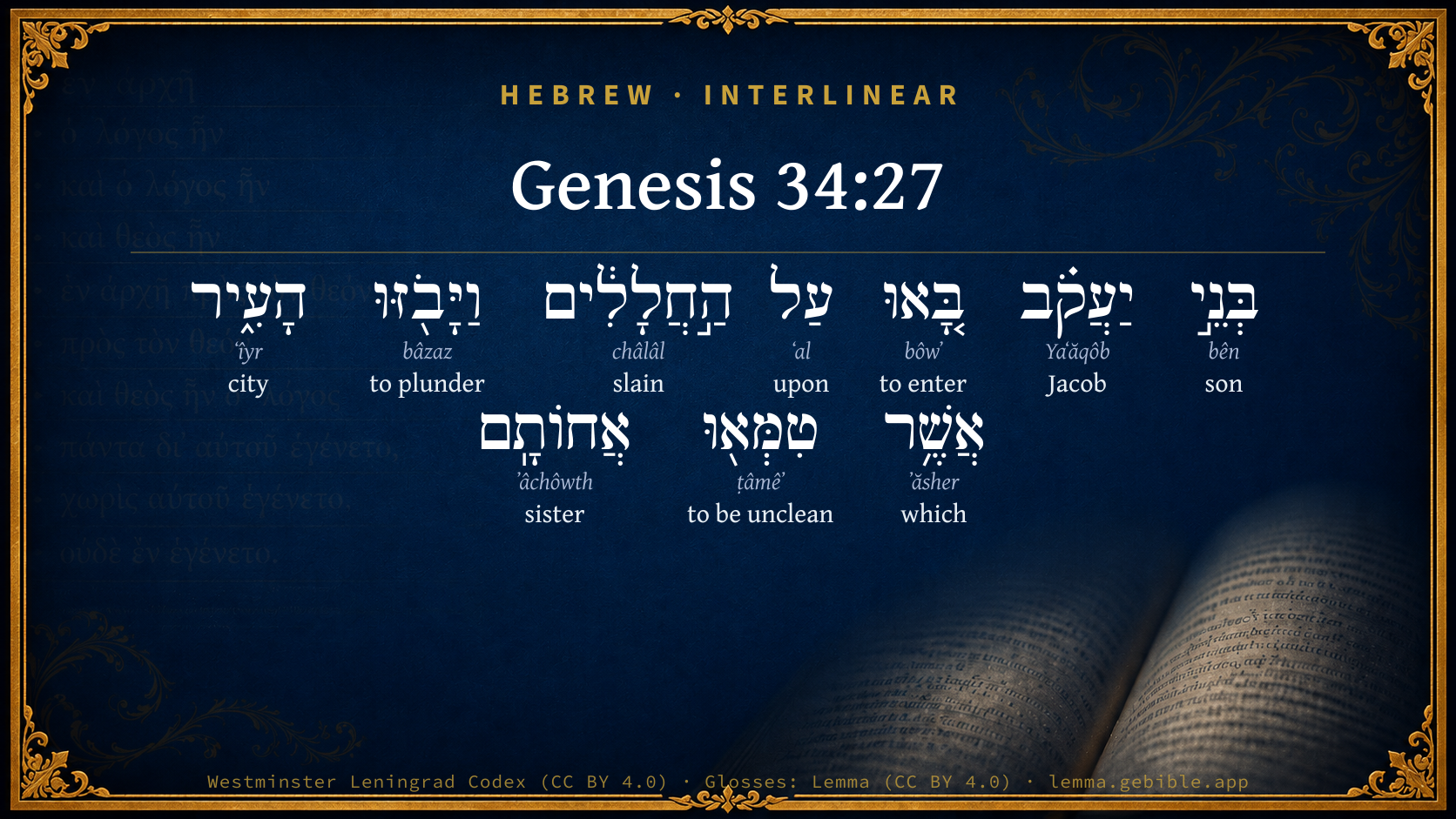
Hebrew (Westminster Leningrad Codex) Genesis 34:27 appears in the Hebrew Old Testament. The text above is from the Westminster Leningrad Codex. Each word links to its Strong’s number, a concise gloss, and parsing drawn from the Open Scriptures Hebrew Bible morphology. Click any word for its full Brown-Driver-Briggs (BDB) entry.
Download image
Cite this verse

Genesis 34:27 (World English Bible). Public Domain. Lemma interlinear Bible study tool, https://lemma.gebible.app/v/genesis/34/27.

Show BibTeX & RIS
BibTeX
RIS
English Translation
Jacob's sons came on the dead, and plundered the city, because they had defiled their sister.
World English Bible · Public Domain
Highlights
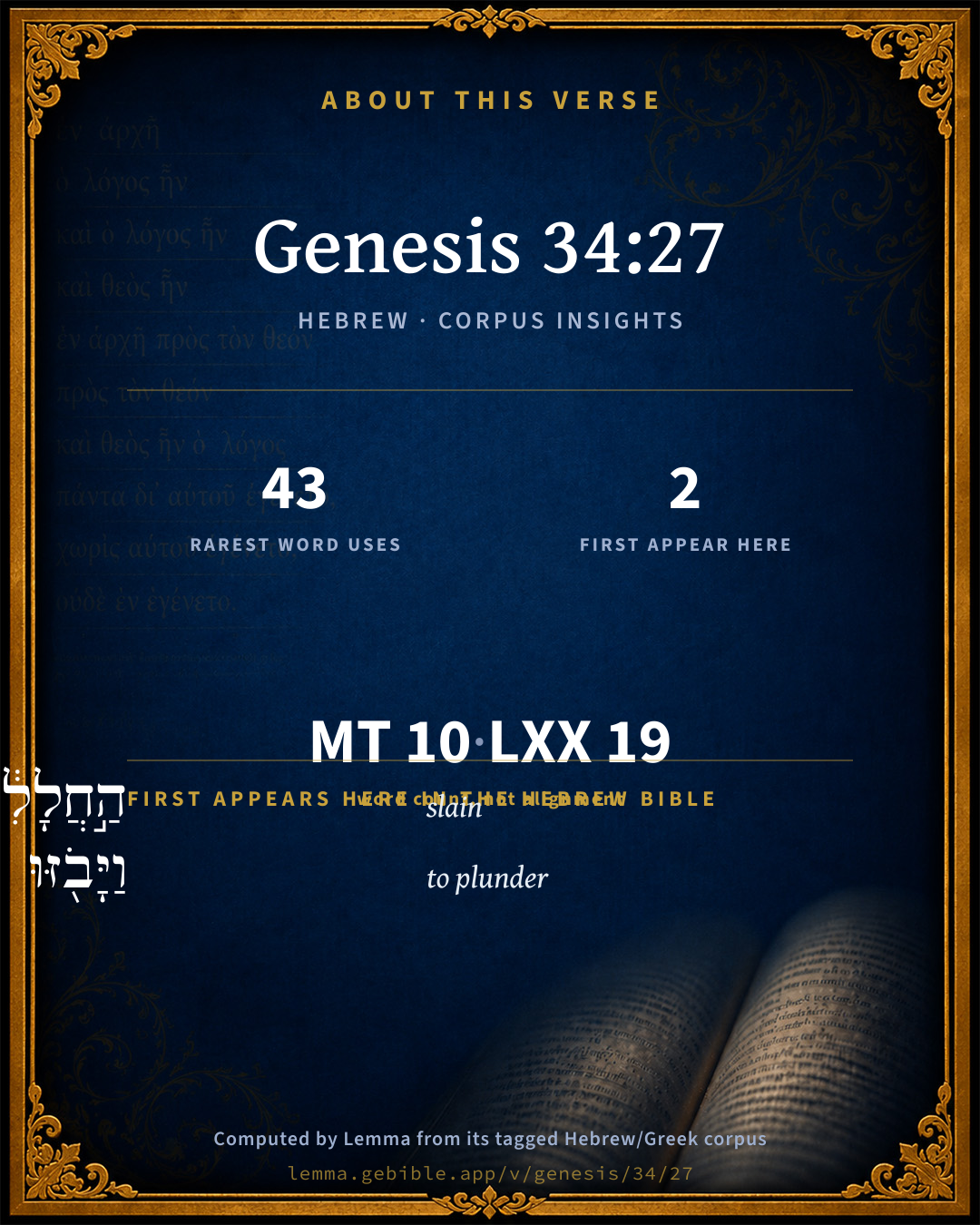
  • 2 first appearances in the Hebrew Bible
Full analysis ↓
Download a study sheet

One document with this verse’s original text, its word-by-word gloss line, the meaning frame, cross-references with their text, attributed commentary, and full source and license credits — printable, and it pastes into notes with its structure intact.

This verse Autodidact and up

Study sheet (.html) Plain text (.txt)

A passage Seminary Student

Up to 50 verses in one chapter. A passage sheet keeps up to 6 commentary sources and 12 cross-references per verse, in the order this page ranks them, and says so on the sheet whenever that leaves anything out. Ask for a single verse and you get the Autodidact verse sheet above.

Everything on this page stays free to read, with no account — the sheet is a download of what is already on screen, not access to it.

Want to remove ads? Support Godless Engineer
Compare translations 3

The same verse in 3 English versions, stacked beneath the original-language interlinear above. Click any original word for its lexicon entry.

Each is an independent rendering of the whole verse — the interlinear is not word-aligned to these translations.

Highlighted words mark where these versions differ — a whole-verse word diff, not a word-by-word alignment.

  • World English Bible Public Domain
    Jacob's sons came on the dead, and plundered the city, because they had defiled their sister.
  • King James Version Public Domain
    The sons of Jacob came upon the slain, and spoiled the city, because they had defiled their sister.
  • unfoldingWord Literal Text CC BY-SA 4.0
    The sons of Jacob came upon the slain and plundered the city, because they had defiled their sister.

unfoldingWord Literal Text — © unfoldingWord, licensed CC BY-SA 4.0. Word-aligned USFM3 via Door43 (git.door43.org/unfoldingWord/en_ult).

Versions to compare (up to 4)

3 of 4 selected

Show all 18 translations

Every available English version of this verse, each an independent rendering of the whole verse.

  • World English Bible Public Domain
    Jacob's sons came on the dead, and plundered the city, because they had defiled their sister.
  • Berean Standard Bible Public Domain
    Jacob’s other sons came upon the slaughter and looted the city, because their sister had been defiled.
  • Majority Standard Bible Public Domain
    Jacob’s other sons came upon the slaughter and looted the city, because their sister had been defiled.
  • King James Version Public Domain
    The sons of Jacob came upon the slain, and spoiled the city, because they had defiled their sister.
  • American Standard Version (1901) Public Domain
    The sons of Jacob came upon the slain, and plundered the city, because they had defiled their sister.
  • Revised Version (1885) Public Domain
    The sons of Jacob came upon the slain, and spoiled the city, because they had defiled their sister.
  • Geneva Bible (1599) Public Domain
    Againe the other sonnes of Iaakob came vpon the dead, and spoyled the citie, because they had defiled their sister.
  • Douay-Rheims (1899) Public Domain
    And when they were gone out, the other sons of Jacob came upon the slain; and plundered the city in revenge of the rape.
  • Young's Literal Translation Public Domain
    Jacob's sons have come in upon the wounded, and they spoil the city, because they had defiled their sister;
  • Literal Standard Version CC BY-SA 4.0
    Jacob’s sons have come in on the wounded, and they spoil the city, because they had defiled their sister;
  • Unlocked Literal Bible CC BY-SA 4.0
    The other sons of Jacob came to the dead bodies and looted the city, because the people had defiled their sister.
  • unfoldingWord Literal Text CC BY-SA 4.0
    The sons of Jacob came upon the slain and plundered the city, because they had defiled their sister.
  • Darby Bible Public Domain
    The sons of Jacob came upon the slain, and plundered the city, because they had defiled their sister.
  • World Messianic Bible Public Domain
    Jacob’s sons came on the dead, and plundered the city, because they had defiled their sister.
  • Webster's Bible Public Domain
    The sons of Jacob came upon the slain, and spoiled the city; because they had defiled their sister.
  • Free Bible Version CC BY-SA 4.0
    Jacob's other sons arrived, robbed the dead bodies, and looted the town where their sister had been violated.
  • Bible in Basic English Public Domain
    And the sons of Jacob came on them when they were wounded and made waste the town because of what had been done to their sister;
  • JPS Tanakh (1917) Public Domain
    The sons of Jacob came upon the slain, and spoiled the city, because they had defiled their sister.

Literal Standard Version (2020), Covenant Press — licensed CC BY-SA 4.0. Text via the HelloAO Bible API (eBible.org). Unlocked Literal Bible (unfoldingWord) — licensed CC BY-SA 4.0. Text via the HelloAO Bible API (eBible.org). unfoldingWord Literal Text — © unfoldingWord, licensed CC BY-SA 4.0. Word-aligned USFM3 via Door43 (git.door43.org/unfoldingWord/en_ult). Free Bible Version, Dr. Jonathan Gallagher — licensed CC BY-SA 4.0. Text via the HelloAO Bible API (eBible.org).

Word by word

More ways to search: Search by grammar → Find every occurrence → Compare this word →

Practice this passage: Drill this verse → Learn its vocabulary →

וַיָּבֹ֖זּוּ
bâzaz
H962
“and · to plunder”
Conjunction + Verb, Qal, Sequential Imperfect, 3rd Person, Masculine, Plural
Part of Speech
Conjunction + Verb
Stem
Qal
Form
Sequential Imperfect
Person
3rd Person
Gender
Masculine
Number
Plural
Full BDB Definition

Origin: a primitive root

TWOT: 225

to spoil, plunder, prey upon, seize - (Qal) to spoil, plunder, despoil - (Niphal) to be spoiled, plundered - (Pual) to be taken as spoil
  1. בְּנֵ֣י bên H1121 “sons of” Noun, Common, Masculine, Plural, Construct
  2. יַעֲקֹ֗ב Yaʻăqôb H3290 “Jacob” Noun, Proper
  3. בָּ֚אוּ bôwʼ H935 “to enter” Verb, Qal, Perfect, 3rd Person, Common, Plural
  4. עַל ʻal H5921 “upon” Preposition
  5. הַ֣חֲלָלִ֔ים châlâl H2491 “the · slain” Particle, Definite Article + Adjective, Adjective, Masculine, Plural, Absolute
  6. הָעִ֑יר ʻîyr H5892 “the · city” Particle, Definite Article + Noun, Common, Feminine, Singular, Absolute
  7. אֲשֶׁ֥ר ʼăsher H834 “which” Particle, Relative
  8. טִמְּא֖וּ ṭâmêʼ H2930 “to be unclean” Verb, Piel, Perfect, 3rd Person, Common, Plural
  9. אֲחוֹתָֽם ʼâchôwth H269 “sister · their” Noun, Common, Feminine, Singular, Construct + Suffix, Personal, 3rd Person, Masculine, Plural

About this verse

These counts appear in no published source. They are computed here, from the morphology-tagged text and Lemma’s own curated glosses. What Lemma adds →

10
words
10
distinct lemmas
Pentateuch
section

First appearance in Scripture

These words make their first canonical appearance in the Hebrew Bible here:

  • הַ֣חֲלָלִ֔ים slain H2491
  • וַיָּבֹ֖זּוּ to plunder H962

Shared distinctive vocabulary

וַיָּבֹ֖זּוּ to plunder H962 occurs in 39 verses of the Hebrew Bible. Also found in:

Grammatical profile

  • 3 verbs
  • 4 nouns
  • 1 adjective
  • 1 preposition
  • 1 particle

Verb forms

  • בָּ֚אוּ Qal · Perfect
  • וַיָּבֹ֖זּוּ Qal · Sequential Imperfect
  • טִמְּא֖וּ Piel · Perfect

Hebrew & Septuagint length

In English translation the verse runs 16 words from the Hebrew and 20 from the Septuagint (LXX English) — closely comparable.

A rough comparison of the two English renderings, which tokenize alike — not a word-level alignment.

Word counts can differ between the Hebrew and the Greek without any difference in meaning — e.g. the Hebrew direct-object marker אֵת has no separate Greek word, and Greek often adds the article ὁ.

In the original languages it is 10 Hebrew tokens and 19 Greek tokens — but the two are counted differently (Hebrew bundles its prefixes and suffixes into one token; the Greek is in lemma form), so that isn’t a like-for-like length.

Cross-references

9

Topical passages linked to Genesis 34:27 in the Treasury of Scripture Knowledge — connected by theme and wording, ordered by reader-vote popularity; previews shown in the World English Bible.

  • Genesis 34:2 Shechem the son of Hamor the Hivite, the prince of the land, saw her. He took her, lay with her, and humbled her.
  • Genesis 34:31 They said, "Should he deal with our sister as with a prostitute?"
  • Exodus 2:14 He said, "Who made you a prince and a judge over us? Do you plan to kill me, as you killed the Egyptian?" Moses was afraid, and said, "Surely this thing is known."
  • Joshua 7:1 But the children of Israel committed a trespass in the devoted thing; for Achan, the son of Carmi, the son of Zabdi, the son of Zerah, of the tribe of Judah, took of the devoted thing: and the anger of Yahweh was kindled against the children of Israel.
  • Joshua 7:13 Up, sanctify the people, and say, Sanctify yourselves against tomorrow: for thus says Yahweh, the God of Israel, There is a devoted thing in the midst of you, Israel; you can not stand before your enemies, until you take away the devoted thing from among you.
  • Joshua 7:21 when I saw among the spoil a goodly Babylonian mantle, and two hundred shekels of silver, and a wedge of gold of fifty shekels weight, then I coveted them, and took them; and, behold, they are hid in the earth in the midst of my tent, and the silver under it.
  • Esther 9:10 the ten sons of Haman the son of Hammedatha, the Jew's enemy, killed they; but they didn't lay their hand on the spoil.
  • Esther 9:16 The other Jews who were in the king's provinces gathered themselves together, and stood for their lives, and had rest from their enemies, and killed of those who hated them seventy-five thousand; but they didn't lay their hand on the spoil.
  • 1 Timothy 6:10 For the love of money is a root of all kinds of evil. Some have been led astray from the faith in their greed, and have pierced themselves through with many sorrows.

Cross-references courtesy of OpenBible.info (CC BY 4.0).

Hebrew and Greek witnesses Masoretic Hebrew ↔ Greek Septuagint

The same verse in the two great witnesses to the Old Testament, shown verse-for-verse.

These are two independent witnesses, not word-aligned to each other, and the Septuagint is shown in lemma (dictionary) form.

Hebrew Genesis 34:27 Masoretic · Westminster Leningrad Codex

בְּנֵ֣י יַעֲקֹ֗ב בָּ֚אוּ עַל הַ֣חֲלָלִ֔ים וַיָּבֹ֖זּוּ הָעִ֑יר אֲשֶׁ֥ר טִמְּא֖וּ אֲחוֹתָֽם

Jacob's sons came on the dead, and plundered the city, because they had defiled their sister.

World English Bible · Public Domain

Greek LXX Genesis 34:27 Septuagint · lemma form

ὁ δέ υἱός ἰακώβ εἰςἔρχομαι ἐπί ὁ τραυματίας καί διαἁρπάζω ὁ πόλις ἐν ὅς μιαίνω δινα ὁ ἀδελφή αὐτός

But the sons of Jacob came upon the wounded, and ravaged the city wherein they had defiled Dina their sister.

LXX2012 (modern English Septuagint) · Public Domain

Hebrew: Westminster Leningrad Codex (CC BY 4.0). Greek: Septuagint (public domain); English from LXX2012 (modern English Septuagint) (Public Domain). How the Septuagint differs from the Hebrew →

Targum (Aramaic paraphrase)

2

The Targum is the ancient Jewish Aramaic paraphrase of the Hebrew Scriptures — an interpretive translation, not the Hebrew text itself. Onkelos (literal) and Pseudo-Jonathan (expansive) render the Torah, and Jonathan the Prophets. Coverage is partial: where no permissively-licensed English translation exists for a verse, only the Aramaic is shown. This is verse-level text, not a word-by-word alignment to the Hebrew.

  1. Targum Onkelos Torah (Genesis–Deuteronomy)
    בְּנֵי יַעֲקֹב עַלּוּ לְחַלָּצָא קָטִילַיָּא וּבְזוֹ קַרְתָּא דִּי סָאִיבוּ אֲחָתְהוֹן

    (no public-domain English translation for this verse)

    Targum Onkelos — Aramaic: “Onkelos Genesis” (public domain); “Onkelos Exodus” (public domain); “Onkelos Leviticus” (public domain); “Onkelos Numbers” (public domain); “Onkelos Deuteronomy” (public domain). English: “Sefaria Community Translation” (CC0 1.0 (public-domain dedication)); “J.W. Etheridge. The Targums of Onkelos and Jonathan Ben Uzziel on the Pentateuch. London: Longmans, Green, 1862” (public domain). Text via Sefaria.

  2. Targum Pseudo-Jonathan Torah (Genesis–Deuteronomy)
    מוֹתַר בְּנוֹי דְיַעֲקב עָלוּ לְחַלָצָא קְטוֹלַיָא וּבָזוּ יַת קַרְתָּא דִסְאִיבוּ בְּגַוָוהּ אֲחַתְהוֹן

    And the rest of the sons of Jakob came to the spoil of the slain, and they sacked the city because they had polluted their sister in the midst of it.

    Targum Pseudo-Jonathan — Aramaic: “Targum Jonathan on Genesis” (public domain); “Targum Jonathan on Exodus” (public domain); “Targum Jonathan on Leviticus” (public domain); “Targum Jonathan on Numbers” (public domain); “Targum Jonathan on Deuteronomy” (public domain). English: “The Targum of Jonathan ben Uzziel, trans. J. W. Etheridge, London, 1862” (public domain). Text via Sefaria.

Commentary

Notes on Genesis 34:27 from classic Christian and Jewish commentators (each source and its license shown beneath its notes). The classic Christian expositions comment on the surrounding passage and are grouped to its opening verse, so a note may address several verses; the Jewish commentaries on the Tanakh (Rashi and others) are per-verse, so they appear only where the commentator wrote on this verse.

Lemma curates 59 commentaries, every one of them public domain or Creative Commons licensed, each selected and text-cleaned for this edition rather than reprinted as found. About our sources →

Trapp's Complete Commentary

John Trapp

Gen 34:27 The sons of Jacob came upon the slain, and spoiled the city, because they had defiled their sister.

Ver. 27. Because they had defiled their sister.] So it was just in God, though unjust in the instruments; who were therefore cursed by Jacob; {Gen 49:7} but yet not rejected by God. His election is of free grace, and not of foreseen faith or works.

John Trapp, A Commentary or Exposition upon All the Books of the Old and New Testament (1647–1656) — public domain. Text from a community e-Sword module.

Adam Clarke's Commentary

Verse 27. The sons of Jacob] The rest of Jacob's sons, the remaining brothers of Simeon and Levi, spoiled the city. Though the others could slay the defenceless males, it was not likely that they could have carried away all the booty, with the women, children, and cattle; it is therefore most natural to suppose that the rest of the sons of Jacob assisted at last in the business.

Adam Clarke's Commentary on the Bible (1810–1826) — public domain. Text from a community e-Sword/MySword module.

John Calvin's Commentaries

27. The sons of Jacob came. Moses shows that, not content with simple revenge, they fly together to the spoil. As it respects the words, they are said to have come upon the slain, either because they made themselves a way over the slaughtered bodies; or because, in addition to the slaughter, they rushed to the plunder. In whichever way it is taken, Moses teaches that, not satisfied with their former wickedness, they made this addition to it. Be it, that they were blinded with anger in shedding blood; yet by what right do they sack the city? This certainly cannot be ascribed to anger. But these are the ordinary fruits of human intemperance, that he who gives himself the rein in perpetrating one wickedness, soon breaks out into another. Thus the sons of Jacob, from being murderers, become also robbers, and the guilt of avarice is added to that of cruelty. The more anxious then should be our endeavors to bridle our desires; lest they should mutually fan each other, so that at length, by their combined action, a dreadful conflagration should arise; but especially, we must beware of using force of arms, which brings with it many perverse and brutal assaults. Moses says that the sons of Jacob did this, because the Shechemites had defiled their sister; but the whole city was not guilty. Moses, however, only states in what way the authors of the slaughter are affected: for although they wish to appear just avengers of the injury, yet they pay no respect to what it was lawful for them to do, and make no attempt to control their depraved affections, and consequently set no bounds to their wickedness. Should any one prefer taking the expression in a higher sense, it may be referred to the judgment of God, by which the whole city was involved in guilt, because no one had opposed the lust of the prince: perhaps many had consented to it, as not being very much concerned about the unjust dishonor done to their guests; but the former sense is what I most approve.

John Calvin's Commentaries (1540-1563) — public domain. Text from the Calvin Translation Society English edition (1840s-50s) via the Christian Classics Ethereal Library (ccel.org). Calvin's coverage is partial (roughly two-thirds of the Bible); uncommented books and verses are honest gaps, never fabricated. The 19th-century editor's footnotes and remarks are omitted so the notes are faithfully Calvin's own voice.

Ellicott's Commentary for English Readers

(27) The sons of Jacob.—After slaying Hamor and Shechem, the two brothers “took Dinah and went out.” It was after this that Jacob’s sons generally—though not without exceptions, for several of them were still very young—joined in seizing the spoil.

A Bible Commentary for English Readers, edited by Charles John Ellicott (1878–1897) — public domain. Text from a community e-Sword module.

The Cambridge Bible for Schools and Colleges

gen. ed. J. J. S. Perowne

27. The sons of Jacob] This verse and Gen_34:28-29 record the version in which all the sons of Jacob united to massacre the males of Shechem, carried away captive the wives and children, and took possession of the wealth and property of the inhabitants: cf. Num_31:9; Num_31:11.

The Cambridge Bible for Schools and Colleges (gen. ed. J. J. S. Perowne; Cambridge University Press, 1878–1918) — public domain. Text from a community e-Sword module.

John Gill's Exposition

They took their sheep, their oxen, and their asses,.... The Shechemites hoped to have the cattle and substance of Jacob's family, and in a hypocritical manner submitted to circumcision, for the sake of worldly advantage; for that, and pleasing their prince, seem to be the only views they had in it; wherefore, in this there is a just retaliation of them in Providence:

and that which was in the city, and that which was in the field; the cattle that were kept at home, and those that were brought up in the field, all became a prey.

John Gill's Exposition of the Whole Bible (1746–1763) — public domain (CC PDM 1.0). Text via the HelloAO Bible API.

Matthew Poole's English Annotations

They, i.e. one of them, as ofttimes that which is done by one man is imputed to the whole body. See Jos 7:1,11,12; 22:20; Mat 2:20. Or they impute Shechem’s fact to all, either invidiously and cunningly to take off from themselves the reproach of this cruel action; or because they made themselves guilty of it, either by not discouraging and hindering that filthiness as far as they might, or by their being instrumental in it, or by their approbation of it and complacency in it.

Matthew Poole's English Annotations on the Holy Bible (1683–1685) — public domain. Text from a community e-Sword/MySword module.

The Pulpit Commentary

Vers. 27-29. The sons of Jacob not all except Simeon and Levi (Delitzsch), nor Simeon and Levi alone (Kalisch, Inglis), but Simeon and Levi along with the others (Rosenm Keil, Lange)came upon the slain, the absence of the w conjunctive at the commencement of this verse, which partitionists account for by the hypothesis that vers. 27-29 are an interpolation, is explained by Keil as designed to express the subjective excitement and indignation of the historian at the revolting character of the crime he was narratingand spoiled the city, because they (i.e. the inhabitants being regarded, on the well-known principle of the solidarity of nations, as involved in the crime of their ruler) had defiled their sister, and so exposed themselves to reprisals, in which they (i.e. the sons of Jacob) took their sheep, and their oxen, and their asses, and that which was in the city, and that which was in the field, and all their wealth, and all their little ones, taph, a collective noun for boys and girls, who are so called from their brisk and tripping motion (Gesenius) and their wives took they captive, and spoiled even all that was in the house. The words describe a complete sacking of the city, in which every house was swept of its inmates and its valuables.

The Pulpit Commentary (1880–1919), ed. H.D.M. Spence-Jones & Joseph S. Exell — public domain. Text from a community e-Sword module.

John Wesley's Explanatory Notes

Tho' Simeon and Levi only were the murderers, yet others of the sons of Jacob came upon the slain, and spoiled the city - And so became accessary to the murder.

John Wesley, Explanatory Notes Upon the Whole Bible (1754–1765) — public domain. Text via the GEBible commentary corpus.

unfoldingWord translationNotes

Door43 World Missions Community

the dead bodies

"the dead bodies of Hamor, Shechem, and their men"

looted the city

"stole everything in the city that was valuable"

because the people had defiled their sister

Shechem alone had defiled Dinah, but Jacob's sons considered Shechem's entire family and everyone in the city responsible for this act.

had defiled

This means that Shechem had greatly dishonored and disgraced Dinah by forcing her to sleep with him. See how you translated "defiled" in Genesis 34:5.

They took their flocks

"Jacob's sons took the people's flocks"

all their wealth

"all their possessions and money"

All their children and their wives, they captured

"They captured all their children and wives"

translationWords

Jacob

die

people group

defile

flocks

donkey

house

unfoldingWord translationNotes — © Distant Shores Media and the Door43 World Missions Community, licensed CC BY-SA 4.0. Source: git.door43.org/Door43/en_tn.

Rashi

Rabbi Shlomo Yitzchaki (Rashi)

על החללים UPON THE SLAIN — to strip the slain.

Rashi on the Tanakh — English translations: “The Judaica Press complete Tanach with Rashi, translated by A. J. Rosenberg” (CC BY 4.0); “Pentateuch with Rashi's commentary by M. Rosenbaum and A.M. Silbermann, 1929-1934” (public domain); “The Metsudah Tanach series, Lakewood, N.J” (CC BY 4.0); and “The Book of Joshua, Metsudah Publications, 1997” (CC BY 4.0). Text via Sefaria.

Radak

Rabbi David Kimhi (Radak)

בני יעקב באו על החללים, to undress them and to take all their possessions

אשר טמאו אחותם, to demonstrate by means of this that the men of this city had defiled their sister. This became public knowledge in the region after the sons of Yaakov killed the people who had tolerated this crime, the townspeople had watched the violent rape and had not lifted a finger to stop it. The sons of Yaakov also took all the movable possessions of the city of Shechem both in the city and the fields belonging to that town.

Radak on the Tanakh — English translations: “Sefaria Community Translation” (CC0 1.0 (public-domain dedication)); “Eliyahu Munk, HaChut Hameshulash” (CC BY 4.0); “Rabbi Mike Feuer, Jerusalem Anthology” (CC BY 4.0); and “R. David Kimhi on the first book of Psalms, Translated by R.G. Finch, London, 1919” (public domain). Text via Sefaria.

Lesson kit

Teaching starters — assembled from the data on this page, not authored interpretation. Every prompt links to the verse data it draws on. Edit before teaching.

Genesis, in the Pentateuch, opens this verse with 10 words (10 distinct Hebrew lemmas). Its most distinctive word is bâzaz (“to plunder”). A historical commentator’s framing appears above. Read the whole chapter for the surrounding context.

Discussion questions

  1. How does “to plunder” (bâzaz) shape what this verse is saying?
  2. 2 words here appear for the first time in Scripture. What is being introduced at this debut?
  3. Genesis 34:29 shares the word «to plunder» with this verse. How do the two illuminate each other?
  4. These translations render this verse differently. What is at stake in choosing one wording over another?
  5. The verb «בָּ֚אוּ» is Qal Perfect. How does its form color the action?
  6. Reading how Trapp's Complete Commentary and Adam Clarke's Commentary read this verse, where do the two commentators agree and where do they part?

Things to notice

Reading settings

Reading text

Shown beneath each verse's original-language words.

Old Testament
Old Testament edition

Read the OT as the Masoretic Hebrew (MT) or the Greek Septuagint (LXX).

English shown for the Greek Septuagint (in the Hebrew ↔ Greek comparison).

Comparing translations? Open the Compare panel on any verse page to stack up to four side by side.