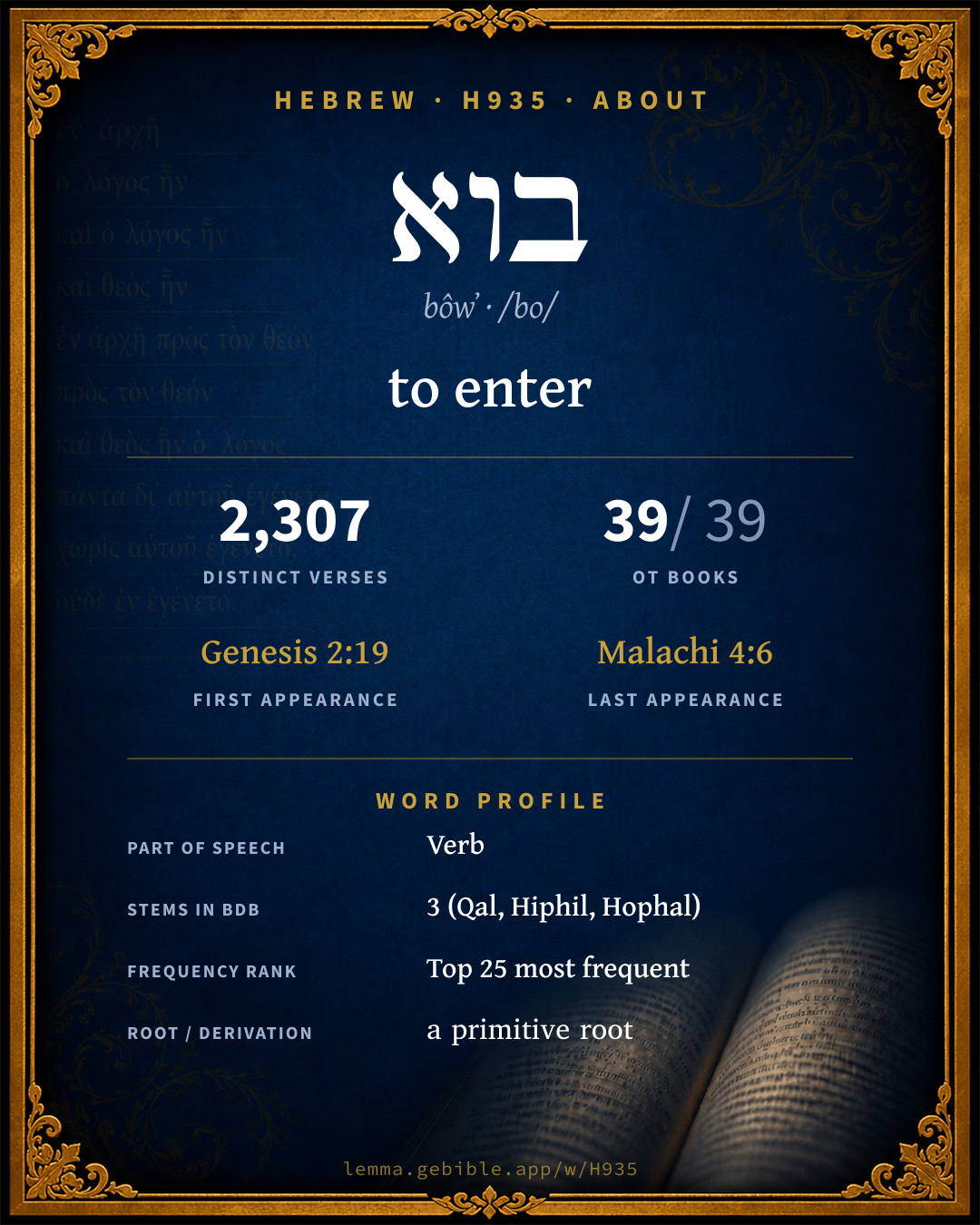
בּוֹא
to enter
‘to enter’ is one of 14 main senses fuller range ↓
Full lexicon entry — Brown-Driver-Briggs (BDB)
From Brown-Driver-Briggs (BDB)
Where this word appears
See every Hiphil verb in the Hebrew Bible →
Grammar key — what these labels mean
Part of speech
- Verb
- An action or state-of-being word.
- Noun
- A naming word — a person, place, thing, or idea.
Noun type
- Proper
- A name of a specific person, place, or people (e.g. Abraham, Zion, Israel).
- Common
- A common noun — a general class of person, place, or thing (“king,” “city,” “water”), not a specific name.
Stem
- Qal
- The basic, simple active stem — the plain form of the verb (“he wrote”). Here: ‘come in’
- Hiphil
- The causative active stem (“he caused / brought about”). Here: ‘cause to come in’
- Hophal
- The passive counterpart of the Hiphil (“he was caused to…”). Here: ‘be brought in’
Form
- Sequential Imperfect
- An imperfect with prefixed waw — the standard past-narrative form (waw-consecutive imperfect).
- Perfect
- A completed action or state — Hebrew marks aspect (completeness) more than strict tense (“he wrote”).
- Imperfect
- An incomplete, ongoing, or future action (“he will / would write”).
- Infinitive Construct
- A bound verbal noun, frequently with prepositions (“to write / in writing”).
- Participle Active
- A verbal adjective expressing ongoing or characteristic action (“writing / one who writes”).
- Sequential Perfect
- A perfect with prefixed waw continuing a preceding imperfect or command (waw-consecutive perfect).
- Imperative
- A direct command (“write!”).
- Jussive
- A third- or second-person volitional form expressing wish or command (“let him write”).
- Infinitive Absolute
- An unbound verbal noun, often intensifying or standing in for a finite verb.
- Participle Passive
- A verbal adjective expressing action received (“written”).
- Cohortative
- A first-person volitional form expressing wish or resolve (“let me / let us write”).
State
- Absolute
- The independent form of a noun, not bound to a following word.
- Construct
- A noun bound to a following noun in a possessive / “of” relationship (the construct chain).
Person
- 3rd Person
- The one spoken about (“he / she / it / they”).
- 2nd Person
- The one addressed (“you”).
- 1st Person
- The speaker (“I / we”).
Gender
- Masculine
- Grammatically masculine.
- Common
- Either gender — not distinguished for this form.
- Feminine
- Grammatically feminine.
Number
- Singular
- One.
- Plural
- More than one (in Hebrew, generally three or more).
Every verse where H935 appears in the Book of Leviticus — 74 distinct verses. Click any verse to open its interlinear word-by-word view. Verse text shown in the World English Bible for context — . Each verse’s Hebrew form is shown with its reference; the English is not keyword-highlighted, since the data carries no word-level English alignment. Use “Compare translations” on any verse to read it across multiple English versions. This concordance covers the Hebrew Bible; Septuagint (Greek Old Testament) occurrences are not indexed here.
Leviticus
- Leviticus 2:2 וֶֽ/הֱבִיאָ֗/הּ conj + Hiphil wpf 3ms + sfx pers 3fs He shall bring it to Aaron's sons the priests; and he shall take his handful of its fine flour, and of its oil, with all its frankincense; and the priest shall burn the memorial of it on the altar, an offering made by fire, of a sweet savor to Yahweh.
- Leviticus 2:8 וְ/הֵבֵאתָ֣ conj + Hiphil wpf 2ms You shall bring the meal offering that is made of these things to Yahweh: and it shall be presented to the priest, and he shall bring it to the altar.
- Leviticus 4:4 וְ/הֵבִ֣יא conj + Hiphil wpf 3ms He shall bring the bull to the door of the Tent of Meeting before Yahweh; and he shall lay his hand on the head of the bull, and kill the bull before Yahweh.
- Leviticus 4:5 וְ/הֵבִ֥יא conj + Hiphil wpf 3ms The anointed priest shall take some of the blood of the bull, and bring it to the Tent of Meeting.
- Leviticus 4:14 וְ/הֵבִ֣יאוּ conj + Hiphil wpf 3cp when the sin in which they have sinned is known, then the assembly shall offer a young bull for a sin offering, and bring it before the Tent of Meeting.
- Leviticus 4:16 וְ/הֵבִ֛יא conj + Hiphil wpf 3ms The anointed priest shall bring of the blood of the bull to the Tent of Meeting:
- Leviticus 4:23 וְ/הֵבִ֧יא conj + Hiphil wpf 3ms if his sin, in which he has sinned, is made known to him, he shall bring as his offering a goat, a male without blemish.
- Leviticus 4:28 וְ/הֵבִ֨יא conj + Hiphil wpf 3ms if his sin, which he has sinned, is made known to him, then he shall bring for his offering a goat, a female without blemish, for his sin which he has sinned.
- Leviticus 4:32 יָבִ֥יא יְבִיאֶֽ/נָּה Hiphil impf 3ms Hiphil impf 3ms + sfx pers 3fs "'If he brings a lamb as his offering for a sin offering, he shall bring a female without blemish.
- Leviticus 5:6 וְ/הֵבִ֣יא conj + Hiphil wpf 3ms and he shall bring his trespass offering to Yahweh for his sin which he has sinned, a female from the flock, a lamb or a goat, for a sin offering; and the priest shall make atonement for him concerning his sin.
- Leviticus 5:7 וְ/הֵבִ֨יא conj + Hiphil wpf 3ms "'If he can't afford a lamb, then he shall bring his trespass offering for that in which he has sinned, two turtledoves, or two young pigeons, to Yahweh; one for a sin offering, and the other for a burnt offering.
- Leviticus 5:8 וְ/הֵבִ֤יא conj + Hiphil wpf 3ms He shall bring them to the priest, who shall first offer the one which is for the sin offering, and wring off its head from its neck, but shall not sever it completely.
- Leviticus 5:11 וְ/הֵבִ֨יא conj + Hiphil wpf 3ms "'But if he can't afford two turtledoves, or two young pigeons, then he shall bring his offering for that in which he has sinned, the tenth part of an ephah of fine flour for a sin offering. He shall put no oil on it, neither shall he put any frankincense on it, for it is a sin offering.
- Leviticus 5:12 וֶ/הֱבִיאָ/הּ֮ conj + Hiphil wpf 3ms + sfx pers 3fs He shall bring it to the priest, and the priest shall take his handful of it as the memorial portion, and burn it on the altar, on the offerings of Yahweh made by fire. It is a sin offering.
- Leviticus 5:15 וְ/הֵבִיא֩ conj + Hiphil wpf 3ms "If anyone commits a trespass, and sins unwittingly, in the holy things of Yahweh; then he shall bring his trespass offering to Yahweh, a ram without blemish from the flock, according to your estimation in silver by shekels, after the shekel of the sanctuary, for a trespass offering.
- Leviticus 5:18 וְ֠/הֵבִיא conj + Hiphil wpf 3ms He shall bring a ram without blemish from of the flock, according to your estimation, for a trespass offering, to the priest; and the priest shall make atonement for him concerning the thing in which he sinned and didn't know it, and he will be forgiven.
- Leviticus 6:6 יָבִ֖יא Hiphil impf 3ms He shall bring his trespass offering to Yahweh, a ram without blemish from the flock, according to your estimation, for a trespass offering, to the priest.
- Leviticus 6:21 תְּבִיאֶ֑/נָּה Hiphil impf 2ms + sfx pers 3fs It shall be made with oil in a baking pan. When it is soaked, you shall bring it in. You shall offer the meal offering in baked pieces for a sweet savor to Yahweh.
- Leviticus 6:30 יוּבָ֨א Hophal impf 3ms No sin offering, of which any of the blood is brought into the Tent of Meeting to make atonement in the Holy Place, shall be eaten: it shall be burned with fire.
- Leviticus 7:29 יָבִ֧יא Hiphil impf 3ms "Speak to the children of Israel, saying, 'He who offers the sacrifice of his peace offerings to Yahweh shall bring his offering to Yahweh out of the sacrifice of his peace offerings.
- Leviticus 7:30 תְּבִיאֶ֔ינָה יְבִיאֶ֔/נּוּ Hiphil impf 3fp Hiphil impf 3ms + sfx pers 3ms With his own hands he shall bring the offerings of Yahweh made by fire. He shall bring the fat with the breast, that the breast may be waved for a wave offering before Yahweh.
- Leviticus 9:23 וַ/יָּבֹ֨א conj + Qal wimpf 3ms Moses and Aaron went into the Tent of Meeting, and came out, and blessed the people: and the glory of Yahweh appeared to all the people.
- Leviticus 10:9 בְּ/בֹאֲ/כֶ֛ם prep + Qal inf.cs + sfx pers 2mp "Drink no wine nor strong drink, you, nor your sons with you, when you go into the Tent of Meeting, that you don't die: it shall be a statute forever throughout your generations:
- Leviticus 10:15 יָבִ֔יאוּ Hiphil impf 3mp The heaved thigh and the waved breast they shall bring with the offerings made by fire of the fat, to wave it for a wave offering before Yahweh: and it shall be yours, and your sons' with you, as a portion forever; as Yahweh has commanded."
- Leviticus 10:18 הוּבָ֣א Hophal pf 3ms Behold, its blood was not brought into the inner part of the sanctuary: you certainly should have eaten it in the sanctuary, as I commanded."
- Leviticus 11:32 יוּבָ֛א Hophal impf 3ms On whatever any of them falls when they are dead, it shall be unclean; whether it is any vessel of wood, or clothing, or skin, or sack, whatever vessel it is, with which any work is done, it must be put into water, and it shall be unclean until the evening; then it will be clean.
- Leviticus 11:34 יָב֥וֹא Qal impf 3ms All food which may be eaten, that on which water comes, shall be unclean; and all drink that may be drunk in every such vessel shall be unclean.
- Leviticus 12:4 תָבֹ֔א Qal impf 3fs She shall continue in the blood of purification thirty-three days. She shall not touch any holy thing, nor come into the sanctuary, until the days of her purifying are completed.
- Leviticus 12:6 תָּבִ֞יא Hiphil impf 3fs "'When the days of her purification are completed, for a son, or for a daughter, she shall bring to the priest at the door of the Tent of Meeting, a year old lamb for a burnt offering, and a young pigeon, or a turtledove, for a sin offering:
- Leviticus 13:2 וְ/הוּבָא֙ conj + Hophal wpf 3ms "When a man shall have a rising in his body's skin, or a scab, or a bright spot, and it becomes in the skin of his body the plague of leprosy, then he shall be brought to Aaron the priest, or to one of his sons the priests:
- Leviticus 13:9 וְ/הוּבָ֖א conj + Hophal wpf 3ms "When the plague of leprosy is in a man, then he shall be brought to the priest;
- Leviticus 13:16 וּ/בָ֖א conj + Qal wpf 3ms Or if the raw flesh turns again, and is changed to white, then he shall come to the priest;
- Leviticus 14:2 וְ/הוּבָ֖א conj + Hophal wpf 3ms "This shall be the law of the leper in the day of his cleansing. He shall be brought to the priest,
- Leviticus 14:8 יָב֣וֹא Qal impf 3ms "He who is to be cleansed shall wash his clothes, and shave off all his hair, and bathe himself in water; and he shall be clean. After that he shall come into the camp, but shall dwell outside his tent seven days.
- Leviticus 14:23 וְ/הֵבִ֨יא conj + Hiphil wpf 3ms "On the eighth day he shall bring them for his cleansing to the priest, to the door of the Tent of Meeting, before Yahweh.
- Leviticus 14:34 תָבֹ֨אוּ֙ Qal impf 2mp "When you have come into the land of Canaan, which I give to you for a possession, and I put a spreading mildew in a house in the land of your possession,
- Leviticus 14:35 וּ/בָא֙ conj + Qal wpf 3ms then he who owns the house shall come and tell the priest, saying, 'There seems to me to be some sort of plague in the house.'
- Leviticus 14:36 יָבֹ֤א יָבֹ֥א Qal impf 3ms Qal impf 3ms The priest shall command that they empty the house, before the priest goes in to examine the plague, that all that is in the house not be made unclean: and afterward the priest shall go in to inspect the house.
- Leviticus 14:42 וְ/הֵבִ֖יאוּ conj + Hiphil wpf 3cp They shall take other stones, and put them in the place of those stones; and he shall take other mortar, and shall plaster the house.
- Leviticus 14:44 וּ/בָא֙ conj + Qal wpf 3ms then the priest shall come in and look; and, behold, if the plague has spread in the house, it is a destructive mildew in the house. It is unclean.
- Leviticus 14:46 וְ/הַ/בָּא֙ conj + ptcl def.art + Qal ptcp.act ms "Moreover he who goes into the house while it is shut up shall be unclean until the evening.
- Leviticus 14:48 בֹּ֨א יָבֹ֜א Qal inf.abs Qal impf 3ms "If the priest shall come in, and examine it, and, behold, the plague hasn't spread in the house, after the house was plastered, then the priest shall pronounce the house clean, because the plague is healed.
- Leviticus 15:14 וּ/בָ֣א conj + Qal wpf 3ms "'On the eighth day he shall take two turtledoves, or two young pigeons, and come before Yahweh to the door of the Tent of Meeting, and give them to the priest:
- Leviticus 15:29 וְ/הֵבִיאָ֤ה conj + Hiphil wpf 3fs On the eighth day she shall take two turtledoves, or two young pigeons, and bring them to the priest, to the door of the Tent of Meeting.
- Leviticus 16:2 יָבֹ֤א Qal juss 3ms and Yahweh said to Moses, "Tell Aaron your brother, not to come at all times into the Most Holy Place within the veil, before the mercy seat which is on the ark; lest he die: for I will appear in the cloud on the mercy seat.
- Leviticus 16:3 יָבֹ֥א Qal impf 3ms "Herewith shall Aaron come into the sanctuary: with a young bull for a sin offering, and a ram for a burnt offering.
- Leviticus 16:12 וְ/הֵבִ֖יא conj + Hiphil wpf 3ms He shall take a censer full of coals of fire from off the altar before Yahweh, and two handfuls of sweet incense beaten small, and bring it within the veil:
- Leviticus 16:15 וְ/הֵבִיא֙ conj + Hiphil wpf 3ms "Then he shall kill the goat of the sin offering, that is for the people, and bring his blood within the veil, and do with his blood as he did with the blood of the bull, and sprinkle it on the mercy seat, and before the mercy seat:
- Leviticus 16:17 בְּ/בֹא֛/וֹ prep + Qal inf.cs + sfx pers 3ms There shall be no one in the Tent of Meeting when he enters to make atonement in the Holy Place, until he comes out, and has made atonement for himself and for his household, and for all the assembly of Israel.
- Leviticus 16:23 וּ/בָ֤א בְּ/בֹא֣/וֹ conj + Qal wpf 3ms prep + Qal inf.cs + sfx pers 3ms "Aaron shall come into the Tent of Meeting, and shall take off the linen garments, which he put on when he went into the Holy Place, and shall leave them there.
- Leviticus 16:26 יָב֥וֹא Qal impf 3ms "He who lets the goat go for the scapegoat shall wash his clothes, and bathe his flesh in water, and afterward he shall come into the camp.
- Leviticus 16:27 הוּבָ֤א Hophal pf 3ms The bull for the sin offering, and the goat for the sin offering, whose blood was brought in to make atonement in the Holy Place, shall be carried forth outside the camp; and they shall burn their skins, their flesh, and their dung with fire.
- Leviticus 16:28 יָב֥וֹא Qal impf 3ms He who burns them shall wash his clothes, and bathe his flesh in water, and afterward he shall come into the camp.
- Leviticus 17:4 הֱבִיא/וֹ֒ Hiphil pf 3ms + sfx pers 3ms and hasn't brought it to the door of the Tent of Meeting, to offer it as an offering to Yahweh before the tabernacle of Yahweh: blood shall be imputed to that man. He has shed blood; and that man shall be cut off from among his people.
- Leviticus 17:5 יָבִ֜יאוּ וֶֽ/הֱבִיאֻ֣/ם Hiphil impf 3mp conj + Hiphil wpf 3cp + sfx pers 3mp This is to the end that the children of Israel may bring their sacrifices, which they sacrifice in the open field, that they may bring them to Yahweh, to the door of the Tent of Meeting, to the priest, and sacrifice them for sacrifices of peace offerings to Yahweh.
- Leviticus 17:9 יְבִיאֶ֔/נּוּ Hiphil impf 3ms + sfx pers 3ms and doesn't bring it to the door of the Tent of Meeting, to sacrifice it to Yahweh; that man shall be cut off from his people.
- Leviticus 18:3 מֵבִ֨יא Hiphil ptcp.act ms You shall not do as they do in the land of Egypt, where you lived: and you shall not do as they do in the land of Canaan, where I am bringing you; neither shall you walk in their statutes.
- Leviticus 19:21 וְ/הֵבִ֤יא conj + Hiphil wpf 3ms He shall bring his trespass offering to Yahweh, to the door of the Tent of Meeting, even a ram for a trespass offering.
- Leviticus 19:23 תָבֹ֣אוּ Qal impf 2mp "'When you come into the land, and have planted all kinds of trees for food, then you shall count their fruit as forbidden. Three years shall they be forbidden to you. It shall not be eaten.
- Leviticus 20:22 מֵבִ֥יא Hiphil ptcp.act ms "'You shall therefore keep all my statutes, and all my ordinances, and do them; that the land, where I am bringing you to dwell, may not vomit you out.
- Leviticus 21:11 יָבֹ֑א Qal impf 3ms neither shall he go in to any dead body, nor defile himself for his father, or for his mother;
- Leviticus 21:23 יָבֹ֗א Qal impf 3ms He shall not come near to the veil, nor come near to the altar, because he has a blemish; that he may not profane my sanctuaries, for I am Yahweh who sanctifies them.'"
- Leviticus 22:7 וּ/בָ֥א conj + Qal wpf 3ms When the sun is down, he shall be clean; and afterward he shall eat of the holy things, because it is his bread.
- Leviticus 23:10 תָבֹ֣אוּ וַ/הֲבֵאתֶ֥ם Qal impf 2mp conj + Hiphil wpf 2mp "Speak to the children of Israel, and tell them, 'When you have come into the land which I give to you, and shall reap its the harvest, then you shall bring the sheaf of the first fruits of your harvest to the priest:
- Leviticus 23:14 הֲבִ֣יאֲ/כֶ֔ם Hiphil inf.cs + sfx pers 2mp You shall eat neither bread, nor roasted grain, nor fresh grain, until this same day, until you have brought the offering of your God. This is a statute forever throughout your generations in all your dwellings.
- Leviticus 23:15 הֲבִ֣יאֲ/כֶ֔ם Hiphil inf.cs + sfx pers 2mp "'You shall count from the next day after the Sabbath, from the day that you brought the sheaf of the wave offering; seven Sabbaths shall be completed:
- Leviticus 23:17 תָּבִ֣יאּוּ Hiphil impf 2mp You shall bring out of your habitations two wave-loaves of two tenth parts of an ephah: they shall be of fine flour, they shall be baked with yeast, for first fruits to Yahweh.
- Leviticus 24:11 וַ/יָּבִ֥יאוּ conj + Hiphil wimpf 3mp The son of the Israelite woman blasphemed the Name, and cursed; and they brought him to Moses. His mother's name was Shelomith, the daughter of Dibri, of the tribe of Dan.
- Leviticus 25:2 תָבֹ֨אוּ֙ Qal impf 2mp "Speak to the children of Israel, and tell them, 'When you come into the land which I give you, then the land shall keep a Sabbath to Yahweh.
- Leviticus 25:22 בּוֹא֙ Qal inf.cs You shall sow the eighth year, and eat of the fruits, the old store; until the ninth year, until its fruits come in, you shall eat the old store.
- Leviticus 25:25 וּ/בָ֤א conj + Qal wpf 3ms "'If your brother becomes poor, and sells some of his possessions, then his kinsman who is next to him shall come, and redeem that which his brother has sold.
- Leviticus 26:25 וְ/הֵבֵאתִ֨י conj + Hiphil wpf 1cs I will bring a sword upon you, that will execute the vengeance of the covenant; and you will be gathered together within your cities: and I will send the pestilence among you; and you will be delivered into the hand of the enemy.
- Leviticus 26:36 וְ/הֵבֵ֤אתִי conj + Hiphil wpf 1cs "'As for those of you who are left, I will send a faintness into their hearts in the lands of their enemies: and the sound of a driven leaf will put them to flight; and they shall flee, as one flees from the sword; and they will fall when no one pursues.
- Leviticus 26:41 וְ/הֵבֵאתִ֣י conj + Hiphil wpf 1cs I also walked contrary to them, and brought them into the land of their enemies: if then their uncircumcised heart is humbled, and they then accept the punishment of their iniquity;
About this entry
At a glance — auto-summarized from this page’s data, not written by a person. Every figure links to its source below. This summary describes the numbers; it doesn’t interpret them.
The Hebrew verb בוא centers on the idea of “to enter.” Debuting at Genesis 2:19, it then recurs through the corpus. It appears 2,307 verses across 39 books of the Hebrew Bible, among its most common vocabulary. As a verb its force shifts by stem, across 3 stems (Qal, Hiphil, and more). It shares a root with באה, מבוא and תבואה. For the data behind this summary, explore the sense tree and the renderings breakdown below.
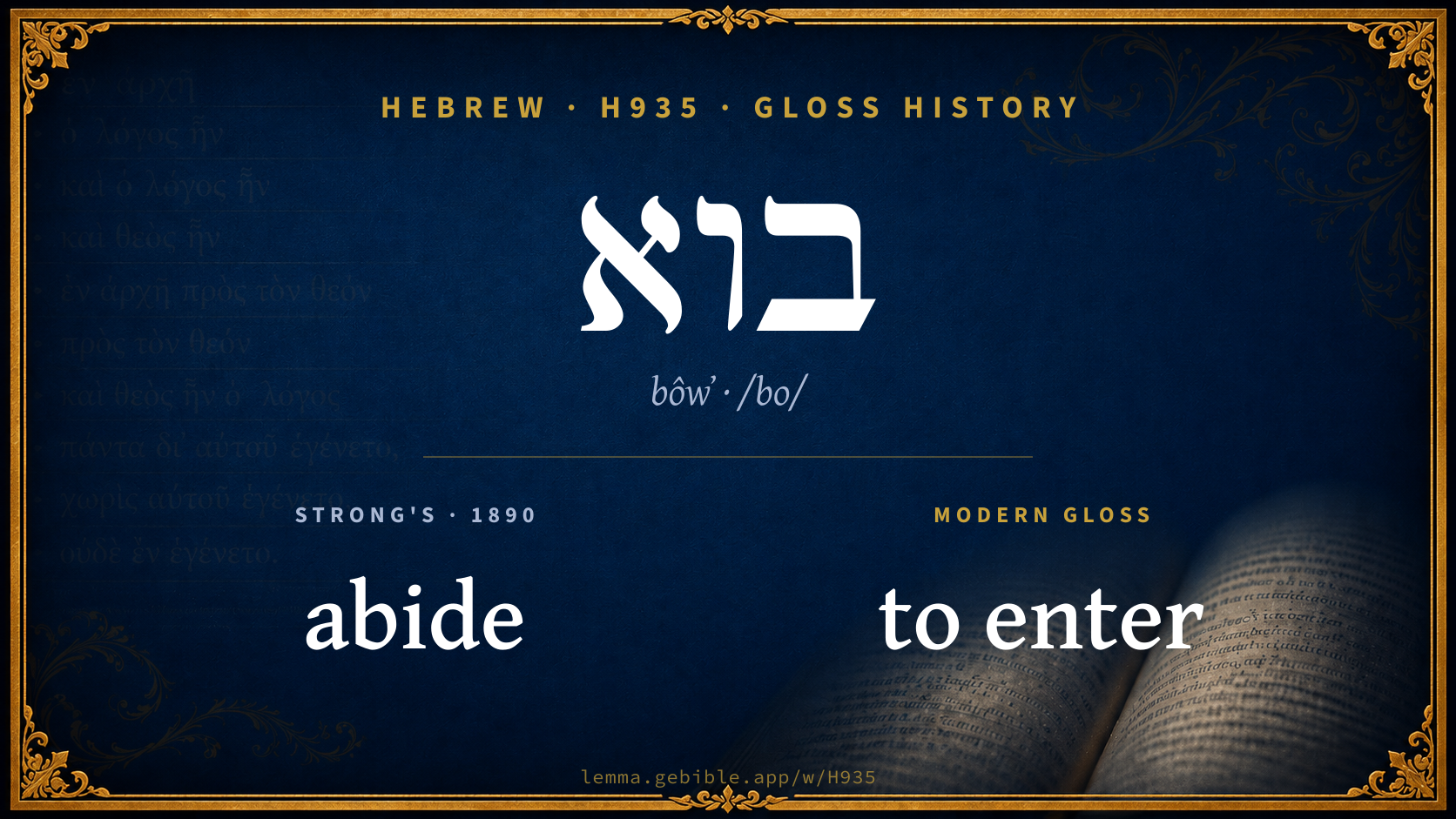
Gloss history
Strong's 1890 vs modern scholarship
About this word
Strong's H935 catalogs a Hebrew word from the Hebrew Old Testament.
These counts are not copied from any lexicon or concordance. They are computed here, from the morphology-tagged Hebrew Old Testament. What Lemma adds →
- 2,307
- distinct verses
- The word appears in 2,307 distinct verses.
- 39 / 39
- OT books
- The word appears in 39 of 39 Old Testament books.
- #14
- by frequency
- Top 25 most frequent Hebrew words (rank 14 of 8,640 Hebrew words by occurrence).
View all 2,307 occurrences in the concordance →
By section of the Old Testament
By traditional corpus
Conventional, traditional groupings — biblical authorship is debated, so this is a traditional corpus grouping, not an authorship claim. Each share is this word’s portion of its verses in that division of the Hebrew canon. Each figure is a share of the word’s 2,307 distinct verses.
- Prophets (Nevi'im) 1,213 verses · 53%
- Torah (Pentateuch) 570 verses · 25%
- Writings (Ketuvim) 524 verses · 23%
How translations render this word
Counts come from each version’s own published word-to-Strong’s tagging or interlinear alignment — an approximate guide to how each version renders this word, not a word-level alignment the data otherwise carries. Because each total is that version’s own tagged count, the per-version totals vary from one another and need not match the appearance or distinct-verse counts above. These counts may also differ from a printed concordance because Lemma counts each distinctly tagged rendering and does not collapse phrase taggings into a single head-word total. This is a fixed set of word-tagged versions (KJV, ASV, BSB, ULT) and does not change with the reading translation you choose elsewhere. Each version’s license is shown beside its name below (and on Sources).
- King James Version: Came 420×, Come 175×, Brought 98×
- American Standard Version: Came 379×, Come 123×, Brought 81×
- Berean Standard Bible: Came 212×, Come 112×, Went 85×
- unfoldingWord Literal Text: Came 327×, And 220×, Come 155×
King James Version Public Domain
Renders H935 across 2,573 tagged occurrences — most commonly:
Plus other, less common renderings. Plus 509 renderings that appear only once — usually multi-word phrases or single function words the recovered tagging swept in, not distinct renderings. Not rendered by a distinct English word in 6 further occurrences.
American Standard Version Public Domain
Renders H935 across 2,567 tagged occurrences — most commonly:
Plus other, less common renderings. Plus 571 renderings that appear only once — usually multi-word phrases or single function words the recovered tagging swept in, not distinct renderings.
Berean Standard Bible Public Domain
Renders H935 across 2,440 tagged occurrences — most commonly:
Plus other, less common renderings. Plus 505 renderings that appear only once — usually multi-word phrases or single function words the recovered tagging swept in, not distinct renderings. Not rendered by a distinct English word in 112 further occurrences.
unfoldingWord Literal Text CC BY-SA 4.0
Renders H935 across 2,955 tagged occurrences — most commonly:
Plus other, less common renderings. Plus 290 renderings that appear only once — usually multi-word phrases or single function words the recovered tagging swept in, not distinct renderings.
41 senses and sub-senses in the full BDB
Hebrew verbs can shift meaning by stem (binyan): Qal is the basic action, Niphal is often passive or reflexive, Piel often intensifies or makes it factitive, and Hiphil is typically causative. The senses below are grouped under the stem BDB assigns to each. This entry also uses Hophal (the passive of Hiphil).
What do BDB’s symbols mean?
BDB uses these scholarly abbreviations:
| Symbol | Meaning |
|---|---|
| 𝔊 | the Septuagint (the ancient Greek translation, LXX) |
| 𝔙 | the Vulgate (the Latin translation) |
| 𝔖 | the Syriac version (the Peshitta) |
| 𝔗 | the Targum (the Aramaic translation) |
| ψ | the Psalms |
| √ | root (the underlying root or stem) |
| ‖ | parallel passage (a synonymous or contrasted parallel) |
| † | the dagger: every passage where the word occurs is cited |
The 41 senses and sub-senses the full Brown-Driver-Briggs lexicon distinguishes for this word, in lexicon order (not ranked by frequency), with BDB’s own verbatim wording and sub-sense lettering. Shown in Hebrew script with BDB’s own scholarly abbreviations. The condensed entry is in the Lexicon Entry tab. See also the Forms in the corpus table below.
Qal
- Pf. בָּא Gn 6:13 +; 3 fs. בָּ֫אָה Gn 15:17 +; sf. בָּאַתְנוּ ψ 44:18; 2 ms. בָּ֫אתָ Jos 13:1 +, בָּ֫אתָה 2 S 3:7; 2 fs. בָּאתְ Gn 16:8 Ru 2:12, וּבָאתְ consec. Ru 3:4 2 S 14:3 Mi 4:10; 3 pl. בָּאוּ Gn 7:9 +; 1 pl. בָּאנוּ Gn 32:7 + (בָּנוּ 1 S 25:8), etc.; Impf. יָבוֹא Gn 32:9 +, יָבֹא Gn 49:10 +; 3 fs. תָּבוֹא Gn 41:50 +; sf. תְּבוֹאָֽתְךָ Jb 22:21 (but text dub. v. Köi. 644); 2 ms. תָּבוֹא Gn 15:15 +; 2 fs. תָּבוֹאִי Ru 3:17 +; 1 s. אָבוֹא Gn 33:14 +; cohort. אָבֹ֫אָה Ju 15:1, אָב֫וֹאָה Gn 29:21 +, וַתָּבֹאתִי 1 S 25:34 (Qr וַתָּבֹאת, but text prob. wrong, v. Köi. 647 Dr, read וַתָּבֹאִי); 3 pl. m. יָבוֹאוּ Gn 6:20 +, also (by textual error) בֹּאוּ Je 27:18 cf. Köi. 645, יְבֹא֑וּן ψ 95:11, sf. יְבֹאוּנִי ψ 119:77, וִיבֹאֻנִי v 41; 3 f. pl. תָּבֹאןָ Gn 30:38, תָּבוֹאנָה 1 S 10:7 +; תְּבֹאֶינָה 1 S 10:7 ψ 45:16, etc.; Imv. בּוֹא, בֹּא Gn 7:1 +, בֹּ֫אָה 1 S 20:21 1 K 13:7, בּ֫וֹאִי, בֹּ֫אִי 2 S 13:11 +; mpl. בֹּ֫אוּ Gn 45:17 +; Inf. בּוֹא, בֹּא Gn 39:16 +; sf. בֹּאִי, בּוֹאִי Gn 48:5 +, בּוֹאֲךָ 1 S 29:6 +, בֹּאֲכָה Gn 10:19 +, etc., בֹּאָם Gn 34:5 +, בֹּאָן Gn 30:38 cf. Ez 42:12 (where Co for בְּבוֹאָן reads לבוא להנה); Pt. בָּא Gn 33:1 +; f. בָּאָ֫ה Gn 29:6 +, הַבָּ֫אָה Gn 18:21 + (accent wrong Ew§ 331 b N.); pl. בָּאִים Gn 18:11 +; cstr. בָּאֵי Gn 23:10 +; f. abs. בָּאוֹת Gn 41:29; (see further on forms Köi. 634 f.);— e.g. Genesis 6:13
- 1. come in, sq. אֶל Gn 6:18; 7:9, 13, sq. בְּ Gn 19:8 & so (subj. רוּחַ) Ez 2:2; 37:10, sq. לְ Est 6:4, sq. ה—ָ loc. Gn 12:11; 41:57 Nu 14:24, sq. acc. (בית) Ju 18:18 2 K 11:19 cf. ψ 100:4 (שַׁעֲרָיו), & בָּאֵי שַׁעַר עִירוֹ Gn 23:10, 18; even of lifeless things 2 K 18:21, וּבָא בְכַפּוֹ (of broken reed) = pierce; of food and drink (sq. אֶל־) Dn 10:3 cf. Gn 41:21 (fat kine when eaten by lean kine); v. also (sq. בְּ) Nu 5:22, 24, 27; abs. Gn 7:16; 24:31 1 K 1:42; 14:6 cf. 2 K 11:5, 9 = 2 Ch 23:4, 8 +; more partic. e.g. Genesis 6:18
- a. opp. יָצָא, go out and come in (Sab. וצֿאם או בהאם Hal152) Jos 6:1 1 K 15:17 = 2 Ch 16:1 2 K 11:8 = 2 Ch 23:7; especially in sense of going about one’s affairs Dt 28:6; 19 Zc 8:10 ψ 121:8; id. + ישׁב 2 K 19:27 = Is 37:28; also sq. לִפְנֵי הָעָם etc. = act as ruler (judge) of, Nu 27:17 2 Ch 1:10 cf. 1 K 3:7; of leading an army 1 S 18:13, 16 cf. also Jos 14:11; v. further Dt 31:2 1 S 29:6 & sub c. infr. e.g. Joshua 6:1
- b. of taking part in worship of congregation Dt 23:2, 3(×2), 4(×2) + (sq. בְּ); or entering into tabernacle for priestly service Ex 28:29, 35 Lv 16:22 (all sq. אֶל־), Ex 28:30 (sq. לִפְנֵי יהוה), Lv 16:17 (sq. inf.) +. e.g. Deuteronomy 23:2
- c. of entering on official duty 2 K 11:9 = 2 Ch 23:8 1 Ch 27:1 (all opp. יצא). e.g. 2 Kings 11:9
- d. of bride coming into her husband’s house Jos 15:18 = Ju 1:14. e.g. Joshua 15:18
- e. of entering a woman’s tent or apartment (with implication coire cum femina, cf. Arabic بَآءٌ NH בִּיאָה coitio; on origin of this use of word cf. RSK 90, 167, 291) Ju 15:1 אֶל־אִשְׁתִּי הֶחָ֑דְרָה, 16;1 Gn 6:4; 16:2; 30:3; 38:8, 9; 39:14 Dt 22:13 2 S 12:24; 16:21; 20:3 Ez 23:44(×3) Pr 6:29 (all sq. אֶל־); sq. עַל־ Gn 19:31 Dt 25:5 יָבֹא עָלֶיהָ וּלְקָחָהּ לוֹ לְאִשָּׁה; cf. בָּאֶיהָ Pr 2:19;—subj. rarely woman Gn 19:34 2 S 11:4. e.g. Judges 15:1
- f. of associating with (sq. בְּ) Jos 23:7, 12 cf. Gn 49:6 בְּסֹדָם אַל תָּבֹא נַפְשִׁי (אַל־תֵּחַד ‖ בִּקְהָלָם). e.g. Joshua 23:7
- g. of entering into specific relations, בּ׳ בְאָלָה, בּ׳ בִבְרִית (v. אלה, ברית); בּוֹא בְדָמִים come into blood-guiltiness, became guilty of murder 1 S 25:26. e.g. 1 Samuel 25:26
- h. of burial, בּ׳ אֶל־קֶבֶר 1 K 13:22; 14:13 cf. תָּבוֹא אֶל־אֲבוֹתֶיךָ Gn 15:15 (‖ תִּקָּבֵר). e.g. 1 Kings 13:22
- i. of sun, set (go in, enter, cf. Assyrian erîb šamši COT Gn 19:23; opp. יצא go forth, rise) Gn 15:12, 17; 28:11 Ex 17:12; 22:25 Lv 22:7 Dt 16:6; 23:12; 24:13, 15 Jos 8:29; 10:13, 27 Ju 19:14 Ec 1:5 2 S 2:24; 3:35 1 K 22:36; 18:34; so also fig. Je 15:9 of calamity בּאה שִׁמְשָׁהּ בְּעוֹד יוֹמָם (‖ אֻמְלְלָה יֹלֶדֶת הַשִּׁבְעָה etc.), cf. Is 60:20; Mi 3:6 וּב׳ הַשֶּׁמֶשׁ עַל־הַנְּבִיאִים of ignorance and confusion. e.g. Genesis 19:23
- j. of harvest, come in = be gathered Lv 25:22 (cf. תְּבוּאָה); so of revenue (income) 1 K 10:14 = 2 Ch 9:13 (sq. לְ pers.),—opp. יצא be expended. k. in other phrases: וַתָּבֹא הָעִיר בַּמָּצוֹר 2 K 24:10 + and the city came into siege; cf. ψ 105:18 בַּרְזֶל בָּאָה נַפְשׁוֹ his soul came into iron (v. AV RVm; Che felt iron chains, cf. Ew Ol Hup Pe; 𝔗 Hi De al. iron came upon his soul); בָּא בַּיָּמִים come into (the) days, = advanced in age Gn 24:1 Jos 13:1; 23:1 (all ‖ זָקֵן); on 1 S 17:12 v. Dr e.g. Leviticus 25:22
- 2. come (approach, arrive) opp. הָלַךְ Gn 16:8 1 S 20:21 (cf. v 22) Ne 6:17 Ec 5:14, 15 (of birth opp. death); sq. אֶל־ pers. vel rei Gn 14:7; 37:23; sq. עַל־ Ex 18:23 2 Ch 20:24 (come up upon, almost = ascend); cf. also Lv 21:11 Nu 6:6; sq. לְ 1 S 9:12 2 Ch 29:17; sq. עַד Nu 13:22 Ju 15:14 2 S 16:5; cf. בָּאוּ בָנִים עַד־מַשְׁבֵּר 2 K 19:3 = Is 37:3 children have come to the birth; sq. עַד + אֶל 2 K 9:20 בָּא עַד אֲלֵיהֶם; sq. ָה loc. Ju 11:16 2 K 6:4; sq. acc. 1 S 4:12; 2 K 8:7 Je 32:24; cf. also La 1:4 בָּאֵי מוֹעֵד those coming to an appointed feast; abs. Gn 45:16 Joseph’s brethren are come, & often; also of lifeless things, ark of י׳ 1 S 4:6; wind Jb 1:19; so כַּסְפְּכֶם בָּא אֵלָ֑י Gn 43:23 your money came unto me = I received your money; our inheritance has fallen to us Nu 32:19 (c. אֶל־); so 1 S 9:16 its cry is come unto me, cf. Gn 18:21 Ex 3:9 La 1:22; of time, often of imminent future, especially in phr. הִנֵּה יָמִים בָּאִים Is 39:6 = 2 K 20:17 Je 7:32; 9:24; 16:14; 19:6; cf. also 1 S 26:10 Ez 7:7 +; of day of י׳ Jo 2:1; 3:4 Zc 14:1 Mal 3:2, 19, 23; also ptcp. as adj. הַיָּמִים הַבָּאִים Ec 2:16 cf. Je 47:4; as subst. הַבָּאוֹת Is 41:22 things to come, future things; & הַבָּאִים alone = adv. in (days) to come Is 27:6; partic. e.g. Genesis 16:8
- a. come with, i. e. come, bringing, sq. בְּ: אָבוֹא בֵיתְךָ בְעוֹלוֹת ψ 66:13; אָבוֹא בִּגְבֻרוֹת אדני י׳ ψ 71:16 (‖ אַזְכִּיר צִדְקָֽתְךָ) so Lv 16:3 & perhaps Pr 18:6—cf. בְּ III. 1. b. e.g. Psalms 66:13
- b. come upon, fall or light upon, of enemy, attack, sq. עַל־ Gn 34:27 1 S 11:12 cf. Gn 32:9 (sq. אֶל־); sq. sf. Jb 15:21, so also 20:22 Ez 32:11; of calamity, etc. Pr 10:24; 28:22 ψ 36:12; 44:18 (all c. sf.); sq. לְ Jb 3:25 (‖ אתה c. sf.) Is 47:9 (‖ בוא על); of blessing, sq. עַל־ Jos 23:15; sq. sf. Jb 22:21 (cf. Di) ψ 119:41, 77. e.g. Genesis 34:27
- c. come to pass, of signs, wonders, predictions, etc. Dt 13:3 Jos 23:14 1 S 9:6 (בֹּא יָבֹא) Is 42:9 Je 28:9 Pr 13:12 Jb 6:8 +. e.g. Deuteronomy 13:3
- d. Gn 6:13 קֵץ כָּל־בָּשָׂר בָּא לְפָנַי perhaps has presented itself before me (v. Kn), cf. La 1:22 supr. & 2 Ch 7:11 (where בוא for usual עלה); but perhaps (cf. Di) has come to pass before me, i. e. in my mind it is already a fact. e.g. Genesis 6:13
- e. † in phr. עַד־בּוֹאֲךָ עַזָּה Ju 6:4 cf. 11:33 1 S 17:52 2 S 5:25 1 K 18:46 (עַד־בֹּאֲכָה) until thou comest to = as far as; so also בּוֹאֲךָ (בֹּאֲכָה) alone, = as far as, or in the direction of, Gn 10:19(×2), 30; 13:10; 25:18 1 S 27:8 (all sq. ָה loc.) 1 S 15:7; so לְבֹא חֲמָת Nu 13:21; 34:8 Ez 48:1, cf. Ez 47:15 (in a different connexion לָבוֹא אפרתה Gn 35:16; 48:7); עַד לְבוֹא ח׳ Jos 13:5 Ju 3:3 1 Ch 13:5, cf. 5:9 2 Ch 26:8 Ez 47:20; מִלְּבוֹא ח׳ Am 6:14 1 K 8:65 2 K 14:25 2 Ch 7:8; of Isaac בָּא מִבּוֹא בְּאֵר לַחַי רֹאִי Gn 24:62 (but text dub.) e.g. Judges 6:4
- f. attain to וְעַד הַשְּׁלשָׁה לֹא בָא 2 S 23:19 = 1 Ch 11:21. e.g. 2 Samuel 23:19
- g. be enumerated הַבָּאִים בְּשֵׁמוֹת, lit. those coming with names 1 Ch 4:38. e.g. 1 Chronicles 4:38
- 3. go, i.e. walk, associate with (עִם) ψ 26:4, so c. אֵת Pr 22:24 (cf. הלך את 13:20 & התהלך את Gn 5:22, 24; 6:9). e.g. Psalms 26:4
- 4. go (cf. הלך) from speaker, but with limit of motion given Is 22:15 לֶךְ־בֹּא אֶל־, so Ez 3:4, 11; Gn 45:17 וּלְכוּ־בֹאוּ אַרְצָה כְּנָ֑עַן; 1 S 22:5 לֵךְ וּבָאתָ־לְךָ אֶרֶץ יְהוּדָה; Is 47:5 Jon 1:3 אֳנִיָּה בָּאָה תַרְשִׁישׁ a ship going to Tarshish; go to war יָבֹאוּ לַמִּלְחָמָה Nu 32:6. e.g. Isaiah 22:15
Hiphil
- Pf. הֵבִיא Gn 4:4 +; sf. הֱבִיאַנִי Dt 9:4 +, etc.; 2 ms. הֵבֵיאתָ Is 43:23, הֵבֵאתָ Gn 20:9 +, etc.; sf. הֲבִיֹאתַנִי 2 S 7:18 1 Ch 17:16, הֲבִיאֹתָנוּ Nu 16:14, הֲבֵתָנוּ ψ 66:11; 1 s. הֵבֵאתִי Gn 31:39 +, והבאיתי Je 25:13 Kt (Qr וְהֵבֵאתִי); sf. וַהֲבִיאוֹתִיךָ Ez 38:16 +, הֲבֵאתִיהָ Is 37:26, etc.; 3 pl. הֵבִיאוּ Gn 43:2 +; sf. הֱבִיאוּהוּ 2 Ch 28:27 etc.; 2 mpl. הֲבֵאתֶם Nu 20:4 +; וַהֲבִיאֹתֶם 1 S 16:17; 1 pl. sf. הֲבִיאֹנֻם Nu 32:17; Impf. יָבִיא (יָבִא) Lv 4:32 +, וַיָּבֵא Gn 2:19 +; sf. וַיְבִיאֵנִי Ez 40:17, etc.; 2 ms. תָּבִיא Jb 14:3; sf. תְּבִיאֵהוּ Je 13:1, וַתְּבִיאֵם Ne 9:23, תְּבִאֵ֗מוֹ Ex 15:17, אָבִיא Ex 11:1 + (אָבִי 1 K 21:29 Mi 1:15), etc.; Imv. הָבֵא Gn 43:16 Ex 4:6, הָבֵיא 1 S 20:40, הָבִיאָה Gn 27:7 +; fs. הָבִיאִי 2 S 13:10 +, etc.; Inf. abs. הָבֵא Hg 1:6; cstr. הָבִיא Gn 18:19 +; Pt. מֵבִיא ψ 74:5 +, מֵבִי 1 K 21:21 + 3 times, מְבִיאֲךָ Dt 8:7; pl. מְבִיאִים (מְבִאִים) 1 K 10:25 +; cstr. מְבִאֵי Je 17:26, מְבִיאֶיהָ Dn 11:6;— e.g. Genesis 4:4
- 1. cause to come in, bring in (conduct, lead, obj. persons and animals), sq. אֶל־ Gn 6:19 Ct 2:4; 3:4; sq. בְּ Lv 26:41 ψ 66:11; sq. לְ Ju 19:21 1 S 19:22; sq. לִפְנֵי Est 1:11, 17; sq. ָה loc. Gn 24:67; 46:7; sq. ָה + אֶל־ Gn 19:10, sq. acc. (חֶדֶר) Ct 1:4 2 K 9:2; also bring, carry in (lifeless things), sq. אֶל־ Nu 31:54 Mal 3:10; sq. בְּ Je 17:21; send, of sending (shooting) arrows (fig.) La 3:13; cf. Lv 26:36; of sending breath (רוּחַ) into dry bones Ez 37:5 (Co על); sq. לְ Ne 13:12; sq. ָה loc. Ex 26:33 2 K 20:20 וַיָּבֵא אֶת־הַמַּיִם הָעִ֑ירָה; sq. acc. (חֶדֶר) 2 S 13:10; also 2 Ch 15:18 (בֵּית); abs. 2 S 6:17; partic. e.g. Genesis 6:19
- a. opp. הוֹצִיא (bring out) Dt 9:28 (sq. אֶל־); especially in combination with הוֹצִיא lead out and in (to and from battle) Nu 27:17 1 Ch 11:2. e.g. Deuteronomy 9:28
- b. bring in women as wives for sons (sq. מִן הַחוּץ) Ju 12:9 (opp. שִׁלַּח הַחוּצָה). e.g. Judges 12:9
- c. bring into judgment וְאֹתִי תָבִיא בְּמִשְׁפָּט עִמָּ֑ךְ Jb 14:3 cf. Ec 11:9; 12:4. e.g. Job 14:3
- d. cause sun to go down Am 8:9 (symbol of judgment). e.g. Amos 8:9
- e. of harvest, bring in, gather 2 S 9:10 Hg 1:6 (opp. זרע) cf. Ne 13:15. e.g. 2 Samuel 9:10
- f. put staves into (בְּ) rings Ex 25:14; 37:5; 38:7 cf. 26:11 Lv 14:42; hand into (בְּ) bosom Ex 4:6(×2); girdle into (בְּ) water Je 13:1. e.g. Exodus 25:14
- g. other phrases, הֵבִיאוּ צַוָּ֯רָם בַּעֲבֹדַת אֲדֹנֵיהֶם Ne 3:5 put their necks to the work, etc.; fig. הביאו את־צואריכם בְּעֹל Je 27:12; הָבִיאָה לַמּוּסָר לֵבֶּ֑ךָ Pr 23:12 apply to instruction thy heart; וְנָבִא לְבַב חָכְמָה ψ 90:12 that we may gain a heart of wisdom. e.g. Nehemiah 3:5
- 2. cause to come, bring, bring near, etc. (animate obj.) sq. אֶל־ Gn 2:19, 22; 43:9 Lv 24:11 Nu 5:15; often of bringing Isr. to Canaan Ex 6:8; 23:23 +, cf. Is 14:2; 56:7 Ne 1:9; abs. Dt 4:38; 6:23; sq. לְ Gn 39:14, 17; sq. ָה loc. Ez 12:13; sq. הֲלֹם Ju 18:3, & עַד־הֲלֹם (fig. of Yahweh’s prospering care) 2 S 7:18 = 1 Ch 17:16; abs. Gn 46:32; also with lifeless obj., Gn 27:10 (sq. לְ), so 2 Ch 36:7; Gn 31:39 (sq. אֶל־); sq. acc. 2 K 12:5 2 Ch 36:18 Dn 1:2(×2); sq. ָה loc. Ex 26:33 Je 20:5; sq. לִפְנֵי 2 Ch 24:14; of ravens bringing food 1 K 17:6 (sq. לְ); of bringing presents Gn 43:26 1 S 9:7; 10:27 (all sq. לְ); cf. 1 S 17:18; especially offerings, sq. לְ Gn 4:3 Nu 15:25 Ne 10:35, 37 (לְבֵית), etc.; Lv 2:2 sq. אֶל־ of priest; abs. Gn 4:4 Lv 4:32; 23:14, 15 Mal 1:13(×2) 2 Ch 31:5; cf. also Ex 35:21, 22, 23, 24:(×2), 27, 29 (sq. לְ for) so 36:3 +; of time, cause a day to come La 1:21; cause cry to come (עַל־) Jb 34:28; = carry והב׳ בָּנַיִךְ בְּחֹצֶן Is 49:22 (‖ עַל־כָּתֵף נשׂא); carry God in (בְּ) the hand Jb 12:6 (cf. אֱלהַּ p. 43); allow to come, almost = invite Est 5:12 (sq. אֶל־) cf. v 10; partic. e.g. Genesis 2:19
- a. sq. עַל־ bring against, or upon, bring enemies against Je 25:9 cf. Ez 23:22; obj. sword Lv 26:25 Ez 5:17; 11:8; 14:17; 33:2; plague Ex 11:1; curse or calamity Gn 27:12 Dt 29:26 1 K 9:9 = 2 Ch 7:22 Jb 42:11 cf. Je 25:13; 36:31; 44:2; 49:8, 37 Ez 14:22; sin Gn 20:9; 26:10 Ex 32:21; cf. also sq. אֶל־ Je 32:42; 49:36. e.g. Jeremiah 25:9
- b. bring to pass 2 K 19:25 = Is 37:26 cf. 1 Ch 4:10 ψ 78:29. e.g. 2 Kings 19:25
- c. bring, bring forward, bring on the scene Mi 1:15 Zc 3:8. e.g. Micah 1:15
- d. bring for a purpose, sq. inf. ψ 78:71 עָלוֹת הֱבִיאוֹ לִרְעוֹת בְּיַעֲקֹב עַמּוֹ מֵאַחַר. e.g. Psalms 78:71
- e. bring, procure בְּנַפְשֵׁנוּ נָבִיא לַחְמֵנוּ La 5:9, ψ 90:12. e.g. Lamentations 5:9
Hophal
- Pf. הוּבָא Lv 10:18 +; 3 fs. הֻבָאת Gn 33:11 (v. infr.); 2 ms. הֻבָ֫אתָה Ez 40:4; 3 pl. הוּבְאוּ Gn 43:18; Impf. יוּבָא Lv 6:23 +, יוּבָ֑אוּ Je 27:22; Pt. מוּבָא 2 K 12:10 +; pl. מוּבָאִים Gn 43:18 Ez 30:11 + 23:42 (Co מרבדים), מוּבָאוֹת ψ 45:15;— e.g. Leviticus 10:18
- a. be brought in (of pers. and things), abs. Gn 43:18; sq. בית into a house Gn 43:18; temple 2 K 12:5, 10, 14, 17; 22:4 2 Ch 34:9, 14. e.g. Genesis 43:18
- b. be brought, sq. לְ Gn 33:11 (but 𝔊 read Hiph. I have brought), ψ 45:15; sq. אֶל־ unto Lv 6:23; 10:18; 13:2, 9; 14:2; cf. Ez 23:42 (but v. Co VB); sq. הֵ֫נָּה Ez 40:4; sq. בָּבֶ֫לָה Je 27:22; sq. inf. Lv 16:27 Ez 30:11; sq. מִן Je 10:9. e.g. Genesis 33:11
- c. be introduced, put, sq. בְּ, staves into rings Ex 27:7; vessel into water Lv 11:32. e.g. Exodus 27:7
Senses from the full Brown-Driver-Briggs lexicon (Brown, Driver, Briggs; Oxford 1906 — public domain), digitized via Sefaria, supplemented by the OpenScriptures HebrewLexicon (CC BY 4.0). Full attribution on Sources.
Word origin
vb. come in, come, go in, go (Assyrian bâʾu HptKAT 499, Ethiopic ቦአ Arabic بَآءَ return)—
— Brown-Driver-Briggs (Oxford 1906, public domain), digitized via Sefaria, supplemented by the OpenScriptures HebrewLexicon (CC BY 4.0). See Sources.
Origin: a primitive root
Jastrow Dictionary
A second Hebrew/Aramaic lexicon for comparison, covering Aramaic and post-biblical (Talmudic, Targumic, Midrashic) usage that the biblical-Hebrew BDB does not. Matched by lemma rather than by Strong’s number, so a lemma may carry more than one Jastrow headword (shown separately below), and the entries cover usage well beyond the Bible.
בּוֹא
- 1. to enter, come. R. Hash. I, 2 בָּאֵי העולם those come into the world, i.e. mortals. Ḥull. 54ᵇ בּוֹאֲכֶם בשלום be welcome!—Tanḥ. Vaëra 14; Midr. Till. to Ps. LXXVIII, 47, a. e. (play on ב̇ח̇נ̇מ̇ל̇ ibid.) [ב̇א נ̇ח̇ מ̇ל̇] ב̇א ח̇ן̇ מ̇ל̇ it (the locust) comes, encamps [rests], and plucks. Y. Shebu. VIII, 38ᶜ top, a. e. במקום שבאת, v. גְּזֵרָה.—Y. Peah I, 15ᶜ top, a. fr. יָבֹא עלי אם וכ׳ may (evil) befall me, if—; cmp. אֲתָא; Koh. R. to X, 8 אם לא יבא וכ׳ (corr. acc.).
- 2. with על (b. h. to have sexual connection. Kerith. I, 1; a. fr.
- 3. with לְיַד or לִידֵי to fall into the power of.—Aboth II, 1 ואין אתה בא לידי עבירה and sin will have no power over thee. Yoma 86ᵇ בא לידו דבר וכ׳ (not באת) he had the power (the chance) to commit a sin &c.; Kidd. 39ᵇ; a. fr.—בּוֹא וראה come and see (I will prove). Yoma l. c.; a. fr.
- 1. to bring, carry. Gitt. I, 1 המֵבִיא וכ׳ he who brings (as a messenger) a letter of divorce from abroad; a. fr.
- 2. to offer. Bicc. I, 1; a. fr.
- 3. to draw an object toward’s one’s self, opp. הוֹלִיךְ, v. הָלַךְ. Ḥull. II, 3 הוליך ולא ה׳ he put the knife out (in slaughtering) but did not draw it backward; ה׳ ולא וכ׳ or drew it toward himself but did not then move forward; a. fr.
- 4. to bring about, produce, cause. Aboth I, 17 מביא חטא begets sin; a. fr.
- 5. to lead, procure admittance. Ab. Zar. 20ᵇ Torah מביאה לידי וכ׳ (v. supra) leads to careful conduct &c. Ib. 18ᵃ אתה מְבִיאֵנִי וכ׳ wilt thou procure me (promise me) admittance into the world to come?; a. fr.
A Dictionary of the Targumim, the Talmud Babli and Yerushalmi, and the Midrashic Literature (Marcus Jastrow; London, Luzac, 1903) — Public Domain. Digitized via Sefaria. Digitized via Sefaria. Full attribution on Sources.
Forms in the corpus
The 1,091 distinct written forms H935 takes in the Hebrew Bible, most frequent first — each parse links to that stem’s occurrences in the concordance. Hebrew forms include their vowel points and cantillation, so a single lemma takes many written forms.
The 60 most common forms are shown; 1,031 rarer forms follow in the full concordance.
Same root — word family
Other BDB entries built from the same root as H935, grouped by Strong’s listed origin. These share a root / origin per the lexicon — not necessarily a shared meaning. Each links to that word’s own entry.
Derived from this word
Compare all same-root words → They share a root, not necessarily a meaning.
Septuagint verse parallels
This word appears in 2,182 verses that also exist in the Greek Old Testament (Septuagint), out of the 2,307 Hebrew verses it occurs in. You can read those verses in Greek by switching the Old Testament edition to the Septuagint.
Read these verses in the Septuagint
- Genesis 2:19
- Exodus 1:1
- Leviticus 2:2
- Numbers 4:3
- Deuteronomy 1:7
- Joshua 1:11
- Judges 1:7
- Ruth 1:2
- 1 Samuel 1:19
- 2 Samuel 1:2
- 1 Kings 1:1
- 2 Kings 1:13
This is a verse-level parallel only — the same verses exist in both the Hebrew and Greek Old Testaments. No word-level Hebrew↔Greek correspondence is claimed: the data carries no such alignment, so no Greek word is shown as this Hebrew word’s translation. Coverage is not total — the Septuagint omits the deuterocanon and renumbers the Psalms, so some Hebrew verses have no direct Greek parallel.