
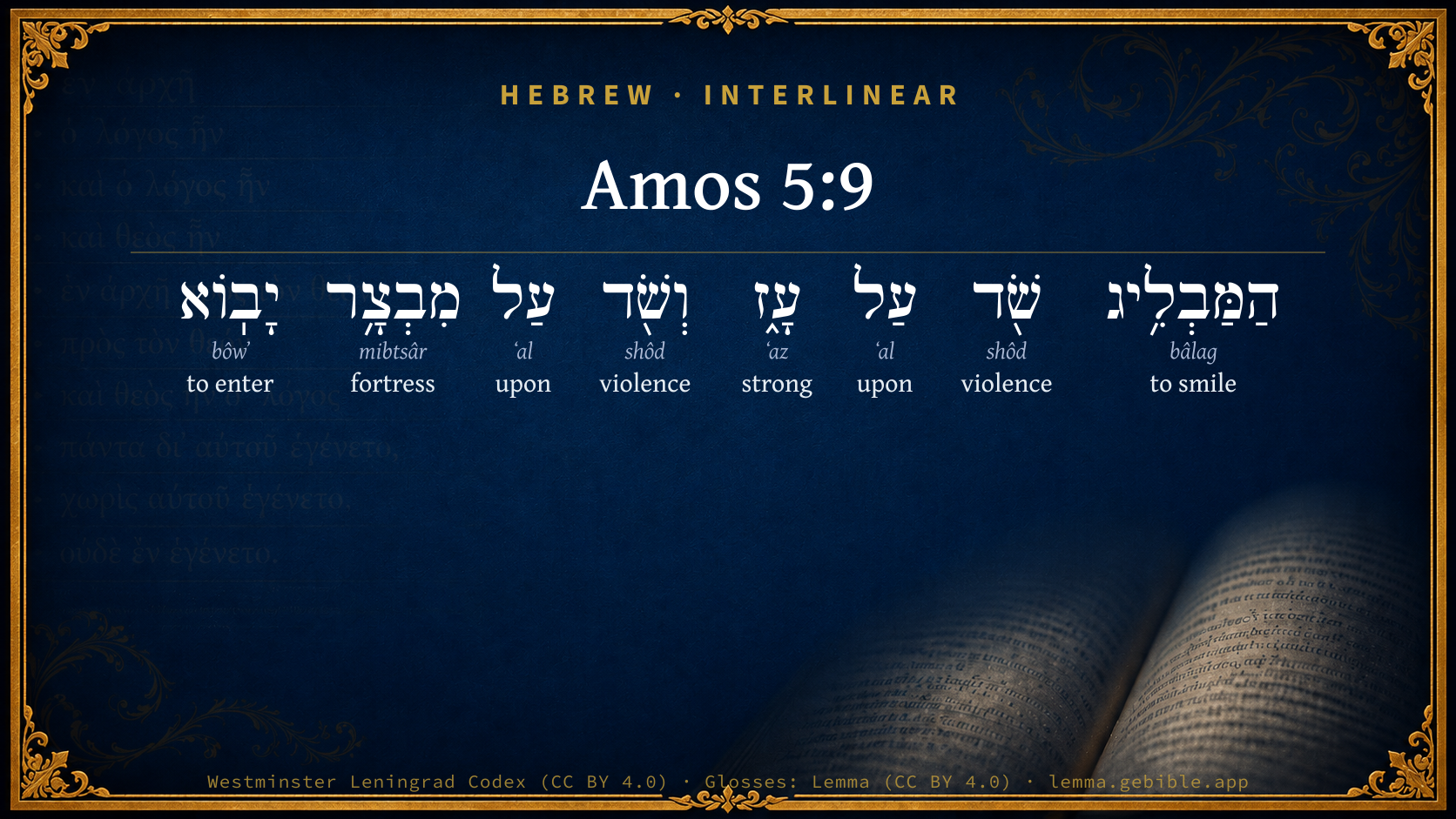
Amos 5:9

Hebrew (Westminster Leningrad Codex) Amos 5:9 appears in the Hebrew Old Testament. The text above is from the Westminster Leningrad Codex. Each word links to its Strong’s number, a concise gloss, and parsing drawn from the Open Scriptures Hebrew Bible morphology. Click any word for its full Brown-Driver-Briggs (BDB) entry.
Download image
Cite this verse

Amos 5:9 (World English Bible). Public Domain. Lemma interlinear Bible study tool, https://lemma.gebible.app/v/amos/5/9.

Show BibTeX & RIS
BibTeX
RIS
English Translation
Who brings sudden destruction on the strong, So that destruction comes on the fortress.
World English Bible · Public Domain
Download a study sheet

One document with this verse’s original text, its word-by-word gloss line, the meaning frame, cross-references with their text, attributed commentary, and full source and license credits — printable, and it pastes into notes with its structure intact.

This verse Autodidact and up

Study sheet (.html) Plain text (.txt)

A passage Seminary Student

Up to 50 verses in one chapter. A passage sheet keeps up to 6 commentary sources and 12 cross-references per verse, in the order this page ranks them, and says so on the sheet whenever that leaves anything out. Ask for a single verse and you get the Autodidact verse sheet above.

Everything on this page stays free to read, with no account — the sheet is a download of what is already on screen, not access to it.

Want to remove ads? Support Godless Engineer
Compare translations 3

The same verse in 3 English versions, stacked beneath the original-language interlinear above. Click any original word for its lexicon entry.

Each is an independent rendering of the whole verse — the interlinear is not word-aligned to these translations.

Highlighted words mark where these versions differ — a whole-verse word diff, not a word-by-word alignment.

  • World English Bible Public Domain
    Who brings sudden destruction on the strong, So that destruction comes on the fortress.
  • King James Version Public Domain
    That strengtheneth the spoiled against the strong, so that the spoiled shall come against the fortress.
  • unfoldingWord Literal Text CC BY-SA 4.0
    He causes destruction to fall on the strong, and destruction comes down on the fortresses.

unfoldingWord Literal Text — © unfoldingWord, licensed CC BY-SA 4.0. Word-aligned USFM3 via Door43 (git.door43.org/unfoldingWord/en_ult).

Versions to compare (up to 4)

3 of 4 selected

Show all 18 translations

Every available English version of this verse, each an independent rendering of the whole verse.

  • World English Bible Public Domain
    Who brings sudden destruction on the strong, So that destruction comes on the fortress.
  • Berean Standard Bible Public Domain
    He flashes destruction on the strong, so that fury comes upon the stronghold.
  • Majority Standard Bible Public Domain
    He flashes destruction on the strong, so that fury comes upon the stronghold.
  • King James Version Public Domain
    That strengtheneth the spoiled against the strong, so that the spoiled shall come against the fortress.
  • American Standard Version (1901) Public Domain
    that bringeth sudden destruction upon the strong, so that destruction cometh upon the fortress.
  • Revised Version (1885) Public Domain
    that bringeth sudden destruction upon the strong, so that destruction cometh upon the fortress.
  • Geneva Bible (1599) Public Domain
    He strengtheneth the destroyer against the mightie: and the destroyer shall come against the fortresse.
  • Douay-Rheims (1899) Public Domain
    He that with a smile bringeth destruction upon the strong, and waste upon the mighty.
  • Young's Literal Translation Public Domain
    Who is brightening up the spoiled against the strong, And the spoiled against a fortress cometh.
  • Literal Standard Version CC BY-SA 4.0
    Who is brightening up the spoiled against the strong, || And the spoiled comes against a fortress.
  • Unlocked Literal Bible CC BY-SA 4.0
    He brings sudden destruction on the strong so that destruction comes on the fortresses.
  • unfoldingWord Literal Text CC BY-SA 4.0
    He causes destruction to fall on the strong, and destruction comes down on the fortresses.
  • Darby Bible Public Domain
    He causeth destruction to break forth suddenly upon the strong, and bringeth destruction upon the fortress.
  • World Messianic Bible Public Domain
    who brings sudden destruction on the strong, so that destruction comes on the fortress.
  • Webster's Bible Public Domain
    That strengtheneth the spoiled against the strong, so that the spoiled shall come against the fortress.
  • Free Bible Version CC BY-SA 4.0
    In a flash he cuts down the strong and destroys the fortresses.
  • Bible in Basic English Public Domain
    Who sends sudden destruction on the strong, so that destruction comes on the walled town.
  • JPS Tanakh (1917) Public Domain
    That causeth destruction to flash upon the strong, so that destruction cometh upon the fortress.

Literal Standard Version (2020), Covenant Press — licensed CC BY-SA 4.0. Text via the HelloAO Bible API (eBible.org). Unlocked Literal Bible (unfoldingWord) — licensed CC BY-SA 4.0. Text via the HelloAO Bible API (eBible.org). unfoldingWord Literal Text — © unfoldingWord, licensed CC BY-SA 4.0. Word-aligned USFM3 via Door43 (git.door43.org/unfoldingWord/en_ult). Free Bible Version, Dr. Jonathan Gallagher — licensed CC BY-SA 4.0. Text via the HelloAO Bible API (eBible.org).

Word by word

More ways to search: Search by grammar → Find every occurrence → Compare this word →

Practice this passage: Drill this verse → Learn its vocabulary →

About this verse

These counts appear in no published source. They are computed here, from the morphology-tagged text and Lemma’s own curated glosses. What Lemma adds →

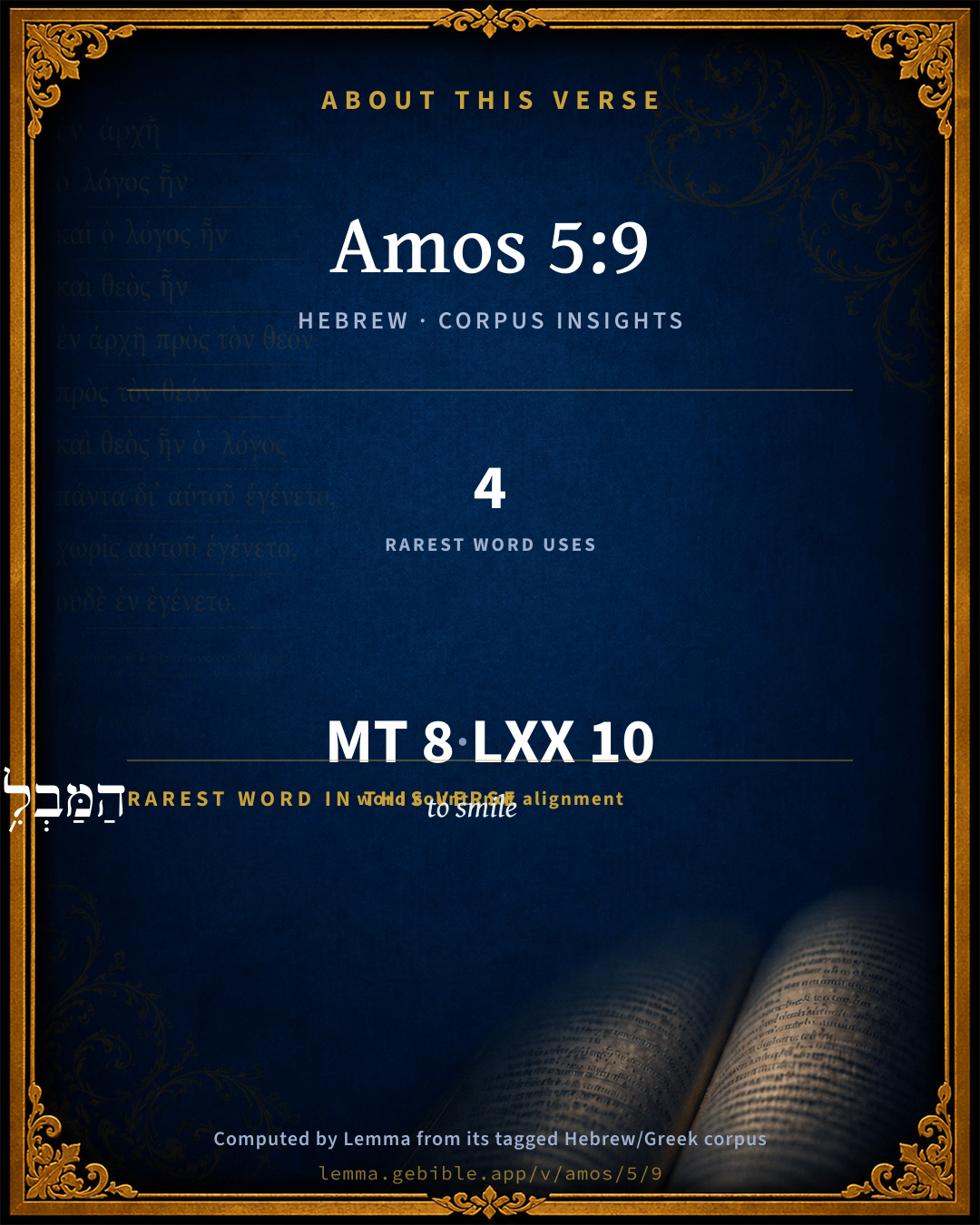
8
words
6
distinct lemmas
Prophets
section

Notable vocabulary

The rarest word here is הַמַּבְלִ֥יג to smile H1082 — appearing just 4 times in the whole Hebrew Bible.

Shared distinctive vocabulary

הַמַּבְלִ֥יג to smile H1082 occurs in 4 verses of the Hebrew Bible. Also found in:

Grammatical profile

  • 2 verbs
  • 3 nouns
  • 1 adjective
  • 2 prepositions

Verb forms

  • הַמַּבְלִ֥יג Hiphil · Participle Active
  • יָבֽוֹא Qal · Imperfect

Repetition

Words recur within this verse — often emphatic in Hebrew:

  • שֹׁ֖ד violence H7701 ×2
  • עַל upon H5921 ×2

Hebrew & Septuagint length

In English translation the verse runs 14 words from the Hebrew and 11 from the Septuagint (LXX English) — closely comparable.

A rough comparison of the two English renderings, which tokenize alike — not a word-level alignment.

Word counts can differ between the Hebrew and the Greek without any difference in meaning — e.g. the Hebrew direct-object marker אֵת has no separate Greek word, and Greek often adds the article ὁ.

In the original languages it is 8 Hebrew tokens and 10 Greek tokens — but the two are counted differently (Hebrew bundles its prefixes and suffixes into one token; the Greek is in lemma form), so that isn’t a like-for-like length.

Cross-references

5

Topical passages linked to Amos 5:9 in the Treasury of Scripture Knowledge — connected by theme and wording, ordered by reader-vote popularity; previews shown in the World English Bible.

  • 2 Kings 13:17 He said, Open the window eastward; and he opened it. Then Elisha said, Shoot; and he shot. He said, Yahweh's arrow of victory, even the arrow of victory over Syria; for you shall strike the Syrians in Aphek, until you have consumed them.
  • 2 Kings 13:25 Jehoash the son of Jehoahaz took again out of the hand of Benhadad the son of Hazael the cities which he had taken out of the hand of Jehoahaz his father by war. Three times did Joash strike him, and recovered the cities of Israel.
  • Jeremiah 37:10 For though you had struck the whole army of the Chaldeans who fight against you, and there remained but wounded men among them, yes would they rise up every man in his tent, and burn this city with fire.
  • Micah 5:11 I will cut off the cities of your land, And will tear down all your strongholds.
  • Hebrews 11:34 quenched the power of fire, escaped the edge of the sword, from weakness were made strong, grew mighty in war, and turned to flight armies of aliens.

Cross-references courtesy of OpenBible.info (CC BY 4.0).

Hebrew and Greek witnesses Masoretic Hebrew ↔ Greek Septuagint

The same verse in the two great witnesses to the Old Testament, shown verse-for-verse.

These are two independent witnesses, not word-aligned to each other, and the Septuagint is shown in lemma (dictionary) form.

Hebrew Amos 5:9 Masoretic · Westminster Leningrad Codex

הַמַּבְלִ֥יג שֹׁ֖ד עַל עָ֑ז וְשֹׁ֖ד עַל מִבְצָ֥ר יָבֽוֹא

Who brings sudden destruction on the strong, So that destruction comes on the fortress.

World English Bible · Public Domain

Greek LXX Amos 5:9 Septuagint · lemma form

ὁ διααἱρέω συντριμμός ἐπί ἰσχύς καί ταλαιπωρία ἐπί ὀχύρωμα ἐπιἄγω

who dispenses ruin to strength, and brings distress upon the fortress.

LXX2012 (modern English Septuagint) · Public Domain

On this verse, The Cambridge Bible for Schools and Colleges discusses the Septuagint’s reading. Read the note in Commentary ↓

Hebrew: Westminster Leningrad Codex (CC BY 4.0). Greek: Septuagint (public domain); English from LXX2012 (modern English Septuagint) (Public Domain). How the Septuagint differs from the Hebrew →

Targum (Aramaic paraphrase)

1

The Targum is the ancient Jewish Aramaic paraphrase of the Hebrew Scriptures — an interpretive translation, not the Hebrew text itself. Onkelos (literal) and Pseudo-Jonathan (expansive) render the Torah, and Jonathan the Prophets. Coverage is partial: where no permissively-licensed English translation exists for a verse, only the Aramaic is shown. This is verse-level text, not a word-by-word alignment to the Hebrew.

  1. Targum Jonathan Prophets (Joshua–Malachi)
    דְמִגַבַּר חֲלָשִׁין עַל תַּקִיפִין וּבְזִיזִין עַל כְּרַכֵּי תַּקִיפִין מַשְׁלִיט:

    (no public-domain English translation for this verse)

    Targum Jonathan — Aramaic: “Mikraot Gedolot” (public domain). English: “Sefaria Community Translation” (CC0 1.0 (public-domain dedication)); “London "Chaldee Paraphrase," 1871” (public domain). Text via Sefaria.

Commentary

Notes on Amos 5:9 from classic Christian and Jewish commentators (each source and its license shown beneath its notes). The classic Christian expositions comment on the surrounding passage and are grouped to its opening verse, so a note may address several verses; the Jewish commentaries on the Tanakh (Rashi and others) are per-verse, so they appear only where the commentator wrote on this verse.

Lemma curates 59 commentaries, every one of them public domain or Creative Commons licensed, each selected and text-cleaned for this edition rather than reprinted as found. About our sources →

Trapp's Complete Commentary

John Trapp

Amo 5:9 That strengtheneth the spoiled against the strong, so that the spoiled shall come against the fortress.

Ver. 9. That strengtheneth the spoiled against the strong] Victorem a victo superari saepe videmus. God can quickly change the scene, turn the scales, Jer 37:10, though ye had smitten the whole army of the Chaldeans, and there remained but wounded men among them, yet should they rise up every man in his tent, and burn this city with fire. In a bloody fight between Amurath III, king of Turks, and Lazarus, despot of Servia, many thousands fell on both sides. In conclusion the Turks had the victory, and Lazarus was slain. Amurath, after that great victory, with some few of his chief captains, taking view of the dead bodies, which without number lay on heaps in the field like mountains, a Christian soldier, sore wounded and all blood, seeing him, in staggering manner arose (as if it had been from death) out of a heap of slain men, and making toward him, for want of strength fell down various times by the way as he came, as if he had been a drunken man. At length, drawing nigh unto him, when they which guarded the king’s person would have stayed him, he was by Amurath himself commanded to come nearer, supposing that he would have craved his life of him. Thus this half-dead Christian, pressing nearer unto him, as if he would, for honour’s sake, have kissed his feet, suddenly stabbed him in the bottom of his belly with a short dagger which he had under his coat; of which wound that great king and conqueror presently died. The name of this man was Miles Cobelite, who, before sore wounded, was shortly after in the presence of Bajazet (Amurath’s son), cut into small pieces. So in that memorable fight between the Swissers and the Dolphin, near to Basil, when Burcardus, monk, a nobleman and a great soldier, grew proud of the victory, and put up his helmet that he might behold what a slaughter they had made, one of the half-dead Swissers, rising up upon his knees, threw a stone at him, which, hitting right, gave him his death’s wound. At the battle of Agincourt, where our Henry V won the day, the French were so confident of a victory, that they sent to King Henry, to know what ransom he would give. Henry, comforting his army with a speech, resolved to open his way over the enemy’s bosom, or else to die. After which, such was the courage of the English, notwithstanding their great wants, as he that ere while could scarcely bend his bow is able now to draw his yard long arrow to the very head.

So that the spoiled (or spoil) shall come against the fortress] And take it by assault. Deus loca, quantumvis valida, vasta facit. There is no strength against the Lord, Pro 21:30.

John Trapp, A Commentary or Exposition upon All the Books of the Old and New Testament (1647–1656) — public domain. Text from a community e-Sword module.

Jamieson, Fausset & Brown

Robert Jamieson, A. R. Fausset & David Brown

strengtheneth the spoiled--literally, "spoil" or "devastation": hence the "person spoiled." WINER, MAURER, and the best modern critics translate, "maketh devastation (or destruction) suddenly to arise," literally, "maketh it to gleam forth like the dawn." Ancient versions support English Version. The Hebrew is elsewhere used, to make, to shine, to make glad: and as English Version here (Psa 39:13), "recover strength."

the spoiled shall come--"devastation," or "destruction shall come upon" [MAURER]. English Version expresses that, strong as Israel fancies herself after the successes of Jeroboam II (Kg2 14:25), even the weakest can be made by God to prevail against the strong.

Jamieson, Fausset & Brown — Commentary Critical and Explanatory on the Whole Bible (1871) — public domain (CC PDM 1.0). Text via the HelloAO Bible API.

Adam Clarke's Commentary

Verse 9. That strengtheneth the spoiled] Who takes the part of the poor and oppressed against the oppressor; and, in the course of his providence, sets up the former, and depresses the latter.

Adam Clarke's Commentary on the Bible (1810–1826) — public domain. Text from a community e-Sword/MySword module.

John Calvin's Commentaries

The Prophet speaks not now of the ordinary works of God, in which his majesty, inspiring the highest reverence, as well as his dread power, shines forth; but he more closely urges the Israelites, who had become so hardened in their vices, that they were wholly inflexible. Here then the Prophet charges them with contumacy and says, “What, think you, will take place? Ye are strong; but God will stir up robbers against you, who will prevail, and beat down and chatter in pieces that obduracy, through which you now resist God.” Thus after having filled them with dread by setting before them the course of nature, he now holds forth this threats that they would themselves have to feel the power of God: for however callous they were, and though in their ferocity they dared to rise up against God, he declares that it would avail them nothing; inasmuch as there was in God’s hand a waster, who would prevail against their obduracy.

And a waster, he says, shall ascend on the very fortresses, or shall enter the fortresses. The Prophet here, in an indirect way, laughs to scorn the vain confidence which filled the Israelites, on observing that they were inclosed in fortified cities and had defenses and a powerful army. All this, he says, will be wholly useless to them when God will raise up strong depredators, who will penetrate through well fortified gates, and leap over walls, and enter strongly defended cities. We now apprehend what the Prophet had in view in these words.

It will now be easy to apply this doctrine to our own instruction: Whenever we are not suitably moved, either by the truth, or by warnings, or by threatenings, let this come to our minds which the Prophet teaches here, namely, that God cannot be mocked, and that hypocrites gain nothing by their delusive ceremonies, when they sacrifice and present their expiations, which by no means please God, — how so? We may indeed easily learn the reason from the nature of God himself. Hence, that we may not transform God, let us learn to raise up our eyes to behold him, and also to look on all things around us; and this will constrain us to adore and fear his great power. It follows —

John Calvin's Commentaries (1540-1563) — public domain. Text from the Calvin Translation Society English edition (1840s-50s) via the Christian Classics Ethereal Library (ccel.org). Calvin's coverage is partial (roughly two-thirds of the Bible); uncommented books and verses are honest gaps, never fabricated. The 19th-century editor's footnotes and remarks are omitted so the notes are faithfully Calvin's own voice.

Ellicott's Commentary for English Readers

(9) That strengthened.—The rendering should be who causeth desolation to gleam upon the strong (who were priding themselves on their immunity), so that desolation cometh on the stronghold.

A Bible Commentary for English Readers, edited by Charles John Ellicott (1878–1897) — public domain. Text from a community e-Sword module.

The Cambridge Bible for Schools and Colleges

gen. ed. J. J. S. Perowne

9. That strengthened the spoiled against the strong &c.] that causeth devastation to flash forth (R.V. marg.) upon the strong, so that devastation cometh (R.V.) upon the fortress. From illustrations of Jehovah’s power as displayed in the physical government of the world, the prophet passes to examples supplied by the moral government of the world: He brings sudden destruction upon the mighty, so that even their strongest fortresses cannot save them. The word rendered strengtheneth occurs also Job_9:27; Job_10:20, Psa_39:13, and a cognate subst. in Jer_8:18. The meaning was forgotten by the Jews; and hence the mediaeval commentators, as David Kimchi, conjectured a sense to strengthen or become strong, more or less consonant with the context in the various passages where the word occurred, which was followed by the Auth. Version of 1611 (in Job and Jer. comfort myself, or take comfort [Lat. ‘comfortare’]; in Psalms 39 recover strength; and here strengtheneth). When, however, subsequently, Arabic was again studied, and compared (especially by Alb. Schultens) with the cognate Semitic languages, the true meaning of the word was speedily discovered: balija, the corresponding word in Arabic, is to have a clear, uncontracted brow, then figuratively, to have a bright, cheerful countenance, or more generally, to be joyous; applied to the dawn, or the sun, to be bright, shine brightly (see Schultens, Origines Hebracae, 1761, p. 19. f.; Lane, Arab. Lex. p. 245). One or other of these meanings suits all the passages in which the word occurs in Hebrew: accordingly in R.V. Job_9:27 is rendered be of good cheer, with marg. “Heb. brighten up”; Job_10:20, Psa_39:13 the old renderings are retained, but the same margin is repeated: here the text (“bringeth sudden destruction”) is also a paraphrase, but the more literal rendering is given on the margin, “causeth destruction to flash forth.”—The repetition of the same word in the two clauses is inelegant: the LXX. for the second שד (‘devastation’) read probably שבר, destruction; cf. Isa_59:7; Isa_60:18.

The Cambridge Bible for Schools and Colleges (gen. ed. J. J. S. Perowne; Cambridge University Press, 1878–1918) — public domain. Text from a community e-Sword module.

John Gill's Exposition

That strengtheneth the spoiled against the strong,.... Such as have been taken by an enemy, who have been stripped of their armour, and spoiled of all their goods and substance, and have no friends nor allies, nor anything to help themselves with; the Lord can supply them with strength, furnish them with weapons, and send them helpers, so that they shall rise up against their conquerors and spoilers, and in their turn subdue them. The Targum is,

"that strengthens the weak against the strong;''

or causes the weak to prevail over the strong. A learned man, from the use of the word in the Arabic language, chooses to render it, "who intends", or "designs, destruction to the strong" (d); that is, in his secret purposes, and which he brings about in providence; though he is doubtful whether it may not have the signification of recreation and refreshment, and whether the construction and circumstances will admit of it; and some do so translate it, "who refreshes himself with destruction against the strong" (e); takes delight and pleasure in it; it is a recreation to him:

so that the spoiled shall come against the fortress: lay siege to it and take it, in which the spoiler thought himself secure with the spoil and substance he had taken from the spoiled; such sudden changes and vicissitudes can God bring upon men when he pleases. Some apply this to the Romans strengthened against the Jews, and besieging their fortified city Jerusalem; but not very aptly.

(d) "qui intendit destinat destructionem forti", Hottinger, Smegma Orientale, l. 1. c. 7. p. 129. (e) "Qui recreat se vastatione contra fortem sive robustum", Junius & Tremellius, Piscator, Tarnovius. So Stockius, p. 136.

John Gill's Exposition of the Whole Bible (1746–1763) — public domain (CC PDM 1.0). Text via the HelloAO Bible API.

Albert Barnes' Notes on the Bible

That strengtheneth the spoiled - (Literally, “spoil” English margin) probably That “maketh devastation to smile on the strong.” . The “smile,” in anger, attests both the extremity of anger, and the consciousness of the ease, wherewith the offence can be punished. They were strong in their own strength; strong, as they deemed, in their “fortress” ; “strong with an evil strength, like one phrensied against his physician.” But their strength would be weakness. “Desolation” when God willed, would “smile at” all which they accounted “might,” and would “come against the fortress,” which, as they deemed, “cut off” all approach.

Albert Barnes' Notes on the Bible (1834–1885) — public domain. Text from a community e-Sword/MySword module.

Haydock's Catholic Bible Commentary

With a smile. That is, with all ease, and without making any effort. (Challoner) --- Aquila has "grinning," to shew displeasure. (St. Jerome) --- Hebrew, "he strengthens the oppressor against the strong," so that those whom he pleases to chastise cannot escape.

George Leo Haydock (1774–1849), Haydock's Catholic Family Bible and Commentary, 1859 edition — public domain. Excludes Psalms (Douay-Rheims chapter numbering differs from Protestant) and Deuterocanonical books (Catholic canon only).

Matthew Poole's English Annotations

That strengtheneth the spoiled; you have been exceedingly weakened and spoiled by your enemies; yet return, repent, seek God, for he can renew your strength, that you shall spoil your spoilers who are strong.

Against the strong; the mighty, victorious, and insolent.

The spoiled, those that had lost their strength, and were as conquered,

shall come against the fortress; shall rally, re-embody, and form a siege against their besiegers: so God, whom you should serve, will soon turn all from dark and dismal into light and pleasing unto you and yours; in your apostacy all will be misery and darkness, but in your return all shall be well and prosperous with you.

Matthew Poole's English Annotations on the Holy Bible (1683–1685) — public domain. Text from a community e-Sword/MySword module.

The Pulpit Commentary

That strengtheneth, etc. Translate, That causeth destruction to flash forth upon the strong, so that destruction cometh upon the fortress.

The idea is that God, as with a lightning flash, smites the strongest man, and no fortress is a refuge from him. Septuagint, JO diairwn suntrimmon ejpin, "Who divideth destruction unto strength." The Vulgate, taking the Hebrew verb balag in the sense of lighting up the countenance, renders, Qui subridet vastitatem super robustum, which means that the Lord smiles while he brings desolation on the mighty a figurative expression denoting his anger at man"s pride, and the ease with which he punishes. We may add that Rosenmuller agrees with the Authorized Version in the first clause: "Who strengtheneth the weak against the strong, and giveth the plunderers power over the fortresses of the strong."

The Pulpit Commentary (1880–1919), ed. H.D.M. Spence-Jones & Joseph S. Exell — public domain. Text from a community e-Sword module.

John Wesley's Explanatory Notes

The strong - The mighty, victorious and insolent. Shall come - Shall rally and form a siege against their besiegers.

John Wesley, Explanatory Notes Upon the Whole Bible (1754–1765) — public domain. Text via the GEBible commentary corpus.

Rashi

Rabbi Shlomo Yitzchaki (Rashi)

Who strengthens Heb. הַמַּבְלִיג, Who strengthens. Like (Job 10:20) “And I will gain strength (וְאַבְלִיגָה) a little while”; (Jer. 8:18) “Were I to suppress (מַבְלִיגִיתִי) my grief.”

the robbed Heb. וְשֹׁד. A person who was robbed and weak [Jonathan renders:] Who strengthens the weak over the strong, and the robbed He gives rule over strong walled cities.

Rashi on the Tanakh — English translations: “The Judaica Press complete Tanach with Rashi, translated by A. J. Rosenberg” (CC BY 4.0); “Pentateuch with Rashi's commentary by M. Rosenbaum and A.M. Silbermann, 1929-1934” (public domain); “The Metsudah Tanach series, Lakewood, N.J” (CC BY 4.0); and “The Book of Joshua, Metsudah Publications, 1997” (CC BY 4.0). Text via Sefaria.

Lesson kit

Teaching starters — assembled from the data on this page, not authored interpretation. Every prompt links to the verse data it draws on. Edit before teaching.

Amos, in the Prophets, opens this verse with 8 words (6 distinct Hebrew lemmas). Its most distinctive word is bâlag (“to smile”). A historical commentator’s framing appears above. Read the whole chapter for the surrounding context.

Discussion questions

  1. The word bâlag carries the sense “to smile.” How does it shape the verse?
  2. Job 9:27 shares the word «to smile» with this verse. How do the two illuminate each other?
  3. “violence” occurs 2× in this one verse. What is the effect of the repetition?
  4. These translations render this verse differently. What is at stake in choosing one wording over another?
  5. The verb «הַמַּבְלִ֥יג» is Hiphil Participle Active. How does its form color the action?
  6. Reading how Trapp's Complete Commentary and Jamieson, Fausset & Brown read this verse, where do the two commentators agree and where do they part?

Things to notice

Reading settings

Reading text

Shown beneath each verse's original-language words.

Old Testament
Old Testament edition

Read the OT as the Masoretic Hebrew (MT) or the Greek Septuagint (LXX).

English shown for the Greek Septuagint (in the Hebrew ↔ Greek comparison).

Comparing translations? Open the Compare panel on any verse page to stack up to four side by side.