
Genesis 24:30

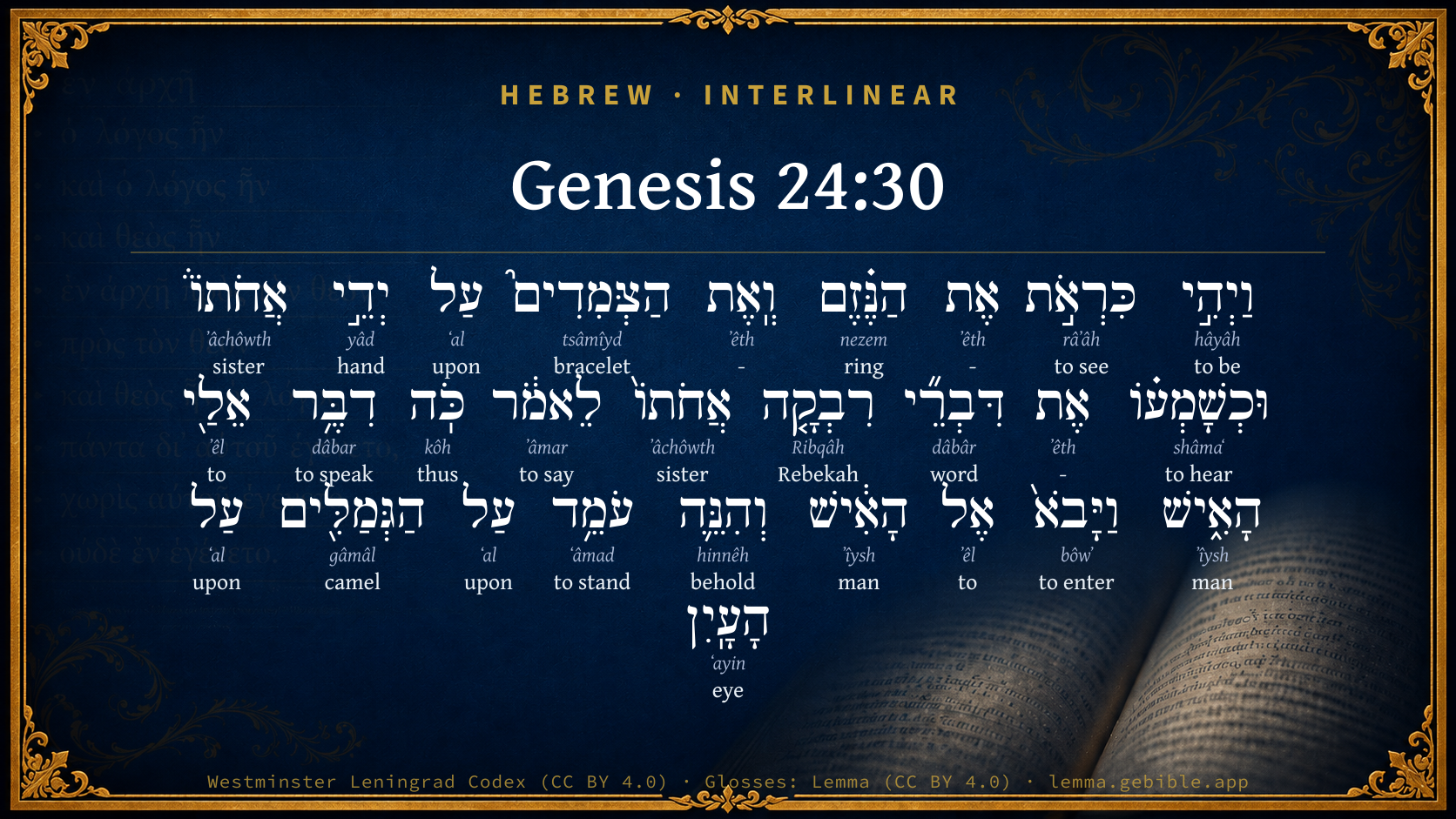
Hebrew (Westminster Leningrad Codex) Genesis 24:30 appears in the Hebrew Old Testament. The text above is from the Westminster Leningrad Codex. Each word links to its Strong’s number, a concise gloss, and parsing drawn from the Open Scriptures Hebrew Bible morphology. Click any word for its full Brown-Driver-Briggs (BDB) entry.
Download image
Cite this verse

Genesis 24:30 (World English Bible). Public Domain. Lemma interlinear Bible study tool, https://lemma.gebible.app/v/genesis/24/30.

Show BibTeX & RIS
BibTeX
RIS
English Translation
It happened, when he saw the ring, and the bracelets on his sister's hands, and when he heard the words of Rebekah his sister, saying, "This is what the man said to me," that he came to the man. Behold, he was standing by the camels at the spring.
World English Bible · Public Domain
Download a study sheet

One document with this verse’s original text, its word-by-word gloss line, the meaning frame, cross-references with their text, attributed commentary, and full source and license credits — printable, and it pastes into notes with its structure intact.

This verse Autodidact and up

Study sheet (.html) Plain text (.txt)

A passage Seminary Student

Up to 50 verses in one chapter. A passage sheet keeps up to 6 commentary sources and 12 cross-references per verse, in the order this page ranks them, and says so on the sheet whenever that leaves anything out. Ask for a single verse and you get the Autodidact verse sheet above.

Everything on this page stays free to read, with no account — the sheet is a download of what is already on screen, not access to it.

Want to remove ads? Support Godless Engineer
Compare translations 3

The same verse in 3 English versions, stacked beneath the original-language interlinear above. Click any original word for its lexicon entry.

Each is an independent rendering of the whole verse — the interlinear is not word-aligned to these translations.

Highlighted words mark where these versions differ — a whole-verse word diff, not a word-by-word alignment.

  • World English Bible Public Domain
    It happened, when he saw the ring, and the bracelets on his sister's hands, and when he heard the words of Rebekah his sister, saying, "This is what the man said to me," that he came to the man. Behold, he was standing by the camels at the spring.
  • King James Version Public Domain
    And it came to pass, when he saw the earring and bracelets upon his sister's hands, and when he heard the words of Rebekah his sister, saying, Thus spake the man unto me; that he came unto the man; and, behold, he stood by the camels at the well.
  • unfoldingWord Literal Text CC BY-SA 4.0
    And it was when he had seen the nose ring and the bracelets on the arms of his sister, and when he had heard the words of Rebekah his sister, saying, “This what the man said to me,” then he went to the man, and behold, he was standing by the camels at the spring.

unfoldingWord Literal Text — © unfoldingWord, licensed CC BY-SA 4.0. Word-aligned USFM3 via Door43 (git.door43.org/unfoldingWord/en_ult).

Versions to compare (up to 4)

3 of 4 selected

Show all 18 translations

Every available English version of this verse, each an independent rendering of the whole verse.

  • World English Bible Public Domain
    It happened, when he saw the ring, and the bracelets on his sister's hands, and when he heard the words of Rebekah his sister, saying, "This is what the man said to me," that he came to the man. Behold, he was standing by the camels at the spring.
  • Berean Standard Bible Public Domain
    As soon as he saw the ring, and the bracelets on his sister’s wrists, and heard Rebekah’s words, “The man said this to me,” he went and found the man standing by the camels near the spring.
  • Majority Standard Bible Public Domain
    As soon as he saw the ring, and the bracelets on his sister’s wrists, and heard Rebekah’s words, “The man said this to me,” he went and found the man standing by the camels near the spring.
  • King James Version Public Domain
    And it came to pass, when he saw the earring and bracelets upon his sister's hands, and when he heard the words of Rebekah his sister, saying, Thus spake the man unto me; that he came unto the man; and, behold, he stood by the camels at the well.
  • American Standard Version (1901) Public Domain
    And it came to pass, when he saw the ring, and the bracelets upon his sister's hands, and when he heard the words of Rebekah his sister, saying, Thus spake the man unto me. That he came unto the man. And, behold, he was standing by the camels at the fountain.
  • Revised Version (1885) Public Domain
    And it came to pass, when he saw the ring, and the bracelets upon his sister’s hands, and when he heard the words of Rebekah his sister, saying, Thus spake the man unto me; that he came unto the man; and, behold, he stood by the camels at the fountain.
  • Geneva Bible (1599) Public Domain
    For when he had seene the earings and the bracelets in his sisters hands, and when he heard the wordes of Rebekah his sister, saying, Thus said the man vnto me, then he went to the man, and loe, he stoode by the camels at the well.
  • Douay-Rheims (1899) Public Domain
    And when he had seen the earrings and bracelets in his sister's hands, and had heard all that she related, saying: Thus and thus the man spoke to me: he came to the man who stood by the camels, and near to the spring of water,
  • Young's Literal Translation Public Domain
    yea, it cometh to pass, when he seeth the ring, and the bracelets on the hands of his sister, and when he heareth the words of Rebekah his sister, saying, `Thus hath the man spoken unto me,' that he cometh in unto the man, and lo, he is standing by the camels by the fountain.
  • Literal Standard Version CC BY-SA 4.0
    indeed, it comes to pass, when he sees the ring, and the bracelets on the hands of his sister, and when he hears the words of his sister Rebekah, saying, “Thus has the man spoken to me,” that he comes to the man, and behold, he is standing by the camels by the fountain.
  • Unlocked Literal Bible CC BY-SA 4.0
    When he had seen the nose ring and the bracelets on his sister's arms, and when he had heard the words of Rebekah his sister, “This is what the man said to me,” he went to the man, and, behold, he was standing by the camels at the spring.
  • unfoldingWord Literal Text CC BY-SA 4.0
    And it was when he had seen the nose ring and the bracelets on the arms of his sister, and when he had heard the words of Rebekah his sister, saying, “This what the man said to me,” then he went to the man, and behold, he was standing by the camels at the spring.
  • Darby Bible Public Domain
    And it came to pass when he saw the ring and the bracelets on his sister's hand, and when he heard the words of Rebecca his sister, saying, Thus spoke the man to me -- that he came to the man, and behold, he was standing by the camels, by the well.
  • World Messianic Bible Public Domain
    When he saw the ring, and the bracelets on his sister’s hands, and when he heard the words of Rebekah his sister, saying, “This is what the man said to me,” he came to the man. Behold, he was standing by the camels at the spring.
  • Webster's Bible Public Domain
    And it came to pass when he saw the ear-ring and bracelets upon his sister's hands, and when he heard the words of Rebekah his sister, saying, Thus spoke the man to me; that he came to the man; and behold, he stood by the camels at the well.
  • Free Bible Version CC BY-SA 4.0
    He'd noticed the nose-ring and the bracelets she was wearing, and he'd heard his sister Rebekah explaining, “This is what the man told me.” When he arrived the man was still there, standing with his camels beside the spring.
  • Bible in Basic English Public Domain
    And when he saw the nose-ring and the ornaments on his sister's hands, and when she gave him word of what the man had said to her, then he went out to the man who was waiting with the camels by the water-spring.
  • JPS Tanakh (1917) Public Domain
    And it came to pass, when he saw the ring, and the bracelets upon his sister's hands, and when he heard the words of Rebekah his sister, saying: 'Thus spoke the man unto me,' that he came unto the man; and, behold, he stood by the camels at the fountain.

Literal Standard Version (2020), Covenant Press — licensed CC BY-SA 4.0. Text via the HelloAO Bible API (eBible.org). Unlocked Literal Bible (unfoldingWord) — licensed CC BY-SA 4.0. Text via the HelloAO Bible API (eBible.org). unfoldingWord Literal Text — © unfoldingWord, licensed CC BY-SA 4.0. Word-aligned USFM3 via Door43 (git.door43.org/unfoldingWord/en_ult). Free Bible Version, Dr. Jonathan Gallagher — licensed CC BY-SA 4.0. Text via the HelloAO Bible API (eBible.org).

Word by word

More ways to search: Search by grammar → Find every occurrence → Compare this word →

Practice this passage: Drill this verse → Learn its vocabulary →

הַצְּמִדִים֮
tsâmîyd
H6781
“the · bracelets”
Particle, Definite Article + Noun, Common, Masculine, Plural, Absolute
Part of Speech
Particle + Noun
Type
Common
Gender
Masculine
Number
Plural
State
Absolute
Full BDB Definition

Origin: from H6775

TWOT: 1927b , 1927c

bracelet - cover (of vessel)
  1. וַיְהִ֣י hâyâh H1961 “and · to be” Conjunction + Verb, Qal, Sequential Imperfect, 3rd Person, Masculine, Singular
  2. כִּרְאֹ֣ת râʼâh H7200 “like/as · to see” Preposition + Verb, Qal, Infinitive Construct
  3. אֶת ʼêth H853 “-” Particle, Direct Object
  4. הַנֶּ֗זֶם nezem H5141 “the · ring” Particle, Definite Article + Noun, Common, Masculine, Singular, Absolute
  5. וְֽאֶת ʼêth H853 “and · -” Conjunction + Particle, Direct Object
  6. עַל ʻal H5921 “upon” Preposition
  7. יְדֵ֣י yâd H3027 “hands of” Noun, Common, Both, Dual, Construct
  8. אֲחֹתוֹ֒ ʼâchôwth H269 “sister · his” Noun, Common, Feminine, Singular, Construct + Suffix, Personal, 3rd Person, Masculine, Singular
  9. וּכְשָׁמְע֗וֹ shâmaʻ H8085 “and · like/as · to hear · him” Conjunction + Preposition + Verb, Qal, Infinitive Construct + Suffix, Personal, 3rd Person, Masculine, Singular
  10. אֶת ʼêth H853 “-” Particle, Direct Object
  11. דִּבְרֵ֞י dâbâr H1697 “words of” Noun, Common, Masculine, Plural, Construct
  12. רִבְקָ֤ה Ribqâh H7259 “Rebekah” Noun, Proper
  13. אֲחֹתוֹ֙ ʼâchôwth H269 “sister · his” Noun, Common, Feminine, Singular, Construct + Suffix, Personal, 3rd Person, Masculine, Singular
  14. לֵאמֹ֔ר ʼâmar H559 “to say” Preposition + Verb, Qal, Infinitive Construct
  15. כֹּֽה kôh H3541 “thus” Adverb
  16. דִבֶּ֥ר dâbar H1696 “to speak” Verb, Piel, Perfect, 3rd Person, Masculine, Singular
  17. אֵלַ֖י ʼêl H413 “to · me” Preposition + Suffix, Personal, 1st Person, Common, Singular
  18. הָאִ֑ישׁ ʼîysh H376 “the · man” Particle, Definite Article + Noun, Common, Masculine, Singular, Absolute
  19. וַיָּבֹא֙ bôwʼ H935 “and · to enter” Conjunction + Verb, Qal, Sequential Imperfect, 3rd Person, Masculine, Singular
  20. אֶל ʼêl H413 “to” Preposition
  21. הָאִ֔ישׁ ʼîysh H376 “the · man” Particle, Definite Article + Noun, Common, Masculine, Singular, Absolute
  22. וְהִנֵּ֛ה hinnêh H2009 “and · behold” Conjunction + Particle, Demonstrative
  23. עֹמֵ֥ד ʻâmad H5975 “standing” Verb, Qal, Participle Active, Masculine, Singular, Absolute
  24. עַל ʻal H5921 “upon” Preposition
  25. הַגְּמַלִּ֖ים gâmâl H1581 “the · camels” Particle, Definite Article + Noun, Common, Masculine, Plural, Absolute
  26. עַל ʻal H5921 “upon” Preposition
  27. הָעָֽיִן ʻayin H5869 “the · eye” Particle, Definite Article + Noun, Common, Both, Singular, Absolute

About this verse

These counts appear in no published source. They are computed here, from the morphology-tagged text and Lemma’s own curated glosses. What Lemma adds →

28
words
21
distinct lemmas
Pentateuch
section

Notable vocabulary

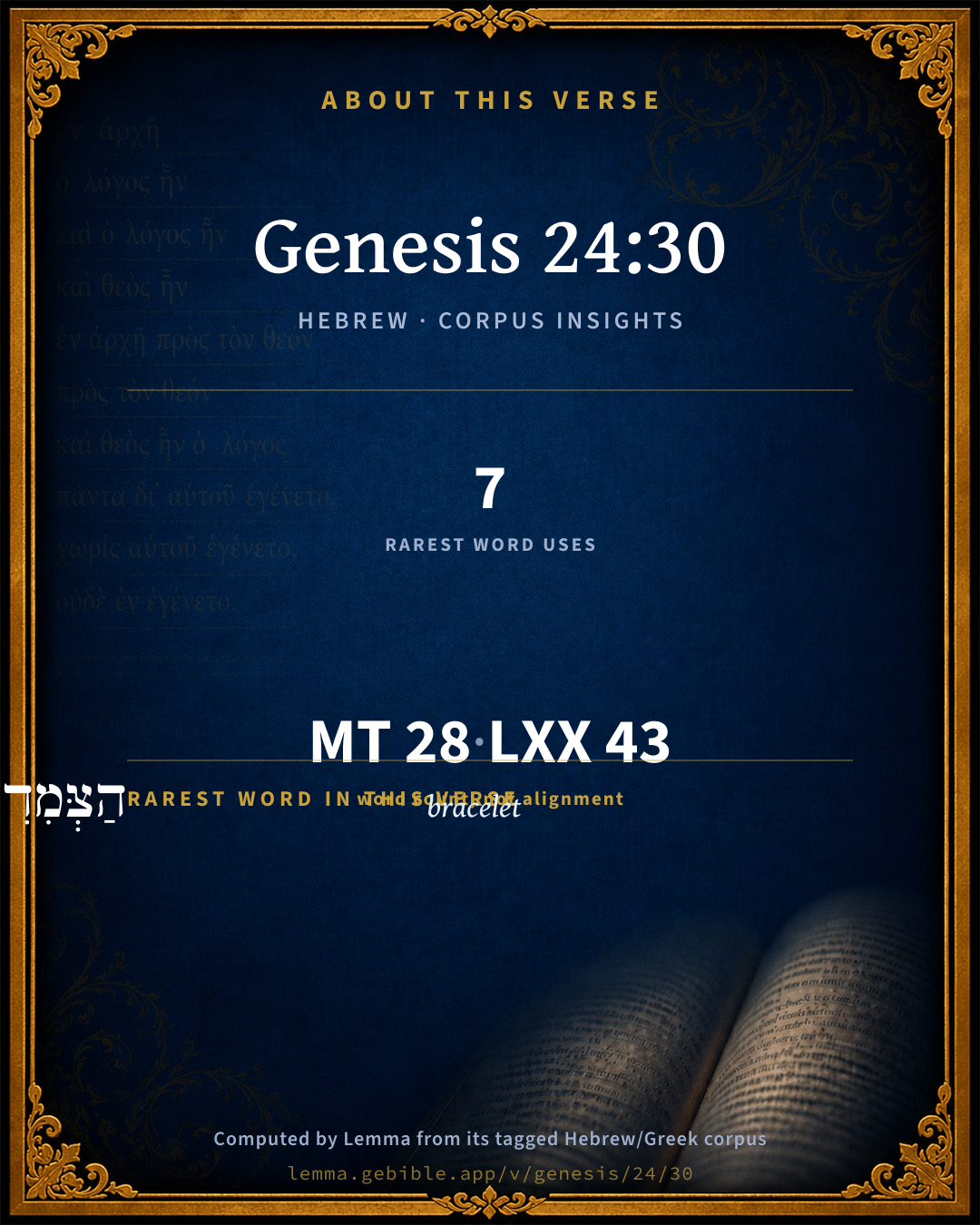
The rarest word here is הַצְּמִדִים֮ bracelet H6781 — appearing just 7 times in the whole Hebrew Bible.

Shared distinctive vocabulary

הַצְּמִדִים֮ bracelet H6781 occurs in 7 verses of the Hebrew Bible. Also found in:

Grammatical profile

  • 7 verbs
  • 11 nouns
  • 5 prepositions
  • 1 adverb
  • 4 particles

Verb forms

  • וַיְהִ֣י Qal · Sequential Imperfect
  • כִּרְאֹ֣ת Qal · Infinitive Construct
  • וּכְשָׁמְע֗וֹ Qal · Infinitive Construct
  • לֵאמֹ֔ר Qal · Infinitive Construct
  • דִבֶּ֥ר Piel · Perfect
  • וַיָּבֹא֙ Qal · Sequential Imperfect
  • עֹמֵ֥ד Qal · Participle Active

Repetition

Words recur within this verse — often emphatic in Hebrew:

  • עַל upon H5921 ×3
  • אֲחֹתוֹ֒ sister H269 ×2
  • הָאִ֑ישׁ man H376 ×2
  • אֵלַ֖י to H413 ×2

Hebrew & Septuagint length

In English translation the verse runs 49 words from the Hebrew and 51 from the Septuagint (LXX English) — closely comparable.

A rough comparison of the two English renderings, which tokenize alike — not a word-level alignment.

Word counts can differ between the Hebrew and the Greek without any difference in meaning — e.g. the Hebrew direct-object marker אֵת has no separate Greek word, and Greek often adds the article ὁ.

In the original languages it is 28 Hebrew tokens and 43 Greek tokens — but the two are counted differently (Hebrew bundles its prefixes and suffixes into one token; the Greek is in lemma form), so that isn’t a like-for-like length.

Hebrew and Greek witnesses Masoretic Hebrew ↔ Greek Septuagint

The same verse in the two great witnesses to the Old Testament, shown verse-for-verse.

These are two independent witnesses, not word-aligned to each other, and the Septuagint is shown in lemma (dictionary) form.

Hebrew Genesis 24:30 Masoretic · Westminster Leningrad Codex

וַיְהִ֣י כִּרְאֹ֣ת אֶת הַנֶּ֗זֶם וְֽאֶת הַצְּמִדִים֮ עַל יְדֵ֣י אֲחֹתוֹ֒ וּכְשָׁמְע֗וֹ אֶת דִּבְרֵ֞י רִבְקָ֤ה אֲחֹתוֹ֙ לֵאמֹ֔ר כֹּֽה דִבֶּ֥ר אֵלַ֖י הָאִ֑ישׁ וַיָּבֹא֙ אֶל הָאִ֔ישׁ וְהִנֵּ֛ה עֹמֵ֥ד עַל הַגְּמַלִּ֖ים עַל הָעָֽיִן

It happened, when he saw the ring, and the bracelets on his sister's hands, and when he heard the words of Rebekah his sister, saying, "This is what the man said to me," that he came to the man. Behold, he was standing by the camels at the spring.

World English Bible · Public Domain

Greek LXX Genesis 24:30 Septuagint · lemma form

καί γίγνομαι ἡνίκα ὁράω ὁ ἐνώτιον καί ὁ ψέλιον ἐπί ὁ χείρ ὁ ἀδελφή αὐτός καί ὅτε ἀκούω ὁ ῥῆμα ρεβεκκα ὁ ἀδελφή αὐτός λέγω οὕτως λαλέω ἐγώ ὁ ἄνθρωπος καί ἔρχομαι πρός ὁ ἄνθρωπος ἵστημι αὐτός ἐπί ὁ κάμηλος ἐπί ὁ πηγή

And it came to pass when he saw the ear-rings and the bracelets on the hands of his sister, and when he heard the words of Rebecca his sister, saying, Thus the man spoke to me, that he went to the man, as he stood by the camels at the well.

LXX2012 (modern English Septuagint) · Public Domain

Hebrew: Westminster Leningrad Codex (CC BY 4.0). Greek: Septuagint (public domain); English from LXX2012 (modern English Septuagint) (Public Domain). How the Septuagint differs from the Hebrew →

Targum (Aramaic paraphrase)

2

The Targum is the ancient Jewish Aramaic paraphrase of the Hebrew Scriptures — an interpretive translation, not the Hebrew text itself. Onkelos (literal) and Pseudo-Jonathan (expansive) render the Torah, and Jonathan the Prophets. Coverage is partial: where no permissively-licensed English translation exists for a verse, only the Aramaic is shown. This is verse-level text, not a word-by-word alignment to the Hebrew.

  1. Targum Onkelos Torah (Genesis–Deuteronomy)
    וַהֲוָה כַּד חָזָא יָת קָדָשָׁא וְיָת שֵׁירַיָּא עַל יְדֵי אֲחָתֵהּ וְכַד שְׁמַע יָת פִּתְגָּמֵי רִבְקָה אֲחָתֵהּ לְמֵימַר כְּדֵין מַלֵּיל עִמִּי גַּבְרָא וַאֲתָא לְוַת גַּבְרָא וְהָא קָאֵם עִלַּוֵּי גַּמְלַיָּא עַל עֵינָא

    (no public-domain English translation for this verse)

    Targum Onkelos — Aramaic: “Onkelos Genesis” (public domain); “Onkelos Exodus” (public domain); “Onkelos Leviticus” (public domain); “Onkelos Numbers” (public domain); “Onkelos Deuteronomy” (public domain). English: “Sefaria Community Translation” (CC0 1.0 (public-domain dedication)); “J.W. Etheridge. The Targums of Onkelos and Jonathan Ben Uzziel on the Pentateuch. London: Longmans, Green, 1862” (public domain). Text via Sefaria.

  2. Targum Pseudo-Jonathan Torah (Genesis–Deuteronomy)
    וַהֲוָה כְּדִי חָמָא יַת קָדָשָׁא וְיַת שֵׁרַיָא עַל יְדֵי אַחְתֵיהּ וְכַד שְׁמַע יַת פִּתְגָמֵי רִבְקָה אַחְתֵיהּ לְמֵימָר כְּדוּן מַלֵיל עִמִי גַבְרָא וְאָתָא לְוַת גַבְרָא וְהָא קָאֵי עֲלוֹי גַמְלַיָא עַל עֵינָא

    And when Laban saw the ring and the bracelets upon the hands of his sister, and heard the words of Rivekah his sister, saying, Thus hath the man spoken with me; he came to the man, and behold, he stood by the camels at the fountain.

    Targum Pseudo-Jonathan — Aramaic: “Targum Jonathan on Genesis” (public domain); “Targum Jonathan on Exodus” (public domain); “Targum Jonathan on Leviticus” (public domain); “Targum Jonathan on Numbers” (public domain); “Targum Jonathan on Deuteronomy” (public domain). English: “The Targum of Jonathan ben Uzziel, trans. J. W. Etheridge, London, 1862” (public domain). Text via Sefaria.

Commentary

Notes on Genesis 24:30 from classic Christian and Jewish commentators (each source and its license shown beneath its notes). The classic Christian expositions comment on the surrounding passage and are grouped to its opening verse, so a note may address several verses; the Jewish commentaries on the Tanakh (Rashi and others) are per-verse, so they appear only where the commentator wrote on this verse.

Lemma curates 59 commentaries, every one of them public domain or Creative Commons licensed, each selected and text-cleaned for this edition rather than reprinted as found. About our sources →

Trapp's Complete Commentary

John Trapp

Gen 24:30 And it came to pass, when he saw the earring and bracelets upon his sister’s hands, and when he heard the words of Rebekah his sister, saying, Thus spake the man unto me; that he came unto the man; and, behold, he stood by the camels at the well.

Ver. 30. When he saw the earring and bracelets.] These were the boons that Laban looked after; these drew the churl forth, and made him so courteous. Worldlings in serving God, serve themselves of God; they follow him for loaves more than for love. Vix diligitur Iesus propter Iesum. Hypocrites would use Christ as a bridge to get to heaven by; which if they could compass, let Christ sink or swim for them, they would not much care. Their love is meretricious, their obedience mercenary; they work only for wages. {a} Fac me pontificem, et ero Christianus, said one Pammachius, a heathen, to the Pope. Those degenerate priests would fain have had priests’ places, when something was to be got, but might not. {Ezr 2:61-62}

{a} These make earth their throne, heaven their footstool. - August.

John Trapp, A Commentary or Exposition upon All the Books of the Old and New Testament (1647–1656) — public domain. Text from a community e-Sword module.

Geneva Bible (1599)

Geneva Bible translators

For he waited on God’s hand, who had now heard his prayer.

Geneva Bible (1599) marginal notes — public domain. Text via Bolls.life.

The Cambridge Bible for Schools and Colleges

gen. ed. J. J. S. Perowne

30. when he saw the ring] With a slight touch of ironical humour, the first hint is thus given of Laban’s avaricious character. The sight of the gold seems to stimulate his courtesy to the servant.

The Cambridge Bible for Schools and Colleges (gen. ed. J. J. S. Perowne; Cambridge University Press, 1878–1918) — public domain. Text from a community e-Sword module.

John Gill's Exposition

And it came to pass, when he saw the earring, and bracelets upon his sister's hands,.... From whence he concluded that he was a rich and generous man she had met with, and might hope to receive a gift also upon giving him an invitation to his house; or however might judge he should be no loser by receiving him kindly and entertaining him generously; therefore it was that he made haste, and ran to him to bring him in; for that Laban was of a covetous disposition, appears from the whole story of him:

and when he heard the words of Rebekah his sister, saying, thus spake the man unto me; inquiring whose daughter she was, and whether there was any room in her father's house for him and those that were with him to lodge in:

that he came unto the man; made haste and ran till he came to him:

and, behold, he stood by the camels at the wall; he did not follow Rebekah, but kept still at the well, expecting somebody would come out of the house and give him an invitation into it, upon Rebekah's representation of him.

John Gill's Exposition of the Whole Bible (1746–1763) — public domain (CC PDM 1.0). Text via the HelloAO Bible API.

Whedon's Commentary on the Bible

Daniel D. Whedon

30. When he saw… and when he heard — What he saw and heard, no doubt, had special influence on his action, and made the blessings and welcome (of Gen_24:31) doubly emphatic.

Daniel D. Whedon (gen. ed.), Commentary on the Old and New Testaments (1874–1909) — public domain. Text from a community e-Sword module.

The Pulpit Commentary

And it cams to pass, when he saw the earring and bracelets upon his sister"s hands (vide ver. 22), and when he heard the words of Rebekah his sister, saying, Thus spake the man unto me; that he came unto the man (this explains the cause of the action mentioned in the previous verse); and, behold, he stood by the camels at the well.

HOMILIES BY F. HASTINGS Ver. 30.

Laban"s eye of greed.

when he saw the bracelets," &c. One thing moved Laban to offer hospitality to a stranger the vision of gold on his sister"s form. ;

I COVETOUSNESS MAKES A MAN CALCULATING WHEN APPEARING TO BE GENEROUS. Laban had not been so pressingly urgent in his invitation if he had not cherished a hope of further advantages. He was a churlish man. He said, "Come in, thou blessed of the Lord," &c., because he saw that which was to him the greatest sign of blessing wealth. Laban helped the more readily to ungird Eliezer"s camels because he hoped thereby to loosen the girdle-purse of his visitor. ;

He had the eye of greed. He could not see anything valuable belonging to another without wishing to possess it.

II COVETOUSNESS MAKES A MAN, GENERALLY, SHORTSIGHTED WITH RESPECT TO HIS OWN BEST INTERESTS. Laban gave Eliezer a bad impression of himself. The latter would soon see through such a man as Laban. He showed this when he gave presents not only to the sister and mother, but to the brother (ver. 53). He knew that it would not he advisable to overlook Laban. Eliezer knew he could be bought. Laban, when treating with Jacob, was just as short-sighted. He gave Leah and Rachel to Jacob as wives only after years of service for which he stipulated. He changed Jacob"s wages ten times. Through his greed he at last lost Jacob. He confessed how great a helper Jacob had been. "The Lord hath blessed me for thy sake". (Gen_30:27) Jacob would not tarry with him, and even the daughters were glad enough to get away from such a father. Covetousness is opposed to our temporal and eternal interests. We lose by it the respect of others here and of God hereafter.

III COVETOUSNESS IS EVER INDIFFERENT TO THE RIGHTFUL CLAIMS OF OTHERS. It will ignore those claims altogether, if possible.

1. We find Laban thus ignored the influence of his father throughout the whole transaction. Perhaps Bethuel was infirm or aged, but he is, consistently with the character of Laban, thrust into the back-ground. Laban also takes all presents, and there is no mention of any being given to his father.

2. We find also he was in great measure indifferent to the happiness of his sister. He was subtle in tongue, and spoke of the Lord arranging things, but he believed in the arrangement because his family was the gainer. A good chance is offered by the Damascene stranger, and Rebekah soon saw that it was a foregone conclusion that she should go with him. Covetousness will make parents careless as to the physical, mental, and moral well-being of their children, and employers care- less of the state of their servants. It is covetousness also that leads many to spread temptations, too strong to be resisted, before others, and one nation to get rich out of that which is sapping the life-blood of another.

IV COVETOUSNESS NEVER SATISFIES, AND OFT MAKES MEN MOST MISERABLE. "He that is greedy of gain troubleth his house." "Envy is rottenness to the bones." Misers perish in the midst of plenty.

Riches possessed, the desire for more is generally intensified. The desire is no more checked than a lamp is extinguished by added oil.

V COVETOUSNESS IS SURE, SOONER OR LATER, TO BE REBUKED. The greed in Laban"s eye which glistened at the sight of the golden ornaments on his sister"s form deepened with the passage of years. At last, in his pursuit of Jacob, he was rebuked by God in a vision, and afterwards by the man he had wronged. Learn, therefore, that medium prosperity is better than great riches gained by greed. Despise not the comforts of life, but live for something higher. What is gained in the world is speedily gone. If we gain much and ruin our souls, we shall not only be rejected by God, but shall bitterly condemn ourselves. H.

The Pulpit Commentary (1880–1919), ed. H.D.M. Spence-Jones & Joseph S. Exell — public domain. Text from a community e-Sword module.

Rashi

Rabbi Shlomo Yitzchaki (Rashi)

על הגמלים [HE WAS STANDING] BY THE CAMELS — to look after them. The phrase is the same as (18:8) “And he (Abraham) stood by them עומד עליהם"— to wait on them.

Rashi on the Tanakh — English translations: “The Judaica Press complete Tanach with Rashi, translated by A. J. Rosenberg” (CC BY 4.0); “Pentateuch with Rashi's commentary by M. Rosenbaum and A.M. Silbermann, 1929-1934” (public domain); “The Metsudah Tanach series, Lakewood, N.J” (CC BY 4.0); and “The Book of Joshua, Metsudah Publications, 1997” (CC BY 4.0). Text via Sefaria.

Sforno

Rabbi Ovadia Sforno

When he had seen. He felt obliged to show gratitude for the gifts.

And heard the words. That Eliezer had asked for lodgings.

He came to the man. To bring him to his home. Standing beside the camels.

He did not show any expectation of being granted lodgings until Lavan offered

Sforno on the Tanakh — English translation: “Yalkut, Sifsei Chachomim Chumash, Metsudah Publications, 2009” (CC BY 4.0). Text via Sefaria.

Radak

Rabbi David Kimhi (Radak)

ויהי כראות, this is reported in order to inform us that Lavan was envious of anyone getting something he did not have, even including his sister. He was the opposite of his sister who had displayed such generous traits. Lavan ran in order to bring these precious items into his own house.

וכשמעו, when he heard that the stranger had spoken to his sister concerning selecting a wife for the son of his master. This is what is meant by

כה דבר אלי האיש. עמד על הגמלים. The words על הגמלים mean the same as עם הגמלים, next to the camels. We have a parallel construction in Exodus 35,22 ויבאו האנשים על הנשים, “the men came in addition to the women.” The meaning here is that Eliezer was seen by Lavan as standing as if waiting for Rivkah to return accompanied by a senior member of the family to invite him and escort him to their home.

Radak on the Tanakh — English translations: “Sefaria Community Translation” (CC0 1.0 (public-domain dedication)); “Eliyahu Munk, HaChut Hameshulash” (CC BY 4.0); “Rabbi Mike Feuer, Jerusalem Anthology” (CC BY 4.0); and “R. David Kimhi on the first book of Psalms, Translated by R.G. Finch, London, 1919” (public domain). Text via Sefaria.

Lesson kit

Teaching starters — assembled from the data on this page, not authored interpretation. Every prompt links to the verse data it draws on. Edit before teaching.

Genesis, in the Pentateuch, opens this verse with 28 words (21 distinct Hebrew lemmas). Its most distinctive word is tsâmîyd (“bracelet”). A historical commentator’s framing appears above. Read the whole chapter for the surrounding context.

Discussion questions

  1. How does “bracelet” (tsâmîyd) shape what this verse is saying?
  2. How does Genesis 24:22, which shares the word «bracelet», read alongside this verse?
  3. What does the repetition of “upon” (3× in this one verse) do in this verse?
  4. The translations on this page render this verse differently — a whole-verse word diff, not a word-by-word alignment. What might account for the different wordings?
  5. «וַיְהִ֣י» is a Qal Sequential Imperfect verb. How does that grammatical form shape the action described?
  6. Compare how Trapp's Complete Commentary and Geneva Bible (1599) read this verse. Where do they agree or differ?

Things to notice

Reading settings

Reading text

Shown beneath each verse's original-language words.

Old Testament
Old Testament edition

Read the OT as the Masoretic Hebrew (MT) or the Greek Septuagint (LXX).

English shown for the Greek Septuagint (in the Hebrew ↔ Greek comparison).

Comparing translations? Open the Compare panel on any verse page to stack up to four side by side.