
Genesis 43:16

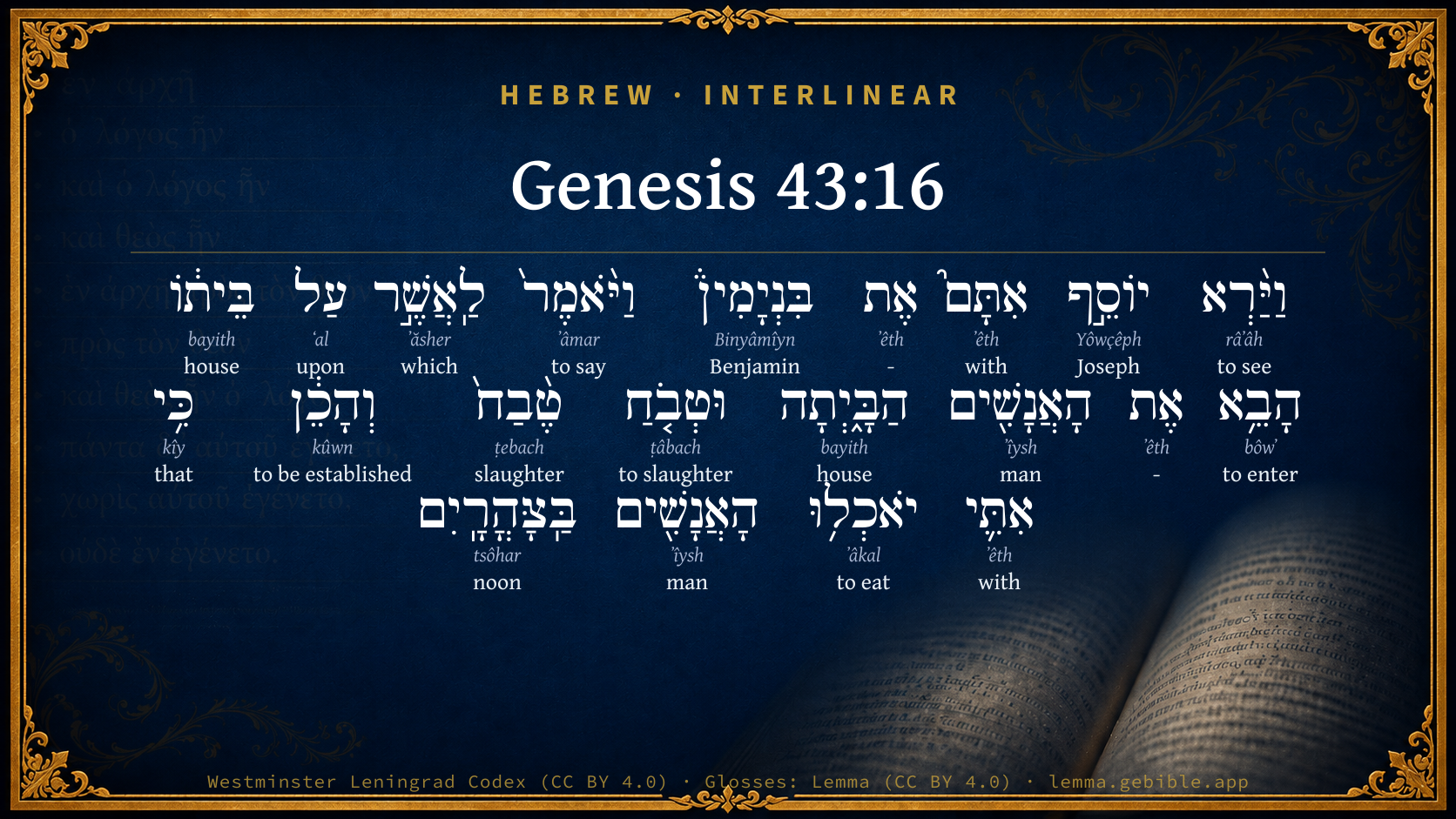
Hebrew (Westminster Leningrad Codex) Genesis 43:16 appears in the Hebrew Old Testament. The text above is from the Westminster Leningrad Codex. Each word links to its Strong’s number, a concise gloss, and parsing drawn from the Open Scriptures Hebrew Bible morphology. Click any word for its full Brown-Driver-Briggs (BDB) entry.
Download image
Cite this verse

Genesis 43:16 (World English Bible). Public Domain. Lemma interlinear Bible study tool, https://lemma.gebible.app/v/genesis/43/16.

Show BibTeX & RIS
BibTeX
RIS
English Translation
When Joseph saw Benjamin with them, he said to the steward of his house, "Bring the men into the house, and butcher an animal, and make ready; for the men will dine with me at noon."
World English Bible · Public Domain
Highlights
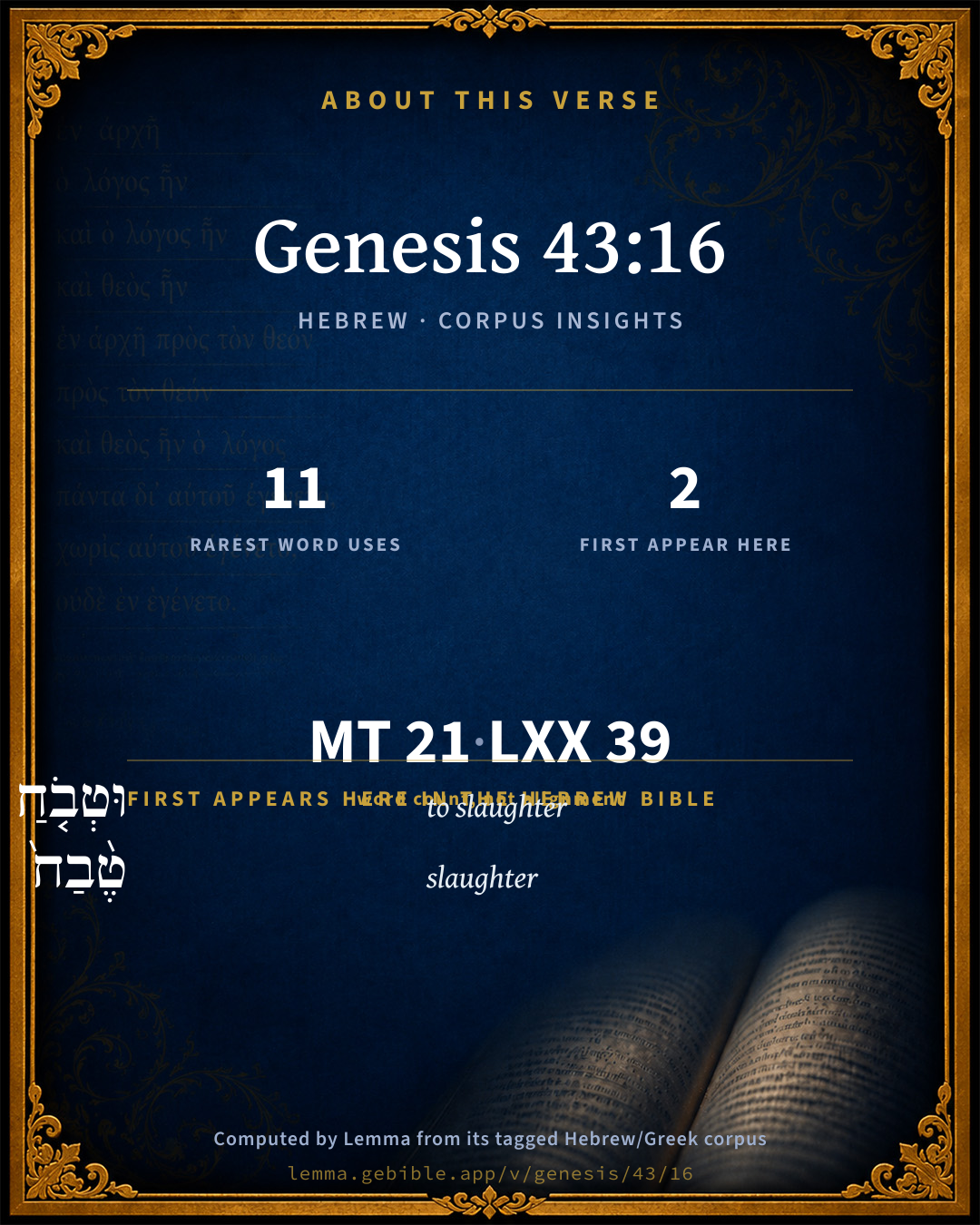
  • 2 first appearances in the Hebrew Bible
Full analysis ↓
Download a study sheet

One document with this verse’s original text, its word-by-word gloss line, the meaning frame, cross-references with their text, attributed commentary, and full source and license credits — printable, and it pastes into notes with its structure intact.

This verse Autodidact and up

Study sheet (.html) Plain text (.txt)

A passage Seminary Student

Up to 50 verses in one chapter. A passage sheet keeps up to 6 commentary sources and 12 cross-references per verse, in the order this page ranks them, and says so on the sheet whenever that leaves anything out. Ask for a single verse and you get the Autodidact verse sheet above.

Everything on this page stays free to read, with no account — the sheet is a download of what is already on screen, not access to it.

Want to remove ads? Support Godless Engineer
Compare translations 3

The same verse in 3 English versions, stacked beneath the original-language interlinear above. Click any original word for its lexicon entry.

Each is an independent rendering of the whole verse — the interlinear is not word-aligned to these translations.

Highlighted words mark where these versions differ — a whole-verse word diff, not a word-by-word alignment.

  • World English Bible Public Domain
    When Joseph saw Benjamin with them, he said to the steward of his house, "Bring the men into the house, and butcher an animal, and make ready; for the men will dine with me at noon."
  • King James Version Public Domain
    And when Joseph saw Benjamin with them, he said to the ruler of his house, Bring these men home, and slay, and make ready; for these men shall dine with me at noon.
  • unfoldingWord Literal Text CC BY-SA 4.0
    And Joseph saw Benjamin with them. Then he said to who over his house, “Take the men to the house, and slaughter an animal and prepare, because the men will eat with me at noon.”

unfoldingWord Literal Text — © unfoldingWord, licensed CC BY-SA 4.0. Word-aligned USFM3 via Door43 (git.door43.org/unfoldingWord/en_ult).

Versions to compare (up to 4)

3 of 4 selected

Show all 18 translations

Every available English version of this verse, each an independent rendering of the whole verse.

  • World English Bible Public Domain
    When Joseph saw Benjamin with them, he said to the steward of his house, "Bring the men into the house, and butcher an animal, and make ready; for the men will dine with me at noon."
  • Berean Standard Bible Public Domain
    When Joseph saw Benjamin with his brothers, he said to the steward of his house, “Take these men to my house. Slaughter an animal and prepare it, for they shall dine with me at noon.”
  • Majority Standard Bible Public Domain
    When Joseph saw Benjamin with his brothers, he said to the steward of his house, “Take these men to my house. Slaughter an animal and prepare it, for they shall dine with me at noon.”
  • King James Version Public Domain
    And when Joseph saw Benjamin with them, he said to the ruler of his house, Bring these men home, and slay, and make ready; for these men shall dine with me at noon.
  • American Standard Version (1901) Public Domain
    And when Joseph saw Benjamin with them, he said to the steward of his house, Bring the men into the house, and slay, and make ready; for the men shall dine with me at noon.
  • Revised Version (1885) Public Domain
    And when Joseph saw Benjamin with them, he said to the steward of his house, Bring the men into the house, and slay, and make ready; for the men shall dine with me at noon.
  • Geneva Bible (1599) Public Domain
    And whe Ioseph saw Beniamin with them, he sayde to his stewarde, Bring these men home and kill meate, and make ready: for the men shall eate with me at noone.
  • Douay-Rheims (1899) Public Domain
    And when he had seen them, and Benjamin with them, he commanded the steward of his house, saying: Bring in the men into the house, and kill victims, and prepare a feast: because they shall eat with me at noon.
  • Young's Literal Translation Public Domain
    and Joseph seeth Benjamin with them, and saith to him who `is' over his house, `Bring the men into the house, and slaughter an animal, and make ready, for with me do the men eat at noon.'
  • Literal Standard Version CC BY-SA 4.0
    and Joseph sees Benjamin with them and says to him who [is] over his house, “Bring the men into the house, and slaughter an animal, and make ready, for the men eat with me at noon.”
  • Unlocked Literal Bible CC BY-SA 4.0
    When Joseph saw Benjamin with them, he said to the steward of his house, “Bring the men into the house, slaughter an animal and prepare it, for the men will eat with me at noon.”
  • unfoldingWord Literal Text CC BY-SA 4.0
    And Joseph saw Benjamin with them. Then he said to who over his house, “Take the men to the house, and slaughter an animal and prepare, because the men will eat with me at noon.”
  • Darby Bible Public Domain
    And Joseph saw Benjamin with them, and said to the [man] who was over his house, Bring the men into the house, and slaughter cattle, and make ready; for the men shall eat with me at noon.
  • World Messianic Bible Public Domain
    When Joseph saw Benjamin with them, he said to the steward of his house, “Bring the men into the house, and butcher an animal, and prepare; for the men will dine with me at noon.”
  • Webster's Bible Public Domain
    \\43:17\\And the man did as Joseph commanded: and the man brought the men into Joseph's house.
  • Free Bible Version CC BY-SA 4.0
    When Joseph saw Benjamin was with them, he told his household supervisor, “Take these men to my house. Slaughter an animal and make a meal, for they are going to eat with me at noon.”
  • Bible in Basic English Public Domain
    And the servant did as Joseph said, and took the men into Joseph's house.
  • JPS Tanakh (1917) Public Domain
    And when Joseph saw Benjamin with them, he said to the steward of his house: 'Bring the men into the house, and kill the beasts, and prepare the meat; for the men shall dine with me at noon.'

Literal Standard Version (2020), Covenant Press — licensed CC BY-SA 4.0. Text via the HelloAO Bible API (eBible.org). Unlocked Literal Bible (unfoldingWord) — licensed CC BY-SA 4.0. Text via the HelloAO Bible API (eBible.org). unfoldingWord Literal Text — © unfoldingWord, licensed CC BY-SA 4.0. Word-aligned USFM3 via Door43 (git.door43.org/unfoldingWord/en_ult). Free Bible Version, Dr. Jonathan Gallagher — licensed CC BY-SA 4.0. Text via the HelloAO Bible API (eBible.org).

Word by word

More ways to search: Search by grammar → Find every occurrence → Compare this word →

Practice this passage: Drill this verse → Learn its vocabulary →

וּטְבֹ֤חַ
ṭâbach
H2873
“and · slaughter”
Conjunction + Verb, Qal, Imperative, 2nd Person, Masculine, Singular
Part of Speech
Conjunction + Verb
Stem
Qal
Form
Imperative
Person
2nd Person
Gender
Masculine
Number
Singular
Full BDB Definition

Origin: a primitive root

TWOT: 786

to slaughter, slay, butcher, kill ruthlessly - (Qal) - to slaughter, butcher - to slay, kill ruthlessly (figuratively)
  1. וַיַּ֨רְא râʼâh H7200 “and · to see” Conjunction + Verb, Qal, Sequential Imperfect, 3rd Person, Masculine, Singular
  2. יוֹסֵ֣ף Yôwçêph H3130 “Joseph” Noun, Proper
  3. אִתָּם֮ ʼêth H854 “with · them” Preposition + Suffix, Personal, 3rd Person, Masculine, Plural
  4. אֶת ʼêth H853 “-” Particle, Direct Object
  5. בִּנְיָמִין֒ Binyâmîyn H1144 “Benjamin” Noun, Proper
  6. וַיֹּ֨אמֶר֙ ʼâmar H559 “and · to say” Conjunction + Verb, Qal, Sequential Imperfect, 3rd Person, Masculine, Singular
  7. לַֽאֲשֶׁ֣ר ʼăsher H834 “to/for · which” Preposition + Particle, Relative
  8. עַל ʻal H5921 “upon” Preposition
  9. בֵּית֔וֹ bayith H1004 “house · his” Noun, Common, Masculine, Singular, Construct + Suffix, Personal, 3rd Person, Masculine, Singular
  10. הָבֵ֥א bôwʼ H935 “enter” Verb, Hiphil, Imperative, 2nd Person, Masculine, Singular
  11. אֶת ʼêth H853 “-” Particle, Direct Object
  12. הָאֲנָשִׁ֖ים ʼîysh H376 “the · men” Particle, Definite Article + Noun, Common, Masculine, Plural, Absolute
  13. הַבָּ֑יְתָה bayith H1004 “the · house” Particle, Definite Article + Noun, Common, Masculine, Singular, Absolute + Suffix, h
  14. טֶ֨בַח֙ ṭebach H2874 “slaughter” Noun, Common, Masculine, Singular, Absolute
  15. וְהָכֵ֔ן kûwn H3559 “and · be established” Conjunction + Verb, Hiphil, Imperative, 2nd Person, Masculine, Singular
  16. כִּ֥י kîy H3588 “that” Conjunction
  17. אִתִּ֛י ʼêth H854 “with · me” Preposition + Suffix, Personal, 1st Person, Common, Singular
  18. יֹאכְל֥וּ ʼâkal H398 “to eat” Verb, Qal, Imperfect, 3rd Person, Masculine, Plural
  19. הָאֲנָשִׁ֖ים ʼîysh H376 “the · men” Particle, Definite Article + Noun, Common, Masculine, Plural, Absolute
  20. בַּֽצָּהֳרָֽיִם tsôhar H6672 “in/at the · noon” Preposition, Determined + Noun, Common, Masculine, Plural, Absolute

About this verse

These counts appear in no published source. They are computed here, from the morphology-tagged text and Lemma’s own curated glosses. What Lemma adds →

21
words
17
distinct lemmas
Pentateuch
section

Notable vocabulary

The rarest word here is וּטְבֹ֤חַ to slaughter H2873 — appearing just 11 times in the whole Hebrew Bible.

First appearance in Scripture

These words make their first canonical appearance in the Hebrew Bible here:

  • וּטְבֹ֤חַ to slaughter H2873
  • טֶ֨בַח֙ slaughter H2874

Shared distinctive vocabulary

וּטְבֹ֤חַ to slaughter H2873 occurs in 11 verses of the Hebrew Bible. Also found in:

Grammatical profile

  • 6 verbs
  • 8 nouns
  • 3 prepositions
  • 1 conjunction
  • 3 particles

Verb forms

  • וַיַּ֨רְא Qal · Sequential Imperfect
  • וַיֹּ֨אמֶר֙ Qal · Sequential Imperfect
  • הָבֵ֥א Hiphil · Imperative
  • וּטְבֹ֤חַ Qal · Imperative
  • וְהָכֵ֔ן Hiphil · Imperative
  • יֹאכְל֥וּ Qal · Imperfect

Repetition

Words recur within this verse — often emphatic in Hebrew:

  • בֵּית֔וֹ house H1004 ×2
  • הָאֲנָשִׁ֖ים man H376 ×2
  • אִתָּם֮ with H854 ×2

Hebrew & Septuagint length

In English translation the verse runs 36 words from the Hebrew and 45 from the Septuagint (LXX English) — closely comparable.

A rough comparison of the two English renderings, which tokenize alike — not a word-level alignment.

Word counts can differ between the Hebrew and the Greek without any difference in meaning — e.g. the Hebrew direct-object marker אֵת has no separate Greek word, and Greek often adds the article ὁ.

In the original languages it is 21 Hebrew tokens and 39 Greek tokens — but the two are counted differently (Hebrew bundles its prefixes and suffixes into one token; the Greek is in lemma form), so that isn’t a like-for-like length.

Cross-references

11

Topical passages linked to Genesis 43:16 in the Treasury of Scripture Knowledge — connected by theme and wording, ordered by reader-vote popularity; previews shown in the World English Bible.

  • Genesis 44:1 He commanded the steward of his house, saying, "Fill the men's sacks with food, as much as they can carry, and put every man's money in his sack's mouth.
  • Genesis 43:19 They came near to the steward of Joseph's house, and they spoke to him at the door of the house,
  • Genesis 15:2 Abram said, "Lord Yahweh, what will you give me, seeing I go childless, and he who will inherit my estate is Eliezer of Damascus?"
  • Genesis 21:8 The child grew, and was weaned. Abraham made a great feast on the day that Isaac was weaned.
  • Genesis 24:2–10 Abraham said to his servant, the elder of his house, who ruled over all that he had, "Please put your hand under my thigh.
  • Genesis 26:30 He made them a feast, and they ate and drink.
  • Genesis 31:54 Jacob offered a sacrifice in the mountain, and called his relatives to eat bread. They ate bread, and stayed all night in the mountain.
  • Genesis 39:4–5 Joseph found favor in his sight. He ministered to him, and he made him overseer over his house, and all that he had he put into his hand.
  • Genesis 44:4 When they had gone out of the city, and were not yet far off, Joseph said to his steward, "Up, follow after the men. When you overtake them, ask them, 'Why have you rewarded evil for good?
  • 1 Samuel 25:11 Shall I then take my bread, and my water, and my meat that I have killed for my shearers, and give it to men who I don't know where they come from?
  • Proverbs 9:2 She has prepared her meat. She has mixed her wine. She has also set her table.

Cross-references courtesy of OpenBible.info (CC BY 4.0).

Hebrew and Greek witnesses Masoretic Hebrew ↔ Greek Septuagint

The same verse in the two great witnesses to the Old Testament, shown verse-for-verse.

These are two independent witnesses, not word-aligned to each other, and the Septuagint is shown in lemma (dictionary) form.

Hebrew Genesis 43:16 Masoretic · Westminster Leningrad Codex

וַיַּ֨רְא יוֹסֵ֣ף אִתָּם֮ אֶת בִּנְיָמִין֒ וַיֹּ֨אמֶר֙ לַֽאֲשֶׁ֣ר עַל בֵּית֔וֹ הָבֵ֥א אֶת הָאֲנָשִׁ֖ים הַבָּ֑יְתָה וּטְבֹ֤חַ טֶ֨בַח֙ וְהָכֵ֔ן כִּ֥י אִתִּ֛י יֹאכְל֥וּ הָאֲנָשִׁ֖ים בַּֽצָּהֳרָֽיִם

When Joseph saw Benjamin with them, he said to the steward of his house, "Bring the men into the house, and butcher an animal, and make ready; for the men will dine with me at noon."

World English Bible · Public Domain

Greek LXX Genesis 43:16 Septuagint · lemma form

ὁράω δέ ιωσηφ αὐτός καί ὁ βενιαμίν ὁ ἀδελφός αὐτός ὁ ὁμομήτριος καί εἶπον ὁ ἐπί ὁ οἰκία αὐτός εἰςἄγω ὁ ἄνθρωπος εἰς ὁ οἰκία καί σφάζω θῦμα καί ἑτοιμάζω μετά ἐγώ γάρ ἐσθίω ὁ ἄνθρωπος ἄρτος ὁ μεσημβρία

And Joseph saw them and his brother Benjamin, born of the same mother; and he said to the steward of his household, Bring the men into the house, and kill beasts and make ready, for the men are to eat bread with me at noon.

LXX2012 (modern English Septuagint) · Public Domain

Hebrew: Westminster Leningrad Codex (CC BY 4.0). Greek: Septuagint (public domain); English from LXX2012 (modern English Septuagint) (Public Domain). How the Septuagint differs from the Hebrew →

Targum (Aramaic paraphrase)

2

The Targum is the ancient Jewish Aramaic paraphrase of the Hebrew Scriptures — an interpretive translation, not the Hebrew text itself. Onkelos (literal) and Pseudo-Jonathan (expansive) render the Torah, and Jonathan the Prophets. Coverage is partial: where no permissively-licensed English translation exists for a verse, only the Aramaic is shown. This is verse-level text, not a word-by-word alignment to the Hebrew.

  1. Targum Onkelos Torah (Genesis–Deuteronomy)
    וַחֲזָא יוֹסֵף עִמְּהוֹן יָת בִּנְיָמִין וַאֲמַר לְדִי מְמַנָּא עַל בֵּיתֵהּ אָעֵיל יָת גֻּבְרַיָּא לְבֵיתָא וּנְכוֹס נִכְסָתָא וְאַתְקֵין אֲרֵי עִמִּי יֵיכְלוּן גֻּבְרַיָּא בְּשֵׁירוּתָא

    (no public-domain English translation for this verse)

    Targum Onkelos — Aramaic: “Onkelos Genesis” (public domain); “Onkelos Exodus” (public domain); “Onkelos Leviticus” (public domain); “Onkelos Numbers” (public domain); “Onkelos Deuteronomy” (public domain). English: “Sefaria Community Translation” (CC0 1.0 (public-domain dedication)); “J.W. Etheridge. The Targums of Onkelos and Jonathan Ben Uzziel on the Pentateuch. London: Longmans, Green, 1862” (public domain). Text via Sefaria.

  2. Targum Pseudo-Jonathan Torah (Genesis–Deuteronomy)
    וַחֲמָא יוֹסֵף עִמְהוֹן יַת בִּנְיָמִין וַאֲמַר לִמְנַשֶׁה דִמְמַנָא אַפִּיטְרוֹפּוֹס עַל בֵּיתֵיהּ אָעֵיל יַת גוּבְרַיָא לְבֵיתָא וּפְרַע בֵּית נִיכְסְתָא וְסַב גִידָא נַשְׁיָא וְאַתְקַן תַּבְשִׁילָא בְּאַפֵּיהוֹן אֲרוּם עִמִי יֵיכְלוּן גוּבְרַיָא בְּאִישׁוֹן שֵׁירוּתָא דְטִיהֲרָא

    And Joseph saw Benjamin with them: and he said to Menasheh whom he had made superintendent over his house, Bring the men into the house, and unloose the house of slaughter, and take out the sinew that shrank, and prepare meat before them; for the man shall eat with me at the time of the noonjday meal.

    Targum Pseudo-Jonathan — Aramaic: “Targum Jonathan on Genesis” (public domain); “Targum Jonathan on Exodus” (public domain); “Targum Jonathan on Leviticus” (public domain); “Targum Jonathan on Numbers” (public domain); “Targum Jonathan on Deuteronomy” (public domain). English: “The Targum of Jonathan ben Uzziel, trans. J. W. Etheridge, London, 1862” (public domain). Text via Sefaria.

Commentary

Notes on Genesis 43:16 from classic Christian and Jewish commentators (each source and its license shown beneath its notes). The classic Christian expositions comment on the surrounding passage and are grouped to its opening verse, so a note may address several verses; the Jewish commentaries on the Tanakh (Rashi and others) are per-verse, so they appear only where the commentator wrote on this verse.

Lemma curates 59 commentaries, every one of them public domain or Creative Commons licensed, each selected and text-cleaned for this edition rather than reprinted as found. About our sources →

Trapp's Complete Commentary

John Trapp

Gen 43:16 And when Joseph saw Benjamin with them, he said to the ruler of his house, Bring [these] men home, and slay, and make ready; for [these] men shall dine with me at noon.

Ver. 16. Slay, and make ready.] Heb., Slay a slaughter of beasts, as at feasts is usual. Quaere nunc cur subito moriamur? saith Seneca; quia mortibas vivimus; What wonder we die suddenly, that live by the death of others?

Shall dine with me at noon.] After serious business despatched in the morning. Aristotle disposed of the morning in studying philosophy; of the afternoon in eloquence, or whatever else he made his recreation.

John Trapp, A Commentary or Exposition upon All the Books of the Old and New Testament (1647–1656) — public domain. Text from a community e-Sword module.

Whedon's Commentary on the Bible

Daniel D. Whedon

RECEPTION AND FEAST AT JOSEPH’S HOUSE, Gen_43:16-34.

16. The ruler of his house — His steward, who had oversight of his domestic affairs.

Daniel D. Whedon (gen. ed.), Commentary on the Old and New Testaments (1874–1909) — public domain. Text from a community e-Sword module.

Tyndale Open Study Notes

Tyndale Open Resources

43:16 When Joseph saw Benjamin with them: Joseph now knew that Benjamin was well (see study note on 42:1–44:34). The feast was both a celebration and a test.

Tyndale Open Study Notes — © Tyndale Open Resources, licensed CC BY-SA 4.0. Text via the HelloAO Bible API.

Geneva Bible (1599)

Geneva Bible translators

Or, to the ruler of his house.

Geneva Bible (1599) marginal notes — public domain. Text via Bolls.life.

Jamieson, Fausset & Brown

Robert Jamieson, A. R. Fausset & David Brown

ruler of his house--In the houses of wealthy Egyptians one upper man servant was intrusted with the management of the house (compare Gen 39:5).

slay, and make ready--Hebrew, "kill a killing"--implying preparations for a grand entertainment (compare Gen 31:54; Sa1 25:11; Pro 9:2; Mat 22:4). The animals have to be killed as well as prepared at home. The heat of the climate requires that the cook should take the joints directly from the hands of the flesher, and the Oriental taste is, from habit, fond of newly killed meat. A great profusion of viands, with an inexhaustible supply of vegetables, was provided for the repasts, to which strangers were invited, the pride of Egyptian people consisting rather in the quantity and variety than in the choice or delicacy of the dishes at their table.

dine . . . at noon--The hour of dinner was at midday.

Jamieson, Fausset & Brown — Commentary Critical and Explanatory on the Whole Bible (1871) — public domain (CC PDM 1.0). Text via the HelloAO Bible API.

Adam Clarke's Commentary

Verse 16. Slay, and make ready] טבח טבח teboach tebach, slay a slaying, or make a great slaughter - let preparations be made for a great feast or entertainment. See a similar form of speech, Pr 9:2; 1Sa 25:11; and Ge 31:54.

Adam Clarke's Commentary on the Bible (1810–1826) — public domain. Text from a community e-Sword/MySword module.

John Calvin's Commentaries

16. And he said to the ruler of his house. Here we perceive the fraternal disposition of Joseph; though it is uncertain whether he was perfectly reconciled, as I will shortly show, in its proper place. If, however, remembering the injury, he loved his brethren less than before, he was still far from having vindictive feelings towards them. But because it was something suspicious that foreigners and men of ignoble rank should be received in a friendly manner, like known guests, to a banquet, by the chief governor of the kingdom, the sons of Jacob would conceive a new fear; namely, that he wished to cast them all into chains; and that their money had been craftily concealed in their sacks, in order that it might prove the occasion of accusation against them. It is however probable, that the crime which they had committed against Joseph, occurred to their minds, and that this fear had proceeded from a guilty conscience. For, unless the judgment of God had tormented them, there was no cause why they should apprehend such an act of perfidy. It may seem absurd, that unknown men should be received to a feast by a prince of the highest dignity. But why not rather incline to a different conjecture; namely, that the governor of Egypt has done this for the purpose of exhibiting to his friends the new and unwonted spectacle of eleven brethren sitting at one table? It will, indeed, sometimes happen that similar anxiety to that felt by Joseph’s brethren, may invade even the best of men; but I would rather ascribe it to the judgment of God, that the sons of Jacob, whose conscience accused them of having inhumanely treated their brother, suspected that they would be dealt with in the same manner. However, they take an early opportunity of vindicating themselves, before inquiry is made respecting the theft. Now, freely to declare that the money had been found in their sacks, and that they had brought it from home to repay it immediately was a strong mark of their innocence. Moreover, they do this in the very porch of the house, because they suspected that, as soon as they entered, the question would be put to them.

John Calvin's Commentaries (1540-1563) — public domain. Text from the Calvin Translation Society English edition (1840s-50s) via the Christian Classics Ethereal Library (ccel.org). Calvin's coverage is partial (roughly two-thirds of the Bible); uncommented books and verses are honest gaps, never fabricated. The 19th-century editor's footnotes and remarks are omitted so the notes are faithfully Calvin's own voice.

Ellicott's Commentary for English Readers

(16) Slay.—The charge of inaccuracy brought against the narrator, upon the supposition that the higher classes in Egypt, especially the priests, did not eat flesh, has been abundantly disproved, as the representations of feasts belonging to this period show that an abundance of animal food was consumed. Animals, moreover, sacred in one district were freely eaten in another. Generally the priests might eat the flesh of oxen and geese, but not mutton, pork or fish. (Rawlinson’s Egypt, i. 438.)

A Bible Commentary for English Readers, edited by Charles John Ellicott (1878–1897) — public domain. Text from a community e-Sword module.

The Cambridge Bible for Schools and Colleges

gen. ed. J. J. S. Perowne

16. the steward of his house] See Gen_43:19 and Gen_44:1; Gen_44:4. The steward of Joseph’s house was the “major domo” of the establishment. Joseph himself had occupied that position. Cf. Gen_39:5.

slay] The slaying of animals indicated a banquet. It was a sign of special honour. Meat food was not usual for the Bedouin. But it was probably regularly eaten by kings and their officials, and by dwellers in towns in Egypt.

at noon] Observe the hour for a banquet. In Palestine the chief meal was in the evening. Cf. Gen_31:54; 1Sa_9:19.

The Cambridge Bible for Schools and Colleges (gen. ed. J. J. S. Perowne; Cambridge University Press, 1878–1918) — public domain. Text from a community e-Sword module.

John Gill's Exposition

And the man did as Joseph bade: and the man brought the men into Joseph's house. Showed them the way to it, and introduced them into it, and led them into some apartment in it, and ordered every thing to be got ready for dinner as his master had bid him, being a diligent and faithful servant: at old Cair is shown to travellers (y) the house of Joseph in the tower, and a very surprising well, said to be made by him, and here, they say; the granaries were, in which the corn was laid up.

(y) Radzivil, Thevenot, Le Brun & Lucas apud Jablonski de Terra Goshen, Dissert. 5. sect. 6.

John Gill's Exposition of the Whole Bible (1746–1763) — public domain (CC PDM 1.0). Text via the HelloAO Bible API.

Haydock's Catholic Bible Commentary

Victims: the blood of which was first offered to God, as he had appointed, (chap. xviii. 1; Leviticus xvii. 5.) and the flesh brought upon the table. If idolatry was then common in Egypt, as Calmet supposes, in opposition to Grotius, Joseph did not participate at least in that impiety. --- At noon. This was the time for the chief meal in Egypt. The Hebrews generally took something at this time, and again in the evening. To eat before noon was esteemed a mark of intemperance. (Ecclesiastes x. 16; Acts ii. 15.) Plato thought the people of Italy, who eat two full meals in the day, would never be eminent for wisdom or for prudence. (Atheneus iv. 10.) (Calmet)

George Leo Haydock (1774–1849), Haydock's Catholic Family Bible and Commentary, 1859 edition — public domain. Excludes Psalms (Douay-Rheims chapter numbering differs from Protestant) and Deuterocanonical books (Catholic canon only).

Matthew Poole's English Annotations

The usual time for the more solemn meal in the east countries, as the evening was the time, and the supper the great meal, among the Romans.

Matthew Poole's English Annotations on the Holy Bible (1683–1685) — public domain. Text from a community e-Sword/MySword module.

The Pulpit Commentary

And when (literally, and) Joseph saw Benjamin with them, he literally, and he) said to the ruler of his house, literally, to him who was over his house, i.e. the steward (cf. Gen_24:2 Gen_39:4 Gen_44:1) Bring these men home (i.e. conduct these men to my house, which was probably at some distance), and slay, literally, slay a slaughter. The assertion that the narrator is here guilty of an inaccuracy in representing Joseph as having animal food prepared for himself and his guests (Bohlen) is refuted by Herodotus (2:37, 40) and by Wilkinson ("Ancient Egyptians," vol. 2: Ge 7. pp. 22, 23, ed. 1878), who says that "beef and goose constituted the principal part of the animal food throughout Egypt," and that according to the sculptures "a considerable quantity of meat was served up at those repasts to which strangers were invited." "Though there was scarcely an animal which was not held sacred in some province, there was, perhaps with the only exception of the cow, none which" was not killed and eaten in other parts of the land" (Kalisch)and make ready; for these men shall dine with me at noon literally, at the double lights ( i.e. at mid-day, the time of greatest splendor.

The Pulpit Commentary (1880–1919), ed. H.D.M. Spence-Jones & Joseph S. Exell — public domain. Text from a community e-Sword module.

Keil & Delitzsch

C. F. Keil & F. Delitzsch

When the brethren appeared before Joseph, he ordered his steward to take them into the house, and prepare a dinner for them and for him. טבה the original form of the imperative for טבח. But the brethren were alarmed, thinking that they were taken into the house because of the money which returned the first time (השּׁב which came back, they could not imagine how), that he might take them unawares (lit., roll upon them), and fall upon them, and keep them as salves, along with their asses. For the purpose of averting what they dreaded, they approached (Gen 43:19) the steward and told him, "at the door of the house," before they entered therefore, how, at the first purchase of corn, on opening their sacks, they found the money that had been paid, "every one's money in the mouth of his sack, our money according to its weight," i.e., in full, and had now brought it back, together with some more money to buy corn, and they did not know who had put their money in their sacks (Gen 43:20-22). The steward, who was initiated into Joseph's plans, replied in a pacifying tone, "Peace be to you (לכם שׁלום is not a form of salutation here, but of encouragement, as in Jdg 6:23): fear not; your God and the God of your father has given you a treasure in your sacks; your money came to me;" and at the same time, to banish all their fear, he brought Simeon out to them. He then conducted them into Joseph's house, and received them in Oriental fashion as the guests of his lord. But, previous to Joseph's arrival, they arranged the present which they had brought with them, as they heard that they were to dine with him.

Keil & Delitzsch — Biblical Commentary on the Old Testament (1861–1891) — public domain (CC PDM 1.0). Text via the HelloAO Bible API. (Old Testament only.)

unfoldingWord translationNotes

Door43 World Missions Community

Benjamin with them

"Benjamin with Joseph's older brothers"

the steward of his house

The "steward" was responsible for managing Joseph's household activities.

He brought the men

Here "brought" can be translated as "took." (See: Go and Come)

to Joseph's house

"into Joseph's house"

translationWords

Joseph (OT)

Benjamin

manager

house

unfoldingWord translationNotes — © Distant Shores Media and the Door43 World Missions Community, licensed CC BY-SA 4.0. Source: git.door43.org/Door43/en_tn.

Rashi

Rabbi Shlomo Yitzchaki (Rashi)

וטבח טבח והכן AND SLAUGHTER THE BEASTS AND MAKE READY — The Hebrew is the same as ולטבח טבח ולהכין (infinitives) “and to slaughter… and to prepare”. The word וּטְבֹחַ is not an imperative, for this should be וּטְבַח (as from שָׁלַח the imperative is שְׁלַח).

בצהרים AT NOON — This word is rendered in the Targum by בשירותא which in Aramaic denotes the first meal during the day; in old French disner. It occurs frequently in the Talmud: (Taanit 11a, lib) “He threw the dog שירותיה his meal; (Berakhot 39b) “he cut bread for the whole of שירותא his meal.” But wherever צהרים means noon it is translated in the Targum by טיהרא.

Rashi on the Tanakh — English translations: “The Judaica Press complete Tanach with Rashi, translated by A. J. Rosenberg” (CC BY 4.0); “Pentateuch with Rashi's commentary by M. Rosenbaum and A.M. Silbermann, 1929-1934” (public domain); “The Metsudah Tanach series, Lakewood, N.J” (CC BY 4.0); and “The Book of Joshua, Metsudah Publications, 1997” (CC BY 4.0). Text via Sefaria.

Radak

Rabbi David Kimhi (Radak)

בצהרים. At midday, the hour of day at which princes, judges, the nobility, all people who look after public affairs consume their main meal, as we know from Kohelet 10,17 ושריך בעת יאכלו, “and your ministers eat at a proper time.” Joseph belonged to this category of people, seeing that all public affairs were under his control.

Radak on the Tanakh — English translations: “Sefaria Community Translation” (CC0 1.0 (public-domain dedication)); “Eliyahu Munk, HaChut Hameshulash” (CC BY 4.0); “Rabbi Mike Feuer, Jerusalem Anthology” (CC BY 4.0); and “R. David Kimhi on the first book of Psalms, Translated by R.G. Finch, London, 1919” (public domain). Text via Sefaria.

Lesson kit

Teaching starters — assembled from the data on this page, not authored interpretation. Every prompt links to the verse data it draws on. Edit before teaching.

Genesis, in the Pentateuch, opens this verse with 21 words (17 distinct Hebrew lemmas). Its most distinctive word is ṭâbach (“to slaughter”). A historical commentator’s framing appears above. Read the whole chapter for the surrounding context.

Discussion questions

  1. What does “to slaughter” (ṭâbach) contribute to the verse as a whole?
  2. 2 words here appear for the first time in Scripture. What is being introduced at this debut?
  3. Exodus 22:1 shares the word «to slaughter» with this verse. How do the two illuminate each other?
  4. “house” occurs 2× in this one verse. What is the effect of the repetition?
  5. These translations render this verse differently. What is at stake in choosing one wording over another?
  6. The verb «וַיַּ֨רְא» is Qal Sequential Imperfect. How does its form color the action?
  7. Reading how Trapp's Complete Commentary and Whedon's Commentary on the Bible read this verse, where do the two commentators agree and where do they part?

Things to notice

Reading settings

Reading text

Shown beneath each verse's original-language words.

Old Testament
Old Testament edition

Read the OT as the Masoretic Hebrew (MT) or the Greek Septuagint (LXX).

English shown for the Greek Septuagint (in the Hebrew ↔ Greek comparison).

Comparing translations? Open the Compare panel on any verse page to stack up to four side by side.