
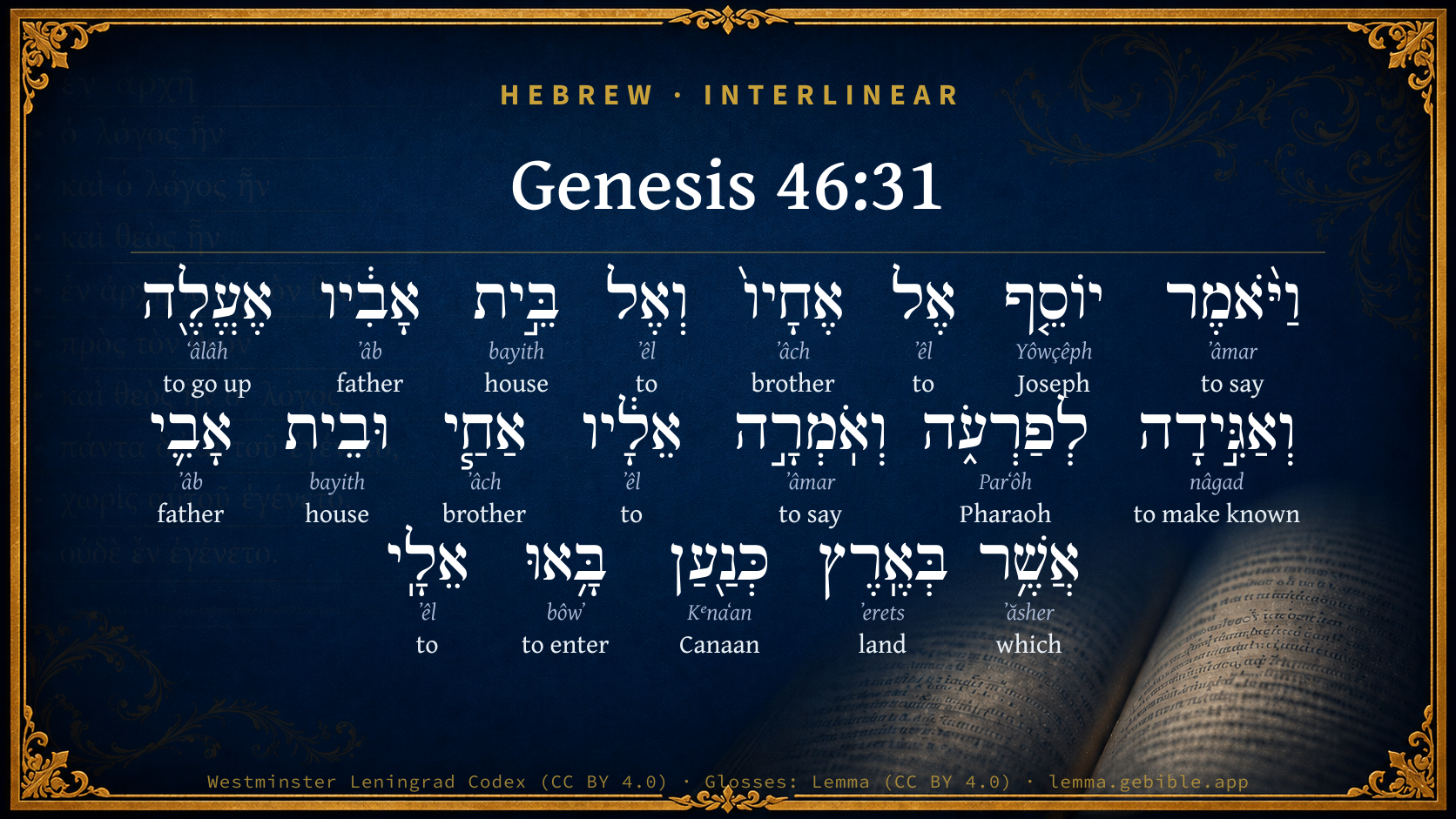
Genesis 46:31

Hebrew (Westminster Leningrad Codex) Genesis 46:31 appears in the Hebrew Old Testament. The text above is from the Westminster Leningrad Codex. Each word links to its Strong’s number, a concise gloss, and parsing drawn from the Open Scriptures Hebrew Bible morphology. Click any word for its full Brown-Driver-Briggs (BDB) entry.
Download image
Cite this verse

Genesis 46:31 (World English Bible). Public Domain. Lemma interlinear Bible study tool, https://lemma.gebible.app/v/genesis/46/31.

Show BibTeX & RIS
BibTeX
RIS
English Translation
Joseph said to his brothers, and to his father's house, "I will go up, and speak with Pharaoh, and will tell him, 'My brothers, and my father's house, who were in the land of Canaan, have come to me.
World English Bible · Public Domain
Download a study sheet

One document with this verse’s original text, its word-by-word gloss line, the meaning frame, cross-references with their text, attributed commentary, and full source and license credits — printable, and it pastes into notes with its structure intact.

This verse Autodidact and up

Study sheet (.html) Plain text (.txt)

A passage Seminary Student

Up to 50 verses in one chapter. A passage sheet keeps up to 6 commentary sources and 12 cross-references per verse, in the order this page ranks them, and says so on the sheet whenever that leaves anything out. Ask for a single verse and you get the Autodidact verse sheet above.

Everything on this page stays free to read, with no account — the sheet is a download of what is already on screen, not access to it.

Want to remove ads? Support Godless Engineer
Compare translations 3

The same verse in 3 English versions, stacked beneath the original-language interlinear above. Click any original word for its lexicon entry.

Each is an independent rendering of the whole verse — the interlinear is not word-aligned to these translations.

Highlighted words mark where these versions differ — a whole-verse word diff, not a word-by-word alignment.

  • World English Bible Public Domain
    Joseph said to his brothers, and to his father's house, "I will go up, and speak with Pharaoh, and will tell him, 'My brothers, and my father's house, who were in the land of Canaan, have come to me.
  • King James Version Public Domain
    And Joseph said unto his brethren, and unto his father's house, I will go up, and show Pharaoh, and say unto him, My brethren, and my father's house, which were in the land of Canaan, are come unto me;
  • unfoldingWord Literal Text CC BY-SA 4.0
    Then Joseph said to his brothers and to the household of his father, “I will go up and report to Pharaoh, and I will say to him, ‘My brothers and the household of my father who in the land of Canaan have come to me.

unfoldingWord Literal Text — © unfoldingWord, licensed CC BY-SA 4.0. Word-aligned USFM3 via Door43 (git.door43.org/unfoldingWord/en_ult).

Versions to compare (up to 4)

3 of 4 selected

Show all 18 translations

Every available English version of this verse, each an independent rendering of the whole verse.

  • World English Bible Public Domain
    Joseph said to his brothers, and to his father's house, "I will go up, and speak with Pharaoh, and will tell him, 'My brothers, and my father's house, who were in the land of Canaan, have come to me.
  • Berean Standard Bible Public Domain
    Joseph said to his brothers and to his father’s household, “I will go up and inform Pharaoh: ‘My brothers and my father’s household from the land of Canaan have come to me.
  • Majority Standard Bible Public Domain
    Joseph said to his brothers and to his father’s household, “I will go up and inform Pharaoh: ‘My brothers and my father’s household from the land of Canaan have come to me.
  • King James Version Public Domain
    And Joseph said unto his brethren, and unto his father's house, I will go up, and show Pharaoh, and say unto him, My brethren, and my father's house, which were in the land of Canaan, are come unto me;
  • American Standard Version (1901) Public Domain
    And Joseph said unto his brethren, and unto his father's house, I will go up, and tell Pharaoh, and will say unto him, My brethren, and my father's house, who were in the land of Canaan, are come unto me;
  • Revised Version (1885) Public Domain
    And Joseph said unto his brethren, and unto his father’s house, I will go up, and tell Pharaoh, and will say unto him, My brethren, and my father’s house, which were in the land of Canaan, are come unto me;
  • Geneva Bible (1599) Public Domain
    Then Ioseph said to his brethren, and to his fathers house, I wil go vp and shew Pharaoh, and tell him, My brethren and my fathers house, which were in the land of Canaan, are come vnto me,
  • Douay-Rheims (1899) Public Domain
    And Joseph said to his brethren, and to all his father's house: I will go up, and will tell Pharao, and will say to him: My brethren and my father's house, that were in the land of Chanaan, are come to me:
  • Young's Literal Translation Public Domain
    And Joseph saith unto his brethren, and unto the house of his father, `I go up, and declare to Pharaoh, and say unto him, My brethren, and the house of my father who `are' in the land of Canaan have come in unto me;
  • Literal Standard Version CC BY-SA 4.0
    And Joseph says to his brothers, and to the house of his father, “I go up, and declare to Pharaoh, and say to him, My brothers, and the house of my father who [are] in the land of Canaan have come to me;
  • Unlocked Literal Bible CC BY-SA 4.0
    Joseph said to his brothers and to his father's house, “I will go up and tell Pharaoh, saying, 'My brothers and my father's house, who were in the land of Canaan, have come to me.
  • unfoldingWord Literal Text CC BY-SA 4.0
    Then Joseph said to his brothers and to the household of his father, “I will go up and report to Pharaoh, and I will say to him, ‘My brothers and the household of my father who in the land of Canaan have come to me.
  • Darby Bible Public Domain
    And Joseph said to his brethren and to his father's house, I will go up, and tell Pharaoh, and say to him, My brethren and my father's house, who were in the land of Canaan, are come to me;
  • World Messianic Bible Public Domain
    Joseph said to his brothers, and to his father’s house, “I will go up, and speak with Pharaoh, and will tell him, ‘My brothers, and my father’s house, who were in the land of Canaan, have come to me.
  • Webster's Bible Public Domain
    And Joseph said to his brethren, and to his father's house, I will go up, and show Pharaoh, and say to him, My brethren, and my father's house, who were in the land of Canaan are come to me.
  • Free Bible Version CC BY-SA 4.0
    Joseph told his brothers and his father's household, “I'm going to go and report to Pharaoh and tell him, ‘My brothers and my father's household have arrived from the country of Canaan to join me.
  • Bible in Basic English Public Domain
    And Joseph said to his brothers and to his father's people, I will go and give the news to Pharaoh, and say to him, My brothers and my father's people, from the land of Canaan, have come to me;
  • JPS Tanakh (1917) Public Domain
    And Joseph said unto his brethren, and unto his father's house: 'I will go up, and tell Pharaoh, and will say unto him: My brethren, and my father's house, who were in the land of Canaan, are come unto me;

Literal Standard Version (2020), Covenant Press — licensed CC BY-SA 4.0. Text via the HelloAO Bible API (eBible.org). Unlocked Literal Bible (unfoldingWord) — licensed CC BY-SA 4.0. Text via the HelloAO Bible API (eBible.org). unfoldingWord Literal Text — © unfoldingWord, licensed CC BY-SA 4.0. Word-aligned USFM3 via Door43 (git.door43.org/unfoldingWord/en_ult). Free Bible Version, Dr. Jonathan Gallagher — licensed CC BY-SA 4.0. Text via the HelloAO Bible API (eBible.org).

Word by word

More ways to search: Search by grammar → Find every occurrence → Compare this word →

Practice this passage: Drill this verse → Learn its vocabulary →

כְּנַ֖עַן
Kᵉnaʻan
H3667
“Canaan”
Noun, Proper
Part of Speech
Noun
Type
Proper
Full BDB Definition

Origin: from H3665

TWOT: 1002 , 1002b

Canaan = "lowland" - the 4th son of Ham and the progenitor of the Phoenicians and of the various nations who peopled the seacoast of Palestine (noun proper masculine) - the land west of the Jordan peopled by the descendants of Canaan and subsequently conquered by the Israelites under Joshua (noun proper locative) - merchant, trader (noun masculine)
  1. וַיֹּ֨אמֶר ʼâmar H559 “and · to say” Conjunction + Verb, Qal, Sequential Imperfect, 3rd Person, Masculine, Singular
  2. יוֹסֵ֤ף Yôwçêph H3130 “Joseph” Noun, Proper
  3. אֶל ʼêl H413 “to” Preposition
  4. אֶחָיו֙ ʼâch H251 “brothers · his” Noun, Common, Masculine, Plural, Construct + Suffix, Personal, 3rd Person, Masculine, Singular
  5. וְאֶל ʼêl H413 “and · to” Conjunction + Preposition
  6. בֵּ֣ית bayith H1004 “house of” Noun, Common, Masculine, Singular, Construct
  7. אָבִ֔יו ʼâb H1 “father · his” Noun, Common, Masculine, Singular, Construct + Suffix, Personal, 3rd Person, Masculine, Singular
  8. אֶעֱלֶ֖ה ʻâlâh H5927 “to go up” Verb, Qal, Imperfect, 1st Person, Common, Singular
  9. וְאַגִּ֣ידָה nâgad H5046 “and · to make known” Conjunction + Verb, Hiphil, Imperfect, 1st Person, Common, Singular
  10. לְפַרְעֹ֑ה Parʻôh H6547 “to/for · Pharaoh” Preposition + Noun, Proper
  11. וְאֹֽמְרָ֣ה ʼâmar H559 “and · to say” Conjunction + Verb, Qal, Cohortative, 1st Person, Common, Singular
  12. אֵלָ֔יו ʼêl H413 “to · him” Preposition + Suffix, Personal, 3rd Person, Masculine, Singular
  13. אַחַ֧י ʼâch H251 “brothers · my” Noun, Common, Masculine, Plural, Construct + Suffix, Personal, 1st Person, Common, Singular
  14. וּבֵית bayith H1004 “and · house of” Conjunction + Noun, Common, Masculine, Singular, Construct
  15. אָבִ֛י ʼâb H1 “father · my” Noun, Common, Masculine, Singular, Construct + Suffix, Personal, 1st Person, Common, Singular
  16. אֲשֶׁ֥ר ʼăsher H834 “which” Particle, Relative
  17. בְּאֶֽרֶץ ʼerets H776 “in/at · land of” Preposition + Noun, Common, Both, Singular, Construct
  18. בָּ֥אוּ bôwʼ H935 “to enter” Verb, Qal, Perfect, 3rd Person, Common, Plural
  19. אֵלָֽי ʼêl H413 “to · me” Preposition + Suffix, Personal, 1st Person, Common, Singular

About this verse

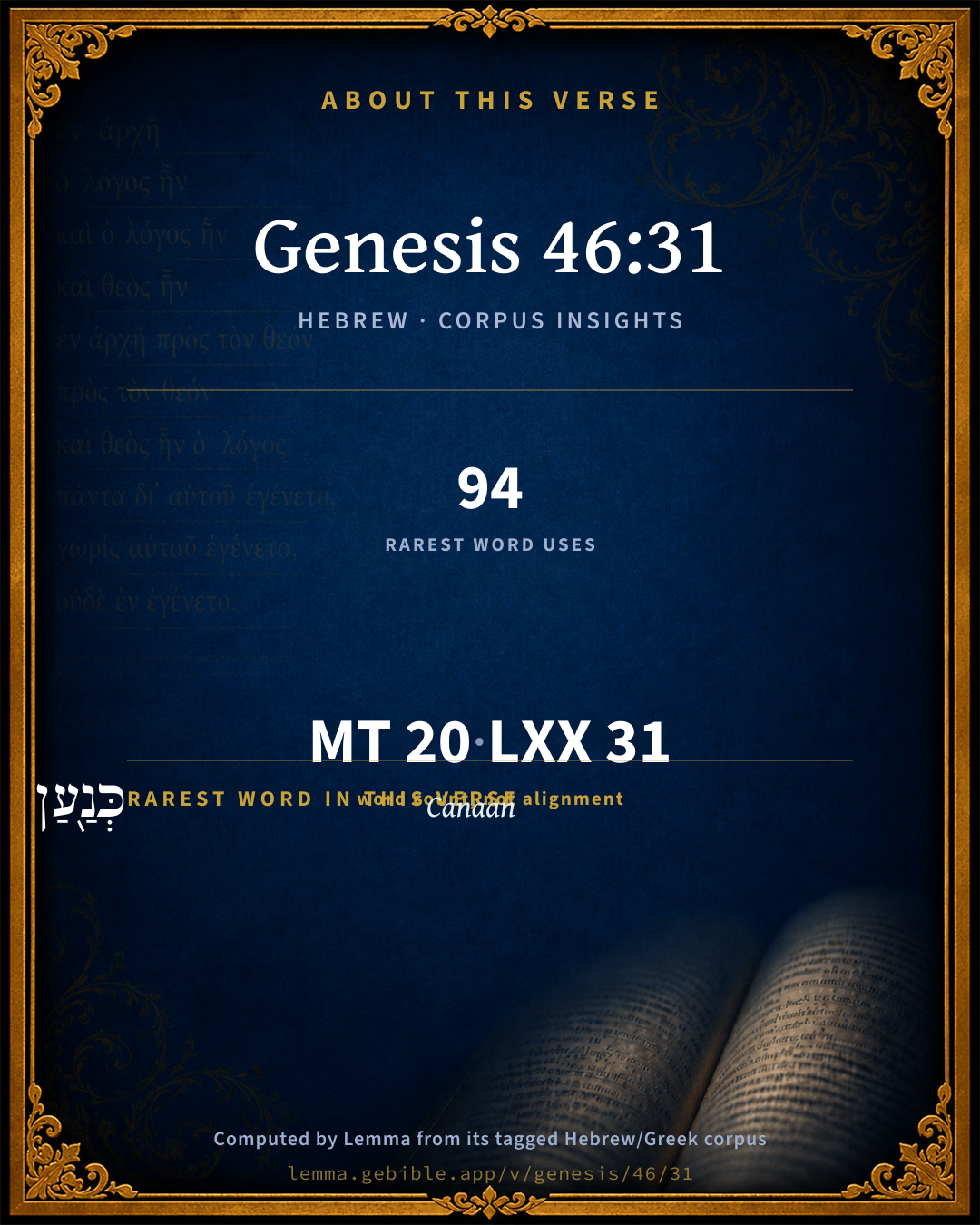
These counts appear in no published source. They are computed here, from the morphology-tagged text and Lemma’s own curated glosses. What Lemma adds →

20
words
13
distinct lemmas
Pentateuch
section

Grammatical profile

  • 5 verbs
  • 10 nouns
  • 4 prepositions
  • 1 particle

Verb forms

  • וַיֹּ֨אמֶר Qal · Sequential Imperfect
  • אֶעֱלֶ֖ה Qal · Imperfect
  • וְאַגִּ֣ידָה Hiphil · Imperfect
  • וְאֹֽמְרָ֣ה Qal · Cohortative
  • בָּ֥אוּ Qal · Perfect

Repetition

Words recur within this verse — often emphatic in Hebrew:

  • וַיֹּ֨אמֶר to say H559 ×2
  • אֶחָיו֙ brother H251 ×2
  • בֵּ֣ית house H1004 ×2
  • אָבִ֔יו father H1 ×2
  • אֶל to H413 ×4

Hebrew & Septuagint length

In English translation the verse runs 39 words from the Hebrew and 35 from the Septuagint (LXX English) — closely comparable.

A rough comparison of the two English renderings, which tokenize alike — not a word-level alignment.

Word counts can differ between the Hebrew and the Greek without any difference in meaning — e.g. the Hebrew direct-object marker אֵת has no separate Greek word, and Greek often adds the article ὁ.

In the original languages it is 20 Hebrew tokens and 31 Greek tokens — but the two are counted differently (Hebrew bundles its prefixes and suffixes into one token; the Greek is in lemma form), so that isn’t a like-for-like length.

Cross-references

4

Topical passages linked to Genesis 46:31 in the Treasury of Scripture Knowledge — connected by theme and wording, ordered by reader-vote popularity; previews shown in the World English Bible.

  • Genesis 45:16–20 The report of it was heard in Pharaoh's house, saying, "Joseph's brothers have come." It pleased Pharaoh well, and his servants.
  • Genesis 47:1–3 Then Joseph went in and told Pharaoh, and said, "My father and my brothers, with their flocks, their herds, and all that they own, have come out of the land of Canaan; and, behold, they are in the land of Goshen."
  • Acts 18:3 and because he practiced the same trade, he lived with them and worked, for by trade they were tent makers.
  • Hebrews 2:11 For both he who sanctifies and those who are sanctified are all from one, for which cause he is not ashamed to call them brothers,

Cross-references courtesy of OpenBible.info (CC BY 4.0).

Hebrew and Greek witnesses Masoretic Hebrew ↔ Greek Septuagint

The same verse in the two great witnesses to the Old Testament, shown verse-for-verse.

These are two independent witnesses, not word-aligned to each other, and the Septuagint is shown in lemma (dictionary) form.

Hebrew Genesis 46:31 Masoretic · Westminster Leningrad Codex

וַיֹּ֨אמֶר יוֹסֵ֤ף אֶל אֶחָיו֙ וְאֶל בֵּ֣ית אָבִ֔יו אֶעֱלֶ֖ה וְאַגִּ֣ידָה לְפַרְעֹ֑ה וְאֹֽמְרָ֣ה אֵלָ֔יו אַחַ֧י וּבֵית אָבִ֛י אֲשֶׁ֥ר בְּאֶֽרֶץ כְּנַ֖עַן בָּ֥אוּ אֵלָֽי

Joseph said to his brothers, and to his father's house, "I will go up, and speak with Pharaoh, and will tell him, 'My brothers, and my father's house, who were in the land of Canaan, have come to me.

World English Bible · Public Domain

Greek LXX Genesis 46:31 Septuagint · lemma form

εἶπον δέ ιωσηφ πρός ὁ ἀδελφός αὐτός ἀναβαίνω ἀποἀγγέλλω ὁ φαραώ καί εἶπον αὐτός ὁ ἀδελφός ἐγώ καί ὁ οἶκος ὁ πατήρ ἐγώ ὅς εἰμί ἐν γῆ χανααν ἥκω πρός ἐγώ

And Joseph said to his brethren, I will go up and tell Pharao, and will say to him, My brethren, and my father's house, who were in the land of Chanaan, are come to me.

LXX2012 (modern English Septuagint) · Public Domain

Hebrew: Westminster Leningrad Codex (CC BY 4.0). Greek: Septuagint (public domain); English from LXX2012 (modern English Septuagint) (Public Domain). How the Septuagint differs from the Hebrew →

Targum (Aramaic paraphrase)

2

The Targum is the ancient Jewish Aramaic paraphrase of the Hebrew Scriptures — an interpretive translation, not the Hebrew text itself. Onkelos (literal) and Pseudo-Jonathan (expansive) render the Torah, and Jonathan the Prophets. Coverage is partial: where no permissively-licensed English translation exists for a verse, only the Aramaic is shown. This is verse-level text, not a word-by-word alignment to the Hebrew.

  1. Targum Onkelos Torah (Genesis–Deuteronomy)
    וַאֲמַר יוֹסֵף לַאֲחוֹהִי וּלְבֵית אֲבוּהִי אֶסַּק וְאֵחַוֵּי לְפַרְעֹה וְאֵימַר לֵהּ אַחַי וּבֵית אַבָּא דִּי בְאַרְעָא דִּכְנַעַן עַלּוּ לְוָתִי

    (no public-domain English translation for this verse)

    Targum Onkelos — Aramaic: “Onkelos Genesis” (public domain); “Onkelos Exodus” (public domain); “Onkelos Leviticus” (public domain); “Onkelos Numbers” (public domain); “Onkelos Deuteronomy” (public domain). English: “Sefaria Community Translation” (CC0 1.0 (public-domain dedication)); “J.W. Etheridge. The Targums of Onkelos and Jonathan Ben Uzziel on the Pentateuch. London: Longmans, Green, 1862” (public domain). Text via Sefaria.

  2. Targum Pseudo-Jonathan Torah (Genesis–Deuteronomy)
    וַאֲמַר יוֹסֵף לְאָחוֹי וּלְבֵית אָבוֹי אִיסַק וְאַתְנֵי לְפַרְעה וְאֵימַר לֵיהּ אַחַי וּבֵית אַבָּא דִבְאַרְעָא דִכְנָעַן אָתוֹ לְוָתִי

    And Joseph said to his brethren and his father's house, I will go up and tell Pharoh, and say to him, My brethren and my father's house from the land of Kenaan have come to me.

    Targum Pseudo-Jonathan — Aramaic: “Targum Jonathan on Genesis” (public domain); “Targum Jonathan on Exodus” (public domain); “Targum Jonathan on Leviticus” (public domain); “Targum Jonathan on Numbers” (public domain); “Targum Jonathan on Deuteronomy” (public domain). English: “The Targum of Jonathan ben Uzziel, trans. J. W. Etheridge, London, 1862” (public domain). Text via Sefaria.

Commentary

Notes on Genesis 46:31 from classic Christian and Jewish commentators (each source and its license shown beneath its notes). The classic Christian expositions comment on the surrounding passage and are grouped to its opening verse, so a note may address several verses; the Jewish commentaries on the Tanakh (Rashi and others) are per-verse, so they appear only where the commentator wrote on this verse.

Lemma curates 59 commentaries, every one of them public domain or Creative Commons licensed, each selected and text-cleaned for this edition rather than reprinted as found. About our sources →

Jamieson, Fausset & Brown

Robert Jamieson, A. R. Fausset & David Brown

Joseph said, . . . I will go up, and show Pharaoh--It was a tribute of respect due to the king to inform him of their arrival. And the instructions which he gave them were worthy of his character alike as an affectionate brother and a religious man.

Next: Genesis Chapter 47

Jamieson, Fausset & Brown — Commentary Critical and Explanatory on the Whole Bible (1871) — public domain (CC PDM 1.0). Text via the HelloAO Bible API.

John Calvin's Commentaries

31. I will go up and show Pharaoh. After Joseph had gone forth to meet his father for the purpose of doing him honor, he also provides what will be useful for him. On this account, he advises Jacob to declare that he and all his family were keepers of cattle, to the end that he might obtain, from the king, a dwelling-place for them, in the land of Goshen. Now although his moderation deserves commendation on the ground, that he usurps no authority to himself, but that, as one of the common people, he waits the pleasure of the king: he yet may be thought craftily to have devised a pretext, by which he might circumvent the king. We see what he desired. Seeing that the land of Goshen was fertile, and celebrated for its rich pastures; this advantage so allured his mind, that he wished to fix his father there: but then, keeping out of Pharaoh’s sight the richness of the land, he puts forth another reason; namely, that Jacob with his sons, were men held in abomination, and that, therefore, he was seeking a place of seclusion, in which they might dwell apart from the Egyptians. It is not, however, very difficult to untie this knot. The fertility of the land of Goshen was so fully known to the king, that no room was left for fraud or calming, (though kings are often too profuse, and foolishly waste much, because they know not what they grant,) yea, Pharaoh, of his own accord, had offered them, unsolicited, the best and choicest place in the kingdom. Therefore this bounty of his was not elicited from him by stratagem; because he was free to form his own judgment respecting what he would give. And truly Joseph, in order that he might act modestly, felt it necessary to seek a habitation in Goshen, on this pretext. For it would have been absurd, or at least inconsiderate, for men who were obscure and strangers, to desire an abode in the best and most convenient place for themselves, as if they possessed a right to choose for themselves. Joseph, therefore, having regard to his own modesty and that of his father, adduces another cause, which was yet a true one. For seeing that the Egyptians held the occupation of shepherds in abhorrence, he explains to the king that this would be a suitable retreat for his brethren. Herein was no dissimulation, because, in no other place, was a quiet habitation accessible to them. Nevertheless, though it was hard for the holy Fathers to be thus opprobriously rejected, and, as it were, to be loathed by a whole nation; yet this ignominy with which they were branded, was most profitable to themselves. For, had they been mingled with the Egyptians, they might have been scattered far and wide; but now, seeing that they are objects of detestation, and are thought unworthy to be admitted to common society, they learn, in this state of separation from others, to cherish more fervently mutual union between themselves; and thus the body of the Church, which God had set apart from the whole world, is not dispersed. So the Lord often permits us to be despised or rejected by the world, that being liberated and cleansed from its pollution, we may cultivate holiness. Finally, he does not suffer us to be bound by chains to the earth, in order that we may be borne upward to heaven.

John Calvin's Commentaries (1540-1563) — public domain. Text from the Calvin Translation Society English edition (1840s-50s) via the Christian Classics Ethereal Library (ccel.org). Calvin's coverage is partial (roughly two-thirds of the Bible); uncommented books and verses are honest gaps, never fabricated. The 19th-century editor's footnotes and remarks are omitted so the notes are faithfully Calvin's own voice.

The Cambridge Bible for Schools and Colleges

gen. ed. J. J. S. Perowne

31. go up] Joseph speaks of the residence of Pharaoh as a place to which he must “go up.” The metaphor is probably taken from the idea of ascent to the residence of royalty; cf. “high station,” “people of eminence.” The words contain no geographical significance in the sense of “up the Nile.”

The Cambridge Bible for Schools and Colleges (gen. ed. J. J. S. Perowne; Cambridge University Press, 1878–1918) — public domain. Text from a community e-Sword module.

The Pulpit Commentary

Vers. 31, 32. And Joseph said unto his brethren, and unto his father"s house, I will go up (employed in ver. 29 to describe a journey from the interior of the country to the desert, or Canaan, the verb hl; is here used in a courtly sense to signify a visit to a sovereign or superior), and show Pharaoh (literally, relate, or tell, to Pharaoh), and say unto him, My brethren, and my father"s house, which were in the land of Canaan, are come unto me; and the men are shepherds (literally, keepers of flocks), for their trade hath been to feed cattle (literally, they are men of cattle); and they have brought their flocks, and their herds, and all that they have.

The Pulpit Commentary (1880–1919), ed. H.D.M. Spence-Jones & Joseph S. Exell — public domain. Text from a community e-Sword module.

unfoldingWord translationNotes

Door43 World Missions Community

his father's house

Here "house" stands for his family. AT: "his father's family" or "his father's household" (See: Metonymy)

I will go up and tell Pharaoh

It was common to use the phrase "go up" when referring to someone going to speak with someone with greater authority. AT: "I will go tell Pharaoh"

tell Pharaoh, saying, 'My brothers ... all that they have.'

This is a quotation within a quotation. It can be stated as an indirect quotation. AT: "tell Pharaoh that my brothers ... all that they have" (See: Quotes Within Quotes and Direct and Indirect Quotations)

translationWords

ancestor

house

Pharaoh

Canaan

shepherd

livestock

flocks

unfoldingWord translationNotes — © Distant Shores Media and the Door43 World Missions Community, licensed CC BY-SA 4.0. Source: git.door43.org/Door43/en_tn.

Rashi

Rabbi Shlomo Yitzchaki (Rashi)

'ואמרה אליו אחי וגו AND I WILL SAY TO HIM— “MY BRETHREN … have come unto me” and further I will say to him, והאנשים רעי צאן 'וגו AND THE MEN ARE SHEPHERDS etc.

Rashi on the Tanakh — English translations: “The Judaica Press complete Tanach with Rashi, translated by A. J. Rosenberg” (CC BY 4.0); “Pentateuch with Rashi's commentary by M. Rosenbaum and A.M. Silbermann, 1929-1934” (public domain); “The Metsudah Tanach series, Lakewood, N.J” (CC BY 4.0); and “The Book of Joshua, Metsudah Publications, 1997” (CC BY 4.0). Text via Sefaria.

Radak

Rabbi David Kimhi (Radak)

ויאמר יוסף אל אחיו, there can be no question that he did not say what follows before first having secured his father’s consent. [What was under discussion was a matter of major importance, i.e. how to preserve the integrity of Yaakov’s family as a clan, and how to minimize assimilation with the local population through voluntary ghettoisation. Pharaoh’s offer of the brothers participating in the political life of Egypt, something Joseph anticipated, had to be declined without giving offence to him. Ed.] The reason the Torah only mentions Joseph speaking to the brothers was that it was the brothers to whom the above-mentioned offer would be made.

אעלה. The word poses a problem, Joseph having been described previously as “ascending” when going to meet his father. How could he now again be ”ascending” on the return journey to his capital? We must therefore understand the word as not referring to the return journey but to Joseph climbing back into his carriage.

Radak on the Tanakh — English translations: “Sefaria Community Translation” (CC0 1.0 (public-domain dedication)); “Eliyahu Munk, HaChut Hameshulash” (CC BY 4.0); “Rabbi Mike Feuer, Jerusalem Anthology” (CC BY 4.0); and “R. David Kimhi on the first book of Psalms, Translated by R.G. Finch, London, 1919” (public domain). Text via Sefaria.

Lesson kit

Teaching starters — assembled from the data on this page, not authored interpretation. Every prompt links to the verse data it draws on. Edit before teaching.

Genesis, in the Pentateuch, opens this verse with 20 words (13 distinct Hebrew lemmas). Its most distinctive word is Kᵉnaʻan (“Canaan”). A historical commentator’s framing appears above. Read the whole chapter for the surrounding context.

Discussion questions

  1. What does “Canaan” (Kᵉnaʻan) contribute to the verse as a whole?
  2. Genesis 45:16–20 shares this passage’s theme. How do the two illuminate each other?
  3. “to say” occurs 2× in this one verse. What is the effect of the repetition?
  4. These translations render this verse differently; the difference is in the English rendering, not the original. What questions does that raise?
  5. The verb «וַיֹּ֨אמֶר» is Qal Sequential Imperfect. How does its form color the action?
  6. Reading how Jamieson, Fausset & Brown and John Calvin's Commentaries read this verse, where do the two commentators agree and where do they part?

Things to notice

Reading settings

Reading text

Shown beneath each verse's original-language words.

Old Testament
Old Testament edition

Read the OT as the Masoretic Hebrew (MT) or the Greek Septuagint (LXX).

English shown for the Greek Septuagint (in the Hebrew ↔ Greek comparison).

Comparing translations? Open the Compare panel on any verse page to stack up to four side by side.