
Genesis 14:7

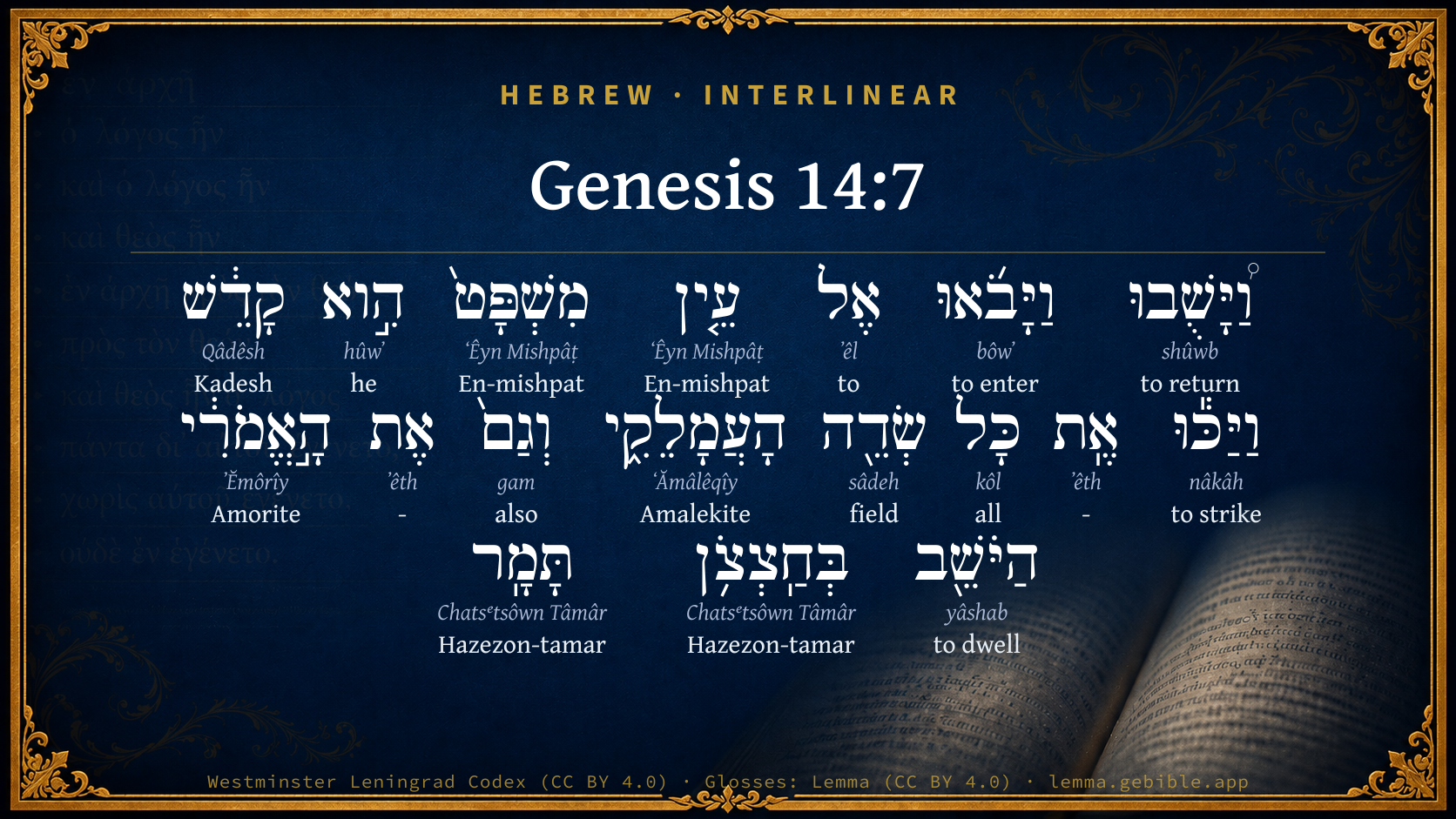
Hebrew (Westminster Leningrad Codex) Genesis 14:7 appears in the Hebrew Old Testament. The text above is from the Westminster Leningrad Codex. Each word links to its Strong’s number, a concise gloss, and parsing drawn from the Open Scriptures Hebrew Bible morphology. Click any word for its full Brown-Driver-Briggs (BDB) entry.
Download image
Cite this verse

Genesis 14:7 (World English Bible). Public Domain. Lemma interlinear Bible study tool, https://lemma.gebible.app/v/genesis/14/7.

Show BibTeX & RIS
BibTeX
RIS
English Translation
They returned, and came to En-mishpat (the same is Kadesh), and struck all the country of the Amalekites, and also the Amorites, that lived in Hazazon Tamar.
World English Bible · Public Domain
Highlights
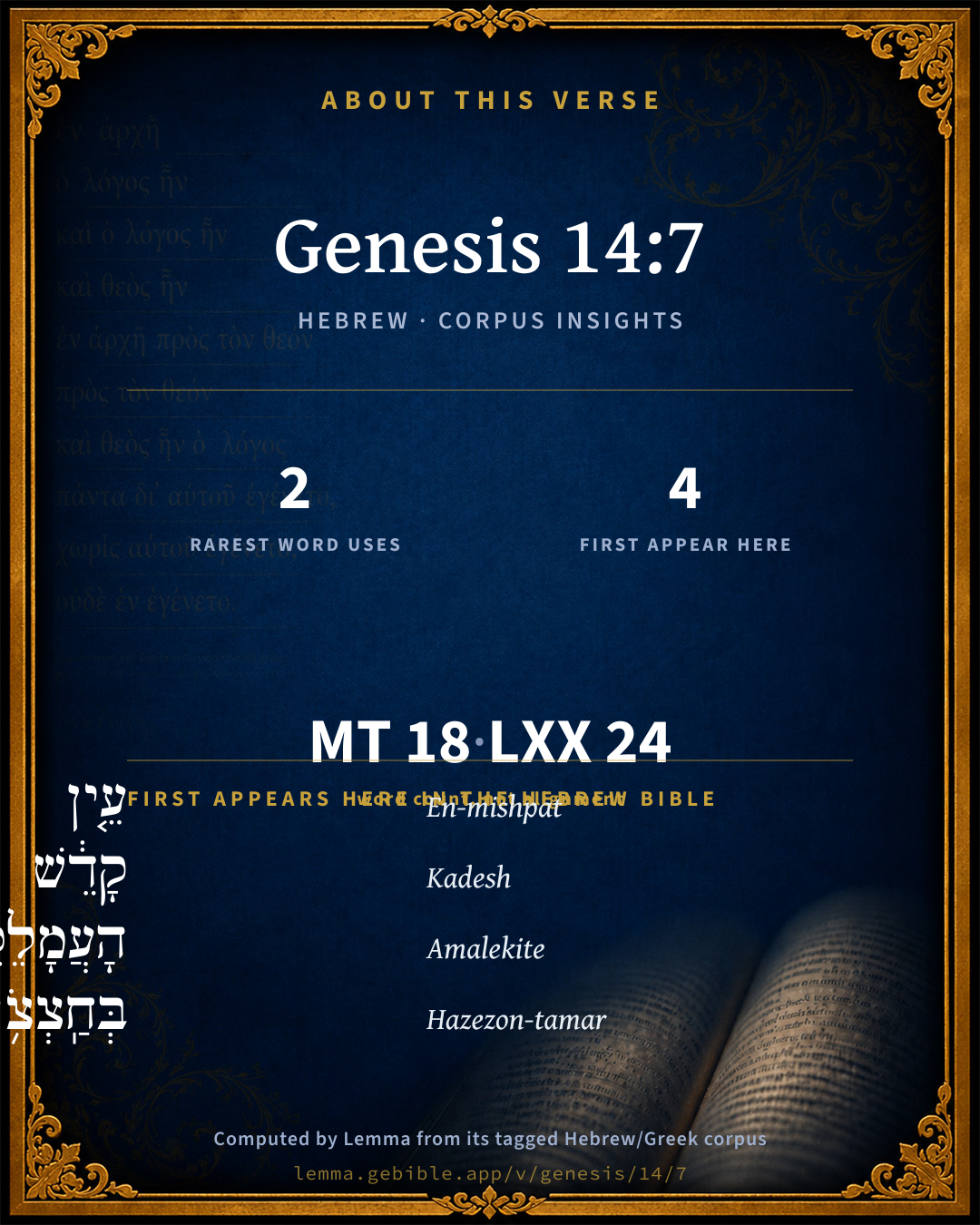
  • 4 first appearances in the Hebrew Bible
Full analysis ↓
Download a study sheet

One document with this verse’s original text, its word-by-word gloss line, the meaning frame, cross-references with their text, attributed commentary, and full source and license credits — printable, and it pastes into notes with its structure intact.

This verse Autodidact and up

Study sheet (.html) Plain text (.txt)

A passage Seminary Student

Up to 50 verses in one chapter. A passage sheet keeps up to 6 commentary sources and 12 cross-references per verse, in the order this page ranks them, and says so on the sheet whenever that leaves anything out. Ask for a single verse and you get the Autodidact verse sheet above.

Everything on this page stays free to read, with no account — the sheet is a download of what is already on screen, not access to it.

Want to remove ads? Support Godless Engineer
Compare translations 3

The same verse in 3 English versions, stacked beneath the original-language interlinear above. Click any original word for its lexicon entry.

Each is an independent rendering of the whole verse — the interlinear is not word-aligned to these translations.

Highlighted words mark where these versions differ — a whole-verse word diff, not a word-by-word alignment.

  • World English Bible Public Domain
    They returned, and came to En-mishpat (the same is Kadesh), and struck all the country of the Amalekites, and also the Amorites, that lived in Hazazon Tamar.
  • King James Version Public Domain
    And they returned, and came to Enmishpat, which is Kadesh, and smote all the country of the Amalekites, and also the Amorites, that dwelt in Hazezontamar.
  • unfoldingWord Literal Text CC BY-SA 4.0
    Then they turned back and came to En Mishpat, which Kadesh, and they struck the entire territory of the Amalekites and also the Amorites, who were living in Hazezon Tamar.

unfoldingWord Literal Text — © unfoldingWord, licensed CC BY-SA 4.0. Word-aligned USFM3 via Door43 (git.door43.org/unfoldingWord/en_ult).

Versions to compare (up to 4)

3 of 4 selected

Show all 18 translations

Every available English version of this verse, each an independent rendering of the whole verse.

  • World English Bible Public Domain
    They returned, and came to En-mishpat (the same is Kadesh), and struck all the country of the Amalekites, and also the Amorites, that lived in Hazazon Tamar.
  • Berean Standard Bible Public Domain
    Then they turned back to invade En-mishpat (that is, Kadesh), and they conquered the whole territory of the Amalekites, as well as the Amorites who lived in Hazazon-tamar.
  • Majority Standard Bible Public Domain
    Then they turned back to invade En-mishpat (that is, Kadesh), and they conquered the whole territory of the Amalekites, as well as the Amorites who lived in Hazazon-tamar.
  • King James Version Public Domain
    And they returned, and came to Enmishpat, which is Kadesh, and smote all the country of the Amalekites, and also the Amorites, that dwelt in Hazezontamar.
  • American Standard Version (1901) Public Domain
    And they returned, and came to En-mishpat (the same is Kadesh), and smote all the country of the Amalekites, and also the Amorites, that dwelt in Hazazon-tamar.
  • Revised Version (1885) Public Domain
    And they returned, and came to En-mishpat (the same is Kadesh), and smote all the country of the Amalekites, and also the Amorites, that dwelt in Hazazon-tamar.
  • Geneva Bible (1599) Public Domain
    And they returned and came to En-mishpat, which is Kadesh, and smote all the countrey of the Amalekites, and also the Amorites that dwelled in Hazezon-tamar.
  • Douay-Rheims (1899) Public Domain
    And they returned, and came to the fountain of Misphat, the same is Cades: and they smote all the country of the Amalecites, and the Amorrhean that dwelt in Asasonthamar.
  • Young's Literal Translation Public Domain
    and they turn back and come in unto En-Mishpat, which `is' Kadesh, and smite the whole field of the Amalekite, and also the Amorite who is dwelling in Hazezon-Tamar.
  • Literal Standard Version CC BY-SA 4.0
    and they turn back and come to En-Mishpat, which [is] Kadesh, and strike the whole field of the Amalekite, and also the Amorite who is dwelling in Hazezon-Tamar.
  • Unlocked Literal Bible CC BY-SA 4.0
    Then they turned and came to En Mishpat (also called Kadesh), and defeated all the country of the Amalekites, and also the Amorites who lived in Hazezon Tamar.
  • unfoldingWord Literal Text CC BY-SA 4.0
    Then they turned back and came to En Mishpat, which Kadesh, and they struck the entire territory of the Amalekites and also the Amorites, who were living in Hazezon Tamar.
  • Darby Bible Public Domain
    And they returned, and came to En-mishpat, which is Kadesh, and smote all the country of the Amalekites, and also the Amorites that dwelt at Hazazon-Tamar.
  • World Messianic Bible Public Domain
    They returned, and came to En Mishpat (also called Kadesh), and struck all the country of the Amalekites, and also the Amorites, that lived in Hazazon Tamar.
  • Webster's Bible Public Domain
    And they returned, and came to En-mishpat, which is Kadesh, and smote all the country of the Amalekites, and also the Amorites, that dwelt in Hazezontamar.
  • Free Bible Version CC BY-SA 4.0
    Then they swung back through and attacked En-mishpat (otherwise known as Kadesh) and conquered the whole country belonging to the Amalekites, as well as the Amorites who lived in Hazazon-tamar.
  • Bible in Basic English Public Domain
    Then they came back to En-mishpat (which is Kadesh), making waste all the country of the Amalekites and of the Amorites living in Hazazon-tamar.
  • JPS Tanakh (1917) Public Domain
    And they turned back, and came to En-mishpat — the same is Kadesh — and smote all the country of the Amalekites, and also the Amorites, that dwelt in Hazazon-tamar.

Literal Standard Version (2020), Covenant Press — licensed CC BY-SA 4.0. Text via the HelloAO Bible API (eBible.org). Unlocked Literal Bible (unfoldingWord) — licensed CC BY-SA 4.0. Text via the HelloAO Bible API (eBible.org). unfoldingWord Literal Text — © unfoldingWord, licensed CC BY-SA 4.0. Word-aligned USFM3 via Door43 (git.door43.org/unfoldingWord/en_ult). Free Bible Version, Dr. Jonathan Gallagher — licensed CC BY-SA 4.0. Text via the HelloAO Bible API (eBible.org).

Word by word

More ways to search: Search by grammar → Find every occurrence → Compare this word →

Practice this passage: Drill this verse → Learn its vocabulary →

עֵ֤ין
ʻÊyn Mishpâṭ
H5880
“En-mishpat”
Noun, Proper
Part of Speech
Noun
Type
Proper
Full BDB Definition

Origin: from H5869 and H4941

TWOT: None

En-mishpat = "spring of judgment" - a place near southern Palestine coincident or the same place as Kadesh
  1. וַ֠יָּשֻׁבוּ shûwb H7725 “and · to return” Conjunction + Verb, Qal, Sequential Imperfect, 3rd Person, Masculine, Plural
  2. וַיָּבֹ֜אוּ bôwʼ H935 “and · to enter” Conjunction + Verb, Qal, Sequential Imperfect, 3rd Person, Masculine, Plural
  3. אֶל ʼêl H413 “to” Preposition
  4. מִשְׁפָּט֙ ʻÊyn Mishpâṭ H5880 “En-mishpat” Noun, Proper
  5. הִ֣וא hûwʼ H1931 “he” Pronoun, Personal, 3rd Person, Feminine, Singular
  6. קָדֵ֔שׁ Qâdêsh H6946 “Kadesh” Noun, Proper
  7. וַיַּכּ֕וּ nâkâh H5221 “and · to strike” Conjunction + Verb, Hiphil, Sequential Imperfect, 3rd Person, Masculine, Plural
  8. אֶֽת ʼêth H853 “-” Particle, Direct Object
  9. כָּל kôl H3605 “all of” Noun, Common, Masculine, Singular, Construct
  10. שְׂדֵ֖ה sâdeh H7704 “field of” Noun, Common, Masculine, Singular, Construct
  11. הָעֲמָלֵקִ֑י ʻĂmâlêqîy H6003 “the · Amalekite” Particle, Definite Article + Noun, Gentilic, Masculine, Singular, Absolute
  12. וְגַם֙ gam H1571 “and · also” Conjunction + Particle, Accusative
  13. אֶת ʼêth H853 “-” Particle, Direct Object
  14. הָ֣אֱמֹרִ֔י ʼĔmôrîy H567 “the · Amorite” Particle, Definite Article + Noun, Gentilic, Masculine, Singular, Absolute
  15. הַיֹּשֵׁ֖ב yâshab H3427 “the · dwelling” Particle, Definite Article + Verb, Qal, Participle Active, Masculine, Singular, Absolute
  16. בְּחַֽצְצֹ֥ן Chatsᵉtsôwn Tâmâr H2688 “in/at · Hazezon-tamar” Preposition + Noun, Proper
  17. תָּמָֽר Chatsᵉtsôwn Tâmâr H2688 “Hazezon-tamar” Noun, Proper

About this verse

These counts appear in no published source. They are computed here, from the morphology-tagged text and Lemma’s own curated glosses. What Lemma adds →

18
words
15
distinct lemmas
Pentateuch
section

Notable vocabulary

The rarest word here is עֵ֤ין En-mishpat H5880 — appearing just 2 times in the whole Hebrew Bible.

First appearance in Scripture

These words make their first canonical appearance in the Hebrew Bible here:

  • עֵ֤ין En-mishpat H5880
  • קָדֵ֔שׁ Kadesh H6946
  • הָעֲמָלֵקִ֑י Amalekite H6003
  • בְּחַֽצְצֹ֥ן Hazezon-tamar H2688

Grammatical profile

  • 4 verbs
  • 9 nouns
  • 1 pronoun
  • 1 preposition
  • 3 particles

Verb forms

  • וַ֠יָּשֻׁבוּ Qal · Sequential Imperfect
  • וַיָּבֹ֜אוּ Qal · Sequential Imperfect
  • וַיַּכּ֕וּ Hiphil · Sequential Imperfect
  • הַיֹּשֵׁ֖ב Qal · Participle Active

Repetition

Words recur within this verse — often emphatic in Hebrew:

  • עֵ֤ין En-mishpat H5880 ×2
  • בְּחַֽצְצֹ֥ן Hazezon-tamar H2688 ×2

Hebrew & Septuagint length

In English translation the verse runs 27 words from the Hebrew and 30 from the Septuagint (LXX English) — closely comparable.

A rough comparison of the two English renderings, which tokenize alike — not a word-level alignment.

Word counts can differ between the Hebrew and the Greek without any difference in meaning — e.g. the Hebrew direct-object marker אֵת has no separate Greek word, and Greek often adds the article ὁ.

In the original languages it is 18 Hebrew tokens and 24 Greek tokens — but the two are counted differently (Hebrew bundles its prefixes and suffixes into one token; the Greek is in lemma form), so that isn’t a like-for-like length.

Cross-references

17

Topical passages linked to Genesis 14:7 in the Treasury of Scripture Knowledge — connected by theme and wording, ordered by reader-vote popularity; previews shown in the World English Bible.

  • 2 Chronicles 20:2 Then there came some who told Jehoshaphat, saying, There comes a great multitude against you from beyond the sea from Syria; and, behold, they are in Hazazon Tamar (the same is En Gedi).
  • Genesis 16:14 Therefore the well was called Beer Lahai Roi. Behold, it is between Kadesh and Bered.
  • Genesis 20:1 Abraham traveled from there toward the land of the South, and lived between Kadesh and Shur. He lived as a foriegner in Gerar.
  • Genesis 36:12 Timna was concubine to Eliphaz, Esau's son; and she bore to Eliphaz Amalek. These are the sons of Adah, Esau's wife.
  • Genesis 36:16 chief Korah, chief Gatam, chief Amalek: these are the chiefs who came of Eliphaz in the land of Edom; these are the sons of Adah.
  • Exodus 17:8–16 Then Amalek came and fought with Israel in Rephidim.
  • Numbers 13:26 They went and came to Moses, and to Aaron, and to all the congregation of the children of Israel, to the wilderness of Paran, to Kadesh; and brought back word to them, and to all the congregation, and shown them the fruit of the land.
  • Numbers 14:43 For there the Amalekite and the Canaanite are before you, and you shall fall by the sword: because you are turned back from following Yahweh, therefore Yahweh will not be with you.
  • Numbers 14:45 Then the Amalekite came down, and the Canaanite who lived in that mountain, and struck them and beat them down, even to Hormah.
  • Numbers 20:1 The children of Israel, even the whole congregation, came into the wilderness of Zin in the first month: and the people abode in Kadesh; and Miriam died there, and was buried there.
  • Numbers 24:20 He looked at Amalek, and took up his parable, and said, Amalek was the first of the nations; But his latter end shall come to destruction.
  • Deuteronomy 1:19 We traveled from Horeb, and went through all that great and terrible wilderness which you saw, by the way to the hill-country of the Amorites, as Yahweh our God commanded us; and we came to Kadesh-barnea.
  • Deuteronomy 1:46 So you abode in Kadesh many days, according to the days that you abode [there].
  • Joshua 15:62 and Nibshan, and the City of Salt, and En Gedi; six cities with their villages.
  • 1 Samuel 15:1–35 Samuel said to Saul, Yahweh sent me to anoint you to be king over his people, over Israel: now therefore listen you to the voice of the words of Yahweh.
  • 1 Samuel 27:1–12 David said in his heart, I shall now perish one day by the hand of Saul: there is nothing better for me than that I should escape into the land of the Philistines; and Saul will despair of me, to seek me any more in all the borders of Israel: so shall I escape out of his hand.
  • 1 Samuel 30:1–31 It happened, when David and his men were come to Ziklag on the third day, that the Amalekites had made a raid on the South, and on Ziklag, and had struck Ziklag, and burned it with fire,

Cross-references courtesy of OpenBible.info (CC BY 4.0).

Hebrew and Greek witnesses Masoretic Hebrew ↔ Greek Septuagint

The same verse in the two great witnesses to the Old Testament, shown verse-for-verse.

These are two independent witnesses, not word-aligned to each other, and the Septuagint is shown in lemma (dictionary) form.

Hebrew Genesis 14:7 Masoretic · Westminster Leningrad Codex

וַ֠יָּשֻׁבוּ וַיָּבֹ֜אוּ אֶל עֵ֤ין מִשְׁפָּט֙ הִ֣וא קָדֵ֔שׁ וַיַּכּ֕וּ אֶֽת כָּל שְׂדֵ֖ה הָעֲמָלֵקִ֑י וְגַם֙ אֶת הָ֣אֱמֹרִ֔י הַיֹּשֵׁ֖ב בְּחַֽצְצֹ֥ן תָּמָֽר

They returned, and came to En-mishpat (the same is Kadesh), and struck all the country of the Amalekites, and also the Amorites, that lived in Hazazon Tamar.

World English Bible · Public Domain

Greek LXX Genesis 14:7 Septuagint · lemma form

καί ἀναστρέφω ἔρχομαι ἐπί ὁ πηγή ὁ κρίσις οὗτος εἰμί καδης καί κατακόπτω πᾶς ὁ ἄρχων αμαληκ καί ὁ ἀμορραῖος ὁ καταοἰκέω ἐν ασασανθαμαρ

And having turned back they came to the well of judgment; this is Cades, and they cut in pieces all the princes of Amalec, and the Amorites dwelling in Asasonthamar.

LXX2012 (modern English Septuagint) · Public Domain

On this verse, The Cambridge Bible for Schools and Colleges discusses the Septuagint’s reading. Read the note in Commentary ↓

Hebrew: Westminster Leningrad Codex (CC BY 4.0). Greek: Septuagint (public domain); English from LXX2012 (modern English Septuagint) (Public Domain). How the Septuagint differs from the Hebrew →

Targum (Aramaic paraphrase)

2

The Targum is the ancient Jewish Aramaic paraphrase of the Hebrew Scriptures — an interpretive translation, not the Hebrew text itself. Onkelos (literal) and Pseudo-Jonathan (expansive) render the Torah, and Jonathan the Prophets. Coverage is partial: where no permissively-licensed English translation exists for a verse, only the Aramaic is shown. This is verse-level text, not a word-by-word alignment to the Hebrew.

  1. Targum Onkelos Torah (Genesis–Deuteronomy)
    וְתָבוּ וַאֲתוּ לְמֵישַׁר פִּלּוּג דִינָא הִיא רְקָם וּמְחוֹ יָת כָּל חֲקַל עֲמַלְקָאָה וְאַף יָת אֱמוֹרָאָה דְיָתֵיב בְּעֵין גֶּדִי

    And they turned, and came to the plain of the division of judgment, which is Rekam, and smote all the fields of the Amalkaah, and also the Amoraah who dwelt in Ein‑gadey.

    Targum Onkelos — Aramaic: “Onkelos Genesis” (public domain); “Onkelos Exodus” (public domain); “Onkelos Leviticus” (public domain); “Onkelos Numbers” (public domain); “Onkelos Deuteronomy” (public domain). English: “Sefaria Community Translation” (CC0 1.0 (public-domain dedication)); “J.W. Etheridge. The Targums of Onkelos and Jonathan Ben Uzziel on the Pentateuch. London: Longmans, Green, 1862” (public domain). Text via Sefaria.

  2. Targum Pseudo-Jonathan Torah (Genesis–Deuteronomy)
    וְתָבוּ וְאָתוּ לְאַתְרָא דְאִתְפְּלִיג דִינָא דְמשֶׁה נְבִיָא עַל עֵינָא דְמֵי מַצוֹתָא הוּא רֵיקָם וּמְחוֹי יַת כָּל חַקְלֵי עֲמַלְקָאֵי וְאוֹף יַת אֱמוֹרָאֵי דְיָתִיב בְּעֵין גֶדִי

    And they returned, and came to the place where was rendered the judgment of Mosheh the prophet, to the fountain of the waters of Strife, which is Requam. And they smote all the fields of the Amalkaee, and also the Emoraee, who dwelt in En-gedi.

    Targum Pseudo-Jonathan — Aramaic: “Targum Jonathan on Genesis” (public domain); “Targum Jonathan on Exodus” (public domain); “Targum Jonathan on Leviticus” (public domain); “Targum Jonathan on Numbers” (public domain); “Targum Jonathan on Deuteronomy” (public domain). English: “The Targum of Jonathan ben Uzziel, trans. J. W. Etheridge, London, 1862” (public domain). Text via Sefaria.

Commentary

Notes on Genesis 14:7 from classic Christian and Jewish commentators (each source and its license shown beneath its notes). The classic Christian expositions comment on the surrounding passage and are grouped to its opening verse, so a note may address several verses; the Jewish commentaries on the Tanakh (Rashi and others) are per-verse, so they appear only where the commentator wrote on this verse.

Lemma curates 59 commentaries, every one of them public domain or Creative Commons licensed, each selected and text-cleaned for this edition rather than reprinted as found. About our sources →

Trapp's Complete Commentary

John Trapp

Gen 14:7 And they returned, and came to Enmishpat, which [is] Kadesh, and smote all the country of the Amalekites, and also the Amorites, that dwelt in Hazezontamar.

Ver. 7. And smote all the country.] Great is the woe of war. {See Trapp on "Gen 14:2"} Great also was the goodness of God to Abram, in giving so many, and so victorious, nations into his hands.

John Trapp, A Commentary or Exposition upon All the Books of the Old and New Testament (1647–1656) — public domain. Text from a community e-Sword module.

Geneva Bible (1599)

Geneva Bible translators

Or, destroyed.

Geneva Bible (1599) marginal notes — public domain. Text via Bolls.life.

Adam Clarke's Commentary

Verse 7. En-mishpat] The well of judgment; probably so called from the judgment pronounced by God on Moses and Aaron for their rebellion at that place; Nu 20:1-10.

Amalekites] So called afterwards, from Amalek, son of Esau; Ge 36:12.

Hazezon-tamar.] Called, in the Chaldee, Engaddi; a city in the land of Canaan, which fell to the lot of Judah; Jos 15:62. See also 2Ch 20:2. It appears, from Canticles So 1:14, to have been a very fruitful place.

Adam Clarke's Commentary on the Bible (1810–1826) — public domain. Text from a community e-Sword/MySword module.

Ellicott's Commentary for English Readers

(7) They returned.—More correctly, they turned, as they did not go back by the same route, but wheeled towards the north-west.

Enmishpat.—The fountain of justice, because at this spring the ancient inhabitants of the country used to meet to settle their disputes. It was also called Kadesh, probably the ’Ain Qadis described by Professor Palmer. It was a great stronghold, and both a sanctuary and a seat of government. It has been visited lately by Mr. Trumbull, for whose account see Palestine Exploration Fund, Quarterly Statement, July, 1881, pp. 208-212.

The Amalekites.—Saul had to pursue these wandering hordes into the recesses of Paran (1Sa_15:7), but they were evidently now in possession of the Negeb of Judea.

Hazezon – tamar, the felling of the palm, is certainly the same as Engedi (2Ch_20:2). For descriptions of this wonderful spot, so dear to Solomon (Son_1:14), see Conder, Tent-work, ii. 135; Tristram, Land of Israel, 281; and for its strategical importance, Tristram, Land of Moab, 25.

A Bible Commentary for English Readers, edited by Charles John Ellicott (1878–1897) — public domain. Text from a community e-Sword module.

The Cambridge Bible for Schools and Colleges

gen. ed. J. J. S. Perowne

7. En-mishpat] i.e. “the Spring of Judgement.” A spring of water at which there would be a sanctuary, whose priest gave oracles and decided disputes; known in the Israelite history as “Kadesh-barnea,” or, as here, “Kadesh.” It has been identified in| modern times with a spring and oasis, called Ain-Kadish, in the desert to the south of Beer-sheba. This was the spot at which the Israelite tribes concentrated after quitting the neighbourhood of Sinai: cf. Num_21:16; Deu_1:46.

the country] Heb. field; LXX and Syr. “princes of” (reading sârê for s’dêh).

the Amalekites] The nomad peoples of the desert who opposed the Israelite march (Exodus 17); and were overthrown by Saul (1 Samuel 15) in the wilderness south of Canaan.

the Amorites, that dwelt in Hazazon-tamar] The Canaanite people dwelling at Engedi (see 2Ch_20:2) among the rocks on the west shore of the Dead Sea. It has also been conjecturally identified with the Tamar of Eze_47:19; Eze_48:28, a town on the S.W. of the Dead Sea. The name Hazazon-tamar has been explained to mean “the cutting of palms.” The name has been thought to be preserved in the Wady Hasasa, not far from Ain-gidi.

The Cambridge Bible for Schools and Colleges (gen. ed. J. J. S. Perowne; Cambridge University Press, 1878–1918) — public domain. Text from a community e-Sword module.

John Gill's Exposition

And they returned, and came to Enmishpat, which is Kadesh,.... Pursuing their victories as far as Elparan by the wilderness, they had passed by the country of the Amalekites; wherefore they "returned", or came back to fall upon them, and they came to a place called Enmishpat, or the "fountain of judgment"; which was not its future name, as Jarchi thinks, because there Moses and Aaron were to be judged concerning the business of that fountain, even the waters of Meribah, with which agrees the Targum of Jonathan;"and they returned and came to the place where the judgment of Moses the prophet was determined by the fountain of the waters of contention:''but it seems to have been the ancient name of the place, and by which it was called at this time, as Kadesh was the name of it at the time of Moses writing this; and therefore he adds:

which is Kadesh; that is, which is now called Kadesh, because there the Lord was sanctified, when the rock at that place was smitten, and waters gushed out: it was a city on the uttermost border of the land of Edom, Num 20:1, and seems formerly to have been a place where causes were heard and judgment passed; and so Onkelos paraphrases it,"to the plain of the division or decision of judgment;''which, as Jarchi himself interprets it,"is a place where the men of the province gathered together for all judgment;''or for hearing all causes and determining them:

and smote all the country of the Amalekites; which, according to Josephus (k), reached from Pelusium in Egypt to the Red sea; they inhabited Arabia Petraea, for he (l) says, the inhabitants of Gobolitis and Petra are called Amalekites; which name is generally supposed to have been given them here by way of anticipation, since the commonly received opinion is, that they were the descendants of Amalek, a grandson of Esau, who was not born when this war was waged, see Gen 36:12; but the Mahometan writers derive the pedigree of Amalek, from whom these people had their name, from Noah in the line of Ham, and make him to be some generations older than Abram, which with them stands thus, Noah, Ham, Aram, Uz, Ad, Amalek (m); and they speak of the Amalekites as dwelling in the country about Mecca, from whence they were driven by the Jorhamites (n): and indeed it seems more probable that the Amalekites were of the posterity of Ham, since Chedorlaomer, a descendant of Shem, falls upon them, and smites them; and they being confederates with the Canaanites, and are with the Amorites, Philistines, and other Canaanitish nations, always mentioned, seem to be a more ancient nation than what could proceed from Amalek the son of Eliphaz, since Amalek is said to be the first of the nations, Num 24:20; nor does there ever appear to be any harmony and friendship between them and the Edomites, as it might be thought there would, if they were a branch of Esau's family; nor did they give them any assistance, when destroyed by Saul, so that they seem rather to be a tribe of the Canaanitish nations; and they are, by Philo (o) the Jew, expressly called Phoenicians:

and also the Amorites, that dwelt in Hazezontamar; the same with the Emorites, see Gen 10:16; another tribe or nation of the Canaanites descended from Amor or Emor, a son of Canaan: the place of their habitation has its name of Hazezontamar from the multitude of palm trees which grew there: for Tamar signifies a palm tree, and Hazezon is from "to cut"; and this part of the name seems to be taken from the cutting of the top, crown, or head of the palm tree, for the sake of a liquor which has a more luscious sweetness than honey; and is of the consistence of a thin syrup, as Dr. Shaw (p) relates; the head of the palm tree being cut off, the top of the trunk is scooped into the shape of a basin, as he says, where the sap in ascending lodges itself at the rate of three or four quarts a day during the first week or fortnight, after which the quantity daily diminishes; and at the end of six weeks or two months the juices are entirely consumed, and the tree becomes dry, and serves only for timber or, firewood. This place is the same with Engedi, Ch2 20:2; and so the Targums of Onkelos and Jonathan here translate it, "in Engedi"; and which place Pliny (q) says was famous for groves of palm trees; it was a city near the Dead sea, see Eze 47:8; and Josephus says (r) it was situated by the lake Asphaltites, that is, the place where Sodom and Gomorrah stood; and he adds, that it was three hundred furlongs distant from Jerusalem, where were the best palm trees and balsam: so that now the four kings had got pretty near Sodom; wherefore it follows,

(k) Antiqu. l. 6. c. 7. sect. 3. (l) lbid. l. 3. c. 2. sect. 1. (m) Taarich, M. S. apud Reland. Palestina illustrata, tom. 1. p. 81. (n) Alkodaius, apud Pocock. Specimen Arab. Hist. p. 173. (o) De Vita Mosis, l. 1. p. 636. (p) Travels, tom. 1. p. 143. Ed. 2. (q) Nat. Hist. l. 5. c. 17. (r) Antiqu. l. 9. c. 1. sect. 2.

John Gill's Exposition of the Whole Bible (1746–1763) — public domain (CC PDM 1.0). Text via the HelloAO Bible API.

Haydock's Catholic Bible Commentary

Misphat, or of judgment and contradiction, because there the Hebrews contended with Moses and Aaron: it was afterwards called Cadez, Numbers xx. 11. --- Amalecites, that is which they afterwards possessed; for as yet Amelec was unborn, chap. xxxvi. 16. (Menochius) --- Amorrheans, to the west of Sodom. (Calmet)

George Leo Haydock (1774–1849), Haydock's Catholic Family Bible and Commentary, 1859 edition — public domain. Excludes Psalms (Douay-Rheims chapter numbering differs from Protestant) and Deuterocanonical books (Catholic canon only).

Matthew Poole's English Annotations

Which is Kadesh, i.e. which after that time was called Kadesh, of which see Num 20:1; 20:14, &c.

The country of the Amalekites, i.e. which afterwards was possessed by the Amalekites, Gen 36:12. A known figure called prolepsis.

Matthew Poole's English Annotations on the Holy Bible (1683–1685) — public domain. Text from a community e-Sword/MySword module.

Whedon's Commentary on the Bible

Daniel D. Whedon

7. They returned, and came to En-mishpat — Having pursued their victorious march southward through all the regions named as far as the wilderness of Paran, they turned northward, fetching a compass to En-mishpat, which seems to have been the ancient name of Kadesh. The site of Kadesh was for a long time an unsettled question. Stanley identified it with Petra; Robinson with Ain-el-Weibeh, some twenty miles northwest of Mt. Hor; Rowlands with Ain Gades, forty miles west of Mr. Hor. But it was reserved for an American traveller, H.C. Trumbull, to confirm the opinion of Rowlands, and put beyond reasonable doubt the locality of this ancient and long lost fountain. Some eighty miles southwest of Hebron he discovered several large springs issuing from underneath a ragged spur of a range of limestone hills, and still bearing the name Qadees. The abundant waters fill several wells or pools, are remarkably pure and sweet, and flow off under the waving grass. The fountain creates an oasis of verdure and beauty in the midst of the great desert et-Tih. “A carpet of grass covered the ground. Fig trees laden with fruit nearly ripe enough for eating, were along the shelter of the southern hillside. Shrubs and flowers showed themselves in variety and profusion.” — TRUMBULL’S Kadesh-Barnea, pp. 272, 273. New York, 1883. Returning from the great wilderness of Paran, the victorious kings would have passed through the region afterward known as the country of the Amalekites, which bordered on the south of Palestine. The Amalekites were a branch of the Edomites, (Gen_36:12,) and are mentioned here proleptically. It is not said they smote the Amalekites, but the country (Hebrews the whole field) of the Amalekites.

Also the Amorites… in Hazezon-tamar — Hazezon-tamar is said to be the same as En-gedi, (2Ch_20:11,) and the latter name lingers in the modern Ain-Jidy, on the western shore of the Dead Sea. The Amorites, descendants of Canaan, (Gen_10:16,) early settled in the palm groves of this region. The conquerors, returning from the south by way of Kadesh, would naturally enter the vale of Siddim from the west, and smite these Amorites on their way.

Daniel D. Whedon (gen. ed.), Commentary on the Old and New Testaments (1874–1909) — public domain. Text from a community e-Sword module.

The Pulpit Commentary

And they returned from the oak of Paran, the southernmost point reached by the invadersand came to En-mishpat the Well of Judgment, regarded as a prolepsis by those who derive the name from the judgment pronounced on Moses and Aaron (A Lapide); but more probably the ancient designation of the town, which was so styled because the townsmen and villagers settled their disputes at the well in its neighborhood (Kalisch)which is Kadesh, of which (Num_20:14) the exact site cannot now be ascertained, though the spring Ain Kades, on the heights of Jebel Hals", twelve miles east-south-east of Moyle, the halting-place of caravans (Rowland, Keil, Kalisch), and Petra (Josephus, Stanley), have been suggested as marking the locality. And smote all the country of the Amalekites. i.e. afterwards possessed by them, to the west of Edom. Amalek was a grandson of Esau. ( vide Gen_36:12) And also the Amorites. The mountaineers, as distinguished from the Canaanites or lowlanders (cf. Gen_10:16) That dwelt in Huezon-tamar. "The pruning of the palm;" afterwards Engedi, "the fountain of the wild goat," situated midway up the western shore of the Dead Sea, and now called Ain-jidy (cf. Jos_15:62; 1Sa_24:1, 1Sa_24:2; 2Ch_20:2; Eze_47:10)

The Pulpit Commentary (1880–1919), ed. H.D.M. Spence-Jones & Joseph S. Exell — public domain. Text from a community e-Sword module.

unfoldingWord translationNotes

Door43 World Missions Community

General Information:

Verses 8 and 9 repeats what was said in Genesis 14:3 and continues to tell what happened when the kings came together to fight.

they turned and came

The word "they" refers to the four foreign kings who were attacking the region of Canaan. Their names were Amraphel, Arioch, Chedorlaomer, and Tidal. AT: "they turned and went" (See: Go and Come)

the Amorites who lived in Hazezon Tamar

This phrase tells which Amorite people were defeated. There were other Amorite people who lived in other places.

the king of Bela (also called Zoar)

The city of Bela was also called Zoar. This information could also be put at the end of the sentence. "the king of Bela went out and prepared for battle. Bela is also called Zoar."

prepared for battle

"joined battle" or "drew up battle lines." Some translators may need to also say that the armies fought, as the UDB does in verse 9. (See: Assumed Knowledge and Implicit Information)

four kings against the five

Since the five kings were listed first, some languages might prefer to translate this as "five kings against four."

translationWords

Kadesh

Shinar

unfoldingWord translationNotes — © Distant Shores Media and the Door43 World Missions Community, licensed CC BY-SA 4.0. Source: git.door43.org/Door43/en_tn.

Rashi

Rabbi Shlomo Yitzchaki (Rashi)

עין משפט היא קדש EN-MISHPAT, THE SAME IS KADESH — It is here named EN-MISHPAT (“the well of judgment’’) in reference to what would happen there in the future — where Moses and Aaron would once be judged because of what occurred at that fountain. It is identical with “the waters of Meribah” (cf. Numbers 20:1 and Numbers 20:13) (Midrash Tanchuma, Lech Lecha 8). Onkelos, however, translates it according to its plain sense: the plain where the people of the district used to gather for every lawsuit.

שדה העמלקי THE COUNTRY OF THE AMALEKITES — Amalek, it is true, was not yet born, but it is here named in reference to the name it would bear in the future (Genesis Rabbah 42:7).

בחצצון תמר IN HAZEZON-TAMAR — This is En-Gedi: so a text plainly states in Chronicles (2 Chronicles 20:2) in the history of Jehoshaphat.

Rashi on the Tanakh — English translations: “The Judaica Press complete Tanach with Rashi, translated by A. J. Rosenberg” (CC BY 4.0); “Pentateuch with Rashi's commentary by M. Rosenbaum and A.M. Silbermann, 1929-1934” (public domain); “The Metsudah Tanach series, Lakewood, N.J” (CC BY 4.0); and “The Book of Joshua, Metsudah Publications, 1997” (CC BY 4.0). Text via Sefaria.

Ramban (Nachmanides)

Rabbi Moshe ben Nachman (Ramban / Nachmanides)

TO EIN MISHPAT, WHICH IS KADESH. It is named [Ein Mishpat, meaning, “the Well of Judgment”] on account of a future event, for Moses and Aaron will be judged because of what will occur at that fountain. Thus the words of Rashi based upon an Agadah., 11. So also in Targum Jonathan here.But I do not understand this for this Kadesh [mentioned here] is Kadesh-barnea which is in El-paran which is by the desert, and it is from there that the spies were sent by Moses in the second year following the Exodus from Egypt, as it is said, Unto the wilderness of Paran, to Kadesh. And it is further written, And we came to Kadesh-barnea… and ye said, Let us send men before us, and there Israel abode many days., Verse 46. But the Kadesh where the judgment of the righteous ones took place is in the wilderness of Zin, which they entered in the fortieth year following the Exodus, as it is said, And the children of Israel, even the whole congregation, came into the wilderness of Zin in the first month, and the people abode in Kadesh, and finish the chapter. Perhaps the Midrash [mentioned above] alludes only to the name, meaning that a place bearing this name Kadesh will become “the Well of Judgment.”Now Onkelos said, “the plain of pilug dina,” but I do not know what this means. Perhaps the word pilug is derived from [the Hebrew word used in the following verses]: ‘Plagim’ (Streams) and watercourses; Who ‘pilag’ (hath cleft) a channel for the waterflood. Similarly, in the language of the Sages we find, “Pilgo (The openness) of the sea.” The verse thus states that on that plain there will flow “a fountain of judgment” entering the depth of the case, as this was a fitting plain destined for kings who would sit there to judge all the peoples of these lands.

THE COUNTRY OF THE AMALEKITES. Rashi comments: “Amalek, it is true, was not yet born, but it is so named here because of the name it would bear in the future.”Now I do not know whether Rashi’s intent is to say that Moshe Rabbeinu called the place by the name it was referred to in his time, but if this be the case, there is no reference to future events involved. Or [if Rashi’s intent is that the nations of Abraham’s era called it by that name] what is being foretold by the nations’ prophetic naming of this place?But the language of Bereshith Rabbah is as follows: “Amalek was not yet born and yet you say, ‘All the country of the Amalekites!’ However, the Torah declares the end from the beginning.” This method of d’rash of the Sages is found in many places. Concerning the rivers of the garden of Eden they also made a similar statement. [river] is the one which surrounds the whole land of Havilah. (Genesis 2:11). Havilah was not yet in existence, and yet the verse says, the whole land of Havilah! However, the Torah declares the end from the beginning.” (Bereshith Rabbah 16:2.) The intent of the Rabbis is to say that from the time the rivers came forth it was already declared that a particular river go towards a land which is destined to be called Assyria. The correct interpretation concerning “the country of the Amalekites” mentioned here is that there was in ancient times some honorable person of the sons of the Horites, the inhabitants of the land, by the name of Amalek, who ruled over this place. Eliphaz, Esau’s firstborn, named his son after this man., Verse 12. Perhaps this Amalek mentioned here was of the family of Timna, his mother, Verse 12. and he also ruled in that place and was chieftain over them.

Ramban (Nachmanides) on the Tanakh — English translation: “Commentary on the Torah by Ramban (Nachmanides). Translated and annotated by Charles B. Chavel. New York, Shilo Pub. House, 1971-1976” (CC BY 4.0). Text via Sefaria.

Radak

Rabbi David Kimhi (Radak)

וישבו ויבאו, after they had first spread out as far as the edge of the desert, they changed direction and marched towards Sodom encountering in their path a place called עין משפט. They were familiar with the history of these places and knew why they bore such names. All of these place-names referred to events that had occurred there at one time or another. There is a Midrash quoted by Rashi in which these names are understood as allusions to events in the future, such as the time when Moses and Aaron would be judged there for hitting the rock instead of speaking to it. At that time the place was called מי מריבה, “waters of the strife.”

שדה העמלקי, [this name supports Rashi’s opinion that the names referred to events in the future, seeing that Amalek, a grandson of Esau, had not been born yet for at least another hundred years. Ed.] When a plain is large enough so that cities can be built in it, it is called שדה. One such example is שדה אדום in Genesis 32,3; another is found in Ruth 1,6 שדה מואב.

Radak on the Tanakh — English translations: “Sefaria Community Translation” (CC0 1.0 (public-domain dedication)); “Eliyahu Munk, HaChut Hameshulash” (CC BY 4.0); “Rabbi Mike Feuer, Jerusalem Anthology” (CC BY 4.0); and “R. David Kimhi on the first book of Psalms, Translated by R.G. Finch, London, 1919” (public domain). Text via Sefaria.

Lesson kit

Teaching starters — assembled from the data on this page, not authored interpretation. Every prompt links to the verse data it draws on. Edit before teaching.

Genesis, in the Pentateuch, opens this verse with 18 words (15 distinct Hebrew lemmas). Its most distinctive word is ʻÊyn Mishpâṭ (“En-mishpat”). A historical commentator’s framing appears above. Read the whole chapter for the surrounding context.

Discussion questions

  1. What does “En-mishpat” (ʻÊyn Mishpâṭ) contribute to the verse as a whole?
  2. 4 words here appear for the first time in Scripture. What is being introduced at this debut?
  3. 2 Chronicles 20:2 shares this passage’s theme. How do the two illuminate each other?
  4. “En-mishpat” occurs 2× in this one verse. What is the effect of the repetition?
  5. The translations on this page render this verse differently — a whole-verse word diff, not a word-by-word alignment. What might account for the different wordings?
  6. The verb «וַ֠יָּשֻׁבוּ» is Qal Sequential Imperfect. How does its form color the action?
  7. Reading how Trapp's Complete Commentary and Geneva Bible (1599) read this verse, where do the two commentators agree and where do they part?

Things to notice

Reading settings

Reading text

Shown beneath each verse's original-language words.

Old Testament
Old Testament edition

Read the OT as the Masoretic Hebrew (MT) or the Greek Septuagint (LXX).

English shown for the Greek Septuagint (in the Hebrew ↔ Greek comparison).

Comparing translations? Open the Compare panel on any verse page to stack up to four side by side.