
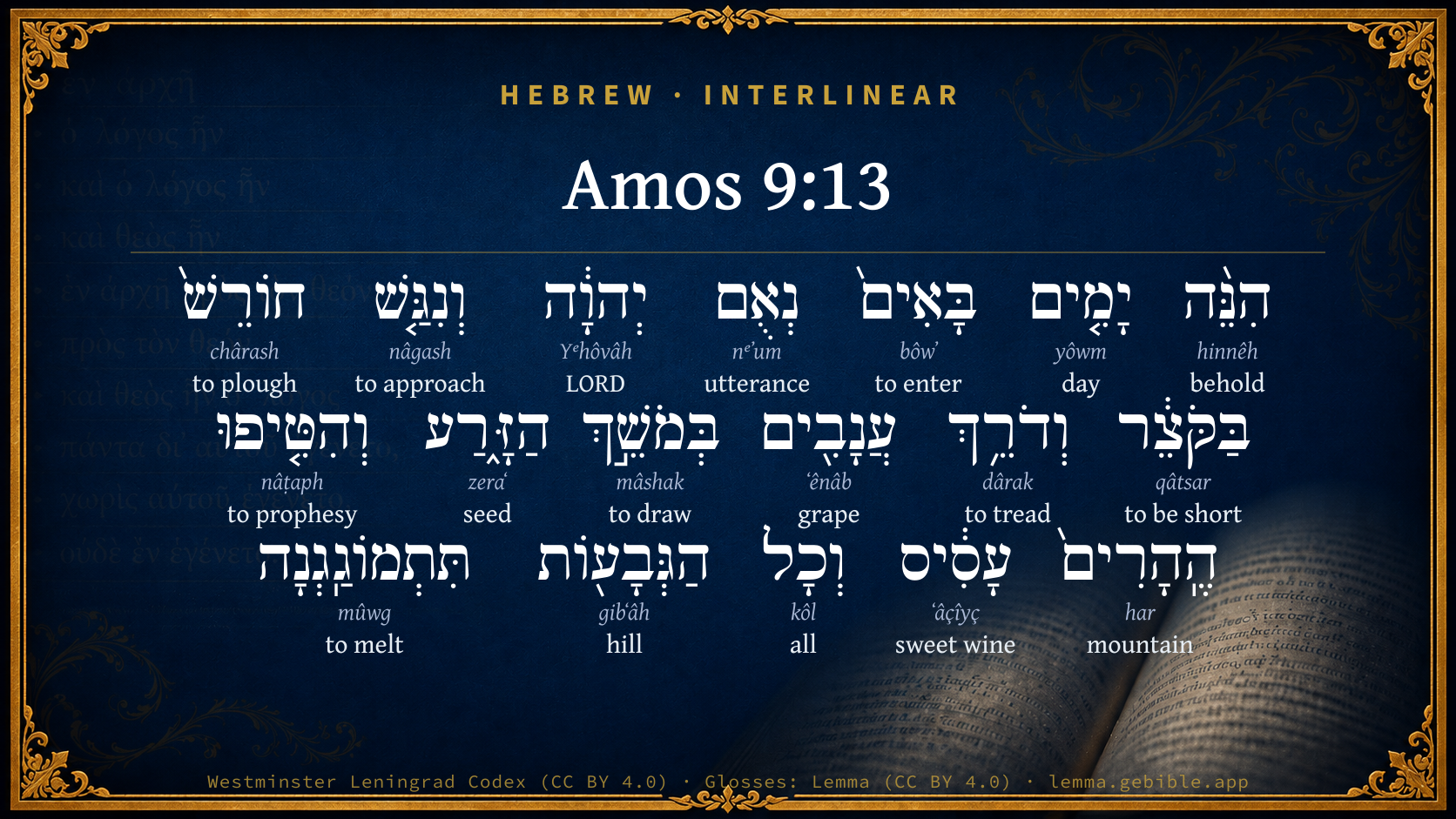
Amos 9:13

Hebrew (Westminster Leningrad Codex) Amos 9:13 appears in the Hebrew Old Testament. The text above is from the Westminster Leningrad Codex. Each word links to its Strong’s number, a concise gloss, and parsing drawn from the Open Scriptures Hebrew Bible morphology. Click any word for its full Brown-Driver-Briggs (BDB) entry.
Download image
Cite this verse

Amos 9:13 (World English Bible). Public Domain. Lemma interlinear Bible study tool, https://lemma.gebible.app/v/amos/9/13.

Show BibTeX & RIS
BibTeX
RIS
English Translation
"Behold, the days come," says Yahweh, "That the plowman shall overtake the reaper, And the one treading grapes him who sows seed; And sweet wine will drip from the mountains, And flow from the hills.
World English Bible · Public Domain
Download a study sheet

One document with this verse’s original text, its word-by-word gloss line, the meaning frame, cross-references with their text, attributed commentary, and full source and license credits — printable, and it pastes into notes with its structure intact.

This verse Autodidact and up

Study sheet (.html) Plain text (.txt)

A passage Seminary Student

Up to 50 verses in one chapter. A passage sheet keeps up to 6 commentary sources and 12 cross-references per verse, in the order this page ranks them, and says so on the sheet whenever that leaves anything out. Ask for a single verse and you get the Autodidact verse sheet above.

Everything on this page stays free to read, with no account — the sheet is a download of what is already on screen, not access to it.

Want to remove ads? Support Godless Engineer
Compare translations 3

The same verse in 3 English versions, stacked beneath the original-language interlinear above. Click any original word for its lexicon entry.

Each is an independent rendering of the whole verse — the interlinear is not word-aligned to these translations.

Highlighted words mark where these versions differ — a whole-verse word diff, not a word-by-word alignment.

  • World English Bible Public Domain
    "Behold, the days come," says Yahweh, "That the plowman shall overtake the reaper, And the one treading grapes him who sows seed; And sweet wine will drip from the mountains, And flow from the hills.
  • King James Version Public Domain
    Behold, the days come, saith the LORD, that the plowman shall overtake the reaper, and the treader of grapes him that soweth seed; and the mountains shall drop sweet wine, and all the hills shall melt.
  • unfoldingWord Literal Text CC BY-SA 4.0
    Behold, the days will come—this is Yahweh’s declaration— when the plowman will overtake the reaper, and the treader of grapes will overtake him who plants seed. The mountains will drip sweet wine, and all the hills will flow with it.

unfoldingWord Literal Text — © unfoldingWord, licensed CC BY-SA 4.0. Word-aligned USFM3 via Door43 (git.door43.org/unfoldingWord/en_ult).

Versions to compare (up to 4)

3 of 4 selected

Show all 18 translations

Every available English version of this verse, each an independent rendering of the whole verse.

  • World English Bible Public Domain
    "Behold, the days come," says Yahweh, "That the plowman shall overtake the reaper, And the one treading grapes him who sows seed; And sweet wine will drip from the mountains, And flow from the hills.
  • Berean Standard Bible Public Domain
    “Behold, the days are coming,” declares the LORD, “when the plowman will overtake the reaper and the treader of grapes, the sower of seed. The mountains will drip with sweet wine, with which all the hills will flow.
  • Majority Standard Bible Public Domain
    “Behold, the days are coming,” declares the LORD, “when the plowman will overtake the reaper and the treader of grapes, the sower of seed. The mountains will drip with sweet wine, with which all the hills will flow.
  • King James Version Public Domain
    Behold, the days come, saith the LORD, that the plowman shall overtake the reaper, and the treader of grapes him that soweth seed; and the mountains shall drop sweet wine, and all the hills shall melt.
  • American Standard Version (1901) Public Domain
    Behold, the days come, saith Jehovah, that the plowman shall overtake the reaper, and the treader of grapes him that soweth seed; and the mountains shall drop sweet wine, and all the hills shall melt.
  • Revised Version (1885) Public Domain
    Behold, the days come, saith the LORD, that the plowman shall overtake the reaper, and the treader of grapes him that soweth seed; and the mountains shall drop sweet wine, and all the hills shall melt.
  • Geneva Bible (1599) Public Domain
    Behold, the dayes come, saith the Lord, that the plowman shall touche the mower, and the treader of grapes him that soweth seede: and the mountaines shall drop sweete wine, and all the hilles shall melt.
  • Douay-Rheims (1899) Public Domain
    Behold the days come, saith the Lord, when the ploughman shall overtake the reaper, and the treader of grapes him that soweth seed: and the mountains shall drop sweetness, and every hill shall be tilled.
  • Young's Literal Translation Public Domain
    Lo, days are coming -- an affirmation of Jehovah, And come nigh hath the ploughman to the reaper, And the treader of grapes to the scatterer of seed, And the mountains have dropt juice, And all the hills do melt.
  • Literal Standard Version CC BY-SA 4.0
    “Behold, days are coming,” || A declaration of YHWH, || “And the plowman has come near to the reaper, || And the treader of grapes to the scatterer of seed, || And the mountains have dropped juice, || And all the hills melt.
  • Unlocked Literal Bible CC BY-SA 4.0
    Look, the days will come—this is Yahweh's declaration— when the plowman will overtake the reaper, and the treader of grapes will overtake him who plants seed. The mountains will drip sweet wine, and all the hills will flow with it.
  • unfoldingWord Literal Text CC BY-SA 4.0
    Behold, the days will come—this is Yahweh’s declaration— when the plowman will overtake the reaper, and the treader of grapes will overtake him who plants seed. The mountains will drip sweet wine, and all the hills will flow with it.
  • Darby Bible Public Domain
    Behold, the days come, saith Jehovah, when the ploughman shall overtake the reaper, and the treader of grapes him that soweth seed; and the mountains shall drop new wine, and all the hills shall melt.
  • World Messianic Bible Public Domain
    “Behold, the days come,” says the LORD, “that the plowman shall overtake the reaper, and the one treading grapes him who sows seed; and sweet wine will drip from the mountains, and flow from the hills.
  • Webster's Bible Public Domain
    Behold, the days come, saith the LORD, that the plowman shall overtake the reaper, and the treader of grapes him that soweth seed; and the mountains shall drop sweet wine, and all the hills shall melt.
  • Free Bible Version CC BY-SA 4.0
    Look! The time is coming, says the Lord, when the reaper will overtake the plowman, and the one who treads the grapes will overtake the one who sows the seed. The mountains will drip with sweet wine, and flow from all the hills.
  • Bible in Basic English Public Domain
    See, the days will come, says the Lord, when the ploughman will overtake him who is cutting the grain, and the crusher of the grapes him who is planting seed; and sweet wine will be dropping from the mountains, and the hills will be turned into streams of wine.
  • JPS Tanakh (1917) Public Domain
    Behold, the days come, saith the LORD, that the plowman shall overtake the reaper, and the treader of grapes him that soweth seed; and the mountains shall drop sweet wine, and all the hills shall melt.

Literal Standard Version (2020), Covenant Press — licensed CC BY-SA 4.0. Text via the HelloAO Bible API (eBible.org). Unlocked Literal Bible (unfoldingWord) — licensed CC BY-SA 4.0. Text via the HelloAO Bible API (eBible.org). unfoldingWord Literal Text — © unfoldingWord, licensed CC BY-SA 4.0. Word-aligned USFM3 via Door43 (git.door43.org/unfoldingWord/en_ult). Free Bible Version, Dr. Jonathan Gallagher — licensed CC BY-SA 4.0. Text via the HelloAO Bible API (eBible.org).

Word by word

More ways to search: Search by grammar → Find every occurrence → Compare this word →

Practice this passage: Drill this verse → Learn its vocabulary →

עָסִ֔יס
ʻâçîyç
H6071
“sweet wine”
Noun, Common, Masculine, Singular, Absolute
Part of Speech
Noun
Type
Common
Gender
Masculine
Number
Singular
State
Absolute
Full BDB Definition

Origin: from H6072

TWOT: 1660a

sweet wine, wine, pressed out juice
  1. הִנֵּ֨ה hinnêh H2009 “behold” Particle, Demonstrative
  2. יָמִ֤ים yôwm H3117 “days” Noun, Common, Masculine, Plural, Absolute
  3. בָּאִים֙ bôwʼ H935 “entering” Verb, Qal, Participle Active, Masculine, Plural, Absolute
  4. נְאֻם nᵉʼum H5002 “utterance of” Noun, Common, Masculine, Singular, Construct
  5. יְהוָ֔ה Yᵉhôvâh H3068 “LORD” Noun, Proper
  6. וְנִגַּ֤שׁ nâgash H5066 “and · to approach” Conjunction + Verb, Niphal, Sequential Perfect, 3rd Person, Masculine, Singular
  7. חוֹרֵשׁ֙ chârash H2790 “ploughing” Verb, Qal, Participle Active, Masculine, Singular, Absolute
  8. בַּקֹּצֵ֔ר qâtsar H7114 “in/at the · being short” Preposition, Determined + Verb, Qal, Participle Active, Masculine, Singular, Absolute
  9. וְדֹרֵ֥ךְ dârak H1869 “and · treading” Conjunction + Verb, Qal, Participle Active, Masculine, Singular, Construct
  10. עֲנָבִ֖ים ʻênâb H6025 “grapes” Noun, Common, Masculine, Plural, Absolute
  11. בְּמֹשֵׁ֣ךְ mâshak H4900 “in/at · drawing” Preposition + Verb, Qal, Participle Active, Masculine, Singular, Construct
  12. הַזָּ֑רַע zeraʻ H2233 “the · seed” Particle, Definite Article + Noun, Common, Masculine, Singular, Absolute
  13. וְהִטִּ֤יפוּ nâṭaph H5197 “and · to prophesy” Conjunction + Verb, Hiphil, Perfect, 3rd Person, Common, Plural
  14. הֶֽהָרִים֙ har H2022 “the · mountains” Particle, Definite Article + Noun, Common, Masculine, Plural, Absolute
  15. וְכָל kôl H3605 “and · all of” Conjunction + Noun, Common, Masculine, Singular, Construct
  16. הַגְּבָע֖וֹת gibʻâh H1389 “the · hills” Particle, Definite Article + Noun, Common, Feminine, Plural, Absolute
  17. תִּתְמוֹגַֽגְנָה mûwg H4127 “to melt” Verb, Hithpolel, Imperfect, 3rd Person, Feminine, Plural

About this verse

These counts appear in no published source. They are computed here, from the morphology-tagged text and Lemma’s own curated glosses. What Lemma adds →

18
words
18
distinct lemmas
Prophets
section

Notable vocabulary

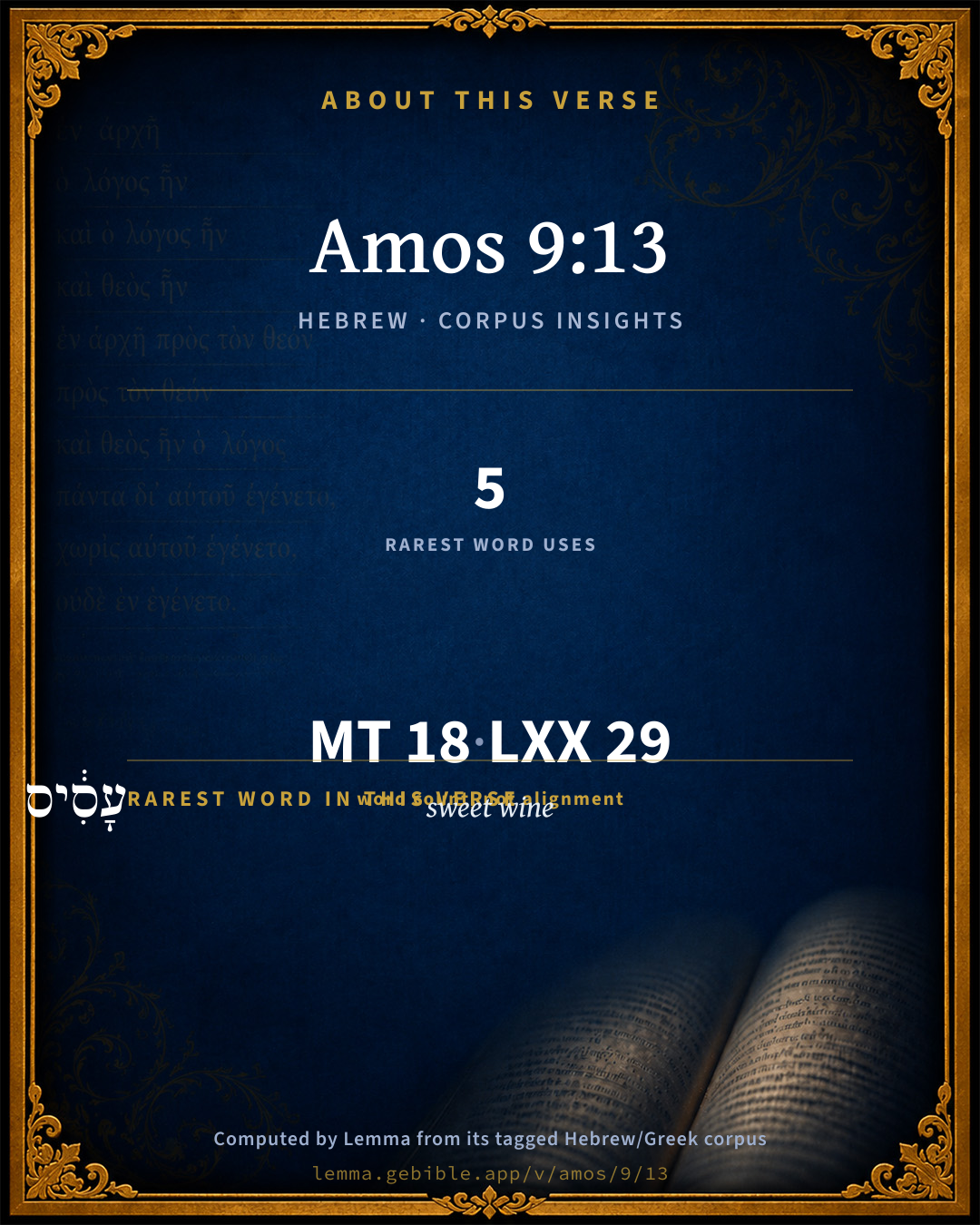
The rarest word here is עָסִ֔יס sweet wine H6071 — appearing just 5 times in the whole Hebrew Bible.

Shared distinctive vocabulary

עָסִ֔יס sweet wine H6071 occurs in 5 verses of the Hebrew Bible. Also found in:

Grammatical profile

  • 8 verbs
  • 9 nouns
  • 1 particle

Verb forms

  • בָּאִים֙ Qal · Participle Active
  • וְנִגַּ֤שׁ Niphal · Sequential Perfect
  • חוֹרֵשׁ֙ Qal · Participle Active
  • בַּקֹּצֵ֔ר Qal · Participle Active
  • וְדֹרֵ֥ךְ Qal · Participle Active
  • בְּמֹשֵׁ֣ךְ Qal · Participle Active
  • וְהִטִּ֤יפוּ Hiphil · Perfect
  • תִּתְמוֹגַֽגְנָה Hithpolel · Imperfect

Hebrew & Septuagint length

In English translation the verse runs 35 words from the Hebrew and 36 from the Septuagint (LXX English) — closely comparable.

A rough comparison of the two English renderings, which tokenize alike — not a word-level alignment.

Word counts can differ between the Hebrew and the Greek without any difference in meaning — e.g. the Hebrew direct-object marker אֵת has no separate Greek word, and Greek often adds the article ὁ.

In the original languages it is 18 Hebrew tokens and 29 Greek tokens — but the two are counted differently (Hebrew bundles its prefixes and suffixes into one token; the Greek is in lemma form), so that isn’t a like-for-like length.

Cross-references

11

Topical passages linked to Amos 9:13 in the Treasury of Scripture Knowledge — connected by theme and wording, ordered by reader-vote popularity; previews shown in the World English Bible.

  • Joel 3:18 It will happen in that day, That the mountains will drop down sweet wine, The hills will flow with milk, All the brooks of Judah will flow with waters; And a fountain will come forth from the house of Yahweh, And will water the valley of Shittim.
  • John 4:35 Don't you say, 'There are yet four months until the harvest?' Behold, I tell you, lift up your eyes, and look at the fields, that they are white for harvest already.
  • Leviticus 26:5 Your threshing shall reach to the vintage, and the vintage shall reach to the sowing time; and you shall eat your bread to the full, and dwell in your land safely.
  • Isaiah 55:13 Instead of the thorn shall come up the fir tree; and instead of the brier shall come up the myrtle tree: and it shall be to Yahweh for a name, for an everlasting sign that shall not be cut off.
  • Isaiah 35:1–2 The wilderness and the dry land shall be glad; and the desert shall rejoice, and blossom as the rose.
  • Ezekiel 36:35 They shall say, This land that was desolate is become like the garden of Eden; and the waste and desolate and ruined cities are fortified and inhabited.
  • Hosea 2:21–23 It will happen in that day, I will respond," says Yahweh, I will respond to the heavens, And they will respond to the earth;
  • Joel 3:20 But Judah will be inhabited forever, And Jerusalem from generation to generation.
  • Judges 5:5 The mountains quaked at the presence of Yahweh, Even yon Sinai at the presence of Yahweh, the God of Israel.
  • Psalms 97:5 The mountains melt like wax at the presence of Yahweh, At the presence of the Lord of the whole earth.
  • Amos 9:5 For the Lord, Yahweh of Hosts, is he who touches the land and it melts, and all who dwell in it will mourn; and it will rise up wholly like the River, and will sink again, like the River of Egypt.

Cross-references courtesy of OpenBible.info (CC BY 4.0).

Hebrew and Greek witnesses Masoretic Hebrew ↔ Greek Septuagint

The same verse in the two great witnesses to the Old Testament, shown verse-for-verse.

These are two independent witnesses, not word-aligned to each other, and the Septuagint is shown in lemma (dictionary) form.

Hebrew Amos 9:13 Masoretic · Westminster Leningrad Codex

הִנֵּ֨ה יָמִ֤ים בָּאִים֙ נְאֻם יְהוָ֔ה וְנִגַּ֤שׁ חוֹרֵשׁ֙ בַּקֹּצֵ֔ר וְדֹרֵ֥ךְ עֲנָבִ֖ים בְּמֹשֵׁ֣ךְ הַזָּ֑רַע וְהִטִּ֤יפוּ הֶֽהָרִים֙ עָסִ֔יס וְכָל הַגְּבָע֖וֹת תִּתְמוֹגַֽגְנָה

"Behold, the days come," says Yahweh, "That the plowman shall overtake the reaper, And the one treading grapes him who sows seed; And sweet wine will drip from the mountains, And flow from the hills.

World English Bible · Public Domain

Greek LXX Amos 9:13 Septuagint · lemma form

ἰδού ἡμέρα ἔρχομαι λέγω κύριος καί καταλαμβάνω ὁ ἀλοητός ὁ τρύγητος καί περκάζω ὁ σταφυλή ἐν ὁ σπόρος καί ἀποσταλάσσω ὁ ὄρος γλυκασμός καί πᾶς ὁ βουνός σύμφυτος εἰμί

Behold, the days come, says the Lord, when the harvest shall overtake the vintage, and the grapes shall ripen at seed time; and the mountains shall drop sweet wine, and all the hills shall be planted.

LXX2012 (modern English Septuagint) · Public Domain

On this verse, The Cambridge Bible for Schools and Colleges discusses the Septuagint’s reading. Read the note in Commentary ↓

Hebrew: Westminster Leningrad Codex (CC BY 4.0). Greek: Septuagint (public domain); English from LXX2012 (modern English Septuagint) (Public Domain). How the Septuagint differs from the Hebrew →

Targum (Aramaic paraphrase)

1

The Targum is the ancient Jewish Aramaic paraphrase of the Hebrew Scriptures — an interpretive translation, not the Hebrew text itself. Onkelos (literal) and Pseudo-Jonathan (expansive) render the Torah, and Jonathan the Prophets. Coverage is partial: where no permissively-licensed English translation exists for a verse, only the Aramaic is shown. This is verse-level text, not a word-by-word alignment to the Hebrew.

  1. Targum Jonathan Prophets (Joshua–Malachi)
    הָא יוֹמַיָא אָתָן אֲמַר יְיָ וְיֶעֱרַע רַדְיָא בַחֲצוֹדָא וְעַצָר עִנְבִין בְּמִפַּק בַּר זַרְעָא וְיִרְבּוּן טוּרַיָא חֲמַר מְרַת וְכָל רָמְתָא יִתְפַּלְחָן:

    (no public-domain English translation for this verse)

    Targum Jonathan — Aramaic: “Mikraot Gedolot” (public domain). English: “Sefaria Community Translation” (CC0 1.0 (public-domain dedication)); “London "Chaldee Paraphrase," 1871” (public domain). Text via Sefaria.

Commentary

Notes on Amos 9:13 from classic Christian and Jewish commentators (each source and its license shown beneath its notes). The classic Christian expositions comment on the surrounding passage and are grouped to its opening verse, so a note may address several verses; the Jewish commentaries on the Tanakh (Rashi and others) are per-verse, so they appear only where the commentator wrote on this verse.

Lemma curates 59 commentaries, every one of them public domain or Creative Commons licensed, each selected and text-cleaned for this edition rather than reprinted as found. About our sources →

Trapp's Complete Commentary

John Trapp

Amo 9:13 Behold, the days come, saith the LORD, that the plowman shall overtake the reaper, and the treader of grapes him that soweth seed; and the mountains shall drop sweet wine, and all the hills shall melt.

Ver. 13. Behold, the days come, saith the Lord, that the plowman] The gospel of peace brings with it the peace of the gospel, and with peace plenty, with the horn of salvation the horn of plenty, a confluence of outward comforts and contentments, as in Solomon’s days and Constantine’s (whom God prospered and blessed beyond all that he could have wished, saith Austin, Bonus Deus Constant tantis terrenis implevit muneribus quanta optare nullus auderet. De C. D. l. 5, 25), and Queen Elizabeth’s whom, for her care to propagate the gospel, he made to be the happiest woman that ever swayed sceptre, as her very enemies were forced to acknowledge: so liberal a paymaster is the Lord, that all his retributions are more than bountiful; and this his servants have not ex largitate, sed ex promisso, out of his general providences, but by virtue of a promise, which is far sweeter. The Masorites have observed, that in this verse are found all the letters of the Hebrew alphabet (as also in 26 more verses of the Old Testament), {Hebrew Text Note} to note, say the Calvinists, that in the kingdom of the Messiah ( In instauratione casulae Davidicae collapsae) there shall be great abundance of all things, et plenum copiae cornu: or, if that should fail, yet plenty of all spiritual benedictions in heavenly things, Eph 1:3, and contented godliness, 1Ti 6:6, which hath an autarkeia, a self-sufficiency; so that having nothing, a man possesseth all things, 2Co 6:10. This the prophet expresseth in the following words, by many excellent hyperboles, though (to say sooth) Christus et regnum eius non patiuntur hyperbolen. All words are too weak to set forth the worth of Christ and his kingdom.

The plowman shall overtake the reaper] In signis hyperbole, saith Mercer: no sooner shall harvest be ended but seeding shall succeed and that promise be fulfilled, Lev 26:5 : all businesses belonging to the tillage of the ground and the inning of the fruit shall have their fit and suitable seasons; where, under the name of corporal blessings, spiritual are to be understood; and indeed those blessings out of Zion are far beyond any other that come out of heaven and earth, Psa 134:3.

And the treader of grapes, him that soweth seed] "Precious seed," Psa 126:5, sowingseed (as one translates it), drawn out of the seed basket, and cast all along upon the land: the meaning is, that the vintage shall last so long, that the seedsman shall scarcely have time to do his business, for waiting upon the winepress.

And the mountains shall drop sweet wine] Or juice of pomegranates, more delicious liquor than that which the Italians profanely call Lachryma Christi, or that which at Paris and Louvaine is called Vinum Theologicum, or Vinum Cos, that is, coloris, odoris, saporis ortirol, the best in the country for colour, savour, and taste, to please the palate.

And all the hills shall melt] sc. With milk, honey, oil, Joe 3:18, the same almost with this. And the heathen poet (Claudian) hath the like,

- “ Subitis messor gaudebit aristis:

Rorabunt querceta favis stagnantia passim

Vina fluent oleique lacus. ” -

John Trapp, A Commentary or Exposition upon All the Books of the Old and New Testament (1647–1656) — public domain. Text from a community e-Sword module.

The Biblical Illustrator

Joseph S. Exell

Amo_9:13

Behold, The days come, saith the Lord, that the plowman shall overtake the reaper.

A revival sermon

Gods promises are not exhausted when they are fulfilled, for when once performed they stand just as good as they did before, and we may await a second accomplishment of them.

I. Explain the text as a promise of revival.

1. Notice a promise of surprising ingathering.

2. The idea of amazing rapidity.

3. Notice the activity of labour which is mentioned in the text. One sign of a true revival is the increased activity of Gods labourers.

4. A time of revival shall be followed by very extraordinary conversion.

II. What is taught us by a revival? That God is absolute monarch of the hearts of men. God does not say here if men are willing, but He gives an absolute promise of a Messing. If it were net for this doctrine I wonder where the ministry would be. Adam Old is too strong for young Melanchthons.

III. The text should be a stimulus for further exertion. The duty of the Church is not to be measured by its success. It is as much the ministers duty to preach the Gospel in adverse times as in propitious seasons. Recollect that even when this revival comes an instrumentality will still be wanted. The ploughman is wanted even after the harvest. The ploughman shall never be so much esteemed as when he follows after the reaper, and the Sower of seed never so much valued as when he comes at the heels of those that tread the grapes. The glory which God puts upon instrumentality should encourage you to use it.

IV. A word of warning to those who know not Christ. (C. H. Spurgeon.)

The Biblical Illustrator, edited by Joseph S. Exell (c. 1880s–1900s) — public domain. Text from a community e-Sword module.

Joseph Benson's Commentary

Amo 9:13. Behold the days come — Here we have another promise, literally to be understood of the abundant plenty which God would bestow on the returned captives, and mystically of the abundant grace given and blessings conferred in gospel days. That the ploughman shall overtake the reaper — He who breaks up the ground, and prepares it for the seed, shall be ready to tread on the heels of the reaper; who shall have a harvest so large, that before he can gather it all in, it shall be time to plough the ground again. And the treader of grapes him that soweth seed — This is to be understood in the same sense as the foregoing clause: so great shall their vintage be, that before the treaders of grapes can have finished their work, the seedsman shall be sowing his seed against the next season. And the mountains shall drop sweet wine — The vineyards shall be so fruitful, and shall produce such abundance of grapes, that wine shall appear to be as plentiful as if it ran down from the mountains. And all the hills shall melt — Hebrew, shall flow. The meaning is, that they should afford such plenty of rich feeding to the cattle, that they should in consequence thereof give a large quantity of milk. The parallel expression to this, in the prophecy of Joel, is, The hills shall flow with milk. As these predictions were not fulfilled in their literal sense between the time of the return of the Jews from Babylon and the coming of Christ, it is evident they are either to be figuratively understood of gospel blessings, or, if taken in their literal sense, they respect the happy state of things during the millennium, which may be supposed to begin after the future restoration of the Jews to their own country. See notes on Joe 3:18. The prophets, it may be observed, frequently describe the days of the Messiah in terms similar to those which the poets used in describing the golden age.

Joseph Benson's Commentary on the Old and New Testaments (1811–1818) — public domain. Text from a community e-Sword module.

Whedon's Commentary on the Bible

Daniel D. Whedon

13-15. The outward extension of the territory will be followed by internal peace and prosperity. Amo_9:13 promises extreme fertility of the soil (see on Hos_2:20-21; compare Joe_2:22 ff.; Lev_26:5). The translations of A.V. and R.V. are not quite accurate. Literally the verse reads, “Behold, the days are about to come, saith Jehovah, that the plowman and the reaper shall touch each other, as well as the treader of grapes and the sower of seed; and the mountains shall drop sweet wine, and all the hills shall melt.” This rendering leaves it undecided whether the plowman is to overtake the reaper and the treader of grapes the sower, or the reaper the plowman and the sower the treader of grapes. Undoubtedly the latter is the thought. The ground will be so fertile that the plowman has hardly completed the work of plowing and sowing when the grain is ready for harvest, and the vintage will be so plentiful that it will not be completed when the time for plowing comes around again. Ordinarily the plowing in Palestine takes place in October, the sowing in November, the barley and wheat harvest in April and May, the vintage in August and September.

Treader of grapes — The grapes were thrown into the winepress, where, in ancient times — and even now in some cases — they were pressed with the feet (for illustrations see Van Lennep, Bible Lands, p. 118; compare Joe_2:24). For 13b see Joe_3:18.

Melt — The vintage will be so bountiful that it will seem as if the hills themselves were being dissolved into streams of wine.

Daniel D. Whedon (gen. ed.), Commentary on the Old and New Testaments (1874–1909) — public domain. Text from a community e-Sword module.

Keil & Delitzsch

C. F. Keil & F. Delitzsch

To the setting up of the kingdom and its outward extension the prophet appends its inward glorification, foretelling the richest blessing of the land (Amo 9:13) and of the nation (Amo 9:14), and lastly, the eternal duration of the kingdom (Amo 9:15). Amo 9:13. "Behold, days come, is the saying of Jehovah, that the ploughman reaches to the reaper, and the treader of grapes to the sower of seed; and the mountains drip new wine, and all the hills melt away. Amo 9:14. And I reverse the captivity of my people Israel, and they build the waste cities, and dwell, and plant vineyards, and drink the wine thereof; and make gardens, and eat the fruit thereof. Amo 9:15. And I plant them in their land, and they shall no more be torn up out of their land which I have given them, saith Jehovah thy God." In the new kingdom of God the people of the Lord will enjoy the blessing, which Moses promised to Israel when faithful to the covenant. This blessing will be poured upon the land in which the kingdom is set up. Amo 9:13 is formed after the promise in Lev 26:5, "Your threshing shall reach unto the vintage, and the vintage shall reach unto the sowing-time;" but Amos transfers the action to the persons employed, and says, "The ploughman will reach to the reaper." Even while the one is engaged in ploughing the land for the sowing, the other will already be able to cut ripe corn; so quickly will the corn grow and ripen. And the treading of the grapes will last to the sowing-time, so abundant will the vintage be. The second half of the verse is taken from Joe 3:18; and according to this passage, the melting of the hills is to be understood as dissolving into streams of milk, new wine, and honey, in which the prophet had the description of the promised land as a land flowing with milk and honey (Exo 3:8, etc.) floating before his mind. In the land so blessed will Israel enjoy unbroken peace, and delight itself in the fruits of its inheritance. On שׁוּב את־שׁבוּת, see the exposition of Hos 6:11. That this phrase is not used here to denote the return of the people from captivity, but the turning of misfortune and misery into prosperity and salvation, is evident from the context; for Israel cannot be brought back out of captivity after it has already taken possession of the Gentiles (Amo 9:12). The thought of Amo 9:14, as attached to Amo 9:13, is the following: As the land of Israel, i.e., the territory of the re-erected kingdom of David, will no more be smitten with the curse of drought and failing crops with which the rebellious are threatened, but will receive the blessing of the greatest fertility, so will the people, i.e., the citizens of this kingdom, be no more visited with calamity and judgment, but enjoy the rich beneficent fruits of their labour in blessed and unbroken peace. This thought is individualized with a retrospective glance at the punishment with which the sinners are threatened in Amo 5:11, - namely, as building waste cities, and dwelling therein, and as drinking the wine of the vineyards that have been planted; not building houses for others any more, as was threatened in Amo 5:11, after Deu 28:30, Deu 28:39; and lastly, as laying out gardens, and eating the fruit thereof, without its being consumed by strangers (Deu 28:33). This blessing will endure for ever (Amo 9:15). Their being planted in their land denotes, not the settling of the people in their land once more, but their firm and lasting establishment and fortification therein. The Lord will make Israel, i.e., His rescued people, into a plantation that will never be torn up again, but strikes firm roots, sends forth blossom, and produces fruit. The words point back to Sa2 7:10, and declare that the firm planting of Israel which was begun by David will be completed with the raising up of the fallen hut of David, inasmuch as no further driving away of the nation into captivity will occur, but the people of the Lord will dwell for ever in the land which their God has given them. Compare Jer 24:6. This promise is sealed by אמר יי אל.

We have not to seek for the realization of this promise in the return of Israel from its captivity to Palestine under Zerubbabel and Ezra; for this was no planting of Israel to dwell for ever in the land, nor was it a setting up of the fallen hut of David. Nor have we to transfer the fulfilment to the future, and think of a time when the Jews, who have been converted to their God and Saviour Jesus Christ, will one day be led back to Palestine. For, as we have already observed at Joe 3:18, Canaan and Israel are types of the kingdom of God and of the church of the Lord. The raising up of the fallen hut of David commenced with the coming of Christ and the founding of the Christian church by the apostles; and the possession of Edom and all the other nations upon whom the Lord reveals His name, took its rise in the reception of the Gentiles into the kingdom of heaven set up by Christ. The founding and building of this kingdom continue through all the ages of the Christian church, and will be completed when the fulness of the Gentiles shall one day enter into the kingdom of God, and the still unbelieving Israel shall have been converted to Christ. The land which will flow with streams of divine blessing is not Palestine, but the domain of the Christian church, or the earth, so far as it has received the blessings of Christianity. The people which cultivates this land is the Christian church, so far as it stands in living faith, and produces fruits of the Holy Ghost. The blessing foretold by the prophet is indeed visible at present in only a very small measure, because Christendom is not yet so pervaded by the Spirit of the Lord, as that it forms a holy people of God. In many respects it still resembles Israel, which the Lord will have to sift by means of judgments. This sifting will be first brought to an end through the judgment upon all nations, which will attend the second coming of Christ. Then will the earth become a Canaan, where the Lord will dwell in His glorified kingdom in the midst of His sanctified people.

Keil & Delitzsch — Biblical Commentary on the Old Testament (1861–1891) — public domain (CC PDM 1.0). Text via the HelloAO Bible API. (Old Testament only.)

Tyndale Open Study Notes

Tyndale Open Resources

9:13-15 The coming age would restore the natural harmony lost in Eden (Gen 3) and would bring a new era of prosperity.

9:13 the hills . . . will drip with sweet wine: Amos points poetically to a future time when humans would once again live in harmony with God’s creation.

Tyndale Open Study Notes — © Tyndale Open Resources, licensed CC BY-SA 4.0. Text via the HelloAO Bible API.

Geneva Bible (1599)

Geneva Bible translators

Read Joel 3:18.

Signifying, that there shall be great plenty of all things, so that when one kind of fruit is ripe, another should follow, and every one in course, Lev. 26:5.

Geneva Bible (1599) marginal notes — public domain. Text via Bolls.life.

Jamieson, Fausset & Brown

Robert Jamieson, A. R. Fausset & David Brown

the days come--at the future restoration of the Jews to their own land.

ploughman shall overtake . . . reaper . . . treader of grapes him that soweth--fulfilling Lev 26:5. Such shall be the abundance that the harvest and vintage can hardly be gathered before the time for preparing for the next crop shall come. Instead of the greater part of the year being spent in war, the whole shall be spent in sowing and reaping the fruits of earth. Compare Isa 65:21-23, as to the same period.

soweth seed--literally, "draweth it forth," namely, from the sack in order to sow it.

mountains . . . drop sweet wine--an appropriate image, as the vines in Palestine were trained on terraces at the sides of the hills.

Jamieson, Fausset & Brown — Commentary Critical and Explanatory on the Whole Bible (1871) — public domain (CC PDM 1.0). Text via the HelloAO Bible API.

Adam Clarke's Commentary

Verse 13. The ploughman shall overtake the reaper] All the seasons shall succeed in due and natural order: but the crops shall be so copious in the fields and in the vineyards, that a long time shall be employed in gathering and disposing of them; so that the seasons of ploughing, sowing, gathering the grapes, treading the wine-press, c., shall press on the heels of each other so vast will be the abundance, and so long the time necessary to gather and cure the grain and fruits. We are informed by travellers in the Holy Land, Barbary, c., that the vintage at Aleppo lasts from the fifteenth of September to the middle of November and that the sowing season begins at the close of October, and lasts through all November. Here, then, the ploughman, sower, grape-gatherer, and operator at the wine-press, not only succeed each other, but have parts of these operations going on at the same time. But great fertility in the land, abundance in the crops, and regularity of the seasons, seem to be the things which the prophet especially predicts. These are all poetical and prophetical images, by which happy times are pointed out.

Adam Clarke's Commentary on the Bible (1810–1826) — public domain. Text from a community e-Sword/MySword module.

John Calvin's Commentaries

Here the Prophet describes the felicity which shall be under the reign of Christ: and we know that whenever the Prophets set forth promises of a happy and prosperous state to God’s people, they adopt metaphorical expressions, and say, that abundance of all good things shall flow, that there shall be the most fruitful produce, that provisions shall be bountifully supplied; for they accommodated their mode of speaking to the notions of that ancient people; it is therefore no wonders if they sometimes speak to them as to children. At the same time, the Spirit under these figurative expressions declares, that the kingdom of Christ shall in every way be happy and blessed, or that the Church of God, which means the same thing, shall be blessed, when Christ shall begin to reign.

Hence he says, Coming are the days, saith Jehovah, and the plowman shall draw nigh, or meet, the reaper The Prophet no doubt refers to the blessing mentioned by Moses in Leviticus 26:5 for the Prophets borrowed thence their mode of speaking, to add more credit and authority to what they taught. And Moses uses nearly the same words, — that the vintage shall meet the harvest, and also that sowing shall meet the plowing: and this is the case, when God supplies abundance of corn and wine, and when the season is pleasant and favorable. We then see what the Prophet means, that is, that God would so bless his people, that he would suffer no lack of good things.

The plowman then shall come nigh the reaper; and the treader of grapes, the bearer of seed. When they shall finish the harvest, they shall begin to plow, for the season will be most favorable; and then when they shall complete their vintage, they shall sow. Thus the fruitfulness, as I have said, of all produce is mentioned.

The Prophet now speaks in a hyperbolical language, and says, Mountains shall drop sweetness, and all the hills shall melt, that is, milk shall flow down. We indeed know that this has never happened; but this manner of speaking is common and often occurs in Scripture. The sum of the whole is, that there will be no common or ordinary abundance of blessings, but what will exceed belief, and even the course of nature, as the very mountains shall as it were flow down. It now follows —

John Calvin's Commentaries (1540-1563) — public domain. Text from the Calvin Translation Society English edition (1840s-50s) via the Christian Classics Ethereal Library (ccel.org). Calvin's coverage is partial (roughly two-thirds of the Bible); uncommented books and verses are honest gaps, never fabricated. The 19th-century editor's footnotes and remarks are omitted so the notes are faithfully Calvin's own voice.

Ellicott's Commentary for English Readers

(13) Shall overtake the reaper.—So rapidly will the harvest follow the ploughing. These closing verses foreshadow the glories of the restored kingdom of David (comp. Hos_3:5), wherein we see the germ of the great Messianic prophecies of Isaiah.

A Bible Commentary for English Readers, edited by Charles John Ellicott (1878–1897) — public domain. Text from a community e-Sword module.

The Cambridge Bible for Schools and Colleges

gen. ed. J. J. S. Perowne

13. A hyperbolical description of the fertility of the soil. So rapid will be the growth of the crops, that the ploughman will hardly have finished breaking up the ground for seed, when the corn will be ready for the reaper; so abundant will be the vintage, that before the grapes are all trodden out, the time will have arrived for sowing seed for the following year: mountains and hills, also, will flow with sweet wine. The time for ploughing would correspond to our October; seed was sown in November: barley and wheat would be ripe in April–May; the vintage was gathered in Aug.–Sept. There is a similar promise in Lev_26:5 “your threshing shall reach unto the vintage, and the vintage shall reach unto the sowing-time”—so abundant, namely, will be the crops.

Behold, days are coming] See on Amo_4:2.

the treader of grapes] The freshly gathered grapes were thrown into the “wine-press” (gath)—usually a trough excavated in the natural rock—where they were “trodden” (דרך) by the feet of men, and the expressed juice, as it ran down, was received into the “wine-fat” (i.e. the “wine-vat”: Heb. yéḳeb), generally another trough excavated similarly in the rock at a somewhat lower level (see O.C. Whitehouse, A Primer of Hebrew Antiquities, p. 99 f.). There are many allusions in the O.T. to this process of treading the grapes (as Jdg_9:27; Isa_63:2-3; Neh_13:15): it was an occasion of rejoicing, and the shouts or huzzahs (hêdâd), with which those engaged at it enlivened their toil, supply the prophets with suggestive imagery (Isa_16:9-10; Jer_25:30; Jer_48:33; Jer_51:14).

him that soweth the seed] Lit. that draweth out, or traileth, the seed: cf. (in the Heb.) Psa_126:6.

shall cause sweet wine to drop down] sweet wine, as Joe_1:5; Joe_3:18, Isa_49:26[204]; Heb. ‘âsîs, from ‘âsas, to tread or press down (Mal_4:3). LXX., here and Joe_3:18, γλυκασμός; in Isa_49:26 οἶνος νέος. The reference is probably to some kind of sweet wine (γλυκὺς οἶνος or vinum dulce), such as was made by the ancients, by partially drying the grapes in the sun, and afterwards allowing the process of fermentation to continue in the juice only 5–7 days, instead of 9 (which was the usual time). See Pliny H.N. xiv. 9; and the Dict. of Classical Antiquities, s.v. Vinum.

[204] Also Son_8:2; but here it denotes a wine made from pomegranates (see D.B. s.v. Pomegranate).

shall melt] more lit. dissolve themselves: so abundant will be the produce of the vineyards, that it will be “as though the hills dissolved themselves in the rich streams which they poured down.” Comp. Joel 3 (4):18, “The mountains shall drop with sweet wine, and the hills shall run with milk, and all the channels of Judah shall run with water”; also, for the hyperbole, the common description of Canaan as “a land flowing with milk and honey.”

13–15. The prosperity and happiness to be enjoyed by Israel upon its own land in the future.

The Cambridge Bible for Schools and Colleges (gen. ed. J. J. S. Perowne; Cambridge University Press, 1878–1918) — public domain. Text from a community e-Sword module.

John Gill's Exposition

Behold, the days come, saith the Lord,.... Or "are coming" (y); and which will commence upon the accomplishment of the above things, when the church of Christ is raised up and established, the Jews converted, and the Gentiles brought in:

that the ploughman shall overtake the reaper; or "meet the reaper" (z); or come up to him, or touch him, as it may be rendered; and so the Targum; that is, before the reaper has well cut down the grain, or it is scarce gathered in, the ploughman shall be ready to plough up the ground again, that it may be sown, and produce another crop:

and the treaders of grapes him that soweth seed; or "draweth seed" (a); out of his basket, and scatters it in the land; signifying that there should he such an abundance of grapes in the vintage, that they would continue pressing till seedtime; and the whole denotes a great affluence of temporal good things, as an emblem of spiritual ones; see Lev 26:5; where something of the like nature is promised, and expressed in much the same manner:

and the mountains shall drop sweet wine; or "new wine" (b); intimating that there shall be abundance of vines grow upon the mountains, which will produce large quantities of wine, so that they shall seem to drop or flow with it:

and all the hills shall melt; with liquors; either with wine or honey, or rather with milk, being covered with flocks and herds, which shall yield abundance of milk; by all which, plenty of spiritual things, as the word and ordinances, and rich supplies of grace, as well as of temporal things, is meant; see Joe 3:18.

(y) "dies venientes", Montanus, Burkius. (z) "et vel cum occurret arator messori", Vatablus, Drusius; "attingent arator messorem", Pagninus, Montanus, Junius & Tremellius, Piscator; "accedet arator ad messorem", Cocceius. (a) "trahentem semen", Montanus, Liveleus, Drusius, Mercerus. (b) "mustum", Pagninus, Montanus, Piscator, Mercerus; "musto", Drusius, Cocceius.

John Gill's Exposition of the Whole Bible (1746–1763) — public domain (CC PDM 1.0). Text via the HelloAO Bible API.

Albert Barnes' Notes on the Bible

Behold the days are coming - The Day of the Lord is ever coming on: every act, good or bad, is drawing it on: everything which fills up the measure of iniquity or which “hastens the accomplishment of the number of the elect;” all time hastens it by. “The plowman shall overtake the reaper and the treader of grapes him that soweth seed.” The image is taken from God’s promise in the law; “Your threshing shall reach unto the vintage, and the vintage shall reach unto the sowing time” Lev 26:5; which is the order of agriculture. The harvest should be so copious that it should not be threshed out until the vintage: the vintage so large, that, instead of ending, as usual, in the middle of the 7th month, it should continue on to the seed-time in November. Amos appears purposely to have altered this. He describes what is wholly beyond nature, in order that it might the more appear that he was speaking of no mere gifts of nature, but, under natural emblems, of the abundance of gifts of grace. “The plowman,” who breaks up the fallow ground, “shall overtake,” or “throng, the reaper. The “plowman” might “throng,” or “join on to the reaper,” either following upon him, or being followed by him; either preparing the soil for the harvest which the reaper gathers in, or breaking it up anew for fresh harvest after the in-gathering.

But the vintage falls between the harvest and the seed-time. If then by the “plowmen thronging on the reaper,” we understand that the harvest should, for its abundance, not be over before the fresh seed-time, then, since the vintage is much nearer to the seed-time than the harvest had been, the words, “he that treadeth out the grapes, him that soweth the seed,” would only say the same less forcibly. In the other way, it is one continuous whole. So vast would be the soil to be cultivated, so beyond all the powers of the cultivator, and yet so rapid and unceasing the growth, that seed-time and harvest would be but one. So our Lord says, “Say not ye, There are yet four months, and then cometh harvest? Behold, I say unto you, Lift up your eyes, and look on the fields, for they are white already to harvest” Joh 4:35. “Four months” ordinarily intervened between seed-time and harvest. Among these Samaritans, seed-time and harvest were one.

They had not, like the Jews, had teachers from God; yet, as soon as our Lord taught them, they believed. But, as seed time and harvest should be one, so should the vintage be continuous with the following seed-time. “The treader of grapes,” the last crowning act of the year of cultivation, should join on to “him that soweth” (literally, “draweth” forth, soweth broadcast, scattereth far and wide the) “seed.” All this is beyond nature, and so, the more in harmony with what went before, the establishment of a kingdom of grace, in which “the pagan” should have “the Name of God called upon” them. He had foretold to them, how God would “send famine on the land, not a famine of bread, nor a thirst for water, but of hearing the words of the Lord” Amo 8:11. Now, under the same image, he declares the repeal of that sentence. He foretells, not the fullness only of God’s gifts, but their unbroken continuance.

Jerome: “All shall succeed one another, so that no day should be void of grain, wine, and gladness.” And they shall not follow only on one another, but shall all go on together in one perpetual round of toil and fruitfulness. There shall be one unceasing inpouring of riches; no break in the heavenly husbandry; labor shall at once yield fruit; the harvest shall but encourage fresh labor. The end shall come swiftly on the beginning; the end shall not close the past only, but issue forth anew. Such is the character of the toils of the Gospel. All the works of grace go on in harmony together; each helps on the other; in one, the fallow-ground of the heart is broken up; in another, seed is sown, the beginning of a holy conversation; in another, is the full richness of the ripened fruit, in advanced holiness or the blood of martyrs. And so, also, of the ministers of Christ, some are adapted especially to one office, some to another; yet all together carry on His one work. All, too, patriarchs, prophets, Apostles, shall meet together in one; they who, before Christ’s coming , “sowed the seed, the promises of the Blessed Seed to come,” and they who “entered into their labors,” not to displace, but to complete them; all shall rejoice together in that Seed which is Christ.

And the mountains shall drop sweet wine and all the hills shall melt - Amos takes the words of Joel, in order to identify their prophecies, yet strengthens the image. For instead of saying, “the hills shall flow with milk,” he says, “they shall melt, dissolve themselves. Such shall be the abundance and super-abundance of blessing, that it shall be as though the hills dissolved themselves in the rich streams which they poured down. The mountains and hills may be symbols, in regard either to their height, or their natural barrenness or their difficulty of cultivation. In past times they were scenes of idolatry. In the time of the Gospel, all should be changed; all should be above nature. All should be obedient to God: all, full of the graces and gifts of God. What was exalted, like the Apostles should be exalted not for itself, but in order to pour out the streams of life-giving doctrine and truth, which would refresh and gladden the faithful. And the lesser heights, “the hills,” should, in their degree, pour out the same streams. Everything, heretofore barren and unfruitful, should overflow with spiritual blessing. The mountains and hills of Judaea, with their terraced sides clad with the vine were a natural symbol fruitfulness to the Jews, but they themselves could not think that natural fruitfulness was meant under this imagery. It would have been a hyperbole as to things of nature; but what, in naturl things, is a hyperbole, is but a faint shadow of the joys and rich delights and glad fruitfulness of grace.

Albert Barnes' Notes on the Bible (1834–1885) — public domain. Text from a community e-Sword/MySword module.

Haydock's Catholic Bible Commentary

Shall overtake, &c. By this is meant the great abundance of spiritual blessings; which, as it were, by a constant succession, shall enrich the Church of Christ. (Challoner) --- Munster, and his imitator, Clarius, see nothing but an allegory in this abundance and return, ver. 14. Yet the literal sense ought to be adopted, when it involves no contradiction. (Houbigant, pref. p. 297.) --- God promised a succession of crops to the faithful Israelites, (Leviticus xxvi. 5.) and the return of the ten tribes is frequently specified. (Calmet)

George Leo Haydock (1774–1849), Haydock's Catholic Family Bible and Commentary, 1859 edition — public domain. Excludes Psalms (Douay-Rheims chapter numbering differs from Protestant) and Deuterocanonical books (Catholic canon only).

Matthew Poole's English Annotations

Here is another promise made literally for assurance of abundant plenty to the returned captives, and mystically, of abundant grace poured forth in gospel days. But of the letter and history.

Behold, mark well, ye poor captived Jews,

the days come; the time will certainly come, nay, it hasteth, and whoso lives to return shall see this word performed.

The ploughman, who breaks up the ground, and prepares it for sowing,

shall overtake the reaper; shall be ready to tread on the heels of the reaper, who shall have a harvest so large, that before he can gather it all in it shall be time to plough the ground and prepare it for the seed for next year’s crop. So God will take away the reproach of famine (in Ezekiel’s phrase) from the mountains of Israel.

And the treader of grapes him that soweth seed; so great shall their vintage be, that ere the treaders of grapes can have finished their work, the seedsman shall be sowing his seed against next harvest season.

The mountains: the Jews did plant the mountains and hills of Canaan with vines, Isa 5:1, there were their vineyards.

Shall drop sweet wine; the vineyards shall be so fruitful, and new wine so plentiful, as if it did, like trickling streams, run down from the mountains; and all the hills shall melt; or as if whole hills were melted into such liquors. See Joe 3:18. It is a lofty strain, and very elegantly expresseth the abundance of outward blessings promised to this people here spoken of. If any will object, It appears not that ever it was so. I answer, It is certain the sins of the returned captives did in very great degrees prevent these blessings, which are here promised under a tacit condition, which they never did fulfil.

Matthew Poole's English Annotations on the Holy Bible (1683–1685) — public domain. Text from a community e-Sword/MySword module.

The Pulpit Commentary

The prophet expatiates upon the rich blessings which shall follow the establishment of the kingdom. Under the figure of a supernatural fertility are represented the victories of grace. (comp. Isa_11:6; Eze_26:10, etc.; 34:25, etc.) The blessing is founded on the Mosaic promise. (Lev_26:5) The ploughman shall overtake the reaper. Ploughing and harvest shall be continuous, without sensible interval. The treader of grapes him that soweth seed. The vintage should be so abundant that it should last till sowing time. The mountains shall drop sweet wine. This is fromntev Joe_3:18. And all the hills shall melt. As Joel says, "shall flow with milk," in this promised land "flowing with milk and honey." Septuagint, pa oiJ bounoimfutoi esontai, "all the hills shall be planted" with vines and olives. For, as Corn. a Lapide quotes, "Bacchus amat colles" (Virg., "Georg.," 2:113). The hyperbolical expressions in the text are not to be taken literally; they depict in bright colours the blessings of the kingdom of Messiah. Material and temporal blessings are generally represented as closely connected with spiritual, and as figurative of them. Such predictions, understood literally, are common in the so called Sibylline Books; see e.g. lib. 3:743, etc., where, among other prodigies, we have

Phgav te rJhxei glukeralaktov

One is reminded of the golden age depicted by Virgil in his fourth eclogue. Trochon cites Claudian, "In Rufin.," 1:381, etc.

... nec vomere sulcus adunco Findetur; subitis messor gaudebit aristis. Rorabunt querceta favis; stagnantia passim Vina fluent, oleique lacus.

Vers. 13-15.

Out of the shadow into the sun.

Israel"s atmosphere has cleared. The thunders are silent. The storms are blown out. The clouds are scattered. The shadow of "the great doom"s image" has lifted. And now the sun comes out in the clear shining after rain. We look forth on a new land of promise, a land from which the curse of God and the track of the destroyer have disappeared. The ruins are rebuilt. The waste places bloom. The fields throw teeming crops, beyond the harvester"s power to gather. The erewhile sinful and down-trodden people are prosperous and pure and free. It is a scene of idyllic beauty and peace a happy finale to the dark storm times that have gone before. This time will be

I A TIME OF TEEMING PLENTY. Figures of unheard of fertility and abundance are multiplied.

1. Seed time and harvest should overlap. "The ploughman shall overtake the reaper," etc. With a certain difficulty of defining the exact idea here, the general purport of the language is plain. The teeming crops could scarcely be gathered till another seed time had come, or else growth would be so quick that the harvest would begin as soon as the seed time was over. So Shakespeare

Spring come to you at the farthest In the very end of harvest.

This rich promise was not now recorded for the first time. Conditionally on obedience, it had been made by the mouth of Moses seven centuries before. (Lev_26:5) But, absolutely made, it assumes a new value now. And as the events in it are altogether impossible in the natural world, it must obviously be taken in a spiritual sense. The plenty, like the previously threatened famine, (Amo_8:11) was not to be one of bread and water, but "of hearing the words of the Lord." In the spiritual sphere the seed time and the harvest may come together. The man who goes forth with seed may return with sheaves. (Psa_126:6) Indeed, the Samaritan fields were "white unto harvest", (Joh_4:35) when, as yet, the sowing had only begun. In such a case poetic figure becomes literal truth, and Zion, as soon as she travails, brings forth. (Isa_66:7, Isa_66:8)

1. The mountains should drop wine spontaneously. The vineyards of Israel were on the mountain slopes. Of the plethora of over-rich grapes with which they would be loaded many would burst, and in the spontaneous discharge of their juice the mountains would literally "drip new wine." This process, in its spiritual analogue, is more wondrous and delightful still. Spiritual plenty has its inevitable and enriching overflow. Freely have ye received, freely give. Spiritual character is always imparting of itself in spiritual influence. From the gracious lip there drops continually the new wine of "a word in season." And the religious life, "lived not for ourselves," is a tide of helpful action beating perpetually on the shore of others" lives.

2. The hills should dissolve themselves in the products they yield. This is the force of the expression, "All the hills shall melt." The rich earth throws its own substance into the teeming crops it bears. The richer it is the larger proportion of its substance is expended in this process. Pure leaf mould would, in this way, almost totally disappear, transforming itself entirely into grain or fruit. In the spiritual sphere self-surrender for others is a law of life. Christ gave himself, and Christians give themselves, for men. "I will very gladly spend and be spent for you" (2Co_12:15) is the philosophy, not alone of Paul"s, but of all Christian living. The gracious heart expends itself in helpful action. The sum total of philanthropic effort in the world is just the concreted spiritual energy of the godly company.

II A TIME OF NATIONAL RESTORATION. (Ver. 14.) Each term here has a spiritual reference, and the whole has an ultimate spiritual fulfilment. This comes:

1. Generally, in the breaking of every yoke by Christ. Sin is bondage enthralment by the devil, the world, and the flesh. Ceremonialism was bondage subjection to "weak and beggarly elements" in symbolic and wearisome observance. From both Christ comes a Liberator. He "makes an end of sin" in every aspect; "destroying the devil," "delivering from this present evil world", (Gal_1:4) and fulfilling his righteousness in men "who walk not alter the flesh." He abolishes type, substituting for it the thing typified: for the shadow, the substance; for the Law, "grace and truth.

2. For individuals, when the Son makes them free. Spiritual bondage cannot survive believing union with Christ. His blood dissolves the chains of guilt. His Spirit breaks the bonds of indwelling sin. Acceptance with God is not conditioned on an impossible obedience to the whole Law, "for we are not under the Law, but under grace". (Rom_7:6) The life of self-surrender is not made burdensome by a carnal nature, "for the law of the Spirit of life in Christ Jesus hath made us free from the law of sin and death." The conditions of the life of joyous fellowship are presented in the inwrought spirit of adoption, and the "Abba, Father" of the free, on Spirit-opened lips (Rom_8:15, Rom_8:21; Joh_4:18) They are free indeed, whom, trebly loosing thus, the Son makes free.

3. For the nation, when brought into the Church during the millennial era. Their conversion in the latter days is distinctly and repeatedly foretold (Hos_3:4, Hos_3:5; Rom_12:12, Rom_12:15; 2Co_3:16) National restoration this may not strictly be, but it is more than equivalent to it. When the long wandering return, when the hearts cold and embittered for ages glow with heavenly love, when the veil drops that hung on mind and sense, when the broken-off branches are set again in the good old olive tree, a spiritual fulfilment will have come of Amos"s words, more glorious than any literal or local one, as the glory of the second temple exceeds the glory of the first.

III A TIME OF RESETTLEMENT IN THEIR OWN LAND. (Ver. 15.) In three classes of events, come or coming, we have as many steps in the fulfilment of this promise.

1. The return from the Babylonish exile. The captivity was God"s final, because effective, disciplinary measure. Israel was thoroughly sickened with heathen gods and heathen ways. Osiris and Isis in Egypt, and Baal and Ashtaroth in Palestine, had won, almost without wooing, an attachment which, in Babylon, Bel and Nebo could not so much as stir. The last and bitterest prescription had succeeded, and soon the patient, cured abroad, was ordered home. Amidst tremendous difficulties, Jerusalem was repaired, the temple rebuilt, and the land in a measure resettled, and so an approximate fulfilment of Amos"s glowing prophecy realized. (Ezr_7:13, etc.)

2. The calling of the Gentiles. They are the spiritual Israel, the true children of Abraham. (Gal_3:7-9) They throw off the yoke of the mystic Babylon; "possess the kingdom forever"; (Dan_7:8-22) "inherit the earth," as their own land; repair the ruins, and restore the spiritual wastes left by sin; and they revel in "the feast of wines on the lees," etc. "Throughout the world Churches of Christ have arisen which, for the firmness of faith, may be called cities; for the gladness of hope, vineyards; and for the sweetness of charity, gardens" (Pusey).

3. The future restoration of the Jews to Palestine. This is foretold. (Eze_28:25 Eze_36:28 Eze_37:25) God does the work (Eze_34:11-13) through Gentile agency. (Isa_49:22 Isa_66:20) "They are to benationally restored to the favour of God, and their acceptance publicly sealed by their restoration to their land" (David Brown, D.D.). Converted Israel will be eminent alike in character and influence in the millennial Church (Isa_59:21 Isa_66:19; Eze_39:29; Mic_5:7) Held again by the old people, her cities rebuilt, her grandeur restored, her broad acres reclaimed and fertile, and, above all, Jesus Christ on the throne of the nation"s heart, Palestine will be indeed "the glory of all lands.

IV ALL THIS SECURED BY INFALLIBLE GUARANTEE. There is no romancing with inspired men. What they say is coming, as God is true. The pledge of this is:

1. Gods character. "Saith Jehovah," i.e. "the One who is." He is Reality as against the seeming, Substance as against the typical, Veracity as against the deceiving, Faithfulness as against the changeful. As being Benevolent he is true, human happiness depending on confidence in his character. As Independent he is true, being above all possible temptation to deceive. As Unchangeable he is true, falsehood being essentially a change of character. As Omnipotent he is true, the use of moral agents in free and yet infallible execution of his purposes being passible only as his Word is a revelation of his thought.

2. His existing relation. "Thy God." Not a God unknown. Not a God apart. Not a God untried. In his present attitude, his covenant relation, his past deeds, in all such facts is "confirmation strong." The God they connect themselves with is a God to trust. His perfections are the strands, and his relation their twining together, in the cord of confidence not quickly broken, which binds the soul to his eternal throne.

Vers. 13-15.

The golden age.

Nothing short of inspiration can account for such a close to such a book. Throughout his prophecies Amos has been exposing national sinfulness, threatening Divine chastisement, picturing the degradation, the desolation, the captivity of the kingdoms of Israel and of Judah. How comes it that he is able to transcend this distressing representation? to look beyond these gloomy clouds? to discern, whether far or near, the vision of a smiling earth, a happy people, a splendid prosperity, an eternal joy? It is not the force of human reasoning; it is not the impulse of delusive hope. No; it is the presence of the Divine Spirit that has purged the prophet"s spiritual vision, so that he sees the glory yet to be; it is this that touches the prophet"s tongue, so that the wail of sorrow and distress is changed into the shout of triumph and the song of joy.

The world"s great age begins anew, The golden years return; The earth doth, like a snake, renew Her winter weeds outworn; Heaven smiles, and faiths and empires gleam Like wrecks of a dissolving dream.

I THE PICTURE OF PROSPERITY. The inspired poet presses into the service all the resources of nature laid open to him by long years of observation and of fellowship. We notice as depicted:

1. The fruitfulness of the soil. The crops of corn, the summer vintage,follow each other in quick succession. From the laden vineyards and adown the sunny slopes flow rivers of delicious wine. The boughs of the trees are weighed down with fruit. For the tillers of the soil and the dwellers in the cities there is "enough and to spare.

2. The peopling of the towns and villages. The banished ones havereturned. The once-silent streets resound with the noise of traffic, with the voices of men, with the songs of the happy.

3. Security and perpetual possession. No longer do the dwellers in thefenced cities arm themselves and man their walls against the foe; no longer do the husbandmen dread the incursions of marauders. Quiet resting places and a sure habitation are secured by the goodness of Providence. Earth seems transformed into primaeval Paradise.

II THE REALITY WHICH THIS PICTURE REPRESENTS.

1. By many interpreters this vision of peace and happiness is deemedpredictive of national prosperity still awaiting the scattered children of Israel. The land of promise shall again flow with milk and honey. Jerusalem shall again be the seat of a mighty kingdom. The hills of Judah and the plains of Ephraim shall again be tilled by the children of Jacob. A converted Israel shall from the Mediterranean to the Jordan, and from the Jordan to the desert, from the heights of Lebanon to the river of Egypt witness to the faithfulness of the Eternal, to the Messiah long rejected, but now and henceforth to be held in honour and to be served with devotion. Planted, and no more to be plucked up, the chosen people shall flourish like the green bay tree, like the cedar in Lebanon.

2. Other interpreters pass straight from this vision of prosperity andgladness to the spiritual prospect which it opens up to the eyes of the believers in God"s Word, of the disciples of Christ. There is peace of which the seat is the conscience, the heart, of man. There is plenty for the satisfaction of man"s deepest wants. There is a sure abiding place for the faithful in the care and love of the Eternal There is a kingdom which is "righteousness, peace, and joy in the Holy Ghost." There is a city of Which every renewed man becomes a denizen, nay, an immortal citizen. There is prosperity in which the poor, the feeble, the despised may share. And there are songs of gladness and of thanksgiving in which all the redeemed and saved shall join. T.

The Pulpit Commentary (1880–1919), ed. H.D.M. Spence-Jones & Joseph S. Exell — public domain. Text from a community e-Sword module.

John Wesley's Explanatory Notes

Behold the days come - Here is another promise literally of abundant plenty to the returned captives, and mystically of abundant grace poured forth in gospel-days. The plowman - Who breaks up the ground, and prepares it for sowing, shall be ready to tread on the heels of the reaper who shall have a harvest so large, that before he can gather it all in, it shall be time to plow the ground again. The treader of grapes - So great shall their vintage be that e'er the treaders of grapes can have finished their work, the seeds-man shall be sowing his seed against the next season. Shall drop - The vineyards shall be so fruitful, and new wine so plentiful as if it ran down from the mountains. Shall melt - Or, as if whole hills were melted into such liquors. If any object, it never was so: I answer, the sins of the returned captives prevented these blessings, which are promised under a tacit condition.

John Wesley, Explanatory Notes Upon the Whole Bible (1754–1765) — public domain. Text via the GEBible commentary corpus.

unfoldingWord translationNotes

Door43 World Missions Community

Look

The writer is telling the reader that he is going to say something surprising. Your language may have a way of doing this.

the days will come ... when the plowman

A future time is spoken of as if "days will come." AT: "there will be a time ... when the plowman" or "in the future ... the plowman" (See: Metaphor)

when the plowman ... him who plants seed

These are two images of Yahweh restoring prosperity in Israel. This means grain will grow faster than the people can harvest it, and there will be so many grapes, those crushing the grapes will still be working when farmers start planting more vineyards.

this is Yahweh's declaration

Yahweh speaks of himself by name to express the certainty of what he is declaring. See how you translated this in Amos 2:11. AT: "this is what Yahweh has declared" or "this is what I, Yahweh, have declared" (See: First, Second, or Third Person)

The mountains will drip sweet wine, and all the hills will flow with it

These two lines mean basically the same thing. The huge amount of grapes and wine in Israel is spoken of as if wine flows down the hills and mountains. (See: Parallelism and Metaphor)

translationWords

reap

grape

wine

unfoldingWord translationNotes — © Distant Shores Media and the Door43 World Missions Community, licensed CC BY-SA 4.0. Source: git.door43.org/Door43/en_tn.

Rashi

Rabbi Shlomo Yitzchaki (Rashi)

that the plowman shall meet the reaper—(Lev. 26:5) “And your threshing shall overtake the vintage, and the vintage shall overtake the sowing.” They will not finish plowing until the harvest comes, and they will not finish harvesting until the time of sowing comes.

shall melt Heb. תִּתְמוֹגַגְנָה. Jonathan renders: shall split. Tilled soil splits when rains come.

sweet wine Heb. עָסִיס. Good and sweet wine.

Rashi on the Tanakh — English translations: “The Judaica Press complete Tanach with Rashi, translated by A. J. Rosenberg” (CC BY 4.0); “Pentateuch with Rashi's commentary by M. Rosenbaum and A.M. Silbermann, 1929-1934” (public domain); “The Metsudah Tanach series, Lakewood, N.J” (CC BY 4.0); and “The Book of Joshua, Metsudah Publications, 1997” (CC BY 4.0). Text via Sefaria.

Lesson kit

Teaching starters — assembled from the data on this page, not authored interpretation. Every prompt links to the verse data it draws on. Edit before teaching.

Amos, in the Prophets, opens this verse with 18 words (18 distinct Hebrew lemmas). Its most distinctive word is ʻâçîyç (“sweet wine”). A historical commentator’s framing appears above. Read the whole chapter for the surrounding context.

Discussion questions

  1. What does “sweet wine” (ʻâçîyç) contribute to the verse as a whole?
  2. How does Song of Solomon 8:2, which shares the word «sweet wine», read alongside this verse?
  3. The translations on this page render this verse differently — a whole-verse word diff, not a word-by-word alignment. What might account for the different wordings?
  4. «בָּאִים֙» is a Qal Participle Active verb. How does that grammatical form shape the action described?
  5. Compare how Trapp's Complete Commentary and The Biblical Illustrator read this verse. Where do they agree or differ?

Things to notice

Reading settings

Reading text

Shown beneath each verse's original-language words.

Old Testament
Old Testament edition

Read the OT as the Masoretic Hebrew (MT) or the Greek Septuagint (LXX).

English shown for the Greek Septuagint (in the Hebrew ↔ Greek comparison).

Comparing translations? Open the Compare panel on any verse page to stack up to four side by side.