Genesis 26:27

Hebrew (Westminster Leningrad Codex) Genesis 26:27 appears in the Hebrew Old Testament. The text above is from the Westminster Leningrad Codex. Each word links to its Strong’s number, a concise gloss, and parsing drawn from the Open Scriptures Hebrew Bible morphology. Click any word for its full Brown-Driver-Briggs (BDB) entry.
Download image
Cite this verse

Genesis 26:27 (World English Bible). Public Domain. Lemma interlinear Bible study tool, https://lemma.gebible.app/v/genesis/26/27.

Show BibTeX & RIS
BibTeX
RIS
English Translation
Isaac said to them, "Why have you come to me, since you hate me, and have sent me away from you?"
World English Bible · Public Domain
Highlights
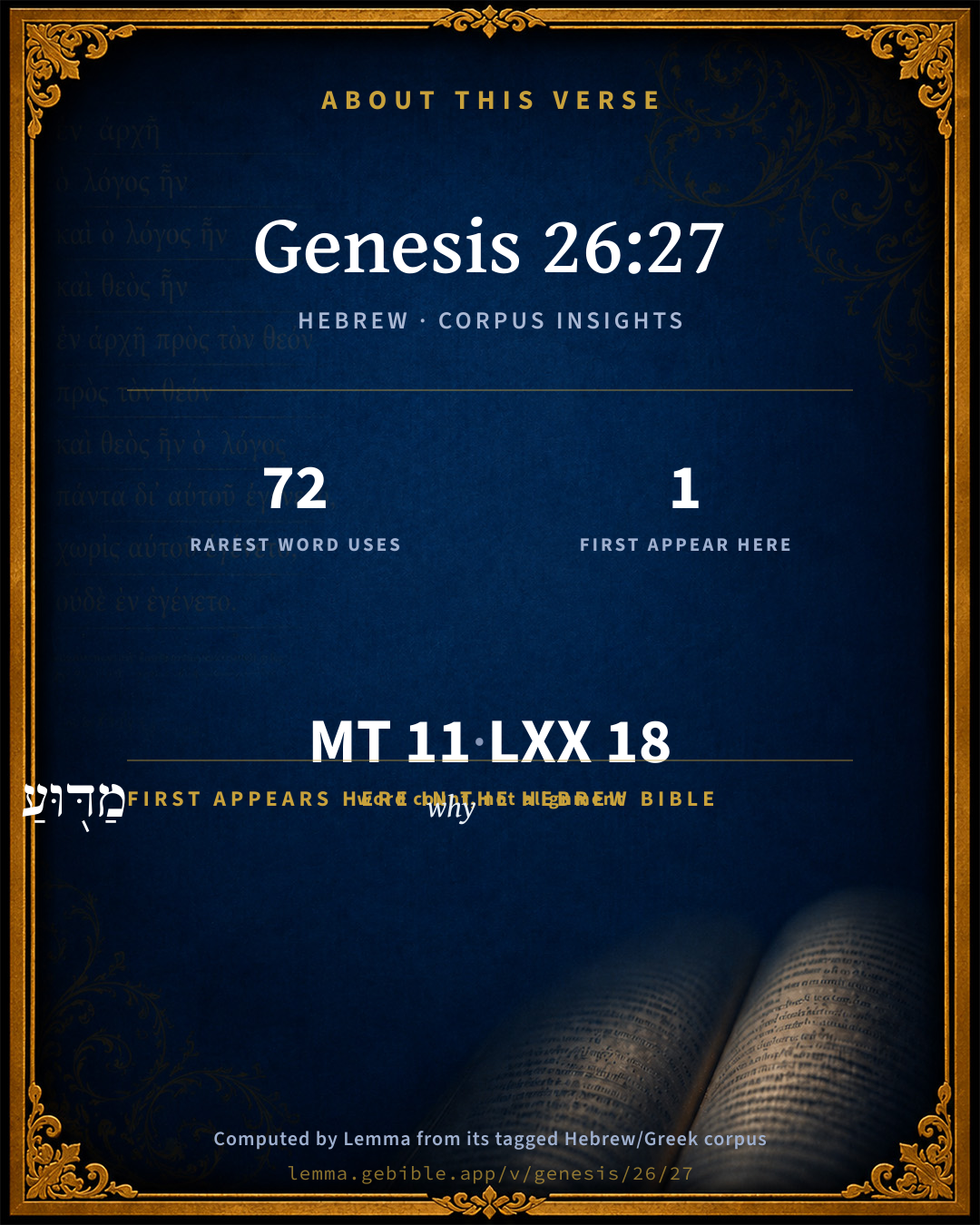
  • 1 first appearance in the Hebrew Bible
Full analysis ↓
Download a study sheet

One document with this verse’s original text, its word-by-word gloss line, the meaning frame, cross-references with their text, attributed commentary, and full source and license credits — printable, and it pastes into notes with its structure intact.

This verse Autodidact and up

Study sheet (.html) Plain text (.txt)

A passage Seminary Student

Up to 50 verses in one chapter. A passage sheet keeps up to 6 commentary sources and 12 cross-references per verse, in the order this page ranks them, and says so on the sheet whenever that leaves anything out. Ask for a single verse and you get the Autodidact verse sheet above.

Everything on this page stays free to read, with no account — the sheet is a download of what is already on screen, not access to it.

Want to remove ads? Support Godless Engineer
Compare translations 3

The same verse in 3 English versions, stacked beneath the original-language interlinear above. Click any original word for its lexicon entry.

Each is an independent rendering of the whole verse — the interlinear is not word-aligned to these translations.

Highlighted words mark where these versions differ — a whole-verse word diff, not a word-by-word alignment.

  • World English Bible Public Domain
    Isaac said to them, "Why have you come to me, since you hate me, and have sent me away from you?"
  • King James Version Public Domain
    And Isaac said unto them, Wherefore come ye to me, seeing ye hate me, and have sent me away from you?
  • unfoldingWord Literal Text CC BY-SA 4.0
    And Isaac said to them, “Why have you come to me, since you hate me, and you sent me away from you?”

unfoldingWord Literal Text — © unfoldingWord, licensed CC BY-SA 4.0. Word-aligned USFM3 via Door43 (git.door43.org/unfoldingWord/en_ult).

Versions to compare (up to 4)

3 of 4 selected

Show all 18 translations

Every available English version of this verse, each an independent rendering of the whole verse.

  • World English Bible Public Domain
    Isaac said to them, "Why have you come to me, since you hate me, and have sent me away from you?"
  • Berean Standard Bible Public Domain
    “Why have you come to me?” Isaac asked them. “You hated me and sent me away.”
  • Majority Standard Bible Public Domain
    “Why have you come to me?” Isaac asked them. “You hated me and sent me away.”
  • King James Version Public Domain
    And Isaac said unto them, Wherefore come ye to me, seeing ye hate me, and have sent me away from you?
  • American Standard Version (1901) Public Domain
    And Isaac said unto them, Wherefore are ye come unto me, seeing ye hate me, and have sent me away from you?
  • Revised Version (1885) Public Domain
    And Isaac said unto them, Wherefore are ye come unto me, seeing ye hate me, and have sent me away from you?
  • Geneva Bible (1599) Public Domain
    To whom Izhak sayd, Wherefore come ye to me, seeing ye hate mee and haue put mee away from you?
  • Douay-Rheims (1899) Public Domain
    Isaac said to them: Why are ye come to me, a man whom you hate, and have thrust out from you?
  • Young's Literal Translation Public Domain
    and Isaac saith unto them, `Wherefore have ye come unto me, and ye have hated me, and ye send me away from you?'
  • Literal Standard Version CC BY-SA 4.0
    and Isaac says to them, “Why have you come to me, and you have hated me, and you send me away from you?”
  • Unlocked Literal Bible CC BY-SA 4.0
    Isaac said to them, “Why are you coming to me, since you hate me and have sent me away from you?”
  • unfoldingWord Literal Text CC BY-SA 4.0
    And Isaac said to them, “Why have you come to me, since you hate me, and you sent me away from you?”
  • Darby Bible Public Domain
    And Isaac said to them, Why are ye come to me, seeing ye hate me, and have driven me away from you?
  • World Messianic Bible Public Domain
    Isaac said to them, “Why have you come to me, since you hate me, and have sent me away from you?”
  • Webster's Bible Public Domain
    And Isaac said to them, Why come ye to me, seeing ye hate me, and have sent me away from you?
  • Free Bible Version CC BY-SA 4.0
    “Why have you come to see me?” Isaac asked them. “Previously you hated me and told me to leave!”
  • Bible in Basic English Public Domain
    And Isaac said to them, Why have you come to me, seeing that in your hate for me you sent me away from you?
  • JPS Tanakh (1917) Public Domain
    And Isaac said unto them: 'Wherefore are ye come unto me, seeing ye hate me, and have sent me away from you?'

Literal Standard Version (2020), Covenant Press — licensed CC BY-SA 4.0. Text via the HelloAO Bible API (eBible.org). Unlocked Literal Bible (unfoldingWord) — licensed CC BY-SA 4.0. Text via the HelloAO Bible API (eBible.org). unfoldingWord Literal Text — © unfoldingWord, licensed CC BY-SA 4.0. Word-aligned USFM3 via Door43 (git.door43.org/unfoldingWord/en_ult). Free Bible Version, Dr. Jonathan Gallagher — licensed CC BY-SA 4.0. Text via the HelloAO Bible API (eBible.org).

Word by word

More ways to search: Search by grammar → Find every occurrence → Compare this word →

Practice this passage: Drill this verse → Learn its vocabulary →

מַדּ֖וּעַ
maddûwaʻ
H4069
“why”
Particle, Interrogative
Part of Speech
Particle
Type
Interrogative
Full BDB Definition

Origin: from H4100 and the pass. participle of H3045

TWOT: 848h

why?, on what account?, wherefore?
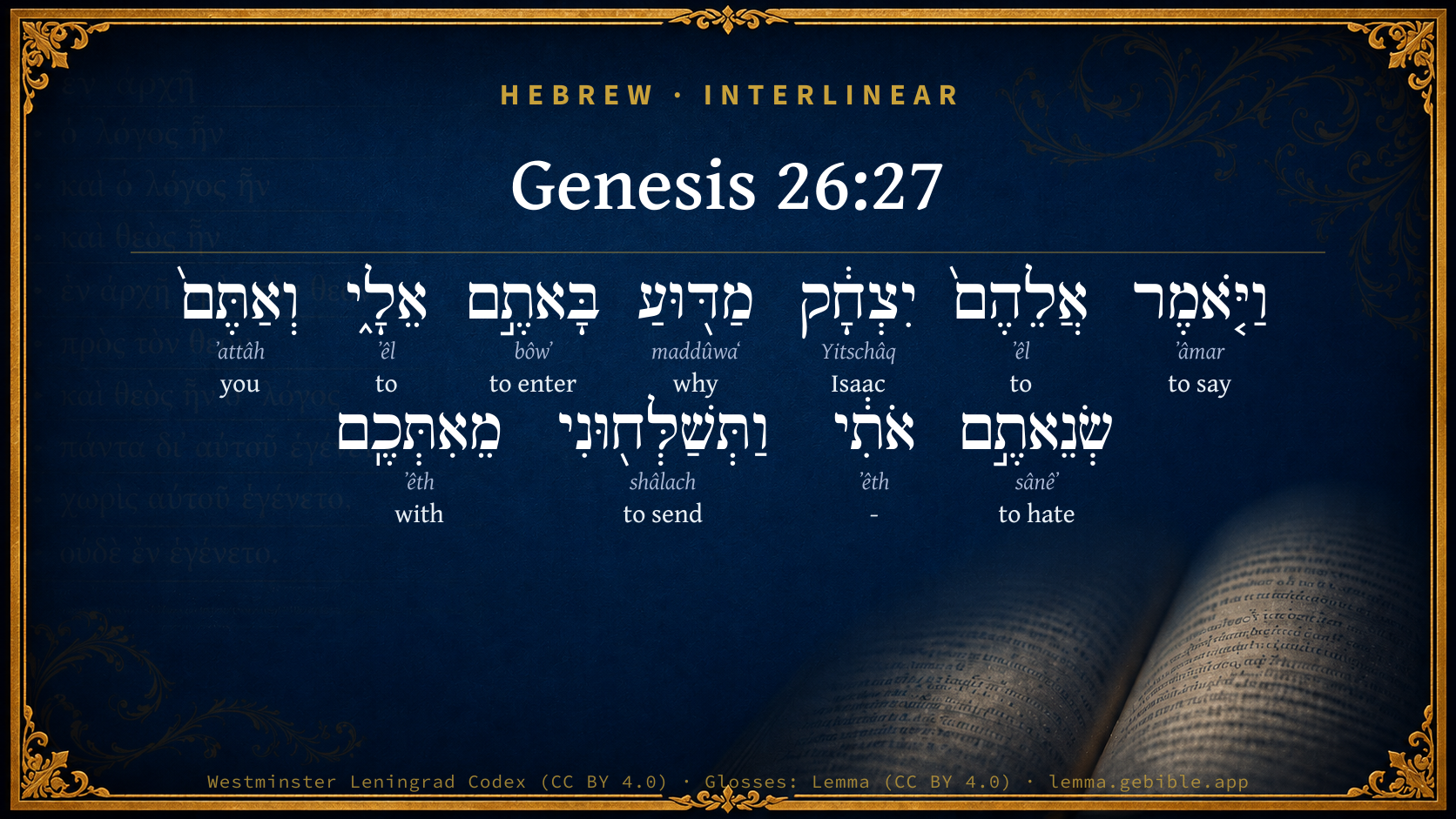
  1. וַיֹּ֤אמֶר ʼâmar H559 “and · to say” Conjunction + Verb, Qal, Sequential Imperfect, 3rd Person, Masculine, Singular
  2. אֲלֵהֶם֙ ʼêl H413 “to · them” Preposition + Suffix, Personal, 3rd Person, Masculine, Plural
  3. יִצְחָ֔ק Yitschâq H3327 “Isaac” Noun, Proper
  4. בָּאתֶ֣ם bôwʼ H935 “to enter” Verb, Qal, Perfect, 2nd Person, Masculine, Plural
  5. אֵלָ֑י ʼêl H413 “to · me” Preposition + Suffix, Personal, 1st Person, Common, Singular
  6. וְאַתֶּם֙ ʼattâh H859 “and · you” Conjunction + Pronoun, Personal, 2nd Person, Masculine, Plural
  7. שְׂנֵאתֶ֣ם sânêʼ H8130 “to hate” Verb, Qal, Perfect, 2nd Person, Masculine, Plural
  8. אֹתִ֔י ʼêth H853 “- · me” Particle, Direct Object + Suffix, Personal, 1st Person, Common, Singular
  9. וַתְּשַׁלְּח֖וּנִי shâlach H7971 “and · to send · me” Conjunction + Verb, Piel, Sequential Imperfect, 2nd Person, Masculine, Plural + Suffix, Personal, 1st Person, Common, Singular
  10. מֵאִתְּכֶֽם ʼêth H854 “from · with · you” Preposition + Preposition + Suffix, Personal, 2nd Person, Masculine, Plural

About this verse

These counts appear in no published source. They are computed here, from the morphology-tagged text and Lemma’s own curated glosses. What Lemma adds →

11
words
10
distinct lemmas
Pentateuch
section

First appearance in Scripture

This word makes its first canonical appearance in the Hebrew Bible here:

  • מַדּ֖וּעַ why H4069

Grammatical profile

  • 4 verbs
  • 1 noun
  • 1 pronoun
  • 3 prepositions
  • 2 particles

Verb forms

  • וַיֹּ֤אמֶר Qal · Sequential Imperfect
  • בָּאתֶ֣ם Qal · Perfect
  • שְׂנֵאתֶ֣ם Qal · Perfect
  • וַתְּשַׁלְּח֖וּנִי Piel · Sequential Imperfect

Repetition

A word recurs within this verse — often emphatic in Hebrew:

  • אֲלֵהֶם֙ to H413 ×2

Hebrew & Septuagint length

In English translation the verse runs 21 words from the Hebrew and 21 from the Septuagint (LXX English) — the same length.

A rough comparison of the two English renderings, which tokenize alike — not a word-level alignment.

Word counts can differ between the Hebrew and the Greek without any difference in meaning — e.g. the Hebrew direct-object marker אֵת has no separate Greek word, and Greek often adds the article ὁ.

In the original languages it is 11 Hebrew tokens and 18 Greek tokens — but the two are counted differently (Hebrew bundles its prefixes and suffixes into one token; the Greek is in lemma form), so that isn’t a like-for-like length.

Cross-references

8

Topical passages linked to Genesis 26:27 in the Treasury of Scripture Knowledge — connected by theme and wording, ordered by reader-vote popularity; previews shown in the World English Bible.

  • Genesis 26:16 Abimelech said to Isaac, "Go from us, for you are much mightier than we."
  • Judges 11:7 Jephthah said to the elders of Gilead, Didn't you hate me, and drive me out of my father's house? and why are you come to me now when you are in distress?
  • Genesis 26:14 He had possessions of flocks, possessions of herds, and a great household. The Philistines envied him.
  • Acts 7:9 "The patriarchs, moved with jealousy against Joseph, sold him into Egypt. God was with him,
  • Acts 7:14 Joseph sent, and summoned Jacob, his father, and all his relatives, seventy-five souls.
  • Acts 7:27 But he who did his neighbor wrong pushed him away, saying, 'Who made you a ruler and a judge over us?
  • Acts 7:35 "This Moses, whom they refused, saying, 'Who made you a ruler and a judge?'--God has sent him as both a ruler and a deliverer by the hand of the angel who appeared to him in the bush.
  • Revelation 3:9 Behold, I give of the synagogue of Satan, of those who say they are Jews, and they are not, but lie. Behold, I will make them to come and worship before your feet, and to know that I have loved you.

Cross-references courtesy of OpenBible.info (CC BY 4.0).

Hebrew and Greek witnesses Masoretic Hebrew ↔ Greek Septuagint

The same verse in the two great witnesses to the Old Testament, shown verse-for-verse.

These are two independent witnesses, not word-aligned to each other, and the Septuagint is shown in lemma (dictionary) form.

Hebrew Genesis 26:27 Masoretic · Westminster Leningrad Codex

וַיֹּ֤אמֶר אֲלֵהֶם֙ יִצְחָ֔ק מַדּ֖וּעַ בָּאתֶ֣ם אֵלָ֑י וְאַתֶּם֙ שְׂנֵאתֶ֣ם אֹתִ֔י וַתְּשַׁלְּח֖וּנִי מֵאִתְּכֶֽם

Isaac said to them, "Why have you come to me, since you hate me, and have sent me away from you?"

World English Bible · Public Domain

Greek LXX Genesis 26:27 Septuagint · lemma form

καί εἶπον αὐτός ισαακ ἵνα τίς ἔρχομαι πρός ἐγώ σύ δέ μισέω ἐγώ καί ἀποστέλλω ἐγώ ἀπό σύ

And Isaac said to them, Therefore have you⌃ come to me? whereas you⌃ hated me, and sent me away from you.

LXX2012 (modern English Septuagint) · Public Domain

Hebrew: Westminster Leningrad Codex (CC BY 4.0). Greek: Septuagint (public domain); English from LXX2012 (modern English Septuagint) (Public Domain). How the Septuagint differs from the Hebrew →

Targum (Aramaic paraphrase)

2

The Targum is the ancient Jewish Aramaic paraphrase of the Hebrew Scriptures — an interpretive translation, not the Hebrew text itself. Onkelos (literal) and Pseudo-Jonathan (expansive) render the Torah, and Jonathan the Prophets. Coverage is partial: where no permissively-licensed English translation exists for a verse, only the Aramaic is shown. This is verse-level text, not a word-by-word alignment to the Hebrew.

  1. Targum Onkelos Torah (Genesis–Deuteronomy)
    וַאֲמַר לְהוֹן יִצְחָק מָה דֵּין אֲתֵיתוּן לְוָתִי וְאַתּוּן סְנֵיתוּן יָתִי וְשַׁלַּחְתּוּנִי מִלְּוָתְכוֹן

    (no public-domain English translation for this verse)

    Targum Onkelos — Aramaic: “Onkelos Genesis” (public domain); “Onkelos Exodus” (public domain); “Onkelos Leviticus” (public domain); “Onkelos Numbers” (public domain); “Onkelos Deuteronomy” (public domain). English: “Sefaria Community Translation” (CC0 1.0 (public-domain dedication)); “J.W. Etheridge. The Targums of Onkelos and Jonathan Ben Uzziel on the Pentateuch. London: Longmans, Green, 1862” (public domain). Text via Sefaria.

  2. Targum Pseudo-Jonathan Torah (Genesis–Deuteronomy)
    וַאֲמַר לְהוֹן יִצְחָק מַה דֵין אָתֵיתוּן לְוָותִי דְאַצְלֵי עֲלֵיכוֹן וְאַתּוּן סְנֵיתוּן יָתִי וְתָרַכְתּוּנִי מִלְוַתְכוֹן

    And Izhak said to them, Why come you to me that I should pray for you, when you have hated me, and driven me from you?

    Targum Pseudo-Jonathan — Aramaic: “Targum Jonathan on Genesis” (public domain); “Targum Jonathan on Exodus” (public domain); “Targum Jonathan on Leviticus” (public domain); “Targum Jonathan on Numbers” (public domain); “Targum Jonathan on Deuteronomy” (public domain). English: “The Targum of Jonathan ben Uzziel, trans. J. W. Etheridge, London, 1862” (public domain). Text via Sefaria.

Commentary

Notes on Genesis 26:27 from classic Christian and Jewish commentators (each source and its license shown beneath its notes). The classic Christian expositions comment on the surrounding passage and are grouped to its opening verse, so a note may address several verses; the Jewish commentaries on the Tanakh (Rashi and others) are per-verse, so they appear only where the commentator wrote on this verse.

Lemma curates 59 commentaries, every one of them public domain or Creative Commons licensed, each selected and text-cleaned for this edition rather than reprinted as found. About our sources →

Trapp's Complete Commentary

John Trapp

Gen 26:27 And Isaac said unto them, Wherefore come ye to me, seeing ye hate me, and have sent me away from you?

Ver. 27. Wherefore come ye to me?] Here was his magnanimity and his modesty both, in expostulating the wrongs they had done unto him. He could not but be sensible of their discourtesies, though he dissembled them. A sheep feels the bite of a dog, as well as a swine, though she make no such noise. Isaac having now a fit opportunity, gives them the telling of it: and "how forcible are right words"! {Job 6:25} There is a real confutation of injuries: and we should consult, whether, in such a case, it be best to deal with the wrongdoers, at all, by words. God’s way is by works: and he must get an Isaac-like temperance and prudence, that thinks himself able to convince them by reason, and to set them down.

John Trapp, A Commentary or Exposition upon All the Books of the Old and New Testament (1647–1656) — public domain. Text from a community e-Sword module.

Adam Clarke's Commentary

Verse 27. Seeing ye hate me] He was justified in thinking thus, because if they did not injure him, they had connived at their servants doing it.

Adam Clarke's Commentary on the Bible (1810–1826) — public domain. Text from a community e-Sword/MySword module.

John Calvin's Commentaries

27. And Isaac said unto them, Wherefore come ye to me? Isaac not only expostulates concerning injuries received, but protests that in future he can have no confidence in them, since he had found in them a disposition so hostile to himself. This passage teaches us, that it is lawful for the faithful to complain of their enemies, in order, if possible, to recall them from their purpose of doing injury, and to restrain their force, frauds, and acts of injustice. For liberty is not inconsistent with patience: nor does God require of his own people, that they should silently digest every injury which may be inflicted upon them, but only that they should restrain their minds and hands from revenge. Now, if their minds are pure and well regulated, their tongues will not be virulent in reproaching the faults of others; but their sole purpose will be to restrain the wicked by a sense of shame from iniquity. For where there is no hope of profiting by complaints, it is better to cherish peace by silence; unless, perhaps, for the purpose of rendering those who delight themselves in wickedness inexcusable. We must, indeed, always beware, lest, from a desire of vengeance, our tongues break out in reproaches; and, as Solomon says, hatred stirreth up strifes. (Proverbs 10:12.)

John Calvin's Commentaries (1540-1563) — public domain. Text from the Calvin Translation Society English edition (1840s-50s) via the Christian Classics Ethereal Library (ccel.org). Calvin's coverage is partial (roughly two-thirds of the Bible); uncommented books and verses are honest gaps, never fabricated. The 19th-century editor's footnotes and remarks are omitted so the notes are faithfully Calvin's own voice.

Ellicott's Commentary for English Readers

(27) Wherefore come ye to me?—Isaac’s return had brought matters to a crisis, and the king must now decide whether there was to be peace or war.

A Bible Commentary for English Readers, edited by Charles John Ellicott (1878–1897) — public domain. Text from a community e-Sword module.

John Gill's Exposition

That thou wilt do us no hurt,.... Neither to our persons nor properties, to our kingdom and subjects, by invading our land, and seizing on our kingdom, all which was feared from Isaac's growing wealth and power:

as we have not touched thee; not done the least injury to him, to his person, family, and substance, but suffered him to go away with all he had untouched:

and as we have done unto thee, nothing but good; by royal authority, or by the command and direction of the king and his nobles; for as for the stopping up the wells his father's servants had dug, and the controversy that was about those in the vale, and the trouble Isaac had on that account, these things were not by the order of the king and council, and perhaps without their knowledge:

and have sent thee away in peace; no one being suffered to do any injury to him, or molest him in carrying off everything that belonged unto him:

thou art now blessed of the Lord; so it appeared by the prosperity he was attended with, and by the Lord's protection of him, and the constant and continual favours he was bestowing on him; and this induced Abimelech and his nobles to seek to cultivate friendship, and be on good terms with him. De Dieu gives a different sense of these words, and considers them in the form of an oath or imprecation,"if thou shouldest do us any hurt, seeing we have not touched thee, &c. be thou now accursed of the Lord,''taking the word used in a contrary sense, as in Job 1:5 Kg1 21:10.

John Gill's Exposition of the Whole Bible (1746–1763) — public domain (CC PDM 1.0). Text via the HelloAO Bible API.

Whedon's Commentary on the Bible

Daniel D. Whedon

27. Wherefore come ye — Isaac receives them coldly, as well he might after their breach of an old treaty of peace with his father. But the king was anxious to be on friendly terms with Isaac, even though the latter was not welcome to settle in his land.

Daniel D. Whedon (gen. ed.), Commentary on the Old and New Testaments (1874–1909) — public domain. Text from a community e-Sword module.

The Pulpit Commentary

And Isaac said unto them, Wherefore WDm, contr, from Wdy; hm; what is taught?for what reason (cf. ti maqwn)come ye to me, seeing (literally, and) ye hate me, and have sent me away from you? While animadverting to the personal hostility to which he had been subjected, Isaac says nothing about the wells of which he had been deprived: a second point of difference between this and the preceding narrative of Abraham"s covenant with the Philistine king.

The Pulpit Commentary (1880–1919), ed. H.D.M. Spence-Jones & Joseph S. Exell — public domain. Text from a community e-Sword module.

Radak

Rabbi David Kimhi (Radak)

ויאמר...ותשלחוני, the plural mode here indicates that at the time when Avimelech had expelled Yitzchok he had done so by following the advice of his ministers and notables. He had also said at that time “לך מעמנו,” Go from us!”

Radak on the Tanakh — English translations: “Sefaria Community Translation” (CC0 1.0 (public-domain dedication)); “Eliyahu Munk, HaChut Hameshulash” (CC BY 4.0); “Rabbi Mike Feuer, Jerusalem Anthology” (CC BY 4.0); and “R. David Kimhi on the first book of Psalms, Translated by R.G. Finch, London, 1919” (public domain). Text via Sefaria.

Lesson kit

Teaching starters — assembled from the data on this page, not authored interpretation. Every prompt links to the verse data it draws on. Edit before teaching.

Genesis, in the Pentateuch, opens this verse with 11 words (10 distinct Hebrew lemmas). Its most distinctive word is maddûwaʻ (“why”). A historical commentator’s framing appears above. Read the whole chapter for the surrounding context.

Discussion questions

  1. The word maddûwaʻ carries the sense “why.” How does it shape the verse?
  2. This is the first place “why” appears in Scripture (first appears here). What does its debut here establish?
  3. How does Genesis 26:16, which shares this passage’s theme, read alongside this verse?
  4. What does the repetition of “to” (2× in this one verse) do in this verse?
  5. These translations render this verse differently. What is at stake in choosing one wording over another?
  6. «וַיֹּ֤אמֶר» is a Qal Sequential Imperfect verb. How does that grammatical form shape the action described?
  7. Compare how Trapp's Complete Commentary and Adam Clarke's Commentary read this verse. Where do they agree or differ?

Things to notice

Reading settings

Reading text

Shown beneath each verse's original-language words.

Old Testament
Old Testament edition

Read the OT as the Masoretic Hebrew (MT) or the Greek Septuagint (LXX).

English shown for the Greek Septuagint (in the Hebrew ↔ Greek comparison).

Comparing translations? Open the Compare panel on any verse page to stack up to four side by side.