
Genesis 6:17

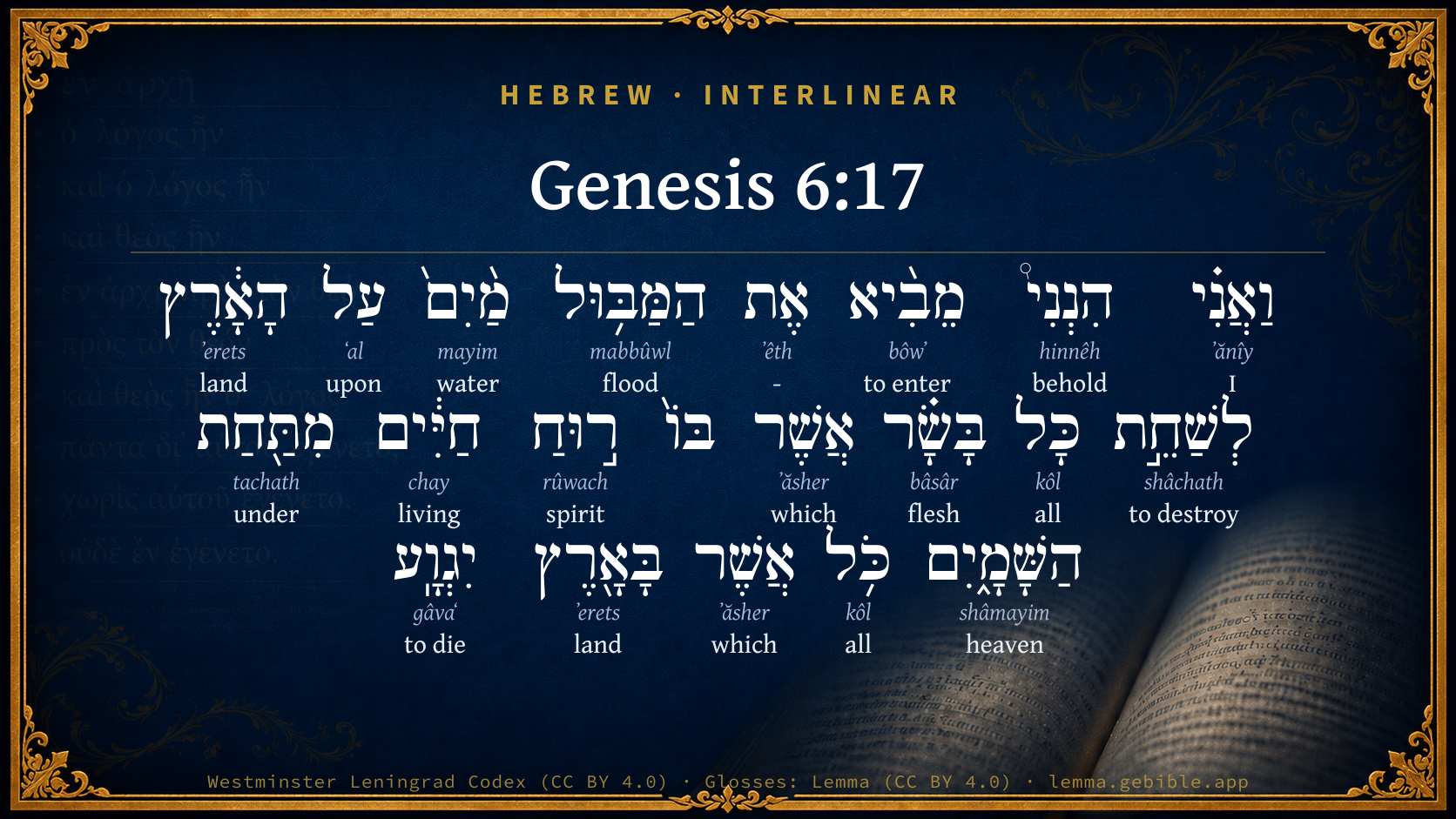
Hebrew (Westminster Leningrad Codex) Genesis 6:17 appears in the Hebrew Old Testament. The text above is from the Westminster Leningrad Codex. Each word links to its Strong’s number, a concise gloss, and parsing drawn from the Open Scriptures Hebrew Bible morphology. Click any word for its full Brown-Driver-Briggs (BDB) entry.
Download image
Cite this verse

Genesis 6:17 (World English Bible). Public Domain. Lemma interlinear Bible study tool, https://lemma.gebible.app/v/genesis/6/17.

Show BibTeX & RIS
BibTeX
RIS
English Translation
I, even, I do bring the flood of waters on this earth, to destroy all flesh having the breath of life from under the sky. Everything that is in the earth will die.
World English Bible · Public Domain
Highlights
  • 3 first appearances in the Hebrew Bible
Full analysis ↓
Download a study sheet

One document with this verse’s original text, its word-by-word gloss line, the meaning frame, cross-references with their text, attributed commentary, and full source and license credits — printable, and it pastes into notes with its structure intact.

This verse Autodidact and up

Study sheet (.html) Plain text (.txt)

A passage Seminary Student

Up to 50 verses in one chapter. A passage sheet keeps up to 6 commentary sources and 12 cross-references per verse, in the order this page ranks them, and says so on the sheet whenever that leaves anything out. Ask for a single verse and you get the Autodidact verse sheet above.

Everything on this page stays free to read, with no account — the sheet is a download of what is already on screen, not access to it.

Want to remove ads? Support Godless Engineer
Compare translations 3

The same verse in 3 English versions, stacked beneath the original-language interlinear above. Click any original word for its lexicon entry.

Each is an independent rendering of the whole verse — the interlinear is not word-aligned to these translations.

Highlighted words mark where these versions differ — a whole-verse word diff, not a word-by-word alignment.

  • World English Bible Public Domain
    I, even, I do bring the flood of waters on this earth, to destroy all flesh having the breath of life from under the sky. Everything that is in the earth will die.
  • King James Version Public Domain
    And, behold, I, even I, do bring a flood of waters upon the earth, to destroy all flesh, wherein is the breath of life, from under heaven; and every thing that is in the earth shall die.
  • unfoldingWord Literal Text CC BY-SA 4.0
    And I, behold, I am bringing floodwaters on the earth to destroy all flesh that the breath of life in it from under the heavens. Everything that on the earth will expire!

unfoldingWord Literal Text — © unfoldingWord, licensed CC BY-SA 4.0. Word-aligned USFM3 via Door43 (git.door43.org/unfoldingWord/en_ult).

Versions to compare (up to 4)

3 of 4 selected

Show all 18 translations

Every available English version of this verse, each an independent rendering of the whole verse.

  • World English Bible Public Domain
    I, even, I do bring the flood of waters on this earth, to destroy all flesh having the breath of life from under the sky. Everything that is in the earth will die.
  • Berean Standard Bible Public Domain
    And behold, I will bring floodwaters upon the earth to destroy every creature under the heavens that has the breath of life. Everything on the earth will perish.
  • Majority Standard Bible Public Domain
    And behold, I will bring floodwaters upon the earth to destroy every creature under the heavens that has the breath of life. Everything on the earth will perish.
  • King James Version Public Domain
    And, behold, I, even I, do bring a flood of waters upon the earth, to destroy all flesh, wherein is the breath of life, from under heaven; and every thing that is in the earth shall die.
  • American Standard Version (1901) Public Domain
    And I, behold, I do bring the flood of waters upon this earth, to destroy all flesh, wherein is the breath of life, from under heaven; everything that is in the earth shall die.
  • Revised Version (1885) Public Domain
    And I, behold, I do bring the flood of waters upon the earth, to destroy all flesh, wherein is the breath of life, from under heaven; every thing that is in the earth shall die.
  • Geneva Bible (1599) Public Domain
    And I, beholde, I will bring a flood of waters vpon the earth to destroy all flesh, wherein is the breath of life vnder the heauen: all that is in the earth shall perish.
  • Douay-Rheims (1899) Public Domain
    Behold I will bring the waters of a great flood upon the earth, to destroy all flesh, wherein is the breath of life, under heaven. All things that are in the earth shall be consumed.
  • Young's Literal Translation Public Domain
    `And I, lo, I am bringing in the deluge of waters on the earth to destroy all flesh, in which `is' a living spirit, from under the heavens; all that `is' in the earth doth expire.
  • Literal Standard Version CC BY-SA 4.0
    And I, behold, I am bringing in the flood of waters on the earth, to destroy from under the heavens all flesh in which [is] a living spirit; all that [is] in the earth expires.
  • Unlocked Literal Bible CC BY-SA 4.0
    Listen, I am about to bring the flood of waters upon the earth, to destroy all flesh that has in it the breath of life from under heaven. Everything that is on the earth will die.
  • unfoldingWord Literal Text CC BY-SA 4.0
    And I, behold, I am bringing floodwaters on the earth to destroy all flesh that the breath of life in it from under the heavens. Everything that on the earth will expire!
  • Darby Bible Public Domain
    For I, behold, I bring a flood of waters on the earth, to destroy all flesh under the heavens in which is the breath of life: everything that is on the earth shall expire.
  • World Messianic Bible Public Domain
    I, even I, will bring the flood of waters on this earth, to destroy all flesh having the breath of life from under the sky. Everything that is in the earth will die.
  • Webster's Bible Public Domain
    And behold, I, even I do bring a flood of waters upon the earth, to destroy all flesh, in which is the breath of life, from under heaven: and every thing that is on the earth shall die.
  • Free Bible Version CC BY-SA 4.0
    I myself am going to flood the earth with water that will destroy everything that breathes. Every living thing everywhere on earth will die.
  • Bible in Basic English Public Domain
    For truly, I will send a great flow of waters over the earth, for the destruction from under the heaven of all flesh in which is the breath of life; everything on the earth will come to an end.
  • JPS Tanakh (1917) Public Domain
    And I, behold, I do bring the flood of waters upon the earth, to destroy all flesh, wherein is the breath of life, from under heaven; every thing that is in the earth shall perish.

Literal Standard Version (2020), Covenant Press — licensed CC BY-SA 4.0. Text via the HelloAO Bible API (eBible.org). Unlocked Literal Bible (unfoldingWord) — licensed CC BY-SA 4.0. Text via the HelloAO Bible API (eBible.org). unfoldingWord Literal Text — © unfoldingWord, licensed CC BY-SA 4.0. Word-aligned USFM3 via Door43 (git.door43.org/unfoldingWord/en_ult). Free Bible Version, Dr. Jonathan Gallagher — licensed CC BY-SA 4.0. Text via the HelloAO Bible API (eBible.org).

Word by word

More ways to search: Search by grammar → Find every occurrence → Compare this word →

Practice this passage: Drill this verse → Learn its vocabulary →

הַמַּבּ֥וּל
mabbûwl
H3999
“the · flood”
Particle, Definite Article + Noun, Common, Masculine, Singular, Absolute
Part of Speech
Particle + Noun
Type
Common
Gender
Masculine
Number
Singular
State
Absolute
Full BDB Definition

Origin: from H2986 in the sense of flowing

TWOT: 1142

flood, deluge. - Noah's flood that submerged the entire planet earth under water for about a year
  1. וַאֲנִ֗י ʼănîy H589 “and · I” Conjunction + Pronoun, Personal, 1st Person, Common, Singular
  2. הִנְנִי֩ hinnêh H2009 “behold · me” Particle, Demonstrative + Suffix, Personal, 1st Person, Common, Singular
  3. מֵבִ֨יא bôwʼ H935 “entering” Verb, Hiphil, Participle Active, Masculine, Singular, Absolute
  4. אֶת ʼêth H853 “-” Particle, Direct Object
  5. מַ֨יִם֙ mayim H4325 “water(s)” Noun, Common, Masculine, Plural, Absolute
  6. עַל ʻal H5921 “upon” Preposition
  7. הָאָ֔רֶץ ʼerets H776 “the · land” Particle, Definite Article + Noun, Common, Both, Singular, Absolute
  8. לְשַׁחֵ֣ת shâchath H7843 “to destroy” Preposition + Verb, Piel, Infinitive Construct
  9. כָּל kôl H3605 “all of” Noun, Common, Masculine, Singular, Construct
  10. בָּשָׂ֗ר bâsâr H1320 “flesh” Noun, Common, Masculine, Singular, Absolute
  11. אֲשֶׁר ʼăsher H834 “which” Particle, Relative
  12. ר֣וּחַ rûwach H7307 “spirit of” Noun, Common, Both, Singular, Construct
  13. חַיִּ֔ים chay H2416 “living things” Noun, Common, Masculine, Plural, Absolute
  14. מִתַּ֖חַת tachath H8478 “from · under” Preposition + Preposition
  15. הַשָּׁמָ֑יִם shâmayim H8064 “the · heaven(s)” Particle, Definite Article + Noun, Common, Masculine, Plural, Absolute
  16. כֹּ֥ל kôl H3605 “all” Noun, Common, Masculine, Singular, Absolute
  17. אֲשֶׁר ʼăsher H834 “which” Particle, Relative
  18. בָּאָ֖רֶץ ʼerets H776 “in/at the · land” Preposition, Determined + Noun, Common, Both, Singular, Absolute
  19. יִגְוָֽע gâvaʻ H1478 “to die” Verb, Qal, Imperfect, 3rd Person, Masculine, Singular

About this verse

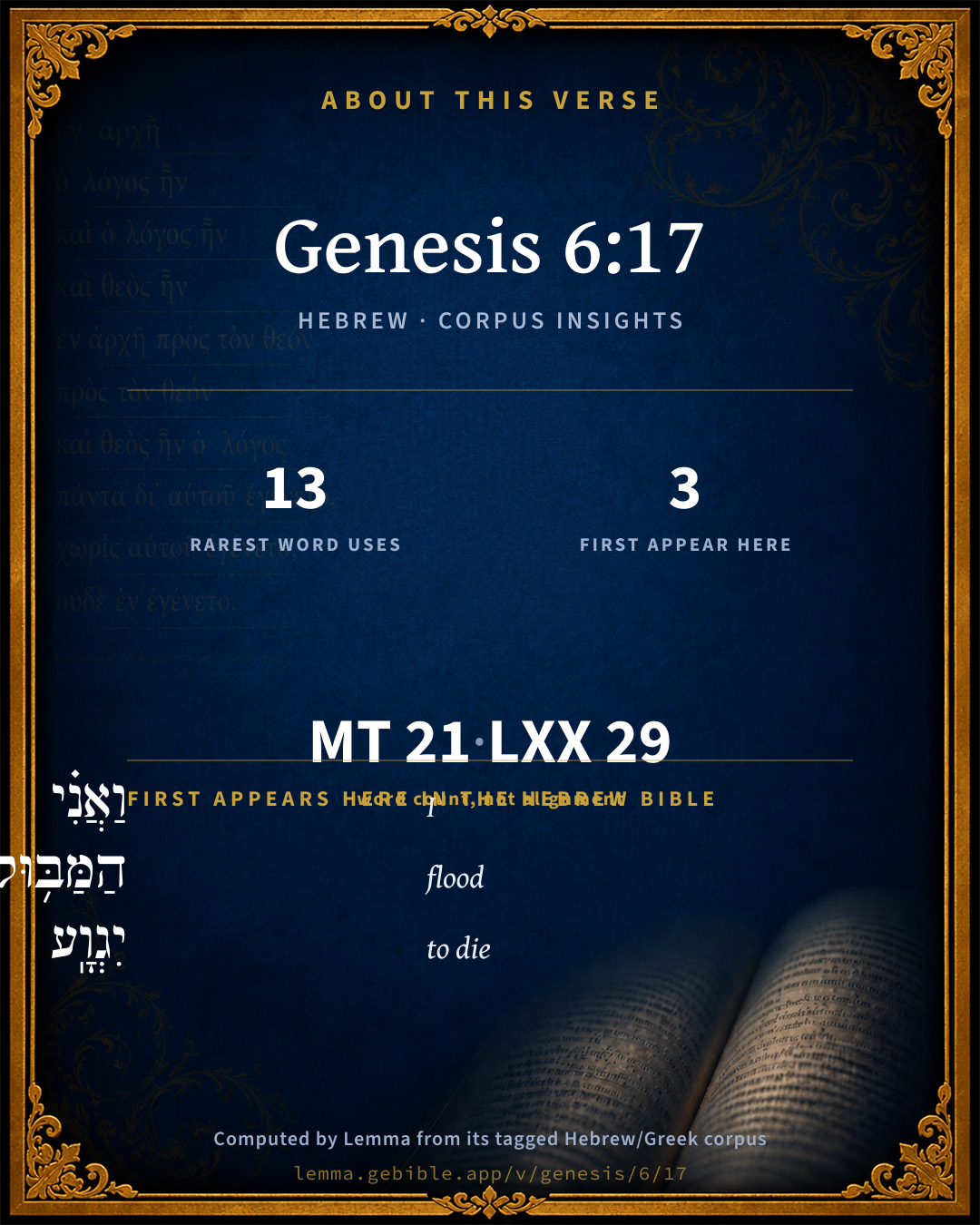
These counts appear in no published source. They are computed here, from the morphology-tagged text and Lemma’s own curated glosses. What Lemma adds →

21
words
17
distinct lemmas
Pentateuch
section

Notable vocabulary

The rarest word here is הַמַּבּ֥וּל flood H3999 — appearing just 13 times in the whole Hebrew Bible.

First appearance in Scripture

These words make their first canonical appearance in the Hebrew Bible here:

  • וַאֲנִ֗י I H589
  • הַמַּבּ֥וּל flood H3999
  • יִגְוָֽע to die H1478

Shared distinctive vocabulary

הַמַּבּ֥וּל flood H3999 occurs in 12 verses of the Hebrew Bible. Also found in:

Grammatical profile

  • 3 verbs
  • 10 nouns
  • 1 pronoun
  • 3 prepositions
  • 4 particles

Verb forms

  • מֵבִ֨יא Hiphil · Participle Active
  • לְשַׁחֵ֣ת Piel · Infinitive Construct
  • יִגְוָֽע Qal · Imperfect

Repetition

Words recur within this verse — often emphatic in Hebrew:

  • הָאָ֔רֶץ land H776 ×2
  • כָּל all H3605 ×2
  • אֲשֶׁר which H834 ×2

Hebrew & Septuagint length

In English translation the verse runs 33 words from the Hebrew and 33 from the Septuagint (LXX English) — the same length.

A rough comparison of the two English renderings, which tokenize alike — not a word-level alignment.

Word counts can differ between the Hebrew and the Greek without any difference in meaning — e.g. the Hebrew direct-object marker אֵת has no separate Greek word, and Greek often adds the article ὁ.

In the original languages it is 21 Hebrew tokens and 29 Greek tokens — but the two are counted differently (Hebrew bundles its prefixes and suffixes into one token; the Greek is in lemma form), so that isn’t a like-for-like length.

Cross-references

32

Topical passages linked to Genesis 6:17 in the Treasury of Scripture Knowledge — connected by theme and wording, ordered by reader-vote popularity; previews shown in the World English Bible.

  • Genesis 7:4 In seven days, I will cause it to rain on the earth for forty days and forty nights. Every living thing that I have made, I will destroy from the surface of the ground."
  • 2 Peter 2:5 and didn't spare the ancient world, but preserved Noah with seven others, a preacher of righteousness, when he brought a flood on the world of the ungodly;
  • Genesis 7:21–23 All flesh died that moved on the earth, including birds, cattle, animals, every creeping thing that creeps on the earth, and every man.
  • Psalms 107:34 And a fruitful land into a salt waste, For the wickedness of those who dwell in it.
  • Hebrews 11:7 By faith, Noah, being warned about things not yet seen, moved with godly fear, prepared an ark for the saving of his house, through which he condemned the world, and became heir of the righteousness which is according to faith.
  • 1 Peter 3:20 who before were disobedient, when God waited patiently in the days of Noah, while the ark was being built. In it, few, that is, eight souls, were saved through water.
  • Psalms 29:10 Yahweh sat enthroned at the Flood. Yes, Yahweh sits as King forever.
  • Amos 9:6 It is he who builds his chambers in the heavens, and has founded his vault on the earth; he who calls for the waters of the sea, and pours them out on the surface of the earth; Yahweh is his name.
  • Genesis 6:7 Yahweh said, "I will destroy man whom I have created from the surface of the ground; man, along with animals, creeping things, and birds of the sky; for I am sorry that I have made them."
  • Genesis 6:13 God said to Noah, "The end of all flesh has come before me, for the earth is filled with violence through them. Behold, I will destroy them with the earth.
  • Exodus 14:17 I, behold, I will harden the hearts of the Egyptians, and they shall go in after them: and I will get myself honor over Pharaoh, and over all his host, over his chariots, and over his horsemen.
  • Leviticus 26:28 then I will walk contrary to you in wrath; and I also will chastise you seven times for your sins.
  • Deuteronomy 32:39 See now that I, even I, am he, There is no god with me: I kill, and I make alive; I wound, and I heal; There is none who can deliver out of my hand.
  • Job 22:16 Who were snatched away before their time, Whose foundation was poured out as a stream,
  • Psalms 93:3–4 The floods have lifted up, Yahweh, The floods have lifted up their voice. The floods lift up their waves.
  • Isaiah 51:12 I, even I, am he who comforts you: who are you, that you are afraid of man who shall die, and of the son of man who shall be made as grass;
  • Isaiah 54:9 For this is [as] the waters of Noah to me; for as I have sworn that the waters of Noah shall no more go over the earth, so have I sworn that I will not be angry with you, nor rebuke you.
  • Ezekiel 5:8 therefore thus says the Lord Yahweh: Behold, I, even I, am against you; and I will execute judgments in the midst of you in the sight of the nations.
  • Ezekiel 6:3 and say, You mountains of Israel, hear the word of the Lord Yahweh: Thus says the Lord Yahweh to the mountains and to the hills, to the watercourses and to the valleys: Behold, I, even I, will bring a sword on you, and I will destroy your high places.
  • Ezekiel 34:11 For thus says the Lord Yahweh: Behold, I myself, even I, will search for my sheep, and will seek them out.
  • Ezekiel 34:20 Therefore thus says the Lord Yahweh to them: Behold, I, even I, will judge between the fat sheep and the lean sheep.
  • Hosea 5:14 For I will be to Ephraim like a lion, And like a young lion to the house of Judah. I myself will tear in pieces and go away. I will carry off, and there will be no one to deliver.
  • Luke 17:27 They ate, they drank, they married, they were given in marriage, until the day that Noah entered into the ark, and the flood came, and destroyed them all.
  • Romans 5:21 that as sin reigned in death, even so might grace reign through righteousness to eternal life through Jesus Christ our Lord.
  • Romans 6:23 For the wages of sin is death, but the free gift of God is eternal life in Christ Jesus our Lord.
  • Genesis 2:7 Yahweh God formed man from the dust of the ground, and breathed into his nostrils the breath of life; and man became a living soul.
  • Genesis 7:15 They went to Noah into the ark, by pairs of all flesh with the breath of life in them.
  • Genesis 7:17 The flood was forty days on the earth. The waters increased, and lifted up the ark, and it was lifted up above the earth.
  • Genesis 9:9 "As for me, behold, I establish my covenant with you, and with your offspring after you,
  • Matthew 24:39 and they didn't know until the flood came, and took them all away, so will be the coming of the Son of Man.
  • Romans 5:12–14 Therefore, as sin entered into the world through one man, and death through sin; and so death passed to all men, because all sinned.
  • Romans 8:20–22 For the creation was subjected to vanity, not of its own will, but because of him who subjected it, in hope

Cross-references courtesy of OpenBible.info (CC BY 4.0).

Hebrew and Greek witnesses Masoretic Hebrew ↔ Greek Septuagint

The same verse in the two great witnesses to the Old Testament, shown verse-for-verse.

These are two independent witnesses, not word-aligned to each other, and the Septuagint is shown in lemma (dictionary) form.

Hebrew Genesis 6:17 Masoretic · Westminster Leningrad Codex

וַאֲנִ֗י הִנְנִי֩ מֵבִ֨יא אֶת הַמַּבּ֥וּל מַ֨יִם֙ עַל הָאָ֔רֶץ לְשַׁחֵ֣ת כָּל בָּשָׂ֗ר אֲשֶׁר בּוֹ֙ ר֣וּחַ חַיִּ֔ים מִתַּ֖חַת הַשָּׁמָ֑יִם כֹּ֥ל אֲשֶׁר בָּאָ֖רֶץ יִגְוָֽע

I, even, I do bring the flood of waters on this earth, to destroy all flesh having the breath of life from under the sky. Everything that is in the earth will die.

World English Bible · Public Domain

Greek LXX Genesis 6:17 Septuagint · lemma form

ἐγώ δέ ἰδού ἐπιἄγω ὁ κατακλυσμός ὕδωρ ἐπί ὁ γῆ καταφθείρω πᾶς σάρξ ἐν ὅς εἰμί πνεῦμα ζωή ὑποκάτω ὁ οὐρανός καί ὅσος ἐάν εἰμί ἐπί ὁ γῆ τελευτάω

And behold I bring a flood of water upon the earth, to destroy all flesh in which is the breath of life under heaven, and whatever things are upon the earth shall die.

LXX2012 (modern English Septuagint) · Public Domain

On this verse, The Cambridge Bible for Schools and Colleges discusses the Septuagint’s reading. Read the note in Commentary ↓

Hebrew: Westminster Leningrad Codex (CC BY 4.0). Greek: Septuagint (public domain); English from LXX2012 (modern English Septuagint) (Public Domain). How the Septuagint differs from the Hebrew →

Targum (Aramaic paraphrase)

2

The Targum is the ancient Jewish Aramaic paraphrase of the Hebrew Scriptures — an interpretive translation, not the Hebrew text itself. Onkelos (literal) and Pseudo-Jonathan (expansive) render the Torah, and Jonathan the Prophets. Coverage is partial: where no permissively-licensed English translation exists for a verse, only the Aramaic is shown. This is verse-level text, not a word-by-word alignment to the Hebrew.

  1. Targum Onkelos Torah (Genesis–Deuteronomy)
    וַאֲנָא הָא אֲנָא מַיְתֵי יָת טוֹפָנָא מַיָּא עַל אַרְעָא לְחַבָּלָא כָּל בִּסְרָא דִּי בֵהּ רוּחָא דְחַיֵּי מִתְּחוֹת שְׁמַיָּא כֹּל דִּי בְאַרְעָא יְמוּת

    And I, behold, I do bring the deluge of waters upon the earth to destroy all flesh in which is the breath of life from under the heavens. Every thing that is on the earth shall die.

    Targum Onkelos — Aramaic: “Onkelos Genesis” (public domain); “Onkelos Exodus” (public domain); “Onkelos Leviticus” (public domain); “Onkelos Numbers” (public domain); “Onkelos Deuteronomy” (public domain). English: “Sefaria Community Translation” (CC0 1.0 (public-domain dedication)); “J.W. Etheridge. The Targums of Onkelos and Jonathan Ben Uzziel on the Pentateuch. London: Longmans, Green, 1862” (public domain). Text via Sefaria.

  2. Targum Pseudo-Jonathan Torah (Genesis–Deuteronomy)
    וַאֲנָא הָאֲנָא מַיְתֵי יַת טוּבְעָנָא מַיָא עַל אַרְעָא לְמִכְלָא כָּל בִּשְרָא דְבֵיהּ רוּחָא דְחַיֵי מִן תְּחוֹת שְׁמַיָא כָּל דִבְאַרְעָא יִתְנְגַד

    And I, behold, I bring a flood of waters upon the earth to swallow up all flesh which hath in it the spirit of life from under the heavens: whatever is upon the earth shall be swept away.

    Targum Pseudo-Jonathan — Aramaic: “Targum Jonathan on Genesis” (public domain); “Targum Jonathan on Exodus” (public domain); “Targum Jonathan on Leviticus” (public domain); “Targum Jonathan on Numbers” (public domain); “Targum Jonathan on Deuteronomy” (public domain). English: “The Targum of Jonathan ben Uzziel, trans. J. W. Etheridge, London, 1862” (public domain). Text via Sefaria.

Commentary

Notes on Genesis 6:17 from classic Christian and Jewish commentators (each source and its license shown beneath its notes). The classic Christian expositions comment on the surrounding passage and are grouped to its opening verse, so a note may address several verses; the Jewish commentaries on the Tanakh (Rashi and others) are per-verse, so they appear only where the commentator wrote on this verse.

Lemma curates 59 commentaries, every one of them public domain or Creative Commons licensed, each selected and text-cleaned for this edition rather than reprinted as found. About our sources →

Trapp's Complete Commentary

John Trapp

Gen 6:17 And, behold, I, even I, do bring a flood of waters upon the earth, to destroy all flesh, wherein [is] the breath of life, from under heaven; [and] every thing that [is] in the earth shall die.

Ver. 17. And behold I, even I.] Verba stomachantis, &c., confirmantis veritatem comminationis suae . Abused mercy turns into fury. God will not alway serve men for a sinning stock. Crudelem medicum intemperans ager facit. {a}

Every thing that is in the earth shall die.] A dismal doom; and God is now absolute in his threatening, because he will be resolute in his execution. Oh, tremble and sin not; while others sin and tremble not. "Kiss the Son, lest he be angry"; {Psa 2:12} "Who knoweth the power of his anger? Surely according to our fear, is his wrath". {Psa 90:11} It is a just presage and desert of ruin, not to be warned. God hath hanged up the old world in gibbets, as it were, for our admonition. Worthily are they made examples, that will not take them. Who pities the second captain, consumed by fire with his company, {2Ki 1:11-12} since he had a fair warning, but would not beware by it? "Behold the day of the Lord cometh, that shall burn as an oven," {Mal 4:1} This last day was foretold by Enoch, {Jdg 1:14} before the deluge was by Noah. Longer it is before it comes, but shall be more terrible when it is come.

{a} Mimus.

John Trapp, A Commentary or Exposition upon All the Books of the Old and New Testament (1647–1656) — public domain. Text from a community e-Sword module.

The Biblical Illustrator

Joseph S. Exell

Gen_6:17-22

I, even I, do bring a flood of waters upon the earth, to destroy all flesh

The flood

I.

The first fact that strikes us in the story of the flood is this: that God, on account of the wickedness to which the world had grown, had made up His mind to sweep it away, once and for all.

II. Out of the seed of Noah God had determined to people the earth once more with a race that would not be so wicked as the one He destroyed.

III. Noah was told to go into the ark because his life was to be saved from the flood. God has provided another ark for us; He tells us to go into it and be saved.

IV. Noahs family was taken with him into the ark, showing the value God sets on family life.

V. God gave it as a reward to Noah for his righteousness that his children went with him into the ark. A holy and loving example preaches a sermon to those who watch it, and remains in the memory of the godless son and the godless daughter long after the parents have been laid in the grave. (Bp. Thorold.)

Lessons from the flood

A long period elapsed between the commencement of the building of the ark and the actual flood. During that period we notice--

1. The strength of Noahs faith. God has told him of a deluge of which there is no appearance; He has commanded him to build a strange vessel for no apparent purpose; He has told him that one hundred and twenty years of toil must elapse before the vessel can be of any use to him. And yet, in the face of all these difficulties, Noah forms and keeps his resolution to obey God.

2. Notice the reception which Noahs work and message probably met with. The first feeling excited would be one of derision and mirth, then would come wonder, then pity, then disappointment and disgust, and lastly, perhaps, a silent contempt.

I. THE FLOOD SHOWS US--

1. How absolute is Gods control over the natural world.

2. The evil of sin, and the light in which it appears to the eye of God.

3. It reminds us of another deluge, of which all unreconciled sinners stand in jeopardy.

II. Consider THE VARIOUS PURPOSES THAT WERE SERVED BY THE DELUGE.

1. It swept away an effete and evil generation, which had become of no use, except to commit sin and thus deprave and weaken the general stock of humanity.

2. The flood was calculated to overawe mankind, and to suggest the idea that other such interpositions might be expected when they were required.

3. The flood furnished an opportunity to God of coming more nearly and closely to men.

4. The flood brought the human family nearer to the promised land of Canaan. (G. Gilfillan.)

The history of the deluge

The history of the deluge is alleged in the New Testament as a type of the deep waters of sin, in which a lost world is perishing, and from which there is no escape but in that ark which God has prepared for us. The eight souls saved from the deluge are types of that little flock which rides safely and triumphantly, though the floods lift up their waves and the billows break over them. And their safety is assured to them, because they are in Christ.

I. At the root of all Christianity lies THAT DEEP MYSTERIOUS TRUTH, THE SPIRITUAL UNION OF THE REDEEMER WITH THOSE WHOM HE REDEEMED. To this truth most emphatically witnesses all the New Testament teaching about the ark as a symbol and a prophecy. For--

1. The ark is a figure of Christ. The ark floated over the waste of waters, as Christ dwelt and toiled and suffered in the wilderness of this world, and amid the waters of affliction.

2. The ark is a figure of the redeemed of Christ. The Church, which is Christs body, is also the ark of refuge from the wrath of God. This life is still to the Church a conflict, a trial, a pilgrimage, a voyage. The crown shall be at the resurrection of the just.

II. The practical thoughts to which this subject leads us differ but little from the doctrinal. Is not the substance and the end of all--safety in Christ, rest in Christ, and at last glory in Christ? Those only who have rested in the ark will rest upon Mount Ararat. The life of the Christian is begun on earth; it is perfected in heaven. When the voyage is over, the Saviour, who has been to us the ark upon the waters, shall be to us, in the eternal mountains of the Lord, rest and peace and light and glory. (Bp. Harold Browne.)

The record of the flood

I. Consider the record of THE FLOOD AS A HISTORY: a history having a two-fold aspect--an aspect of judgment, and an aspect of mercy.

1. God, St. Peter says, spared not the old world, He brought in a flood upon the world of the ungodly. He who made can destroy. Long trifled with, God is not mocked: and he who will not have Him for his Father must at last know Him as his Judge.

2. The record of judgment passes on into a record of mercy. Mercy was shown:

(1) in preservation;

(2) in reconstruction.

II. Consider THE FLOOD IN ITS USES: AS A TYPE, AS A PROPHECY, AND AS A WARNING.

1. The water through which Noah and his family passed into their ark was like the water of holy baptism, through which a Christian, penitent and believing, finds his way into the Church of the living God.

2. St. Peter exhibits the flood to us also as a prophecy. The flood of waters becomes in its turn the prediction of a last flood of fire. He who foretold the one--and notwithstanding long delay the word was fulfilled--may be believed when He threatens the other; and no pause or respite can defeat the certainty of the performance.

3. There is one special warning appended by our Lord Jesus Christ Himself to the Scriptural record of the great deluge: As the days of Noah were, so shall also the coming of the Son of Man be. (Dean Vaughan.)

Flood of waters

Mythology tells how Jupiter burned with anger at the wickedness of the iron age. Having summoned a council of the gods, he addressed them--setting forth the awful condition of the things upon the earth, and announcing his determination to destroy all its inhabitants. He took a thunderbolt, and was about to launch it upon the world, to destroy it by fire, when he bethought himself that it might enkindle the heavens also. He then resolved to drown it by making the clouds pour out torrents of rain:--

With his clenchd fist

He squeezed the clouds:

Then, with his mace, the monarch struck the ground;

With inward trembling earth received the wound,

And rising streams a ready passage found.

(W. Adamson.)

The impotence of floods

The Almighty is about to do here what some of us in our imperfect wisdom have often wished to see done: we have supposed that if all notoriously bad people could be removed at a stroke from the world the kingdom of heaven would be at once established on the earth. The idea may be put roughly thus: Bring together all prisoners, all idlers, drunkards, thieves, liars, and every known form of criminal; take them out into the middle of the Atlantic and sink them there, and at once society will be regenerated, and paradise will be regained. Now this is substantially the very course which the Almighty took in the days of Noah, with what results we know only too well. All our fine theories have been tested, and they come to nothing. The tree of manhood has been cut down to the very root, and it has been shown in every possible way that the root itself must be cured if the branches are to become strong and fruitful. If you were today to destroy all the world, with the single exception of one household, and that household the most pious and honourable that ever lived, in less than half a century we should see all the bad characteristics returning. Water cannot drown sin. Fire cannot burn out sin. Prisons cannot cure theft and cruelty. We must go deeper. In the meantime it was well to try some rough experiments, merely for the sake of showing that they were not worth trying. If the flood had not been tried there are some reformers amongst us who would have thought of that as a lucky idea, and wondered that it had never occurred to the Divine mind! After all, it is a very elementary idea. It is the very first idea that would occur to a healthy mind: the world is a failure, man is a criminal and a fool, sin is rampant in the land; very well; that being the case, drown the world. There are persons who seriously ask, Do you think the flood ever did occur? and there are others who find shells on hilltops, and show them in proof of a universal deluge. O fools and slow of heart! This flood is occurring every day; this judgment upon sin never ceases; this protection of a righteous seed is an eternal fact! How long shall we live in the mere letter, and have only a history instead of a revelation--a memorandum book instead of a living Father? That there was a flood exactly as is described in the Bible! have not so much as a shadow of a doubt; but even if I took it as an allegory, or a typical judgment given in parable, I should seize the account as one that is far more profoundly true than any mere fact could ever be. Look at it! God morally angry, righteousness asserted, sin judged, goodness preserved, evil destroyed; it is true, it must be true, every honest heart demands that it be taken as true. (J. Parker, D. D.)

The Biblical Illustrator, edited by Joseph S. Exell (c. 1880s–1900s) — public domain. Text from a community e-Sword module.

Joseph Benson's Commentary

Gen 6:17-18. Behold, I, even I, do bring a flood of waters upon the earth — I, who am infinite in power and therefore can do it; infinite in justice, and therefore will do it. But with thee will I establish my covenant — 1st, The covenant of providence, that the course of nature should be continued to the end of time, notwithstanding the interruption which the flood would give to it: this promise was immediately made to Noah and his sons, Gen 9:8, &c.; they were as trustees for all this part of the creation, and a great honour was thereby put upon them. 2d, The covenant of grace, that God would be to him a God, and that out of his seed God would take to himself a people.

Joseph Benson's Commentary on the Old and New Testaments (1811–1818) — public domain. Text from a community e-Sword module.

Tyndale Open Study Notes

Tyndale Open Resources

6:17 cover the earth with a flood: Some propose that the flood might only have covered the ancient Near East as it was known to Noah or Moses. However, the flood’s stated purpose—to destroy every living thing that breathes (see also 6:7, 11-13; 7:1, 4, 18-23; 8:21)—and its effect of undoing creation (see study notes on 1:9-10; 7:11-12) suggest that the flood covered the entire planet (see also 1 Pet 3:20; 2 Pet 2:5; 3:6).

Tyndale Open Study Notes — © Tyndale Open Resources, licensed CC BY-SA 4.0. Text via the HelloAO Bible API.

Jamieson, Fausset & Brown

Robert Jamieson, A. R. Fausset & David Brown

And, behold, I, even I, do bring a flood--The repetition of the announcement was to establish its certainty (Gen 41:32). Whatever opinion may be entertained as to the operation of natural laws and agencies in the deluge, it was brought on the world by God as a punishment for the enormous wickedness of its inhabitants.

Jamieson, Fausset & Brown — Commentary Critical and Explanatory on the Whole Bible (1871) — public domain (CC PDM 1.0). Text via the HelloAO Bible API.

Adam Clarke's Commentary

Verse 17. I - do bring a flood] מבול; mabbul; a word used only to designate the general deluge, being never applied to signify any other kind of inundation; and does not the Holy Spirit intend to show by this that no other flood was ever like this, and that it should continue to be the sole one of the kind? There have been many partial inundations in various countries, but never more than ONE general deluge; and we have God's promise, Ge 9:15, that there shall never be another.

Adam Clarke's Commentary on the Bible (1810–1826) — public domain. Text from a community e-Sword/MySword module.

Ellicott's Commentary for English Readers

(17) A flood.—Mabbul, another archaic word. It is used only of the deluge, except in Psa_29:10, where, however, there is an evident allusion to the flood of Noah.

Every thing that is in the earth shall die.—That this by no means involves the theory of a universal deluge has been shown with admirable cogency by Professor Tayler Lewis in “Lange’s Commentary.” His view is that the writer described with perfect truthfulness that of which he was either an eye-witness, or of which he had received the knowledge by tradition; or lastly, that he recorded in his own language the impressions divinely inspired in his mind by God. “We have no right,” he adds, “to force upon him, and upon the scene so vividly described, our modern notions or our modern knowledge of the earth, with its Alps and Himalayas, its round figure, its extent and diversities, so much beyond any knowledge he could have possessed or any conception he could have formed.” The excursus is too long even for condensation, but we may add, first, that the idea of unnecessary miracle is contrary both to the wisdom of the Almighty, and to what we actually find in the Bible with respect to the exercise of supernatural power; and, secondly, that the narrative itself repeatedly negatives the theory that the flood extended to any great distance beyond the regions then occupied by man. Moreover, it is in exact accordance with the use of words in Holy Scripture that the large term, the earth, is limited to the earth as known to Noah and his contemporaries. We shall also discover in what follows reason for believing that the account originally came from one who was an eye-witness; and the extreme antiquity of the language is a proof that it was committed to writing at a time long anterior to the age of Moses.

A Bible Commentary for English Readers, edited by Charles John Ellicott (1878–1897) — public domain. Text from a community e-Sword module.

The Cambridge Bible for Schools and Colleges

gen. ed. J. J. S. Perowne

17. And I, behold, I] The emphasis on the 1st person seems to bring out the thought of the terrible necessity of this act of universal destruction brought upon the world by its Creator.

the flood] Heb. mabbûl, a word used only of the Deluge in this passage (6–9) and in Psa_29:10, where “the flood of waters” fails to give the meaning, which is “the Deluge (the mabbûl) of waters.”

all flesh] See Gen_6:12. Here, however, it denotes the animals as well as mankind.

the breath of life] Lit. “the spirit (ruaḥ, LXX πνεῦμα) of life,” a different phrase from that in Gen_2:7, “the breath (nishmath) of life” (J). Noah is commanded to enter the ark, taking with him his own family and two of all the animals. The Priestly Writer could not endorse the idea that the distinction between “clean” and “unclean” was known before the days of Moses. In J, however (Gen_7:2-3), it is assumed that this distinction was primaeval (see note).

The Cambridge Bible for Schools and Colleges (gen. ed. J. J. S. Perowne; Cambridge University Press, 1878–1918) — public domain. Text from a community e-Sword module.

John Gill's Exposition

And of every living thing of all flesh, two of every sort shalt thou bring into the ark,.... That is, of fowls, cattle, and creeping things, as after explained; and two of each sort at least were to be brought, as Jarchi observes, and not fewer; though of the clean sort there were to be more, even seven, as after directed; and these were to be brought, that they might preserve their species, as it follows:

to keep them alive with thee; to be fed and nourished by him in the ark, while others perished by the flood, that so they might propagate their own species, and be continued, for which reason it is further ordered:

they shall be male and female; not any two, but one male and one female, for the end before mentioned.

John Gill's Exposition of the Whole Bible (1746–1763) — public domain (CC PDM 1.0). Text via the HelloAO Bible API.

Matthew Poole's English Annotations

I, even I, which is thus emphatically repeated, to signify that this flood did not proceed from natural causes, but from the immediate hand and judgment of God,

do bring, i.e. will assuredly and speedily bring,

all flesh, i.e. all men, birds, and beasts.

Every thing that is in the earth. This limitation is added to show, that the fishes are not included in the threatened destruction, either because they did not live in the same element wherein men lived and sinned; or because they were not so instrumental in men’s sins as the beasts might be; or because man had a greater command over the beasts than over the fishes, and greater service and benefit from them; and therefore the destruction of the former was a greater and more proper punishment to man than the latter.

Matthew Poole's English Annotations on the Holy Bible (1683–1685) — public domain. Text from a community e-Sword/MySword module.

Whedon's Commentary on the Bible

Daniel D. Whedon

17. Behold, I, even I, do bring a flood — Language setting forth a special and awful providence. The word מבול, flood, here used, is applied only to the deluge of Noah; Psa_29:10, is no exception; and everywhere except in Gen_9:15, where it is promised that a similar judgment shall never recur, it invariably has the article, pointing out the great inundation that once washed out the world’s sin in judgment.

To destroy all flesh — This language is absolute and unqualified, as in Gen_6:13, yet afterward the exceptions are introduced. Such rhetorical peculiarities mark the extreme antique simplicity of the style. These simple, absolute assertions, pictorially describing facts when seen, as it were, on successive sides, would have been interwoven into balanced periods in a more modern historical production.

Daniel D. Whedon (gen. ed.), Commentary on the Old and New Testaments (1874–1909) — public domain. Text from a community e-Sword module.

The Pulpit Commentary

And, behold, I, even I More correctly, "And I, behold, I," an emphatic assertion that what was coming was a Divine visitation, and not simply a natural occurrence. Do bring. Literally, brining, the participle standing in place of the finite verb to indicate the certainty of the future action (vide Gesenius, "Gram.," A flood of waters upon the earth. lWKm, pronounced by Bohlen "far-fetched," "is an archaic word coined expressly for the waters of Noah, (Isa_44:9) and is used nowhere else except. (Psa_29:10) waters upon the earth" (Keil) The first intimation of the means to be employed in inflicting judgment on the morally corrupted world. To destroy all flesh, wherein is the breath of life, from under heaven; and every thing that is in the earth shall die.

The fishes only being excepted, "either

(1) because they did not live in the same element wherein man lived and sinned; or

(2) because they were not so instrumental in man"s sins as the beasts might be; or

(3) because man had a greater command over the beasts than over the fishes, and greater service and benefit from them" (Peele).

The Pulpit Commentary (1880–1919), ed. H.D.M. Spence-Jones & Joseph S. Exell — public domain. Text from a community e-Sword module.

John Wesley's Explanatory Notes

And behold, I, even I, do bring a flood of waters upon the earth - I that am infinite in power, and therefore can do it; infinite in justice, and therefore will do it.

John Wesley, Explanatory Notes Upon the Whole Bible (1754–1765) — public domain. Text via the GEBible commentary corpus.

Kretzmann's Popular Commentary

Paul E. Kretzmann

The Announcement of the Flood

v. 17. And, behold, I, even I, do bring a flood of waters upon the earth, to destroy all flesh, wherein is the breath of life, from under heaven; and everything that is in the earth shall die. The announcement is very definite: I am bringing the deluge of waters upon (or over) the earth. That is the punishment which the Lord had had in mind all the while, and this is about to be realized in that universal flood. The result would be the destruction of all flesh in which is the breath of life, of all beings that breathe with lungs: all such beings would have to yield up their spirit.

v. 18. But with thee will I establish My covenant; and thou shalt come into the ark, thou and thy sons and thy wife and thy sons’ wives with thee. Through Noah and his sons the Lord intended to propagate the human race after the Flood, with a new beginning, on the basis of the covenant which He was now making with him.

v. 19. And of every living thing of all flesh, two of every sort shalt thou bring into the ark to keep them alive with thee; they shall be male and female.

v. 20. of fowls after their kind, and of cattle after their kind, of every creeping thing of the earth after his kind, two of every sort shall come unto thee to keep them alive. This was God’s provision against the total extermination of the animals with the breath of life. A pair of every kind, at the instigation of God, came to the ark and was admitted by Noah. This was true of the larger mammals as well as of the birds and reptiles: they all were to be kept alive in the midst of the general destruction.

v. 21. And take thou unto thee of all food that is eaten, and thou shalt gather it to thee; and it shall be for food for thee and for them. The providence of God overlooked nothing that was necessary to keep Noah with his entire cargo of animals alive; an abundant supply of food was laid in.

v. 22. Thus did Noah; according to all that God commanded him, so did he. This was an evidence of Noah’s faith, Heb 11:7. For as yet there was nothing to be seen of the Flood, and he was undoubtedly subjected to every form of ridicule. The essence of faith is trust in the Word of God in spite of all the attempts of the enemies to heap scorn upon His promises.

Paul E. Kretzmann, Popular Commentary of the Bible (1921–1924) — public domain. Text from a community e-Sword module.

Rashi

Rabbi Shlomo Yitzchaki (Rashi)

ואני הנני מביא AND I, BEHOLD, I DO BRING — God says, “Now I am prepared to agree with those angels who cautioned Me and long ago said to Me (when I was about to create man), (Psalms 8:5) “What is man that thou art mindful of him” (Genesis Rabbah 31:12).

מבול A FLOOD — so called because it ruined (בלה) everything; because it cast everything into confusion (בלל), and because it brought (הוביל from root יבל) everything down from the heights to a lower level. And this last explanation underlies the translation of Onkelos who translates it by טופנא (Ar. טוף = Heb. צוף) because the Flood caused everything to float about and brought it (the Ark) to Babel which is a low-lying district. That is the reason why it (Babylon) is called, also, Shinar (שנער): because all those who died through the Flood were shaken out (ננערו) into it (Shabbat 113b).

Rashi on the Tanakh — English translations: “The Judaica Press complete Tanach with Rashi, translated by A. J. Rosenberg” (CC BY 4.0); “Pentateuch with Rashi's commentary by M. Rosenbaum and A.M. Silbermann, 1929-1934” (public domain); “The Metsudah Tanach series, Lakewood, N.J” (CC BY 4.0); and “The Book of Joshua, Metsudah Publications, 1997” (CC BY 4.0). Text via Sefaria.

Ramban (Nachmanides)

Rabbi Moshe ben Nachman (Ramban / Nachmanides)

AND, BEHOLD, I DO BRING THE FLOOD. “Now I agree with those angels who long ago said to Me [when I was about to create man], What is man that Thou art mindful of him.” Thus the words of Rashi quoting Bereshith Rabbah. But I wonder: in what way did He “agree” with them since He left man a remnant for a great deliverance through Noah and his sons and all living things to increase their seed as the sand! Perhaps this agreement with their opinion signified [His intent which was to come to fruition] when He would show them no mercy. [However, when the Divine quality of mercy was introduced, it resulted in the deliverance of mankind through Noah.]By way of the truth [the mystic lore of the Cabala], va’ani (And I) is similar to: And I also will chastise you; (And I) thus intimates the attribute of judgment. so also, I am He! behold, My covenant is with thee; And as for Me, this is My covenant. The verse here thus states: “I also will have My hand on them for having destroyed the earth.” This is why He said [after the flood]: This is the token of the covenant which I make. — He maketh sore, and He bindeth up. The learned student [in the mystic lore of the Cabala] will understand.

Ramban (Nachmanides) on the Tanakh — English translation: “Commentary on the Torah by Ramban (Nachmanides). Translated and annotated by Charles B. Chavel. New York, Shilo Pub. House, 1971-1976” (CC BY 4.0). Text via Sefaria.

Radak

Rabbi David Kimhi (Radak)

ואני...המבול מים, the word מבול after the word המבול is missing, a word which should have been written since we had not heard about a concept called מבול previously. There are some other parallels to this missing construct form when we would have expected it, as in Joshua 3,15 הארון הברית. The basic root of the word מבול is נבל, in the same sense as in Job 38,37 ונבלי מים מי ישכיב? “who can tilt the water bottles from the sky?” This is a reference to rain emanating from the celestial regions. At the same time the word also contains an allusion to “falling”, מפלה, as in Isaiah 1,30 נובלת עליה, things which fall from the sky and are poured on to earth The word מבול is an adjective describing a certain type of rain. The word גשם on the other hand, is a noun. This is why it is possible to use the word מבול concerning any matter that drops out of the sky, such as snow, fire, hail, etc. Also, this is the reason why the Torah did not need to write גשם מים מתחת השמים, if the Torah had not added the words כל אשר בארץ, I would have thought that the fish had also been meant to die. The word בארץ in our verse therefore means “on the dry land.” The decree of destruction did not include the fish because since they do not share man’s habitat they did not adopt man’s corrupt ways. (compare Zevachim 113)

Radak on the Tanakh — English translations: “Sefaria Community Translation” (CC0 1.0 (public-domain dedication)); “Eliyahu Munk, HaChut Hameshulash” (CC BY 4.0); “Rabbi Mike Feuer, Jerusalem Anthology” (CC BY 4.0); and “R. David Kimhi on the first book of Psalms, Translated by R.G. Finch, London, 1919” (public domain). Text via Sefaria.

Lesson kit

Teaching starters — assembled from the data on this page, not authored interpretation. Every prompt links to the verse data it draws on. Edit before teaching.

Genesis, in the Pentateuch, opens this verse with 21 words (17 distinct Hebrew lemmas). Its most distinctive word is mabbûwl (“flood”). A historical commentator’s framing appears above. Read the whole chapter for the surrounding context.

Discussion questions

  1. How does “flood” (mabbûwl) shape what this verse is saying?
  2. 3 words here appear for the first time in Scripture. What is being introduced at this debut?
  3. Genesis 7:6 shares the word «flood» with this verse. How do the two illuminate each other?
  4. “land” occurs 2× in this one verse. What is the effect of the repetition?
  5. These translations render this verse differently. What is at stake in choosing one wording over another?
  6. The verb «מֵבִ֨יא» is Hiphil Participle Active. How does its form color the action?
  7. Reading how Trapp's Complete Commentary and The Biblical Illustrator read this verse, where do the two commentators agree and where do they part?

Things to notice

Reading settings

Reading text

Shown beneath each verse's original-language words.

Old Testament
Old Testament edition

Read the OT as the Masoretic Hebrew (MT) or the Greek Septuagint (LXX).

English shown for the Greek Septuagint (in the Hebrew ↔ Greek comparison).

Comparing translations? Open the Compare panel on any verse page to stack up to four side by side.