Genesis 15:17

Hebrew (Westminster Leningrad Codex) Genesis 15:17 appears in the Hebrew Old Testament. The text above is from the Westminster Leningrad Codex. Each word links to its Strong’s number, a concise gloss, and parsing drawn from the Open Scriptures Hebrew Bible morphology. Click any word for its full Brown-Driver-Briggs (BDB) entry.
Download image
Cite this verse

Genesis 15:17 (World English Bible). Public Domain. Lemma interlinear Bible study tool, https://lemma.gebible.app/v/genesis/15/17.

Show BibTeX & RIS
BibTeX
RIS
English Translation
It came to pass that, when the sun went down, and it was dark, behold, a smoking furnace, and a flaming torch passed between these pieces.
World English Bible · Public Domain
Highlights
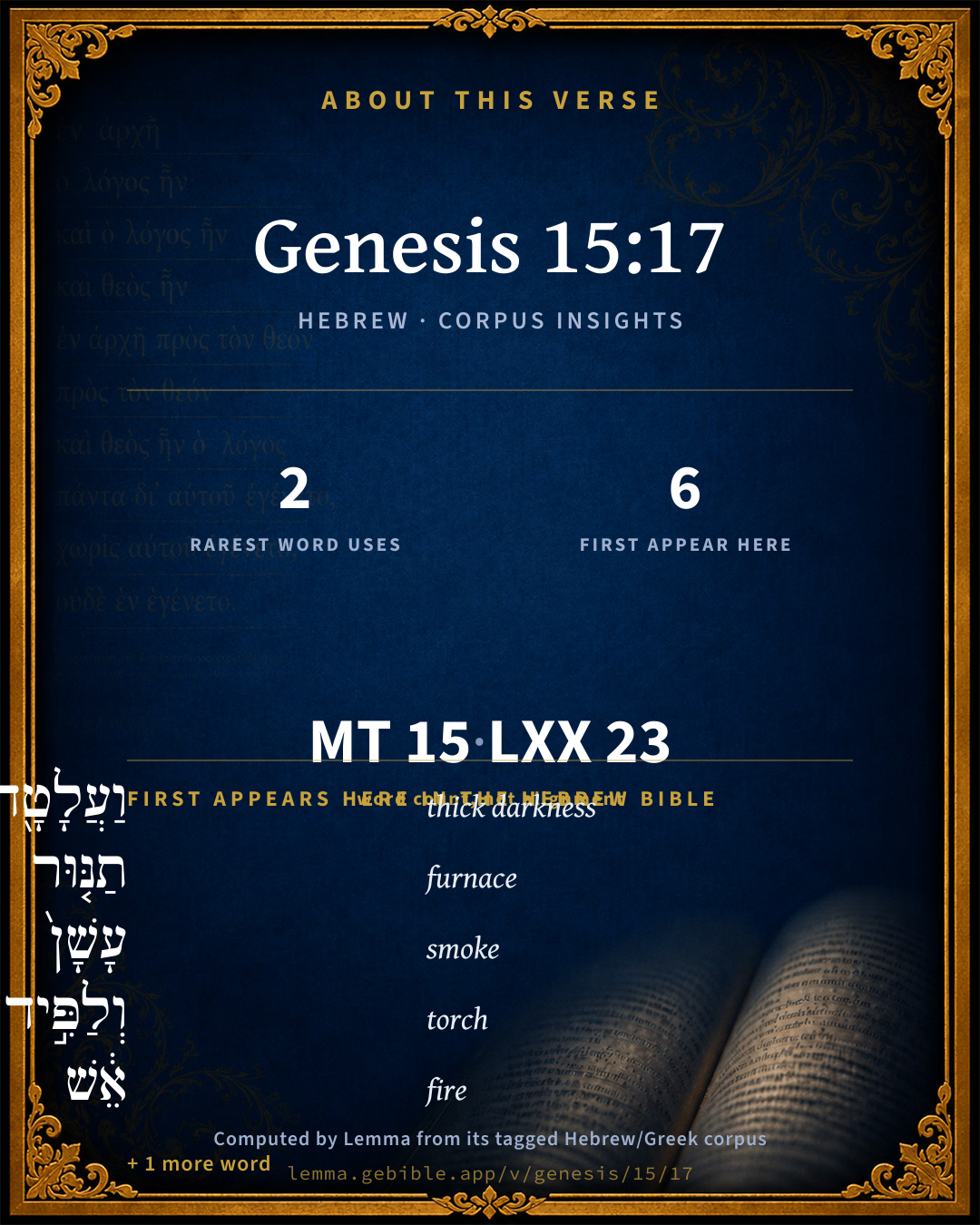
  • 6 first appearances in the Hebrew Bible
Full analysis ↓
Download a study sheet

One document with this verse’s original text, its word-by-word gloss line, the meaning frame, cross-references with their text, attributed commentary, and full source and license credits — printable, and it pastes into notes with its structure intact.

This verse Autodidact and up

Study sheet (.html) Plain text (.txt)

A passage Seminary Student

Up to 50 verses in one chapter. A passage sheet keeps up to 6 commentary sources and 12 cross-references per verse, in the order this page ranks them, and says so on the sheet whenever that leaves anything out. Ask for a single verse and you get the Autodidact verse sheet above.

Everything on this page stays free to read, with no account — the sheet is a download of what is already on screen, not access to it.

Want to remove ads? Support Godless Engineer
Compare translations 3

The same verse in 3 English versions, stacked beneath the original-language interlinear above. Click any original word for its lexicon entry.

Each is an independent rendering of the whole verse — the interlinear is not word-aligned to these translations.

Highlighted words mark where these versions differ — a whole-verse word diff, not a word-by-word alignment.

  • World English Bible Public Domain
    It came to pass that, when the sun went down, and it was dark, behold, a smoking furnace, and a flaming torch passed between these pieces.
  • King James Version Public Domain
    And it came to pass, that, when the sun went down, and it was dark, behold a smoking furnace, and a burning lamp that passed between those pieces.
  • unfoldingWord Literal Text CC BY-SA 4.0
    And it happened, the sun went down and darkness came, and behold, a smoking fire pot and a flaming torch that passed between those pieces.

unfoldingWord Literal Text — © unfoldingWord, licensed CC BY-SA 4.0. Word-aligned USFM3 via Door43 (git.door43.org/unfoldingWord/en_ult).

Versions to compare (up to 4)

3 of 4 selected

Show all 18 translations

Every available English version of this verse, each an independent rendering of the whole verse.

  • World English Bible Public Domain
    It came to pass that, when the sun went down, and it was dark, behold, a smoking furnace, and a flaming torch passed between these pieces.
  • Berean Standard Bible Public Domain
    When the sun had set and darkness had fallen, behold, a smoking firepot and a flaming torch appeared and passed between the halves of the carcasses.
  • Majority Standard Bible Public Domain
    When the sun had set and darkness had fallen, behold, a smoking firepot and a flaming torch appeared and passed between the halves of the carcasses.
  • King James Version Public Domain
    And it came to pass, that, when the sun went down, and it was dark, behold a smoking furnace, and a burning lamp that passed between those pieces.
  • American Standard Version (1901) Public Domain
    And it came to pass, that, when the sun went down, and it was dark, behold, a smoking furnace, and a flaming torch that passed between these pieces.
  • Revised Version (1885) Public Domain
    And it came to pass, that, when the sun went down, and it was dark, behold a smoking furnace, and a flaming torch that passed between these pieces.
  • Geneva Bible (1599) Public Domain
    Also when the sunne went downe, there was a darkenes: and behold, a smoking fornace, and a firebrand, which went betweene those pieces.
  • Douay-Rheims (1899) Public Domain
    And when the sun was set, there arose a dark mist, and there appeared a smoking furnace and a lamp of fire passing between those divisions.
  • Young's Literal Translation Public Domain
    And it cometh to pass -- the sun hath gone in, and thick darkness hath been -- and lo, a furnace of smoke, and a lamp of fire, which hath passed over between those pieces.
  • Literal Standard Version CC BY-SA 4.0
    And it comes to pass—the sun has gone in, and thick darkness has been and behold, a furnace of smoke, and a lamp of fire, which has passed over between those pieces.
  • Unlocked Literal Bible CC BY-SA 4.0
    When the sun had gone down and it was dark, behold, a smoking fire pot and a flaming torch passed between the pieces.
  • unfoldingWord Literal Text CC BY-SA 4.0
    And it happened, the sun went down and darkness came, and behold, a smoking fire pot and a flaming torch that passed between those pieces.
  • Darby Bible Public Domain
    And it came to pass when the sun had gone down, and it was dark, that behold, there was a smoking furnace, and a flame of fire which passed between those pieces.
  • World Messianic Bible Public Domain
    It came to pass that, when the sun went down, and it was dark, behold, a smoking furnace and a flaming torch passed between these pieces.
  • Webster's Bible Public Domain
    And it came to pass, that when the sun had gone down, and it was dark, behold a smoking furnace, and a burning lamp that passed between those pieces.
  • Free Bible Version CC BY-SA 4.0
    After the sun set and it grew dark, suddenly a smoking furnace and a flaming torch appeared and passed between the halves of the animal carcasses.
  • Bible in Basic English Public Domain
    Then when the sun went down and it was dark, he saw a smoking fire and a flaming light which went between the parts of the bodies.
  • JPS Tanakh (1917) Public Domain
    And it came to pass, that, when the sun went down, and there was thick darkness, behold a smoking furnace, and a flaming torch that passed between these pieces.

Literal Standard Version (2020), Covenant Press — licensed CC BY-SA 4.0. Text via the HelloAO Bible API (eBible.org). Unlocked Literal Bible (unfoldingWord) — licensed CC BY-SA 4.0. Text via the HelloAO Bible API (eBible.org). unfoldingWord Literal Text — © unfoldingWord, licensed CC BY-SA 4.0. Word-aligned USFM3 via Door43 (git.door43.org/unfoldingWord/en_ult). Free Bible Version, Dr. Jonathan Gallagher — licensed CC BY-SA 4.0. Text via the HelloAO Bible API (eBible.org).

Word by word

More ways to search: Search by grammar → Find every occurrence → Compare this word →

Practice this passage: Drill this verse → Learn its vocabulary →

הַגְּזָרִ֥ים
gezer
H1506
“the · parts”
Particle, Definite Article + Noun, Common, Masculine, Plural, Absolute
Part of Speech
Particle + Noun
Type
Common
Gender
Masculine
Number
Plural
State
Absolute
Full BDB Definition

Origin: from H1504

TWOT: 340a

part
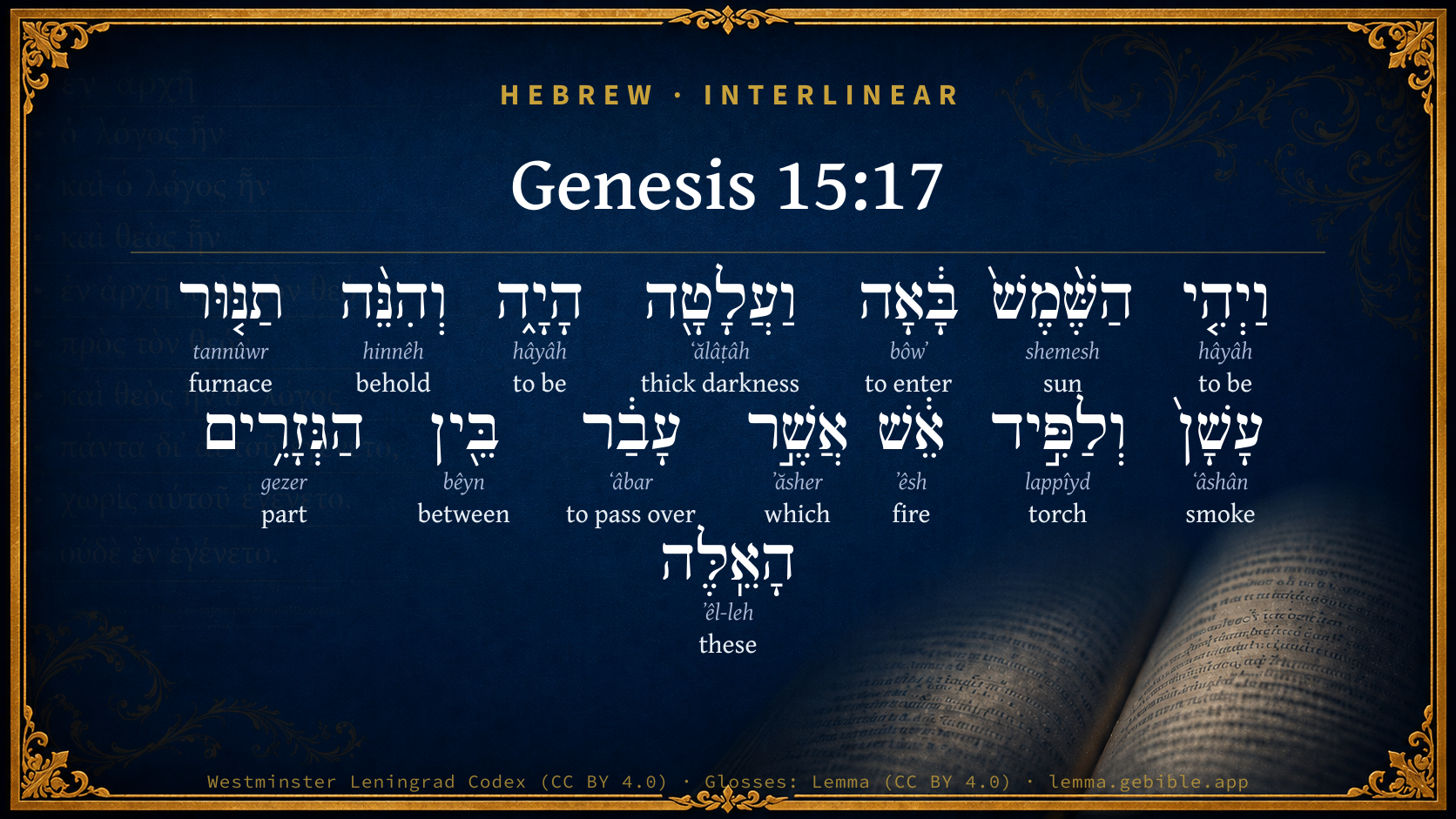
  1. וַיְהִ֤י hâyâh H1961 “and · to be” Conjunction + Verb, Qal, Sequential Imperfect, 3rd Person, Masculine, Singular
  2. הַשֶּׁ֨מֶשׁ֙ shemesh H8121 “the · sun” Particle, Definite Article + Noun, Common, Both, Singular, Absolute
  3. בָּ֔אָה bôwʼ H935 “to enter” Verb, Qal, Perfect, 3rd Person, Feminine, Singular
  4. וַעֲלָטָ֖ה ʻălâṭâh H5939 “and · thick darkness” Conjunction + Noun, Common, Feminine, Singular, Absolute
  5. הָיָ֑ה hâyâh H1961 “to be” Verb, Qal, Perfect, 3rd Person, Masculine, Singular
  6. וְהִנֵּ֨ה hinnêh H2009 “and · behold” Conjunction + Particle, Demonstrative
  7. תַנּ֤וּר tannûwr H8574 “furnace of” Noun, Common, Masculine, Singular, Construct
  8. עָשָׁן֙ ʻâshân H6227 “smoke” Noun, Common, Masculine, Singular, Absolute
  9. וְלַפִּ֣יד lappîyd H3940 “and · torch of” Conjunction + Noun, Common, Masculine, Singular, Construct
  10. אֵ֔שׁ ʼêsh H784 “fire” Noun, Common, Both, Singular, Absolute
  11. אֲשֶׁ֣ר ʼăsher H834 “which” Particle, Relative
  12. עָבַ֔ר ʻâbar H5674 “to pass over” Verb, Qal, Perfect, 3rd Person, Masculine, Singular
  13. בֵּ֖ין bêyn H996 “between” Preposition
  14. הָאֵֽלֶּה ʼêl-leh H428 “the · these” Particle, Definite Article + Pronoun, Demonstrative, Common, Plural

About this verse

These counts appear in no published source. They are computed here, from the morphology-tagged text and Lemma’s own curated glosses. What Lemma adds →

15
words
14
distinct lemmas
Pentateuch
section

Notable vocabulary

The rarest word here is הַגְּזָרִ֥ים part H1506 — appearing just 2 times in the whole Hebrew Bible.

First appearance in Scripture

These words make their first canonical appearance in the Hebrew Bible here:

  • וַעֲלָטָ֖ה thick darkness H5939
  • תַנּ֤וּר furnace H8574
  • עָשָׁן֙ smoke H6227
  • וְלַפִּ֣יד torch H3940
  • אֵ֔שׁ fire H784
  • הַגְּזָרִ֥ים part H1506

Shared distinctive vocabulary

הַגְּזָרִ֥ים part H1506 occurs in 2 verses of the Hebrew Bible. Also found in:

Grammatical profile

  • 4 verbs
  • 7 nouns
  • 1 pronoun
  • 1 preposition
  • 2 particles

Verb forms

  • וַיְהִ֤י Qal · Sequential Imperfect
  • בָּ֔אָה Qal · Perfect
  • הָיָ֑ה Qal · Perfect
  • עָבַ֔ר Qal · Perfect

Repetition

A word recurs within this verse — often emphatic in Hebrew:

  • וַיְהִ֤י to be H1961 ×2

Hebrew & Septuagint length

In English translation the verse runs 26 words from the Hebrew and 27 from the Septuagint (LXX English) — closely comparable.

A rough comparison of the two English renderings, which tokenize alike — not a word-level alignment.

Word counts can differ between the Hebrew and the Greek without any difference in meaning — e.g. the Hebrew direct-object marker אֵת has no separate Greek word, and Greek often adds the article ὁ.

In the original languages it is 15 Hebrew tokens and 23 Greek tokens — but the two are counted differently (Hebrew bundles its prefixes and suffixes into one token; the Greek is in lemma form), so that isn’t a like-for-like length.

Cross-references

9

Topical passages linked to Genesis 15:17 in the Treasury of Scripture Knowledge — connected by theme and wording, ordered by reader-vote popularity; previews shown in the World English Bible.

  • Jeremiah 34:18–19 I will give the men who have transgressed my covenant, who have not performed the words of the covenant which they made before me, when they cut the calf in two and passed between the parts of it;
  • Judges 6:21 Then the angel of Yahweh put forth the end of the staff that was in his hand, and touched the flesh and the unleavened cakes; and there went up fire out of the rock, and consumed the flesh and the unleavened cakes; and the angel of Yahweh departed out of his sight.
  • Jeremiah 11:4 which I commanded your fathers in the day that I brought them forth out of the land of Egypt, out of the iron furnace, saying, Obey my voice, and do them, according to all which I command you: so shall you be my people, and I will be your God;
  • Exodus 3:2–3 The angel of Yahweh appeared to him in a flame of fire out of the midst of a bush. He looked, and behold, the bush burned with fire, and the bush was not consumed.
  • 1 Chronicles 21:26 David built there an altar to Yahweh, and offered burnt offerings and peace-offerings, and called on Yahweh; and he answered him from the sky by fire on the altar of burnt offering.
  • Deuteronomy 4:20 But Yahweh has taken you, and brought you forth out of the iron furnace, out of Egypt, to be to him a people of inheritance, as at this day.
  • Judges 13:20 For it happened, when the flame went up toward the sky from off the altar, that the angel of Yahweh ascended in the flame of the altar: and Manoah and his wife looked on; and they fell on their faces to the ground.
  • 2 Samuel 22:9 There went up a smoke out of his nostrils, Fire out of his mouth devoured: Coals were kindled by it.
  • Isaiah 62:1 For Zion's sake will I not hold my peace, and for Jerusalem's sake I will not rest, until her righteousness go forth as brightness, and her salvation as a lamp that burns.

Cross-references courtesy of OpenBible.info (CC BY 4.0).

Hebrew and Greek witnesses Masoretic Hebrew ↔ Greek Septuagint

The same verse in the two great witnesses to the Old Testament, shown verse-for-verse.

These are two independent witnesses, not word-aligned to each other, and the Septuagint is shown in lemma (dictionary) form.

Hebrew Genesis 15:17 Masoretic · Westminster Leningrad Codex

וַיְהִ֤י הַשֶּׁ֨מֶשׁ֙ בָּ֔אָה וַעֲלָטָ֖ה הָיָ֑ה וְהִנֵּ֨ה תַנּ֤וּר עָשָׁן֙ וְלַפִּ֣יד אֵ֔שׁ אֲשֶׁ֣ר עָבַ֔ר בֵּ֖ין הַגְּזָרִ֥ים הָאֵֽלֶּה

It came to pass that, when the sun went down, and it was dark, behold, a smoking furnace, and a flaming torch passed between these pieces.

World English Bible · Public Domain

Greek LXX Genesis 15:17 Septuagint · lemma form

ἐπεί δέ γίγνομαι ὁ ἥλιος πρός δυσμή φλόξ γίγνομαι καί ἰδού κλίβανος καπνίζω καί λαμπάς πῦρ ὅς διαἔρχομαι ἀνά μέσος ὁ διχοτόμημα οὗτος

And when the sun was about to set, there was a flame, and behold a smoking furnace and lamps of fire, which passed between these divided pieces.

LXX2012 (modern English Septuagint) · Public Domain

On this verse, The Pulpit Commentary discusses the Septuagint’s reading. Read the note in Commentary ↓

Hebrew: Westminster Leningrad Codex (CC BY 4.0). Greek: Septuagint (public domain); English from LXX2012 (modern English Septuagint) (Public Domain). How the Septuagint differs from the Hebrew →

Targum (Aramaic paraphrase)

2

The Targum is the ancient Jewish Aramaic paraphrase of the Hebrew Scriptures — an interpretive translation, not the Hebrew text itself. Onkelos (literal) and Pseudo-Jonathan (expansive) render the Torah, and Jonathan the Prophets. Coverage is partial: where no permissively-licensed English translation exists for a verse, only the Aramaic is shown. This is verse-level text, not a word-by-word alignment to the Hebrew.

  1. Targum Onkelos Torah (Genesis–Deuteronomy)
    וַהֲוָה שִׁמְשָׁא עַלַת וְקִבְלָא הֲוָה וְהָא תַּנוּר דִתְנַן וּבָעוּר דְאֶשָׁתָא דִעֲדָא בֵּין פַּלְגַיָא הָאִלֵין

    (no public-domain English translation for this verse)

    Targum Onkelos — Aramaic: “Onkelos Genesis” (public domain); “Onkelos Exodus” (public domain); “Onkelos Leviticus” (public domain); “Onkelos Numbers” (public domain); “Onkelos Deuteronomy” (public domain). English: “Sefaria Community Translation” (CC0 1.0 (public-domain dedication)); “J.W. Etheridge. The Targums of Onkelos and Jonathan Ben Uzziel on the Pentateuch. London: Longmans, Green, 1862” (public domain). Text via Sefaria.

  2. Targum Pseudo-Jonathan Torah (Genesis–Deuteronomy)
    וַהֲוָה שִׁמְשָׁא טְמָעָא וְחוּמְטָא הֲוַת וְהָא חָמָא אַבְרָם גֵיהִנָם מַסִיק תְּנָנָא וְגוֹמְרִין דְאֵשָׁא וּמַבְעִיר שְׁבִיבִין דְנוּר לְמֵידַן בֵּיהּ רַשִׁעַיָא וְהָא עָבַר בֵּין פַּסְגַיָא הָאִילֵן

    And when the sun had set there was darkness. And, behold, Abram saw Gehinnam ascending, smoke with flaming coals and burning flakes of fire, werewith the wicked are to be judged. And, behold, He passed between those divisions.

    Targum Pseudo-Jonathan — Aramaic: “Targum Jonathan on Genesis” (public domain); “Targum Jonathan on Exodus” (public domain); “Targum Jonathan on Leviticus” (public domain); “Targum Jonathan on Numbers” (public domain); “Targum Jonathan on Deuteronomy” (public domain). English: “The Targum of Jonathan ben Uzziel, trans. J. W. Etheridge, London, 1862” (public domain). Text via Sefaria.

Commentary

Notes on Genesis 15:17 from classic Christian and Jewish commentators (each source and its license shown beneath its notes). The classic Christian expositions comment on the surrounding passage and are grouped to its opening verse, so a note may address several verses; the Jewish commentaries on the Tanakh (Rashi and others) are per-verse, so they appear only where the commentator wrote on this verse.

Lemma curates 59 commentaries, every one of them public domain or Creative Commons licensed, each selected and text-cleaned for this edition rather than reprinted as found. About our sources →

Matthew Henry's Commentary

Here is, I. The covenant ratified (Gen 15:17); the sign which Abram desired was given, at length, when the sun had gone down, so that it was dark; for that was a dark dispensation.

1. The smoking furnace signified the affliction of his seed in Egypt. They were there in the iron furnace (Deu 4:20), the furnace of affliction (Isa 48:10), labouring in the very fire. They were there in the smoke, their eyes darkened, that they could not see to the end of their troubles, and themselves at a loss to conceive what God would do with them. Clouds and darkness were round about them.

2. The burning lamp denotes comfort in this affliction; and this God showed to Abram, at the same time that he showed him the smoking furnace. (1.) Light denotes deliverance out of the furnace; their salvation was as a lamp that burneth, Isa 62:1. When God came down to deliver them, he appeared in a bush that burned, and was not consumed, Exo 3:2. (2.) The lamp denotes direction in the smoke. God's word was their lamp: this word to Abram was so, it was a light shining in a dark place. Perhaps this burning lamp prefigured the pillar of cloud and fire, which led them out of Egypt, in which God was. (3.) The burning lamp denotes the destruction of their enemies who kept them so long in the furnace. See Zac 12:6. The same cloud that enlightened the Israelites troubled and burned the Egyptians.

3. The passing of these between the pieces was the confirming of the covenant God now made with him, that he might have strong consolation, being fully persuaded that what God promised he would certainly perform. It is probable that the furnace and lamp, which passed between the pieces, burnt and consumed them, and so completed the sacrifice, and testified God's acceptance of it, as of Gideon's (Jdg 6:21), Manoah's (Jdg 13:19, Jdg 13:20), and Solomon's, Ch2 7:1. So it intimates, (1.) That God's covenants with man are made by sacrifice (Psa 50:5), by Christ, the great sacrifice: no agreement without atonement. (2.) God's acceptance of our spiritual sacrifices is a token for good and an earnest of further favours. See Jdg 13:23. And by this we may know that he accepts our sacrifices if he kindle in our souls a holy fire of pious and devout affections in them.

II. The covenant repeated and explained: In that same day, that day never to be forgotten, the Lord made a covenant with Abram, that is, gave a promise to Abram, saying, Unto thy seed have I given this land, Gen 15:18. Here is,

1. A rehearsal of the grant. He had said before, To thy seed will I give this land, Gen 12:7; Gen 13:15. But here he says, I have given it; that is, (1.) I have given the promise of it, the charter is sealed and delivered, and cannot be disannulled. Note, God's promises are God's gifts, and are so to be accounted. (2.) The possession is as sure, in due time, as if it were now actually delivered to them. What God has promised is as sure as if it were already done; hence, it is said, He that believes hath everlasting life (Joh 3:36), for he shall as surely go to heaven as if he were there already.

2. A recital of the particulars granted, such as is usual in the grants of lands. He specifies the boundaries of the land intended hereby to be granted, Gen 15:18. And then, for the greater certainty, as is usual in such cases, he mentions in whose tenure and occupation these lands now were. Ten several nations, or tribes, are here spoken of (Gen 15:19-21) that must be cast our, to make room for the seed of Abram. They were not possessed of all these countries when God brought them into Canaan. The bounds are fixed much narrower, Num 34:2, Num 34:3, etc. But, (1.) In David's time, and Solomon's, their jurisdiction extended to the utmost of these limits, Ch2 9:26. (2.) It was their own fault that they were not sooner and longer in possession of all these territories. They forfeited their right by their sins, and by their own sloth and cowardice kept themselves out of possession. (3.) The land granted is here described in its utmost extent because it was to be a type of the heavenly inheritance, where there is room enough: in our father's house are many mansions. The present occupants are named, because their number, and strength, and long prescription, should be no hindrance to the accomplishment of this promise in its season, and to magnify God's love to Abram and his seed, in giving to that one nation the possessions of many nations, so precious were they in his sight, and so honourable, Isa 43:4.

Matthew Henry's Commentary on the Whole Bible (1708–1710) — public domain (CC PDM 1.0). Text via the HelloAO Bible API.

Trapp's Complete Commentary

John Trapp

Gen 15:17 And it came to pass, that, when the sun went down, and it was dark, behold a smoking furnace, and a burning lamp that passed between those pieces.

Ver. 17. A smoking furnace, and a burning lamp.] Figuring out either God (who is a consuming fire) cutting covenant, {Gen 15:10} per condescensum ; or else, the furnace of Israel’s affliction, and then the lamp of their salvation.

John Trapp, A Commentary or Exposition upon All the Books of the Old and New Testament (1647–1656) — public domain. Text from a community e-Sword module.

The Biblical Illustrator

Joseph S. Exell

Gen_15:17

Behold a smoking furnace, and a burning lamp that passed between those pieces

The furnace and the lamp

In this whole striking and impressive narrative there are teachings of the utmost interest and value; and I would fain extract alike from the sacrifice, the furnace, and the lamp, guiding light and strengthening cheer for Abrahams spiritual seed today.

1. Note, first, that Abrams long and lonely hours of watching came to an end at last, and that patient waiting upon God obtained its due reward. You, too, may find that your offering of ardent prayer, or self-sacrificing deed of service or of suffering, may seem for long unanswered and in vain. Yet, though the vision tarry long, still wait for it; the day may slowly die, the night may gather round before the gladdening light shall come, but it shall come, and turn the darkness back again to dawn.

2. Note, further, that from every offering to God--the song of praise, the fervent prayer, the submissive will, the good deeds, or the consecrated life--we need to drive, with watchful hand and eye, the vultures of evilthoughts and selfish aims and worldly motives and Satanic temptations away. Now, as then, mans extremity is Gods opportunity, and still the unclean spirits which haunt and harass the Christian, even at his devotions as well as otherwise, are scared off just as they circle round for a final swoop, and wing their baffled flight away!

3. Note, further, that the mysterious furnace and the supernatural lamp were seen in direct connection with the chosen sacrifice. They moved to and fro upon the altar and among the consecrated offerings, and were seen nowhere else. Now, see how this applies to the seed of Abraham, the Israelitish race. They were a chosen people, selected and set apart out of all the tribes of men to be, in a sense, absolutely singular--Gods own people. This choice on Gods part, and this consecration on theirs, was symbolized and ratified by altar sacrifices and the fire from heaven. Their consecration to God brought the furnace of purification and the lamp of illumination, in order to fit them for the high and glorious destiny to which they were called. In the life and death of Jesus Christ, too, Abrams glorious seed, the vision was fulfilled. How clearly we can see the smoking furnace in the sore affliction through which He passed! Yet, ever amid all, through the whole of His sharp pilgrimage, He had ever the light and the comfort, the cheer and the guidance, of the burning lamp. By His conscious sinlessness, His secret mountain intercourse with God, by the baptism of the Brooding Dove, by the Fathers voice and presence, by saintly messengers from heaven, by perpetual gift of gracious power, the burning lamp of light and love moved along through all His life of sacrifice, up the hill of Calvary, through the sepulchre, and from Mount Olivet up to the hills of God! The patriarchs vision is fulfilled, too, in the history and experience of the Church of God, the true Israel, the spiritual seed of Abraham. The Church of Christ, the guild and family of true believers throughout all the world, is also, like Abrams sacrifice, the elect of God. It is a chosen nation, a royal priesthood, a peculiar people, elect, precious. By holy dedication the Church lays itself on the altar of its Lord, and offers perpetual sacrifice through the blood of the Atoning Lamb; and God says of it, I will be their God, and they shall be My people. Here, again, we see how consecration is linked with purification and illumination--here, again, the Chosen Sacrifice is subjected to the smoking furnaceand burning lamp. The smoke of the one and the gleam of the other can be traced all along the line of the Churchs march. You can see the reek of the furnace in the rage of Herod, in the cruelty of Domitian, in the savagery of Nero, the passion of the English Mary, the atrocities of papal Rome. You can catch the reflection of the furnace glow in the sword of Mahomet, the rocks of Madagascar, the dungeons of Naples, the stakes of Smithfield, and the Inquisition of Spain. In some form or other, today, the smoking furnace moves through the pilgrim and militant Church of Christ. But, as with Israel of old, as with Jesus, the Churchs Head, so the Church itself has never been without the glow of the burning lamp. Gods Church has never lost the light of truth, never been robbed of the divinely-kindled lamp of Love! I want to extract one more lesson for personal application. The singular vision of Abram is equally fulfilled in the life and lot of every Christian believer. Like Abrams offered victims, the Christian, too, is the chosen and consecrated possession of the Lord. He hath presented himself a living sacrifice, holy and acceptable to God, and in return, the Lord hath set apart him that is godly for Himself. And here, again, in the individual, consecration is attended by purification and illumination. The living sacrifice goes hand in hand with the smoking furnace and the burning lamp. In the Christian life the smoking furnace is full often seen and felt. The path of suffering, test, and trial must be trodden by every child of God. This Christian must carry along a painful bodily ailment. That one must go mourning because of an absent face, a silent voice, a vacant chair. Another must struggle, baffled and perplexed with temporal and financial cares, half worsted in the fight. And still another weeps over a blighted hope, a thankless child, or an unfaithful friend. Everywhere, and with everyone, the smoking furnace moves in and out along the consecrated life. But still, in the Christians lot the burning lamp holds precious and abiding place. The word of promise, grace, and guidance is with him all the way. The candle of the Lord burns in his heart; the lamp of eternal truth and love burns with a quenchless fire, casts a guiding light on his heavenward path, sweeps away the mists even from deaths deep river, expels the shadows from the very grave, and is reflected by the jasper walls that gleam on the hills of God! Is Abram afraid of the smoking furnace? In the light of the burning lamp he reads, Fear not, Abraham, I am thy shield, thy exceeding great reward. Does Pauls thorn rankle so deep that he pleads thrice with tears and sighs to be delivered? The burning lamp flings the promise on the smoke cloud--My grace is sufficient for thee, and at once the apostle glories in his infirmities and praises God in the fire! So with thee, O Christian! In thy trials thou shalt have triumphs, in thy sorrows thou shalt have solace. For thy trouble thou shalt have double; in tribulation shall come compensation, and always and ever the smoking furnace shall be held in check by the gleam of the burning lamp! Do you ask in doubtful wonder why a consecrated life should be so closely linked with affliction? I answer that the furnace is the purifying agent making the sanctification perfect and the sacrifice more precious and complete. The furnace, too, endows the consecrated soul with the properties of steel, gives the tempered hardness and solidity of character which enables the Christian to fulfil the Apostolic counsel--Quit you like men; be strong! That was the end of Israels sore distresses. Behold I have refined thee, says Jehovah--I have chosen thee out of the furnace of affliction. Even of Jesus it is said that He learned obedience by the things that He suffered, and that by suffering He was made perfect as the Captain of our salvation. Take heart, then, O thou follower of the Captain. If that is the way the Master trod, should not the servant tread it still? Make thy sacrifice thorough, willing, constant, and entire. (J. J. Wray.)

Ratification of a covenant by a burning lamp

In illustration of this very ancient mode of ratifying a covenant, Roberts says--It is an interesting fact that the burning lamp or tire is still used in the East in confirmation of a covenant. Should a person in the evening make a solemn promise to perform something for another, and should the latter doubt his word, the former will say, pointing to the flame of the lamp, That is the witness. On occasions of greater importance, when two or more join in a covenant, should the fidelity of any be questioned, they will say, We invoke the lamp of the temple. When an agreement of this kind is broken, it will be said, Who would have thought this, for the lamp of the temple was invoked?

The Biblical Illustrator, edited by Joseph S. Exell (c. 1880s–1900s) — public domain. Text from a community e-Sword module.

Joseph Benson's Commentary

Gen 15:17. Behold a smoking furnace — This signified the affliction of his seed in Egypt: they were there in the furnace of affliction, and labouring in the very fire. They were there in the smoke, their eyes darkened that they could not see to the end of their troubles. And a burning lamp — This speaks comfort in this affliction: and this God showed Abram at the same time with the smoking furnace. The lamp notes direction in the smoke; God’s word was their lamp, a light shining in a dark place. Perhaps, too, this burning lamp prefigured the pillar of a cloud and fire which led them out of Egypt. The “passing of these between the pieces” was the confirming of the covenant God now made with him.

Joseph Benson's Commentary on the Old and New Testaments (1811–1818) — public domain. Text from a community e-Sword module.

Tyndale Open Study Notes

Tyndale Open Resources

15:17-18 smoking firepot . . . flaming torch: Fire represented the Lord’s cleansing, consuming zeal and unapproachable holiness (cp. Isa 6:3-7). The holy God made (literally cut) a unilateral covenant with Abram; its promises were absolutely sure because they did not depend on what Abram or his descendants might do.

Tyndale Open Study Notes — © Tyndale Open Resources, licensed CC BY-SA 4.0. Text via the HelloAO Bible API.

Adam Clarke's Commentary

Verse 17. Smoking furnace and a burning lamp] Probably the smoking furnace might be designed as an emblem of the sore afflictions of the Israelites in Egypt; but the burning lamp was certainly the symbol of the Divine presence, which, passing between the pieces, ratified the covenant with Abram, as the following verse immediately states.

Adam Clarke's Commentary on the Bible (1810–1826) — public domain. Text from a community e-Sword/MySword module.

John Calvin's Commentaries

17. Behold, a smoking furnace. Again a new vision was added, to confirm his faith in the oracle. At first, Abram was horror-struck with the thick darkness; now, in the midst of a smoking furnace, he sees a burning lamp. Many suppose that a sacrifice was consumed with this fire; but I rather interpret it as a symbol of future deliverance, which would well agree with the fact itself. For there are two things contrary to each other in appearance; the obscurity of smoke, and the shining of a lamp. Hence Abram knew that light would, at length, emerge out of darkness. An analogy is always to be sought for between signs, and the things signified, that there may be a mutual correspondence between them. Then, since the symbol, in itself, is but a lifeless carcass, reference ought always to be made to the word which is annexed to it. But here, by the word, liberty was promised to Abram’s seed, in the midst of servitude. Now the condition of the Church could not be painted more to the life, than when God causes a burning torch to proceed out of the smoke, in order that the darkness of afflictions may not overwhelm us, but that we may cherish a good hope of life even in death; because the Lord will, at length, shine upon us, if only we offer up ourselves in sacrifice to Him.

John Calvin's Commentaries (1540-1563) — public domain. Text from the Calvin Translation Society English edition (1840s-50s) via the Christian Classics Ethereal Library (ccel.org). Calvin's coverage is partial (roughly two-thirds of the Bible); uncommented books and verses are honest gaps, never fabricated. The 19th-century editor's footnotes and remarks are omitted so the notes are faithfully Calvin's own voice.

Ellicott's Commentary for English Readers

(17) A smoking furnace.—The word really means the circular firepot which Orientals use in their houses to sit round for purposes of warmth. This one was wreathed in smoke, out of which shot “a burning lamp” (Heb., a torch of flame). For not two symbols, but only one, passed between the divided carcases. Abram had probably passed between them immediately after arranging them, and now Jehovah does the same. Fire is the recognised symbol of the Deity, as in the burning bush, the pillar of fire, the lightnings on Mount Sinai, &c.

A Bible Commentary for English Readers, edited by Charles John Ellicott (1878–1897) — public domain. Text from a community e-Sword module.

The Cambridge Bible for Schools and Colleges

gen. ed. J. J. S. Perowne

17. a smoking furnace] The sign of the covenant is given in the appearance of a kiln, from which issued smoke and a blazing torch; and this passed through the two rows of the divided carcases. The figure described as a “smoking furnace” (tannur) was that of a clay constructed kiln, or furnace, such as is used for baking purposes by the Fellaheen. It is the κλίβανος = “oven,” of Mat_6:30. For the fire and smoke as a symbol of the Theophany, see Exo_13:21; Exo_19:18; Exo_24:17.

The Cambridge Bible for Schools and Colleges (gen. ed. J. J. S. Perowne; Cambridge University Press, 1878–1918) — public domain. Text from a community e-Sword module.

John Gill's Exposition

In the same day the Lord made a covenant with Abram,.... Which he confirmed by passing between the pieces and accepting his sacrifice:

saying, unto thy seed have I given this land; he had given it in his purpose, and he had given the promise of it, and here he renews the grant, and ratifies and confirms it, even the land of Canaan, where Abram now was, though only a sojourner in it; and which is described by its boundaries and present occupants, in this and the following verses, as is usually done in grants of lands and deeds of conveyance:

from the river of Egypt, unto the great river, the river of Euphrates; the river of Egypt is the Nile, which overflowed it annually and made it fruitful; so the Targum of Jonathan calls it the river of Egypt; it may be rendered, "from the river Mizraim or Egypt", for the name of Egypt was given to the river Nile as well as to the country, and so it is called by Homer (p); and Diodorus Siculus (q) says, the Nile was first called Egypt; some (r) think the Nile is not here meant, but a little river of Egypt that ran through the desert that lay between Palestine and Egypt; but it seems to be a branch of the river Nile, which was lesser about Palestine or Damiata, at the entrance of Egypt, than at other places. Brocardus (s) says,"from Delta to Heliopolis were three miles, where another river was separated from the Nile, and carried to the city of Pelusium; and, adds he, this river is properly called in Scripture the river of Egypt, and at it is bounded the lot of the tribe of Judah.''This river of Egypt, or the Nile, was the southern boundary of the land of Canaan, and from hence to the river Euphrates, the eastern boundary, was the utmost extent of it in which it was ever possessed, as it was in the times of David and Solomon, Sa2 8:3.

(p) Odyss. 14. vid. Pausan. Boeotica, sive l. 9. p. 859. (q) Bibliothec. l. 1. p. 56. (r) See Rollin's Ancient History, vol. 1. p. 92. (s) Apud Drusium in loc.

John Gill's Exposition of the Whole Bible (1746–1763) — public domain (CC PDM 1.0). Text via the HelloAO Bible API.

Haydock's Catholic Bible Commentary

A lamp, or symbol of the Divinity, passing, as Abram also did, between the divided beasts, to ratify the covenant. See Jeremias xxxiv. 18.

George Leo Haydock (1774–1849), Haydock's Catholic Family Bible and Commentary, 1859 edition — public domain. Excludes Psalms (Douay-Rheims chapter numbering differs from Protestant) and Deuterocanonical books (Catholic canon only).

Matthew Poole's English Annotations

By which symbol God designed to represent, either,

1. The future state of Abram's seed; the

smoking furnace signifying Israel's misery in the iron furnace of Egypt, as it is called, Jer 11:4; and the

burning lamp noting their deliverance, or light shining out of darkness. Or,

2. His own presence; for God is called a consuming fire, Heb 12:29; and both smoke and fire are elsewhere mentioned as the signs and means of God's appearance. See Exo 3:2; 19:9,16,18; 20:18. And this sense seems to be favoured by the following words, it being the custom of persons entering into covenant to pass between such pieces as hath been said; and because God hath no body which could visibly do so, therefore he doth it in this type or shadow.

Matthew Poole's English Annotations on the Holy Bible (1683–1685) — public domain. Text from a community e-Sword/MySword module.

Whedon's Commentary on the Bible

Daniel D. Whedon

17. When the sun went down, and it was dark — The progress of time is marked; in Gen_15:12, when the sun was going down; here when it went down, and darkness was on all things. The Hebrew word for darkness in this verse is different from that so rendered in Gen_15:12. There it means soul darkness; here night’s darkness.

A smoking furnace — Hebrews, an oven of smoke. According to Jahn, the tannur, here rendered furnace, was a moveable oven, constructed of brick, and plastered within and without with clay. The burning lamp is not to be regarded as another and distinct object, separate from the furnace. A better version is, flames of fire. The thing seen was a moving oven, from the top of which issued a flame of fire in the midst of a cloud of smoke. Like the pillar of cloud and fire, (Exo_13:21,) this smoke and flame were symbols of the presence and power of Jehovah; not solely “symbols of the wrath of God,” (Keil,) nor yet to be construed as “the smoke of destruction, and the light of salvation.” — Murphy. All these thoughts lie in the background, but the great thought is, that Jehovah himself, by these symbols of his personal presence and manifestation, condescends to covenant with Abram, and passed between those pieces. God’s penal judgments may well be symbolized by a smoking furnace, (comp. Gen_19:28; Mal_4:1,) and flaming fire may denote either the consuming wrath (Psa_89:46; Lam_2:3) or the salvation of God, (Isa_62:1 :) and Jehovah’s presence and power among his covenant people would be displayed in both these ways — avenging them on their enemies when they were injured, and chastening and smiting them when they sinned.

Daniel D. Whedon (gen. ed.), Commentary on the Old and New Testaments (1874–1909) — public domain. Text from a community e-Sword module.

The Pulpit Commentary

And it came to pass, that, when the sun went down, literally, and it was (i.e. this took place), the sun went down; less accurately, ejpei deneto prov dusmav (LXX), which was the state of matters in Ver. 12. Here the sun, which was then setting, is described as having setand it was dark, literally, and darkness was, i.e. a darkness that might be felt, as in Ver. 12; certainly not floneto (LXX), as if there were another flame besides the one specified in the descriptionbehold a smoking furnace, the rWNT, or Oriental furnace, had the form of a cylindrical fire-pot (cf. Gesenius, p. 869; Keil in loco) and a burning lamp a lamp of fire, or fiery torch, emerging from the smoking stove: an emblem of the Divine presence (cf. Exo_19:18) that passed between those pieces in ratification of the covenant.

The Pulpit Commentary (1880–1919), ed. H.D.M. Spence-Jones & Joseph S. Exell — public domain. Text from a community e-Sword module.

John Wesley's Explanatory Notes

When the sun was gone down the sign was given - The smoaking furnace signified the affliction of his seed in Egypt: they were there in the furnace of affliction, and labouring in the very fire. They were there in the smoke, their eyes darkened that they could not see to the end of their troubles. 2. The burning lamp speaks comfort in this affliction; and this God shewed Abram at the same time with the smoaking furnace. The lamp notes direction in the smoke; God's word was their lamp, a light shining in a dark place. Perhaps too this burning lamp prefigured the pillar of a cloud and fire which led them out of Egypt. 3. The passing of these between the pieces was the confirming of the covenant God now made with him. It is probable this furnace and lamp, which passed between the pieces, burned and consumed them, and so compleated the sacrifice, and testified God's acceptance of it, as of Gideon's, Jude vi, 21, Manoah's, Jude xiii, 19, 20, and Solomon's, 2 Chron. vii, 1. So it intimates,

1. That God's covenants with man are made by sacrifice, Psalm l, 5, by Christ, the great sacrifice.

2. God's acceptance of our spiritual sacrifices is a token for good, and an earnest of farther favours.

John Wesley, Explanatory Notes Upon the Whole Bible (1754–1765) — public domain. Text via the GEBible commentary corpus.

Keil & Delitzsch

C. F. Keil & F. Delitzsch

When the sun had gone down, and thick darkness had come on (היה impersonal), "behold a smoking furnace, and (with) a fiery torch, which passed between those pieces," - a description of what Abram saw in his deep prophetic sleep, corresponding to the mysterious character of the whole proceeding. תּנּוּר, a stove, is a cylindrical fire-pot, such as is used in the dwelling-houses of the East. The phenomenon, which passed through the pieces as they lay opposite to one another, resembled such a smoking stove, from which a fiery torch, i.e., a brilliant flame, was streaming forth. In this symbol Jehovah manifested Himself to Abram, just as He afterwards did to the people of Israel in the pillar of cloud and fire. Passing through the pieces, He ratified the covenant which He made with Abram. His glory was enveloped in fire and smoke, the produce of the consuming fire, - both symbols of the wrath of God (cf. Psa 18:9, and Hengstenberg in loc.), whose fiery zeal consumes whatever opposes it (vid., Exo 3:2). - To establish and give reality to the covenant to be concluded with Abram, Jehovah would have to pass through the seed of Abram when oppressed by the Egyptians and threatened with destruction, and to execute judgment upon their oppressors (Exo 7:4; Exo 12:12). In this symbol, the passing of the Lord between the pieces meant something altogether different from the oath of the Lord by Himself in Gen 22:16, or by His life in Deu 32:40, or by His soul in Amo 6:8 and Jer 51:14. It set before Abram the condescension of the Lord to his seed, in the fearful glory of His majesty as the judge of their foes. Hence the pieces were not consumed by the fire; for the transaction had reference not to a sacrifice, which God accepted, and in which the soul of the offerer was to ascend in the smoke to God, but to a covenant in which God came down to man. From the nature of this covenant, it followed, however, that God alone went through the pieces in a symbolical representation of Himself, and not Abram also. For although a covenant always establishes a reciprocal relation between two individuals, yet in that covenant which God concluded with a man, the man did not stand on an equality with God, but God established the relation of fellowship by His promise and His gracious condescension to the man, who was at first purely a recipient, and was only qualified and bound to fulfil the obligations consequent upon the covenant by the reception of gifts of grace.

Keil & Delitzsch — Biblical Commentary on the Old Testament (1861–1891) — public domain (CC PDM 1.0). Text via the HelloAO Bible API. (Old Testament only.)

unfoldingWord translationNotes

Door43 World Missions Community

behold

The word "behold" here alerts us to pay attention to the surprising information that follows.

a smoking fire pot and a flaming torch passed between the pieces

God did this to show Abram that he was making a covenant with him.

passed between the pieces

"passed through between the two rows of animal pieces"

covenant

In this covenant God promises to bless Abram, and he will continue to bless him as long as Abram follows him.

I hereby give this land

By saying this, God was giving the land to Abram's descendants. God was doing this then, but the descendants would not go into the land until many years later.

the great river, the Euphrates

"the large river, the Euphrates." These are two ways of referring to the same river.

the Kenites, the Kenizzites, the Kadmonites, the Hittites, the Perizzites, the Rephaites, the Amorites, the Canaanites, the Girgashites, and the Jebusites

These are the names of groups of people who lived in that land. God would allow Abraham's descendants to conquer these people and take their land. (See: How to Translate Names)

translationWords

Yahweh

covenant

Abraham

descend

Egypt

Euphrates River

unfoldingWord translationNotes — © Distant Shores Media and the Door43 World Missions Community, licensed CC BY-SA 4.0. Source: git.door43.org/Door43/en_tn.

Rashi

Rabbi Shlomo Yitzchaki (Rashi)

ויהי השמש באה AND IT CAME TO PASS, WHEN THE SUN WENT DOWN —Similar syntactical constructions are (42:35) ויהי הם מריקים שקיהם “And it came to pass when they were emptying their sacks”, and (2 Kings 13:21) ויהי הם קוברים איש “and it came to pass when they were burying a man” — as much as to say, and this thing happened (i. e. after ויהי supply the words דבר זה: “And this thing happened: the sun set etc.”)

השמש באה THE SUN CAME — i.e. set.

ועלטה היה THERE WAS THICK DARKNESS — darkness during the day-time

'והנה תנור עשן וגו BEHOLD A SMOKING FURNACE — He foreshadowed to him that these Monarchies would descend into Gehinom (Pirkei DeRabbi Eliezer 28).

באה IT (SHE) CAME — The accent is on the first syllable, consequently it must signify that it (the sun) had already set. If, however, the accent were on the last syllable, on the א, it would signify that there was darkness whilst it was setting (i. e. the former is a perfect, the latter a participle). It is impossible to explain it thus here (that it means the sun was setting) because it has already been stated (v. 12) “And it came to pass that when the sun was setting”, and the passing of the smoking furnace took place after this — consequently the sun had set already when it passed. This is the difference in the case of every word (verb), feminine gender, whose root has two letters, as בא,קם,שב: when the accent is on the first syllable, it is the perfect tense, as is this word באה here, and like (19:9) “And Rachel (באה) came”; (37:7) “And my sheaf קמה arose”; (Ruth 1:15) “Behold, thy sister-in-law (שבה) has gone back”; but when the accent is on the last syllable it is a present tense (participle), denoting an action being done now and continuing to be done, as for instance, (29:6) “She is coming (באה) with the sheep”; (Ester 2:14) “In the evening she used to come (באה) and in the morning (שבה) she used to return”.

Rashi on the Tanakh — English translations: “The Judaica Press complete Tanach with Rashi, translated by A. J. Rosenberg” (CC BY 4.0); “Pentateuch with Rashi's commentary by M. Rosenbaum and A.M. Silbermann, 1929-1934” (public domain); “The Metsudah Tanach series, Lakewood, N.J” (CC BY 4.0); and “The Book of Joshua, Metsudah Publications, 1997” (CC BY 4.0). Text via Sefaria.

Ramban (Nachmanides)

Rabbi Moshe ben Nachman (Ramban / Nachmanides)

AND BEHOLD, A SMOKING FURNACE, AND A FLAMING TORCH. It appeared to Abraham as if the furnace was all smoke and in its midst a flaming torch was burning, similar to a great smoke, with a fire flashing up. The “smoke” mentioned here is the cloud, and thick darkness mentioned at the giving of the Torah, and “the flaming torch” in its midst is “the fire” mentioned there: And thou didst hear His words out of the midst of the fire;, Verse 36. and it is further written: And the appearance of the glory of the Eternal was like devouring fire, etc. Thus the Divine Glory passed between the parts of the sacrifices, and this is the covenant which He made with Abraham forever. This is the meaning of the verse, the Eternal made a covenant with Abraham, as the Holy One, blessed be He, Himself carried through “the covenant of between the parts.” The student versed in the mysteries of the Torah will understand.

Ramban (Nachmanides) on the Tanakh — English translation: “Commentary on the Torah by Ramban (Nachmanides). Translated and annotated by Charles B. Chavel. New York, Shilo Pub. House, 1971-1976” (CC BY 4.0). Text via Sefaria.

Radak

Rabbi David Kimhi (Radak)

ויהי השמש באה, the word באה is accented on the first syllable, seeing that here it is a verb in the past tense.

ועלטה, a form of intense darkness. G'd hinted by the use of this intense darkness that there would be other exiles, and that the redemption from the exile in Egypt would not be the final redemption of the Jewish people. The description of the sun having set followed by עלטה, implies that there would be no light at all, no moon and no stars would be visible in the sky.

והנה תנור עשן ולפיד אשת, the word עשן is an adjective used in the same kind of meter as חכם סכל, which means חכם וסכל, "a wise man who acts foolishly." We would translate it here as "a smoking furnace." The point is that within the overall vision, Avram saw another furnace belching smoke, within the general atmosphere of intense darkness. This latter picture was an allusion to G'd's anger which coats Israel with its some during the long years of exile, the final exile which is the worst of them all. This is also what David had to say concerning this long and most difficult exile, when he exclaimed in Psalms 80,5 עד מתי עשנת בתפלת עמך, "for how long will You remain smoking angrily at the prayers of Your people?"

ולפיד אש, a reference to the flame of fire traversing between the cut up carcasses of the sacrificial animals. This vision contained two separate allusions. First and foremost it part in concluding this covenant with Avram, a symbol of two humans walking between two parts of something which represents each party's portion of the covenant, treaty, pact. [the mutuality of a covenant could be demonstrated by each party to it keeping as a memento one half of a hundred dollar bil cut in half, ownership of which proves that one is a party to the treaty. Ed.] We find another example of this kind of confir4ming a pact, a covenant in Jeremiah 34,18 העגל רשר כרתו לשנים ויעברו בין בתריו, "the calf which the cut in two so as to pass between the halves." [the occasion was the solemn promise not to enslave again the Jewish slaves whom their owners had agreed to release in response to the prophet's (G'd's) demand with Nevuchadnezzar already at the gates of Jerusalem. Ed.] Following up on this symbolic phenomenon, we read here in verse 18 "on that day G'd had concluded a covenant with Avram, etc." In that verse we have the word לאמור, which introduces a second aspect of this covenant, i.e. that during all the many years that the exiles will last, G'd on His part will remember this covenant with the Jewish people, the descendants of Avram, and not totally abandon them. This same flame of fire which originally signified the concluding of the covenant will eventually consume those who defied the bond between Israel and G'd by cruelly suppressing them and trying to wean them away from their G'd. This will occur during the wars of Gog and Magog (Ezekiel 38,22) etc.

Radak on the Tanakh — English translations: “Sefaria Community Translation” (CC0 1.0 (public-domain dedication)); “Eliyahu Munk, HaChut Hameshulash” (CC BY 4.0); “Rabbi Mike Feuer, Jerusalem Anthology” (CC BY 4.0); and “R. David Kimhi on the first book of Psalms, Translated by R.G. Finch, London, 1919” (public domain). Text via Sefaria.

Lesson kit

Teaching starters — assembled from the data on this page, not authored interpretation. Every prompt links to the verse data it draws on. Edit before teaching.

Genesis, in the Pentateuch, opens this verse with 15 words (14 distinct Hebrew lemmas). Its most distinctive word is gezer (“part”). A historical commentator’s framing appears above. Read the whole chapter for the surrounding context.

Discussion questions

  1. What does “part” (gezer) contribute to the verse as a whole?
  2. 6 words here appear for the first time in Scripture. What is being introduced at this debut?
  3. Psalms 136:13 shares the word «part» with this verse. How do the two illuminate each other?
  4. “to be” occurs 2× in this one verse. What is the effect of the repetition?
  5. The translations on this page render this verse differently — a whole-verse word diff, not a word-by-word alignment. What might account for the different wordings?
  6. The verb «וַיְהִ֤י» is Qal Sequential Imperfect. How does its form color the action?
  7. Reading how Matthew Henry's Commentary and Trapp's Complete Commentary read this verse, where do the two commentators agree and where do they part?

Things to notice

Reading settings

Reading text

Shown beneath each verse's original-language words.

Old Testament
Old Testament edition

Read the OT as the Masoretic Hebrew (MT) or the Greek Septuagint (LXX).

English shown for the Greek Septuagint (in the Hebrew ↔ Greek comparison).

Comparing translations? Open the Compare panel on any verse page to stack up to four side by side.