Genesis 41:14

Hebrew (Westminster Leningrad Codex) Genesis 41:14 appears in the Hebrew Old Testament. The text above is from the Westminster Leningrad Codex. Each word links to its Strong’s number, a concise gloss, and parsing drawn from the Open Scriptures Hebrew Bible morphology. Click any word for its full Brown-Driver-Briggs (BDB) entry.
Download image
Cite this verse

Genesis 41:14 (World English Bible). Public Domain. Lemma interlinear Bible study tool, https://lemma.gebible.app/v/genesis/41/14.

Show BibTeX & RIS
BibTeX
RIS
English Translation
Then Pharaoh sent and called Joseph, and they brought him hastily out of the dungeon. He shaved himself, changed his clothing, and came in to Pharaoh.
World English Bible · Public Domain
Highlights
  • 1 first appearance in the Hebrew Bible
Full analysis ↓
Download a study sheet

One document with this verse’s original text, its word-by-word gloss line, the meaning frame, cross-references with their text, attributed commentary, and full source and license credits — printable, and it pastes into notes with its structure intact.

This verse Autodidact and up

Study sheet (.html) Plain text (.txt)

A passage Seminary Student

Up to 50 verses in one chapter. A passage sheet keeps up to 6 commentary sources and 12 cross-references per verse, in the order this page ranks them, and says so on the sheet whenever that leaves anything out. Ask for a single verse and you get the Autodidact verse sheet above.

Everything on this page stays free to read, with no account — the sheet is a download of what is already on screen, not access to it.

Want to remove ads? Support Godless Engineer
Compare translations 3

The same verse in 3 English versions, stacked beneath the original-language interlinear above. Click any original word for its lexicon entry.

Each is an independent rendering of the whole verse — the interlinear is not word-aligned to these translations.

Highlighted words mark where these versions differ — a whole-verse word diff, not a word-by-word alignment.

  • World English Bible Public Domain
    Then Pharaoh sent and called Joseph, and they brought him hastily out of the dungeon. He shaved himself, changed his clothing, and came in to Pharaoh.
  • King James Version Public Domain
    Then Pharaoh sent and called Joseph, and they brought him hastily out of the dungeon: and he shaved himself, and changed his raiment, and came in unto Pharaoh.
  • unfoldingWord Literal Text CC BY-SA 4.0
    Then Pharaoh sent and called for Joseph. So they quickly brought him from the pit. Then he shaved and changed his clothes and came to Pharaoh.

unfoldingWord Literal Text — © unfoldingWord, licensed CC BY-SA 4.0. Word-aligned USFM3 via Door43 (git.door43.org/unfoldingWord/en_ult).

Versions to compare (up to 4)

3 of 4 selected

Show all 18 translations

Every available English version of this verse, each an independent rendering of the whole verse.

  • World English Bible Public Domain
    Then Pharaoh sent and called Joseph, and they brought him hastily out of the dungeon. He shaved himself, changed his clothing, and came in to Pharaoh.
  • Berean Standard Bible Public Domain
    So Pharaoh sent for Joseph, who was quickly brought out of the dungeon. After he had shaved and changed his clothes, he went in before Pharaoh.
  • Majority Standard Bible Public Domain
    So Pharaoh sent for Joseph, who was quickly brought out of the dungeon. After he had shaved and changed his clothes, he went in before Pharaoh.
  • King James Version Public Domain
    Then Pharaoh sent and called Joseph, and they brought him hastily out of the dungeon: and he shaved himself, and changed his raiment, and came in unto Pharaoh.
  • American Standard Version (1901) Public Domain
    Then Pharaoh sent and called Joseph, and they brought him hastily out of the dungeon: and he shaved himself, and changed his raiment, and came in unto Pharaoh.
  • Revised Version (1885) Public Domain
    Then Pharaoh sent and called Joseph, and they brought him hastily out of the dungeon: and he shaved himself, and changed his raiment, and came in unto Pharaoh.
  • Geneva Bible (1599) Public Domain
    Then sent Pharaoh, and called Ioseph, and they brought him hastily out of prison, and he shaued him, and chaunged his rayment, and came to Pharaoh.
  • Douay-Rheims (1899) Public Domain
    There was there a young man a Hebrew, servant to the same captain of the soldiers: to whom we told our dreams,
  • Young's Literal Translation Public Domain
    And Pharaoh sendeth and calleth Joseph, and they cause him to run out of the pit, and he shaveth, and changeth his garments, and cometh in unto Pharaoh.
  • Literal Standard Version CC BY-SA 4.0
    And Pharaoh sends and calls Joseph, and they cause him to run out of the pit, and he shaves, and changes his garments, and comes to Pharaoh.
  • Unlocked Literal Bible CC BY-SA 4.0
    Then Pharaoh sent and called for Joseph. They quickly took him out of the dungeon. He shaved himself, changed his clothes, and came in to Pharaoh.
  • unfoldingWord Literal Text CC BY-SA 4.0
    Then Pharaoh sent and called for Joseph. So they quickly brought him from the pit. Then he shaved and changed his clothes and came to Pharaoh.
  • Darby Bible Public Domain
    Then Pharaoh sent and called Joseph; and they brought him hastily out of the dungeon. And he shaved [himself], and changed his clothes, and came in to Pharaoh.
  • World Messianic Bible Public Domain
    Then Pharaoh sent and called Joseph, and they brought him hastily out of the dungeon. He shaved himself, changed his clothing, and came in to Pharaoh.
  • Webster's Bible Public Domain
    Then Pharaoh sent and called Joseph, and they brought him hastily out of the dungeon: and he shaved himself, and changed his raiment, and came before Pharaoh.
  • Free Bible Version CC BY-SA 4.0
    Pharaoh summoned Joseph, and they quickly brought him from the prison. After he'd shaved and changed his clothes, he was presented to Pharaoh.
  • Bible in Basic English Public Domain
    Then Pharaoh sent for Joseph, and they took him quickly out of prison; and when his hair had been cut and his dress changed, he came before Pharaoh.
  • JPS Tanakh (1917) Public Domain
    Then Pharaoh sent and called Joseph, and they brought him hastily out of the dungeon. And he shaved himself, and changed his raiment, and came in unto Pharaoh.

Literal Standard Version (2020), Covenant Press — licensed CC BY-SA 4.0. Text via the HelloAO Bible API (eBible.org). Unlocked Literal Bible (unfoldingWord) — licensed CC BY-SA 4.0. Text via the HelloAO Bible API (eBible.org). unfoldingWord Literal Text — © unfoldingWord, licensed CC BY-SA 4.0. Word-aligned USFM3 via Door43 (git.door43.org/unfoldingWord/en_ult). Free Bible Version, Dr. Jonathan Gallagher — licensed CC BY-SA 4.0. Text via the HelloAO Bible API (eBible.org).

Word by word

More ways to search: Search by grammar → Find every occurrence → Compare this word →

Practice this passage: Drill this verse → Learn its vocabulary →

וַיְגַלַּח֙
gâlach
H1548
“and · to shave”
Conjunction + Verb, Piel, Sequential Imperfect, 3rd Person, Masculine, Singular
Part of Speech
Conjunction + Verb
Stem
Piel
Form
Sequential Imperfect
Person
3rd Person
Gender
Masculine
Number
Singular
Full BDB Definition

Origin: a primitive root

TWOT: 351

to poll, shave, shave off, be bald - (Piel) - to shave - to shave off - (figuratively of devastation) - (Pual) to be shaven - (Hithpael) to shave oneself
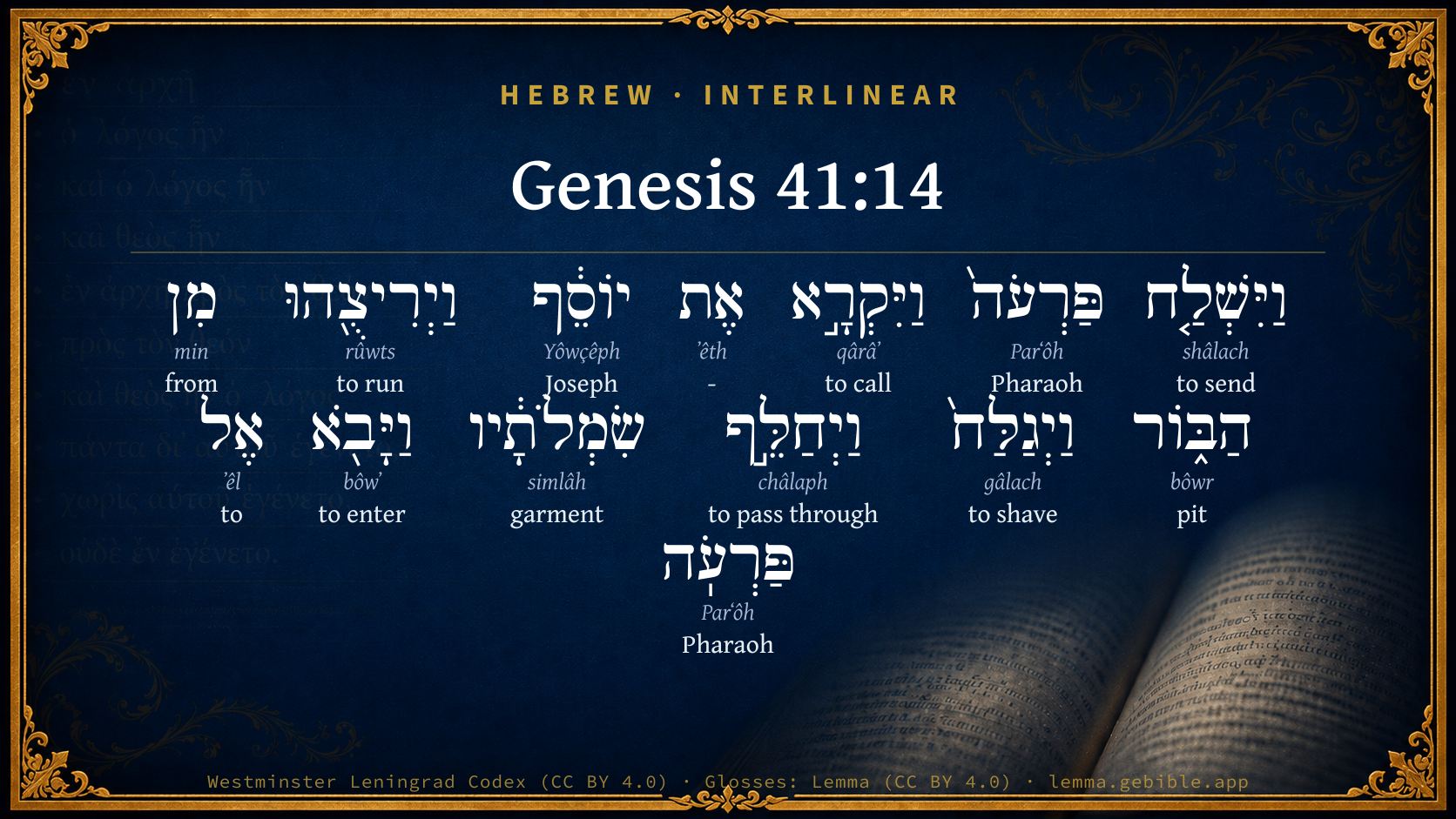
  1. וַיִּשְׁלַ֤ח shâlach H7971 “and · to send” Conjunction + Verb, Qal, Sequential Imperfect, 3rd Person, Masculine, Singular
  2. פַּרְעֹה֙ Parʻôh H6547 “Pharaoh” Noun, Proper
  3. וַיִּקְרָ֣א qârâʼ H7121 “and · to call” Conjunction + Verb, Qal, Sequential Imperfect, 3rd Person, Masculine, Singular
  4. אֶת ʼêth H853 “-” Particle, Direct Object
  5. יוֹסֵ֔ף Yôwçêph H3130 “Joseph” Noun, Proper
  6. וַיְרִיצֻ֖הוּ rûwts H7323 “and · to run · him” Conjunction + Verb, Hiphil, Sequential Imperfect, 3rd Person, Masculine, Plural + Suffix, Personal, 3rd Person, Masculine, Singular
  7. מִן min H4480 “from” Preposition
  8. הַבּ֑וֹר bôwr H953 “the · pit” Particle, Definite Article + Noun, Common, Masculine, Singular, Absolute
  9. וַיְחַלֵּ֣ף châlaph H2498 “and · to pass through” Conjunction + Verb, Piel, Sequential Imperfect, 3rd Person, Masculine, Singular
  10. שִׂמְלֹתָ֔יו simlâh H8071 “garments · his” Noun, Common, Feminine, Plural, Construct + Suffix, Personal, 3rd Person, Masculine, Singular
  11. וַיָּבֹ֖א bôwʼ H935 “and · to enter” Conjunction + Verb, Qal, Sequential Imperfect, 3rd Person, Masculine, Singular
  12. אֶל ʼêl H413 “to” Preposition
  13. פַּרְעֹֽה Parʻôh H6547 “Pharaoh” Noun, Proper

About this verse

These counts appear in no published source. They are computed here, from the morphology-tagged text and Lemma’s own curated glosses. What Lemma adds →

14
words
13
distinct lemmas
Pentateuch
section

Notable vocabulary

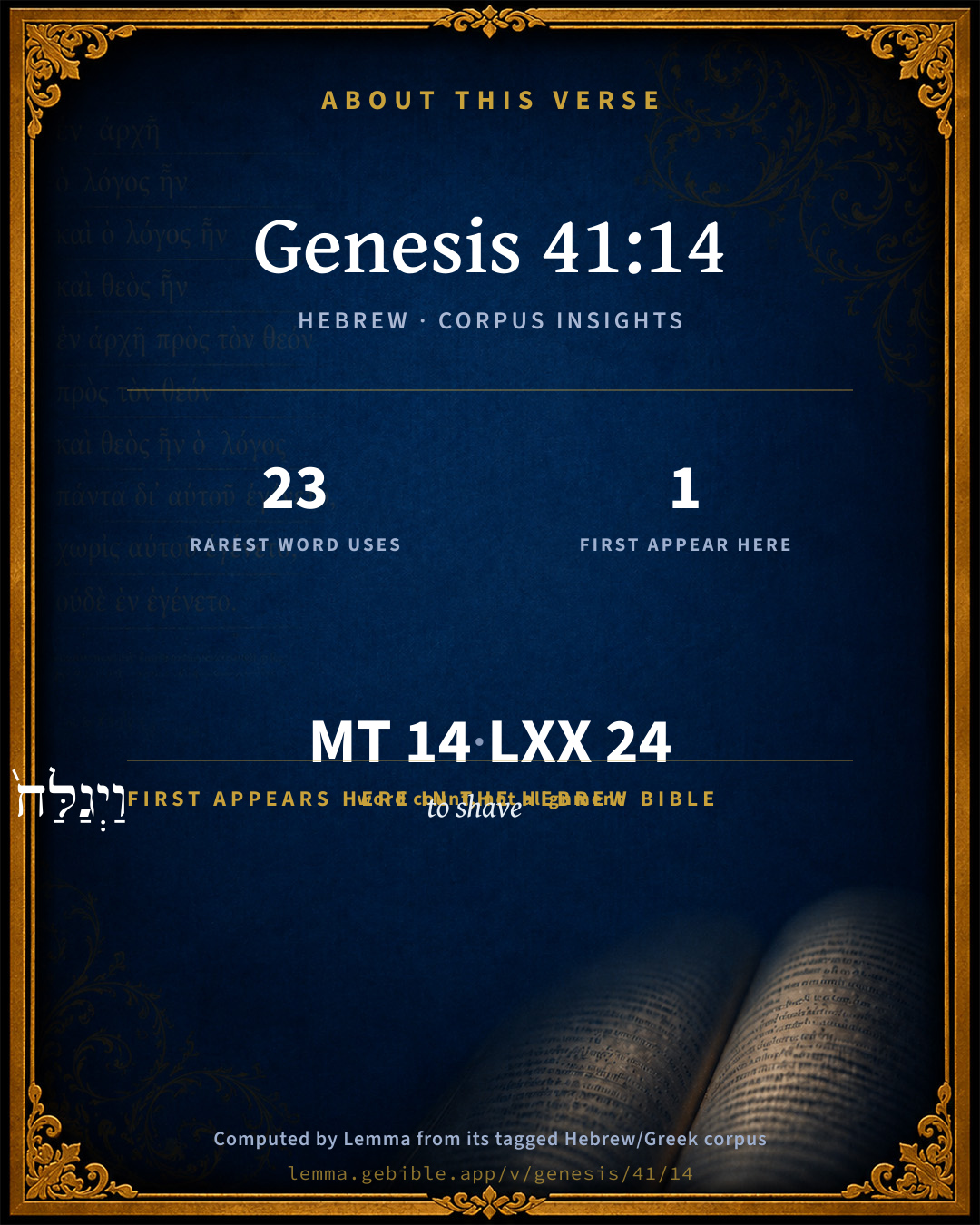
The rarest word here is וַיְגַלַּח֙ to shave H1548 — appearing just 23 times in the whole Hebrew Bible.

First appearance in Scripture

This word makes its first canonical appearance in the Hebrew Bible here:

  • וַיְגַלַּח֙ to shave H1548

Shared distinctive vocabulary

וַיְגַלַּח֙ to shave H1548 occurs in 18 verses of the Hebrew Bible. Also found in:

Grammatical profile

  • 6 verbs
  • 5 nouns
  • 2 prepositions
  • 1 particle

Verb forms

  • וַיִּשְׁלַ֤ח Qal · Sequential Imperfect
  • וַיִּקְרָ֣א Qal · Sequential Imperfect
  • וַיְרִיצֻ֖הוּ Hiphil · Sequential Imperfect
  • וַיְגַלַּח֙ Piel · Sequential Imperfect
  • וַיְחַלֵּ֣ף Piel · Sequential Imperfect
  • וַיָּבֹ֖א Qal · Sequential Imperfect

Repetition

A word recurs within this verse — often emphatic in Hebrew:

  • פַּרְעֹה֙ Pharaoh H6547 ×2

Hebrew & Septuagint length

In English translation the verse runs 26 words from the Hebrew and 26 from the Septuagint (LXX English) — the same length.

A rough comparison of the two English renderings, which tokenize alike — not a word-level alignment.

Word counts can differ between the Hebrew and the Greek without any difference in meaning — e.g. the Hebrew direct-object marker אֵת has no separate Greek word, and Greek often adds the article ὁ.

In the original languages it is 14 Hebrew tokens and 24 Greek tokens — but the two are counted differently (Hebrew bundles its prefixes and suffixes into one token; the Greek is in lemma form), so that isn’t a like-for-like length.

Cross-references

12

Topical passages linked to Genesis 41:14 in the Treasury of Scripture Knowledge — connected by theme and wording, ordered by reader-vote popularity; previews shown in the World English Bible.

  • Daniel 2:25 Then Arioch brought in Daniel before the king in haste, and said thus to him, I have found a man of the children of the captivity of Judah, who will make known to the king the interpretation.
  • Psalms 113:7–8 He raises up the poor out of the dust. Lifts up the needy from the ash heap;
  • Psalms 105:19–22 Until the time that his word happened, And Yahweh's word proved him true.
  • 1 Samuel 2:7–8 Yahweh makes poor, and makes rich: He brings low, he also lifts up.
  • 2 Kings 25:29 and changed his prison garments. [Jehoiachin] ate bread before him continually all the days of his life:
  • Jeremiah 52:32–33 and he spoke kindly to him, and set his throne above the throne of the kings who were with him in Babylon,
  • Esther 5:1 Now it happened on the third day, that Esther put on her royal clothing, and stood in the inner court of the king's house, over against the king's house: and the king sat on his royal throne in the royal house, over against the entrance of the house.
  • Isaiah 61:3 to appoint to those who mourn in Zion, to give to them a garland for ashes, the oil of joy for mourning, the garment of praise for the spirit of heaviness; that they may be called trees of righteousness, the planting of Yahweh, that he may be glorified.
  • Exodus 10:16 Then Pharaoh called for Moses and Aaron in haste, and he said, "I have sinned against Yahweh your God, and against you.
  • Isaiah 61:10 I will greatly rejoice in Yahweh, my soul shall be joyful in my God; for he has clothed me with the garments of salvation, he has covered me with the robe of righteousness, as a bridegroom decks himself with a garland, and as a bride adorns herself with her jewels.
  • 2 Samuel 19:24 Mephibosheth the son of Saul came down to meet the king; and he had neither dressed his feet, nor trimmed his beard, nor washed his clothes, from the day the king departed until the day he came home in peace.
  • Esther 4:1–4 Now when Mordecai knew all that was done, Mordecai tore his clothes, and put on sackcloth with ashes, and went out into the midst of the city, and cried with a loud and a bitter cry;

Cross-references courtesy of OpenBible.info (CC BY 4.0).

Hebrew and Greek witnesses Masoretic Hebrew ↔ Greek Septuagint

The same verse in the two great witnesses to the Old Testament, shown verse-for-verse.

These are two independent witnesses, not word-aligned to each other, and the Septuagint is shown in lemma (dictionary) form.

Hebrew Genesis 41:14 Masoretic · Westminster Leningrad Codex

וַיִּשְׁלַ֤ח פַּרְעֹה֙ וַיִּקְרָ֣א אֶת יוֹסֵ֔ף וַיְרִיצֻ֖הוּ מִן הַבּ֑וֹר וַיְגַלַּח֙ וַיְחַלֵּ֣ף שִׂמְלֹתָ֔יו וַיָּבֹ֖א אֶל פַּרְעֹֽה

Then Pharaoh sent and called Joseph, and they brought him hastily out of the dungeon. He shaved himself, changed his clothing, and came in to Pharaoh.

World English Bible · Public Domain

Greek LXX Genesis 41:14 Septuagint · lemma form

ἀποστέλλω δέ φαραώ καλέω ὁ ιωσηφ καί ἐκἄγω αὐτός ἐκ ὁ ὀχύρωμα καί ξυράω αὐτός καί ἀλλάσσω ὁ στολή αὐτός καί ἔρχομαι πρός φαραώ

And Pharao having sent, called Joseph; and they brought him out from the prison, and shaved him, and changed his dress, and he came to Pharao.

LXX2012 (modern English Septuagint) · Public Domain

On this verse, The Cambridge Bible for Schools and Colleges discusses the Septuagint’s reading. Read the note in Commentary ↓

Hebrew: Westminster Leningrad Codex (CC BY 4.0). Greek: Septuagint (public domain); English from LXX2012 (modern English Septuagint) (Public Domain). How the Septuagint differs from the Hebrew →

Targum (Aramaic paraphrase)

2

The Targum is the ancient Jewish Aramaic paraphrase of the Hebrew Scriptures — an interpretive translation, not the Hebrew text itself. Onkelos (literal) and Pseudo-Jonathan (expansive) render the Torah, and Jonathan the Prophets. Coverage is partial: where no permissively-licensed English translation exists for a verse, only the Aramaic is shown. This is verse-level text, not a word-by-word alignment to the Hebrew.

  1. Targum Onkelos Torah (Genesis–Deuteronomy)
    וּשְׁלַח פַּרְעֹה וּקְרָא יָת יוֹסֵף וְאַרְהָטוּהִי מִן בֵּית אֲסִירֵי וְסַפַּר וְשַׁנִּי כְסוּתֵהּ וְעַל לְוַת פַּרְעֹה

    (no public-domain English translation for this verse)

    Targum Onkelos — Aramaic: “Onkelos Genesis” (public domain); “Onkelos Exodus” (public domain); “Onkelos Leviticus” (public domain); “Onkelos Numbers” (public domain); “Onkelos Deuteronomy” (public domain). English: “Sefaria Community Translation” (CC0 1.0 (public-domain dedication)); “J.W. Etheridge. The Targums of Onkelos and Jonathan Ben Uzziel on the Pentateuch. London: Longmans, Green, 1862” (public domain). Text via Sefaria.

  2. Targum Pseudo-Jonathan Torah (Genesis–Deuteronomy)
    וְשָׁדַר פַּרְעה וּקְרָא יַת יוֹסֵף וְדִילוּגֵיהּ מִן בֵּית אֲסִירֵי וְסַפֵּר וְשַׁנִי כְּסוּתֵיהּ וְעַל לְוַת פַּרְעה

    And Pharoh sent and called Joseph, and hastened him from the prison; and he dressed his hair, and changed his garments, and went unto Pharoh.

    Targum Pseudo-Jonathan — Aramaic: “Targum Jonathan on Genesis” (public domain); “Targum Jonathan on Exodus” (public domain); “Targum Jonathan on Leviticus” (public domain); “Targum Jonathan on Numbers” (public domain); “Targum Jonathan on Deuteronomy” (public domain). English: “The Targum of Jonathan ben Uzziel, trans. J. W. Etheridge, London, 1862” (public domain). Text via Sefaria.

Commentary

Notes on Genesis 41:14 from classic Christian and Jewish commentators (each source and its license shown beneath its notes). The classic Christian expositions comment on the surrounding passage and are grouped to its opening verse, so a note may address several verses; the Jewish commentaries on the Tanakh (Rashi and others) are per-verse, so they appear only where the commentator wrote on this verse.

Lemma curates 59 commentaries, every one of them public domain or Creative Commons licensed, each selected and text-cleaned for this edition rather than reprinted as found. About our sources →

Trapp's Complete Commentary

John Trapp

Gen 41:14 Then Pharaoh sent and called Joseph, and they brought him hastily out of the dungeon: and he shaved [himself], and changed his raiment, and came in unto Pharaoh.

Ver. 14. And they brought him hastily.] Heb., They made him run: who haply knew not what this haste and hurry meant, but was betwixt hope and fear till he came to the king. It is God that "bringeth low, and lifteth up; that raiseth up the poor out of the dust, and lifteth up the beggar from the dunghill, to set him among princes," &c. {1Sa 2:7-8} In the year of grace 1622, the Turkish Janizaries, who have learned that damnable art of making and unmaking their king at pleasure, drew Mustapha, whom they had formerly deposed, out of prison: and when he begged for his life they assured him of the empire; and carrying him forth upon their shoulders, cried with a loud voice "This is Mustapha, Sultan of the Turks; God save Mustapha, &c.," with which sudden change the man was so affected that he fell into a swoon for joy, and they had much ado to keep life in him. {a} Our Henry IV was crowned the very same day, that the year before he had been banished the realm {b}

And changed his raiment, and came in unto Pharaoh.] And should not we get on our best when we are to come before God? Should we accost him in the nasty tattered rags of the old Adam; and not spruce up ourselves with the best of our preparation?

{a} Mustapha, subita illa mutatione qua ex carcere ad summam dignitatem et potentiam evectus erat, ita commotus fuit, ut animi deliquium pateretur ,& c. - Parei. Medul., p. 1165.

{b} Dan., Hist. of Engl., p. 48.

John Trapp, A Commentary or Exposition upon All the Books of the Old and New Testament (1647–1656) — public domain. Text from a community e-Sword module.

The Biblical Illustrator

Joseph S. Exell

Gen_41:14-16

Then Pharaoh sent and called Joseph

Joseph summoned into Pharaohs presence

I.

HIS LONG WAITING FOR NOTICE AND DELIVERANCE. The religious mind will see in this the wisdom of God.

1. In regard to the education of character.

2. In its adaptation to the circumstances of the individual.

3. In its elevation above all human infirmities.

II. THE MANIFEST HAND OF GOD IN IT. It was wisely ordered that Joseph should be under no obligation to Pharaoh for his deliverance. It is for his own sake that Pharaoh sends for Joseph. The chief butler was suffered to forget his friend, the prophet of his deliverance, and was forced to remember him only by circumstances. To neither of them was Joseph indebted. Thus it was Gods design that the chosen family should be under obligations to none. Their calling was to impart blessings to mankind, and not to receive.

III. HIS PIETY THROUGHOUT THE INTERVIEW.

1. His simplicity of character. He makes no long speech. He does not use the opportunity to glorify himself, or to plead for liberty and reward. His manner was dignified and respectful, yet marked by great openness and simplicity of character. Joseph is the same in the palace or in the prison.

2. His humility. He indulged in no spirit of boasting, though this compliment from the king would have tempted weaker men to be vain and proud (Gen_41:15). Joseph never forgot his character as a witness for God.

3. His calmness. He was conscious of Gods presence and of his own integrity, so he could afford to be calm before the rulers of this world.

4. His kindly consideration for others. Pharaoh might have reason for the worst fears when he heard of the interpretation of the bakers dream. Though a king he was not exempt from the common evils of human nature; nor from death--the chief calamity. But Joseph hastens to remove all fear of an unfavourable interpretation from his mind, by assuring him that the future had in it nothing but what would make for the peace of Pharaoh. (T. H.Leale.)

The turning-point in Josephs career

It is a very difficult thing to let patience have her perfect work. Who has not felt again and again the truth of the proverb, Hope deferred maketh the heart sick?

I. This sickness would, no doubt, again and again be felt by Joseph, when his patience was so long and so severely tried.

II. Look now at the means by which the deliverance of Joseph was brought about.

III. The perplexity of Pharaoh would only be increased by the inability of his wise men to resolve his doubts.

IV. Look now at Josephs introduction to Pharaoh.

V. See now what Joseph did, after interpreting Pharaohs dream. He did not stop there. He suggested the practical use to be made of the Divine revelation which was now granted. (C. Overton.)

The prime minister

I. OBSERVE JOSEPHS SUDDEN ELEVATION.

1. The elevation was unanimous. The imprisoned Hebrew had surprised king and statesmen with his high and noble qualities. By subtle methods God moved their hearts, and in a short hour Joseph was raised from prison to the highest pinnacle of power.

2. His main recommendation was spiritual Pharaoh recognized him at once as a man in whom dwelt the Spirit of God. The power of the Spirit is available for any emergency.

3. He was entrusted with supreme authority. Such was the high estimate of Joseph, created in all minds, that they felt he was worthy of the largest trust. They could trust him as they trusted the law of gravitation. A Christian will never abuse his power. Now, Josephs early dreams begin to be realized.

II. MARK HIS EMINENT CHARACTER.

1. It was transparent with honesty. Looking down into the clear waters of an Italian lake at night, you may see every star of heaven faithfully reflected; so, looking into Josephs character, every grace and virtue of heaven seemed there to shine. His mind was the mirror of an honest purpose.

2. It was a character marked by energy. Indolence, so common among Orientals, found no place in him. Soon as duty was discovered, it was discharged.

3. He was as religious in prosperity as in adversity. This is solid worth; this is rare piety. That tree is well-rooted which, can bear the scorching heat of summer, as well as the cold blast of a winters storm; so that mans soul is well-rooted in God who is as prayerful in a mansion as he was in a prison. When children were born in Josephs house the God of his fathers was not forgotten.

III. CONSIDER HIS SAGACIOUS POLICY.

1. Joseph was a great economist. In His administration God is a great economist, and Joseph followed God. Our spiritual riches should supply the lack in others.

2. Joseph was a man of order. Nothing was left at haphazard. In an enterprise so vast order was essential to success.

3. Josephs policy turned disaster into blessings. In Potiphars house, and in the State prison, Joseph had been learning daily the kind of administration prevalent in Egypt. His vigorous mind detected its weak points. He saw how easily discontent and sedition might arise; he saw where corruption and misrule crept in. And now he found an opportunity for applying a remedy. As the Prime Minister for Pharaoh, he made the sceptre of the king everywhere more powerful. (J. Dickerson Davies, M. A.)

Great changes in life

There are great changes in life. Some of our lives amount to a succession of rapid changes; and it takes a man of some moral nerve and stamina to stand the violent alternations of fortune. Some men cannot bear promotion. It is dangerous to send little boats far out into the sea. Some men are clever, sharp, natty, precise, wonderfully well informed, newspaper fed and fattened, and yet, if you were to increase their wages just a pound a week, they would lose their heads. That is a most marvellous thing, and yet nobody ever thought he would lose his head with such an increase of fortune. But it is a simple fact, that some men could not bear to step out of a dungeon into a palace: it would kill them. What helps a man to bear these changes of fortune, whether they be down or up? God-He can give a man gracefulness of mien when he has to walk down, and God can give him enhanced princely dignity when he has to walk up; a right moral condition, a right state of heart, the power of putting a proper valuation upon prisons and palaces, gold and dross. Nothing but such moral rectitude can give a man security amidst all the changes of fortune or position in life. His information will not do it; his genius will not do it. Nothing will do it but a Divine state of heart. It is beautiful to talk to a man who has such a state of heart, when great changes and wonderful surprises come upon him--when Pharaohs send for him in haste. It is always a good and stimulating thing to talk to a great man, a great nature, a man that has some completeness about him. It must be always a very ticklish, delicate, and unpleasant thing to talk to snobs and shams and well-tailored mushrooms; but a noble thing to talk to a noble man, who knows what prison life is, who knows what hardness of life is, and that has some notion of how to behave himself even when the greatest personages require his attendance. Few men could have borne this change. None of us can bear the great changes of life with calmness, fortitude, dignity, except we be rightly established in things that are Divine and everlasting. (J. Parker, D. D.)

The Biblical Illustrator, edited by Joseph S. Exell (c. 1880s–1900s) — public domain. Text from a community e-Sword module.

Joseph Benson's Commentary

Gen 41:14. Brought him out of the dungeon — Or prison; for, as Joseph was now so much employed, and intrusted with all the affairs of the prison and prisoners, it is not probable that he should still be kept confined in the dungeon, properly so called. The king could scarce allow him time, but that decency required it, to shave himself, and to change his raiment. It is done with all possible expedition, and Joseph is brought in perhaps almost as much surprised as Peter was, Act 12:9; so suddenly is his captivity brought back, that he is as one that dreams, Psa 126:1. Pharaoh immediately, without inquiring who or whence he was, tells him his business, that he expected he should interpret his dream.

Joseph Benson's Commentary on the Old and New Testaments (1811–1818) — public domain. Text from a community e-Sword module.

Tyndale Open Study Notes

Tyndale Open Resources

41:14-15 Pharaoh immediately summoned Joseph from prison to interpret his dreams. • He shaved, as was the Egyptian custom.

Tyndale Open Study Notes — © Tyndale Open Resources, licensed CC BY-SA 4.0. Text via the HelloAO Bible API.

Geneva Bible (1599)

Geneva Bible translators

The wicked seek to the Prophets of God in their necessity, whom in their prosperity they abhor.

Geneva Bible (1599) marginal notes — public domain. Text via Bolls.life.

Jamieson, Fausset & Brown

Robert Jamieson, A. R. Fausset & David Brown

Then Pharaoh sent and called Joseph--Now that God's set time had come (Psa 105:19), no human power nor policy could detain Joseph in prison. During his protracted confinement, he might have often been distressed with perplexing doubts; but the mystery of Providence was about to be cleared up, and all his sorrows forgotten in the course of honor and public usefulness in which his services were to be employed.

shaved himself--The Egyptians were the only Oriental nation that liked a smooth chin. All slaves and foreigners who were reduced to that condition, were obliged, on their arrival in that country, to conform to the cleanly habits of the natives, by shaving their beards and heads, the latter of which were covered with a close cap. Thus prepared, Joseph was conducted to the palace, where the king seemed to have been anxiously waiting his arrival.

Jamieson, Fausset & Brown — Commentary Critical and Explanatory on the Whole Bible (1871) — public domain (CC PDM 1.0). Text via the HelloAO Bible API.

Adam Clarke's Commentary

Verse 14. They brought him hastily out of the dungeon] Pharaoh was in perplexity on account of his dreams; and when he heard of Joseph, he sent immediately to get him brought before him. He shaved himself - having let his beard grow all the time he was in prison, he now trimmed it, for it is not likely that either the Egyptians or Hebrews shaved themselves in our sense of the word: the change of raiment was, no doubt, furnished out of the king's wardrobe; as Joseph, in his present circumstances, could not be supposed to have any changes of raiment.

Adam Clarke's Commentary on the Bible (1810–1826) — public domain. Text from a community e-Sword/MySword module.

John Calvin's Commentaries

14. Then Pharaoh sent and called Joseph. We see in the person of a proud king, as in a glass, what necessity can effect. They whose circumstances are happy and prosperous will scarcely condescend to hear those whom they esteem true prophets, still less will they listen to strangers. Wherefore it was necessary that the obstinacy of Pharaoh should be first subdued, in order that he might send for Joseph, and accept him as his master and instructor. The same kind of preparation is also necessary even for the elect; because they never become docile until the pride of the flesh is laid low. Whenever, therefore, we are cast into grievous troubles, which keep us in perplexity and anxiety, let us know that God, in this manner, is accomplishing his design of rendering us obedient to himself. When Moses relates that Joseph, before he came into the presence of the king, changed his garments, we may hence conjecture that his clothing was mean. To the same point, what is added respecting his “shaving himself,” ought, in my opinion, to be referred: for since Egypt was a nations of effeminate delicacy, it is probable that they, being studious of neatness and elegance, rather nourished their hair than otherwise. But as Joseph put off his squalid raiment, so, that he might have no remaining cause of shame, he is shaved. Let us know, then, that the servant of God lay in filth even to the day of his deliverance.

John Calvin's Commentaries (1540-1563) — public domain. Text from the Calvin Translation Society English edition (1840s-50s) via the Christian Classics Ethereal Library (ccel.org). Calvin's coverage is partial (roughly two-thirds of the Bible); uncommented books and verses are honest gaps, never fabricated. The 19th-century editor's footnotes and remarks are omitted so the notes are faithfully Calvin's own voice.

Ellicott's Commentary for English Readers

(14) He shaved himself.—Herodotus (ii. 36) mentions that the Egyptians suffered their hair and beards to grow only when in mourning; whereas in Palestine the beard was regarded as a manly ornament. On Egyptian monuments only captives and men of low condition are represented with beards. In the prison, therefore, Joseph would leave his beard untrimmed, but when summoned into the king’s presence, he would shave it off. Abravanel notices that for each suffering of Joseph there was an exact recompense. It was for dreams that his brethren hated him, and by help of dreams he was exalted in Egypt. They stripped him of his many-coloured coat; the Egyptians clothed him in byssus. They cast him into a pit, and from the pit of the prison he was drawn forth by Pharaoh. They sold him into slavery; in Egypt he was made lord.

A Bible Commentary for English Readers, edited by Charles John Ellicott (1878–1897) — public domain. Text from a community e-Sword module.

The Cambridge Bible for Schools and Colleges

gen. ed. J. J. S. Perowne

14. and they … dungeon] A clause probably introduced, like that in Gen_40:15, in order to harmonize the E with the J version. In E, Joseph is a slave, not a prisoner: in J he is a prisoner, cf. Gen_39:21-23.

shaved himself] The Egyptians paid extreme care to matters of cleanliness. They were very generally themselves clean shaven. LXX and Lat. render “they shaved him.”

The Cambridge Bible for Schools and Colleges (gen. ed. J. J. S. Perowne; Cambridge University Press, 1878–1918) — public domain. Text from a community e-Sword module.

John Gill's Exposition

Then Pharaoh sent and called Joseph,.... Sent messengers to him to come to him directly, ordered the captain of the guard, or keeper of prison, to loose him, and let him free, see Psa 105:20,

and they brought him hastily out of the dungeon; that is, out of the prison house; which, as Jarchi says, was made like a ditch or dungeon, or in which the dungeon was where Joseph was first put when he was brought to prison; though it cannot be thought that he continued there when he had so much respect shown him by the keeper, and had other prisoners committed to his care: however, he was fetched in great haste from his place of confinement, by the messengers that were sent for him; or "they made him to run" (h), from the prison to the palace, the king being so eager to have his dream interpreted to him:

and he shaved himself; or the barber shaved him, as Aben Ezra; his beard had not been shaved, nor the hair of his head cut very probably for a considerable time; it being usual for persons in such circumstances to neglect such things:

and changed his raiment; his prison garments being such as were not fit to appear in before a king, and put on others, which either the king sent him, or the captain of the guard his master furnished him with:

and came in unto Pharaoh: into his palace, and his presence; what city it was in which this Pharaoh kept his palace, is no where said; very probably it was which the Scriptures call Zoan, that being the ancient city of Egypt, Num 13:22.

(h) "et currere fecerunt eum", Pagninus, Montanus, Munster, Vatablus; "et fecerunt ut curreret", Piscator.

John Gill's Exposition of the Whole Bible (1746–1763) — public domain (CC PDM 1.0). Text via the HelloAO Bible API.

Haydock's Catholic Bible Commentary

Shaved him. The Egyptians let their hair grow, and neglected their persons, when they were in mourning or prison. But on other occasions they cut their hair in their youth. (Herod. ii. 36. iii. 12.) It was not lawful to appear in court in mourning attire. (Esther iv. 2; Genesis l. 4.) (Calmet)

George Leo Haydock (1774–1849), Haydock's Catholic Family Bible and Commentary, 1859 edition — public domain. Excludes Psalms (Douay-Rheims chapter numbering differs from Protestant) and Deuterocanonical books (Catholic canon only).

Matthew Poole's English Annotations

The dungeon, or prison, by a synecdoche of the part for the whole. For it is not probable that Joseph, who was now so much employed, and intrusted with all the affairs of the prison and prisoners, Gen 39:21-23, should still be kept in the dungeon properly so called.

He shaved himself; for till then he suffered his hair to grow, as the manner was for persons in prison, or under great sorrow, 2Sa 19:24. But to appear in a mournful dress before the king was not convenient, nor usual. Compare Est 4:4.

Matthew Poole's English Annotations on the Holy Bible (1683–1685) — public domain. Text from a community e-Sword/MySword module.

Whedon's Commentary on the Bible

Daniel D. Whedon

14. Brought him hastily — Hebrews, caused him to run. Every thing was excitement about the royal household that day, and hence the haste.

Shaved — According to Herodotus (ii, 36) the Egyptians never allowed their beards to grow, except while mourning for deceased relatives. The most recent researches into Egyptian archaeology confirm this statement. In order, therefore, to conform to the Egyptian ideas of propriety, Joseph was shaved in order to be presentable at the royal court.

Daniel D. Whedon (gen. ed.), Commentary on the Old and New Testaments (1874–1909) — public domain. Text from a community e-Sword module.

The Pulpit Commentary

Then Pharaoh sent and called Joseph, and they brought him hastily (literally, caused him to run) out of the dungeon: (vide Gen_40:15) and he shaved himself, this was exactly in accordance with Egyptian custom (Heb 2:36). Wilkinson states that "the custom of shaving the head as well as beard was not confined to the priests in Egypt, but was general among all classes" (Rawlinson"s "Herodotus," vol. 2. p. 49; cf. "Ancient Egyptians," vol. 2. pp. 330-332. ed. 1878). That the verb is not more exactly defined by a terra Cellowing, such as the head, (Num_6:9) the beard, (2Sa_10:4) but stands alone (the only instance of its intransitive use), appears to suggest that the writer was familiar with the practice of shaving (vide Havernick, "Introd.,and changed his raiment, as required by the customs of Egypt (vide Hengstenberg"s "Egypt," p. 30; of. (Gen_35:2) and came (or went) in unto Pharaoh.

HOMILIES BY J.F. MONTGOMERY Ver. 14.

The blessing of suffering wrongfully.

Joseph had probably been three years in prison (cf. ver. 1 with 40:4). Sorely must his faith have been tried. His brothers, who had plotted his death, prosperous; himself a slave, spending the best years of his life in prison; and that because he had been faithful to God and to his master. We know the end, and therefore hardly realize his desolate condition when no sign of anything but that he should live and die uncared for and forgotten. But the trial comes more home to us when some one for whom we care, or perhaps ourselves, "endure grief, suffering wrongfully;" when unsuspecting frankness has been overreached, or trust betrayed, or feebleness oppressed.

We feel not only that wrong has been done, but as if there had been a failure in God"s care. It is one thing to acknowledge the doctrine of God"s providence, and quite another to feel it under pressure of trouble. A frequent mistake to think of suffering as calling for immediate restitution. Since God beholds the wrong, should there not be some speedy token that he does so? The truth which faith has to grasp is that God is carrying out a plan, for which all these things are.a preparation. We may not be able to trace it; but it is so. Thus it was with Joseph. All through these sad years God was guiding him. It was not merely that in time the cloud was removed; every step of the way had its purpose. (Joh_16:20) In the prison he was learning lessons of the soul, unlearning the spirit of censoriousness and of self-complacency, (Gen_37:2) and, by obeying, learning how to rule. And the course of events bore him on to what was prepared for him. Had he remained at home, or returned thither, or had Potiphar not cast him into prison, he would not have been the head of a great work in Egypt, the helper of his family, the instrument of fulfilling God"s promise. Not one step of his course was in vain; his sufferings were blessings.

I IN SUFFERING WRONG WE ARE FOLLOWING CHRIST. He suffered for us, "leaving us an example" (1Pe_2:21) of willingness to suffer for the good of others. This is the principle of self-sacrifice; not a self-willed sacrifice, (Col_2:23) but the submission of the will to (Luk_22:42; Heb_10:7) "This is acceptable with God" to accept as from him what he sends, though we may-not see its use. (Heb_12:5-7)

II FOR EVERY CHRISTIAN THE DISCIPLINE OF SUFFERING IS NEEDFUL. If it was so in our Lord"s sinless human nature, (Heb_2:10) how much more in us, who must be taught to subdue the flesh to the spirit I Without trial Christian courage and fruit-bearing graces would fail, (Joh_15:2) as without the winter"s cold the forest tree would not form sound wood. And trial calls them into exercise, (Rom_5:3) and through a sense of our weakness draws us nearer to God. (2Co_12:7-9)

III NOT ONLY TRIAL IN GENERAL, BUT EVERY PART OF IT WORKS GOOD. To every part the promise applies. (Joh_16:20) So it was with Joseph. God lays no stroke without cause. (Heb_12:10) The conviction of this works practical patience. This particular suffering has its own loving message.

IV WE OFTEN CANNOT FORESEE THE PURPOSE OF TRIALS. How different was the end to which God was leading Joseph from anything he could have expected or hoped for! Yet far better. We can see but a very little way along the path by which God is leading us. We walk by faith that his guidance is unerring, and that which he has provided is best. M. (Eph_3:20)

The Pulpit Commentary (1880–1919), ed. H.D.M. Spence-Jones & Joseph S. Exell — public domain. Text from a community e-Sword module.

Keil & Delitzsch

C. F. Keil & F. Delitzsch

Pharaoh immediately sent for Joseph. As quickly as possible he was fetched from the prison; and after shaving the hair of his head and beard, and changing his clothes, as the customs of Egypt required (see Hengst. Egypt and the Books of Moses, p. 30), he went in to the king. On the king's saying to him, "I have heard of thee (עליך de te), thou hearest a dream to interpret it," - i.e., thou only needest to hear a dream, and thou canst at once interpret it - Joseph replied, "Not I (בּלעדי, lit., "not so far as me," this is not in my power, vid., Gen 14:24), God will answer Pharaoh's good," i.e., what shall profit Pharaoh; just as in Gen 40:8 he had pointed the two prisoners away from himself to God. Pharaoh then related his double dream (Gen 41:17-24), and Joseph gave the interpretation (Gen 41:25-32): "The dream of Pharaoh is one (i.e., the two dreams have the same meaning); God hath showed Pharaoh what He is about to do." The seven cows and seven ears of corn were seven years, the fat ones very fertile years of superabundance, the lean ones very barren years of famine; the latter would follow the former over the whole land of Egypt, so that the years of famine would leave no trace of the seven fruitful years; and, "for that the dream was doubled unto Pharaoh twice" (i.e., so far as this fact is concerned, it signifies) "that the thing is firmly resolved by God, and God will quickly carry it out." In the confidence of this interpretation which looked forward over fourteen years, the divinely enlightened seer's glance was clearly manifested, and could not fail to make an impression upon the king, when contrasted with the perplexity of the Egyptian augurs and wise men. Joseph followed up his interpretation by the advice (Gen 41:33-36), that Pharaoh should "look out (ירא) a man discreet and wise, and set him over the land of Egypt;" and cause יעשׂה) that in the seven years of superabundance he should raise fifths (חמּשׁ), i.e., the fifth part of the harvest, through overseers, and have the corn, or the stores of food (אכל), laid up in the cities "under the hand of the king," i.e., by royal authority and direction, as food for the land for the seven years of famine, that it might not perish through famine.

Keil & Delitzsch — Biblical Commentary on the Old Testament (1861–1891) — public domain (CC PDM 1.0). Text via the HelloAO Bible API. (Old Testament only.)

Kretzmann's Popular Commentary

Paul E. Kretzmann

Pharaoh tells Joseph his Dreams

v. 14. Then Pharaoh sent and called Joseph, he gave orders that he should be fetched, and they brought him hastily out of the dungeon, the word being used here again to designate the unpleasantness of the prison, The description shows how quickly the fortunes of Joseph turned. And he shaved himself, the Egyptian custom permitting long hair and a beard only in case of mourning, and changed his raiment, as one fully sensible of the great honor conferred upon him, and came in unto Pharaoh.

v. 15. And Pharaoh said unto Joseph, I have dreamed a dream, and there is none that can interpret it; and I have heard say of thee that thou canst understand a dream to interpret it. In his anxiety Pharaoh overstated the facts, intimating that it was but necessary for Joseph to hear a dream, and the interpretation would follow as a matter of course.

v. 16. And Joseph answered Pharaoh, saying, It is not in me, literally, By no means I; Joseph was far from arrogating to himself this ability;—God shall give Pharaoh an answer of peace. It was both a prayer and a promise.

v. 17. And Pharaoh said unto Joseph, In my dream, behold, I stood upon the bank of the river;

v. 18. and, behold, there came up out of the river seven kine, fat-fleshed and well-favored; and they fed in a meadow;

v. 19. and, behold, seven other kine came up after them, poor and very ill-favored and lean-fleshed, such as in ever saw in all the land of Egypt for badness. As Pharaoh remembers the scene in his dream, the extreme ugliness of the lean cows stood out very prominently.

v. 20. And the lean and the ill-favored kine did eat up the first seven fat kine;

v. 21. and when they had eaten them up, when in their greed they had swallowed them whole, it could not be known that they had eaten them; but they were still ill-favored, as at the beginning. Pharaoh added also this item for the sake of emphasIsaiah So I awoke. But immediately after falling asleep again, Pharaoh dreamed once more.

v. 22. And I saw in my dream, and, behold, seven ears came up in one stalk, full and good;

v. 23. and, behold, seven ears, withered, thin, and blasted with the east wind, sprung up after them;

v. 24. and the thin ears devoured the seven good ears. Cf vv. 5-7. And I told this unto the magicians; but there was none that could declare it to me, v. 8.

Paul E. Kretzmann, Popular Commentary of the Bible (1921–1924) — public domain. Text from a community e-Sword module.

unfoldingWord translationNotes

Door43 World Missions Community

Pharaoh sent and called for

It is understood that Pharaoh sent servants. AT: "Pharaoh sent his servants to get Joseph" (See: Ellipsis)

out of the dungeon

"out of the jail" or "out of the prison"

He shaved himself

It was common practice to shave both the facial and head hair when preparing to go before Pharaoh.

came in to Pharaoh

Here "came" can be stated as "went." AT: "went before Pharaoh" (See: Go and Come)

there is no interpreter for it

"no one can explain the meaning"

you can interpret it

"you can explain its meaning"

It is not in me

"I am not the one who can explain the meaning"

God will answer Pharaoh with favor

"God will answer Pharaoh favorably"

translationWords

Pharaoh

Joseph (OT)

dream

God

favor

unfoldingWord translationNotes — © Distant Shores Media and the Door43 World Missions Community, licensed CC BY-SA 4.0. Source: git.door43.org/Door43/en_tn.

Rashi

Rabbi Shlomo Yitzchaki (Rashi)

מן הבור OUT OF THE DUNGEON — from the place of imprisonment which was made as a kind of pit Similarly, wherever בור occurs in Scripture it signifies a pit — even though it does not contain water (for בור is used of a cistern, excavated as a pit out of rocks) it is still called a בור; old French fosse.

ויגלח AND HE CLIPPED HIS HAIR, out of respect for the king (Genesis Rabbah 89:9).

Rashi on the Tanakh — English translations: “The Judaica Press complete Tanach with Rashi, translated by A. J. Rosenberg” (CC BY 4.0); “Pentateuch with Rashi's commentary by M. Rosenbaum and A.M. Silbermann, 1929-1934” (public domain); “The Metsudah Tanach series, Lakewood, N.J” (CC BY 4.0); and “The Book of Joshua, Metsudah Publications, 1997” (CC BY 4.0). Text via Sefaria.

Sforno

Rabbi Ovadia Sforno

They hurried him. A miraculous deliverance always transpires with haste. So it was when the Israelites left Egypt (see Shemos 12:39), and so will it be when Yisrael is redeemed from the current exile.

Sforno on the Tanakh — English translation: “Yalkut, Sifsei Chachomim Chumash, Metsudah Publications, 2009” (CC BY 4.0). Text via Sefaria.

Radak

Rabbi David Kimhi (Radak)

ויריצוהו מן הבור, they removed him from jail in haste seeing that Royal commands are always carried out promptly and as a matter of priority.

ויגלח ויחלף שמלותיו, admission to the presence of the king is conditional on both body and attire being in first class condition.

Radak on the Tanakh — English translations: “Sefaria Community Translation” (CC0 1.0 (public-domain dedication)); “Eliyahu Munk, HaChut Hameshulash” (CC BY 4.0); “Rabbi Mike Feuer, Jerusalem Anthology” (CC BY 4.0); and “R. David Kimhi on the first book of Psalms, Translated by R.G. Finch, London, 1919” (public domain). Text via Sefaria.

Lesson kit

Teaching starters — assembled from the data on this page, not authored interpretation. Every prompt links to the verse data it draws on. Edit before teaching.

Genesis, in the Pentateuch, opens this verse with 14 words (13 distinct Hebrew lemmas). Its most distinctive word is gâlach (“to shave”). A historical commentator’s framing appears above. Read the whole chapter for the surrounding context.

Discussion questions

  1. What does “to shave” (gâlach) contribute to the verse as a whole?
  2. The word “to shave” first appears here in Scripture. What is being introduced at this debut?
  3. Leviticus 13:33 shares the word «to shave» with this verse. How do the two illuminate each other?
  4. “Pharaoh” occurs 2× in this one verse. What is the effect of the repetition?
  5. The translations on this page render this verse differently — a whole-verse word diff, not a word-by-word alignment. What might account for the different wordings?
  6. The verb «וַיִּשְׁלַ֤ח» is Qal Sequential Imperfect. How does its form color the action?
  7. Reading how Trapp's Complete Commentary and The Biblical Illustrator read this verse, where do the two commentators agree and where do they part?

Things to notice

Reading settings

Reading text

Shown beneath each verse's original-language words.

Old Testament
Old Testament edition

Read the OT as the Masoretic Hebrew (MT) or the Greek Septuagint (LXX).

English shown for the Greek Septuagint (in the Hebrew ↔ Greek comparison).

Comparing translations? Open the Compare panel on any verse page to stack up to four side by side.