
Genesis 19:8

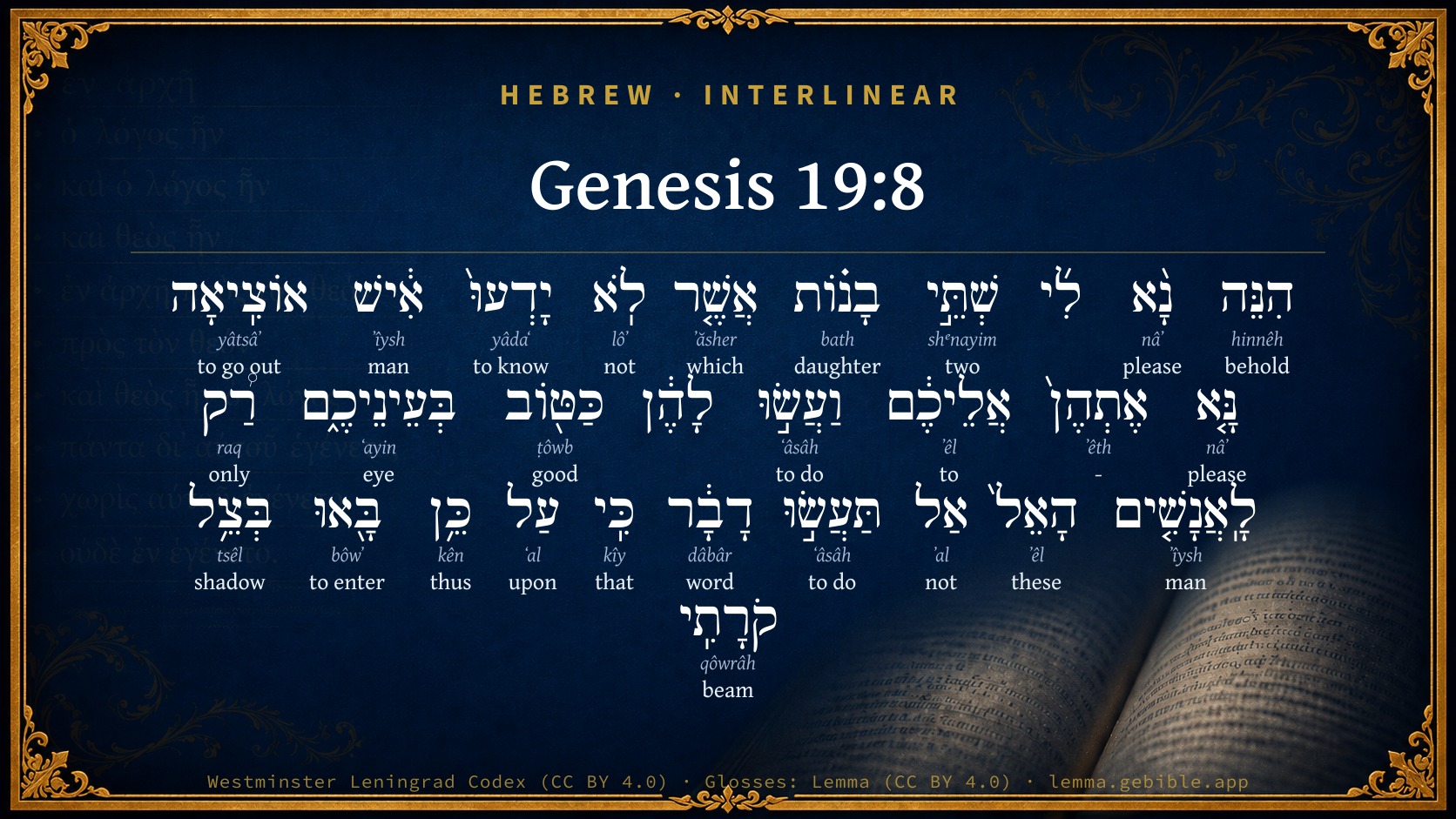
Hebrew (Westminster Leningrad Codex) Genesis 19:8 appears in the Hebrew Old Testament. The text above is from the Westminster Leningrad Codex. Each word links to its Strong’s number, a concise gloss, and parsing drawn from the Open Scriptures Hebrew Bible morphology. Click any word for its full Brown-Driver-Briggs (BDB) entry.
Download image
Cite this verse

Genesis 19:8 (World English Bible). Public Domain. Lemma interlinear Bible study tool, https://lemma.gebible.app/v/genesis/19/8.

Show BibTeX & RIS
BibTeX
RIS
English Translation
See now, I have two virgin daughters. Please let me bring them out to you, and do you to them as is good in your eyes. Only don't do anything to these men, because they have come under the shadow of my roof."
World English Bible · Public Domain
Highlights
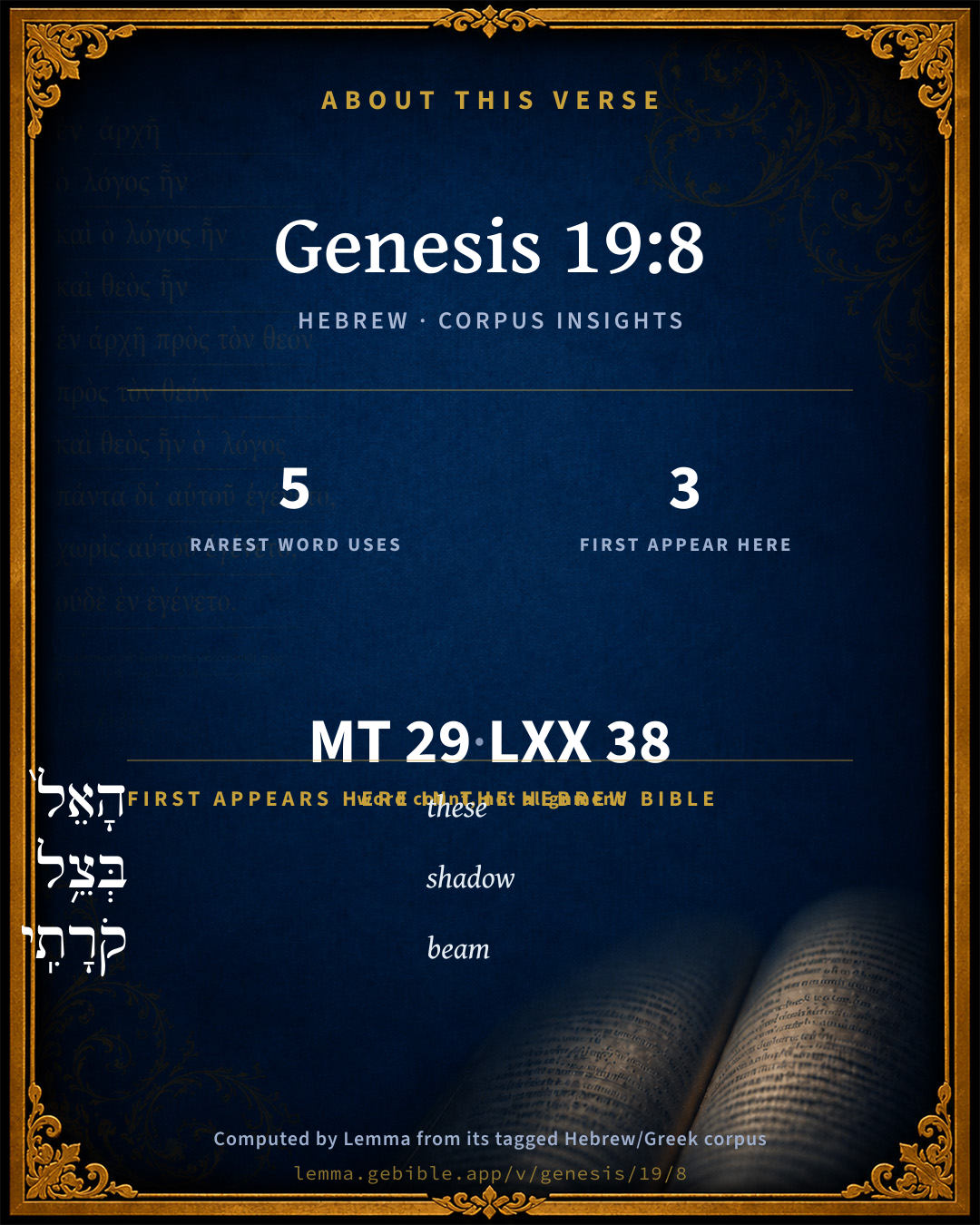
  • 3 first appearances in the Hebrew Bible
Full analysis ↓
Download a study sheet

One document with this verse’s original text, its word-by-word gloss line, the meaning frame, cross-references with their text, attributed commentary, and full source and license credits — printable, and it pastes into notes with its structure intact.

This verse Autodidact and up

Study sheet (.html) Plain text (.txt)

A passage Seminary Student

Up to 50 verses in one chapter. A passage sheet keeps up to 6 commentary sources and 12 cross-references per verse, in the order this page ranks them, and says so on the sheet whenever that leaves anything out. Ask for a single verse and you get the Autodidact verse sheet above.

Everything on this page stays free to read, with no account — the sheet is a download of what is already on screen, not access to it.

Want to remove ads? Support Godless Engineer
Compare translations 3

The same verse in 3 English versions, stacked beneath the original-language interlinear above. Click any original word for its lexicon entry.

Each is an independent rendering of the whole verse — the interlinear is not word-aligned to these translations.

Highlighted words mark where these versions differ — a whole-verse word diff, not a word-by-word alignment.

  • World English Bible Public Domain
    See now, I have two virgin daughters. Please let me bring them out to you, and do you to them as is good in your eyes. Only don't do anything to these men, because they have come under the shadow of my roof."
  • King James Version Public Domain
    Behold now, I have two daughters which have not known man; let me, I pray you, bring them out unto you, and do ye to them as is good in your eyes: only unto these men do nothing; for therefore came they under the shadow of my roof.
  • unfoldingWord Literal Text CC BY-SA 4.0
    Behold, please: I have two daughters who have not known a man. Please let me bring them out to you, and you do to them as good in your eyes. But do not do anything to these men, because for that they have come under the shadow of my rafters.”

unfoldingWord Literal Text — © unfoldingWord, licensed CC BY-SA 4.0. Word-aligned USFM3 via Door43 (git.door43.org/unfoldingWord/en_ult).

Versions to compare (up to 4)

3 of 4 selected

Show all 18 translations

Every available English version of this verse, each an independent rendering of the whole verse.

  • World English Bible Public Domain
    See now, I have two virgin daughters. Please let me bring them out to you, and do you to them as is good in your eyes. Only don't do anything to these men, because they have come under the shadow of my roof."
  • Berean Standard Bible Public Domain
    Look, I have two daughters who have never slept with a man. Let me bring them to you, and you can do to them as you please. But do not do anything to these men, for they have come under the protection of my roof.”
  • Majority Standard Bible Public Domain
    Look, I have two daughters who have never slept with a man. Let me bring them to you, and you can do to them as you please. But do not do anything to these men, for they have come under the protection of my roof.”
  • King James Version Public Domain
    Behold now, I have two daughters which have not known man; let me, I pray you, bring them out unto you, and do ye to them as is good in your eyes: only unto these men do nothing; for therefore came they under the shadow of my roof.
  • American Standard Version (1901) Public Domain
    Behold now, I have two daughters that have not known man; let me, I pray you, bring them out unto you, and do ye to them as is good in your eyes: only unto these men do nothing, forasmuch as they are come under the shadow of my roof.
  • Revised Version (1885) Public Domain
    Behold now, I have two daughters which have not known man; let me, I pray you, bring them out unto you, and do ye to them as is good in your eyes: only unto these men do nothing; forasmuch as they are come under the shadow of my roof.
  • Geneva Bible (1599) Public Domain
    Beholde nowe, I haue two daughters, which haue not knowen man: them will I bring out now vnto you, and doe to them as seemeth you good: onely vnto these men doe nothing: for therefore are they come vnder the shadowe of my roofe.
  • Douay-Rheims (1899) Public Domain
    I have two daughters who as yet have not known man: I will bring them out to you, and abuse you them as it shall please you, so that you do no evil to these men, because they are come in under the shadow of my roof.
  • Young's Literal Translation Public Domain
    lo, I pray you, I have two daughters, who have not known any one; let me, I pray you, bring them out unto you, and do to them as `is' good in your eyes; only to these men do not anything, for therefore have they come in within the shadow of my roof.'
  • Literal Standard Version CC BY-SA 4.0
    now behold, I have two daughters who have not known anyone; please let me bring them out to you, and do to them as [is] good in your eyes; only do nothing to these men, for therefore they have come in within the shadow of my roof.”
  • Unlocked Literal Bible CC BY-SA 4.0
    Look, I have two daughters who have not slept with any man. Let me, I beg you, bring them out to you, and you do to them whatever is good in your eyes. Only do nothing to these men, because they have come under the shadow of my roof.”
  • unfoldingWord Literal Text CC BY-SA 4.0
    Behold, please: I have two daughters who have not known a man. Please let me bring them out to you, and you do to them as good in your eyes. But do not do anything to these men, because for that they have come under the shadow of my rafters.”
  • Darby Bible Public Domain
    Behold now, I have two daughters who have not known a man: let me now bring them out to you; and do to them as is good in your sight: only, to these men do nothing; for therefore have they come under the shadow of my roof.
  • World Messianic Bible Public Domain
    See now, I have two virgin daughters. Please let me bring them out to you, and you may do to them what seems good to you. Only don’t do anything to these men, because they have come under the shadow of my roof.”
  • Webster's Bible Public Domain
    Behold now, I have two daughters who have not known man; let me, I pray you, bring them out to you, and do ye to them as is good in your eyes: only to these men do nothing; for therefore came they under the shadow of my roof.
  • Free Bible Version CC BY-SA 4.0
    Listen, I've got two virgin daughters. Let me bring them out to you, and you can do to them whatever you want, but please don't do anything to these men. It's my responsibility to look after them.”
  • Bible in Basic English Public Domain
    See now, I have two unmarried daughters; I will send them out to you so that you may do to them whatever seems good to you: only do nothing to these men, for this is why they have come under the shade of my roof.
  • JPS Tanakh (1917) Public Domain
    Behold now, I have two daughters that have not known man; let me, I pray you, bring them out unto you, and do ye to them as is good in your eyes; only unto these men do nothing; forasmuch as they are come under the shadow of my roof.'

Literal Standard Version (2020), Covenant Press — licensed CC BY-SA 4.0. Text via the HelloAO Bible API (eBible.org). Unlocked Literal Bible (unfoldingWord) — licensed CC BY-SA 4.0. Text via the HelloAO Bible API (eBible.org). unfoldingWord Literal Text — © unfoldingWord, licensed CC BY-SA 4.0. Word-aligned USFM3 via Door43 (git.door43.org/unfoldingWord/en_ult). Free Bible Version, Dr. Jonathan Gallagher — licensed CC BY-SA 4.0. Text via the HelloAO Bible API (eBible.org).

Word by word

More ways to search: Search by grammar → Find every occurrence → Compare this word →

Practice this passage: Drill this verse → Learn its vocabulary →

קֹרָתִֽי
qôwrâh
H6982
“beam · my”
Noun, Common, Feminine, Singular, Construct + Suffix, Personal, 1st Person, Common, Singular
Part of Speech
Noun
Type
Common
Gender
Feminine
Number
Singular
State
Construct
Full BDB Definition

Origin: from H6979

TWOT: 2068d

rafter, beam
  1. הִנֵּה hinnêh H2009 “behold” Particle, Demonstrative
  2. נָ֨א nâʼ H4994 “please” Particle, Exhortation
  3. שְׁתֵּ֣י shᵉnayim H8147 “two” Adjective, Cardinal number, Feminine, Dual, Construct
  4. בָנ֗וֹת bath H1323 “daughters” Noun, Common, Feminine, Plural, Absolute
  5. אֲשֶׁ֤ר ʼăsher H834 “which” Particle, Relative
  6. לֹֽא lôʼ H3808 “not” Particle, Negative
  7. יָדְעוּ֙ yâdaʻ H3045 “to know” Verb, Qal, Perfect, 3rd Person, Common, Plural
  8. אִ֔ישׁ ʼîysh H376 “man” Noun, Common, Masculine, Singular, Absolute
  9. אוֹצִֽיאָה yâtsâʼ H3318 “to go out” Verb, Hiphil, Cohortative, 1st Person, Common, Singular
  10. נָּ֤א nâʼ H4994 “please” Particle, Interjection
  11. אֶתְהֶן֙ ʼêth H853 “- · them” Particle, Direct Object + Suffix, Personal, 3rd Person, Feminine, Plural
  12. אֲלֵיכֶ֔ם ʼêl H413 “to · you” Preposition + Suffix, Personal, 2nd Person, Masculine, Plural
  13. וַעֲשׂ֣וּ ʻâsâh H6213 “and · do” Conjunction + Verb, Qal, Imperative, 2nd Person, Masculine, Plural
  14. כַּטּ֖וֹב ṭôwb H2896 “like/as the · good” Preposition, Determined + Adjective, Adjective, Masculine, Singular, Absolute
  15. בְּעֵינֵיכֶ֑ם ʻayin H5869 “in/at · eyes · your” Preposition + Noun, Common, Both, Dual, Construct + Suffix, Personal, 2nd Person, Masculine, Plural
  16. רַ֠ק raq H7535 “only” Particle, Accusative
  17. לָֽאֲנָשִׁ֤ים ʼîysh H376 “to/for the · men” Preposition, Determined + Noun, Common, Masculine, Plural, Absolute
  18. הָאֵל֙ ʼêl H411 “the · these” Particle, Definite Article + Pronoun, Demonstrative, Common, Plural
  19. אַל ʼal H408 “not” Particle, Negative
  20. תַּעֲשׂ֣וּ ʻâsâh H6213 “to do” Verb, Qal, Jussive, 2nd Person, Masculine, Plural
  21. דָבָ֔ר dâbâr H1697 “word” Noun, Common, Masculine, Singular, Absolute
  22. כִּֽי kîy H3588 “that” Conjunction
  23. עַל ʻal H5921 “upon” Preposition
  24. כֵּ֥ן kên H3651 “thus” Particle, Demonstrative
  25. בָּ֖אוּ bôwʼ H935 “to enter” Verb, Qal, Perfect, 3rd Person, Common, Plural
  26. בְּצֵ֥ל tsêl H6738 “in/at · shadow of” Preposition + Noun, Common, Masculine, Singular, Construct

About this verse

These counts appear in no published source. They are computed here, from the morphology-tagged text and Lemma’s own curated glosses. What Lemma adds →

29
words
24
distinct lemmas
Pentateuch
section

Notable vocabulary

The rarest word here is קֹרָתִֽי beam H6982 — appearing just 5 times in the whole Hebrew Bible.

First appearance in Scripture

These words make their first canonical appearance in the Hebrew Bible here:

  • הָאֵל֙ these H411
  • בְּצֵ֥ל shadow H6738
  • קֹרָתִֽי beam H6982

Shared distinctive vocabulary

קֹרָתִֽי beam H6982 occurs in 5 verses of the Hebrew Bible. Also found in:

Grammatical profile

  • 5 verbs
  • 7 nouns
  • 2 adjectives
  • 1 pronoun
  • 4 prepositions
  • 1 conjunction
  • 9 particles

Verb forms

  • יָדְעוּ֙ Qal · Perfect
  • אוֹצִֽיאָה Hiphil · Cohortative
  • וַעֲשׂ֣וּ Qal · Imperative
  • תַּעֲשׂ֣וּ Qal · Jussive
  • בָּ֖אוּ Qal · Perfect

Repetition

Words recur within this verse — often emphatic in Hebrew:

  • נָ֨א please H4994 ×2
  • אִ֔ישׁ man H376 ×2
  • וַעֲשׂ֣וּ to do H6213 ×2

Hebrew & Septuagint length

In English translation the verse runs 43 words from the Hebrew and 46 from the Septuagint (LXX English) — closely comparable.

A rough comparison of the two English renderings, which tokenize alike — not a word-level alignment.

Word counts can differ between the Hebrew and the Greek without any difference in meaning — e.g. the Hebrew direct-object marker אֵת has no separate Greek word, and Greek often adds the article ὁ.

In the original languages it is 29 Hebrew tokens and 38 Greek tokens — but the two are counted differently (Hebrew bundles its prefixes and suffixes into one token; the Greek is in lemma form), so that isn’t a like-for-like length.

Cross-references

9

Topical passages linked to Genesis 19:8 in the Treasury of Scripture Knowledge — connected by theme and wording, ordered by reader-vote popularity; previews shown in the World English Bible.

  • Judges 19:24 Behold, here is my daughter a virgin, and his concubine; them I will bring out now, and humble you them, and do with them what seems good to you: but to this man don't do any such folly.
  • Genesis 19:31–38 The firstborn said to the younger, "Our father is old, and there is not a man in the earth to come in to us after the manner of all the earth.
  • Genesis 18:5 I will get a morsel of bread so you can refresh your heart. After that you may go your way, now that you have come to your servant." They said, "Very well, do as you have said."
  • Genesis 42:37 Reuben spoke to his father, saying, "Kill my two sons, if I don't bring him to you. Deliver him into my hand, and I will bring him to you again."
  • Judges 9:15 The bramble said to the trees, If in truth you anoint me king over you, then come and take refuge in my shade; and if not, let fire come out of the bramble, and devour the cedars of Lebanon.
  • Isaiah 58:7 Isn't it to deal your bread to the hungry, and that you bring the poor who are cast out to your house? when you see the naked, that you cover him; and that you not hide yourself from your own flesh?
  • Mark 9:6 For he didn't know what to say, for they were very afraid.
  • Romans 3:8 Why not (as we are slanderously reported, and as some affirm that we say), "Let us do evil, that good may come?" Those who say so are justly condemned.
  • Exodus 32:22 Aaron said, "Don't let the anger of my lord grow hot. You know the people, that they are set on evil.

Cross-references courtesy of OpenBible.info (CC BY 4.0).

Hebrew and Greek witnesses Masoretic Hebrew ↔ Greek Septuagint

The same verse in the two great witnesses to the Old Testament, shown verse-for-verse.

These are two independent witnesses, not word-aligned to each other, and the Septuagint is shown in lemma (dictionary) form.

Hebrew Genesis 19:8 Masoretic · Westminster Leningrad Codex

הִנֵּה נָ֨א לִ֜י שְׁתֵּ֣י בָנ֗וֹת אֲשֶׁ֤ר לֹֽא יָדְעוּ֙ אִ֔ישׁ אוֹצִֽיאָה נָּ֤א אֶתְהֶן֙ אֲלֵיכֶ֔ם וַעֲשׂ֣וּ לָהֶ֔ן כַּטּ֖וֹב בְּעֵינֵיכֶ֑ם רַ֠ק לָֽאֲנָשִׁ֤ים הָאֵל֙ אַל תַּעֲשׂ֣וּ דָבָ֔ר כִּֽי עַל כֵּ֥ן בָּ֖אוּ בְּצֵ֥ל קֹרָתִֽי

See now, I have two virgin daughters. Please let me bring them out to you, and do you to them as is good in your eyes. Only don't do anything to these men, because they have come under the shadow of my roof."

World English Bible · Public Domain

Greek LXX Genesis 19:8 Septuagint · lemma form

εἰμί δέ ἐγώ δύο θυγάτηρ ὅς οὐ γιγνώσκω ἀνήρ ἐκἄγω αὐτός πρός σύ καί χράομαι αὐτός καθά ἄν ἀρέσκω σύ μόνον εἰς ὁ ἀνήρ οὗτος μή ποιέω μηδείς ἄδικος ὅς εἵνεκεν εἰςἔρχομαι ὑπό ὁ σκέπη ὁ δοκός ἐγώ

But I have two daughters, who have not known a man. I will bring them out to you, and do you⌃ use them as it may please you, only do not injury to these men, to avoid which they came under the shelter of my roof.

LXX2012 (modern English Septuagint) · Public Domain

Hebrew: Westminster Leningrad Codex (CC BY 4.0). Greek: Septuagint (public domain); English from LXX2012 (modern English Septuagint) (Public Domain). How the Septuagint differs from the Hebrew →

Targum (Aramaic paraphrase)

2

The Targum is the ancient Jewish Aramaic paraphrase of the Hebrew Scriptures — an interpretive translation, not the Hebrew text itself. Onkelos (literal) and Pseudo-Jonathan (expansive) render the Torah, and Jonathan the Prophets. Coverage is partial: where no permissively-licensed English translation exists for a verse, only the Aramaic is shown. This is verse-level text, not a word-by-word alignment to the Hebrew.

  1. Targum Onkelos Torah (Genesis–Deuteronomy)
    הָא כְעַן לִי תַּרְתֵּין בְּנָן דִּי לָא יְדָעִנּוּן גְּבַר אַפֵּק כְּעַן יַתְהוֹן לְוָתְכוֹן וְעִיבִידוּ לְהֵן כִּדְתַקֵּן בְּעֵינֵיכוֹן לְחוֹד לְגֻבְרַיָּא הָאִלֵּין לָא תַעְבְּדוּן מִדַּעַם אֲרֵי עַל כֵּן עַלּוּ בִּטְלַל שֵׁרוּתִי

    (no public-domain English translation for this verse)

    Targum Onkelos — Aramaic: “Onkelos Genesis” (public domain); “Onkelos Exodus” (public domain); “Onkelos Leviticus” (public domain); “Onkelos Numbers” (public domain); “Onkelos Deuteronomy” (public domain). English: “Sefaria Community Translation” (CC0 1.0 (public-domain dedication)); “J.W. Etheridge. The Targums of Onkelos and Jonathan Ben Uzziel on the Pentateuch. London: Longmans, Green, 1862” (public domain). Text via Sefaria.

  2. Targum Pseudo-Jonathan Torah (Genesis–Deuteronomy)
    הָא כְדוֹן אִית לִי תַּרְתֵּין בְּנָן דְלָא שְׁמִישׁוּ עִם גְבַר אַנְפֵּיק כְּדוֹן יַתְהוֹן לְוַתְכוֹן וְעִיבִידוּ לְהוֹן כִּדְתַקִין קוּמֵיכוֹן לְחוֹד לְגוּבְרַיָא הָאִילֵין לָא תַעֲבְדוּן מִידַעַם בִּישׁ אֲרוּם בְּגִין כֵּן עָלוּ לְמֵיבַת תְּחוֹת טְלַל כְּשׁוּרָא הָדָא דִי לִי

    Behold, now, I have two daughters who have had no dealing with a man; I would now bring even them out to you to do to them as is meet before you, rather than you should do evil to these men, because they have entered in to lodge under the shadow of my roof.

    Targum Pseudo-Jonathan — Aramaic: “Targum Jonathan on Genesis” (public domain); “Targum Jonathan on Exodus” (public domain); “Targum Jonathan on Leviticus” (public domain); “Targum Jonathan on Numbers” (public domain); “Targum Jonathan on Deuteronomy” (public domain). English: “The Targum of Jonathan ben Uzziel, trans. J. W. Etheridge, London, 1862” (public domain). Text via Sefaria.

Commentary

Notes on Genesis 19:8 from classic Christian and Jewish commentators (each source and its license shown beneath its notes). The classic Christian expositions comment on the surrounding passage and are grouped to its opening verse, so a note may address several verses; the Jewish commentaries on the Tanakh (Rashi and others) are per-verse, so they appear only where the commentator wrote on this verse.

Lemma curates 59 commentaries, every one of them public domain or Creative Commons licensed, each selected and text-cleaned for this edition rather than reprinted as found. About our sources →

Trapp's Complete Commentary

John Trapp

Gen 19:8 Behold now, I have two daughters which have not known man; let me, I pray you, bring them out unto you, and do ye to them as [is] good in your eyes: only unto these men do nothing; for therefore came they under the shadow of my roof.

Ver. 8. Behold now, I have two daughters.] This was an inconsiderate motion, such as the best minds easily yield, when once troubled, it was proper to the Lord Christ to be subject to natural passions and perturbations, "yet without sin"; as a crystal glass full of clear water remains still pure, howsoever it be shaken. The Hebrews think that for this sinful offering to prostitute his daughters, he was given up by God to commit incest with his daughters.

John Trapp, A Commentary or Exposition upon All the Books of the Old and New Testament (1647–1656) — public domain. Text from a community e-Sword module.

Joseph Benson's Commentary

Gen 19:8. I have two daughters — This was unadvisedly and unjustifiably offered, probably through the great discomposure and perturbation which his mind was in. It is true, of two evils we must choose the less, but of two sins we must choose neither, nor ever do evil that good may come of it.

Joseph Benson's Commentary on the Old and New Testaments (1811–1818) — public domain. Text from a community e-Sword module.

Geneva Bible (1599)

Geneva Bible translators

That I should preserve them from all injury.

He deserveth praise in defending his guests, but he is to be blamed in seeking unlawful means.

Geneva Bible (1599) marginal notes — public domain. Text via Bolls.life.

Adam Clarke's Commentary

Verse 8. Behold now, I have two daughters] Nothing but that sacred light in which the rights of hospitality were regarded among the eastern nations, could either justify or palliate this proposal of Lot. A man who had taken a stranger under his care and protection, was bound to defend him even at the expense of his own life. In this light the rights of hospitality are still regarded in Asiatic countries; and on these high notions only, the influence of which an Asiatic mind alone can properly appreciate, Lot's conduct on this occasion can be at all excused: but even then, it was not only the language of anxious solicitude, but of unwarrantable haste.

Adam Clarke's Commentary on the Bible (1810–1826) — public domain. Text from a community e-Sword/MySword module.

John Calvin's Commentaries

8. I have two daughters. As the constancy of Lot, in risking his own life for the defense of his guests, deserves no common praise; so now Moses relates that a defect was mixed with this great virtue, which sprinkled it with some imperfection. For, being destitute of advice, he devises (as is usual in intricate affairs) an unlawful remedy. He does not hesitate to prostitute his own daughters, that he may restrain the indomitable fury of the people. But he should rather have endured a thousand deaths, than have resorted to such a measure. Yet such are commonly the works of holy men: since nothing proceeds from them so excellent, as not to be in some respect defective. Lot, indeed, is urged by extreme necessity; and it is no wonder that he offers his daughters to be polluted, when he sees that he has to deal with wild beasts; yet he inconsiderately seeks to remedy one evil by means of another. I can easily excuse some for extenuating his fault; yet he is not free from blame, because he would ward off evil with evil. But we are warned by this example, that when the Lord has furnished us with the spirit of invincible fortitude, we must also pray that he may govern us by the spirit of prudence; and that he will never suffer us to be deprived of a sound judgment, and a well-regulated reason. For then only shall we rightly proceed in our course of duty, when, in complicated affairs, we perceive, with a composed mind, what is necessary, what is lawful, and what is expedient to be done; then shall we be prepared promptly to meet any danger whatever. For, that our minds should be carried hither and thither by hastily catching at wicked counsels, is not less perilous than that they should be agitated by fear. But when reduced to the last straits, let us learn to pray, that the Lord would open to us some way of escape. Others would excuse Lot by a different pretext, namely, that he knew his daughters would not be desired. But I have no doubt that, being willing to avail himself of the first subterfuge which occurred to him, he turned aside from the right way. This, however, is indisputable; although the men of Sodom had not yet, in express terms, avowed the base desire with which they were inflamed, yet Lot, from their daily crimes, had formed his judgment respecting it. If any one should raise the objection that such a supposition is absurd; I answer, that, since by custom they had imagined the crime to be lawful, the crowd was easily excited by a few instigators, as it commonly happens, where no distinction is maintained between right and wrong. When Lot says, Therefore came they under the shadow of my roof; his meaning is, that they had been committed to him by the Lord, and that he should be guilty of perfidy, unless he endeavored to protect them.

John Calvin's Commentaries (1540-1563) — public domain. Text from the Calvin Translation Society English edition (1840s-50s) via the Christian Classics Ethereal Library (ccel.org). Calvin's coverage is partial (roughly two-thirds of the Bible); uncommented books and verses are honest gaps, never fabricated. The 19th-century editor's footnotes and remarks are omitted so the notes are faithfully Calvin's own voice.

Ellicott's Commentary for English Readers

(8) I have two daughters.—It is plain from Jdg_19:24 that this proposal was not viewed in old time with the horror which it seems to deserve. Granting with St. Ambrose that it was the substitution of a smaller for a greater sin, and with St. Chrysostom that Lot was bound by the laws of hospitality to do his utmost to protect his guests, yet he was also bound as a father equally to protect his daughters to the last extremity: and if men might substitute smaller for greater sins, they would have an excuse for practising every form of wickedness. The difficulty arises from the high character given of Lot by St. Peter (2Pe_2:7-8): but Lot was righteous only relatively; and though his soul was daily vexed by what he saw, it was not vexed enough to make him quit such evil surroundings, and return to the healthy and virtuous life of the mountains. And, when finally he sought refuge in them, as it was not of his own free will, but on compulsion (Gen_19:30), he found there no peace, but shared, even if unknowingly, in deeds of horrible lust. The warning of his fall is, that men who part with religious privileges for the sake of worldly advantage are in danger of sinking into moral degradation, and of losing, with their faith and hope, not only their self-respect and happiness, but even that earthly profit for the sake of which they sacrificed their religion.

Unto these men.—The form of the pronoun is archaic, and occurs again in Gen_19:25. It is found in a few other places in the Pentateuch, but never elsewhere.

For therefore, &c. . . . —Comp. Gen_18:5.

A Bible Commentary for English Readers, edited by Charles John Ellicott (1878–1897) — public domain. Text from a community e-Sword module.

The Cambridge Bible for Schools and Colleges

gen. ed. J. J. S. Perowne

8. forasmuch as] R.V. marg. for therefore: cf. Gen_18:5. Lot’s proposal, so atrocious in our ears, may have been deemed meritorious in an Eastern country, where no sacrifice was considered too great to maintain inviolate the safety of a stranger who had been received in hospitality. That Lot should have thought of imperilling the honour of his family, and not have rather hazarded his own life, is due not so much to the weakness of the man as to the terribly low estimate of womanhood which prevailed at that time. A parallel is afforded by the story in Jdg_1:19. The three regulations of modern Arab law as to the protection of the stranger are recorded by Robertson Smith in his Kinship, p. 259, “(1) the man whose tent rope has touched thine is thy stranger; (2) so also is he who journeys with thee by day and sleeps by thy side at night; (3) the guest who eats with thee is under thy protection, until he has eaten with another.”

The Cambridge Bible for Schools and Colleges (gen. ed. J. J. S. Perowne; Cambridge University Press, 1878–1918) — public domain. Text from a community e-Sword module.

John Gill's Exposition

Behold now, I have two daughters, which have not known man,.... Though some think they were espoused to men, but had not yet cohabited with them, see Gen 19:14,

let me, I pray you, bring them out unto you, and do ye to them as is good in your eyes; this was a very great evil in Lot to make such an offer of his daughters; it was contrary to parental love and affection, an exposing the chastity of his daughters, which should have been his care to preserve; nor had he a power to dispose of them in such a manner: and though fornication is a lesser evil than sodomy, yet all evil is to be avoided, and even it is not to be done that good may come: nothing can be said to excuse this good man, but the hurry of spirit, and confusion of mind that he was in, not knowing what to say or do to prevent the base designs of those men; that he might be pretty certain they would not accept of his offer, their lust burning more after men than women; that this showed his great regard to the laws of hospitality, that he had rather sacrifice his daughters to their brutal lusts, than give up the men that were in his house to them; and that he might hope that this would soften their minds, and put them off of any further attempt; but after all it must be condemned as a dangerous and imprudent action:

only unto these men do nothing; for as yet he knew them not to be angels; had he, it would not have given him the concern it did, since he must have known that they were able to defend themselves, and that the sin these men offered to commit could not be perpetrated on them: but he took them for mere men, and his request is, that no injury might be done to their persons in any respect, and especially in that way which their wicked hearts put them upon, and is so shocking to nature:

for therefore came they under the shadow of my roof; for though it was not their intention in coming, nor the design of Providence in bringing them into Lot's house, to secure them from the violence of the men of Sodom, but for the preservation of Lot and his family, which as yet he knew nothing of, yet it was what Lot had in view in giving the invitation to them: and the laws of hospitality being reckoned sacred and inviolable, a man's house was accounted an asylum for strangers when taken into it.

John Gill's Exposition of the Whole Bible (1746–1763) — public domain (CC PDM 1.0). Text via the HelloAO Bible API.

Haydock's Catholic Bible Commentary

Known man. They were neglected, while men were inflamed with desires of each other. See Romans i. (Haydock) --- Abuse. Lot tries by every means to divert them from their purpose; being well assured, that they would have nothing to do with his daughters, who were promised to some of the inhabitants. He endeavours to gain time, hoping perhaps that his guests would escape by some back way, while he is talking to the people. (Haydock) ---Some allow that, under so great a perturbation of mind, he consented to an action which could never be allowed, though it was a less evil. (Menochius)

George Leo Haydock (1774–1849), Haydock's Catholic Family Bible and Commentary, 1859 edition — public domain. Excludes Psalms (Douay-Rheims chapter numbering differs from Protestant) and Deuterocanonical books (Catholic canon only).

Matthew Poole's English Annotations

Which have not known man, to wit, carnally. See Gen 24:16; Num 31:18; Jdg 11:39.

Do ye to them as is good in your eyes, whatsoever your purpose or pleasure is. See the same phrase Gen 20:15; 41:37; Num 24:1, &c. A most imprudent and sinful motion, whereby he yielded to one sin to prevent another, contrary to Rom 3:8, and exposed his daughters’ chastity, which he was obliged to preserve, and which indeed he had no power to expose, especially seeing they were betrothed to other men, Gen 19:14. But it is some extenuation of his sin that it proceeded from his great charity and kindness to strangers, and that he was at this time under a great perturbation and discomposure of mind.

For therefore, that they might be preserved from such outrages. This was the design of the thing, though not of those persons. See Poole on "Gen 18:5".

Under the shadow of my roof, i.e. under the protection of my house. Shadow is oft put for protection or defence, as Jdg 9:15; Psa 36:7; Jer 48:45.

Matthew Poole's English Annotations on the Holy Bible (1683–1685) — public domain. Text from a community e-Sword/MySword module.

Whedon's Commentary on the Bible

Daniel D. Whedon

8. Two daughters — This proposition of Lot is utterly shocking and outrageous. But see Jdg_19:24, and note there. “We may suppose,” says Murphy, “that it was spoken rashly, in the heat of the moment, and with the expectation that he would not be taken at his word.” The Oriental idea of hospitality would also lead a man to lay down his own life, or go to almost any extreme, for the safety of his guest. With every possible apology, however, Lot’s proposal in this case reveals how his long residence in the wicked city had lowered his moral tone.

Daniel D. Whedon (gen. ed.), Commentary on the Old and New Testaments (1874–1909) — public domain. Text from a community e-Sword module.

John Wesley's Explanatory Notes

I have two daughters - This was unadvisedly and unjustifiably offered. It is true, of two evils we must chose the less, but of two sins we must chose neither, nor ever do evil that good may come of it.

John Wesley, Explanatory Notes Upon the Whole Bible (1754–1765) — public domain. Text via the GEBible commentary corpus.

Rashi

Rabbi Shlomo Yitzchaki (Rashi)

האל is the same as האלה THESE.

כי על כן באו FOR AS MUCH AS THEY HAVE COME — For (כי) this kindness please do out of respect to me because that (על כן) they have come בצל קורתי UNDER THE SHADOW OF MY ROOF. — In the Targum this is given by בטלל שרותי: the Targum (Aramaic) for קורה (a beam) is שרותא.

Rashi on the Tanakh — English translations: “The Judaica Press complete Tanach with Rashi, translated by A. J. Rosenberg” (CC BY 4.0); “Pentateuch with Rashi's commentary by M. Rosenbaum and A.M. Silbermann, 1929-1934” (public domain); “The Metsudah Tanach series, Lakewood, N.J” (CC BY 4.0); and “The Book of Joshua, Metsudah Publications, 1997” (CC BY 4.0). Text via Sefaria.

Ramban (Nachmanides)

Rabbi Moshe ben Nachman (Ramban / Nachmanides)

LET ME, I PRAY YOU, BRING THEM OUT UNTO YOU. From the praise of this man Lot we have come to his disgrace: he made every effort on behalf of his guests in order to save them because they came under the shadow of his roof, but he is ready to appease the men of the city by abandoning his daughters to prostitution! This bespeaks nothing but an evil heart for it shows that the matter of prostitution of women was not repugnant to him, and that in his opinion he would not be doing such great injustice to his daughters. It is for this reason that our Rabbis have said, “It is the custom of the world that a man fights to the death for the honor of his daughters and his wife, to slay or to be slain, but this man hands over his daughters for dishonor. Said the Holy One, blessed be He, to him, ‘It is for yourself that you keep them.’” Now Lot was fearful [for the welfare of the angels] as he thought that they were men, but when they smote the men of the city with blindness and they said to him, For we will destroy this place… and the Eternal hath sent us, then he recognized them and believed in doing whatever they commanded him.Know and understand that the matter of the concubine of Gibeah, even though it resembles this affair, does not attain the degree of evil of the inhabitants of Sodom. Those wicked ones of Gibeah had no intention of stopping people from coming among them. Rather, they were steeped in immorality and desired sexual relations with the wayfarer, and when he brought his concubine out to them, they were satisfied with her., Verse 25. The old man [who had invited the wayfarer to his house] and who said to the men of Gibeah, Behold, here is my daughter, a virgin, and his concubine; I will bring them out now… and do with them what seemeth good unto you, Verse 24. knew that they would not want his daughter and that they would not harm her. This was why they refused to listen to him. And when he finally turned his concubine alone outdoors to them, they ceased molesting him. Now the master of the house, as well as the guest, both wanted to save the man through his concubine, as a concubine does not have the status of a man’s wife. Besides, she had already played the harlot against him., Verse 2. In that breach, too, not all of the men of the city were involved as they were in Sodom, concerning which it is said, Both young and old, all the people from every quarter, while of Gibeah it is said, Behold, the men of the city, certain base fellows — only some of them, those who were the rulers and strong men of the city, even as the man said in relating the incident, And the masters of Gibeah [rather than anshei] Gibeah.” The J.P.S. translation, however, renders it: And the men of Gibeah rose against me. rose against me. This was why the others did not protest against them. Now the chiefs of all the people, of all the tribes of Israel, Verse 2. wanted to erect a great guard in the matter of immorality by slaying them, as it is said, Now therefore deliver up the men, the base fellows that are in Gibeah, that we may put them to death., Verse 13. It is clear that according to the law of the Torah they were not guilty of the death-penalty as they had done no deed exclusive of the torture of the concubine — harlot. They did not intend her death, nor did she die at their hands for they let her go at the approach of dawn, 19:25. and she walked from them to her master’s house and after that she died, Verse 26. weakened perhaps by her numerous violations, and chilled while lying at the door until it was light, and there she died. But because the men of Gibeah had wanted to do a shameful deed just as the men of Sodom, the tribes saw fit “to make a fence unto the Torah” so that this should never again happen or be contemplated in Israel, even as they said, And that we may put away evil from Israel., 20:13. This judgment has its origin in the principle which our Rabbis have stated: “The Court may administer stripes and the death penalty which are not authorized by the Torah. However, they may not do this [with the intent of instituting a law which] transgresses the words of the Torah but only for the purpose of erecting a fence around the Torah.” The tribe of Benjamin, however, did not consent to this as they were not guilty of the death-penalty for violating the concubine. Perhaps the Benjamites were also provoked by the fact that the tribes did not communicate with them first and reached a consensus without asking for their opinion.In my opinion, this [failure to consult Benjamin] caused Israel’s punishment which resulted in their being routed at first since the war was done not in accordance with the law. The obligation of making “the fence” lay upon the tribe of Benjamin, and not upon them, as it is the tribe itself that is obligated to judge its constituents. Thus both parties were deserving of punishment. Benjamin sinned by not bothering to punish the wicked ones or even rebuke them. Israel sinned by making war not in accordance with the law, and they asked not counsel at the mouth of the Eternal on this matter. Instead they questioned G-d and said, Who shall go up for us first to battle against the children of Benjamin? They themselves had decided to do battle in any case. Similarly, they did not inquire concerning the outcome of the battle, “If Thou wilt give them into my hand,” since they relied on their man-power which was exceedingly great as they were now more than ten times [as numerous as the Benjamites]., Verse 17) while the Benjamites numbered twenty-six thousand (ibid., Verse 15). All they asked was, Who shall go up for us first, this being like casting lots among them. Perhaps each tribe was saying, “I will not go up first,” or each tribe was saying, “I will be first.” And the Holy One, blessed be He, answered in accordance with their question: Judah first, meaning Judah is always first, For He hath chosen Judah to be prince. This was why He did not say, “Judah shall go up,” as in other places, for He did not give them permission. However, He did not stop them, and neither did he tell them, Go not up, neither fight, because of the merited punishment of the Benjamites. Thus did G-d walk with both of them by chance, leaving them to natural circumstances. Accordingly, the Benjamites, who were valiant men and whose cities were well fortified, destroyed the Israelites who had “made flesh their arm of strength.” But now the Benjamites compounded their merited punishment. It would have been sufficient for them to drive the Israelites away from Gibeah. Instead, they killed them, seeking to destroy them by a perpetual hatred, and they slew the mighty number of twenty-two thousand of their people. Now when the Israelites suffered such a great defeat they became aware of their error, namely, that they did battle with their brethren without receiving Divine permission and engaged in a battle which was not in accordance with the law of the Torah. Therefore, on the second day they asked, shall I again draw nigh to battle against the children of Benjamin my brother?, Verse 23. Now they mentioned the brotherhood among them, asking whether He forbids them to do battle. But now on the second day, G-d permitted them, saying, Go up against him, Verse 23. as it was now permissible for them to avenge the spilled blood of their brethren. However, they did not ask whether they will be victorious because they were still relying upon their superior numbers to bring victory under all circumstances. But since G-d had explained to them only that the battle was permissible to them, and since their first sin had not yet been atoned for, there fell among them also on the second day eighteen thousand. On the third day they decreed a fast, and they fasted and they wept… before the Eternal, Verse 26. and they offered burnt-offerings to atone for their sinful thoughts. (Vayikra Rabbah 7:3.) through which they relied upon the strength of their arm. They also offered peace-offerings, Verse 26. which were Thanksgiving peace-offerings, since they considered themselves as if they had all escaped from the sword of Benjamin. This indeed is the law of all who are delivered from danger: they are to bring a thanks-offering, just as it is said, And let them offer the sacrifices of thanksgiving, and declare His works with singing, and it is further written, And now shall my head be lifted up above mine enemies round about me; and I will offer in His tabernacle sacrifices with trumpet-sound; I will sing, yea, I will sing praises unto the Eternal., 27:6.Now the number of dead among the Israelites during the two days was forty thousand, and in the end twenty-five thousand of Benjamin’s warriors fell, besides those that were put to the sword from the whole city and all that they found., Verse 48. It is possible that among the men, women and children they totalled fifteen thousand additional casualties, thus making the punishment of the two groups equal.And how significant are the words of our Rabbis who said that the anger of G-d at that time was due to the idol of Micah! “Said the Holy One, blessed be He, ‘Concerning My honor, which was violated by those guilty of death and those who raised their hand against the principle of religion, namely, the unity of G-d, you did not protest; but for the honor of a mortal you did protest, to an extent which exceeded the limits of justice!”Therefore He confounded the counsel of the two groups and made their hearts stubborn, and they remembered not the brotherly covenant. But after the affair they had regrets, just as it is said, And the people came to Beth-eland sat there till evening before G-d, and lifted up their voice, and wept bitterly. And they said: O Eternal, G-d of Israel, why is this come to pass in Israel, that there should be today one tribe missing from Israel? For now they realized their mistakes and punishment.We have thus incidentally explained a concealed matter which is not clear [with a cursory reading of the text], and we have mentioned the cause thereof.

Ramban (Nachmanides) on the Tanakh — English translation: “Commentary on the Torah by Ramban (Nachmanides). Translated and annotated by Charles B. Chavel. New York, Shilo Pub. House, 1971-1976” (CC BY 4.0). Text via Sefaria.

Radak

Rabbi David Kimhi (Radak)

הנה נא, the words mean “now!” Now restrain your urge to kill these people. I will now hand over to you my two daughters and you can satisfy your urges with them. You can rape them, seeing that they are still virgins. Alternatively, you may even kill them. This is what he meant when he added the words כטוב בעיניכם. אל תעשו דבר, “do not do something evil.!” כי על כן באו, seeing they have come to spend the night under my roof, leave them be, in my honour, I would rather have you abuse my daughters or even kill them, than to do any harm to these men.”

Radak on the Tanakh — English translations: “Sefaria Community Translation” (CC0 1.0 (public-domain dedication)); “Eliyahu Munk, HaChut Hameshulash” (CC BY 4.0); “Rabbi Mike Feuer, Jerusalem Anthology” (CC BY 4.0); and “R. David Kimhi on the first book of Psalms, Translated by R.G. Finch, London, 1919” (public domain). Text via Sefaria.

Lesson kit

Teaching starters — assembled from the data on this page, not authored interpretation. Every prompt links to the verse data it draws on. Edit before teaching.

Genesis, in the Pentateuch, opens this verse with 29 words (24 distinct Hebrew lemmas). Its most distinctive word is qôwrâh (“beam”). A historical commentator’s framing appears above. Read the whole chapter for the surrounding context.

Discussion questions

  1. What does “beam” (qôwrâh) contribute to the verse as a whole?
  2. 3 words here appear for the first time in Scripture. What is being introduced at this debut?
  3. 2 Kings 6:2 shares the word «beam» with this verse. How do the two illuminate each other?
  4. “please” occurs 2× in this one verse. What is the effect of the repetition?
  5. These translations render this verse differently; the difference is in the English rendering, not the original. What questions does that raise?
  6. The verb «יָדְעוּ֙» is Qal Perfect. How does its form color the action?
  7. Reading how Trapp's Complete Commentary and Joseph Benson's Commentary read this verse, where do the two commentators agree and where do they part?

Things to notice

Reading settings

Reading text

Shown beneath each verse's original-language words.

Old Testament
Old Testament edition

Read the OT as the Masoretic Hebrew (MT) or the Greek Septuagint (LXX).

English shown for the Greek Septuagint (in the Hebrew ↔ Greek comparison).

Comparing translations? Open the Compare panel on any verse page to stack up to four side by side.