
Joshua 1:11

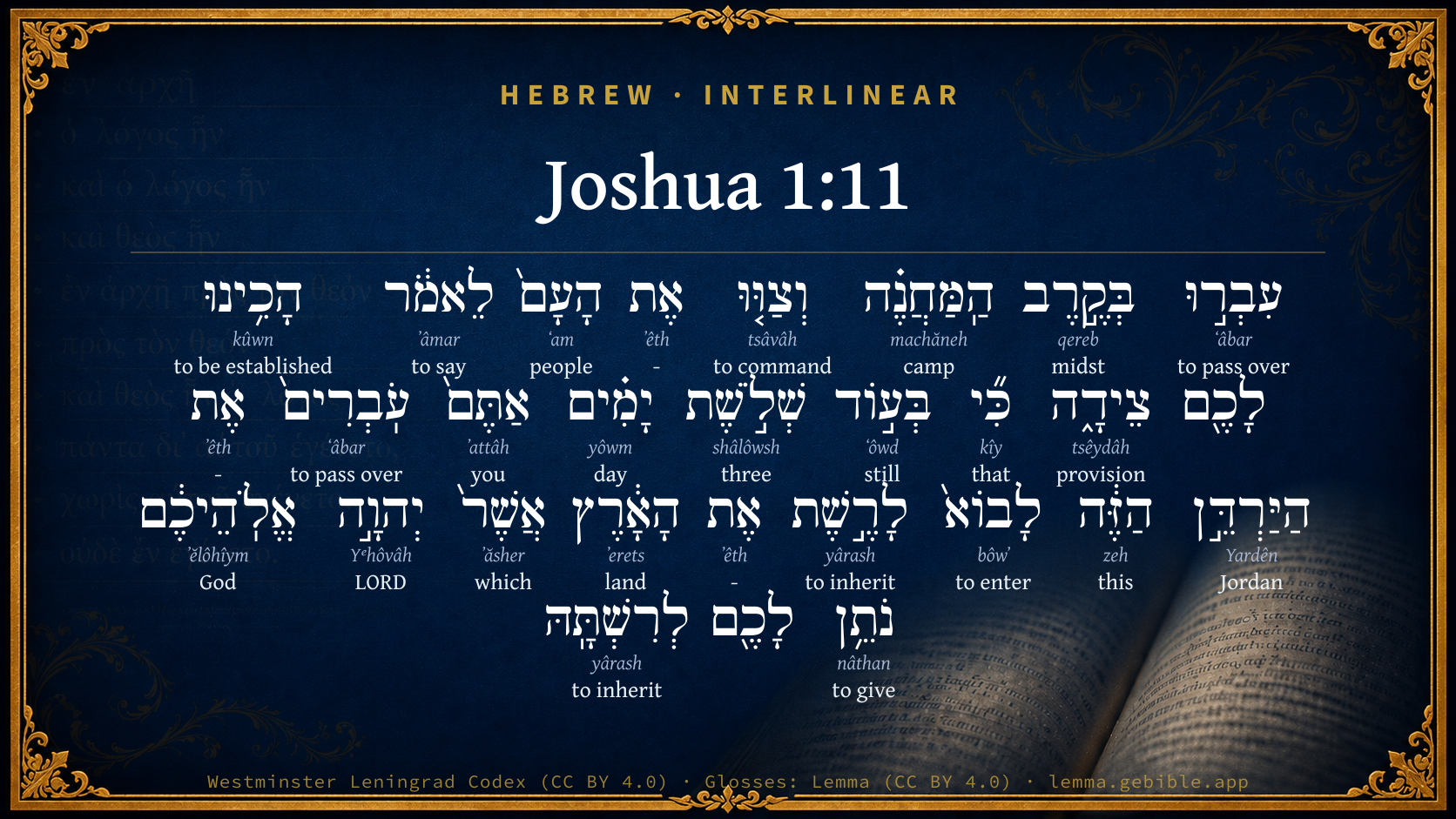
Hebrew (Westminster Leningrad Codex) Joshua 1:11 appears in the Hebrew Old Testament. The text above is from the Westminster Leningrad Codex. Each word links to its Strong’s number, a concise gloss, and parsing drawn from the Open Scriptures Hebrew Bible morphology. Click any word for its full Brown-Driver-Briggs (BDB) entry.
Download image
Cite this verse

Joshua 1:11 (World English Bible). Public Domain. Lemma interlinear Bible study tool, https://lemma.gebible.app/v/joshua/1/11.

Show BibTeX & RIS
BibTeX
RIS
English Translation
Pass through the midst of the camp, and command the people, saying, Prepare food; for within three days you are to pass over this Jordan, to go in to possess the land, which Yahweh your God gives you to possess it.
World English Bible · Public Domain
Download a study sheet

One document with this verse’s original text, its word-by-word gloss line, the meaning frame, cross-references with their text, attributed commentary, and full source and license credits — printable, and it pastes into notes with its structure intact.

This verse Autodidact and up

Study sheet (.html) Plain text (.txt)

A passage Seminary Student

Up to 50 verses in one chapter. A passage sheet keeps up to 6 commentary sources and 12 cross-references per verse, in the order this page ranks them, and says so on the sheet whenever that leaves anything out. Ask for a single verse and you get the Autodidact verse sheet above.

Everything on this page stays free to read, with no account — the sheet is a download of what is already on screen, not access to it.

Want to remove ads? Support Godless Engineer
Compare translations 3

The same verse in 3 English versions, stacked beneath the original-language interlinear above. Click any original word for its lexicon entry.

Each is an independent rendering of the whole verse — the interlinear is not word-aligned to these translations.

Highlighted words mark where these versions differ — a whole-verse word diff, not a word-by-word alignment.

  • World English Bible Public Domain
    Pass through the midst of the camp, and command the people, saying, Prepare food; for within three days you are to pass over this Jordan, to go in to possess the land, which Yahweh your God gives you to possess it.
  • King James Version Public Domain
    Pass through the host, and command the people, saying, Prepare you victuals; for within three days ye shall pass over this Jordan, to go in to possess the land, which the LORD your God giveth you to possess it.
  • unfoldingWord Literal Text CC BY-SA 4.0
    “Pass through the midst of the camp and command the people, saying, ‘Prepare provisions for yourselves, because within three days you are crossing over this Jordan to enter to possess the land that Yahweh your God is giving to you to possess it.’”

unfoldingWord Literal Text — © unfoldingWord, licensed CC BY-SA 4.0. Word-aligned USFM3 via Door43 (git.door43.org/unfoldingWord/en_ult).

Versions to compare (up to 4)

3 of 4 selected

Show all 18 translations

Every available English version of this verse, each an independent rendering of the whole verse.

  • World English Bible Public Domain
    Pass through the midst of the camp, and command the people, saying, Prepare food; for within three days you are to pass over this Jordan, to go in to possess the land, which Yahweh your God gives you to possess it.
  • Berean Standard Bible Public Domain
    “Go through the camp and tell the people, ‘Prepare your provisions, for within three days you will cross the Jordan to go in and take possession of the land that the LORD your God is giving you to possess.’”
  • Majority Standard Bible Public Domain
    “Go through the camp and tell the people, ‘Prepare your provisions, for within three days you will cross the Jordan to go in and take possession of the land that the LORD your God is giving you to possess.’”
  • King James Version Public Domain
    Pass through the host, and command the people, saying, Prepare you victuals; for within three days ye shall pass over this Jordan, to go in to possess the land, which the LORD your God giveth you to possess it.
  • American Standard Version (1901) Public Domain
    Pass through the midst of the camp, and command the people, saying, Prepare you victuals; for within three days ye are to pass over this Jordan, to go in to possess the land, which Jehovah your God giveth you to possess it.
  • Revised Version (1885) Public Domain
    Pass through the midst of the camp, and command the people, saying, Prepare you victuals; for within three days ye are to pass over this Jordan, to go in to possess the land, which the LORD your God giveth you to possess it.
  • Geneva Bible (1599) Public Domain
    Passe through the hoste, and commande the people, saying, Prepare you vitailes: for after three dayes ye shall passe ouer this Iorden, to goe in to possesse the lande, which the Lord your God giueth you to possesse it.
  • Douay-Rheims (1899) Public Domain
    Prepare you victuals: for after the third day you shall pass over the Jordan and shall go in to possess the land, which the Lord your God will give you.
  • Young's Literal Translation Public Domain
    `Pass over into the midst of the camp, and command the people, saying, Prepare for yourselves provision, for within three days ye are passing over this Jordan, to go in to possess the land which Jehovah your God is giving to you to possess it.'
  • Literal Standard Version CC BY-SA 4.0
    “Pass over into the midst of the camp, and command the people, saying, Prepare provision for yourselves, for within three days you are passing over this Jordan, to go in to possess the land which your God YHWH is giving to you to possess it.”
  • Unlocked Literal Bible CC BY-SA 4.0
    “Go through the camp and command the people, 'Prepare provisions for yourselves. In three days you will cross over this Jordan and go in and possess the land that Yahweh your God is giving you to possess.'”
  • unfoldingWord Literal Text CC BY-SA 4.0
    “Pass through the midst of the camp and command the people, saying, ‘Prepare provisions for yourselves, because within three days you are crossing over this Jordan to enter to possess the land that Yahweh your God is giving to you to possess it.’”
  • Darby Bible Public Domain
    Go through the midst of the camp, and command the people, saying, Prepare yourselves victuals, for in three days ye shall pass over this Jordan, that ye may enter in to take possession of the land which Jehovah your God giveth you to possess it.
  • World Messianic Bible Public Domain
    “Pass through the middle of the camp, and command the people, saying, ‘Prepare food; for within three days you are to pass over this Jordan, to go in to possess the land which the LORD your God gives you to possess.’”
  • Webster's Bible Public Domain
    Pass through the host, and command the people, saying, Prepare you provisions; for within three days ye shall pass over this Jordan, to go in to possess the land which the LORD your God giveth you to possess it.
  • Free Bible Version CC BY-SA 4.0
    “Go through the whole camp and tell the people, ‘Get everything ready, because in three days time we will cross the Jordan, to go and take the land God is giving to you to possess.’”
  • Bible in Basic English Public Domain
    Go through the tents and give orders to the people, saying, Get ready a store of food; for in three days you are to go over this river Jordan and take for your heritage the land which the Lord your God is giving you.
  • JPS Tanakh (1917) Public Domain
    'Pass through the midst of the camp, and command the people, saying: Prepare you victuals; for within three days ye are to pass over this Jordan, to go in to possess the land, which the LORD your God giveth you to possess it.'

Literal Standard Version (2020), Covenant Press — licensed CC BY-SA 4.0. Text via the HelloAO Bible API (eBible.org). Unlocked Literal Bible (unfoldingWord) — licensed CC BY-SA 4.0. Text via the HelloAO Bible API (eBible.org). unfoldingWord Literal Text — © unfoldingWord, licensed CC BY-SA 4.0. Word-aligned USFM3 via Door43 (git.door43.org/unfoldingWord/en_ult). Free Bible Version, Dr. Jonathan Gallagher — licensed CC BY-SA 4.0. Text via the HelloAO Bible API (eBible.org).

Word by word

More ways to search: Search by grammar → Find every occurrence → Compare this word →

Practice this passage: Drill this verse → Learn its vocabulary →

צֵידָ֑ה
tsêydâh
H6720
“provision”
Noun, Common, Both, Singular, Absolute
Part of Speech
Noun
Type
Common
Gender
Both
Number
Singular
State
Absolute
Full BDB Definition

Origin: from H6718

TWOT: 1886b

provision, food
  1. עִבְר֣וּ ʻâbar H5674 “pass over” Verb, Qal, Imperative, 2nd Person, Masculine, Plural
  2. בְּקֶ֣רֶב qereb H7130 “in/at · midst of” Preposition + Noun, Common, Masculine, Singular, Construct
  3. הַֽמַּחֲנֶ֗ה machăneh H4264 “the · camp” Particle, Definite Article + Noun, Common, Both, Singular, Absolute
  4. וְצַוּ֤וּ tsâvâh H6680 “and · command” Conjunction + Verb, Piel, Imperative, 2nd Person, Masculine, Plural
  5. אֶת ʼêth H853 “-” Particle, Direct Object
  6. הָעָם֙ ʻam H5971 “the · people” Particle, Definite Article + Noun, Common, Masculine, Singular, Absolute
  7. לֵאמֹ֔ר ʼâmar H559 “to say” Preposition + Verb, Qal, Infinitive Construct
  8. הָכִ֥ינוּ kûwn H3559 “be established” Verb, Hiphil, Imperative, 2nd Person, Masculine, Plural
  9. כִּ֞י kîy H3588 “that” Conjunction
  10. בְּע֣וֹד ʻôwd H5750 “in/at · still” Preposition + Adverb
  11. שְׁלֹ֣שֶׁת shâlôwsh H7969 “three” Adjective, Cardinal number, Masculine, Singular, Construct
  12. יָמִ֗ים yôwm H3117 “days” Noun, Common, Masculine, Plural, Absolute
  13. אַתֶּם֙ ʼattâh H859 “you” Pronoun, Personal, 2nd Person, Masculine, Plural
  14. עֹֽבְרִים֙ ʻâbar H5674 “passing over” Verb, Qal, Participle Active, Masculine, Plural, Absolute
  15. אֶת ʼêth H853 “-” Particle, Direct Object
  16. הַיַּרְדֵּ֣ן Yardên H3383 “the · Jordan” Particle, Definite Article + Noun, Proper
  17. הַזֶּ֔ה zeh H2088 “the · this” Particle, Definite Article + Pronoun, Demonstrative, Masculine, Singular
  18. לָבוֹא֙ bôwʼ H935 “to enter” Preposition + Verb, Qal, Infinitive Construct
  19. לָרֶ֣שֶׁת yârash H3423 “to inherit” Preposition + Verb, Qal, Infinitive Construct
  20. אֶת ʼêth H853 “-” Particle, Direct Object
  21. הָאָ֔רֶץ ʼerets H776 “the · land” Particle, Definite Article + Noun, Common, Both, Singular, Absolute
  22. אֲשֶׁר֙ ʼăsher H834 “which” Particle, Relative
  23. יְהוָ֣ה Yᵉhôvâh H3068 “LORD” Noun, Proper
  24. אֱלֹֽהֵיכֶ֔ם ʼĕlôhîym H430 “God(s) · your” Noun, Common, Masculine, Plural, Construct + Suffix, Personal, 2nd Person, Masculine, Plural
  25. נֹתֵ֥ן nâthan H5414 “giving” Verb, Qal, Participle Active, Masculine, Singular, Absolute
  26. לְרִשְׁתָּֽהּ yârash H3423 “to inherit · her” Preposition + Verb, Qal, Infinitive Construct + Suffix, Personal, 3rd Person, Feminine, Singular

About this verse

These counts appear in no published source. They are computed here, from the morphology-tagged text and Lemma’s own curated glosses. What Lemma adds →

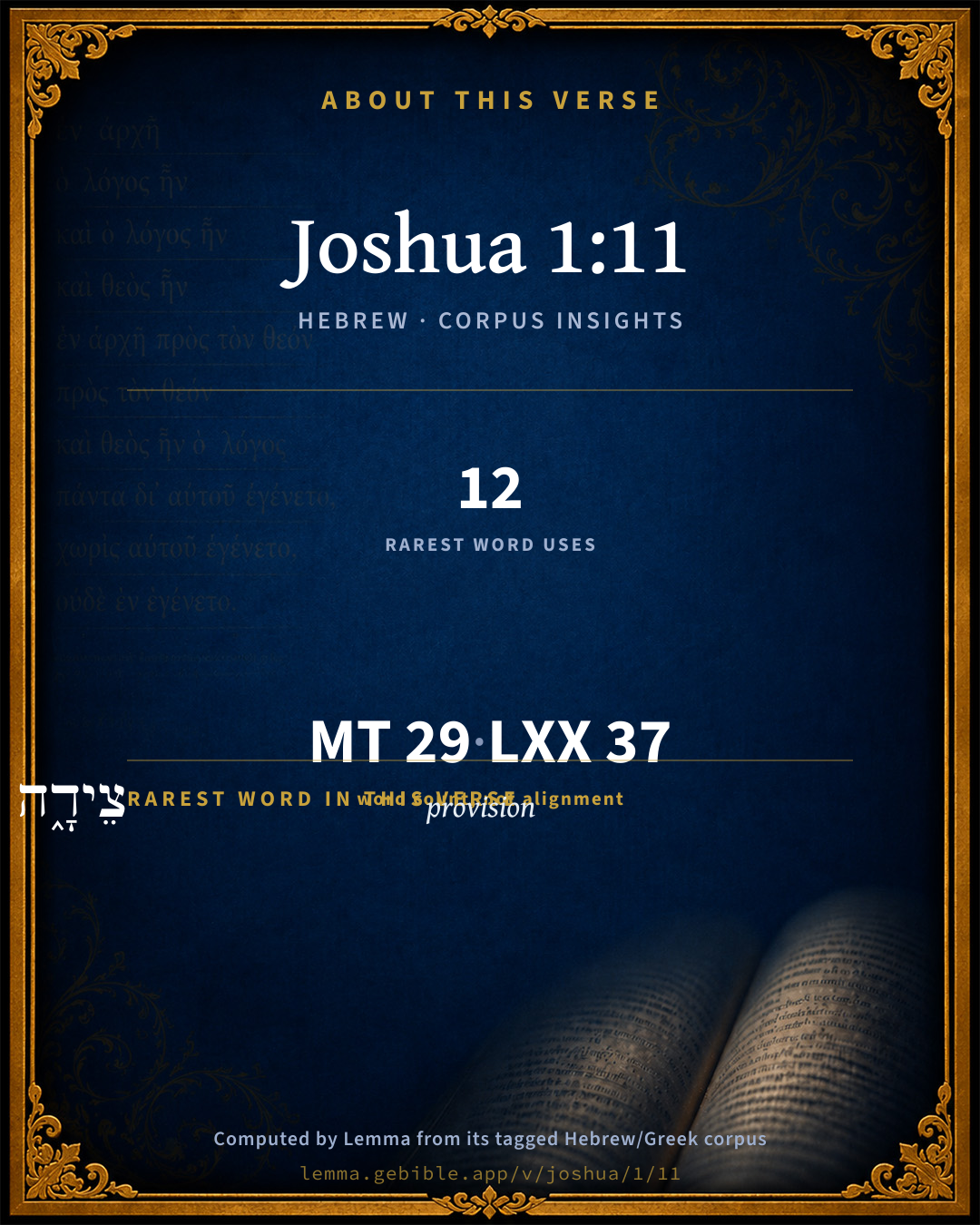
29
words
23
distinct lemmas
Historical
section

Notable vocabulary

The rarest word here is צֵידָ֑ה provision H6720 — appearing just 12 times in the whole Hebrew Bible.

Shared distinctive vocabulary

צֵידָ֑ה provision H6720 occurs in 11 verses of the Hebrew Bible. Also found in:

Grammatical profile

  • 9 verbs
  • 9 nouns
  • 1 adjective
  • 2 pronouns
  • 2 prepositions
  • 1 conjunction
  • 1 adverb
  • 4 particles

Verb forms

  • עִבְר֣וּ Qal · Imperative
  • וְצַוּ֤וּ Piel · Imperative
  • לֵאמֹ֔ר Qal · Infinitive Construct
  • הָכִ֥ינוּ Hiphil · Imperative
  • עֹֽבְרִים֙ Qal · Participle Active
  • לָבוֹא֙ Qal · Infinitive Construct
  • לָרֶ֣שֶׁת Qal · Infinitive Construct
  • נֹתֵ֥ן Qal · Participle Active
  • לְרִשְׁתָּֽהּ Qal · Infinitive Construct

Repetition

Words recur within this verse — often emphatic in Hebrew:

  • עִבְר֣וּ to pass over H5674 ×2
  • לָרֶ֣שֶׁת to inherit H3423 ×2

Hebrew & Septuagint length

In English translation the verse runs 41 words from the Hebrew and 46 from the Septuagint (LXX English) — closely comparable.

A rough comparison of the two English renderings, which tokenize alike — not a word-level alignment.

Word counts can differ between the Hebrew and the Greek without any difference in meaning — e.g. the Hebrew direct-object marker אֵת has no separate Greek word, and Greek often adds the article ὁ.

In the original languages it is 29 Hebrew tokens and 37 Greek tokens — but the two are counted differently (Hebrew bundles its prefixes and suffixes into one token; the Greek is in lemma form), so that isn’t a like-for-like length.

Cross-references

6

Topical passages linked to Joshua 1:11 in the Treasury of Scripture Knowledge — connected by theme and wording, ordered by reader-vote popularity; previews shown in the World English Bible.

  • Deuteronomy 9:1 Hear, Israel: you are to pass over the Jordan this day, to go in to dispossess nations greater and mightier than yourself, cities great and fortified up to the sky,
  • 2 Kings 20:5 Turn back, and tell Hezekiah the prince of my people, Thus says Yahweh, the God of David your father, I have heard your prayer, I have seen your tears: behold, I will heal you; on the third day you shall go up to the house of Yahweh.
  • Hosea 6:2 After two days will he revive us. On the third day he will raise us up, And we will live before him.
  • Deuteronomy 11:31 For you are to pass over the Jordan to go in to possess the land which Yahweh your God gives you, and you shall possess it, and dwell therein.
  • Joshua 3:2 It happened after three days, that the officers went through the midst of the camp;
  • Exodus 19:11 and be ready against the third day; for on the third day Yahweh will come down in the sight of all the people on Mount Sinai.

Cross-references courtesy of OpenBible.info (CC BY 4.0).

Hebrew and Greek witnesses Masoretic Hebrew ↔ Greek Septuagint

The same verse in the two great witnesses to the Old Testament, shown verse-for-verse.

These are two independent witnesses, not word-aligned to each other, and the Septuagint is shown in lemma (dictionary) form.

Hebrew Joshua 1:11 Masoretic · Westminster Leningrad Codex

עִבְר֣וּ בְּקֶ֣רֶב הַֽמַּחֲנֶ֗ה וְצַוּ֤וּ אֶת הָעָם֙ לֵאמֹ֔ר הָכִ֥ינוּ לָכֶ֖ם צֵידָ֑ה כִּ֞י בְּע֣וֹד שְׁלֹ֣שֶׁת יָמִ֗ים אַתֶּם֙ עֹֽבְרִים֙ אֶת הַיַּרְדֵּ֣ן הַזֶּ֔ה לָבוֹא֙ לָרֶ֣שֶׁת אֶת הָאָ֔רֶץ אֲשֶׁר֙ יְהוָ֣ה אֱלֹֽהֵיכֶ֔ם נֹתֵ֥ן לָכֶ֖ם לְרִשְׁתָּֽהּ

Pass through the midst of the camp, and command the people, saying, Prepare food; for within three days you are to pass over this Jordan, to go in to possess the land, which Yahweh your God gives you to possess it.

World English Bible · Public Domain

Greek LXX Joshua 1:11 Septuagint · lemma form

εἰςἔρχομαι κατά μέσος ὁ παρεμβολή ὁ λαός καί ἐντέλλομαι ὁ λαός λέγω ἑτοιμάζω ἐπισιτισμός ὅτι ἔτι τρεῖς ἡμέρα καί σύ διαβαίνω ὁ ἰορδάνης οὗτος εἰςἔρχομαι καταἔχω ὁ γῆ ὅς κύριος ὁ θεός ὁ πατήρ σύ δίδωμι σύ

Go into the midst of the camp of the people, and command the people, saying, Prepare provisions; for yet three days and you⌃ shall go over this Jordan, entering in to take possession of the land, which the Lord God of your fathers gives to you.

LXX2012 (modern English Septuagint) · Public Domain

On this verse, Matthew Poole's English Annotations discusses the Septuagint’s reading. Read the note in Commentary ↓

Hebrew: Westminster Leningrad Codex (CC BY 4.0). Greek: Septuagint (public domain); English from LXX2012 (modern English Septuagint) (Public Domain). How the Septuagint differs from the Hebrew →

Targum (Aramaic paraphrase)

1

The Targum is the ancient Jewish Aramaic paraphrase of the Hebrew Scriptures — an interpretive translation, not the Hebrew text itself. Onkelos (literal) and Pseudo-Jonathan (expansive) render the Torah, and Jonathan the Prophets. Coverage is partial: where no permissively-licensed English translation exists for a verse, only the Aramaic is shown. This is verse-level text, not a word-by-word alignment to the Hebrew.

  1. Targum Jonathan Prophets (Joshua–Malachi)
    עִבָרוּ בְּגוֹ מַשְׁרִיתָא וּפַקִידוּ יַת עַמָא לְמֵימָר אַתְקִינוּ לְכוֹן זְוָדִין אֲרֵי בְּסוֹף תְּלָתָא יוֹמִין אַתּוּן עָבְרִין יַת יַרְדְנָא הָדֵין לְמֵיעַל לְמֵירַת יַת אַרְעָא דַייָ אֱלָהָכוֹן יָהֵיב לְכוֹן לְמִירְתָהּ:

    (no public-domain English translation for this verse)

    Targum Jonathan — Aramaic: “Mikraot Gedolot” (public domain). English: “Sefaria Community Translation” (CC0 1.0 (public-domain dedication)); “London "Chaldee Paraphrase," 1871” (public domain). Text via Sefaria.

Commentary

Notes on Joshua 1:11 from classic Christian and Jewish commentators (each source and its license shown beneath its notes). The classic Christian expositions comment on the surrounding passage and are grouped to its opening verse, so a note may address several verses; the Jewish commentaries on the Tanakh (Rashi and others) are per-verse, so they appear only where the commentator wrote on this verse.

Lemma curates 59 commentaries, every one of them public domain or Creative Commons licensed, each selected and text-cleaned for this edition rather than reprinted as found. About our sources →

Trapp's Complete Commentary

John Trapp

Jos 1:11 Pass through the host, and command the people, saying, Prepare you victuals; for within three days ye shall pass over this Jordan, to go in to possess the land, which the LORD your God giveth you to possess it.

Ver. 11. Prepare you victuals.] Beside the manna, that cibus praeparatus, {a} as the word man signifieth; food prepared for them by God. See Deu 2:6.

{a} Paratum aliquid ad edendum. - Martinius, in Lexico.

John Trapp, A Commentary or Exposition upon All the Books of the Old and New Testament (1647–1656) — public domain. Text from a community e-Sword module.

Albert Barnes' Notes on the Bible

Prepare you victuals - The order was probably given with the knowledge that the manna would cease when the host crossed the Jordan Exo 16:35, and possibly because amidst their preparations there might not be opportunity to gather it in sufficient quantity. Nor does it appear that manna ever formed the whole and sole sustenance of the people. (Compare Num 20:1 note.)

It is the view of the majority of commentators - Jewish and Christian, ancient and modern - that the “three days” here named are identical with those of Jos 3:2; and that the command of Joshua in the text was not in fact given until after the return of the spies. Here, as elsewhere in the Hebrew historical books and frequently in the Gospels, the order of time is superseded by the order of thought. For the purpose if the writer was not historical merely; it was, on the contrary, mainly religious and theoretical. Intending, then, to exhibit God as accomplishing His promises to the covenant-people, he begins by informing us that God gave the word and set Joshua and the host actually in motion to take possession of their inheritance. Having placed this leading fact in the forefront, he returns to mention in Josh. 2 certain transactions closely relevant to the early stages of Joshua’s conquests, but which had in fact happened before the camp was removed from the plains of Moab and immediately after the expiration of the thirty days’ mourning for Moses. Deu 34:8. The order of events was probably the following - 3rd Nisan, the spies are sent out Jos 2:1; 6th, the spies return Jos 2:23; 7th, the camp is removed from Shittim to the bank of Jordan Jos 3:1, and the command Jos 1:11 is issued; 10th, the river is crossed Jos 4:19.

Albert Barnes' Notes on the Bible (1834–1885) — public domain. Text from a community e-Sword/MySword module.

Tyndale Open Study Notes

Tyndale Open Resources

1:11 Because of fear and unbelief, the previous generation had refused to enter the Promised Land from the south forty years earlier (see Num 13–14). The current generation would now enter from the east, across the Jordan River.

Tyndale Open Study Notes — © Tyndale Open Resources, licensed CC BY-SA 4.0. Text via the HelloAO Bible API.

Geneva Bible (1599)

Geneva Bible translators

Meaning, from the day that this was proclaimed, Josh. 3:2.

Geneva Bible (1599) marginal notes — public domain. Text via Bolls.life.

Jamieson, Fausset & Brown

Robert Jamieson, A. R. Fausset & David Brown

command the people, saying, Prepare you victuals--not manna, which, though it still fell, would not keep; but corn, sheep, and articles of food procurable in the conquered countries.

for within three days ye shall pass over this Jordan--that is, the third day, according to Hebrew idiom--the time allotted for getting ready before the encampment in Abel-Shittim broke up and they removed to the desert bank of the river where no victuals were available. At the same time Joshua himself convened the two and a half tribes which had settled east of Jordan, to remind them of their promise (Num. 32:1-42) to assist their brethren in the conquest of western Canaan. Their readiness to redeem their pledge and the terms in which they answered the appeal of Joshua displayed to great advantage their patriotic and pious feelings at so interesting a crisis.

Jamieson, Fausset & Brown — Commentary Critical and Explanatory on the Whole Bible (1871) — public domain (CC PDM 1.0). Text via the HelloAO Bible API.

Adam Clarke's Commentary

Verse 11. Prepare you victuals] צדה tsedah, such prey or provisions as they had taken from the conquered countries, such as corn, oxen, sheep, c. for the word signifies prey, or what is taken by hunting, c. This was necessary, as they were about to undergo considerable fatigue in marching, and in making preparations for the passage of the Jordan for although the manna had not ceased to fall, yet such other provisions as are mentioned above were necessary on this occasion.

For within three days ye shall pass] Calmet contends, with great appearance of truth, that these three days should be reckoned from the first day of their encamping at Jordan, three days after the return of the spies, i.e., on the eighth day of the first month, on the tenth of which they passed over Jordan. The text therefore is supposed to mean, Prepare victuals for three days' march, for "on the third day after your decampment from Shittim ye shall pass over this Jordan."

Adam Clarke's Commentary on the Bible (1810–1826) — public domain. Text from a community e-Sword/MySword module.

Ellicott's Commentary for English Readers

(11) Prepare you victuals.—The question may be asked, what preparation is intended, since they had the manna, which did not cease until several days after they passed the Jordan. But it does not seem possible to assign any other meaning to the word except that of provision for a journey or for a warlike expedition. Perhaps the order was intended to prepare the Israelites for the transition from the manna to other food. It may be also that the manna which supported them in their pilgrimage through the wilderness was not so fit to sustain them in the warfare which they were about to begin. For the phrase itself, compare Exo_12:39 : “They were thrust out of Egypt, and could not tarry, neither had they prepared for themselves any victual.” When there was a difficulty in obtaining other provision, God gave His people manna. Now, when they could easily provide food for themselves, He would not support them in idleness; and perhaps this is the common-sense view of the order given in the text. If called to any expedition which would take them far from the camp, the manna would not be within reach of all.

A Bible Commentary for English Readers, edited by Charles John Ellicott (1878–1897) — public domain. Text from a community e-Sword module.

The Cambridge Bible for Schools and Colleges

gen. ed. J. J. S. Perowne

11. Prepare you victuals] The word denotes (a) food got in hunting; (b) food of any kind, especially provisions for a journey. Comp. Exo_12:39, “neither had they prepared for themselves any victual;” Jos_9:11; Jos_9:14; Jdg_7:8, “So the people took victuals in their hands, and their trumpets;” 1Sa_22:10, “And he inquired of the Lord for him, and gave him victuals.” The need of the provision on this occasion is explained by the cessation of the Manna. See below, ch. Jos_5:12.

within three days] Comp. ch. Jos_3:1-2. The order appears to have been given on the 7th day of the month Nisan, for the people crossed the Jordan on the 10th. The expedition, therefore, of the spies occupied from the 5th to the 8th of the month, and the message to the eastern tribes was sent during the same interval.

The Cambridge Bible for Schools and Colleges (gen. ed. J. J. S. Perowne; Cambridge University Press, 1878–1918) — public domain. Text from a community e-Sword module.

John Gill's Exposition

Pass through the host,.... The whole camp of Israel, consisting of six hundred thousand fighting men:

and command the people; even all the people of Israel; this includes women as well as men, for the one, as well as the other, were to do what follows, and especially it may seem the business of the former:

saying, prepare ye victuals; this must be understood; as Kimchi observes, of other sorts of food besides bread; for they had manna, the bread of heaven, which fell about their tents every morning, so that they were sufficiently provided with that always, and which did not cease until they had entered the land, even until the sixteenth of Nisan, Jos 5:12; though indeed, as Abendana observes, that might be said to be prepared, it being ground in mills, and beat in mortars, and made cakes of, Num 11:8; but rather this designs meat and other provisions, which being upon the borders of Moab and Midian, they could furnish themselves with for their money; and besides, they were in the possession of a fine country, of Bashan and Gilead, they had taken from Sihon and Og. Jarchi interprets it of everything fit for journeying, and arms for war, with which they were supplied from the spoils of their enemies, the Egyptians at the Red sea, Amalek at Rephidim, and the Amorites and Midianites lately smitten by them; and to this sense Josephus (m) seems to agree:

for within three days ye shall pass over this Jordan: or at the end of three days, as the Targum of Jonathan; and so Jarchi, while there are yet three days, after that ye shall pass over: but here arises a difficulty to be reconciled, how this could be done three days after, when the spies, which Joshua is afterward said to send into the land, stayed three days in the mountains, besides the time of their going, and returning, and stay at Rahab's house; and it was not till after their return that the camp began to move; to which it may be observed, that though the affair of the spies is afterward related, they might have been sent by Joshua before this order was given to prepare for the journey, and of this opinion are several of the Jewish writers (n): this being the case, they might return before the expiration of these three days, at the end of which Joshua, with the whole host, moved, agreeably to these orders:

to go in to possess the land which the Lord your God giveth you to possess it; which must be a great inducement and encouragement to them to observe his instructions, and go over with him.

(m) Antiqu. l. 5. c. 1. sect. 1. (n) Jarchi, Ben Gersom, & Abarbinel in loc.

John Gill's Exposition of the Whole Bible (1746–1763) — public domain (CC PDM 1.0). Text via the HelloAO Bible API.

Haydock's Catholic Bible Commentary

Victuals. The manna still supplied the army after they had passed the Jordan, chap. v. 12. But Josue might fear lest the people might not have liberty to gather it in the midst of the enemy’s country, or he might perhaps suppose that this miraculous food would be withdrawn, as soon as they had entered Chanaan. He therefore takes all necessary precautions, and gets other sorts of provisions in the neighbourhood. (Calmet) --- This might foreshew, that in the primitive Church the ceremonies and privileges of the old law would not be abrogated immediately, but they might be used for a time along with the rites of the gospel, till the old law should be buried with honour. (Worthington) --- Third day, after their departure from Setim; or perhaps this order was only published when the Israelites were arrived on the banks of the Jordan. (Calmet)

George Leo Haydock (1774–1849), Haydock's Catholic Family Bible and Commentary, 1859 edition — public domain. Excludes Psalms (Douay-Rheims chapter numbering differs from Protestant) and Deuterocanonical books (Catholic canon only).

Matthew Poole's English Annotations

Prepare you victuals; for although manna was given them to supply their want of ordinary provisions in the wilderness; yet they were allowed, when they had opportunity, to purchase other provisions, and did so, Deu 2:6,28. And now having been some time in the land of the Amorites, and together with manna used themselves to other food which that country plentifully supplied them with, they are warned to furnish themselves therewith for their approaching march.

Within three days.

Quest. How can this be, when the spies, who were not yet sent away, continued three days hid in the mountains, Jos 2:22, and the people passed not over till three days after the spies returned? Jos 3:2.

Answ. These words, though placed here, seem not to have been delivered by Joshua till after the return of the spies; such transpositions being so frequent in Scripture, that interpreters have formed this general rule, that there is no certain order, no former nor latter, in the histories of the Scripture. And hence it comes that these three days mentioned here below, after the history of the spies, are again repeated, Jos 3:2. Besides, the Septuagint render the words yet three days; and the Chaldee, in the end of three days; others, after three days, as it is Jos 3:2. Or these three days may be the same with those Jos 2:22, and the matter may be conceived thus: Joshua gives the people notice of their passage over Jordan within three days here, and at the same time sends away the spies, who return ere those three days be ended. For the three days, Jos 2:22, may be understood of one whole day, and part of two other days, as it is in that famous instance, Mat 27:63, of which see more on that place, and on Mat 12:40. The spies came to Jericho in the evening of the first day, and intended to lie there, Jos 2:8; but being disturbed and affrighted by the search made after them, they go away that night into the mountains, and there abide the time mentioned. Joshua having delivered this message from God to the Israelites, and sent away the spies, removes from Shittim to Jordan, Jos 3:1, being sufficiently assured of his safe passage over Jordan, whatsoever became of the spies; and after those three days mentioned here were past, Jos 3:2, he sends the officers to the people with a second message about the manner of their actual passing over.

Matthew Poole's English Annotations on the Holy Bible (1683–1685) — public domain. Text from a community e-Sword/MySword module.

Whedon's Commentary on the Bible

Daniel D. Whedon

11. Prepare you victuals — Provision for a journey; natural produce; not manna, for this became putrid on the second day. The manna did not cease to fall till they had entered Canaan and eaten of the corn of the land. Jos_5:12. But it was in harmony with the divine economy that the supernatural supply should diminish as the natural supply increased in the fertile trans-Jordanic region. God never works miracles as a premium to indolence.

Within three days ye shall pass over this Jordan — If we follow the order of the narrative, and allow that the spies were sent out after this proclamation to the officers, we shall find that the Israelites did not cross the Jordan within three days. The spies were gone three days, and the people paused on the river’s bank three days more, so that the crossing could not have taken place till the seventh day. To meet this difficulty some suppose that the spies had been sent out previous to Joshua’s proclamation to the officers; see note on Jos_2:1. [But it is not necessary to understand these words of Joshua as a positive prediction that all the people would actually cross over the Jordan and be in the Promised Land within these three days. The words are literally ye crossing, that is, ye will be on your march to cross. He proposed within three days to break up the camp at Shittim and be on his way over the Jordan, and this is all the words can necessarily be made to mean. Keil supposes that because the two spies were detained, and obliged to hide three days in the mountain, (Jos_2:22,) Joshua was thereby hindered from carrying out his purpose as he at first designed. But why is it necessary to maintain that the spies returned to Joshua at the camp at Shittim? It is not so written, (see Jos_2:23,) and we may possibly suppose that when they returned to Joshua they found him arrived at the Jordan. But even granting that they returned to the camp at Shittim, as the history most naturally implies, the three days they hid in the mountain may have been only parts of three days. See note on Jos_2:22.] The inspired writers directed their attention more to facts than to chronological order. In this command Joshua displays a remarkable degree of that faith and courage to which he had just been exhorted. The rapid Jordan, at its flood, is before him, and he has no boats, no bridge, no pontoon train, but he assures that vast host that they and their wives and children and flocks shall, within a few days, safely cross that angry torrent.

Daniel D. Whedon (gen. ed.), Commentary on the Old and New Testaments (1874–1909) — public domain. Text from a community e-Sword module.

The Pulpit Commentary

Prepare you victuals. Literally, game, the term being applied to meat obtained by hunting. Thus it is applied by Isaac to Esau"s venison in Ge 27. Here it means food of any kind, but especially animal food. It is therefore obvious that the miraculous supply of manna was soon to cease. (cf. Jos_5:12) Within three days. Much difficulty has been created here by the fact that another three days are mentioned in Jos_3:2 as elapsing after the return of the spies, which has been supposed to have taken place between this command and the period then mentioned. Three more days were spent (Jos_2:22) by the spies in eluding the pursuit of the men of Jericho one day in going thither, and one more in returning to Moses. Consequently eight days, if not more, (see Jos_3:7) must have elapsed between this proclamation and the actual crossing of the Jordan. But when we remember that the Hebrew language possesses no pluperfect tense, that there are many instances, such as (very probably) Gen_12:1, and more certainly Gen_3:1 Gen_6:6 Gen_20:18 Gen_26:18, Gen_26:32, where the Hebrew narrative has clearly departed from the chronological order, and that the chronology is obscured by this chasm in the Hebrew linguistic system, we may suppose that the narrative in the second chapter is parenthetical, and relates to events which occurred before the occasion now spoken of. This is the view taken by Josephus and the Rabbis, and our translators have adopted it in the margin a proceeding which, as their preface shows, may frequently be held to imply that in their opinion it is the preferable interpretation. It is energetically impugned by Keil, who maintains that there are insuperable difficulties in the way of this arrangement. He does not, however, make out a very powerful case against the simple explanation of Cornelius a Lapide, that the spies left the camp on the 3rd Nisan, returned on the 6th, that Joshua gave his order on the 7th, and that on the 10th (Jos_4:19) the crossing was effected. Stripped of all verbiage, Keil"s argument appears to amount simply to this, that it was not likely that the account of the narrative would be thus interrupted by an account of a transaction out of its proper chronological order. It may be added that it seems doubtful whether we must not render the word rml in ver. 12, by the pluperfect, for it seems very probable that the word of command to the two tribes and a half who had obtained their inheritance beyond Jordan had been given before this, and that therefore it may have preceded the command given to the spies, in which case one of Keil"s chief objections fails to the ground.

Other explanations than that of Cornelius a Lapide have been suggested. Thus Kimchi supposes that the spies left on the 5th Nisan and returned on the 8th; while Masius supposes that they were sent out simultaneously with these orders. Augustine"s explanation, that Joshua did not speak by revelation, but was influenced by human hope, is noticeable, as proving that the early fathers did not always take the strictest view of inspiration.

The Pulpit Commentary (1880–1919), ed. H.D.M. Spence-Jones & Joseph S. Exell — public domain. Text from a community e-Sword module.

John Wesley's Explanatory Notes

Prepare you victuals - For although Manna was given them to supply their want of ordinary provisions in the wilderness; yet they were allowed, when they had opportunity, to purchase other provisions, and did so, Deut. ii, 6, 28. And now having been some time in the land of the Amorites, and together with Manna used themselves to other food, which that country plentifully supplied them with; they are warned to furnish themselves therewith for their approaching march. Three days - These words, though placed here, seem not to have been delivered by Joshua 'till after the return of the spies; such transpositions being frequent in scripture. And hence it comes, that these three days mentioned here below, after the history of the spies, are again repeated chap. iii, 2.

John Wesley, Explanatory Notes Upon the Whole Bible (1754–1765) — public domain. Text via the GEBible commentary corpus.

Rashi

Rabbi Shlomo Yitzchaki (Rashi)

Prepare your travel needs. [Prepare] everything necessary for (traveling) and weapons for the [upcoming] battle, he said to them. You cannot say the צֵדָה refers to food and drink maintains that while they still ate of the manna, they bought other varieties of food from the non-Jewish merchants, and it was these foods that they were commanded to prepare. for they had sufficient manna in their vessels to last them untill the sixteenth of Nissan, and so it is said: ‘The manna ceased on the morrow.’

After three days. At the end of three days. When you will have been here three days; then you will cross [the Jordan].

Rashi on the Tanakh — English translations: “The Judaica Press complete Tanach with Rashi, translated by A. J. Rosenberg” (CC BY 4.0); “Pentateuch with Rashi's commentary by M. Rosenbaum and A.M. Silbermann, 1929-1934” (public domain); “The Metsudah Tanach series, Lakewood, N.J” (CC BY 4.0); and “The Book of Joshua, Metsudah Publications, 1997” (CC BY 4.0). Text via Sefaria.

Lesson kit

Teaching starters — assembled from the data on this page, not authored interpretation. Every prompt links to the verse data it draws on. Edit before teaching.

Joshua, in the Historical, opens this verse with 29 words (23 distinct Hebrew lemmas). Its most distinctive word is tsêydâh (“provision”). A historical commentator’s framing appears above. Read the whole chapter for the surrounding context.

Discussion questions

  1. What does “provision” (tsêydâh) contribute to the verse as a whole?
  2. How does Genesis 27:3, which shares the word «provision», read alongside this verse?
  3. What does the repetition of “to pass over” (2× in this one verse) do in this verse?
  4. These translations render this verse differently; the difference is in the English rendering, not the original. What questions does that raise?
  5. «עִבְר֣וּ» is a Qal Imperative verb. How does that grammatical form shape the action described?
  6. Compare how Trapp's Complete Commentary and Albert Barnes' Notes on the Bible read this verse. Where do they agree or differ?

Things to notice

Reading settings

Reading text

Shown beneath each verse's original-language words.

Old Testament
Old Testament edition

Read the OT as the Masoretic Hebrew (MT) or the Greek Septuagint (LXX).

English shown for the Greek Septuagint (in the Hebrew ↔ Greek comparison).

Comparing translations? Open the Compare panel on any verse page to stack up to four side by side.