
Leviticus 25:22

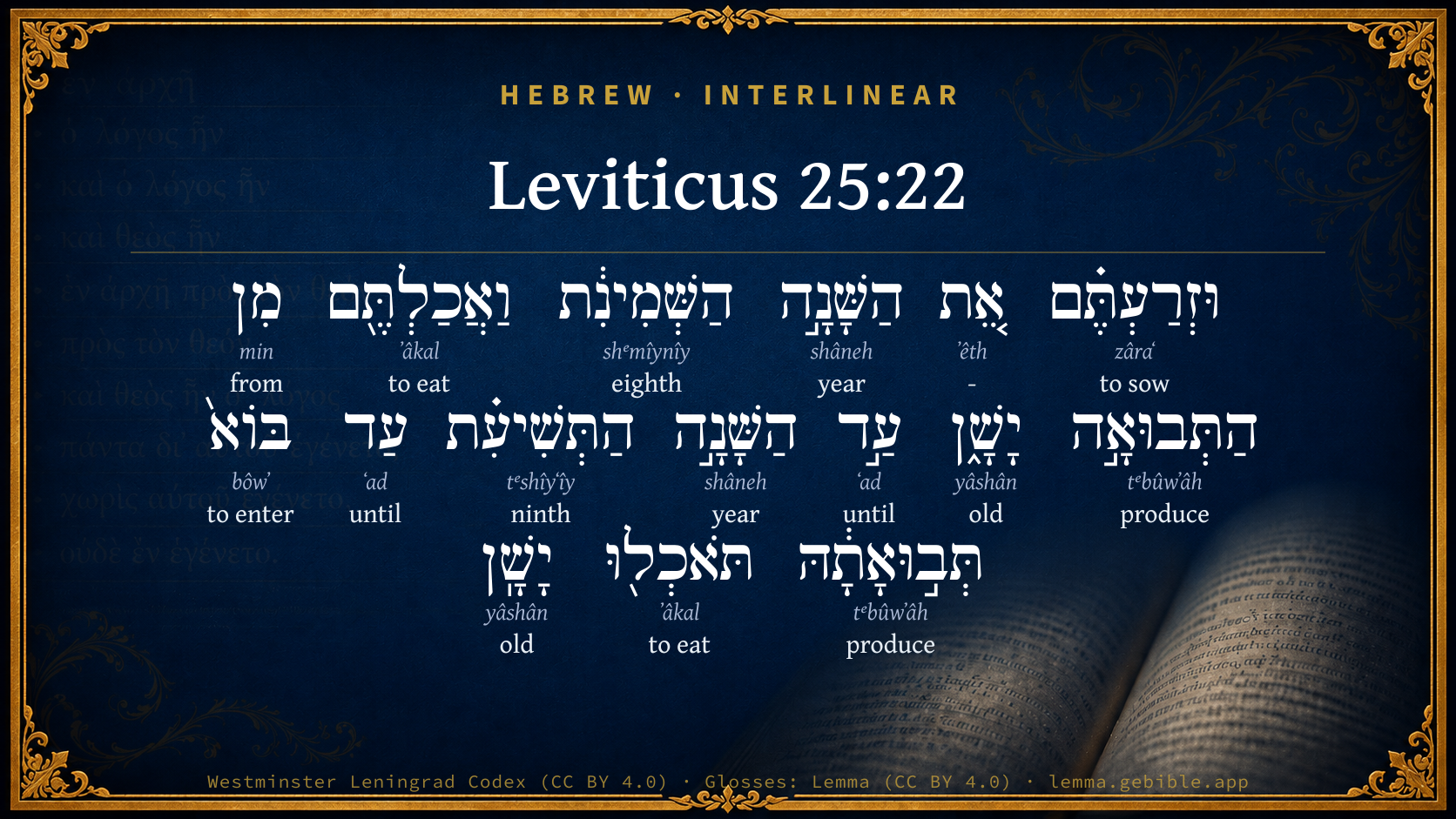
Hebrew (Westminster Leningrad Codex) Leviticus 25:22 appears in the Hebrew Old Testament. The text above is from the Westminster Leningrad Codex. Each word links to its Strong’s number, a concise gloss, and parsing drawn from the Open Scriptures Hebrew Bible morphology. Click any word for its full Brown-Driver-Briggs (BDB) entry.
Download image
Cite this verse

Leviticus 25:22 (World English Bible). Public Domain. Lemma interlinear Bible study tool, https://lemma.gebible.app/v/leviticus/25/22.

Show BibTeX & RIS
BibTeX
RIS
English Translation
You shall sow the eighth year, and eat of the fruits, the old store; until the ninth year, until its fruits come in, you shall eat the old store.
World English Bible · Public Domain
Highlights
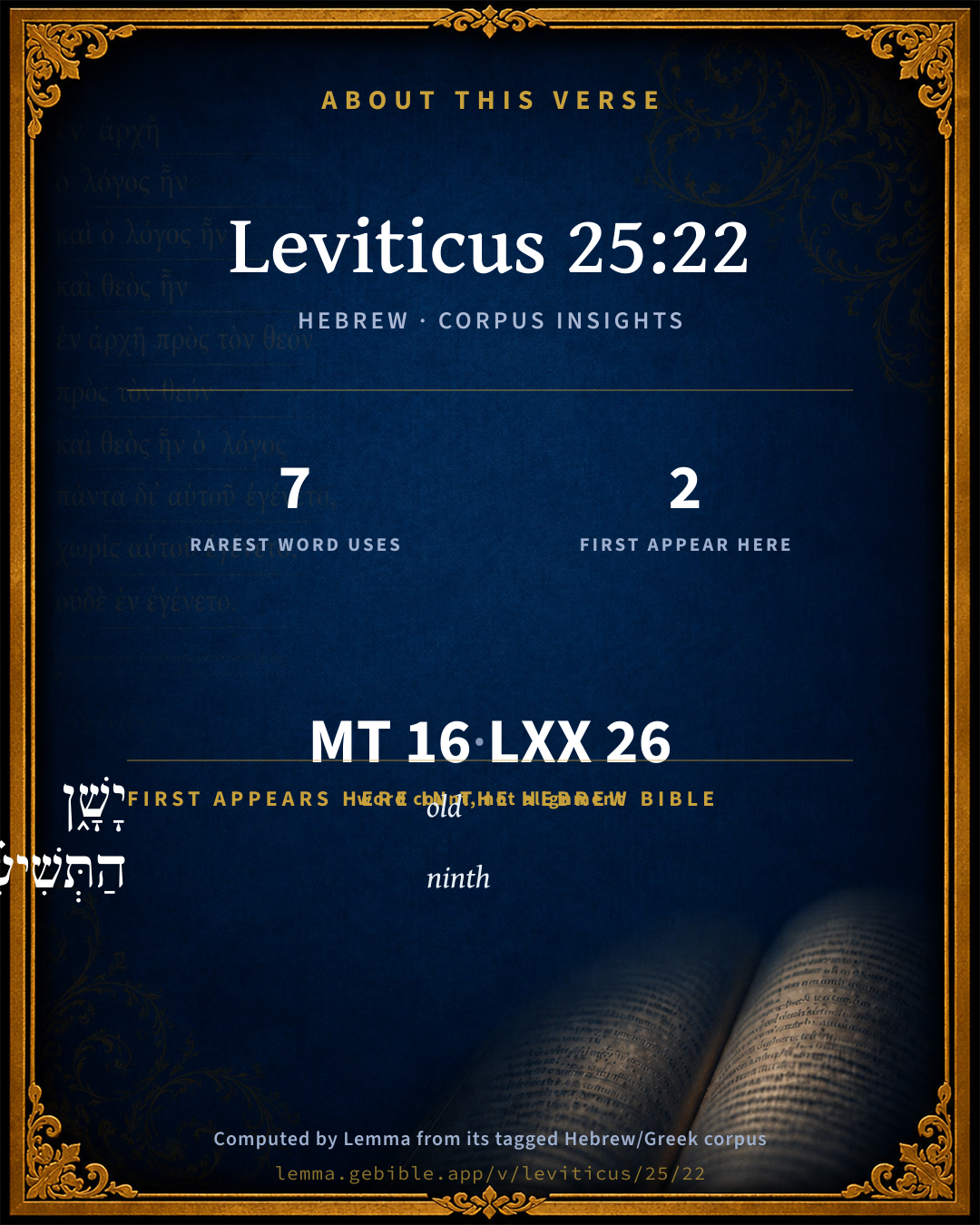
  • 2 first appearances in the Hebrew Bible
Full analysis ↓
Download a study sheet

One document with this verse’s original text, its word-by-word gloss line, the meaning frame, cross-references with their text, attributed commentary, and full source and license credits — printable, and it pastes into notes with its structure intact.

This verse Autodidact and up

Study sheet (.html) Plain text (.txt)

A passage Seminary Student

Up to 50 verses in one chapter. A passage sheet keeps up to 6 commentary sources and 12 cross-references per verse, in the order this page ranks them, and says so on the sheet whenever that leaves anything out. Ask for a single verse and you get the Autodidact verse sheet above.

Everything on this page stays free to read, with no account — the sheet is a download of what is already on screen, not access to it.

Want to remove ads? Support Godless Engineer
Compare translations 3

The same verse in 3 English versions, stacked beneath the original-language interlinear above. Click any original word for its lexicon entry.

Each is an independent rendering of the whole verse — the interlinear is not word-aligned to these translations.

Highlighted words mark where these versions differ — a whole-verse word diff, not a word-by-word alignment.

  • World English Bible Public Domain
    You shall sow the eighth year, and eat of the fruits, the old store; until the ninth year, until its fruits come in, you shall eat the old store.
  • King James Version Public Domain
    And ye shall sow the eighth year, and eat yet of old fruit until the ninth year; until her fruits come in ye shall eat of the old store.
  • unfoldingWord Literal Text CC BY-SA 4.0
    And you shall sow the eighth year, and you shall eat from the old produce until the ninth year. Until its produce comes in, you shall eat the old.

unfoldingWord Literal Text — © unfoldingWord, licensed CC BY-SA 4.0. Word-aligned USFM3 via Door43 (git.door43.org/unfoldingWord/en_ult).

Versions to compare (up to 4)

3 of 4 selected

Show all 18 translations

Every available English version of this verse, each an independent rendering of the whole verse.

  • World English Bible Public Domain
    You shall sow the eighth year, and eat of the fruits, the old store; until the ninth year, until its fruits come in, you shall eat the old store.
  • Berean Standard Bible Public Domain
    While you are sowing in the eighth year, you will be eating from the previous harvest, until the ninth year’s harvest comes in.
  • Majority Standard Bible Public Domain
    While you are sowing in the eighth year, you will be eating from the previous harvest, until the ninth year’s harvest comes in.
  • King James Version Public Domain
    And ye shall sow the eighth year, and eat yet of old fruit until the ninth year; until her fruits come in ye shall eat of the old store.
  • American Standard Version (1901) Public Domain
    And ye shall sow the eighth year, and eat of the fruits, the old store; until the ninth year, until its fruits come in, ye shall eat the old store.
  • Revised Version (1885) Public Domain
    And ye shall sow the eighth year, and eat of the fruits, the old store; until the ninth year, until her fruits come in, ye shall eat the old store.
  • Geneva Bible (1599) Public Domain
    And ye shall sowe the eight yeere, and eate of the olde fruite vntill the ninth yeere: vntill the fruite thereof come, ye shall eate the olde.
  • Douay-Rheims (1899) Public Domain
    And the eighth year you shall sow, and shall eat of the old fruits, until the ninth year: till new grow up, you shall eat the old store.
  • Young's Literal Translation Public Domain
    and ye have sown the eighth year, and have eaten of the old increase; until the ninth year, until the coming in of its increase, ye do eat the old.
  • Literal Standard Version CC BY-SA 4.0
    and you have sown [in] the eighth year, and have eaten of the old increase; you eat the old until the ninth year, until the coming in of its increase.
  • Unlocked Literal Bible CC BY-SA 4.0
    You will plant in the eighth year and continue to eat from the previous years' produce and the stored food. Until the harvest of the ninth year comes in, you will be able to eat from the provisions stored in the previous years.
  • unfoldingWord Literal Text CC BY-SA 4.0
    And you shall sow the eighth year, and you shall eat from the old produce until the ninth year. Until its produce comes in, you shall eat the old.
  • Darby Bible Public Domain
    and ye shall sow in the eighth year, and ye shall eat of the old fruit until the ninth year; until her produce come in, ye shall eat the old.
  • World Messianic Bible Public Domain
    You shall sow the eighth year, and eat of the fruits from the old store until the ninth year. Until its fruits come in, you shall eat the old store.
  • Webster's Bible Public Domain
    And ye shall sow the eighth year, and eat of old fruit until the ninth year; until its fruits come in ye shall eat of the old store.
  • Free Bible Version CC BY-SA 4.0
    As you sow in the eighth year, you will still be eating from that harvest, which will last until your harvest in the ninth year.
  • Bible in Basic English Public Domain
    And in the eighth year you will put in your seed, and get your food from the old stores, till the fruit of the ninth year is ready.
  • JPS Tanakh (1917) Public Domain
    And ye shall sow the eighth year, and eat of the produce, the old store; until the ninth year, until her produce come in, ye shall eat the old store.

Literal Standard Version (2020), Covenant Press — licensed CC BY-SA 4.0. Text via the HelloAO Bible API (eBible.org). Unlocked Literal Bible (unfoldingWord) — licensed CC BY-SA 4.0. Text via the HelloAO Bible API (eBible.org). unfoldingWord Literal Text — © unfoldingWord, licensed CC BY-SA 4.0. Word-aligned USFM3 via Door43 (git.door43.org/unfoldingWord/en_ult). Free Bible Version, Dr. Jonathan Gallagher — licensed CC BY-SA 4.0. Text via the HelloAO Bible API (eBible.org).

Word by word

More ways to search: Search by grammar → Find every occurrence → Compare this word →

Practice this passage: Drill this verse → Learn its vocabulary →

יָשָׁ֑ן
yâshân
H3465
“old”
Adjective, Adjective, Masculine, Singular, Absolute
Part of Speech
Adjective
Type
Adjective
Gender
Masculine
Number
Singular
State
Absolute
Full BDB Definition

Origin: from H3462

TWOT: 928b

old, store, storage
  1. וּזְרַעְתֶּ֗ם zâraʻ H2232 “and · to sow” Conjunction + Verb, Qal, Sequential Perfect, 2nd Person, Masculine, Plural
  2. אֵ֚ת ʼêth H853 “-” Particle, Direct Object
  3. הַשָּׁנָ֣ה shâneh H8141 “the · year” Particle, Definite Article + Noun, Common, Feminine, Singular, Absolute
  4. הַשְּׁמִינִ֔ת shᵉmîynîy H8066 “the · eighth” Particle, Definite Article + Adjective, Ordinal number, Feminine, Singular, Absolute
  5. וַאֲכַלְתֶּ֖ם ʼâkal H398 “and · to eat” Conjunction + Verb, Qal, Sequential Perfect, 2nd Person, Masculine, Plural
  6. מִן min H4480 “from” Preposition
  7. הַתְּבוּאָ֣ה tᵉbûwʼâh H8393 “the · produce” Particle, Definite Article + Noun, Common, Feminine, Singular, Absolute
  8. עַ֣ד ʻad H5704 “until” Preposition
  9. הַשָּׁנָ֣ה shâneh H8141 “the · year” Particle, Definite Article + Noun, Common, Feminine, Singular, Absolute
  10. הַתְּשִׁיעִ֗ת tᵉshîyʻîy H8671 “the · ninth” Particle, Definite Article + Adjective, Ordinal number, Feminine, Singular, Absolute
  11. עַד ʻad H5704 “until” Preposition
  12. בּוֹא֙ bôwʼ H935 “to enter” Verb, Qal, Infinitive Construct
  13. תְּב֣וּאָתָ֔הּ tᵉbûwʼâh H8393 “produce · her” Noun, Common, Feminine, Singular, Construct + Suffix, Personal, 3rd Person, Feminine, Singular
  14. תֹּאכְל֖וּ ʼâkal H398 “to eat” Verb, Qal, Imperfect, 2nd Person, Masculine, Plural
  15. יָשָֽׁן yâshân H3465 “old” Adjective, Adjective, Masculine, Singular, Absolute

About this verse

These counts appear in no published source. They are computed here, from the morphology-tagged text and Lemma’s own curated glosses. What Lemma adds →

16
words
11
distinct lemmas
Pentateuch
section

Notable vocabulary

The rarest word here is יָשָׁ֑ן old H3465 — appearing just 7 times in the whole Hebrew Bible.

First appearance in Scripture

These words make their first canonical appearance in the Hebrew Bible here:

  • יָשָׁ֑ן old H3465
  • הַתְּשִׁיעִ֗ת ninth H8671

Shared distinctive vocabulary

יָשָׁ֑ן old H3465 occurs in 5 verses of the Hebrew Bible. Also found in:

Grammatical profile

  • 4 verbs
  • 4 nouns
  • 4 adjectives
  • 3 prepositions
  • 1 particle

Verb forms

  • וּזְרַעְתֶּ֗ם Qal · Sequential Perfect
  • וַאֲכַלְתֶּ֖ם Qal · Sequential Perfect
  • בּוֹא֙ Qal · Infinitive Construct
  • תֹּאכְל֖וּ Qal · Imperfect

Repetition

Words recur within this verse — often emphatic in Hebrew:

  • הַשָּׁנָ֣ה year H8141 ×2
  • וַאֲכַלְתֶּ֖ם to eat H398 ×2
  • הַתְּבוּאָ֣ה produce H8393 ×2
  • יָשָׁ֑ן old H3465 ×2
  • עַ֣ד until H5704 ×2

Hebrew & Septuagint length

In English translation the verse runs 29 words from the Hebrew and 28 from the Septuagint (LXX English) — closely comparable.

A rough comparison of the two English renderings, which tokenize alike — not a word-level alignment.

Word counts can differ between the Hebrew and the Greek without any difference in meaning — e.g. the Hebrew direct-object marker אֵת has no separate Greek word, and Greek often adds the article ὁ.

In the original languages it is 16 Hebrew tokens and 26 Greek tokens — but the two are counted differently (Hebrew bundles its prefixes and suffixes into one token; the Greek is in lemma form), so that isn’t a like-for-like length.

Cross-references

4

Topical passages linked to Leviticus 25:22 in the Treasury of Scripture Knowledge — connected by theme and wording, ordered by reader-vote popularity; previews shown in the World English Bible.

  • Leviticus 26:10 You shall eat old store long kept, and you shall move out the old because of the new.
  • 2 Kings 19:29 This shall be the sign to you: You shall eat this year that which grows of itself, and in the second year that which springs of the same; and in the third year sow you, and reap, and plant vineyards, and eat the fruit of it.
  • Joshua 5:11–12 They ate of the produce of the land on the next day after the Passover, unleavened cakes and parched grain, in the same day.
  • Isaiah 37:30 This shall be the sign to you: you shall eat this year that which grows of itself, and in the second year that which springs of the same; and in the third year sow you, and reap, and plant vineyards, and eat the fruit of it.

Cross-references courtesy of OpenBible.info (CC BY 4.0).

Hebrew and Greek witnesses Masoretic Hebrew ↔ Greek Septuagint

The same verse in the two great witnesses to the Old Testament, shown verse-for-verse.

These are two independent witnesses, not word-aligned to each other, and the Septuagint is shown in lemma (dictionary) form.

Hebrew Leviticus 25:22 Masoretic · Westminster Leningrad Codex

וּזְרַעְתֶּ֗ם אֵ֚ת הַשָּׁנָ֣ה הַשְּׁמִינִ֔ת וַאֲכַלְתֶּ֖ם מִן הַתְּבוּאָ֣ה יָשָׁ֑ן עַ֣ד הַשָּׁנָ֣ה הַתְּשִׁיעִ֗ת עַד בּוֹא֙ תְּב֣וּאָתָ֔הּ תֹּאכְל֖וּ יָשָֽׁן

You shall sow the eighth year, and eat of the fruits, the old store; until the ninth year, until its fruits come in, you shall eat the old store.

World English Bible · Public Domain

Greek LXX Leviticus 25:22 Septuagint · lemma form

καί σπείρω ὁ ἔτος ὁ ὄγδοος καί ἐσθίω ἀπό ὁ γένημα παλαιός ἕως ὁ ἔτος ὁ ἔνατος ἕως ἄν ἔρχομαι ὁ γένημα αὐτός ἐσθίω παλαιός παλαιός

And you⌃ shall sow in the eighth year, and eat old fruits till the ninth year: until its fruit come, you⌃ shall eat old fruits of the old.

LXX2012 (modern English Septuagint) · Public Domain

Hebrew: Westminster Leningrad Codex (CC BY 4.0). Greek: Septuagint (public domain); English from LXX2012 (modern English Septuagint) (Public Domain). How the Septuagint differs from the Hebrew →

Targum (Aramaic paraphrase)

2

The Targum is the ancient Jewish Aramaic paraphrase of the Hebrew Scriptures — an interpretive translation, not the Hebrew text itself. Onkelos (literal) and Pseudo-Jonathan (expansive) render the Torah, and Jonathan the Prophets. Coverage is partial: where no permissively-licensed English translation exists for a verse, only the Aramaic is shown. This is verse-level text, not a word-by-word alignment to the Hebrew.

  1. Targum Onkelos Torah (Genesis–Deuteronomy)
    וְתִזְרְעוּן יָת שַׁתָּא תְמִינֵתָא וְתֵיכְלוּן מִן עֲלַלְתָּא עַתִּיקָא עַד שַׁתָּא תְשִׁיעֵתָא עַד מֵעַל עֲלַלְתַּהּ תֵּיכְלוּן עַתִּיקָא

    (no public-domain English translation for this verse)

    Targum Onkelos — Aramaic: “Onkelos Genesis” (public domain); “Onkelos Exodus” (public domain); “Onkelos Leviticus” (public domain); “Onkelos Numbers” (public domain); “Onkelos Deuteronomy” (public domain). English: “Sefaria Community Translation” (CC0 1.0 (public-domain dedication)); “J.W. Etheridge. The Targums of Onkelos and Jonathan Ben Uzziel on the Pentateuch. London: Longmans, Green, 1862” (public domain). Text via Sefaria.

  2. Targum Pseudo-Jonathan Torah (Genesis–Deuteronomy)
    וְתִזְרְעוּן יַת שַׁתָּא תְּמִינָתָא וְתֵיכְלוּן מִן עֲלַלְתָּא עַתִּיקְתָּא דְהַהוּא שַׁתָּא שְׁתִיתֵיתָא עַד שַׁתָּא תְּשִׁיעָתָא עַד זְמַן מֵיעַל עֲלַלְתָּא תֵּיכְלוּן עַתִּיקְתָּא

    But you shall sow in the eighth year, and eat of the old produce of the sixth year until the ninth year; until the time of the incoming of the new produce, shall you eat of the old.

    Targum Pseudo-Jonathan — Aramaic: “Targum Jonathan on Genesis” (public domain); “Targum Jonathan on Exodus” (public domain); “Targum Jonathan on Leviticus” (public domain); “Targum Jonathan on Numbers” (public domain); “Targum Jonathan on Deuteronomy” (public domain). English: “The Targum of Jonathan ben Uzziel, trans. J. W. Etheridge, London, 1862” (public domain). Text via Sefaria.

Commentary

Notes on Leviticus 25:22 from classic Christian and Jewish commentators (each source and its license shown beneath its notes). The classic Christian expositions comment on the surrounding passage and are grouped to its opening verse, so a note may address several verses; the Jewish commentaries on the Tanakh (Rashi and others) are per-verse, so they appear only where the commentator wrote on this verse.

Lemma curates 59 commentaries, every one of them public domain or Creative Commons licensed, each selected and text-cleaned for this edition rather than reprinted as found. About our sources →

Trapp's Complete Commentary

John Trapp

Lev 25:22 And ye shall sow the eighth year, and eat [yet] of old fruit until the ninth year; until her fruits come in ye shall eat [of] the old [store].

Ver. 22. Ye shall eat of the old store.] Leave that care to me, who will cause you to have "all sufficiency in all things, that ye may abound to every good work." {2Co 9:8; 2Co 9:10}

John Trapp, A Commentary or Exposition upon All the Books of the Old and New Testament (1647–1656) — public domain. Text from a community e-Sword module.

Ellicott's Commentary for English Readers

(22) And ye shall sow the eighth year, and eat yet of old fruit.—Better, And when ye shall sow in the eighth year, ye shall yet eat of the old produce, that is, when at the termination of the sabbatical year the Israelites resume the cultivation of the soil in the eighth year, the abundant crop of the sixth year—the year preceding the sabbatical year—will not only suffice for this year, but will reach till that part of the ninth year when the crops sown in the eighth are ripe and gathered in. Accordingly, the sixth year’s harvest will suffice till the Feast of Tabernacles, or till Tishri 1 of the ninth year.

Until her fruits come in.—Better, until its produce come in, that is, the produce of the eighth year which was gathered in the ninth. Lev_25:20, therefore, which states the anticipated question, and Lev_25:21-22, which contain the reply, ought properly to follow immediately after Lev_25:7, since they meet the difficulty arising from the rest of the land during the sabbatical year. The redactor of Leviticus may, however, have inserted Lev_25:20-22 here because the difficulty raised in them, and the reply given to the anticipated question, apply equally to the jubile year. The special Divine interposition which is here promised to meet the requirements of one year’s cessation from cultivating the land will, as a matter of course, be all the more readily vouchsafed when the Israelites will have to exercise greater obedience and faith in the jubile, and abstain two successive years from tilling the ground.

A Bible Commentary for English Readers, edited by Charles John Ellicott (1878–1897) — public domain. Text from a community e-Sword module.

John Gill's Exposition

And ye shall sow the eighth year,.... Sow the land in the eighth year, and likewise dress their vines, olives, &c.

and eat yet of the old fruit; even in the eighth year, of the old fruit of the sixth year, as the Targum of Jonathan adds:

until the ninth year; that is, as Jarchi explains it, until the feast of tabernacles of the ninth, which was the time that the increase of the eighth came into the house; for all summer it was in the field, and in Tisri or September was the time of gathering it into the house; and sometimes it was necessary to provide for four years on the sixth, which was before the sabbatical year, the seventh, for they ceased from tilling the ground two years running, the seventh and the jubilee year; but this Scripture is said concerning all the rest of the sabbatical years: these encouraging promises, one would have thought, would have been placed more naturally after the account of the sabbatical year that followed, Lev 25:7; but the reason of their being inserted here seems to be, because in the year of jubilee they were neither to sow nor reap, nor gather in the grapes of the undressed vine, as in the sabbatical year, Lev 25:11; wherefore those things are said for encouragement at the one time as at the other; since it might easily be concluded, that he that could provide for them every sixth year for three years to come, could once in fifty years provide for four:

until her fruits come in, ye shall eat of the old store; some of which came in in March, as barley, others in May, as the wheat, and others in August and September, as the grapes, olives, &c. which was the time of ingathering several fruits of the earth, and of finishing the whole.

John Gill's Exposition of the Whole Bible (1746–1763) — public domain (CC PDM 1.0). Text via the HelloAO Bible API.

Haydock's Catholic Bible Commentary

CHAPTER XXV.

George Leo Haydock (1774–1849), Haydock's Catholic Family Bible and Commentary, 1859 edition — public domain. Excludes Psalms (Douay-Rheims chapter numbering differs from Protestant) and Deuterocanonical books (Catholic canon only).

Matthew Poole's English Annotations

Of old fruit; of the sixth year principally, if not solely.

Until her fruits, i.e. the fruits of the eighth year.

Matthew Poole's English Annotations on the Holy Bible (1683–1685) — public domain. Text from a community e-Sword/MySword module.

John Wesley's Explanatory Notes

Old fruit - Of the sixth year principally, if not solely.

John Wesley, Explanatory Notes Upon the Whole Bible (1754–1765) — public domain. Text via the GEBible commentary corpus.

Rashi

Rabbi Shlomo Yitzchaki (Rashi)

עד השנה התשיעית UNTIL THE NINTH YEAR — i. e. until the Feast of Tabernacles of the ninth year which is the time when the crop of the eighth year comes ‎(בא תבואתה) into the house (the granaries). For during the whole summer-time (the fruits) remained in the fields inthe barns, and in Tishri was the time for gathering them into the house. Sometimes indeed it th)e soil) had to bring forth fruits for four years, viz., during the sixth year preceding the seventh “Shemittah” (i. e. in the forty-eighth year of the Jubilee-period) when they had to refrain from agricultural work two successive years, viz., the Sabbatical year and the Jubilee immediately following it. This verse, however, (which mentions only an increase sufficient for three years) is said (written) with reference to all other (i. e. ordinary) Sabbatical years.

Rashi on the Tanakh — English translations: “The Judaica Press complete Tanach with Rashi, translated by A. J. Rosenberg” (CC BY 4.0); “Pentateuch with Rashi's commentary by M. Rosenbaum and A.M. Silbermann, 1929-1934” (public domain); “The Metsudah Tanach series, Lakewood, N.J” (CC BY 4.0); and “The Book of Joshua, Metsudah Publications, 1997” (CC BY 4.0). Text via Sefaria.

Lesson kit

Teaching starters — assembled from the data on this page, not authored interpretation. Every prompt links to the verse data it draws on. Edit before teaching.

Leviticus, in the Pentateuch, opens this verse with 16 words (11 distinct Hebrew lemmas). Its most distinctive word is yâshân (“old”). A historical commentator’s framing appears above. Read the whole chapter for the surrounding context.

Discussion questions

  1. How does “old” (yâshân) shape what this verse is saying?
  2. 2 words make their first appearance in Scripture here. What does this debut establish?
  3. How does Leviticus 26:10, which shares the word «old», read alongside this verse?
  4. What does the repetition of “year” (2× in this one verse) do in this verse?
  5. These translations render this verse differently. What is at stake in choosing one wording over another?
  6. «וּזְרַעְתֶּ֗ם» is a Qal Sequential Perfect verb. How does that grammatical form shape the action described?
  7. Compare how Trapp's Complete Commentary and Ellicott's Commentary for English Readers read this verse. Where do they agree or differ?

Things to notice

Reading settings

Reading text

Shown beneath each verse's original-language words.

Old Testament
Old Testament edition

Read the OT as the Masoretic Hebrew (MT) or the Greek Septuagint (LXX).

English shown for the Greek Septuagint (in the Hebrew ↔ Greek comparison).

Comparing translations? Open the Compare panel on any verse page to stack up to four side by side.