
Esther 2:12

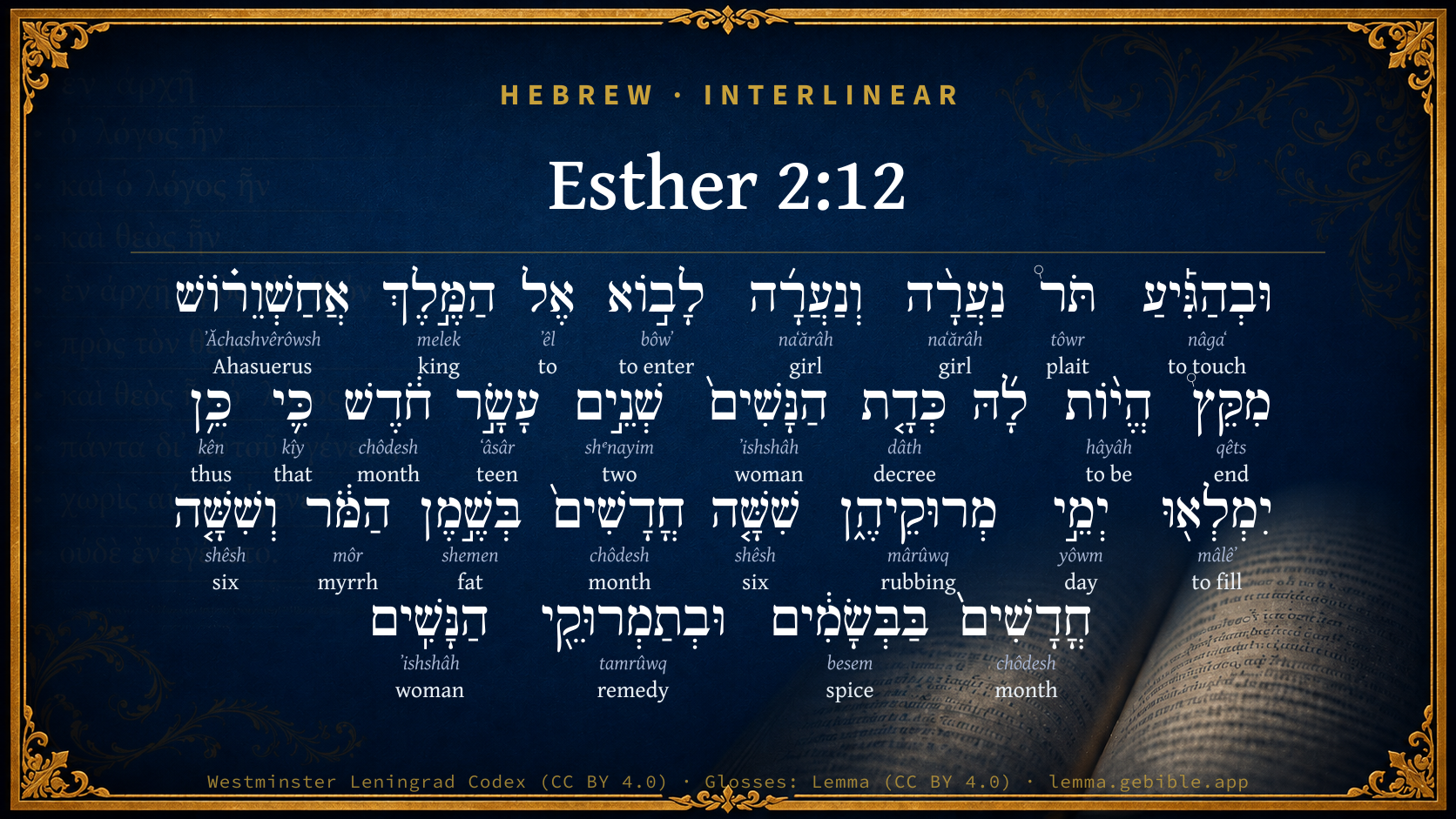
Hebrew (Westminster Leningrad Codex) Esther 2:12 appears in the Hebrew Old Testament. The text above is from the Westminster Leningrad Codex. Each word links to its Strong’s number, a concise gloss, and parsing drawn from the Open Scriptures Hebrew Bible morphology. Click any word for its full Brown-Driver-Briggs (BDB) entry.
Download image
Cite this verse

Esther 2:12 (World English Bible). Public Domain. Lemma interlinear Bible study tool, https://lemma.gebible.app/v/esther/2/12.

Show BibTeX & RIS
BibTeX
RIS
English Translation
Now when the turn of every maiden was come to go in to king Ahasuerus, after it had been done to her as prescribed for the women twelve months (for so were the days of their purification accomplished, [to wit], six months with oil of myrrh, and six months with sweet odors and with the things for the purifying of the women),
World English Bible · Public Domain
Highlights
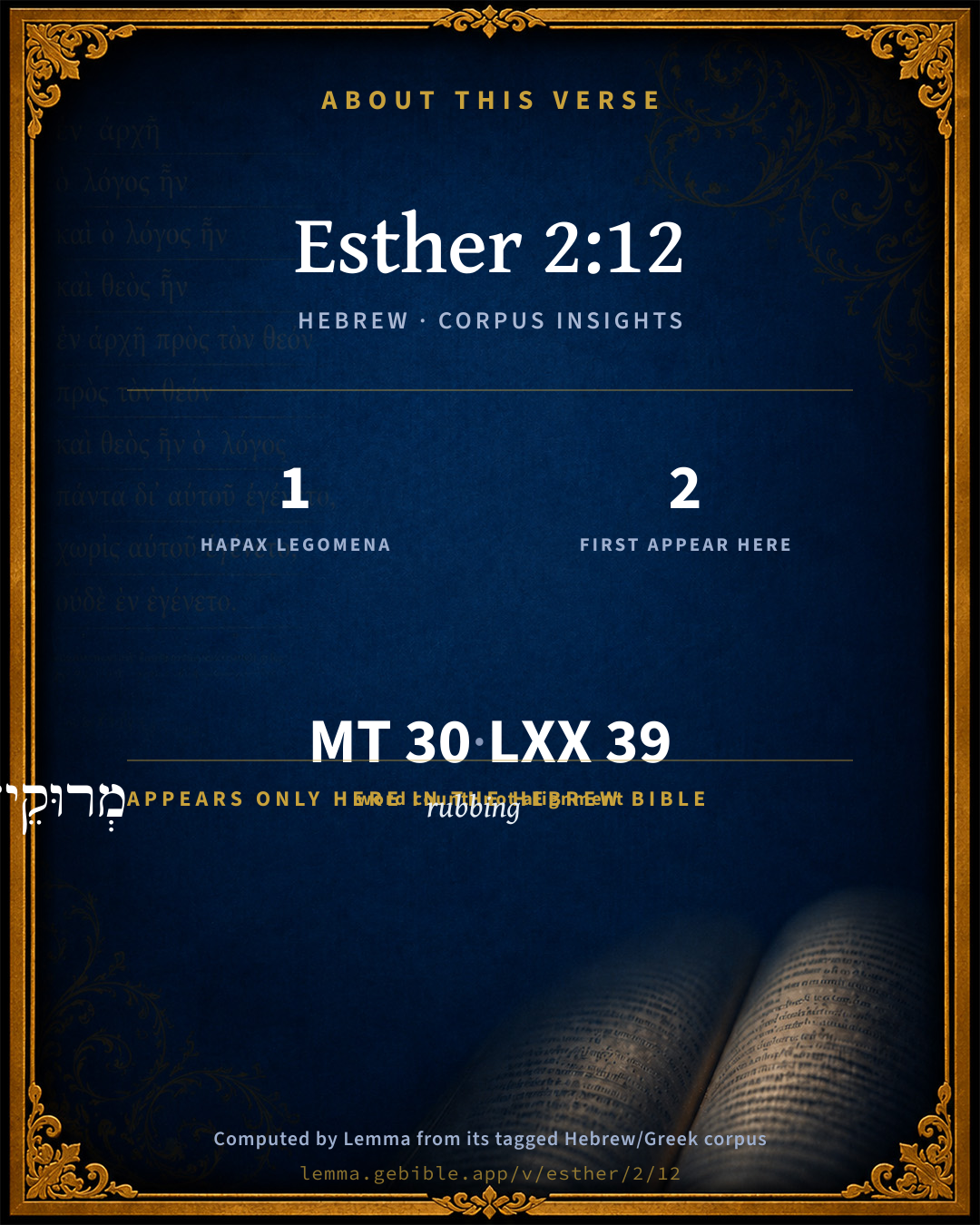
  • 1 hapax legomenon — only here in the Hebrew Bible
  • 2 first appearances in the Hebrew Bible
Full analysis ↓
Download a study sheet

One document with this verse’s original text, its word-by-word gloss line, the meaning frame, cross-references with their text, attributed commentary, and full source and license credits — printable, and it pastes into notes with its structure intact.

This verse Autodidact and up

Study sheet (.html) Plain text (.txt)

A passage Seminary Student

Up to 50 verses in one chapter. A passage sheet keeps up to 6 commentary sources and 12 cross-references per verse, in the order this page ranks them, and says so on the sheet whenever that leaves anything out. Ask for a single verse and you get the Autodidact verse sheet above.

Everything on this page stays free to read, with no account — the sheet is a download of what is already on screen, not access to it.

Want to remove ads? Support Godless Engineer
Compare translations 3

The same verse in 3 English versions, stacked beneath the original-language interlinear above. Click any original word for its lexicon entry.

Each is an independent rendering of the whole verse — the interlinear is not word-aligned to these translations.

Highlighted words mark where these versions differ — a whole-verse word diff, not a word-by-word alignment.

  • World English Bible Public Domain
    Now when the turn of every maiden was come to go in to king Ahasuerus, after it had been done to her as prescribed for the women twelve months (for so were the days of their purification accomplished, [to wit], six months with oil of myrrh, and six months with sweet odors and with the things for the purifying of the women),
  • King James Version Public Domain
    Now when every maid's turn was come to go in to king Ahasuerus, after that she had been twelve months, according to the manner of the women, (for so were the days of their purifications accomplished, to wit, six months with oil of myrrh, and six months with sweet odours, and with other things for the purifying of the women;)
  • unfoldingWord Literal Text CC BY-SA 4.0
    Now when the turn came for young woman by young woman to go to the king Ahasuerus, it was after her 12 months, according to the law of women. For thus the days of their beautification would be fulfilled: six months by oil of myrrh, then six months by perfumes and by the ointments of women.

unfoldingWord Literal Text — © unfoldingWord, licensed CC BY-SA 4.0. Word-aligned USFM3 via Door43 (git.door43.org/unfoldingWord/en_ult).

Versions to compare (up to 4)

3 of 4 selected

Show all 18 translations

Every available English version of this verse, each an independent rendering of the whole verse.

  • World English Bible Public Domain
    Now when the turn of every maiden was come to go in to king Ahasuerus, after it had been done to her as prescribed for the women twelve months (for so were the days of their purification accomplished, [to wit], six months with oil of myrrh, and six months with sweet odors and with the things for the purifying of the women),
  • Berean Standard Bible Public Domain
    In the twelve months before her turn to go to King Xerxes, the harem regulation required each young woman to receive beauty treatments with oil of myrrh for six months, and then with perfumes and cosmetics for another six months.
  • Majority Standard Bible Public Domain
    In the twelve months before her turn to go to King Xerxes, the harem regulation required each young woman to receive beauty treatments with oil of myrrh for six months, and then with perfumes and cosmetics for another six months.
  • King James Version Public Domain
    Now when every maid's turn was come to go in to king Ahasuerus, after that she had been twelve months, according to the manner of the women, (for so were the days of their purifications accomplished, to wit, six months with oil of myrrh, and six months with sweet odours, and with other things for the purifying of the women;)
  • American Standard Version (1901) Public Domain
    Now when the turn of every maiden was come to go in to king Ahasuerus, after that it had been done to her according to the law for the women twelve months (for so were the days of their purifications accomplished, `to wit', six months with oil of myrrh, and six months with sweet odors and with the things for the purifying of the women),
  • Revised Version (1885) Public Domain
    Now when the turn of every maiden was come to go in to king Ahasuerus, after that it had been done to her according to the law for the women, twelve months, (for so were the days of their purifications accomplished, to wit, six months with oil of myrrh, and six months with sweet odours, and with the things for the purifying of the women,)
  • Geneva Bible (1599) Public Domain
    And when the course of euery mayd came, to go in to King Ahashuerosh, after that she had bene twelue moneths according to the maner of the women (for so were the dayes of their purifications accomplished, sixe moneths with oyle of myrrhe, and sixe moneths with sweete odours and in the purifying of the women:
  • Douay-Rheims (1899) Public Domain
    Now when every virgin's turn came to go in to the king, after all had been done for setting them off to advantage, it was the twelfth month: so that for six months they were anointed with oil of myrrh, and for other six months they used certain perfumes and sweet spices.
  • Young's Literal Translation Public Domain
    And in the drawing nigh of the turn of each young woman to come in unto the king Ahasuerus, at the end of there being to her -- according to the law of the women -- twelve months, for so they fulfil the days of their purifications; six months with oil of myrrh, and six months with spices, and with the purifications of women,
  • Literal Standard Version CC BY-SA 4.0
    And in the drawing near of the turn of each young woman to come in to King Ahasuerus, at the end of there being to her—according to the law of the women—twelve months, for so they fulfill the days of their purifications; six months with oil of myrrh, and six months with perfumes, and with the purifications of women,
  • Unlocked Literal Bible CC BY-SA 4.0
    When the turn came for each girl to go to King Ahasuerus—complying with the regulations for the women, each girl had to complete twelve months of beauty treatments, six months with oil of myrrh, and six with perfumes and cosmetics—
  • unfoldingWord Literal Text CC BY-SA 4.0
    Now when the turn came for young woman by young woman to go to the king Ahasuerus, it was after her 12 months, according to the law of women. For thus the days of their beautification would be fulfilled: six months by oil of myrrh, then six months by perfumes and by the ointments of women.
  • Darby Bible Public Domain
    And when every maiden's turn came to go in to king Ahasuerus after that she had been treated for twelve months, according to the manner of the women (for so were the days of their purification accomplished -- six months with oil of myrrh, and six months with spices, and with things for the purifying of the women,
  • World Messianic Bible Public Domain
    Each young woman’s turn came to go in to King Ahasuerus after her purification for twelve months (for so were the days of their purification accomplished, six months with oil of myrrh, and six months with sweet fragrances and with preparations for beautifying women).
  • Webster's Bible Public Domain
    Now when every maid's turn had come to go in to king Ahasuerus, after that she had been twelve months, according to the manner of the women, (for so were the days of their purifications accomplished, to wit, six months with oil of myrrh, and six months with sweet odors, and with other things for the purifying of the women;)
  • Free Bible Version CC BY-SA 4.0
    Before it was the turn of a young woman to go to King Xerxes, she had to complete twelve months of beauty treatments for women that were required: six months with oil of myrrh, and six with perfumed oils and ointments.
  • Bible in Basic English Public Domain
    Now every girl, when her turn came, had to go in to King Ahasuerus, after undergoing, for a space of twelve months, what was ordered by the law for the women (for this was the time necessary for making them clean, that is, six months with oil of myrrh and six months with sweet perfumes and such things as are needed for making women clean):
  • JPS Tanakh (1917) Public Domain
    Now when the turn of every maiden was come to go in to king Ahasuerus, after that it had been done to her according to the law for the women, twelve months — for so were the days of their anointing accomplished, to wit, six months with oil of myrrh, and six month with sweet odours, and with other ointments of the women —

Literal Standard Version (2020), Covenant Press — licensed CC BY-SA 4.0. Text via the HelloAO Bible API (eBible.org). Unlocked Literal Bible (unfoldingWord) — licensed CC BY-SA 4.0. Text via the HelloAO Bible API (eBible.org). unfoldingWord Literal Text — © unfoldingWord, licensed CC BY-SA 4.0. Word-aligned USFM3 via Door43 (git.door43.org/unfoldingWord/en_ult). Free Bible Version, Dr. Jonathan Gallagher — licensed CC BY-SA 4.0. Text via the HelloAO Bible API (eBible.org).

Word by word

More ways to search: Search by grammar → Find every occurrence → Compare this word →

Practice this passage: Drill this verse → Learn its vocabulary →

מְרוּקֵיהֶ֑ן
mârûwq
H4795
“rubbings · their”
Noun, Common, Masculine, Plural, Construct + Suffix, Personal, 3rd Person, Feminine, Plural
Part of Speech
Noun
Type
Common
Gender
Masculine
Number
Plural
State
Construct
Full BDB Definition

Origin: from H4838

TWOT: 1246a

scraping, rubbing - of year of preparation of girls for the harem; bodily rubbings
  1. וּבְהַגִּ֡יעַ nâgaʻ H5060 “and · in/at · to touch” Conjunction + Preposition + Verb, Hiphil, Infinitive Construct
  2. תֹּר֩ tôwr H8447 “plait of” Noun, Common, Masculine, Singular, Construct
  3. נַעֲרָ֨ה naʻărâh H5291 “girl” Noun, Common, Feminine, Singular, Absolute
  4. וְנַעֲרָ֜ה naʻărâh H5291 “and · girl” Conjunction + Noun, Common, Feminine, Singular, Absolute
  5. לָב֣וֹא bôwʼ H935 “to enter” Preposition + Verb, Qal, Infinitive Construct
  6. אֶל ʼêl H413 “to” Preposition
  7. הַמֶּ֣לֶךְ melek H4428 “the · king” Particle, Definite Article + Noun, Common, Masculine, Singular, Absolute
  8. אֲחַשְׁוֵר֗וֹשׁ ʼĂchashvêrôwsh H325 “Ahasuerus” Noun, Proper
  9. מִקֵּץ֩ qêts H7093 “from · end of” Preposition + Noun, Common, Masculine, Singular, Construct
  10. הֱי֨וֹת hâyâh H1961 “to be” Verb, Qal, Infinitive Construct
  11. כְּדָ֤ת dâth H1881 “like/as · decree of” Preposition + Noun, Common, Feminine, Singular, Construct
  12. הַנָּשִׁים֙ ʼishshâh H802 “the · women” Particle, Definite Article + Noun, Common, Feminine, Plural, Absolute
  13. שְׁנֵ֣ים shᵉnayim H8147 “two” Adjective, Cardinal number, Masculine, Dual, Absolute
  14. עָשָׂ֣ר ʻâsâr H6240 “teen” Adjective, Cardinal number, Masculine, Singular, Absolute
  15. חֹ֔דֶשׁ chôdesh H2320 “month” Noun, Common, Masculine, Singular, Absolute
  16. כִּ֛י kîy H3588 “that” Conjunction
  17. כֵּ֥ן kên H3651 “thus” Particle, Demonstrative
  18. יִמְלְא֖וּ mâlêʼ H4390 “to fill” Verb, Qal, Imperfect, 3rd Person, Masculine, Plural
  19. יְמֵ֣י yôwm H3117 “days of” Noun, Common, Masculine, Plural, Construct
  20. שִׁשָּׁ֤ה shêsh H8337 “six” Adjective, Cardinal number, Masculine, Singular, Absolute
  21. חֳדָשִׁים֙ chôdesh H2320 “months” Noun, Common, Masculine, Plural, Absolute
  22. בְּשֶׁ֣מֶן shemen H8081 “in/at · fat of” Preposition + Noun, Common, Masculine, Singular, Construct
  23. הַמֹּ֔ר môr H4753 “the · myrrh” Particle, Definite Article + Noun, Common, Masculine, Singular, Absolute
  24. וְשִׁשָּׁ֤ה shêsh H8337 “and · six” Conjunction + Adjective, Cardinal number, Masculine, Singular, Absolute
  25. חֳדָשִׁים֙ chôdesh H2320 “months” Noun, Common, Masculine, Plural, Absolute
  26. בַּבְּשָׂמִ֔ים besem H1314 “in/at the · spices” Preposition, Determined + Noun, Common, Masculine, Plural, Absolute
  27. וּבְתַמְרוּקֵ֖י tamrûwq H8562 “and · in/at · remedies of” Conjunction + Preposition + Noun, Common, Masculine, Plural, Construct
  28. הַנָּשִֽׁים ʼishshâh H802 “the · women” Particle, Definite Article + Noun, Common, Feminine, Plural, Absolute

About this verse

These counts appear in no published source. They are computed here, from the morphology-tagged text and Lemma’s own curated glosses. What Lemma adds →

30
words
24
distinct lemmas
Historical
section

Notable vocabulary

1 hapax legomenon — a word that appears only here in the entire Hebrew Bible:

  • מְרוּקֵיהֶ֑ן rubbing H4795

First appearance in Scripture

These words make their first canonical appearance in the Hebrew Bible here:

  • תֹּר֩ plait H8447
  • מְרוּקֵיהֶ֑ן rubbing H4795

Shared distinctive vocabulary

תֹּר֩ plait H8447 occurs in 4 verses of the Hebrew Bible. Also found in:

Grammatical profile

  • 4 verbs
  • 18 nouns
  • 4 adjectives
  • 2 prepositions
  • 1 conjunction
  • 1 particle

Verb forms

  • וּבְהַגִּ֡יעַ Hiphil · Infinitive Construct
  • לָב֣וֹא Qal · Infinitive Construct
  • הֱי֨וֹת Qal · Infinitive Construct
  • יִמְלְא֖וּ Qal · Imperfect

Repetition

Words recur within this verse — often emphatic in Hebrew:

  • חֹ֔דֶשׁ month H2320 ×3
  • נַעֲרָ֨ה girl H5291 ×2
  • הַנָּשִׁים֙ woman H802 ×2
  • שִׁשָּׁ֤ה six H8337 ×2

Hebrew & Septuagint length

In English translation the verse runs 62 words from the Hebrew and 47 from the Septuagint (LXX English) — closely comparable.

A rough comparison of the two English renderings, which tokenize alike — not a word-level alignment.

Word counts can differ between the Hebrew and the Greek without any difference in meaning — e.g. the Hebrew direct-object marker אֵת has no separate Greek word, and Greek often adds the article ὁ.

In the original languages it is 30 Hebrew tokens and 39 Greek tokens — but the two are counted differently (Hebrew bundles its prefixes and suffixes into one token; the Greek is in lemma form), so that isn’t a like-for-like length.

Cross-references

5

Topical passages linked to Esther 2:12 in the Treasury of Scripture Knowledge — connected by theme and wording, ordered by reader-vote popularity; previews shown in the World English Bible.

  • Proverbs 7:17 I have perfumed my bed with myrrh, aloes, and cinnamon.
  • 1 Thessalonians 4:4–5 that each one of you know how to possess himself of his own vessel in sanctification and honor,
  • Isaiah 57:9 You went to the king with oil, and did increase your perfumes, and did send your ambassadors far off, and did debase yourself even to Sheol.
  • Song of Solomon 3:6 Who is this who comes up from the wilderness like pillars of smoke, Perfumed with myrrh and frankincense, With all spices of the merchant?
  • Luke 7:37–38 Behold, a woman in the city who was a sinner, when she knew that he was reclining in the Pharisee's house, she brought an alabaster jar of ointment.

Cross-references courtesy of OpenBible.info (CC BY 4.0).

Hebrew and Greek witnesses Masoretic Hebrew ↔ Greek Septuagint

The same verse in the two great witnesses to the Old Testament, shown verse-for-verse.

These are two independent witnesses, not word-aligned to each other, and the Septuagint is shown in lemma (dictionary) form.

Hebrew Esther 2:12 Masoretic · Westminster Leningrad Codex

וּבְהַגִּ֡יעַ תֹּר֩ נַעֲרָ֨ה וְנַעֲרָ֜ה לָב֣וֹא אֶל הַמֶּ֣לֶךְ אֲחַשְׁוֵר֗וֹשׁ מִקֵּץ֩ הֱי֨וֹת לָ֜הּ כְּדָ֤ת הַנָּשִׁים֙ שְׁנֵ֣ים עָשָׂ֣ר חֹ֔דֶשׁ כִּ֛י כֵּ֥ן יִמְלְא֖וּ יְמֵ֣י מְרוּקֵיהֶ֑ן שִׁשָּׁ֤ה חֳדָשִׁים֙ בְּשֶׁ֣מֶן הַמֹּ֔ר וְשִׁשָּׁ֤ה חֳדָשִׁים֙ בַּבְּשָׂמִ֔ים וּבְתַמְרוּקֵ֖י הַנָּשִֽׁים

Now when the turn of every maiden was come to go in to king Ahasuerus, after it had been done to her as prescribed for the women twelve months (for so were the days of their purification accomplished, [to wit], six months with oil of myrrh, and six months with sweet odors and with the things for the purifying of the women),

World English Bible · Public Domain

Greek LXX Esther 2:12 Septuagint · lemma form

οὗτος δέ εἰμί καιρός κοράσιον εἰςἔρχομαι πρός ὁ βασιλεύς ὅταν ἀναπληρόω μήν δέκα δύο οὕτως γάρ ἀναπληρόω ὁ ἡμέρα ὁ θεραπεία μήν ἕξ ἀλείφω ἐν σμύρνινος ἔλαιον καί μήν ἕξ ἐν ὁ ἄρωμα καί ἐν ὁ σμῆγμα ὁ γυνή

Now this was the time for a virgin to go into the king, when she should have fulfilled twelve months; for so are the days of purification fulfilled, six months while they are anointing themselves with oil of myrrh, and six months with spices and women's purifications.

LXX2012 (modern English Septuagint) · Public Domain

On this verse, Keil & Delitzsch discusses the Septuagint’s reading. Read the note in Commentary ↓

Hebrew: Westminster Leningrad Codex (CC BY 4.0). Greek: Septuagint (public domain); English from LXX2012 (modern English Septuagint) (Public Domain). How the Septuagint differs from the Hebrew →

Commentary

Notes on Esther 2:12 from classic Christian and Jewish commentators (each source and its license shown beneath its notes). The classic Christian expositions comment on the surrounding passage and are grouped to its opening verse, so a note may address several verses; the Jewish commentaries on the Tanakh (Rashi and others) are per-verse, so they appear only where the commentator wrote on this verse.

Lemma curates 59 commentaries, every one of them public domain or Creative Commons licensed, each selected and text-cleaned for this edition rather than reprinted as found. About our sources →

Trapp's Complete Commentary

John Trapp

Est 2:12 Now when every maid’s turn was come to go in to king Ahasuerus, after that she had been twelve months, according to the manner of the women, (for so were the days of their purifications accomplished, [to wit], six months with oil of myrrh, and six months with sweet odours, and with [other] things for the purifying of the women;)

Ver. 12. Now when every maid’s turn was come] Their turns then they took, and held it their happiness to lose that which was their honour. See 1Th 4:4, {See Trapp on "1Th 4:4"} their bodies were first adulterated, and then vitiated. This was abominable.

After that she had been twelve months] Time spent without spare, and woefully wasted in making provision for the flesh to fulfil the lusts thereof; which the prophet Amos rightly calleth a thing of nought, Amo 6:13; Amo 4:5-6. Is time no better worth than to be thus rioted out in vanity? doth not eternity depend upon it, even the heaviest weights upon the weakest wires? It is therefore a good rule that one giveth,

Corrige praeteritum, rege praesens, cerne futurum.

According to the manner of the women] Who of themselves are apt enough (without an order to do so, as here) to cast away too much time and cost in tricking and trimming their bodies (those painted sheaths), as the comedians have tartly taxed them. Negotii quantum in muliere una est! saith Plautus. What a deal of do is there with one woman in this kind! And Nosti mores mulierum, saith Terence, dum moliuntur, dum comuntur, annus est. And as for the Persian women, Aelian saith that they were above all others most addicted to this vanity (Lib. xii. cap. 1); and yet the haughty daughters of Zion are deeply censured, and heavily threatened, Isa 3:18, where the prophet gives us an inventory of those ladies’ gallantry, and tells them that their fineness shall be turned into filthiness, their neatness become nastiness.

For so were the days of their purification accomplished] What strange preparation was here for the impure bed of a heathen! Every virgin must be six months purified, and six months perfumed. O God, saith one, what care and cost is requisite to that soul which should be addressed a fit bride for thy holy and glorious Majesty!

To wit, six months with oil of myrrh] To cleanse them, and to clear up their countenances.

And six months with sweet odours] Of these there is a lawful use (why else were they created?), to please the sense, refresh the spirits, comfort the brain, &c. But the excess and abuse of them is utterly unlawful, and was justly punished in Darius, the last Persian monarch, and Muleasses, king of Tunis, who so far affected sweet odours, that he could not be without them whiles he was in the field against his enemy, thereby it came to pass, that being overcome in battle by his own son Amidas (another Absalom), and pursued among the rest that fled, he was found and known who he was by the perfumes that he had about him, though to prevent it he had besmeared himself with blood and dust. Martial, writing to his sweet friend, saith,

Posthmne, non bene olet, qui bene semper olet.

And another saith, That woman smells best who smells of nothing. Spiret autem foemina Christum, saith Clement of Alexandria, Let women learn and labour to smell of Christ, who is the royal unction, and let them ever be anointed with chastity, that chiefest ointment (Paedag. lib. 2, cap. 8).

And with other things for the purifying of women] Here was no end of excess and of expense; and all to satisfy the lust of this impure prince. Silver is lavished out of the bag, and much wealth cast away upon these minions, who had nothing else to do but to exercise their wits in devising ornaments and artifices, whereby they might get the king’s favour, and attain to the queendom. Cicero telleth us that it was ordinary with the kings of Persia to bestow upon their women such a city to buy them bracelets, and such a city for head-tires, &c., Haec in collum, haec in crines (Orat. 5, in Verr.). This was luxus plane monstrosissimus et prodigalissimus, as one saith, most prodigious and prodigal luxury. So eagerly are the wicked bent upon the satisfying of their lusts, that they care not what cost they cast away upon them. Ask me never so much dowry, saith that Amouretto, Gen 34:11-12. Judah let go his signet, bracelets, and staff, to the harlot. Josephus reports of one Decius Mundus (Immundus rather), a nobleman, that to one Paulina, a lady in Rome, he offered as much as came to six thousand pounds to satisfy his lusts but one night, and yet he could not bring her to his lure by such a large offer; though afterwards (under the mask of Anubis, to which dog’s head she was devoted) he found means to abuse her; which was the destruction both of those bawdy priests and their temple.

John Trapp, A Commentary or Exposition upon All the Books of the Old and New Testament (1647–1656) — public domain. Text from a community e-Sword module.

Joseph Benson's Commentary

Est 2:12. According to the manner of the women — Who were kept so long, partly for their better purification, as it here follows; partly out of state, as that which became so great a king; and partly that, being so long in safe custody, the king might be sure he was not imposed upon by a child begotten by another man. Six months with oil of myrrh, and six months with sweet odours — It is observed by Pliny, lib. 13, cap. 1, that ointments were first invented by the Persians. Oil of myrrh was used, not only on account of its fragrancy, but to make the skin soft and smooth, and to clear it from all manner of scurf; and the sweet odours were necessary, in those hot countries, to take away all ill scents, and, as some think, to enliven and invigorate the constitution.

Joseph Benson's Commentary on the Old and New Testaments (1811–1818) — public domain. Text from a community e-Sword module.

The Preacher's Complete Homiletical Commentary

Joseph S. Exell (gen. ed.)

CRITICAL NOTES.]

Est_2:13. Whatsoever she desired] In the way of jewels, ornaments, or dress. “No doubt,” says Rawlinson, “the virgins generally took the opportunity—one that would occur but once in their lives—to load themselves with precious ornaments of various kinds—necklaces, bracelets, earrings, anklets, and the like.”

MAIN HOMILETICS OF THE PARAGRAPH. Est_2:12-14

THE VANITY OF EARTHLY HOPES

Here is a vivid description of the means taken to minister to and to gratify the carnal pleasures of a depot. Sensuality is permitted without stint. Manhood is lowered. The animal is made supreme. Ahasuerus the king is turned into Ahasuerus the slave—the slave of degrading lusts. Men have not the same opportunities of self-degradation as were provided for this Eastern monarch. But still men may give way to the sensual. Let them avoid the earthly and the sensual, for their climax is the devilish. Now consider the unhappy case of these poor virgins.

I. The great preparation. For twelve months these unhappy victims were being prepared for the great occasion that would most likely occur only once in their lives. Oil of myrrh and sweet odours were at their disposal in abundance. The choicest garments and rarest jewels were in readiness. Female vanity could for once gratify its propensity for outward adornments. Through all time men and women will make great preparation to render the external attractive, while the internal is neglected. Even now women will dress and trick themselves up for a state reception of a few moments’ duration. Very few make earnest preparation to dress the soul, and to be ready for heavenly reception.

II. The flattering hopes. Each virgin would doubtless entertain the hope of becoming queen in place of the deposed Vashti. What a delightful prospect! How flattering the hopes that would flutter in each virgin’s mind! We please ourselves thus with fond delusive hopes. Well is it for us that hope is so buoyant in this dark world. After all, these flattering hopes are of great service to us in our chequered career.

III. Great preparations wasted. These virgins derived little earthly profit from all their planning and arranging. What a picture this of the wasted preparations in the lives of most! Much money is spent on the boy’s education, and just as he reaches manhood death comes and seizes the prey. The lovely maiden droops and dies ere the flower of her beauty is fully blown. The prince is killed by the weapons of savages before he has had time to achieve a name and to lay claim to imperial dignity. The pen falls from the writer’s hand just as he is beginning to give permanence to the laboured and matured thoughts of his mind. The world is full of ruins. Wasted preparations strew the ground.

IV. Flattering hopes destroyed. These virgins were sent back into the chambers of the concubines—“the prison of sad and withered hearts.” There are many prisons that we do not see. Imprisoned souls endure the saddest punishment. Withered hearts! who shall count them? Flattering hopes destroyed! who shall tell their appalling number? Every life has its own long, dreary list of blasted hopes.

Learn—(a) that preparation for heavenly service is never wasted. Perhaps life is not so full of waste as we have supposed. The Divine Builder can turn our very ruins to useful purposes. The preparation that was wasted in one man’s life may be of service to another. However, the true way to avoid possible waste is to make this earthly life a preparation for the heavenly. We prepare to enter the court of earthly kings, and are never summoned to the royal presence; but those who prepare in the right spirit and according to the gospel method to enter the court of the King eternal will most assuredly be summoned to stand in that Presence where there is fulness of joy. (b) That the hopes suggested by the gospel cannot be destroyed. The hopes of the worldling are too often delusive. The hopes of the hypocrite shall perish. But the hope of the righteous is gladness. To the man who builds by faith on the gospel of God’s dear Son there is gladness in anticipation and gladness in fruition. Those who, justified by faith in Christ, and sanctified by the Divine Spirit, entertain the hope of being for ever in heaven, will never be sent back to the prison of sad and withered hearts. (c) If the children of this world make such great preparations for positions they may never be called to occupy, what preparations should the children of light make to occupy aright the high position to which they will be most certainly called. “Wherefore the rather, brethren, give diligence to make your calling and election sure.”

SUGGESTIVE COMMENTS ON Est_2:12-14

What strife, what emulation was now amongst all the Persian damsels that either were or thought themselves fair! Every one hopes to be a queen, and sees no reason why any other should be thought more excellent. How happy were we if we could be so ambitious of our espousals to the King of heaven! Every virgin must be six months purified with the oil of myrrh, and six other months perfumed with sweet odours, besides those special receipts that were allowed to each upon their own election. O God, what care, what cost is requisite to that soul which should be addressed a fit bride for thine holy and glorious majesty? When we have scoured ourselves with the most cleansing oil of our repentance, and have perfumed ourselves with thy best graces, and our perfectest obedience, it is the only praise of thy mercy that we may be accepted.—Bishop Hall.

No doubt the virgins generally took the opportunity—one that would occur but once in their lives—to load themselves with precious ornaments of various kinds—necklaces, bracelets, earrings, anklets, and the like.—Rawlinson.

What care and cost is required for the decoration of the soul when it would prepare as an acceptable bride for Jesus.—Starke.

Because God desires more and more to have delight in us, and to draw nigh to us, and therefore he more and more goes on to purge us. For though he loves us at first, when full of corruptions, yet he cannot so much delight in us as he would, nor have that communion with us, no more than a husband can with a wife who hath an unsavoury breath or a loathsome disease. They must therefore be purified for his bed, as Esther was for Ahasuerus. “Draw nigh to God,” says James, “and he will draw nigh to you;” but then you must “cleanse your hands, and purify your hearts,” as it follows there; God else hath no delight to draw nigh to you.—Goodwin.

ILLUSTRATIONS TO CHAPTER 2

Discipline of the passions. The passions may be humoured until they become our master, as a horse may be pampered till he gets the better of his rider; but early discipline will prevent mutiny, and keep the helm in the hands of reason. Properly controlled, the passions may, like a horse with the bit in his mouth, or a ship with the helm in the hand of a skilful mariner, be managed and made useful.

A rich landlord once cruelly oppressed a poor widow. Her son, a little boy of eight years, saw it. He afterwards became a painter, and painted a life likeness of the dark scene. Years afterwards, he placed it where the man saw it. He turned pale, trembled in every joint, and offered any sum to purchase it, that he might put it out of sight. Thus there is an invisible painter drawing on the canvas of the soul a life likeness, reflecting correctly all the passions and actions of our spiritual history on earth. Now and again we should be compelled to look at them, and the folly of our acts will sting us, as it did the landlord, and also Ahasuerus.

Control of anger. Socrates, finding himself in emotion against a slave, said: “I would beat you if I were not angry.” Having received a box on the ears, he contented himself by only saying, with a smile, “It is a pity we do not know when to put on the helmet.” Socrates, meeting a gentleman of rank in the streets, saluted him; but the gentleman took no notice of it. His friends in company, observing what passed, told the philosopher “That they were so exasperated at the man’s incivility, that they had a good mind to resent it.” He very calmly replied, “If you met any person in the road in a worse habit of body than yourself, would you think you had reason to be enraged with him on that account? Pray, then, what greater reason can you have for being incensed at a man for a worse habit of mind than any of yourselves?” That was a brave, strong man.

Impressions of sin. The great stone book of nature reveals many records of the past. In the red sandstone there are found, in some places, marks which are clearly the impression of showers of rain, and these are so perfect that it can even be detected in which direction the shower inclined, and from what quarter it proceeded—and this ages ago. Even so sin leaves its track behind it, and God keeps a faithful record of all our sins.—Biblical Treasury.

“If you cut a gash in a man’s head, you may heal it; but you can never rub out, nor wash out, nor cut out the scar. It may be a witness against you in his corpse; still it may be covered by the coffin, or hidden in the grave; but then it is not till decomposition shall take place, that it shall entirely disappear. But, if you smite your soul by sin, you make a scar that will remain; no coffin or grave shall hide it; no fire, not even the eternal flames, shall burn out sin’s stains.”

Counterfeit repentance. Beware that you make no mistake about the nature of true repentance. The devil knows too well the value of the precious grace not to dress up spurious imitations of it. Wherever there is good coin there will always be bad money.—Ryle.

Repentance before pardon. The first physic to recover our souls is not cordials, but corrosives; not an immediate stepping into heaven by a present assurance, but mourning, and lamentations, and a little bewailing of our former transgressions. With Mary Magdalene we must wash Christ’s feet with our tears of sorrow, before we may anoint his head with “the oil of gladness.”—Browning.

In all parts of the East, women are spoken of as being much inferior to men in wisdom; and nearly all their sages have proudly descanted on the ignorance of women. In the Hindoo book called the ‘Kurral,’ it is declared, “All women are ignorant.” In other works similar remarks are found: “Ignorance is a woman’s jewel. The feminine qualities are four—ignorance, fear, shame, and impurity. To a woman disclose not a secret. Talk not to me in that way; it is all female wisdom.”—Roberts.

Degradation of woman. The farmers of the upper Alps, though by no means wealthy, live like lords in their houses, while the heaviest portion of agricultural labour devolves on the wife. It is no uncommon thing to see a woman yoked to the plough along with an ass, while the husband guides it. A farmer of the upper Alps accounts it an act of politeness to lend his wife to a neighbour who is too much oppressed with work; and the neighbour, in his turn, lends his wife for a few day’s work, whenever the favour is requested.—Percy.

Radical reform. A small bite from a serpent will affect the whole body. There is no way to calm the sea but by excommunicating Jonah from the ship. If the root be killed, the branches will soon be withered. If the spring be diminished, there is no doubt that the streams will soon fail. When the fuel of corruption is removed, then the fire of affliction is extinguished.—Secker.

Individual responsibility. Daniel Webster was once asked, “What is the most important thought you ever entertained?” He replied, after a moment’s reflection, “the most important thought I ever had was my individual responsibility to God.” There is no royal road, either to wealth or learning. Princes and kings, poor men, peasants, all alike must attend to the wants of their own bodies, and their own minds. No man can eat, drink, or sleep by proxy. No man can get the alphabet learned for him by another. All these are things which everybody must do for himself, or they will not be done at all. Just as it is with the mind and body, so it is with the soul. There are certain things absolutely needful to the soul’s health and well-being. Each must repent for himself. Each must apply to Christ for himself. And for himself each must speak to God and pray.—Ryle.

The Preacher's Complete Homiletical Commentary (gen. ed. Joseph S. Exell; Funk & Wagnalls, c. 1892) — public domain (pre-1929). A full-Bible homiletical/sermon-outline anthology covering 65 of 66 books (2 John is absent from the source module). Text from a community e-Sword module.

Keil & Delitzsch

C. F. Keil & F. Delitzsch

Before relating the appearance of Esther before the king, the narrator more particularly describes in Est 2:12-14 the preparations for this event, and how Esther behaved with respect to them.

Est 2:12-13

"When every maid's turn came (i.e., at every time that any maid's turn came) to go in to King Ahashverosh, after the time when it had been done to her twelve months according to the law of the women - for thus were the days of their purification accomplished: six months with oil of myrrh, and six months with balsam and ointments of purification for women - and the maiden came to the king, all that she desired was given her to go with her out of the women's house unto the king's house." תּור, turn in succession, used only here and Est 2:15. The turn to go in unto the king did not come to any maid until וגו היות מקּץ, at the end of the time when it had been done to her according to the law ... This time lasted twelve months after her reception into the house of the women; and the law of the women, according to which it was done to her, was, that she should be purified for six months with oil of myrrh, and as long with בּשׂמים, sweet odours and other ointments. בּאה הנּערה וּבזה (Est 2:13) forms the continuation of the antecedent clause commencing with כּהנּיע, or, to speak more correctly, of a second antedecent with which the conclusion כּל־אשׁר את is connected. Some expositors understand בּזה, with the lxx, of the time: illo sc. tempore; others of the condition: hoc modo ornata or ea lege (Cler.), and therefore as parallel in meaning with the כּן of Est 4:16. Either view is admissible and suits the sense, but the latter is more in harmony with the parallel passage Est 4:16, and therefore preferable. All that was to be given her, can only relate to ornaments and jewels, which were to be given that each might appear before the king adorned and dressed after her own taste.

Est 2:14

In the evening she went (to the king), and on the morrow she returned to the women's house, a second (time) to the hand (under the keeping of) Shaashgaz, the king's chamberlain, who kept the concubines; she came no more to the king, except the king delighted in her and she were called by name, i.e., specially. שׁני instead of שׁנית, like Neh 3:30.

Est 2:15

When Esther's turn came to go in unto the king, she required nothing (to take with her, see Est 2:13) but what Hegai the king's chamberlain appointed (hence as not concerned to please the king by special adornment), and she obtained favour in the sight of all them that looked upon her, namely, by her modesty and humility. On חן נשׂא, see remarks on Est 2:9.

Est 2:16

She was taken into the king's house (מלכוּת בּית instead of המּלך בּית, the palace of the kingdom, the royal residence) in the tenth month, i.e., the month Tebeth, in the seventh year of his reign.

Est 2:17

And the king loved Esther above all the women, and she obtained grace and favour in his sight more than all the virgins; and he set the royal crown upon her head, and made her queen instead of Vashti. The meaning evidently is, that the king, immediately after their first meeting, bestowed his affections upon Esther in preference to all the women and maidens, and chose her queen.

Est 2:18

To celebrate Esther's elevation to the crown, the king made a great feast, called Esther's feast, to all his princes and servants, and granted release to the provinces. The verbale Hiph. הנחה is translated in the lxx ἄφεσις, Vulg. requies, and understood either of a remission of taxes or a remission of labour, a holiday. Although the Chald. understands it of a remission of taxes, yet the use of the verb עשׂה rather favours the latter meaning, viz., the appointment of a holiday, on which there would be arresting from labour. Finally, he gave gifts with royal munificence משׂאת like Amo 5:11; Jer 40:5; המּלך כּיד like Est 1:7. - It seems strange that a period of four years should intervene between the repudiation of Vashti in the third year of Ahashverosh and the elevation of Esther in the seventh, an interval whose length cannot be adequately accounted for by the statements of the present book. Only a few days could have elapsed between the disgrace of Vashti and the time when the king remembered her; for this took place, we are told, when the king's wrath was appeased. The proposal to collect virgins from all parts of his kingdom to Susa was then immediately made. Now, if the carrying out of this proposal took half a year, and the preparation of the virgins by anointing, etc., lasted a year, Esther, even if her turn to go in unto the king had not come for six months, might have been made queen two years after the repudiation of Vashti. As she obtained the favour of Hegai immediately upon her reception into the women's house, so that he hastened her purifications (Est 2:9), she would not be brought before the king among the last, but would rather be one of the first to go in. The long interval which elapsed between the repudiation of Vashti and the elevation of Esther, can only be satisfactorily explained by the history of the reign of Xerxes; in fact, by the circumstance that his campaign against Greece took place during this time.

Keil & Delitzsch — Biblical Commentary on the Old Testament (1861–1891) — public domain (CC PDM 1.0). Text via the HelloAO Bible API. (Old Testament only.)

Tyndale Open Study Notes

Tyndale Open Resources

2:12 The twelve months of preparation no doubt involved training in court customs as well as beauty treatments, but the focus here is on physical beauty.

Tyndale Open Study Notes — © Tyndale Open Resources, licensed CC BY-SA 4.0. Text via the HelloAO Bible API.

Jamieson, Fausset & Brown

Robert Jamieson, A. R. Fausset & David Brown

Now when every maid's turn was come to go in to king Ahasuerus--A whole year was spent in preparation for the intended honor. Considering that this took place in a palace, the long period prescribed, together with the profusion of costly and fragrant cosmetics employed, was probably required by state etiquette.

Jamieson, Fausset & Brown — Commentary Critical and Explanatory on the Whole Bible (1871) — public domain (CC PDM 1.0). Text via the HelloAO Bible API.

Adam Clarke's Commentary

Verse 12. Six months with oil of myrrh] See on Es 2:3. The reason of this purification seems not to be apprehended by any writer I have seen. The most beautiful of all the young virgins of all the provinces of Babylon were to be selected; and these were taken out of all classes of the people, indiscriminately; consequently there must have been many who were brought up in low life. Now we know that those who feed on coarse strong food, which is not easily digested, have generally a copious perspiration, which is strongly odorous; and in many, though in every respect amiable, and even beautiful, this odour is far from being pleasant. Pure, wholesome, easily digested, and nourishing aliment, with the frequent use of the hot bath, continued for twelve months. the body frequently rubbed with olive oil, will in almost every case remove all that is disagreeable of this kind. This treatment will give a healthy action to all the subcutaneous vessels, and in every respect promote health and comfort.

Adam Clarke's Commentary on the Bible (1810–1826) — public domain. Text from a community e-Sword/MySword module.

Ellicott's Commentary for English Readers

(12) Manner.—Translate, law or ordinance, as in Est_1:8; Est_1:15.

A Bible Commentary for English Readers, edited by Charles John Ellicott (1878–1897) — public domain. Text from a community e-Sword module.

The Cambridge Bible for Schools and Colleges

gen. ed. J. J. S. Perowne

12. after that it had been done to her according to the law for the women, twelve months] More accurate than A.V. after that she had been twelve months, according to the manner of the women.

sweet odours] spices or balsam. The Hebrew and English words for myrrh (môr) and balsam (bôsem) are etymologically identical. These spices came to us from the East, and retained their Eastern names in European languages.

the things for the purifying] a general designation including the two items just mentioned. The A.V. less accurately has other things for the purifying.

The Cambridge Bible for Schools and Colleges (gen. ed. J. J. S. Perowne; Cambridge University Press, 1878–1918) — public domain. Text from a community e-Sword module.

John Gill's Exposition

Now when every maid's turn was come to go in to King Ahasuerus, after that she had been twelve months, according to the manner of women,.... That were prepared in the house of the women to be presented to the king for his liking; for it seems that these virgins came in turns to him, according to the time they had been in the house; as did the wives of the kings of Persia, as Herodotus relates (p):

for so were the days of their purifications accomplished; that is, in the space of twelve months, which were thus divided: to wit:

six months with oil of myrrh; which Ben Melech interprets of musk:

and six month's with sweet odours; the former was used to make the skin smooth and soft, and these to remove all ill scents through sweat, or any other cause:

and with other things for the purifying of women: by bathing, rubbing, &c. and such a space of time was observed not only for the thorough purification of them, but partly was of state and grandeur, and partly that it might be a clear case they were not with child by another, before they came to the king.

(p) Thalia, sive, l. 3. c. 69.

John Gill's Exposition of the Whole Bible (1746–1763) — public domain (CC PDM 1.0). Text via the HelloAO Bible API.

Haydock's Catholic Bible Commentary

Turn. This was rigidly observed, in that country, where polygamy prevailed, Genesis xxx. 16. (Herodotus iii. 69.) --- The wives were "shut up in separate apartments," (Just. i. 9.) in the remotest parts of the palace. (Calmet) --- Twelfth. A full year elapsed before they could be admitted. --- A sweet. Protestants, "other things for the purifying of the women." (Haydock) --- It would be difficult to form an adequate idea of the luxury of the Persians, if the Scripture had not informed us. The kings were not satisfied with one wife. Assuerus had 400; (Josephus) and Darius Codomannus carried 360 with him, in his expeditions. (Curtius iii.) --- Parmenio took an incredible number of his concubines, at Damascus. (Atheneus xiii. 9.) --- They were not all treated alike, but all were very sumptuously adorned. Cities were allotted to furnish one with sandals, another with girdles, &c. (Cicero in Verrem. v.) (Calmet)

George Leo Haydock (1774–1849), Haydock's Catholic Family Bible and Commentary, 1859 edition — public domain. Excludes Psalms (Douay-Rheims chapter numbering differs from Protestant) and Deuterocanonical books (Catholic canon only).

Matthew Poole's English Annotations

According to the manner of the women; who were kept so long, partly, for their better purification, as it here follows; partly, out of state, as that which became so great a king; and partly, that being so long in safe custody, the king might be sure that the child begotten upon any of them was his own.

With oil of myrrh; which is useful both for making the skin exactly clean, and smooth, and solid, and for giving strength and rigour to the body.

With sweet odours; which was the more necessary, because the bodies of men and women in those hot countries did of themselves yield very ill scents, if not corrected and qualified by art.

Matthew Poole's English Annotations on the Holy Bible (1683–1685) — public domain. Text from a community e-Sword/MySword module.

Whedon's Commentary on the Bible

Daniel D. Whedon

12. According to the manner of the women — Rather, the law of the women; that is, the order or requirement indicated in Est_2:2 and explained in the sequel of this verse, according to which these women were to go through a twelvemonths’ purification.

Myrrh… sweet odours — The design was to cleanse, soften, and beautify to the utmost possible degree.

Daniel D. Whedon (gen. ed.), Commentary on the Old and New Testaments (1874–1909) — public domain. Text from a community e-Sword module.

The Pulpit Commentary

After she had been twelve months, according to the manner of the women. Rather, "After she had been (in the palace), according to the law prescribed to the women, twelve months." A year"s purification was considered necessary before any maiden could approach the king (see the comment on ver. 3). Six months with oil of myrrh. Myrrh was highly esteemed, both for its scent and for its purifying power, by the ancients. In Egypt it was employed largely in the preparation of mummies (Herod., 2:86). The Jews were directed to make it one of the chief ingredients in their "holy anointing oil". (Exo_30:23-25)

Dresses and beds were scented with it (Psa_45:8; Pro_7:17) And six months with sweet odours. The word translated "sweet odours" seems to mean "spices" generally. (comp. Son_4:16)

The Pulpit Commentary (1880–1919), ed. H.D.M. Spence-Jones & Joseph S. Exell — public domain. Text from a community e-Sword module.

unfoldingWord translationNotes

Door43 World Missions Community

General Information:

Verses 12-14 are background information about the customs for the women who became the king's wives. (See: Background Information)

complying with the regulations for the women

"acting in accordance with the requirements for the women"

beauty treatments

Things done to make the girls look more beautiful and smell good.

cosmetics

Use the same word or phrase used in Esther 2:3.

whatever she desired was given to her

This can be stated in active form. AT: "she could take whatever she desired" (See: Active or Passive)

palace

See how you translated this in Esther 1:5.

translationWords

king

Ahasuerus

oil

myrrh

unfoldingWord translationNotes — © Distant Shores Media and the Door43 World Missions Community, licensed CC BY-SA 4.0. Source: git.door43.org/Door43/en_tn.

Rashi

Rabbi Shlomo Yitzchaki (Rashi)

turn Heb. תֹּר, her time.

Rashi on the Tanakh — English translations: “The Judaica Press complete Tanach with Rashi, translated by A. J. Rosenberg” (CC BY 4.0); “Pentateuch with Rashi's commentary by M. Rosenbaum and A.M. Silbermann, 1929-1934” (public domain); “The Metsudah Tanach series, Lakewood, N.J” (CC BY 4.0); and “The Book of Joshua, Metsudah Publications, 1997” (CC BY 4.0). Text via Sefaria.

Lesson kit

Teaching starters — assembled from the data on this page, not authored interpretation. Every prompt links to the verse data it draws on. Edit before teaching.

Esther, in the Historical, opens this verse with 30 words (24 distinct Hebrew lemmas). Its most distinctive word is mârûwq (“rubbing”). A historical commentator’s framing appears above. Read the whole chapter for the surrounding context.

Discussion questions

  1. The word mârûwq carries the sense “rubbing.” How does it shape the verse?
  2. This verse holds 1 word here found nowhere else in the Hebrew Bible. What might the rare word draw attention to?
  3. 2 words here appear for the first time in Scripture. What is being introduced at this debut?
  4. Esther 2:15 shares the word «plait» with this verse. How do the two illuminate each other?
  5. “month” occurs 3× in this one verse. What is the effect of the repetition?
  6. The translations on this page render this verse differently — a whole-verse word diff, not a word-by-word alignment. What might account for the different wordings?
  7. The verb «וּבְהַגִּ֡יעַ» is Hiphil Infinitive Construct. How does its form color the action?
  8. Reading how Trapp's Complete Commentary and Joseph Benson's Commentary read this verse, where do the two commentators agree and where do they part?

Things to notice

  • 1 word in this verse appears nowhere else in the Hebrew Bible.
  • 2 words make their first canonical appearance in Scripture here.
  • This verse counts 30 Hebrew ↔ 39 Greek words.
  • These translations choose different wording for 32 words in this verse.
  • “month” occurs 3× in this single verse.

Reading settings

Reading text

Shown beneath each verse's original-language words.

Old Testament
Old Testament edition

Read the OT as the Masoretic Hebrew (MT) or the Greek Septuagint (LXX).

English shown for the Greek Septuagint (in the Hebrew ↔ Greek comparison).

Comparing translations? Open the Compare panel on any verse page to stack up to four side by side.