
1 Kings 13:22

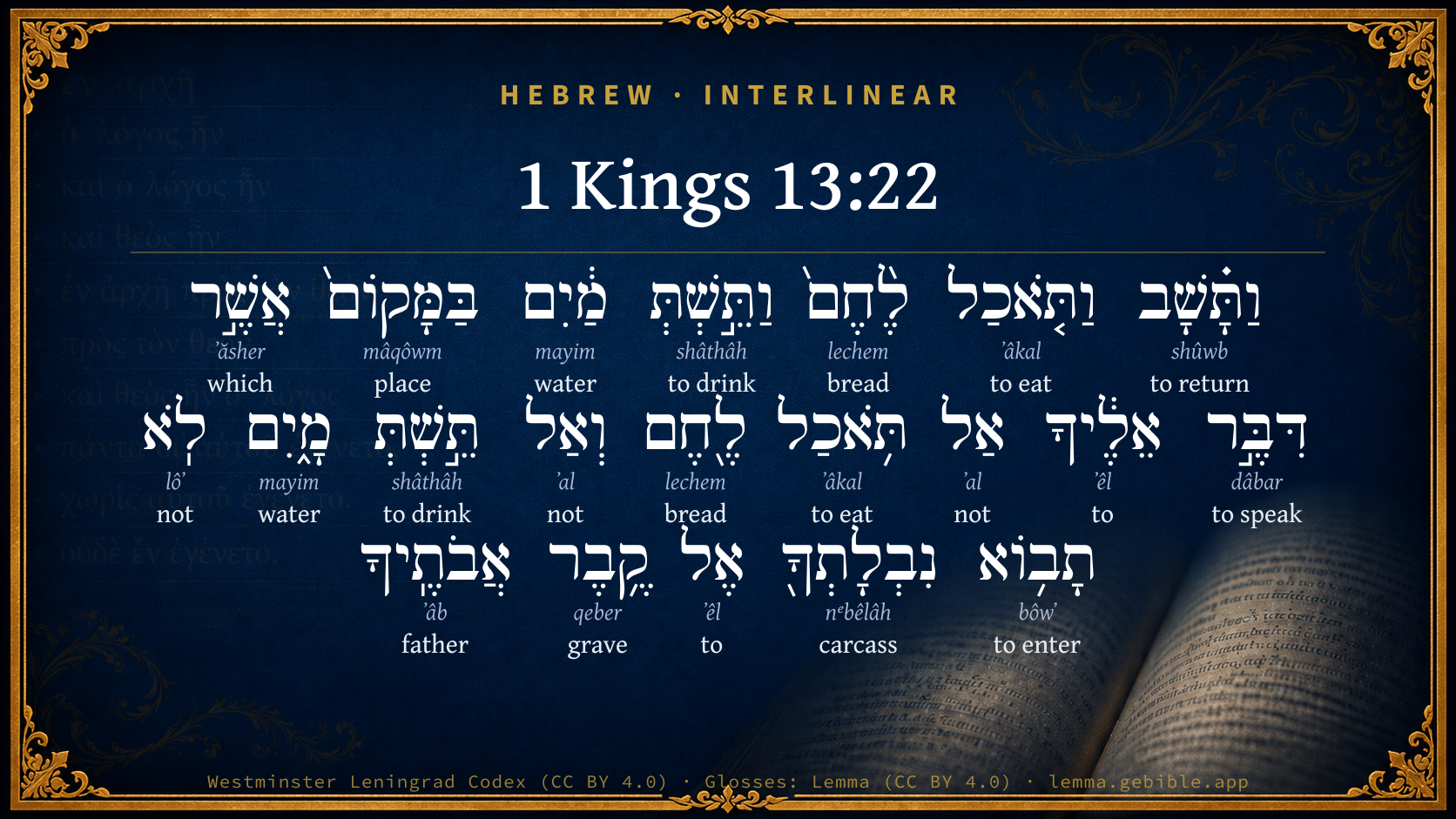
Hebrew (Westminster Leningrad Codex) 1 Kings 13:22 appears in the Hebrew Old Testament. The text above is from the Westminster Leningrad Codex. Each word links to its Strong’s number, a concise gloss, and parsing drawn from the Open Scriptures Hebrew Bible morphology. Click any word for its full Brown-Driver-Briggs (BDB) entry.
Download image
Cite this verse

1 Kings 13:22 (World English Bible). Public Domain. Lemma interlinear Bible study tool, https://lemma.gebible.app/v/1-kings/13/22.

Show BibTeX & RIS
BibTeX
RIS
English Translation
but came back, and have eaten bread and drunk water in the place of which he said to you, Eat no bread, and drink no water; your body shall not come to the tomb of your fathers.
World English Bible · Public Domain
Download a study sheet

One document with this verse’s original text, its word-by-word gloss line, the meaning frame, cross-references with their text, attributed commentary, and full source and license credits — printable, and it pastes into notes with its structure intact.

This verse Autodidact and up

Study sheet (.html) Plain text (.txt)

A passage Seminary Student

Up to 50 verses in one chapter. A passage sheet keeps up to 6 commentary sources and 12 cross-references per verse, in the order this page ranks them, and says so on the sheet whenever that leaves anything out. Ask for a single verse and you get the Autodidact verse sheet above.

Everything on this page stays free to read, with no account — the sheet is a download of what is already on screen, not access to it.

Want to remove ads? Support Godless Engineer
Compare translations 3

The same verse in 3 English versions, stacked beneath the original-language interlinear above. Click any original word for its lexicon entry.

Each is an independent rendering of the whole verse — the interlinear is not word-aligned to these translations.

Highlighted words mark where these versions differ — a whole-verse word diff, not a word-by-word alignment.

  • World English Bible Public Domain
    but came back, and have eaten bread and drunk water in the place of which he said to you, Eat no bread, and drink no water; your body shall not come to the tomb of your fathers.
  • King James Version Public Domain
    But camest back, and hast eaten bread and drunk water in the place, of the which the Lord did say to thee, Eat no bread, and drink no water; thy carcass shall not come unto the sepulchre of thy fathers.
  • unfoldingWord Literal Text CC BY-SA 4.0
    and you have returned and you have eaten bread and you have drunk water in the place which he spoke to you, “You shall not eat bread and you shall not drink water,” your corpse shall not enter into the grave of your fathers.’”

unfoldingWord Literal Text — © unfoldingWord, licensed CC BY-SA 4.0. Word-aligned USFM3 via Door43 (git.door43.org/unfoldingWord/en_ult).

Versions to compare (up to 4)

3 of 4 selected

Show all 18 translations

Every available English version of this verse, each an independent rendering of the whole verse.

  • World English Bible Public Domain
    but came back, and have eaten bread and drunk water in the place of which he said to you, Eat no bread, and drink no water; your body shall not come to the tomb of your fathers.
  • Berean Standard Bible Public Domain
    but you went back and ate bread and drank water in the place where He told you not to do so, your body shall never reach the tomb of your fathers.’”
  • Majority Standard Bible Public Domain
    but you went back and ate bread and drank water in the place where He told you not to do so, your body shall never reach the tomb of your fathers.’”
  • King James Version Public Domain
    But camest back, and hast eaten bread and drunk water in the place, of the which the Lord did say to thee, Eat no bread, and drink no water; thy carcass shall not come unto the sepulchre of thy fathers.
  • American Standard Version (1901) Public Domain
    but camest back, and hast eaten bread and drunk water in the place of which he said to thee, Eat no bread, and drink no water; thy body shall not come unto the sepulchre of thy fathers.
  • Revised Version (1885) Public Domain
    but camest back, and hast eaten bread and drunk water in the place of the which he said to thee, Eat no bread, and drink no water; thy carcase shall not come unto the sepulchre of thy fathers.
  • Geneva Bible (1599) Public Domain
    But camest backe againe, and hast eaten bread and drunke water in the place (whereof he did say vnto thee, Thou shalt eate no bread nor drinke any water) thy carkeis shall not come vnto the sepulchre of thy fathers.
  • Douay-Rheims (1899) Public Domain
    And hast returned and eaten bread, and drunk water in the place wherein he commanded thee that thou shouldst not eat bread, nor drink water, thy dead body shall not be brought into the sepulchre of thy fathers.
  • Young's Literal Translation Public Domain
    and turnest back and dost eat bread and drink water in the place of which He said unto thee, Thou dost not eat bread nor drink water -- thy carcase cometh not in unto the burying-place of thy fathers.'
  • Literal Standard Version CC BY-SA 4.0
    and turn back and eat bread and drink water in the place of which He said to you, You do not eat bread nor drink water—your carcass does not come into the burying-place of your fathers.”
  • Unlocked Literal Bible CC BY-SA 4.0
    but came back and have eaten food and drunk water in the place about which Yahweh told you to eat no food and drink no water, your body will not be buried in the tomb of your fathers.'”
  • unfoldingWord Literal Text CC BY-SA 4.0
    and you have returned and you have eaten bread and you have drunk water in the place which he spoke to you, “You shall not eat bread and you shall not drink water,” your corpse shall not enter into the grave of your fathers.’”
  • Darby Bible Public Domain
    but camest back, and hast eaten bread and drunk water in the place of which he said to thee, Eat no bread and drink no water; thy carcase shall not come to the sepulchre of thy fathers.
  • World Messianic Bible Public Domain
    but came back, and have eaten bread and drank water in the place of which he said to you, “Eat no bread, and drink no water,” your body will not come to the tomb of your fathers.’”
  • Webster's Bible Public Domain
    But hast returned, and hast eaten bread and drank water in the place, of which the LORD said to thee, Eat no bread, and drink no water; thy carcass shall not come to the sepulcher of thy fathers.
  • Free Bible Version CC BY-SA 4.0
    instead you went back and ate and drank in the place where he told you not to, your body will not be buried in the tomb of your fathers.”
  • Bible in Basic English Public Domain
    But have come back, and have taken food and water in this place where he said you were to take no food or water; your dead body will not be put to rest with your fathers.
  • JPS Tanakh (1917) Public Domain
    but camest back, and hast eaten bread and drunk water in the place of which He said to thee: Eat no bread, and drink no water; thy carcass shall not come unto the sepulchre of thy fathers.'

Literal Standard Version (2020), Covenant Press — licensed CC BY-SA 4.0. Text via the HelloAO Bible API (eBible.org). Unlocked Literal Bible (unfoldingWord) — licensed CC BY-SA 4.0. Text via the HelloAO Bible API (eBible.org). unfoldingWord Literal Text — © unfoldingWord, licensed CC BY-SA 4.0. Word-aligned USFM3 via Door43 (git.door43.org/unfoldingWord/en_ult). Free Bible Version, Dr. Jonathan Gallagher — licensed CC BY-SA 4.0. Text via the HelloAO Bible API (eBible.org).

Word by word

More ways to search: Search by grammar → Find every occurrence → Compare this word →

Practice this passage: Drill this verse → Learn its vocabulary →

נִבְלָתְךָ֖
nᵉbêlâh
H5038
“carcass · your”
Noun, Common, Feminine, Singular, Construct + Suffix, Personal, 2nd Person, Masculine, Singular
Part of Speech
Noun
Type
Common
Gender
Feminine
Number
Singular
State
Construct
Full BDB Definition

Origin: from H5034

TWOT: 1286a

carcass, corpse - of humans, idols, animals
  1. וַתָּ֗שָׁב shûwb H7725 “and · to return” Conjunction + Verb, Qal, Sequential Imperfect, 2nd Person, Masculine, Singular
  2. וַתֹּ֤אכַל ʼâkal H398 “and · to eat” Conjunction + Verb, Qal, Sequential Imperfect, 2nd Person, Masculine, Singular
  3. לֶ֨חֶם֙ lechem H3899 “bread” Noun, Common, Both, Singular, Absolute
  4. וַתֵּ֣שְׁתְּ shâthâh H8354 “and · to drink” Conjunction + Verb, Qal, Sequential Imperfect, 2nd Person, Masculine, Singular
  5. מַ֔יִם mayim H4325 “water(s)” Noun, Common, Masculine, Plural, Absolute
  6. בַּמָּקוֹם֙ mâqôwm H4725 “in/at the · place” Preposition, Determined + Noun, Common, Masculine, Singular, Absolute
  7. אֲשֶׁ֣ר ʼăsher H834 “which” Particle, Relative
  8. דִּבֶּ֣ר dâbar H1696 “to speak” Verb, Piel, Perfect, 3rd Person, Masculine, Singular
  9. אֵלֶ֔יךָ ʼêl H413 “to · you” Preposition + Suffix, Personal, 2nd Person, Masculine, Singular
  10. אַל ʼal H408 “not” Particle, Negative
  11. תֹּ֥אכַל ʼâkal H398 “to eat” Verb, Qal, Jussive, 2nd Person, Masculine, Singular
  12. לֶ֖חֶם lechem H3899 “bread” Noun, Common, Both, Singular, Absolute
  13. וְאַל ʼal H408 “and · not” Conjunction + Particle, Negative
  14. תֵּ֣שְׁתְּ shâthâh H8354 “to drink” Verb, Qal, Jussive, 3rd Person, Masculine, Singular
  15. מָ֑יִם mayim H4325 “water(s)” Noun, Common, Masculine, Plural, Absolute
  16. לֹֽא lôʼ H3808 “not” Particle, Negative
  17. תָב֥וֹא bôwʼ H935 “to enter” Verb, Qal, Imperfect, 3rd Person, Feminine, Singular
  18. אֶל ʼêl H413 “to” Preposition
  19. קֶ֥בֶר qeber H6913 “grave of” Noun, Common, Masculine, Singular, Construct
  20. אֲבֹתֶֽיךָ ʼâb H1 “fathers · your” Noun, Common, Masculine, Plural, Construct + Suffix, Personal, 2nd Person, Masculine, Singular

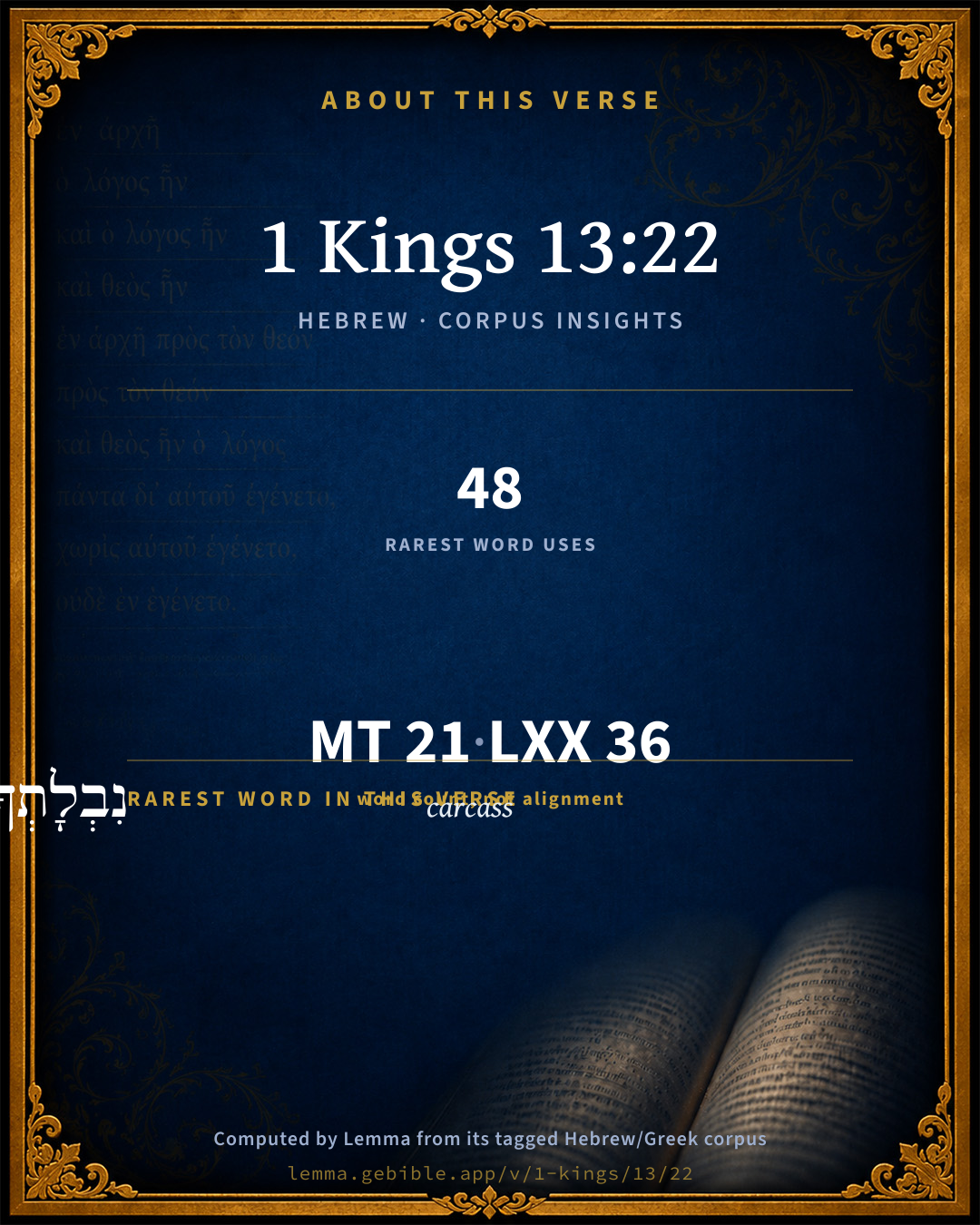
About this verse

These counts appear in no published source. They are computed here, from the morphology-tagged text and Lemma’s own curated glosses. What Lemma adds →

21
words
15
distinct lemmas
Historical
section

Shared distinctive vocabulary

נִבְלָתְךָ֖ carcass H5038 occurs in 41 verses of the Hebrew Bible. Also found in:

Grammatical profile

  • 7 verbs
  • 8 nouns
  • 2 prepositions
  • 4 particles

Verb forms

  • וַתָּ֗שָׁב Qal · Sequential Imperfect
  • וַתֹּ֤אכַל Qal · Sequential Imperfect
  • וַתֵּ֣שְׁתְּ Qal · Sequential Imperfect
  • דִּבֶּ֣ר Piel · Perfect
  • תֹּ֥אכַל Qal · Jussive
  • תֵּ֣שְׁתְּ Qal · Jussive
  • תָב֥וֹא Qal · Imperfect

Repetition

Words recur within this verse — often emphatic in Hebrew:

  • וַתֹּ֤אכַל to eat H398 ×2
  • לֶ֨חֶם֙ bread H3899 ×2
  • וַתֵּ֣שְׁתְּ to drink H8354 ×2
  • מַ֔יִם water H4325 ×2
  • אֵלֶ֔יךָ to H413 ×2
  • אַל not H408 ×2

Hebrew & Septuagint length

In English translation the verse runs 37 words from the Hebrew and 42 from the Septuagint (LXX English) — closely comparable.

A rough comparison of the two English renderings, which tokenize alike — not a word-level alignment.

Word counts can differ between the Hebrew and the Greek without any difference in meaning — e.g. the Hebrew direct-object marker אֵת has no separate Greek word, and Greek often adds the article ὁ.

In the original languages it is 21 Hebrew tokens and 36 Greek tokens — but the two are counted differently (Hebrew bundles its prefixes and suffixes into one token; the Greek is in lemma form), so that isn’t a like-for-like length.

Cross-references

5

Topical passages linked to 1 Kings 13:22 in the Treasury of Scripture Knowledge — connected by theme and wording, ordered by reader-vote popularity; previews shown in the World English Bible.

  • 1 Kings 13:30 He laid his body in his own grave; and they mourned over him, [saying], Alas, my brother!
  • 1 Kings 14:13 All Israel shall mourn for him, and bury him; for he only of Jeroboam shall come to the grave, because in him there is found some good thing toward Yahweh, the God of Israel, in the house of Jeroboam.
  • 2 Chronicles 21:19–20 It happened, in process of time, at the end of two years, that his bowels fell out by reason of his sickness, and he died of sore diseases. His people made no burning for him, like the burning of his fathers.
  • Isaiah 14:18–20 All the kings of the nations, all of them, sleep in glory, everyone in his own house.
  • Jeremiah 22:18–19 Therefore thus says Yahweh concerning Jehoiakim the son of Josiah, king of Judah: they shall not lament for him, [saying], Ah my brother! or, Ah sister! They shall not lament for him, [saying] Ah lord! or, Ah his glory!

Cross-references courtesy of OpenBible.info (CC BY 4.0).

Hebrew and Greek witnesses Masoretic Hebrew ↔ Greek Septuagint

The same verse in the two great witnesses to the Old Testament, shown verse-for-verse.

These are two independent witnesses, not word-aligned to each other, and the Septuagint is shown in lemma (dictionary) form.

Hebrew 1 Kings 13:22 Masoretic · Westminster Leningrad Codex

וַתָּ֗שָׁב וַתֹּ֤אכַל לֶ֨חֶם֙ וַתֵּ֣שְׁתְּ מַ֔יִם בַּמָּקוֹם֙ אֲשֶׁ֣ר דִּבֶּ֣ר אֵלֶ֔יךָ אַל תֹּ֥אכַל לֶ֖חֶם וְאַל תֵּ֣שְׁתְּ מָ֑יִם לֹֽא תָב֥וֹא נִבְלָתְךָ֖ אֶל קֶ֥בֶר אֲבֹתֶֽיךָ

but came back, and have eaten bread and drunk water in the place of which he said to you, Eat no bread, and drink no water; your body shall not come to the tomb of your fathers.

World English Bible · Public Domain

Greek LXX 1 Kings 13:22 Septuagint · lemma form

καί ἐπιστρέφω καί ἐσθίω ἄρτος καί πίνω ὕδωρ ἐν ὁ τόπος οὗτος ὅς λαλέω πρός σύ λέγω μή ἐσθίω ἄρτος καί μή πίνω ὕδωρ οὐ μή εἰςἔρχομαι ὁ σῶμα σύ εἰς ὁ τάφος ὁ πατήρ σύ

but have returned, and eaten bread and drunk water in the place of which he spoke to you, saying, You shall not eat bread, and shall not drink water; therefore your body shall in nowise enter into the sepulchre of your fathers.

LXX2012 (modern English Septuagint) · Public Domain

Hebrew: Westminster Leningrad Codex (CC BY 4.0). Greek: Septuagint (public domain); English from LXX2012 (modern English Septuagint) (Public Domain). How the Septuagint differs from the Hebrew →

Targum (Aramaic paraphrase)

1

The Targum is the ancient Jewish Aramaic paraphrase of the Hebrew Scriptures — an interpretive translation, not the Hebrew text itself. Onkelos (literal) and Pseudo-Jonathan (expansive) render the Torah, and Jonathan the Prophets. Coverage is partial: where no permissively-licensed English translation exists for a verse, only the Aramaic is shown. This is verse-level text, not a word-by-word alignment to the Hebrew.

  1. Targum Jonathan Prophets (Joshua–Malachi)
    וְתַבְתָּא וַאֲכַלְתָּ לַחְמָא וְאִשְׁתֵּיתָא מַיָא בְאַתְרָא דְמַלֵיל עִמָךְ לָא תֵיכוּל לַחְמָא וְלָא תִשְׁתֵּי מַיָא לָא תִתְכְּנֵישׁ נְבֶלְתָּךְ לְקִבְרָא דַאֲבָהָתָךְ:

    (no public-domain English translation for this verse)

    Targum Jonathan — Aramaic: “Mikraot Gedolot” (public domain). English: “Sefaria Community Translation” (CC0 1.0 (public-domain dedication)); “London "Chaldee Paraphrase," 1871” (public domain). Text via Sefaria.

Commentary

Notes on 1 Kings 13:22 from classic Christian and Jewish commentators (each source and its license shown beneath its notes). The classic Christian expositions comment on the surrounding passage and are grouped to its opening verse, so a note may address several verses; the Jewish commentaries on the Tanakh (Rashi and others) are per-verse, so they appear only where the commentator wrote on this verse.

Lemma curates 59 commentaries, every one of them public domain or Creative Commons licensed, each selected and text-cleaned for this edition rather than reprinted as found. About our sources →

Trapp's Complete Commentary

John Trapp

1Ki 13:22 But camest back, and hast eaten bread and drunk water in the place, of the which [the LORD] did say to thee, Eat no bread, and drink no water; thy carcase shall not come unto the sepulchre of thy fathers.

Ver. 22. And hast eaten bread and drunk water in the place, &c.] There is in the "Acts and Monuments of the Church," a memorable story of Bishop Ridley, who offering to preach before the Lady Mary, and being repulsed, he was brought by Sir Thomas Warton, her servant, to the dining place, and desired to drink: which after he had done, he paused a while, looking very sadly, and suddenly broke out into these words, Surely I have done amiss! Why so, quoth the knight? For I have drunk, said he, in that place where God’s word offered hath been refused: whereas if I had remembered my duty, I had departed immediately, shaking off the dust of my shoes for a testimony against this house. These words were by the said bishop spoken with such a vehemency, that some of the hearers afterwards confessed the hairs to stand upright on their heads. {a}

Thy carcass shall not come.] Thou shalt die ere thou come home. This was a gracious warning, that he might repent of his sin before he died.

{a} Act. and Mon., fol. 1270.

John Trapp, A Commentary or Exposition upon All the Books of the Old and New Testament (1647–1656) — public domain. Text from a community e-Sword module.

Adam Clarke's Commentary

Verse 22. Thy carcass shall not come] This intimated to him that he was to die an untimely death, but probably did not specify by what means.

Adam Clarke's Commentary on the Bible (1810–1826) — public domain. Text from a community e-Sword/MySword module.

The Cambridge Bible for Schools and Colleges

gen. ed. J. J. S. Perowne

22. the Lord did say to thee] There is no need for the italics of the A. V. There can be no mistaking who is meant if we render (with R.V.) ‘he said to thee.’

thy carcase shall not come unto the sepulchre of thy fathers] With the Jews, as since with Christians, burial rites were much regarded. To be cast out unburied was deemed a great calamity (cf. Psa_79:3; Jer_14:16), and a judgement for sin, as in the case of Jezebel (2Ki_9:10). To be buried by the side of one’s ancestors shews that all care has been bestowed upon the corpse. In the present instance the deprivation of such burial is equivalent to death in some unusual way and at a distance from home.

The Cambridge Bible for Schools and Colleges (gen. ed. J. J. S. Perowne; Cambridge University Press, 1878–1918) — public domain. Text from a community e-Sword module.

John Gill's Exposition

And when he was gone, a lion met him by the way, and slew him,.... Perhaps not far from Bethel; and this lion might come out of the same wood the she bears did, that devoured the children that mocked the prophet, as Bishop Patrick conjectures, Kg2 2:23.

and his carcass was cast in the way; in the high road, where it seems the lion seized him, and he fell:

and the ass stood by it; disregarded and unhurt by the lion, though the prophet was pulled off of the back of him:

the lion also stood by the carcass: not offering to tear it in pieces and devour it, but rather, as if he was the guard of it, to keep off all others from meddling with it; these circumstances are very surprising, and show the thing to be of God; for when the lion had done what he had a commission to do, which was to kill the prophet, he was to do no more.

John Gill's Exposition of the Whole Bible (1746–1763) — public domain (CC PDM 1.0). Text via the HelloAO Bible API.

Albert Barnes' Notes on the Bible

On the anxiety of the Hebrews to be buried with their fathers, see Gen 47:30; Gen 49:29, Gen 49:1,Gen 49:25; 2Sa 19:37, etc.

Albert Barnes' Notes on the Bible (1834–1885) — public domain. Text from a community e-Sword/MySword module.

Haydock's Catholic Bible Commentary

Fathers. This was a great punishment for the Hebrews, Genesis xlix. 29.

George Leo Haydock (1774–1849), Haydock's Catholic Family Bible and Commentary, 1859 edition — public domain. Excludes Psalms (Douay-Rheims chapter numbering differs from Protestant) and Deuterocanonical books (Catholic canon only).

Matthew Poole's English Annotations

i.e. Thou shalt not die a natural, but a violent death; and that in this journey, before thou returnest to thy native habitation; and thy carcass shall not be buried in the proper sepulchre; which was esteemed a kind of curse, and a note of infamy; as the contrary was reckoned an honour and blessing. See 1Ki 14:13; Isa 14:19,20; Jer 22:19; 26:23.

Matthew Poole's English Annotations on the Holy Bible (1683–1685) — public domain. Text from a community e-Sword/MySword module.

Whedon's Commentary on the Bible

Daniel D. Whedon

22. Thy carcass shall not come — Thou shalt perish by a violent death on thy return, and thy body shall not be buried with thy kindred. Thou shalt not reach home alive or dead. “We read of no accusation or reply on the part of the seduced prophet, nor any excuse on the part of his seducer. The matter was too solemn for bandying words; and both understood where the real pinch of the matter lay.” — Kitto.

Daniel D. Whedon (gen. ed.), Commentary on the Old and New Testaments (1874–1909) — public domain. Text from a community e-Sword module.

The Pulpit Commentary

But camest back, and hast eaten bread and drunk water in the place, of the which the Lord did say to thee, flat no bread, and drink no water; thy carcase rather corpse; "carcase" is now a term of disparagement, of which, however, there is no idea in the Hebrew shall not come unto the sepulchre of thy fathers. The desire, common in a greater or less degree to all mankind, to rest after death amongst kindred dust, was especially strong in the Jew. It is evidenced by the common euphemism "he was gathered unto his fathers," and by the provisions of Abraham, (Gen_23:4) Jacob, (Gen_47:29 Gen_49:29-31) and Joseph. (Gen_1:25) See also the words of Barzillai. (2Sa_19:37; and compare 2Sa_2:32) This denunciation did not necessarily imply a violent death (as Keil, al.) or even a speedy death, but it prepared the man of God for some untimely end.

The Pulpit Commentary (1880–1919), ed. H.D.M. Spence-Jones & Joseph S. Exell — public domain. Text from a community e-Sword module.

John Wesley's Explanatory Notes

Shall not, &c. - Thou shalt not die a natural, but a violent death; and that in this journey, before thou returnest to thy native habitation. But is it not strange that the lying prophet escapes, while the man of God is so severely punished? Certainly there must be a judgment to come, when these things shall be called over again, and when those who sinned most and suffered least in this world, will receive according to their works.

John Wesley, Explanatory Notes Upon the Whole Bible (1754–1765) — public domain. Text via the GEBible commentary corpus.

Lesson kit

Teaching starters — assembled from the data on this page, not authored interpretation. Every prompt links to the verse data it draws on. Edit before teaching.

1 Kings, in the Historical, opens this verse with 21 words (15 distinct Hebrew lemmas). Its most distinctive word is nᵉbêlâh (“carcass”). A historical commentator’s framing appears above. Read the whole chapter for the surrounding context.

Discussion questions

  1. The word nᵉbêlâh carries the sense “carcass.” How does it shape the verse?
  2. How does Leviticus 5:2, which shares the word «carcass», read alongside this verse?
  3. What does the repetition of “to eat” (2× in this one verse) do in this verse?
  4. These translations render this verse differently. What is at stake in choosing one wording over another?
  5. «וַתָּ֗שָׁב» is a Qal Sequential Imperfect verb. How does that grammatical form shape the action described?
  6. Compare how Trapp's Complete Commentary and Adam Clarke's Commentary read this verse. Where do they agree or differ?

Things to notice

Reading settings

Reading text

Shown beneath each verse's original-language words.

Old Testament
Old Testament edition

Read the OT as the Masoretic Hebrew (MT) or the Greek Septuagint (LXX).

English shown for the Greek Septuagint (in the Hebrew ↔ Greek comparison).

Comparing translations? Open the Compare panel on any verse page to stack up to four side by side.