Genesis 47:7

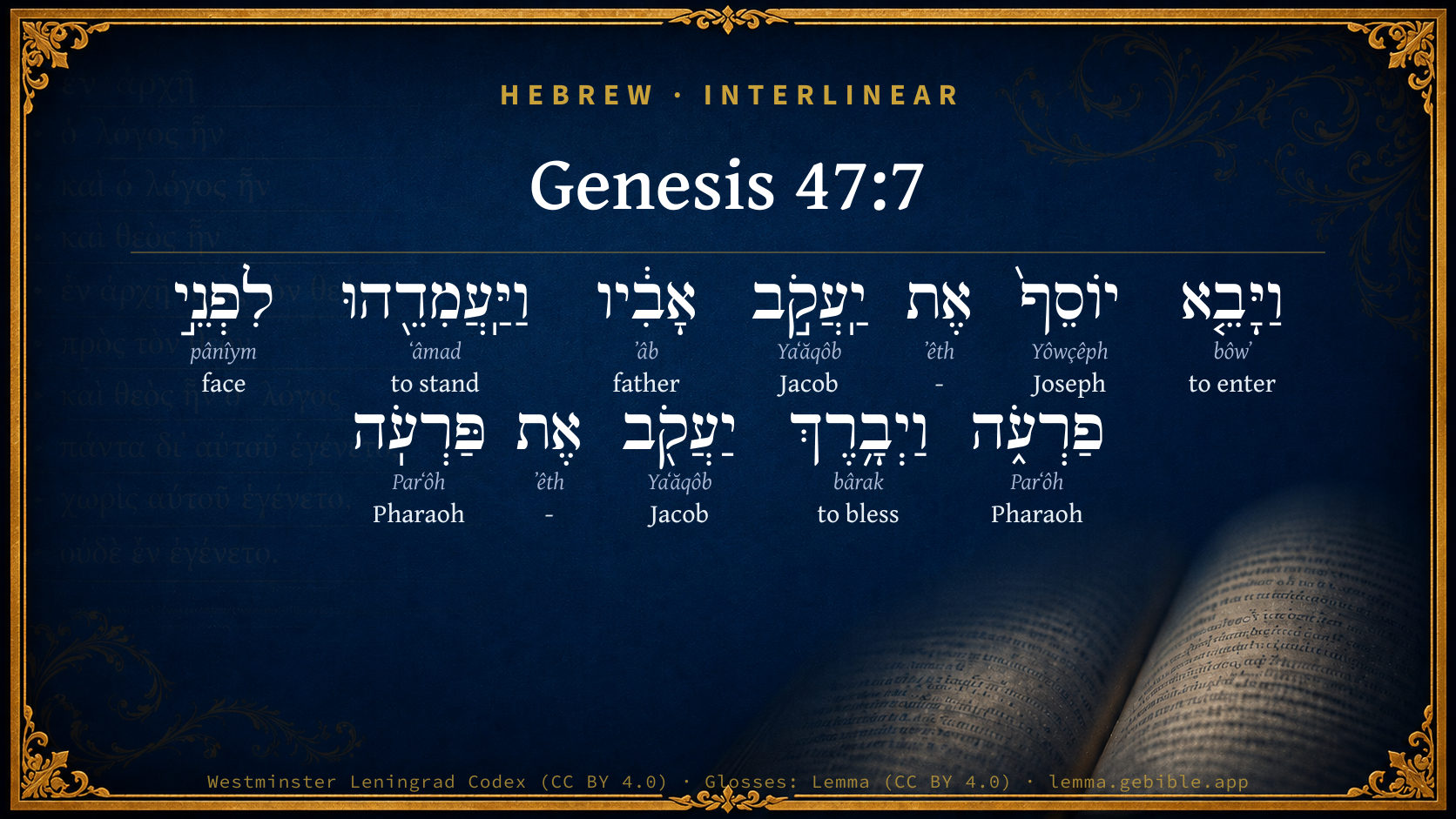
Hebrew (Westminster Leningrad Codex) Genesis 47:7 appears in the Hebrew Old Testament. The text above is from the Westminster Leningrad Codex. Each word links to its Strong’s number, a concise gloss, and parsing drawn from the Open Scriptures Hebrew Bible morphology. Click any word for its full Brown-Driver-Briggs (BDB) entry.
Download image
Cite this verse

Genesis 47:7 (World English Bible). Public Domain. Lemma interlinear Bible study tool, https://lemma.gebible.app/v/genesis/47/7.

Show BibTeX & RIS
BibTeX
RIS
English Translation
Joseph brought in Jacob, his father, and set him before Pharaoh, and Jacob blessed Pharaoh.
World English Bible · Public Domain
Download a study sheet

One document with this verse’s original text, its word-by-word gloss line, the meaning frame, cross-references with their text, attributed commentary, and full source and license credits — printable, and it pastes into notes with its structure intact.

This verse Autodidact and up

Study sheet (.html) Plain text (.txt)

A passage Seminary Student

Up to 50 verses in one chapter. A passage sheet keeps up to 6 commentary sources and 12 cross-references per verse, in the order this page ranks them, and says so on the sheet whenever that leaves anything out. Ask for a single verse and you get the Autodidact verse sheet above.

Everything on this page stays free to read, with no account — the sheet is a download of what is already on screen, not access to it.

Want to remove ads? Support Godless Engineer
Compare translations 3

The same verse in 3 English versions, stacked beneath the original-language interlinear above. Click any original word for its lexicon entry.

Each is an independent rendering of the whole verse — the interlinear is not word-aligned to these translations.

Highlighted words mark where these versions differ — a whole-verse word diff, not a word-by-word alignment.

  • World English Bible Public Domain
    Joseph brought in Jacob, his father, and set him before Pharaoh, and Jacob blessed Pharaoh.
  • King James Version Public Domain
    And Joseph brought in Jacob his father, and set him before Pharaoh: and Jacob blessed Pharaoh.
  • unfoldingWord Literal Text CC BY-SA 4.0
    Then Joseph brought Jacob his father and presented him before Pharaoh, and Jacob blessed Pharaoh.

unfoldingWord Literal Text — © unfoldingWord, licensed CC BY-SA 4.0. Word-aligned USFM3 via Door43 (git.door43.org/unfoldingWord/en_ult).

Versions to compare (up to 4)

3 of 4 selected

Show all 18 translations

Every available English version of this verse, each an independent rendering of the whole verse.

  • World English Bible Public Domain
    Joseph brought in Jacob, his father, and set him before Pharaoh, and Jacob blessed Pharaoh.
  • Berean Standard Bible Public Domain
    Then Joseph brought in his father Jacob and presented him before Pharaoh, and Jacob blessed Pharaoh.
  • Majority Standard Bible Public Domain
    Then Joseph brought in his father Jacob and presented him before Pharaoh, and Jacob blessed Pharaoh.
  • King James Version Public Domain
    And Joseph brought in Jacob his father, and set him before Pharaoh: and Jacob blessed Pharaoh.
  • American Standard Version (1901) Public Domain
    And Joseph brought in Jacob his father, and set him before Pharaoh: and Jacob blessed Pharaoh.
  • Revised Version (1885) Public Domain
    And Joseph brought in Jacob his father, and set him before Pharaoh: and Jacob blessed Pharaoh.
  • Geneva Bible (1599) Public Domain
    Ioseph also brought Iaakob his father, and set him before Pharaoh. And Iaakob saluted Pharaoh.
  • Douay-Rheims (1899) Public Domain
    After this Joseph brought in his to the king, and presented him before him: and he blessed him.
  • Young's Literal Translation Public Domain
    And Joseph bringeth in Jacob his father, and causeth him to stand before Pharaoh; and Jacob blesseth Pharaoh.
  • Literal Standard Version CC BY-SA 4.0
    And Joseph brings in his father Jacob, and causes him to stand before Pharaoh; and Jacob blesses Pharaoh.
  • Unlocked Literal Bible CC BY-SA 4.0
    Then Joseph brought in Jacob his father and presented him to Pharaoh. Jacob blessed Pharaoh.
  • unfoldingWord Literal Text CC BY-SA 4.0
    Then Joseph brought Jacob his father and presented him before Pharaoh, and Jacob blessed Pharaoh.
  • Darby Bible Public Domain
    And Joseph brought Jacob his father, and set him before Pharaoh. And Jacob blessed Pharaoh.
  • World Messianic Bible Public Domain
    Joseph brought in Jacob, his father, and set him before Pharaoh; and Jacob blessed Pharaoh.
  • Webster's Bible Public Domain
    And Joseph brought in Jacob his father, and set him before Pharaoh: and Jacob blessed Pharaoh.
  • Free Bible Version CC BY-SA 4.0
    Then Joseph went with his father Jacob and introduced him to Pharaoh. After Jacob blessed Pharaoh,
  • Bible in Basic English Public Domain
    Then Joseph made his father Jacob come before Pharaoh, and Jacob gave him his blessing.
  • JPS Tanakh (1917) Public Domain
    And Joseph brought in Jacob his father, and set him before Pharaoh. And Jacob blessed Pharaoh.

Literal Standard Version (2020), Covenant Press — licensed CC BY-SA 4.0. Text via the HelloAO Bible API (eBible.org). Unlocked Literal Bible (unfoldingWord) — licensed CC BY-SA 4.0. Text via the HelloAO Bible API (eBible.org). unfoldingWord Literal Text — © unfoldingWord, licensed CC BY-SA 4.0. Word-aligned USFM3 via Door43 (git.door43.org/unfoldingWord/en_ult). Free Bible Version, Dr. Jonathan Gallagher — licensed CC BY-SA 4.0. Text via the HelloAO Bible API (eBible.org).

Word by word

More ways to search: Search by grammar → Find every occurrence → Compare this word →

Practice this passage: Drill this verse → Learn its vocabulary →

יוֹסֵף֙
Yôwçêph
H3130
“Joseph”
Noun, Proper
Part of Speech
Noun
Type
Proper
Full BDB Definition

Origin: future of H3254

TWOT: None

Joseph = "Jehovah has added" - the eldest son of Jacob by Rachel - father of Igal, who represented the tribe of Issachar among the spies - a son of Asaph - a man who took a foreign wife in the time of Ezra - a priest of the family of Shebaniah in the time of Nehemiah
  1. וַיָּבֵ֤א bôwʼ H935 “and · to enter” Conjunction + Verb, Hiphil, Sequential Imperfect, 3rd Person, Masculine, Singular
  2. אֶת ʼêth H853 “-” Particle, Direct Object
  3. יַֽעֲקֹ֣ב Yaʻăqôb H3290 “Jacob” Noun, Proper
  4. אָבִ֔יו ʼâb H1 “father · his” Noun, Common, Masculine, Singular, Construct + Suffix, Personal, 3rd Person, Masculine, Singular
  5. וַיַּֽעֲמִדֵ֖הוּ ʻâmad H5975 “and · to stand · him” Conjunction + Verb, Hiphil, Sequential Imperfect, 3rd Person, Masculine, Singular + Suffix, Personal, 3rd Person, Masculine, Singular
  6. לִפְנֵ֣י pânîym H6440 “to/for · face(s) of” Preposition + Noun, Common, Both, Plural, Construct
  7. פַרְעֹ֑ה Parʻôh H6547 “Pharaoh” Noun, Proper
  8. וַיְבָ֥רֶךְ bârak H1288 “and · to bless” Conjunction + Verb, Piel, Sequential Imperfect, 3rd Person, Masculine, Singular
  9. יַעֲקֹ֖ב Yaʻăqôb H3290 “Jacob” Noun, Proper
  10. אֶת ʼêth H853 “-” Particle, Direct Object
  11. פַּרְעֹֽה Parʻôh H6547 “Pharaoh” Noun, Proper

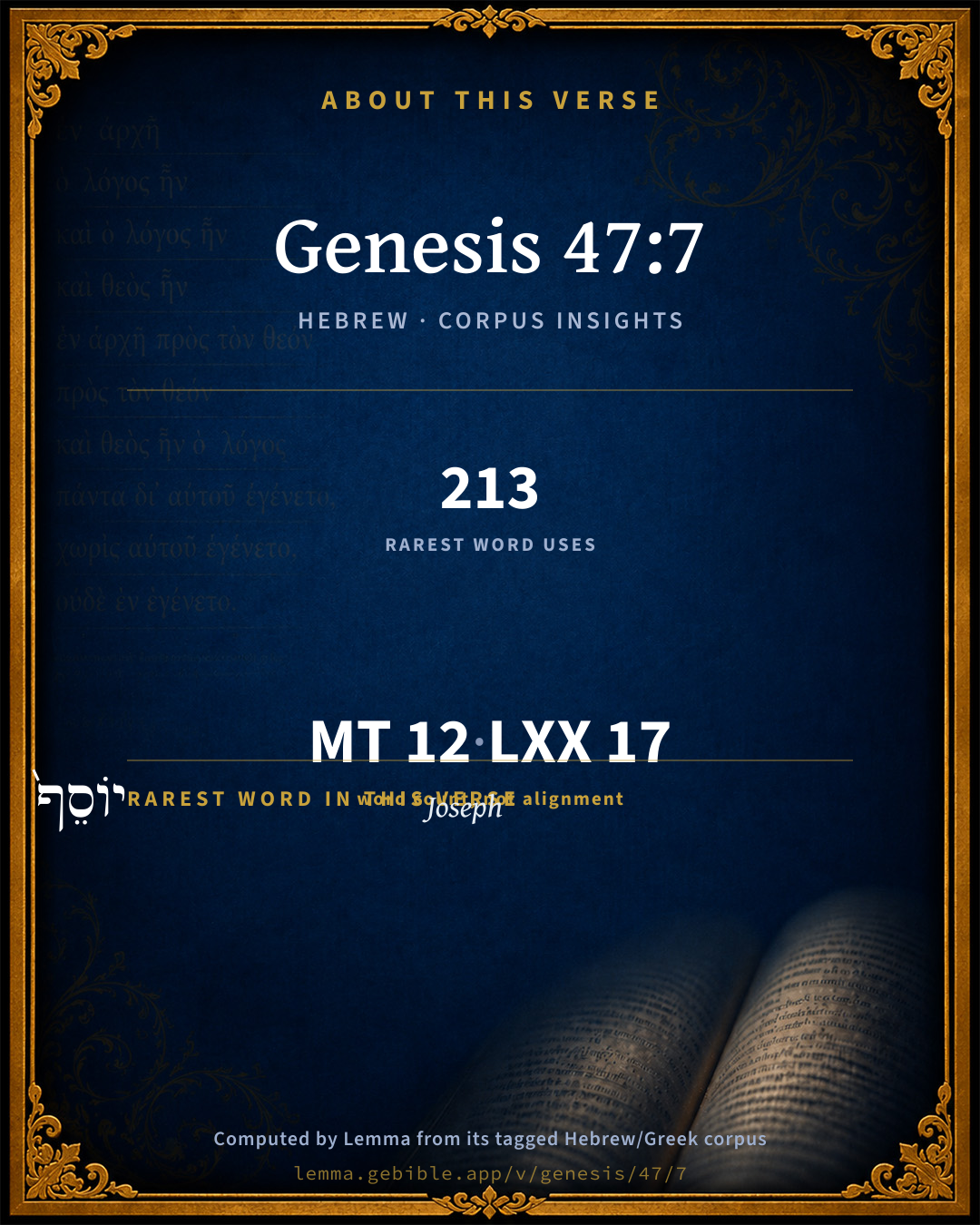
About this verse

These counts appear in no published source. They are computed here, from the morphology-tagged text and Lemma’s own curated glosses. What Lemma adds →

12
words
9
distinct lemmas
Pentateuch
section

Grammatical profile

  • 3 verbs
  • 7 nouns
  • 2 particles

Verb forms

  • וַיָּבֵ֤א Hiphil · Sequential Imperfect
  • וַיַּֽעֲמִדֵ֖הוּ Hiphil · Sequential Imperfect
  • וַיְבָ֥רֶךְ Piel · Sequential Imperfect

Repetition

Words recur within this verse — often emphatic in Hebrew:

  • יַֽעֲקֹ֣ב Jacob H3290 ×2
  • פַרְעֹ֑ה Pharaoh H6547 ×2

Hebrew & Septuagint length

In English translation the verse runs 15 words from the Hebrew and 16 from the Septuagint (LXX English) — closely comparable.

A rough comparison of the two English renderings, which tokenize alike — not a word-level alignment.

Word counts can differ between the Hebrew and the Greek without any difference in meaning — e.g. the Hebrew direct-object marker אֵת has no separate Greek word, and Greek often adds the article ὁ.

In the original languages it is 12 Hebrew tokens and 17 Greek tokens — but the two are counted differently (Hebrew bundles its prefixes and suffixes into one token; the Greek is in lemma form), so that isn’t a like-for-like length.

Cross-references

14

Topical passages linked to Genesis 47:7 in the Treasury of Scripture Knowledge — connected by theme and wording, ordered by reader-vote popularity; previews shown in the World English Bible.

  • Genesis 47:10 Jacob blessed Pharaoh, and went out from the presence of Pharaoh.
  • Genesis 35:27 Jacob came to Isaac his father, to Mamre, to Kiriath Arba (the same is Hebron), where Abraham and Isaac lived as foreigners.
  • Exodus 12:32 Take both your flocks and your herds, as you have said, and be gone; and bless me also!"
  • Numbers 6:23–24 "Speak to Aaron and to his sons, saying, 'This is how you shall bless the children of Israel.' You shall tell them,
  • Joshua 14:13 Joshua blessed him; and he gave Hebron to Caleb the son of Jephunneh for an inheritance.
  • 1 Samuel 2:20 Eli blessed Elkanah and his wife, and said, Yahweh give you seed of this woman for the petition which was asked of Yahweh. They went to their own home.
  • 2 Samuel 8:10 then Toi sent Joram his son to king David, to Greet him, and to bless him, because he had fought against Hadadezer and struck him: for Hadadezer had wars with Toi. [Joram] brought with him vessels of silver, and vessels of gold, and vessels of brass:
  • 2 Samuel 14:22 Joab fell to the ground on his face, and did obeisance, and blessed the king: and Joab said, Today your servant knows that I have found favor in your sight, my lord, king, in that the king has performed the request of his servant.
  • 2 Samuel 19:39 All the people went over the Jordan, and the king went over: and the king kissed Barzillai, and blessed him; and he returned to his own place.
  • 1 Kings 1:47 Moreover the king's servants came to bless our lord king David, saying, Your God make the name of Solomon better than your name, and make his throne greater than your throne: and the king bowed himself on the bed.
  • 2 Kings 4:29 Then he said to Gehazi, Gird up your loins, and take my staff in your hand, and go your way: if you meet any man, Don't greet him; and if anyone greets you, don't answer him again: and lay my staff on the face of the child.
  • Matthew 26:26 As they were eating, Jesus took bread, gave thanks for it, and broke it. He gave to the disciples, and said, "Take, eat; this is my body."
  • Luke 22:19 He took bread, and when he had given thanks, he broke it, and gave to them, saying, "This is my body which is given for you. Do this in memory of me."
  • 1 Peter 2:17 Honor all men. Love the brotherhood. Fear God. Honor the king.

Cross-references courtesy of OpenBible.info (CC BY 4.0).

Hebrew and Greek witnesses Masoretic Hebrew ↔ Greek Septuagint

The same verse in the two great witnesses to the Old Testament, shown verse-for-verse.

These are two independent witnesses, not word-aligned to each other, and the Septuagint is shown in lemma (dictionary) form.

Hebrew Genesis 47:7 Masoretic · Westminster Leningrad Codex

וַיָּבֵ֤א יוֹסֵף֙ אֶת יַֽעֲקֹ֣ב אָבִ֔יו וַיַּֽעֲמִדֵ֖הוּ לִפְנֵ֣י פַרְעֹ֑ה וַיְבָ֥רֶךְ יַעֲקֹ֖ב אֶת פַּרְעֹֽה

Joseph brought in Jacob, his father, and set him before Pharaoh, and Jacob blessed Pharaoh.

World English Bible · Public Domain

Greek LXX Genesis 47:7 Septuagint · lemma form

εἰςἄγω δέ ιωσηφ ἰακώβ ὁ πατήρ αὐτός καί ἵστημι αὐτός ἐναντίον φαραώ καί εὐλογέω ἰακώβ ὁ φαραώ

And Joseph brought in Jacob his father, and set him before Pharao; and Jacob blessed Pharao.

LXX2012 (modern English Septuagint) · Public Domain

Hebrew: Westminster Leningrad Codex (CC BY 4.0). Greek: Septuagint (public domain); English from LXX2012 (modern English Septuagint) (Public Domain). How the Septuagint differs from the Hebrew →

Targum (Aramaic paraphrase)

2

The Targum is the ancient Jewish Aramaic paraphrase of the Hebrew Scriptures — an interpretive translation, not the Hebrew text itself. Onkelos (literal) and Pseudo-Jonathan (expansive) render the Torah, and Jonathan the Prophets. Coverage is partial: where no permissively-licensed English translation exists for a verse, only the Aramaic is shown. This is verse-level text, not a word-by-word alignment to the Hebrew.

  1. Targum Onkelos Torah (Genesis–Deuteronomy)
    וְאַיְתִי יוֹסֵף יָת יַעֲקֹב אֲבוּהִי וַאֲקִימִנֵּהּ קֳדָם פַּרְעֹה וּבְרִיךְ יַעֲקֹב יָת פַּרְעֹה

    (no public-domain English translation for this verse)

    Targum Onkelos — Aramaic: “Onkelos Genesis” (public domain); “Onkelos Exodus” (public domain); “Onkelos Leviticus” (public domain); “Onkelos Numbers” (public domain); “Onkelos Deuteronomy” (public domain). English: “Sefaria Community Translation” (CC0 1.0 (public-domain dedication)); “J.W. Etheridge. The Targums of Onkelos and Jonathan Ben Uzziel on the Pentateuch. London: Longmans, Green, 1862” (public domain). Text via Sefaria.

  2. Targum Pseudo-Jonathan Torah (Genesis–Deuteronomy)
    וְאַיְיתֵי יוֹסֵף יַת יַעֲקב אָבוּי וַאֲקִימֵיהּ קֳדָם פַּרְעה וּבְרִיךְ יַעֲקב יַת פַּרְעה וַאֲמַר יְהֵי רַעֲוָא דְיִתְמְלוּן מוֹי דְנִילוּס וְיַעֲדֵי כַּפְנָא מִן עַלְמָא בְּיוֹמָךְ

    And Joseph brought Jakob his father, and presented him before Pharoh. And Jakob blessed Pharoh, and said, May it please the Almighty that the waters of Nilos may be replenished, and may the famine pass away from the world in thy days!

    Targum Pseudo-Jonathan — Aramaic: “Targum Jonathan on Genesis” (public domain); “Targum Jonathan on Exodus” (public domain); “Targum Jonathan on Leviticus” (public domain); “Targum Jonathan on Numbers” (public domain); “Targum Jonathan on Deuteronomy” (public domain). English: “The Targum of Jonathan ben Uzziel, trans. J. W. Etheridge, London, 1862” (public domain). Text via Sefaria.

Commentary

Notes on Genesis 47:7 from classic Christian and Jewish commentators (each source and its license shown beneath its notes). The classic Christian expositions comment on the surrounding passage and are grouped to its opening verse, so a note may address several verses; the Jewish commentaries on the Tanakh (Rashi and others) are per-verse, so they appear only where the commentator wrote on this verse.

Lemma curates 59 commentaries, every one of them public domain or Creative Commons licensed, each selected and text-cleaned for this edition rather than reprinted as found. About our sources →

Trapp's Complete Commentary

John Trapp

Gen 47:7 And Joseph brought in Jacob his father, and set him before Pharaoh: and Jacob blessed Pharaoh.

Ver. 7. Jacob blessed Pharaoh.] That is, he prayed God to bless him, both at meeting and parting. To salute is comely: but see that ye be hearty, not frothy; prayerful, not complimental. We are heirs of blessing, and must therefore be free of it. {1Pe 3:9}

John Trapp, A Commentary or Exposition upon All the Books of the Old and New Testament (1647–1656) — public domain. Text from a community e-Sword module.

The Biblical Illustrator

Joseph S. Exell

Gen_47:7

And Joseph brought in Jacob his father

Joseph and his father

I.

JOSEPH HONOURED HIS FATHER JACOB BY SHOWING HIM THE UTMOST RESPECT (Gen_46:29).

II. JOSEPH HONOURED HIS FATHER BY SHOWING HIS LOVE FOR HIM. One of our martyr-Presidents never stood higher in the nations eyes than when he turned around, after his inauguration, and, before all the assembled thousands, greeted his mother with a filial kiss.

III. JOSEPH HONOURED HIS FATHER BY HIS PURE AND NOBLE LIFE. Words of respect are comparatively worthless unless they have a life behind them.

IV. JOSEPH HONOURED HIS FATHER BY PRESENTING HIM SO PROMPTLY TO PHARAOH. He shows not a particle of shame of his rusticity, Jacobs homespun must have contrasted strangely with Pharaohs purple; Jacobs uncouth phrases of country-life with the kings polished diction. Joseph knew well enough how such people were ordinarily despised at the court, and yet how he omits no chance to show to Pharaoh how much he loved and honoured his father. The story is told of the Dean of Canterbury, afterwards Archbishop Tillotson, that one day after he had attained his churchly honours, an old man from the country, with uncouth manners, called at his door and inquired for John Tillotson. The foot man was about to dismiss him with scorn for presuming to ask in that familiar way for his master, when the Archbishop caught sight of his visitor and flew down the stairs to embrace the old man before all the servants, exclaiming with tones of genuine delight, It is my beloved father! We all admire such exhibitions of filial love, which overcomes the fear of the cool conventionalities of the world, and we find from our lesson that Pharaoh was touched by his prime ministers loyalty to his poor relations, for he gave him this royal token of his pleasure: The land of Egypt is before thee; in the best of the land make thy father and thy brethren to dwell; &c. (F. E. Clark.)

An interview with royalty

I desire to linger awhile on this thrilling scene. There are wise, good lessons in it.

1. I look upon it first of all and see an attractive picture of venerable old age. The hoary head is a crown of glory, says Solomon, if it he found in the way of righteousness. Age invests many things with a beauty of its own. An aged oak, wide-spread, gnarled, and weather-warped, stalwart, green, and stately; or an ancient castle, weatherworn and storm-swept, moss-clad and ivy-covered, its grey towers still standing bold and brave to all the winds of heaven; but of all attractive pictures that old time can draw, nothing is more winsome than the silver locks and mellowed features of godly old age. They remind me of some retired Greenwich or Chelsea veteran who can tell the tale of scars and wounds, of hair-breath escapes, of brave comrades, of stirring campaigns, of hard-fought battles; only this has been a holier war, followed by a dearer peace and more sweet reward and victories than ever followed Trafalgar or Waterloo. So with the godly character. It is beautiful in all its stages from youth to manhood; hut surely, fairest of all when age, experience, and grace hath ripened it into saintliness, and something of the heavenly shines outward from the soul within. As I look upon this aged patriarch confronting all the splendours of Pharaohs court, I see him standing on the utmost border, waiting to be ushered into the presence of a grand Monarch, into a fairer palace, and among a richer and nobler throng, and where he himself will be the wearer of a richer crown. As I look upon this strange scene in Pharaohs palace, I see that there is something grander and more powerful in moral worth than in any kind or amount of material power or possessions. In the epistle to the Hebrews I find this sentence, Without contradiction, the less is blessed of the greater. Jacob has something and can procure something which makes the monarch less than he, something which makes him better and greater than the king. It is the blessing of God. It is power with God. It is that influence from heaven and with heaven which belongs to moral goodness and virtue, and especially to aged piety everywhere and at all times. And Jacob blessed Pharaoh. Never forget that righteousness is far away greater than the riches.

2. And once more, as I look upon that striking scene in Pharaohs palace and listen to the aged patriarchs words, I think of his testimony concerning life. He calls it a pilgrimage. Young men! have you ever thought of that? Behind you there is a stern uncompromising power that is always muttering, Move on! Move on! March through the moments! hurry through the hours! tramp along the days! tread through the mouths! stride along the years! You cant halt! You cant step backward. Move on! Oh, but this is a tremendous view of human life! God help us from this hour to walk aright; to keep the path of duty, the ways of the Lord, lest the later stages of our pilgrimage find us in swamp and quagmire, scorching desert or thorny jungle when our strength is exhausted and the dull night winds blow!

3. I notice, too, that Jacob calls his days evil days. He means by that they had been sorrowful, full of trouble and care. Well, his was a hard life, he had had disappointment and distress beyond the common. If you will read his history you will find that his own conduct had to answer largely for his cares; his sins were the seed of his sorrows; his wrong-doing caused the very most of his rough usage, and nobody knew that better than Jacob did himself. Sin is the mother of sorrow, and its seeds sown in the life are sure to bring a harvest of pain. There is an Australian weapon called the boomerang, which is thrown so as to describe a series of curves and comes back at last to the feet of the thrower. Sin is a boomerang which we throw off into space, but it turns upon its author, and strikes the soul that launched it.

4. Learn another lesson from this striking picture--a lesson of Gods sure faithfulness. Jacob with all his faults had served and trusted God. His troubles and distresses had helped to bring him more fully into pious confidence and patient faith; and his trust in God brought about all things right at last. (J. J. Wray.)

Jacob and Pharaoh

1. The chief value of this narrative is that it affords one of the most impressive of all illustrations of the providential purposes of God.

2. We gain here some insight into the business regulations of a successful government. Pharaoh appears to have been a model king. He managed the state on business principles. The first question he asked these strangers who had come to settle in his kingdom was, What is your occupation? Such a government expects its subjects to be men of business. No idlers were wanted there in time of famine; none but men of ability, active habits, prudence, capacity.

3. We find in this scene an example of courtesy. There is a touching simplicity and an air of vivid reality in this picture, which leads to intuitive recognition of its genuineness. Jacob respected Pharaohs office, and Pharaoh respected Jacobs age.

4. We have here also a model for conversation.

5. This scene suggests a sad retrospect. Jacob as a prince had prevailed with God. He had gained the birthright, but he had not escaped the consequences of his own sins. Men do not escape the fruits of sin by receiving honours in the kingdom of God. Gods grace may brighten the future, but nothing else than righteous living can make happy memories; and the shadows of youthful transgression stretch across a long life.

6. We have in this scene a remainder of our eternal relations with God. (A. E. Dunning.)

Jacob and Pharaoh

I. A STRANGE MEETING. Meetings of historical characters and their results an interesting study (Diogenes and Alexander, Columbus and Ferdinand, Luther and Charles V., Milton and Galileo, &c.). None more remarkable than this.

1. Strange circumstances led to it.

2. A strange introduction given to it. Joseph presented five of his brethren to the king. These probably were the five eldest, who were at this time advanced in life.

3. Strange conversation marked it. Pharaoh, apparently overwhelmed by the venerable aspect of Jacob, inquired his age. Jacob, talking to a much younger man, calls his own life short.

4. Strange consequences flowed from it. Nearly 400 years ago this meeting left its mark on history, never to be effaced. Consequences to Israel and Egypt.

5. After the farewell was spoken they appear to have never seen each other again.

II. A STRANGE CONTRAST,

1. A patriarch, and a prince. The one the head of Gods chosen people, now numbering a few souls, to become a nation; the other the head of a mighty people, already a great nation.

2. A servant of God, and a worshipper of idols. The one the head of a people who were to become great and powerful; the other the king of a nation that should afterwards be humbled.

3. An Israelitish shepherd, and an Egyptian monarch. The occupation of the one an abomination to the other.

4. A poor man, and a rich man. The one, through his son, the benefactor and the deliverer of the other.

5. A very aged man, and a man in the prime of life. Age of Pharaoh uncertain, but the age of Jacob 130 years.

III. A STRANGE COMMENT, i.e., on life.

1. It is a pilgrimage. Not a settled, permanent, certain ,state. A journey from the cradle to the grave. Among strange people, scenes, trials, and joys. Over hills of prosperity and across plains of content, down valleys of sorrow and poverty.

2. Counted by days. The unit of measurement very short. Know not what a day may bring forth.

3. Few. Yet 130 years. How few are our years! Few as compared with eternity; or even with life of many (Methuselah, &c.). Few, compared with hopes, projects, &c.

4. Evil. Full of sin, sorrow, &c. Little done that is good. Man born to trouble. Uncertain. Full of changes.

5. Yet the longest life only a pilgrimage, and reckoned by days. Learn:

1. The best meeting for us is the meeting of the penitent sinner with the merciful Saviour. Arrangements are made for it, good results will inevitably flow from it. The closet is the audience-chamber.

2. The best contrast for us is between the old state of nature and the new state of grace. May we all realize it, and enjoy its blessings.

3. Then our new life, hopes, &c., will be a comment on the Saviours power, and on the work of the Holy Spirit (written epistles, &c.). And when this short pilgrimage is over, we shall, in eternity, comment upon the wonderful love of God, and the blessed life in heaven. (J. C. Gray.)

Joseph introduces Jacob and his family to Pharaoh

I. THE INTRODUCTION.

1. Of Josephs brethren. In this appears--

(1) Josephs character for fidelity to his promise.

(2) Josephs respect for constituted authority.

(3) The straightforwardness of Josephs brethren (Gen_47:3-4).

2. Of Josephs father.

(1) The reverence due to age.

(2) The priesthood of age.

II. THE RECEPTION.

1. Of the brethren.

2. Of Jacob. (T. H. Leale.)

Josephs filial conduct

I. SEEKING ROYAL FAVOUR.

1. Approaching the king.

2. Speaking for others.

3. Presented to the king.

II. SECURING ROYAL AID.

1. Kindly inquiry (Gen_47:3).

2. Truthful statement (Gen_47:4).

3. Generous permission (Gen_47:6).

III. DISPENSING ROYAL BOUNTY.

1. The father honoured (Gen_47:7).

2. A home bestowed (Gen_47:11).

3. The family nourished (Gen_47:12). (American Sunday School Times.)

Growth by transplanting

I. The conduct of Joseph in reference to the settlement in Goshen is an example of THE POSSIBILITY OF UNITING WORLDLY PRUDENCE WITH HIGH RELIGIOUS PRINCIPLE AND GREAT GENEROSITY OF NATURE. He had promised his brothers a home in that fertile Eastern district, which afforded many advantages in its proximity to Canaan, its adaptation to pastoral life, and its vicinity to Joseph when in Zoan, the capital. But he had not consulted Pharaoh, and, however absolute his authority, it scarcely stretched to giving away Egyptian territory without leave. So his first care, when the wanderers arrive, is to manage the confirmation of the grant. He goes about it with considerable astuteness--a hereditary quality, which is redeemed from blame because used for unselfish purposes and unstained by deceit. He does not tell Pharaoh how far he had gone, but simply announces that his family are in Goshen, as if awaiting the monarchs further pleasure. Then he introduces a deputation, no doubt carefully chosen, of five of his brothers (as if the whole number would have been too formidable), previously instructed how to answer. He knows what Pharaoh is in the habit of asking, or he knows that he can lead him to ask the required question, which will bring out the fact of their being shepherds, and utilize the prejudice against that occupation, to insure separation in Goshen. All goes as he had arranged. Joseph is a saint and a politician. His shrewdness is never craft; sagacity is not alien to consecration. No doubt it has to be carefully watched lest it degenerate; but prudence is as needful as enthusiasm, and he is the complete man who has a burning fire down in his heart to generate the force that drives him, and a steady hand on the helm, and a keen eye on the chart, to guide him. Be ye wise as serpents, but also harmless as doves.

II. WE MAY SEE IN JOSEPHS CONDUCT ALSO AN INSTANCE OF A MAN IN HIGH OFFICE AND NOT ASHAMED OF HIS HUMBLE RELATIONS. It is as if some high official in Paris were to walk in half-a-dozen peasants in blouse and sabots, and present them to the president as my brothers. It was a brave thing to do; and it teaches a lesson which many people in America and England, who have made their way in the world, would be nobler and more esteemed if they learned.

III. The brothers word to Pharaoh is another instance of THAT IGNORANT CARRYING OUT OF THE DIVINE PURPOSES WHICH WE HAVE ALREADY HAD TO NOTICE. They thought of five years, and it was to be nearly as many centuries. They thought of temporary shelter and food; God meant an education of them and their descendants. Over all this story the unseen Hand hovers, chastising, guiding, impelling; and the human agents are free and yet fulfilling an eternal purpose, blind and yet accountable, responsible for motives, and mercifully ignorant of consequences. So we all play our little parts. We have no call to be curious as to what will come of our deeds. This end of the action, the motive of it, is our care; the other end, the outcome of it, is Gods business to see to.

IV. We may also observe HOW TRIVIAL INCIDENTS ARE WROUGHT INTO GODS SCHEME. The Egyptian hatred of the shepherd class secured one of the prime reasons for the removal from Canaan, the unimpeded growth of a tribe into a nation.

V. THE INTERVIEW OF JACOB WITH PHARAOH IS PATHETIC AND BEAUTIFUL. (A. Maclaren, D. D.)

Jacob before Pharaoh

I. THE IMPRESSIVE SPECTACLE OF A VENERABLE OLD AGE.

1. Picture the old mans attitude of soul toward God, and death, and the world to come.

2. His retrospect of life, and how he now sees events in their true proportions and bearings.

3. His own subdued passions and amiable spirit.

4. His concern for, and interest in, the rising generation.

II. THE SUPERIORITY OF MORAL OVER MATERIAL GREATNESS AND WORTH. Jacob blessed Pharaoh (Heb_8:7).

III. A LESSON ON LIFES EVANESCENCE AND VANITY (Gen_47:9).

1. A natural reflection.

2. It may be a morbid and evil reflection. Better to imitate the Psalmists thankful hopefulness (Psa_23:1-6).

IV. A LESSON OF TRUST IN GOD TO BRING ABOUT ALL THINGS RIGHT AT LAST. (T. G. Horton.)

Jacob and Pharaoh

I. THE PATRIARCH JACOB, IN HIS OLD AGE, A SOJOURNER IN EGYPT.

II. JACOB AND THE PHARAOH OF EGYPT.

III. JOSEPH, THE AFFECTIONATE SON AND NOBLE BROTHER.

1. The reality of Josephs love for his brothers, as well as for his lather, is found in the abundant provision he made for them all.

2. This evidence of Josephs forgiveness of his brothers great wrong to him, and of his care for them, completes the picture of one of the most beautiful characters presented in history.

3. And this perfection of character, combining so many qualities, presents him to us not only as a beautiful model of manliness, of filial and fraternal love, but also as one of the most perfect types of our great exemplar, the Lord Jesus Christ.

Lessons:

1. Gods faithfulness to His people.

2. Notwithstanding the Divine love, Gods people are not exempt from suffering.

3. A good son maketh the heart of his father to rejoice.

4. Let us learn more perfectly the duty of loving one another. (D. C. Hughes, M. A.)

The Biblical Illustrator, edited by Joseph S. Exell (c. 1880s–1900s) — public domain. Text from a community e-Sword module.

Joseph Benson's Commentary

Gen 47:7. Jacob blessed Pharaoh — Which is repeated, Gen 47:10, as being a circumstance very remarkable. And remarkable surely it was that the greater, for such Pharaoh was in all external things, in wealth, power and glory, should be blessed of the less, Heb 7:7. But before God, and in reality, Jacob was much greater than Pharaoh. It is probable, therefore, that he not only saluted him, prayed for and thanked him for all his favours to him and his, all which the original word, here rendered blessed, often means; but that he blessed him with the authority of a patriarch and a prophet: and a patriarch’s blessing was a thing not to be despised, no, not by a potent prince.

Joseph Benson's Commentary on the Old and New Testaments (1811–1818) — public domain. Text from a community e-Sword module.

Tyndale Open Study Notes

Tyndale Open Resources

47:7-10 When Jacob entered Pharaoh’s court and when he left, he blessed Pharaoh, an indication of Jacob’s position as God’s representative (see Heb 7:7). God had promised that he would bless those who blessed Abraham’s family (Gen 12:2-3), so he now blessed Pharaoh and Egypt.

Tyndale Open Study Notes — © Tyndale Open Resources, licensed CC BY-SA 4.0. Text via the HelloAO Bible API.

Geneva Bible (1599)

Geneva Bible translators

Hebrew, blessed.

Geneva Bible (1599) marginal notes — public domain. Text via Bolls.life.

Jamieson, Fausset & Brown

Robert Jamieson, A. R. Fausset & David Brown

Joseph brought in Jacob his father--There is a pathetic and most affecting interest attending this interview with royalty; and when, with all the simplicity and dignified solemnity of a man of God, Jacob signalized his entrance by imploring the divine blessing on the royal head, it may easily be imagined what a striking impression the scene would produce (compare Heb 7:7).

Jamieson, Fausset & Brown — Commentary Critical and Explanatory on the Whole Bible (1871) — public domain (CC PDM 1.0). Text via the HelloAO Bible API.

Adam Clarke's Commentary

Verse 7. Jacob blessed Pharaoh.] Saluted him on his entrance with Peace be unto thee, or some such expression of respect and good will. For the meaning of the term to bless, as applied to God and man, See Clarke on Ge 2:3.

Adam Clarke's Commentary on the Bible (1810–1826) — public domain. Text from a community e-Sword/MySword module.

John Calvin's Commentaries

7. And Joseph brought in Jacob his father. Although Moses relates, in a continuous narrative, that Jacob was brought to the king, yet I do not doubt that some time had intervened; at least, till he had obtained a place wherein he might dwell; and where he might leave his family more safely, and with a more tranquil mind; and also, where he might refresh himself, for a little while, after the fatigue of his journey. And whereas he is said to have blessed Pharaoh, by this term Moses does not mean a common and profane salutation, but the pious and holy prayer of a servant of God. For the children of this world salute kings and princes for the sake of honor, but, by no means, raise their thoughts to God. Jacob acts otherwise; for he adjoins to civil reverence that pious affection which causes him to commend the safety of the king to God. And Jeremiah prescribes this rule to the Jews, that they should pray for the peace of Babylon as long as they were to live in exile; because in the peace of that land and empire their own peace would be involved. (Jeremiah 29:7.) If this duty was enjoined on miserable captives, forcibly deprived of their liberty, and torn from their own country; how much more did Jacob owe it to a king so humane and beneficent? But of whatever character they may be who rule over us, we are commanded to offer up public prayers for them. (1 Timothy 2:1.) Therefore the same subjection to authority is required severally from each of us.

John Calvin's Commentaries (1540-1563) — public domain. Text from the Calvin Translation Society English edition (1840s-50s) via the Christian Classics Ethereal Library (ccel.org). Calvin's coverage is partial (roughly two-thirds of the Bible); uncommented books and verses are honest gaps, never fabricated. The 19th-century editor's footnotes and remarks are omitted so the notes are faithfully Calvin's own voice.

Ellicott's Commentary for English Readers

(7) Jacob blessed Pharaoh.—The presentation of Jacob to Pharaoh seems to have been a much more solemn matter than that of Joseph’s brethren. Pharaoh looks upon them with interest as the brothers of his vizier, grants their request for leave to dwell in Goshen, and even empowers Joseph to make the ablest of them chief herdsmen over the royal cattle. But Jacob had attained to an age which gave him great dignity: for to an Egyptian 120 was the utmost limit of longevity. Jacob was now 130, and Pharaoh treats him with the greatest honour, and twice accepts his blessing. More must be meant by this than the usual salutation, in which each one presented to the king prayed for the prolongation of his life. Pharaoh probably bowed before Jacob as a saintly personage, and received a formal benediction.

A Bible Commentary for English Readers, edited by Charles John Ellicott (1878–1897) — public domain. Text from a community e-Sword module.

The Cambridge Bible for Schools and Colleges

gen. ed. J. J. S. Perowne

7. Jacob blessed Pharaoh] Here and in Gen_47:10 Jacob is said to “bless” Pharaoh. We should understand by this the solemn and benevolent benediction which is the privilege of aged persons in addressing those of much higher rank. According to another interpretation, the word should be rendered “saluted”; cf. 1Sa_13:10; 2Ki_4:29.

The Cambridge Bible for Schools and Colleges (gen. ed. J. J. S. Perowne; Cambridge University Press, 1878–1918) — public domain. Text from a community e-Sword module.

John Gill's Exposition

And Joseph brought in Jacob his father,.... That is, some time after he had introduced his five brethren, and had gotten the grant of Goshen for them, when he sent, for his father from thence, or he came quickly after to Tanis or Memphis, where Pharaoh's court was:

and set him before Pharaoh; presented Jacob to him, and placed his father right before Pharaoh, perhaps in a chair, or on a seat, by Pharaoh's order, because of his age, and in honour to him:

and Jacob blessed Pharaoh; wished him health and happiness, prayed for his welfare, and gave him thanks for all his kindness to him and his; and he blessed him not only in a way of civility, as was usual when men came into the presence of princes, but in an authoritative way, as a prophet and patriarch, a man divinely inspired of God, and who had great power in prayer with him: the Targum of Jonathan gives us his prayer thus,"may it be the pleasure (i.e. of God) that the waters of the Nile may be filled, and that the famine may remove from the world in thy days.''

John Gill's Exposition of the Whole Bible (1746–1763) — public domain (CC PDM 1.0). Text via the HelloAO Bible API.

Haydock's Catholic Bible Commentary

Blessed him, Pharao; saying, perhaps, God save the king; or, O king live for ever: thus wishing that he might enjoy all sorts of blessings. (Menochius) --- It is generally taken in this sense, when men bless one another; but when they bless God, they mean to praise, supplicate, or thank him. (Calmet)

George Leo Haydock (1774–1849), Haydock's Catholic Family Bible and Commentary, 1859 edition — public domain. Excludes Psalms (Douay-Rheims chapter numbering differs from Protestant) and Deuterocanonical books (Catholic canon only).

Matthew Poole's English Annotations

Not in an authoritative way, as the greater blesseth the less, but in a general manner, i.e. he saluted him, thanked him for all his favours to him and his, and prayed to God to bless and recompense him for it. Thus blessing is put for saluting, 1Sa 13:10; 2Ki 4:29; for praying, Num 6:23,24; for thanksgiving, Mat 26:26, compare with Luk 22:19.

Matthew Poole's English Annotations on the Holy Bible (1683–1685) — public domain. Text from a community e-Sword/MySword module.

The Pulpit Commentary

And Joseph brought in Jacob his father, and set him before Pharaoh. It has been thought that Jacob"s presentation to the Egyptian king was deferred till after the monarch"s interview with his sons because of the public and political character of that interview, relating as it did to the occupation of the land, while Jacob"s introduction to the sovereign was of a purely personal and private description. And Jacob in reply probably to a request from Pharaoh (Tayler Lewis), but more likely sua sponteblessed Pharaoh. Not simply extended to him the customary salutation accorded to kings (Rosenm Kalisch, Alford, and others), like the "May the king live for ever!" of later times (2Sa_16:16; 1Ki_1:25; Dan_2:4 Dan_3:9, &c.); but, conscious of his dignity as a prophet of Jehovah, pronounced on him a heavenly benediction (Murphy, "Speaker"s Commentary," and others) hoe verbo non vulgaris et profana salutatio notatur, sed pia sanctaque servi Dei precatio (Calvin).

The Pulpit Commentary (1880–1919), ed. H.D.M. Spence-Jones & Joseph S. Exell — public domain. Text from a community e-Sword module.

Keil & Delitzsch

C. F. Keil & F. Delitzsch

Joseph then presented his father to Pharaoh, but not till after the audience of his brothers had been followed by the royal permission to settle, for which the old man, who was bowed down with age, was not in a condition to sue. The patriarch saluted the king with a blessing, and replied to his inquiry as to his age, "The days of the years of my pilgrimage are 130 years; few and sorrowful are the days of my life's years, and have not reached (the perfect in the presentiment of his approaching end) the days of the life's years of my fathers in the days of their pilgrimage." Jacob called his own life and that of his fathers a pilgrimage (מגוּרים), because they had not come into actual possession of the promised land, but had been obliged all their life long to wander about, unsettled and homeless, in the land promised to them for an inheritance, as in a strange land. This pilgrimage was at the same time a figurative representation of the inconstancy and weariness of the earthly life, in which man does not attain to that true rest of peace with God and blessedness in His fellowship, for which he was created, and for which therefore his soul is continually longing (cf. Psa 39:13; Psa 119:19, Psa 119:54; Ch1 29:15). The apostle, therefore, could justly regard these words as a declaration of the longing of the patriarchs for the eternal rest of their heavenly fatherland (Heb 11:13-16). So also Jacob's life was little (מעט) and evil (i.e., full of toil and trouble) in comparison with the life of his fathers. For Abraham lived to be 175 years old, and Isaac 180; and neither of them had led a life so agitated, so full of distress and dangers, of tribulation and anguish, as Jacob had from his first flight to Haran up to the time of his removal to Egypt.

Keil & Delitzsch — Biblical Commentary on the Old Testament (1861–1891) — public domain (CC PDM 1.0). Text via the HelloAO Bible API. (Old Testament only.)

unfoldingWord translationNotes

Door43 World Missions Community

Jacob blessed Pharaoh

Here "blessed" means to express a desire for positive and beneficial things to happen to that person.

How long have you lived?

"How old are you?"

The years of my travels are a hundred and thirty

The phrase "years of my travels" refers to how long he has lived on the earth traveling from one place to another. AT: "I have traveled on the earth for 130 years" (See: Numbers)

The years of my life have been few ... not been as long as those of my ancestors

Jacob means his life is short compared to the lives of Abraham and Isaac.

painful

Jacob has experienced much pain and trouble during his life.

translationWords

Jacob

bless

year

unfoldingWord translationNotes — © Distant Shores Media and the Door43 World Missions Community, licensed CC BY-SA 4.0. Source: git.door43.org/Door43/en_tn.

Rashi

Rabbi Shlomo Yitzchaki (Rashi)

ויברך יעקב AND JACOB BLESSED — this was the greeting of peace, as is usual in the case of all who are granted an interview with kings at long intervals; saluer in old French

Rashi on the Tanakh — English translations: “The Judaica Press complete Tanach with Rashi, translated by A. J. Rosenberg” (CC BY 4.0); “Pentateuch with Rashi's commentary by M. Rosenbaum and A.M. Silbermann, 1929-1934” (public domain); “The Metsudah Tanach series, Lakewood, N.J” (CC BY 4.0); and “The Book of Joshua, Metsudah Publications, 1997” (CC BY 4.0). Text via Sefaria.

Ramban (Nachmanides)

Rabbi Moshe ben Nachman (Ramban / Nachmanides)

AND JACOB BLESSED PHARAOH. This refers to a salutation, as is customary for all who are granted an occasional interview with kings. Thus the language of Rashi. But this does not appear to be so, for it is not royal protocol for a person to greet the king, and the Rabbis have similarly said: “May a servant greet the king?” Instead, it refers to a real blessing which Jacob bestowed upon Pharaoh, for it is customary for aged and pious people who come before kings to bless them with wealth, possessions, honor, and the advancement of their kingdom, even as Scripture says, Let my lord king David live forever. Upon his taking leave of Pharaoh, Jacob again blessed him in order to take permission to leave. Our Rabbis have said that he blessed him that the Nile might rise at his approach.

Ramban (Nachmanides) on the Tanakh — English translation: “Commentary on the Torah by Ramban (Nachmanides). Translated and annotated by Charles B. Chavel. New York, Shilo Pub. House, 1971-1976” (CC BY 4.0). Text via Sefaria.

Radak

Rabbi David Kimhi (Radak)

ויברך יעקב את פרעה. He greeted him (bestowed a blessing) as is customary when one is introduced to the king. The custom is highlighted in Kings II 4,29 where Elisha told Gechazi not to respond to anyone’s greeting. Yaakov blessed Pharaoh again upon leaving after the audience. I have not found a satisfactory explanation why the Torah had to report something so ordinary.

Radak on the Tanakh — English translations: “Sefaria Community Translation” (CC0 1.0 (public-domain dedication)); “Eliyahu Munk, HaChut Hameshulash” (CC BY 4.0); “Rabbi Mike Feuer, Jerusalem Anthology” (CC BY 4.0); and “R. David Kimhi on the first book of Psalms, Translated by R.G. Finch, London, 1919” (public domain). Text via Sefaria.

Lesson kit

Teaching starters — assembled from the data on this page, not authored interpretation. Every prompt links to the verse data it draws on. Edit before teaching.

Genesis, in the Pentateuch, opens this verse with 12 words (9 distinct Hebrew lemmas). Its most distinctive word is Yôwçêph (“Joseph”). A historical commentator’s framing appears above. Read the whole chapter for the surrounding context.

Discussion questions

  1. What does “Joseph” (Yôwçêph) contribute to the verse as a whole?
  2. Genesis 47:10 shares this passage’s theme. How do the two illuminate each other?
  3. “Jacob” occurs 2× in this one verse. What is the effect of the repetition?
  4. These translations render this verse differently; the difference is in the English rendering, not the original. What questions does that raise?
  5. The verb «וַיָּבֵ֤א» is Hiphil Sequential Imperfect. How does its form color the action?
  6. Reading how Trapp's Complete Commentary and The Biblical Illustrator read this verse, where do the two commentators agree and where do they part?

Things to notice

Reading settings

Reading text

Shown beneath each verse's original-language words.

Old Testament
Old Testament edition

Read the OT as the Masoretic Hebrew (MT) or the Greek Septuagint (LXX).

English shown for the Greek Septuagint (in the Hebrew ↔ Greek comparison).

Comparing translations? Open the Compare panel on any verse page to stack up to four side by side.