Genesis 43:25

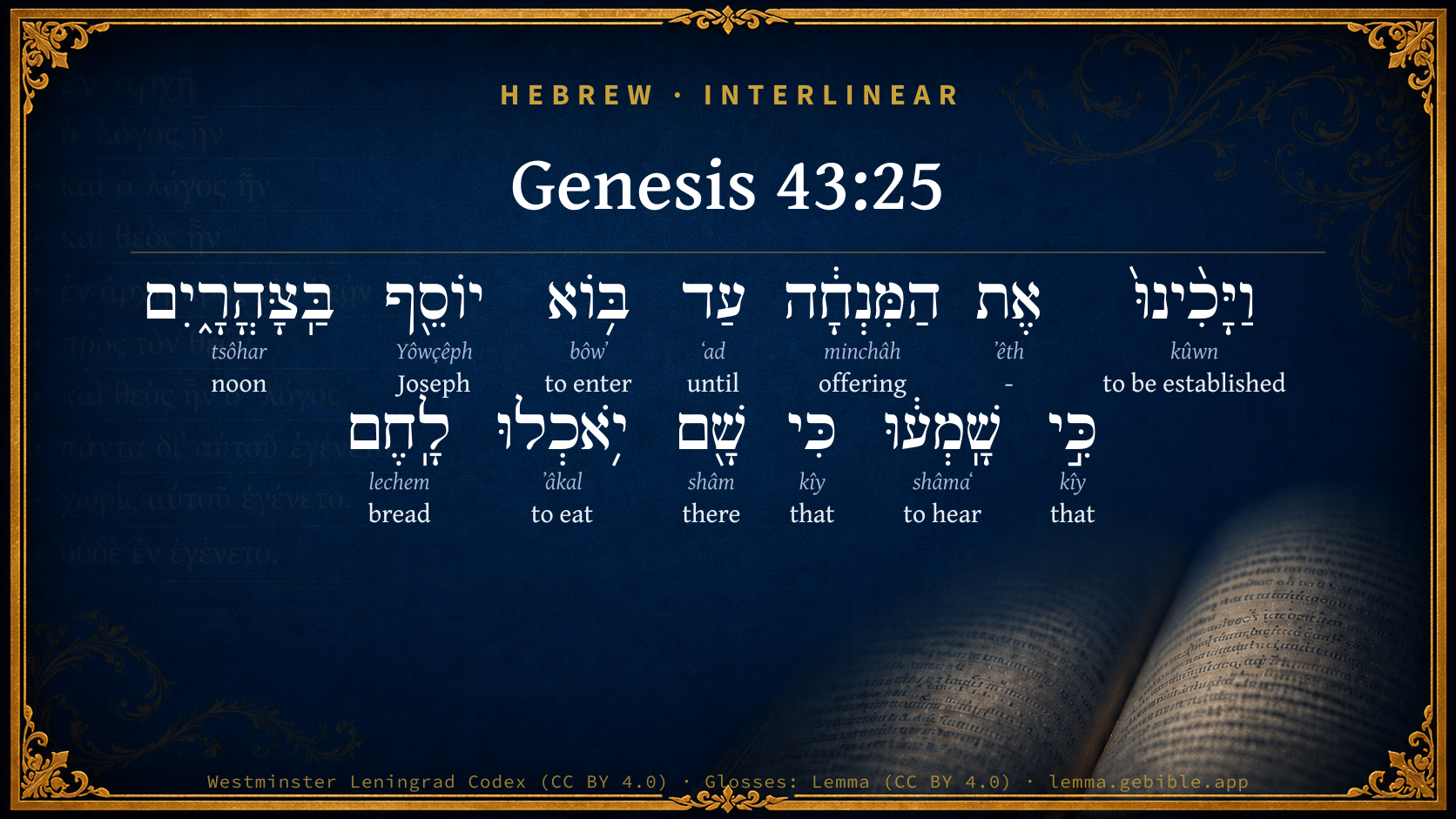
Hebrew (Westminster Leningrad Codex) Genesis 43:25 appears in the Hebrew Old Testament. The text above is from the Westminster Leningrad Codex. Each word links to its Strong’s number, a concise gloss, and parsing drawn from the Open Scriptures Hebrew Bible morphology. Click any word for its full Brown-Driver-Briggs (BDB) entry.
Download image
Cite this verse

Genesis 43:25 (World English Bible). Public Domain. Lemma interlinear Bible study tool, https://lemma.gebible.app/v/genesis/43/25.

Show BibTeX & RIS
BibTeX
RIS
English Translation
They made ready the present for Joseph's coming at noon, for they heard that they should eat bread there.
World English Bible · Public Domain
Download a study sheet

One document with this verse’s original text, its word-by-word gloss line, the meaning frame, cross-references with their text, attributed commentary, and full source and license credits — printable, and it pastes into notes with its structure intact.

This verse Autodidact and up

Study sheet (.html) Plain text (.txt)

A passage Seminary Student

Up to 50 verses in one chapter. A passage sheet keeps up to 6 commentary sources and 12 cross-references per verse, in the order this page ranks them, and says so on the sheet whenever that leaves anything out. Ask for a single verse and you get the Autodidact verse sheet above.

Everything on this page stays free to read, with no account — the sheet is a download of what is already on screen, not access to it.

Want to remove ads? Support Godless Engineer
Compare translations 3

The same verse in 3 English versions, stacked beneath the original-language interlinear above. Click any original word for its lexicon entry.

Each is an independent rendering of the whole verse — the interlinear is not word-aligned to these translations.

Highlighted words mark where these versions differ — a whole-verse word diff, not a word-by-word alignment.

  • World English Bible Public Domain
    They made ready the present for Joseph's coming at noon, for they heard that they should eat bread there.
  • King James Version Public Domain
    And they made ready the present against Joseph came at noon: for they heard that they should eat bread there.
  • unfoldingWord Literal Text CC BY-SA 4.0
    And they prepared the gift for Joseph’s arrival at noon, because they had heard that they would eat bread there.

unfoldingWord Literal Text — © unfoldingWord, licensed CC BY-SA 4.0. Word-aligned USFM3 via Door43 (git.door43.org/unfoldingWord/en_ult).

Versions to compare (up to 4)

3 of 4 selected

Show all 18 translations

Every available English version of this verse, each an independent rendering of the whole verse.

  • World English Bible Public Domain
    They made ready the present for Joseph's coming at noon, for they heard that they should eat bread there.
  • Berean Standard Bible Public Domain
    Since the brothers had been told that they were going to eat a meal there, they prepared their gift for Joseph’s arrival at noon.
  • Majority Standard Bible Public Domain
    Since the brothers had been told that they were going to eat a meal there, they prepared their gift for Joseph’s arrival at noon.
  • King James Version Public Domain
    And they made ready the present against Joseph came at noon: for they heard that they should eat bread there.
  • American Standard Version (1901) Public Domain
    And they made ready the present against Joseph's coming at noon: for they heard that they should eat bread there.
  • Revised Version (1885) Public Domain
    And they made ready the present against Joseph came at noon: for they heard that they should eat bread there.
  • Geneva Bible (1599) Public Domain
    And they made ready their present against Ioseph came at noone, (for they heard say, that they should eate bread there)
  • Douay-Rheims (1899) Public Domain
    But they made ready the presents, against Joseph came at noon: for they had heard that they should eat bread there.
  • Young's Literal Translation Public Domain
    and they prepare the present until the coming of Joseph at noon, for they have heard that there they do eat bread.
  • Literal Standard Version CC BY-SA 4.0
    and they prepare the present until the coming of Joseph at noon, for they have heard that there they eat bread.
  • Unlocked Literal Bible CC BY-SA 4.0
    They prepared the gifts for Joseph's coming at noon, for they had heard that they would eat there.
  • unfoldingWord Literal Text CC BY-SA 4.0
    And they prepared the gift for Joseph’s arrival at noon, because they had heard that they would eat bread there.
  • Darby Bible Public Domain
    And they made ready the gift for Joseph's coming at noon; for they had heard that they should eat bread there.
  • World Messianic Bible Public Domain
    They prepared the present for Joseph’s coming at noon, for they heard that they should eat bread there.
  • Webster's Bible Public Domain
    \\43:26\\And when Joseph came home, they brought him the present which was in their hand into the house, and bowed themselves to him to the earth.
  • Free Bible Version CC BY-SA 4.0
    They got their gifts ready for when Joseph would come at noon, because they had found out that they were going to eat there.
  • Bible in Basic English Public Domain
    And when Joseph came in, they gave him the things which they had for him, and went down to the earth before him.
  • JPS Tanakh (1917) Public Domain
    And they made ready the present against Joseph's coming at noon; for they heard that they should eat bread there.

Literal Standard Version (2020), Covenant Press — licensed CC BY-SA 4.0. Text via the HelloAO Bible API (eBible.org). Unlocked Literal Bible (unfoldingWord) — licensed CC BY-SA 4.0. Text via the HelloAO Bible API (eBible.org). unfoldingWord Literal Text — © unfoldingWord, licensed CC BY-SA 4.0. Word-aligned USFM3 via Door43 (git.door43.org/unfoldingWord/en_ult). Free Bible Version, Dr. Jonathan Gallagher — licensed CC BY-SA 4.0. Text via the HelloAO Bible API (eBible.org).

Word by word

More ways to search: Search by grammar → Find every occurrence → Compare this word →

Practice this passage: Drill this verse → Learn its vocabulary →

בַּֽצָּהֳרָ֑יִם
tsôhar
H6672
“in/at the · noon”
Preposition, Determined + Noun, Common, Masculine, Plural, Absolute
Part of Speech
Preposition + Noun
Type
Common
Gender
Masculine
Number
Plural
State
Absolute
Full BDB Definition

Origin: from H6671

TWOT: 1883a , 1883b

noon, midday (noun masculine) - noon (as specific time of day) - noon (in simile as bright of happiness, blessing) - roof (noun feminine) - meaning dubious
  1. וַיָּכִ֨ינוּ֙ kûwn H3559 “and · to be established” Conjunction + Verb, Hiphil, Sequential Imperfect, 3rd Person, Masculine, Plural
  2. אֶת ʼêth H853 “-” Particle, Direct Object
  3. הַמִּנְחָ֔ה minchâh H4503 “the · offering” Particle, Definite Article + Noun, Common, Feminine, Singular, Absolute
  4. עַד ʻad H5704 “until” Preposition
  5. בּ֥וֹא bôwʼ H935 “to enter” Verb, Qal, Infinitive Construct
  6. יוֹסֵ֖ף Yôwçêph H3130 “Joseph” Noun, Proper
  7. כִּ֣י kîy H3588 “that” Conjunction
  8. שָֽׁמְע֔וּ shâmaʻ H8085 “to hear” Verb, Qal, Perfect, 3rd Person, Common, Plural
  9. כִּי kîy H3588 “that” Conjunction
  10. שָׁ֖ם shâm H8033 “there” Adverb
  11. יֹ֥אכְלוּ ʼâkal H398 “to eat” Verb, Qal, Imperfect, 3rd Person, Masculine, Plural
  12. לָֽחֶם lechem H3899 “bread” Noun, Common, Both, Singular, Absolute

About this verse

These counts appear in no published source. They are computed here, from the morphology-tagged text and Lemma’s own curated glosses. What Lemma adds →

13
words
12
distinct lemmas
Pentateuch
section

Notable vocabulary

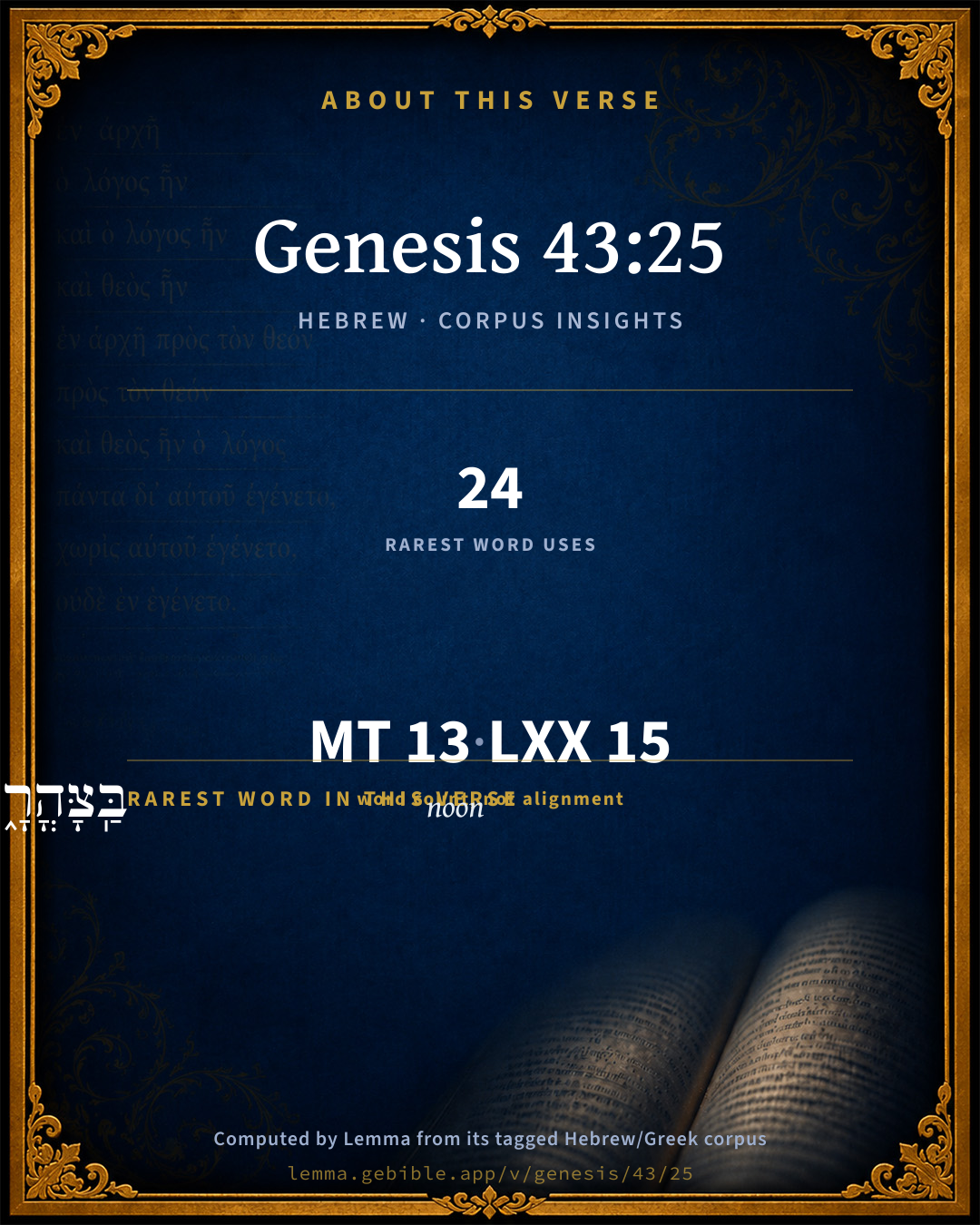
The rarest word here is בַּֽצָּהֳרָ֑יִם noon H6672 — appearing just 24 times in the whole Hebrew Bible.

Shared distinctive vocabulary

בַּֽצָּהֳרָ֑יִם noon H6672 occurs in 24 verses of the Hebrew Bible. Also found in:

Grammatical profile

  • 4 verbs
  • 4 nouns
  • 1 preposition
  • 2 conjunctions
  • 1 adverb
  • 1 particle

Verb forms

  • וַיָּכִ֨ינוּ֙ Hiphil · Sequential Imperfect
  • בּ֥וֹא Qal · Infinitive Construct
  • שָֽׁמְע֔וּ Qal · Perfect
  • יֹ֥אכְלוּ Qal · Imperfect

Repetition

A word recurs within this verse — often emphatic in Hebrew:

  • כִּ֣י that H3588 ×2

Hebrew & Septuagint length

In English translation the verse runs 19 words from the Hebrew and 20 from the Septuagint (LXX English) — closely comparable.

A rough comparison of the two English renderings, which tokenize alike — not a word-level alignment.

Word counts can differ between the Hebrew and the Greek without any difference in meaning — e.g. the Hebrew direct-object marker אֵת has no separate Greek word, and Greek often adds the article ὁ.

In the original languages it is 13 Hebrew tokens and 15 Greek tokens — but the two are counted differently (Hebrew bundles its prefixes and suffixes into one token; the Greek is in lemma form), so that isn’t a like-for-like length.

Cross-references

2

Topical passages linked to Genesis 43:25 in the Treasury of Scripture Knowledge — connected by theme and wording, ordered by reader-vote popularity; previews shown in the World English Bible.

  • Genesis 43:11 Their father, Israel, said to them, "If it be so now, do this. Take from the choice fruits of the land in your bags, and carry down a present for the man, a little balm, a little honey, spices and myrrh, nuts, and almonds;
  • Genesis 43:16 When Joseph saw Benjamin with them, he said to the steward of his house, "Bring the men into the house, and butcher an animal, and make ready; for the men will dine with me at noon."

Cross-references courtesy of OpenBible.info (CC BY 4.0).

Hebrew and Greek witnesses Masoretic Hebrew ↔ Greek Septuagint

The same verse in the two great witnesses to the Old Testament, shown verse-for-verse.

These are two independent witnesses, not word-aligned to each other, and the Septuagint is shown in lemma (dictionary) form.

Hebrew Genesis 43:25 Masoretic · Westminster Leningrad Codex

וַיָּכִ֨ינוּ֙ אֶת הַמִּנְחָ֔ה עַד בּ֥וֹא יוֹסֵ֖ף בַּֽצָּהֳרָ֑יִם כִּ֣י שָֽׁמְע֔וּ כִּי שָׁ֖ם יֹ֥אכְלוּ לָֽחֶם

They made ready the present for Joseph's coming at noon, for they heard that they should eat bread there.

World English Bible · Public Domain

Greek LXX Genesis 43:25 Septuagint · lemma form

ἑτοιμάζω δέ ὁ δῶρον ἕως ὁ ἔρχομαι ιωσηφ μεσημβρία ἀκούω γάρ ὅτι ἐκεῖ μέλλω ἀριστάω

And they prepared their gifts, until Joseph came at noon, for they heard that he was going to dine there.

LXX2012 (modern English Septuagint) · Public Domain

Hebrew: Westminster Leningrad Codex (CC BY 4.0). Greek: Septuagint (public domain); English from LXX2012 (modern English Septuagint) (Public Domain). How the Septuagint differs from the Hebrew →

Targum (Aramaic paraphrase)

2

The Targum is the ancient Jewish Aramaic paraphrase of the Hebrew Scriptures — an interpretive translation, not the Hebrew text itself. Onkelos (literal) and Pseudo-Jonathan (expansive) render the Torah, and Jonathan the Prophets. Coverage is partial: where no permissively-licensed English translation exists for a verse, only the Aramaic is shown. This is verse-level text, not a word-by-word alignment to the Hebrew.

  1. Targum Onkelos Torah (Genesis–Deuteronomy)
    וְאַתְקִינוּ יָת תִּקְרֻבְתָּא עַד דְּעַל יוֹסֵף בְּשֵׁירוּתָא אֲרֵי שְׁמָעוּ אֲרֵי תַמָּן יֵיכְלוּן לַחֲמָא

    (no public-domain English translation for this verse)

    Targum Onkelos — Aramaic: “Onkelos Genesis” (public domain); “Onkelos Exodus” (public domain); “Onkelos Leviticus” (public domain); “Onkelos Numbers” (public domain); “Onkelos Deuteronomy” (public domain). English: “Sefaria Community Translation” (CC0 1.0 (public-domain dedication)); “J.W. Etheridge. The Targums of Onkelos and Jonathan Ben Uzziel on the Pentateuch. London: Longmans, Green, 1862” (public domain). Text via Sefaria.

  2. Targum Pseudo-Jonathan Torah (Genesis–Deuteronomy)
    וְאַתְקִינִין יַת דוֹרוֹנָא עַד מֵיעַל יוֹסֵף בְשֵׁרוּתָא דְטִיהֲרָא אֲרוּם שָׁמְעוּ מִנֵיהּ אֲרוּם תַּמָן יִסְעֲדוּן לַחֲמָא

    And they made ready the present against the entrance of Joseph at the noon-day feast; for they had heard from him that they were to eat bread there.

    Targum Pseudo-Jonathan — Aramaic: “Targum Jonathan on Genesis” (public domain); “Targum Jonathan on Exodus” (public domain); “Targum Jonathan on Leviticus” (public domain); “Targum Jonathan on Numbers” (public domain); “Targum Jonathan on Deuteronomy” (public domain). English: “The Targum of Jonathan ben Uzziel, trans. J. W. Etheridge, London, 1862” (public domain). Text via Sefaria.

Commentary

Notes on Genesis 43:25 from classic Christian and Jewish commentators (each source and its license shown beneath its notes). The classic Christian expositions comment on the surrounding passage and are grouped to its opening verse, so a note may address several verses; the Jewish commentaries on the Tanakh (Rashi and others) are per-verse, so they appear only where the commentator wrote on this verse.

Lemma curates 59 commentaries, every one of them public domain or Creative Commons licensed, each selected and text-cleaned for this edition rather than reprinted as found. About our sources →

Trapp's Complete Commentary

John Trapp

Gen 43:25 And they made ready the present against Joseph came at noon: for they heard that they should eat bread there.

Ver. 25. And they made ready the present.] For, "a man’s gift makes room for him, and bringeth him before great men." {Pro 18:16} So it doth also before God, who looks for "a present," {Psa 72:10} and loves to hear from us. "Praise waiteth for thee, O God, in Sion, and unto thee shall the vow be performed." {Psa 65:1}

John Trapp, A Commentary or Exposition upon All the Books of the Old and New Testament (1647–1656) — public domain. Text from a community e-Sword module.

John Calvin's Commentaries

25. Against Joseph came at noon-day. It is doubtful whether this was the ordinary hour of dining among the Egyptians, or whether Joseph, on that day, sat down earlier than he was accustomed to do, on account of his guests. It is, however, most likely that the usual custom of dining was observed. Although, among the people of the East, there might be a different manner of living, dinners were in use, not only among the Egyptians, but also in Judea, and in other neighboring regions. Yet it is probable that this was to them, also, in the place of a supper, both because they would sit long at table, and our quick method of eating would not have been tolerable to people in those heated climes; especially when they received guests with greater luxury than usual, as it will presently appear, was done at this time. The washing of the feet, (as we have seen before,) was a part of hospitality, and intended to relieve weariness; because, in those parts, the feet might easily become inflamed whenever they journeyed on foot. It was also more honorable, according to ancient custom, that a portion of food should be sent to each from Joseph, rather than that it should be distributed by the cook. But because these things are trivial, and are not conducive to piety, I only slightly touch upon them; and would even omit them entirely, except that, to remove a scruple from the minds of the unskillful, is sometimes useful, if it be but done sparingly and with brevity.

John Calvin's Commentaries (1540-1563) — public domain. Text from the Calvin Translation Society English edition (1840s-50s) via the Christian Classics Ethereal Library (ccel.org). Calvin's coverage is partial (roughly two-thirds of the Bible); uncommented books and verses are honest gaps, never fabricated. The 19th-century editor's footnotes and remarks are omitted so the notes are faithfully Calvin's own voice.

Ellicott's Commentary for English Readers

(25) For they heard . . . —As Joseph in Gen_43:16 gives his orders in the Egyptian language, his brethren would not understand why they were taken to the governor’s palace; but probably the steward now tells them that they were to feast with the governor, in order to allay their fears, as the rights of hospitality were too sacred to permit of perfidy to a guest.

A Bible Commentary for English Readers, edited by Charles John Ellicott (1878–1897) — public domain. Text from a community e-Sword module.

The Cambridge Bible for Schools and Colleges

gen. ed. J. J. S. Perowne

25. the present] Cf. Gen_43:11.

against Joseph came] i.e. so as to be ready when Joseph arrived. For this use of “against” = “in readiness for the time when,” cf. 2Ki_16:12, “So did Urijah the priest make it against king Ahaz came from Damascus.”

eat bread] A good instance of the use of this phrase in the sense of “to take a meal,” cf. Gen_43:16, Gen_31:54, Gen_37:25.

The Cambridge Bible for Schools and Colleges (gen. ed. J. J. S. Perowne; Cambridge University Press, 1878–1918) — public domain. Text from a community e-Sword module.

John Gill's Exposition

And when Joseph came home,.... In order to dine, it being noontime:

they brought him the present which was in their hand into the house; everyone took a part of it in his hand, and brought it to Joseph in the parlour where he was, and delivered it to him as a present from their father, or from themselves, or it may be as from both:

and bowed themselves to him to the earth; in the most prostrate and humble manner, now again fulfilling his dream, and more completely than before, for now all his eleven brethren were together, signified by the eleven stars in the dream, that made obeisance to him, see Gen 37:9.

John Gill's Exposition of the Whole Bible (1746–1763) — public domain (CC PDM 1.0). Text via the HelloAO Bible API.

The Pulpit Commentary

And they made ready the present against Joseph came at noon: for they heard that they should eat bread there. This must have been communicated to them after they had entered Joseph"s palace, since they had obviously not learnt it upon the way thither (vide supra, ver. 18).

The Pulpit Commentary (1880–1919), ed. H.D.M. Spence-Jones & Joseph S. Exell — public domain. Text from a community e-Sword module.

Rashi

Rabbi Shlomo Yitzchaki (Rashi)

ויכינו means AND THEY MADE READY — they laid it out ornately in fine vessels.

Rashi on the Tanakh — English translations: “The Judaica Press complete Tanach with Rashi, translated by A. J. Rosenberg” (CC BY 4.0); “Pentateuch with Rashi's commentary by M. Rosenbaum and A.M. Silbermann, 1929-1934” (public domain); “The Metsudah Tanach series, Lakewood, N.J” (CC BY 4.0); and “The Book of Joshua, Metsudah Publications, 1997” (CC BY 4.0). Text via Sefaria.

Radak

Rabbi David Kimhi (Radak)

ויכינו, they arranged the gifts they had brought in a manner that would look appropriately impressive by the time Joseph would come home.

כי שמעו, from the official in charge of Joseph’s palace that they were preparing the meal.

לחם, a term which is inclusive, meaning the entire meal.

Radak on the Tanakh — English translations: “Sefaria Community Translation” (CC0 1.0 (public-domain dedication)); “Eliyahu Munk, HaChut Hameshulash” (CC BY 4.0); “Rabbi Mike Feuer, Jerusalem Anthology” (CC BY 4.0); and “R. David Kimhi on the first book of Psalms, Translated by R.G. Finch, London, 1919” (public domain). Text via Sefaria.

Lesson kit

Teaching starters — assembled from the data on this page, not authored interpretation. Every prompt links to the verse data it draws on. Edit before teaching.

Genesis, in the Pentateuch, opens this verse with 13 words (12 distinct Hebrew lemmas). Its most distinctive word is tsôhar (“noon”). A historical commentator’s framing appears above. Read the whole chapter for the surrounding context.

Discussion questions

  1. The word tsôhar carries the sense “noon.” How does it shape the verse?
  2. Genesis 6:16 shares the word «noon» with this verse. How do the two illuminate each other?
  3. “that” occurs 2× in this one verse. What is the effect of the repetition?
  4. These translations render this verse differently; the difference is in the English rendering, not the original. What questions does that raise?
  5. The verb «וַיָּכִ֨ינוּ֙» is Hiphil Sequential Imperfect. How does its form color the action?
  6. Reading how Trapp's Complete Commentary and John Calvin's Commentaries read this verse, where do the two commentators agree and where do they part?

Things to notice

Reading settings

Reading text

Shown beneath each verse's original-language words.

Old Testament
Old Testament edition

Read the OT as the Masoretic Hebrew (MT) or the Greek Septuagint (LXX).

English shown for the Greek Septuagint (in the Hebrew ↔ Greek comparison).

Comparing translations? Open the Compare panel on any verse page to stack up to four side by side.