Genesis 18:21

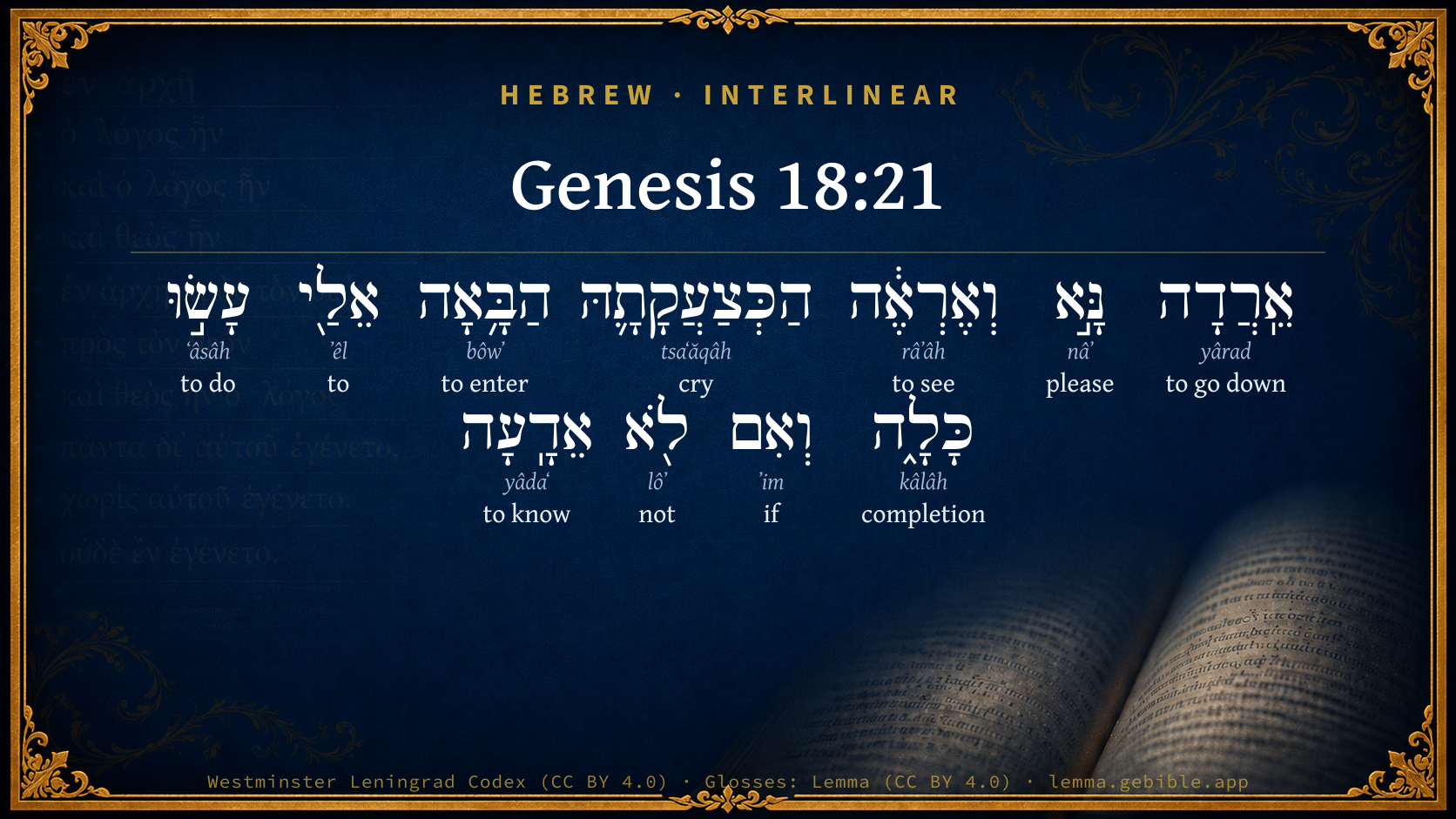
Hebrew (Westminster Leningrad Codex) Genesis 18:21 appears in the Hebrew Old Testament. The text above is from the Westminster Leningrad Codex. Each word links to its Strong’s number, a concise gloss, and parsing drawn from the Open Scriptures Hebrew Bible morphology. Click any word for its full Brown-Driver-Briggs (BDB) entry.
Download image
Cite this verse

Genesis 18:21 (World English Bible). Public Domain. Lemma interlinear Bible study tool, https://lemma.gebible.app/v/genesis/18/21.

Show BibTeX & RIS
BibTeX
RIS
English Translation
I will go down now, and see whether they have done altogether according to the cry of it, which is come to me. If not, I will know."
World English Bible · Public Domain
Highlights
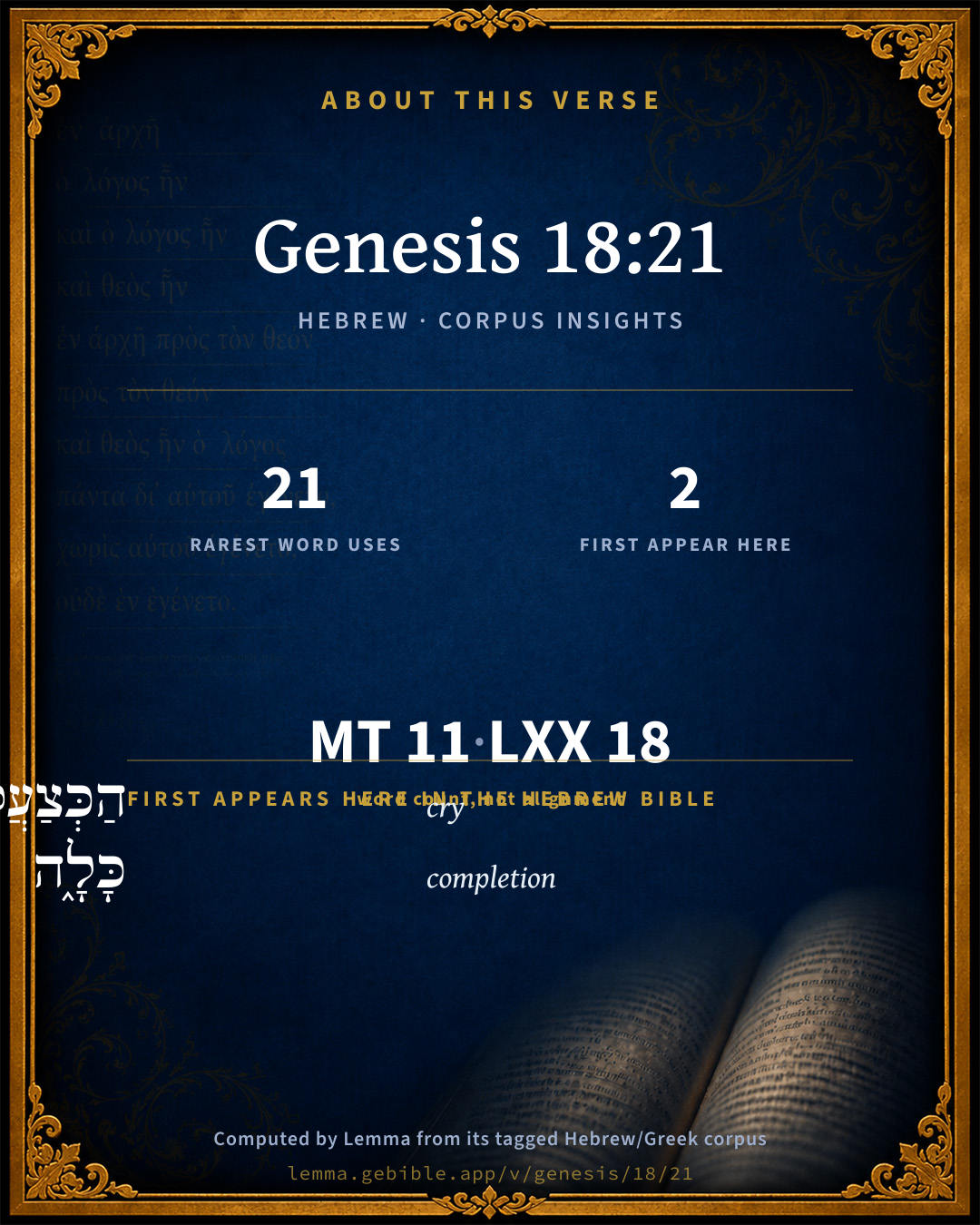
  • 2 first appearances in the Hebrew Bible
Full analysis ↓
Download a study sheet

One document with this verse’s original text, its word-by-word gloss line, the meaning frame, cross-references with their text, attributed commentary, and full source and license credits — printable, and it pastes into notes with its structure intact.

This verse Autodidact and up

Study sheet (.html) Plain text (.txt)

A passage Seminary Student

Up to 50 verses in one chapter. A passage sheet keeps up to 6 commentary sources and 12 cross-references per verse, in the order this page ranks them, and says so on the sheet whenever that leaves anything out. Ask for a single verse and you get the Autodidact verse sheet above.

Everything on this page stays free to read, with no account — the sheet is a download of what is already on screen, not access to it.

Want to remove ads? Support Godless Engineer
Compare translations 3

The same verse in 3 English versions, stacked beneath the original-language interlinear above. Click any original word for its lexicon entry.

Each is an independent rendering of the whole verse — the interlinear is not word-aligned to these translations.

Highlighted words mark where these versions differ — a whole-verse word diff, not a word-by-word alignment.

  • World English Bible Public Domain
    I will go down now, and see whether they have done altogether according to the cry of it, which is come to me. If not, I will know."
  • King James Version Public Domain
    I will go down now, and see whether they have done altogether according to the cry of it, which is come unto me; and if not, I will know.
  • unfoldingWord Literal Text CC BY-SA 4.0
    I will go down now and see whether they have done altogether according to its outcry that has come to me. And if not, I will know.”

unfoldingWord Literal Text — © unfoldingWord, licensed CC BY-SA 4.0. Word-aligned USFM3 via Door43 (git.door43.org/unfoldingWord/en_ult).

Versions to compare (up to 4)

3 of 4 selected

Show all 18 translations

Every available English version of this verse, each an independent rendering of the whole verse.

  • World English Bible Public Domain
    I will go down now, and see whether they have done altogether according to the cry of it, which is come to me. If not, I will know."
  • Berean Standard Bible Public Domain
    I will go down to see if their actions fully justify the outcry that has reached Me. If not, I will find out.”
  • Majority Standard Bible Public Domain
    I will go down to see if their actions fully justify the outcry that has reached Me. If not, I will find out.”
  • King James Version Public Domain
    I will go down now, and see whether they have done altogether according to the cry of it, which is come unto me; and if not, I will know.
  • American Standard Version (1901) Public Domain
    I will go down now, and see whether they have done altogether according to the cry of it, which is come unto me; and if not, I will know.
  • Revised Version (1885) Public Domain
    I will go down now, and see whether they have done altogether according to the cry of it, which is come unto me; and if not, I will know.
  • Geneva Bible (1599) Public Domain
    I will goe downe nowe, and see whether they haue done altogether according to that crie which is come vnto me: and if not, that I may knowe.
  • Douay-Rheims (1899) Public Domain
    And the Lord said: The cry of Sodom and Gomorrha is multiplied, and their sin is become exceedingly grievous.
  • Young's Literal Translation Public Domain
    I go down now, and see whether according to its cry which is coming unto Me they have done completely -- and if not -- I know;'
  • Literal Standard Version CC BY-SA 4.0
    I go down now, and see whether according to its cry which is coming to Me they have done completely—and if not—I know”;
  • Unlocked Literal Bible CC BY-SA 4.0
    I will now go down there and see the outcry against her that has come to me, whether they have really done it. If not, I will know.”
  • unfoldingWord Literal Text CC BY-SA 4.0
    I will go down now and see whether they have done altogether according to its outcry that has come to me. And if not, I will know.”
  • Darby Bible Public Domain
    I will go down now, and see whether they have done altogether according to the cry of it, which is come to me; and if not, I will know [it].
  • World Messianic Bible Public Domain
    I will go down now, and see whether their deeds are as bad as the reports which have come to me. If not, I will know.”
  • Webster's Bible Public Domain
    I will go down now, and see whether they have done altogether according to the cry of it, which is come to me; and if not, I will know.
  • Free Bible Version CC BY-SA 4.0
    I'm going to see if these complaints that have reached me are completely true. I'll know if they're not.”
  • Bible in Basic English Public Domain
    I will go down now, and see if their acts are as bad as they seem from the outcry which has come to me; and if they are not, I will see.
  • JPS Tanakh (1917) Public Domain
    I will go down now, and see whether they have done altogether according to the cry of it, which is come unto Me; and if not, I will know.'

Literal Standard Version (2020), Covenant Press — licensed CC BY-SA 4.0. Text via the HelloAO Bible API (eBible.org). Unlocked Literal Bible (unfoldingWord) — licensed CC BY-SA 4.0. Text via the HelloAO Bible API (eBible.org). unfoldingWord Literal Text — © unfoldingWord, licensed CC BY-SA 4.0. Word-aligned USFM3 via Door43 (git.door43.org/unfoldingWord/en_ult). Free Bible Version, Dr. Jonathan Gallagher — licensed CC BY-SA 4.0. Text via the HelloAO Bible API (eBible.org).

Word by word

More ways to search: Search by grammar → Find every occurrence → Compare this word →

Practice this passage: Drill this verse → Learn its vocabulary →

הַכְּצַעֲקָתָ֛הּ
tsaʻăqâh
H6818
“like/as · cry · her”
Particle, Interrogative + Preposition + Noun, Common, Feminine, Singular, Construct + Suffix, Personal, 3rd Person, Feminine, Singular
Part of Speech
Particle + Preposition + Noun
Type
Common
Gender
Feminine
Number
Singular
State
Construct
Full BDB Definition

Origin: from H6817

TWOT: 1947a

cry, outcry - outcry (against) - cry of distress (especially as heard by God)
  1. אֵֽרֲדָה yârad H3381 “to go down” Verb, Qal, Cohortative, 1st Person, Common, Singular
  2. נָּ֣א nâʼ H4994 “please” Particle, Interjection
  3. וְאֶרְאֶ֔ה râʼâh H7200 “and · to see” Conjunction + Verb, Qal, Cohortative, 1st Person, Common, Singular
  4. הַבָּ֥אָה bôwʼ H935 “the · to enter” Particle, Definite Article + Verb, Qal, Perfect, 3rd Person, Feminine, Singular
  5. אֵלַ֖י ʼêl H413 “to · me” Preposition + Suffix, Personal, 1st Person, Common, Singular
  6. עָשׂ֣וּ ʻâsâh H6213 “to do” Verb, Qal, Perfect, 3rd Person, Common, Plural
  7. כָּלָ֑ה kâlâh H3617 “completion” Noun, Common, Feminine, Singular, Absolute
  8. וְאִם ʼim H518 “and · if” Conjunction + Conjunction
  9. לֹ֖א lôʼ H3808 “not” Particle, Negative
  10. אֵדָֽעָה yâdaʻ H3045 “to know” Verb, Qal, Imperfect, 1st Person, Common, Singular

About this verse

These counts appear in no published source. They are computed here, from the morphology-tagged text and Lemma’s own curated glosses. What Lemma adds →

11
words
11
distinct lemmas
Pentateuch
section

Notable vocabulary

The rarest word here is הַכְּצַעֲקָתָ֛הּ cry H6818 — appearing just 21 times in the whole Hebrew Bible.

First appearance in Scripture

These words make their first canonical appearance in the Hebrew Bible here:

  • הַכְּצַעֲקָתָ֛הּ cry H6818
  • כָּלָ֑ה completion H3617

Shared distinctive vocabulary

הַכְּצַעֲקָתָ֛הּ cry H6818 occurs in 20 verses of the Hebrew Bible. Also found in:

Grammatical profile

  • 5 verbs
  • 2 nouns
  • 1 preposition
  • 1 conjunction
  • 2 particles

Verb forms

  • אֵֽרֲדָה Qal · Cohortative
  • וְאֶרְאֶ֔ה Qal · Cohortative
  • הַבָּ֥אָה Qal · Perfect
  • עָשׂ֣וּ Qal · Perfect
  • אֵדָֽעָה Qal · Imperfect

Hebrew & Septuagint length

In English translation the verse runs 28 words from the Hebrew and 25 from the Septuagint (LXX English) — closely comparable.

A rough comparison of the two English renderings, which tokenize alike — not a word-level alignment.

Word counts can differ between the Hebrew and the Greek without any difference in meaning — e.g. the Hebrew direct-object marker אֵת has no separate Greek word, and Greek often adds the article ὁ.

In the original languages it is 11 Hebrew tokens and 18 Greek tokens — but the two are counted differently (Hebrew bundles its prefixes and suffixes into one token; the Greek is in lemma form), so that isn’t a like-for-like length.

Cross-references

19

Topical passages linked to Genesis 18:21 in the Treasury of Scripture Knowledge — connected by theme and wording, ordered by reader-vote popularity; previews shown in the World English Bible.

  • Exodus 3:8 I have come down to deliver them out of the hand of the Egyptians, and to bring them up out of that land to a good and large land, to a land flowing with milk and honey; to the place of the Canaanite, the Hittite, the Amorite, the Perizzite, the Hivite, and the Jebusite.
  • Genesis 11:5 Yahweh came down to see the city and the tower, which the children of men built.
  • Joshua 22:22 The Mighty One, God, Yahweh, the Mighty One, God, Yahweh, he knows; and Israel he shall know: if it be in rebellion, or if in trespass against Yahweh (don't save us this day),
  • Genesis 11:7 Come, let's go down, and there confuse their language, that they may not understand one another's speech."
  • Exodus 33:5 Yahweh said to Moses, "Tell the children of Israel, 'You are a stiff-necked people. If I were to go up into your midst for one moment, I would consume you. Therefore now take off your jewelry from you, that I may know what to do to you."
  • Deuteronomy 8:2 You shall remember all the way which Yahweh your God has led you these forty years in the wilderness, that he might humble you, to prove you, to know what was in your heart, whether you would keep his commandments, or not.
  • Deuteronomy 13:3 you shall not listen to the words of that prophet, or to that dreamer of dreams: for Yahweh your God proves you, to know whether you love Yahweh your God with all your heart and with all your soul.
  • Psalms 139:1–24 Yahweh, you have searched me, And you know me.
  • Jeremiah 17:10 I, Yahweh, search the mind, I try the heart, even to give every man according to his ways, according to the fruit of his doings.
  • Micah 1:3 For, behold, Yahweh comes forth out of his place, And will come down and tread on the high places of the earth.
  • Zephaniah 1:12 It will happen at that time, that I will search Jerusalem with lamps, and I will punish the men who are settled on their dregs, who say in their heart, "Yahweh will not do good, neither will he do evil."
  • Luke 16:15 He said to them, "You are those who justify yourselves in the sight of men, but God knows your hearts. For that which is exalted among men is an abomination in the sight of God.
  • Job 34:22 There is no darkness, nor thick gloom, Where the workers of iniquity may hide themselves.
  • Psalms 90:8 You have set our iniquities before you, Our secret sins in the light of your presence.
  • Jeremiah 17:1 The sin of Judah is written with a pen of iron, [and] with the point of a diamond: it is engraved on the tablet of their heart, and on the horns of your altars;
  • John 6:38 For I have come down from heaven, not to do my own will, but the will of him who sent me.
  • 2 Corinthians 11:11 Why? Because I don't love you? God knows.
  • 1 Thessalonians 4:16 For the Lord himself will descend from heaven with a shout, with the voice of the archangel, and with God's trumpet. The dead in Christ will rise first,
  • Hebrews 4:13 There is no creature that is hidden from his sight, but all things are naked and laid open before the eyes of him with whom we have to do.

Cross-references courtesy of OpenBible.info (CC BY 4.0).

Hebrew and Greek witnesses Masoretic Hebrew ↔ Greek Septuagint

The same verse in the two great witnesses to the Old Testament, shown verse-for-verse.

These are two independent witnesses, not word-aligned to each other, and the Septuagint is shown in lemma (dictionary) form.

Hebrew Genesis 18:21 Masoretic · Westminster Leningrad Codex

אֵֽרֲדָה נָּ֣א וְאֶרְאֶ֔ה הַכְּצַעֲקָתָ֛הּ הַבָּ֥אָה אֵלַ֖י עָשׂ֣וּ כָּלָ֑ה וְאִם לֹ֖א אֵדָֽעָה

I will go down now, and see whether they have done altogether according to the cry of it, which is come to me. If not, I will know."

World English Bible · Public Domain

Greek LXX Genesis 18:21 Septuagint · lemma form

καταβαίνω οὖν ὁράω εἰ κατά ὁ κραυγή αὐτός ὁ ἔρχομαι πρός ἐγώ συντελέω εἰ δέ μή ἵνα γιγνώσκω

I will therefore go down and see, if they completely correspond with the cry which comes to me, and if not, that I may know.

LXX2012 (modern English Septuagint) · Public Domain

On this verse, The Pulpit Commentary discusses the Septuagint’s reading. Read the note in Commentary ↓

Hebrew: Westminster Leningrad Codex (CC BY 4.0). Greek: Septuagint (public domain); English from LXX2012 (modern English Septuagint) (Public Domain). How the Septuagint differs from the Hebrew →

Targum (Aramaic paraphrase)

2

The Targum is the ancient Jewish Aramaic paraphrase of the Hebrew Scriptures — an interpretive translation, not the Hebrew text itself. Onkelos (literal) and Pseudo-Jonathan (expansive) render the Torah, and Jonathan the Prophets. Coverage is partial: where no permissively-licensed English translation exists for a verse, only the Aramaic is shown. This is verse-level text, not a word-by-word alignment to the Hebrew.

  1. Targum Onkelos Torah (Genesis–Deuteronomy)
    אִתְגְּלֵי כְעַן וְאֶדּוּן הֲכִי קְבִלְתְּהוֹן דְּעַלַּת לָקֳדָמַי עֲבָדוּ אֶעְבֵּד עִמְּהוֹן גְּמִירָא אִם לָא תָיְבִין וְאִם תָּיְבִין לָא אֶתְפְּרָע

    (no public-domain English translation for this verse)

    Targum Onkelos — Aramaic: “Onkelos Genesis” (public domain); “Onkelos Exodus” (public domain); “Onkelos Leviticus” (public domain); “Onkelos Numbers” (public domain); “Onkelos Deuteronomy” (public domain). English: “Sefaria Community Translation” (CC0 1.0 (public-domain dedication)); “J.W. Etheridge. The Targums of Onkelos and Jonathan Ben Uzziel on the Pentateuch. London: Longmans, Green, 1862” (public domain). Text via Sefaria.

  2. Targum Pseudo-Jonathan Torah (Genesis–Deuteronomy)
    אִתְגְלֵי כְּדוּן וְאֶחְמֵי הָא כְּקִיבַלְתָּא דְרִיבָה פְּלֵיטִית דְעָלַת קוֹמוֹי עָבָדוּ גְמִירָא הִינוּן חַיָבִין וְאִם עַבְדִין תְּתוּבָא הֲלָא הִינוּן קֳדָמָי זַכָּאִין כְּמָא דְלָא יַדְעֵיהּ וְלָא אִתְפְּרַע

    I will now appear, and see whether, as the cry of a damsel torn away, which ascendeth before Me, they have made completion of their sins; (or, whether they have made an end of their sins;) and if they have wrought repentance, shall they not be as (if) innocent before Me? and as if not knowing, I will not punish.

    Targum Pseudo-Jonathan — Aramaic: “Targum Jonathan on Genesis” (public domain); “Targum Jonathan on Exodus” (public domain); “Targum Jonathan on Leviticus” (public domain); “Targum Jonathan on Numbers” (public domain); “Targum Jonathan on Deuteronomy” (public domain). English: “The Targum of Jonathan ben Uzziel, trans. J. W. Etheridge, London, 1862” (public domain). Text via Sefaria.

Commentary

Notes on Genesis 18:21 from classic Christian and Jewish commentators (each source and its license shown beneath its notes). The classic Christian expositions comment on the surrounding passage and are grouped to its opening verse, so a note may address several verses; the Jewish commentaries on the Tanakh (Rashi and others) are per-verse, so they appear only where the commentator wrote on this verse.

Lemma curates 59 commentaries, every one of them public domain or Creative Commons licensed, each selected and text-cleaned for this edition rather than reprinted as found. About our sources →

Trapp's Complete Commentary

John Trapp

Gen 18:21 I will go down now, and see whether they have done altogether according to the cry of it, which is come unto me; and if not, I will know.

Ver 21. I will go down now, and see, &c.] The Sodomites sinned as freely and securely as if God knew nothing. Now therefore he is come to know, that is, to give them to know that he knew all, as well as if he had been in their bosoms.

John Trapp, A Commentary or Exposition upon All the Books of the Old and New Testament (1647–1656) — public domain. Text from a community e-Sword module.

Joseph Benson's Commentary

Gen 18:21. I will go down now and see — Not as if there were any thing concerning which God is in doubt; but he is pleased thus to express himself after the manner of men, and to show that he ascertains the criminal’s guilt before he passes sentence.

Joseph Benson's Commentary on the Old and New Testaments (1811–1818) — public domain. Text from a community e-Sword module.

Geneva Bible (1599)

Geneva Bible translators

For our sins cry for vengeance, though none accuse us.

God speaketh after the fashion of men: that is, I will enter into judgment with good advice.

Geneva Bible (1599) marginal notes — public domain. Text via Bolls.life.

Jamieson, Fausset & Brown

Robert Jamieson, A. R. Fausset & David Brown

I will go down . . . and see--language used after the manner of men. These cities were to be made examples to all future ages of God's severity; and therefore ample proof given that the judgment was neither rash nor excessive (Eze 18:23; Jer 18:7).

Jamieson, Fausset & Brown — Commentary Critical and Explanatory on the Whole Bible (1871) — public domain (CC PDM 1.0). Text via the HelloAO Bible API.

Adam Clarke's Commentary

Verse 21. I will go down now, &c.] A lesson to magistrates, teaching them not to judge according to report, but accurately to inquire into the facts themselves. - Jarchi.

Adam Clarke's Commentary on the Bible (1810–1826) — public domain. Text from a community e-Sword/MySword module.

John Calvin's Commentaries

21. I will go down now. Since this was a signal example of the wrath of God, which He intends to be celebrated through all ages, and to which he frequently refers in the Scripture; therefore Moses diligently records those things which are especially to be considered in divine judgments; just as, in this place, he commends the moderation of God, who does not immediately fulminate against the ungodly and pour out his vengeance upon them; but who, when affairs were utterly desperate, at length executes the punishment which had been long held suspended over them. And the Lord does not testify in vain, that he proceeds to inflict punishment in a suitable and rightly attempered order; because, whenever he chastises us, we are apt to think that he acts towards us more severely than is just. Even when, with astonishing forbearance, he waits for us, until we have come to the utmost limit of impiety, and our wickedness has become too obstinate to be spared any longer; still we complain of the excessive haste of his rigour. Therefore he presents as in a conspicuous picture, his equity in bearing with us, in order that we may know, that he never breaks forth to inflict punishment, except on those who are mature in crime. Now, if, on the other hand, we look at Sodom; there a horrible example of stupor meets our eyes. For the men of Sodom go on, as if they had nothing to do with God; their sense of good and evil being extinguished, they wallow like cattle in every kind of filth; and just as if they should never have to render an account of their conduct, they flatter themselves in their vices. Since this disease too much prevails in all ages, and is at present far too common, it is important to mark this circumstance, that at the very time when the men of Sodom, having dismissed all fear of God, were indulging themselves, and were promising themselves impunity, however they might sin, God was taking counsel to destroy them, and was moved, by the tumultuous cry of their iniquities, to descend to earth, while they were buried in profound sleep. Wherefore, if God, at any time, defers his judgments; let us not, therefore, think ourselves in a better condition; but before the cry of our wickedness shall have wearied his ears may we, aroused by His threats, quickly hasten to appease Him. Since, however, such forbearance of God cannot be comprehended by us, Moses introduces Him as speaking according to the manner of men.

Whether they have done altogether according to the cry of it. The Hebrew noun כלא (cala,) which Moses here uses, means the perfection, or the end of a thing, and also its destruction. Therefore, Jerome turns it, ‘If they shall have completed it in act.’ I have, indeed, no doubt but Moses intimates, that God came down, in order to inquire whether or not their sins had risen to the highest point: just as he before said, that the iniquities of the Amorites were not yet full. The sum of the whole then is; the Lord was about to see whether they were altogether desperate, as having precipitated themselves into the lowest depths of evil; or whether they were still in the midst of a course, from which it was possible for them to be recalled to a sound mind; forasmuch as he was unwilling utterly to destroy those cities, if, by any method, their wickedness was curable. Others translate the passage, ‘If they have done this, their final destruction is at hand: but if not, I will see how far they are to be punished.’ But the former sense is most accordant with the context.

John Calvin's Commentaries (1540-1563) — public domain. Text from the Calvin Translation Society English edition (1840s-50s) via the Christian Classics Ethereal Library (ccel.org). Calvin's coverage is partial (roughly two-thirds of the Bible); uncommented books and verses are honest gaps, never fabricated. The 19th-century editor's footnotes and remarks are omitted so the notes are faithfully Calvin's own voice.

Ellicott's Commentary for English Readers

(21) I will go down.—God examines before He punishes (see Note on Gen_11:5) with the same care and personal inspection as the most conscientious earthly judge.

Altogether.—Some take this word, not as an adverb, but as a noun (comp. Isa_10:23), and translate “I will see whether they have done according to the cry of it: (in which case there shall be for them) utter destruction.” But the ellipse is harsh; and inquiry, the knowing and not the punishing, is the prominent thought in the words of Jehovah. Hence too the last clause, “I will know.” The two angels go to Sodom to give the people a final trial. If they meet with upright treatment, then God will know that there are limits to the wickedness of its inhabitants, and it will be spared.

A Bible Commentary for English Readers, edited by Charles John Ellicott (1878–1897) — public domain. Text from a community e-Sword module.

The Cambridge Bible for Schools and Colleges

gen. ed. J. J. S. Perowne

21. I will go down] Cf. Gen_11:5; Gen_11:7. The Dead Sea lies in a deep depression to which there would be a continuous descent from Hebron; so that the words may be also understood quite literally. The strong anthropomorphism is in the character of J.

The Cambridge Bible for Schools and Colleges (gen. ed. J. J. S. Perowne; Cambridge University Press, 1878–1918) — public domain. Text from a community e-Sword module.

John Gill's Exposition

I will go down now,.... The Son of God in an human form now with Abraham, who proposes to go from the place where he was, which perhaps was on higher ground, to the plain in which Sodom and Gomorrah stood; and whither it seems certain he did go down, after he had done talking with Abraham, see Gen 19:24,

and see whether they have done altogether; committed all the sins, and in such manner, and with such circumstances as reported; or, "have made a full end" (c), have tilled up the measure of their iniquities, and so are ripe for ruin:

according to the cry of it which is come unto me; this is spoken after the manner of men; for otherwise God saw all their wickedness, and knew full well the nature and circumstances of it, and how general it was; but this method he proposes to take, to show the justice of his proceedings, and to instruct judges, and set an example to them, not to condemn any without thoroughly examining their cause:

and if not, I will know: the reason of this cry, and what is proper to be done. The note of Aben Ezra is,"if they have so done (according to the cry) I will make a consumption among them (so he takes the sense of the word (d) we render "altogether"); but if not, "I will know", I will have mercy on them.''

(c) "fecerint consummationem", Pagninus, Montanus, Munster, Vatablus, Drusius, Cocceius. (d) "Fecerint consumptionem", Piscator, Schmidt; so the Targums of Jonathan and Jerusalem.

John Gill's Exposition of the Whole Bible (1746–1763) — public domain (CC PDM 1.0). Text via the HelloAO Bible API.

Haydock's Catholic Bible Commentary

I will go down, &c. The Lord here accommodates his discourse to the way of speaking and acting amongst men: for he knoweth all things, and needeth not to go any where for information. --- Note here, that two of the three angels went away immediately for Sodom; whilst the third, who represented the Lord, remained with Abraham.

George Leo Haydock (1774–1849), Haydock's Catholic Family Bible and Commentary, 1859 edition — public domain. Excludes Psalms (Douay-Rheims chapter numbering differs from Protestant) and Deuterocanonical books (Catholic canon only).

Matthew Poole's English Annotations

i.e. I will inquire into the truth of the thing. God here speaks after the manner of men, and for the example and instruction of judges to search into causes ere they pass sentence.

Whether they have done altogether; Heb.

Whether they have made a consummation or accomplishment; i.e. whether they have filled up the measure of their sins. Compare Gen 15:16; Mat 23:32; Jam 1:15.

Matthew Poole's English Annotations on the Holy Bible (1683–1685) — public domain. Text from a community e-Sword/MySword module.

Whedon's Commentary on the Bible

Daniel D. Whedon

21. I will go down — From the high lands of Hebron to the vale of Siddim. This manner of speaking is every way appropriate to the form in which the Lord revealed himself on this occasion. The incarnation itself was but an accommodation on the part of God to the conditions of man’s life, and all such modes of speech as this are an accommodation to human thought. Jehovah thus declares that he will not move in judgment on a wicked city without longsuffering, care, and personal knowledge of all things.

Daniel D. Whedon (gen. ed.), Commentary on the Old and New Testaments (1874–1909) — public domain. Text from a community e-Sword module.

The Pulpit Commentary

I will go down now, (cf. Gen_11:5) and see (judicial investigation ever precedes judicial infliction at the Divine tribunal) whether they have done altogether literally, whether they have made cow, piousness, i.e. carried their iniquity to perfection, to the highest pitch of wickedness (Calvin, Delitzsch, Keil); or consummated their wickedness, by carrying it to that pitch of fullness which works death (Ainsworth, Kalisch, Rosenm The received rendering, which regards hlk as an adverb, has the authority of Luther and Gesenius according to the cry of it, which has come unto me; and if not, I will know. The LXX render ina gnw, meaning, "should it not be so, I will still go down, that I may ascertain the exact truth;" the Chaldee paraphrases, "and if they repent, I will not exact punishment." The entire verse is anthropomorphic, and designed to express the Divine solicitude that the strictest justice should characterize all his dealings both with men and nations.

The Pulpit Commentary (1880–1919), ed. H.D.M. Spence-Jones & Joseph S. Exell — public domain. Text from a community e-Sword module.

John Wesley's Explanatory Notes

I will go down now and see - Not as if there were any thing concerning which God is in doubt; but he is pleased thus to express himself after the manner of men.

John Wesley, Explanatory Notes Upon the Whole Bible (1754–1765) — public domain. Text via the GEBible commentary corpus.

Keil & Delitzsch

C. F. Keil & F. Delitzsch

God was about to go down, and convince Himself whether they had done entirely according to the cry which had reached Him, or not. כלה עשׂה, lit., to make completeness, here referring to the extremity of iniquity, generally to the extremity of punishment (Nah 1:8-9; Jer 4:27; Jer 5:10): כּלה is a noun, as Isa 10:23 shows, not an adverb, as in Exo 11:1. After this explanation, the men (according to Gen 19:1, the two angels) turned from thence to go to Sodom (Gen 18:22); but Abraham continued standing before Jehovah, who had been talking with him, and approached Him with earnestness and boldness of faith to intercede for Sodom. He was urged to this, not by any special interest in Lot, for in that case he would have prayed for his deliverance; nor by the circumstance that, as he had just before felt himself called upon to become the protector, avenger, and deliverer of the land from its foes, so he now thought himself called upon to act as mediator, and to appeal from Jehovah's judicial wrath to Jehovah's covenant grace (Kurtz), for he had not delivered the land from the foe, but merely rescued his nephew Lot and all the booty that remained after the enemy had withdrawn; nor did he appeal to the covenant grace of Jehovah, but to His justice alone; and on the principle that the Judge of all the earth could not possibly destroy the righteous with the wicked, he founded his entreaty that God would forgive the city if there were but fifty righteous in it, or even if there were only ten. He was led to intercede in this way, not by "communis erga quinque populos misericordia" (Calvin), but by the love which springs from the consciousness that one's own preservation and rescue are due to compassionate grace alone; love, too, which cannot conceive of the guilt of others as too great for salvation to be possible. This sympathetic love, springing from the faith which was counted for righteousness, impelled him to the intercession which Luther thus describes: "sexies petiit, et cum tanto ardore ac affectu sic urgente, ut prae nimia angustia, qua cupit consultum miseris civitatibus, videatur quasi stulte loqui." There may be apparent folly in the words, "Wilt Thou also destroy the righteous with the wicked?" but they were only "violenta oratio et impetuosa, quasi cogens Deum ad ignoscendum." For Abraham added, "peradventure there be fifty righteous within the city; wilt Thou also destroy and not forgive (נשׁא, to take away and bear the guilt, i.e., forgive) the place for the fifty righteous that are therein?" and described the slaying of the righteous with the wicked as irreconcilable with the justice of God. He knew that he was speaking to the Judge of all the earth, and that before Him he was "but dust and ashes" - "dust in his origin, and ashes in the end;" and yet he made bold to appeal still further, and even as low as ten righteous, to pray that for their sake He would spare the city. - הפּעם אך (Gen 18:32) signifies "only this (one) time more," as in Exo 10:17. This "seemingly commercial kind of entreaty is," as Delitzsch observes, "the essence of true prayer. It is the holy ἀναίδεια, of which our Lord speaks in Luk 11:8, the shamelessness of faith, which bridges over the infinite distance of the creature from the Creator, appeals with importunity to the heart of God, and ceases not till its point is gained. This would indeed be neither permissible nor possible, had not God, by virtue of the mysterious interlacing of necessity and freedom in His nature and operations, granted a power to the prayer of faith, to which He consents to yield; had He not, by virtue of His absoluteness, which is anything but blind necessity, placed Himself in such a relation to men, that He not merely works upon them by means of His grace, but allows them to work upon Him by means of their faith; had He not interwoven the life of the free creature into His own absolute life, and accorded to a created personality the right to assert itself in faith, in distinction from His own." With the promise, that even for the sake of ten righteous He would not destroy the city, Jehovah "went His way," that is to say, vanished; and Abraham returned to his place, viz., to the grove of Mamre. The judgment which fell upon the wicked cities immediately afterwards, proves that there were not ten "righteous persons" in Sodom; by which we understand, not merely ten sinless or holy men, but ten who through the fear of God and conscientiousness had kept themselves free from the prevailing sin and iniquity of these cities.

Keil & Delitzsch — Biblical Commentary on the Old Testament (1861–1891) — public domain (CC PDM 1.0). Text via the HelloAO Bible API. (Old Testament only.)

Rashi

Rabbi Shlomo Yitzchaki (Rashi)

ארדה נא I WILL GO DOWN NOW — This teaches the judges that they should not give decisions in cases involving capital punishment, except after having carefully looked into the matter — all as I have explained in the section dealing with the dispersion of the nations (11:5). Another explanation of ארדה נא is: I will go down to the very end of their doings (I will fathom the depths of their wickedness).

הכצעקתה WHETHER ACCORDING TO THE CRY OF IT (literally, of her) — i.e. the cry of the country (מדינה which is feminine).

הבאה אלי עשו WHETHER THEY HAVE DONE [ACCORDING TO THE CRY OF IT] WHICH IS COME UNTO ME — If they persist in their rebellious ways, (כלה) an end will I make of them; if, however, they do not persist in their rebellious ways, I shall know what I shall do — punishing them only with suffering, but I will not make an end of them. — A similar phrase we find elsewhere, (Exodus 33:5) “There- fore now put off thy ornaments from thee that I may know what to do unto thee”. — For this reason there is a separation marked by a פסיק between עשו and כלה, in order to separate in sense one word from the other. Our Teachers explained the word הכצעקתה “the cry of her”, to refer to the cry of a certain girl whom they put to death in an unnatural manner because she had given food to a poor man, as is explained in the chapter Chelek (Sanhedrin 109b).

Rashi on the Tanakh — English translations: “The Judaica Press complete Tanach with Rashi, translated by A. J. Rosenberg” (CC BY 4.0); “Pentateuch with Rashi's commentary by M. Rosenbaum and A.M. Silbermann, 1929-1934” (public domain); “The Metsudah Tanach series, Lakewood, N.J” (CC BY 4.0); and “The Book of Joshua, Metsudah Publications, 1997” (CC BY 4.0). Text via Sefaria.

Sforno

Rabbi Ovadia Sforno

I will descend now. I will plumb the depths of their wickedness to see what will come of it in the end.

And see. I will allow their true colors to be seen by allowing them to attack Lot for his generosity. Then the world will know that it was not for naught that they were punished.

If their wailing … is indicative … destruction [shall come]. Alternatively, “If all of them participated” — I will see whether any of them protests

Sforno on the Tanakh — English translation: “Yalkut, Sifsei Chachomim Chumash, Metsudah Publications, 2009” (CC BY 4.0). Text via Sefaria.

Radak

Rabbi David Kimhi (Radak)

ארדה נא ואראה, we explained the meaning of G’d’s “descending” already on 11,5. This time the text says ואראה, “I shall see,” instead of לראות, “to see.” The Torah writes in this vein although we know that G’d is perfectly aware of all that goes on here on earth. The reason why the Torah describes G’d’s activity in this manner is only to remind people on earth that He is not in a hurry to mete out retribution, but is patient, and even when His patience is exhausted, He does not act impetuously, but is always in complete control. He examines if there is any way in which delaying retribution can be justified. It was this very phrase which provided Avraham with an opening to engage G’d in a dialogue concerning His Justice and man’s perception of Divine justice. He did this not because he doubted G’d’s justice, but in order to be able to teach man something about how G’d’s justice works.

הכצעקתה, if in accordance with the outcry that has come to My attention, they have indeed done, כלה, they deserve to die, but if not, אדעה, I will know about it, and I will welcome the fact that Avraham appreciates this and will ask Me about how I administer justice. The mappik heh is a hint that Sodom was the city which determined the fate of the others. Its satellites patterned their lifestyles on that of the city of Sodom. A comment in the Midrash (quoted by Rashi) suggests that the mappik heh underscores a specific incident in which a young girl who had a soft heart and gave bread to a stranger was found out and punished most cruelly, being smeared with honey and suspended between two trees, so that the bees killed her in the process of licking the honey off her body.

Radak on the Tanakh — English translations: “Sefaria Community Translation” (CC0 1.0 (public-domain dedication)); “Eliyahu Munk, HaChut Hameshulash” (CC BY 4.0); “Rabbi Mike Feuer, Jerusalem Anthology” (CC BY 4.0); and “R. David Kimhi on the first book of Psalms, Translated by R.G. Finch, London, 1919” (public domain). Text via Sefaria.

Lesson kit

Teaching starters — assembled from the data on this page, not authored interpretation. Every prompt links to the verse data it draws on. Edit before teaching.

Genesis, in the Pentateuch, opens this verse with 11 words (11 distinct Hebrew lemmas). Its most distinctive word is tsaʻăqâh (“cry”). A historical commentator’s framing appears above. Read the whole chapter for the surrounding context.

Discussion questions

  1. How does “cry” (tsaʻăqâh) shape what this verse is saying?
  2. 2 words here appear for the first time in Scripture. What is being introduced at this debut?
  3. Genesis 19:13 shares the word «cry» with this verse. How do the two illuminate each other?
  4. The translations on this page render this verse differently — a whole-verse word diff, not a word-by-word alignment. What might account for the different wordings?
  5. The verb «אֵֽרֲדָה» is Qal Cohortative. How does its form color the action?
  6. Reading how Trapp's Complete Commentary and Joseph Benson's Commentary read this verse, where do the two commentators agree and where do they part?

Things to notice

Reading settings

Reading text

Shown beneath each verse's original-language words.

Old Testament
Old Testament edition

Read the OT as the Masoretic Hebrew (MT) or the Greek Septuagint (LXX).

English shown for the Greek Septuagint (in the Hebrew ↔ Greek comparison).

Comparing translations? Open the Compare panel on any verse page to stack up to four side by side.