
Genesis 37:25

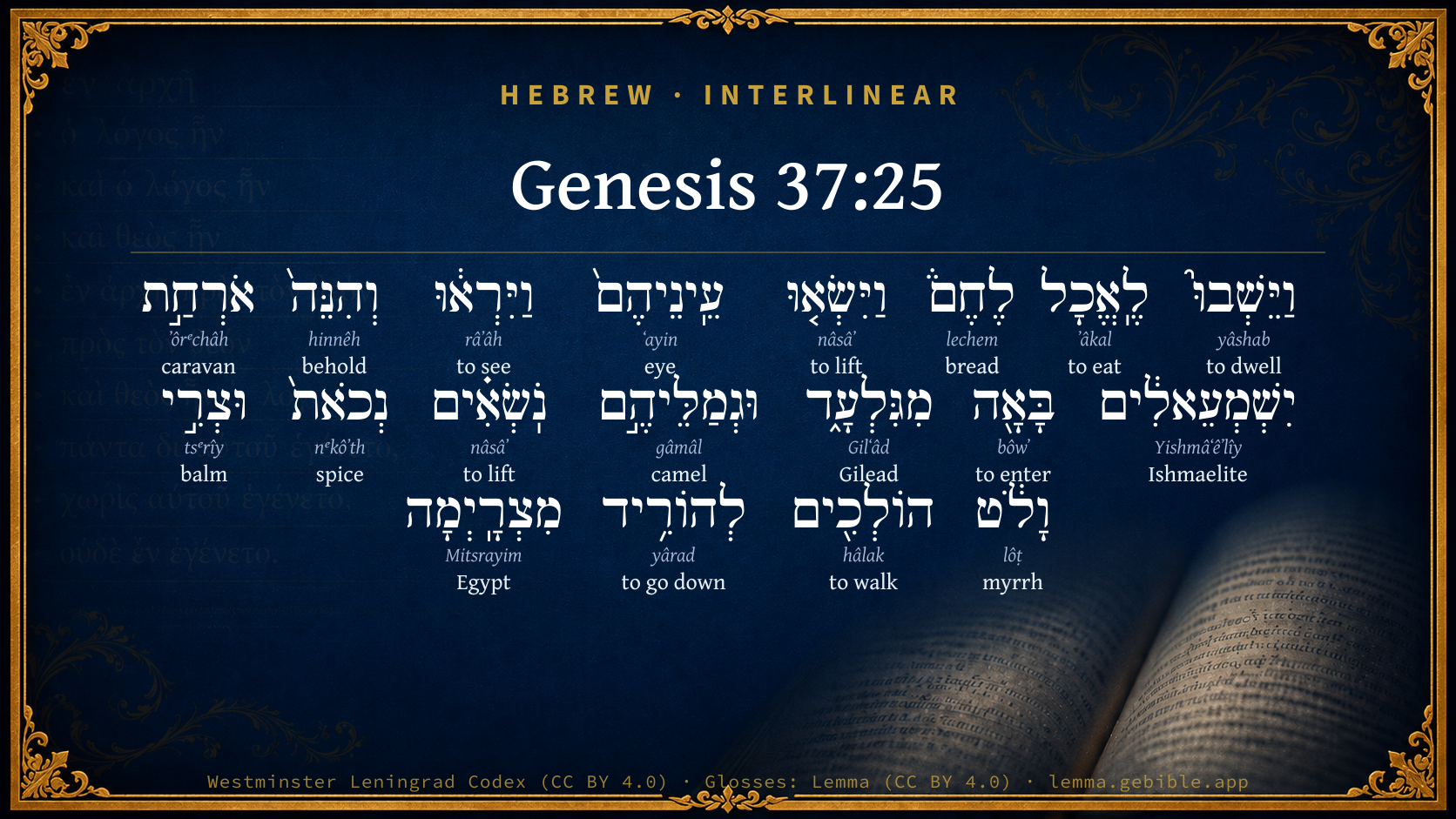
Hebrew (Westminster Leningrad Codex) Genesis 37:25 appears in the Hebrew Old Testament. The text above is from the Westminster Leningrad Codex. Each word links to its Strong’s number, a concise gloss, and parsing drawn from the Open Scriptures Hebrew Bible morphology. Click any word for its full Brown-Driver-Briggs (BDB) entry.
Download image
Cite this verse

Genesis 37:25 (World English Bible). Public Domain. Lemma interlinear Bible study tool, https://lemma.gebible.app/v/genesis/37/25.

Show BibTeX & RIS
BibTeX
RIS
English Translation
They sat down to eat bread, and they lifted up their eyes and looked, and saw a caravan of Ishmaelites was coming from Gilead, with their camels bearing spices and balm and myrrh, going to carry it down to Egypt.
World English Bible · Public Domain
Highlights
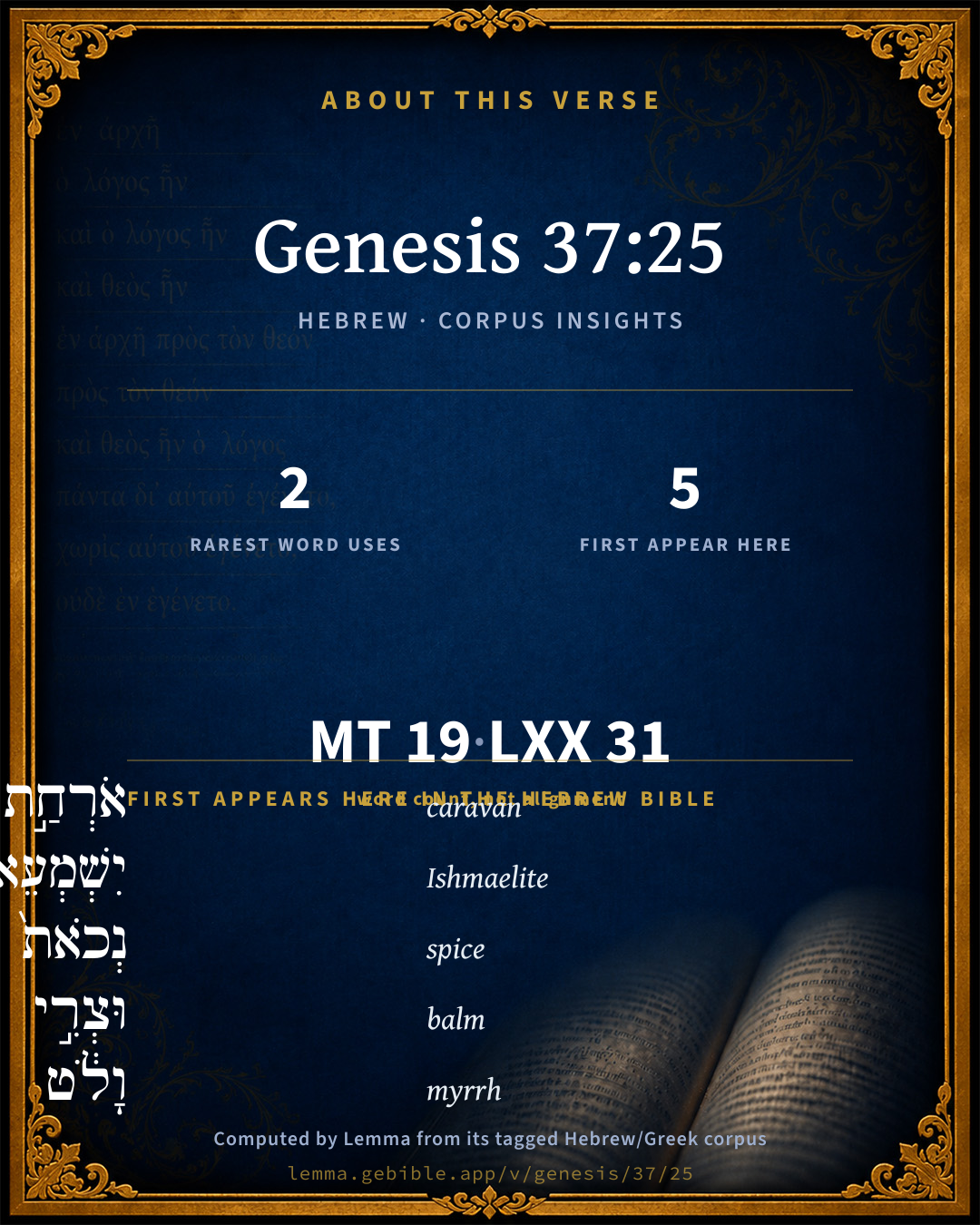
  • 5 first appearances in the Hebrew Bible
Full analysis ↓
Download a study sheet

One document with this verse’s original text, its word-by-word gloss line, the meaning frame, cross-references with their text, attributed commentary, and full source and license credits — printable, and it pastes into notes with its structure intact.

This verse Autodidact and up

Study sheet (.html) Plain text (.txt)

A passage Seminary Student

Up to 50 verses in one chapter. A passage sheet keeps up to 6 commentary sources and 12 cross-references per verse, in the order this page ranks them, and says so on the sheet whenever that leaves anything out. Ask for a single verse and you get the Autodidact verse sheet above.

Everything on this page stays free to read, with no account — the sheet is a download of what is already on screen, not access to it.

Want to remove ads? Support Godless Engineer
Compare translations 3

The same verse in 3 English versions, stacked beneath the original-language interlinear above. Click any original word for its lexicon entry.

Each is an independent rendering of the whole verse — the interlinear is not word-aligned to these translations.

Highlighted words mark where these versions differ — a whole-verse word diff, not a word-by-word alignment.

  • World English Bible Public Domain
    They sat down to eat bread, and they lifted up their eyes and looked, and saw a caravan of Ishmaelites was coming from Gilead, with their camels bearing spices and balm and myrrh, going to carry it down to Egypt.
  • King James Version Public Domain
    And they sat down to eat bread: and they lifted up their eyes and looked, and, behold, a company of Ishmaelites came from Gilead with their camels bearing spicery and balm and myrrh, going to carry it down to Egypt.
  • unfoldingWord Literal Text CC BY-SA 4.0
    Then they sat down to eat bread, and they lifted their eyes and looked, and behold, a caravan of Ishmaelites was coming from Gilead. And their camels were carrying spices and balm and myrrh they were going to take down to Egypt.

unfoldingWord Literal Text — © unfoldingWord, licensed CC BY-SA 4.0. Word-aligned USFM3 via Door43 (git.door43.org/unfoldingWord/en_ult).

Versions to compare (up to 4)

3 of 4 selected

Show all 18 translations

Every available English version of this verse, each an independent rendering of the whole verse.

  • World English Bible Public Domain
    They sat down to eat bread, and they lifted up their eyes and looked, and saw a caravan of Ishmaelites was coming from Gilead, with their camels bearing spices and balm and myrrh, going to carry it down to Egypt.
  • Berean Standard Bible Public Domain
    And as they sat down to eat a meal, they looked up and saw a caravan of Ishmaelites coming from Gilead. Their camels were carrying spices, balm, and myrrh on their way down to Egypt.
  • Majority Standard Bible Public Domain
    And as they sat down to eat a meal, they looked up and saw a caravan of Ishmaelites coming from Gilead. Their camels were carrying spices, balm, and myrrh on their way down to Egypt.
  • King James Version Public Domain
    And they sat down to eat bread: and they lifted up their eyes and looked, and, behold, a company of Ishmaelites came from Gilead with their camels bearing spicery and balm and myrrh, going to carry it down to Egypt.
  • American Standard Version (1901) Public Domain
    And they sat down to eat bread: and they lifted up their eyes and looked, and, behold, a caravan of Ishmaelites was coming from Gilead, with their camels bearing spicery and balm and myrrh, going to carry it down to Egypt.
  • Revised Version (1885) Public Domain
    And they sat down to eat bread: and they lifted up their eyes and looked, and, behold, a travelling company of Ishmaelites came from Gilead, with their camels bearing spicery and balm and myrrh, going to carry it down to Egypt.
  • Geneva Bible (1599) Public Domain
    Then they sate them downe to eate bread: and they lift vp their eyes and looked, and behold, there came a companie of Ishmeelites from Gilead, and their camels laden with spicerie, and balme, and myrrhe, and were going to cary it downe into Egypt.
  • Douay-Rheims (1899) Public Domain
    And sitting down to eat bread, they saw some Ismaelites on their way coming from Calaad, with their camels, carrying spices, and balm, and myrrh to Egypt.
  • Young's Literal Translation Public Domain
    And they sit down to eat bread, and they lift up their eyes, and look, and lo, a company of Ishmaelites coming from Gilead, and their camels bearing spices, and balm, and myrrh, going to take `them' down to Egypt.
  • Literal Standard Version CC BY-SA 4.0
    And they sit down to eat bread, and they lift up their eyes, and look, and behold, a caravan of Ishmaelites coming from Gilead, and their camels carrying spices, and balm, and myrrh, going to take [them] down to Egypt.
  • Unlocked Literal Bible CC BY-SA 4.0
    They sat down to eat bread. They lifted up their eyes and looked, and, behold, a caravan of Ishmaelites was coming from Gilead, with their camels bearing spices and balm and myrrh. They were traveling to carry them down to Egypt.
  • unfoldingWord Literal Text CC BY-SA 4.0
    Then they sat down to eat bread, and they lifted their eyes and looked, and behold, a caravan of Ishmaelites was coming from Gilead. And their camels were carrying spices and balm and myrrh they were going to take down to Egypt.
  • Darby Bible Public Domain
    And they sat down to eat bread; and they lifted up their eyes and looked, and behold, a caravan of Ishmaelites came from Gilead; and their camels bore tragacanth, and balsam, and ladanum -- going to carry [it] down to Egypt.
  • World Messianic Bible Public Domain
    They sat down to eat bread, and they lifted up their eyes and looked, and saw a caravan of Ishmaelites coming from Gilead, with their camels bearing spices and balm and myrrh, going to carry it down to Egypt.
  • Webster's Bible Public Domain
    And they sat down to eat bread: and they lifted up their eyes and looked, and behold, a company of Ishmaelites came from Gilead, with their camels bearing spicery, and balm, and myrrh, going to carry them down to Egypt.
  • Free Bible Version CC BY-SA 4.0
    They were just sitting down to have a meal when they saw a caravan of Ishmaelites coming from Gilead. Their camels were carrying aromatic spices, balm, and myrrh to take to Egypt.
  • Bible in Basic English Public Domain
    Then seating themselves, they took their meal: and looking up, they saw a travelling band of Ishmaelites, coming from Gilead on their way to Egypt, with spices and perfumes on their camels.
  • JPS Tanakh (1917) Public Domain
    And they sat down to eat bread; and they lifted up their eyes and looked, and, behold, a caravan of Ishmaelites came from Gilead, with their camels bearing spicery and balm and ladanum, going to carry it down to Egypt.

Literal Standard Version (2020), Covenant Press — licensed CC BY-SA 4.0. Text via the HelloAO Bible API (eBible.org). Unlocked Literal Bible (unfoldingWord) — licensed CC BY-SA 4.0. Text via the HelloAO Bible API (eBible.org). unfoldingWord Literal Text — © unfoldingWord, licensed CC BY-SA 4.0. Word-aligned USFM3 via Door43 (git.door43.org/unfoldingWord/en_ult). Free Bible Version, Dr. Jonathan Gallagher — licensed CC BY-SA 4.0. Text via the HelloAO Bible API (eBible.org).

Word by word

More ways to search: Search by grammar → Find every occurrence → Compare this word →

Practice this passage: Drill this verse → Learn its vocabulary →

אֹרְחַ֣ת
ʼôrᵉchâh
H736
“caravan of”
Noun, Common, Feminine, Singular, Construct
Part of Speech
Noun
Type
Common
Gender
Feminine
Number
Singular
State
Construct
Full BDB Definition

Origin: active participle of H732

TWOT: 161c

caravan, travelling company
  1. וַיֵּשְׁבוּ֮ yâshab H3427 “and · to dwell” Conjunction + Verb, Qal, Sequential Imperfect, 3rd Person, Masculine, Plural
  2. לֶֽאֱכָל ʼâkal H398 “to eat” Preposition + Verb, Qal, Infinitive Construct
  3. לֶחֶם֒ lechem H3899 “bread” Noun, Common, Both, Singular, Absolute
  4. וַיִּשְׂא֤וּ nâsâʼ H5375 “and · to lift” Conjunction + Verb, Qal, Sequential Imperfect, 3rd Person, Masculine, Plural
  5. עֵֽינֵיהֶם֙ ʻayin H5869 “eyes · their” Noun, Common, Both, Dual, Construct + Suffix, Personal, 3rd Person, Masculine, Plural
  6. וַיִּרְא֔וּ râʼâh H7200 “and · to see” Conjunction + Verb, Qal, Sequential Imperfect, 3rd Person, Masculine, Plural
  7. וְהִנֵּה֙ hinnêh H2009 “and · behold” Conjunction + Particle, Demonstrative
  8. יִשְׁמְעֵאלִ֔ים Yishmâʻêʼlîy H3459 “Ishmaelites” Noun, Gentilic, Masculine, Plural, Absolute
  9. בָּאָ֖ה bôwʼ H935 “entering” Verb, Qal, Participle Active, Feminine, Singular, Absolute
  10. מִגִּלְעָ֑ד Gilʻâd H1568 “from · Gilead” Preposition + Noun, Proper
  11. וּגְמַלֵּיהֶ֣ם gâmâl H1581 “and · camels · their” Conjunction + Noun, Common, Masculine, Plural, Construct + Suffix, Personal, 3rd Person, Masculine, Plural
  12. נֹֽשְׂאִ֗ים nâsâʼ H5375 “lifting” Verb, Qal, Participle Active, Masculine, Plural, Absolute
  13. נְכֹאת֙ nᵉkôʼth H5219 “spice” Noun, Common, Feminine, Singular, Absolute
  14. וּצְרִ֣י tsᵉrîy H6875 “and · balm” Conjunction + Noun, Common, Masculine, Singular, Absolute
  15. וָלֹ֔ט lôṭ H3910 “and · myrrh” Conjunction + Noun, Common, Masculine, Singular, Absolute
  16. הוֹלְכִ֖ים hâlak H1980 “walking” Verb, Qal, Participle Active, Masculine, Plural, Absolute
  17. לְהוֹרִ֥יד yârad H3381 “to go down” Preposition + Verb, Hiphil, Infinitive Construct
  18. מִצְרָֽיְמָה Mitsrayim H4714 “Egypt · toward” Noun, Proper + Suffix, Demonstrative

About this verse

These counts appear in no published source. They are computed here, from the morphology-tagged text and Lemma’s own curated glosses. What Lemma adds →

19
words
18
distinct lemmas
Pentateuch
section

Notable vocabulary

The rarest word here is אֹרְחַ֣ת caravan H736 — appearing just 2 times in the whole Hebrew Bible.

First appearance in Scripture

These words make their first canonical appearance in the Hebrew Bible here:

  • אֹרְחַ֣ת caravan H736
  • יִשְׁמְעֵאלִ֔ים Ishmaelite H3459
  • נְכֹאת֙ spice H5219
  • וּצְרִ֣י balm H6875
  • וָלֹ֔ט myrrh H3910

Shared distinctive vocabulary

אֹרְחַ֣ת caravan H736 occurs in 2 verses of the Hebrew Bible. Also found in:

Grammatical profile

  • 8 verbs
  • 10 nouns
  • 1 particle

Verb forms

  • וַיֵּשְׁבוּ֮ Qal · Sequential Imperfect
  • לֶֽאֱכָל Qal · Infinitive Construct
  • וַיִּשְׂא֤וּ Qal · Sequential Imperfect
  • וַיִּרְא֔וּ Qal · Sequential Imperfect
  • בָּאָ֖ה Qal · Participle Active
  • נֹֽשְׂאִ֗ים Qal · Participle Active
  • הוֹלְכִ֖ים Qal · Participle Active
  • לְהוֹרִ֥יד Hiphil · Infinitive Construct

Repetition

A word recurs within this verse — often emphatic in Hebrew:

  • וַיִּשְׂא֤וּ to lift H5375 ×2

Hebrew & Septuagint length

In English translation the verse runs 40 words from the Hebrew and 42 from the Septuagint (LXX English) — closely comparable.

A rough comparison of the two English renderings, which tokenize alike — not a word-level alignment.

Word counts can differ between the Hebrew and the Greek without any difference in meaning — e.g. the Hebrew direct-object marker אֵת has no separate Greek word, and Greek often adds the article ὁ.

In the original languages it is 19 Hebrew tokens and 31 Greek tokens — but the two are counted differently (Hebrew bundles its prefixes and suffixes into one token; the Greek is in lemma form), so that isn’t a like-for-like length.

Cross-references

16

Topical passages linked to Genesis 37:25 in the Treasury of Scripture Knowledge — connected by theme and wording, ordered by reader-vote popularity; previews shown in the World English Bible.

  • Genesis 37:28 Midianites who were merchants passed by, and they drew and lifted up Joseph out of the pit, and sold Joseph to the Ishmaelites for twenty pieces of silver. They brought Joseph into Egypt.
  • Genesis 43:11 Their father, Israel, said to them, "If it be so now, do this. Take from the choice fruits of the land in your bags, and carry down a present for the man, a little balm, a little honey, spices and myrrh, nuts, and almonds;
  • Jeremiah 8:22 Is there no balm in Gilead? is there no physician there? why then isn't the health of the daughter of my people recovered?
  • Genesis 16:11–12 The angel of Yahweh said to her, "Behold, you are with child, and will bear a son. You shall call his name Ishmael, because Yahweh has heard your affliction.
  • Genesis 37:36 The Midianites sold him into Egypt to Potiphar, an officer of Pharaoh's, the captain of the guard.
  • Genesis 25:1–4 Abraham took another wife, and her name was Keturah.
  • Genesis 25:16–18 These are the sons of Ishmael, and these are their names, by their villages, and by their encampments: twelve princes, according to their nations.
  • Genesis 31:23 He took his relatives with him, and pursued after him seven days' journey. He overtook him in the mountain of Gilead.
  • Genesis 39:1 Joseph was brought down to Egypt. Potiphar, an officer of Pharaoh's, the captain of the guard, an Egyptian, bought him from the hand of the Ishmaelites that had brought him down there.
  • Psalms 14:4 Have all the workers of iniquity no knowledge, Who eat up my people as they eat bread, And don't call on Yahweh?
  • Proverbs 30:20 So is the way of an adulterous woman: She eats and wipes her mouth, And says, 'I have done nothing wrong.'
  • Jeremiah 46:11 Go up into Gilead, and take balm, virgin daughter of Egypt: in vain do you use many medicines; there is no healing for you.
  • Amos 6:6 Who drink wine in bowls, And anoint themselves with the best oils; But they are not grieved for the affliction of Joseph.
  • Genesis 31:21 So he fled with all that he had. He rose up, passed over the River, and set his face toward the mountain of Gilead.
  • Esther 3:15 The posts went forth in haste by the king's commandment, and the decree was given out in Shushan the palace. The king and Haman sat down to drink; but the city of Shushan was perplexed.
  • Psalms 83:6 The tents of Edom and the Ishmaelites; Moab, and the Hagrites;

Cross-references courtesy of OpenBible.info (CC BY 4.0).

Hebrew and Greek witnesses Masoretic Hebrew ↔ Greek Septuagint

The same verse in the two great witnesses to the Old Testament, shown verse-for-verse.

These are two independent witnesses, not word-aligned to each other, and the Septuagint is shown in lemma (dictionary) form.

Hebrew Genesis 37:25 Masoretic · Westminster Leningrad Codex

וַיֵּשְׁבוּ֮ לֶֽאֱכָל לֶחֶם֒ וַיִּשְׂא֤וּ עֵֽינֵיהֶם֙ וַיִּרְא֔וּ וְהִנֵּה֙ אֹרְחַ֣ת יִשְׁמְעֵאלִ֔ים בָּאָ֖ה מִגִּלְעָ֑ד וּגְמַלֵּיהֶ֣ם נֹֽשְׂאִ֗ים נְכֹאת֙ וּצְרִ֣י וָלֹ֔ט הוֹלְכִ֖ים לְהוֹרִ֥יד מִצְרָֽיְמָה

They sat down to eat bread, and they lifted up their eyes and looked, and saw a caravan of Ishmaelites was coming from Gilead, with their camels bearing spices and balm and myrrh, going to carry it down to Egypt.

World English Bible · Public Domain

Greek LXX Genesis 37:25 Septuagint · lemma form

καταἵζω δέ ἐσθίω ἄρτος καί ἀναβλέπω ὁ ὀφθαλμός ὁράω καί ἰδού ὁδοιπόρος ισμαηλίτης ἄρχω ἐκ γαλαάδ καί ὁ κάμηλος αὐτός γέμω θυμίαμα καί ῥητίνη καί στακτή πορεύομαι δέ καταἄγω εἰς αἴγυπτος

And they sat down to eat bread; and having lifted up their eyes they saw, and behold, Ismaelitish travellers came from Galaad, and their camels were heavily loaded with spices, and resin, and myrrh; and they went to bring them to Egypt.

LXX2012 (modern English Septuagint) · Public Domain

On this verse, The Cambridge Bible for Schools and Colleges discusses the Septuagint’s reading. Read the note in Commentary ↓

Hebrew: Westminster Leningrad Codex (CC BY 4.0). Greek: Septuagint (public domain); English from LXX2012 (modern English Septuagint) (Public Domain). How the Septuagint differs from the Hebrew →

Targum (Aramaic paraphrase)

2

The Targum is the ancient Jewish Aramaic paraphrase of the Hebrew Scriptures — an interpretive translation, not the Hebrew text itself. Onkelos (literal) and Pseudo-Jonathan (expansive) render the Torah, and Jonathan the Prophets. Coverage is partial: where no permissively-licensed English translation exists for a verse, only the Aramaic is shown. This is verse-level text, not a word-by-word alignment to the Hebrew.

  1. Targum Onkelos Torah (Genesis–Deuteronomy)
    וְאַסְחָרוּ לְמֵיכַל לַחֲמָא וּזְקָפוּ עֵינֵיהוֹן וַחֲזוֹ וְהָא שְׁיָרַת עֲרָבָאֵי אָתְיָא מִגִּלְעָד וְגַמְלֵיהוֹן טְעִינִין שְׁעַף וּקְטַף וּלְטוֹם אָזְלִין לַאֲחָתָא לְמִצְרָיִם

    (no public-domain English translation for this verse)

    Targum Onkelos — Aramaic: “Onkelos Genesis” (public domain); “Onkelos Exodus” (public domain); “Onkelos Leviticus” (public domain); “Onkelos Numbers” (public domain); “Onkelos Deuteronomy” (public domain). English: “Sefaria Community Translation” (CC0 1.0 (public-domain dedication)); “J.W. Etheridge. The Targums of Onkelos and Jonathan Ben Uzziel on the Pentateuch. London: Longmans, Green, 1862” (public domain). Text via Sefaria.

  2. Targum Pseudo-Jonathan Torah (Genesis–Deuteronomy)
    וְחָזְרוּ לְמֵיכַל לַחֲמָא וּזְקָפוּ עֵינֵיהוֹן וַחֲמוֹן וְהָא סִיעָא דַעֲרָבָאִין אַתְיָא מִגִלְעָד וּגְמַלֵיהוֹן טְעוּנִין שַׁעֲוָה וּשְרַף קְטַף וּלְטוֹם מְטַיְילִין לַאֲחָתָא לְמִצְרָיִם

    And they sat around to eat bread. And they lifted up their eyes, and looked, and behold a band of Arabians were coming from Gilead with their camels, carrying wax, resin, balsam and stacte, proceeding to go into Mizraim.

    Targum Pseudo-Jonathan — Aramaic: “Targum Jonathan on Genesis” (public domain); “Targum Jonathan on Exodus” (public domain); “Targum Jonathan on Leviticus” (public domain); “Targum Jonathan on Numbers” (public domain); “Targum Jonathan on Deuteronomy” (public domain). English: “The Targum of Jonathan ben Uzziel, trans. J. W. Etheridge, London, 1862” (public domain). Text via Sefaria.

Commentary

Notes on Genesis 37:25 from classic Christian and Jewish commentators (each source and its license shown beneath its notes). The classic Christian expositions comment on the surrounding passage and are grouped to its opening verse, so a note may address several verses; the Jewish commentaries on the Tanakh (Rashi and others) are per-verse, so they appear only where the commentator wrote on this verse.

Lemma curates 59 commentaries, every one of them public domain or Creative Commons licensed, each selected and text-cleaned for this edition rather than reprinted as found. About our sources →

Trapp's Complete Commentary

John Trapp

Gen 37:25 And they sat down to eat bread: and they lifted up their eyes and looked, and, behold, a company of Ishmeelites came from Gilead with their camels bearing spicery and balm and myrrh, going to carry [it] down to Egypt.

Ver. 25. And they sat down to eat.] To weep for their wickedness, they should have sat down rather. But the devil had drawn a hard hoof over their hearts, that either they fdt no remorse of what they had done, for present; or else they sought to ease themselves of it by eating and merry making. "They drank wine in bowls; but no man was sorry for the affliction of Joseph." {Amo 6:6} Nay, perhaps they had so tired themselves with making away their brother, that they were even spent again, and stood in need of some refreshing. The good providence of God was in it howsoever, that they should there sit down, till the merchants came by from Gilead, which was a market for merchants. {Jer 8:22; Jer 22:6} "All things co-operate for good to them that love God." {Rom 8:28}

John Trapp, A Commentary or Exposition upon All the Books of the Old and New Testament (1647–1656) — public domain. Text from a community e-Sword module.

The Biblical Illustrator

Joseph S. Exell

Gen_37:25

A company of Ishmaelites

Lessons

1.

Providence can make eyes to see, and such objects to be presented, which may occasion diversion of evil plots against the saints.

2. God orders travellers, and trades, and journies, to serve His own ends to His servants.

3. Accidental events to men are settled providences unto the servants of God.

4. Trade from land to land, about proper fruits of the respective countries, hath been, of old, ordered by Providence, for common advantage God allows and commends it (Gen_49:13).

5. The same place may be aimed at by God and men, but upon several accounts (Gen_37:25).

6. Providence toucheth hearts as well as eyes of sinners to defeat cruel designs against His.

7. One spoiler may be wrought upon by God to cause others to desist from cruelty.

8. Thoughts of the unprofitableness of sin is a forcing means to avoid it.

9. Murder and concealment of blood bring no advantage to sinners (Gen_37:26.)

10. Hypocrites may judge there is no profit in one sin, but some in another.

11. Hypocrites may dissuade men from one sin, but incite them to others, Come, &c.

12. Malice of formalists to sincere Christians sticks not to sell them to bitter enemies of the Church.

13. God makes natural relation and motions to flesh sometimes to keep persons from cruelty.

14. God causeth the counsel of one conspirator to defeat the rest, and makes them concur to His ends (Gen_37:27).

15. Providence offers opportunity to sinners for doing their will, that His may be done.

16. Murderers are made deliverers by God at His pleasure and in His measure.

17. The most innocent souls may be sold for slaves when aimed by God to be lords.

18. A small price do wicked men put upon the best of Gods servants, nay on His Son.

19. Gracious souls, surprised by the wicked in their honest ways, may be carried whither they would not.

20. Ishmaelites may carry innocents to Egypt for their ends, but God orders them thither for His own. So God maketh use of sinners. They bring him to make gain of him, God sends him to save and gain others. (G. Hughes, B. D.)

Caravan trade

From very early times, a lively caravan trade was entertained between Syria and the East Jordanic provinces on the one hand, and Egypt on the other; it brought the esteemed products of Arabia and the wares and merchandises of eastern Asia into the land of the Pharaohs; and in the course of time, the importation was conducted with all possible regularity, and on lines prudently chosen and marked out. We find, thai so early as the sixteenth dynasty, stations were formed, temples erected, and wells dug and protected, in the Arabian Desert, for the benefit of those who had occasion to pass through it in their commercial travels. Egypt had, at that period, already attained a great measure of the civilization of which it was capable; it enjoyed a strong government and well-organized public institutions; and the political and social relations were regulated on a firm basis. This sense of security favoured the development of comfort and luxury; the higher castes especially appreciated all that delights and embellishes life; their wants increased in an incredible degree; and they encouraged every undertaking which promised to gratify them. Among the articles in peculiar demand were all varieties of spicery and perfumes, required not only for the feasts and pleasures of the living, but for the embalming of the dead; the mummies generally emitted so delicious a fragrance that they were for generations kept in the houses of the relatives, arranged along the walls, and then only entombed; which practice, however, received, no doubt, its first impulse from the devoted love bestowed in Egypt on departed parents and relatives. The amount of spicery consumed for all these purposes was necessarily immense; and the caravan introduced in our narrative was exclusively laden with those costly commodities. The men who conducted it were Midianites (Gen_37:28; Gen_37:36), a tribe partly nomadic, but partly actively engaged in commerce. But as the Ishmaelites commanded by far the greatest part of the caravan trade, all those who carried on the same pursuits were designated by their name. (M. M.Kalisch, Ph. D.)

Circumstances favouring bad men

There are times when circumstances seem to favour bad men. Some of us are accustomed to teach that circumstances are the voice of Divine Providence. There is a sense--a profound sense--in which that is perfectly true. God speaks by combinations of events, by the complications of history, by unexpected occurrences. Most undoubtedly so. We have marked this. In many cases we have seen their moral meaning, and have been attracted to them as to the cloudy pillar in the day time and the fire by night. At the same time, there is another side to that doctrine. Here in the text we find circumstances evidently combining in favour of the bad men who had agreed to part with their brother. They sat down to eat bread--perfectly tranquil, social amongst themselves, a rough hospitality prevailing. Just as they sat down to enjoy themselves with their bread they lifted up their eyes, and at that very moment a company of Ishmaelites came from Gilead with their camels. What could be more providential? They came in the very nick of time. The brethren hadnt to go up and down hawking their brother, knocking at door after door to ask if anybody could take him off their hands; but at the very moment when the discussion was pending and anxiety was at white heat, these circumstances so combined and converged as to point out the way of Providence and the path of right. Then we ought to look at circumstances with a critical eye. We ought first to look at moral principles and then at circumstances. If the morality is right, the eventuality may be taken as an element worthy of consideration in the debate and strife of the hour. But if the principles at the very base are wrong, we are not to see circumstances as Divine providences, but rather as casual ways to the realization of a nefarious intent. Let us be still more particular about this. I do not deny that these Ishmaelites came providentially at that identical moment. I believe that the Ishmaelites were sent by Almighty God at that very crisis, and that they were intended by Him to offer the solution of the difficult problem. But it is one thing for us to debase circumstances to our own use and convenience, and another to view them from Gods altitude and to accept them in Gods spirit. (J. Parker D. D.)

The uncertainties that characterize our human existence

How true it is that we know not what a day may bring forth! Joseph goes out on his fathers errand and never more returns to his fathers house--does not see his father again, in fact, for twenty-two years. Of course the crime of his brothers was of the cause of this long separation between him and his venerable parent. But how often similar things occur even among ourselves! Some years ago a little boy was stolen from his home in Philadelphia, and though every means that affection could suggest or professional skill could devise have been used for his discovery, the mystery has never been cleared up, so that to this hour his parents are in most horrible suspense. In our own city, too, scarcely a week elapses without the announcement that some one has disappeared from home and business, and very frequently nothing more is heard of him. But, apart from such occurrences, which may be traced to the cunning and malignity of wicked men, and which are a disgrace to our much boasted civilization, how often it happens, in the simple providence of God, and without blame to any one, that those who part in the morning with the hope of meeting again in a very short while never see each other more on earth! The street accident causes death; or the sudden outbreak of fire in the building in which their office hours are spent cuts off all possibility of escape, and they are burned to ashes; or a panic in a crowded place of amusement which they visited has caused a great loss of life, and they are numbered among the victims; or a railroad collision has smashed the train in which they were passengers, and they are reported among the dead; or, without any such catastrophe, they have simply yielded to a sudden paroxysm of illness and passed within the veil. Who knows not how frequently such things are occurring in the midst of us, so that, as we have lately had occasion again and again to say, the proverb is verified that it is the unexpected that happens. What then? Are we to have our hearts for ever darkened with the shadow of the possibility of such things coming to us? No; for that would be to make our lives continually miserable; but the lesson is that we should be ever ready to respond to the call of God, and should take short views of things by living, as nearly as possible, a day at a time. We need not borrow trouble on the strength of the uncertainty to which I have referred, for sufficient unto the day is the evil thereof; but we ought to be taught by it to finish every days work in its own day, since its lesson is, Boast not thyself of tomorrow, for thou knowest not what a day may bring forth. (W. M. Taylor, D. D.)

Judahs suggestion

The very brightest and luckiest idea of all. He touched human nature to the very quick when he said, What profit is it? And instantly they seemed to convict themselves of a kind of thickheadedness, and said one to another, Ah, to be sure, why no profit at all. Here is an opportunity of selling him, and that will turn to the account of us all. Sell is as short a word as slay. Sell! that will get clear of him. Let us sell. Sell! we shall have no blood upon our hands. Then we shall, perhaps, have a couple of shekels a-piece, and tossing them up in the air an inch or so, and catching them again, and hearing their pleasant chink. This is the plan, to be sure. This is the way out of the difficulty. We are sorry we ever thought of shedding blood; we shake ourselves from all such imputations. Let us sell the lad, and there will be an end of the difficulty. Selling does not always take a man out of difficulty. Bargain-making is not always satisfactory. There is a gain that is loss; there is a loss that is gain. There is a separation that takes the hated object from the eyes, yet that object is an element in society and in life--working, penetrating, developing--and it will come back again upon us some day greater than power, with intensified poignancy; and the man that was driven away from us a beggar and a slave may one day rise up in our path, terrible as an avenger, irresistible as a judgment of God. Well, his brethren were content. Men even say that they enjoy a great peace, and, therefore, that if circumstances are tolerably favourable, they say that on the whole they feel in a good state of mind. Therefore, they conclude that they have not been doing anything very wrong. Let us understand that vice may have a soporific effect upon the conscience and judgment; that we may work ourselves into such a state of mind as to place ourselves under circumstances that are fictitious, unsound in their moral bearing, however enjoyable may be their immediate influence upon the mind. I am struck by this circumstance, in reading the account which is before me, namely, how possible it is to fall from a rough kind of vice, such as, Let us slay our brother, into a milder form of iniquity, such as, Let us sell our brother, and to think that we have now actually come into a state of virtue. That is to say, selling as contrasted with slaying seems so moderate and amiable a thing, as actually to amount to a kind of virtue. Am I understood upon this point? We are not to compare one act with another and say, Comparatively speaking this act is good. Virtue is not a quantity to be compared. Virtue is a non-declinable quality. I know how easy it is, when some very startling proposition has been before the mind, to accept a modified form of the proposition, which in itself is morally corrupt; and yet to imagine, by the very descent from the other point, that we have come into a region of virtue. When men say, Let us slay our brother, there is a little shuddering in society. We dont want to slay our brother. Well, then, says an acute man, let us sell him. And, instantly, amiable Christian people say, Ay, ay, this is a very different thing; yes, let us sell him. Observe, the morality is not changed, only the point in the scale has been lowered. When God comes to judge lie will not say, Is this virtue and water? is this diluted vice? but, Is this right? is this wrong? The standard of judgment will be the holiness of God! (J. Parker, D. D.)

The Biblical Illustrator, edited by Joseph S. Exell (c. 1880s–1900s) — public domain. Text from a community e-Sword module.

Keil & Delitzsch

C. F. Keil & F. Delitzsch

Reuben had saved Joseph's life indeed by his proposal; but his intention to send him back to his father was frustrated. For as soon as the brethren sat down to eat, after the deed was performed, they saw a company of Ishmaelites from Gilead coming along the road which leads from Beisan past Jenin (Rob. Pal. iii. 155) and through the plain of Dothan to the great caravan road that runs from Damascus by Lejun (Legio, Megiddo), Ramleh, and Gaza to Egypt (Rob. iii. 27, 178). The caravan drew near, laden with spices: viz., נכאת, gum-tragacanth; צרי, balsam, for which Gilead was celebrated (Gen 43:11; Jer 8:22; Jer 46:11); and לט, ladanum, the fragrant resin of the cistus-rose. Judah seized the opportunity to propose to his brethren to sell Joseph to the Ishmaelites. "What profit have we," he said, "that we slay our brother and conceal his blood? Come, let us sell him to the Ishmaelites; and our hand, let it not lay hold of him (sc., to slay him), for he is our brother, our flesh." Reuben wished to deliver Joseph entirely from his brothers' malice. Judah also wished to save his life, though not from brotherly love so much as from the feeling of horror, which was not quite extinct within him, at incurring the guilt of fratricide; but he would still like to get rid of him, that his dreams might not come true. Judah, like his brethren, was probably afraid that their father might confer upon Joseph the rights of the first-born, and so make him lord over them. His proposal was a welcome one. When the Arabs passed by, the brethren fetched Joseph out of the pit and sold him to the Ishmaelites, who took him into Egypt. The different names given to the traders - viz., Ishmaelites (Gen 37:25, Gen 37:27, and Gen 37:28), Midianites (Gen 37:28), and Medanites (Gen 37:36) - do not show that the account has been drawn from different legends, but that these tribes were often confounded, from the fact that they resembled one another so closely, not only in their common descent from Abraham (Gen 16:15 and Gen 25:2), but also in the similarity of their mode of life and their constant change of abode, that strangers could hardly distinguish them, especially when they appeared not as tribes but as Arabian merchants, such as they are here described as being: "Midianitish men, merchants." That descendants of Abraham should already be met with in this capacity is by no means strange, if we consider that 150 years had passed by since Ishmael's dismissal from his father's house, - a period amply sufficient for his descendants to have grown through marriage into a respectable tribe. The price, "twenty (sc., shekels) of silver," was the price which Moses afterwards fixed as the value of a boy between 5 and 20 (Lev 27:5), the average price of a slave being 30 shekels (Exo 21:32). But the Ishmaelites naturally wanted to make money by the transaction.

Keil & Delitzsch — Biblical Commentary on the Old Testament (1861–1891) — public domain (CC PDM 1.0). Text via the HelloAO Bible API. (Old Testament only.)

Tyndale Open Study Notes

Tyndale Open Resources

37:25-28 The Ishmaelite traders were descendants of the slave child who was cast out for mocking Isaac. Now they would enslave Joseph. When he was sold for twenty pieces of silver and carried to Egypt, he was at least preserved alive.

Tyndale Open Study Notes — © Tyndale Open Resources, licensed CC BY-SA 4.0. Text via the HelloAO Bible API.

Geneva Bible (1599)

Geneva Bible translators

Or, rosen, turpentine, or treacle.

Geneva Bible (1599) marginal notes — public domain. Text via Bolls.life.

Jamieson, Fausset & Brown

Robert Jamieson, A. R. Fausset & David Brown

they sat down to eat bread--What a view does this exhibit of those hardened profligates! Their common share in this conspiracy is not the only dismal feature in the story. The rapidity, the almost instantaneous manner in which the proposal was followed by their joint resolution, and the cool indifference, or rather the fiendish satisfaction, with which they sat down to regale themselves, is astonishing. It is impossible that mere envy at his dreams, his gaudy dress, or the doting partiality of their common father, could have goaded them on to such a pitch of frenzied resentment or confirmed them in such consummate wickedness. Their hatred to Joseph must have had a far deeper seat. It must have been produced by dislike to his piety and other excellencies, which made his character and conduct a constant censure upon theirs, and on account of which they found that they could never be at ease till they had rid themselves of his hated presence. This was the true solution of the mystery, just as it was in the case of Cain (Jo1 3:12).

they lifted up their eyes, . . . and, behold, a company of Ishmaelites--They are called Midianites (Gen 37:28), and Medanites, in Hebrew (Gen 37:36), being a travelling caravan composed of a mixed association of Arabians. Those tribes of Northern Arabia had already addicted themselves to commerce, and long did they enjoy a monopoly, the carrying trade being entirely in their hands. Their approach could easily be seen; for, as their road, after crossing the ford from the trans-jordanic district, led along the south side of the mountains of Gilboa, a party seated on the plain of Dothan could trace them and their string of camels in the distance as they proceeded through the broad and gently sloping valley that intervenes. Trading in the produce of Arabia and India, they were in the regular course of traffic on their way to Egypt: and the chief articles of commerce in which this clan dealt were

spicery from India, that is, a species of resinous gum, called storax, balm--"balm of Gilead," the juice of the balsam tree, a native of Arabia-Felix, and myrrh--an Arabic gum of a strong, fragrant smell. For these articles there must have been an enormous demand in Egypt as they were constantly used in the process of embalming.

Jamieson, Fausset & Brown — Commentary Critical and Explanatory on the Whole Bible (1871) — public domain (CC PDM 1.0). Text via the HelloAO Bible API.

Adam Clarke's Commentary

Verse 25. They sat down to eat bread] Every act is perfectly in character, and describes forcibly the brutish and diabolic nature of their ruthless souls.

A company of Ishmaelites] We may naturally suppose that this was a caravan, composed of different tribes that, for their greater safety, were travelling together, and of which Ishmaelites and Midianites made the chief. In the Chaldee they are called Arabians, which, from ערב arab, to mingle, was in all probability used by the Targumist as the word Arabians is used among us, which comprehends a vast number of clans, or tribes of people. The Jerusalem Targum calls them סרקין Sarkin, what we term Saracens. In the Persian, the clause stands thus: [Persian] karavanee iskmaaleem araban aya. "A caravan of Ishmaelite Arabs came." This seems to give the true sense.

Adam Clarke's Commentary on the Bible (1810–1826) — public domain. Text from a community e-Sword/MySword module.

John Calvin's Commentaries

25. And they sat down to eat bread. This was an astonishing barbarity, that they could quietly feast, while, in intention, they were guilty of their brother’s death: for, had there been one drop of humanity in their souls, they would at least have felt some inward compunctions; yea, commonly, the very worst men are afraid after the commission of a crime. Since the patriarchs fell into such a state of insensibility, let us learn, from their example, to fear lest, by the righteous anger of God, the same lethargy should seize upon our senses. Meanwhile, it is proper to consider the admirable progress of God’s counsel. Joseph had already passed through a double death: and now, as if by a third death, he is, beyond all expectation, rescued from the grave. For what was it less than death, to be sold as a slave to foreigners? Indeed his condition was rendered worse by the chance; because Reuben, secretly drawing him out of the pit, would have brought him back to his father: whereas now he is dragged to a distant part of the earth, without hope of return. But this was a secret turn, by which God had determined to raise him on high. And at length, he shows by the event, how much better it was that Joseph should be led far away from his own family, than that he should remain in safety at home. Moreover, the speech of Judah, by which he persuades his brethren to sell Joseph, has somewhat more reason. For he ingenuously confesses that they would be guilty of homicide, if they suffered him to perish in the pit. What gain shall we make, he says, if his blood be covered; for our hands will nevertheless be polluted with blood. By this time their fury was in some degree abated, so that they listened to more humane counsel; for though it was outrageous perfidy to sell their brother to strangers; yet it was something to send him away alive, that, at least, he might be nourished as a slave. We see, therefore, that the diabolical flame of madness, with which they had all burned, was abating, when they acknowledged that they could profit nothing by hiding their crime from the eyes of men; because homicide must of necessity come into view before God. For at first, they absolved themselves from guilt, as if no Judge sat in heaven. But now the sense of nature, which the cruelty of hatred had before benumbed, begins to exert its power. And certainly, even in the reprobate, who seem entirely to have cast off humanity, time shows that some residue of it remains. When wicked and violent affections rage, their tumultuous fervor hinders nature from acting its part. But no minds are so stupid, that a consideration of their own wickedness will not sometimes fill them with remorse: for, in order that men may come inexcusable to the judgment-seat of God, it is necessary that they should first be condemned by themselves. They who are capable of cure, and whom the Lord leads to repentance, differ from the reprobates in this, that while the latter obstinately conceal the knowledge of their crimes, the former gradually return from the indulgence of sin, to obey the voice of reason. Moreover, what Judah here declares concerning his brother, the Lord, by the prophet, extends to the whole human race. Whenever, therefore, depraved lust impels to unjust violence, or any other injury, let us remember this sacred bond by which the whole of society is bound together, in order that it may restrain us from evil doings. For man cannot injure men, but he becomes an enemy to his own flesh, and violates and perverts the whole order of nature.

John Calvin's Commentaries (1540-1563) — public domain. Text from the Calvin Translation Society English edition (1840s-50s) via the Christian Classics Ethereal Library (ccel.org). Calvin's coverage is partial (roughly two-thirds of the Bible); uncommented books and verses are honest gaps, never fabricated. The 19th-century editor's footnotes and remarks are omitted so the notes are faithfully Calvin's own voice.

Ellicott's Commentary for English Readers

(25) A company of Ishmeelites.—Dothan was situated on the great caravan line by which the products of India and Western Asia were brought to Egypt. As the eastern side of Canaan is covered by the great Arabian desert, the caravans had to travel in a north-westernly direction until, having forded the Euphrates, they could strike across from Tadmor to Gilead. The route thence led them over the Jordan at Beisan, and so southward to Egypt. For “Ishmeelites,” we have “Midianites,” Heb., Medyanim, in Gen_37:28, and Medanites, Heb., Medanim, in Gen_37:36; but the Targum and the Syriac, instead of Ishmeelites, read Arabs. Midian was a son of Abraham by Keturah, and Ishmael was his son by Hagar. But probably these merchants were descended from neither by blood, but belonged to some branch of the Canaanites, who were the great traders of ancient times, and which Ishmael and Midian had compelled to submit to their sway. (But see Note on Gen_25:2.) The Jewish interpreters are reduced to great straits in reconciling these names, and even assert that Joseph was sold three times. Really Ishmeelites, Midianites, and Medanites are all one and the same, if we regard them as bearing the names only politically.

It is remarkable that the Egyptians never took part in the carrying trade. Even the navigation of the Red Sea they left to the Phœnicians, Israelites, and Syrians, though Psammetichus, Pharaoh-Necho, and Apries tried to induce the Egyptians to take to maritime pursuits. Their products were corn, stuffs of byssus and other materials, and carpets; but the exportation of these goods they left to foreign traders.

Spicery, and balm, and myrrh.—The first was probably gum tragacanth, though some think that it was storax, the gum of the styrax tree (see Gen_30:37). “Balm,” that is, balsam, was probably the resin of the balsamodendron Gileadense, a tree which grows abundantly in Gilead, and of which the gum was greatly in use for healing wounds. “Myrrh” was certainly ladanum, the gum of the cistus rose (cistus creticus). As all these were products of Palestine valued in Egypt, Jacob included them in his present to the governor there (Gen_43:11).

A Bible Commentary for English Readers, edited by Charles John Ellicott (1878–1897) — public domain. Text from a community e-Sword module.

The Cambridge Bible for Schools and Colleges

gen. ed. J. J. S. Perowne

25. to eat bread] i.e. to take their meal; cf. Gen_31:54, Gen_43:25. The E narrative is here interrupted, and is resumed at Gen_37:28.

25b. a travelling company] “A caravan.” Cf. Job_6:19, “the caravans of Tema, the companies of Sheba”; Isa_21:13, “travelling companies of Dedanites.” Dothan lay on the trade route that led from Gilead through the valley of Jezreel towards Egypt.

Ishmaelites] This must be regarded as a descriptive title for bands of traders at the time of the composition of this narrative. Ishmael, according to the P genealogies in Genesis, was Jacob’s uncle; and the sons of Ishmael were cousins of Joseph. Here the title is used almost in the sense of “Bedouin nomads.”

from Gilead] The trade route followed by caravans passed (1) from Gilead on the east of the Jordan, (2) by a ford, across the Jordan, (3) by Beth-Shean or Beisan, down the plain of Jezreel, and so (4) by Lydda and the coast, to Egypt.

spicery] R.V. marg. gum tragacanth, or, storax. “Spicery” is too vague a word. LXX θυμιαμάτων. Lat. aromata. “Tragacanth” is “the resinous gum of the Astragalus gummifer.” “Spice, Old Fr. espice (epice), is derived from species. The mediaeval merchants recognised four ‘kinds’ = species of aromatic trade; hence ‘spice,’ viz. saffron, cloves, cinnamon, nutmegs.” Weekley’s Romance of Words, p. 129 (1912).

balm] R.V. marg. mastic, for which Gilead was famous; cf. Gen_43:11; Jer_8:22; Jer_46:11; Jer_51:8; Eze_27:17. It was used for incense, and medicinally for wounds. It is said to be the gum of the mastic tree, pistacia lentiscus.

myrrh] R.V. marg. ladanum, a gum obtained from the cistus creticus, or rock-rose. Myrrh, lôt = LXX στακτή (cf. Gen_43:11), appears is ladunu in Assyrian inscriptions describing tribute from Syria to Tiglath-Pileser IV. The caravan trade with Egypt was evidently largely occupied with materials for the practice of physicians, embalmers, and priests.

The Cambridge Bible for Schools and Colleges (gen. ed. J. J. S. Perowne; Cambridge University Press, 1878–1918) — public domain. Text from a community e-Sword module.

John Gill's Exposition

And Judah said unto his brethren,.... In sight of the Ishmaelites, a thought came into his mind to get Joseph sold to them:

what profit is it if we slay our brother, and conceal his blood? it could be no advantage to them even if they could have concealed his blood from men; and if it was discovered, as it would, in all likelihood, by come means or another, then they must be answerable for it; and if not, God would take vengeance on them, from whom they could never conceal it; and therefore it would be most profitable and advantageous to them to sell him, and not destroy him, or take away his life; and to suffer him to lie in the pit and die was the same thing.

John Gill's Exposition of the Whole Bible (1746–1763) — public domain (CC PDM 1.0). Text via the HelloAO Bible API.

Haydock's Catholic Bible Commentary

To eat bread. How could they do this while their innocent brother was praying and lamenting! (chap. xlii. 21.) (Haydock) --- Some: a caravan of merchants. (Du Hamel) --- Balm, or rosin; "That of Syria resembles attic honey." (Pliny, Natural History) --- Myrrh, (stacten); Hebrew, Lot: "drops of myrrh or laudanum, or of the Lotus tree." (Calmet)

George Leo Haydock (1774–1849), Haydock's Catholic Family Bible and Commentary, 1859 edition — public domain. Excludes Psalms (Douay-Rheims chapter numbering differs from Protestant) and Deuterocanonical books (Catholic canon only).

Matthew Poole's English Annotations

They sat down to eat bread, to refresh themselves, their consciences being stupified, and their hearts hardened against their brother, notwithstanding all his most passionate entreaties to them, Gen 42:21.

Ishmeelites; the posterity of Ishmael. See Gen 25:18.

Gilead, a famous place for balm, and other excellent commodities, and for the confluence of merchants. See Jer 8:22; 22:6.

Balm, or rosin, as the ancient and divers other translators render it.

Matthew Poole's English Annotations on the Holy Bible (1683–1685) — public domain. Text from a community e-Sword/MySword module.

Whedon's Commentary on the Bible

Daniel D. Whedon

25. Sat down to eat — This remark reveals their heartless cruelty most vividly. Reuben was not a partaker of that meal; but off, probably, devising measures for the rescue of his brother.

Daniel D. Whedon (gen. ed.), Commentary on the Old and New Testaments (1874–1909) — public domain. Text from a community e-Sword module.

John Wesley's Explanatory Notes

They sat down to eat bread - They felt no remorse of conscience, which if they had, would have spoiled their stomach to their meat. A great force put upon conscience commonly stupifies it, and for the time deprives it both of sense and speech.

John Wesley, Explanatory Notes Upon the Whole Bible (1754–1765) — public domain. Text via the GEBible commentary corpus.

unfoldingWord translationNotes

Door43 World Missions Community

They sat down to eat bread

"Bread" represents food in general. AT: "They sat down to eat food" or "Joseph's brothers sat down to eat" (See: Synecdoche)

They lifted up their eyes and looked, and, behold, a caravan

Here looking up is spoken of as if a person literally lifted up his eyes. Also, the word "behold" is used here to draw the reader's attention to what the men saw. AT: "They looked up and they suddenly saw a caravan" (See: Metaphor)

bearing

carrying

spices

seasonings

balm

an oily substance with a sweet smell used for healing and protecting skin. "medicine"

traveling to carry them down to Egypt

"bringing them down to Egypt." This can be made more explicit. AT: "bringing them down to Egypt to sell them" (See: Assumed Knowledge and Implicit Information)

What profit is it if we kill our brother and cover up his blood?

This can be written as a statement. AT: "We do not gain a profit by killing our brother and covering up his blood" (See: Rhetorical Question)

cover up his blood

This is a figure of speech referring to hiding Joseph's death. AT: "hide his murder" (See: Metaphor)

translationWords

bread

Ishmael

Gilead

camel

myrrh

Egypt

Judah

blood

unfoldingWord translationNotes — © Distant Shores Media and the Door43 World Missions Community, licensed CC BY-SA 4.0. Source: git.door43.org/Door43/en_tn.

Rashi

Rabbi Shlomo Yitzchaki (Rashi)

ארחת means what the Targum says — A CARAVAN; this is called ארחת with reference to the travelers on the road (ארח) who compose it.

וגמליהם נשאים AND THEIR CAMELS WERE BEARING etc. — Why does Scripture specially announce what they were laden with? It is to tell you how great is the reward of the righteous: it is not usual for Arabs to carry anything but naphta and itran (tar) which are evil-smelling, but for this one (Joseph, the righteous) it was specially arranged that they should be carrying fragrant spices so that he should not suffer from a bad odour (Genesis Rabbah 84:17).

נכאת SPICERY — Every collection of many kinds of spices is called נכאת. So, too, (2 Kings 20:13) “and he showed them all the house of his נכתה which means the house where his spices were mixed. Onkelos translates it as meaning wax (perhaps an aromatic gum).

צרי AND BALM — a resin that exudes from the wood of the balsam-tree: it is the נטף that is enumerated among the ingredients of the incense used in the Tabernacle (Exodus 30:34; cf. Keritot 6a).

ולט AND LADANUM — This is called Lotos in the language of the Mishna. Our Rabbis have in treatise Niddah 8a explained that it is a vegetable root; it bears the name aristolochia (birthwort).

Rashi on the Tanakh — English translations: “The Judaica Press complete Tanach with Rashi, translated by A. J. Rosenberg” (CC BY 4.0); “Pentateuch with Rashi's commentary by M. Rosenbaum and A.M. Silbermann, 1929-1934” (public domain); “The Metsudah Tanach series, Lakewood, N.J” (CC BY 4.0); and “The Book of Joshua, Metsudah Publications, 1997” (CC BY 4.0). Text via Sefaria.

Ramban (Nachmanides)

Rabbi Moshe ben Nachman (Ramban / Nachmanides)

AND, BEHOLD, A CARAVAN OF ISHMAELITES CAME FROM GILEAD. When they looked up and saw at a distance men approaching from the direction of Gilead, ), and finally as Midianites (Verse 36). they recognized them as a camel caravan of Ishmaelites on their way to Egypt, for it was from Gilead that balms and spices came, and it was their custom to bring it to Egypt. This was why Judah said to them, “Behold these men come from afar and are travelling to a distant country. Let us sell him to them so that the matter should not become known.” And when they came near they discovered them to be merchants of spices and balms — Midianites, merchantmen — who had hired the camels from the Ishmaelites. They sold Joseph to the Midianites who purchased him for profit, but the company of Ishmaelites, the lessors of the camels, would not purchase him for their own investment purposes. The verse which states, And they sold Joseph to the Ishmaelites, means that it was to them that the Midianites who bought him turned him over, for they were the ones who transported the merchandise to Egypt. This is also the meaning of the verse, From the hand of the Ishmaelites, that had brought him down thither, for he was in their care. But the Midianites were his masters, and they made trade with him. This is the sense of the verse, And the Midianites sold him to Egypt. All stories in Scripture are written in this manner: sometimes it is told in the name of the authority who commands that it be done, and other times in the name of the agent who performs the act. Such a case is the verse, All the great work of the Eternal which He did, while elsewhere it states, Which Moses did in the sight of all Israel., 34:12. Similarly it says, Thus all the work that king Solomon did in the house of the Eternal was finished, but it was Hiram that did it, as it is written, And he came to king Solomon, and wrought all his work., Verse 14. In the case of Joseph himself, the verse says, And whatsoever they did there, he was the doer of it, thus ascribing the action both to he who commanded it and the one who did it.Rabbi Abraham ibn Ezra says that the Midianites are called Ishmaelites, just as Scripture, in speaking of Midianite kings, says, Because they were Ishmaelites. But the matter is not as Ibn Ezra considered it to be since the verse which states, For they had golden ear-rings, because they were Ishmaelites, alludes to “the children of the east” whose war it was, as it is written, Now all the Midianites and Amalekites and the children of the east assembled themselves together, 6:33. and “the children of the east” are Ishmaelites, for concerning all the sons of the concubines that Abraham had, it is said, And he sent them away from Isaac his son, while he yet lived, eastward, unto the east country. It is also possible that the kings were Ishmaelites who ruled over Midian. Otherwise, why should “kings of Midian” be called by the name of Ishmael their brother?In line with the literal sense of Scripture the correct interpretation concerning the sale of Joseph is as we have said. But our Rabbis have said that he was sold several times [and have thereby explained why his captors are alternately referred to as Midianites and Ishmaelites].

Ramban (Nachmanides) on the Tanakh — English translation: “Commentary on the Torah by Ramban (Nachmanides). Translated and annotated by Charles B. Chavel. New York, Shilo Pub. House, 1971-1976” (CC BY 4.0). Text via Sefaria.

Radak

Rabbi David Kimhi (Radak)

נכאת, according to Bereshit Rabbah 91,11, wax.

צרי, according to the view of Rabbi Shimon ben Gamliel the word refers to resin, sap found in the trunk of the balsam tree. The word לוט according to Bereshit Rabbah 91,11 is מצטכי, Lotus?.

Radak on the Tanakh — English translations: “Sefaria Community Translation” (CC0 1.0 (public-domain dedication)); “Eliyahu Munk, HaChut Hameshulash” (CC BY 4.0); “Rabbi Mike Feuer, Jerusalem Anthology” (CC BY 4.0); and “R. David Kimhi on the first book of Psalms, Translated by R.G. Finch, London, 1919” (public domain). Text via Sefaria.

Lesson kit

Teaching starters — assembled from the data on this page, not authored interpretation. Every prompt links to the verse data it draws on. Edit before teaching.

Genesis, in the Pentateuch, opens this verse with 19 words (18 distinct Hebrew lemmas). Its most distinctive word is ʼôrᵉchâh (“caravan”). A historical commentator’s framing appears above. Read the whole chapter for the surrounding context.

Discussion questions

  1. The word ʼôrᵉchâh carries the sense “caravan.” How does it shape the verse?
  2. 5 words make their first appearance in Scripture here. What does this debut establish?
  3. How does Isaiah 21:13, which shares the word «caravan», read alongside this verse?
  4. What does the repetition of “to lift” (2× in this one verse) do in this verse?
  5. These translations render this verse differently. What is at stake in choosing one wording over another?
  6. «וַיֵּשְׁבוּ֮» is a Qal Sequential Imperfect verb. How does that grammatical form shape the action described?
  7. Compare how Trapp's Complete Commentary and The Biblical Illustrator read this verse. Where do they agree or differ?

Things to notice

Reading settings

Reading text

Shown beneath each verse's original-language words.

Old Testament
Old Testament edition

Read the OT as the Masoretic Hebrew (MT) or the Greek Septuagint (LXX).

English shown for the Greek Septuagint (in the Hebrew ↔ Greek comparison).

Comparing translations? Open the Compare panel on any verse page to stack up to four side by side.