
Genesis 37:32

Hebrew (Westminster Leningrad Codex) Genesis 37:32 appears in the Hebrew Old Testament. The text above is from the Westminster Leningrad Codex. Each word links to its Strong’s number, a concise gloss, and parsing drawn from the Open Scriptures Hebrew Bible morphology. Click any word for its full Brown-Driver-Briggs (BDB) entry.
Download image
Cite this verse

Genesis 37:32 (World English Bible). Public Domain. Lemma interlinear Bible study tool, https://lemma.gebible.app/v/genesis/37/32.

Show BibTeX & RIS
BibTeX
RIS
English Translation
They took the coat of many colors, and they brought it to their father, and said, "We have found this. Examine it, now, whether it is your son's coat or not."
World English Bible · Public Domain
Download a study sheet

One document with this verse’s original text, its word-by-word gloss line, the meaning frame, cross-references with their text, attributed commentary, and full source and license credits — printable, and it pastes into notes with its structure intact.

This verse Autodidact and up

Study sheet (.html) Plain text (.txt)

A passage Seminary Student

Up to 50 verses in one chapter. A passage sheet keeps up to 6 commentary sources and 12 cross-references per verse, in the order this page ranks them, and says so on the sheet whenever that leaves anything out. Ask for a single verse and you get the Autodidact verse sheet above.

Everything on this page stays free to read, with no account — the sheet is a download of what is already on screen, not access to it.

Want to remove ads? Support Godless Engineer
Compare translations 3

The same verse in 3 English versions, stacked beneath the original-language interlinear above. Click any original word for its lexicon entry.

Each is an independent rendering of the whole verse — the interlinear is not word-aligned to these translations.

Highlighted words mark where these versions differ — a whole-verse word diff, not a word-by-word alignment.

  • World English Bible Public Domain
    They took the coat of many colors, and they brought it to their father, and said, "We have found this. Examine it, now, whether it is your son's coat or not."
  • King James Version Public Domain
    And they sent the coat of many colors, and they brought it to their father; and said, This have we found: know now whether it be thy son's coat or no.
  • unfoldingWord Literal Text CC BY-SA 4.0
    Then they sent the multicolored tunic and had it brought to their father and said, “We found this. Please examine whether it your son’s tunic or not.”

unfoldingWord Literal Text — © unfoldingWord, licensed CC BY-SA 4.0. Word-aligned USFM3 via Door43 (git.door43.org/unfoldingWord/en_ult).

Versions to compare (up to 4)

3 of 4 selected

Show all 18 translations

Every available English version of this verse, each an independent rendering of the whole verse.

  • World English Bible Public Domain
    They took the coat of many colors, and they brought it to their father, and said, "We have found this. Examine it, now, whether it is your son's coat or not."
  • Berean Standard Bible Public Domain
    They sent the robe of many colors to their father and said, “We found this. Examine it to see whether it is your son’s robe or not.”
  • Majority Standard Bible Public Domain
    They sent the robe of many colors to their father and said, “We found this. Examine it to see whether it is your son’s robe or not.”
  • King James Version Public Domain
    And they sent the coat of many colors, and they brought it to their father; and said, This have we found: know now whether it be thy son's coat or no.
  • American Standard Version (1901) Public Domain
    and they sent the coat of many colors, and they brought it to their father, and said, This have we found: know now whether it is thy son's coat or not.
  • Revised Version (1885) Public Domain
    and they sent the coat of many colours, and they brought it to their father; and said, This have we found: know now whether it be thy son’s coat or not.
  • Geneva Bible (1599) Public Domain
    So they sent that particoloured coat, and they brought it vnto their father, and saide, This haue we founde: see nowe, whether it be thy sonnes coate, or no.
  • Douay-Rheims (1899) Public Domain
    Sending some to carry it to their father, and to say: This we have found: see whether it be thy son's coat, or not.
  • Young's Literal Translation Public Domain
    and send the long coat, and they bring `it' in unto their father, and say, `This have we found; discern, we pray thee, whether it `is' thy son's coat or not?'
  • Literal Standard Version CC BY-SA 4.0
    and send the long coat, and they bring [it] to their father, and say, “We have found this; please discern whether it [is] your son’s coat or not.”
  • Unlocked Literal Bible CC BY-SA 4.0
    Then they brought it to their father and said, “We found this. Please see whether it is your son's clothing or not.”
  • unfoldingWord Literal Text CC BY-SA 4.0
    Then they sent the multicolored tunic and had it brought to their father and said, “We found this. Please examine whether it your son’s tunic or not.”
  • Darby Bible Public Domain
    and they sent the vest of many colours and had it carried to their father, and said, This have we found: discern now whether it is thy son's vest or not.
  • World Messianic Bible Public Domain
    They took the tunic of many colors, and they brought it to their father, and said, “We have found this. Examine it, now, and see if it is your son’s tunic or not.”
  • Webster's Bible Public Domain
    And they sent the coat of many colors, and they brought it to their father; and said, This have we found: know now whether it is thy son's coat or not.
  • Free Bible Version CC BY-SA 4.0
    Then they sent the colorful robe to their father with the message, “We found this. Please examine it and see if it's your son's robe or not.”
  • Bible in Basic English Public Domain
    And they took the coat to their father, and said, We came across this; is it your son's coat or not?
  • JPS Tanakh (1917) Public Domain
    and they sent the coat of many colours, and they brought it to their father; and said: 'This have we found. Know now whether it is thy son's coat or not.'

Literal Standard Version (2020), Covenant Press — licensed CC BY-SA 4.0. Text via the HelloAO Bible API (eBible.org). Unlocked Literal Bible (unfoldingWord) — licensed CC BY-SA 4.0. Text via the HelloAO Bible API (eBible.org). unfoldingWord Literal Text — © unfoldingWord, licensed CC BY-SA 4.0. Word-aligned USFM3 via Door43 (git.door43.org/unfoldingWord/en_ult). Free Bible Version, Dr. Jonathan Gallagher — licensed CC BY-SA 4.0. Text via the HelloAO Bible API (eBible.org).

Word by word

More ways to search: Search by grammar → Find every occurrence → Compare this word →

Practice this passage: Drill this verse → Learn its vocabulary →

הַפַּסִּ֗ים
paç
H6446
“the · palms”
Particle, Definite Article + Noun, Common, Masculine, Plural, Absolute
Part of Speech
Particle + Noun
Type
Common
Gender
Masculine
Number
Plural
State
Absolute
Full BDB Definition

Origin: from H6461

TWOT: 1789a

flat (of the hand or foot), palm, sole - of the tunic reaching to palms and soles (figuratively)
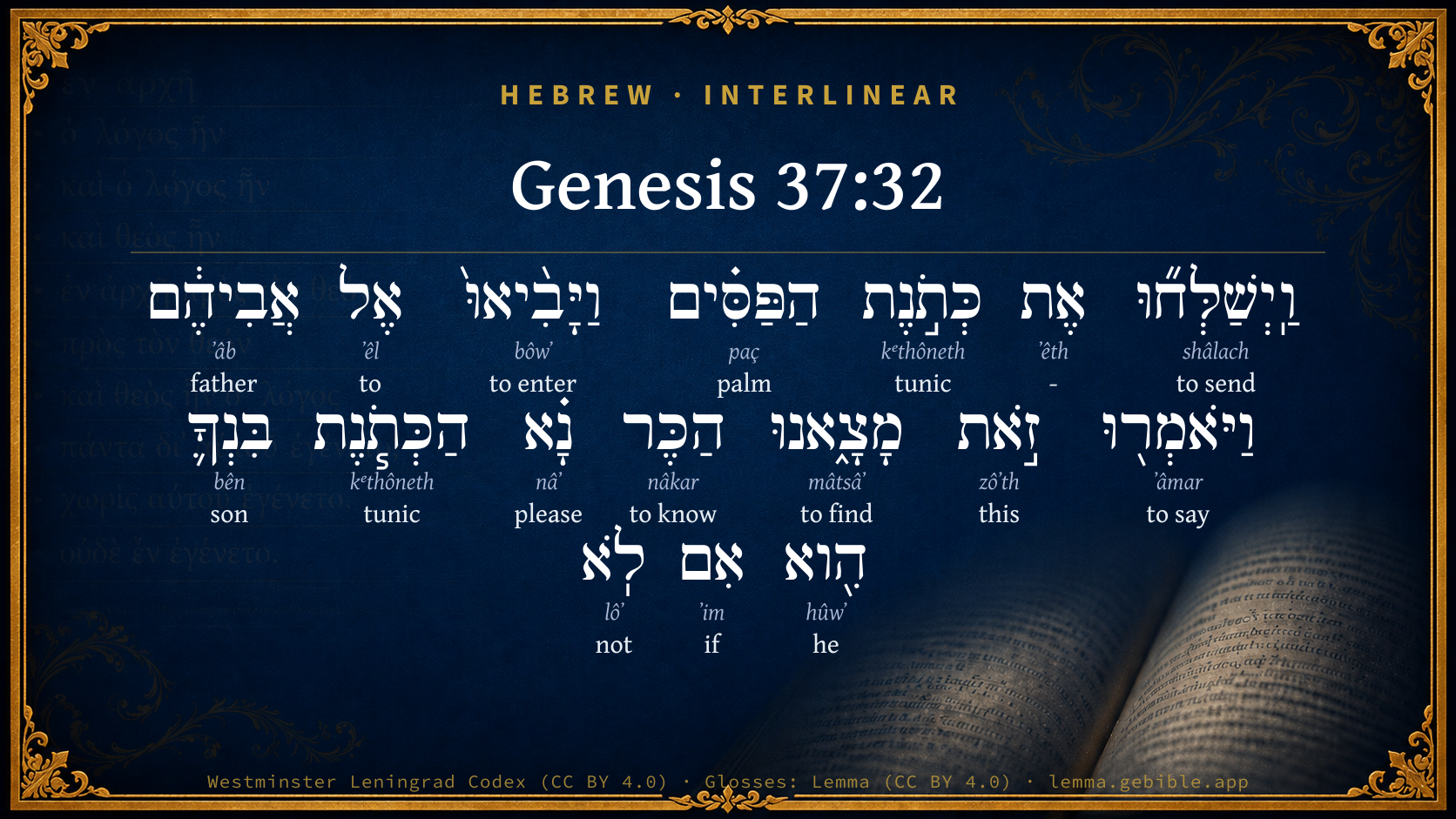
  1. וַֽיְשַׁלְּח֞וּ shâlach H7971 “and · to send” Conjunction + Verb, Piel, Sequential Imperfect, 3rd Person, Masculine, Plural
  2. אֶת ʼêth H853 “-” Particle, Direct Object
  3. כְּתֹ֣נֶת kᵉthôneth H3801 “tunic of” Noun, Common, Feminine, Singular, Construct
  4. וַיָּבִ֨יאוּ֙ bôwʼ H935 “and · to enter” Conjunction + Verb, Hiphil, Sequential Imperfect, 3rd Person, Masculine, Plural
  5. אֶל ʼêl H413 “to” Preposition
  6. אֲבִיהֶ֔ם ʼâb H1 “father · their” Noun, Common, Masculine, Singular, Construct + Suffix, Personal, 3rd Person, Masculine, Plural
  7. וַיֹּאמְר֖וּ ʼâmar H559 “and · to say” Conjunction + Verb, Qal, Sequential Imperfect, 3rd Person, Masculine, Plural
  8. זֹ֣את zôʼth H2063 “this” Pronoun, Demonstrative, Feminine, Singular
  9. מָצָ֑אנוּ mâtsâʼ H4672 “to find” Verb, Qal, Perfect, 1st Person, Common, Plural
  10. הַכֶּר nâkar H5234 “know” Verb, Hiphil, Imperative, 2nd Person, Masculine, Singular
  11. נָ֗א nâʼ H4994 “please” Particle, Exhortation
  12. הַכְּתֹ֧נֶת kᵉthôneth H3801 “tunic of” Particle, Interrogative + Noun, Common, Feminine, Singular, Construct
  13. בִּנְךָ֛ bên H1121 “son · your” Noun, Common, Masculine, Singular, Construct + Suffix, Personal, 2nd Person, Masculine, Singular
  14. הִ֖וא hûwʼ H1931 “he” Pronoun, Personal, 3rd Person, Feminine, Singular
  15. אִם ʼim H518 “if” Conjunction
  16. לֹֽא lôʼ H3808 “not” Particle, Negative

About this verse

These counts appear in no published source. They are computed here, from the morphology-tagged text and Lemma’s own curated glosses. What Lemma adds →

17
words
16
distinct lemmas
Pentateuch
section

Notable vocabulary

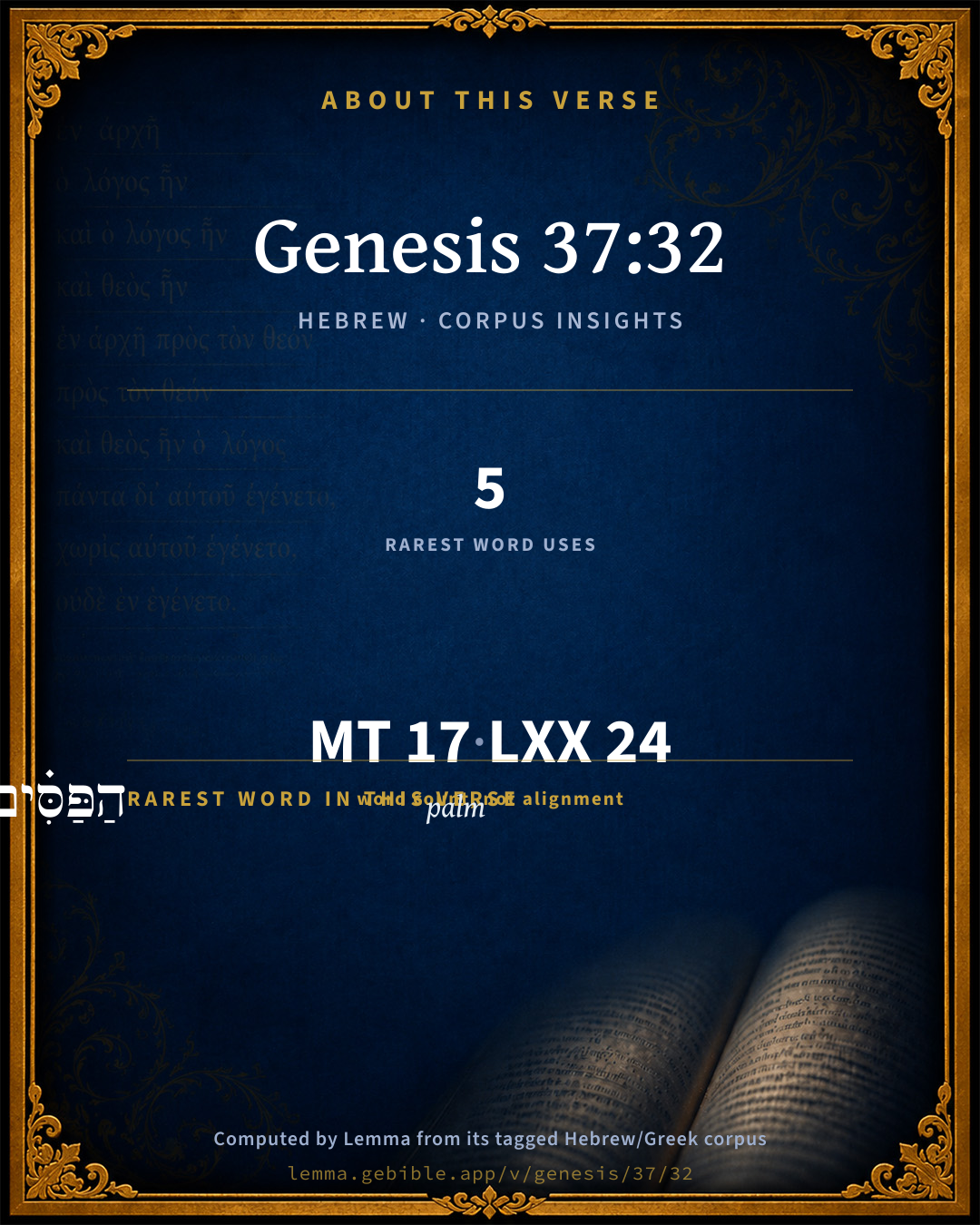
The rarest word here is הַפַּסִּ֗ים palm H6446 — appearing just 5 times in the whole Hebrew Bible.

Shared distinctive vocabulary

הַפַּסִּ֗ים palm H6446 occurs in 5 verses of the Hebrew Bible. Also found in:

Grammatical profile

  • 5 verbs
  • 5 nouns
  • 2 pronouns
  • 1 preposition
  • 1 conjunction
  • 3 particles

Verb forms

  • וַֽיְשַׁלְּח֞וּ Piel · Sequential Imperfect
  • וַיָּבִ֨יאוּ֙ Hiphil · Sequential Imperfect
  • וַיֹּאמְר֖וּ Qal · Sequential Imperfect
  • מָצָ֑אנוּ Qal · Perfect
  • הַכֶּר Hiphil · Imperative

Repetition

A word recurs within this verse — often emphatic in Hebrew:

  • כְּתֹ֣נֶת tunic H3801 ×2

Hebrew & Septuagint length

In English translation the verse runs 31 words from the Hebrew and 55 from the Septuagint (LXX English) — the Septuagint runs noticeably longer here. See the side-by-side →

A rough comparison of the two English renderings, which tokenize alike — not a word-level alignment.

Word counts can differ between the Hebrew and the Greek without any difference in meaning — e.g. the Hebrew direct-object marker אֵת has no separate Greek word, and Greek often adds the article ὁ.

In the original languages it is 17 Hebrew tokens and 24 Greek tokens — but the two are counted differently (Hebrew bundles its prefixes and suffixes into one token; the Greek is in lemma form), so that isn’t a like-for-like length.

Cross-references

3

Topical passages linked to Genesis 37:32 in the Treasury of Scripture Knowledge — connected by theme and wording, ordered by reader-vote popularity; previews shown in the World English Bible.

  • Luke 15:30 But when this, your son, came, who has devoured your living with prostitutes, you killed the fattened calf for him.'
  • Genesis 37:3 Now Israel loved Joseph more than all his children, because he was the son of his old age, and he made him a coat of many colors.
  • Genesis 44:20–23 We said to my lord, 'We have a father, an old man, and a child of his old age, a little one; and his brother is dead, and he alone is left of his mother; and his father loves him.'

Cross-references courtesy of OpenBible.info (CC BY 4.0).

Hebrew and Greek witnesses Masoretic Hebrew ↔ Greek Septuagint

The same verse in the two great witnesses to the Old Testament, shown verse-for-verse.

Here the Septuagint runs noticeably longer than the Hebrew — LXX2012 (modern English Septuagint) 55 words vs World English Bible 31. A rough length comparison of the two English translations, not a word-level alignment — read both below.

These are two independent witnesses, not word-aligned to each other, and the Septuagint is shown in lemma (dictionary) form.

Hebrew Genesis 37:32 Masoretic · Westminster Leningrad Codex

וַֽיְשַׁלְּח֞וּ אֶת כְּתֹ֣נֶת הַפַּסִּ֗ים וַיָּבִ֨יאוּ֙ אֶל אֲבִיהֶ֔ם וַיֹּאמְר֖וּ זֹ֣את מָצָ֑אנוּ הַכֶּר נָ֗א הַכְּתֹ֧נֶת בִּנְךָ֛ הִ֖וא אִם לֹֽא

They took the coat of many colors, and they brought it to their father, and said, "We have found this. Examine it, now, whether it is your son's coat or not."

World English Bible · Public Domain

Greek LXX Genesis 37:32 Septuagint · lemma form

καί ἀποστέλλω ὁ χιτών ὁ ποικίλος καί εἰςφέρω ὁ πατήρ αὐτός καί εἶπον οὗτος εὑρίσκω ἐπιγιγνώσκω εἰ χιτών ὁ υἱός σύ εἰμί ἤ οὐ

And they sent the coat of many colors; and they brought it to their father, and said, This have we found; know if it be your son's coat or no. And he recognized it, and said, It is my son's coat, an evil wild beast has devoured him; a wild beast has carried off Joseph.

LXX2012 (modern English Septuagint) · Public Domain

Hebrew: Westminster Leningrad Codex (CC BY 4.0). Greek: Septuagint (public domain); English from LXX2012 (modern English Septuagint) (Public Domain). How the Septuagint differs from the Hebrew →

Targum (Aramaic paraphrase)

2

The Targum is the ancient Jewish Aramaic paraphrase of the Hebrew Scriptures — an interpretive translation, not the Hebrew text itself. Onkelos (literal) and Pseudo-Jonathan (expansive) render the Torah, and Jonathan the Prophets. Coverage is partial: where no permissively-licensed English translation exists for a verse, only the Aramaic is shown. This is verse-level text, not a word-by-word alignment to the Hebrew.

  1. Targum Onkelos Torah (Genesis–Deuteronomy)
    וְשַׁלָּחוּ יָת כִּתּוּנָא דְפַסֵּי וְאַיְתִיוּ לְוַת אֲבוּהוֹן וַאֲמָרוּ דָא אַשְׁכַּחְנָא אִשְׁתְּמוֹדַע כְּעַן הֲכִתּוּנָא דִבְרָךְ הִיא אִם לָא

    (no public-domain English translation for this verse)

    Targum Onkelos — Aramaic: “Onkelos Genesis” (public domain); “Onkelos Exodus” (public domain); “Onkelos Leviticus” (public domain); “Onkelos Numbers” (public domain); “Onkelos Deuteronomy” (public domain). English: “Sefaria Community Translation” (CC0 1.0 (public-domain dedication)); “J.W. Etheridge. The Targums of Onkelos and Jonathan Ben Uzziel on the Pentateuch. London: Longmans, Green, 1862” (public domain). Text via Sefaria.

  2. Targum Pseudo-Jonathan Torah (Genesis–Deuteronomy)
    וְשַׁדָרוּ בְּיַד בְּנֵי זִלְפָּה וּבְיַד בְּנֵי בִלְהָה יַת פַּרְגוֹד מְצַיָיר וְאַיְיתוֹהִי לְוַת אֲבוּהוֹן וְאָמָרוּ הָא אַשְׁכַּחֲנָא אִשְׁתְּמוֹדַע כְּדוּן הֲפַרְגוֹדָא דִבְרָךְ הִיא אִין לָא

    And they sent it by the hand of the sons of Zilpha and of the sons of Bilhah the figured garment; and they brought it to their father, and said, This have we found; know now, whether it be thy son's garment, or not.

    Targum Pseudo-Jonathan — Aramaic: “Targum Jonathan on Genesis” (public domain); “Targum Jonathan on Exodus” (public domain); “Targum Jonathan on Leviticus” (public domain); “Targum Jonathan on Numbers” (public domain); “Targum Jonathan on Deuteronomy” (public domain). English: “The Targum of Jonathan ben Uzziel, trans. J. W. Etheridge, London, 1862” (public domain). Text via Sefaria.

Commentary

Notes on Genesis 37:32 from classic Christian and Jewish commentators (each source and its license shown beneath its notes). The classic Christian expositions comment on the surrounding passage and are grouped to its opening verse, so a note may address several verses; the Jewish commentaries on the Tanakh (Rashi and others) are per-verse, so they appear only where the commentator wrote on this verse.

Lemma curates 59 commentaries, every one of them public domain or Creative Commons licensed, each selected and text-cleaned for this edition rather than reprinted as found. About our sources →

Trapp's Complete Commentary

John Trapp

Gen 37:32 And they sent the coat of [many] colours, and they brought [it] to their father; and said, This have we found: know now whether it [be] thy son’s coat or no.

Ver. 32. Know now whether it be thy son’s coat.] One Philip, bishop of Beauvieu, in France, in the time of our Richard I, being a martial man, and much annoying our borders, was by King Richard in a skirmish happily taken, and put in prison. The bishop hereupon complained to the Pope, who wrote in the behalf of his son, as an ecclesiastical person, &c. The king sent to the Pope the armour he was taken in, with these words engraven thereon, "Know whether this be thy son’s coat, or not." Which the Pope viewing, sware it was rather the coat of a son of Mars, than a son of the Church; and so bade the king use his pleasure. {a}

{a} Heyl., Geog., p. 108.

John Trapp, A Commentary or Exposition upon All the Books of the Old and New Testament (1647–1656) — public domain. Text from a community e-Sword module.

Tyndale Open Study Notes

Tyndale Open Resources

37:32 your son: In their cold hatred, the brothers did not refer to Joseph by name or acknowledge him as their brother (see 21:10).

Tyndale Open Study Notes — © Tyndale Open Resources, licensed CC BY-SA 4.0. Text via the HelloAO Bible API.

Geneva Bible (1599)

Geneva Bible translators

To wit, the messengers which were sent.

Geneva Bible (1599) marginal notes — public domain. Text via Bolls.life.

Adam Clarke's Commentary

Verse 32. Sent the coat of many colours - to their father] What deliberate cruelty to torture the feelings of their aged father, and thus harrow up his soul!

Adam Clarke's Commentary on the Bible (1810–1826) — public domain. Text from a community e-Sword/MySword module.

Ellicott's Commentary for English Readers

(32) They brought it.—Heb., they caused it to go, that is, sent it by the hand of a messenger. They were unwilling to see the first burst of their father’s agony.

And said.—These were the words that were to be spoken by the messenger who was charged to bear the coat to Jacob.

A Bible Commentary for English Readers, edited by Charles John Ellicott (1878–1897) — public domain. Text from a community e-Sword module.

John Gill's Exposition

And he knew it, and said, it is my son's coat,.... He took it, and examined it, and was soon convinced, and well assured it was his son's coat; read the words without the supplement "it is", and the pathos will appear the more, "my son's coat!" and think with what a beating heart, with what trembling limbs, with what wringing of hands, with what flowing eyes, and faultering speech, he spoke these words, and what follow:

an evil beast hath devoured him; this was natural to conclude from the condition the coat was in, and from the country he was sent into, which abounded with wild beasts, and was the very thing Joseph's brethren contrived to say themselves; and in this view they wished and hoped the affair would be considered, and so their wickedness concealed:

Joseph is without doubt rent in pieces; or "in rending is rent" (d); he is most certainly rent in pieces, there is no question to be made of it; it is plain, and it must be the case.

(d) "discerpendo discerptus est"; Drusius, Schmidt.

John Gill's Exposition of the Whole Bible (1746–1763) — public domain (CC PDM 1.0). Text via the HelloAO Bible API.

Matthew Poole's English Annotations

They

brought it by a messenger whom they sent: men are commonly said to do what they cause others to do.

Matthew Poole's English Annotations on the Holy Bible (1683–1685) — public domain. Text from a community e-Sword/MySword module.

Whedon's Commentary on the Bible

Daniel D. Whedon

32. Thy son’s coat — Not our brother’s! Every word of theirs in this dark pretext is studiously cruel.

Daniel D. Whedon (gen. ed.), Commentary on the Old and New Testaments (1874–1909) — public domain. Text from a community e-Sword module.

Ramban (Nachmanides)

Rabbi Moshe ben Nachman (Ramban / Nachmanides)

AND THEY SENT THE COAT OF MANY COLORS, AND THEY BROUGHT IT TO THEIR FATHER. I.e., by command., clearly indicates that they did not bring it themselves. Ramban answers that the second half of the verse means that they commanded others to bring the coat to their father. Perhaps the word vayavi’u (and they brought) refers to the messengers who brought the coat, for the brothers dispatched it when they were still in Dothan, and it was the messengers who said, This we have found; recognize now. It may be that they sent the coat to Hebron, to one of their homes, and when they arrived they brought it before their father, and said to him, This we have found. They did all of this in order to feign ignorance of the matter, for had they remained quiet, he would have suspected them, saying; “You killed him,” for he knew that they were jealous of him.And some scholars explain the word vayeshalchu — ordinarily translated as “and they sent” — to mean that they pierced the coat with a sword in order to tear it in many places, to give the appearance of having been torn by the teeth of animals. The word vayeshalchu would thus be derived from the verse, By the sword (‘b’shelach’) they shall perish. The significance of the word hapasim (many colors) is that they sent him the coat so that he might recognize it by the colors which he had made for him.

Ramban (Nachmanides) on the Tanakh — English translation: “Commentary on the Torah by Ramban (Nachmanides). Translated and annotated by Charles B. Chavel. New York, Shilo Pub. House, 1971-1976” (CC BY 4.0). Text via Sefaria.

Radak

Rabbi David Kimhi (Radak)

וישלחו, some of the brothers were the messengers who delivered this tattered blood-spattered tunic. Some commentators believe that the word is derived from Job 36,12 בשלח יעברו, “they will die by the sword.” According to this, the brothers imitated the incisions made by the sharp teeth of wild beasts so that Yaakov would think that Joseph’s fate had been that he had been devoured or at least killed by such a marauding animal.

הכר נא, According to Bereshit Rabbah 84,19 G’d repaid Yehudah for his use of the phrase הכר נא when tricking his father into making a false deduction, by Tamar challenging him with the very same expression הכר נא, which embarrassed him into admitting that he was the father of the fetus that Tamar his daughter-in-law was pregnant with (38,25)

Radak on the Tanakh — English translations: “Sefaria Community Translation” (CC0 1.0 (public-domain dedication)); “Eliyahu Munk, HaChut Hameshulash” (CC BY 4.0); “Rabbi Mike Feuer, Jerusalem Anthology” (CC BY 4.0); and “R. David Kimhi on the first book of Psalms, Translated by R.G. Finch, London, 1919” (public domain). Text via Sefaria.

Lesson kit

Teaching starters — assembled from the data on this page, not authored interpretation. Every prompt links to the verse data it draws on. Edit before teaching.

Genesis, in the Pentateuch, opens this verse with 17 words (16 distinct Hebrew lemmas). Its most distinctive word is paç (“palm”). The Greek Septuagint runs longer here. A historical commentator’s framing appears above. Read the whole chapter for the surrounding context.

Discussion questions

  1. What does “palm” (paç) contribute to the verse as a whole?
  2. How does Genesis 37:3, which shares the word «palm», read alongside this verse?
  3. What does the repetition of “tunic” (2× in this one verse) do in this verse?
  4. The Septuagint runs longer here than the Hebrew. What might account for the difference?
  5. These translations render this verse differently; the difference is in the English rendering, not the original. What questions does that raise?
  6. «וַֽיְשַׁלְּח֞וּ» is a Piel Sequential Imperfect verb. How does that grammatical form shape the action described?
  7. Compare how Trapp's Complete Commentary and Tyndale Open Study Notes read this verse. Where do they agree or differ?

Things to notice

Reading settings

Reading text

Shown beneath each verse's original-language words.

Old Testament
Old Testament edition

Read the OT as the Masoretic Hebrew (MT) or the Greek Septuagint (LXX).

English shown for the Greek Septuagint (in the Hebrew ↔ Greek comparison).

Comparing translations? Open the Compare panel on any verse page to stack up to four side by side.