Genesis 27:5

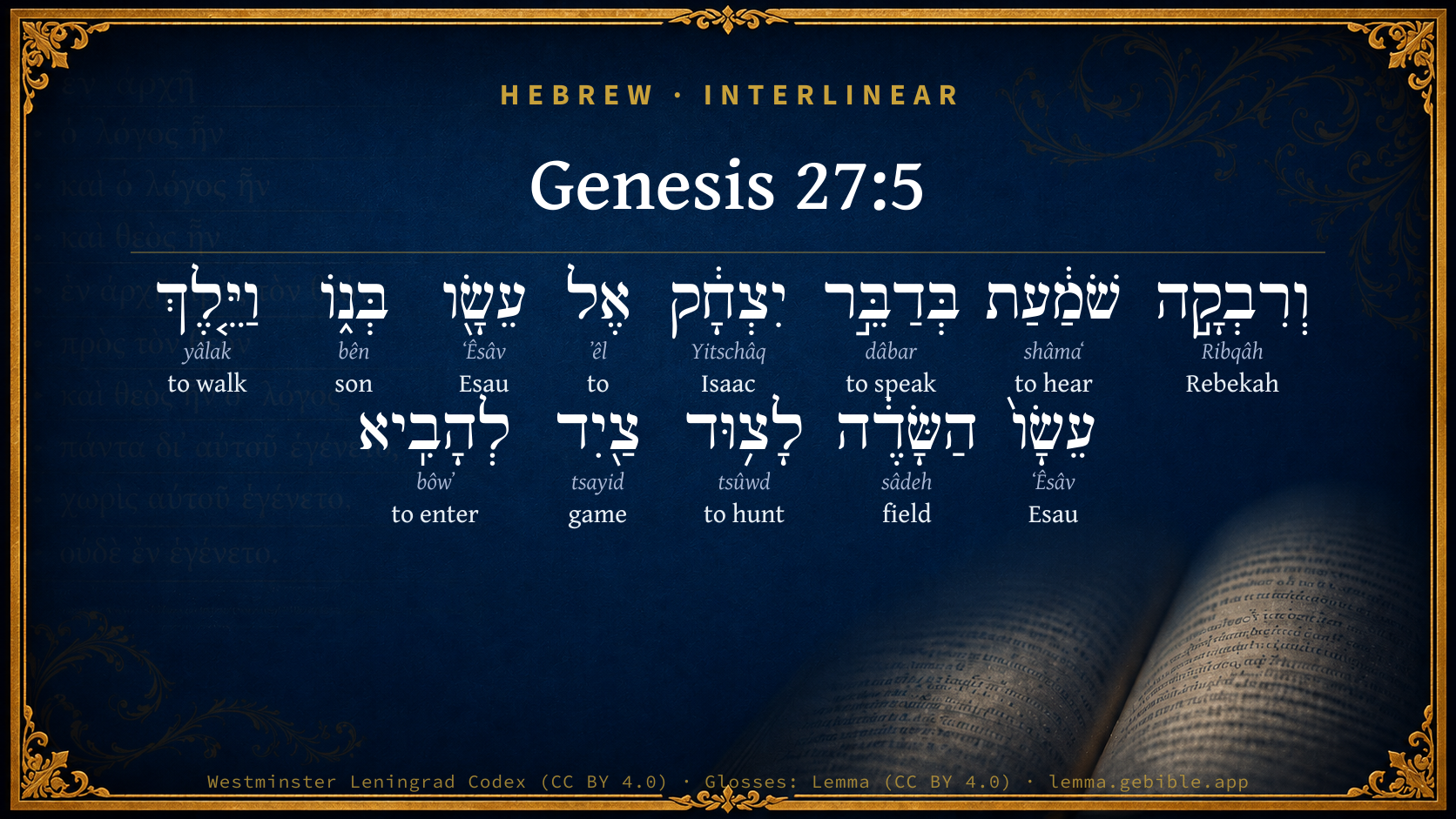
Hebrew (Westminster Leningrad Codex) Genesis 27:5 appears in the Hebrew Old Testament. The text above is from the Westminster Leningrad Codex. Each word links to its Strong’s number, a concise gloss, and parsing drawn from the Open Scriptures Hebrew Bible morphology. Click any word for its full Brown-Driver-Briggs (BDB) entry.
Download image
Cite this verse

Genesis 27:5 (World English Bible). Public Domain. Lemma interlinear Bible study tool, https://lemma.gebible.app/v/genesis/27/5.

Show BibTeX & RIS
BibTeX
RIS
English Translation
Rebekah heard when Isaac spoke to Esau his son. Esau went to the field to hunt for venison, and to bring it.
World English Bible · Public Domain
Download a study sheet

One document with this verse’s original text, its word-by-word gloss line, the meaning frame, cross-references with their text, attributed commentary, and full source and license credits — printable, and it pastes into notes with its structure intact.

This verse Autodidact and up

Study sheet (.html) Plain text (.txt)

A passage Seminary Student

Up to 50 verses in one chapter. A passage sheet keeps up to 6 commentary sources and 12 cross-references per verse, in the order this page ranks them, and says so on the sheet whenever that leaves anything out. Ask for a single verse and you get the Autodidact verse sheet above.

Everything on this page stays free to read, with no account — the sheet is a download of what is already on screen, not access to it.

Want to remove ads? Support Godless Engineer
Compare translations 3

The same verse in 3 English versions, stacked beneath the original-language interlinear above. Click any original word for its lexicon entry.

Each is an independent rendering of the whole verse — the interlinear is not word-aligned to these translations.

Highlighted words mark where these versions differ — a whole-verse word diff, not a word-by-word alignment.

  • World English Bible Public Domain
    Rebekah heard when Isaac spoke to Esau his son. Esau went to the field to hunt for venison, and to bring it.
  • King James Version Public Domain
    And Rebekah heard when Isaac spake to Esau his son. And Esau went to the field to hunt for venison, and to bring it.
  • unfoldingWord Literal Text CC BY-SA 4.0
    And Rebekah was listening while Isaac spoke to Esau his son. Then Esau went the field to hunt game to bring it back.

unfoldingWord Literal Text — © unfoldingWord, licensed CC BY-SA 4.0. Word-aligned USFM3 via Door43 (git.door43.org/unfoldingWord/en_ult).

Versions to compare (up to 4)

3 of 4 selected

Show all 18 translations

Every available English version of this verse, each an independent rendering of the whole verse.

  • World English Bible Public Domain
    Rebekah heard when Isaac spoke to Esau his son. Esau went to the field to hunt for venison, and to bring it.
  • Berean Standard Bible Public Domain
    Now Rebekah was listening to what Isaac told his son Esau. So when Esau went into the field to hunt game and bring it back,
  • Majority Standard Bible Public Domain
    Now Rebekah was listening to what Isaac told his son Esau. So when Esau went into the field to hunt game and bring it back,
  • King James Version Public Domain
    And Rebekah heard when Isaac spake to Esau his son. And Esau went to the field to hunt for venison, and to bring it.
  • American Standard Version (1901) Public Domain
    And Rebekah heard when Isaac spake to Esau his son. And Esau went to the field to hunt for venison, and to bring it.
  • Revised Version (1885) Public Domain
    And Rebekah heard when Isaac spake to Esau his son. And Esau went to the field to hunt for venison, and to bring it.
  • Geneva Bible (1599) Public Domain
    (Nowe Rebekah heard, when Izhak spake to Esau his sonne) and Esau went into the fielde to hunt for venison, and to bring it.
  • Douay-Rheims (1899) Public Domain
    And when Rebecca had heard this, and he was gone into the field to fulfill his father's commandment,
  • Young's Literal Translation Public Domain
    And Rebekah is hearkening while Isaac is speaking unto Esau his son; and Esau goeth to the field to hunt provision -- to bring in;
  • Literal Standard Version CC BY-SA 4.0
    And Rebekah is listening while Isaac is speaking to his son Esau; and Esau goes to the field to hunt game—to bring in;
  • Unlocked Literal Bible CC BY-SA 4.0
    Now Rebekah heard it when Isaac spoke to Esau his son. Esau went to the field to hunt for game and bring it back.
  • unfoldingWord Literal Text CC BY-SA 4.0
    And Rebekah was listening while Isaac spoke to Esau his son. Then Esau went the field to hunt game to bring it back.
  • Darby Bible Public Domain
    And Rebecca heard when Isaac spoke to Esau his son. And Esau went to the field to hunt venison, to bring it.
  • World Messianic Bible Public Domain
    Rebekah heard when Isaac spoke to Esau his son. Esau went to the field to hunt for venison, and to bring it.
  • Webster's Bible Public Domain
    And Rebekah heard when Isaac spoke to Esau his son; and Esau went to the field to hunt for venison, and to bring it.
  • Free Bible Version CC BY-SA 4.0
    Rebekah heard what Isaac told his son Esau. So when Esau left to go hunting in the countryside for wild game,
  • Bible in Basic English Public Domain
    Now Isaac's words to his son were said in Rebekah's hearing. Then Esau went out to get the meat.
  • JPS Tanakh (1917) Public Domain
    And Rebekah heard when Isaac spoke to Esau his son. And Esau went to the field to hunt for venison, and to bring it.

Literal Standard Version (2020), Covenant Press — licensed CC BY-SA 4.0. Text via the HelloAO Bible API (eBible.org). Unlocked Literal Bible (unfoldingWord) — licensed CC BY-SA 4.0. Text via the HelloAO Bible API (eBible.org). unfoldingWord Literal Text — © unfoldingWord, licensed CC BY-SA 4.0. Word-aligned USFM3 via Door43 (git.door43.org/unfoldingWord/en_ult). Free Bible Version, Dr. Jonathan Gallagher — licensed CC BY-SA 4.0. Text via the HelloAO Bible API (eBible.org).

Word by word

More ways to search: Search by grammar → Find every occurrence → Compare this word →

Practice this passage: Drill this verse → Learn its vocabulary →

צַ֖יִד
tsayid
H6718
“game”
Noun, Common, Masculine, Singular, Absolute
Part of Speech
Noun
Type
Common
Gender
Masculine
Number
Singular
State
Absolute
Full BDB Definition

Origin: from a form of H6679 and meaning the same

TWOT: 1885a , 1886a

hunting, game - hunting - game hunted - provision, food - provision, food, food-supply
  1. וְרִבְקָ֣ה Ribqâh H7259 “and · Rebekah” Conjunction + Noun, Proper
  2. שֹׁמַ֔עַת shâmaʻ H8085 “hearing” Verb, Qal, Participle Active, Feminine, Singular, Absolute
  3. בְּדַבֵּ֣ר dâbar H1696 “in/at · to speak” Preposition + Verb, Piel, Infinitive Construct
  4. יִצְחָ֔ק Yitschâq H3327 “Isaac” Noun, Proper
  5. אֶל ʼêl H413 “to” Preposition
  6. עֵשָׂ֖ו ʻÊsâv H6215 “Esau” Noun, Proper
  7. בְּנ֑וֹ bên H1121 “son · his” Noun, Common, Masculine, Singular, Construct + Suffix, Personal, 3rd Person, Masculine, Singular
  8. וַיֵּ֤לֶךְ yâlak H3212 “and · to walk” Conjunction + Verb, Qal, Sequential Imperfect, 3rd Person, Masculine, Singular
  9. עֵשָׂו֙ ʻÊsâv H6215 “Esau” Noun, Proper
  10. הַשָּׂדֶ֔ה sâdeh H7704 “the · field” Particle, Definite Article + Noun, Common, Masculine, Singular, Absolute
  11. לָצ֥וּד tsûwd H6679 “to hunt” Preposition + Verb, Qal, Infinitive Construct
  12. לְהָבִֽיא bôwʼ H935 “to enter” Preposition + Verb, Hiphil, Infinitive Construct

About this verse

These counts appear in no published source. They are computed here, from the morphology-tagged text and Lemma’s own curated glosses. What Lemma adds →

13
words
12
distinct lemmas
Pentateuch
section

Notable vocabulary

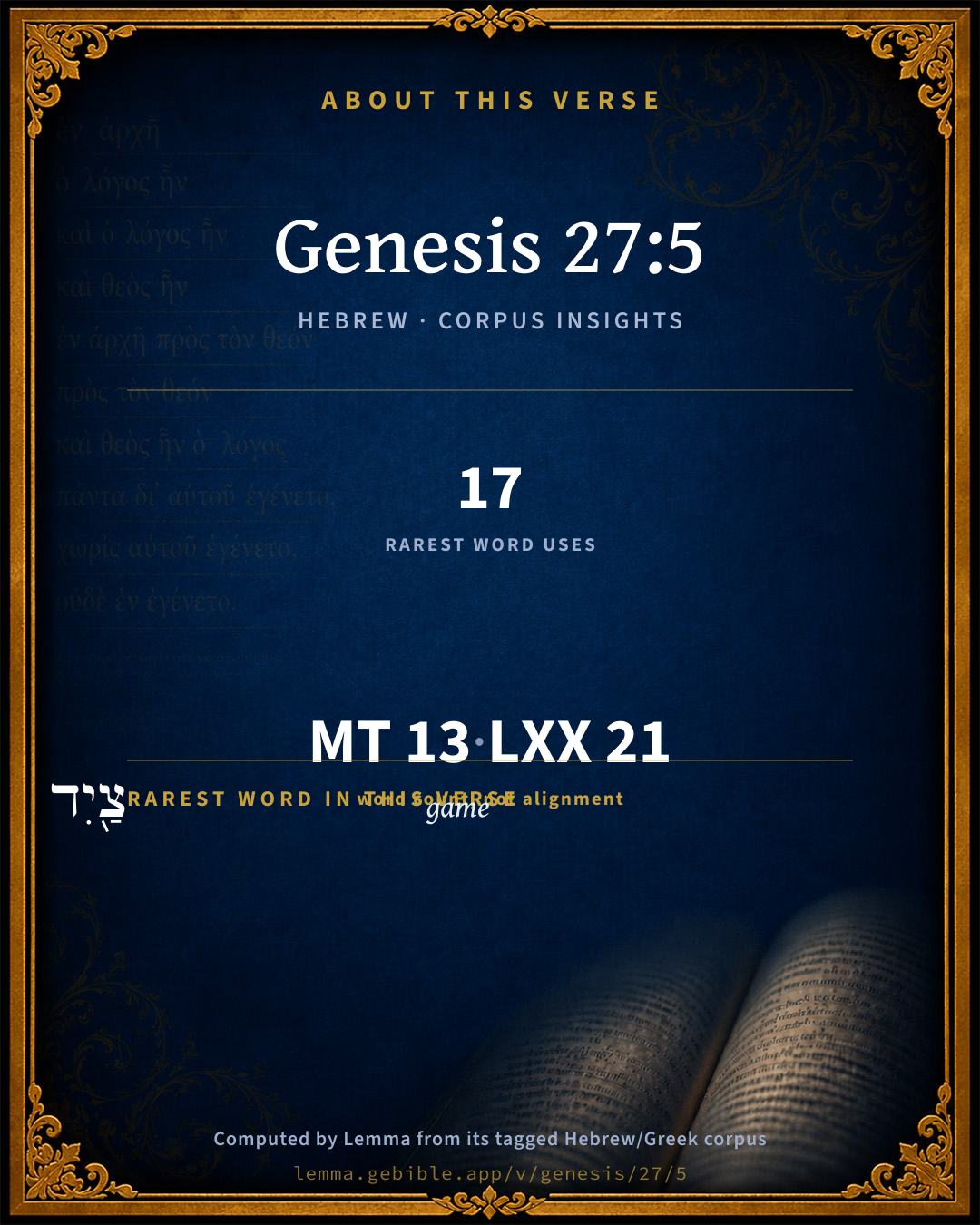
The rarest word here is צַ֖יִד game H6718 — appearing just 17 times in the whole Hebrew Bible.

Shared distinctive vocabulary

צַ֖יִד game H6718 occurs in 16 verses of the Hebrew Bible. Also found in:

Grammatical profile

  • 5 verbs
  • 7 nouns
  • 1 preposition

Verb forms

  • שֹׁמַ֔עַת Qal · Participle Active
  • בְּדַבֵּ֣ר Piel · Infinitive Construct
  • וַיֵּ֤לֶךְ Qal · Sequential Imperfect
  • לָצ֥וּד Qal · Infinitive Construct
  • לְהָבִֽיא Hiphil · Infinitive Construct

Repetition

A word recurs within this verse — often emphatic in Hebrew:

  • עֵשָׂ֖ו Esau H6215 ×2

Hebrew & Septuagint length

In English translation the verse runs 22 words from the Hebrew and 21 from the Septuagint (LXX English) — closely comparable.

A rough comparison of the two English renderings, which tokenize alike — not a word-level alignment.

Word counts can differ between the Hebrew and the Greek without any difference in meaning — e.g. the Hebrew direct-object marker אֵת has no separate Greek word, and Greek often adds the article ὁ.

In the original languages it is 13 Hebrew tokens and 21 Greek tokens — but the two are counted differently (Hebrew bundles its prefixes and suffixes into one token; the Greek is in lemma form), so that isn’t a like-for-like length.

Hebrew and Greek witnesses Masoretic Hebrew ↔ Greek Septuagint

The same verse in the two great witnesses to the Old Testament, shown verse-for-verse.

These are two independent witnesses, not word-aligned to each other, and the Septuagint is shown in lemma (dictionary) form.

Hebrew Genesis 27:5 Masoretic · Westminster Leningrad Codex

וְרִבְקָ֣ה שֹׁמַ֔עַת בְּדַבֵּ֣ר יִצְחָ֔ק אֶל עֵשָׂ֖ו בְּנ֑וֹ וַיֵּ֤לֶךְ עֵשָׂו֙ הַשָּׂדֶ֔ה לָצ֥וּד צַ֖יִד לְהָבִֽיא

Rebekah heard when Isaac spoke to Esau his son. Esau went to the field to hunt for venison, and to bring it.

World English Bible · Public Domain

Greek LXX Genesis 27:5 Septuagint · lemma form

ρεβεκκα δέ ἀκούω λαλέω ισαακ πρός ησαυ ὁ υἱός αὐτός πορεύομαι δέ ησαυ εἰς ὁ πεδίον θηρεύω θήρα ὁ πατήρ αὐτός

And Rebecca heard Isaac speaking to Esau his son; and Esau went to the plain to procure venison for his father.

LXX2012 (modern English Septuagint) · Public Domain

Hebrew: Westminster Leningrad Codex (CC BY 4.0). Greek: Septuagint (public domain); English from LXX2012 (modern English Septuagint) (Public Domain). How the Septuagint differs from the Hebrew →

Targum (Aramaic paraphrase)

2

The Targum is the ancient Jewish Aramaic paraphrase of the Hebrew Scriptures — an interpretive translation, not the Hebrew text itself. Onkelos (literal) and Pseudo-Jonathan (expansive) render the Torah, and Jonathan the Prophets. Coverage is partial: where no permissively-licensed English translation exists for a verse, only the Aramaic is shown. This is verse-level text, not a word-by-word alignment to the Hebrew.

  1. Targum Onkelos Torah (Genesis–Deuteronomy)
    וְרִבְקָה שְׁמַעַת כַּד מַלִּיל יִצְחָק לְוַת עֵשָׂו בְּרֵהּ וַאֲזַל עֵשָׂו לְחַקְלָא לְמֵיצַד צֵידָא לְאַיְתָאָה

    (no public-domain English translation for this verse)

    Targum Onkelos — Aramaic: “Onkelos Genesis” (public domain); “Onkelos Exodus” (public domain); “Onkelos Leviticus” (public domain); “Onkelos Numbers” (public domain); “Onkelos Deuteronomy” (public domain). English: “Sefaria Community Translation” (CC0 1.0 (public-domain dedication)); “J.W. Etheridge. The Targums of Onkelos and Jonathan Ben Uzziel on the Pentateuch. London: Longmans, Green, 1862” (public domain). Text via Sefaria.

  2. Targum Pseudo-Jonathan Torah (Genesis–Deuteronomy)
    וְרִבְקָה שָׁמְעַת בְּרוּחַ קוּדְשָׁא כַּד מַלֵיל יִצְחָק עִם עֵשָו בְּרֵיהּ וְאָזַל עֵשָו לְחַקְלָא לְמֵיצַד צֵידָא לְאַיְתֵיאָה

    And Rivekah heard by the Holy Spirit as Izhak spake with Esau his son. And Esau went to the field to take venison to bring it.

    Targum Pseudo-Jonathan — Aramaic: “Targum Jonathan on Genesis” (public domain); “Targum Jonathan on Exodus” (public domain); “Targum Jonathan on Leviticus” (public domain); “Targum Jonathan on Numbers” (public domain); “Targum Jonathan on Deuteronomy” (public domain). English: “The Targum of Jonathan ben Uzziel, trans. J. W. Etheridge, London, 1862” (public domain). Text via Sefaria.

Commentary

Notes on Genesis 27:5 from classic Christian and Jewish commentators (each source and its license shown beneath its notes). The classic Christian expositions comment on the surrounding passage and are grouped to its opening verse, so a note may address several verses; the Jewish commentaries on the Tanakh (Rashi and others) are per-verse, so they appear only where the commentator wrote on this verse.

Lemma curates 59 commentaries, every one of them public domain or Creative Commons licensed, each selected and text-cleaned for this edition rather than reprinted as found. About our sources →

Trapp's Complete Commentary

John Trapp

Gen 27:5 And Rebekah heard when Isaac spake to Esau his son. And Esau went to the field to hunt [for] venison, [and] to bring [it].

Ver. 5. Esau went to the field to hunt, &c.] But before he returned, the blessing was otherwise bestowed. "The hope of the hypocrite shall perish". {Job 8:13} How many lie languishing at hope’s hospital, as he at the pool of Bethesda, and no help comes! They repair to the creatures, as to a lottery, with heads full of hopes, but return with hearts full of blanks. Or, if they draw nigh to God, they think they take hold of him; but it is but as the child that catcheth at the shadow or the wall, which he thinks he holds fast in his hand; but it vanisheth. The common hope is ill bottomed. "Hope unfailable," {Rom 5:5} is founded upon "faith unfeigned". {1Ti 1:5} Deo confisi nunquam confusi. He sneaketh sweetest comfort "to the heart, in the wilderness". {Hos 2:14}

John Trapp, A Commentary or Exposition upon All the Books of the Old and New Testament (1647–1656) — public domain. Text from a community e-Sword module.

Tyndale Open Study Notes

Tyndale Open Resources

27:5-17 The blessing seemed to be in jeopardy. In scene two, Rebekah and Jacob sought to achieve God’s blessing by deception, without faith or love. Rebekah planned to deceive the old man into thinking that he was blessing Esau when he was actually blessing Jacob.

27:5 Esau agreed to Isaac’s plan, thus breaking the oath he had sworn to Jacob (25:33).

Tyndale Open Study Notes — © Tyndale Open Resources, licensed CC BY-SA 4.0. Text via the HelloAO Bible API.

Adam Clarke's Commentary

Verse 5. And Rebekah heard] And was determined, if possible, to frustrate the design of Isaac, and procure the blessing for her favourite son. Some pretend that she received a Divine inspiration to the purpose; but if she had she needed not to have recourse to deceit, to help forward the accomplishment. Isaac, on being informed, would have had too much piety not to prefer the will of his Maker to his own partiality for his eldest son; but Rebekah had nothing of the kind to plead, and therefore had recourse to the most exceptionable means to accomplish her ends.

Adam Clarke's Commentary on the Bible (1810–1826) — public domain. Text from a community e-Sword/MySword module.

John Calvin's Commentaries

5. And Rebekah heard. Moses now explains more fully the artifice by which Jacob attained the blessing. It truly appears ridiculous, that an old man, deceived by the cunning of his wife, should, through ignorance and error, have given utterance to what was contrary to his wish. And surely the stratagem of Rebekah was not without fault; for although she could not guide her husband by salutary counsel, yet it was not a legitimate method of acting, to circumvent him by such deceit. For, as a lie is in itself culpable, she sinned more grievously still in this, that she desired to sport in a sacred matter with such wiles. She knew that the decree by which Jacob had been elected and adopted was immutable; why then does she not patiently wait till God shall confirm it in fact, and shall show that what he had once pronounced from heaven is certain? Therefore, she darkens the celestial oracle by her lie, and abolishes, as far as she was able, the grace promised to her son. Now, if we consider farther, whence arose this great desire to bestir herself; her extraordinary faith will on the other hand appear. For, as she did not hesitate to provoke her husband against herself, to light up implacable enmity between the brothers, to expose her beloved son Jacob to the danger of immediate death, and to disturb the whole family; this certainly flowed from no other source than her faith. The inheritance promised by God was firmly fixed in her mind; she knew that it was decreed to her son Jacob. And therefore, relying upon the covenant of God, and keeping in mind the oracle received, she forgets the world. Thus, we see, that her faith was mixed with an unjust and immoderate zeal. This is to be carefully observed, in order that we may understand that a pure and distinct knowledge does not always so illuminate the minds of the pious as to cause them to be governed, in all their actions, by the Holy Spirit, but that the little light which shows them their path is enveloped in various clouds of ignorance and error; so that while they hold a right course, and are tending towards the goal, they yet occasionally slide. Finally, both in Isaac and in his wife the principle of faith was preeminent. But each, by ignorance in certain particulars, and by other faults, either diverged a little from the way, or, at least, stumbled in the way. But seeing that, nevertheless, the election of God stood firm; nay, that he even executed his design through the deceit of a woman, he vindicates, in this manner, the whole praise of his benediction to his own gratuitous goodness.

John Calvin's Commentaries (1540-1563) — public domain. Text from the Calvin Translation Society English edition (1840s-50s) via the Christian Classics Ethereal Library (ccel.org). Calvin's coverage is partial (roughly two-thirds of the Bible); uncommented books and verses are honest gaps, never fabricated. The 19th-century editor's footnotes and remarks are omitted so the notes are faithfully Calvin's own voice.

Ellicott's Commentary for English Readers

(5) Rebekah heard.—She was possibly present when Isaac gave the order, and he may even have wished her to know his determination to give the blessing to his favourite son. But the words filled her with dismay. She had, no doubt, treasured the prophecy of Jacob’s ultimate superiority, and now it seemed as if the father would reverse it. Had her faith been pure and exalted, she would have known that God would fulfil His word without her help; but all alike act from unworthy motives, and all have their meed of punishment. But here the fault began with Isaac, and Rebekah probably considered that she was preventing a grievous wrong.

A Bible Commentary for English Readers, edited by Charles John Ellicott (1878–1897) — public domain. Text from a community e-Sword module.

John Gill's Exposition

And Rebekah heard when Isaac spake to Esau his son,.... She might hear Isaac call to him by one means or another, that he had sent for him, or might see him go into his father's tent, and might stand at the door of it and listen to hear what he said to him; though the Targum of Jonathan says, she heard by the Holy Spirit:

and Esau went to the field to hunt for venison, and to bring it; as his father directed and enjoined him; and thus it was ordered by divine Providence, that there might be time and opportunity for Jacob to get the blessing before his broker.

John Gill's Exposition of the Whole Bible (1746–1763) — public domain (CC PDM 1.0). Text via the HelloAO Bible API.

The Pulpit Commentary

And Rebekah (who, though younger than Isaac, must also have been old) heard when Isaac spake literally, in the speaking of Isaac; B with the inf. forming a periphrasis for the gerund, and being commonly rendered by when, (Gen_14:3 Gen_31:18) the subordinated noun being changed in translation into the subject of the sentence (vide Ewald, "Hebrews Synt.," to Esau his son (to which the "her son" of ver. 6 stands in contrast). And Esau went to the field to hunt for venison, literally, to hunt hunting. (vide on ver. 3) and to bring iti.e. the savory meat" or delicious food," as directed (ver. 4).

The Pulpit Commentary (1880–1919), ed. H.D.M. Spence-Jones & Joseph S. Exell — public domain. Text from a community e-Sword module.

Keil & Delitzsch

C. F. Keil & F. Delitzsch

Rebekah, who heard what he said, sought to frustrate this intention, and to secure the blessing for her (favourite) son Jacob. Whilst Esau was away hunting, she told Jacob to take his father a dish, which she would prepare from two kids according to his taste; and, having introduced himself as Esau, to ask for the blessing "before Jehovah." Jacob's objection, that the father would know him by his smooth skin, and so, instead of blessing him, might pronounce a curse upon him as a mocker, i.e., one who was trifling with his blind father, she silenced by saying, that she would take the curse upon herself. She evidently relied upon the word of promise, and thought that she ought to do her part to secure its fulfilment by directing the father's blessing to Jacob; and to this end she thought any means allowable. Consequently she was so assured of the success of her stratagem as to have no fear of the possibility of a curse. Jacob then acceded to her plan, and fetched the goats. Rebekah prepared them according to her husband's taste; and having told Jacob to put on Esau's best clothes which were with her in the dwelling (the tent, not the house), she covered his hands and the smooth (i.e., the smoother parts) of his neck with the skins of the kids of the goats,

(Note: We must not think of our European goats, whose skins would be quite unsuitable for any such deception. "It is the camel-goat of the East, whose black, silk-like hair was used even by the Romans as a substitute for human hair. Martial xii. 46." - Tuch on v. 16.)

and sent him with the savoury dish to his father.

Keil & Delitzsch — Biblical Commentary on the Old Testament (1861–1891) — public domain (CC PDM 1.0). Text via the HelloAO Bible API. (Old Testament only.)

Kretzmann's Popular Commentary

Paul E. Kretzmann

Rebekah Arranges to have Jacob Blessed First

v. 5. And Rebekah heard when Isaac spake to Esau, his son. This overhearing of Isaac’s plan by Rebekah was due to the dispensation of God. And Esau went to the field to hunt for venison, and to bring it.

v. 6. And Rebekah spake unto Jacob, her son, saying, Behold, I heard thy father speak unto Esau, thy brother, saying,

v. 7. Bring me venison, and make me savory meat, that I may eat, and bless thee before the Lord before my death. Rebekah made Jacob her confederate by making known to him all that she had found out.

v. 8. Now, therefore, my son, obey my voice according to that which I command thee.

v. 9. Go now to the flock, which included goats as well as sheep, and fetch me from thence two good kids of the goats, an ample supply being needed in order to represent venison; and I will make them savory meat for thy father, such as he loveth, for Rebekah was also familiar with Isaac’s tastes and knew in what form he preferred his roast venison.

v. 10. And thou shalt bring it to thy father that he may eat, and that he may bless thee before his death. Thus Jacob was given to understand what role he was to play in Rebekah’s plan.

v. 11. And Jacob said to Rebekah, his mother, Behold, Esau, my brother, is a hairy man, and I am a smooth man;

v. 12. my father peradventure will feel me, and I shall seem to him as a deceiver; and I shall bring a curse upon me, and not a blessing. This was partly prudence, partly the voice of conscience which told him that he would be making himself a scoffer in the eyes of his old blind father, one making sport of the latter’s infirmity, and the discovery would result in his bringing away a curse instead of a blessing. Out of respect for his mother Jacob does not refer to the wrong itself, but to its dangerous consequences.

v. 13. And his mother said unto him, Upon me be thy curse, my son; only obey my voice, and go fetch me them. Both the blame and the curse which might strike Jacob Rebekah was willing to shoulder, for with her to plan meant to act, to pursue her course to the finish.

v. 14. And he went, and fetched, and brought them to his mother; and his mother made savory meat, such as his father loved.

v. 15. And Rebekah took goodly raiment of her eldest son Esau, which were with her in the house, and put them upon Jacob, her younger son. They were garments of preciousness, and Rebekah planned to have both the touch and the odor of the garments-deceive Isaac.

v. 16. And she put the skins of the kids of the goats upon his hands, and upon the smooth of his neck. It seems that Angora goats are here referred to, whose long, silky wool resembled human hair.

v. 17. And she gave the savory meat and the bread, which she had prepared, into the hand of her son Jacob. Thus Rebekah had taken the matter of the patriarchal blessing into her own hands. She had in mind, of course, the promise which she had received, but her rashness caused her to identify her plan with the plan of God. She felt that she must come to the aid of the divine dispensation, but her manner of acting had neither God’s command nor His promise. It was the mercy of the Lord which afterward turned her human machinations for the best.

Paul E. Kretzmann, Popular Commentary of the Bible (1921–1924) — public domain. Text from a community e-Sword module.

unfoldingWord translationNotes

Door43 World Missions Community

Now

The word "now" shows a change of emphasis to Rebekah and Jacob. (See: Background Information)

Rebekah heard it when Isaac spoke to Esau his son

"Rebekah heard Isaac speaking to his son Esau"

Esau went ... bring it back. Rebekah spoke to Jacob

After Esau leaves, Rebekah speaks to Jacob because of what she heard. AT: "So when Esau went ... bring it back, Rebekah spoke to Jacob" (See: Connecting Words)

to Esau his son ... to Jacob her son

Esau and Jacob were both sons of Isaac and Rebekah. They are called "his son" and "her son" to emphasize that one parent preferred one son over the other son.

See here

The phrase "see here" adds emphasis to what follows. AT: "Listen carefully"

He said, 'Bring me game and make me delicious food, that I may eat it and bless you in the presence of Yahweh before my death.'

This is a quotation within a quotation. It can be stated as an indirect quotation. AT: "He told Esau to 'hunt a wild animal, and to make the tasty meat that he loves.' Then before he dies, Isaac will bless Esau in the presence of Yahweh." (See: Quotes Within Quotes and Direct and Indirect Quotations)

Bring me game

"Bring me a wild animal that you hunt and kill"

make me delicious food

"cook for me the tasty meat that I love." See how this was translated in Genesis 27:04.

bless you in the presence of Yahweh

"bless you before Yahweh"

before my death

"before I die"

translationWords

Rebekah

Isaac

Esau

Jacob

Yahweh

unfoldingWord translationNotes — © Distant Shores Media and the Door43 World Missions Community, licensed CC BY-SA 4.0. Source: git.door43.org/Door43/en_tn.

Rashi

Rabbi Shlomo Yitzchaki (Rashi)

לצוד ציד להביא TO HUNT FOR VENISON IN ORDER TO BRING IT —What is the force of to bring it? It means that he intended that if he would find no venison (flesh of a wild, ownerless animal) he would bring home of the flesh of an animal acquired by theft (Genesis Rabbah 65:13).

Rashi on the Tanakh — English translations: “The Judaica Press complete Tanach with Rashi, translated by A. J. Rosenberg” (CC BY 4.0); “Pentateuch with Rashi's commentary by M. Rosenbaum and A.M. Silbermann, 1929-1934” (public domain); “The Metsudah Tanach series, Lakewood, N.J” (CC BY 4.0); and “The Book of Joshua, Metsudah Publications, 1997” (CC BY 4.0). Text via Sefaria.

Radak

Rabbi David Kimhi (Radak)

ורבקה היתה שומעת בדבר יצחק, she saw that Esau had gone to carry out his father’s instructions and she told Yaakov about it as she was jealous that Esau should obtain this blessing. She did not realise that Yaakov would be blessed even if he did not receive a blessing from his father, and that was also what his father had assumed. Yitzchok was a righteous man, and he would never have become guilty of depriving Yaakov of a blessing which he deserved by giving it to Esau instead. Rivkah was so consumed with her love for Yaakov that she advised him to engage in cheating in order to secure the blessing for himself. She did not feel that there was something sinful in doing that.

Radak on the Tanakh — English translations: “Sefaria Community Translation” (CC0 1.0 (public-domain dedication)); “Eliyahu Munk, HaChut Hameshulash” (CC BY 4.0); “Rabbi Mike Feuer, Jerusalem Anthology” (CC BY 4.0); and “R. David Kimhi on the first book of Psalms, Translated by R.G. Finch, London, 1919” (public domain). Text via Sefaria.

Lesson kit

Teaching starters — assembled from the data on this page, not authored interpretation. Every prompt links to the verse data it draws on. Edit before teaching.

Genesis, in the Pentateuch, opens this verse with 13 words (12 distinct Hebrew lemmas). Its most distinctive word is tsayid (“game”). A historical commentator’s framing appears above. Read the whole chapter for the surrounding context.

Discussion questions

  1. How does “game” (tsayid) shape what this verse is saying?
  2. Genesis 10:9 shares the word «game» with this verse. How do the two illuminate each other?
  3. “Esau” occurs 2× in this one verse. What is the effect of the repetition?
  4. These translations render this verse differently; the difference is in the English rendering, not the original. What questions does that raise?
  5. The verb «שֹׁמַ֔עַת» is Qal Participle Active. How does its form color the action?
  6. Reading how Trapp's Complete Commentary and Tyndale Open Study Notes read this verse, where do the two commentators agree and where do they part?

Things to notice

Reading settings

Reading text

Shown beneath each verse's original-language words.

Old Testament
Old Testament edition

Read the OT as the Masoretic Hebrew (MT) or the Greek Septuagint (LXX).

English shown for the Greek Septuagint (in the Hebrew ↔ Greek comparison).

Comparing translations? Open the Compare panel on any verse page to stack up to four side by side.