Genesis 35:16

Hebrew (Westminster Leningrad Codex) Genesis 35:16 appears in the Hebrew Old Testament. The text above is from the Westminster Leningrad Codex. Each word links to its Strong’s number, a concise gloss, and parsing drawn from the Open Scriptures Hebrew Bible morphology. Click any word for its full Brown-Driver-Briggs (BDB) entry.
Download image
Cite this verse

Genesis 35:16 (World English Bible). Public Domain. Lemma interlinear Bible study tool, https://lemma.gebible.app/v/genesis/35/16.

Show BibTeX & RIS
BibTeX
RIS
English Translation
They traveled from Bethel. There was still some distance to come to Ephrath, and Rachel travailed. She had hard labor.
World English Bible · Public Domain
Highlights Full analysis ↓
Download a study sheet

One document with this verse’s original text, its word-by-word gloss line, the meaning frame, cross-references with their text, attributed commentary, and full source and license credits — printable, and it pastes into notes with its structure intact.

This verse Autodidact and up

Study sheet (.html) Plain text (.txt)

A passage Seminary Student

Up to 50 verses in one chapter. A passage sheet keeps up to 6 commentary sources and 12 cross-references per verse, in the order this page ranks them, and says so on the sheet whenever that leaves anything out. Ask for a single verse and you get the Autodidact verse sheet above.

Everything on this page stays free to read, with no account — the sheet is a download of what is already on screen, not access to it.

Want to remove ads? Support Godless Engineer
Compare translations 3

The same verse in 3 English versions, stacked beneath the original-language interlinear above. Click any original word for its lexicon entry.

Each is an independent rendering of the whole verse — the interlinear is not word-aligned to these translations.

Highlighted words mark where these versions differ — a whole-verse word diff, not a word-by-word alignment.

  • World English Bible Public Domain
    They traveled from Bethel. There was still some distance to come to Ephrath, and Rachel travailed. She had hard labor.
  • King James Version Public Domain
    And they journeyed from Bethel; and there was but a little way to come to Ephrath: and Rachel travailed, and she had hard labor.
  • unfoldingWord Literal Text CC BY-SA 4.0
    Then they set out from Bethel, and there was still a distance of land to come to Ephrath. Then Rachel started giving birth but was having great difficulty while she was giving birth.

unfoldingWord Literal Text — © unfoldingWord, licensed CC BY-SA 4.0. Word-aligned USFM3 via Door43 (git.door43.org/unfoldingWord/en_ult).

Versions to compare (up to 4)

3 of 4 selected

Show all 18 translations

Every available English version of this verse, each an independent rendering of the whole verse.

  • World English Bible Public Domain
    They traveled from Bethel. There was still some distance to come to Ephrath, and Rachel travailed. She had hard labor.
  • Berean Standard Bible Public Domain
    Later, they set out from Bethel, and while they were still some distance from Ephrath, Rachel began to give birth, and her labor was difficult.
  • Majority Standard Bible Public Domain
    Later, they set out from Bethel, and while they were still some distance from Ephrath, Rachel began to give birth, and her labor was difficult.
  • King James Version Public Domain
    And they journeyed from Bethel; and there was but a little way to come to Ephrath: and Rachel travailed, and she had hard labor.
  • American Standard Version (1901) Public Domain
    And they journeyed from Beth-el; and there was still some distance to come to Ephrath: and Rachel travailed, and she had hard labor.
  • Revised Version (1885) Public Domain
    And they journeyed from Beth-el; and there was still some way to come to Ephrath: and Rachel travailed, and she had hard labour.
  • Geneva Bible (1599) Public Domain
    Then they departed from Beth-el, and when there was about halfe a daies iourney of ground to come to Ephrath, Rahel trauailed, and in trauailing she was in perill.
  • Douay-Rheims (1899) Public Domain
    And going forth from thence, he came in the springtime to the land which leadeth to Ephrata: wherein when Rachel was in travail,
  • Young's Literal Translation Public Domain
    And they journey from Bethel, and there is yet a kibrath of land before entering Ephratha, and Rachel beareth, and is sharply pained in her bearing;
  • Literal Standard Version CC BY-SA 4.0
    And they journey from Bethel, and there is yet a distance of land before entering Ephratha, and Rachel bears, and is sharply pained in her bearing;
  • Unlocked Literal Bible CC BY-SA 4.0
    They journeyed on from Bethel. While they were still some distance from Ephrath, Rachel went into labor. She had hard labor.
  • unfoldingWord Literal Text CC BY-SA 4.0
    Then they set out from Bethel, and there was still a distance of land to come to Ephrath. Then Rachel started giving birth but was having great difficulty while she was giving birth.
  • Darby Bible Public Domain
    And they journeyed from Bethel. And there was yet a certain distance to come to Ephrath, when Rachel travailed in childbirth; and it went hard with her in her childbearing.
  • World Messianic Bible Public Domain
    They traveled from Bethel. There was still some distance to come to Ephrath, and Rachel travailed. She had hard labor.
  • Webster's Bible Public Domain
    And they journeyed from Beth-el; and there was but a little way to come to Ephrath: and Rachel travailed, and she had hard labor.
  • Free Bible Version CC BY-SA 4.0
    Then they moved on from Bethel. While they were still some distance from Ephrath, Rachel went into labor and had great difficulty giving birth.
  • Bible in Basic English Public Domain
    So they went on from Beth-el; and while they were still some distance from Ephrath, the pains of birth came on Rachel and she had a hard time.
  • JPS Tanakh (1917) Public Domain
    And they journeyed from Beth-el; and there was still some way to come to Ephrath; and Rachel travailed, and she had hard labour.

Literal Standard Version (2020), Covenant Press — licensed CC BY-SA 4.0. Text via the HelloAO Bible API (eBible.org). Unlocked Literal Bible (unfoldingWord) — licensed CC BY-SA 4.0. Text via the HelloAO Bible API (eBible.org). unfoldingWord Literal Text — © unfoldingWord, licensed CC BY-SA 4.0. Word-aligned USFM3 via Door43 (git.door43.org/unfoldingWord/en_ult). Free Bible Version, Dr. Jonathan Gallagher — licensed CC BY-SA 4.0. Text via the HelloAO Bible API (eBible.org).

Word by word

More ways to search: Search by grammar → Find every occurrence → Compare this word →

Practice this passage: Drill this verse → Learn its vocabulary →

כִּבְרַת
kibrâh
H3530
“distance of”
Noun, Common, Feminine, Singular, Construct
Part of Speech
Noun
Type
Common
Gender
Feminine
Number
Singular
State
Construct
Full BDB Definition

Origin: from H3528

TWOT: 947b

distance (undetermined length)
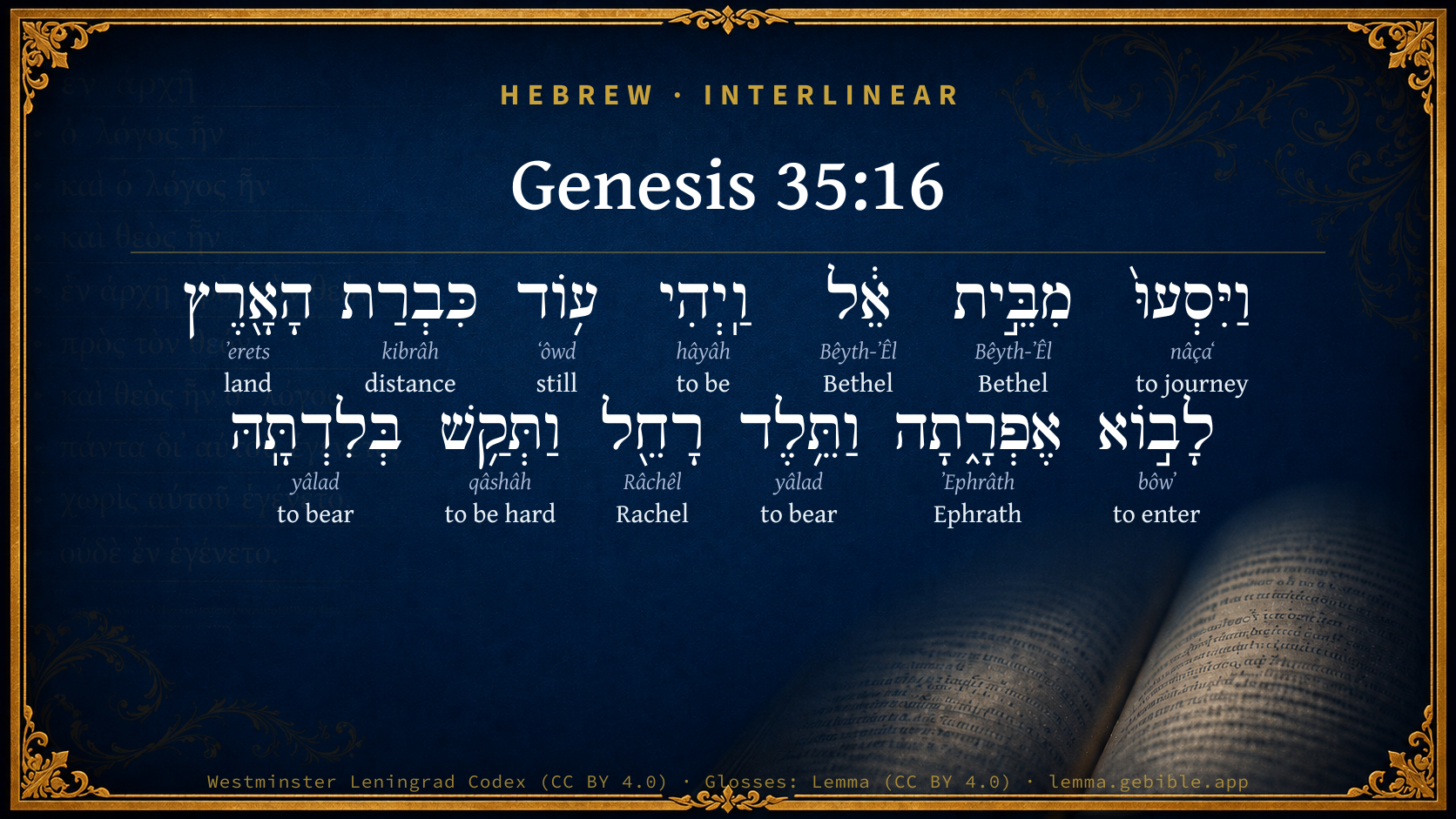
  1. וַיִּסְעוּ֙ nâçaʻ H5265 “and · to journey” Conjunction + Verb, Qal, Sequential Imperfect, 3rd Person, Masculine, Plural
  2. מִבֵּ֣ית Bêyth-ʼÊl H1008 “from · Bethel” Preposition + Noun, Proper
  3. אֵ֔ל Bêyth-ʼÊl H1008 “Bethel” Noun, Proper
  4. וַֽיְהִי hâyâh H1961 “and · to be” Conjunction + Verb, Qal, Sequential Imperfect, 3rd Person, Masculine, Singular
  5. ע֥וֹד ʻôwd H5750 “still” Adverb
  6. הָאָ֖רֶץ ʼerets H776 “the · land” Particle, Definite Article + Noun, Common, Both, Singular, Absolute
  7. לָב֣וֹא bôwʼ H935 “to enter” Preposition + Verb, Qal, Infinitive Construct
  8. אֶפְרָ֑תָה ʼEphrâth H672 “Ephrath” Noun, Proper
  9. וַתֵּ֥לֶד yâlad H3205 “and · to bear” Conjunction + Verb, Qal, Sequential Imperfect, 3rd Person, Feminine, Singular
  10. רָחֵ֖ל Râchêl H7354 “Rachel” Noun, Proper
  11. וַתְּקַ֥שׁ qâshâh H7185 “and · to be hard” Conjunction + Verb, Piel, Sequential Imperfect, 3rd Person, Feminine, Singular
  12. בְּלִדְתָּֽהּ yâlad H3205 “in/at · to bear · her” Preposition + Verb, Qal, Infinitive Construct + Suffix, Personal, 3rd Person, Feminine, Singular

About this verse

These counts appear in no published source. They are computed here, from the morphology-tagged text and Lemma’s own curated glosses. What Lemma adds →

13
words
11
distinct lemmas
Pentateuch
section

Notable vocabulary

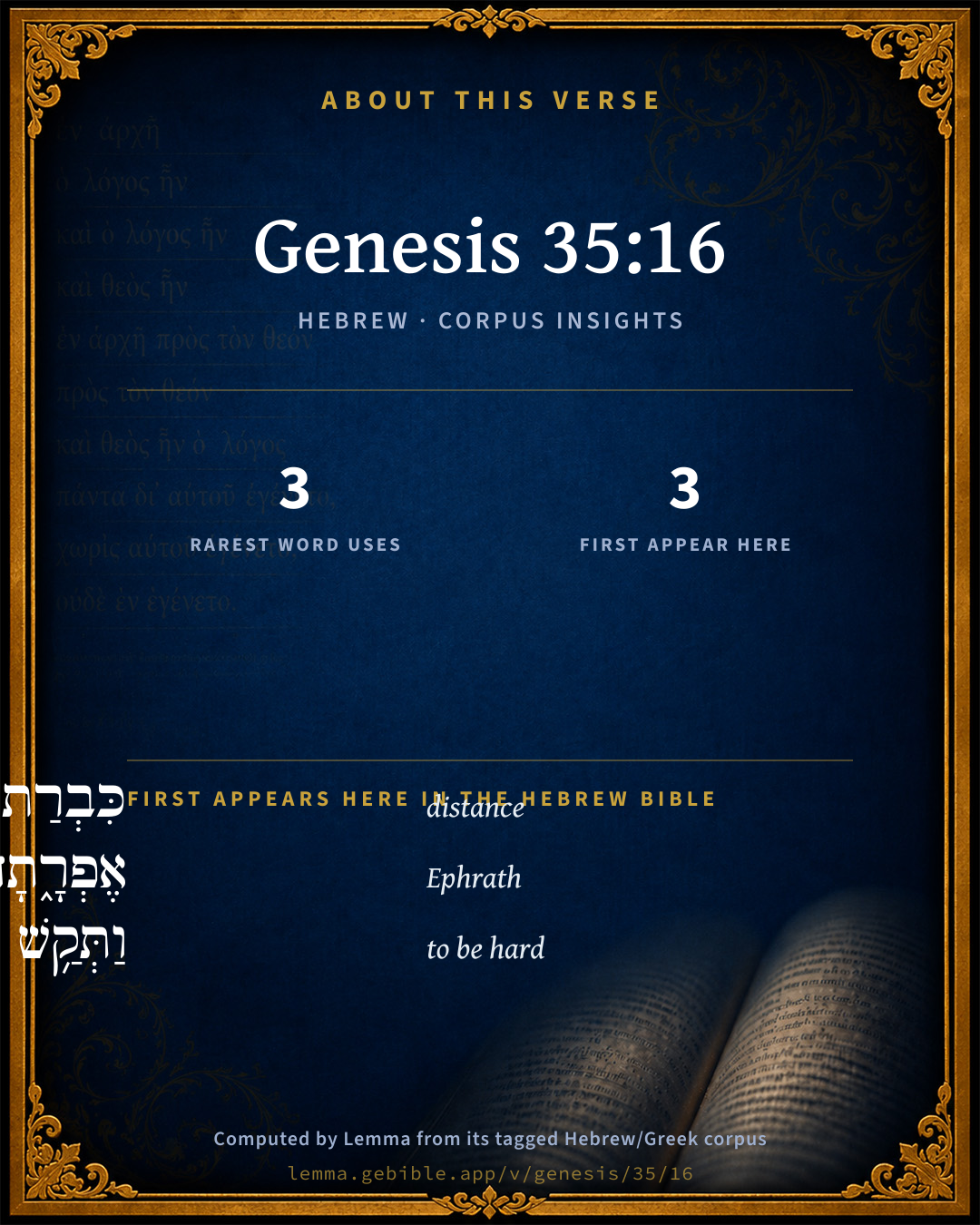
The rarest word here is כִּבְרַת distance H3530 — appearing just 3 times in the whole Hebrew Bible.

First appearance in Scripture

These words make their first canonical appearance in the Hebrew Bible here:

  • כִּבְרַת distance H3530
  • אֶפְרָ֑תָה Ephrath H672
  • וַתְּקַ֥שׁ to be hard H7185

Shared distinctive vocabulary

כִּבְרַת distance H3530 occurs in 3 verses of the Hebrew Bible. Also found in:

Grammatical profile

  • 6 verbs
  • 6 nouns
  • 1 adverb

Verb forms

  • וַיִּסְעוּ֙ Qal · Sequential Imperfect
  • וַֽיְהִי Qal · Sequential Imperfect
  • לָב֣וֹא Qal · Infinitive Construct
  • וַתֵּ֥לֶד Qal · Sequential Imperfect
  • וַתְּקַ֥שׁ Piel · Sequential Imperfect
  • בְּלִדְתָּֽהּ Qal · Infinitive Construct

Repetition

Words recur within this verse — often emphatic in Hebrew:

  • מִבֵּ֣ית Bethel H1008 ×2
  • וַתֵּ֥לֶד to bear H3205 ×2

Hebrew & Septuagint length

In English translation the verse runs 20 words from the Hebrew and 40 from the Septuagint (LXX English) — the Septuagint runs noticeably longer here. See the side-by-side →

A rough comparison of the two English renderings, which tokenize alike — not a word-level alignment.

Word counts can differ between the Hebrew and the Greek without any difference in meaning — e.g. the Hebrew direct-object marker אֵת has no separate Greek word, and Greek often adds the article ὁ.

Cross-references

12

Topical passages linked to Genesis 35:16 in the Treasury of Scripture Knowledge — connected by theme and wording, ordered by reader-vote popularity; previews shown in the World English Bible.

  • Micah 5:2 But you, Bethlehem Ephrathah, Being small among the clans of Judah, Out of you one will come forth to me that is to be ruler in Israel; Whose goings forth are from of old, from everlasting.
  • Genesis 48:7 As for me, when I came from Paddan, Rachel died by me in the land of Canaan in the way, when there was still some distance to come to Ephrath, and I buried her there in the way to Ephrath (the same is Bethlehem)."
  • Genesis 3:16 To the woman he said, "I will greatly multiply your pain in childbirth. In pain you will bring forth children. Your desire will be for your husband, and he will rule over you."
  • Genesis 35:19 Rachel died, and was buried in the way to Ephrath (the same is Bethlehem).
  • Ruth 1:2 The name of the man was Elimelech, and the name of his wife Naomi, and the name of his two sons Mahlon and Chilion, Ephrathites of Bethlehem Judah. They came into the country of Moab, and continued there.
  • 2 Kings 5:19 He said to him, Go in peace. So he departed from him a little way.
  • 1 Chronicles 2:19 Azubah died, and Caleb took to him Ephrath, who bore him Hur.
  • Psalms 132:6 Behold, we heard of it in Ephrathah. We found it in the field of Jaar:
  • Matthew 2:1 Now when Jesus was born in Bethlehem of Judea in the days of Herod the king, behold, wise men from the east came to Jerusalem, saying,
  • Matthew 2:16 Then Herod, when he saw that he was mocked by the wise men, was exceedingly angry, and sent out, and killed all the male children who were in Bethlehem and in all the surrounding countryside, from two years old and under, according to the exact time which he had learned from the wise men.
  • Matthew 2:18 "A voice was heard in Ramah, Lamentation, weeping and great mourning, Rachel weeping for her children; She wouldn't be comforted, Because they are no more."
  • 1 Timothy 2:15 but she will be saved through her child-bearing, if they continue in faith, love, and sanctification with sobriety.

Cross-references courtesy of OpenBible.info (CC BY 4.0).

Hebrew and Greek witnesses Masoretic Hebrew ↔ Greek Septuagint

The same verse in the two great witnesses to the Old Testament, shown verse-for-verse.

Here the Septuagint runs noticeably longer than the Hebrew — LXX2012 (modern English Septuagint) 40 words vs World English Bible 20. A rough length comparison of the two English translations, not a word-level alignment — read both below.

These are two independent witnesses, not word-aligned to each other, and the Septuagint is shown in lemma (dictionary) form.

Hebrew Genesis 35:16 Masoretic · Westminster Leningrad Codex

וַיִּסְעוּ֙ מִבֵּ֣ית אֵ֔ל וַֽיְהִי ע֥וֹד כִּבְרַת הָאָ֖רֶץ לָב֣וֹא אֶפְרָ֑תָה וַתֵּ֥לֶד רָחֵ֖ל וַתְּקַ֥שׁ בְּלִדְתָּֽהּ

They traveled from Bethel. There was still some distance to come to Ephrath, and Rachel travailed. She had hard labor.

World English Bible · Public Domain

Greek LXX Genesis 35:16 Septuagint · lemma form

ἀποαἴρω δέ ἰακώβ ἐκ βαιθηλ πήγνυμι ὁ σκηνή αὐτός ἐπέκεινα ὁ πύργος γαδερ γίγνομαι δέ ἡνίκα ἐγγίζω χαβραθα εἰς γῆ ἔρχομαι εφραθα τίκτω ραχηλ καί δυστοκέω ἐν ὁ τοκετός

[And Jacob removed from Baethel, and pitched his tent beyond the tower of Gader,] and it came to pass when he drew near to Chabratha, to enter into Ephratha, Rachel travailed; and in her travail she was in hard labor.

LXX2012 (modern English Septuagint) · Public Domain

On this verse, The Pulpit Commentary discusses the Septuagint’s reading. Read the note in Commentary ↓

Hebrew: Westminster Leningrad Codex (CC BY 4.0). Greek: Septuagint (public domain); English from LXX2012 (modern English Septuagint) (Public Domain). How the Septuagint differs from the Hebrew →

Targum (Aramaic paraphrase)

2

The Targum is the ancient Jewish Aramaic paraphrase of the Hebrew Scriptures — an interpretive translation, not the Hebrew text itself. Onkelos (literal) and Pseudo-Jonathan (expansive) render the Torah, and Jonathan the Prophets. Coverage is partial: where no permissively-licensed English translation exists for a verse, only the Aramaic is shown. This is verse-level text, not a word-by-word alignment to the Hebrew.

  1. Targum Onkelos Torah (Genesis–Deuteronomy)
    וּנְטָלוּ מִבֵּית אֵל וַהֲוָה עוֹד כְּרוּבַת אַרְעָא לְמֵיעַל לְאֶפְרָת וִילִידַת רָחֵל וְקַשִׁיאַת בְּמֵילְדַהּ

    (no public-domain English translation for this verse)

    Targum Onkelos — Aramaic: “Onkelos Genesis” (public domain); “Onkelos Exodus” (public domain); “Onkelos Leviticus” (public domain); “Onkelos Numbers” (public domain); “Onkelos Deuteronomy” (public domain). English: “Sefaria Community Translation” (CC0 1.0 (public-domain dedication)); “J.W. Etheridge. The Targums of Onkelos and Jonathan Ben Uzziel on the Pentateuch. London: Longmans, Green, 1862” (public domain). Text via Sefaria.

  2. Targum Pseudo-Jonathan Torah (Genesis–Deuteronomy)
    וּנְטָלוּ מִבֵּית אֵל וַהֲוָה תּוּב סוֹגְעֵי אַשְׁווֹן עֲלַלְתָּא דְאַרְעָא בְּמֵיתֵיהּ לְאֶפְרָת וִילֵידַת רָחֵל וְקַשְׁיַית בְּמֵילְדָהּ

    And they proceeded from Beth El; and there was yet much space of provision land in the coming to Ephrath and Rahel travailed, and had hard labour in her birth.

    Targum Pseudo-Jonathan — Aramaic: “Targum Jonathan on Genesis” (public domain); “Targum Jonathan on Exodus” (public domain); “Targum Jonathan on Leviticus” (public domain); “Targum Jonathan on Numbers” (public domain); “Targum Jonathan on Deuteronomy” (public domain). English: “The Targum of Jonathan ben Uzziel, trans. J. W. Etheridge, London, 1862” (public domain). Text via Sefaria.

Commentary

Notes on Genesis 35:16 from classic Christian and Jewish commentators (each source and its license shown beneath its notes). The classic Christian expositions comment on the surrounding passage and are grouped to its opening verse, so a note may address several verses; the Jewish commentaries on the Tanakh (Rashi and others) are per-verse, so they appear only where the commentator wrote on this verse.

Lemma curates 59 commentaries, every one of them public domain or Creative Commons licensed, each selected and text-cleaned for this edition rather than reprinted as found. About our sources →

Jamieson, Fausset & Brown

Robert Jamieson, A. R. Fausset & David Brown

BIRTH OF BENJAMIN--DEATH OF RACHEL, &c. (Gen 35:16-27)

And they journeyed from Beth-el--There can be no doubt that much enjoyment was experienced at Beth-el, and that in the religious observances solemnized, as well as in the vivid recollections of the glorious vision seen there, the affections of the patriarch were powerfully animated and that he left the place a better and more devoted servant of God. When the solemnities were over, Jacob, with his family, pursued a route directly southward, and they reached Ephrath, when they were plunged into mourning by the death of Rachel, who sank in childbirth, leaving a posthumous son [Gen 35:18]. A very affecting death, considering how ardently the mind of Rachel had been set on offspring (compare Gen 30:1).

Jamieson, Fausset & Brown — Commentary Critical and Explanatory on the Whole Bible (1871) — public domain (CC PDM 1.0). Text via the HelloAO Bible API.

Trapp's Complete Commentary

John Trapp

Gen 35:16 And they journeyed from Bethel; and there was but a little way to come to Ephrath: and Rachel travailed, and she had hard labour.

Ver. 17. Thou shalt have this son also.] So she had "children," according to her desire; but this last, to her cost, for a chastisement of her strong affections, which drew on strong afflictions; as hard knots must have hard wedges. They that would needs have a penny for their pains, had no joy of their penny: when the end of the day came, {Mat 20:13} when they were to go into another world, they saw that their penny was no such good silver; that preferment, profit, credit, were but empty things, and could not satisfy. It is best to be moderate in our desires after these outward things; and not so set upon it as to indent with God for such, and so much: this may be dangerous.

John Trapp, A Commentary or Exposition upon All the Books of the Old and New Testament (1647–1656) — public domain. Text from a community e-Sword module.

The Biblical Illustrator

Joseph S. Exell

Gen_35:16-20

Rachel died, and was buried in the way to Ephrath, which is Bethlehem

The death of Rachel

I.

IN ITS SOLEMN AND MELANCHOLY ASPECT.

1. It was death upon a journey.

2. It was death in the time of travail.

3. It was death just when his old fond desire was accomplished.

II. IN ITS HOPEFUL AND PROPHETIC ASPECT.

1. It teaches the doctrine of victory through pain.

2. It teaches that death is not annihilation. As her soul was in departing (for she died) (Gen_35:18). Death is here represented, not as the complete extinction of all thought and feeling, but as the separation of soul and body. It is not a sinking into nought, but only a change of state and place.

3. It teaches us what is the characteristic mark of Gods chosen people. Israel of old had the portion of affliction, and thus became the time of the Messiah, whose peculiar and distinctive mark was, that He was a Man of sorrows and acquainted with grief (Isa_53:3). Rachel was theancestress of the suffering children of Israel.

4. It teaches a lesson of encouragement to all mothers dying in similar circumstances. (T. H. Leale.)

Rachels death

Thus she that had said, Give me children, or I die, died in child-birth! Several circumstances which attended this afflictive event are deserving of notice.

(1) The words of the midwife: Fear not: thou shalt have this son also. When Rachel bare her first son, she called him Joseph, that is, adding; for, said she, by a prophetic impulse, the Lord shall add to me another son. It is probably in reference to this that the midwife spake as she did.

Her words, if reported to Jacob, with the recollection of the above prophetic hint, would raise his hopes, and render his loss more affecting, by adding to it the pain of disappointment. They appear to have no influence however on Rachel. She has the sentence of death in herself, and makes no answer; but turning her eyes towards the child, and calling him Ben-oni, the son of my sorrow, she expired!

(2) The terms by which her death is described. As her soul was in departing. An ordinary historian would have said, as she was dying, or as she was ready-to expire: but the Scriptures delight is an impressive kind of phraseology, which at the same time shall both instruct the mind and effect the heart. It was by means of such language, on various occasions, that the doctrine of a future state was known and felt from generation to generation among the Israelites, while the heathen around them, with all their learning, were in the dark upon the subject.

(3) The change of the childs name--She called his name Ben-oni; but his father called him Benjamin. The former, though very appropriate at the time, yet if continued, must tend perpetually to revive the recollection of the death of his mother; and of such a monitor Jacob did not stand in need. The name given him, signified, the son of my right hand; that is, a son of the most tender affection and delight, inheriting the place which his mother had formerly possessed in his fathers heart. If the love of God be wanting, that of a creature will often be supreme; and where this is the case, the loss of the object is frequently known to leave the party utterly inconsolable; but though the affection of a good man may be very strong, and his sorrow proportionably very deep; yet he is taught to consider that every created good is only lent him; and that his generation work being as yet unfulfilled, it is not for him to feel melancholy, nor to pore over his loss with a sullenness that shall unfit him for duty, but rather to divert his affections from the object that is taken, and direct them to those that are left.

(4) The stone erected to her memory, and which appears to have continued for many generations. Burying her in the place where she died, Jacob set a pillar upon her grave; and that was the pillar of Rachels grave when her history was written. It was near this place, if not upon the very spot, that the tribe of Benjamin afterwards had its inheritance: and therefore it is that the people who lived in the times of Jeremiah are called Rachels children. The babes which Herod murdered are also so called. (A. Fuller.)

Lessons

1. Providence ordereth the saints below no long settlement, but to move sometimes from desired places.

2. Motions from Bethel to Ephrath, from Gods comforts to Gods chastenings are ordered to Gods saints by himself.

3. Providential afflictions may betide Gods dearest servants unexpectedly in their ways.

4. Souls exorbitantly desirous of children, may have them from God with bitterness enough (Gen_35:16).

5. The bitterest pains in child-bearing may befall the best of women.

6. It is the midwifes honour, with Gods Spirit, to be pitiful and comfortable unto women in travail.

7. God doth add sons to His in their earnest desires sometimes, wherein they may take little delight (Gen_30:24),

8. Providence sometimes brings living children out of dying mothers (Gen_35:17).

9. Killing pains in child-bearing may befal souls to much longing for children.

10. Dying mothers in their passions may name children their griefs and not their joy.

11. Souls die not, but go out of bodies to God who gave them Ecc_12:7).

12. Tender affection in fathers name their children more dear which they have with loss of wives (verse 18).

13. Rachels may die when Leahs live, the beloved before the despised.

14. Comely interment is a duty to relations in all places, where providence calleth them away.

15. Places notable for births and burials are sometimes noted by Gods spirit (verse 19).

16. It is suitable to nature and not contrary to grace, to set up and keep memorials of deceased relations.

17. Durable monuments of providences may be useful for posterity.

18. It is not unlawful to leave monuments of the dead, only vanity and superstition avoided (verse 20). (G. Hughes, B. D)

The Biblical Illustrator, edited by Joseph S. Exell (c. 1880s–1900s) — public domain. Text from a community e-Sword module.

Whedon's Commentary on the Bible

Daniel D. Whedon

DEATH OF RACHEL, Gen_35:16-20.

16. Journeyed from Beth-el — Having paid his vows at Beth-el, he feels a yearning to move on, southward, and see his father Isaac again.

A little way — Hebrews, a chibrath of land; some apparently definite measure of length or distance, but now to us unknown.

Ephrath — The ancient name of the place afterwards so well known as Bethlehem. Gen_35:19.

Rachel travailed — At the birth of Joseph, she had yearned for yet another son, (Gen_30:24,) and had given her firstborn a name in confidence that this hope would be realized. But many years passed before her hope was filled, and then at the cost of her own life.

Daniel D. Whedon (gen. ed.), Commentary on the Old and New Testaments (1874–1909) — public domain. Text from a community e-Sword module.

The Pulpit Commentary

CHAPTER 35:16-29

And they journeyed not in opposition to the Divine commandment (ver. 1), which did not enjoin a permanent settlement at Bethel, but in accordance probably with his own desire, if not also Heaven"s counsel, to proceed to Mamre to visit Isaacfrom Bethel (southwards in the direction of Hebron); and there was but a little way (literally, there was yet a space of land; probably a few furlongs (Murphy), about four English miles (Gerlach). The Vulgate translates, "in the springtime," and the LXX render, ejgeneto deka hggisen eijv cabraqa, both of which are misunderstandings of the originalto come to Ephrath: Fruitful; the ancient name of Bethlehem (vide infra ver. 19) and Rachel travailed, and she had hard labor literally, she had hard labor in her parturition, which was perhaps all the more severe that sixteen or seventeen years had elapsed since her first son, Joseph, was born.

HOMILETICS.

Vers. 16-29.

From Bethel to Mamre.

I THE DEATH OF RACHEL.

1. The travailing woman. Rachel, overtaken by the pains of childbirth, had hard labor. In every instance an inheritance derived from mother Eve, (Gen_3:16) the sorrow of maternity was in her case providentially intensified; perhaps by her advanced age, or by the discomforts of travel, or by feebleness of health, or possibly by special appointment of God as a rebuke for her inordinate desire for children, (Gen_30:1) or as a means of shortening her life.

1. The comforting midwife. Though her name is not recorded, wherever this pathetic story is recited, there shall her kindly offices to the dying Rachel be remembered. Chosen to assist Rachel in her bodily struggle, she was likewise helpful to Rachel in her soul"s conflict. Sympathizing with the sufferer in her-pain, she sought to minister comfort to the drooping heart in its despondency. They who tend the sick and dying should be tender in their feelings and hopeful in their words, as well as skilful and gentle in their acts.

2. The departing mother. Though Rachel"s child was born, Rachel herself died; in which were some circumstances of sadness, as

(1) that it happened on a journey, the way to Ephrath, and near its end was but a little way to come to Ephrath," where it is likely Jacob had intended to rest a while for Rachel"s convenience;

(2) that it occurred on the occasion of her confinement, death in child-bed being a comparatively rare experience in the history of mothers, though, considering the severity of the ordeal, it is a special mercy that any mothers survive; and

(3) that it removed her from her newly-born son, than which no greater grief can agitate a dying mother"s heart, and the thought of which perhaps gave added poignancy to the bitter anguish with which she named her child Ben-out the son of my sorrow.

(1) that she died in the presence of her husband, Jacob being by her couch to catch her latest breath;

(2) that she died not before she gave him another son, to be to him whom she loved a Benjamin, though to herself Ben-oni; and

(3) that she died in the hope of a glorious immortality, her soul departing to the better country, even a heavenly.

Yet in Rachel"s death were certain elements of gladness, as

3. The bereaved husband.

(1) Cheering the drooping heart of his dying wife. This is probably the correct view to be taken of what otherwise interpreted cannot fail to seem strangely inconsistent Jacob"s naming Rachel"s child Benjamin, the son of my right hand, the son of my affection, of my prosperity, a token of good hope and happy fortune, while Rachel called him Ben-oni. "In vain the broken-hearted father refusing to take in the terrible fact passing under his eye determined to be sanguine to the last, and let no evil omen touch either mother or child whispers hope in the dull ear of death, and welcomes the last pledge of an undying love as no "son of sorrow," but "the son of the right hand" (Candlish).

(2) Burying the lifeless body of his beloved spouse, which doubtless he would do with reverent affection and with heart-felt mourning.

(3) Erecting a pillar above her lonely grave to demonstrate his affection for her who slept beneath, to show that though she lay not in the family tomb, she was not forgotten, and to mark the last resting-place of an ancestress of Israel.

II THE SIN OF REUBEN.

1. The enormity of Reubens wickedness. The act which he committed was that of incest, since Bilhah had been the wife of Jacob. It was a sin punishable by death under Moses" law, (Lev_18:8) and such a sin as should not be named among Christians. (1Co_5:1) It is not likely that Bilhah was innocent in this matter, but it is certain that Reuben was guilty of heinous transgression.

2. The impression it produced on Jacob. "Israel heard." We may supply the hiatus by saying,

(1) with inexpressible grief grief that a son and wife of his should have committed such a horrible iniquity;

(2) with bitter shame was this to be the end of all God"s mercies to his house, and of all his efforts to piously direct his household?

(3) with silent submission, as recognizing God"s hand in the dispensation. More bitter and crushing was this last stroke than the death of Rachel or even the ravishment of Dinah; and Jacob"s silence under it may be interpreted as the silence of devout resignation: was dumb, because thou didst it.

III THE DEATH OF ISAAC.

1. He was spared to see his sows return. "Jacob came unto Isaac his father unto Mamre" at least a considerable period before his death. According to calculations (vide Exposition), Isaac survived the sale of Joseph thirteen years. Hence Jacob"s coming home must have taken place while Isaac had yet many years to live. It is a mercy which God does not grant to all, to see their children and their children"s children around them before they die.

2. He was privileged to reach a good old age. "The days of Isaac were a hundred and fourscore years." Piety has a special tendency to prolong life, (Psa_34:12) while the wicked live not half their days. (Psa_55:23)

1. He was favored with a peaceful and a blessed end. Isaac gave up the ghost, and died, and was gathered unto his people." See Homily on the death of Abraham. (Gen_25:8)

2. He was honored with a decent and respectful funeral. "Esau and Jacob buried him." They laid him beside his ancestral dust in the family burying-place of Machpelah, where already slept the lifeless bodies of Abraham and Sarah, awaiting the resurrection, while his spirit went to company with theirs in the better country, even a heavenly.

Learn

1. That bereavements, like the rest of life"s afflictions, are of God"s ordering, both as to time, place, and manner.

2. That in human families they who are most beloved are frequently removed first.

3. That the sick and dying should be ministered to with sympathy and tender attention.

4. That good men should love their wives when living, and remember them when dead.

5. That faith should always try to see the bright light of blessing in the cloud of earth"s afflictions.

6. That worse calamities may overtake a saint than bereavements.

7. That pious children do not cast off their parents in old age.

HOMILIES BY R.A. REDFORD

Vers. 16-29. These family records mingle well with the story of God"s grace. The mothers Ben-oni" is the father"s Benjamin." Out of the pain and the bereavement sometimes comes the consolation. A strange blending of joy and sorrow is the tale of human love. But there is a higher love which may draw out the pure stream of peace and calm delight from that impure fountain. Jacob and Esau were separated in their lives, but they met at their father"s grave. Death is a terrible divider, but a uniter too. Under the shadow of the great mystery, on the borders of an eternal world, in the presence of those tears which human eyes weep for the dead, even when they can weep no other tears, the evil things of envy, hatred, revenge, alienation do often hide themselves, and the better things of love, lessee, brotherhood, amity come forth. Jacob was with Isaac when he died, and Esau came to the grave. R.

The Pulpit Commentary (1880–1919), ed. H.D.M. Spence-Jones & Joseph S. Exell — public domain. Text from a community e-Sword module.

The Preacher's Complete Homiletical Commentary

Joseph S. Exell (gen. ed.)

CRITICAL NOTES.—

Gen_35:18. Ben-oni.] Heb. Son of my pain. Benjamin. Heb. Son of right hand, or, son of happiness.—

Gen_35:20. The pillar of Rachel’s grave unto this day.] The grave of Rachel was well known in the time of Samuel. (1Sa_10:2.) The expression “unto this day” occurs often in Genesis, but not elsewhere in the Pentateuch, excepting once in Deuteronomy.—

MAIN HOMILETICS OF THE PARAGRAPH.—Gen_35:16-20

THE DEATH OF RACHEL

Consider it—

I. In its solemn and melancholy aspect

1. It was death upon a journey. “And they journeyed from Bethel; and there was but a little way to come to Ephrath.” (Gen_35:16.) In such cases, death is generally an unlooked for event. This sad circumstance deeply impressed Jacob, and many years afterwards he looks back to it with sorrowful remembrance. (Gen_48:7.)

2. It was death in the time of travail. This is always a melancholy circumstance when the mother sacrifices her own life in giving life to her child.

3. It was death just when her old fond desire was accomplished. When Joseph was born, she believed that God would add to her another son. Now the long expected gift is granted, but she expires in the very moment of victory. Consider it—

II. In its hopeful and prophetic aspect.

1. It teaches the doctrine of victory through pain. She enriches the family of Jacob with a son, thus completing their number to twelve. The midwife comforts her thereupon. But the dying mother gave to the boy the name of Ben-oni, son of my pain. Through pain and sorrow this victory was gained. This was not an utterance of despair, but a conviction that life had come out of death; victory out of pain, sorrow, and apparent failure. This is the spirit of the cross. Through pain and sorrow, and apparent failure, Christ has purchased victory for us.

2. It teaches that death is not annihilation. “As her soul was in departing, (for she died).” (Gen_35:18.) Death is here represented, not as the complete extinction of all thought and feeling, but as the separation of soul and body. It is not a sinking into nought, but only a change of state and place.

3. It teaches us what is the characteristic mark of God’s chosen people. Israel of old had the portion of affliction, and thus became the type of the Messiah, whose peculiar and distinctive mark was, that He was “a Man of sorrows and acquainted with grief.” (Isa_53:3.) Rachel was the ancestress of the suffering children of Israel.

4. It teaches a lesson of encouragement to all mothers dying in similar circumstances. This is the first instance, recorded in the Bible, of a mother dying in travail. How solemn was the original penalty. Gen. (Gen_3:16.) And yet in God’s later Revelation that penalty becomes transfigured, and there is in it an element of hope and blessing. (1Ti_2:15.)

SUGGESTIVE COMMENTS ON THE VERSES

Gen_35:16. Bethel beheld him at the summit of worldly happiness; Bethlehem, the next town through which he passes, sees him in the depths of affliction. The incident recalls, with painful vividness, the passionate exclamation she had before uttered, “Give me children, or else I die.” Her prayer was heard, but at the expense of her life. Alas! how often should we be ruined at our own request, if God were not more merciful to us than we are to ourselves.—(Bush).

Gen_35:17. The first midwife who appears in the region of sacred history is a worthy counterpart to the first nurse, Deborah. She shows the vocation of a midwife, to support the labouring with sympathy, to encourage her, and to strengthen her by the birth of a child, especially of a son, or the announcement of the beginning of the new life.—(Lange).

Gen_35:18. Her words appear to have had no influence upon Rachel, who has the sentence of death in herself, and makes no answer; but, turning her dying eyes towards the child, and calling him, Ben-oni, “Son of my sorrow,” she expires.—(Bush).

The former name, though very appropriate at the time, yet if continued, must tend perpetually to revive the recollection of the death of his mother, and of such a monitor Jacob did not stand in need. It is not for him to feed melancholy, nor to pore over his loss with a sullenness that shall unfit him for duty, but rather to divert his affections from the object that is taken, and direct them to those that are left.—(Fuller).

It is true, indeed, even in the sense of the usually received antithesis, that every newborn child is a Ben-oni, and a Benjamin; Ben-oni in Adam, Benjamin in Christ.—(Lange).

Let men make their burdens as light as they can, and not increase their worldly sorrow by sight of sad objects. It will come, as we say of foul weather, soon enough; we need not send for it.—(Trapp).

As her soul was in departing. An ordinary historian would have said, as she was dying, or as she was ready to expire. But the Scriptures delight in an impressive kind of phraseology, which at the same time shall both instruct the mind and touch the heart.—(Fuller.)

Gen_35:19. Bethlehem here enters, clouded by Jacob’s mourning; afterwards enlightened by David, the Old Testament hero out of Judah, and finally glorified by the fulfilment of Israel’s hope.—(Lange.)

Gen_35:20. The pillar of Rachel’s grave. Jacob loves the monumental stone.—(Murphy).

The Preacher's Complete Homiletical Commentary (gen. ed. Joseph S. Exell; Funk & Wagnalls, c. 1892) — public domain (pre-1929). A full-Bible homiletical/sermon-outline anthology covering 65 of 66 books (2 John is absent from the source module). Text from a community e-Sword module.

Lange's Commentary on the Holy Scriptures

SEVENTH SECTION

Departure from Bethel. Benjamin’s birth. Rachel’s death.

Gen_35:16-20

16And they journeyed from Bethel; and there was but a little4 way to come to Ephrath [fruit, the fruitful]: and Rachel travailed, and she had hard labor. 17And it came to pass, when she was in hard labor, that the midwife said unto her, Fear not; thou shalt have this son also.5 18And it came to pass as her soul was in departing, (for she died,) that she called his name Ben-oni [my son of pain or sorrow]: but his father called him Benjamin [son of the right hand]. 19And Rachel died, and was buried in the way to Ephrath, which is Beth-lehem [house of bread]. 20And Jacob set a pillar [monument] upon her grave: that is the pillar of Rachel’s grave unto this day.

EXEGETICAL, AND CRITICAL

And they journeyed.—The residence at Bethel, enjoined upon him, had reached its end with the founding of the altar, and the completed thanksgiving.—And there was but a little way.—An unknown distance. The Rabbinical explanation, “as far as one could plough in a day,” is senseless, for in one direction they could plough miles, but in ploughing a field, the breadth ploughed depends upon the length of the field, but in any case is too small to be the measure of distances. The Sept., misunderstanding the passage, makes it the name of a place. [In the 19th verse, however, the Sept. has hippodrome.—A. G.] Delitzsch conjectures a distance equal to a Persian parasang.—And Rachel travailed.—The wish she had uttered at Joseph’s birth, that God would give her another son, now, after a long period, perhaps sixteen or seventeen years, is about to be fulfilled, but it caused her death. Jacob was now old, and Rachel certainly was no longer young; moreover, she had not. borne children for many years. Delitzsch reckons Jacob’s age at one hundred and six, and Rachel’s at about fifty years.—When she was in hard labor.—The Piel and Hiphil forms of קָשָׁה denote not merely heavy birth-pains, but the very birth-throes and anguish.—The midwife, i. e., a maid-servant skilful and trusted in this matter.—Thou shalt have a son.—The last consolation for Rachel. She dies during the final fulfilment of the strongest wish of her life. [As her soul was departing, denotes not the annihilation of the soul, but the change of state and place. It presupposes, of course, its perpetual existence; at least, its existence after death.—A. G.] In this sense we must explain the giving of the name. The emphasis in the son of my pain, must be laid upon son. From her very death-anguish, a son is born to her. Knobel explains the name to mean son of my vanity, און, because his birth caused her “annihilation,” i. e., death. In this explanation, the child becomes the father, i. e., originator of her “annihilation,” but is not the son. The son of her pain, on the contrary, denotes the great gain of her sorrow; she dies, as it were, sacrificing herself; and, indeed, the once childless, now in childbed.—But his father called him.—Against the interpretation of Benjamin, as the son of prosperity, may be urged the ימין in the Hebrew, which cannot with any certainty be said to mean prosperity; and further, that this would have been in harsh contrast with the dying word of the mother. Delitzsch, therefore, holds that the son of the right hand, may mean the son of the south, since the other sons were born in the north. Some derive the name son of prosperity from the fact that Jacob had now reached a happy independence, or from the fact that Benjamin filled up the prosperous number twelve (see Delitzsch). But Benjamin might be regarded as the son of the strong right hand, since he fills up the quiver of the twelve mighty sons (Psa_127:5). We may bring into view, further, the relation of the name to the state of rest which Jacob now believed that he had attained. The tired wanderer now prepares himself as a patriarch to rest, and his youngest favorite must take the place at his right hand. But he is not thereby designated as his successor. Jacob seems, in some erroneous way, for a long time to have had Joseph in his eye for this position; still, not with the same self-will with which Isaac had chosen Esau. The Samaritan explanation, son of days, ימים, i. e., of his old days or age, we pass with a mere allusion. Some suggest, also, that Jacob called him Benjamin, so that he might not be constantly reminded of his loss by the name Ben-oni. This lays the ground for the change of the name, but not for the choice of Benjamin.—In the way to Ephrath.—Ephrath (from פָרָה) is the fruitful, a name which corresponds with the added name Bethlehem (house of bread). The distance from Jerusalem to Bethlehem is about two hours, in a southerly direction, on the road to Hebron. About a half-hour on this side of Bethlehem, some three hundred steps to the right of the road, there lies, in a small recess, the traditional grave of Rachel. This “Kubbet-Rahil (Rachel’s grave), is merely a Moslem wely, or the grave of some saint, a small, square stone structure, with a dome, and within a grave of the ordinary Mohammedan form (Robinson: “Res.” vol. i. p. 322), which has been recently enlarged by the addition of a square court on the east side, with high walls and arches (later “Res.” p. 373).” Keil. We must distinguish between the old tradition as to the locality, and the present structure. Knobel infers, from Mic_4:8, that Jacob’s next station, the tower of the flock, was in the vicinity of Jerusalem. In that case Rachel’s grave, and even Ephrath, must be sought north of Jerusalem, according to 1Sa_10:2, and the addition—which is Bethlehem—must be viewed as a later interpretation. In Micah, however, in the passage which speaks of the tower of the flock, or the stronghold of the congregation, the words seem to be used in a symbolical sense. But the passage, 1Sa_10:2, is of greater importance. If Rama, the home of Samuel, lay to the north of Jerusalem, then Rachel’s grave must have been in that region, and the more so, since it is said to have been within the limits of Benjamin, whose boundaries did not run below Jerusalem. We refer for further discussions to Knobel, p. 275, and Delitzsch [and Mr. Grove, in Smith’s Bible Dict.—A. G.] We are inclined to regard it as probable that the Benjamites, at the time of the conquest of the country, brought the bones of Rachel from Ephrath, into their own region, and that since then, there have been two monuments of Rachel, one marking the place of her death, and her first burial; the other, the place where they laid her bones, in the home of her Ben-oni. Similar transportations of the remains of the blessed occur in the history of Israel. In this view we may explain more clearly how Rachel (Jer_40:1) bewailed her children at Rama, than it is by the usual remark, that the exiled were gathered at Rama.—Unto this day.—From this notice Delitzsch infers that Genesis was not completed until after the arrival of the Israelites in Canaan. Keil says this remark would have been in place within ten or twenty years after the erection of the pillar. Still, he appears to have felt that a term of from ten to twenty years could make no distinction between older and more recent times, and hence adds in a note, if this pillar was actually preserved until the time of the conquest, i. e., over four hundred and fifty years, this remark may be viewed as an interpolation of a later writer. It belongs, doubtless, to the last redaction or revision of Genesis. Still there are possible ways in which the Israelites even in the desert could have received information as to the existence of this monument, although this is less probable. [Kurtz defends the genuineness of the passage, but locates the grave of Rachel in the vicinity of Rama, on the grounds that the announcement here of a stretch of land is indefinite, and further, that the designation of the place by the distant Bethlehem, arose from the fact that the tower of the flock in Bethlehem was the next station of Jacob, and his residence for a considerable period; and lastly, that Jer_31:15 clearly points to the vicinity of Rama. Keil urges in favor of his own view, that the existence of a monument of this kind, in a strange land, whose inhabitants could have had no interest in preserving it, even for the space of ten or twenty years, might well have appeared worthy of notice.—A. G.]

DOCTRINAL AND ETHICAL

1. Rachel’s wish; Rachel’s death; but her death at the same time her last gain in this life.

2. Rachel’s confinement at Bethlehem, viewed in its sad and bright aspects: 1. The sad aspect: A confinement upon a journey; a death in the presence of the goal of the journey so long desired; a parting by death from the desired child. 2. The joyful aspect: A son in whom her old wish is now fulfilled (see Gen_30:24; also the passionate word, “Give me children, or else I die,” Gen_30:1); a new enriching of Jacob, and indeed, to the completion of the number twelve; the triumph that she dies as the mother of a child.

3. Rachel’s death and grave. A preliminary consecration of the region of Bethlehem. Through her tragic end she becomes the ancestress of the suffering children of Israel generally, even of the children of Leah (Jer_31:15; Mat_2:17). Her grave probably at, Ephrath and Rama at the same time. Rachel as the first example mentioned in the Scriptures of a mother dying in travail, and a comforter to mothers dying in similar circumstances. The solemn aspect of such a death (Gen_3:16). Its beauty and transfiguration (1Ti_2:15).

4. The heroic struggles, and struggling places of travailing women. Through these painful struggles they form the beautiful complement to the manly struggles in sacred wars. While the latter are institutes of death, the former are the institutes of life.

5. The first midwife who appears in the region of sacred history, is a worthy counterpart to the first nurse, Deborah. She shows the vocation of a midwife, to support the laboring with sympathy, to encourage her, and to strengthen her by announcing the birth of a child, especially of a son, or the announcement of the beginning of the new life.

6. The name Benoni, on Rachel’s lips, was not an utterance of despair, but of a deeply painful feeling of victory. The desired fruit of her womb came out of these death-struggles. Jacob’s naming connects itself with this also: the son of my right hand, companionship of my rest, support, joy of my old age. It is true, indeed, even in the sense of the usually received antithesis, that every new-born child is a Benoni, and a Benjamin; Benoni in Adam, Benjamin in Christ.

7. The youngest children of a family, Benjamin’s companions; and frequently described as Benjamins, they stand under the blessing of a ripe old age, under the protection of older and stronger brothers and sisters; but on the other hand, the danger that the paternal discipline should give way to grandfather-like indulgence, great as it may be in particular cases, is scarcely brought into view here. They embrace, as it were, in themselves, the whole past of the family and the most distant future.

8. Bethlehem here enters, clouded by Jacob’s mourning; afterwards enlightened by David, the Old-Testament hero out of Judah, and finally glorified by the fulfilment of Israel’s hope.

9. The following verse shows how Jacob, as the Israel of God, rises from his grief over Rachel’s death.

10. As her soul was departing. As Starke suggests, we have thus an indication that we are to regard death as the separation of the soul and body. For if, indeed, נֶפשׁ, the soul, is life also, so, and much more, is the human life, soul.

HOMILETICAL AND PRACTICAL

See the Doctrinal and Ethical remarks. It requires no special notice that this section is peculiarly adapted for texts at the burial of women dying ir confinement, at the transactions over consecrated graves, and similar occasions.—Rachel’s death upon the journey.—Rachel’s journey home in a two-fold sense.—Our life a pilgrimage.—As we are all born during the pilgrimage, so we must all die upon our pilgrimage.—We reach a fixed, permanent goal only upon the other side. Benoni and Benjamin: 1. The similarity of the names; 2. the difference between them.—Jacob at Rachel’s grave.—His silent grief.—His uttered faith.

Starke: An enunciation of Jacob’s sorrows. It is connected with the names: Simeon, Levi, Dinah, Rachel, Reuben, and Bilhah. Then follows Isaac’s death, and afterwards Joseph’s disappearance; the famine, etc. Hence he says: “Few and evil have the days of the years of my life been” (Gen_47:9). (An allegorical comparison of Rachel, at this birth, with the Jewish Church. As Rachel died at the birth of Benjamin, so the Jewish Church at the birth of Christ.)—Cramer: The birth-throes are a cross and a reminder of our sins (Gen_3:16). God recognizes this, and gives his aid (Joh_16:21).—But if the divinely-blessed mother, or her fruit, should die, their happiness is not put in peril (1Ti_2:15).—Christian midwives should encourage women in this fearful crisis.—Women in this state should diligently prepare themselves for death.—Osiander: The dead bodies of the pious are not to be treated as those of irrational animals, but must be decently buried, that we may thus testify our hope in the resurrection from the dead (Pro_10:7).—Schröder: Bethlehem is called now Beit-Lahm; i. e., meat-house. Benjamin a type of the Messiah, who, in his humiliation, was a man of sorrows, and in his exaltation a son of the right hand of God (Drechsler). [Wordsworth here brings out several striking analogies between Benjamin and St. Paul, basing them upon the word ἔκτρωμα, which the apostle applies to himself “as one born out of due time,” properly, “the child whose birth is the cause of his mother’s death.” Paul speaks of himself as one thus born, and thus seems to invite us to compare him with Benjamin. P. 145.—A. G.]

Footnotes:

[4][כִּבְרַת־הָאָרֶץ, a space or stretch of ground. How long is unknown; see Gen_48:7; 2Ki_5:19. Josephus renders a furlong; the Sept., “somewhat longer distance.”—A. G.]

[5][Lit., for this is also to thee a son.—A. G.]

Lange's Commentary on the Holy Scriptures (Critical, Doctrinal, and Homiletical), ed. John Peter Lange, English translation edited by Philip Schaff (1864–1880) — public domain. Text from a community e-Sword module.

Tyndale Open Study Notes

Tyndale Open Resources

35:16-20 Benjamin’s birth completed the family, but it was a sorrowful event because Rachel died in childbirth (see study note on 31:32).

Tyndale Open Study Notes — © Tyndale Open Resources, licensed CC BY-SA 4.0. Text via the HelloAO Bible API.

Geneva Bible (1599)

Geneva Bible translators

The Hebrew word signifieth as much ground as one may go from baite to baite, which is taken for half a day’s journey.

Geneva Bible (1599) marginal notes — public domain. Text via Bolls.life.

Matthew Henry's Commentary

We have here the story of the death of Rachel, the beloved wife of Jacob. 1. She fell in travail by the way, not able to reach to Bethlehem, the next town, though they were near it; so suddenly does pain sometimes come upon a woman in travail, which she cannot escape, or put off. We may suppose Jacob had soon a tent up, convenient enough for her reception. 2. Her pains were violent. She had hard labour, harder than usual: this was the effect of sin, Gen 3:16. Note, Human life begins with sorrow, and the roses of its joy are surrounded with thorns. 3. The midwife encouraged her, Gen 35:17. No doubt she had her midwife with her, ready at hand, yet that would not secure her. Rachel had said, when she bore Joseph, God shall add another son, which now the midwife remembers, and tells her her words were made good. Yet this did not avail to keep up her spirits; unless God command away fear, no one else can. He only says as one having authority, Fear not. We are apt, in extreme perils, to comfort ourselves and our friends with the hopes of a temporal deliverance, in which we may be disappointed; we had better found our comforts on that which cannot fail us, the hope of eternal life. 4. Her travail was to the life of the child, but to her own death. Note, Though the pains and perils of childbearing were introduced by sin, yet they have sometimes been fatal to very holy women, who, though not saved in childbearing, are saved through it with an everlasting salvation. Rachel had passionately said, Give me children, or else I die; and now that she had children (for this was her second) she died. Her dying is here called the departing of her soul. Note, The death of the body is but the departure of the soul to the world of spirits. 5. Her dying lips called her new-born son Ben-oni, The son of my sorrow. And many a son, not born in such hard labour, yet proves the son of his parent's sorrow, and the heaviness of her that bore him. Children are enough the sorrow of their poor mothers in the breeding, bearing, and nursing of them; they should therefore, when they grow up, study to be their joy, and so, if possible, to make them some amends. But Jacob, because he would not renew the sorrowful remembrance of the mother's death every time he called his son by his name, changed his name, and called him Benjamin, The son of my right hand; that is, "very dear to me, set on my right hand for a blessing, the support of my age, like the staff in my right hand." 6. Jacob buried her near the place where she died. As she died in child-bed, it was convenient to bury her quickly; and therefore he did not bring her to the burying-place of his family. If the soul be at rest after death, it matters little where the body lies. In the place where the tree falls, there let it be. No mention is made of the mourning that was at her death, because that might easily be taken for granted. Jacob, no doubt, was a true mourner. Note, Great afflictions sometimes befal us immediately after great comforts. Lest Jacob should be lifted up with the visions of the Almighty with which he was honoured, this was sent as a thorn in the flesh to humble him. Those that enjoy the favours peculiar to the children of God must yet expect the troubles that are common to the children of men. Deborah, who, had she lived, would have been a comfort to Rachel in her extremity, died but a little before. Note, When death comes into a family, it often strikes double. God by it speaks once, yea, twice. The Jewish writers say, "The death of Deborah and Rachel was to expiate the murder of the Shechemites, occasioned by Dinah, a daughter of the family." 7. Jacob set up a pillar upon her grave, so that it was known, long after, to be Rachel's sepulchre (Sa1 10:2), and Providence so ordered it that this place afterwards fell in the lot of Benjamin. Jacob set up a pillar in remembrance of his joys (Gen 35:14), and here he sets up one in remembrance of his sorrows; for, as it may be of use to ourselves to keep both in mind, so it may be of use to others to transmit the memorials of both: the church, long afterwards, owned that what God said to Jacob at Bethel, both by his word and by his rod, he intended for their instruction (Hos 12:4), There he spoke with us.

Matthew Henry's Commentary on the Whole Bible (1708–1710) — public domain (CC PDM 1.0). Text via the HelloAO Bible API.

Adam Clarke's Commentary

Verse 16. There was but a little way to come to Ephrath] The word כברת kibrath, translated here a little way, has greatly perplexed commentators. It occurs only here, in Ge 48:7, and 2Kg 5:19; and it seems to have been some sort of measure applied to land, as we say a mile, an acre, a rood, a perch; but what the exact quantity of the kibrath was cannot be ascertained. Ephrath, called also Bethlehem, and Bethlehem Ephrata, was the birthplace of our blessed Redeemer. See its meaning Mt 2:6.

Adam Clarke's Commentary on the Bible (1810–1826) — public domain. Text from a community e-Sword/MySword module.

John Calvin's Commentaries

16. And they journeyed from Beth-el. We have seen how severe a wound the defilement of his daughter inflicted on holy Jacob, and with what terror the cruel deed of his two sons had inspired him. Various trials are now blended together, by which he is heavily afflicted throughout his old age; until, on his departure into Egypt, he receives new joy at the sight of his son Joseph. But even this was a most grievous temptation, to be exiled from the promised land even to his death. The death of his beloved wife is next related; and soon after follows the incestuous intercourse of his firstborn with his wife Bilhah. A little later, Isaac his father dies; then his son Joseph is snatched away, whom he supposes to have been torn in pieces by wild beasts. While he is almost consumed with perpetual mourning, a famine arises, so that he is compelled to seek food from Egypt. There another of his sons is kept in chains; and, at length, he is deprived of his own most beloved Benjamin, whom he sends away as if his own bowels were torn from him. We see, therefore, by what a severe conflict, and by what a continued succession of evils, he was trained to the hope of a better life. And whereas Rachel died in childbirth, through the fatigue of the journey, before they reached a resting-place; this would prove no small accession to his grief. But, as to his being bereaved of his most beloved wife, this was probably the cause, that the Lord intended to correct the exorbitance of his affection for her. The Holy Spirit fixes no mark of infamy upon Leah, seeing that she was a holy woman, and endowed with greater virtue; but Jacob more highly appreciated Rachel’s beauty. This fault in the holy man was cured by a bitter medicine, when his wife was taken away from him: and the Lord often deprives the faithful of his own gifts, to correct their perverse abuse of them. The wicked, indeed, more audaciously profane the gifts of God; but if God connives longer at their misconduct, a more severe condemnation remains to them on account of his forbearance. But in taking away from his own people the occasion of sinning, he promotes their salvation. Whoever, therefore, desires the continued use of God’s gifts, let him learn not to abuse them, but to enjoy them with purity and sobriety.

John Calvin's Commentaries (1540-1563) — public domain. Text from the Calvin Translation Society English edition (1840s-50s) via the Christian Classics Ethereal Library (ccel.org). Calvin's coverage is partial (roughly two-thirds of the Bible); uncommented books and verses are honest gaps, never fabricated. The 19th-century editor's footnotes and remarks are omitted so the notes are faithfully Calvin's own voice.

Ellicott's Commentary for English Readers

(16) But a little way.—Heb., and there was still a “chibrath” of land to come to Ephrath. This word occurs four times in the Old Testament: here, in Gen_48:7, in 2Ki_5:19, and in Amo_9:9, where it is used in the sense of a sieve. Many of the Rabbins, therefore, translate “in the spring-time,” because the earth is then riddled by the plough like a sieve; and the Targum and Vulgate adopt this rendering. The real meaning of the word is lost, but probably it was a measure of distance; and the Jewish interpreters generally think that it meant a mile, because Rachel’s traditional tomb was about that distance from Bethlehem.

Ephrath (the fruitful) and Beth-lehem (the house of bread) have virtually the same meaning, but the latter name would be given to the town only when its pastures had given place to arable lands, where corn was sown for bread.

A Bible Commentary for English Readers, edited by Charles John Ellicott (1878–1897) — public domain. Text from a community e-Sword module.

The Cambridge Bible for Schools and Colleges

gen. ed. J. J. S. Perowne

16. some way] The word in the Heb. denotes a measure of distance. What it was, however, cannot be determined. It is found in Gen_48:7 and 2Ki_5:19. LXX renders as a proper name Chabratha.

to Ephrath] The name of a place otherwise unknown, in Benjamite territory, south of Bethel: not Bethlehem (Mic_5:2); see Gen_35:19.

16–22a (J). Birth of Benjamin and Death of Rachel

“The meaning of the statement that Rachel died when Benjamin was born is that the formation of the new tribe Benjamin broke up the old tribe Rachel” (Bennett). But it would be a mistake to attempt to distinguish too closely the personal and tribal elements in the narrative. Events in personal life may be recorded for their symbolical significance. The story of Jacob, as distinct from that of Joseph, closes with Rachel’s death.

The Cambridge Bible for Schools and Colleges (gen. ed. J. J. S. Perowne; Cambridge University Press, 1878–1918) — public domain. Text from a community e-Sword module.

John Gill's Exposition

And it came to pass, when she was in hard labour,.... In the midst of it, and at the worst:

that the midwife said unto her, fear not; for Rachel big with child, it was necessary to take a midwife with them in the journey; and perhaps this might be one that was always kept in the family, and had been assisting to all Jacob's wives and concubines at their labours; and this seems probable from what follows, since she not only bids her be of good courage, and not fear, comforting her under her pains, giving her hopes they would soon be over, and that she would have a safe delivery, and do well: but this she assures her of:

thou shalt have this son also; as she had one before, at whose birth she said, "the Lord shall add to me another son"; and therefore called his name Joseph, Gen 30:24; this the midwife remembered, and endeavours to comfort her with the accomplishment of it.

John Gill's Exposition of the Whole Bible (1746–1763) — public domain (CC PDM 1.0). Text via the HelloAO Bible API.

Haydock's Catholic Bible Commentary

Spring. Hebrew, cibrath. Septuagint leave it untranslated, Chalratha, though they render it horse-race, (ver. 19.) and join both together, chap. xlviii. 7. The word occurs again, 4 Kings v. 19; and St. Jerome translates it the spring, or the finest time of the earth. Others suppose it signifies the high road, (ver. 19.) or horse-course, or a mile, &c. as if the place, where Rachel died, and not the season of the year, were designated. Calmet concludes, she died about the distance of an acre (sillon, furrow or ridge) from Ephrata. But there seems to be no reason why we should recede from the Vulgate. (Haydock)

George Leo Haydock (1774–1849), Haydock's Catholic Family Bible and Commentary, 1859 edition — public domain. Excludes Psalms (Douay-Rheims chapter numbering differs from Protestant) and Deuterocanonical books (Catholic canon only).

John Wesley's Explanatory Notes

She had hard labour - Harder than usual.

John Wesley, Explanatory Notes Upon the Whole Bible (1754–1765) — public domain. Text via the GEBible commentary corpus.

Keil & Delitzsch

C. F. Keil & F. Delitzsch

Birth of Benjamin and Death of Rachel. - Jacob's departure from Bethel was not in opposition to the divine command, "dwell there" (Gen 35:1). For the word שׁב does not enjoin a permanent abode; but, when taken in connection with what follows, "make there an altar," it merely directs him to stay there and perform his vow. As they were travelling forward, Rachel was taken in labour not far from Ephratah. הארץ כּברת is a space, answering probably to the Persian parassang, though the real meaning of כּברה is unknown. The birth was a difficult one. בּלדתּהּ תּקשׁ: she had difficulty in her labour (instead of Piel we find Hiphil in Gen 35:17 with the same signification). The midwife comforted her by saying: "Fear not, for this also is to thee a son," - a wish expressed by her when Joseph was born (Gen 30:24). But she expired; and as she was dying, she called him Been-oni, "son of my pain." Jacob, however, called him Ben-jamin, probably son of good fortune, according to the meaning of the word jamin sustained by the Arabic, to indicate that his pain at the loss of his favourite wife was compensated by the birth of this son, who now completed the number twelve. Other explanations are less simple. He buried Rachel on the road to Ephratah, or Ephrath (probably the fertile, from פּרה), i.e., Bethlehem (bread-house), by which name it is better known, though the origin of it is obscure. He also erected a monument over her grave (מצּבה, στήλη), on which the historian observes, "This is the pillar of Rachel's grave unto this day:" a remark which does not necessarily point to a post-Mosaic period, but which could easily have been made even 10 or 20 years after its erection. For the fact that a grave-stone had been preserved upon the high road in a foreign land, the inhabitants of which had no interest whatever in it, might appear worthy of notice even though only a single decennary had passed away.

(Note: But even if this Mazzebah was really preserved till the conquest of Canaan by the Israelites, i.e., more than 450 years, and the remark referred to that time, it might be an interpolation by a later hand. The grave was certainly a well-known spot in Samuel's time (Sa1 10:2); but a monumentum ubi Rachel posita est uxor Jacob is first mentioned again by the Bordeaux pilgrims of a.d. 333 and Jerome. The Kubbet Rahil (Rachel's grave), which is now shown about half an hour's journey to the north of Bethlehem, to the right of the road from Jerusalem to Hebron, is merely "an ordinary Muslim wely, or tomb of a holy person, a small square building of stone with a dome, and within it a tomb in the ordinary Mohammedan form" (Rob. Pal. 1, p. 322). It has been recently enlarged by a square court with high walls and arches on the eastern side (Rob. Bibl. Researches. p. 357). Now although this grave is not ancient, the correctness of the tradition, which fixes upon this as the site of Rachel's grave, cannot on the whole be disputed. At any rate, the reasons assigned to the contrary by Thenius, Kurtz, and others are not conclusive.)

Keil & Delitzsch — Biblical Commentary on the Old Testament (1861–1891) — public domain (CC PDM 1.0). Text via the HelloAO Bible API. (Old Testament only.)

Kretzmann's Popular Commentary

Paul E. Kretzmann

The Death of Rachel

v. 16. And they journeyed from Bethel, since Jacob’s vow was now fulfilled and his thanksgiving completed; and there was but a little way to come to Ephrath, they were still a certain distance from the town afterward known as Bethlehem, which they had probably tried to reach in time; and Rachel travailed, and she had hard labor, the anguish and the throes of a hard birth were upon her. Her wish at the time of Joseph’s birth was fulfilled, but, after a quiescent period of seventeen years, she suffered even unto death.

v. 17. And it came to pass, when she was in hard labor, that the midwife said unto her, Fear not; thou shalt have this son also. That was intended as a word of comfort to Rachel, in the midst of her intense suffering, for it told her that her wish had been granted by the Lord.

v. 18. And it came to pass, as her soul was in departing (for she died), that she called his name Benoni (son of my pain); but his father called him Benjamin (son of the right hand, son of fortune or prosperity). The text plainly indicates a life of the soul after the death of the body. In spite of his grief over the death of his beloved wife, Jacob’s joy over this son of his old age could not be suppressed.

v. 19. And Rachel died, and was buried in the way to Ephrath, which is Bethlehem.

v. 20. And Jacob set a pillar upon her grave; that is the pillar of Rachel’s grave unto this day. So the monument was still standing in the days when Moses wrote. It was a bitter cup of grief which Jacob had to quaff at the death of his wife, for even believers feel the sting of death.

Paul E. Kretzmann, Popular Commentary of the Bible (1921–1924) — public domain. Text from a community e-Sword module.

unfoldingWord translationNotes

Door43 World Missions Community

Ephrath

This is another name for the town of Bethlehem.

She had hard labor

"She was having a very difficult time giving birth to the child"

While she was in hardest labor

"When the labor pain was at its worst"

midwife

a person who helps a woman when she is giving birth to a child

As she was dying, with her dying breath

A "dying breath" is a person's last breath before he or she dies. AT: "Just before she died, as she was taking her last breath" (See: Idiom)

Ben-Oni

Translator may add a footnote that says "The name Ben-Oni means 'son of my sorrow.'" (See: How to Translate Names)

Benjamin

Translator may add a footnote that says "The name Benjamin means 'son of the right hand.'" The phrase "right hand" indicates a place of special favor.

was buried

This can be stated in active form. AT: "they buried her" (See: Active or Passive)

on the way

"alongside the road"

It is the marker of Rachel's grave to this day

"It marks Rachel's grave still to this day"

to this day

"up to the present time." This means to the time that the author was writing this.

translationWords

Bethel

Bethlehem

Rachel

labor pains

fear

Benjamin

bury

column

grave

unfoldingWord translationNotes — © Distant Shores Media and the Door43 World Missions Community, licensed CC BY-SA 4.0. Source: git.door43.org/Door43/en_tn.

Rashi

Rabbi Shlomo Yitzchaki (Rashi)

כברת הארץ A KIBRATH OF LAND — Menachem ben Seruk explains the word כברת to have the meaning of כביר “much” and that the phrase means a great distance. A Midrashic explanation is: at the time when the ground was full of holes and was riddled like a sieve (כברה) (cf. Rashi on Genesis 48:7) — when there was plenty of ploughed ground; the winter was passed, but the dry season had not yet come. This, however, cannot be the literal sense of the verse, for in the case of Naaman we find (2 Kings 5:19) “So he departed from him כברת ארץ” (which cannot possibly have this meaning). I think that it is a name for a measure of land, the distance of a Parsa or more, just as you say (Isaiah 5:10) “acres (צמדי) of vineyard” and (33:19) “the parcel (חלקת) of field”: In the same way in reference to a man’s journey Scripture mentions the name of a measure — viz., a כברת ארץ, a כברה of land.

Rashi on the Tanakh — English translations: “The Judaica Press complete Tanach with Rashi, translated by A. J. Rosenberg” (CC BY 4.0); “Pentateuch with Rashi's commentary by M. Rosenbaum and A.M. Silbermann, 1929-1934” (public domain); “The Metsudah Tanach series, Lakewood, N.J” (CC BY 4.0); and “The Book of Joshua, Metsudah Publications, 1997” (CC BY 4.0). Text via Sefaria.

Ramban (Nachmanides)

Rabbi Moshe ben Nachman (Ramban / Nachmanides)

A ‘KIVRATH’ OF LAND. Menachem ben Saruk. explained the word as having the meaning of kabir (much), i.e., great distance. A Midrashic explanation is: “At the time when the ground is full of holes like a sieve, when there was plenty of ploughed ground. The winter was past, but the dry season had not yet come.” This, however, cannot be the literal sense of the verse, for in the case of Naaman we find, And he departed from him a ‘kivrath’ of land, [which cannot possibly have this meaning since the sense there is that he had walked away but a small distance from Naaman when Gehazi immediately ran after him]. I think that it is a name for a measure of land. This is Rashi’s language.The correct interpretation is that which Rabbi David Kimchi has advanced, i.e., that the letter kaph in the word kivrath is the kaph of comparison and is not a root letter of the word, the basic word being as in the verses: They were their ‘levaruth’ (food); ‘Vethavreini’ (and give me to eat) bread, meaning a small amount of food in the morning., and here in his commentary. And here the meaning of kivrath is the distance a pedestrian covers from morning to the time of eating, for all travellers measure distances in this manner.This I originally wrote when still in Spain, but now that I was worthy and came to Jerusalem and Note 25 in Seder Lech Lecha. — praise to G-d Who is kind and deals kindly! — I saw with my eyes that there is not even a mile between Rachel’s grave and Bethlehem. This explanation of Rabbi David Kimchi has thus been refuted, as have the words of Menachem [ben Saruk, who said that there was a great distance between the grave and Bethlehem]. Rather kivrath is a name for a measure of land, as Rashi has said, and there is no adjectival part in the word but only a substantive as in most nouns, with the kaph serving a formative purpose to indicate that it was not an exact measure. And if the word be adjectival, modifying eretz, it is possible that brath is like bath, as in the expression, What ‘bri’ (my son)? and what “bar” (O son) of my womb? The word bath is thus the name for a small measure of land by which travellers measure the way, similar to the present day mile. It is called “bath of the land” for this small measure is as “a daughter” to the Persian mile or some other measure known in those days.And I have also seen that Rachel’s grave is not in Ramah nor near it, [as the plain meaning of the verse in Jeremiah, 31:15, would seem to indicate: A voice is heard in Ramah… Rachel weeping for her children]. Instead, Ramah which is in Benjamin is about four Persian miles distant from it, and Ramah of the hill-country of Ephraim is more than two days’ travel from it. Therefore, I say that the verse stating, A voice is heard in Ramah, is a metaphor, in the manner of rhetorical expression, meaning to say that Rachel wept so loudly and bitterly that her voice was heard from afar in Ramah, which was on top of the mountain of [the territory of] her son Benjamin. [She cried for her children who went into exile] because they were not there, and she was desolate of them. Thus Scripture does not say, “In Ramah, Rachel weeps for her children.” but it says that the voice was heard there.It appears to me that Jacob buried Rachel on the road and did not bring her into Bethlehem in Judah, which was near there, because he saw by the prophetic spirit that Bethlehem Ephrathah will belong to Judah, and he wished to bury her only within the border of her son Benjamin, and the road on which the monument over Rachel’s grave stands is near to Beth-el in the border of Benjamin. And so the Rabbis have said in the Sifre: “Rachel died in the portion of Benjamin,” as it is found in the Parshath V’zoth Habrachah. Now I have seen in the Targum of Yonathan ben Uziel, on the three Targumim of the Pentateuch. that he discerned this, and he translated: “A voice is heard high in the world.” [He thus interpreted Ramah, not as the name of a place, since Rachel was not buried in Ramah, as explained above, but rather on the basis of its root ram (high)], and he thus translated the whole verse as applying to the congregation of Israel rather than Rachel.

Ramban (Nachmanides) on the Tanakh — English translation: “Commentary on the Torah by Ramban (Nachmanides). Translated and annotated by Charles B. Chavel. New York, Shilo Pub. House, 1971-1976” (CC BY 4.0). Text via Sefaria.

Radak

Rabbi David Kimhi (Radak)

ויסעו...כברת, the meaning of the word כברת הארץ is equivalent to approximately 1200 meters. I believe that the letter כ here is a preposition, the name of the word describing the distance being ברת. We find a similar construction in Samuel II 12,17 ולא ברה אתם לחם “he did not even eat a little amount with them. [I do not understand the relevance of this verse to the word כברת in our verse. Ed.] The letter כ may be a כף הדמיון a letter introducing an estimate, such as כעשרים איש, about 20 men, or כאלפים אמה, approximately 2000 cubits.

ותקש בלדתה, she endured great pain during her birthing. The word ותקש may be an intransitive mode of the verb in spite of the dagesh in the letter ת, or it may be in the transitive mode meaning that the pains caused her body to become rigid, interfering with the birthing process. At any rate, she suffered extreme pain.

Radak on the Tanakh — English translations: “Sefaria Community Translation” (CC0 1.0 (public-domain dedication)); “Eliyahu Munk, HaChut Hameshulash” (CC BY 4.0); “Rabbi Mike Feuer, Jerusalem Anthology” (CC BY 4.0); and “R. David Kimhi on the first book of Psalms, Translated by R.G. Finch, London, 1919” (public domain). Text via Sefaria.

Lesson kit

Teaching starters — assembled from the data on this page, not authored interpretation. Every prompt links to the verse data it draws on. Edit before teaching.

Genesis, in the Pentateuch, opens this verse with 13 words (11 distinct Hebrew lemmas). Its most distinctive word is kibrâh (“distance”). The Greek Septuagint runs longer here. A historical commentator’s framing appears above. Read the whole chapter for the surrounding context.

Discussion questions

  1. What does “distance” (kibrâh) contribute to the verse as a whole?
  2. 3 words make their first appearance in Scripture here. What does this debut establish?
  3. How does Genesis 48:7, which shares the word «distance», read alongside this verse?
  4. What does the repetition of “Bethel” (2× in this one verse) do in this verse?
  5. The Septuagint runs longer here than the Hebrew. What might account for the difference?
  6. The translations on this page render this verse differently — a whole-verse word diff, not a word-by-word alignment. What might account for the different wordings?
  7. «וַיִּסְעוּ֙» is a Qal Sequential Imperfect verb. How does that grammatical form shape the action described?
  8. Compare how Jamieson, Fausset & Brown and Trapp's Complete Commentary read this verse. Where do they agree or differ?

Things to notice

  • 3 words make their first canonical appearance in Scripture here.
  • These translations choose different wording for 21 words in this verse.
  • “Bethel” occurs 2× in this single verse.
  • 11 distinct Hebrew lemmas span 13 words in this verse.

Reading settings

Reading text

Shown beneath each verse's original-language words.

Old Testament
Old Testament edition

Read the OT as the Masoretic Hebrew (MT) or the Greek Septuagint (LXX).

English shown for the Greek Septuagint (in the Hebrew ↔ Greek comparison).

Comparing translations? Open the Compare panel on any verse page to stack up to four side by side.