Exodus 10:4

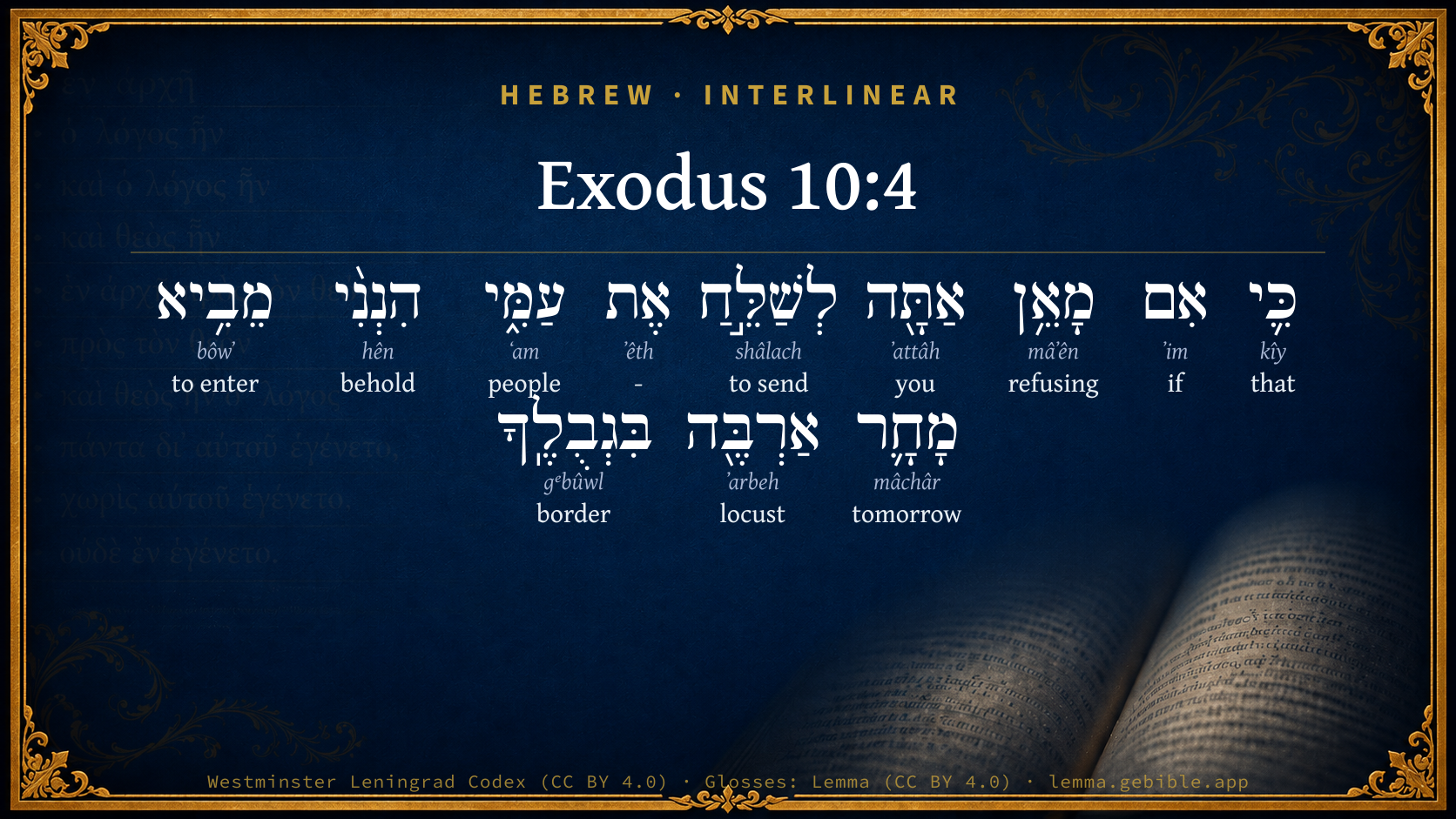
Hebrew (Westminster Leningrad Codex) Exodus 10:4 appears in the Hebrew Old Testament. The text above is from the Westminster Leningrad Codex. Each word links to its Strong’s number, a concise gloss, and parsing drawn from the Open Scriptures Hebrew Bible morphology. Click any word for its full Brown-Driver-Briggs (BDB) entry.
Download image
Cite this verse

Exodus 10:4 (World English Bible). Public Domain. Lemma interlinear Bible study tool, https://lemma.gebible.app/v/exodus/10/4.

Show BibTeX & RIS
BibTeX
RIS
English Translation
Or else, if you refuse to let my people go, behold, tomorrow I will bring locusts into your country,
World English Bible · Public Domain
Highlights
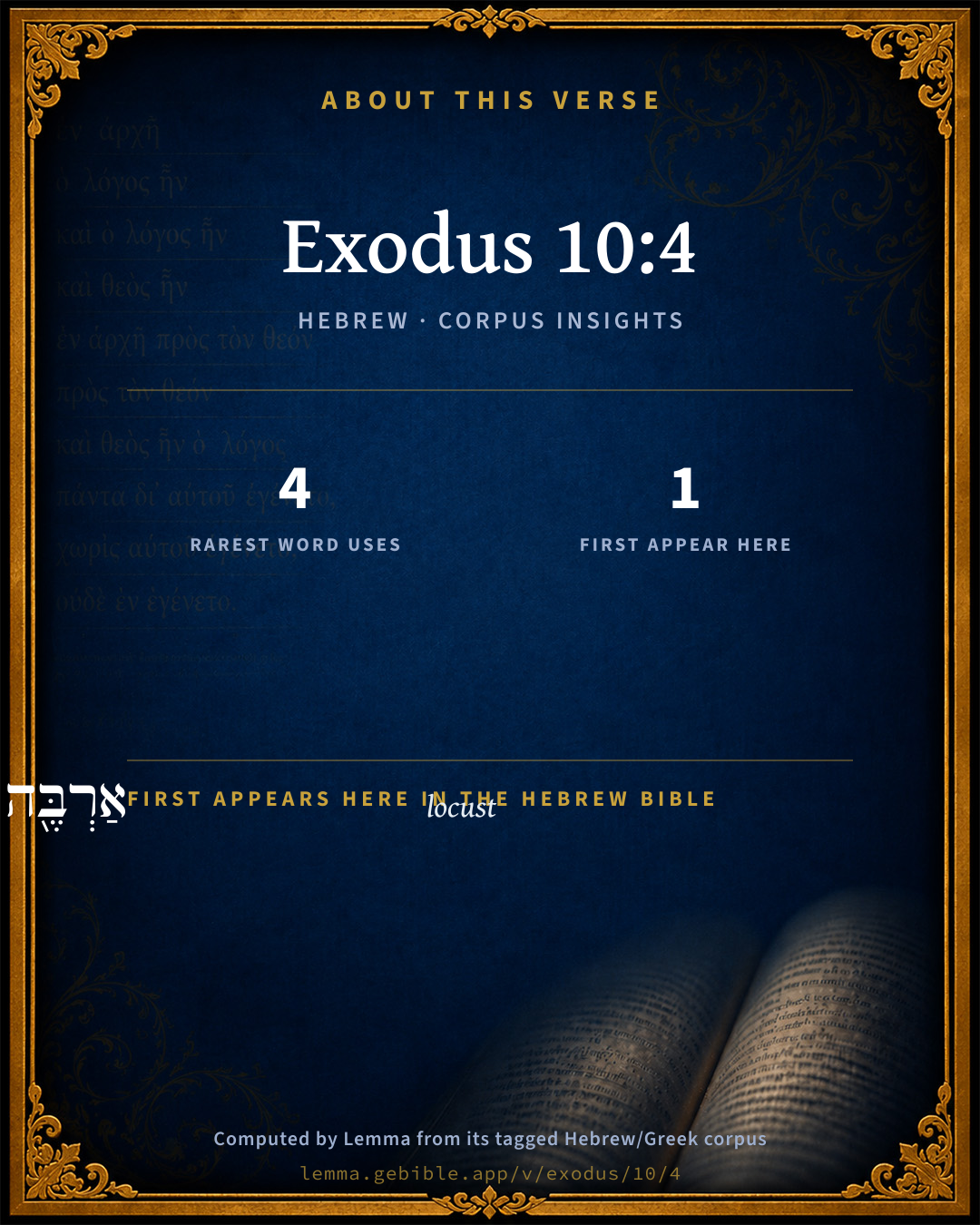
  • 1 first appearance in the Hebrew Bible
Full analysis ↓
Download a study sheet

One document with this verse’s original text, its word-by-word gloss line, the meaning frame, cross-references with their text, attributed commentary, and full source and license credits — printable, and it pastes into notes with its structure intact.

This verse Autodidact and up

Study sheet (.html) Plain text (.txt)

A passage Seminary Student

Up to 50 verses in one chapter. A passage sheet keeps up to 6 commentary sources and 12 cross-references per verse, in the order this page ranks them, and says so on the sheet whenever that leaves anything out. Ask for a single verse and you get the Autodidact verse sheet above.

Everything on this page stays free to read, with no account — the sheet is a download of what is already on screen, not access to it.

Want to remove ads? Support Godless Engineer
Compare translations 3

The same verse in 3 English versions, stacked beneath the original-language interlinear above. Click any original word for its lexicon entry.

Each is an independent rendering of the whole verse — the interlinear is not word-aligned to these translations.

Highlighted words mark where these versions differ — a whole-verse word diff, not a word-by-word alignment.

  • World English Bible Public Domain
    Or else, if you refuse to let my people go, behold, tomorrow I will bring locusts into your country,
  • King James Version Public Domain
    Else, if thou refuse to let my people go, behold, to morrow will I bring the locusts into thy coast:
  • unfoldingWord Literal Text CC BY-SA 4.0
    For if you refuse to let my people go, behold me, I am about to bring locust within your borders tomorrow.

unfoldingWord Literal Text — © unfoldingWord, licensed CC BY-SA 4.0. Word-aligned USFM3 via Door43 (git.door43.org/unfoldingWord/en_ult).

Versions to compare (up to 4)

3 of 4 selected

Show all 18 translations

Every available English version of this verse, each an independent rendering of the whole verse.

  • World English Bible Public Domain
    Or else, if you refuse to let my people go, behold, tomorrow I will bring locusts into your country,
  • Berean Standard Bible Public Domain
    But if you refuse to let My people go, I will bring locusts into your territory tomorrow.
  • Majority Standard Bible Public Domain
    But if you refuse to let My people go, I will bring locusts into your territory tomorrow.
  • King James Version Public Domain
    Else, if thou refuse to let my people go, behold, to morrow will I bring the locusts into thy coast:
  • American Standard Version (1901) Public Domain
    Else, if thou refuse to let my people go, behold, to-morrow will I bring locusts into thy border:
  • Revised Version (1885) Public Domain
    Else, if thou refuse to let my people go, behold, tomorrow will I bring locusts into thy border:
  • Geneva Bible (1599) Public Domain
    But if thou refuse to let my people go, beholde, to morowe will I bring grashoppers into thy coastes.
  • Douay-Rheims (1899) Public Domain
    But if thou resist, and wilt not let them go, behold I will bring in to morrow the locust into thy coasts:
  • Young's Literal Translation Public Domain
    for if thou art refusing to send My people away, lo, I am bringing in to-morrow the locust into thy border,
  • Literal Standard Version CC BY-SA 4.0
    for if you are refusing to send My people away, behold, tomorrow I am bringing in the locust into your border,
  • Unlocked Literal Bible CC BY-SA 4.0
    But if you refuse to let my people go, listen, tomorrow I will bring locusts into your land.
  • unfoldingWord Literal Text CC BY-SA 4.0
    For if you refuse to let my people go, behold me, I am about to bring locust within your borders tomorrow.
  • Darby Bible Public Domain
    For, if thou refuse to let my people go, behold, I will to-morrow bring locusts into thy borders;
  • World Messianic Bible Public Domain
    Or else, if you refuse to let my people go, behold, tomorrow I will bring locusts into your country,
  • Webster's Bible Public Domain
    Else, if thou shalt refuse to let my people go, behold, to-morrow will I bring the locusts into thy border:
  • Free Bible Version CC BY-SA 4.0
    If you refuse to let my people leave, tomorrow I will send a plague of locusts into your country.
  • Bible in Basic English Public Domain
    For if you will not let my people go, tomorrow I will send locusts into your land:
  • JPS Tanakh (1917) Public Domain
    Else, if thou refuse to let My people go, behold, to-morrow will I bring locusts into thy border;

Literal Standard Version (2020), Covenant Press — licensed CC BY-SA 4.0. Text via the HelloAO Bible API (eBible.org). Unlocked Literal Bible (unfoldingWord) — licensed CC BY-SA 4.0. Text via the HelloAO Bible API (eBible.org). unfoldingWord Literal Text — © unfoldingWord, licensed CC BY-SA 4.0. Word-aligned USFM3 via Door43 (git.door43.org/unfoldingWord/en_ult). Free Bible Version, Dr. Jonathan Gallagher — licensed CC BY-SA 4.0. Text via the HelloAO Bible API (eBible.org).

Word by word

More ways to search: Search by grammar → Find every occurrence → Compare this word →

Practice this passage: Drill this verse → Learn its vocabulary →

מָאֵ֥ן
mâʼên
H3986
“refusing”
Verb, Piel, Participle Active, Masculine, Singular, Absolute
Part of Speech
Verb
Stem
Piel
Form
Participle Active
Gender
Masculine
Number
Singular
State
Absolute
Full BDB Definition

Origin: from H3985

TWOT: 1138a

refusing, unwilling to obey
  1. כִּ֛י kîy H3588 “that” Conjunction
  2. אִם ʼim H518 “if” Conjunction
  3. אַתָּ֖ה ʼattâh H859 “you” Pronoun, Personal, 2nd Person, Masculine, Singular
  4. לְשַׁלֵּ֣חַ shâlach H7971 “to send” Preposition + Verb, Piel, Infinitive Construct
  5. אֶת ʼêth H853 “-” Particle, Direct Object
  6. עַמִּ֑י ʻam H5971 “people · my” Noun, Common, Masculine, Singular, Construct + Suffix, Personal, 1st Person, Common, Singular
  7. הִנְנִ֨י hên H2005 “behold · me” Particle, Demonstrative + Suffix, Personal, 1st Person, Common, Singular
  8. מֵבִ֥יא bôwʼ H935 “entering” Verb, Hiphil, Participle Active, Masculine, Singular, Absolute
  9. מָחָ֛ר mâchâr H4279 “tomorrow” Noun, Common, Masculine, Singular, Absolute
  10. אַרְבֶּ֖ה ʼarbeh H697 “locust” Noun, Common, Masculine, Singular, Absolute
  11. בִּגְבֻלֶֽךָ gᵉbûwl H1366 “in/at · border · your” Preposition + Noun, Common, Masculine, Singular, Construct + Suffix, Personal, 2nd Person, Masculine, Singular

About this verse

These counts appear in no published source. They are computed here, from the morphology-tagged text and Lemma’s own curated glosses. What Lemma adds →

12
words
12
distinct lemmas
Pentateuch
section

Notable vocabulary

The rarest word here is מָאֵ֥ן refusing H3986 — appearing just 4 times in the whole Hebrew Bible.

First appearance in Scripture

This word makes its first canonical appearance in the Hebrew Bible here:

  • אַרְבֶּ֖ה locust H697

Shared distinctive vocabulary

מָאֵ֥ן refusing H3986 occurs in 4 verses of the Hebrew Bible. Also found in:

Grammatical profile

  • 3 verbs
  • 4 nouns
  • 1 pronoun
  • 2 conjunctions
  • 2 particles

Verb forms

  • מָאֵ֥ן Piel · Participle Active
  • לְשַׁלֵּ֣חַ Piel · Infinitive Construct
  • מֵבִ֥יא Hiphil · Participle Active

Hebrew & Septuagint length

In English translation the verse runs 19 words from the Hebrew and 25 from the Septuagint (LXX English) — closely comparable.

A rough comparison of the two English renderings, which tokenize alike — not a word-level alignment.

Word counts can differ between the Hebrew and the Greek without any difference in meaning — e.g. the Hebrew direct-object marker אֵת has no separate Greek word, and Greek often adds the article ὁ.

Cross-references

10

Topical passages linked to Exodus 10:4 in the Treasury of Scripture Knowledge — connected by theme and wording, ordered by reader-vote popularity; previews shown in the World English Bible.

  • Revelation 9:3 Then out of the smoke came forth locusts on the earth, and power was given to them, as the scorpions of the earth have power.
  • Joel 2:25 I will restore to you the years that the swarming locust has eaten, The great locust, the grasshopper, and the caterpillar, My great army, which I sent among you.
  • Exodus 8:10 He said, "Tomorrow." He said, "Be it according to your word, that you may know that there is none like Yahweh our God.
  • Exodus 8:23 I will put a division between my people and your people: by tomorrow shall this sign be."'"
  • Exodus 9:5 Yahweh appointed a set time, saying, "Tomorrow Yahweh shall do this thing in the land."
  • Exodus 9:18 Behold, tomorrow about this time I will cause it to rain a very grievous hail, such as has not been in Egypt since the day it was founded even until now.
  • Exodus 11:4–5 Moses said, "This is what Yahweh says: 'About midnight I will go out into the midst of Egypt,
  • Proverbs 30:27 The locusts have no king, Yet they advance in ranks;
  • Joel 1:4–7 What the swarming locust has left, the great locust has eaten. What the great locust has left, the grasshopper has eaten. What the grasshopper has left, the caterpillar has eaten.
  • Joel 2:2–11 A day of darkness and gloominess, A day of clouds and thick darkness. As the dawn spreading on the mountains, A great and strong people; There has never been the like, Neither will there be any more after them, Even to the years of many generations.

Cross-references courtesy of OpenBible.info (CC BY 4.0).

Hebrew and Greek witnesses Masoretic Hebrew ↔ Greek Septuagint

The same verse in the two great witnesses to the Old Testament, shown verse-for-verse.

These are two independent witnesses, not word-aligned to each other, and the Septuagint is shown in lemma (dictionary) form.

Hebrew Exodus 10:4 Masoretic · Westminster Leningrad Codex

כִּ֛י אִם מָאֵ֥ן אַתָּ֖ה לְשַׁלֵּ֣חַ אֶת עַמִּ֑י הִנְנִ֨י מֵבִ֥יא מָחָ֛ר אַרְבֶּ֖ה בִּגְבֻלֶֽךָ

Or else, if you refuse to let my people go, behold, tomorrow I will bring locusts into your country,

World English Bible · Public Domain

Greek LXX Exodus 10:4 Septuagint · lemma form

ἐάν δέ μή θέλω σύ ἐκ ἀποστέλλω ὁ λαός ἐγώ ἰδού ἐγώ ἐπιἄγω οὗτος ὁ ὥρα αὔριον ἀκρίς πολύς ἐπί πᾶς ὁ ὅριον σύ

But if you will not send my people away, behold, at this hour to-morrow I will bring an abundance of locusts upon all your coasts.

LXX2012 (modern English Septuagint) · Public Domain

Hebrew: Westminster Leningrad Codex (CC BY 4.0). Greek: Septuagint (public domain); English from LXX2012 (modern English Septuagint) (Public Domain). How the Septuagint differs from the Hebrew →

Targum (Aramaic paraphrase)

2

The Targum is the ancient Jewish Aramaic paraphrase of the Hebrew Scriptures — an interpretive translation, not the Hebrew text itself. Onkelos (literal) and Pseudo-Jonathan (expansive) render the Torah, and Jonathan the Prophets. Coverage is partial: where no permissively-licensed English translation exists for a verse, only the Aramaic is shown. This is verse-level text, not a word-by-word alignment to the Hebrew.

  1. Targum Onkelos Torah (Genesis–Deuteronomy)
    אֲרֵי אִם סָרֵיב אַתְּ לְשַׁלָחָא יָת עַמִי הָא אֲנָא מַיְיתִי מְחָר גוֹבָא בִּתְחוּמָךְ:

    (no public-domain English translation for this verse)

    Targum Onkelos — Aramaic: “Onkelos Genesis” (public domain); “Onkelos Exodus” (public domain); “Onkelos Leviticus” (public domain); “Onkelos Numbers” (public domain); “Onkelos Deuteronomy” (public domain). English: “Sefaria Community Translation” (CC0 1.0 (public-domain dedication)); “J.W. Etheridge. The Targums of Onkelos and Jonathan Ben Uzziel on the Pentateuch. London: Longmans, Green, 1862” (public domain). Text via Sefaria.

  2. Targum Pseudo-Jonathan Torah (Genesis–Deuteronomy)
    אֲרוּם אִין יֵשׁ מְסָרֵב אַנְתְּ לְמִפְטוֹר יַת עַמִּי הָא אֲנָא מַיְיתֵי מְחַר גּוֹבָא בִּתְחוּמָךְ

    But if thou refuse to let My people go, behold, tomorrow I bring the locust upon thy borders,

    Targum Pseudo-Jonathan — Aramaic: “Targum Jonathan on Genesis” (public domain); “Targum Jonathan on Exodus” (public domain); “Targum Jonathan on Leviticus” (public domain); “Targum Jonathan on Numbers” (public domain); “Targum Jonathan on Deuteronomy” (public domain). English: “The Targum of Jonathan ben Uzziel, trans. J. W. Etheridge, London, 1862” (public domain). Text via Sefaria.

Commentary

Notes on Exodus 10:4 from classic Christian and Jewish commentators (each source and its license shown beneath its notes). The classic Christian expositions comment on the surrounding passage and are grouped to its opening verse, so a note may address several verses; the Jewish commentaries on the Tanakh (Rashi and others) are per-verse, so they appear only where the commentator wrote on this verse.

Lemma curates 59 commentaries, every one of them public domain or Creative Commons licensed, each selected and text-cleaned for this edition rather than reprinted as found. About our sources →

Trapp's Complete Commentary

John Trapp

Exo 10:4 Else, if thou refuse to let my people go, behold, to morrow will I bring the locusts into thy coast:

Ver. 4. Else, if thou refuse.] Men should look up with David, and see the punishing angel over their heads with a drawn sword, and submit. And if not, Balaam’s ass shall condemn them for their desperate lewdness: for he fell down before the angel.

I will bring the locusts.] God hath treasuries of plagues for the obstinate; neither can he be, as the poet feared of his Jupiter, {a} possibly exhausted.

{a} Si quoties peccent homines, &c.

John Trapp, A Commentary or Exposition upon All the Books of the Old and New Testament (1647–1656) — public domain. Text from a community e-Sword module.

The Preacher's Complete Homiletical Commentary

Joseph S. Exell (gen. ed.)

CRITICAL NOTES.—

Exo_10:4. Locusts] ’Arbch (ארכה): prob., the gryllus gregarius—Ges., Dav., Fü.; G. & D. understanding the word to mean “swarmers,”—F., “browsers.”

Exo_10:8. But who are they that shall go?] One is ready to smile at the simplicity of this speech. It will be seen that there is no conjunction in the Heb. answering to our “but,” thus showing an almost amusing precipitancy in the interrogatory, as if the speaker would retract his permission before it is well uttered: mi’ wa-mi’ ha-ho-lekhim’!, “who and who are the going ones?”

Exo_10:9. We will go, etc.] Again would we call attention to the style of the Hebrew: here to the arrangement of the words—to the vigourous inversion by which the full demand of Moses is made to smite the ear of Pharaoh with the utmost force. “WITH OUR YOUNG AND WITH OUR OLD will we go: WITH OUR SONS AND WITH OUR DAUGHTERS, WITH OUR FLOCKS AND WITH OUR HERDS, will we go; for A FESTIVAL TO JEHOVAH [is] ours!”

Exo_10:10. As I let you go] “As certainly as I let you go;” or, “whenever I let you go.” It is clearly the language of defiance.

Exo_10:11. For that ye did desire] It is necessary to lay stress on “that” and “ye” successively, to bring out the true meaning: “For—THAT—YE—did desire” = for THAT is what YE were desiring.”

MAIN HOMILETICS ON THE PARAGRAPH.—Exo_10:4-11

THE PLAGUE OF LOCUSTS THREATENED

I. It was threatened in case that Pharaoh would not give the Israelites the freedom demanded by God. (Exo_10:4.) God has now been in controversy with Pharaoh for a long time, and we should have thought that the latter would have experienced quite enough of retribution to make him yield. But now another plague is threatened. God will continue to plague men till they give up sin. He will not yield the welfare of His own despised people to the obstinacy of a wicked ruler. The good have in God a stern Defender.

II. That some men are much more sensitive to the threatenings of God than others. (Exo_10:7.) The servants of Pharaoh give tokens of submission; but they are more fearful than penitent. They endeavour to persuade the king to come to terms with Moses. Pharaoh consents to their wish. Calls the two servants of God. He endeavours to bargain with them. But in vain. He wants to retain the young children of Israel in bondage. He knew that they would grow up to be of value to his nation. Satan does not like to let children go out of his service. Parents should not leave their young ones behind when they set out in the service of heaven. If men were sensitive to the threatenings of God, what judgments would they avert!

III. That Divine threatenings must make ministers faithful in the discharge of their duty. (Exo_10:9.) Moses gives the king to understand that there would be no compromise in the matter; that he must either let Israel go, or suffer the penalty of disobedience. Moses was fearless. He was faithful. He was true to his mission. And so in the times of threatened retribution it behoves the minister of God to be faithful, to denounce all attempts at moral compromise.

SUGGESTIVE COMMENTS ON THE VERSES

Exo_10:4-6. To-morrow:—

1. A judgment.

2. A mystery.

3. A crisis.

4. An anxiety.

5. A hope.

If thou refuse:—

1. Then man can refuse to obey God.

2. Then man can dare the judgments of God.

3. Then man takes a great responsibility upon himself.

The locusts:—

1. Very grievous.

2. Darkening the light.

3. Devouring the fruit.

4. Entering the houses.

Good men should leave sinners when they have declared the message of God:—

1. As a reproof.

2. As a contempt.

3. As a prophecy.

4. As a relief.

Exo_10:7. A REMONSTRANCE AGAINST SIN

I. It was addressed by inferiors to their Superior. Pharaoh was remonstrated with by his servants, by the chief men of his realm. Hitherto they appear to have been silent. Now they become impatient of the suffering brought upon them. How much good would be accomplished if advisers would always remonstrate with kings in conflict with the Eternal! The conduct of these men was,

(1) bold;

(2) wise;

(3) needed; and if inferiors would endeavour to check those above them when they are about to do evil, they would prevent much crime, they would render themselves blameless, and would do a brave and a faithful thing.

II. It was inspired by a deep feeling of terror. The servants of Pharaoh were concerned for their own safety as well as for the welfare of the nation, which was endangered by the plagues. They regarded Moses as a snare unto them. And so men are animated by varied motives in their remonstrances against sin—sometimes pure and lofty, at other times mean and selfish. These servants did not feel sin to be sin, but a punishment, and hence their entreaty with the king. But it is well for men under any circumstances to cry out against moral evil.

III. It was influential for temporary good. Moses and Aaron were brought again unto Pharaoh. The king saw that his chief advisers were against him, and regarded their utterance as representative of the national feeling. He had misgivings. The remonstrance made him halt in his rebellion. And many a remonstrance since has made the sinner hesitate in a course of evil, even though it has not reformed his life. Some men are apparently more accessible to the advice of their comrades than they are to the commands of heaven. The wicked servant may preach the gospel to his despotic master.

IV. It was ultimately disregarded. The servants had given Pharaoh good advice, they had influenced him aright, and they had uttered an unconscious prophecy of his future; yet they were finally disregarded. When a man disregards God, he is not likely to pay much heed to the remonstrance of his comrades. Many a wise man has had the pain of seeing his good advice rejected by the sinner. LESSONS,

1. Remonstrate with the sinner.

2. Show him the folly and woe of sin.

3. You are not responsible for the result of such a remonstrance.

Exo_10:8. RENEWED OPPORTUNITIES OF MORAL GOOD, “And Moses and Aaron were brought again unto Pharaoh.”

I. Consequent upon the faithful rebuke of friends. The king was led through the rebuke of his servants to seek another interview with Moses and Aaron, and hence to have another opportunity afforded him of yielding to the command of God. Men have repeated opportunities given them for moral improvement in their lives; often through the plain fidelity of a friend.

II. Through contact with a holy man. Pharaoh was again brought into the companionship of Moses and Aaron. He would feel the influence of their characters upon him. Every time we are brought into contact with a bright and beautiful moral character we should seek to catch something of its radiance. Such contact is an opportunity for soul improvement.

III. May be left unused through the perverseness of the soul. Pharaoh was none the better for this renewed interview with these two servants of God. He only manifested his obstinacy more fully. It is awfully possible to allow all the renewed opportunities of the soul for moral good to pass away unimproved.

Exo_10:9. Captious questions from wicked men are plainly answered by God’s servants.

Ministers must faithfully declare the purpose of God with regard to His Church.

Little ones as well as great must be carried along with the Church of God to their rest.

The work of the Church after redemption is to serve Jehovah, and to keep a feast to Him.

Exo_10:10-11. Proud persecutors terrified with judgments, though they yield a little to God, yet scorn to give Him His terms.

It is the policy and cruelty of persecutors to keep in thraldom the little ones of the Church.

Persecuting powers threaten the Church with evil, as God threatens them.

Whatever persecuting powers seem to yield to the Church, they resolve it shall not be so as God would have it.

Persecuting powers shall tell God who shall serve Him, and allow no more.

God’s servants are driven out with contempt from powers, when they serve not their turn.

Driving away the servants of God:—

1. It is to drive away a good friend.

2. It is to drive away a faithful monitor.

3. It is to drive away a real benefactor.

4. It is to drive away an angel of God.

THE THREATS OF THE WICKED, Exo_10:10, latter clause.

God’s servants need to be courageous men. They have often to stand before rulers for His sake, and oppose them. They are surrounded by the machinations of powerful adversaries. They are often threatened.

I. Evil men often seek to retard God’s servants in their works by threats. God’s purposes often come into collision with the actions of wicked men. They often regard His servants as their enemies. Divine work always opposes evil. God’s servants have to break in pieces the deceptions, wrongs, and tyrannies of their age. Evil is often entrenched in triumphant positions. Men find their interest in upholding it. Wicked men defend it, and attack those who assail it. They think that they can terrify God’s servants and hinder their work, but their threats are vain. God sustains all whom He sends. No opposition, however virulent, can retard them from doing His work. They may be weak and few, but He is their strength. The lives of reformers, martyrs, and philanthropists attest this. His presence has made them valiant and persevering.

“But saved by a Divine alliance

From terrors of defeat.

Unvauntingly, yet with defiance,

One man the world may meet.”

II. That the threats of evil men need not be feared. Moses and Aaron were safe though Pharaoh might threaten evil. They were, humanly speaking, but the champions of slaves, and he was a mighty potentate; yet they were stronger than he, and had less cause for fear. We may fear evil just in proportion as we separate ourselves from God and resist His purposes. Tyrants have often proved their powerlessness to injure God’s ambassadors. God has His eye upon them, and a “hook for their jaws.” Nothing can really harm God’s servants. They may have to suffer, but suffering will be turned into triumphant joy. They may be cast into prison, but their prison walls will gleam with celestial splendour; and like the saintly Rutherford, they will find that their enemies have only sent them to reside for a while in one of God’s palaces; they may be robbed of their earthly possessions, but their true riches will be increased; they may be put to a cruel death, but this will only hasten them home from their toils to receive an eternal reward. Real evil cannot befall them. Those who are doing God’s work are invincible. They are covered with the shield of the Almighty; and their work ever goes on. No fulmination of malice can stop it. They and their work are alike secure. They have no cause to fear evil.

III. That the evil threatened, menaces the threatener. Threats often fall upon those who utter them. What evil was before Pharaoh! Thus evil men, deceived by their pride, lose sight of their own dangers. They threaten when they ought to fear. Secure in their own fancied strength, they have hurled their malice upon the servants of the Most High; but their words have recoiled upon themselves. They have digged a pit and have fallen into it. The gallows that has been erected for Mordecai has borne the body of Haman. They proudly boast,

“But an hour comes to tame the might man

Unto the infant’s weakness.”

F. Hemans.

They forget God. As Luther said concerning the Potentates of his day, who did not remember the overruling might of God in their projects: “Our Lord God says unto them: For whom then do ye hold Me? for a cypher? Do I sit here above in vain, and to no purpose? You shall know that I will twist your accounts about finely, and make them all false reckonings.” So it was with Pharaoh when he threatened Moses and Aaron.—W. O. Lilley.

THE IMPERIOUSNESS OF UNBELIEF, seen (“And they were driven out from Pharaoh’s presence” Exo_10:11):—

I. In its reluctance to grant concessions. Impressed by the terrible evidences of Jehovah’s power, and urged by his terror-stricken advisers, the proud king seems willing at length to release the people. But half repenting the permission, he asks “But who are they that shall go?” (Exo_10:8.) So is it ever with unbelief. When compelled to make admissions, it does so with hesitation and with regret. They are wrung from a mind too proud to admit defeat.

II. In its irritable impatience in listening to the voice of reason. Moses claimed that the whole nation should depart, male and female of all ages, along with their flocks and herds. There was nothing unreasonable in this. Even the Egyptians held religious festivals at which it was customary for the women to accompany the men. But the capricious monarch, in the most indignant and scornful manner, swears the little ones shall not be allowed to go, nor any other than the men (Exo_10:10.) Thus he showed his contempt, not only for Jehovah’s ambassadors, but for Jehovah Himself. So is it ever with unbelief. It is impatient of control; inaccessible to reason, especially of the highest kind; and manifests an impotent rage against the arguments it cannot answer.

III. In its ignominious treatment of religious teachers. The wrath of the tyrant king rose beyond all control, and he imperiously waved Moses and Aaron out of his sight. “And they were driven out from Pharaoh’s presence.” Foiled and confounded by the simple but unanswerable presentation of the truth, unbelief vents its passion in spiteful invective.

The utmost rage of unbelief is powerless to daunt the courage of God’s messengers. When Valens, the Arian Emperor, threatened Basil with bonds and banishment, the fearless bishop exclaimed—“Let him threaten boys with these. The Emperor may take away my life, but not my faith: my head, but not my crown.”—G. Barlow.

The Preacher's Complete Homiletical Commentary (gen. ed. Joseph S. Exell; Funk & Wagnalls, c. 1892) — public domain (pre-1929). A full-Bible homiletical/sermon-outline anthology covering 65 of 66 books (2 John is absent from the source module). Text from a community e-Sword module.

Tyndale Open Study Notes

Tyndale Open Resources

10:4 These locusts were not the insects called locusts in North America, but a form of migratory grasshopper. Swarming out of desert regions, they could devastate large areas of land, devouring all the plant life before them.

Tyndale Open Study Notes — © Tyndale Open Resources, licensed CC BY-SA 4.0. Text via the HelloAO Bible API.

Geneva Bible (1599)

Geneva Bible translators

Or, locusts.

Geneva Bible (1599) marginal notes — public domain. Text via Bolls.life.

Jamieson, Fausset & Brown

Robert Jamieson, A. R. Fausset & David Brown

to-morrow will I bring the locusts--Moses was commissioned to renew the request, so often made and denied, with an assurance that an unfavorable answer would be followed on the morrow by an invasion of locusts. This species of insect resembles a large, spotted, red and black, double-winged grasshopper, about three inches or less in length, with the two hind legs working like hinged springs of immense strength and elasticity. Perhaps no more terrible scourge was ever brought on a land than those voracious insects, which fly in such countless numbers as to darken the land which they infest; and on whatever place they alight, they convert it into a waste and barren desert, stripping the ground of its verdure, the trees of their leaves and bark, and producing in a few hours a degree of desolation which it requires the lapse of years to repair.

Jamieson, Fausset & Brown — Commentary Critical and Explanatory on the Whole Bible (1871) — public domain (CC PDM 1.0). Text via the HelloAO Bible API.

Adam Clarke's Commentary

The EIGHTH plague - the LOCUSTS

Verse 4. To-morrow will I bring the locusts] The word ארבה arbeh, a locust, is probably from the root רבה rabah, he multiplied, became great, mighty, c. because of the immense swarms of these animals by which different countries, especially the east, are infested. The locust, in entomology, belongs to a genus of insects known among naturalists by the term GRYLLI; and includes three species, crickets, grasshoppers, and those commonly called locusts; and as they multiply faster than any other animal in creation, they are properly entitled to the name ארבה arbeh, which might be translated the numerous or multiplied insect. See this circumstance referred to, Jdg 6:5; Jdg 7:12; Ps 105:34; Jer 46:23; Jer 51:14; Joe 1:6; Na 3:15; Judith 2:19, 20; where the most numerous armies are compared to the arbeh or locust. The locust has a large open mouth; and in its two jaws it has four incisive teeth, which traverse each other like scissors, being calculated, from their mechanism, to grip or cut. Mr. Volney, in his Travels in Syria, gives a striking account of this most awful scourge of God: -

"Syria partakes together with Egypt and Persia, and almost all the whole middle part of Asia, in the terrible scourge, I mean those clouds of locusts of which travellers have spoken; the quantity of which is incredible to any person who has not himself seen them, the earth being covered by them for several leagues round. The noise they make in browsing the plants and trees may be heard at a distance, like an army plundering in secret. Fire seems to follow their tracks. Wherever their legions march the verdure disappears from the country, like a curtain drawn aside; the trees and plants, despoiled of their leaves, make the hideous appearance of winter instantly succeed to the bright scenes of spring. When these clouds of locusts take their flight, in order to surmount some obstacle, or the more rapidly to cross some desert, one may literally say that the sun is darkened by them."

Baron de Tott gives a similar account: "Clouds of locusts frequently alight on the plains of the Noguais, (the Tartars,) and giving preference to their fields of millet, ravage them in an instant. Their approach darkens the horizon, and so enormous is their multitude, it hides the light of the sun. They alight on the fields, and there form a bed of six or seven inches thick. To the noise of their flight succeeds that of their devouring actively, which resembles the rattling of hail-stones; but its consequences are infinitely more destructive. Fire itself eats not so fast; nor is there any appearance of vegetation to be found when they again take their flight, and go elsewhere to produce new disasters."

Dr. Shaw, who witnessed most formidable swarms of these in Barbary in the years 1724 and 1725, gives the following account of them: "They were much larger than our grasshoppers, and had brown-spotted wings, with legs and bodies of a bright yellow. Their first appearance was towards the latter end of March. In the middle of April their numerous swarms, like a succession of clouds, darkened the sun. In the month of May they retired to the adjacent plains to deposit their eggs: these were no sooner hatched in June than the young brood first produced, while in their caterpillar or worm-like state, formed themselves into a compact body of more than a furlong square, and, marching directly forward, climbed over trees, walls, and houses, devouring every plant in their way. Within a day or two another brood was hatched, and advancing in the same manner, gnawed off the young branches and bark of the trees left by the former, making a complete desolation. The inhabitants, to stop their progress, made a variety of pits and trenches all over their fields and gardens, which they filled with water, or else heaped up therein heath, stubble, c., which they set on fire but to no purpose: for the trenches were quickly filled up and the fires extinguished, by infinite swarms succeeding one another; while the front seemed regardless of danger, and the rear pressed on so close that retreat was altogether impossible. In a month's time they threw off their worm-like state; and in a new form, with wings and legs, and additional powers, returned to their former voracity." - Shaw's Travels, 187. 188, 4to edition.

The descriptions given by these travellers show that God's army, described by the Prophet Joel, Joe 2:1-11, was innumerable swarms of locusts, to which the accounts given by Dr. Shaw and others exactly agree.

Adam Clarke's Commentary on the Bible (1810–1826) — public domain. Text from a community e-Sword/MySword module.

Ellicott's Commentary for English Readers

(4) To morrow will I bring the locusts into thy coast.—Locusts, as already observed, are not indigenous to Egypt, but only occasional visitants. Consequently they always enter the country from some other, as Nubia, Abyssinia, Syria, or Arabia. On the quarter from which the present plague came, see the comment on Exo_10:13.

A Bible Commentary for English Readers, edited by Charles John Ellicott (1878–1897) — public domain. Text from a community e-Sword module.

The Cambridge Bible for Schools and Colleges

gen. ed. J. J. S. Perowne

4. to-morrow] cf. Exo_8:23, Exo_9:5-6; Exo_9:18.

locusts] A well-known plague in Palestine and neighbouring countries: see for descriptions both of their immense numbers, and of their ravages, the writer’s notes on Joel (in the Camb. Bible), pp. 37–39, 48–53, 87–91. They do not however seem to visit Egypt very frequently. Niebuhr (as cited by Kn.) witnessed at Cairo in January a great swarm of locusts blown up by a SW. wind from the Libyan desert: Lepsius (Letters, p. 104) describes one in March, coming up also from the SW., which covered the whole country far and near. Denon (Voyages dans la basse et la haute Égypte, 1807, i. 287) describes one brought up by the wind from the East, which eventually, when the wind changed, was driven back into the desert.

4–8 (J). The sequel,—and once, probably, the immediate sequel,—to Exo_10:28-29 (J): see the note there.

The Cambridge Bible for Schools and Colleges (gen. ed. J. J. S. Perowne; Cambridge University Press, 1878–1918) — public domain. Text from a community e-Sword module.

John Gill's Exposition

Else, if thou refuse to let my people go,.... He threatens him with the following plague, the plague of the locusts, which Pliny (x) calls "denrum irae pestis":

behold, tomorrow will I bring the locusts into thy coast; according to Bishop Usher (y) this was about the seventh day of the month Abib, that this plague was threatened, and on the morrow, which was the eighth day, it was brought; but Aben Ezra relates it as an opinion of Japhet an Hebrew writer, that there were many days between the plague of the hail, and the plague of the locusts, that there might be time for the grass and plants to spring out of the field; but this seems not necessary, for these locusts only ate of what were left of the hail, as in the following verse.

(x) Nat. Hist. l. 11. c. 29. (y) Annales Vet. Test. p. 21.

John Gill's Exposition of the Whole Bible (1746–1763) — public domain (CC PDM 1.0). Text via the HelloAO Bible API.

Albert Barnes' Notes on the Bible

The locusts - The locust is less common in Egypt than in many eastern countries, yet it is well known, and dreaded as the most terrible of scourges. They come generally from the western deserts, but sometimes from the east and the southeast. No less than nine names are given to the locust in the Bible, of which the word used here is the most common (ארבה 'arbeh); it signifies “multitudinous,” and whenever it occurs reference is made to its terrible devastations.

Albert Barnes' Notes on the Bible (1834–1885) — public domain. Text from a community e-Sword/MySword module.

Whedon's Commentary on the Bible

Daniel D. Whedon

4. I bring the locusts into thy coast — The destruction of all herbage by locusts is as complete as by fire over all the area which they cover, and they have been known to spread over from one to two thousand square miles. Their numbers and voracity are almost incredible. Indeed, it is said that they consume not merely from appetite, but from love of destruction, and not only vegetable and insect life, but cloth, leather, and even woodwork and furniture of houses. They rise from the horizon in immense columns, darkening the sun by their flight, filling the air with a whirring sound which is compared to the noise of fire or of distant wheels, and when driven in dense masses by winds into the sea, their decay emits a stench which spreads for many miles. In less than half a day they will crop grass and young grains even with the ground, leaving only the bare stalks of older plants, and in a very few hours will strip all trees clean of fruit, leaves, and bark. The noise of their browsing may be heard at quite a distance as they approach, and after they have passed, the trees are reduced to naked trunks and stems. No language more appropriately describes this fearful visitation than that of the prophet Joel: “A fire devoureth before them, and behind them a flame burneth. The land is as the garden of Eden before them, and behind them it is a desolate wilderness… Like the noise of chariots on the tops of the mountains.… Like the noise of a flame of fire that devoureth the stubble… They shall run like mighty men, they shall climb the wall like men of war… The sun and the moon shall be dark, and the stars shall withdraw their shining.” Joe_2:1-11. See the whole passage.

Daniel D. Whedon (gen. ed.), Commentary on the Old and New Testaments (1874–1909) — public domain. Text from a community e-Sword module.

The Pulpit Commentary

To-morrow. Again a warning is given, and a space of time interposed, during which the king may repent and submit himself, if he chooses. The locusts. The species intended is probably either the Aeridium peregrinum or the Oedipoda migratoria. Both are common in Arabia and Syria, and both are known in Egypt. They are said to be equally destructive. The Hebrew name, arbeh, points to the "multitudinous" character of the visitation. A traveller in Syria says is difficult to express the effect produced on us by the sight of the whole atmosphere filled on all sides and to a great height by an innumerable quantity of these insects, whose flight was slow and uniform, and whose noise resembled that of rain; the sky was darkened, and the light of the sun considerably weakened. In a moment the terraces of the houses, the streets, and all the fields were covered by these insects." (Ollivier, Voyage clans l"Empire Ottoman, vol. 2. p. 424.) Into thy coasti.e. "across thy border, into thy territories." The locust is only an occasional visitant in Egypt, and seems always to arrive from some foreign country.

The Pulpit Commentary (1880–1919), ed. H.D.M. Spence-Jones & Joseph S. Exell — public domain. Text from a community e-Sword module.

Keil & Delitzsch

C. F. Keil & F. Delitzsch

To punish this obstinate refusal, Jehovah would bring locusts in such dreadful swarms as Egypt had never known before, which would eat up all the plants left by the hail, and even fill the houses. "They will cover the eye of the earth." This expression, which is peculiar to the Pentateuch, and only occurs again in Exo 10:15 and Num 22:5, Num 22:11, is based upon the ancient and truly poetic idea, that the earth, with its covering of plants, looks up to man. To substitute the rendering "surface" for the "eye," is to destroy the real meaning of the figure; "face" is better. It was in the swarms that actually hid the ground that the fearful character of the plague consisted, as the swarms of locusts consume everything green. "The residue of the escape" is still further explained as "that which remaineth unto you from the hail," viz., the spelt and wheat, and all the vegetables that were left (Exo 10:12 and Exo 10:15). For "all the trees that sprout" (Exo 10:5), we find in Exo 10:15, "all the tree-fruits and everything green upon the trees."

Keil & Delitzsch — Biblical Commentary on the Old Testament (1861–1891) — public domain (CC PDM 1.0). Text via the HelloAO Bible API. (Old Testament only.)

Ramban (Nachmanides)

Rabbi Moshe ben Nachman (Ramban / Nachmanides)

BEHOLD, TOMORROW WILL I BRING LOCUSTS. Commentators have said that there was a long interval between the plague of hail and that of locusts, as is suggested by the expression, and [the locusts] shall eat every tree which groweth for you out of the field. In my opinion, the interval between these plagues was not a long one but rather was very brief. It is known that the judgment of the Egyptians did not last more than a year, this being so established through our knowledge of the years of Moses our Teacher, just as we have been taught in Tractate Eduyoth: “The judgment of the Egyptians in Egypt endured twelve months.” And so it is indicated by Scripture when saying, and they shall eat the residue of that which is escaped, which remaineth unto you from the hail. And it is further written, even all that the hail had left, thus indicating that it was in that very same year. If so, [we must say that] the hail came down that year during the month of Adar, not before, for the barley was in the ears [and therefore smitten by the hail], but the wheat had not grown up, Verse 32. and therefore its tender sprouts could not be completely destroyed by the hail, as they would grow back again. Then too the vine had not yet budded, and the trees were not in flower. It is for this reason that Scripture states, and [the hail] broke every tree of the field, meaning that it broke the branches and boughs. Then, in one month’s time, in the month of Nisan, the wheat and the spelt grew, these being the residue of that which is escaped, which remaineth unto you from the hail, and the trees began to blossom and the flowers appeared. This then is the purport of the word hatzomei’ach (which groweth), since the locusts came and ate their blossoms and thus destroyed everything since they did not leave them a blossom or flower. And in this very month, the children of Israel were redeemed [from Egypt]. The verse which states [that the locusts consumed] all the fruit of the tree, [which would indicate that there were fruits already on the tree and, therefore, that a long interval must have passed between the plagues of hail and locusts], is to be understood as referring to the flower which produces the fruits, similar to the expression, every herb on the tree, [which cannot be understood literally, since herbs do not grow on trees. Consequently, it must be understood as Rashi has it: “any green leaf on the tree.” Here too then, “the fruit of the tree” is not to be taken literally, but should be understood as “the flower of the tree”].

Ramban (Nachmanides) on the Tanakh — English translation: “Commentary on the Torah by Ramban (Nachmanides). Translated and annotated by Charles B. Chavel. New York, Shilo Pub. House, 1971-1976” (CC BY 4.0). Text via Sefaria.

Lesson kit

Teaching starters — assembled from the data on this page, not authored interpretation. Every prompt links to the verse data it draws on. Edit before teaching.

Exodus, in the Pentateuch, opens this verse with 12 words (12 distinct Hebrew lemmas). Its most distinctive word is mâʼên (“refusing”). A historical commentator’s framing appears above. Read the whole chapter for the surrounding context.

Discussion questions

  1. How does “refusing” (mâʼên) shape what this verse is saying?
  2. This is the first place “locust” appears in Scripture (first appears here). What does its debut here establish?
  3. How does Exodus 8:2, which shares the word «refusing», read alongside this verse?
  4. These translations render this verse differently. What is at stake in choosing one wording over another?
  5. «מָאֵ֥ן» is a Piel Participle Active verb. How does that grammatical form shape the action described?
  6. Compare how Trapp's Complete Commentary and The Preacher's Complete Homiletical Commentary read this verse. Where do they agree or differ?

Things to notice

Reading settings

Reading text

Shown beneath each verse's original-language words.

Old Testament
Old Testament edition

Read the OT as the Masoretic Hebrew (MT) or the Greek Septuagint (LXX).

English shown for the Greek Septuagint (in the Hebrew ↔ Greek comparison).

Comparing translations? Open the Compare panel on any verse page to stack up to four side by side.