
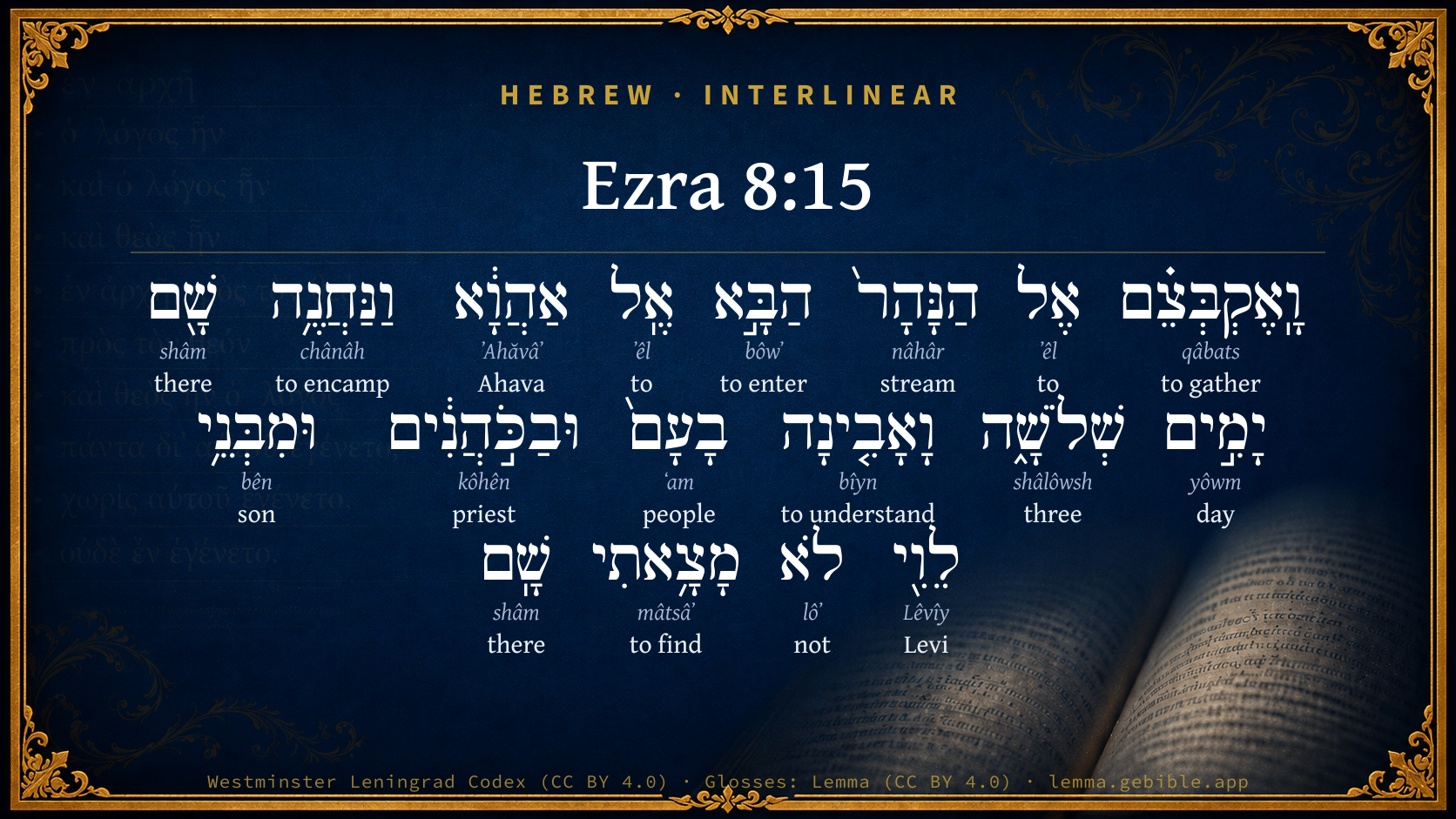
Ezra 8:15

Hebrew (Westminster Leningrad Codex) Ezra 8:15 appears in the Hebrew Old Testament. The text above is from the Westminster Leningrad Codex. Each word links to its Strong’s number, a concise gloss, and parsing drawn from the Open Scriptures Hebrew Bible morphology. Click any word for its full Brown-Driver-Briggs (BDB) entry.
Download image
Cite this verse

Ezra 8:15 (World English Bible). Public Domain. Lemma interlinear Bible study tool, https://lemma.gebible.app/v/ezra/8/15.

Show BibTeX & RIS
BibTeX
RIS
English Translation
I gathered them together to the river that runs to Ahava; and there we encamped three days: and I viewed the people, and the priests, and found there none of the sons of Levi.
World English Bible · Public Domain
Highlights
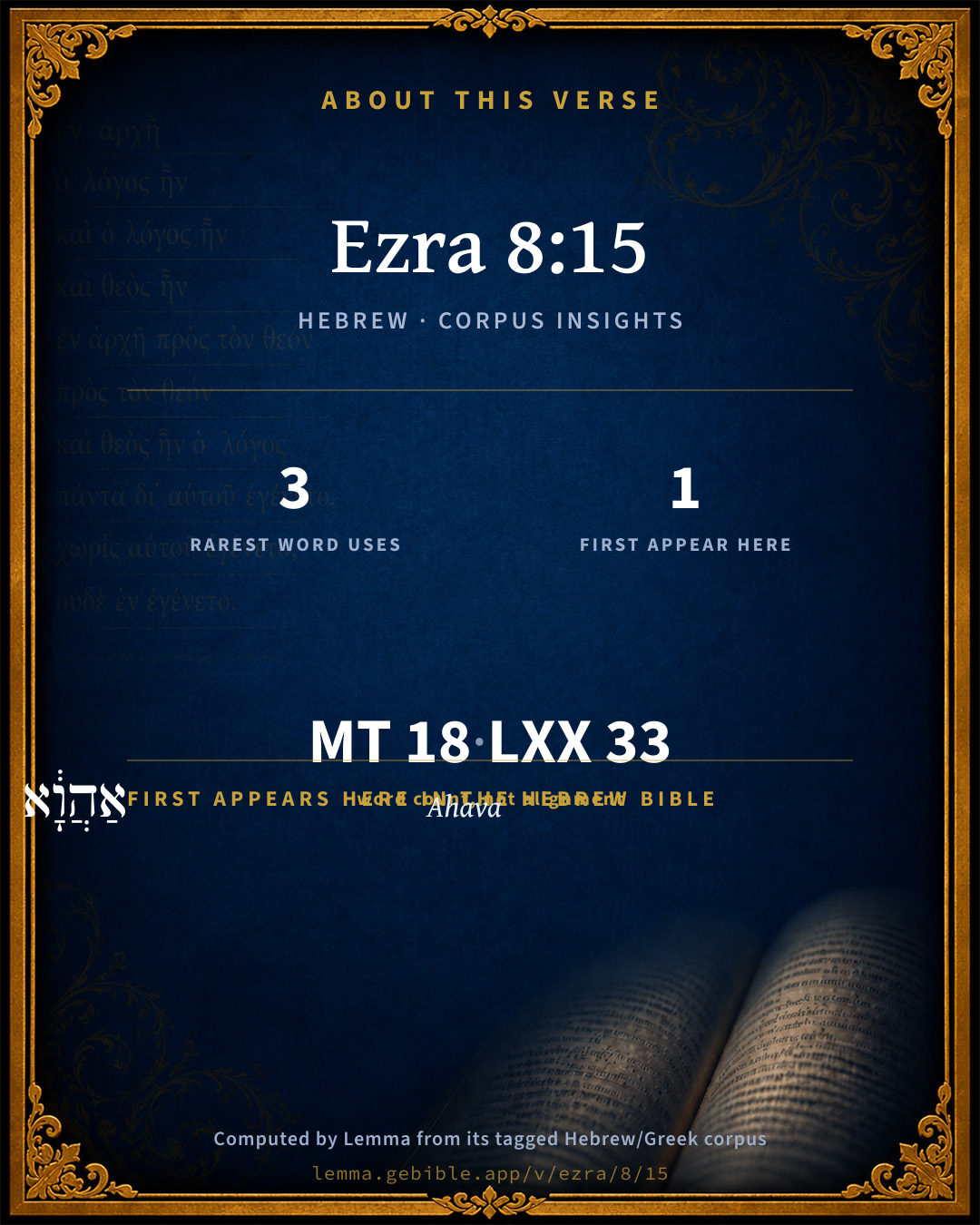
  • 1 first appearance in the Hebrew Bible
Full analysis ↓
Download a study sheet

One document with this verse’s original text, its word-by-word gloss line, the meaning frame, cross-references with their text, attributed commentary, and full source and license credits — printable, and it pastes into notes with its structure intact.

This verse Autodidact and up

Study sheet (.html) Plain text (.txt)

A passage Seminary Student

Up to 50 verses in one chapter. A passage sheet keeps up to 6 commentary sources and 12 cross-references per verse, in the order this page ranks them, and says so on the sheet whenever that leaves anything out. Ask for a single verse and you get the Autodidact verse sheet above.

Everything on this page stays free to read, with no account — the sheet is a download of what is already on screen, not access to it.

Want to remove ads? Support Godless Engineer
Compare translations 3

The same verse in 3 English versions, stacked beneath the original-language interlinear above. Click any original word for its lexicon entry.

Each is an independent rendering of the whole verse — the interlinear is not word-aligned to these translations.

Highlighted words mark where these versions differ — a whole-verse word diff, not a word-by-word alignment.

  • World English Bible Public Domain
    I gathered them together to the river that runs to Ahava; and there we encamped three days: and I viewed the people, and the priests, and found there none of the sons of Levi.
  • King James Version Public Domain
    And I gathered them together to the river that runneth to Ahava; and there abode we in tents three days: and I viewed the people, and the priests, and found there none of the sons of Levi.
  • unfoldingWord Literal Text CC BY-SA 4.0
    And I gathered them to the river, the one that goes to Ahava, and we encamped there three days. And I examined the people and the priests, but I did not find there any from the sons of Levi.

unfoldingWord Literal Text — © unfoldingWord, licensed CC BY-SA 4.0. Word-aligned USFM3 via Door43 (git.door43.org/unfoldingWord/en_ult).

Versions to compare (up to 4)

3 of 4 selected

Show all 18 translations

Every available English version of this verse, each an independent rendering of the whole verse.

  • World English Bible Public Domain
    I gathered them together to the river that runs to Ahava; and there we encamped three days: and I viewed the people, and the priests, and found there none of the sons of Levi.
  • Berean Standard Bible Public Domain
    Now I assembled these exiles at the canal that flows to Ahava, and we camped there three days. And when I searched among the people and priests, I found no Levites there.
  • Majority Standard Bible Public Domain
    Now I assembled these exiles at the canal that flows to Ahava, and we camped there three days. And when I searched among the people and priests, I found no Levites there.
  • King James Version Public Domain
    And I gathered them together to the river that runneth to Ahava; and there abode we in tents three days: and I viewed the people, and the priests, and found there none of the sons of Levi.
  • American Standard Version (1901) Public Domain
    And I gathered them together to the river that runneth to Ahava; and there we encamped three days: and I viewed the people, and the priests, and found there none of the sons of Levi.
  • Revised Version (1885) Public Domain
    And I gathered them together to the river that runneth to Ahava; and there we encamped three days: and I viewed the people, and the priests, and found there none of the sons of Levi.
  • Geneva Bible (1599) Public Domain
    And I gathered them to the Riuer that goeth toward Ahaua, and there abode we three dayes: then I viewed the people, and the Priests, and found there none of the sonnes of Leui.
  • Douay-Rheims (1899) Public Domain
    And I gathered them together to the river, which runneth down to Ahava, and we stayed there three days: and I sought among the people and among the priests for the sons of Levi, and found none there.
  • Young's Literal Translation Public Domain
    And I gather them unto the river that is going unto Ahava, and we encamp there three days; and I consider about the people, and about the priests, and of the sons of Levi I have found none there;
  • Literal Standard Version CC BY-SA 4.0
    And I gather them to the river that is going to Ahava, and we encamp there three days; and I consider about the people, and about the priests, and of the sons of Levi I have found none there;
  • Unlocked Literal Bible CC BY-SA 4.0
    I gathered the travelers at the canal that goes to Ahava, and we camped there three days. I examined the people and priests, but could not find any descendants of Levi there.
  • unfoldingWord Literal Text CC BY-SA 4.0
    And I gathered them to the river, the one that goes to Ahava, and we encamped there three days. And I examined the people and the priests, but I did not find there any from the sons of Levi.
  • Darby Bible Public Domain
    And I gathered them together at the river that runs to Ahava; and there we encamped three days; and I surveyed the people and the priests, and found none of the sons of Levi there.
  • World Messianic Bible Public Domain
    I gathered them together to the river that runs to Ahava; and there we encamped three days. Then I looked around at the people and the priests, and found there were none of the sons of Levi.
  • Webster's Bible Public Domain
    And I assembled them at the river that runneth to Ahava; and there we abode in tents three days: and I viewed the people, and the priests, and found there none of the sons of Levi.
  • Free Bible Version CC BY-SA 4.0
    I gathered the returning exiles together at the Ahava Canal. We camped there for three days while I reviewed who had come—the ordinary people, the priests, and the Levites. I discovered there wasn't a single Levite
  • Bible in Basic English Public Domain
    And I made them come together by the river flowing to Ahava; and we were there in tents for three days: and after viewing the people and the priests I saw that no sons of Levi were there.
  • JPS Tanakh (1917) Public Domain
    And I gathered them together to the river that runneth to Ahava; and there we encamped three days; and I viewed the people, and the priests, and found there none of the sons of Levi.

Literal Standard Version (2020), Covenant Press — licensed CC BY-SA 4.0. Text via the HelloAO Bible API (eBible.org). Unlocked Literal Bible (unfoldingWord) — licensed CC BY-SA 4.0. Text via the HelloAO Bible API (eBible.org). unfoldingWord Literal Text — © unfoldingWord, licensed CC BY-SA 4.0. Word-aligned USFM3 via Door43 (git.door43.org/unfoldingWord/en_ult). Free Bible Version, Dr. Jonathan Gallagher — licensed CC BY-SA 4.0. Text via the HelloAO Bible API (eBible.org).

Word by word

More ways to search: Search by grammar → Find every occurrence → Compare this word →

Practice this passage: Drill this verse → Learn its vocabulary →

אַהֲוָ֔א
ʼAhăvâʼ
H163
“Ahava”
Noun, Proper
Part of Speech
Noun
Type
Proper
Full BDB Definition

Origin: probably of foreign origin

TWOT: None

Ahava = "I shall subsist" - town or area in Babylonia
  1. וָֽאֶקְבְּצֵ֗ם qâbats H6908 “and · to gather · them” Conjunction + Verb, Qal, Sequential Imperfect, 1st Person, Common, Singular + Suffix, Personal, 3rd Person, Masculine, Plural
  2. אֶל ʼêl H413 “to” Preposition
  3. הַנָּהָר֙ nâhâr H5104 “the · stream” Particle, Definite Article + Noun, Common, Masculine, Singular, Absolute
  4. הַבָּ֣א bôwʼ H935 “the · entering” Particle, Definite Article + Verb, Qal, Participle Active, Masculine, Singular, Absolute
  5. אֶֽל ʼêl H413 “to” Preposition
  6. וַנַּחֲנֶ֥ה chânâh H2583 “and · to encamp” Conjunction + Verb, Qal, Sequential Imperfect, 1st Person, Common, Plural
  7. שָׁ֖ם shâm H8033 “there” Adverb
  8. יָמִ֣ים yôwm H3117 “days” Noun, Common, Masculine, Plural, Absolute
  9. שְׁלֹשָׁ֑ה shâlôwsh H7969 “three” Adjective, Cardinal number, Masculine, Singular, Absolute
  10. וָאָבִ֤ינָה bîyn H995 “and · to understand” Conjunction + Verb, Qal, Sequential Imperfect, 1st Person, Common, Singular + Suffix, h
  11. בָעָם֙ ʻam H5971 “in/at the · people” Preposition, Determined + Noun, Common, Masculine, Singular, Absolute
  12. וּבַכֹּ֣הֲנִ֔ים kôhên H3548 “and · in/at the · priests” Conjunction + Preposition, Determined + Noun, Common, Masculine, Plural, Absolute
  13. וּמִבְּנֵ֥י bên H1121 “and · from · sons of” Conjunction + Preposition + Noun, Common, Masculine, Plural, Construct
  14. לֵוִ֖י Lêvîy H3878 “Levi” Noun, Proper
  15. לֹא lôʼ H3808 “not” Particle, Negative
  16. מָצָ֥אתִי mâtsâʼ H4672 “to find” Verb, Qal, Perfect, 1st Person, Common, Singular
  17. שָֽׁם shâm H8033 “there” Adverb

About this verse

These counts appear in no published source. They are computed here, from the morphology-tagged text and Lemma’s own curated glosses. What Lemma adds →

18
words
16
distinct lemmas
Historical
section

Notable vocabulary

The rarest word here is אַהֲוָ֔א Ahava H163 — appearing just 3 times in the whole Hebrew Bible.

First appearance in Scripture

This word makes its first canonical appearance in the Hebrew Bible here:

  • אַהֲוָ֔א Ahava H163

Shared distinctive vocabulary

אַהֲוָ֔א Ahava H163 occurs in 3 verses of the Hebrew Bible. Also found in:

Grammatical profile

  • 5 verbs
  • 7 nouns
  • 1 adjective
  • 2 prepositions
  • 2 adverbs
  • 1 particle

Verb forms

  • וָֽאֶקְבְּצֵ֗ם Qal · Sequential Imperfect
  • הַבָּ֣א Qal · Participle Active
  • וַנַּחֲנֶ֥ה Qal · Sequential Imperfect
  • וָאָבִ֤ינָה Qal · Sequential Imperfect
  • מָצָ֥אתִי Qal · Perfect

Repetition

Words recur within this verse — often emphatic in Hebrew:

  • שָׁ֖ם there H8033 ×2
  • אֶל to H413 ×2

Hebrew & Septuagint length

In English translation the verse runs 34 words from the Hebrew and 34 from the Septuagint (LXX English) — the same length.

A rough comparison of the two English renderings, which tokenize alike — not a word-level alignment.

Word counts can differ between the Hebrew and the Greek without any difference in meaning — e.g. the Hebrew direct-object marker אֵת has no separate Greek word, and Greek often adds the article ὁ.

In the original languages it is 18 Hebrew tokens and 33 Greek tokens — but the two are counted differently (Hebrew bundles its prefixes and suffixes into one token; the Greek is in lemma form), so that isn’t a like-for-like length.

Cross-references

9

Topical passages linked to Ezra 8:15 in the Treasury of Scripture Knowledge — connected by theme and wording, ordered by reader-vote popularity; previews shown in the World English Bible.

  • Ezra 7:7 There went up some of the children of Israel, and of the priests, and the Levites, and the singers, and the porters, and the Nethinim, to Jerusalem, in the seventh year of Artaxerxes the king.
  • Ezra 8:21 Then I proclaimed a fast there, at the river Ahava, that we might humble ourselves before our God, to seek of him a straight way for us, and for our little ones, and for all our substance.
  • Ezra 8:31 Then we departed from the river Ahava on the twelfth [day] of the first month, to go to Jerusalem: and the hand of our God was on us, and he delivered us from the hand of the enemy and the bandit by the way.
  • Ezra 8:2 Of the sons of Phinehas, Gershom. Of the sons of Ithamar, Daniel. Of the sons of David, Hattush.
  • Psalms 137:1 By the rivers of Babylon, there we sat down. Yes, we wept, when we remembered Zion.
  • Ezekiel 3:15 Then I came to them of the captivity at Tel Aviv, that lived by the river Chebar, and to where they lived; and I sat there overwhelmed among them seven days.
  • Ezekiel 1:1 Now it happened in the thirtieth year, in the fourth [month], in the fifth [day] of the month, as I was among the captives by the river Chebar, that the heavens were opened, and I saw visions of God.
  • Acts 16:13 On the Sabbath day we went forth outside of the city by a riverside, where we supposed there was a place of prayer, and we sat down, and spoke to the women who had come together.
  • Ezra 7:24 Also we inform you, that touching any of the priests and Levites, the singers, porters, Nethinim, or servants of this house of God, it shall not be lawful to impose tribute, custom, or toll, on them.

Cross-references courtesy of OpenBible.info (CC BY 4.0).

Hebrew and Greek witnesses Masoretic Hebrew ↔ Greek Septuagint

The same verse in the two great witnesses to the Old Testament, shown verse-for-verse.

These are two independent witnesses, not word-aligned to each other, and the Septuagint is shown in lemma (dictionary) form.

Hebrew Ezra 8:15 Masoretic · Westminster Leningrad Codex

וָֽאֶקְבְּצֵ֗ם אֶל הַנָּהָר֙ הַבָּ֣א אֶֽל אַהֲוָ֔א וַנַּחֲנֶ֥ה שָׁ֖ם יָמִ֣ים שְׁלֹשָׁ֑ה וָאָבִ֤ינָה בָעָם֙ וּבַכֹּ֣הֲנִ֔ים וּמִבְּנֵ֥י לֵוִ֖י לֹא מָצָ֥אתִי שָֽׁם

I gathered them together to the river that runs to Ahava; and there we encamped three days: and I viewed the people, and the priests, and found there none of the sons of Levi.

World English Bible · Public Domain

Greek LXX Ezra 8:15 Septuagint · lemma form

καί συνἄγω αὐτός πρός ὁ ποταμός ὁ ἔρχομαι πρός ὁ ευι καί παρα ἐνβάλλω ἐκεῖ ἡμέρα τρεῖς καί συνἵημι ἐν ὁ λαός καί ἐν ὁ ἱερεύς καί ἀπό υἱός λευί οὐ εὑρίσκω ἐκεῖ

And I gathered them to the river that comes to Evi, and we encamped there three days: and I reviewed the people and the priests, and found none of the sons of Levi there.

LXX2012 (modern English Septuagint) · Public Domain

In the Septuagint this is one book — Esdras B (2 Esdras): Ezra is chapters 1–10, Nehemiah 11–23.

On this verse, Keil & Delitzsch discusses the Septuagint’s reading. Read the note in Commentary ↓

Hebrew: Westminster Leningrad Codex (CC BY 4.0). Greek: Septuagint (public domain); English from LXX2012 (modern English Septuagint) (Public Domain). How the Septuagint differs from the Hebrew →

Commentary

Notes on Ezra 8:15 from classic Christian and Jewish commentators (each source and its license shown beneath its notes). The classic Christian expositions comment on the surrounding passage and are grouped to its opening verse, so a note may address several verses; the Jewish commentaries on the Tanakh (Rashi and others) are per-verse, so they appear only where the commentator wrote on this verse.

Lemma curates 59 commentaries, every one of them public domain or Creative Commons licensed, each selected and text-cleaned for this edition rather than reprinted as found. About our sources →

Jamieson, Fausset & Brown

Robert Jamieson, A. R. Fausset & David Brown

HE SENDS TO IDDO FOR MINISTERS FOR THE TEMPLE SERVICE. (Ezr 8:15-20)

I gathered them together to the river that runneth to Ahava--This river has not been ascertained. It is probable that the Ahava was one of the streams or numerous canals of Mesopotamia communicating with the Euphrates [Cyclopædia of Biblical Literature]. But it was certainly in Babylonia on the banks of that stream; and perhaps the place appointed for general rendezvous was in the neighborhood of a town of the same name. The emigrants encamped there for three days, according to Oriental custom, while the preparations for the departure were being completed and Ezra was arranging the order of the caravan.

I . . . found there none of the sons of Levi--that is, the ordinary Levites. Notwithstanding the privilege of exemption from all taxes granted to persons engaged in the temple service, none of the Levitical tribes were induced to join the settlement in Jerusalem; and it was even not without difficulty Ezra persuaded some of the priestly families to accompany him.

Jamieson, Fausset & Brown — Commentary Critical and Explanatory on the Whole Bible (1871) — public domain (CC PDM 1.0). Text via the HelloAO Bible API.

Trapp's Complete Commentary

John Trapp

Ezr 8:15 And I gathered them together to the river that runneth to Ahava; and there abode we in tents three days: and I viewed the people, and the priests, and found there none of the sons of Levi.

Ver. 15. And I gathered them together to the river] There was their first rendezvous, at the meeting of two rivers; whereof that country was full, Psa 137:1, and therefore fertile as the garden of the Lord, whereof it was a part, as most geographers are of opinion.

And there abode we in tents] Glad we had our faces set toward Zion (going weeping, &c., Jer 50:4-5), and our backs upon Babylon; of which we might well say, as the philosopher afterwards did of Athens, that it was a pleasant place to travel through, but not safe to dwell in.

And found there none of the sons of Levi] None but what he afterwards sent for, no volunteers; this was lamentable, that Levites should be so backward to so good a business. Here was nomen inane, crimen immane. missing name, enormous crime.

John Trapp, A Commentary or Exposition upon All the Books of the Old and New Testament (1647–1656) — public domain. Text from a community e-Sword module.

Joseph Benson's Commentary

Ezr 8:15. To the river that runneth to Ahava — Or the river of Ahava, as it is called, Ezr 8:21; Ezr 8:31. By comparing of these places, it seems that Ahava was the name both of the river and of the town or place by which it ran. Either this was that river of Assyria, which other writers call Adiava, or Diava, which ran along the Adiabene, upon which Ptolemy places the city of Abane, or Aavane; or some other river which ran into the Euphrates. Here, some imagine, was the country which (2Ki 17:24) is called Ava, from whence the king of Assyria translated the people called Avites into Palestine, and in their room settled some of the captive Israelites. It was a common thing for those who travelled from Babylon to Jerusalem, in order to avoid the scorching heat of the desert of Arabia, to shape their course northward at first, and then turning westward, to pass through Syria into Palestine. But Ezra had a further reason for his taking this route; for, as he intended to get together as many Israelites as he could, to carry along with him to Jerusalem, he took his course this way, and made a halt in the country of Ava, or Ahava, from whence he might send emissaries, to a place afterward mentioned, to invite such Jews as were there to come and join him. See Calmet’s Dict. on the word Ahava. And found there none of the sons of Levi — To wit, who were simple Levites, and not priests; and therefore the Levites mentioned Ezr 7:7, by anticipation, were not yet come to him.

Joseph Benson's Commentary on the Old and New Testaments (1811–1818) — public domain. Text from a community e-Sword module.

Whedon's Commentary on the Bible

Daniel D. Whedon

THE GATHERING AND PREPARATIONS AT THE RIVER THAT RUNNETH TO AHAVA, Ezr_8:15-20.

15. The river that runneth to Ahava — So that Ahava was not the name of the river, but the place to which or near which the river ran. It was probably the same as the Ava or Ivah of 2Ki_17:24; 2Ki_18:34; and the river is to be understood of the Euphrates at that spot, or, what is more probable, some canal or small stream that flowed into the Euphrates at that place. Ahava, or Ava, was situated in the northern part of Babylonia, and is represented by the modern Hit. See note on 2Ki_17:24.

None of the sons of Levi — That is, none of the Levites as distinguished from the priests. All the priests were sons of Levi, but all the sons of Levi were not priests. The priests were confined to the descendants of Aaron, (through Phinehas and Ithamar of Ezr_8:2.) The Levites proper were descendants of other sons of Levi. See the genealogy of 1 Chronicles 6.

Daniel D. Whedon (gen. ed.), Commentary on the Old and New Testaments (1874–1909) — public domain. Text from a community e-Sword module.

Keil & Delitzsch

C. F. Keil & F. Delitzsch

Account of the journey. - Ezr 8:15 The assembling of the expedition. When the Israelites who were about to return to Jerusalem had assembled, and were ready for starting, Ezra perceived that there were no Levites among them. He then sent for certain chief men among them, and by means of the influence of Iddo, the chief at the place Casiphia, induced a number of Levites and Nethinim to determine on joining the expedition (Ezr 8:15). He then proclaimed a fast at the place of meeting, for the purpose of supplicating God to grant them a prosperous journey (Ezr 8:21).

Ezr 8:15-17

The travellers assembled at the river Ahava, where they encamped three days. In Ezr 8:15 the river is designated אל־אהוא הבּא, i.e., either which comes (flows) towards Ahava, or flows into Ahava; in Ezr 8:21 it is more briefly called אהוא נהר, and in Ezr 8:31 אהוא נהר, which may mean the river of Ahava, of the region or district called Ahava, or, after the analogy of פּרת נהר, merely the river of the name of Ahava. It is doubtful which of these meanings is correct, the name Ahava being still unexplained. Comp. the various conjectures in A. G. F. Schirmer, observationes exeg. crit. in libr. Esdrae, Vratisl. 1820, p. 28ff. The connection points to a place or district in the neighbourhood of Babylon; hence Bertheau is inclined to regard Ahava as a tributary or canal of the Euphrates, flowing through a place, perhaps only a field or open space, of the same name, in the immediate neighbourhood of Babylon; while Ewald supposes it may be the river somewhat to the west or south of Euphrates, called by the Greeks Pallacopas, whose situation would suit the context, and whose name might arise from אהוא פלג, the river Ahwa or Aba. The lxx gives the name Εὐί; in 1 Esdr. 8:40 and 61 we find Θερά, evidently a false reading. Josephus says quite generally, εἰς τὸ πέραν τοῦ Εύφράτου. - When Ezra, during the three days' encampment at this place, directed his attention to the people and the priests (ב הבין, to give heed, Neh 13:7; Dan 9:23, and elsewhere), he found no Levites among those who had assembled. Ezr 8:16 He then sent several chief men to Iddo, the chief man in the place Casiphia, to beg him and his brethren to bring him servants for the house of God. The lxx translates ל אשׁלחה, "I sent to (or for) Eliezer," etc., which would mean to fetch them: "that I might then send them to Iddo." The Vulgate, on the other hand, and many expositors, understand ל as nota accus., like Ch2 17:7, which is simpler. Of the nine men here designated as ראשׁים, the names of Eliezer, Shemaiah, Jarib, Nathan, Zechariah, and Meshullam occur again in Ezr 10:15, Ezr 10:18-31, though we cannot certainly infer the identify of those who bear them. The appellation ראשׁים does not determine whether they belonged to the priesthood or laity. The two remaining are called מבינים, teachers; comp. Neh 8:7, Neh 8:9; Ch1 15:22; Ch1 25:8, and elsewhere. Although this word is, in the passages cited, used of Levites, yet we cannot suppose those here named to have been teaching Levites, because, according to Ezr 8:16, there were as yet no Levites amongst the assemblage; hence, too, they could not be teachers properly so called, but only men of wisdom and understanding. The Chethiv ואוצאה must be read ואוצאה: I sent them to (על, according to later usage, for אל); the Keri is ואצוּה, I despatched, sent them. Both readings suit the sense. The place Casiphia is entirely unknown, but cannot have been far from the river Ahava. Caspia, the region of the Caspian Sea, is out of the question, being far too remote. "I put words in their mouth to speak to Iddo," i.e., I told them exactly what they should say to Iddo; comp. Sa2 14:3, Sa2 14:19. The words אדּו אחיו הנּתוּנים give no intelligible meaning; for אהיו we must, with the Vulgate, 1 Esdras, and others, read ואחיו: to Iddo and his brethren, the Nethinim, at the place Casiphia. This would seem to say that Iddo was one of the Nethinim. Such an inference is not, however, a necessary one; for the expression may also, like "Zadok the (high) priest and his brethren, the (ordinary) priests," Ch1 16:39, be understood to mean that Iddo, the chief man of that place, was a Levite, and that the Nethinim were, as a lower order of temple servants, called brethren of Iddo the Levite. The circumstance that not only Nethinim, but also Levites, were induced by Iddo to join the expedition (Ezr 8:8), requires us thus to understand the words. אל לבית משׁרתים, servants for the house of God, are Levites and Nethinim, the upper and lower orders of the temple ministers. From Ezr 8:17 it appears that both Levites and Nethinim had settled in the place Casiphia, and that Iddo, as the chief man of the place, held an influential position among them. No further inferences, however, concerning their settlement and employment can be drawn from this circumstance.

Ezr 8:18-19

The delegates sent to Iddo succeeded, through the gracious assistance of God (אל בּיד, see Ezr 7:6), in inducing forty Levites, and two hundred and twenty Nethinim, by means of Iddo's influence, to join their fellow-countrymen in their journey to Jerusalem. They brought to us ... לנוּ and עלינוּ refer to Ezra and his fellow-travellers. שׂכל אישׁ, a man of understanding, seems to be a proper name, being joined to Sherebiah, the name following, by a ו copulative. He was one of the descendants of Mahli, the son, i.e., grandson, of Levi the son of Israel, i.e., Jacob: comp. Exo 6:16, Exo 6:19; Ch1 6:4. Sherebiah occurs again in Ezr 8:24, and Neh 8:7; Neh 9:4, etc., Ezr 10:13; 12:24. The Levite Hashabiah, Ezr 10:19, is also named again, Ezr 8:24, Neh 10:2, and Neh 12:24, while the name of the Levite Jeshaiah, on the contrary, is not again met with in the books of either Ezra or Nehemiah.

Ezr 8:20

With respect to the Nethinim, whom David and the princes (of Israel) had given for the service of the Levites (i.e., made servants of the temple, to perform the lowest offices for the Levites), comp. Jos 9:21 and Ezr 2:43. "They all were distinguished by name," i.e., were men of note; comp. remarks on Ch1 12:31.

Ezr 8:21-30

The last preparations for the journey. - Ezr 8:21 Then the company of fellow-travellers was thus completed, Ezra proclaimed a fast at the place of meeting at the river Ahava, "that we might humble ourselves before our God, to seek of Him a prosperous journey for ourselves, our families, and our goods," Fasting, as a means of humbling themselves before God, for the purpose of obtaining an answer to their petitions, was an ancient custom with the Israelites: Jdg 20:26; Sa1 7:6; Joe 1:14; Ch2 20:3. ישׁרה דּרך, a straight way, a way made level by the removal of obstructions, i.e., a prosperous journey; comp. Psa 112:7. טף, a noun collective, properly the little children, more frequently denoted the entire family, a man's wives and children; see remarks on Exo 12:37. רכוּשׁ, possessions in cattle and other goods.

Ezr 8:22-23

For I was ashamed to request of the king a band of soldiers and horsemen to help us against enemies in the way (i.e., to protect us from hostile attacks during our journey); for we had said to the king: The hand of our God is over all them that seek him for good (i.e., for their good), and His power and His wrath against all them that forsake Him. עזּו in connection with אפּו is not His powerful wrath, but His power and might to conquer all enemies, evidencing itself in wrath against the wicked. This confession, which they had uttered before the king, they desired to make good by earnest humble supplication, that God would prove Himself their help and defence against all their enemies. And for this - adds Ezra, looking back on their prosperous journey after it was accomplished - He was entreated of us. Because they had supplicated His assistance by prayer and fasting, God granted them His protection by the way.

Ezr 8:24-30

Then Ezra delivered the gold, the silver, and the vessels, which he had received as gifts for the temple, to twelve of the chiefs of the priests, and twelve Levites, that they might take charge of them during the journey, and bring them to Jerusalem. "I separated twelve of the chief of the priests," i.e., from the whole company of priests who were journeying with us. The following לשׁרביה does not suit the sense, whether we take the ל as a sign of the dative (lxx) or of the accusative (Vulgate, and several expositors). For Sherebiah and Hashabiah were neither priests nor chiefs of priests, but Levites of the race of Merari (v. 18), and cannot therefore be reckoned among the twelve chiefs of priests. If we take לשׁרביה for a dative, and translate, "I separated twelve of the chiefs of the priests for Sherebiah and Hashabiah," this would place the priests in a servile relation to the Levites, contrary to their true position. For לשׁרביה we must read ושׁרביה, and accept the reading of 1 Esdras, καὶ Ἐσερεβίαν, as correct. Ezra separated twelve chiefs of the priests and twelve Levites, for the purpose of delivering to their custody the gifts of gold, silver, and implements for the temple. Of the chiefs of the priests no names are mentioned; of the Levites, the two names Sherebiah and Hashabiah are given as those of heads of houses, with whom ten other Levites were associated.

Ezr 8:25-27

To these chief priests and Levites Ezra weighed the silver and the gold and the vessels; שׁקל, to weigh, i.e., to deliver by weight. In the Chethiv אשׁקולה the O sound is maintained, and consequently the Keri is pointed -. On the other hand, in Ezr 8:26 the וּ is dropped, and the form pointed with -, though many MSS, followed by J. H. Michaelis, have ו- here also. אל בּית תּרוּמת is in apposition with the before-named objects: the gold, the silver, and the vessels, the offering for the house of our God, which the king, his councillors ... had offered; comp. Ezr 7:15-16, Ezr 7:19. In ההרימוּ the article represents the relative pronoun; see on Ch1 26:28. הנּמצאים, all Israelites who were found, met with, in Babylon, and were not going with them to Jerusalem; comp. Ch1 29:17; Ch2 5:11. ידם על, like יד על, Ezr 1:8, to their hand, i.e., handed over to their keeping. The gifts amounted to: six hundred and fifty talents of silver, and silver vessels one hundred in talents, i.e., one hundred talents in value, one hundred talents of gold, and twenty covered basins of gold (comp. Ezr 1:10) one thousand dariks in value, and two brazen vessels of fine golden brilliancy, precious as gold. מצהב is an abstract noun, formed from the participle Hophal of צהב, to glitter like gold, and constructed as a feminine. The word, with its adjective, either depends upon נחשׁט, in the stat. construct., or stands in apposition thereto, and is not, as a participle Hophal, used adjectively and combined with נחשׁט, for then the two adjectives מצהב and טובה would not be in different genders. חמוּדות, like חמוּדות כּלי, Ch2 20:25.

Ezr 8:28-29

On delivering these treasures, Ezra adds the admonition: Ye are holy to the Lord, and the vessels are holy, and the gold and the silver are a free-will offering unto the Lord God of your fathers; watch and keep (that which is committed to you). Since they were themselves, as priests and Levites, holy to the Lord, they were also to treat and keep the gifts committed to their charge as holy gifts, until, on their arrival at Jerusalem, they should weigh them (i.e., deliver them by weight) before the priests, the Levites, and the princes of Israel, in the chambers of the house of the Lord. The article to הלּשׁכוה (stat. construct.) is among the incorrectnesses of the later Hebrew.

Ezr 8:30

Then they took the weight of the silver, ... i.e., received the silver, etc., delivered to them by weight.

Ezr 8:31-36

The start, the journey, and the arrival at Jerusalem. - Ezr 8:31 The start from the river Ahava (comp. Ezr 8:15) did not take place till the twelfth day of the first month; while according to Ezr 7:9, the journey from Babylon was appointed for the first day of the month, and according to Ezr 8:15, the bands of travellers who assembled at the river Ahava encamped there three days. These statements may be reconciled as follows: On the first day the company of travellers began to assemble, and during the three days' encampment at the place of meeting Ezra became aware that no Levites were found among the travellers; upon which he took the measures mentioned, Ezr 8:16, etc., to induce certain Levites and Nethinim to accompany them. When these were afterwards present, Ezra ordained a fast, to supplicate the divine protection for the journey, and committed the sacred gifts to the care of the priests and Levites. Eight days elapsed while these preparations for departure were being made, so that the start from the river Ahava did not take place till the twelfth day. The journey was successfully accomplished, God's gracious protection delivering them from the hands of enemies and marauders; comp. Ezr 8:22.

Ezr 8:32-33

They arrived at Jerusalem, as stated Ezr 7:9, on the first day of the fifth month, the journey consequently occupying three months and a half. The particulars of the journey are not communicated; and as we do not even know the locality of the place of meeting at the river Ahava, the length of road to be traversed cannot be determined. After their arrival at Jerusalem, they abode, i.e., remained, as Nehemiah subsequently did, quiet and inactive three days, to recover from the fatigues and hardships of the journey, Neh 2:11, before they undertook the arrangement of their affairs. On the fourth day, the gifts they had brought with them were delivered in the house of God (נשׁקל, like אשׁקלה, Ezr 8:16) into the hand of Meremoth and Eleazar the priests, and Jozabad and Noadiah, two Levites, who took charge of them, the chiefs of the priests and Levites being, according to Ezr 8:29, also present. Meremoth Ben Uriah reappears in Neh 3:4, Neh 3:21, and is also intended Neh 12:3. Eleazar the son of Phinehas, and the Levite Noadiah, are not again met with. Jozabad, of the sons of Jeshua (Ezr 2:40), may be the Levite Jozabad mentioned Neh 10:23. Binnui is named among the Levites, Neh 10:10 and Neh 12:8.

Ezr 8:34

"By number, by weight, as to all," i.e., all was delivered by number and weight; and the whole weight was written at that time, i.e., an authentic list was made at the delivery which then took place.

Ezr 8:35

After the delivery of the dedicated gifts, those who had come up out of captivity (with Ezra), the sons of the captivity, offered burnt-offerings and sin-offerings, out of gratitude for the favour shown by God in the gracious restoration of His people Israel. This is implied in the words: "burnt-offerings to the God of Israel, twelve bullocks for all Israel" (the twelve tribes), and twelve he-goats for a sin-offering, as in Ezr 6:17. Ninety-six (8 x 12) lambs and seventy-seven lambs (77, the intensified seven) were likewise brought as a burnt-offering. "All this was a burnt-offering for the Lord," of which, therefore, nothing could be eaten by the offerers. The sin-offering preceded the burnt-offering, as the necessary basis of an acceptable burnt-offering. The sin-offerings availed as an atonement for the sins of all Israel, and the burnt-offerings typified the surrender of the entire nation to the service of the Lord. Thus the fact that these were offered for all Israel was an actual declaration that they who had now returned were henceforth resolved, together with all Israel, to dedicate their lives to the service of the Lord their God.

Ezr 8:36

Hereupon the royal decrees (the commission, Ezr 7:12-26) were delivered to the satraps of the king, and to the governors on this side the river; and they furthered the people and the house of God, as Artaxerxes had commanded in his edict, Ezr 7:20-24. On אחשׁדּרפּנים and פּחוות, see rem. on Dan 3:2. The satraps were the military chiefs of the province, the פּחוות, the heads of the civil government. נשּׂא, to lift up, to support, like Ezr 1:4.

Keil & Delitzsch — Biblical Commentary on the Old Testament (1861–1891) — public domain (CC PDM 1.0). Text via the HelloAO Bible API. (Old Testament only.)

Tyndale Open Study Notes

Tyndale Open Resources

8:15 The Ahava Canal came off the Euphrates River near Babylon. • not one Levite had volunteered: Only a few Levites had come earlier with Sheshbazzar (2:40). It is unclear why so few Levites returned to Jerusalem.

Tyndale Open Study Notes — © Tyndale Open Resources, licensed CC BY-SA 4.0. Text via the HelloAO Bible API.

Geneva Bible (1599)

Geneva Bible translators

To that place of Euphrates, where Ahava the river entereth into it.

Geneva Bible (1599) marginal notes — public domain. Text via Bolls.life.

Adam Clarke's Commentary

Verse 15. The river that runneth to Ahava] Ahava was a river itself, which is supposed to be the same that is called Diava or Adiava, in the province of Adiabene; and perhaps the place whence the people of Ava came who were brought by the king of Assyria to Palestine, 2Kg 17:24.

None of the sons of Levi.] None that were simply Levites. He found priests, and they were sons of Levi; but no Levites that were not priests.

Adam Clarke's Commentary on the Bible (1810–1826) — public domain. Text from a community e-Sword/MySword module.

Ellicott's Commentary for English Readers

(15) Ahava.—Both river and town. Nine days’ journey brought them thither; and there is a place now called Hit, about eighty miles from Babylon, which has been identified with it.

None of the sons of Levi.—Only seventy-four had returned with Zerubbabel (Ezr_2:40); and hero we have evidence that the disinclination continued. The importance of Levitcal service in the Temple accounts for the anxiety of Ezra.

(15-31) The journey through Ahava to Jerusalem.

A Bible Commentary for English Readers, edited by Charles John Ellicott (1878–1897) — public domain. Text from a community e-Sword module.

The Cambridge Bible for Schools and Colleges

gen. ed. J. J. S. Perowne

(b) 15–20. The Encampment of Ahava; the Absence of Levites

15. The Rendezvous

15. the river that runneth to Ahava] ‘Ahava’ is here the name of a place, which seems to have also given its name to the river. Ewald conjectured that the river Ahava (or Peleg-Ahava) was to be identified with the Palacopas, which flowed S. of Babylon. Rawlinson identifies with the river Is mentioned by Herodotus (i. 179) flowing from the E. into the Euphrates at a point, where stood a town of the same name (the modern Hit), an eight days’ journey distant from Babylon. He points out that a well-known town upon the line of march would be a likely spot for a halting-place.

We do not however gather from the verse that Ezra’s march had actually begun. The rendezvous at Ahava enabled Ezra to make the necessary preliminary review of his large company. It is hardly likely that this first review would be held at a great distance from Babylon, where the great majority of the Jews were settled. On the other hand it is equally unlikely that a gathering of 1500 men and of a caravan which must have comprised 7000 or 8000 souls would have met within the walls of Babylon.

The conjecture therefore that the Ahava was one of the many canals or artificial rivers in the vicinity of Babylon, appears to be the most probable. Perhaps there was a specially influential settlement of Jews on the banks of the Ahava, as there had been once on the banks of the Chebar (cf. Eze_1:1 &c.). For purposes of lustration the pious Jews may have met with special frequency by the banks of rivers (cf. the proseuchæ and synagogues of later times), “By the rivers of Babylon,” (Psa_137:1). See Act_16:13.

1Es_8:41 renders by ‘a river called Theras’ (ἐπὶ τὸν λεγόμενον Θερὰν πόταμον). The LXX. gives πρὸς τὸν Εὐί (Ezr_8:21 Ἀουέ).

abode we in tents] R.V. we encamped. The three days’ encampment preceded the final move. The short interval was employed by Ezra in securing the services of Levites. As the camp was struck and the march begun on the 12th day (see Ezr_8:31), the encampment lasted from the 9th to the 12th. Ezra’s preparations were begun on the 1st day (see Ezr_7:9 and note).

I viewed] i.e. gave attention to. The same word occurs in Neh_13:7, “I came to Jerusalem and understood of the evil.” Cf. Pro_7:7, “I discerned among the youths”. Job_42:3; Dan_12:8.

the people, and the priests] i.e. the laity (cf. Ezr_2:2), and the priests.

and found there none of the sons of Levi] On the occasion of Zerubbabel’s journey from Babylon, only seventy-four Levites accompanied him, although over four thousand priests returned (cf. Ezr_2:36, &c.). The backwardness of the Levites to join in the return to the Temple-worship is probably to be explained by their having been especially concerned in (a) the worship at the high places, (b) the idolatrous forms of worship, which the reformation of Josiah had sought to abolish. See Introduction § 7. iv. C.

The Cambridge Bible for Schools and Colleges (gen. ed. J. J. S. Perowne; Cambridge University Press, 1878–1918) — public domain. Text from a community e-Sword module.

John Gill's Exposition

And I gathered them together to the river that runneth to Ahava,.... From whence also the river bore the same name; or that from the river, see Ezr 8:21, and may be the same with Adiabene, a country in Assyria, which had its name from the river Adiava:

and there abode we in tents three days; or pitched their camp; this was the place of their rendezvous:

and I viewed the people and the priests; mustered them, took the number of them, and what tribe and families they were of:

and found there none of the sons of Levi; excepting the priests.

John Gill's Exposition of the Whole Bible (1746–1763) — public domain (CC PDM 1.0). Text via the HelloAO Bible API.

Albert Barnes' Notes on the Bible

Ahava was both a town and a river Ezr 8:21. The modern name of the place is Hit. It is famous for its bitumen springs, and is situated on the Euphrates, at a distance of about 80 miles from Babylon, toward the northwest.

None of the sons of Levi - The Levites appear to have been disinclined to return to Jerusalem (see Ezr 3:8 note).

Albert Barnes' Notes on the Bible (1834–1885) — public domain. Text from a community e-Sword/MySword module.

Haydock's Catholic Bible Commentary

Ahava. This river (ver. 21., and 31.) runs through the territory of the same name, called Hava; (4 Kings xvii. 24.) the people of which exchanged places with the Israelites. Esdras makes a circuit to prevail on some of the latter to return with him, unless he began his journey from Susa. Babylon comprises all that country. (Calmet) --- None there, who were not priests, ver. 2. (Lyranus) (Menochius)

George Leo Haydock (1774–1849), Haydock's Catholic Family Bible and Commentary, 1859 edition — public domain. Excludes Psalms (Douay-Rheims chapter numbering differs from Protestant) and Deuterocanonical books (Catholic canon only).

Matthew Poole's English Annotations

The river that runneth to Ahava; or,

the river of Ahava, as it is called, Ezr 8:21,31. By comparing of these places, it seems that Ahava was the name both of the river, and of the town or place by which it ran. Either this was that river which other writers call Adiava, which runs to Assyria, which thence is called Adiabene; or some other river running into Euphrates.

None of the sons of Levi, to wit, who were simple Levites, and not priests. And therefore the Levites, mentioned Ezr 7:7, by anticipation, were not yet come to him.

Matthew Poole's English Annotations on the Holy Bible (1683–1685) — public domain. Text from a community e-Sword/MySword module.

The Pulpit Commentary

I gathered them together to the river that runneth to Ahava. The "river that runneth to Ahava" is now generally identified with the Is of Herodotus (i. 179), a small stream flowing into the Euphrates from the east, at a point where stood a city of the same name, distant (according to Herodotus) eight days" journey from Babylon. The city appears to be mentioned under the slightly variant forms of Ava (aW) and Ivah (hWi) in the Second Book of Kings. (2Ki_17:24 2Ki_19:13) It is called Aia, or Aba, by the LXX; Ihi in the Talmud; Aei by Isidore of Charax. The modern name is Hit. The town has always been one of some importance in connection with the bitumen springs of the neighbourhood. Ezra s reason for selecting the place as a halting-point seems to have been the fact that many Jews were settled in the district (see ver. 17). We abode in tents. A large caravan, like Ezra"s, even when it reached a town, would pitch its tents outside, and remain in them rather than scatter itself among the khans and caravanserais. The phrase is therefore to be understood literally. I viewed the people. Rather, "I looked among the people I looked to see whether there were any Levites or no. ("Quaesivi in populo et in sacerdotibus de filiis Levi. Vulg.) And found there none of the sons of Levi. It is difficult to account for the fact; but there seems certainly to have been a special disinclination to return to Jerusalem on the part of the Levites. Only seventy-four went up with Zerubbabel, when the priests who returned were 4289; (Ezr_2:36-40) and now there was not a single one in the whole of Ezra"s band. Did the jealous spirit of Korah (Num_16:8-10) still animate the great body of the tribe?

HOMILIES BY J.A. MACDONALD

Vers. 15-20.

The halt at the Ahava.

The journey of the children of Israel from Babylon to Jerusalem may be viewed, like that of their fathers from Egypt to Canaan, as a type of the pilgrimage of Christians from the abominations and miseries of the sinful world to the purity and happiness of heaven. In this view the halt at the "river that runneth to Ahava" may suggest

I THAT WE SHOULD HAVE SEASONS FOR REELECTION.

1. The halt furnished Ezra with such a season.

(1) It gave him an opportunity for "viewing the people and the priests." His purpose was to see how the company he conducted would be useful in recruiting the colony at Jerusalem. Christians should consider of what service may they be to the Church of the firstborn in heaven.

(2) The value of service is measured by sympathy with its purposes. Therefore we should cultivate fellowship with God and with the purest and noblest of his people.

2. The review discovered to Ezra a want of Levites in the company.

(1) There were priests there who were Levites. But the priests had functions of their own distinct from those of the Levites who were not of the family of Aaron.

(2) There were no Levites who were not priests. These too had their own proper functions.

(3) As in Jerusalem there was work for every order of sacred person, so should there be in the Church. So will there be in Jerusalem above. Query Do we, as Ezra did, reflect upon the needs of God"s Church? Is God"scause ours, as it was his?

II THAT REFLECTION SHOULD LEAD TO ACTION.

1. Ezra resolved upon a mission.

(1) There were Levites still in Babylon. So are there Christians mingled with the communities of Antichrist.

(2) The Levites were congregated at Casiphia. This word comes from a root which denotes silver. Some think Casiphia meant the Caspian Mountains, in the silver mines of which these Levites were working. Others construe it to mean Silver Street, possibly some bazaar in Babylon in which silversmiths conducted trade. How characteristic of the sons of Levi to be where precious metals are exchanged!

2. The mission he resolved upon he organised.

(1) He chose "chief men" for his missionaries. If Providence has given men high social position, its influence should be devoted to the ministry of his message.

(2) He also summoned "men of understanding." The world should not so monopolise the talent of our sons that only the refuse, the imbeciles, are given to the Church. There is scope in the message of God for the greatest ability.

(3) "Men of understanding" here are not only those of good natural parts, but those who are skilled in the teaching of God"s law. (Neh_10:28, Neh_10:29)

3. He then instructed his missioners.

(1) He sent them "with commandment unto Iddo, the chief at the place of Casiphia." Calls to the service of God come with authority. Ministers of the gospel are ambassadors for Christ. (2Co_5:20)

(2) He sent them with arguments. He "put words into their mouths." The import of the words is suggested in the end to be accomplished, viz., "that they should bring unto us ministers for the house of God." Surely the service of God in his house is far more important than the trade in Silver Street.

III THAT WELL-DIRECTED EFFORT WILL INSURE SUCCESS.

1. The missioners returned, having gained over a man of understanding.

(1) This achievement is put in the forefront. This son of Mahli was evidently a great acquisition to Ezra.

(2) A man of understanding is an acquisition to any cause. How valuable to the cause of order is the influence of such a one!

2. Thirty-eight Levites are next mentioned.

(1) The "man of understanding" is mentioned before Sherebiah, Hashabiah, and Jeshaiah, with their sons and brethren, perhaps because of the influence he may have exerted in bringing them over. A man is not only valuable for what he is, but for what he does.

(2) We have Sherebiah the Levite again mentioned amongst them that made religious confession of God"s goodness and their own wickedness. (Neh_9:5)

3. Then follow 220 Nethinims.

(1) Here is an acquisition for which Ezra had not asked. God does for us more than we ask (1Co_2:9; Eph_3:20)

(2) All success is from God. Ezra recognised this (ver. 18). Let us follow his good example. J.A.M.

The Pulpit Commentary (1880–1919), ed. H.D.M. Spence-Jones & Joseph S. Exell — public domain. Text from a community e-Sword module.

John Wesley's Explanatory Notes

Of Levi - None who were simple Levites, and not the priests. And therefore the Levites mentioned, chap. vii, 7, by anticipation were not yet come to him.

John Wesley, Explanatory Notes Upon the Whole Bible (1754–1765) — public domain. Text via the GEBible commentary corpus.

unfoldingWord translationNotes

Door43 World Missions Community

General Information:

The word "I" in chapter 8 refers to Ezra. He is the author.

General Information:

Verse 16 contains a list of men's names. (See: How to Translate Names)

the canal that goes to Ahava

Possible meanings are that the "canal" was 1) a waterway that men built or 2) an ordinary river. It can be translated in a more general way. AT: "the waterway that flows to Ahava"

Ahava

This is the name of a place (See: How to Translate Names)

Shemaiah

See how you translated this man's name in Esra 8:13.

Elnathan ... Elnathan ... Elnathan

There were apparently three men with the same name.

translationWords

people group

priest

descend

Levi

Zechariah (OT)

teacher

unfoldingWord translationNotes — © Distant Shores Media and the Door43 World Missions Community, licensed CC BY-SA 4.0. Source: git.door43.org/Door43/en_tn.

Rashi

Rabbi Shlomo Yitzchaki (Rashi)

to the flowing river Heb. אֶל הַנָהָר הַבָּא, lit. to the coming river.

to Ahava to that river.

and we encamped there and we were camping there.

and I surveyed the people I directed my attention to survey the people who had gathered with me.

Rashi on the Tanakh — English translations: “The Judaica Press complete Tanach with Rashi, translated by A. J. Rosenberg” (CC BY 4.0); “Pentateuch with Rashi's commentary by M. Rosenbaum and A.M. Silbermann, 1929-1934” (public domain); “The Metsudah Tanach series, Lakewood, N.J” (CC BY 4.0); and “The Book of Joshua, Metsudah Publications, 1997” (CC BY 4.0). Text via Sefaria.

Lesson kit

Teaching starters — assembled from the data on this page, not authored interpretation. Every prompt links to the verse data it draws on. Edit before teaching.

Ezra, in the Historical, opens this verse with 18 words (16 distinct Hebrew lemmas). Its most distinctive word is ʼAhăvâʼ (“Ahava”). A historical commentator’s framing appears above. Read the whole chapter for the surrounding context.

Discussion questions

  1. How does “Ahava” (ʼAhăvâʼ) shape what this verse is saying?
  2. The word “Ahava” first appears here in Scripture. What is being introduced at this debut?
  3. Ezra 8:21 shares the word «Ahava» with this verse. How do the two illuminate each other?
  4. “there” occurs 2× in this one verse. What is the effect of the repetition?
  5. These translations render this verse differently. What is at stake in choosing one wording over another?
  6. The verb «וָֽאֶקְבְּצֵ֗ם» is Qal Sequential Imperfect. How does its form color the action?
  7. Reading how Jamieson, Fausset & Brown and Trapp's Complete Commentary read this verse, where do the two commentators agree and where do they part?

Things to notice

Reading settings

Reading text

Shown beneath each verse's original-language words.

Old Testament
Old Testament edition

Read the OT as the Masoretic Hebrew (MT) or the Greek Septuagint (LXX).

English shown for the Greek Septuagint (in the Hebrew ↔ Greek comparison).

Comparing translations? Open the Compare panel on any verse page to stack up to four side by side.