
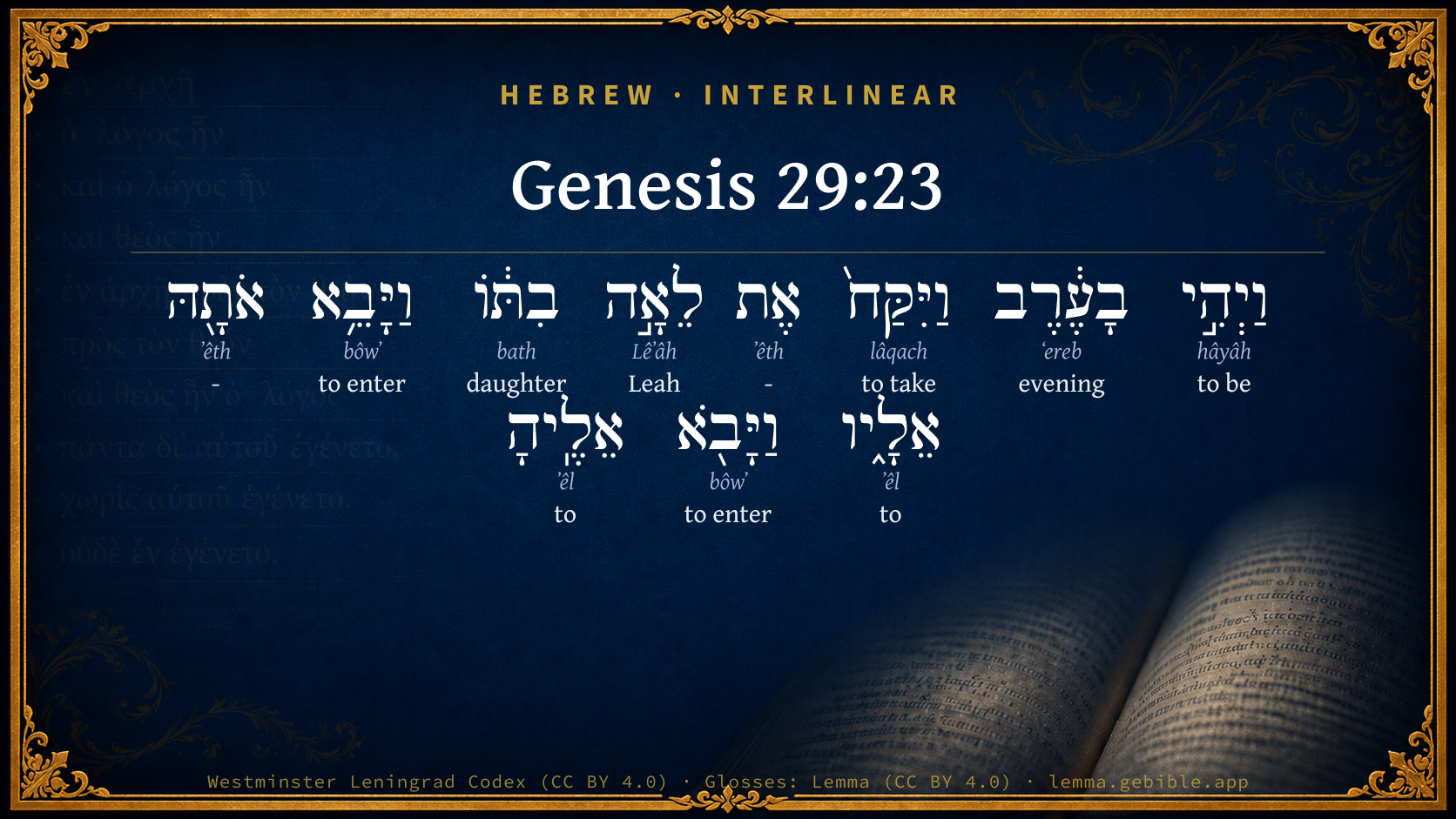
Genesis 29:23

Hebrew (Westminster Leningrad Codex) Genesis 29:23 appears in the Hebrew Old Testament. The text above is from the Westminster Leningrad Codex. Each word links to its Strong’s number, a concise gloss, and parsing drawn from the Open Scriptures Hebrew Bible morphology. Click any word for its full Brown-Driver-Briggs (BDB) entry.
Download image
Cite this verse

Genesis 29:23 (World English Bible). Public Domain. Lemma interlinear Bible study tool, https://lemma.gebible.app/v/genesis/29/23.

Show BibTeX & RIS
BibTeX
RIS
English Translation
It happened in the evening, that he took Leah his daughter, and brought her to him. He went in to her.
World English Bible · Public Domain
Download a study sheet

One document with this verse’s original text, its word-by-word gloss line, the meaning frame, cross-references with their text, attributed commentary, and full source and license credits — printable, and it pastes into notes with its structure intact.

This verse Autodidact and up

Study sheet (.html) Plain text (.txt)

A passage Seminary Student

Up to 50 verses in one chapter. A passage sheet keeps up to 6 commentary sources and 12 cross-references per verse, in the order this page ranks them, and says so on the sheet whenever that leaves anything out. Ask for a single verse and you get the Autodidact verse sheet above.

Everything on this page stays free to read, with no account — the sheet is a download of what is already on screen, not access to it.

Want to remove ads? Support Godless Engineer
Compare translations 3

The same verse in 3 English versions, stacked beneath the original-language interlinear above. Click any original word for its lexicon entry.

Each is an independent rendering of the whole verse — the interlinear is not word-aligned to these translations.

Highlighted words mark where these versions differ — a whole-verse word diff, not a word-by-word alignment.

  • World English Bible Public Domain
    It happened in the evening, that he took Leah his daughter, and brought her to him. He went in to her.
  • King James Version Public Domain
    And it came to pass in the evening, that he took Leah his daughter, and brought her to him; and he went in unto her.
  • unfoldingWord Literal Text CC BY-SA 4.0
    But it happened in the evening that he took Leah his daughter and brought her to him, and he went to her.

unfoldingWord Literal Text — © unfoldingWord, licensed CC BY-SA 4.0. Word-aligned USFM3 via Door43 (git.door43.org/unfoldingWord/en_ult).

Versions to compare (up to 4)

3 of 4 selected

Show all 18 translations

Every available English version of this verse, each an independent rendering of the whole verse.

  • World English Bible Public Domain
    It happened in the evening, that he took Leah his daughter, and brought her to him. He went in to her.
  • Berean Standard Bible Public Domain
    But when evening came, Laban took his daughter Leah and gave her to Jacob, and he slept with her.
  • Majority Standard Bible Public Domain
    But when evening came, Laban took his daughter Leah and gave her to Jacob, and he slept with her.
  • King James Version Public Domain
    And it came to pass in the evening, that he took Leah his daughter, and brought her to him; and he went in unto her.
  • American Standard Version (1901) Public Domain
    And it came to pass in the evening, that he took Leah his daughter, and brought her to him. And he went in unto her.
  • Revised Version (1885) Public Domain
    And it came to pass in the evening, that he took Leah his daughter, and brought her to him; and he went in unto her.
  • Geneva Bible (1599) Public Domain
    But whe the euening was come, he tooke Leah his daughter and brought her to him, and he went in vnto her.
  • Douay-Rheims (1899) Public Domain
    And at night he brought in Lia his daughter to him,
  • Young's Literal Translation Public Domain
    And it cometh to pass in the evening, that he taketh Leah, his daughter, and bringeth her in unto him, and he goeth in unto her;
  • Literal Standard Version CC BY-SA 4.0
    And it comes to pass in the evening, that he takes his daughter Leah, and brings her to him, and he goes in to her;
  • Unlocked Literal Bible CC BY-SA 4.0
    In the evening, Laban took Leah his daughter and brought her to Jacob, who slept with her.
  • unfoldingWord Literal Text CC BY-SA 4.0
    But it happened in the evening that he took Leah his daughter and brought her to him, and he went to her.
  • Darby Bible Public Domain
    And it came to pass in the evening, that he took Leah his daughter, and brought her to him; and he went in to her.
  • World Messianic Bible Public Domain
    In the evening, he took Leah his daughter, and brought her to Jacob. He went in to her.
  • Webster's Bible Public Domain
    And it came to pass in the evening, that he took Leah his daughter, and brought her to him; and he went in to her.
  • Free Bible Version CC BY-SA 4.0
    But once it was dark Laban brought his daughter Leah to Jacob, and he slept with her.
  • Bible in Basic English Public Domain
    And in the evening he took Leah, his daughter, and gave her to him, and he went in to her.
  • JPS Tanakh (1917) Public Domain
    And it came to pass in the evening, that he took Leah his daughter, and brought her to him; and he went in unto her.

Literal Standard Version (2020), Covenant Press — licensed CC BY-SA 4.0. Text via the HelloAO Bible API (eBible.org). Unlocked Literal Bible (unfoldingWord) — licensed CC BY-SA 4.0. Text via the HelloAO Bible API (eBible.org). unfoldingWord Literal Text — © unfoldingWord, licensed CC BY-SA 4.0. Word-aligned USFM3 via Door43 (git.door43.org/unfoldingWord/en_ult). Free Bible Version, Dr. Jonathan Gallagher — licensed CC BY-SA 4.0. Text via the HelloAO Bible API (eBible.org).

Word by word

More ways to search: Search by grammar → Find every occurrence → Compare this word →

Practice this passage: Drill this verse → Learn its vocabulary →

לֵאָ֣ה
Lêʼâh
H3812
“Leah”
Noun, Proper
Part of Speech
Noun
Type
Proper
Full BDB Definition

Origin: from H3811

TWOT: None

Leah = "weary" - daughter of Laban, first wife of Jacob, and mother of Reuben, Simeon, Levi, Judah, Issachar, Zebulun, and Dinah
  1. וַיְהִ֣י hâyâh H1961 “and · to be” Conjunction + Verb, Qal, Sequential Imperfect, 3rd Person, Masculine, Singular
  2. בָעֶ֔רֶב ʻereb H6153 “in/at the · evening” Preposition, Determined + Noun, Common, Masculine, Singular, Absolute
  3. וַיִּקַּח֙ lâqach H3947 “and · to take” Conjunction + Verb, Qal, Sequential Imperfect, 3rd Person, Masculine, Singular
  4. אֶת ʼêth H853 “-” Particle, Direct Object
  5. בִתּ֔וֹ bath H1323 “daughter · his” Noun, Common, Feminine, Singular, Construct + Suffix, Personal, 3rd Person, Masculine, Singular
  6. וַיָּבֵ֥א bôwʼ H935 “and · to enter” Conjunction + Verb, Hiphil, Sequential Imperfect, 3rd Person, Masculine, Singular
  7. אֹתָ֖הּ ʼêth H853 “- · her” Particle, Direct Object + Suffix, Personal, 3rd Person, Feminine, Singular
  8. אֵלָ֑יו ʼêl H413 “to · him” Preposition + Suffix, Personal, 3rd Person, Masculine, Singular
  9. וַיָּבֹ֖א bôwʼ H935 “and · to enter” Conjunction + Verb, Qal, Sequential Imperfect, 3rd Person, Masculine, Singular
  10. אֵלֶֽיהָ ʼêl H413 “to · her” Preposition + Suffix, Personal, 3rd Person, Feminine, Singular

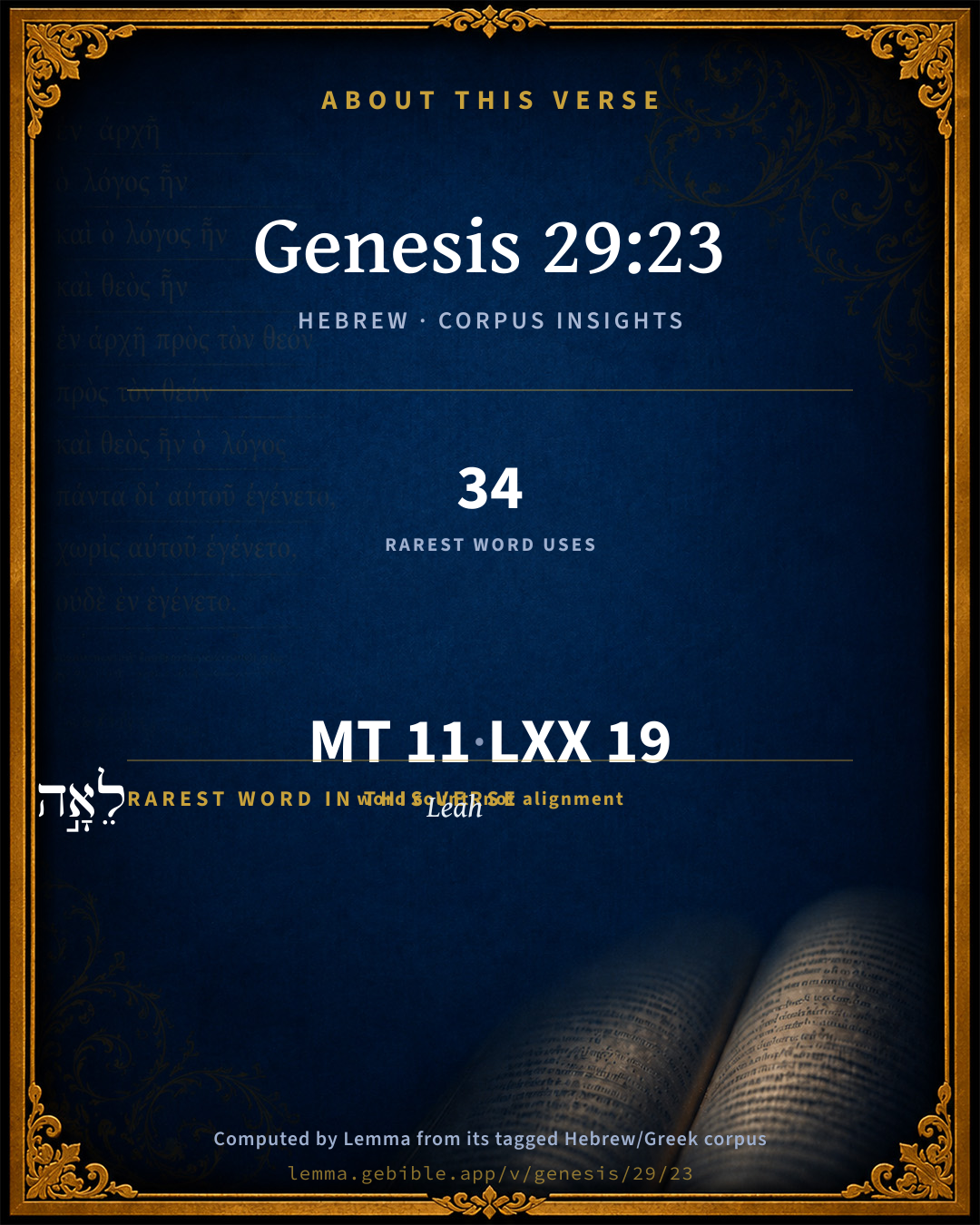
About this verse

These counts appear in no published source. They are computed here, from the morphology-tagged text and Lemma’s own curated glosses. What Lemma adds →

11
words
8
distinct lemmas
Pentateuch
section

Shared distinctive vocabulary

לֵאָ֣ה Leah H3812 occurs in 32 verses of the Hebrew Bible. Also found in:

Grammatical profile

  • 4 verbs
  • 3 nouns
  • 2 prepositions
  • 2 particles

Verb forms

  • וַיְהִ֣י Qal · Sequential Imperfect
  • וַיִּקַּח֙ Qal · Sequential Imperfect
  • וַיָּבֵ֥א Hiphil · Sequential Imperfect
  • וַיָּבֹ֖א Qal · Sequential Imperfect

Repetition

Words recur within this verse — often emphatic in Hebrew:

  • וַיָּבֵ֥א to enter H935 ×2
  • אֵלָ֑יו to H413 ×2

Hebrew & Septuagint length

In English translation the verse runs 21 words from the Hebrew and 22 from the Septuagint (LXX English) — closely comparable.

A rough comparison of the two English renderings, which tokenize alike — not a word-level alignment.

Word counts can differ between the Hebrew and the Greek without any difference in meaning — e.g. the Hebrew direct-object marker אֵת has no separate Greek word, and Greek often adds the article ὁ.

In the original languages it is 11 Hebrew tokens and 19 Greek tokens — but the two are counted differently (Hebrew bundles its prefixes and suffixes into one token; the Greek is in lemma form), so that isn’t a like-for-like length.

Cross-references

3

Topical passages linked to Genesis 29:23 in the Treasury of Scripture Knowledge — connected by theme and wording, ordered by reader-vote popularity; previews shown in the World English Bible.

  • Micah 7:5 Don't trust in a neighbor. Don't put confidence in a friend. With the woman lying in your embrace, Be careful of the words of your mouth!
  • Genesis 24:65 She said to the servant, "Who is the man who is walking in the field to meet us?" The servant said, "It is my master." She took her veil, and covered herself.
  • Genesis 38:14–15 She took off of her the garments of her widowhood, and covered herself with her veil, and wrapped herself, and sat in the gate of Enaim, which is by the way to Timnah; for she saw that Shelah was grown up, and she wasn't given to him as a wife.

Cross-references courtesy of OpenBible.info (CC BY 4.0).

Hebrew and Greek witnesses Masoretic Hebrew ↔ Greek Septuagint

The same verse in the two great witnesses to the Old Testament, shown verse-for-verse.

These are two independent witnesses, not word-aligned to each other, and the Septuagint is shown in lemma (dictionary) form.

Hebrew Genesis 29:23 Masoretic · Westminster Leningrad Codex

וַיְהִ֣י בָעֶ֔רֶב וַיִּקַּח֙ אֶת לֵאָ֣ה בִתּ֔וֹ וַיָּבֵ֥א אֹתָ֖הּ אֵלָ֑יו וַיָּבֹ֖א אֵלֶֽיהָ

It happened in the evening, that he took Leah his daughter, and brought her to him. He went in to her.

World English Bible · Public Domain

Greek LXX Genesis 29:23 Septuagint · lemma form

καί γίγνομαι ἑσπέρα καί λαμβάνω λαβαν λεια ὁ θυγάτηρ αὐτός εἰςἄγω αὐτός πρός ἰακώβ καί εἰςἔρχομαι πρός αὐτός ἰακώβ

And it was even, and he took his daughter Lea, and brought her in to Jacob, and Jacob went in to her.

LXX2012 (modern English Septuagint) · Public Domain

Hebrew: Westminster Leningrad Codex (CC BY 4.0). Greek: Septuagint (public domain); English from LXX2012 (modern English Septuagint) (Public Domain). How the Septuagint differs from the Hebrew →

Targum (Aramaic paraphrase)

2

The Targum is the ancient Jewish Aramaic paraphrase of the Hebrew Scriptures — an interpretive translation, not the Hebrew text itself. Onkelos (literal) and Pseudo-Jonathan (expansive) render the Torah, and Jonathan the Prophets. Coverage is partial: where no permissively-licensed English translation exists for a verse, only the Aramaic is shown. This is verse-level text, not a word-by-word alignment to the Hebrew.

  1. Targum Onkelos Torah (Genesis–Deuteronomy)
    וַהֲוָה בְרַמְשָׁא וּדְבַר יָת לֵאָה בְרַתֵּהּ וְאָעֵיל יָתַהּ לְוָתֵהּ וְעַל לְוָתַהּ

    (no public-domain English translation for this verse)

    Targum Onkelos — Aramaic: “Onkelos Genesis” (public domain); “Onkelos Exodus” (public domain); “Onkelos Leviticus” (public domain); “Onkelos Numbers” (public domain); “Onkelos Deuteronomy” (public domain). English: “Sefaria Community Translation” (CC0 1.0 (public-domain dedication)); “J.W. Etheridge. The Targums of Onkelos and Jonathan Ben Uzziel on the Pentateuch. London: Longmans, Green, 1862” (public domain). Text via Sefaria.

  2. Targum Pseudo-Jonathan Torah (Genesis–Deuteronomy)
    וַהֲוָה בְרַמְשָׁא וּדְבַר יַת לֵאָה בְּרַתֵּיהּ וְאָעֵיל יָתָהּ לְוָתֵיהּ וְעַל לְוָותָהּ

    And it was in the evening that he brought Leah his daughter, and introduced her to him, and he went in with her.

    Targum Pseudo-Jonathan — Aramaic: “Targum Jonathan on Genesis” (public domain); “Targum Jonathan on Exodus” (public domain); “Targum Jonathan on Leviticus” (public domain); “Targum Jonathan on Numbers” (public domain); “Targum Jonathan on Deuteronomy” (public domain). English: “The Targum of Jonathan ben Uzziel, trans. J. W. Etheridge, London, 1862” (public domain). Text via Sefaria.

Commentary

Notes on Genesis 29:23 from classic Christian and Jewish commentators (each source and its license shown beneath its notes). The classic Christian expositions comment on the surrounding passage and are grouped to its opening verse, so a note may address several verses; the Jewish commentaries on the Tanakh (Rashi and others) are per-verse, so they appear only where the commentator wrote on this verse.

Lemma curates 59 commentaries, every one of them public domain or Creative Commons licensed, each selected and text-cleaned for this edition rather than reprinted as found. About our sources →

Trapp's Complete Commentary

John Trapp

Gen 29:23 And it came to pass in the evening, that he took Leah his daughter, and brought her to him; and he went in unto her.

Ver. 23. He took Leah his daughter.] The elder, for the younger; by a like fraud, as Rebekah his mother had not long before, in a cunning disguise, substituted him, the younger son, for the elder. God pays us often in our own coin, {a} and measures to us again the self-same measure that we have meted to others. {Mat 7:2} Herod mocked the wise men, and is mocked of them. {Mat 2:16} And how oft do we see those that would beguile others, punished with illusion? God usually retaliates, and proportions jealousy to jealousy, provocation to provocation, {Deu 32:21} number to number, {Isa 65:11-12} choice to choice, {Isa 66:3-4} device to device, {Mic 2:1; Mic 2:3} frowardness to frowardness, {Psa 18:26} contrariety to contrariety. {Lev 26:21} Even the righteous shall be recompensed in the earth, {Pro 11:31} as was Jacob.

{a} Plerumque Deus servat legem talionis .

John Trapp, A Commentary or Exposition upon All the Books of the Old and New Testament (1647–1656) — public domain. Text from a community e-Sword module.

Joseph Benson's Commentary

Gen 29:23. He took Leah and brought her to him — This deceit he might the more easily practise, as it was customary in those times to bring the bride to her husband veiled, and without lights. This guile of Laban undoubtedly sorely grieved Jacob; and perhaps it happened as a punishment to him for the guile he had used in supplanting his brother.

Joseph Benson's Commentary on the Old and New Testaments (1811–1818) — public domain. Text from a community e-Sword module.

Tyndale Open Study Notes

Tyndale Open Resources

29:23-26 Like Isaac, Jacob was plied with food and wine (cp. 27:25), deprived of sight in the darkness (cp. 27:1), baffled by clothing (cp. 27:15), and misled by touch (cp. 27:23). The marriage had been consummated (29:23; see 2:24), so Jacob was bound to Leah. • It’s not our custom here to marry off a younger daughter ahead of the firstborn: Laban’s words are a reminder of what Jacob did when he, the younger son, pretended to be his older brother to gain the blessing (ch 27). Now Leah, the older sister, pretended to be the younger sister to get a husband. God gave the deceiver a dose of his own deception as a discipline in his life.

Tyndale Open Study Notes — © Tyndale Open Resources, licensed CC BY-SA 4.0. Text via the HelloAO Bible API.

Geneva Bible (1599)

Geneva Bible translators

The cause why Jacob was deceived was, that in old time the wife was covered with a veil, when she was brought to her husband in sign of chastity and shamefastness.

Geneva Bible (1599) marginal notes — public domain. Text via Bolls.life.

Adam Clarke's Commentary

Verse 23. In the evening - he took Leah his daughter] As the bride was always veiled, and the bride chamber generally dark, or nearly so, and as Leah was brought to Jacob in the evening, the imposition here practised might easily pass undetected by Jacob, till the ensuing day discovered the fraud.

Adam Clarke's Commentary on the Bible (1810–1826) — public domain. Text from a community e-Sword/MySword module.

Ellicott's Commentary for English Readers

(23)He took Leah his daughter.—As the bride is taken to the bridegroom’s house closely veiled (see Note on Gen_24:65), and as probably there was some similarity in voice and form between the two sisters, this deception was quite easy. But Leah must have been a party to the fraud, and therefore Jacob’s dislike of her was not altogether without reason.

A Bible Commentary for English Readers, edited by Charles John Ellicott (1878–1897) — public domain. Text from a community e-Sword module.

The Cambridge Bible for Schools and Colleges

gen. ed. J. J. S. Perowne

23. he took Leah] The bride was brought to the bridegroom enveloped in a veil; cf. Gen_24:65. “The bridegroom can scarcely ever obtain even a surreptitious glance at the features of his bride until he finds her in his absolute possession.” Lane, Manners and Customs of the Modern Egyptians.

24 (P). Zilpah his handmaid] For the custom of the bride being attended by her own servant to her new home, cf. Gen_24:59.

The Cambridge Bible for Schools and Colleges (gen. ed. J. J. S. Perowne; Cambridge University Press, 1878–1918) — public domain. Text from a community e-Sword module.

John Gill's Exposition

And it came to pass in the evening,.... After the feast was over, and the guests were departed; when it was night, a fit season to execute his designs, and practise deceit:

that he took Leah his daughter, and brought her to him, to Jacob, in his apartment, his bedchamber, or to him in bed: for it is still the custom in some eastern countries for the bridegroom to go to bed first, and then the bride comes, or is brought to him in the dark, and veiled, so that he sees her not: so the Armenians have now such a custom at their marriages that the husband goes to bed first; nor does the bride put off her veil till in bed (o): and in Barbary the bride is brought to the bridegroom's house, and with some of her female relations conveyed into a private room (p); then the bride's mother, or some very near relation, introduces the bridegroom to his new spouse, who is in the dark, and obliged in modesty not to speak or answer upon any account: and if this was the case here, as it is highly probable it was, the imposition on Jacob is easily accounted for:

and he went in unto her; or lay with her as his wife; a modest expression of the use of the bed.

(o) Tournefort's Voyage to the Levant, vol. 3. p. 255. (p) Ockley's Account of Southwest Barbary, c. 6. p. 78.

John Gill's Exposition of the Whole Bible (1746–1763) — public domain (CC PDM 1.0). Text via the HelloAO Bible API.

Matthew Poole's English Annotations

The occasion of the deceit was the custom of those times, which was to bring the bride to her husband in the dark, and with a veil upon her face: see Ge 24:65. And Leah being instructed by her father, and confederate with him in the deceit, was, doubtless, careful not to discover herself by speech, or any other way, to him.

Matthew Poole's English Annotations on the Holy Bible (1683–1685) — public domain. Text from a community e-Sword/MySword module.

Whedon's Commentary on the Bible

Daniel D. Whedon

23. Took Leah — There was no formal public ceremony of marriage; the parties were not openly presented to one another, but in the evening the bride, closely veiled, was led to the husband’s tent. Hence the ease with which it was possible to present Leah to Jacob instead of Rachel.

Daniel D. Whedon (gen. ed.), Commentary on the Old and New Testaments (1874–1909) — public domain. Text from a community e-Sword module.

The Pulpit Commentary

And it came to pass in the evening, that he took Leah his daughter, and brought her to him. The deception practiced on Jacob was rendered possible by the fact that the bride was usually conducted into the marriage chamber veiled; the veil being so long and close as to conceal not only the face, but much of the person. (vide Gen_14:5) And he went in unto her. The conduct of Laban is perfectly intelligible as the outcome of his sordid avarice; but it is difficult to understand how Leah could acquiesce in a proposal so base as to wrong her sister by marrying one who neither sought nor loved her. She must herself have been attached to Jacob; and it is probable that Laban had explained to her his plan for bringing about a double wedding.

The Pulpit Commentary (1880–1919), ed. H.D.M. Spence-Jones & Joseph S. Exell — public domain. Text from a community e-Sword module.

unfoldingWord translationNotes

Door43 World Missions Community

who slept with her

It is implied that Jacob did not know he was with Leah because it was dark and he could not see. The full meaning of this statement can be made explicit. (See: Assumed Knowledge and Implicit Information)

Laban gave his female servant Zilpah ... her servant

Here the author gives background information about Laban giving Zilpah to Leah. Most likely he gave Zilpah to Leah before the wedding. (See: Background Information)

Zilpah

This is the name of Leah's female servant. (See: How to Translate Names)

behold, it was Leah

"Jacob was surprised to see it was Leah in bed with him." The word "behold" here shows that Jacob was surprised by what he saw.

What is this you have done to me?

Jacob uses a question to express his anger and surprise. This rhetorical question can be translated as a statement. AT: "I cannot believe you did this to me!" (See: Rhetorical Question)

Did I not serve you for Rachel?

Jacob uses these questions to express his hurt that Laban had tricked him. This rhetorical question can be translated as a statement. AT: "I served you for seven years to marry Rachel!" (See: Rhetorical Question)

translationWords

Leah

had relations with

servant

unfoldingWord translationNotes — © Distant Shores Media and the Door43 World Missions Community, licensed CC BY-SA 4.0. Source: git.door43.org/Door43/en_tn.

Radak

Rabbi David Kimhi (Radak)

ויהי בערב, the Torah uses this opportunity to teach us that sexual intercourse even with artificial light, i.e. during the night is not appropriate, how much more so is it inappropriate during daylight hours. If it were appropriate to indulge in intercourse using artificial light Lavan could not have passed off Leah as Rachel without Yaakov becoming aware of this. It is clear from the text that Yaakov did not realise Leah as having been his partner in bed until the following morning. [the word הנה in verse 25 which we explained as always adding a new, up until then unknown, element is proof for this. Ed.]

Radak on the Tanakh — English translations: “Sefaria Community Translation” (CC0 1.0 (public-domain dedication)); “Eliyahu Munk, HaChut Hameshulash” (CC BY 4.0); “Rabbi Mike Feuer, Jerusalem Anthology” (CC BY 4.0); and “R. David Kimhi on the first book of Psalms, Translated by R.G. Finch, London, 1919” (public domain). Text via Sefaria.

Lesson kit

Teaching starters — assembled from the data on this page, not authored interpretation. Every prompt links to the verse data it draws on. Edit before teaching.

Genesis, in the Pentateuch, opens this verse with 11 words (8 distinct Hebrew lemmas). Its most distinctive word is Lêʼâh (“Leah”). A historical commentator’s framing appears above. Read the whole chapter for the surrounding context.

Discussion questions

  1. How does “Leah” (Lêʼâh) shape what this verse is saying?
  2. Genesis 29:16 shares the word «Leah» with this verse. How do the two illuminate each other?
  3. “to enter” occurs 2× in this one verse. What is the effect of the repetition?
  4. The translations on this page render this verse differently — a whole-verse word diff, not a word-by-word alignment. What might account for the different wordings?
  5. The verb «וַיְהִ֣י» is Qal Sequential Imperfect. How does its form color the action?
  6. Reading how Trapp's Complete Commentary and Joseph Benson's Commentary read this verse, where do the two commentators agree and where do they part?

Things to notice

Reading settings

Reading text

Shown beneath each verse's original-language words.

Old Testament
Old Testament edition

Read the OT as the Masoretic Hebrew (MT) or the Greek Septuagint (LXX).

English shown for the Greek Septuagint (in the Hebrew ↔ Greek comparison).

Comparing translations? Open the Compare panel on any verse page to stack up to four side by side.