
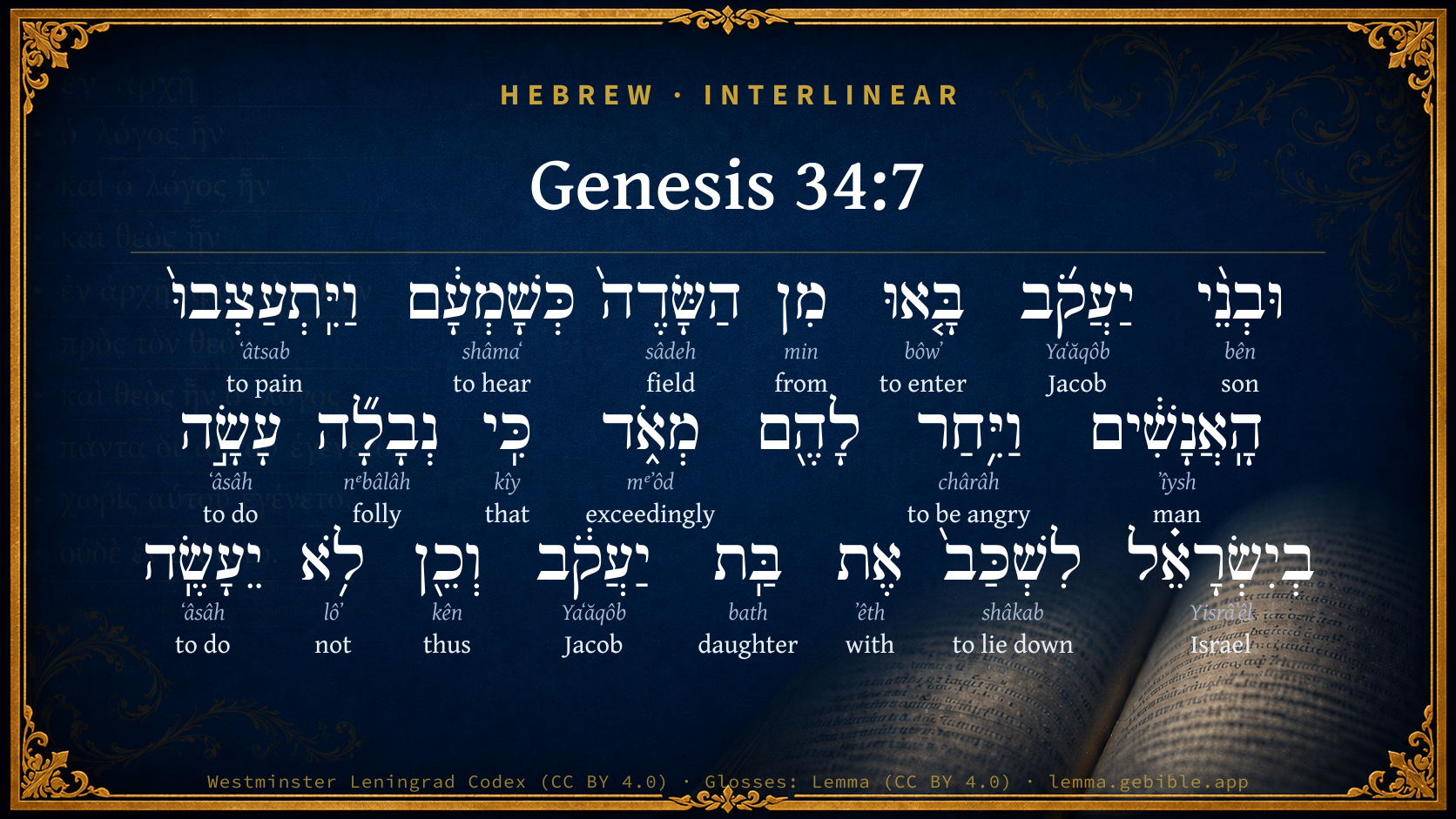
Genesis 34:7

Hebrew (Westminster Leningrad Codex) Genesis 34:7 appears in the Hebrew Old Testament. The text above is from the Westminster Leningrad Codex. Each word links to its Strong’s number, a concise gloss, and parsing drawn from the Open Scriptures Hebrew Bible morphology. Click any word for its full Brown-Driver-Briggs (BDB) entry.
Download image
Cite this verse

Genesis 34:7 (World English Bible). Public Domain. Lemma interlinear Bible study tool, https://lemma.gebible.app/v/genesis/34/7.

Show BibTeX & RIS
BibTeX
RIS
English Translation
The sons of Jacob came in from the field when they heard it. The men were grieved, and they were very angry, because he had done folly in Israel in lying with Jacob's daughter; which thing ought not to be done.
World English Bible · Public Domain
Highlights
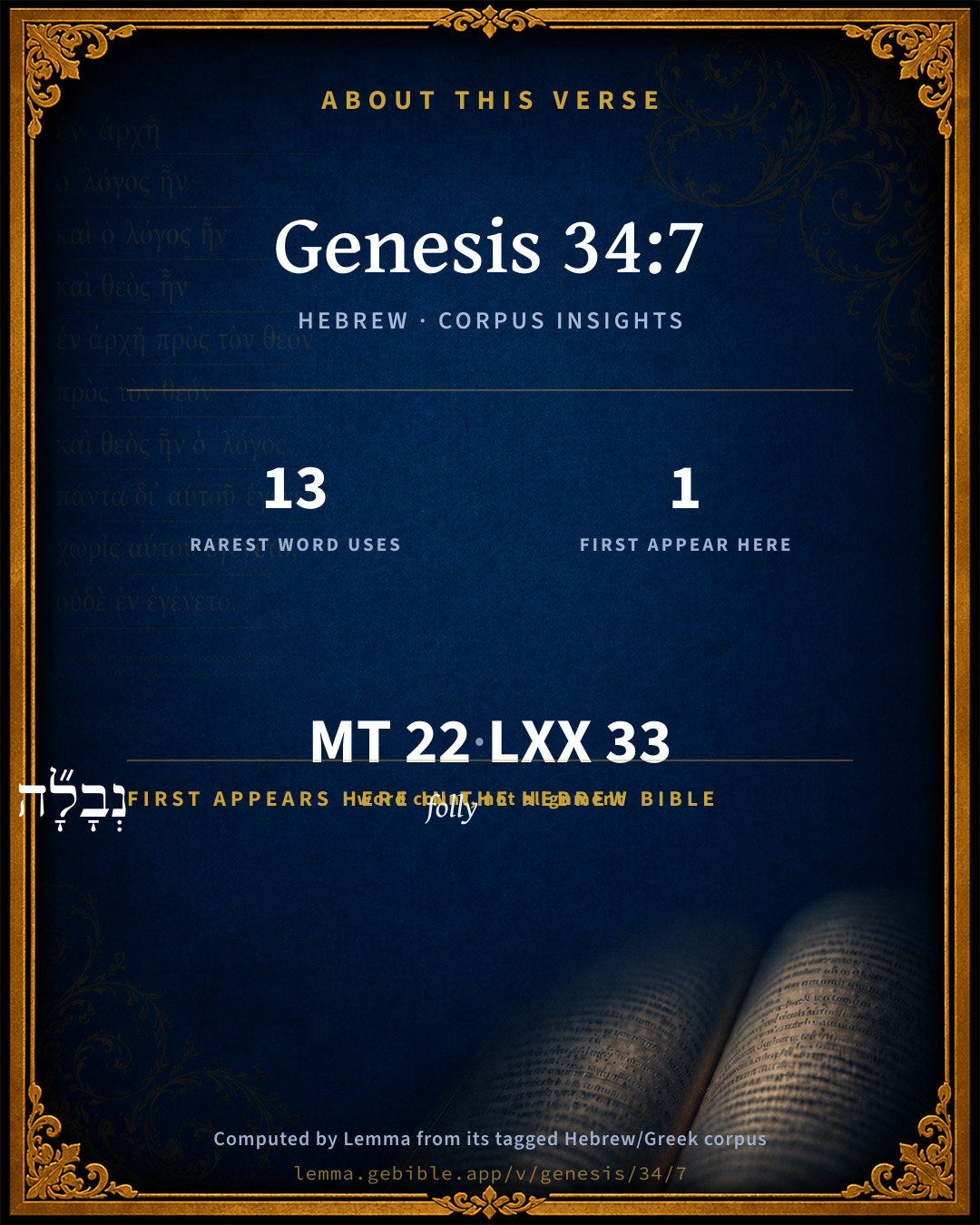
  • 1 first appearance in the Hebrew Bible
Full analysis ↓
Download a study sheet

One document with this verse’s original text, its word-by-word gloss line, the meaning frame, cross-references with their text, attributed commentary, and full source and license credits — printable, and it pastes into notes with its structure intact.

This verse Autodidact and up

Study sheet (.html) Plain text (.txt)

A passage Seminary Student

Up to 50 verses in one chapter. A passage sheet keeps up to 6 commentary sources and 12 cross-references per verse, in the order this page ranks them, and says so on the sheet whenever that leaves anything out. Ask for a single verse and you get the Autodidact verse sheet above.

Everything on this page stays free to read, with no account — the sheet is a download of what is already on screen, not access to it.

Want to remove ads? Support Godless Engineer
Compare translations 3

The same verse in 3 English versions, stacked beneath the original-language interlinear above. Click any original word for its lexicon entry.

Each is an independent rendering of the whole verse — the interlinear is not word-aligned to these translations.

Highlighted words mark where these versions differ — a whole-verse word diff, not a word-by-word alignment.

  • World English Bible Public Domain
    The sons of Jacob came in from the field when they heard it. The men were grieved, and they were very angry, because he had done folly in Israel in lying with Jacob's daughter; which thing ought not to be done.
  • King James Version Public Domain
    And the sons of Jacob came out of the field when they heard it: and the men were grieved, and they were very wroth, because he had wrought folly in Israel in lying with Jacob's daughter: which thing ought not to be done.
  • unfoldingWord Literal Text CC BY-SA 4.0
    Then the sons of Jacob came from the fields. When they heard, then the men were grieved and it burned within them greatly, because he had done something disgraceful to Israel by lying with the daughter of Jacob, and such a thing should not have been done!

unfoldingWord Literal Text — © unfoldingWord, licensed CC BY-SA 4.0. Word-aligned USFM3 via Door43 (git.door43.org/unfoldingWord/en_ult).

Versions to compare (up to 4)

3 of 4 selected

Show all 18 translations

Every available English version of this verse, each an independent rendering of the whole verse.

  • World English Bible Public Domain
    The sons of Jacob came in from the field when they heard it. The men were grieved, and they were very angry, because he had done folly in Israel in lying with Jacob's daughter; which thing ought not to be done.
  • Berean Standard Bible Public Domain
    When Jacob’s sons heard what had happened, they returned from the field. They were filled with grief and fury, because Shechem had committed an outrage in Israel by lying with Jacob’s daughter—a thing that should not be done.
  • Majority Standard Bible Public Domain
    When Jacob’s sons heard what had happened, they returned from the field. They were filled with grief and fury, because Shechem had committed an outrage in Israel by lying with Jacob’s daughter—a thing that should not be done.
  • King James Version Public Domain
    And the sons of Jacob came out of the field when they heard it: and the men were grieved, and they were very wroth, because he had wrought folly in Israel in lying with Jacob's daughter: which thing ought not to be done.
  • American Standard Version (1901) Public Domain
    And the sons of Jacob came in from the field when they heard it: and the men were grieved, and they were very wroth, because he had wrought folly in Israel in lying with Jacob's daughter; which thing ought not to be done.
  • Revised Version (1885) Public Domain
    And the sons of Jacob came in from the field when they heard it: and the men were grieved, and they were very wroth, because he had wrought folly in Israel in lying with Jacob’s daughter; which thing ought not to be done.
  • Geneva Bible (1599) Public Domain
    And whe the sonnes of Iaakob were come out of the fielde and heard it, it grieued the men, and they were very angry, because he had wrought villenie in Israel, in that he had lyen with Iaakobs daughter: which thing ought not to be done.
  • Douay-Rheims (1899) Public Domain
    Behold his sons came from the field: and hearing what had passed, they were exceeding angry, because he had done a foul thing in Israel, and committed an unlawful act, in ravishing Jacob's daughter,
  • Young's Literal Translation Public Domain
    and the sons of Jacob came in from the field when they heard, and the men grieve themselves, and it `is' very displeasing to them, for folly he hath done against Israel, to lie with the daughter of Jacob -- and so it is not done.
  • Literal Standard Version CC BY-SA 4.0
    and the sons of Jacob came in from the field when they heard, and the men grieve themselves, and it [is] very displeasing to them, for folly he has done against Israel, to lie with the daughter of Jacob—and so it is not done.
  • Unlocked Literal Bible CC BY-SA 4.0
    The sons of Jacob came in from the field when they heard of the matter. The men were offended. They were very angry because he had disgraced Israel by forcing himself on Jacob's daughter, for such a thing should not have been done.
  • unfoldingWord Literal Text CC BY-SA 4.0
    Then the sons of Jacob came from the fields. When they heard, then the men were grieved and it burned within them greatly, because he had done something disgraceful to Israel by lying with the daughter of Jacob, and such a thing should not have been done!
  • Darby Bible Public Domain
    And the sons of Jacob came from the fields when they heard [it]; and the men were grieved, and they were very angry, because he had wrought what was disgraceful in Israel, in lying with Jacob's daughter, which thing ought not to be done.
  • World Messianic Bible Public Domain
    The sons of Jacob came in from the field when they heard it. The men were grieved, and they were very angry, because he had done folly in Israel in lying with Jacob’s daughter, a thing that ought not to be done.
  • Webster's Bible Public Domain
    And the sons of Jacob came from the field when they heard it: and the men were grieved, and they were very wroth, because he had wrought folly in Israel, in lying with Jacob's daughter; which thing ought not to be done.
  • Free Bible Version CC BY-SA 4.0
    When Jacob's sons returned from the fields they were very upset when they heard the news and became extremely angry because Shechem had done something outrageous in Israel by having sex with Jacob's daughter—something that should never be done.
  • Bible in Basic English Public Domain
    Now the sons of Jacob came in from the fields when they had news of it, and they were wounded and very angry because of the shame he had done in Israel by having connection with Jacob's daughter; and they said, Such a thing is not to be done.
  • JPS Tanakh (1917) Public Domain
    And the sons of Jacob came in from the field when they heard it; and the men were grieved, and they were very wroth, because he had wrought a vile deed in Israel in lying with Jacob's daughter; which thing ought not to be done.

Literal Standard Version (2020), Covenant Press — licensed CC BY-SA 4.0. Text via the HelloAO Bible API (eBible.org). Unlocked Literal Bible (unfoldingWord) — licensed CC BY-SA 4.0. Text via the HelloAO Bible API (eBible.org). unfoldingWord Literal Text — © unfoldingWord, licensed CC BY-SA 4.0. Word-aligned USFM3 via Door43 (git.door43.org/unfoldingWord/en_ult). Free Bible Version, Dr. Jonathan Gallagher — licensed CC BY-SA 4.0. Text via the HelloAO Bible API (eBible.org).

Word by word

More ways to search: Search by grammar → Find every occurrence → Compare this word →

Practice this passage: Drill this verse → Learn its vocabulary →

נְבָלָ֞ה
nᵉbâlâh
H5039
“folly”
Noun, Common, Feminine, Singular, Absolute
Part of Speech
Noun
Type
Common
Gender
Feminine
Number
Singular
State
Absolute
Full BDB Definition

Origin: from H5036

TWOT: 1285b

senselessness, folly - disgraceful folly - of immorality, profane actions - disgrace, contumely disgrace
  1. וּבְנֵ֨י bên H1121 “and · sons of” Conjunction + Noun, Common, Masculine, Plural, Construct
  2. יַעֲקֹ֜ב Yaʻăqôb H3290 “Jacob” Noun, Proper
  3. בָּ֤אוּ bôwʼ H935 “to enter” Verb, Qal, Perfect, 3rd Person, Common, Plural
  4. מִן min H4480 “from” Preposition
  5. הַשָּׂדֶה֙ sâdeh H7704 “the · field” Particle, Definite Article + Noun, Common, Masculine, Singular, Absolute
  6. כְּשָׁמְעָ֔ם shâmaʻ H8085 “like/as · to hear · them” Preposition + Verb, Qal, Infinitive Construct + Suffix, Personal, 3rd Person, Masculine, Plural
  7. וַיִּֽתְעַצְּבוּ֙ ʻâtsab H6087 “and · to pain” Conjunction + Verb, Hithpael, Sequential Imperfect, 3rd Person, Masculine, Plural
  8. הָֽאֲנָשִׁ֔ים ʼîysh H376 “the · men” Particle, Definite Article + Noun, Common, Masculine, Plural, Absolute
  9. וַיִּ֥חַר chârâh H2734 “and · to be angry” Conjunction + Verb, Qal, Sequential Imperfect, 3rd Person, Masculine, Singular
  10. מְאֹ֑ד mᵉʼôd H3966 “exceedingly” Adverb
  11. כִּֽי kîy H3588 “that” Conjunction
  12. עָשָׂ֣ה ʻâsâh H6213 “to do” Verb, Qal, Perfect, 3rd Person, Masculine, Singular
  13. בְיִשְׂרָאֵ֗ל Yisrâʼêl H3478 “in/at · Israel” Preposition + Noun, Proper
  14. לִשְׁכַּב֙ shâkab H7901 “to lie down” Preposition + Verb, Qal, Infinitive Construct
  15. אֶת ʼêth H854 “with” Preposition
  16. בַּֽת bath H1323 “daughter of” Noun, Common, Feminine, Singular, Construct
  17. יַעֲקֹ֔ב Yaʻăqôb H3290 “Jacob” Noun, Proper
  18. וְכֵ֖ן kên H3651 “and · thus” Conjunction + Particle, Demonstrative
  19. לֹ֥א lôʼ H3808 “not” Particle, Negative
  20. יֵעָשֶֽׂה ʻâsâh H6213 “to do” Verb, Niphal, Imperfect, 3rd Person, Masculine, Singular

About this verse

These counts appear in no published source. They are computed here, from the morphology-tagged text and Lemma’s own curated glosses. What Lemma adds →

22
words
19
distinct lemmas
Pentateuch
section

Notable vocabulary

The rarest word here is נְבָלָ֞ה folly H5039 — appearing just 13 times in the whole Hebrew Bible.

First appearance in Scripture

This word makes its first canonical appearance in the Hebrew Bible here:

  • נְבָלָ֞ה folly H5039

Shared distinctive vocabulary

נְבָלָ֞ה folly H5039 occurs in 13 verses of the Hebrew Bible. Also found in:

Grammatical profile

  • 7 verbs
  • 8 nouns
  • 3 prepositions
  • 1 conjunction
  • 1 adverb
  • 2 particles

Verb forms

  • בָּ֤אוּ Qal · Perfect
  • כְּשָׁמְעָ֔ם Qal · Infinitive Construct
  • וַיִּֽתְעַצְּבוּ֙ Hithpael · Sequential Imperfect
  • וַיִּ֥חַר Qal · Sequential Imperfect
  • עָשָׂ֣ה Qal · Perfect
  • לִשְׁכַּב֙ Qal · Infinitive Construct
  • יֵעָשֶֽׂה Niphal · Imperfect

Repetition

Words recur within this verse — often emphatic in Hebrew:

  • יַעֲקֹ֜ב Jacob H3290 ×2
  • עָשָׂ֣ה to do H6213 ×2

Hebrew & Septuagint length

In English translation the verse runs 41 words from the Hebrew and 45 from the Septuagint (LXX English) — closely comparable.

A rough comparison of the two English renderings, which tokenize alike — not a word-level alignment.

Word counts can differ between the Hebrew and the Greek without any difference in meaning — e.g. the Hebrew direct-object marker אֵת has no separate Greek word, and Greek often adds the article ὁ.

In the original languages it is 22 Hebrew tokens and 33 Greek tokens — but the two are counted differently (Hebrew bundles its prefixes and suffixes into one token; the Greek is in lemma form), so that isn’t a like-for-like length.

Cross-references

21

Topical passages linked to Genesis 34:7 in the Treasury of Scripture Knowledge — connected by theme and wording, ordered by reader-vote popularity; previews shown in the World English Bible.

  • Joshua 7:15 It shall be, that he who is taken with the devoted thing shall be burnt with fire, he and all that he has; because he has transgressed the covenant of Yahweh, and because he has done folly in Israel.
  • Judges 20:6 I took my concubine, and cut her in pieces, and sent her throughout all the country of the inheritance of Israel; for they have committed lewdness and folly in Israel.
  • Deuteronomy 22:21 then they shall bring out the young lady to the door of her father's house, and the men of her city shall stone her to death with stones, because she has done folly in Israel, to play the prostitute in her father's house: so shall you put away the evil from the midst of you.
  • Genesis 20:9 Then Abimelech called Abraham, and said to him, "What have you done to us? How have I sinned against you, that you have brought on me and on my kingdom a great sin? You have done deeds to me that ought not to be done!"
  • Hebrews 13:4 Let marriage be held in honor among all, and let the bed be undefiled: but God will judge the sexually immoral and adulterers.
  • Genesis 46:7 his sons, and his sons' sons with him, his daughters, and his sons' daughters, and he brought all his seed with him into Egypt.
  • Exodus 19:5–6 Now therefore, if you will indeed obey my voice, and keep my covenant, then you shall be my own possession from among all peoples; for all the earth is mine;
  • Leviticus 4:2 "Speak to the children of Israel, saying, 'If anyone sins unintentionally, in any of the things which Yahweh has commanded not to be done, and does any one of them:
  • Leviticus 4:13 "'If the whole congregation of Israel sins, and the thing is hidden from the eyes of the assembly, and they have done any of the things which Yahweh has commanded not to be done, and are guilty;
  • Leviticus 4:27 "'If anyone of the common people sins unwittingly, in doing any of the things which Yahweh has commanded not to be done, and is guilty;
  • Deuteronomy 23:17 There shall be no prostitute of the daughters of Israel, neither shall there be a sodomite of the sons of Israel.
  • Judges 19:22–25 As they were making their hearts merry, behold, the men of the city, certain base fellows, beset the house round about, beating at the door; and they spoke to the master of the house, the old man, saying, Bring forth the man who came into your house, that we may know him.
  • 2 Samuel 13:12–13 She answered him, No, my brother, do not force me; for no such thing ought to be done in Israel. Don't you do this folly.
  • 2 Samuel 13:21 But when king David heard of all these things, he was very angry.
  • Psalms 93:5 Your statutes stand firm. Holiness adorns your house, Yahweh, forevermore.
  • Proverbs 7:7 I saw among the simple ones. I discerned among the youths a young man void of understanding,
  • 1 Corinthians 6:18 Flee sexual immorality! "Every sin that a man does is outside the body," but he who commits sexual immorality sins against his own body.
  • 1 Corinthians 10:8 Neither let us commit sexual immorality, as some of them committed, and in one day twenty-three thousand fell.
  • Ephesians 5:3 But sexual immorality, and all uncleanness, or covetousness, let it not even be mentioned among you, as becomes saints;
  • James 3:10 Out of the same mouth comes forth blessing and cursing. My brothers, these things ought not to be so.
  • 1 Peter 2:9 But you are a chosen race, a royal priesthood, a holy nation, a people for God's own possession, that you may show forth the excellencies of him who called you out of darkness into his marvelous light:

Cross-references courtesy of OpenBible.info (CC BY 4.0).

Hebrew and Greek witnesses Masoretic Hebrew ↔ Greek Septuagint

The same verse in the two great witnesses to the Old Testament, shown verse-for-verse.

These are two independent witnesses, not word-aligned to each other, and the Septuagint is shown in lemma (dictionary) form.

Hebrew Genesis 34:7 Masoretic · Westminster Leningrad Codex

וּבְנֵ֨י יַעֲקֹ֜ב בָּ֤אוּ מִן הַשָּׂדֶה֙ כְּשָׁמְעָ֔ם וַיִּֽתְעַצְּבוּ֙ הָֽאֲנָשִׁ֔ים וַיִּ֥חַר לָהֶ֖ם מְאֹ֑ד כִּֽי נְבָלָ֞ה עָשָׂ֣ה בְיִשְׂרָאֵ֗ל לִשְׁכַּב֙ אֶת בַּֽת יַעֲקֹ֔ב וְכֵ֖ן לֹ֥א יֵעָשֶֽׂה

The sons of Jacob came in from the field when they heard it. The men were grieved, and they were very angry, because he had done folly in Israel in lying with Jacob's daughter; which thing ought not to be done.

World English Bible · Public Domain

Greek LXX Genesis 34:7 Septuagint · lemma form

ὁ δέ υἱός ἰακώβ ἔρχομαι ἐκ ὁ πεδίον ὡς δέ ἀκούω κατανύττω ὁ ἀνήρ καί λυπηρός εἰμί αὐτός σφόδρα ὅτι ἀσχήμων ποιέω ἐν ἰσραήλ κοιμάω μετά ὁ θυγάτηρ ἰακώβ καί οὐ οὕτως εἰμί

And the sons of Jacob came from the plain; and when they heard, the men were deeply pained, and it was very grievous to them, because the man wrought folly in Israel, having lain with the daughter of Jacob, and so it must not be.

LXX2012 (modern English Septuagint) · Public Domain

On this verse, The Pulpit Commentary discusses the Septuagint’s reading. Read the note in Commentary ↓

Hebrew: Westminster Leningrad Codex (CC BY 4.0). Greek: Septuagint (public domain); English from LXX2012 (modern English Septuagint) (Public Domain). How the Septuagint differs from the Hebrew →

Targum (Aramaic paraphrase)

2

The Targum is the ancient Jewish Aramaic paraphrase of the Hebrew Scriptures — an interpretive translation, not the Hebrew text itself. Onkelos (literal) and Pseudo-Jonathan (expansive) render the Torah, and Jonathan the Prophets. Coverage is partial: where no permissively-licensed English translation exists for a verse, only the Aramaic is shown. This is verse-level text, not a word-by-word alignment to the Hebrew.

  1. Targum Onkelos Torah (Genesis–Deuteronomy)
    וּבְנֵי יַעֲקֹב עַלּוּ מִן חַקְלָא כַּד שְׁמָעוּ וְאִתְנְסִיסוּ גֻּבְרַיָּא וּתְקֵיף לְהוֹן לַחֲדָא אֲרֵי קְלָנָא עֲבַד בְּיִשְׂרָאֵל לְמִשְׁכַּב עִם בַּת יַעֲקֹב וְכֵן לָא כָשַׁר לְאִתְעֲבָדָא

    (no public-domain English translation for this verse)

    Targum Onkelos — Aramaic: “Onkelos Genesis” (public domain); “Onkelos Exodus” (public domain); “Onkelos Leviticus” (public domain); “Onkelos Numbers” (public domain); “Onkelos Deuteronomy” (public domain). English: “Sefaria Community Translation” (CC0 1.0 (public-domain dedication)); “J.W. Etheridge. The Targums of Onkelos and Jonathan Ben Uzziel on the Pentateuch. London: Longmans, Green, 1862” (public domain). Text via Sefaria.

  2. Targum Pseudo-Jonathan Torah (Genesis–Deuteronomy)
    וּבְנוֹי דְיַעֲקב עָלוּ מִן חַקְלָא כְּדִי שָׁמְעַן וְאִתְנְסִיסוּ גוּבְרַיָא וּתְקֵיף לְהוֹם לַחֲדָא אֲרוּם קְלָנָא עָבַד שְׁכֶם בְּיִשְרָאֵל לְמִשְכּוֹב עִם בְּרַת יַעֲקב וְכֵן לָא הֲוָה כַּשְׁרָא לְאִתְעוֹבָדָא

    And the sons of Jakob had come up from the field when they heard. And the men were indignant, and very violently moved, because Shekem had wrought dishonour in Israel in lying with the daughter of Jakob; for so it was not right to have been done.

    Targum Pseudo-Jonathan — Aramaic: “Targum Jonathan on Genesis” (public domain); “Targum Jonathan on Exodus” (public domain); “Targum Jonathan on Leviticus” (public domain); “Targum Jonathan on Numbers” (public domain); “Targum Jonathan on Deuteronomy” (public domain). English: “The Targum of Jonathan ben Uzziel, trans. J. W. Etheridge, London, 1862” (public domain). Text via Sefaria.

Commentary

Notes on Genesis 34:7 from classic Christian and Jewish commentators (each source and its license shown beneath its notes). The classic Christian expositions comment on the surrounding passage and are grouped to its opening verse, so a note may address several verses; the Jewish commentaries on the Tanakh (Rashi and others) are per-verse, so they appear only where the commentator wrote on this verse.

Lemma curates 59 commentaries, every one of them public domain or Creative Commons licensed, each selected and text-cleaned for this edition rather than reprinted as found. About our sources →

Trapp's Complete Commentary

John Trapp

Gen 34:7 And the sons of Jacob came out of the field when they heard [it]: and the men were grieved, and they were very wroth, because he had wrought folly in Israel in lying with Jacob’s daughter; which thing ought not to be done.

Ver. 7. The men were grieved, and very wroth.] A pair of unruly passions, when combined, especially: they ride one upon the back of another, as kine do in a strait passage; and will make an Alexander kill his best friends, such as he would afterwards have revived, with the best and warmest blood in his own heart.

“Qui non moderabitur irae,

Infectum velit esse, dolor quod suaserit, et mens.”

- Horat.

Because he had wrought folly in Israel.] That is, in the Church, where fornication should "not be once named," much less committed. {Eph 5:3} Sin is odious anywhere; most of all among saints. A thistle is unseemly in a garden, filthiness in a vestal, baseness in a prince. And yet, by the malice of Satan, there are, many times, more scandals in the Church than else where: such incest at Corinth, {1Co 5:1} as not among heathens; such folly in Jacob’s family, as not at Shechem, or Seir. "Sodom, thy sister, hath not done, she nor her daughters, as thou hast done, thou and thy daughters." {Eze 16:48} This is lamentable!

John Trapp, A Commentary or Exposition upon All the Books of the Old and New Testament (1647–1656) — public domain. Text from a community e-Sword module.

Joseph Benson's Commentary

Gen 34:7. He had wrought folly — All sin is folly: but some sinful actions are attended with such circumstances of ignorance and thoughtlessness, and are so inimical to our temporal as well as eternal interests, that they peculiarly merit the name of folly. Shechem’s sin is termed folly in Israel, according to the language of after-times; for Israel was not yet a people, but a family only.

Joseph Benson's Commentary on the Old and New Testaments (1811–1818) — public domain. Text from a community e-Sword module.

Geneva Bible (1599)

Geneva Bible translators

Hebrew, and it shall not be so done.

Or, folly.

Geneva Bible (1599) marginal notes — public domain. Text via Bolls.life.

Jamieson, Fausset & Brown

Robert Jamieson, A. R. Fausset & David Brown

the men were grieved, and . . . very wroth--Good men in such a case could not but grieve; but it would have been well if their anger had been less, or that they had known the precept "let not the sun go down upon your wrath" [Eph 4:26]. No injury can justify revenge (Deu 32:35; Rom 12:9); but Jacob's sons planned a scheme of revenge in the most deceitful manner.

Jamieson, Fausset & Brown — Commentary Critical and Explanatory on the Whole Bible (1871) — public domain (CC PDM 1.0). Text via the HelloAO Bible API.

Adam Clarke's Commentary

Verse 7. He had wrought folly in Israel] The land, afterwards generally called Israel, was not as yet so named; and the sons of Jacob were neither called Israel, Israelites nor Jews, till long after this. How then can it be said that Shechem had wrought folly in Israel? The words are capable of a more literal translation: בישראל beyisrael, may be translated, against Israel. The angel had said, Thy name shall be called no more Jacob - not only Jacob, but Israel. It was this that aggravated the offence of Shechem; he wrought folly against Israel, the prince of God, in lying with the daughter of Jacob. Here both the names are given; Jacob, whose daughter was defiled, and Israel, the prince of God, against whom the offence was committed.

Adam Clarke's Commentary on the Bible (1810–1826) — public domain. Text from a community e-Sword/MySword module.

John Calvin's Commentaries

7. And the sons of Jacob came out of the field. Moses begins to relate the tragic issue of this history. Shechem, indeed, had acted wickedly and impiously; but it was far more atrocious and wicked that the sons of Jacob should murder a whole people, to avenge themselves of the private fault of one man. It was by no means fitting to seek a cruel compensation for the levity and rashness of one youth, by the slaughter of so many men. Again, who had constituted them judges, that they should dare, with their own hands, to execute vengeance for an injury inflicted upon them? Perfidy was also superadded, because they proceeded, under the pretext of a covenant, to perpetrate this enormous crime. In Jacob, moreover, we have an admirable example of patient endurance; who, though afflicted with so many evils, yet did not faint under them. But chiefly we must consider the mercy of God, by which it came to pass, that the covenant of grace remained with the posterity of Jacob. For what seemed less suitable, than that a few men in whom such furious rage and such implacable malice reigned, should be reckoned among the people and the sons of God, to the exclusion of all the world besides? We see certainly that it was not through any power of their own that they had not altogether declined from the kingdom of God. Whence it appears that the favor which God had vouchsafed unto them was gratuitous, and not founded upon their merits. We also require to be treated by Him with the same indulgence, seeing that we should utterly fall away, if God did not pardon our sins. The sons of Jacob have, indeed, a just cause of offense, because not only are they affected with their own private ignominy, but they are tormented with the indignity of the crime, because their sister had been dragged forth from the house of Jacob, as from a sanctuary, to be violated. For this they chiefly urge, that it would have been wickedness to allow such disgrace in the elect and holy people: but they themselves, through the hatred of one sin, rush furiously forward to greater and more intolerable crimes. Therefore we must beware, lest, after we have become severe judges in condemning the faults of others, we hasten inconsiderately into evil. But chiefly we must abstain from violent remedies which surpass the evil we desire to correct.

Which thing ought not to be done Interpreters commonly explain the passage as meaning, “it is not becoming that such a thing should be done;” but, in my judgment, it applies more properly to the sons of Jacob, who had determined with themselves that the injury was not to be borne. Yet they wrongfully appropriate to themselves the right of taking revenge: why do they not rather reflect thus; “God, who has received us under his care and protection, will not suffer this injury to pass unavenged; in the meantime, it is our part to be silent, and to leave the act of punishing, which is not placed in our hands, entirely to his sovereign will.” Hence we may learn, when we are angry at the sins of other men, not to attempt anything which is beyond our own duty.

John Calvin's Commentaries (1540-1563) — public domain. Text from the Calvin Translation Society English edition (1840s-50s) via the Christian Classics Ethereal Library (ccel.org). Calvin's coverage is partial (roughly two-thirds of the Bible); uncommented books and verses are honest gaps, never fabricated. The 19th-century editor's footnotes and remarks are omitted so the notes are faithfully Calvin's own voice.

Ellicott's Commentary for English Readers

(7) He had wrought folly in Israel.—The great anger of Jacob’s sons agrees as completely with the general harshness of their characters as the silence of the father with his habitual thoughtfulness; but it was aroused by a great wrong. The use, however, of the term Israel to signify the family of Jacob as distinguished from his person belongs to the age of Moses, and is one of the proofs of the arrangement of these records having been his work. In selecting them, and weaving them together into one history, he would add whatever was necessary, and in the latter half of this verse we apparently have one such addition.

A Bible Commentary for English Readers, edited by Charles John Ellicott (1878–1897) — public domain. Text from a community e-Sword module.

The Cambridge Bible for Schools and Colleges

gen. ed. J. J. S. Perowne

7. wrought folly] The word nebâlah denotes “senseless wickedness,” an offence against honour and morality: cf. the use of the word in Deu_22:21; Jos_7:15; Jdg_19:23-24; 2Sa_13:12.

in Israel] The addition of these words (as in Deu_22:21; Jdg_20:6; Jdg_20:10; Jer_29:23) is of course an anachronism, when put into the mouth of Jacob; and indicates a time of authorship when this phrase had become proverbial.

ought not to be done] See notes on Gen_20:9, Gen_29:26.

The Cambridge Bible for Schools and Colleges (gen. ed. J. J. S. Perowne; Cambridge University Press, 1878–1918) — public domain. Text from a community e-Sword module.

John Gill's Exposition

And the sons of Jacob came out of the field, when they heard it,..... Either by a messenger Jacob sent to them, to acquaint them with it, or by some other hand: however, be it as it will, as soon as they heard of the abuse of their sister, they immediately left their flocks to the care of their servants, and came to their father's tent:

and the men were grieved and were very wroth; they were grieved for the sin committed against God, very probably, as well as for the injury done to their sister, and they were wroth against Shechem the author of it:

because he had wrought folly in Israel, in lying with Jacob's daughter; all sin is folly, being a transgression of the law of God founded in the highest wisdom, and particularly uncleanness, and that branch of it, deflowering a virgin; and this action being committed on Jacob's daughter, whose name was Israel, is said to be "in", or rather "against" Israel (h), to his grief, and to the reproach of him and his family: though these words may be rather the words of Moses, than of the sons of Jacob; or however are expressed not in the language used by them, but in what was in use in the times of Moses, when Israel was the name of a nation and church, whereas it was now but a personal name, and at most but the name of a family; and though this was done to one of the family, yet not in it, but in the house of Hamor or Shechem:

which thing ought not to be done; being against the law and light of nature to do such an action by force and violence, and against the law of nations to suffer it to go with impunity.

(h) "contra Israelem", Junius & Tremellius, Piscator, Calovius; so Ainsworth.

John Gill's Exposition of the Whole Bible (1746–1763) — public domain (CC PDM 1.0). Text via the HelloAO Bible API.

Haydock's Catholic Bible Commentary

In Israel, or against the honour and peace of their father and all his family. --- An unlawful act, which some nevertheless commit without scruple, and even dare to represent as a matter of small consequence if they marry afterwards!

George Leo Haydock (1774–1849), Haydock's Catholic Family Bible and Commentary, 1859 edition — public domain. Excludes Psalms (Douay-Rheims chapter numbering differs from Protestant) and Deuterocanonical books (Catholic canon only).

Matthew Poole's English Annotations

Because he had wrought folly; that is, wickedness; which howsoever vain men many times esteem their wisdom, by the sentence of the all-wise God is accounted and commonly in Scripture called folly, as Deu 22:21; Jos 7:15; Jdg 19:23; 20:6, &c.

In Israel, or, against Israel; either,

1. Against the person, and in or against the family of Israel, a person near and dear to God, and highly honoured by him, and in covenant with God; who therefore esteems the injuries done to Israel as if they were done to himself. See Gen 12:3; Exo 23:22; Zec 2:8. Or,

2. In or against the church of God, which then was in a manner confined to that family, and which is oft called by the name of Israel. See Deu 22:21; Jos 7:15. And Moses may here vary the phrase from what was used in Jacob’s time to what was usual in his time, the sense being in both the same, and therefore not altered by such a change.

Which thing ought not to be done; Heb. shall not be done, i.e. should not, &c. But in the Hebrew language words of the future time oft signify duty and decency, as Mal 1:6; 2:7.

Matthew Poole's English Annotations on the Holy Bible (1683–1685) — public domain. Text from a community e-Sword/MySword module.

Whedon's Commentary on the Bible

Daniel D. Whedon

7. Came… heard… grieved… wroth — Jacob had silently meditated the matter before his sons came, (Gen_34:5,) and probably felt all the dangers, shame, and trouble necessarily arising from the rape, but hesitated what to do. But his sons, with all the passion and daring of youth, feeling the deep disgrace incurred, allowed their sense of wrong to generate in them the darkest purposes of revenge.

Wrought folly in Israel — This is the language of the writer, not of Jacob’s sons. He speaks as one would naturally do after the name Israel had become national and historic.

Daniel D. Whedon (gen. ed.), Commentary on the Old and New Testaments (1874–1909) — public domain. Text from a community e-Sword module.

The Pulpit Commentary

And the sons of Jacob (i.e. Leah"s children, Dinah"s full brothers, for certain, though perhaps also her half brothers) came out of the field when they heard it (Jacob having probably sent them word): and the men were grieved, literally, grieved themselves, or became pained with anger, the verb being the hithpael of bx; to toil or labor with pain. The LXX connect this with the preceding clause, wJv de hkousan, katenughsan oiJ andrev, implying that they did not learn of their sister"s seduction till they came homeand they were very wroth, literally, it burned to them greatly (cf. Gen_31:36; 1Sa_15:11; 2Sa_19:4:3) Michaelis mentions an opinion still entertained in the East which explains the excessive indignation kindled in the breasts of Dinah"s brothers, vie., that "in those countries it is thought that a brother is more dishonored by the seduction of his sister than a man by the infidelity of his wife; for, say the Arabs, a man may divorce his wife, and then she is no longer his; while a sister and daughter remain always sister and daughter" (vide Kurtz, "Hist. of Old Covenant," (82)because he (i.e. Shechem) had wrought folly. the term folly easily passes into the idea of wickedness of a shameful character (1Sa_25:25; 2Sa_13:12) since from the standpoint of Scripture sin is the height of unreason (Psa_74:22; Jer_17:11) and holiness the sublimest act of wisdom (Psa_111:10; Pro_1:4) in (or against) Israel the word, here applied for the first time to Jacob"s household, afterwards became the usual national designation of Jacob"s descendants; and the phrase here employed for the first time afterwards passed into a standing expression for acts done against the sacred character which belonged to Israel as a separated and covenanted community, especially for sins of the (Deu_22:21; Jud_1:20:10; Jer_29:23) but also for other crimes (Jos_7:15) in lying with Jacob"s daughter. The special wickedness of Shechem consisted in dishonoring a daughter of one who was the head of the theocratic line, and therefore under peculiar obligations to lead s holy life. Which thing ought not to be done literally, and so is it not done (cf. Gen_29:26) Assigned to the historian ("Speaker"s Commentary"), or to the hand of a late redactor (Davidson, Colenso, Alford), there is no reason why these words should not have been spoken by Jacob"s sons (Keil, Murphy, and others)" to indicate their sense of the new and higher morality that had come in with the name of Israel (Lange).

The Pulpit Commentary (1880–1919), ed. H.D.M. Spence-Jones & Joseph S. Exell — public domain. Text from a community e-Sword module.

John Wesley's Explanatory Notes

It is called folly in Israel - According to the language of after- times, for Israel was not yet a people, but a family only.

John Wesley, Explanatory Notes Upon the Whole Bible (1754–1765) — public domain. Text via the GEBible commentary corpus.

Rashi

Rabbi Shlomo Yitzchaki (Rashi)

וכן לא יעשה AND THUS IT OUGHT NOT TO BE DONE — viz., to do violence to a maiden, for even the heathens have trained themselves (literally, have fenced themselves round) against unchastity as a consequence of the Flood which had come upon the world as a punishment for this sin (Genesis Rabbah 80:6).

Rashi on the Tanakh — English translations: “The Judaica Press complete Tanach with Rashi, translated by A. J. Rosenberg” (CC BY 4.0); “Pentateuch with Rashi's commentary by M. Rosenbaum and A.M. Silbermann, 1929-1934” (public domain); “The Metsudah Tanach series, Lakewood, N.J” (CC BY 4.0); and “The Book of Joshua, Metsudah Publications, 1997” (CC BY 4.0). Text via Sefaria.

Ramban (Nachmanides)

Rabbi Moshe ben Nachman (Ramban / Nachmanides)

AND THUS IT OUGHT NOT TO BE DONE. I.e., to do violence to maidens, for the nations “had fenced themselves round” against unchastity as a result of the Flood. This is Rashi’s language. But I do not know this, for the Canaanites were immersed in unchastity with women, beasts and males, as it is written, For all these abominations have the men of the land done, that were before you, and they did not begin such practices in that generation [but rather it was their traditional behavior], and even in the days of Abraham and Isaac, the patriarchs feared lest they kill them in order to take their wives. Instead, the expression, and thus it ought not to be done, refers back to the word beyisrael (in Israel): because he had wrought a vile deed in Israel… and thus it ought not to be done among them. This is why Scripture said in Israel for it was not a base deed among the Canaanites. And Onkelos translated: “It is not proper that it be done,” meaning that it is forbidden, and that is why it was a base deed in Israel.

Ramban (Nachmanides) on the Tanakh — English translation: “Commentary on the Torah by Ramban (Nachmanides). Translated and annotated by Charles B. Chavel. New York, Shilo Pub. House, 1971-1976” (CC BY 4.0). Text via Sefaria.

Radak

Rabbi David Kimhi (Radak)

ובני יעקב...בישראל, the rape of Dinah was considered as a stain of the spiritual wholeness of all the family of Yisrael.

וכן לא יעשה, it was totally unforgivable for something of this nature to be done. This is why they were so angry that it had been done to them (of all people).

Radak on the Tanakh — English translations: “Sefaria Community Translation” (CC0 1.0 (public-domain dedication)); “Eliyahu Munk, HaChut Hameshulash” (CC BY 4.0); “Rabbi Mike Feuer, Jerusalem Anthology” (CC BY 4.0); and “R. David Kimhi on the first book of Psalms, Translated by R.G. Finch, London, 1919” (public domain). Text via Sefaria.

Lesson kit

Teaching starters — assembled from the data on this page, not authored interpretation. Every prompt links to the verse data it draws on. Edit before teaching.

Genesis, in the Pentateuch, opens this verse with 22 words (19 distinct Hebrew lemmas). Its most distinctive word is nᵉbâlâh (“folly”). A historical commentator’s framing appears above. Read the whole chapter for the surrounding context.

Discussion questions

  1. How does “folly” (nᵉbâlâh) shape what this verse is saying?
  2. The word “folly” first appears here in Scripture. What is being introduced at this debut?
  3. Deuteronomy 22:21 shares the word «folly» with this verse. How do the two illuminate each other?
  4. “Jacob” occurs 2× in this one verse. What is the effect of the repetition?
  5. The translations on this page render this verse differently — a whole-verse word diff, not a word-by-word alignment. What might account for the different wordings?
  6. The verb «בָּ֤אוּ» is Qal Perfect. How does its form color the action?
  7. Reading how Trapp's Complete Commentary and Joseph Benson's Commentary read this verse, where do the two commentators agree and where do they part?

Things to notice

Reading settings

Reading text

Shown beneath each verse's original-language words.

Old Testament
Old Testament edition

Read the OT as the Masoretic Hebrew (MT) or the Greek Septuagint (LXX).

English shown for the Greek Septuagint (in the Hebrew ↔ Greek comparison).

Comparing translations? Open the Compare panel on any verse page to stack up to four side by side.