
1 Kings 1:53

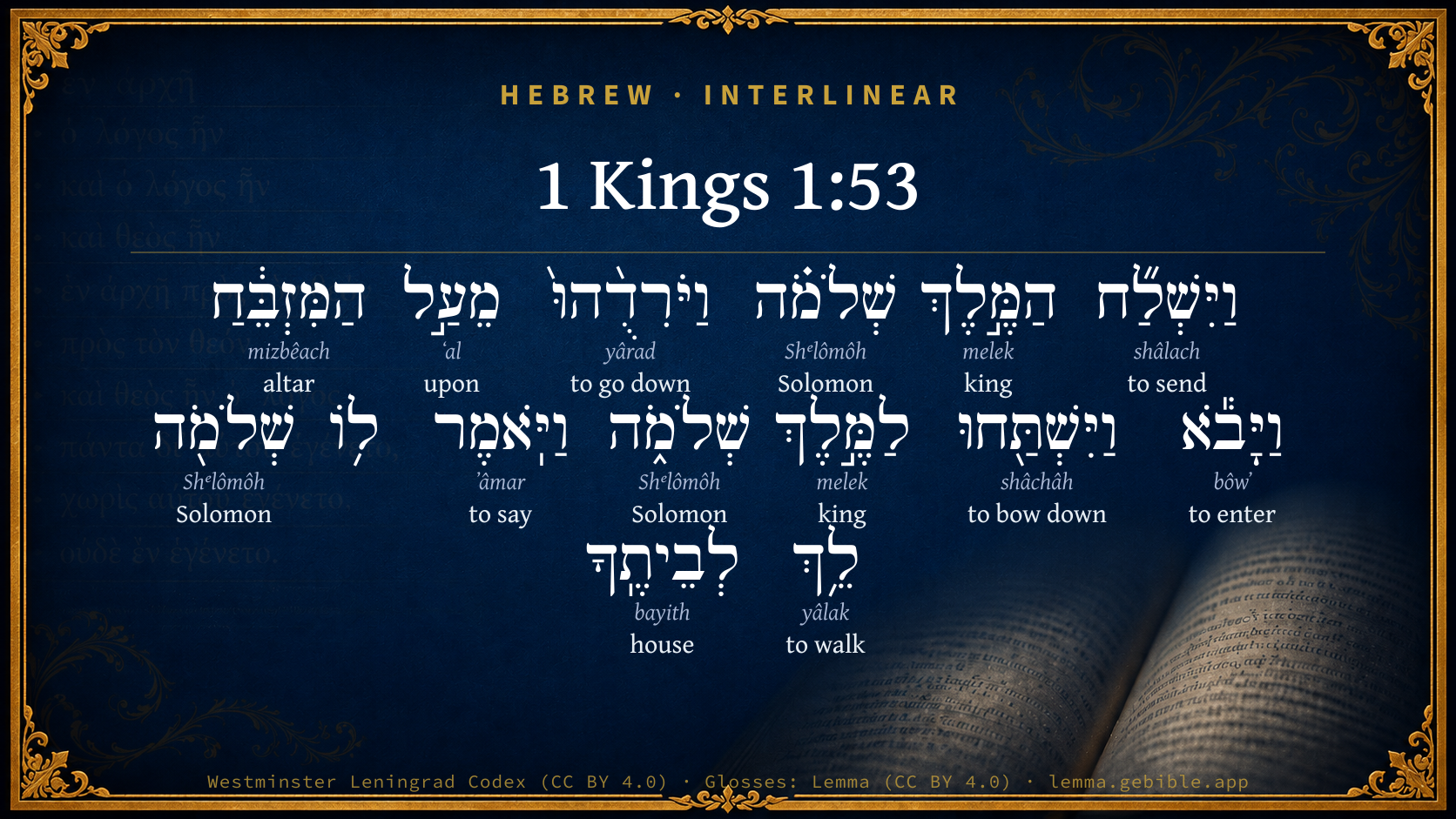
Hebrew (Westminster Leningrad Codex) 1 Kings 1:53 appears in the Hebrew Old Testament. The text above is from the Westminster Leningrad Codex. Each word links to its Strong’s number, a concise gloss, and parsing drawn from the Open Scriptures Hebrew Bible morphology. Click any word for its full Brown-Driver-Briggs (BDB) entry.
Download image
Cite this verse

1 Kings 1:53 (World English Bible). Public Domain. Lemma interlinear Bible study tool, https://lemma.gebible.app/v/1-kings/1/53.

Show BibTeX & RIS
BibTeX
RIS
English Translation
So king Solomon sent, and they brought him down from the altar. He came and did obeisance to king Solomon; and Solomon said to him, Go to your house.
World English Bible · Public Domain
Download a study sheet

One document with this verse’s original text, its word-by-word gloss line, the meaning frame, cross-references with their text, attributed commentary, and full source and license credits — printable, and it pastes into notes with its structure intact.

This verse Autodidact and up

Study sheet (.html) Plain text (.txt)

A passage Seminary Student

Up to 50 verses in one chapter. A passage sheet keeps up to 6 commentary sources and 12 cross-references per verse, in the order this page ranks them, and says so on the sheet whenever that leaves anything out. Ask for a single verse and you get the Autodidact verse sheet above.

Everything on this page stays free to read, with no account — the sheet is a download of what is already on screen, not access to it.

Want to remove ads? Support Godless Engineer
Compare translations 3

The same verse in 3 English versions, stacked beneath the original-language interlinear above. Click any original word for its lexicon entry.

Each is an independent rendering of the whole verse — the interlinear is not word-aligned to these translations.

Highlighted words mark where these versions differ — a whole-verse word diff, not a word-by-word alignment.

  • World English Bible Public Domain
    So king Solomon sent, and they brought him down from the altar. He came and did obeisance to king Solomon; and Solomon said to him, Go to your house.
  • King James Version Public Domain
    So king Solomon sent, and they brought him down from the altar. And he came and bowed himself to king Solomon: and Solomon said unto him, Go to thine house.
  • unfoldingWord Literal Text CC BY-SA 4.0
    And King Solomon sent, and they brought him down from beside the altar. And he came and prostrated himself to King Solomon. And Solomon said to him, “Go to your house.”

unfoldingWord Literal Text — © unfoldingWord, licensed CC BY-SA 4.0. Word-aligned USFM3 via Door43 (git.door43.org/unfoldingWord/en_ult).

Versions to compare (up to 4)

3 of 4 selected

Show all 18 translations

Every available English version of this verse, each an independent rendering of the whole verse.

  • World English Bible Public Domain
    So king Solomon sent, and they brought him down from the altar. He came and did obeisance to king Solomon; and Solomon said to him, Go to your house.
  • Berean Standard Bible Public Domain
    So King Solomon summoned Adonijah down from the altar, and he came and bowed down before King Solomon, who said to him, “Go to your home.”
  • Majority Standard Bible Public Domain
    So King Solomon summoned Adonijah down from the altar, and he came and bowed down before King Solomon, who said to him, “Go to your home.”
  • King James Version Public Domain
    So king Solomon sent, and they brought him down from the altar. And he came and bowed himself to king Solomon: and Solomon said unto him, Go to thine house.
  • American Standard Version (1901) Public Domain
    So king Solomon sent, and they brought him down from the altar. And he came and did obeisance to king Solomon; and Solomon said unto him, Go to thy house.
  • Revised Version (1885) Public Domain
    So king Solomon sent, and they brought him down from the altar. And he came and did obeisance to king Solomon: and Solomon said unto him, Go to thine house.
  • Geneva Bible (1599) Public Domain
    Then King Salomon sent, and they brought him from the altar, and he came and did obeisance vnto King Salomon. And Salomon sayde vnto him, Go to thine house.
  • Douay-Rheims (1899) Public Domain
    Then king Solomon sent, and brought him out from the altar: and going in he worshipped king Solomon: and Solomon said to him: Go to thy house.
  • Young's Literal Translation Public Domain
    And king Solomon sendeth, and they bring him down from off the altar, and he cometh in and boweth himself to king Solomon, and Solomon saith to him, `Go to thy house.'
  • Literal Standard Version CC BY-SA 4.0
    And King Solomon sends, and they bring him down from off the altar, and he comes in and bows himself to King Solomon, and Solomon says to him, “Go to your house.”
  • Unlocked Literal Bible CC BY-SA 4.0
    So King Solomon sent men, who brought Adonijah down from the altar. He came and bowed down to King Solomon, and Solomon said to him, “Go to your house.”
  • unfoldingWord Literal Text CC BY-SA 4.0
    And King Solomon sent, and they brought him down from beside the altar. And he came and prostrated himself to King Solomon. And Solomon said to him, “Go to your house.”
  • Darby Bible Public Domain
    And king Solomon sent, and they brought him down from the altar. And he came and bowed himself to king Solomon; and Solomon said to him, Go to thy house.
  • World Messianic Bible Public Domain
    So King Solomon sent, and they brought him down from the altar. He came and bowed down to King Solomon; and Solomon said to him, “Go to your house.”
  • Webster's Bible Public Domain
    So king Solomon sent, and they brought him down from the altar. And he came and bowed himself to king Solomon: and Solomon said to him, Go to thy house.
  • Free Bible Version CC BY-SA 4.0
    King Solomon had Adonijah brought down from the altar, and he came and bowed down before King Solomon, who told him, “Go home.”
  • Bible in Basic English Public Domain
    So King Solomon sent, and they took him down from the altar. And he came and gave honour to King Solomon; and Solomon said to him, Go to your house.
  • JPS Tanakh (1917) Public Domain
    So king Solomon sent, and they brought him down from the altar. And he came and prostrated himself before king Solomon; and Solomon said unto him: 'Go to thy house.'

Literal Standard Version (2020), Covenant Press — licensed CC BY-SA 4.0. Text via the HelloAO Bible API (eBible.org). Unlocked Literal Bible (unfoldingWord) — licensed CC BY-SA 4.0. Text via the HelloAO Bible API (eBible.org). unfoldingWord Literal Text — © unfoldingWord, licensed CC BY-SA 4.0. Word-aligned USFM3 via Door43 (git.door43.org/unfoldingWord/en_ult). Free Bible Version, Dr. Jonathan Gallagher — licensed CC BY-SA 4.0. Text via the HelloAO Bible API (eBible.org).

Word by word

More ways to search: Search by grammar → Find every occurrence → Compare this word →

Practice this passage: Drill this verse → Learn its vocabulary →

וַיִּשְׁתַּ֖חוּ
shâchâh
H7812
“and · to bow down”
Conjunction + Verb, Hithpael, Sequential Imperfect, 3rd Person, Masculine, Singular
Part of Speech
Conjunction + Verb
Stem
Hithpael
Form
Sequential Imperfect
Person
3rd Person
Gender
Masculine
Number
Singular
Full BDB Definition

Origin: a primitive root

TWOT: 2360

to bow down - (Qal) to bow down - (Hiphil) to depress (figuratively) - (Hithpael) - to bow down, prostrate oneself - before superior in homage - before God in worship - before false gods - before angel
  1. וַיִּשְׁלַ֞ח shâlach H7971 “and · to send” Conjunction + Verb, Qal, Sequential Imperfect, 3rd Person, Masculine, Singular
  2. הַמֶּ֣לֶךְ melek H4428 “the · king” Particle, Definite Article + Noun, Common, Masculine, Singular, Absolute
  3. שְׁלֹמֹ֗ה Shᵉlômôh H8010 “Solomon” Noun, Proper
  4. וַיֹּרִדֻ֨הוּ֙ yârad H3381 “and · to go down · him” Conjunction + Verb, Hiphil, Sequential Imperfect, 3rd Person, Masculine, Plural + Suffix, Personal, 3rd Person, Masculine, Singular
  5. מֵעַ֣ל ʻal H5921 “from · upon” Preposition + Preposition
  6. הַמִּזְבֵּ֔חַ mizbêach H4196 “the · altar” Particle, Definite Article + Noun, Common, Masculine, Singular, Absolute
  7. וַיָּבֹ֕א bôwʼ H935 “and · to enter” Conjunction + Verb, Qal, Sequential Imperfect, 3rd Person, Masculine, Singular
  8. לַמֶּ֣לֶךְ melek H4428 “to/for the · king” Preposition, Determined + Noun, Common, Masculine, Singular, Absolute
  9. שְׁלֹמֹ֑ה Shᵉlômôh H8010 “Solomon” Noun, Proper
  10. וַיֹּֽאמֶר ʼâmar H559 “and · to say” Conjunction + Verb, Qal, Sequential Imperfect, 3rd Person, Masculine, Singular
  11. שְׁלֹמֹ֖ה Shᵉlômôh H8010 “Solomon” Noun, Proper
  12. לֵ֥ךְ yâlak H3212 “walk” Verb, Qal, Imperative, 2nd Person, Masculine, Singular
  13. לְבֵיתֶֽךָ bayith H1004 “to/for · house · your” Preposition + Noun, Common, Masculine, Singular, Construct + Suffix, Personal, 2nd Person, Masculine, Singular

About this verse

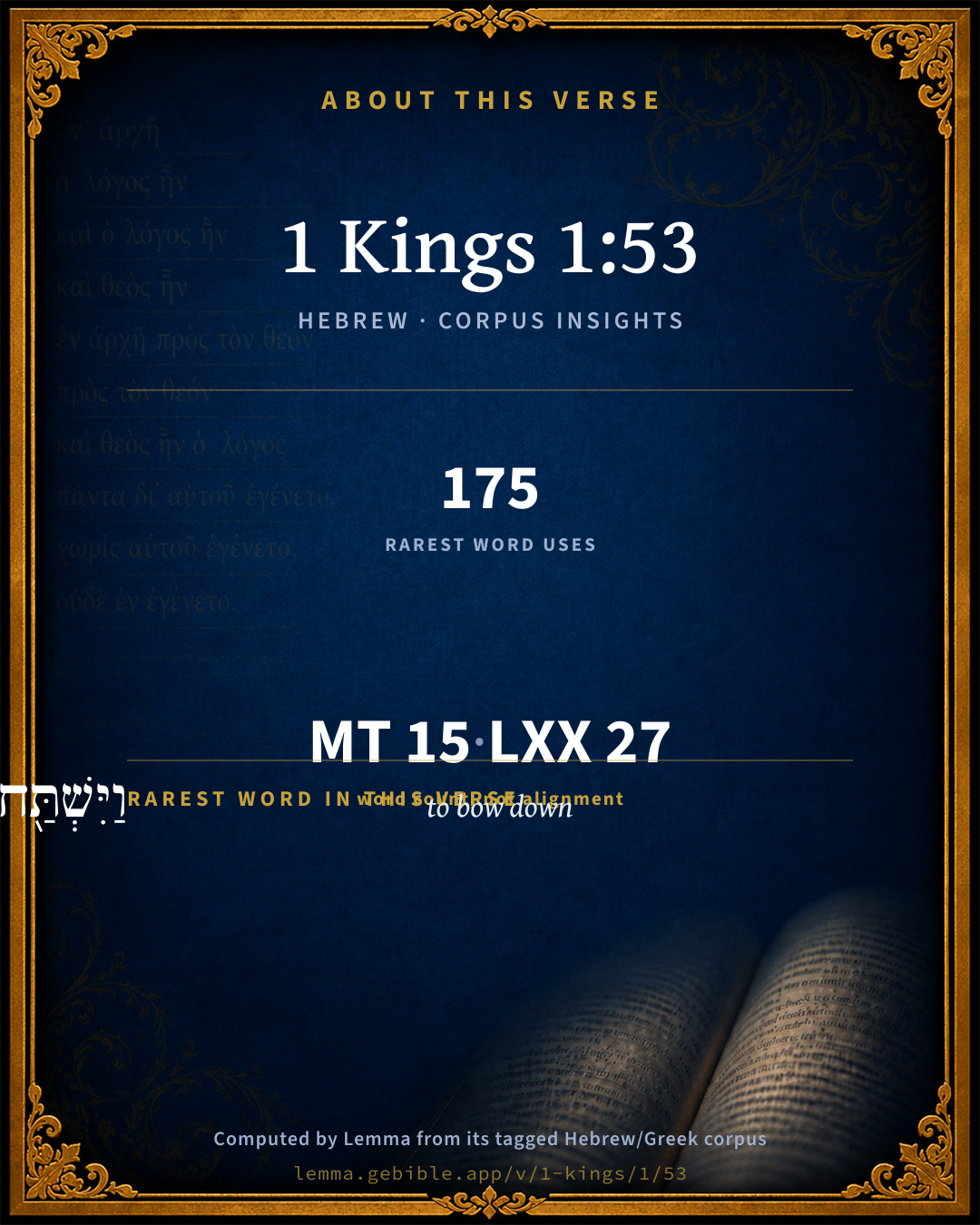
These counts appear in no published source. They are computed here, from the morphology-tagged text and Lemma’s own curated glosses. What Lemma adds →

15
words
11
distinct lemmas
Historical
section

Grammatical profile

  • 6 verbs
  • 7 nouns
  • 2 prepositions

Verb forms

  • וַיִּשְׁלַ֞ח Qal · Sequential Imperfect
  • וַיֹּרִדֻ֨הוּ֙ Hiphil · Sequential Imperfect
  • וַיָּבֹ֕א Qal · Sequential Imperfect
  • וַיִּשְׁתַּ֖חוּ Hithpael · Sequential Imperfect
  • וַיֹּֽאמֶר Qal · Sequential Imperfect
  • לֵ֥ךְ Qal · Imperative

Repetition

Words recur within this verse — often emphatic in Hebrew:

  • שְׁלֹמֹ֗ה Solomon H8010 ×3
  • הַמֶּ֣לֶךְ king H4428 ×2

Hebrew & Septuagint length

In English translation the verse runs 29 words from the Hebrew and 31 from the Septuagint (LXX English) — closely comparable.

A rough comparison of the two English renderings, which tokenize alike — not a word-level alignment.

Word counts can differ between the Hebrew and the Greek without any difference in meaning — e.g. the Hebrew direct-object marker אֵת has no separate Greek word, and Greek often adds the article ὁ.

In the original languages it is 15 Hebrew tokens and 27 Greek tokens — but the two are counted differently (Hebrew bundles its prefixes and suffixes into one token; the Greek is in lemma form), so that isn’t a like-for-like length.

Cross-references

7

Topical passages linked to 1 Kings 1:53 in the Treasury of Scripture Knowledge — connected by theme and wording, ordered by reader-vote popularity; previews shown in the World English Bible.

  • 2 Samuel 1:2 it happened on the third day, that behold, a man came out of the camp from Saul, with his clothes torn, and earth on his head: and so it was, when he came to David, that he fell to the earth, and did obeisance.
  • 2 Samuel 14:24 The king said, Let him turn to his own house, but let him not see my face. So Absalom turned to his own house, and didn't see the king's face.
  • 2 Samuel 14:28 Absalom lived two full years in Jerusalem; and he didn't see the king's face.
  • 1 Kings 1:16 Bathsheba bowed, and did obeisance to the king. The king said, What would you?
  • 1 Kings 1:31 Then Bathsheba bowed with her face to the earth, and did obeisance to the king, and said, Let my lord king David live forever.
  • 1 Kings 2:36 The king sent and called for Shimei, and said to him, Build yourself a house in Jerusalem, and dwell there, and don't go forth from there any where.
  • Proverbs 24:21 My son, fear Yahweh and the king. Don't join those who are rebellious:

Cross-references courtesy of OpenBible.info (CC BY 4.0).

Hebrew and Greek witnesses Masoretic Hebrew ↔ Greek Septuagint

The same verse in the two great witnesses to the Old Testament, shown verse-for-verse.

These are two independent witnesses, not word-aligned to each other, and the Septuagint is shown in lemma (dictionary) form.

Hebrew 1 Kings 1:53 Masoretic · Westminster Leningrad Codex

וַיִּשְׁלַ֞ח הַמֶּ֣לֶךְ שְׁלֹמֹ֗ה וַיֹּרִדֻ֨הוּ֙ מֵעַ֣ל הַמִּזְבֵּ֔חַ וַיָּבֹ֕א וַיִּשְׁתַּ֖חוּ לַמֶּ֣לֶךְ שְׁלֹמֹ֑ה וַיֹּֽאמֶר ל֥וֹ שְׁלֹמֹ֖ה לֵ֥ךְ לְבֵיתֶֽךָ

So king Solomon sent, and they brought him down from the altar. He came and did obeisance to king Solomon; and Solomon said to him, Go to your house.

World English Bible · Public Domain

Greek LXX 1 Kings 1:53 Septuagint · lemma form

καί ἀποστέλλω ὁ βασιλεύς σαλωμών καί καταφέρω αὐτός ἀπάνωθεν ὁ θυσιαστήριον καί εἰςἔρχομαι καί προςκυνέω ὁ βασιλεύς σαλωμών καί εἶπον αὐτός σαλωμών δεῦρο εἰς ὁ οἶκος σύ

And king Solomon sent, and they brought him away from the altar; and he went in and did obeisance to king Solomon: and Solomon said to him, Go to your house.

LXX2012 (modern English Septuagint) · Public Domain

Hebrew: Westminster Leningrad Codex (CC BY 4.0). Greek: Septuagint (public domain); English from LXX2012 (modern English Septuagint) (Public Domain). How the Septuagint differs from the Hebrew →

Targum (Aramaic paraphrase)

1

The Targum is the ancient Jewish Aramaic paraphrase of the Hebrew Scriptures — an interpretive translation, not the Hebrew text itself. Onkelos (literal) and Pseudo-Jonathan (expansive) render the Torah, and Jonathan the Prophets. Coverage is partial: where no permissively-licensed English translation exists for a verse, only the Aramaic is shown. This is verse-level text, not a word-by-word alignment to the Hebrew.

  1. Targum Jonathan Prophets (Joshua–Malachi)
    וּשְׁלַח מַלְכָּא שְׁלֹמֹה וְאַחֲתוּהִי מֵעִלַוֵי מַדְבְּחָא וַאֲתָא וּסְגִיד לְמַלְכָּא שְׁלֹמֹה וַאֲמַר לֵיהּ שְׁלֹמֹה אֱזִיל לְבֵיתָךְ:

    (no public-domain English translation for this verse)

    Targum Jonathan — Aramaic: “Mikraot Gedolot” (public domain). English: “Sefaria Community Translation” (CC0 1.0 (public-domain dedication)); “London "Chaldee Paraphrase," 1871” (public domain). Text via Sefaria.

Commentary

Notes on 1 Kings 1:53 from classic Christian and Jewish commentators (each source and its license shown beneath its notes). The classic Christian expositions comment on the surrounding passage and are grouped to its opening verse, so a note may address several verses; the Jewish commentaries on the Tanakh (Rashi and others) are per-verse, so they appear only where the commentator wrote on this verse.

Lemma curates 59 commentaries, every one of them public domain or Creative Commons licensed, each selected and text-cleaned for this edition rather than reprinted as found. About our sources →

Trapp's Complete Commentary

John Trapp

1Ki 1:53 So king Solomon sent, and they brought him down from the altar. And he came and bowed himself to king Solomon: and Solomon said unto him, Go to thine house.

Ver. 53. Go to thine house.] Meddle not with state matters, but mind thine own affairs; Res tuas age, intra tuam pelliculam te contine.

“ Vivo tibi, quantumque potes praelustria vita. ”

John Trapp, A Commentary or Exposition upon All the Books of the Old and New Testament (1647–1656) — public domain. Text from a community e-Sword module.

Jamieson, Fausset & Brown

Robert Jamieson, A. R. Fausset & David Brown

they brought him down from the altar--from the ledge around the altar on which he was standing.

he bowed himself--that is, did homage to Solomon as king.

Next: 1 Kings Chapter 2

Jamieson, Fausset & Brown — Commentary Critical and Explanatory on the Whole Bible (1871) — public domain (CC PDM 1.0). Text via the HelloAO Bible API.

Adam Clarke's Commentary

Verse 53. Go to thine house.] Intimating that he should have no place about the king's person, nor under the government. Adonijah must have seen that he stood continually on his good behaviour.

Friar Bacon's method of restoring and strengthening the Natural Heat

"I have read many volumes of the wise: I find few things in physic which restore the natural heat, weakened by dissolution of the innate moisture, or increase of a foreign one.

"But certain wise men have tacitly made mention of some medicine, which is likened to that which goes out of the mine of the noble animal. They affirm that in it there is a force and virtue which restores and increases the natural heat. As to its disposition, they say it is like youth itself, and contains an equal and temperate complexion.

"And the signs of a temperate complexion in men are when their colour is made up of white and red, when the hair is yellow, inclined to redness and curling.

"This medicine indeed is like to such a complexion, for it is of a temperate heat: its flame is temperate and sweet, and grateful to the smell. When it departs from this temperature, it departs so far from its virtue and goodness.

"This medicine therefore temperately heats, because it is temperately hot; it therefore heals because it is whole. When it is sick, it makes a man sick; when it is distempered, it breeds distempers, and changes the body to its own disposition, because of the similitude it has with the body.

"For the infirmity of a brute animal rarely passes into a man, but into another animal of the same kind; but the infirmity of man passes into man; and so does health, because of likeness.

"This thing is seldom found; and although sometimes it be found, yet it cannot commodiously be had of all men.

"Now, when this thing is like to youth, that is, of temperate complexion, it has good operations; if its temperature be better, it produces better effects: sometimes it is even in the highest degree of its perfection, and then it operates best; and then there is that property whereof we have spoken before.

"This differs from other medicines and nutriments, which heat and moisten after a certain temperate manner, and are good for old men. For other medicines principally heat and moisten the body; and, secondarily, they strengthen the native heat, and after that refresh the body, by moistening and heating it. For it brings back this heat in old men, who have it but weakly and deficient, to a certain stronger and more vehement power.

"If a plaster be made hereof, and applied to the stomach, it will help very much, for it will refresh the stomach itself, and excite an appetite; it will very much recreate an old man, and change him to a kind of youth; and will make complexions, by what means soever depraved or corrupted, better. But it is to be observed, that Venus doth weaken and diminish the power and virtue of this thing!

"And it is very likely that the son of the prince, in his second canon of the Operations of Simple Medicines spoke of this thing, where he saith, that there is a certain medicine, concealed by wise men, lest the incontinent should offend their Creator. There is such a heat in this thing, as is in young men of sound complexion; and if I durst declare the properties of this heat, this most hidden secret should presently be revealed. For this heat doth help the palsical, it restores and preserves the wasted strength of the native heat, and causeth it to flourish in all the members, and gently revives the aged.

"But the simple medicine which restores the native heat, when wasted and weakened, is that which is likened to the complexion of a healthy young man."

All this covered and enigmatical description is intended simply to point out that very medicine recommended by the Jewish physicians to restore and invigorate the dying king. I could show the bearing of every sentence, but I must leave something to the good sense of my readers. By attending to the words in italics, the sense will be more easily discovered. See Clarke on Ru 4:16.

Adam Clarke's Commentary on the Bible (1810–1826) — public domain. Text from a community e-Sword/MySword module.

The Cambridge Bible for Schools and Colleges

gen. ed. J. J. S. Perowne

53. and they brought him down from the altar] The expression refers perhaps to the steps on which Adonijah must have gone up to cling to the sides of the altar, or it may be to the elevation of the whole situation as the altar stood before the ark on Mt. Zion.

bowed himself] The same word as in 47 is used of David’s religious reverence. So Adonijah did homage to Solomon as his lord; and by pardoning the chief offender the new king shewed the rest of Adonijah’s adherents that they need not despair of forgiveness. Thus he would be most likely to change them from foes to friends.

The Cambridge Bible for Schools and Colleges (gen. ed. J. J. S. Perowne; Cambridge University Press, 1878–1918) — public domain. Text from a community e-Sword module.

John Gill's Exposition

So King Solomon sent, and they brought down Adonijah from the altar,.... It being built upon an hill, as both that at Gibeon, and in Araunah's threshing floor, were:

and he came and bowed himself to King Solomon; in a way of reverence and subjection, acknowledging him to be king, and himself his subject:

and Solomon said to him, go to thine house; in peace; signifying that he pardoned him, and he might go home, and enjoy his family and substance; and by this intimating that he should only regard the affairs of his family, and not trouble himself with those of the kingdom and state, Abarbinel fancies, that because Solomon said, that if he showed himself to be a worthy man, or a man of fortitude and valour, that Adonijah thought that his meaning was, that he should go before him as a man of war, and minister to him; which made him so ready to come and stand before him; in which he was mistaken, Solomon meant no such thing; nor would he take him into his court and service, but sent him home to his own house.

Next: 1 Kings Chapter 2

John Gill's Exposition of the Whole Bible (1746–1763) — public domain (CC PDM 1.0). Text via the HelloAO Bible API.

Haydock's Catholic Bible Commentary

House. He does not forbid him the court, but grants him pardon. (Menochius)

George Leo Haydock (1774–1849), Haydock's Catholic Family Bible and Commentary, 1859 edition — public domain. Excludes Psalms (Douay-Rheims chapter numbering differs from Protestant) and Deuterocanonical books (Catholic canon only).

Matthew Poole's English Annotations

Lead a private or retired and quiet life, without noise and numerous attendants, and meddle not with the affairs of the court and kingdom.

Matthew Poole's English Annotations on the Holy Bible (1683–1685) — public domain. Text from a community e-Sword/MySword module.

The Pulpit Commentary

So King Solomon sent and they brought him down The altar was elevated: probably a slope, not steps (Exo_20:26) led to it from Hebrew from upon. He was still clinging to it the altar. And he came and bowed himself to king Solomon i.e. , made obeisance to him as king. Cf. vers. 16, 23, 31 and Solomon said unto him, Go to thine house. This was not a sentence of banishment from court, but merely a dismissal to a private life, involving a tacit admonition to live quietly and be thankful that his life was spared him. Vade in domum tuam, ibi quiesce et res tuas age, nec te publicis regni mei negotiis immisceas" (Corn. A Lapide).

The Pulpit Commentary (1880–1919), ed. H.D.M. Spence-Jones & Joseph S. Exell — public domain. Text from a community e-Sword module.

John Wesley's Explanatory Notes

Go to thine house - Lead a private life, without noise and numerous attendants, and meddle not with the affairs of the kingdom.

John Wesley, Explanatory Notes Upon the Whole Bible (1754–1765) — public domain. Text via the GEBible commentary corpus.

Keil & Delitzsch

C. F. Keil & F. Delitzsch

He then had him fetched down from the altar (הוריד( ratl, inasmuch as the altar stood upon an eminence); and when he fell down before the king, i.e., did homage to him as king, he gave him his life and freedom in the words, "Go to thy house." The expression לביתך לך does not imply his banishment from the court (compare Kg1 2:13 and Sa2 14:24). Solomon did not wish to commence his own ascent of the throne by infliction of punishment, and therefore presented the usurper with his life on the condition that he kept himself quiet.

Keil & Delitzsch — Biblical Commentary on the Old Testament (1861–1891) — public domain (CC PDM 1.0). Text via the HelloAO Bible API. (Old Testament only.)

Lesson kit

Teaching starters — assembled from the data on this page, not authored interpretation. Every prompt links to the verse data it draws on. Edit before teaching.

1 Kings, in the Historical, opens this verse with 15 words (11 distinct Hebrew lemmas). Its most distinctive word is shâchâh (“to bow down”). A historical commentator’s framing appears above. Read the whole chapter for the surrounding context.

Discussion questions

  1. The word shâchâh carries the sense “to bow down.” How does it shape the verse?
  2. 2 Samuel 1:2 shares this passage’s theme. How do the two illuminate each other?
  3. “Solomon” occurs 3× in this one verse. What is the effect of the repetition?
  4. These translations render this verse differently. What is at stake in choosing one wording over another?
  5. The verb «וַיִּשְׁלַ֞ח» is Qal Sequential Imperfect. How does its form color the action?
  6. Reading how Trapp's Complete Commentary and Jamieson, Fausset & Brown read this verse, where do the two commentators agree and where do they part?

Things to notice

Reading settings

Reading text

Shown beneath each verse's original-language words.

Old Testament
Old Testament edition

Read the OT as the Masoretic Hebrew (MT) or the Greek Septuagint (LXX).

English shown for the Greek Septuagint (in the Hebrew ↔ Greek comparison).

Comparing translations? Open the Compare panel on any verse page to stack up to four side by side.