
Genesis 27:25

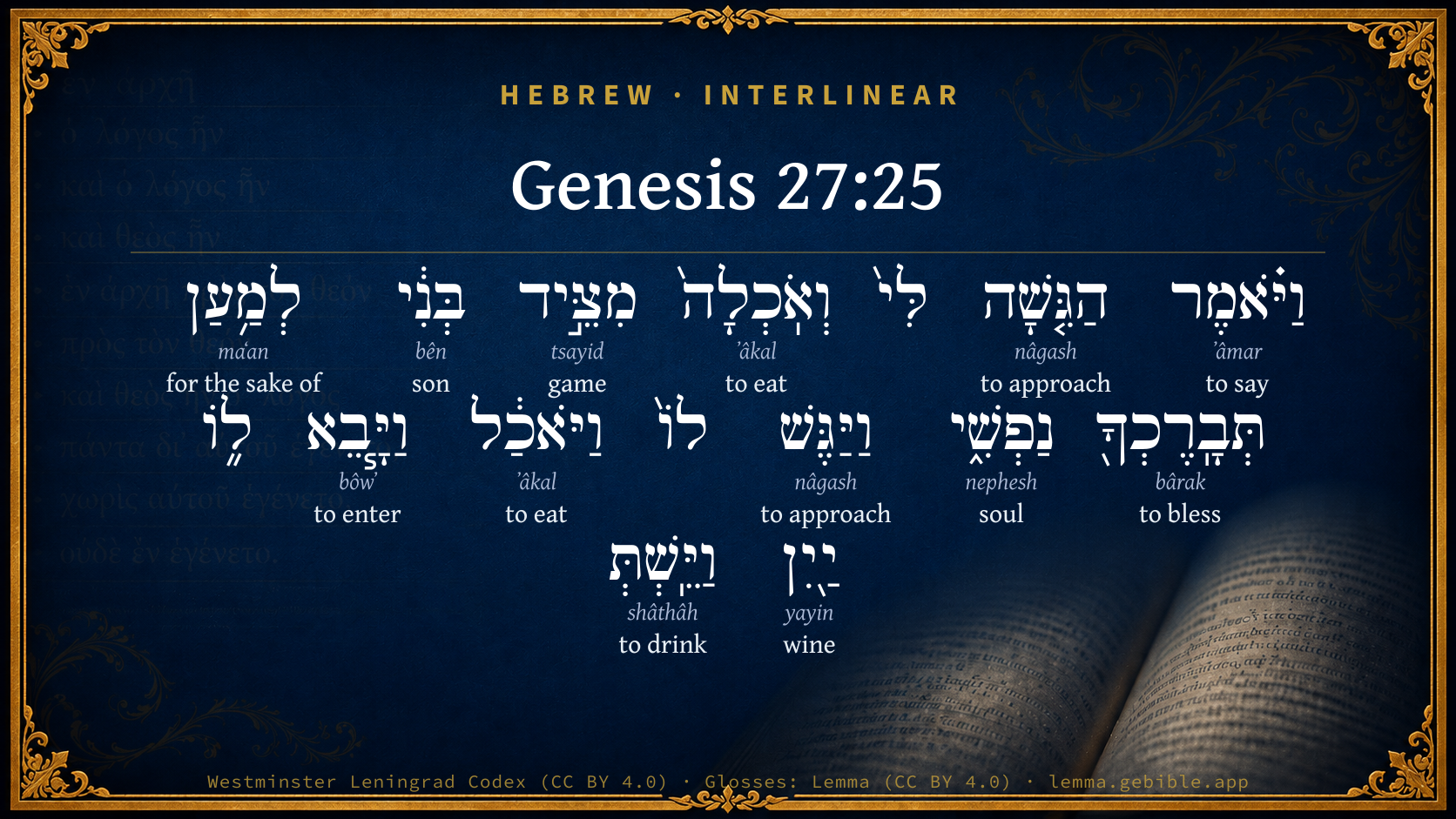
Hebrew (Westminster Leningrad Codex) Genesis 27:25 appears in the Hebrew Old Testament. The text above is from the Westminster Leningrad Codex. Each word links to its Strong’s number, a concise gloss, and parsing drawn from the Open Scriptures Hebrew Bible morphology. Click any word for its full Brown-Driver-Briggs (BDB) entry.
Download image
Cite this verse

Genesis 27:25 (World English Bible). Public Domain. Lemma interlinear Bible study tool, https://lemma.gebible.app/v/genesis/27/25.

Show BibTeX & RIS
BibTeX
RIS
English Translation
He said, "Bring it near to me, and I will eat of my son's venison, that my soul may bless you." He brought it near to him, and he ate. He brought him wine, and he drank.
World English Bible · Public Domain
Download a study sheet

One document with this verse’s original text, its word-by-word gloss line, the meaning frame, cross-references with their text, attributed commentary, and full source and license credits — printable, and it pastes into notes with its structure intact.

This verse Autodidact and up

Study sheet (.html) Plain text (.txt)

A passage Seminary Student

Up to 50 verses in one chapter. A passage sheet keeps up to 6 commentary sources and 12 cross-references per verse, in the order this page ranks them, and says so on the sheet whenever that leaves anything out. Ask for a single verse and you get the Autodidact verse sheet above.

Everything on this page stays free to read, with no account — the sheet is a download of what is already on screen, not access to it.

Want to remove ads? Support Godless Engineer
Compare translations 3

The same verse in 3 English versions, stacked beneath the original-language interlinear above. Click any original word for its lexicon entry.

Each is an independent rendering of the whole verse — the interlinear is not word-aligned to these translations.

Highlighted words mark where these versions differ — a whole-verse word diff, not a word-by-word alignment.

  • World English Bible Public Domain
    He said, "Bring it near to me, and I will eat of my son's venison, that my soul may bless you." He brought it near to him, and he ate. He brought him wine, and he drank.
  • King James Version Public Domain
    And he said, Bring it near to me, and I will eat of my son's venison, that my soul may bless thee. And he brought it near to him, and he did eat: and he brought him wine and he drank.
  • unfoldingWord Literal Text CC BY-SA 4.0
    Then he said, “Bring to me, and I will eat some of my son’s game, so that my soul will bless you.” Then he brought to him, and he ate; and he brought wine to him, and he drank.

unfoldingWord Literal Text — © unfoldingWord, licensed CC BY-SA 4.0. Word-aligned USFM3 via Door43 (git.door43.org/unfoldingWord/en_ult).

Versions to compare (up to 4)

3 of 4 selected

Show all 18 translations

Every available English version of this verse, each an independent rendering of the whole verse.

  • World English Bible Public Domain
    He said, "Bring it near to me, and I will eat of my son's venison, that my soul may bless you." He brought it near to him, and he ate. He brought him wine, and he drank.
  • Berean Standard Bible Public Domain
    “Serve me,” said Isaac, “and let me eat some of my son’s game, so that I may bless you.” Jacob brought it to him, and he ate; then he brought him wine, and he drank.
  • Majority Standard Bible Public Domain
    “Serve me,” said Isaac, “and let me eat some of my son’s game, so that I may bless you.” Jacob brought it to him, and he ate; then he brought him wine, and he drank.
  • King James Version Public Domain
    And he said, Bring it near to me, and I will eat of my son's venison, that my soul may bless thee. And he brought it near to him, and he did eat: and he brought him wine and he drank.
  • American Standard Version (1901) Public Domain
    And he said, Bring it near to me, and I will eat of my son's venison, that my soul may bless thee. And he brought it near to him, and he did eat. And he brought him wine, and he drank.
  • Revised Version (1885) Public Domain
    And he said, Bring it near to me, and I will eat of my son’s venison, that my soul may bless thee. And he brought it near to him, and he did eat: and he brought him wine, and he drank.
  • Geneva Bible (1599) Public Domain
    Then said he, Bring it me hither, and I will eate of my sonnes venison, that my soule may blesse thee. And he brought it to him, and he ate: also he brought him wine, and he dranke.
  • Douay-Rheims (1899) Public Domain
    Then he said: Bring me the meats of thy hunting, my son, that my soul may bless thee. And when they were brought, and he had eaten, he offered him wine also, which after he had drunk,
  • Young's Literal Translation Public Domain
    And he saith, `Bring nigh to me, and I do eat of my son's provision, so that my soul doth bless thee;' and he bringeth nigh to him, and he eateth; and he bringeth to him wine, and he drinketh.
  • Literal Standard Version CC BY-SA 4.0
    And he says, “Bring [it] near to me, and I eat of my son’s game, so that my soul blesses you”; and he brings [it] near to him, and he eats; and he brings wine to him, and he drinks.
  • Unlocked Literal Bible CC BY-SA 4.0
    Isaac said, “Bring the food to me, and I will eat of your game, so that I may bless you.” Jacob brought the food to him. Isaac ate, and Jacob brought him wine, and he drank.
  • unfoldingWord Literal Text CC BY-SA 4.0
    Then he said, “Bring to me, and I will eat some of my son’s game, so that my soul will bless you.” Then he brought to him, and he ate; and he brought wine to him, and he drank.
  • Darby Bible Public Domain
    And he said, Bring [it] near to me, that I may eat of my son's venison, in order that my soul may bless thee. And he brought [it] near to him, and he ate; and he brought him wine, and he drank.
  • World Messianic Bible Public Domain
    He said, “Bring it near to me, and I will eat of my son’s venison, that my soul may bless you.” He brought it near to him, and he ate. He brought him wine, and he drank.
  • Webster's Bible Public Domain
    And he said, bring it near to me, and I will eat of my son's venison, that my soul may bless thee. And he brought it near to him, and he ate: and he brought him wine, and he drank.
  • Free Bible Version CC BY-SA 4.0
    Then he said, “My son, bring me some of your wild game to eat, so that I may give you my blessing.” Jacob brought some for him to eat, as well as some wine for him to drink.
  • Bible in Basic English Public Domain
    And he said, Put it before me and I will take of my son's meat, so that I may give you a blessing. And he put it before him and he took it; and he gave him wine, and he had a drink.
  • JPS Tanakh (1917) Public Domain
    And he said: 'Bring it near to me, and I will eat of my son's venison, that my soul may bless thee.' And he brought it near to him, and he did eat; and he brought him wine, and he drank.

Literal Standard Version (2020), Covenant Press — licensed CC BY-SA 4.0. Text via the HelloAO Bible API (eBible.org). Unlocked Literal Bible (unfoldingWord) — licensed CC BY-SA 4.0. Text via the HelloAO Bible API (eBible.org). unfoldingWord Literal Text — © unfoldingWord, licensed CC BY-SA 4.0. Word-aligned USFM3 via Door43 (git.door43.org/unfoldingWord/en_ult). Free Bible Version, Dr. Jonathan Gallagher — licensed CC BY-SA 4.0. Text via the HelloAO Bible API (eBible.org).

Word by word

More ways to search: Search by grammar → Find every occurrence → Compare this word →

Practice this passage: Drill this verse → Learn its vocabulary →

מִצֵּ֣יד
tsayid
H6718
“from · game of”
Preposition + Noun, Common, Masculine, Singular, Construct
Part of Speech
Preposition + Noun
Type
Common
Gender
Masculine
Number
Singular
State
Construct
Full BDB Definition

Origin: from a form of H6679 and meaning the same

TWOT: 1885a , 1886a

hunting, game - hunting - game hunted - provision, food - provision, food, food-supply
  1. וַיֹּ֗אמֶר ʼâmar H559 “and · to say” Conjunction + Verb, Qal, Sequential Imperfect, 3rd Person, Masculine, Singular
  2. הַגִּ֤שָׁה nâgash H5066 “approach” Verb, Hiphil, Imperative, 2nd Person, Masculine, Singular + Suffix, h
  3. וְאֹֽכְלָה֙ ʼâkal H398 “and · to eat” Conjunction + Verb, Qal, Cohortative, 1st Person, Common, Singular
  4. בְּנִ֔י bên H1121 “son · my” Noun, Common, Masculine, Singular, Construct + Suffix, Personal, 1st Person, Common, Singular
  5. לְמַ֥עַן maʻan H4616 “for the sake of” Preposition
  6. תְּבָֽרֶכְךָ֖ bârak H1288 “to bless · you” Verb, Piel, Imperfect, 3rd Person, Feminine, Singular + Suffix, Personal, 2nd Person, Masculine, Singular
  7. נַפְשִׁ֑י nephesh H5315 “soul · my” Noun, Common, Both, Singular, Construct + Suffix, Personal, 1st Person, Common, Singular
  8. וַיַּגֶּשׁ nâgash H5066 “and · to approach” Conjunction + Verb, Hiphil, Sequential Imperfect, 3rd Person, Masculine, Singular
  9. וַיֹּאכַ֔ל ʼâkal H398 “and · to eat” Conjunction + Verb, Qal, Sequential Imperfect, 3rd Person, Masculine, Singular
  10. וַיָּ֧בֵא bôwʼ H935 “and · to enter” Conjunction + Verb, Hiphil, Sequential Imperfect, 3rd Person, Masculine, Singular
  11. יַ֖יִן yayin H3196 “wine” Noun, Common, Masculine, Singular, Absolute
  12. וַיֵּֽשְׁתְּ shâthâh H8354 “and · to drink” Conjunction + Verb, Qal, Sequential Imperfect, 3rd Person, Masculine, Singular

About this verse

These counts appear in no published source. They are computed here, from the morphology-tagged text and Lemma’s own curated glosses. What Lemma adds →

16
words
11
distinct lemmas
Pentateuch
section

Notable vocabulary

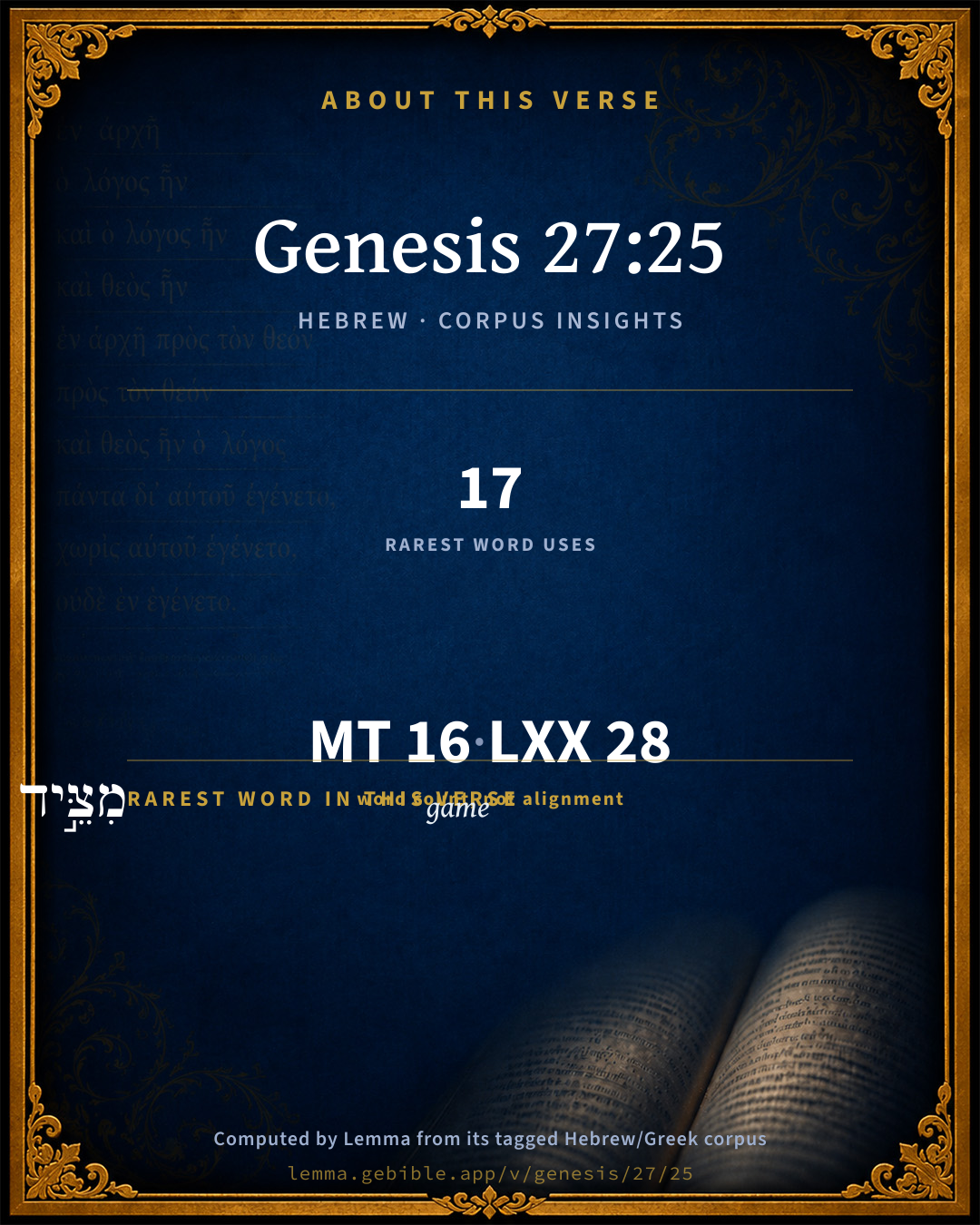
The rarest word here is מִצֵּ֣יד game H6718 — appearing just 17 times in the whole Hebrew Bible.

Shared distinctive vocabulary

מִצֵּ֣יד game H6718 occurs in 16 verses of the Hebrew Bible. Also found in:

Grammatical profile

  • 8 verbs
  • 4 nouns
  • 4 prepositions

Verb forms

  • וַיֹּ֗אמֶר Qal · Sequential Imperfect
  • הַגִּ֤שָׁה Hiphil · Imperative
  • וְאֹֽכְלָה֙ Qal · Cohortative
  • תְּבָֽרֶכְךָ֖ Piel · Imperfect
  • וַיַּגֶּשׁ Hiphil · Sequential Imperfect
  • וַיֹּאכַ֔ל Qal · Sequential Imperfect
  • וַיָּ֧בֵא Hiphil · Sequential Imperfect
  • וַיֵּֽשְׁתְּ Qal · Sequential Imperfect

Repetition

Words recur within this verse — often emphatic in Hebrew:

  • הַגִּ֤שָׁה to approach H5066 ×2
  • וְאֹֽכְלָה֙ to eat H398 ×2

Hebrew & Septuagint length

In English translation the verse runs 37 words from the Hebrew and 37 from the Septuagint (LXX English) — the same length.

A rough comparison of the two English renderings, which tokenize alike — not a word-level alignment.

Word counts can differ between the Hebrew and the Greek without any difference in meaning — e.g. the Hebrew direct-object marker אֵת has no separate Greek word, and Greek often adds the article ὁ.

In the original languages it is 16 Hebrew tokens and 28 Greek tokens — but the two are counted differently (Hebrew bundles its prefixes and suffixes into one token; the Greek is in lemma form), so that isn’t a like-for-like length.

Cross-references

1

Topical passages linked to Genesis 27:25 in the Treasury of Scripture Knowledge — connected by theme and wording, ordered by reader-vote popularity; previews shown in the World English Bible.

  • Genesis 27:4 Make me savory food, such as I love, and bring it to me, that I may eat, and that my soul may bless you before I die."

Cross-references courtesy of OpenBible.info (CC BY 4.0).

Hebrew and Greek witnesses Masoretic Hebrew ↔ Greek Septuagint

The same verse in the two great witnesses to the Old Testament, shown verse-for-verse.

These are two independent witnesses, not word-aligned to each other, and the Septuagint is shown in lemma (dictionary) form.

Hebrew Genesis 27:25 Masoretic · Westminster Leningrad Codex

וַיֹּ֗אמֶר הַגִּ֤שָׁה לִּי֙ וְאֹֽכְלָה֙ מִצֵּ֣יד בְּנִ֔י לְמַ֥עַן תְּבָֽרֶכְךָ֖ נַפְשִׁ֑י וַיַּגֶּשׁ לוֹ֙ וַיֹּאכַ֔ל וַיָּ֧בֵא ל֦וֹ יַ֖יִן וַיֵּֽשְׁתְּ

He said, "Bring it near to me, and I will eat of my son's venison, that my soul may bless you." He brought it near to him, and he ate. He brought him wine, and he drank.

World English Bible · Public Domain

Greek LXX Genesis 27:25 Septuagint · lemma form

καί εἶπον προςἄγω ἐγώ καί ἐσθίω ἀπό ὁ θήρα σύ τέκνον ἵνα εὐλογέω σύ ὁ ψυχή ἐγώ καί προςἄγω αὐτός καί ἐσθίω καί εἰςφέρω αὐτός οἶνος καί πίνω

And he said, Bring hither, and I will eat of your venison, son, that my soul may bless you; and he brought it near to him, and he ate, and he brought him wine, and he drank.

LXX2012 (modern English Septuagint) · Public Domain

Hebrew: Westminster Leningrad Codex (CC BY 4.0). Greek: Septuagint (public domain); English from LXX2012 (modern English Septuagint) (Public Domain). How the Septuagint differs from the Hebrew →

Targum (Aramaic paraphrase)

2

The Targum is the ancient Jewish Aramaic paraphrase of the Hebrew Scriptures — an interpretive translation, not the Hebrew text itself. Onkelos (literal) and Pseudo-Jonathan (expansive) render the Torah, and Jonathan the Prophets. Coverage is partial: where no permissively-licensed English translation exists for a verse, only the Aramaic is shown. This is verse-level text, not a word-by-word alignment to the Hebrew.

  1. Targum Onkelos Torah (Genesis–Deuteronomy)
    וַאֲמַר קָרֵיב קֳדָמַי וְאֵיכוּל מִצֵידָא דִּבְרִי בְּדִיל דִּי תְבָרְכִנָּךְ נַפְשִׁי וְקָרֵיב לֵהּ וַאֲכַל וְאַיְתִי (נ''י וְאָעֵל) לֵהּ חַמְרָא וּשְׁתִי

    (no public-domain English translation for this verse)

    Targum Onkelos — Aramaic: “Onkelos Genesis” (public domain); “Onkelos Exodus” (public domain); “Onkelos Leviticus” (public domain); “Onkelos Numbers” (public domain); “Onkelos Deuteronomy” (public domain). English: “Sefaria Community Translation” (CC0 1.0 (public-domain dedication)); “J.W. Etheridge. The Targums of Onkelos and Jonathan Ben Uzziel on the Pentateuch. London: Longmans, Green, 1862” (public domain). Text via Sefaria.

  2. Targum Pseudo-Jonathan Torah (Genesis–Deuteronomy)
    וַאֲמַר קָרֵיב לִי וְאֵיכוֹל מִצֵידָא דִבְרִי בְּגִין תְּבָרְכִינָךְ נַפְשִׁי וְקָרֵיב לֵיהּ וְאָכַל וְלָא הֲוָה חַמְרָא גַבֵּיהּ וְאִזְדַמֵן לֵיהּ מַלְאָכָא וְאַיְיתִי מִן חַמְרָא דְאִצְטִנַע בְּעִינְבוֹיֵי מִן יוֹמֵי שֵׁירוּי עַלְמָא וְיַהֲבֵיהּ בְּיַד יַעֲקב וְיַעֲקב אַמְטֵי לֵיהּ לְאָבוּי וּשְׁתִי

    And he said, Draw near, and I will eat of my son's venison, that my soul may bless thee. And he approached him, and he ate; and he had no wine; but an angel prepared it for him, from the wine which had been kept in its grapes from the days of the beginning of the world; and he gave it into Jakob's hand, and Jakob brought it to his father, and he drank.

    Targum Pseudo-Jonathan — Aramaic: “Targum Jonathan on Genesis” (public domain); “Targum Jonathan on Exodus” (public domain); “Targum Jonathan on Leviticus” (public domain); “Targum Jonathan on Numbers” (public domain); “Targum Jonathan on Deuteronomy” (public domain). English: “The Targum of Jonathan ben Uzziel, trans. J. W. Etheridge, London, 1862” (public domain). Text via Sefaria.

Commentary

Notes on Genesis 27:25 from classic Christian and Jewish commentators (each source and its license shown beneath its notes). The classic Christian expositions comment on the surrounding passage and are grouped to its opening verse, so a note may address several verses; the Jewish commentaries on the Tanakh (Rashi and others) are per-verse, so they appear only where the commentator wrote on this verse.

Lemma curates 59 commentaries, every one of them public domain or Creative Commons licensed, each selected and text-cleaned for this edition rather than reprinted as found. About our sources →

Trapp's Complete Commentary

John Trapp

Gen 27:25 And he said, Bring [it] near to me, and I will eat of my son’s venison, that my soul may bless thee. And he brought [it] near to him, and he did eat: and he brought him wine, and he drank.

Ver. 25. Bring it near to me.] Divinum consilium dum devitatur, impletur: humana sapientia, dum reluctatur, comprehenditur, saith Gregory. Here Isaac doth unwilling and unwitting justice.

John Trapp, A Commentary or Exposition upon All the Books of the Old and New Testament (1647–1656) — public domain. Text from a community e-Sword module.

The Biblical Illustrator

Joseph S. Exell

Gen_27:25-29

God give thee of the dew of heaven, and the fatness of the earth, and plenty of corn and wine

Isaac blessing Jacob

I.

WITH TEMPORAL BLESSINGS.

1. A fertile soil.

2. Abundance of provision.

3. Political pre-eminence.

II. WITH SPIRITUAL BLESSINGS.

1. The channel of spiritual blessing to mankind.

2. A test of character. (T. H. Leale.)

Isaacs blessing--the parents warning

I. First, we shall consider WHEREIN ISAACS BLESSING CONSISTED.

1. Plenty, heaven and earth combining to enrich the happy possessor.

2. Power, almost unlimited, especially over his own brethren.

3. And last, though not the least, a mighty influence with God and a great interest in the courts of heaven. Cursed be every one that curseth thee, and blessed be he that blesseth thee. Or, in other words, Let God be an enemy to all thy enemies, and a friend to all thy friends.

4. Now these, doubtless, were very desirable mercies, and they belonged, by right, to the first-born; though God was pleased sometimes to revoke that taw, and to transfer these blessings from the elder to the younger, as instanced in the case before us, and also in that of Cain and of Reuben. These, I say, were very desirable mercies, and, when accompanied with the Divine sanction, of untold value. But still, after all, they were but temporary. They lasted only for this life; and Jacob, I doubt not, might have managed very well without any one of them. The blessing of Isaac, therefore, must have comprised something more than what we have here recorded; otherwise we may be well assured that Jacob would never have risked so much to obtain it, nor would his mother ever have placed him in so hazardous and perilous a situation. But the fact is, these temporal blessings were but the shadows of better things to come. They were, to use an apostolic phrase, the substance of things hoped for, the evidence of things not seen. They included all those good things which were more particularly specified to Abraham when God entered into covenant with him. They intimated, for instance, in the first place, that from him should descend the Messiah--He who was to be the Prince of the kings of the earth . . . before whom all nations should come and worship . . . and who was to rule them with a rod of iron, and to break them to shivers as a potters vessel. And, in the second place, that from him also should come the church that was to be specially owned and blessed by God; and consequently we find Isaac, when afterwards confirming the blessing to Jacob, calling it the blessing of Abraham.

II. What were THE MEANS THAT REBEKAH ADOPTED to secure the blessing for her favourite son Jacob. They were little else than a tissue of lies and deceit.

III. Let us now see what LESSONS we may gather up from a contemplation of the whole subject.

1. In the first place, then, it reads a very solemn and affecting warning to parents. It teaches the folly and danger of making invidious distinctions between the different members of your families--of showing an undue partiality for one child more than another. It is a withering curse. It introduces discord and dissension into every family wherever it finds a footing, and it is the fruitful source of all evil, social and moral. Whenever, therefore, you feel its chilling influence beginning to steal over you, oh, remember Rebekah, and in the name and strength of your God shake it from you. Give it no encouragement; or, if you must, keep it to yourself. Let no one else ever see or feel it. In the second place, learn from this subject the way in which our Heavenly Father will have us to seek for His blessing. We must come to Him for it in and through our Elder Brother. We must come clothed in His goodly raiment, even that pure and spotless robe which He wrought for us on Calvary. There is no other way under heaven whereby we can be saved. And if you ask me by what means we are to get this goodly raiment--this pure and spotless righteousness, I answer, simply by asking for it. Ask, says your God and Saviour, and you shall have. And although it cost Him a great price--even His own precious blood--yet He offers it to you without money and without price. Oh, go to Him, then, and ask Him for this precious gift; for the gift of God is eternal life. (E. Harper, B. A.)

Isaac blessing Jacob

1. That parents ought to bless their children; too many do curse, and not bless them.

2. Children ought to fear the causeful curses of their parents. The better son feared the curse of his father (Gen_27:12).

3. Parents ought rather to gather a stock of Divine promises, that they may bless their children more out of faith than out of form, praying for them out of a promise, as Isaac did then for his son Jacob, praying that the blessing of Abraham might come upon him (Gen_28:4).

4. A wishing our childrens weal customarily without a praying for them believingly, is neither enough for parents, nor is it all (or at all) that is warranted by Isaacs blessing Jacob here. There is much difference between a formal wish and a faithful prayer for their good.

5. Spiritual blessings must be sought and sued for in their proper season. Here Esau came too late for the blessing, which was bestowed before he lost the right season (which is a part of time above all other parts, even the shine and lustre of time), so could not obtain it, no, not with tears Heb_12:16-17). (C. Ness.)

The Biblical Illustrator, edited by Joseph S. Exell (c. 1880s–1900s) — public domain. Text from a community e-Sword module.

The Preacher's Complete Homiletical Commentary

Joseph S. Exell (gen. ed.)

CRITICAL NOTES.—

Gen_27:27. And blessed him.] The blessing (Gen_27:27-29) is in the form of poetic parallelism.—

Gen_27:28. The dew of heaven, and the fatness of the earth.] In Palestine these are closely connected. The dews are copious, and make up for the lack of rain during several months of the year. The dew of Hermon, and the dew upon the mountains of Zion are spoken of by the Psalmist as an evidence of the Divine blessing. (Psalms 133; Deu_33:13; Deu_33:28.)—

MAIN HOMILETICS OF THE PARAGRAPH.—Gen_27:25-29

ISAAC BLESSING JACOB

The father is at length satisfied, and expresses his paternal affection by a kiss. He accepts his son’s duty and favour in the providing and preparation of the last solemn meal. He then proceeds to bless his son.

I. With temporal blessings.

1. A fertile soil. To him was promised “the fatness of the earth.” This was fulfilled in the exceeding fertility of the Holy Land. (Deu_8:7-9.) This natural richness of the soil was to be replenished by “the dew of heaven,” one blessing answering to and requiring the other. There is a ministry of service and of mediation throughout all parts of God’s works, each department of nature deriving some aid and influence from every other. Hence it is that when God promises one blessing He intends to impart every other blessing which is necessary to complete it. The fatness of the earth shall be answered by the dew of heaven.

2. Abundance of provision. “Corn and wine.” These imply all the rest. All things are promised which are necessary to the sustenance and enjoyment of life.

3. Political pre-eminence. “Let people serve thee.” Here is a promise of universal dominion—lordship over foreign nations. It is also promised that Jacob shall preserve pre-eminence among his own kindred. “Be lord over thy brethren, and let thy mother’s sons bow down to thee.” This was God’s election, that “the elder should serve the younger.” The greatness and importance of the nation were to be developed throughout the line of Isaac’s family.

II. With spiritual blessings. “Cursed be every one that curseth thee, and blessed be he that blesseth thee.” Though not expressed in such clear and full terms, this is virtually the same promise as that made to Abraham. The blessing conveyed to Jacob was—

1. The channel of spiritual blessing to mankind. The seed of Abraham was to proceed throughout history along this chosen line, and in that seed all the families of the earth were to be blessed. “Salvation is of the Jews,” i.e., it must spring forth from them. Also, this blessing was to be—

2. A test of character. A curse was pronounced upon those who should curse Jacob. All who should reject and despise the salvation provided through the seed of Abraham would bring condemnation upon themselves. The position men take up with regard to the salvation offered through the Messiah is a test of spiritual character. Christ was “set for the fall and for the rising of many in Israel.” And by men’s treatment of Him and His claims “the thoughts of many hearts shall be revealed.” The whole of the blessing here promised to Jacob is only realised fully in Christ. The possession of a fertile land, the expansion of the chosen family into a great nation, and the subjugation of other peoples are the prominent features in the promise made to Abraham, and they prefigured the glory and dominion which belong to Messiah’s kingdom.

“The beam that shines from Zion’s hill

Will lighten every land;

The King who reigns on Zion’s throne

Shall all the world command.”

SUGGESTIVE COMMENTS ON THE VERSES

Gen_27:25-26. The kiss was a sign of affection and reverence (Gen_48:10; Psa_2:12). His thus coming in contact with his father’s person would also afford a proof to the senses, from the peculiar scent of his apparel, in favour of his alleged identity. But it was deceiving, if not betraying, his father with a kiss.—(Bush.)

Gen_27:27. The smell in this case was probably occasioned by the aromatic herbs which had been laid up with the clothes, both to prevent their being fretted by the moths, and to give them an agreeable odour. The Orientals are proverbially fond of perfumes. They sprinkle their clothes with scented oils or waters, or fumigate them with the incense from odoriferous woods, or carry such woods or fragrant herbs in a small bag or sewed up in their clothes.—(Bush.)

It is not common to salute, as in England, they simply smell each other; and it is said that some people know their children by the smell. The crown of the head is the principle place for smelling. Of an amiable man it is said, “How sweet is the smell of that man! the smell of his goodness is universal!”—(Roberts.)

Isaac believes, and blessed the younger son in the garments of the elder. If our heavenly father smell upon our backs the savour of our elder brother’s robes, we cannot depart from him unblessed.—(Bp. Hall.)

Gen_27:28. It is probable that the language of the whole verses has a sense beyond that of the simple letter. “The dew of heaven” and the “fatness of the earth” shadow out to us the doctrines of the Gospel and the graces of the Holy Spirit shed forth upon men; in fine, the whole inventory of spiritual mercies which flow to the holy seed in virtue of the covenant made with Abraham. This is confirmed by the drift of the following among other passages—Deu_32:2; Hos_14:6-7; Isa_25:6; Isa_8:8. Indeed, so clearly analogous is this in point of phraseology to the blessing pronounced upon Esau, that, unless we would make them almost equivalent, it would seem imperative upon us to affix some sense to the words over and above that conveyed by the mere letter.—(Bush.)

For Jacob the blessing is, “God give thee of the dew of heaven and the fatness of the earth.” Here the earth is postponed to heaven; the blessings of this world to those of the world to come; the gifts of nature to the gifts of grace. But for Esau the blessing is, “Behold thy dwelling shall be the fatness of the earth, and the dew of heaven from above.” Here heaven is postponed to earth, the spiritual to the natural, the blessings of salvation to temporal prosperity.

Gen_27:29. This is the only part of the blessing that directly comprises spiritual things, and even this is of a peculiar form. It is to be recollected that it was Isaac’s intention to bless Esau, and he may have felt that Esau, after all, was not to be the progenitor of the holy seed. Hence the form of expression is vague enough to apply to temporal things, and yet sufficiently comprehensive to embrace the infliction of the ban of sin, and the diffusion of the blessing of salvation by means of the holy seed.—(Murphy.)

The Preacher's Complete Homiletical Commentary (gen. ed. Joseph S. Exell; Funk & Wagnalls, c. 1892) — public domain (pre-1929). A full-Bible homiletical/sermon-outline anthology covering 65 of 66 books (2 John is absent from the source module). Text from a community e-Sword module.

The Cambridge Bible for Schools and Colleges

gen. ed. J. J. S. Perowne

25. did eat … drank] The feast, consisting of food and drink, is the preliminary to the solemn ceremony of blessing, just as it precedes the rites of a covenant; cf. Gen_26:30; Gen_31:54.

The Cambridge Bible for Schools and Colleges (gen. ed. J. J. S. Perowne; Cambridge University Press, 1878–1918) — public domain. Text from a community e-Sword module.

John Gill's Exposition

And he said, bring it near to me,.... Being in a good measure satisfied that it must be Esau that was with him, he agreed that he should set his savoury meat before him he had prepared and brought to him:

and I will eat of my son's venison, that my soul may bless thee; this showed that as yet he had not blessed him, at least that the main and principal blessing was yet to come:

and he brought it near to him, and he did eat; set it on a table before him, and guided his hands to it, or fed him with it, and he made a meal of it:

and he brought him wine, and he drank; and so was comfortably refreshed, and in a good temper and disposition of mind to confer the blessing.

John Gill's Exposition of the Whole Bible (1746–1763) — public domain (CC PDM 1.0). Text via the HelloAO Bible API.

Radak

Rabbi David Kimhi (Radak)

ויאמר...ואכלה מציד בני, as if he had said: “from your venison.” However, he used a formulation which was customary at the time.

ויבא לו יין, in order to gladden his heart. In those days people generally did not drink wine with their meals unless the expression משתה, is employed by Scripture to indicate that wine was served.

Radak on the Tanakh — English translations: “Sefaria Community Translation” (CC0 1.0 (public-domain dedication)); “Eliyahu Munk, HaChut Hameshulash” (CC BY 4.0); “Rabbi Mike Feuer, Jerusalem Anthology” (CC BY 4.0); and “R. David Kimhi on the first book of Psalms, Translated by R.G. Finch, London, 1919” (public domain). Text via Sefaria.

Lesson kit

Teaching starters — assembled from the data on this page, not authored interpretation. Every prompt links to the verse data it draws on. Edit before teaching.

Genesis, in the Pentateuch, opens this verse with 16 words (11 distinct Hebrew lemmas). Its most distinctive word is tsayid (“game”). A historical commentator’s framing appears above. Read the whole chapter for the surrounding context.

Discussion questions

  1. What does “game” (tsayid) contribute to the verse as a whole?
  2. Genesis 10:9 shares the word «game» with this verse. How do the two illuminate each other?
  3. “to approach” occurs 2× in this one verse. What is the effect of the repetition?
  4. These translations render this verse differently. What is at stake in choosing one wording over another?
  5. The verb «וַיֹּ֗אמֶר» is Qal Sequential Imperfect. How does its form color the action?
  6. Reading how Trapp's Complete Commentary and The Biblical Illustrator read this verse, where do the two commentators agree and where do they part?

Things to notice

Reading settings

Reading text

Shown beneath each verse's original-language words.

Old Testament
Old Testament edition

Read the OT as the Masoretic Hebrew (MT) or the Greek Septuagint (LXX).

English shown for the Greek Septuagint (in the Hebrew ↔ Greek comparison).

Comparing translations? Open the Compare panel on any verse page to stack up to four side by side.