
Genesis 47:5

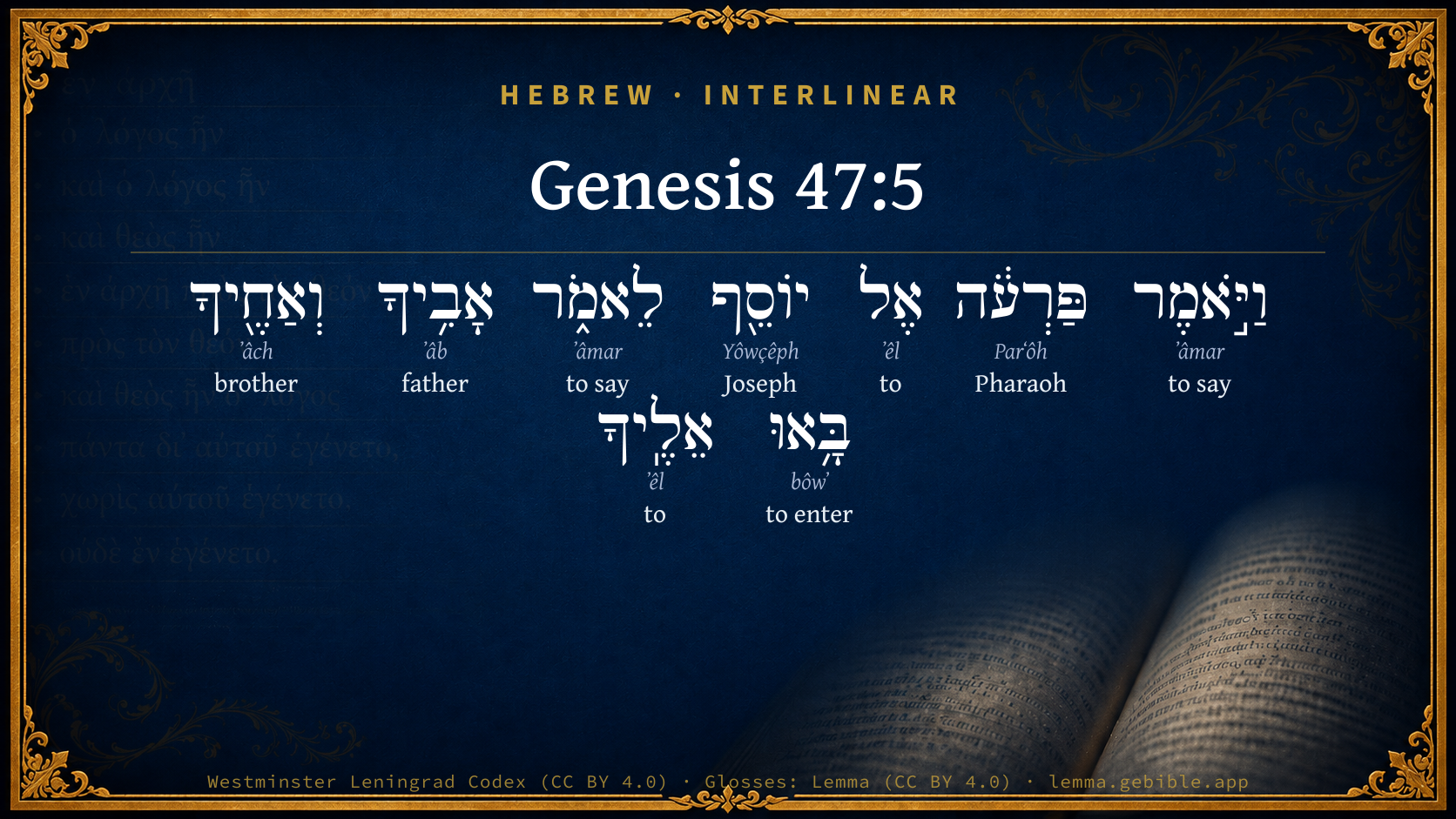
Hebrew (Westminster Leningrad Codex) Genesis 47:5 appears in the Hebrew Old Testament. The text above is from the Westminster Leningrad Codex. Each word links to its Strong’s number, a concise gloss, and parsing drawn from the Open Scriptures Hebrew Bible morphology. Click any word for its full Brown-Driver-Briggs (BDB) entry.
Download image
Cite this verse

Genesis 47:5 (World English Bible). Public Domain. Lemma interlinear Bible study tool, https://lemma.gebible.app/v/genesis/47/5.

Show BibTeX & RIS
BibTeX
RIS
English Translation
Pharaoh spoke to Joseph, saying, "Your father and your brothers have come to you.
World English Bible · Public Domain
Download a study sheet

One document with this verse’s original text, its word-by-word gloss line, the meaning frame, cross-references with their text, attributed commentary, and full source and license credits — printable, and it pastes into notes with its structure intact.

This verse Autodidact and up

Study sheet (.html) Plain text (.txt)

A passage Seminary Student

Up to 50 verses in one chapter. A passage sheet keeps up to 6 commentary sources and 12 cross-references per verse, in the order this page ranks them, and says so on the sheet whenever that leaves anything out. Ask for a single verse and you get the Autodidact verse sheet above.

Everything on this page stays free to read, with no account — the sheet is a download of what is already on screen, not access to it.

Want to remove ads? Support Godless Engineer
Compare translations 3

The same verse in 3 English versions, stacked beneath the original-language interlinear above. Click any original word for its lexicon entry.

Each is an independent rendering of the whole verse — the interlinear is not word-aligned to these translations.

Highlighted words mark where these versions differ — a whole-verse word diff, not a word-by-word alignment.

  • World English Bible Public Domain
    Pharaoh spoke to Joseph, saying, "Your father and your brothers have come to you.
  • King James Version Public Domain
    And Pharaoh spake unto Joseph, saying, Thy father and thy brethren are come unto thee:
  • unfoldingWord Literal Text CC BY-SA 4.0
    Then Pharaoh said to Joseph, saying, “Your father and your brothers have come to you.

unfoldingWord Literal Text — © unfoldingWord, licensed CC BY-SA 4.0. Word-aligned USFM3 via Door43 (git.door43.org/unfoldingWord/en_ult).

Versions to compare (up to 4)

3 of 4 selected

Show all 18 translations

Every available English version of this verse, each an independent rendering of the whole verse.

  • World English Bible Public Domain
    Pharaoh spoke to Joseph, saying, "Your father and your brothers have come to you.
  • Berean Standard Bible Public Domain
    Pharaoh said to Joseph, “Now that your father and brothers have come to you,
  • Majority Standard Bible Public Domain
    Pharaoh said to Joseph, “Now that your father and brothers have come to you,
  • King James Version Public Domain
    And Pharaoh spake unto Joseph, saying, Thy father and thy brethren are come unto thee:
  • American Standard Version (1901) Public Domain
    And Pharaoh spake unto Joseph, saying, Thy father and thy brethren are come unto thee:
  • Revised Version (1885) Public Domain
    And Pharaoh spake unto Joseph, saying, Thy father and thy brethren are come unto thee:
  • Geneva Bible (1599) Public Domain
    Then spake Pharaoh to Ioseph, saying, Thy father and thy brethren are come vnto thee.
  • Douay-Rheims (1899) Public Domain
    The king therefore said to Joseph: Thy father and thy brethren are come to thee.
  • Young's Literal Translation Public Domain
    And Pharaoh speaketh unto Joseph, saying, `Thy father and thy brethren have come unto thee:
  • Literal Standard Version CC BY-SA 4.0
    And Pharaoh speaks to Joseph, saying, “Your father and your brothers have come to you:
  • Unlocked Literal Bible CC BY-SA 4.0
    Then Pharaoh spoke to Joseph, saying, “Your father and your brothers have come to you.
  • unfoldingWord Literal Text CC BY-SA 4.0
    Then Pharaoh said to Joseph, saying, “Your father and your brothers have come to you.
  • Darby Bible Public Domain
    And Pharaoh spoke to Joseph, saying, Thy father and thy brethren are come to thee.
  • World Messianic Bible Public Domain
    Pharaoh spoke to Joseph, saying, “Your father and your brothers have come to you.
  • Webster's Bible Public Domain
    And Pharaoh spoke to Joseph, saying, Thy father and thy brethren have come to thee:
  • Free Bible Version CC BY-SA 4.0
    Pharaoh said to Joseph, “Now that your father and brothers have arrived to join you,
  • Bible in Basic English Public Domain
    And Pharaoh said to Joseph, Let them have the land of Goshen; and if there are any able men among them, put them over my cattle.
  • JPS Tanakh (1917) Public Domain
    And Pharaoh spoke unto Joseph, saying: 'Thy father and thy brethren are come unto thee;

Literal Standard Version (2020), Covenant Press — licensed CC BY-SA 4.0. Text via the HelloAO Bible API (eBible.org). Unlocked Literal Bible (unfoldingWord) — licensed CC BY-SA 4.0. Text via the HelloAO Bible API (eBible.org). unfoldingWord Literal Text — © unfoldingWord, licensed CC BY-SA 4.0. Word-aligned USFM3 via Door43 (git.door43.org/unfoldingWord/en_ult). Free Bible Version, Dr. Jonathan Gallagher — licensed CC BY-SA 4.0. Text via the HelloAO Bible API (eBible.org).

Word by word

More ways to search: Search by grammar → Find every occurrence → Compare this word →

Practice this passage: Drill this verse → Learn its vocabulary →

יוֹסֵ֖ף
Yôwçêph
H3130
“Joseph”
Noun, Proper
Part of Speech
Noun
Type
Proper
Full BDB Definition

Origin: future of H3254

TWOT: None

Joseph = "Jehovah has added" - the eldest son of Jacob by Rachel - father of Igal, who represented the tribe of Issachar among the spies - a son of Asaph - a man who took a foreign wife in the time of Ezra - a priest of the family of Shebaniah in the time of Nehemiah
  1. וַיֹּ֣אמֶר ʼâmar H559 “and · to say” Conjunction + Verb, Qal, Sequential Imperfect, 3rd Person, Masculine, Singular
  2. פַּרְעֹ֔ה Parʻôh H6547 “Pharaoh” Noun, Proper
  3. אֶל ʼêl H413 “to” Preposition
  4. לֵאמֹ֑ר ʼâmar H559 “to say” Preposition + Verb, Qal, Infinitive Construct
  5. אָבִ֥יךָ ʼâb H1 “father · your” Noun, Common, Masculine, Singular, Construct + Suffix, Personal, 2nd Person, Masculine, Singular
  6. וְאַחֶ֖יךָ ʼâch H251 “and · brothers · your” Conjunction + Noun, Common, Masculine, Plural, Construct + Suffix, Personal, 2nd Person, Masculine, Singular
  7. בָּ֥אוּ bôwʼ H935 “to enter” Verb, Qal, Perfect, 3rd Person, Common, Plural
  8. אֵלֶֽיךָ ʼêl H413 “to · you” Preposition + Suffix, Personal, 2nd Person, Masculine, Singular

About this verse

These counts appear in no published source. They are computed here, from the morphology-tagged text and Lemma’s own curated glosses. What Lemma adds →

9
words
7
distinct lemmas
Pentateuch
section

Grammatical profile

  • 3 verbs
  • 4 nouns
  • 2 prepositions

Verb forms

  • וַיֹּ֣אמֶר Qal · Sequential Imperfect
  • לֵאמֹ֑ר Qal · Infinitive Construct
  • בָּ֥אוּ Qal · Perfect

Repetition

Words recur within this verse — often emphatic in Hebrew:

  • וַיֹּ֣אמֶר to say H559 ×2
  • אֶל to H413 ×2

Hebrew & Septuagint length

In English translation the verse runs 14 words from the Hebrew and 15 from the Septuagint (LXX English) — closely comparable.

A rough comparison of the two English renderings, which tokenize alike — not a word-level alignment.

Word counts can differ between the Hebrew and the Greek without any difference in meaning — e.g. the Hebrew direct-object marker אֵת has no separate Greek word, and Greek often adds the article ὁ.

Hebrew and Greek witnesses Masoretic Hebrew ↔ Greek Septuagint

The same verse in the two great witnesses to the Old Testament, shown verse-for-verse.

These are two independent witnesses, not word-aligned to each other, and the Septuagint is shown in lemma (dictionary) form.

Hebrew Genesis 47:5 Masoretic · Westminster Leningrad Codex

וַיֹּ֣אמֶר פַּרְעֹ֔ה אֶל יוֹסֵ֖ף לֵאמֹ֑ר אָבִ֥יךָ וְאַחֶ֖יךָ בָּ֥אוּ אֵלֶֽיךָ

Pharaoh spoke to Joseph, saying, "Your father and your brothers have come to you.

World English Bible · Public Domain

Greek LXX Genesis 47:5 Septuagint · lemma form

εἶπον δέ φαραώ ὁ ιωσφη καταοἰκέω ἐν γῆ γεσεμ εἰ δέ ἐπίσταμαι ὅτι εἰμί ἐν αὐτός ἀνήρ δυνατός καταἵστημι αὐτός ἄρχων ὁ ἐμός κτῆνος ἔρχομαι δέ εἰς αἴγυπτος πρός ιωσηφ ἰακώβ καί ὁ υἱός αὐτός καί ἀκούω φαραώ βασιλεύς αἴγυπτος καί εἶπον φαραώ πρός ιωσηφ λέγω ὁ πατήρ σύ καί ὁ ἀδελφός σύ ἥκω πρός σύ

And Pharao spoke to Joseph, saying, Your father, and your brethren, are come to you.

LXX2012 (modern English Septuagint) · Public Domain

Hebrew: Westminster Leningrad Codex (CC BY 4.0). Greek: Septuagint (public domain); English from LXX2012 (modern English Septuagint) (Public Domain). How the Septuagint differs from the Hebrew →

Targum (Aramaic paraphrase)

2

The Targum is the ancient Jewish Aramaic paraphrase of the Hebrew Scriptures — an interpretive translation, not the Hebrew text itself. Onkelos (literal) and Pseudo-Jonathan (expansive) render the Torah, and Jonathan the Prophets. Coverage is partial: where no permissively-licensed English translation exists for a verse, only the Aramaic is shown. This is verse-level text, not a word-by-word alignment to the Hebrew.

  1. Targum Onkelos Torah (Genesis–Deuteronomy)
    וַאֲמַר פַּרְעֹה לְיוֹסֵף לְמֵימָר אֲבוּךְ וְאַחָיךְ אֲתוֹ לְוָתָךְ

    (no public-domain English translation for this verse)

    Targum Onkelos — Aramaic: “Onkelos Genesis” (public domain); “Onkelos Exodus” (public domain); “Onkelos Leviticus” (public domain); “Onkelos Numbers” (public domain); “Onkelos Deuteronomy” (public domain). English: “Sefaria Community Translation” (CC0 1.0 (public-domain dedication)); “J.W. Etheridge. The Targums of Onkelos and Jonathan Ben Uzziel on the Pentateuch. London: Longmans, Green, 1862” (public domain). Text via Sefaria.

  2. Targum Pseudo-Jonathan Torah (Genesis–Deuteronomy)
    וַאֲמַר פַּרְעה לְיוֹסֵף לְמֵימַר אָבוּךְ וְאָחָךְ אָתוֹ לְוָותָךְ

    And Pharoh spake to Joseph, saying, Thy father and thy brethren have come to thee.

    Targum Pseudo-Jonathan — Aramaic: “Targum Jonathan on Genesis” (public domain); “Targum Jonathan on Exodus” (public domain); “Targum Jonathan on Leviticus” (public domain); “Targum Jonathan on Numbers” (public domain); “Targum Jonathan on Deuteronomy” (public domain). English: “The Targum of Jonathan ben Uzziel, trans. J. W. Etheridge, London, 1862” (public domain). Text via Sefaria.

Commentary

Notes on Genesis 47:5 from classic Christian and Jewish commentators (each source and its license shown beneath its notes). The classic Christian expositions comment on the surrounding passage and are grouped to its opening verse, so a note may address several verses; the Jewish commentaries on the Tanakh (Rashi and others) are per-verse, so they appear only where the commentator wrote on this verse.

Lemma curates 59 commentaries, every one of them public domain or Creative Commons licensed, each selected and text-cleaned for this edition rather than reprinted as found. About our sources →

Trapp's Complete Commentary

John Trapp

Gen 47:5 And Pharaoh spake unto Joseph, saying, Thy father and thy brethren are come unto thee:

Ver. 5. And Pharaoh spake unto Joseph.] Kind he was, and constant, to so good a servant; as Darius likewise was to his Zopyrus, whom he preferred before the taking of twenty Babylons; {a} the King of Poland to his noble servant Zelislaus, to whom he sent a golden hand, instead of that hand he lost in his wars {b}

{a} Herodot., lib. iv.

{b} Cromerus.

John Trapp, A Commentary or Exposition upon All the Books of the Old and New Testament (1647–1656) — public domain. Text from a community e-Sword module.

The Biblical Illustrator

Joseph S. Exell

Gen_47:5-6

In the best of the land make thy father and brethren to dwell

The best gifts of God bestowed on His people

1.

In the first place, GOD GIVETH THE BEST UNTO HIS TRUE ISRAEL. He gives them a land of rest, He gives them a land of safety, He gives them a land of abundance, and He giveth them the best things in that land. He not only pardons them, but His pardon is a costly pardon. He not only gives them righteousness, but He gives them a glorious righteousness. Does He supply their wants? It is all fulness He gives them; even for the supply of the little ones, as you observe in the twenty-fourth verse: And it shall come to pass, in the increase, that ye shall give the fifth part unto Pharaoh; and four parts shall be your own, for the seed of the field, and for your food, and for them of your households, and for food for your little ones, unfolding this great truth--that the supply which is in Christ, is not only for the least, but for the least wants of the least; that there is nothing minute in Gods sight. He has provided for helplessness of body, for nervousness of spirit, for a distracted mind, for strong inward temptations, for outward trials, for domestic afflictions, for everything that concerns us in that straight way, the straightness of which at times no one can enter into but the Lord Jesus Christ Himself.

II. But now observe, secondly, WHY IT IS GOD DOES THIS.

1. Wherever God acteth, He acted as God--greatly; what He doeth, He doeth as God, worthy God. You and I act below ourselves; God never can act below Himself. The great God in His forgiveness is great; in His righteousness He is great; in the abundant supplies of His grace He is great; in the freeness of His salvation He is great; in the sympathies of His love He is great; and that because He is God (see Isa_55:7-9; Hos_11:8-9).

2. But there is another reason; that is, the love which He bears towards His Israel. Who can describe what that love is?

3. But there is another reason, and I think, if I were to lose sight of that, I should lose sight of the Gospel itself; every blessing that the Israel of God enjoy, they enjoy for the true Josephs sake. It is not for their sakes, but it is for Christs sake.

III. THE PRACTICAL REARING OF THIS IMPORTANT SUBJECT.

1. Great cause for deep thankfulness.

2. Then there is in the subject that which should lead to great stirring up of desire. We should desire that we may enter into the best of the land.

3. I am sure we have great cause for deep abasement as we think of the subject. God has given us the best; what have we given Him? (J. H.Evans, M. A.)

The Biblical Illustrator, edited by Joseph S. Exell (c. 1880s–1900s) — public domain. Text from a community e-Sword module.

John Calvin's Commentaries

5. And Pharaoh spake unto Joseph. It is to be ascribed to the favor of God that Pharaoh was not offended when they desired that a separate dwelling-place might be granted to them; for we know that nothing is more indignantly borne by kings, than that their favors should be rejected. Pharaoh offers them a perpetual home, but they rather wish to depart from him. Should any one ascribe this to modesty, on the ground that it would have been proud to ask for the right of citizenship, in order that they might enjoy the same privilege as natives; the suggestion is indeed plausible. It is, however, fallacious, for in asking to be admitted as guests and strangers, they took timely precaution that Pharaoh should not hold them bound in the chains of servitude. The passage of Sophocles is known: —

%Os tiv derannon ejmporeu>etai, Kei>nou ojtilov, ka}n ejleu>qerov mo>lh|

Who refuge seeks within a tyrant’s door, When once he enters there, is free no more. Langhorne’s Plutarch

It was therefore of importance to the sons of Jacob to declare, in limine, on what condition they wished to live in Egypt. And so much the more inexcusable was the cruelty exercised towards them, when, in violation of this compact, they were most severely oppressed, and were denied that opportunity of departure, for which they had stipulated. Isaiah indeed says that the king of Egypt had some pretext for his conduct, because the sons of Jacob had voluntarily placed themselves under his authority, (Isaiah 52:4;) but he is speaking comparatively, in order that he may the more grievously accuse the Assyrians, who had invaded the posterity of Jacob, when they were quiet in their own country, and expelled them thence by unjust violence. Therefore the law of hospitality was wickedly violated when the Israelites were oppressed as slaves, and when the return into their own country, for which they had silently covenanted, was denied them; though they had professed that they had come thither as guests; for fidelity and humanity ought to have been exercised towards them, by the king, when once they were received under his protection. It appears, therefore, that the children of Israel so guarded themselves, as in the presence of God, that they had just ground of complaint against the Egyptians. But seeing that the pledge given them by the king proved of no advantage to them according to the flesh; let the faithful learn, from their example, to train themselves to patience. For it commonly happens, that he who enters the court of a tyrant, is under the necessity of laying down his liberty at the door.

John Calvin's Commentaries (1540-1563) — public domain. Text from the Calvin Translation Society English edition (1840s-50s) via the Christian Classics Ethereal Library (ccel.org). Calvin's coverage is partial (roughly two-thirds of the Bible); uncommented books and verses are honest gaps, never fabricated. The 19th-century editor's footnotes and remarks are omitted so the notes are faithfully Calvin's own voice.

John Gill's Exposition

And Pharaoh spake unto Joseph,.... Who was present at the conversation that passed between him and his brethren:

saying, thy father and thy brethren are come unto thee; which is observed, not for Joseph's information, but to lead on to what he had to say further.

John Gill's Exposition of the Whole Bible (1746–1763) — public domain (CC PDM 1.0). Text via the HelloAO Bible API.

The Pulpit Commentary

Vers. 5, 6. And Pharaoh spake unto Joseph, saying, Thy father and thy brethren are come unto thee: the land of Egypt is before thee; (cf. Gen_20:15) in the best of the land make thy father and brethren to dwell. Wilkinson thinks it possible that Jacob"s sons "may have asked and obtained a grant of land from the Egyptian monarch on condition of certain services being performed by themselves and their descendants" ("Ancient Egyptians," vol. 1. Genesis 2. p. 35). In the land of Goshen let them dwell. Robinson speaks of the province of es-Shar-Kiyeh, which corresponds as nearly as possible with ancient Goshen, as being even in modern times (1736) exceedingly productive and thickly populated. And if thou knowest any men of activity among them, literally, and if thou knowest, and there be among them, men of strength chayil, from chul, to twist (eijluw ejlissw), the idea being that of strength as of twisted ropethen make them rulers over my cattle literally, and thou shelf make them masters of cattle over that which belongs to me. "The shepherds on an Egyptian estate were chosen by the steward, who ascertained their character and skill previous to their being appointed to so important a trust" (Wilkinson, "Ancient Egyptians," vol. 2. p. 445, ed. 1878).

The Pulpit Commentary (1880–1919), ed. H.D.M. Spence-Jones & Joseph S. Exell — public domain. Text from a community e-Sword module.

unfoldingWord translationNotes

Door43 World Missions Community

The land of Egypt is before you

"The land of Egypt is open to you" or "All of the land of Egypt is available to you"

Settle your father and your brothers in the best region, the land of Goshen

"Settle your father and your brothers in the land of Goshen, which is the best region"

If you know any capable men among them

It is implied that they are capable of taking care of animals. AT: "If you know of any men among them who have great skill taking care of animals" (See: Assumed Knowledge and Implicit Information)

translationWords

Pharaoh

Egypt

Goshen

livestock

unfoldingWord translationNotes — © Distant Shores Media and the Door43 World Missions Community, licensed CC BY-SA 4.0. Source: git.door43.org/Door43/en_tn.

Ramban (Nachmanides)

Rabbi Moshe ben Nachman (Ramban / Nachmanides)

THY FATHER AND THY BRETHREN ARE COME UNTO THEE. This introduction is as if to say: “Now I have heard that your father and your brothers have come, and the land of Egypt is before you.” The correct interpretation appears to me to be that Pharaoh said to Joseph: “Your father and your brothers have come to you because they have heard of your glory, and it is upon you that they have cast their burden. See that you treat them well for it is your responsibility and it is within your power.”

Ramban (Nachmanides) on the Tanakh — English translation: “Commentary on the Torah by Ramban (Nachmanides). Translated and annotated by Charles B. Chavel. New York, Shilo Pub. House, 1971-1976” (CC BY 4.0). Text via Sefaria.

Lesson kit

Teaching starters — assembled from the data on this page, not authored interpretation. Every prompt links to the verse data it draws on. Edit before teaching.

Genesis, in the Pentateuch, opens this verse with 9 words (7 distinct Hebrew lemmas). Its most distinctive word is Yôwçêph (“Joseph”). A historical commentator’s framing appears above. Read the whole chapter for the surrounding context.

Discussion questions

  1. The word Yôwçêph carries the sense “Joseph.” How does it shape the verse?
  2. “to say” occurs 2× in this one verse. What is the effect of the repetition?
  3. The translations on this page render this verse differently — a whole-verse word diff, not a word-by-word alignment. What might account for the different wordings?
  4. The verb «וַיֹּ֣אמֶר» is Qal Sequential Imperfect. How does its form color the action?
  5. Reading how Trapp's Complete Commentary and The Biblical Illustrator read this verse, where do the two commentators agree and where do they part?

Things to notice

  • These translations choose different wording for 7 words in this verse.
  • “to say” occurs 2× in this single verse.
  • 7 distinct Hebrew lemmas span 9 words in this verse.

Reading settings

Reading text

Shown beneath each verse's original-language words.

Old Testament
Old Testament edition

Read the OT as the Masoretic Hebrew (MT) or the Greek Septuagint (LXX).

English shown for the Greek Septuagint (in the Hebrew ↔ Greek comparison).

Comparing translations? Open the Compare panel on any verse page to stack up to four side by side.