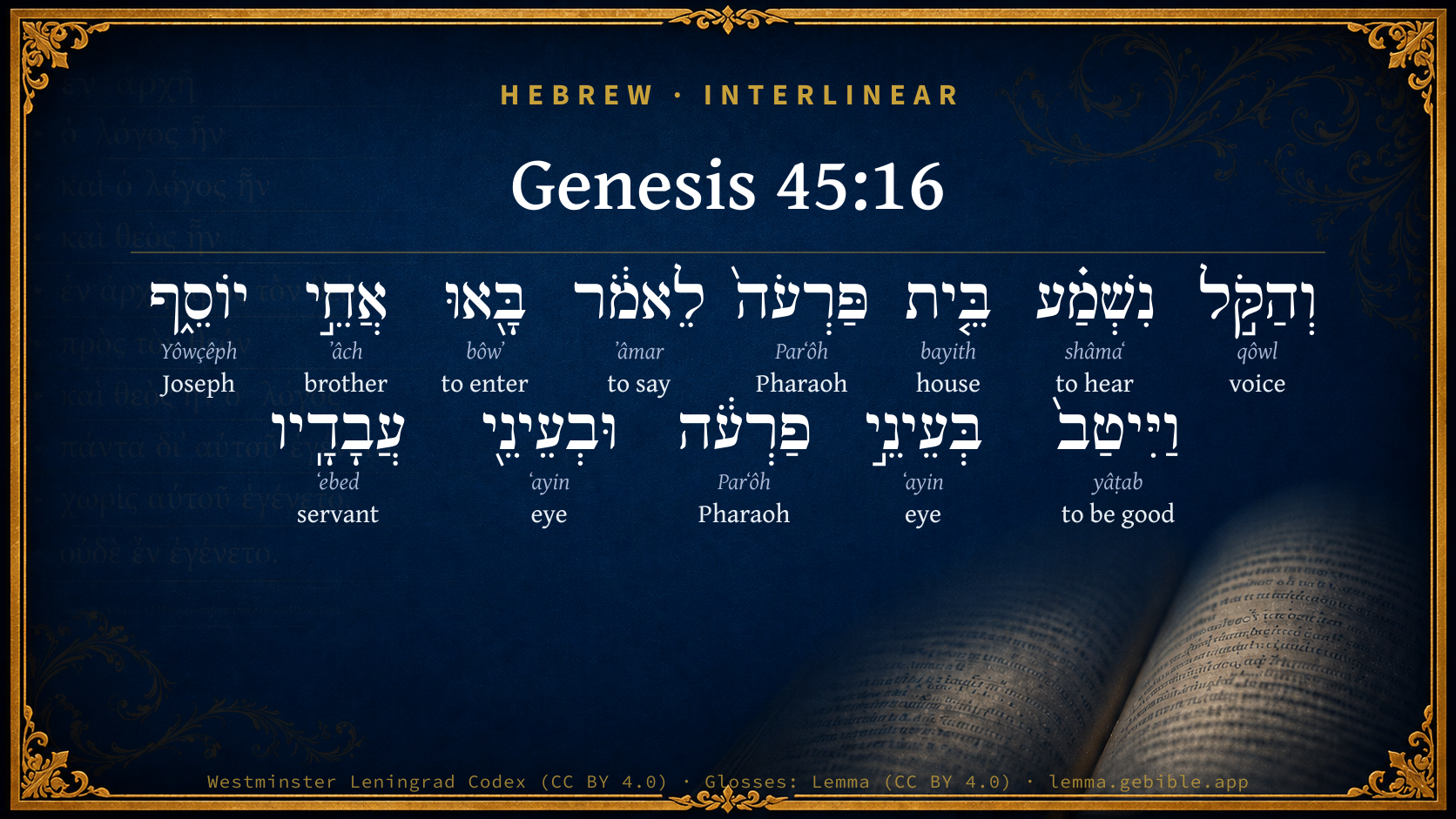
Genesis 45:16

Hebrew (Westminster Leningrad Codex) Genesis 45:16 appears in the Hebrew Old Testament. The text above is from the Westminster Leningrad Codex. Each word links to its Strong’s number, a concise gloss, and parsing drawn from the Open Scriptures Hebrew Bible morphology. Click any word for its full Brown-Driver-Briggs (BDB) entry.
Download image
Cite this verse

Genesis 45:16 (World English Bible). Public Domain. Lemma interlinear Bible study tool, https://lemma.gebible.app/v/genesis/45/16.

Show BibTeX & RIS
BibTeX
RIS
English Translation
The report of it was heard in Pharaoh's house, saying, "Joseph's brothers have come." It pleased Pharaoh well, and his servants.
World English Bible · Public Domain
Download a study sheet

One document with this verse’s original text, its word-by-word gloss line, the meaning frame, cross-references with their text, attributed commentary, and full source and license credits — printable, and it pastes into notes with its structure intact.

This verse Autodidact and up

Study sheet (.html) Plain text (.txt)

A passage Seminary Student

Up to 50 verses in one chapter. A passage sheet keeps up to 6 commentary sources and 12 cross-references per verse, in the order this page ranks them, and says so on the sheet whenever that leaves anything out. Ask for a single verse and you get the Autodidact verse sheet above.

Everything on this page stays free to read, with no account — the sheet is a download of what is already on screen, not access to it.

Want to remove ads? Support Godless Engineer
Compare translations 3

The same verse in 3 English versions, stacked beneath the original-language interlinear above. Click any original word for its lexicon entry.

Each is an independent rendering of the whole verse — the interlinear is not word-aligned to these translations.

Highlighted words mark where these versions differ — a whole-verse word diff, not a word-by-word alignment.

  • World English Bible Public Domain
    The report of it was heard in Pharaoh's house, saying, "Joseph's brothers have come." It pleased Pharaoh well, and his servants.
  • King James Version Public Domain
    And the fame thereof was heard in Pharaoh's house, saying, Joseph's brethren are come: and it pleased Pharaoh well, and his servants.
  • unfoldingWord Literal Text CC BY-SA 4.0
    And the report was heard the house of Pharaoh, saying, “The brothers of Joseph have come.” And it was good in the eyes of Pharaoh and in the eyes of his servants.

unfoldingWord Literal Text — © unfoldingWord, licensed CC BY-SA 4.0. Word-aligned USFM3 via Door43 (git.door43.org/unfoldingWord/en_ult).

Versions to compare (up to 4)

3 of 4 selected

Show all 18 translations

Every available English version of this verse, each an independent rendering of the whole verse.

  • World English Bible Public Domain
    The report of it was heard in Pharaoh's house, saying, "Joseph's brothers have come." It pleased Pharaoh well, and his servants.
  • Berean Standard Bible Public Domain
    When the news reached Pharaoh’s house that Joseph’s brothers had come, Pharaoh and his servants were pleased.
  • Majority Standard Bible Public Domain
    When the news reached Pharaoh’s house that Joseph’s brothers had come, Pharaoh and his servants were pleased.
  • King James Version Public Domain
    And the fame thereof was heard in Pharaoh's house, saying, Joseph's brethren are come: and it pleased Pharaoh well, and his servants.
  • American Standard Version (1901) Public Domain
    And the report thereof was heard in Pharaoh's house, saying, Joseph's brethren are come: and it pleased Pharaoh well, and his servants.
  • Revised Version (1885) Public Domain
    And the fame thereof was heard in Pharaoh’s house, saying, Joseph’s brethren are come: and it pleased Pharaoh well, and his servants.
  • Geneva Bible (1599) Public Domain
    And the tidinges came vnto Pharaohs house, so that they said, Iosephs brethre are come: and it pleased Pharaoh well, and his seruants.
  • Douay-Rheims (1899) Public Domain
    And it was heard, and the fame was abroad in the king's court: The brethren of Joseph are come: and Pharao with all his family was glad.
  • Young's Literal Translation Public Domain
    And the sound hath been heard in the house of Pharaoh, saying, `Come have the brethren of Joseph;' and it is good in the eyes of Pharaoh, and in the eyes of his servants,
  • Literal Standard Version CC BY-SA 4.0
    And the sound has been heard in the house of Pharaoh, saying, “The brothers of Joseph have come”; and it is good in the eyes of Pharaoh, and in the eyes of his servants,
  • Unlocked Literal Bible CC BY-SA 4.0
    The news of the matter was told in Pharaoh's house: “Joseph's brothers have come.” It pleased Pharaoh and his servants very much.
  • unfoldingWord Literal Text CC BY-SA 4.0
    And the report was heard the house of Pharaoh, saying, “The brothers of Joseph have come.” And it was good in the eyes of Pharaoh and in the eyes of his servants.
  • Darby Bible Public Domain
    And the report was heard in Pharaoh's house, saying, Joseph's brethren are come. And it was good in the eyes of Pharaoh, and in the eyes of his bondmen.
  • World Messianic Bible Public Domain
    The report of it was heard in Pharaoh’s house, saying, “Joseph’s brothers have come.” It pleased Pharaoh well, and his servants.
  • Webster's Bible Public Domain
    And the fame of this was heard in Pharaoh's house, saying, Joseph's brethren are come: and it pleased Pharaoh well, and his servants.
  • Free Bible Version CC BY-SA 4.0
    Word soon reached Pharaoh's palace that Joseph's brothers had arrived. Pharaoh and his officials were glad to hear the news.
  • Bible in Basic English Public Domain
    And news of these things went through Pharaoh's house, and it was said that Joseph's brothers were come; and it seemed good to Pharaoh and his servants.
  • JPS Tanakh (1917) Public Domain
    And the report thereof was heard in Pharaoh's house, saying: 'Joseph's brethren are come'; and it pleased Pharaoh well, and his servants.

Literal Standard Version (2020), Covenant Press — licensed CC BY-SA 4.0. Text via the HelloAO Bible API (eBible.org). Unlocked Literal Bible (unfoldingWord) — licensed CC BY-SA 4.0. Text via the HelloAO Bible API (eBible.org). unfoldingWord Literal Text — © unfoldingWord, licensed CC BY-SA 4.0. Word-aligned USFM3 via Door43 (git.door43.org/unfoldingWord/en_ult). Free Bible Version, Dr. Jonathan Gallagher — licensed CC BY-SA 4.0. Text via the HelloAO Bible API (eBible.org).

Word by word

More ways to search: Search by grammar → Find every occurrence → Compare this word →

Practice this passage: Drill this verse → Learn its vocabulary →

וַיִּיטַב֙
yâṭab
H3190
“and · to be good”
Conjunction + Verb, Qal, Sequential Imperfect, 3rd Person, Masculine, Singular
Part of Speech
Conjunction + Verb
Stem
Qal
Form
Sequential Imperfect
Person
3rd Person
Gender
Masculine
Number
Singular
Full BDB Definition

Origin: a primitive root

TWOT: 863

to be good, be pleasing, be well, be glad - (Qal) - to be glad, be joyful - to be well placed - to be well for, be well with, go well with - to be pleasing, be pleasing to - (Hiphil) - to make glad, rejoice - to do good to, deal well with - to do well, do thoroughly - to make a thing good or right or beautiful - to do well, do right
  1. וְהַקֹּ֣ל qôwl H6963 “and · the · voice” Conjunction + Particle, Definite Article + Noun, Common, Masculine, Singular, Absolute
  2. נִשְׁמַ֗ע shâmaʻ H8085 “to hear” Verb, Niphal, Perfect, 3rd Person, Masculine, Singular
  3. בֵּ֤ית bayith H1004 “house of” Noun, Common, Masculine, Singular, Construct
  4. פַּרְעֹה֙ Parʻôh H6547 “Pharaoh” Noun, Proper
  5. לֵאמֹ֔ר ʼâmar H559 “to say” Preposition + Verb, Qal, Infinitive Construct
  6. בָּ֖אוּ bôwʼ H935 “to enter” Verb, Qal, Perfect, 3rd Person, Common, Plural
  7. אֲחֵ֣י ʼâch H251 “brothers of” Noun, Common, Masculine, Plural, Construct
  8. יוֹסֵ֑ף Yôwçêph H3130 “Joseph” Noun, Proper
  9. בְּעֵינֵ֣י ʻayin H5869 “in/at · eyes of” Preposition + Noun, Common, Both, Dual, Construct
  10. פַרְעֹ֔ה Parʻôh H6547 “Pharaoh” Noun, Proper
  11. וּבְעֵינֵ֖י ʻayin H5869 “and · in/at · eyes of” Conjunction + Preposition + Noun, Common, Both, Dual, Construct
  12. עֲבָדָֽיו ʻebed H5650 “servants · his” Noun, Common, Masculine, Plural, Construct + Suffix, Personal, 3rd Person, Masculine, Singular

About this verse

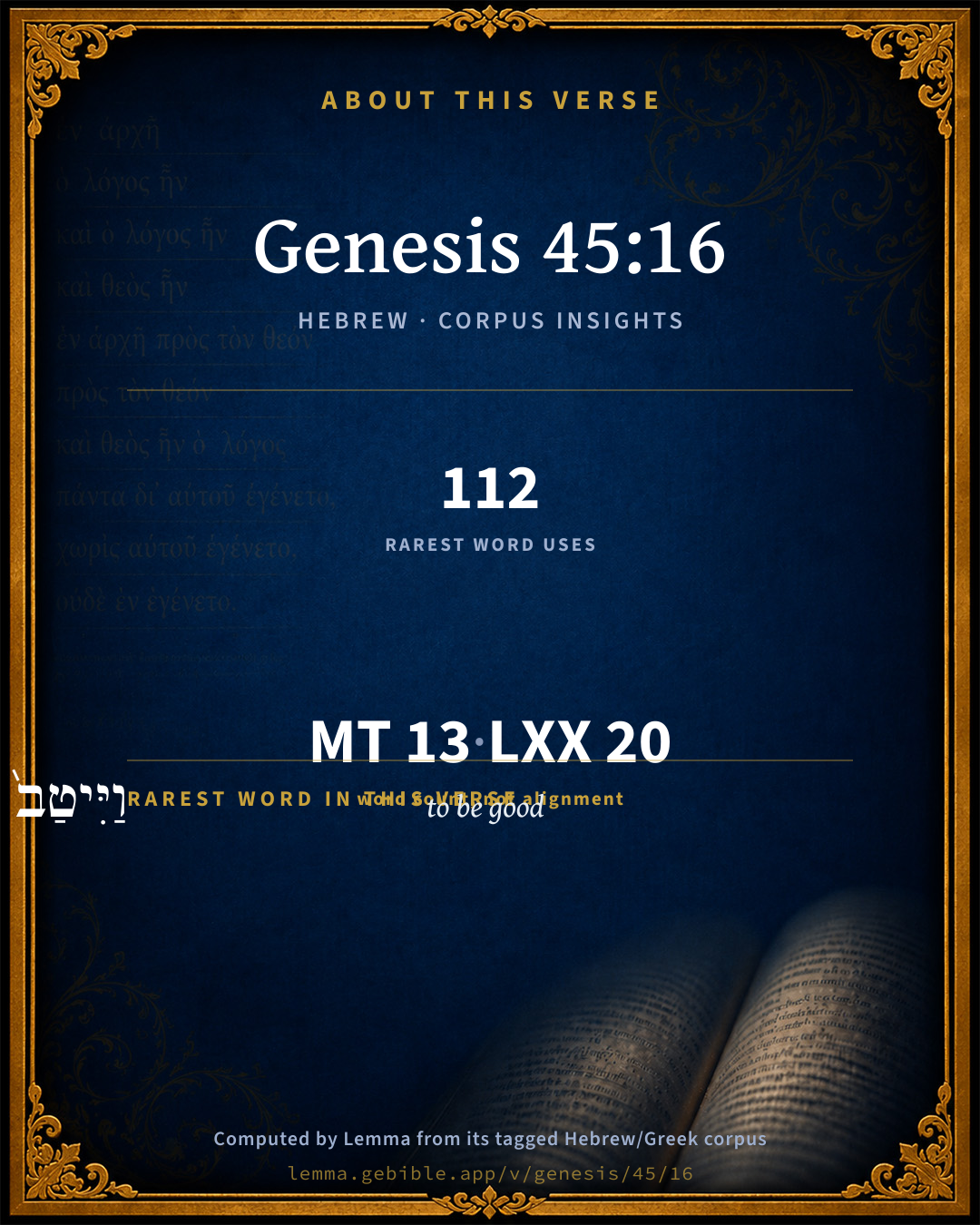
These counts appear in no published source. They are computed here, from the morphology-tagged text and Lemma’s own curated glosses. What Lemma adds →

13
words
11
distinct lemmas
Pentateuch
section

Grammatical profile

  • 4 verbs
  • 9 nouns

Verb forms

  • נִשְׁמַ֗ע Niphal · Perfect
  • לֵאמֹ֔ר Qal · Infinitive Construct
  • בָּ֖אוּ Qal · Perfect
  • וַיִּיטַב֙ Qal · Sequential Imperfect

Repetition

Words recur within this verse — often emphatic in Hebrew:

  • פַּרְעֹה֙ Pharaoh H6547 ×2
  • בְּעֵינֵ֣י eye H5869 ×2

Hebrew & Septuagint length

In English translation the verse runs 21 words from the Hebrew and 22 from the Septuagint (LXX English) — closely comparable.

A rough comparison of the two English renderings, which tokenize alike — not a word-level alignment.

Word counts can differ between the Hebrew and the Greek without any difference in meaning — e.g. the Hebrew direct-object marker אֵת has no separate Greek word, and Greek often adds the article ὁ.

In the original languages it is 13 Hebrew tokens and 20 Greek tokens — but the two are counted differently (Hebrew bundles its prefixes and suffixes into one token; the Greek is in lemma form), so that isn’t a like-for-like length.

Cross-references

12

Topical passages linked to Genesis 45:16 in the Treasury of Scripture Knowledge — connected by theme and wording, ordered by reader-vote popularity; previews shown in the World English Bible.

  • Genesis 16:6 But Abram said to Sarai, "Behold, your maid is in your hand. Do to her whatever is good in your eyes." Sarai dealt harshly with her, and she fled from her face.
  • Genesis 20:15 Abimelech said, "Behold, my land is before you. Dwell where it pleases you."
  • Genesis 34:18 Their words pleased Hamor, and Shechem, Hamor's son.
  • Genesis 41:33 Now therefore let Pharaoh look for a discreet and wise man, and set him over the land of Egypt.
  • Deuteronomy 1:33 who went before you in the way, to seek you out a place to pitch your tents in, in fire by night, to show you by what way you should go, and in the cloud by day.
  • 2 Samuel 3:36 All the people took notice of it, and it pleased them; as whatever the king did pleased all the people.
  • 2 Chronicles 30:4 The thing was right in the eyes of the king and of all the assembly.
  • Esther 1:21 The saying pleased the king and the princes; and the king did according to the word of Memucan:
  • Esther 2:4 and let the maiden who pleases the king be queen instead of Vashti. The thing pleased the king; and he did so.
  • Esther 5:14 Then said Zeresh his wife and all his friends to him, Let a gallows be made fifty cubits high, and in the morning speak you to the king that Mordecai may be hanged thereon: then go you in merrily with the king to the banquet. The thing pleased Haman; and he caused the gallows to be made.
  • Acts 6:5 These words pleased the whole multitude. They chose Stephen, a man full of faith and of the Holy Spirit, Philip, Prochorus, Nicanor, Timon, Parmenas, and Nicolaus, a proselyte of Antioch;
  • Acts 7:13 On the second time Joseph was made known to his brothers, and Joseph's race was revealed to Pharaoh.

Cross-references courtesy of OpenBible.info (CC BY 4.0).

Hebrew and Greek witnesses Masoretic Hebrew ↔ Greek Septuagint

The same verse in the two great witnesses to the Old Testament, shown verse-for-verse.

These are two independent witnesses, not word-aligned to each other, and the Septuagint is shown in lemma (dictionary) form.

Hebrew Genesis 45:16 Masoretic · Westminster Leningrad Codex

וְהַקֹּ֣ל נִשְׁמַ֗ע בֵּ֤ית פַּרְעֹה֙ לֵאמֹ֔ר בָּ֖אוּ אֲחֵ֣י יוֹסֵ֑ף וַיִּיטַב֙ בְּעֵינֵ֣י פַרְעֹ֔ה וּבְעֵינֵ֖י עֲבָדָֽיו

The report of it was heard in Pharaoh's house, saying, "Joseph's brothers have come." It pleased Pharaoh well, and his servants.

World English Bible · Public Domain

Greek LXX Genesis 45:16 Septuagint · lemma form

καί διαβοάω ὁ φωνή εἰς ὁ οἶκος φαραώ λέγω ἥκω ὁ ἀδελφός ιωσηφ χαίρω δέ φαραώ καί ὁ θεραπεία αὐτός

And the report was carried into the house of Pharao, saying, Joseph's brethren are come; and Pharao was glad, and his household.

LXX2012 (modern English Septuagint) · Public Domain

On this verse, The Pulpit Commentary discusses the Septuagint’s reading. Read the note in Commentary ↓

Hebrew: Westminster Leningrad Codex (CC BY 4.0). Greek: Septuagint (public domain); English from LXX2012 (modern English Septuagint) (Public Domain). How the Septuagint differs from the Hebrew →

Targum (Aramaic paraphrase)

2

The Targum is the ancient Jewish Aramaic paraphrase of the Hebrew Scriptures — an interpretive translation, not the Hebrew text itself. Onkelos (literal) and Pseudo-Jonathan (expansive) render the Torah, and Jonathan the Prophets. Coverage is partial: where no permissively-licensed English translation exists for a verse, only the Aramaic is shown. This is verse-level text, not a word-by-word alignment to the Hebrew.

  1. Targum Onkelos Torah (Genesis–Deuteronomy)
    וְקָלָא אִשְׁתְּמַע בֵית פַּרְעֹה לְמֵימַר עַלּוּ אֲחֵי יוֹסֵף וּשְׁפַר בְּעֵינֵי פַרְעֹה וּבְעֵינֵי עַבְדּוֹהִי

    (no public-domain English translation for this verse)

    Targum Onkelos — Aramaic: “Onkelos Genesis” (public domain); “Onkelos Exodus” (public domain); “Onkelos Leviticus” (public domain); “Onkelos Numbers” (public domain); “Onkelos Deuteronomy” (public domain). English: “Sefaria Community Translation” (CC0 1.0 (public-domain dedication)); “J.W. Etheridge. The Targums of Onkelos and Jonathan Ben Uzziel on the Pentateuch. London: Longmans, Green, 1862” (public domain). Text via Sefaria.

  2. Targum Pseudo-Jonathan Torah (Genesis–Deuteronomy)
    וְקָלָא אִשְׁתְּמַע בֵּית מַלְכוּתָא דְפַרְעה לְמֵימַר אָתוֹ אֲחֵי יוֹסֵף וּשְׁפַר פִּתְגָמָא בְּעֵינֵי פַּרְעה וּבְעֵינֵי עַבְדוֹי

    And a voice was heard in the royal house of Pharoh, saying, The brothers of Joseph are come. And the thing was pleasing in the eyes of Pharoh, and in the eyes of his servants.

    Targum Pseudo-Jonathan — Aramaic: “Targum Jonathan on Genesis” (public domain); “Targum Jonathan on Exodus” (public domain); “Targum Jonathan on Leviticus” (public domain); “Targum Jonathan on Numbers” (public domain); “Targum Jonathan on Deuteronomy” (public domain). English: “The Targum of Jonathan ben Uzziel, trans. J. W. Etheridge, London, 1862” (public domain). Text via Sefaria.

Commentary

Notes on Genesis 45:16 from classic Christian and Jewish commentators (each source and its license shown beneath its notes). The classic Christian expositions comment on the surrounding passage and are grouped to its opening verse, so a note may address several verses; the Jewish commentaries on the Tanakh (Rashi and others) are per-verse, so they appear only where the commentator wrote on this verse.

Lemma curates 59 commentaries, every one of them public domain or Creative Commons licensed, each selected and text-cleaned for this edition rather than reprinted as found. About our sources →

Matthew Henry's Commentary

Here is, 1. The kindness of Pharaoh to Joseph, and to his relations for his sake: he bade his brethren welcome (Gen 45:16), though it was a time of scarcity, and they were likely to be a charge to him. Nay, because it pleased Pharaoh, it pleased his servants too, at least they pretended to be pleased because Pharaoh was. He engaged Joseph to send for his father down to Egypt, and promised to furnish them with all conveniences both for his removal thither and his settlement there. If the good of all the land of Egypt (as it was not better stocked than any other land, thanks to Joseph, under God) would suffice him, he was welcome to it all, it was all his own, even the fat of the land (Gen 45:18), so that they need not regard their stuff, Gen 45:20. What they had in Canaan he reckoned but stuff, in comparison with what he had for them in Egypt; and therefore if they should be constrained to leave some of that behind them, let them not be discontented; Egypt would afford them enough to make up the losses of their removal. Thus those for whom Christ intends shares in his heavenly glory ought not to regard the stuff of this world: The best of its enjoyments are but stuff, but lumber; we cannot make sure of it while we are here, much less can we carry it away with us; let us not therefore be solicitous about it, nor set our eyes or hearts upon it. There are better things reserved for us in that blessed land whither our Joseph has gone to prepare a place.

II. The kindness of Joseph to his father and brethren. Pharaoh was respectful to Joseph, in gratitude, because he had been an instrument of much good to him and his kingdom, not only preserving it from the common calamity, but helping to make it considerable among the nations; for all their neighbours would say, "Surely the Egyptians are a wise and an understanding people, that are so well stocked in a time of scarcity." For this reason Pharaoh never thought any thing too much that he could do for Joseph. Note, There is a gratitude owing even to inferiors; and when any have shown us kindness we should study to requite it, not only to them, but to their relations. And Joseph likewise was respectful to his father and brethren in duty, because they were his near relations, though his brethren had been his enemies, and his father long a stranger. 1. He furnished them for necessity, Gen 45:21. He gave them wagons and provisions for the way, both going and coming; for we never find that Jacob was very rich, and, at this time, when the famine prevailed, we may suppose he was rather poor. 2. He furnished them for ornament and delight. To his brethren he gave two suits a piece of good clothes, to Benjamin five suits, and money besides in his pocket, Gen 45:22. To his father he sent a very handsome present of the varieties of Egypt, Gen 45:23. Note, Those that are wealthy should be generous, and devise liberal things; what is an abundance good for, but to do good with it? 3. He dismissed them with a seasonable caution: See that you fall not out by the way, Gen 45:24. He knew they were but too apt to be quarrelsome; and what had lately passed, which revived the remembrance of what they had done formerly against their brother, might give them occasion to quarrel. Joseph had observed them to contend about it, Gen 42:22. To one they would say, "It was you that first upbraided him with his dreams;" to another, "It was you that stripped him of his fine coat;" to another, "It was you that threw him into the pit," etc. Now Joseph, having forgiven them all, lays this obligation upon them, not to upbraid one another. This charge our Lord Jesus has given to us, that we love one another, that we live in peace, that whatever occurs, or whatever former occurrences are remembered, we fall not out. For, (1.) We are brethren, we have all one Father. (2.) We are his brethren, and we shame our relation to him who is our peace, if we fall out. (3.) We are guilty, verily guilty, and, instead of quarrelling with one another, have a great deal of reason to fall out with ourselves. (4.) We are, or hope to be, forgiven of God whom we have all offended, and therefore should be ready to forgive one another. (5.) We are by the way, a way that lies through the land of Egypt, where we have many eyes upon us, that seek occasion and advantage against us, a way that leads to Canaan, where we hope to be for ever in perfect peace.

Matthew Henry's Commentary on the Whole Bible (1708–1710) — public domain (CC PDM 1.0). Text via the HelloAO Bible API.

Trapp's Complete Commentary

John Trapp

Gen 45:16 And the fame thereof was heard in Pharaoh’s house, saying, Joseph’s brethren are come: and it pleased Pharaoh well, and his servants.

Ver. 6. It pleased Pharaoh well, and his servants.] And therefore his servants, because Pharaoh. For, Aulici sunt instar speculi, saith Pareus. Courtiers are their prince’s looking glasses; if he laugh, so do they; where he loves, they love, in pretence, at least; for all is but counterfeit. And here, Potest Augur Augurem videre, et non ridere? saith Cato, in Cicero. {a} The senate gave public thanks to the gods for all that Nero did, even when he had killed his mother, though they never so much abhorred it. When he sang at any time, though it were never so ill, for he had a small harsh voice, his courtiers would soothe him up with, Quam pulcher Caesar, Apollo, Augustus, εις ως πυθιος, μα σε Kαισαρ ουδεις σε νικα, &c. {b} And because he hated the senate, notwithstanding all their flatteries, Vatinius was greatly in favour with him, for saying, Odi te Caesar, quod Senator es. Parasiti principum sputa, instar canum lingunt.

{a} Cic., De Divinatione, lib. ii.

{b} Dio, in Nerone.

John Trapp, A Commentary or Exposition upon All the Books of the Old and New Testament (1647–1656) — public domain. Text from a community e-Sword module.

The Biblical Illustrator

Joseph S. Exell

Gen_45:16-20

Take your father and your households, and come unto me: and I will give you the flood of the land of Egypt

Pharaohs invitation to Jacob and his sons

I.

THIS SPEAKS WELL AS TO HIS DELICATE CONSIDERATION FOR JOSEPH.

II. THIS SHOWS THE VALUE HE SET UPON JOSEPH.

III. THIS TEACHES US HOW GREAT IS THE INFLUENCE OF CHARACTER. (T. H.Leale.)

Bring your father; or, Christmas gatherings

Family gatherings are old as history! Governments change. There was government Patriarchal--government by Judges--government by Kings in old Judea; and there are governments now, Imperialist--Monarchical--Republican. But the family remains ever and always, founded by God, and rooted in the constitution of human life, as the mountains are rooted in the earth.

I. A GOOD MAN CARRIES THE OLD HOME IS HIS HEART. Josephs was not a self-chosen pilgrimage; so then, it was not you that sent me hither, but God. He knew that. It was a history over-ruled by God for highest ends. It is wise and well that enterprize and energy should characterize a nations sons, but they need not forget the old home. Surely, however, if any one might have cut off the remembrances of home, it was the castaway Joseph! That he owed his brethren nothing everyone must admit--nothing, indeed, but that which all Christians owe to their enemies and to themselves--the sovereignty of love over enmity. This man, successful, honoured, uplifted to be Prime Minister of Egypt, tried to exile the old home from his heart. The narrative in a previous chapter tells us this--And Joseph called the name of the firstborn Manasseh: for God, said he, hath made me forget all my toil, and all my fathers house (Gen_41:51). But one sight of the dear old faces broke down all his power to exclude them from his love.

II. IN A TRUE HOME EVERY LOST CHILD CREATES A BLANK. God wants every wandering child home. While we are yet a great way off, He comes forth to meet us. Jacob had many sons, and these sons had wives, and then fresh children came into the world--his sons and his sons sons; his daughters and his sons daughters. Children--grandchildren! But these words, Joseph is not! constitute a little window into Jacobs heart. If you have ever lost a child, you still say in the words of the beautiful poem, We are seven! And if Joseph is away--far away--lost to you in the saddest of all senses, still he lives in your heart.

III. THE TIME COMES WHEN THE FATHER VISITS THE SON. This is beautiful. And it is a parable of that which occurs sometimes now. The old home circle visits the successful son, and he heads the table, and feels not that he does his father honour, but that the father honours him by his presence; this is all-glorious. I am not sure that the old world, of which China is one of the permanent shoots, does not set us an illustrious example in this respect, viz., the honour due to age and parentage; but I am sure that ancient Greece might teach us reverence, for a young man would rise in an assembly there and give his place to an aged man at once. Flippant familiarity in speech is unseemly in relations between the young and the old, for speech is an index of character. Josephs speech is touched with reverence, and he seems to feel a culmination of kindly providence in the fact that his father should know of his glory in Egypt. I trust that many a sons heart will leap in future days when he sees, amid the faces looking on with rapt interest in a season of honour and reward, the features of his father.

IV. THE JOURNEY IS THAT OF A RELIGIOUS OLD MAN. Israel took his journey, and came to Beer-sheba, and offered sacrifices unto the God of his father Isaac. Then he thought of his father. We smile at old men finding it difficult to think themselves old, but their childhood is only a little way behind. (W. M. Statham, M. A.)

The Biblical Illustrator, edited by Joseph S. Exell (c. 1880s–1900s) — public domain. Text from a community e-Sword module.

The Pulpit Commentary

CHAPTER 45:16-28

And the fame thereof literally, the voice, hence rumor (cf. Jer_3:9) was heard in Pharaoh"s house (having been brought thither doubtless by some of the Court officials), saying, Joseph"s brethren it is probable that they would style him Zaphnath-paaneah (cf. Gen_41:45) are come (i.e. are arrived in Egypt): and it pleased Pharaoh well, and his servants literally, it was good in the eyes of Pharaoh, and in the eyes of his servants (cf. Gen_41:37) The LXX render ejcarh de Faraw; the Vulgate, gavisus est Pharao, i.e. Pharaoh was glad.

HOMILETICS.

Vers. 16-28.

Joseph"s invitation to Jacob.

I AUTHORIZED BY PHARAOH. Though possessed of the liberty to issue such a commission as he had just entrusted to his brethren, Joseph felt that it would be right and proper to have his sovereign"s sanction. Accordingly, on mentioning the matter to the king, the required consent was

1. Immediately obtained. "Say unto thy brethren, This do ye; lade your beasts, and go, get you unto the land of Canaan; and take your father and your households, and come unto me." It was also

2. Sincerely given, as was attested by the royal order to take Egyptian curricles in order to convey the immigrants. "Now thou art commanded, this do ye; take you wagons out of the land of Egypt for your little ones, and for your wives, and bring your father, and come." And, still further, it was

3. Warmly urged, by a handsome promise will give you the good of the land of Egypt, and ye shall eat the fat of the land and an earnest exhortation regard not your stuff; for the good of all the land Of Egypt is yours.

II ATTESTED BY JOSEPH. Had the sincerity of Joseph stood in need of any demonstration, it would at once have been supplied by

1. The splendid carriages he sent from Egypt to convey his father. That they had such an influence upon the heart of Jacob is apparent from the narrative. At first the old man could not bring himself to credit the report which his sons brought; but when he saw the wagons which Joseph had sent to carry him, the spirit of Jacob their father revived.

2. The valuable presents he bestowed upon his brethren and sent to his father: to each of the ten "changes of raiment;" to Benjamin 300 pieces of silver and five changes of raiment;" to his father ten asses laden with the good things of Egypt, and ten she-asses laden with corn and bread and meat for his father by the way. Gifts such as these were an index to the love which dwelt in Joseph"s heart.

3. The good counsel he addressed to his brethren: "See that ye fall not out by the way." It was not likely if they disagreed among themselves that they would execute successfully the great commission Joseph had entrusted to them. It was a token of his anxiety for their accomplishing his mission that they should unitedly and lovingly address themselves to its performance.

III REPORTED BY THE BRETHREN. On arriving at Hebron in the land of Canaan the sons of Jacob hastened to unburden themselves of their marvelous intelligence. The invitation of Joseph was detailed

1. Faithfully. On the last occasion on which they had returned to Hebron with tidings concerning Joseph they had lied, and their father believed them; this time, although the old man believed not, what they said was true: "Joseph is yet alive, and he is governor over all the land of Egypt," adding that he wished his venerable parent to go down to Egypt beside him.

2. Fully. "They told him all the words of Joseph which he had said unto them," not forgetting to deliver him the presents, and point him to the wagons or royal carriages which his son had sent for his conveyance thither.

IV ACCEPTED BY JACOB. The strange tale to which the old man listened seemed on its first hearing to be incredible. Such a shock did it give to his feeble sensibilities that his heart almost stopped its beating. Apprehending that they were only mocking his already aged and bereaved spirit, he believed them not. But at length the splendid carriages carried conviction to his mind, and he believed

1. With holy satisfaction. "It is enough." Since this was true, he had no desires unsatisfied below.

2. With paternal love. "Joseph my son" (what tenderness in the words!) "is yet alive.

3. With simple confidence. "I will go down and see him before I die.

HOMILIES BY R.A. REDFORD

Vers. 16-28.

The grace of God to his people.

We are now dealing no longer with Joseph"s personal history, but brought out into the larger sphere of "the children of Israel" (ver. 21). Already it may be said the Egyptian period in the history of the children of Israel has commenced. Pharaoh comes upon the scene and his servants. All the wealth of Egypt is placed at the command of Israel. The men who had been the transgressors against Joseph are now the mediators of the great change in the condition and prospects of the Israelitish race. The effect upon the old man"s heart. R.

The Pulpit Commentary (1880–1919), ed. H.D.M. Spence-Jones & Joseph S. Exell — public domain. Text from a community e-Sword module.

The Preacher's Complete Homiletical Commentary

Joseph S. Exell (gen. ed.)

CRITICAL NOTES.—

Gen_45:20. Regard not your stuff.] Houses, or pieces of furniture which must be left behind. The word is literally your utensils, articles of household use.—

MAIN HOMILETICS OF THE PARAGRAPH.—Gen_45:16-20

PHARAOH’S INVITATION TO JACOB AND HIS SONS

Pharaoh invites Joseph’s brethren and their father to dwell in his land. (Gen_45:17-20.)

I. This speaks well as to his delicate consideration for Joseph. He had reposed full confidence in Joseph, leaving to him the management of all his affairs. Joseph had already given orders that his father should be brought down to Egypt. (Gen_45:13.) He knew also that he was admitted so far into the confidence of his master that he could take this liberty. But Pharaoh, with great delicacy, wishes to spare Joseph’s feelings in having to invite his own relations, as it were, to another man’s house.

II. This shows the value he set upon Joseph. His invitation is accompanied with more liberal offers than those of his trusted servant. Joseph only desired them to bring all the property they had; but Pharaoh bids them disregard their household goods, as he himself would make for them an abundant and sufficient provision. (Gen_45:10-20.) The “good of all the land of Egypt” was theirs. Pharaoh will even have them brought to Egypt with all possible speed and comfort. He gives orders for waggons to fetch them. They could only have this favour by royal command, for it was strictly forbidden that waggons should be taken out of Egypt. His great liberality towards this family tells us how high Joseph was in his esteem. He wanted to express the gratitude of the nation to so great a benefactor.

III. This teaches us how great is the influence of character. Joseph’s character had made a strong impression upon his master. We often say hard things concerning the ingratitude of human nature; but, after all, there is much gratitude yet to be found, even in this heartless world. Pharaoh had found Joseph faithful in all things, and, therefore, honoured and esteemed him. Such influence could not be gained by exalted position, or by mere authority, nor could it be commanded and enforced by law. It can only arise in consequence of that law of the human heart by which love begets love.

SUGGESTIVE COMMENTS ON THE VERSES

Gen_45:16. They highly esteemed Joseph on his own account; and that he should prove to be a member of a respectable family, and have the pleasure of again meeting with his nearest relatives, were circumstances that afforded them a real gratification.—(Murphy)

The servants of princes are seldom disposed to look kindly upon those that are raised above themselves, especially if foreigners. Joseph’s merits, indeed, were such that they could not but be universally acknowledged; yet the spirit which is in man lusteth so strongly to envy, that Joseph’s continued good standing in the court of Pharaoh must be considered as a singularly good testimony to the wisdom and blamelessness of his deportment to all around him.—(Bush).

Gen_45:17. Pharaoh is good to Jacob and his house, for Joseph’s sake; so is God to us and ours, for Jesu’s sake.—(Trapp).

Gen_45:18. So saith Christ, “Come unto me, and ye shall find rest to your souls” (Mat_11:28). Say you meet with some trouble by the way, as haply Jacob had foul weather ere he came down to Egypt. What is a drop of vinegar put into an ocean of wine? No country hath more venemous creatures than Egypt, none more antidotes. So godliness, saith one, hath many troubles, and as many helps against trouble.—(Trapp).

Gen_45:19. This was a mode of travelling to which Jacob had been but little used. As at that day, so at the present, wheel carriages are almost wholly unknown in the country of Palestine.—(Bush).

Christ will send His waggons for us, His cherubins, and clouds to fetch us up to heaven at the last day (1Th_4:15), as they did Moses and Elias (Mat_17:3). This David foresaw, and therefore envied not the pomp and state of those men of God’s hand, that are whirled here up and down in waggons and chariots, etc. (Psa_17:14-15).—(Trapp).

Gen_45:20. Why should those who have all the riches of the better country before them give themselves any disquiet about the perishing things that belong to the earthly house of this tabernacle? The heirs of heaven are rich in the midst of poverty; although they have nothing, they possess all things. Never let them give less credit to the promises of their heavenly Father than Jacob’s son gave to the King of Egypt.—(Bush).

Alexander, hearing of the riches of the Indies, divided his kingdom of Macedon among his captains and soldiers. And being asked what he had left for himself, he answered, Hope. And should not the hope of heaven make us slight all earthly vanities? (Heb_11:1).—(Trapp).

The family of Jacob thus came to Egypt, not by conquest or purchase, but by hospitable invitation, as free, independent visitors or settlers. As they were free to come or not, so were they free to stay or leave.—(Murphy).

The Preacher's Complete Homiletical Commentary (gen. ed. Joseph S. Exell; Funk & Wagnalls, c. 1892) — public domain (pre-1929). A full-Bible homiletical/sermon-outline anthology covering 65 of 66 books (2 John is absent from the source module). Text from a community e-Sword module.

Keil & Delitzsch

C. F. Keil & F. Delitzsch

Invitation to Jacob to Come into Egypt. - Gen 45:16. The report of the arrival of Joseph's brethren soon found it sway into the palace, and made so favourable an impression upon Pharaoh and his courtiers, that the king sent a message through Joseph to his brethren to come with their father and their families ("your houses") into Egypt, saying that he would give them "the good of the land of Egypt," and they should eat "the fat of the land." טוּב, "the good," is not the best part, but the good things (produce) of the land, as in Gen 45:20, Gen 45:23, Gen 24:10; Kg2 8:9. חלב, fat, i.e., the finest productions.

Keil & Delitzsch — Biblical Commentary on the Old Testament (1861–1891) — public domain (CC PDM 1.0). Text via the HelloAO Bible API. (Old Testament only.)

Tyndale Open Study Notes

Tyndale Open Resources

45:16–47:12 This section is transitional, as the family moved from Canaan to Goshen, where they would live for the next four centuries.

45:16-25 Joseph sent his brothers with instructions to bring Jacob and the entire family to Egypt. Out of gratitude for Joseph’s having saved all of Egypt (45:18; see 47:20), Pharaoh promised the best of all the land of Egypt, and Joseph gave them the finest products of Egypt.

Tyndale Open Study Notes — © Tyndale Open Resources, licensed CC BY-SA 4.0. Text via the HelloAO Bible API.

Geneva Bible (1599)

Geneva Bible translators

Hebrew, voice.

Geneva Bible (1599) marginal notes — public domain. Text via Bolls.life.

John Calvin's Commentaries

16. And the fame thereof was heard in Pharaoh’s house. What Moses now relates, was prior in the order of events. For before Joseph sent for his father, the report of the coming of his brethren had reached the palace. And Joseph would not have promised so confidently a home to his brethren in Egypt, except by the king’s permission. What, therefore, Moses had before briefly alluded to, he now more fully explains; namely, that the king, with a ready and cheerful mind, declared his high esteem for Joseph, in freely offering to his father and brethren, the most fertile part of Egypt for their dwelling. And from another statement of Moses it appears that, as long as he lived, the Israelites were treated with clemency and kindness. For, in Exodus 1:8, the commencement of the tyranny and cruelty is said to have been made by his successor, to whom Joseph was unknown.

John Calvin's Commentaries (1540-1563) — public domain. Text from the Calvin Translation Society English edition (1840s-50s) via the Christian Classics Ethereal Library (ccel.org). Calvin's coverage is partial (roughly two-thirds of the Bible); uncommented books and verses are honest gaps, never fabricated. The 19th-century editor's footnotes and remarks are omitted so the notes are faithfully Calvin's own voice.

Ellicott's Commentary for English Readers

(16) It pleased Pharaoh . . . —It was of great importance, as regards the future position of the Israelites in Egypt, that they should go thither, not as men who had forced themselves on the country. but as invited guests. Hence the information that the arrival of Joseph’s brethren was a thing pleasing to Pharaoh, and hence also the fulness with which his commands are recorded.

A Bible Commentary for English Readers, edited by Charles John Ellicott (1878–1897) — public domain. Text from a community e-Sword module.

The Cambridge Bible for Schools and Colleges

gen. ed. J. J. S. Perowne

16–28. Joseph’s Brethren bring the News to Jacob

16. the fame] Lit. “the voice.” It is not the sound of Joseph’s weeping, but the news of the discovery of his brethren.

The Cambridge Bible for Schools and Colleges (gen. ed. J. J. S. Perowne; Cambridge University Press, 1878–1918) — public domain. Text from a community e-Sword module.

John Gill's Exposition

And the fame thereof was heard in Pharaoh's house,.... The report was carried to court, and there it was told by some from Joseph's house, who had overheard what had passed, at least somewhat of it:

saying, Joseph's brethren are come; perhaps they might call him by his Egyptian name, though the historian gives him his Hebrew name, and which was his right name, and by which he was best known to the Hebrews, for whose sake chiefly he wrote:

and it pleased Pharaoh well, and his servants; for Joseph being greatly beloved both by the king and his courtiers, who are meant by his servants, they were glad of an opportunity of showing their further regard to him, by their respect and civilities to his relations and friends, who had been the means of providing for the welfare of the whole kingdom, and of saving all their lives; Pharaoh's expressions of pleasure on this occasion were, no doubt sincere, whatever were those of his courtiers; who might not so well affect a stranger, and one that had been in a very low estate of life, to be raised above them, and have so much trust reposed is him, and honour conferred upon him, and might dissemble in their respect to Joseph before their sovereign; though such might be the prudence and affability of Joseph, and such the sense they had of their obligations to him in point of gratitude, that they might be really pleased to hear that his brethren were come; and the rather Pharaoh and his court might be the more delighted, because that it appeared that he came of a good family in Canaan; whereas they knew no more of him than of his having been a slave in Potiphar's house, and then cast into a prison for a crime charged upon him, out of which he was taken, and made the great man he was.

John Gill's Exposition of the Whole Bible (1746–1763) — public domain (CC PDM 1.0). Text via the HelloAO Bible API.

Haydock's Catholic Bible Commentary

Family, and courtiers. They were all so enraptured with Joseph’s conduct, that they rejoiced in whatever gave him pleasure. (Menochius) --- They thought, perhaps, that his relations would resemble him, and be of service to Egypt. (Haydock)

George Leo Haydock (1774–1849), Haydock's Catholic Family Bible and Commentary, 1859 edition — public domain. Excludes Psalms (Douay-Rheims chapter numbering differs from Protestant) and Deuterocanonical books (Catholic canon only).

Matthew Poole's English Annotations

Because they all owed their lives unto Joseph, and his favour was now fresh and present, and therefore he had more influence upon them, and they more kindness for him.

Matthew Poole's English Annotations on the Holy Bible (1683–1685) — public domain. Text from a community e-Sword/MySword module.

Whedon's Commentary on the Bible

Daniel D. Whedon

16. The fame thereof was heard — The report was made; literally, the voice (or noise) was heard.

It pleased Pharaoh well — Hebrews, it was good in the eyes of Pharaoh. “The grateful esteem in which Joseph was held made every thing good that interested him, and the discovery that the Hebrew slave belonged to a family that was not unknown at the court of the Pharaohs (chap. 12) was also pleasing. The ‘good’ and the ‘fat’ of the land were now freely laid at the disposal of the family of Joseph. This is simply a general expression for the choice things of Egypt.” — Newhall.

Daniel D. Whedon (gen. ed.), Commentary on the Old and New Testaments (1874–1909) — public domain. Text from a community e-Sword module.

Kretzmann's Popular Commentary

Paul E. Kretzmann

Jacob invited to Egypt

v. 16. And the fame thereof was heard in Pharaoh’s house, saying, Joseph’s brethren are come. The news reached the royal palace very soon. And it pleased Pharaoh well and his servants, which shows the high regard that Joseph enjoyed; for all nomadic tribes, including the Hebrews, were despised by the Egyptians. The latter fact was forgotten in the universal joy.

v. 17. And Pharaoh said unto Joseph, Say unto thy brethren, This do ye; lade your beasts and go; get you unto the land of Canaan;

v. 18. and take your father and your households, and come unto me; and I will give you the good of the land of Egypt, and ye shall eat the fat of the land. The best, the richest products of the country should be at their disposal, just as if they were truly the relatives of royalty.

v. 19. Now thou art commanded, this do ye, the language of authoritative courtesy: take you wagons out of the land of Egypt for your little ones, and for your wives, and bring your father, and come. They were to be provided with all the conveniences of travel, especially with the two-wheeled wagons of Egypt, which could very well be used even in the trackless desert.

v. 20. Also regard not your stuff, they should not mind the loss of some articles of furniture which could not well be transported for such a long distance; for the good of all the land of Egypt is yours.

v. 21. And the children of Israel did so; and Joseph gave them wagons, according to the commandment of Pharaoh, and gave them provision for the way; he took care of all their needs for the journey.

v. 22. To all of them he gave each man changes of raiment; every one of the brothers was fitted out with a new suit of clothes; but to Benjamin he gave three hundred pieces of silver and five changes of raiment, holiday clothing, as a change for the usual dress.

v. 23. And to his father he sent after this manner: ten asses laden with the good things of Egypt, presents to indicate what Jacob might expect in the land whose king had invited him, and ten she-asses laden with corn and bread and meat for his father by the way. The grain, the bread, and the other food was to serve as provisions for Jacob and his household on their way to Egypt.

v. 24. So he sent his brethren away, and they departed; and he said unto them, See that ye fall not out by the way. They should not be tempted to hark back to the old crime, as to who had really instigated the wrong, and thus sin again. It is a warning which has its value even today, in similar circumstances.

v. 25. And they went up out of Egypt, and came into the land of Canaan unto Jacob, their father,

v. 26. and told him, saying, Joseph is yet alive, and he is governor over all the land of Egypt. Their extreme joy makes them almost too abrupt in the announcement of their news. And Jacob’s heart fainted, it stopped in chill and amazement, for he believed them not. The news was too wonderful to be true, after all these years of mourning.

v. 27. And they told him all the words of Joseph which he had said unto them; and when he saw the wagons which Joseph had sent to carry him, concrete evidence of Joseph’s love and of the truth of the account concerning him, the spirit of Jacob, their father, revived; he was filled with new life and vigor.

v. 28. And Israel said, It is enough; Joseph, my son, is yet alive; I will go and see him before I die. He no longer doubted; he was convinced; and he had only one great desire, namely, to see his son as soon as possible. The Lord may cause His children to bear many heavy crosses for many years, but eventually He always brings joy and happiness into their hearts.

Paul E. Kretzmann, Popular Commentary of the Bible (1921–1924) — public domain. Text from a community e-Sword module.

unfoldingWord translationNotes

Door43 World Missions Community

The news of the matter was told in Pharaoh's house: "Joseph's brothers have come."

This is a quotation within a quotation. It can be stated as an indirect quotation. It may also be stated in active form. AT: "Everyone in Pharaoh's palace heard that Joseph's brothers had come." (See: Quotes Within Quotes and Direct and Indirect Quotations and Active or Passive)

Pharaoh's house

This stands for Pharaoh's palace.

Say to your brothers, 'Do this: Load your animals and go to the land of Canaan. Get your father and your households and come to me. I will give you the good of the land of Egypt, and you will eat the fat of the land.'

This is a quotation within a quotation. It can be stated as an indirect quotation. AT: "Tell your brothers to load their animals and go to Canaan to get their father and families. Tell them to come here, and I will give them the best land in Egypt and the best food we have to offer" (See: Quotes Within Quotes and Direct and Indirect Quotations)

I will give you the good of the land of Egypt

"I will give you the best land in Egypt"

you will eat the fat of the land

The best food that a land produces is spoken of as if it were the fat portion of the land. AT: "you will eat the best food in the land" (See: Metaphor)

translationWords

Pharaoh

house

servant

Canaan

household

Egypt

unfoldingWord translationNotes — © Distant Shores Media and the Door43 World Missions Community, licensed CC BY-SA 4.0. Source: git.door43.org/Door43/en_tn.

Rashi

Rabbi Shlomo Yitzchaki (Rashi)

והקל נשמע בית פרעה AND THE FAME THEREOF WAS HEARD IN PHARAOH’S HOUSE — It is the same as בבית, in the house of Pharaoh and here it denotes the actual house (cp. 45:2).

Rashi on the Tanakh — English translations: “The Judaica Press complete Tanach with Rashi, translated by A. J. Rosenberg” (CC BY 4.0); “Pentateuch with Rashi's commentary by M. Rosenbaum and A.M. Silbermann, 1929-1934” (public domain); “The Metsudah Tanach series, Lakewood, N.J” (CC BY 4.0); and “The Book of Joshua, Metsudah Publications, 1997” (CC BY 4.0). Text via Sefaria.

Ramban (Nachmanides)

Rabbi Moshe ben Nachman (Ramban / Nachmanides)

JOSEPH’s BRETHREN ARE COME. The intent thereof is that Joseph told the house of Pharaoh that he had honorable brothers in the land of the Hebrews, for he had been stolen away from there, and now the Egyptians heard that Joseph’s brothers had come as he said.

AND IT PLEASED PHARAOH WELL, AND HIS SERVANTS. For it was a disgrace to them to be ruled by a stranger, a servant [of whom it is said], out of prison he came forth to be king, and now when his honorable brothers came to him, and it became known that Joseph was worthy to stand before kings, they all rejoiced in the matter.

Ramban (Nachmanides) on the Tanakh — English translation: “Commentary on the Torah by Ramban (Nachmanides). Translated and annotated by Charles B. Chavel. New York, Shilo Pub. House, 1971-1976” (CC BY 4.0). Text via Sefaria.

Sforno

Rabbi Ovadia Sforno

This was good in the eyes of Pharaoh. He reasoned that if Yoseif’s family settled there he would have more of a stake in the country’s welfare and would perform his duties more diligently.

Sforno on the Tanakh — English translation: “Yalkut, Sifsei Chachomim Chumash, Metsudah Publications, 2009” (CC BY 4.0). Text via Sefaria.

Radak

Rabbi David Kimhi (Radak)

וייטב, the Egyptians were very relieved to see that Joseph was the member of a distinguished family. Avraham’s family was an internationally known family.

Radak on the Tanakh — English translations: “Sefaria Community Translation” (CC0 1.0 (public-domain dedication)); “Eliyahu Munk, HaChut Hameshulash” (CC BY 4.0); “Rabbi Mike Feuer, Jerusalem Anthology” (CC BY 4.0); and “R. David Kimhi on the first book of Psalms, Translated by R.G. Finch, London, 1919” (public domain). Text via Sefaria.

Lesson kit

Teaching starters — assembled from the data on this page, not authored interpretation. Every prompt links to the verse data it draws on. Edit before teaching.

Genesis, in the Pentateuch, opens this verse with 13 words (11 distinct Hebrew lemmas). Its most distinctive word is yâṭab (“to be good”). A historical commentator’s framing appears above. Read the whole chapter for the surrounding context.

Discussion questions

  1. What does “to be good” (yâṭab) contribute to the verse as a whole?
  2. Genesis 16:6 shares this passage’s theme. How do the two illuminate each other?
  3. “Pharaoh” occurs 2× in this one verse. What is the effect of the repetition?
  4. The translations on this page render this verse differently — a whole-verse word diff, not a word-by-word alignment. What might account for the different wordings?
  5. The verb «נִשְׁמַ֗ע» is Niphal Perfect. How does its form color the action?
  6. Reading how Matthew Henry's Commentary and Trapp's Complete Commentary read this verse, where do the two commentators agree and where do they part?

Things to notice

Reading settings

Reading text

Shown beneath each verse's original-language words.

Old Testament
Old Testament edition

Read the OT as the Masoretic Hebrew (MT) or the Greek Septuagint (LXX).

English shown for the Greek Septuagint (in the Hebrew ↔ Greek comparison).

Comparing translations? Open the Compare panel on any verse page to stack up to four side by side.