Genesis 39:17

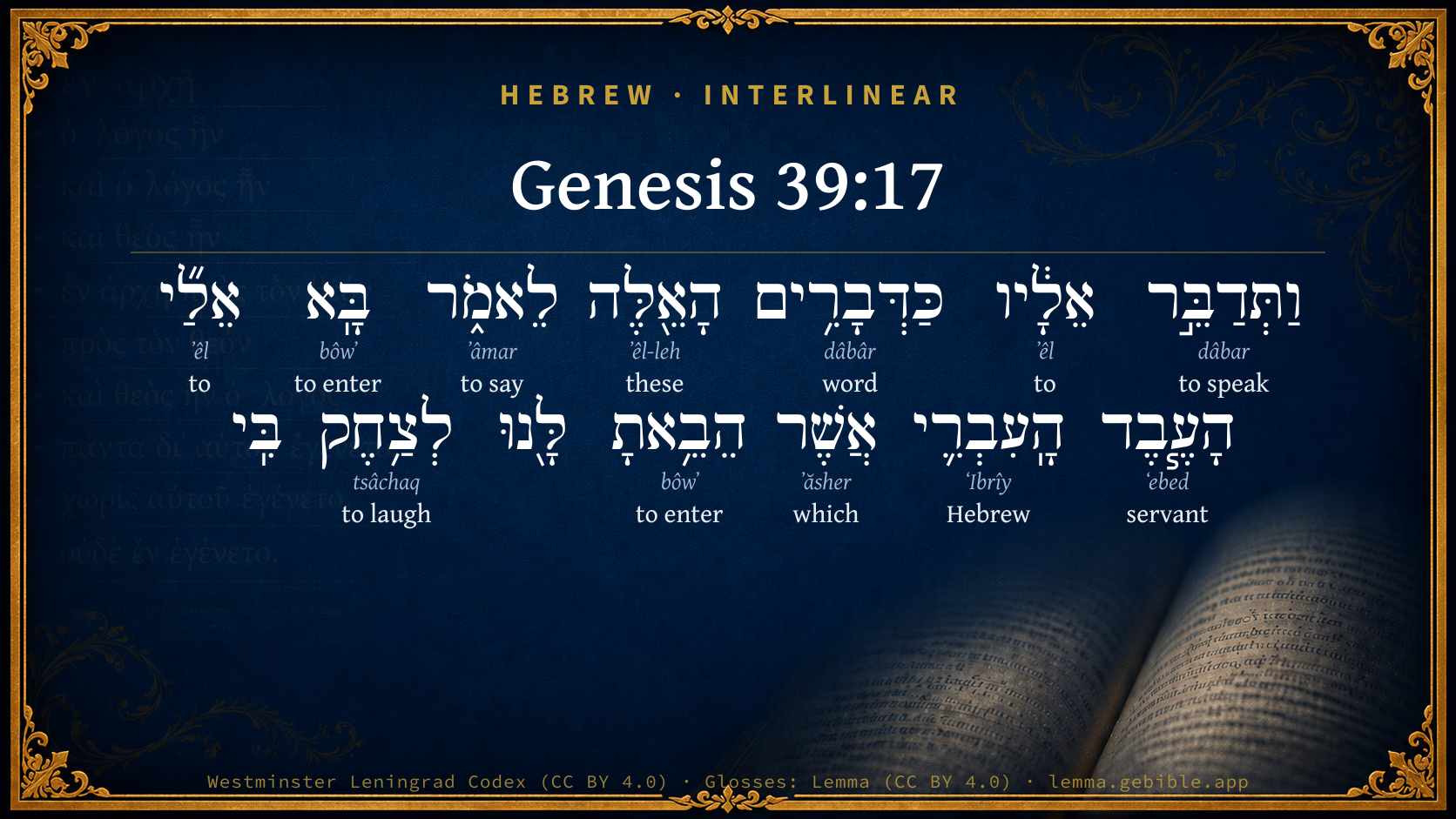
Hebrew (Westminster Leningrad Codex) Genesis 39:17 appears in the Hebrew Old Testament. The text above is from the Westminster Leningrad Codex. Each word links to its Strong’s number, a concise gloss, and parsing drawn from the Open Scriptures Hebrew Bible morphology. Click any word for its full Brown-Driver-Briggs (BDB) entry.
Download image
Cite this verse

Genesis 39:17 (World English Bible). Public Domain. Lemma interlinear Bible study tool, https://lemma.gebible.app/v/genesis/39/17.

Show BibTeX & RIS
BibTeX
RIS
English Translation
She spoke to him according to these words, saying, "The Hebrew servant, whom you have brought to us, came in to me to mock me,
World English Bible · Public Domain
Download a study sheet

One document with this verse’s original text, its word-by-word gloss line, the meaning frame, cross-references with their text, attributed commentary, and full source and license credits — printable, and it pastes into notes with its structure intact.

This verse Autodidact and up

Study sheet (.html) Plain text (.txt)

A passage Seminary Student

Up to 50 verses in one chapter. A passage sheet keeps up to 6 commentary sources and 12 cross-references per verse, in the order this page ranks them, and says so on the sheet whenever that leaves anything out. Ask for a single verse and you get the Autodidact verse sheet above.

Everything on this page stays free to read, with no account — the sheet is a download of what is already on screen, not access to it.

Want to remove ads? Support Godless Engineer
Compare translations 3

The same verse in 3 English versions, stacked beneath the original-language interlinear above. Click any original word for its lexicon entry.

Each is an independent rendering of the whole verse — the interlinear is not word-aligned to these translations.

Highlighted words mark where these versions differ — a whole-verse word diff, not a word-by-word alignment.

  • World English Bible Public Domain
    She spoke to him according to these words, saying, "The Hebrew servant, whom you have brought to us, came in to me to mock me,
  • King James Version Public Domain
    And she spake unto him according to these words, saying, The Hebrew servant, which thou hast brought unto us, came in unto me to mock me:
  • unfoldingWord Literal Text CC BY-SA 4.0
    Then she spoke to him according to those words, saying, “The Hebrew slave whom you brought to us came to me to laugh at me!

unfoldingWord Literal Text — © unfoldingWord, licensed CC BY-SA 4.0. Word-aligned USFM3 via Door43 (git.door43.org/unfoldingWord/en_ult).

Versions to compare (up to 4)

3 of 4 selected

Show all 17 translations

Every available English version of this verse, each an independent rendering of the whole verse.

  • World English Bible Public Domain
    She spoke to him according to these words, saying, "The Hebrew servant, whom you have brought to us, came in to me to mock me,
  • Berean Standard Bible Public Domain
    Then she told him the same story: “The Hebrew slave you brought us came to me to make sport of me,
  • Majority Standard Bible Public Domain
    Then she told him the same story: “The Hebrew slave you brought us came to me to make sport of me,
  • King James Version Public Domain
    And she spake unto him according to these words, saying, The Hebrew servant, which thou hast brought unto us, came in unto me to mock me:
  • American Standard Version (1901) Public Domain
    And she spake unto him according to these words, saying, The Hebrew servant, whom thou hast brought unto us, came in unto me to mock me:
  • Revised Version (1885) Public Domain
    And she spake unto him according to these words, saying, The Hebrew servant, which thou hast brought unto us, came in unto me to mock me:
  • Geneva Bible (1599) Public Domain
    Then she tolde him according to these words, saying, The Ebrew seruat, which thou hast brought vnto vs, came in to me, to mocke me.
  • Young's Literal Translation Public Domain
    And she speaketh unto him according to these words, saying, `The Hebrew servant whom thou hast brought unto us, hath come in unto me to play with me;
  • Literal Standard Version CC BY-SA 4.0
    And she speaks to him according to these words, saying, “The Hebrew servant whom you have brought to us, has come in to me to play with me;
  • Unlocked Literal Bible CC BY-SA 4.0
    She told him this explanation, “The Hebrew servant whom you brought to us, came in to mock me.
  • unfoldingWord Literal Text CC BY-SA 4.0
    Then she spoke to him according to those words, saying, “The Hebrew slave whom you brought to us came to me to laugh at me!
  • Darby Bible Public Domain
    And she spoke to him according to these words, saying, The Hebrew bondman that thou hast brought to us came in to me to mock me;
  • World Messianic Bible Public Domain
    She spoke to him according to these words, saying, “The Hebrew servant, whom you have brought to us, came in to me to mock me,
  • Webster's Bible Public Domain
    And she spoke to him according to these words, saying, The Hebrew servant, which thou hast brought to us, came in to me to mock me.
  • Free Bible Version CC BY-SA 4.0
    Then she told him her story. It went like this: “That Hebrew slave you brought here tried to come and dishonor me.
  • Bible in Basic English Public Domain
    Then she gave him the same story, saying, The Hebrew servant whom you have taken into our house came in to make sport of me;
  • JPS Tanakh (1917) Public Domain
    And she spoke unto him according to these words, saying: 'The Hebrew servant, whom thou hast brought unto us, came in unto me to mock me.

Literal Standard Version (2020), Covenant Press — licensed CC BY-SA 4.0. Text via the HelloAO Bible API (eBible.org). Unlocked Literal Bible (unfoldingWord) — licensed CC BY-SA 4.0. Text via the HelloAO Bible API (eBible.org). unfoldingWord Literal Text — © unfoldingWord, licensed CC BY-SA 4.0. Word-aligned USFM3 via Door43 (git.door43.org/unfoldingWord/en_ult). Free Bible Version, Dr. Jonathan Gallagher — licensed CC BY-SA 4.0. Text via the HelloAO Bible API (eBible.org).

Word by word

More ways to search: Search by grammar → Find every occurrence → Compare this word →

Practice this passage: Drill this verse → Learn its vocabulary →

לְצַ֥חֶק
tsâchaq
H6711
“to laugh”
Preposition + Verb, Piel, Infinitive Construct
Part of Speech
Preposition + Verb
Stem
Piel
Form
Infinitive Construct
Full BDB Definition

Origin: a primitive root

TWOT: 1905

to laugh, mock, play - (Qal) to laugh - (Piel) - to jest - to sport, play, make sport, toy with, make a toy of
  1. וַתְּדַבֵּ֣ר dâbar H1696 “and · to speak” Conjunction + Verb, Piel, Sequential Imperfect, 3rd Person, Feminine, Singular
  2. אֵלָ֔יו ʼêl H413 “to · him” Preposition + Suffix, Personal, 3rd Person, Masculine, Singular
  3. כַּדְּבָרִ֥ים dâbâr H1697 “like/as the · words” Preposition, Determined + Noun, Common, Masculine, Plural, Absolute
  4. הָאֵ֖לֶּה ʼêl-leh H428 “the · these” Particle, Definite Article + Pronoun, Demonstrative, Common, Plural
  5. לֵאמֹ֑ר ʼâmar H559 “to say” Preposition + Verb, Qal, Infinitive Construct
  6. בָּֽא bôwʼ H935 “to enter” Verb, Qal, Perfect, 3rd Person, Masculine, Singular
  7. אֵלַ֞י ʼêl H413 “to · me” Preposition + Suffix, Personal, 1st Person, Common, Singular
  8. הָעֶ֧בֶד ʻebed H5650 “the · servant” Particle, Definite Article + Noun, Common, Masculine, Singular, Absolute
  9. הָֽעִבְרִ֛י ʻIbrîy H5680 “the · Hebrew” Particle, Definite Article + Noun, Gentilic, Masculine, Singular, Absolute
  10. אֲשֶׁר ʼăsher H834 “which” Particle, Relative
  11. הֵבֵ֥אתָ bôwʼ H935 “to enter” Verb, Hiphil, Perfect, 2nd Person, Masculine, Singular

About this verse

These counts appear in no published source. They are computed here, from the morphology-tagged text and Lemma’s own curated glosses. What Lemma adds →

14
words
10
distinct lemmas
Pentateuch
section

Notable vocabulary

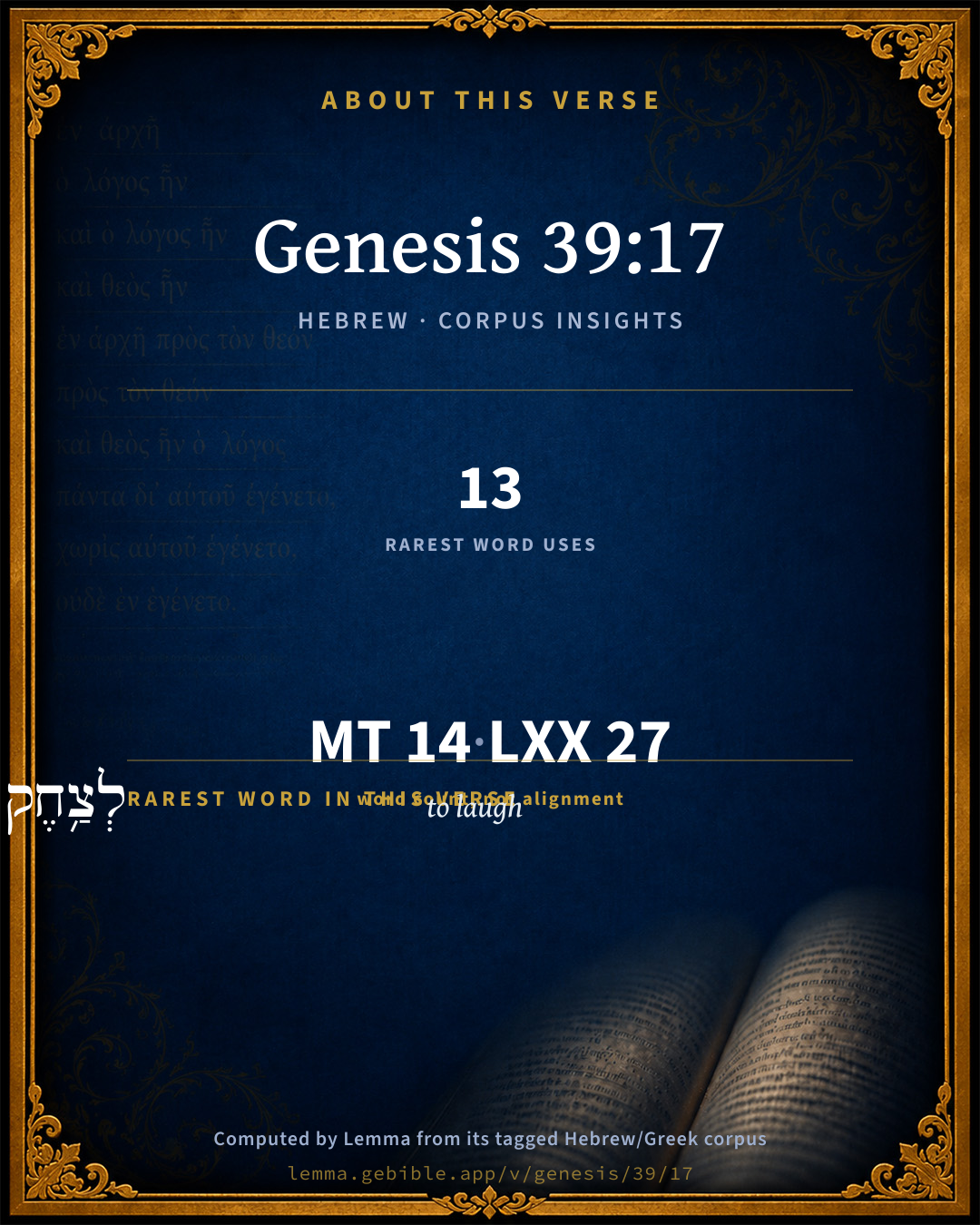
The rarest word here is לְצַ֥חֶק to laugh H6711 — appearing just 13 times in the whole Hebrew Bible.

Shared distinctive vocabulary

לְצַ֥חֶק to laugh H6711 occurs in 12 verses of the Hebrew Bible. Also found in:

Grammatical profile

  • 5 verbs
  • 3 nouns
  • 1 pronoun
  • 4 prepositions
  • 1 particle

Verb forms

  • וַתְּדַבֵּ֣ר Piel · Sequential Imperfect
  • לֵאמֹ֑ר Qal · Infinitive Construct
  • בָּֽא Qal · Perfect
  • הֵבֵ֥אתָ Hiphil · Perfect
  • לְצַ֥חֶק Piel · Infinitive Construct

Repetition

Words recur within this verse — often emphatic in Hebrew:

  • בָּֽא to enter H935 ×2
  • אֵלָ֔יו to H413 ×2

Hebrew & Septuagint length

In English translation the verse runs 25 words from the Hebrew and 35 from the Septuagint (LXX English) — the Septuagint runs noticeably longer here. See the side-by-side →

A rough comparison of the two English renderings, which tokenize alike — not a word-level alignment.

Word counts can differ between the Hebrew and the Greek without any difference in meaning — e.g. the Hebrew direct-object marker אֵת has no separate Greek word, and Greek often adds the article ὁ.

In the original languages it is 14 Hebrew tokens and 27 Greek tokens — but the two are counted differently (Hebrew bundles its prefixes and suffixes into one token; the Greek is in lemma form), so that isn’t a like-for-like length.

Cross-references

12

Topical passages linked to Genesis 39:17 in the Treasury of Scripture Knowledge — connected by theme and wording, ordered by reader-vote popularity; previews shown in the World English Bible.

  • Exodus 23:1 "You shall not spread a false report. Don't join your hand with the wicked to be a malicious witness.
  • Genesis 39:14 that she called to the men of her house, and spoke to them, saying, "Behold, he has brought in a Hebrew to us to mock us. He came in to me to lie with me, and I cried with a loud voice.
  • Exodus 20:16 "You shall not give false testimony against your neighbor.
  • 1 Kings 18:17 It happened, when Ahab saw Elijah, that Ahab said to him, Is it you, you troubler of Israel?
  • 1 Kings 21:9–13 She wrote in the letters, saying, Proclaim a fast, and set Naboth on high among the people:
  • Psalms 37:14 The wicked have drawn out the sword, and have bent their bow, To cast down the poor and needy, To kill those who are upright in the way.
  • Psalms 55:3 Because of the voice of the enemy, Because of the oppression of the wicked. For they bring suffering on me. In anger they hold a grudge against me.
  • Proverbs 12:19 Truth's lips will be established forever, But a lying tongue is only momentary.
  • Proverbs 19:5 A false witness shall not be unpunished. He who pours out lies shall not go free.
  • Proverbs 19:9 A false witness shall not be unpunished. He who utters lies shall perish.
  • Matthew 26:65 Then the high priest tore his clothing, saying, "He has spoken blasphemy! Why do we need any more witnesses? Behold, now you have heard his blasphemy.
  • Psalms 120:2–4 Deliver my soul, Yahweh, from lying lips, From a deceitful tongue.

Cross-references courtesy of OpenBible.info (CC BY 4.0).

Hebrew and Greek witnesses Masoretic Hebrew ↔ Greek Septuagint

The same verse in the two great witnesses to the Old Testament, shown verse-for-verse.

Here the Septuagint runs noticeably longer than the Hebrew — LXX2012 (modern English Septuagint) 35 words vs World English Bible 25. A rough length comparison of the two English translations, not a word-level alignment — read both below.

These are two independent witnesses, not word-aligned to each other, and the Septuagint is shown in lemma (dictionary) form.

Hebrew Genesis 39:17 Masoretic · Westminster Leningrad Codex

וַתְּדַבֵּ֣ר אֵלָ֔יו כַּדְּבָרִ֥ים הָאֵ֖לֶּה לֵאמֹ֑ר בָּֽא אֵלַ֞י הָעֶ֧בֶד הָֽעִבְרִ֛י אֲשֶׁר הֵבֵ֥אתָ לָּ֖נוּ לְצַ֥חֶק בִּֽי

She spoke to him according to these words, saying, "The Hebrew servant, whom you have brought to us, came in to me to mock me,

World English Bible · Public Domain

Greek LXX Genesis 39:17 Septuagint · lemma form

καί λαλέω αὐτός κατά ὁ ῥῆμα οὗτος λέγω εἰςἔρχομαι πρός ἐγώ ὁ παῖς ὁ εβραῖος ὅς εἰςἄγω πρός ἐγώ ἐνπαίζω ἐγώ καί εἶπον ἐγώ κοιμάω μετά σύ

And she spoke to him according to these words, saying, The Hebrew servant, whom you brought in to us, came in to me to mock me, and said to me, I will lie with you.

LXX2012 (modern English Septuagint) · Public Domain

Hebrew: Westminster Leningrad Codex (CC BY 4.0). Greek: Septuagint (public domain); English from LXX2012 (modern English Septuagint) (Public Domain). How the Septuagint differs from the Hebrew →

Targum (Aramaic paraphrase)

2

The Targum is the ancient Jewish Aramaic paraphrase of the Hebrew Scriptures — an interpretive translation, not the Hebrew text itself. Onkelos (literal) and Pseudo-Jonathan (expansive) render the Torah, and Jonathan the Prophets. Coverage is partial: where no permissively-licensed English translation exists for a verse, only the Aramaic is shown. This is verse-level text, not a word-by-word alignment to the Hebrew.

  1. Targum Onkelos Torah (Genesis–Deuteronomy)
    וּמַלֵּילַת עִמֵּהּ כְּפִתְגָּמַיָּא הָאִלֵּין לְמֵימָר עַל לְוָתִי עַבְדָּא עִבְרָאָה דִּי אַיְתֵיתָא לָנָא לְחַיָּכָא בִי

    (no public-domain English translation for this verse)

    Targum Onkelos — Aramaic: “Onkelos Genesis” (public domain); “Onkelos Exodus” (public domain); “Onkelos Leviticus” (public domain); “Onkelos Numbers” (public domain); “Onkelos Deuteronomy” (public domain). English: “Sefaria Community Translation” (CC0 1.0 (public-domain dedication)); “J.W. Etheridge. The Targums of Onkelos and Jonathan Ben Uzziel on the Pentateuch. London: Longmans, Green, 1862” (public domain). Text via Sefaria.

  2. Targum Pseudo-Jonathan Torah (Genesis–Deuteronomy)
    וּמַלִילַת לֵיהּ כְּפִתְגָמַיָא הָאִלֵין לְמֵימַר עַל לְוָתִי עַבְדָא עִבְרָאֵי דְאַיְיתֵיתָא לָנָא לְמִגְחוֹךְ בִּי

    and she spake to him according to these words, saying The Hebrew servant whom thou broughtest to us came in to me to mock me.

    Targum Pseudo-Jonathan — Aramaic: “Targum Jonathan on Genesis” (public domain); “Targum Jonathan on Exodus” (public domain); “Targum Jonathan on Leviticus” (public domain); “Targum Jonathan on Numbers” (public domain); “Targum Jonathan on Deuteronomy” (public domain). English: “The Targum of Jonathan ben Uzziel, trans. J. W. Etheridge, London, 1862” (public domain). Text via Sefaria.

Commentary

Notes on Genesis 39:17 from classic Christian and Jewish commentators (each source and its license shown beneath its notes). The classic Christian expositions comment on the surrounding passage and are grouped to its opening verse, so a note may address several verses; the Jewish commentaries on the Tanakh (Rashi and others) are per-verse, so they appear only where the commentator wrote on this verse.

Lemma curates 59 commentaries, every one of them public domain or Creative Commons licensed, each selected and text-cleaned for this edition rather than reprinted as found. About our sources →

Trapp's Complete Commentary

John Trapp

Gen 39:17 And she spake unto him according to these words, saying, The Hebrew servant, which thou hast brought unto us, came in unto me to mock me:

Ver. 17. And she spake unto him, &c.] Here "the adulteress hunteth for the precious life." {Pro 6:26} Her lust, as Amnon’s, turneth into extreme hatred. This is just the custom of a courtezan: -

“Aut te ardenter amat, aut te capitaliter odit.”

- Mantuan.

Heathens tell us the like of their Hippolytus; that when Phaedra, his stepmother, could not win him to her will this way, she accused him to his father Theseus, as if he had attempted her chastity: whereupon he was forced to flee his country. Likewise of Bellerophon, a young prince, with whoso beauty Sthenobaea, queen of Argives, being taken, solicited him to lie with her; which when he refused, she accused him to her husband, that he would have ravished her. {a} This he believing, sent him with letters to Iobates, king of Lycia, to make him away; Iobates put him upon many desperate services, to have despatched him. But finding him a valiant and victorious man, he afterwards bestowed his daughter on him, with part of his kingdom. Which when Sthenobaea heard of, she hanged herself for woe. {b} So perhaps did this housewife in the text, when she saw Joseph so highly advanced by Pharaoh. The death, howsoever, was too good for her.

{a} Ovid, Metam.

{b} Homer, Iliad, lib. vi.

John Trapp, A Commentary or Exposition upon All the Books of the Old and New Testament (1647–1656) — public domain. Text from a community e-Sword module.

Geneva Bible (1599)

Geneva Bible translators

Or, after this manner.

Geneva Bible (1599) marginal notes — public domain. Text via Bolls.life.

John Gill's Exposition

And she spake unto him according to these words,.... When her husband came home she related to him the above affair, according to the purport of the above words, and in much the same manner, and to the same import as she had to the men of her house:

saying, the Hebrew servant which thou hast brought unto us came in unto me to mock me; in an obscene manner, using filthy words and actions, contrary to the rules of chastity as well as good manners; or, in other words, to lie with her, which she pretended he solicited.

John Gill's Exposition of the Whole Bible (1746–1763) — public domain (CC PDM 1.0). Text via the HelloAO Bible API.

Haydock's Catholic Bible Commentary

Thou hast, &c. As if her husband were guilty of an indiscretion. (Menochius)

George Leo Haydock (1774–1849), Haydock's Catholic Family Bible and Commentary, 1859 edition — public domain. Excludes Psalms (Douay-Rheims chapter numbering differs from Protestant) and Deuterocanonical books (Catholic canon only).

Matthew Poole's English Annotations

So she makes her husband accessory to the crime, that she might provoke him to the sharper revenge.

Matthew Poole's English Annotations on the Holy Bible (1683–1685) — public domain. Text from a community e-Sword/MySword module.

Rashi

Rabbi Shlomo Yitzchaki (Rashi)

בא אלי —The sentence means: the Hebrew servant whom thou hast brought unto us came to me to have his sport with me.

Rashi on the Tanakh — English translations: “The Judaica Press complete Tanach with Rashi, translated by A. J. Rosenberg” (CC BY 4.0); “Pentateuch with Rashi's commentary by M. Rosenbaum and A.M. Silbermann, 1929-1934” (public domain); “The Metsudah Tanach series, Lakewood, N.J” (CC BY 4.0); and “The Book of Joshua, Metsudah Publications, 1997” (CC BY 4.0). Text via Sefaria.

Lesson kit

Teaching starters — assembled from the data on this page, not authored interpretation. Every prompt links to the verse data it draws on. Edit before teaching.

Genesis, in the Pentateuch, opens this verse with 14 words (10 distinct Hebrew lemmas). Its most distinctive word is tsâchaq (“to laugh”). The Greek Septuagint runs longer here. A historical commentator’s framing appears above. Read the whole chapter for the surrounding context.

Discussion questions

  1. The word tsâchaq carries the sense “to laugh.” How does it shape the verse?
  2. Genesis 17:17 shares the word «to laugh» with this verse. How do the two illuminate each other?
  3. “to enter” occurs 2× in this one verse. What is the effect of the repetition?
  4. Compared with the Hebrew, the Septuagint runs longer here. What questions does that raise?
  5. These translations render this verse differently. What is at stake in choosing one wording over another?
  6. The verb «וַתְּדַבֵּ֣ר» is Piel Sequential Imperfect. How does its form color the action?
  7. Reading how Trapp's Complete Commentary and Geneva Bible (1599) read this verse, where do the two commentators agree and where do they part?

Things to notice

Reading settings

Reading text

Shown beneath each verse's original-language words.

Old Testament
Old Testament edition

Read the OT as the Masoretic Hebrew (MT) or the Greek Septuagint (LXX).

English shown for the Greek Septuagint (in the Hebrew ↔ Greek comparison).

Comparing translations? Open the Compare panel on any verse page to stack up to four side by side.