Genesis 34:20

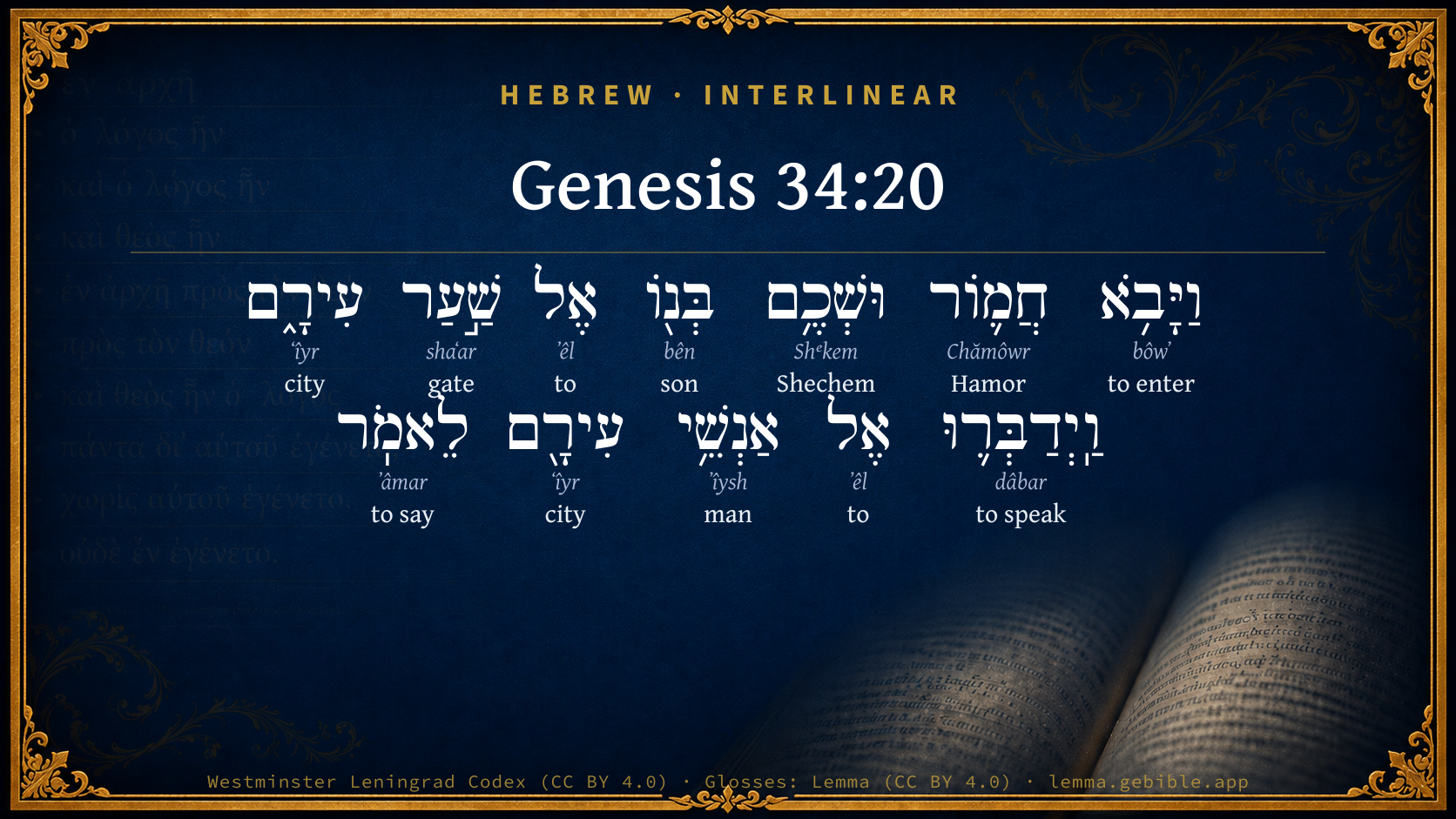
Hebrew (Westminster Leningrad Codex) Genesis 34:20 appears in the Hebrew Old Testament. The text above is from the Westminster Leningrad Codex. Each word links to its Strong’s number, a concise gloss, and parsing drawn from the Open Scriptures Hebrew Bible morphology. Click any word for its full Brown-Driver-Briggs (BDB) entry.
Download image
Cite this verse

Genesis 34:20 (World English Bible). Public Domain. Lemma interlinear Bible study tool, https://lemma.gebible.app/v/genesis/34/20.

Show BibTeX & RIS
BibTeX
RIS
English Translation
Hamor and Shechem, his son, came to the gate of their city, and talked with the men of their city, saying,
World English Bible · Public Domain
Download a study sheet

One document with this verse’s original text, its word-by-word gloss line, the meaning frame, cross-references with their text, attributed commentary, and full source and license credits — printable, and it pastes into notes with its structure intact.

This verse Autodidact and up

Study sheet (.html) Plain text (.txt)

A passage Seminary Student

Up to 50 verses in one chapter. A passage sheet keeps up to 6 commentary sources and 12 cross-references per verse, in the order this page ranks them, and says so on the sheet whenever that leaves anything out. Ask for a single verse and you get the Autodidact verse sheet above.

Everything on this page stays free to read, with no account — the sheet is a download of what is already on screen, not access to it.

Want to remove ads? Support Godless Engineer
Compare translations 3

The same verse in 3 English versions, stacked beneath the original-language interlinear above. Click any original word for its lexicon entry.

Each is an independent rendering of the whole verse — the interlinear is not word-aligned to these translations.

Highlighted words mark where these versions differ — a whole-verse word diff, not a word-by-word alignment.

  • World English Bible Public Domain
    Hamor and Shechem, his son, came to the gate of their city, and talked with the men of their city, saying,
  • King James Version Public Domain
    And Hamor and Shechem his son came unto the gate of their city, and communed with the men of their city, saying,
  • unfoldingWord Literal Text CC BY-SA 4.0
    So Hamor and Shechem his son went to the gate of their city, and they spoke to the men of their city, saying,

unfoldingWord Literal Text — © unfoldingWord, licensed CC BY-SA 4.0. Word-aligned USFM3 via Door43 (git.door43.org/unfoldingWord/en_ult).

Versions to compare (up to 4)

3 of 4 selected

Show all 18 translations

Every available English version of this verse, each an independent rendering of the whole verse.

  • World English Bible Public Domain
    Hamor and Shechem, his son, came to the gate of their city, and talked with the men of their city, saying,
  • Berean Standard Bible Public Domain
    So Hamor and his son Shechem went to the gate of their city and addressed the men of their city:
  • Majority Standard Bible Public Domain
    So Hamor and his son Shechem went to the gate of their city and addressed the men of their city:
  • King James Version Public Domain
    And Hamor and Shechem his son came unto the gate of their city, and communed with the men of their city, saying,
  • American Standard Version (1901) Public Domain
    And Hamor and Shechem his son came unto the gate of their city, and communed with the men of their city, saying,
  • Revised Version (1885) Public Domain
    And Hamor and Shechem his son came unto the gate of their city, and communed with the men of their city, saying,
  • Geneva Bible (1599) Public Domain
    Then Hamor and Shechem his Sonne went vnto the gate of their citie, and communed with the men of their citie, saying,
  • Douay-Rheims (1899) Public Domain
    And going into the gate of the city they spoke to the people:
  • Young's Literal Translation Public Domain
    And Hamor cometh -- Shechem his son also -- unto the gate of their city, and they speak unto the men of their city, saying,
  • Literal Standard Version CC BY-SA 4.0
    And Hamor comes—his son Shechem also—to the gate of their city, and they speak to the men of their city, saying,
  • Unlocked Literal Bible CC BY-SA 4.0
    Hamor and Shechem his son went to the gate of their city and spoke with the men of their city, saying,
  • unfoldingWord Literal Text CC BY-SA 4.0
    So Hamor and Shechem his son went to the gate of their city, and they spoke to the men of their city, saying,
  • Darby Bible Public Domain
    And Hamor and Shechem his son came to the gate of their city, and spoke to the men of their city, saying,
  • World Messianic Bible Public Domain
    Hamor and Shechem, his son, came to the gate of their city, and talked with the men of their city, saying,
  • Webster's Bible Public Domain
    And Hamor and Shechem his son came to the gate of their city, and communed with the men of their city, saying,
  • Free Bible Version CC BY-SA 4.0
    Hamor and Shechem went to the town gate and spoke to the other leaders there.
  • Bible in Basic English Public Domain
    Then Hamor and Shechem, his son, went to the meeting-place of their town, and said to the men of the town,
  • JPS Tanakh (1917) Public Domain
    And Hamor and Shechem his son came unto the gate of their city, and spoke with the men of their city, saying:

Literal Standard Version (2020), Covenant Press — licensed CC BY-SA 4.0. Text via the HelloAO Bible API (eBible.org). Unlocked Literal Bible (unfoldingWord) — licensed CC BY-SA 4.0. Text via the HelloAO Bible API (eBible.org). unfoldingWord Literal Text — © unfoldingWord, licensed CC BY-SA 4.0. Word-aligned USFM3 via Door43 (git.door43.org/unfoldingWord/en_ult). Free Bible Version, Dr. Jonathan Gallagher — licensed CC BY-SA 4.0. Text via the HelloAO Bible API (eBible.org).

Word by word

More ways to search: Search by grammar → Find every occurrence → Compare this word →

Practice this passage: Drill this verse → Learn its vocabulary →

חֲמ֛וֹר
Chămôwr
H2544
“Hamor”
Noun, Proper
Part of Speech
Noun
Type
Proper
Full BDB Definition

Origin: the same as H2543

TWOT: None

Hamor = "he-ass" - the Hivite prince of the city of Shechem when Jacob entered Palestine
  1. וַיָּבֹ֥א bôwʼ H935 “and · to enter” Conjunction + Verb, Qal, Sequential Imperfect, 3rd Person, Masculine, Singular
  2. וּשְׁכֶ֥ם Shᵉkem H7927 “and · Shechem” Conjunction + Noun, Proper
  3. בְּנ֖וֹ bên H1121 “son · his” Noun, Common, Masculine, Singular, Construct + Suffix, Personal, 3rd Person, Masculine, Singular
  4. אֶל ʼêl H413 “to” Preposition
  5. שַׁ֣עַר shaʻar H8179 “gate of” Noun, Common, Masculine, Singular, Construct
  6. עִירָ֑ם ʻîyr H5892 “city · their” Noun, Common, Feminine, Singular, Construct + Suffix, Personal, 3rd Person, Masculine, Plural
  7. וַֽיְדַבְּר֛וּ dâbar H1696 “and · to speak” Conjunction + Verb, Piel, Sequential Imperfect, 3rd Person, Masculine, Plural
  8. אֶל ʼêl H413 “to” Preposition
  9. אַנְשֵׁ֥י ʼîysh H376 “men of” Noun, Common, Masculine, Plural, Construct
  10. עִירָ֖ם ʻîyr H5892 “city · their” Noun, Common, Feminine, Singular, Construct + Suffix, Personal, 3rd Person, Masculine, Plural
  11. לֵאמֹֽר ʼâmar H559 “to say” Preposition + Verb, Qal, Infinitive Construct

About this verse

These counts appear in no published source. They are computed here, from the morphology-tagged text and Lemma’s own curated glosses. What Lemma adds →

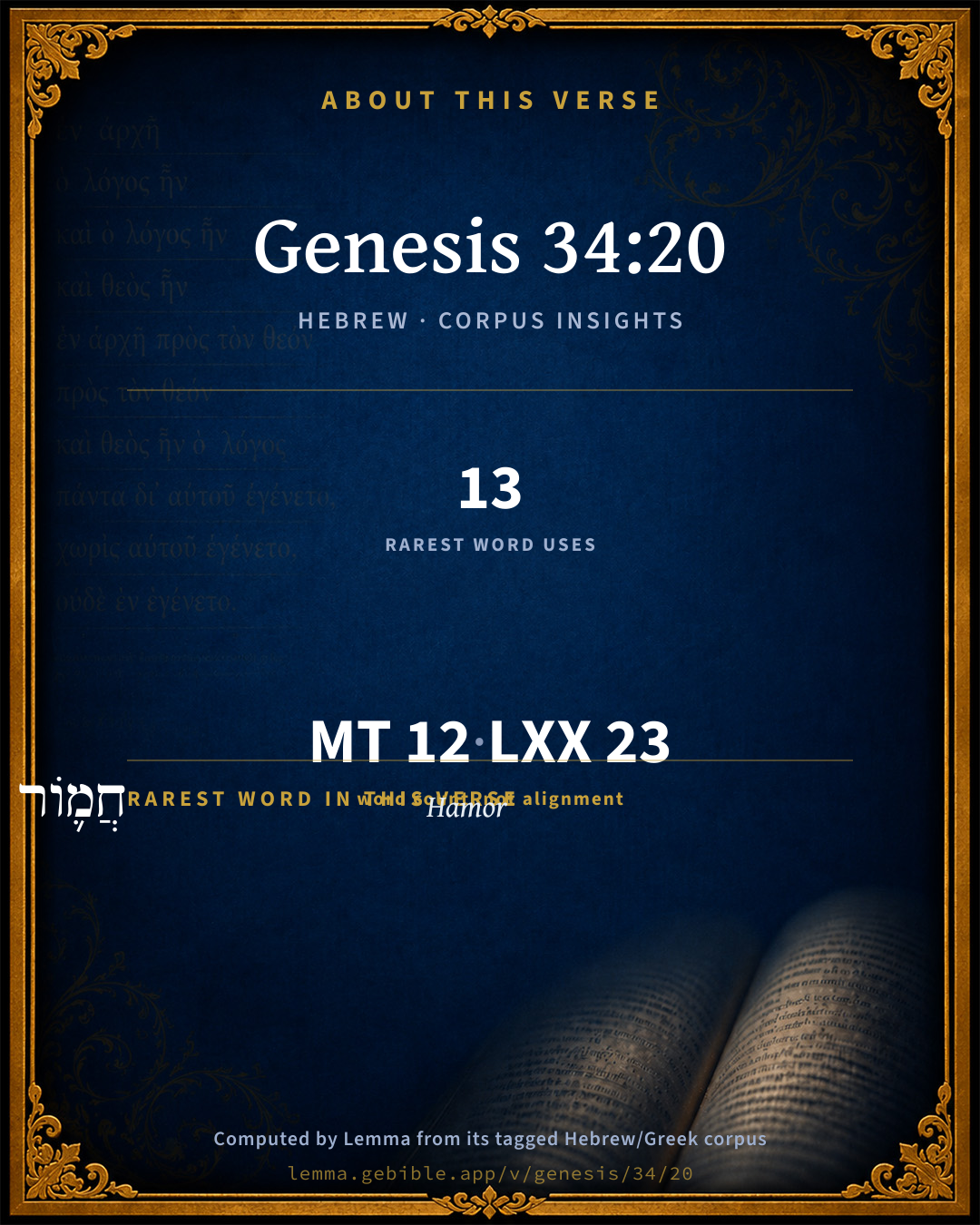
12
words
10
distinct lemmas
Pentateuch
section

Notable vocabulary

The rarest word here is חֲמ֛וֹר Hamor H2544 — appearing just 13 times in the whole Hebrew Bible.

Shared distinctive vocabulary

חֲמ֛וֹר Hamor H2544 occurs in 12 verses of the Hebrew Bible. Also found in:

Grammatical profile

  • 3 verbs
  • 7 nouns
  • 2 prepositions

Verb forms

  • וַיָּבֹ֥א Qal · Sequential Imperfect
  • וַֽיְדַבְּר֛וּ Piel · Sequential Imperfect
  • לֵאמֹֽר Qal · Infinitive Construct

Repetition

Words recur within this verse — often emphatic in Hebrew:

  • עִירָ֑ם city H5892 ×2
  • אֶל to H413 ×2

Hebrew & Septuagint length

In English translation the verse runs 21 words from the Hebrew and 22 from the Septuagint (LXX English) — closely comparable.

A rough comparison of the two English renderings, which tokenize alike — not a word-level alignment.

Word counts can differ between the Hebrew and the Greek without any difference in meaning — e.g. the Hebrew direct-object marker אֵת has no separate Greek word, and Greek often adds the article ὁ.

In the original languages it is 12 Hebrew tokens and 23 Greek tokens — but the two are counted differently (Hebrew bundles its prefixes and suffixes into one token; the Greek is in lemma form), so that isn’t a like-for-like length.

Cross-references

11

Topical passages linked to Genesis 34:20 in the Treasury of Scripture Knowledge — connected by theme and wording, ordered by reader-vote popularity; previews shown in the World English Bible.

  • Ruth 4:1 Now Boaz went up to the gate, and sat him down there: and, behold, the near kinsman of whom Boaz spoke came by; to whom he said, Ho, such a one! turn aside, sit down here. He turned aside, and sat down.
  • Genesis 22:17 that in blessing I will bless you, and in multiplying I will multiply your seed as the stars of the heavens, and as the sand which is on the seashore. Your seed will possess the gate of his enemies.
  • Genesis 23:10 Now Ephron was sitting in the midst of the children of Heth. Ephron the Hittite answered Abraham in the hearing of the children of Heth, even of all who went in at the gate of his city, saying,
  • Deuteronomy 17:5 then shall you bring forth that man or that woman, who has done this evil thing, to your gates, even the man or the woman; and you shall stone them to death with stones.
  • 2 Samuel 15:2 Absalom rose up early, and stood beside the way of the gate: and it was so, that when any man had a suit which should come to the king for judgment, then Absalom called to him, and said, Of what city are you? He said, Your servant is of one of the tribes of Israel.
  • Job 29:7 When I went forth to the city gate, When I prepared my seat in the street,
  • Proverbs 31:23 Her husband is respected in the gates, When he sits among the elders of the land.
  • Amos 5:10 They hate him who reproves in the gate, And they abhor him who speaks blamelessly.
  • Amos 5:12 For I know how many your offenses, And how great are your sins-- You who afflict the just, Who take a bribe, And who turn aside the needy in the courts.
  • Amos 5:15 Hate evil, love good, And establish justice in the courts. It may be that Yahweh, the God of hosts, will be gracious to the remnant of Joseph."
  • Zechariah 8:16 These are the things that you shall do: speak every man the truth with his neighbor. Execute the judgment of truth and peace in your gates,

Cross-references courtesy of OpenBible.info (CC BY 4.0).

Hebrew and Greek witnesses Masoretic Hebrew ↔ Greek Septuagint

The same verse in the two great witnesses to the Old Testament, shown verse-for-verse.

These are two independent witnesses, not word-aligned to each other, and the Septuagint is shown in lemma (dictionary) form.

Hebrew Genesis 34:20 Masoretic · Westminster Leningrad Codex

וַיָּבֹ֥א חֲמ֛וֹר וּשְׁכֶ֥ם בְּנ֖וֹ אֶל שַׁ֣עַר עִירָ֑ם וַֽיְדַבְּר֛וּ אֶל אַנְשֵׁ֥י עִירָ֖ם לֵאמֹֽר

Hamor and Shechem, his son, came to the gate of their city, and talked with the men of their city, saying,

World English Bible · Public Domain

Greek LXX Genesis 34:20 Septuagint · lemma form

ἔρχομαι δέ εμμωρ καί συχεμ ὁ υἱός αὐτός πρός ὁ πύλη ὁ πόλις αὐτός καί λαλέω πρός ὁ ἀνήρ ὁ πόλις αὐτός λέγω

And Emmor and Sychem his son came to the gate of their city, and spoke to the men of their city, saying,

LXX2012 (modern English Septuagint) · Public Domain

Hebrew: Westminster Leningrad Codex (CC BY 4.0). Greek: Septuagint (public domain); English from LXX2012 (modern English Septuagint) (Public Domain). How the Septuagint differs from the Hebrew →

Targum (Aramaic paraphrase)

2

The Targum is the ancient Jewish Aramaic paraphrase of the Hebrew Scriptures — an interpretive translation, not the Hebrew text itself. Onkelos (literal) and Pseudo-Jonathan (expansive) render the Torah, and Jonathan the Prophets. Coverage is partial: where no permissively-licensed English translation exists for a verse, only the Aramaic is shown. This is verse-level text, not a word-by-word alignment to the Hebrew.

  1. Targum Onkelos Torah (Genesis–Deuteronomy)
    וַאֲתָא חֲמוֹר וּשְׁכֶם בְּרֵהּ לִתְרַע קַרְתְּהוֹן וּמַלִּילוּ עִם אֲנָשֵׁי קַרְתְּהוֹן לְמֵימָר

    (no public-domain English translation for this verse)

    Targum Onkelos — Aramaic: “Onkelos Genesis” (public domain); “Onkelos Exodus” (public domain); “Onkelos Leviticus” (public domain); “Onkelos Numbers” (public domain); “Onkelos Deuteronomy” (public domain). English: “Sefaria Community Translation” (CC0 1.0 (public-domain dedication)); “J.W. Etheridge. The Targums of Onkelos and Jonathan Ben Uzziel on the Pentateuch. London: Longmans, Green, 1862” (public domain). Text via Sefaria.

  2. Targum Pseudo-Jonathan Torah (Genesis–Deuteronomy)
    וְאָתָא חֲמוֹר וּשְׁכֶם בְּרֵיהּ לִתְרַע קַרְתֵּיהוֹן וּמַלִילוּ עִם אִינְשֵׁי תְּרַע קַרְתֵּיהוֹן לְמֵימָר

    And Hamor and Shekem his son came to the gate of their city, and spake with the men of the gate of their city, saying,

    Targum Pseudo-Jonathan — Aramaic: “Targum Jonathan on Genesis” (public domain); “Targum Jonathan on Exodus” (public domain); “Targum Jonathan on Leviticus” (public domain); “Targum Jonathan on Numbers” (public domain); “Targum Jonathan on Deuteronomy” (public domain). English: “The Targum of Jonathan ben Uzziel, trans. J. W. Etheridge, London, 1862” (public domain). Text via Sefaria.

Commentary

Notes on Genesis 34:20 from classic Christian and Jewish commentators (each source and its license shown beneath its notes). The classic Christian expositions comment on the surrounding passage and are grouped to its opening verse, so a note may address several verses; the Jewish commentaries on the Tanakh (Rashi and others) are per-verse, so they appear only where the commentator wrote on this verse.

Lemma curates 59 commentaries, every one of them public domain or Creative Commons licensed, each selected and text-cleaned for this edition rather than reprinted as found. About our sources →

Trapp's Complete Commentary

John Trapp

Gen 34:20 And Hamor and Shechem his son came unto the gate of their city, and communed with the men of their city, saying,

Ver. 20. And Hamor and Shechem, &c.] These great men easily persuaded and prevailed with the people to have what they would. Great need have we to pray for good governors. When Crispus believed, who was the chief ruler of the synagogue, many Corinthians believed also. {Act 18:8} Paul was loath to lose the deputy; because his conversion would draw on many others, is on the contrary, Jeroboam caused Israel to sin; and generally, as the kings were good or evil, so were the people; in which, as in a beast, the whole body follows the head.

John Trapp, A Commentary or Exposition upon All the Books of the Old and New Testament (1647–1656) — public domain. Text from a community e-Sword module.

Geneva Bible (1599)

Geneva Bible translators

For the people used to assemble there, and justice was also ministered.

Geneva Bible (1599) marginal notes — public domain. Text via Bolls.life.

Jamieson, Fausset & Brown

Robert Jamieson, A. R. Fausset & David Brown

Hamor and Shechem . . . came unto the gate of their city--That was the place where every public communication was made; and in the ready obsequious submission of the people to this measure we see an evidence either of the extraordinary affection for the governing family, or of the abject despotism of the East, where the will of a chief is an absolute command.

Jamieson, Fausset & Brown — Commentary Critical and Explanatory on the Whole Bible (1871) — public domain (CC PDM 1.0). Text via the HelloAO Bible API.

The Cambridge Bible for Schools and Colleges

gen. ed. J. J. S. Perowne

20. the gate of their city] The place for the transaction of public business: see note on Gen_19:1, Gen_23:10.

The Cambridge Bible for Schools and Colleges (gen. ed. J. J. S. Perowne; Cambridge University Press, 1878–1918) — public domain. Text from a community e-Sword module.

John Gill's Exposition

These men are peaceable with us,.... Meaning Jacob and his sons, pointing to their tents which were near their city; and no doubt more was said than is here expressed, and that these words were introduced with a preface, in which notice was taken of Jacob and his family, and their names mentioned, as here their character is given; that they were men of peaceable dispositions, harmless and inoffensive, as appeared they had been ever since they came into these parts; and there was a great deal of reason to believe they still would be, and which was an argument in their favour, to admit them to a residence among them:

therefore let them dwell in the land, and trade therein; give them leave to dwell where they please, and carry on what trade and traffic in the land they think fit; since they are not likely to be quarrelsome and troublesome, but will deal honestly and honourably, and pay duly for what they agree for or merchandise in:

for the land, behold, it is large enough for them; there is room enough for them to dwell in, and pasturage enough for their cattle, and land enough to manure and till, without in the least incommoding the inhabitants: yea, it is likely to be to their advantage, since they would pay for what they should purchase or hire, and would improve the land which lay uncultivated:

let us take their daughters to us for wives, and let us give them our daughters; this was the thing principally aimed at; and the rest, both what goes before, and what follows after, were in order to this.

John Gill's Exposition of the Whole Bible (1746–1763) — public domain (CC PDM 1.0). Text via the HelloAO Bible API.

Haydock's Catholic Bible Commentary

CHAPTER XXXIV.

Gate. Here judgment was given, the markets held, &c. They endeavoured to convince the people, that the conditions offered would be for their interest. (Menochius)

George Leo Haydock (1774–1849), Haydock's Catholic Family Bible and Commentary, 1859 edition — public domain. Excludes Psalms (Douay-Rheims chapter numbering differs from Protestant) and Deuterocanonical books (Catholic canon only).

Matthew Poole's English Annotations

The gate of their city, the place where all public affairs were debated and concluded. See Poole on "Gen 22:17"; see Poole on "Gen 23:10".

Matthew Poole's English Annotations on the Holy Bible (1683–1685) — public domain. Text from a community e-Sword/MySword module.

The Pulpit Commentary

Vers. 20-23. And Hamor and Shechem his son came (or went) unto the gate of their city, (vide on Gen_19:2 Gen_23:10) and communed with (or spake to) the men of their city, saying, These men (i.e. Jacob and his sons) are peaceable with us (literally, peaceable are they with us. This is the first argument employed by Hamor and Shechem to secure the consent of the citizens to the formation of an alliance with Jacob and his sons); therefore let them dwell in the land, and trade therein; literally, and they will dwell in the land, and trade in it (so. if you permit) for (literally, and) the land, behold, it is large enough literally, broad of hands, i.e. on both sides (cf. Isa_33:21; Psa_104:25) for them (literally, before them, i.e. for them to wander about with their flocks and herds. This was the second argument employed by Hamor and his son); let us take their daughters to us for wives, and let us give them our daughters. Only herein (or under this condition) will the men consent unto us for to dwell with us, to be one people, if every male among us be circumcised (literally, in the circumcising to or by us of every male), as they are circumcised. After which statement of the indispensable condition of the alliance proposed, they advance as a third argument for its acceptance the material advantages which such an alliance would inevitably secure for them. Shall not their cattle and their substance and every beast of theirs (the mikneh refer to flocks and herds; the behemah to asses and camels) be ours? literally, Shall not these (be) to us? only let us consent unto them, and they will dwell with us.

The Pulpit Commentary (1880–1919), ed. H.D.M. Spence-Jones & Joseph S. Exell — public domain. Text from a community e-Sword module.

Kretzmann's Popular Commentary

Paul E. Kretzmann

The Men of Shechem Agree to the Demand

v. 20. And Hamor and Shechem, his son, came unto the gate of their city, the usual place for public meetings, and communed with the men of their city, saying,

v. 21. These men are peaceable with us; therefore let them dwell in the land, and trade therein; for the land, behold, it is large enough for them; let us take their daughters to us for wives, and let us give them our daughters. In suggesting to the men of the city that the Israelites be given the rights of full citizenship, together with permission to carry on the business of herdmen or of traders, Hamor and Shechem were careful to appeal very strongly to the self-interest of the Shechemites, knowing that their mission would thus have the best chances of success.

v. 22. Only herein will the men consent unto us for to dwell with us, to be one people, if every male among us be circumcised, as they are circumcised. This condition is inserted in the midst of the appeal, in order not to have It stand out so strongly.

v. 23. Shall not their cattle and their substance and every beast of theirs be ours? Here the fact mentioned above that the land was wide before their hands and faces, affording enough room in every direction, is connected with the thought that the great wealth of the newcomers would also be at the disposal of the people of Shechem, through the marriages that would be consummated. Only let us consent unto them, and they will dwell with us.

v. 24. And unto Hamor and unto Shechem, his son, hearkened all that went out of the gate of his city; and every male was circumcised, all that went out of the gate of his city. The expression is repeated in order to show that there was no exception among all the men of Shechem. They accepted the rite all the more readily, since it was by no means unknown among Oriental nations. Thus the people of Shechem, heathen though they were, acted in good faith, just as the outward honesty of many an unbeliever in our days puts to shame those that confess the true God.

Paul E. Kretzmann, Popular Commentary of the Bible (1921–1924) — public domain. Text from a community e-Sword module.

unfoldingWord translationNotes

Door43 World Missions Community

the gate of their city

It was common for leaders to meet at the city gate to make official decisions.

These men

"Jacob, his sons, and the people of Israel"

peace with us

Here "us" includes Hamor, his son and all the people they spoke with at the city gate. (See: Inclusive "We")

let them live in the land and trade in it

"let them live and trade in the land"

for, really, the land is large enough for them

Shechem uses the word "really" to add emphasis to his statement. "because, certainly, the land is large enough for them" or "because, indeed, there is plenty of land for them"

take their daughters ... give them our daughters

This refers to marriages between the women of one group and the men of the other group. See how you translated similar phrases in Genesis 34:9.

translationWords

Hamor

Shechem

gate

peace

unfoldingWord translationNotes — © Distant Shores Media and the Door43 World Missions Community, licensed CC BY-SA 4.0. Source: git.door43.org/Door43/en_tn.

Radak

Rabbi David Kimhi (Radak)

ויבא...אל שער עירם, this is where they would hold an assembly of the elders of the town together with the other influential citizens as was the custom pertaining to all matters of common concern. We find examples of such conduct both in Deuteronomy 25,7 and in Ruth 4,1. where the word השערה means that this is the place where assembles were held.

Radak on the Tanakh — English translations: “Sefaria Community Translation” (CC0 1.0 (public-domain dedication)); “Eliyahu Munk, HaChut Hameshulash” (CC BY 4.0); “Rabbi Mike Feuer, Jerusalem Anthology” (CC BY 4.0); and “R. David Kimhi on the first book of Psalms, Translated by R.G. Finch, London, 1919” (public domain). Text via Sefaria.

Lesson kit

Teaching starters — assembled from the data on this page, not authored interpretation. Every prompt links to the verse data it draws on. Edit before teaching.

Genesis, in the Pentateuch, opens this verse with 12 words (10 distinct Hebrew lemmas). Its most distinctive word is Chămôwr (“Hamor”). A historical commentator’s framing appears above. Read the whole chapter for the surrounding context.

Discussion questions

  1. How does “Hamor” (Chămôwr) shape what this verse is saying?
  2. How does Genesis 33:19, which shares the word «Hamor», read alongside this verse?
  3. What does the repetition of “city” (2× in this one verse) do in this verse?
  4. The translations on this page render this verse differently — a whole-verse word diff, not a word-by-word alignment. What might account for the different wordings?
  5. «וַיָּבֹ֥א» is a Qal Sequential Imperfect verb. How does that grammatical form shape the action described?
  6. Compare how Trapp's Complete Commentary and Geneva Bible (1599) read this verse. Where do they agree or differ?

Things to notice

Reading settings

Reading text

Shown beneath each verse's original-language words.

Old Testament
Old Testament edition

Read the OT as the Masoretic Hebrew (MT) or the Greek Septuagint (LXX).

English shown for the Greek Septuagint (in the Hebrew ↔ Greek comparison).

Comparing translations? Open the Compare panel on any verse page to stack up to four side by side.