Genesis 29:6

Hebrew (Westminster Leningrad Codex) Genesis 29:6 appears in the Hebrew Old Testament. The text above is from the Westminster Leningrad Codex. Each word links to its Strong’s number, a concise gloss, and parsing drawn from the Open Scriptures Hebrew Bible morphology. Click any word for its full Brown-Driver-Briggs (BDB) entry.
Download image
Cite this verse

Genesis 29:6 (World English Bible). Public Domain. Lemma interlinear Bible study tool, https://lemma.gebible.app/v/genesis/29/6.

Show BibTeX & RIS
BibTeX
RIS
English Translation
He said to them, "Is it well with him?" They said, "It is well. See, Rachel, his daughter, is coming with the sheep."
World English Bible · Public Domain
Highlights
  • 1 first appearance in the Hebrew Bible
Full analysis ↓
Download a study sheet

One document with this verse’s original text, its word-by-word gloss line, the meaning frame, cross-references with their text, attributed commentary, and full source and license credits — printable, and it pastes into notes with its structure intact.

This verse Autodidact and up

Study sheet (.html) Plain text (.txt)

A passage Seminary Student

Up to 50 verses in one chapter. A passage sheet keeps up to 6 commentary sources and 12 cross-references per verse, in the order this page ranks them, and says so on the sheet whenever that leaves anything out. Ask for a single verse and you get the Autodidact verse sheet above.

Everything on this page stays free to read, with no account — the sheet is a download of what is already on screen, not access to it.

Want to remove ads? Support Godless Engineer
Compare translations 3

The same verse in 3 English versions, stacked beneath the original-language interlinear above. Click any original word for its lexicon entry.

Each is an independent rendering of the whole verse — the interlinear is not word-aligned to these translations.

Highlighted words mark where these versions differ — a whole-verse word diff, not a word-by-word alignment.

  • World English Bible Public Domain
    He said to them, "Is it well with him?" They said, "It is well. See, Rachel, his daughter, is coming with the sheep."
  • King James Version Public Domain
    And he said unto them, Is he well? And they said, He is well: and, behold, Rachel his daughter cometh with the sheep.
  • unfoldingWord Literal Text CC BY-SA 4.0
    Then he said to them, “Are well for him?” And they said, “ well. And behold, Rachel his daughter is coming with the sheep.”

unfoldingWord Literal Text — © unfoldingWord, licensed CC BY-SA 4.0. Word-aligned USFM3 via Door43 (git.door43.org/unfoldingWord/en_ult).

Versions to compare (up to 4)

3 of 4 selected

Show all 18 translations

Every available English version of this verse, each an independent rendering of the whole verse.

  • World English Bible Public Domain
    He said to them, "Is it well with him?" They said, "It is well. See, Rachel, his daughter, is coming with the sheep."
  • Berean Standard Bible Public Domain
    “Is he well?” Jacob inquired. “Yes,” they answered, “and here comes his daughter Rachel with his sheep.”
  • Majority Standard Bible Public Domain
    “Is he well?” Jacob inquired. “Yes,” they answered, “and here comes his daughter Rachel with his sheep.”
  • King James Version Public Domain
    And he said unto them, Is he well? And they said, He is well: and, behold, Rachel his daughter cometh with the sheep.
  • American Standard Version (1901) Public Domain
    And he said unto them, Is it well with him? And they said, It is well. And, behold, Rachel his daughter cometh with the sheep.
  • Revised Version (1885) Public Domain
    And he said unto them, Is it well with him? And they said, It is well: and, behold, Rachel his daughter cometh with the sheep.
  • Geneva Bible (1599) Public Domain
    Againe he sayd vnto them, Is he in good health? And they answered, He is in good health, and beholde, his daughter Rahel commeth with the sheepe.
  • Douay-Rheims (1899) Public Domain
    He said: Is he in health? He is in health, say they: and behold Rachel his daughter cometh with his flock.
  • Young's Literal Translation Public Domain
    And he saith to them, `Hath he peace?' and they say, `Peace; and lo, Rachel his daughter is coming with the flock.'
  • Literal Standard Version CC BY-SA 4.0
    And he says to them, “Does he have peace?” And they say, “Peace; and behold, his daughter Rachel is coming with the flock.”
  • Unlocked Literal Bible CC BY-SA 4.0
    He said to them, “Is he well?” They said, “He is well, and, look there, Rachel his daughter is coming with the sheep.”
  • unfoldingWord Literal Text CC BY-SA 4.0
    Then he said to them, “Are well for him?” And they said, “ well. And behold, Rachel his daughter is coming with the sheep.”
  • Darby Bible Public Domain
    And he said to them, Is he well? And they said, [He is] well; and behold, there comes Rachel his daughter with the sheep.
  • World Messianic Bible Public Domain
    He said to them, “Is it well with him?” They said, “It is well. See, Rachel, his daughter, is coming with the sheep.”
  • Webster's Bible Public Domain
    And he said to them, Is he well? And they said, He is well: and behold, Rachel his daughter cometh with the sheep.
  • Free Bible Version CC BY-SA 4.0
    “How is he?” he asked. “He's well,” they replied. “Look! In fact here's his daughter Rachel coming with the sheep right now.”
  • Bible in Basic English Public Domain
    And he said to them, Is he well? And they said, He is well, and here is Rachel his daughter coming with the sheep.
  • JPS Tanakh (1917) Public Domain
    And he said unto them: 'Is it well with him?' And they said: 'It is well; and, behold, Rachel his daughter cometh with the sheep.'

Literal Standard Version (2020), Covenant Press — licensed CC BY-SA 4.0. Text via the HelloAO Bible API (eBible.org). Unlocked Literal Bible (unfoldingWord) — licensed CC BY-SA 4.0. Text via the HelloAO Bible API (eBible.org). unfoldingWord Literal Text — © unfoldingWord, licensed CC BY-SA 4.0. Word-aligned USFM3 via Door43 (git.door43.org/unfoldingWord/en_ult). Free Bible Version, Dr. Jonathan Gallagher — licensed CC BY-SA 4.0. Text via the HelloAO Bible API (eBible.org).

Word by word

More ways to search: Search by grammar → Find every occurrence → Compare this word →

Practice this passage: Drill this verse → Learn its vocabulary →

רָחֵ֣ל
Râchêl
H7354
“Rachel”
Noun, Proper
Part of Speech
Noun
Type
Proper
Full BDB Definition

Origin: the same as H7353

TWOT: None

Rachel = "ewe" - daughter of Laban, wife of Jacob, and mother of Joseph and Benjamin
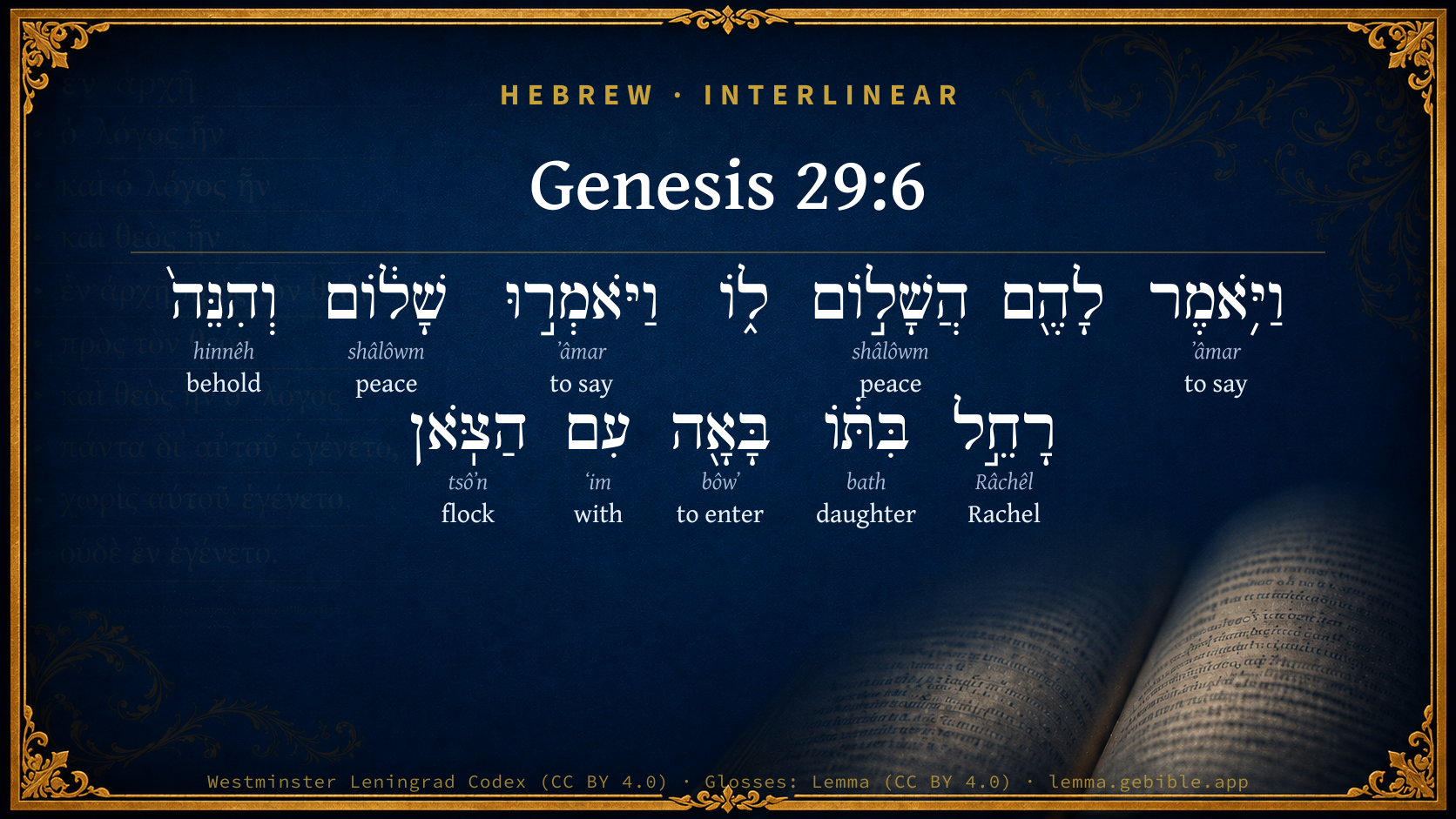
  1. וַיֹּ֥אמֶר ʼâmar H559 “and · to say” Conjunction + Verb, Qal, Sequential Imperfect, 3rd Person, Masculine, Singular
  2. הֲשָׁל֣וֹם shâlôwm H7965 “peace” Particle, Interrogative + Noun, Common, Masculine, Singular, Absolute
  3. וַיֹּאמְר֣וּ ʼâmar H559 “and · to say” Conjunction + Verb, Qal, Sequential Imperfect, 3rd Person, Masculine, Plural
  4. שָׁל֔וֹם shâlôwm H7965 “peace” Noun, Common, Masculine, Singular, Absolute
  5. וְהִנֵּה֙ hinnêh H2009 “and · behold” Conjunction + Particle, Demonstrative
  6. בִּתּ֔וֹ bath H1323 “daughter · his” Noun, Common, Feminine, Singular, Construct + Suffix, Personal, 3rd Person, Masculine, Singular
  7. בָּאָ֖ה bôwʼ H935 “entering” Verb, Qal, Participle Active, Feminine, Singular, Absolute
  8. עִם ʻim H5973 “with” Preposition
  9. הַצֹּֽאן tsôʼn H6629 “the · flock” Particle, Definite Article + Noun, Common, Both, Singular, Absolute

About this verse

These counts appear in no published source. They are computed here, from the morphology-tagged text and Lemma’s own curated glosses. What Lemma adds →

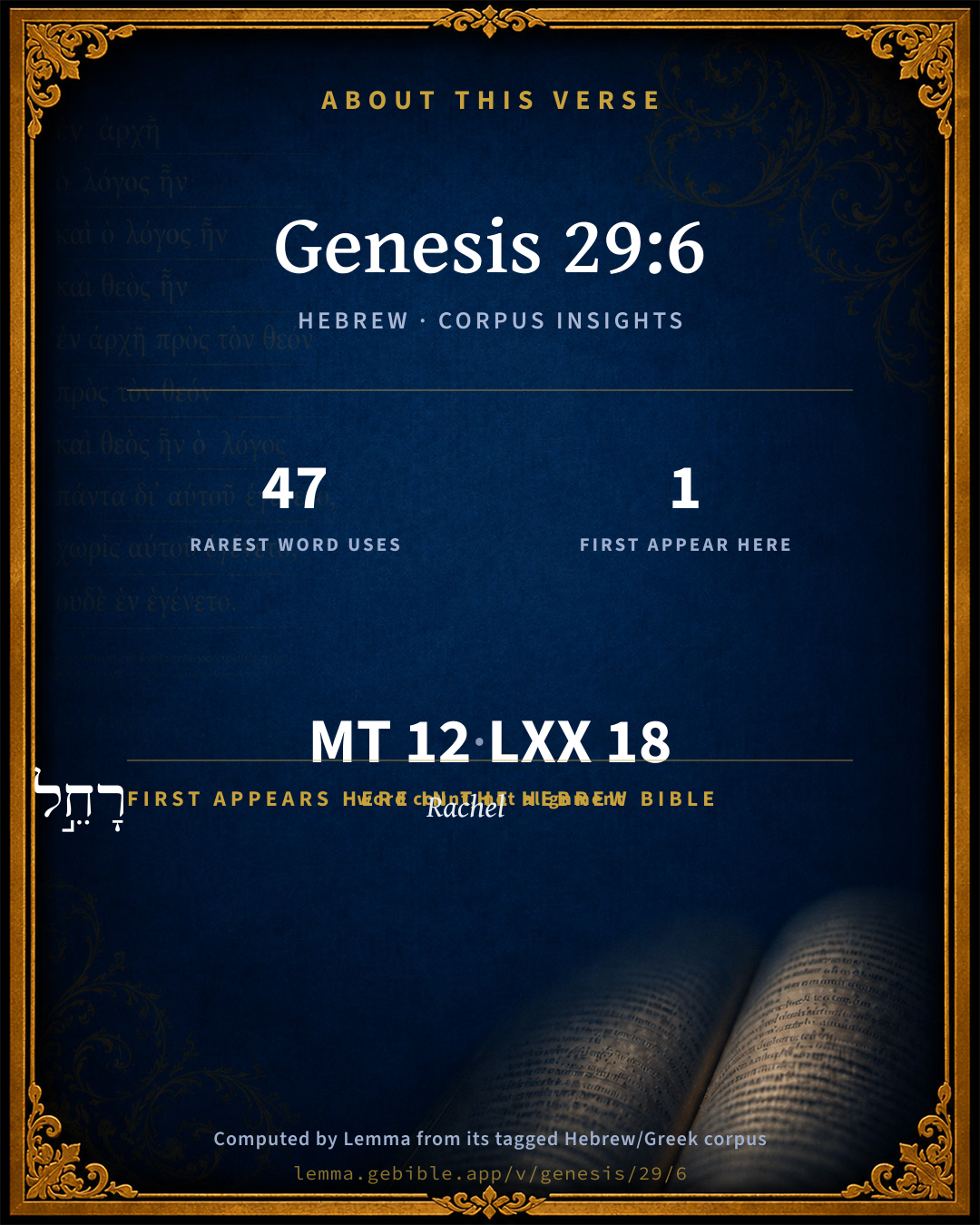
12
words
8
distinct lemmas
Pentateuch
section

First appearance in Scripture

This word makes its first canonical appearance in the Hebrew Bible here:

  • רָחֵ֣ל Rachel H7354

Shared distinctive vocabulary

רָחֵ֣ל Rachel H7354 occurs in 44 verses of the Hebrew Bible. Also found in:

Grammatical profile

  • 3 verbs
  • 5 nouns
  • 3 prepositions
  • 1 particle

Verb forms

  • וַיֹּ֥אמֶר Qal · Sequential Imperfect
  • וַיֹּאמְר֣וּ Qal · Sequential Imperfect
  • בָּאָ֖ה Qal · Participle Active

Repetition

Words recur within this verse — often emphatic in Hebrew:

  • וַיֹּ֥אמֶר to say H559 ×2
  • הֲשָׁל֣וֹם peace H7965 ×2

Hebrew & Septuagint length

In English translation the verse runs 23 words from the Hebrew and 23 from the Septuagint (LXX English) — the same length.

A rough comparison of the two English renderings, which tokenize alike — not a word-level alignment.

Word counts can differ between the Hebrew and the Greek without any difference in meaning — e.g. the Hebrew direct-object marker אֵת has no separate Greek word, and Greek often adds the article ὁ.

In the original languages it is 12 Hebrew tokens and 18 Greek tokens — but the two are counted differently (Hebrew bundles its prefixes and suffixes into one token; the Greek is in lemma form), so that isn’t a like-for-like length.

Cross-references

6

Topical passages linked to Genesis 29:6 in the Treasury of Scripture Knowledge — connected by theme and wording, ordered by reader-vote popularity; previews shown in the World English Bible.

  • Genesis 37:14 He said to him, "Go now, see whether it is well with your brothers, and well with the flock; and bring me word again." So he sent him out of the valley of Hebron, and he came to Shechem.
  • Genesis 43:27 He asked them of their welfare, and said, "Is your father well, the old man of whom you spoke? Is he yet alive?"
  • Exodus 18:7 Moses went out to meet his father-in-law, and bowed and kissed him. They asked each other of their welfare, and they came into the tent.
  • 1 Samuel 17:22 David left his baggage in the hand of the keeper of the baggage, and ran to the army, and came and greeted his brothers.
  • 1 Samuel 25:5 David sent ten young men, and David said to the young men, Go up to Carmel, and go to Nabal, and greet him in my name:
  • 2 Samuel 20:9 Joab said to Amasa, Is it well with you, my brother? Joab took Amasa by the beard with his right hand to kiss him.

Cross-references courtesy of OpenBible.info (CC BY 4.0).

Hebrew and Greek witnesses Masoretic Hebrew ↔ Greek Septuagint

The same verse in the two great witnesses to the Old Testament, shown verse-for-verse.

These are two independent witnesses, not word-aligned to each other, and the Septuagint is shown in lemma (dictionary) form.

Hebrew Genesis 29:6 Masoretic · Westminster Leningrad Codex

וַיֹּ֥אמֶר לָהֶ֖ם הֲשָׁל֣וֹם ל֑וֹ וַיֹּאמְר֣וּ שָׁל֔וֹם וְהִנֵּה֙ רָחֵ֣ל בִּתּ֔וֹ בָּאָ֖ה עִם הַצֹּֽאן

He said to them, "Is it well with him?" They said, "It is well. See, Rachel, his daughter, is coming with the sheep."

World English Bible · Public Domain

Greek LXX Genesis 29:6 Septuagint · lemma form

εἶπον δέ αὐτός ὑγιαίνω ὁ δέ εἶπον ὑγιαίνω καί ἰδού ραχηλ ὁ θυγάτηρ αὐτός ἔρχομαι μετά ὁ πρόβατον

And he said to them, Is he well? And they said, He is well. And behold Rachel his daughter came with the sheep.

LXX2012 (modern English Septuagint) · Public Domain

On this verse, The Pulpit Commentary discusses the Septuagint’s reading. Read the note in Commentary ↓

Hebrew: Westminster Leningrad Codex (CC BY 4.0). Greek: Septuagint (public domain); English from LXX2012 (modern English Septuagint) (Public Domain). How the Septuagint differs from the Hebrew →

Targum (Aramaic paraphrase)

2

The Targum is the ancient Jewish Aramaic paraphrase of the Hebrew Scriptures — an interpretive translation, not the Hebrew text itself. Onkelos (literal) and Pseudo-Jonathan (expansive) render the Torah, and Jonathan the Prophets. Coverage is partial: where no permissively-licensed English translation exists for a verse, only the Aramaic is shown. This is verse-level text, not a word-by-word alignment to the Hebrew.

  1. Targum Onkelos Torah (Genesis–Deuteronomy)
    וַאֲמַר לְהוֹן הַשְׁלַם לֵהּ וַאֲמָרוּ שְׁלַם וְהָא רָחֵל בְּרַתֵּהּ אַתְיָא עִם עָנָא

    (no public-domain English translation for this verse)

    Targum Onkelos — Aramaic: “Onkelos Genesis” (public domain); “Onkelos Exodus” (public domain); “Onkelos Leviticus” (public domain); “Onkelos Numbers” (public domain); “Onkelos Deuteronomy” (public domain). English: “Sefaria Community Translation” (CC0 1.0 (public-domain dedication)); “J.W. Etheridge. The Targums of Onkelos and Jonathan Ben Uzziel on the Pentateuch. London: Longmans, Green, 1862” (public domain). Text via Sefaria.

  2. Targum Pseudo-Jonathan Torah (Genesis–Deuteronomy)
    וַאֲמַר לְהוֹם הַשְׁלַם לֵיהּ וַאֲמָרוּ שְׁלָם וְהָא רָחֵל בְּרַתֵּיהּ אַתְיָא עִם עָנָא

    And he said, Hath he peace? And they said, Peace; and, behold, Rahel his daughter cometh with the sheep.

    Targum Pseudo-Jonathan — Aramaic: “Targum Jonathan on Genesis” (public domain); “Targum Jonathan on Exodus” (public domain); “Targum Jonathan on Leviticus” (public domain); “Targum Jonathan on Numbers” (public domain); “Targum Jonathan on Deuteronomy” (public domain). English: “The Targum of Jonathan ben Uzziel, trans. J. W. Etheridge, London, 1862” (public domain). Text via Sefaria.

Commentary

Notes on Genesis 29:6 from classic Christian and Jewish commentators (each source and its license shown beneath its notes). The classic Christian expositions comment on the surrounding passage and are grouped to its opening verse, so a note may address several verses; the Jewish commentaries on the Tanakh (Rashi and others) are per-verse, so they appear only where the commentator wrote on this verse.

Lemma curates 59 commentaries, every one of them public domain or Creative Commons licensed, each selected and text-cleaned for this edition rather than reprinted as found. About our sources →

Trapp's Complete Commentary

John Trapp

Gen 29:6 And he said unto them, [Is] he well? And they said, [He is] well: and, behold, Rachel his daughter cometh with the sheep.

Ver. 6. And, behold, Rachel his daughter.] Note, that our least and ordinary actions are ordered and directed by God; as Nathanael’s being under the fig tree, {Joh 1:48} &c. Birds flying seem to fly at liberty, yet are guided by an overruling hand of Heaven: so are our thoughts, affections, actions. Sic curat Deus universos, quasi singulos; sic singulos, quasi solos , saith Augustine, Rachel, by a divine providence, meets Jacob at the well: so doth the Church (that shepherdess, Son 1:7-8) meet Christ in his ordinances. {Psa 23:2-3}

John Trapp, A Commentary or Exposition upon All the Books of the Old and New Testament (1647–1656) — public domain. Text from a community e-Sword module.

Joseph Benson's Commentary

Gen 29:6. Rachel his daughter cometh with the sheep — According to the custom of those times, when simplicity and industry were in fashion among persons of great quality, and of both sexes. They who find fault with the Scriptures, and question the truth of such accounts, discover great ignorance of the state of former ages.

Joseph Benson's Commentary on the Old and New Testaments (1811–1818) — public domain. Text from a community e-Sword module.

Geneva Bible (1599)

Geneva Bible translators

Or, he is in peace? by the which word the Hebrews signify all prosperity.

Geneva Bible (1599) marginal notes — public domain. Text via Bolls.life.

Adam Clarke's Commentary

Verse 6. Is he well?] השלום לו hashalom lo? Is there peace to him? Peace among the Hebrews signified all kinds of prosperity. Is he a prosperous man in his family and in his property? And they said, He is well, שלום shalom, he prospers.

Rachel - cometh with the sheep.] רחל rachel (the ch sounded strongly guttural) signifies a sheep or ewe; and she probably had her name from her fondness for these animals.

Adam Clarke's Commentary on the Bible (1810–1826) — public domain. Text from a community e-Sword/MySword module.

The Cambridge Bible for Schools and Colleges

gen. ed. J. J. S. Perowne

6. Rachel] The name means “Ewe,” a personal name, though, possibly, also tribal. In very early times, the designation of an animal seems often to have been transferred to a family or clan in connexion with the “totem,” or animal associated in worship with the spirit-god of the community.

The Cambridge Bible for Schools and Colleges (gen. ed. J. J. S. Perowne; Cambridge University Press, 1878–1918) — public domain. Text from a community e-Sword module.

John Gill's Exposition

And he said unto them, is he well?.... In good health, he and his family, or "is peace unto him" (b); does he enjoy prosperity and happiness? for this word was used in the eastern nations, and still is, for all kind of felicity:

and they said, he is well; or has peace; he and his family are in good health, enjoying all the comforts and blessings of life:

and, behold, Rachel his daughter cometh with the sheep; at that very instant she was coming out of the city with her father's flock of sheep, to water them at the well; an instance of great humility, diligence, and simplicity; this was very providential to Jacob.

(b) "nunquid pax ei", Montanus, Vatablus, Fagius, Cartwright, Schmidt.

John Gill's Exposition of the Whole Bible (1746–1763) — public domain (CC PDM 1.0). Text via the HelloAO Bible API.

Haydock's Catholic Bible Commentary

Health. Hebrew, "in peace;" by which name all good things are designated. (Du Hamel)

George Leo Haydock (1774–1849), Haydock's Catholic Family Bible and Commentary, 1859 edition — public domain. Excludes Psalms (Douay-Rheims chapter numbering differs from Protestant) and Deuterocanonical books (Catholic canon only).

Matthew Poole's English Annotations

According to the manner of those times, Exo 2:16; Son 1:7,8, when humility, innocency, simplicity, and industry were in fashion, both among men and women of great quality. There are some that quarrel with the Scripture, and question the truth of such relations, because they judge of the state of ancient times and things by the present age, whereby they discover great folly and deep ignorance of the state of former ages.

Matthew Poole's English Annotations on the Holy Bible (1683–1685) — public domain. Text from a community e-Sword/MySword module.

The Pulpit Commentary

And he said unto them, Is he well? Literally, is there peace to him? meaning not simply bodily health, but all manner of felicity; uJgiainei (LXX); sanusne est? (Vulgate). Cf. the Christian salutation, tax vobiscum And they said, He is well (literally, peace): and, behold, Rachel (Gesenius)his daughter cometh with the sheep.

The Pulpit Commentary (1880–1919), ed. H.D.M. Spence-Jones & Joseph S. Exell — public domain. Text from a community e-Sword module.

Rashi

Rabbi Shlomo Yitzchaki (Rashi)

באה עם הצאן IS COMING WITH THE FLOCK — The accent in the word באה is on the א, and the Targum is אתיא (a participle), “she is coming”; but in (v. 9) “And Rachel came (באה)”, the accent is on the first syllable, on the ב, and the Targum is אתת, “she came”. The former expresses the meaning “she is doing something” (a participle), the latter expresses the meaning “she has done something’ (a past tense).

Rashi on the Tanakh — English translations: “The Judaica Press complete Tanach with Rashi, translated by A. J. Rosenberg” (CC BY 4.0); “Pentateuch with Rashi's commentary by M. Rosenbaum and A.M. Silbermann, 1929-1934” (public domain); “The Metsudah Tanach series, Lakewood, N.J” (CC BY 4.0); and “The Book of Joshua, Metsudah Publications, 1997” (CC BY 4.0). Text via Sefaria.

Radak

Rabbi David Kimhi (Radak)

באה, with the stress on the last syllable seeing the word is in the present tense.

Radak on the Tanakh — English translations: “Sefaria Community Translation” (CC0 1.0 (public-domain dedication)); “Eliyahu Munk, HaChut Hameshulash” (CC BY 4.0); “Rabbi Mike Feuer, Jerusalem Anthology” (CC BY 4.0); and “R. David Kimhi on the first book of Psalms, Translated by R.G. Finch, London, 1919” (public domain). Text via Sefaria.

Lesson kit

Teaching starters — assembled from the data on this page, not authored interpretation. Every prompt links to the verse data it draws on. Edit before teaching.

Genesis, in the Pentateuch, opens this verse with 12 words (8 distinct Hebrew lemmas). Its most distinctive word is Râchêl (“Rachel”). A historical commentator’s framing appears above. Read the whole chapter for the surrounding context.

Discussion questions

  1. How does “Rachel” (Râchêl) shape what this verse is saying?
  2. This is the first place “Rachel” appears in Scripture (first appears here). What does its debut here establish?
  3. How does Genesis 29:9, which shares the word «Rachel», read alongside this verse?
  4. What does the repetition of “to say” (2× in this one verse) do in this verse?
  5. These translations render this verse differently. What is at stake in choosing one wording over another?
  6. «וַיֹּ֥אמֶר» is a Qal Sequential Imperfect verb. How does that grammatical form shape the action described?
  7. Compare how Trapp's Complete Commentary and Joseph Benson's Commentary read this verse. Where do they agree or differ?

Things to notice

Reading settings

Reading text

Shown beneath each verse's original-language words.

Old Testament
Old Testament edition

Read the OT as the Masoretic Hebrew (MT) or the Greek Septuagint (LXX).

English shown for the Greek Septuagint (in the Hebrew ↔ Greek comparison).

Comparing translations? Open the Compare panel on any verse page to stack up to four side by side.