
Genesis 42:6

Hebrew (Westminster Leningrad Codex) Genesis 42:6 appears in the Hebrew Old Testament. The text above is from the Westminster Leningrad Codex. Each word links to its Strong’s number, a concise gloss, and parsing drawn from the Open Scriptures Hebrew Bible morphology. Click any word for its full Brown-Driver-Briggs (BDB) entry.
Download image
Cite this verse

Genesis 42:6 (World English Bible). Public Domain. Lemma interlinear Bible study tool, https://lemma.gebible.app/v/genesis/42/6.

Show BibTeX & RIS
BibTeX
RIS
English Translation
Joseph was the governor over the land. It was he who sold to all the people of the land. Joseph's brothers came, and bowed themselves down to him with their faces to the earth.
World English Bible · Public Domain
Highlights
  • 1 first appearance in the Hebrew Bible
Full analysis ↓
Download a study sheet

One document with this verse’s original text, its word-by-word gloss line, the meaning frame, cross-references with their text, attributed commentary, and full source and license credits — printable, and it pastes into notes with its structure intact.

This verse Autodidact and up

Study sheet (.html) Plain text (.txt)

A passage Seminary Student

Up to 50 verses in one chapter. A passage sheet keeps up to 6 commentary sources and 12 cross-references per verse, in the order this page ranks them, and says so on the sheet whenever that leaves anything out. Ask for a single verse and you get the Autodidact verse sheet above.

Everything on this page stays free to read, with no account — the sheet is a download of what is already on screen, not access to it.

Want to remove ads? Support Godless Engineer
Compare translations 3

The same verse in 3 English versions, stacked beneath the original-language interlinear above. Click any original word for its lexicon entry.

Each is an independent rendering of the whole verse — the interlinear is not word-aligned to these translations.

Highlighted words mark where these versions differ — a whole-verse word diff, not a word-by-word alignment.

  • World English Bible Public Domain
    Joseph was the governor over the land. It was he who sold to all the people of the land. Joseph's brothers came, and bowed themselves down to him with their faces to the earth.
  • King James Version Public Domain
    And Joseph was the governor over the land, and he it was that sold to all the people of the land: and Joseph's brethren came, and bowed down themselves before him with their faces to the earth.
  • unfoldingWord Literal Text CC BY-SA 4.0
    Now Joseph the governor over the land. he who was selling to all the people of the land. So the brothers of Joseph came and bowed down to him noses to the ground.

unfoldingWord Literal Text — © unfoldingWord, licensed CC BY-SA 4.0. Word-aligned USFM3 via Door43 (git.door43.org/unfoldingWord/en_ult).

Versions to compare (up to 4)

3 of 4 selected

Show all 18 translations

Every available English version of this verse, each an independent rendering of the whole verse.

  • World English Bible Public Domain
    Joseph was the governor over the land. It was he who sold to all the people of the land. Joseph's brothers came, and bowed themselves down to him with their faces to the earth.
  • Berean Standard Bible Public Domain
    Now Joseph was the ruler of the land; he was the one who sold grain to all its people. So when his brothers arrived, they bowed down before him with their faces to the ground.
  • Majority Standard Bible Public Domain
    Now Joseph was the ruler of the land; he was the one who sold grain to all its people. So when his brothers arrived, they bowed down before him with their faces to the ground.
  • King James Version Public Domain
    And Joseph was the governor over the land, and he it was that sold to all the people of the land: and Joseph's brethren came, and bowed down themselves before him with their faces to the earth.
  • American Standard Version (1901) Public Domain
    And Joseph was the governor over the land; he it was that sold to all the people of the land. And Joseph's brethren came, and bowed down themselves to him with their faces to the earth.
  • Revised Version (1885) Public Domain
    And Joseph was the governor over the land; he it was that sold to all the people of the land: and Joseph’s brethren came, and bowed down themselves to him with their faces to the earth.
  • Geneva Bible (1599) Public Domain
    Now Ioseph was gouerner of the land, who solde to all the people of the lande: then Iosephs brethren came, and bowed their face to the groud before him.
  • Douay-Rheims (1899) Public Domain
    And Joseph was governor in the land of Egypt, and corn was sold by his direction to the people. And when his brethren had bowed down to him,
  • Young's Literal Translation Public Domain
    and Joseph is the ruler over the land, he who is selling to all the people of the land, and Joseph's brethren come and bow themselves to him -- face to the earth.
  • Literal Standard Version CC BY-SA 4.0
    and Joseph is the ruler over the land, he who is selling to all the people of the land, and Joseph’s brothers come and bow themselves to him—face to the earth.
  • Unlocked Literal Bible CC BY-SA 4.0
    Now Joseph was the governor over the land. He was the one who sold to all the people of the land. Joseph's brothers came and bowed down to him with their faces to the ground.
  • unfoldingWord Literal Text CC BY-SA 4.0
    Now Joseph the governor over the land. he who was selling to all the people of the land. So the brothers of Joseph came and bowed down to him noses to the ground.
  • Darby Bible Public Domain
    And Joseph, he was the governor over the land -- he it was that sold [the corn] to all the people of the land. And Joseph's brethren came and bowed down to him, the face to the earth.
  • World Messianic Bible Public Domain
    Joseph was the governor over the land. It was he who sold to all the people of the land. Joseph’s brothers came, and bowed themselves down to him with their faces to the earth.
  • Webster's Bible Public Domain
    And Joseph was the governor over the land, and he it was that sold to all the people of the land: and Joseph's brethren came, and bowed themselves before him with their faces to the earth.
  • Free Bible Version CC BY-SA 4.0
    Joseph was the governor of the country and he sold grain to all the people there. So Joseph's brothers went to him, and bowed low before him with their faces to the ground.
  • Bible in Basic English Public Domain
    Now Joseph was ruler over all the land, and it was he who gave out the grain to all the people of the land; and Joseph's brothers came before him and went down on their faces to the earth.
  • JPS Tanakh (1917) Public Domain
    And Joseph was the governor over the land; he it was that sold to all the people of the land. And Joseph's brethren came, and bowed down to him with their faces to the earth.

Literal Standard Version (2020), Covenant Press — licensed CC BY-SA 4.0. Text via the HelloAO Bible API (eBible.org). Unlocked Literal Bible (unfoldingWord) — licensed CC BY-SA 4.0. Text via the HelloAO Bible API (eBible.org). unfoldingWord Literal Text — © unfoldingWord, licensed CC BY-SA 4.0. Word-aligned USFM3 via Door43 (git.door43.org/unfoldingWord/en_ult). Free Bible Version, Dr. Jonathan Gallagher — licensed CC BY-SA 4.0. Text via the HelloAO Bible API (eBible.org).

Word by word

More ways to search: Search by grammar → Find every occurrence → Compare this word →

Practice this passage: Drill this verse → Learn its vocabulary →

הַשַּׁלִּ֣יט
shallîyṭ
H7989
“the · ruler”
Particle, Definite Article + Adjective, Adjective, Masculine, Singular, Absolute
Part of Speech
Particle + Adjective
Type
Adjective
Gender
Masculine
Number
Singular
State
Absolute
Full BDB Definition

Origin: from H7980

TWOT: 2396a

having mastery, domineering, master - having mastery - ruler (substantive) - domineering, imperious
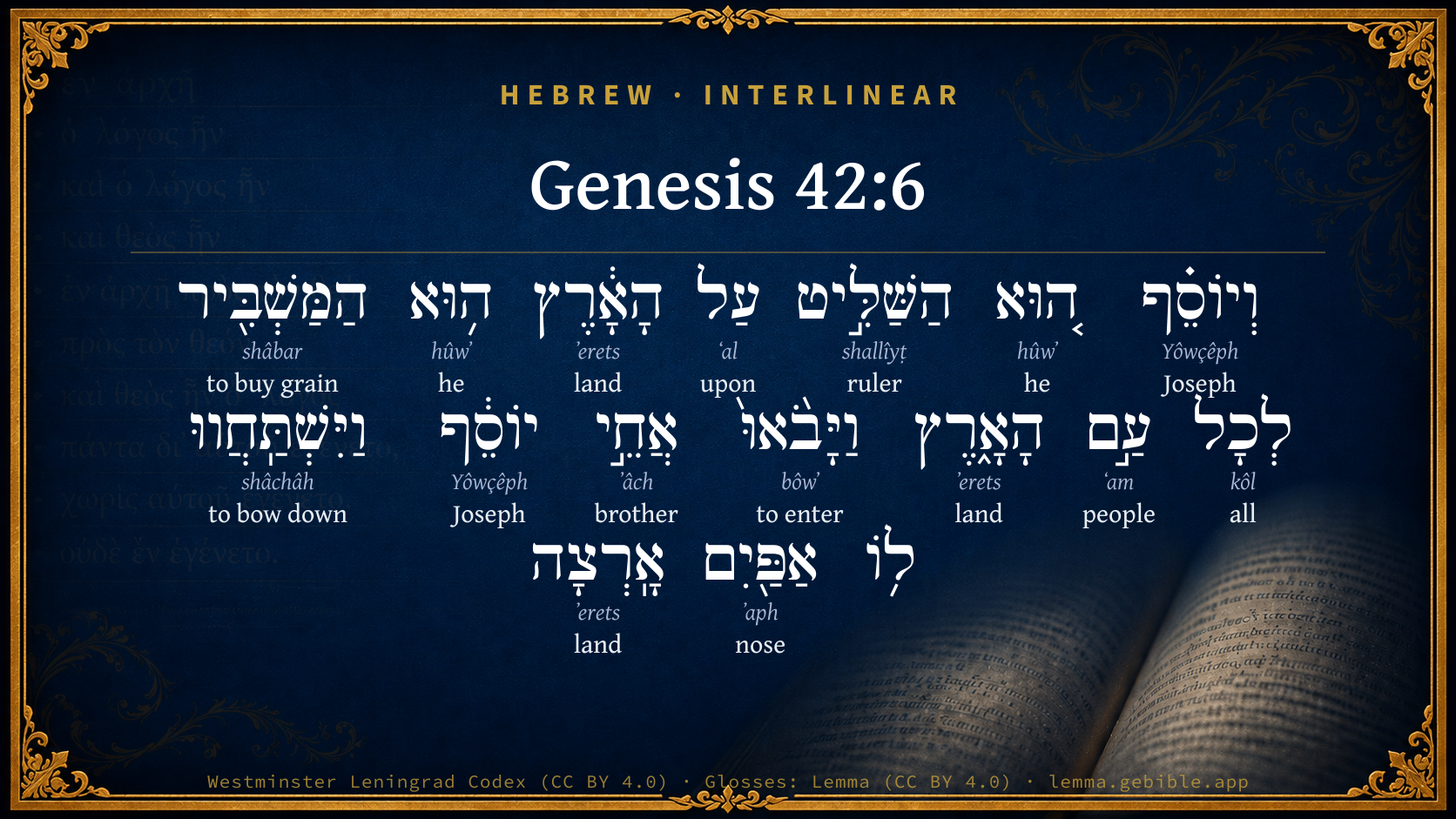
  1. וְיוֹסֵ֗ף Yôwçêph H3130 “and · Joseph” Conjunction + Noun, Proper
  2. ה֚וּא hûwʼ H1931 “he” Pronoun, Personal, 3rd Person, Masculine, Singular
  3. עַל ʻal H5921 “upon” Preposition
  4. הָאָ֔רֶץ ʼerets H776 “the · land” Particle, Definite Article + Noun, Common, Both, Singular, Absolute
  5. ה֥וּא hûwʼ H1931 “he” Pronoun, Personal, 3rd Person, Masculine, Singular
  6. הַמַּשְׁבִּ֖יר shâbar H7666 “the · buying grain” Particle, Definite Article + Verb, Hiphil, Participle Active, Masculine, Singular, Absolute
  7. לְכָל kôl H3605 “to/for · all of” Preposition + Noun, Common, Masculine, Singular, Construct
  8. עַ֣ם ʻam H5971 “people of” Noun, Common, Masculine, Singular, Construct
  9. הָאָ֑רֶץ ʼerets H776 “the · land” Particle, Definite Article + Noun, Common, Both, Singular, Absolute
  10. וַיָּבֹ֨אוּ֙ bôwʼ H935 “and · to enter” Conjunction + Verb, Qal, Sequential Imperfect, 3rd Person, Masculine, Plural
  11. אֲחֵ֣י ʼâch H251 “brothers of” Noun, Common, Masculine, Plural, Construct
  12. יוֹסֵ֔ף Yôwçêph H3130 “Joseph” Noun, Proper
  13. וַיִּשְׁתַּֽחֲווּ shâchâh H7812 “and · to bow down” Conjunction + Verb, Hithpael, Sequential Imperfect, 3rd Person, Masculine, Plural
  14. אַפַּ֖יִם ʼaph H639 “nostrils” Noun, Common, Masculine, Dual, Absolute
  15. אָֽרְצָה ʼerets H776 “land · toward” Noun, Common, Both, Singular, Absolute + Suffix, Demonstrative

About this verse

These counts appear in no published source. They are computed here, from the morphology-tagged text and Lemma’s own curated glosses. What Lemma adds →

17
words
12
distinct lemmas
Pentateuch
section

Notable vocabulary

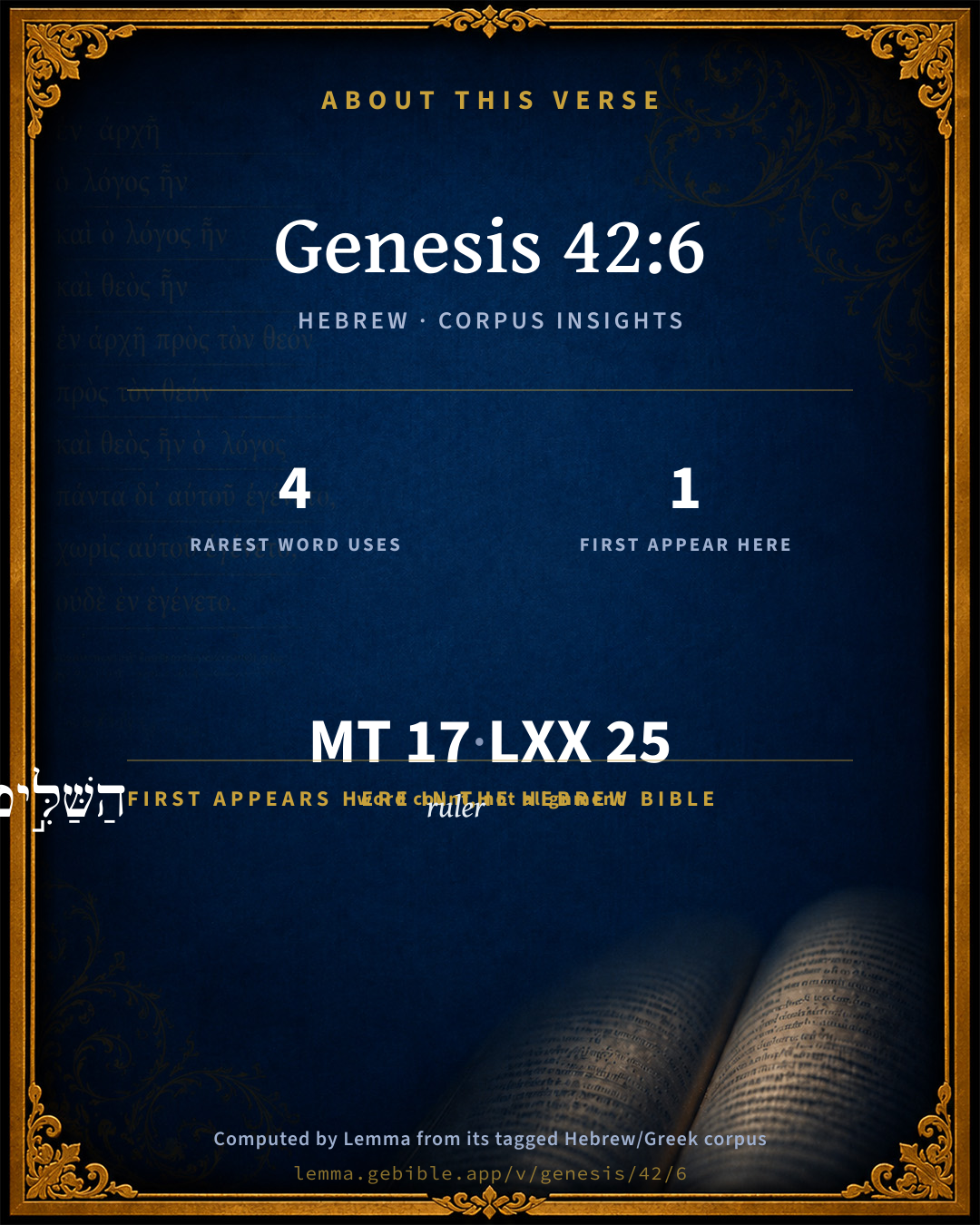
The rarest word here is הַשַּׁלִּ֣יט ruler H7989 — appearing just 4 times in the whole Hebrew Bible.

First appearance in Scripture

This word makes its first canonical appearance in the Hebrew Bible here:

  • הַשַּׁלִּ֣יט ruler H7989

Shared distinctive vocabulary

הַשַּׁלִּ֣יט ruler H7989 occurs in 4 verses of the Hebrew Bible. Also found in:

Grammatical profile

  • 3 verbs
  • 9 nouns
  • 1 adjective
  • 2 pronouns
  • 2 prepositions

Verb forms

  • הַמַּשְׁבִּ֖יר Hiphil · Participle Active
  • וַיָּבֹ֨אוּ֙ Qal · Sequential Imperfect
  • וַיִּשְׁתַּֽחֲווּ Hithpael · Sequential Imperfect

Repetition

Words recur within this verse — often emphatic in Hebrew:

  • הָאָ֔רֶץ land H776 ×3
  • וְיוֹסֵ֗ף Joseph H3130 ×2
  • ה֚וּא he H1931 ×2

Hebrew & Septuagint length

In English translation the verse runs 34 words from the Hebrew and 34 from the Septuagint (LXX English) — the same length.

A rough comparison of the two English renderings, which tokenize alike — not a word-level alignment.

Word counts can differ between the Hebrew and the Greek without any difference in meaning — e.g. the Hebrew direct-object marker אֵת has no separate Greek word, and Greek often adds the article ὁ.

In the original languages it is 17 Hebrew tokens and 25 Greek tokens — but the two are counted differently (Hebrew bundles its prefixes and suffixes into one token; the Greek is in lemma form), so that isn’t a like-for-like length.

Cross-references

11

Topical passages linked to Genesis 42:6 in the Treasury of Scripture Knowledge — connected by theme and wording, ordered by reader-vote popularity; previews shown in the World English Bible.

  • Genesis 18:2 He lifted up his eyes and looked, and saw that three men stood opposite him. When he saw them, he ran to meet them from the tent door, and bowed himself to the earth,
  • Genesis 19:1 The two angels came to Sodom at evening. Lot sat in the gate of Sodom. Lot saw them, and rose up to meet them. He bowed himself with his face to the earth,
  • Genesis 37:7–10 for, behold, we were binding sheaves in the field, and behold, my sheaf arose and also stood upright; and behold, your sheaves came around, and bowed down to my sheaf."
  • Genesis 41:40–41 You shall be over my house, and according to your word will all my people be ruled. Only in the throne I will be greater than you."
  • Genesis 41:55–56 When all the land of Egypt was famished, the people cried to Pharaoh for bread, and Pharaoh said to all the Egyptians, "Go to Joseph. What he says to you, do."
  • Genesis 44:14 Judah and his brothers came to Joseph's house, and he was still there. They fell on the ground before him.
  • Genesis 45:8 So now it wasn't you who sent me here, but God, and he has made me a father to Pharaoh, lord of all his house, and ruler over all the land of Egypt.
  • Genesis 45:26 They told him, saying, "Joseph is still alive, and he is ruler over all the land of Egypt." His heart fainted, for he didn't believe them.
  • Acts 7:10 and delivered him out of all his afflictions, and gave him favor and wisdom before Pharaoh, king of Egypt. He made him governor over Egypt and all his house.
  • Revelation 3:9 Behold, I give of the synagogue of Satan, of those who say they are Jews, and they are not, but lie. Behold, I will make them to come and worship before your feet, and to know that I have loved you.
  • Psalms 105:16–21 He called for a famine on the land. He destroyed the food supplies.

Cross-references courtesy of OpenBible.info (CC BY 4.0).

Hebrew and Greek witnesses Masoretic Hebrew ↔ Greek Septuagint

The same verse in the two great witnesses to the Old Testament, shown verse-for-verse.

These are two independent witnesses, not word-aligned to each other, and the Septuagint is shown in lemma (dictionary) form.

Hebrew Genesis 42:6 Masoretic · Westminster Leningrad Codex

וְיוֹסֵ֗ף ה֚וּא הַשַּׁלִּ֣יט עַל הָאָ֔רֶץ ה֥וּא הַמַּשְׁבִּ֖יר לְכָל עַ֣ם הָאָ֑רֶץ וַיָּבֹ֨אוּ֙ אֲחֵ֣י יוֹסֵ֔ף וַיִּשְׁתַּֽחֲווּ ל֥וֹ אַפַּ֖יִם אָֽרְצָה

Joseph was the governor over the land. It was he who sold to all the people of the land. Joseph's brothers came, and bowed themselves down to him with their faces to the earth.

World English Bible · Public Domain

Greek LXX Genesis 42:6 Septuagint · lemma form

ιωσηφ δέ εἰμί ἄρχων ὁ γῆ οὗτος πωλέω πᾶς ὁ λαός ὁ γῆ ἔρχομαι δέ ὁ ἀδελφός ιωσηφ προςκυνέω αὐτός ἐπί πρόσωπον ἐπί ὁ γῆ

And Joseph was ruler of the land; he sold to all the people of the land. And the brethren of Joseph, having come, did reverence to him, bowing with the face to the ground.

LXX2012 (modern English Septuagint) · Public Domain

Hebrew: Westminster Leningrad Codex (CC BY 4.0). Greek: Septuagint (public domain); English from LXX2012 (modern English Septuagint) (Public Domain). How the Septuagint differs from the Hebrew →

Targum (Aramaic paraphrase)

2

The Targum is the ancient Jewish Aramaic paraphrase of the Hebrew Scriptures — an interpretive translation, not the Hebrew text itself. Onkelos (literal) and Pseudo-Jonathan (expansive) render the Torah, and Jonathan the Prophets. Coverage is partial: where no permissively-licensed English translation exists for a verse, only the Aramaic is shown. This is verse-level text, not a word-by-word alignment to the Hebrew.

  1. Targum Onkelos Torah (Genesis–Deuteronomy)
    וְיוֹסֵף הוּא דְּשַׁלִּיט עַל אַרְעָא הוּא דְזַבִּין עִיבוּרָא לְכָל עַמָּא דְאַרְעָא וַאֲתוֹ אֲחֵי יוֹסֵף וּסְגִידוּ לֵהּ עַל אַפֵּיהוֹן עַל אַרְעָא

    (no public-domain English translation for this verse)

    Targum Onkelos — Aramaic: “Onkelos Genesis” (public domain); “Onkelos Exodus” (public domain); “Onkelos Leviticus” (public domain); “Onkelos Numbers” (public domain); “Onkelos Deuteronomy” (public domain). English: “Sefaria Community Translation” (CC0 1.0 (public-domain dedication)); “J.W. Etheridge. The Targums of Onkelos and Jonathan Ben Uzziel on the Pentateuch. London: Longmans, Green, 1862” (public domain). Text via Sefaria.

  2. Targum Pseudo-Jonathan Torah (Genesis–Deuteronomy)
    וְיוֹסֵף הוּא הֲוָה שַׁלִיט עַל אַרְעָא וִידַע דְאָחוֹי עָלִין לְמִזְבּוּן מַנֵי נְטוּרִין בְּתַרְעֵי קַרְתָּא לְמִכְתּוֹב כָּל דְעָלִיל בְּיוֹמָא הַהוּא שְׁמֵיהּ וְשֵׁם אָבוֹי וְהוּא הֲוָה מְזַבֵּן עִיבּוּרָא לְכָל עַמָא דְאַרְעָא וְאָתוּ אֲחֵי יוֹסֵף וּבְלָשׁוּ בִּסְרַטְיָיתָא וּבְפַלְטְיָיתָא וּבְבָתֵּי פוּנְדַקְתָּא וְלָא אַשְׁכְּחוּהוּ וְעָלוּ לְבַיְיתֵיהּ וּסְגָדוּ לֵיהּ עַל אַפֵּיהוֹם עַל אַרְעָא

    And Joseph was ruler over the land; and he knew that his brethren had come to buy; for he had appointed notaries at the gates of the city to register daily, of every one who came, his name and the name of his father; and he it was who sold corn to all the people of the land. And the brethren of Joseph came. And they looked through all the streets, and public places, and hospices, but could not find Him. And they came unto his house, and worshipped him with their faces to the ground.

    Targum Pseudo-Jonathan — Aramaic: “Targum Jonathan on Genesis” (public domain); “Targum Jonathan on Exodus” (public domain); “Targum Jonathan on Leviticus” (public domain); “Targum Jonathan on Numbers” (public domain); “Targum Jonathan on Deuteronomy” (public domain). English: “The Targum of Jonathan ben Uzziel, trans. J. W. Etheridge, London, 1862” (public domain). Text via Sefaria.

Commentary

Notes on Genesis 42:6 from classic Christian and Jewish commentators (each source and its license shown beneath its notes). The classic Christian expositions comment on the surrounding passage and are grouped to its opening verse, so a note may address several verses; the Jewish commentaries on the Tanakh (Rashi and others) are per-verse, so they appear only where the commentator wrote on this verse.

Lemma curates 59 commentaries, every one of them public domain or Creative Commons licensed, each selected and text-cleaned for this edition rather than reprinted as found. About our sources →

Trapp's Complete Commentary

John Trapp

Gen 42:6 And Joseph [was] the governor over the land, [and] he [it was] that sold to all the people of the land: and Joseph’s brethren came, and bowed down themselves before him [with] their faces to the earth.

Ver. 6. And Joseph was the governor.] Of the Hebrew word here used, is made in Arabic the title Sultan, given at this day to the great Turk by his subjects; among whom the Arabic is now the learned language. Their Koran is written in it, and prohibited to be translated; which both preserves the tongue, they say, and conceals religion.

And Joseph’s brethren came, and bowed.] This those mockers little thought ever to have done to that dreamer. But the will of the Lord, that shall stand.

John Trapp, A Commentary or Exposition upon All the Books of the Old and New Testament (1647–1656) — public domain. Text from a community e-Sword module.

Joseph Benson's Commentary

Gen 42:6. Joseph’s brethren came and bowed themselves before him — Some have inferred from this that the names of all the strangers that came to buy corn in Egypt were brought to Joseph and registered; and such persons or families as were any way remarkable, were brought before him. Thus his brethren would of course be introduced to him: but, in general, he undoubtedly sold the corn by deputies. With their faces to the earth — The common method of salutation in the eastern nations. Thus Joseph’s first dream was already fulfilled; their sheaves bowed to his sheaf.

Joseph Benson's Commentary on the Old and New Testaments (1811–1818) — public domain. Text from a community e-Sword module.

Tyndale Open Study Notes

Tyndale Open Resources

42:6-7 Joseph’s first dream (37:5-11) was partially fulfilled when his brothers bowed down to him without recognizing him (see also 43:26; 44:14). It was totally fulfilled in 50:18. Joseph recognized his brothers immediately, but he could not reveal himself because he did not yet trust them to be the honest men they claimed to be (42:10).

Tyndale Open Study Notes — © Tyndale Open Resources, licensed CC BY-SA 4.0. Text via the HelloAO Bible API.

Jamieson, Fausset & Brown

Robert Jamieson, A. R. Fausset & David Brown

Joseph was the governor--in the zenith of his power and influence.

he it was that sold--that is, directed the sales; for it is impossible that he could give attendance in every place. It is probable, however, that he may have personally superintended the storehouses near the border of Canaan, both because that was the most exposed part of the country and because he must have anticipated the arrival of some messengers from his father's house.

Joseph's brethren came, and bowed down themselves before him--His prophetic dreams [Gen 37:5-11] were in the course of being fulfilled, and the atrocious barbarity of his brethren had been the means of bringing about the very issue they had planned to prevent (Isa 60:14; Rev 3:9, last clause).

Jamieson, Fausset & Brown — Commentary Critical and Explanatory on the Whole Bible (1871) — public domain (CC PDM 1.0). Text via the HelloAO Bible API.

Adam Clarke's Commentary

Verse 6. Joseph was the governor] שליט shallit, an intendant, a protector, from שלט skalat, to be over as a protector; hence שלטים shelatim, shields, or arms for protection and defence, 2Sa 8:7; and שלטון shilton, power and authority, Ec 8:4, Ec 8:8; and hence the Arabic [Arabic] sultan, a lord, prince, or king, from [Arabic] salata, he obtained and exercised dominion, he ruled. Was it not from this very circumstance, Joseph being shallit, that all the Mohammedan governors of Egypt, c., took the title of sultan?

Bowed down themselves before him] Thus fulfilling the prophetic dream, Ge 37:7-8, which they had taken every precaution to render null and void. But there is neither might nor counsel against the Lord.

Adam Clarke's Commentary on the Bible (1810–1826) — public domain. Text from a community e-Sword/MySword module.

John Calvin's Commentaries

6. And Joseph was the governor over the land. Moses connects the honor of Joseph with his fidelity and diligence. For although he was possessed of supreme authority, he nevertheless submitted to every possible laborious service, just as if he had been a hired servant. From which example we must learn, that as any one excels in honor, he is bound to be the more fully occupied in business; but that they who desire to combine leisure with dignity, utterly pervert the sacred order of God. Let it be, moreover, understood, that the corn was sold by Joseph, not as if he measured it out with his own hands, or himself received the money for it, seeing that it was set to sale in many parts of the kingdom, and he could scarcely have attended to one single storehouse: but that the whole of the stores were under his power.

John Calvin's Commentaries (1540-1563) — public domain. Text from the Calvin Translation Society English edition (1840s-50s) via the Christian Classics Ethereal Library (ccel.org). Calvin's coverage is partial (roughly two-thirds of the Bible); uncommented books and verses are honest gaps, never fabricated. The 19th-century editor's footnotes and remarks are omitted so the notes are faithfully Calvin's own voice.

Ellicott's Commentary for English Readers

(6) Joseph’s brethren came and bowed down themselves before him.—Throughout the land of Egypt Joseph would sell by deputy, and only give general directions; but the arrival of so large a party as Joseph’s ten brethren, each probably with several attendants, would be reported to the governor in person, as certainly was the case with Abraham when he went into Egypt (Gen_12:14-15). Such visits would happen only occasionally, and the arrival of foreigners was always a matter looked upon with suspicion, especially upon the Arabian frontier.

A Bible Commentary for English Readers, edited by Charles John Ellicott (1878–1897) — public domain. Text from a community e-Sword module.

The Cambridge Bible for Schools and Colleges

gen. ed. J. J. S. Perowne

6–17. The first Interview with Joseph

6. governor] The late, and not very common, word here used in the Hebrew (shâlît) denotes the position of “Grand Vizier1[59]

[59] On the “Grand Vizier” of Egypt, see Appendix E, The name of one of the Hyksos kings, Salatis, presents a resemblance to shâlît, which has been remarked upon (Budge, Hist. Eg. iii. 146, note 1).

,” “the T’ate,” or chief officer of state: see note on Gen_41:42. It is akin to our word “Sultan,” and rendered “ruler” in Ecc_7:19; Ecc_10:5.

he it was that sold] We need not suppose that Joseph in person always conducted the business transactions; but a group of foreign purchasers would be brought into his presence to be interrogated.

bowed down themselves] Cf. Gen_42:9. Joseph’s dreams are fulfilled: see Gen_37:7; Gen_37:9-10.

The Cambridge Bible for Schools and Colleges (gen. ed. J. J. S. Perowne; Cambridge University Press, 1878–1918) — public domain. Text from a community e-Sword module.

John Gill's Exposition

And Joseph saw his brethren,.... Among those that came to buy corn, and when they prostrated themselves before him:

and he knew them; some of them being at man's estate, and their beards grown when they sold him, and their habits and dress now being much the same it was then, and by them he knew the younger:

but made himself strange unto them; took no notice of them as his relations, but carried himself to them as he did to other foreigners, and yet more strangely:

and spake roughly unto them; or hard (z) things or words; put on a stern countenance, and spoke with a high tone and in a rough surly manner to them:

and he said unto them, whence come ye? who are ye? of what country are ye? what is your business here?

and they said, from the land of Canaan to buy food; which they could not get in Canaan, the famine being there so great.

(z) "dura", Pagninus, Montanus, Drusius, Piscator, Schmidt.

John Gill's Exposition of the Whole Bible (1746–1763) — public domain (CC PDM 1.0). Text via the HelloAO Bible API.

Haydock's Catholic Bible Commentary

To him. Conformably to the prophetic dreams, chap. xxxvii. 7, 9. (Menochius) --- Joseph was like a prince or sultan, shallit, with sovereign authority. (Calmet)

George Leo Haydock (1774–1849), Haydock's Catholic Family Bible and Commentary, 1859 edition — public domain. Excludes Psalms (Douay-Rheims chapter numbering differs from Protestant) and Deuterocanonical books (Catholic canon only).

Matthew Poole's English Annotations

He sold to the people; either,

1. By his ministers and commissioners appointed to that end, as men in Scripture and in all authors are said to do that which others do by their authority and command. Or,

2. He himself immediately contracted with the buyers, or at least with such as were foreigners; which he did upon prudential reasons; both because he would not have them to pry into the state of Egypt, Gen 42:12, and because he would by that opportunity understand the state of other lands, and improve that knowledge for his master’s service.

Joseph’s brethren bowed down themselves before him; thus unwittingly fulfilling Joseph’s dream, Gen 37:7.

Matthew Poole's English Annotations on the Holy Bible (1683–1685) — public domain. Text from a community e-Sword/MySword module.

Whedon's Commentary on the Bible

Daniel D. Whedon

6. The governor — The word (שׁלישׂ) thus rendered occurs elsewhere only in the later Hebrew books — Ezekiel, Daniel, and Ecclesiastes. It seems, says Keil, “to have been the standing title which the Shemites gave to Joseph as ruler in Egypt, and from this the later legend of Salatis, the first king of the Hyksos, arose.” Josephus, Apion, 1:14.

He it was that sold — Not that Joseph personally attended to all the details of the selling; but he had general oversight and authority; and when, as in the present instance, a large number of foreigners came to buy, he would be called upon to receive them in due form, and see that all was proper. He would not allow a general traffic in Egyptian grain to be carried on among foreign nations in such a time of famine.

Daniel D. Whedon (gen. ed.), Commentary on the Old and New Testaments (1874–1909) — public domain. Text from a community e-Sword module.

The Pulpit Commentary

And Joseph was the governor over the land. The word fyLiv from flv to rule, describes one invested with despotic authority, or a sultan (Gesenius), in which character the early Shemites appear to have regarded Joseph (Keil). It is probably the same idea which recurs in the name Salatis, which, according to Manetho, belonged to the first of the shepherd kings (Josephus, "Contra Apionem," 1:14). Occurring nowhere else in the Pentateuch, it reappears in the later writings of Ecclesiastes, (Ecc_7:10 Ecc_10:5) Ezra, (Ezr_4:20 Ezr_7:24) Daniel, (Dan_2:15 Dan_5:29) which, however, need not suggest an exilian or post-exilian authorship, but may be explained by the fact that the root is found equally in the Arabic and Aramaean dialects (Keil). And he it was that sold to all the people of the land. Not conducted the retail corn trade (Tuch, Oort, Kuenen), which was assigned to subordinates; (ver. 25 Gen_44:1) but presided over the general market of the kingdom (Murphy), probably fixing the price at which the grain should be sold, determining the quantities to be allowed to purchasers, and examining the companies of foreigners who came to buy (Rosenm Havernick, Lange, Gerlach). And Joseph"s brethren came, and bowed down themselves before him with their faces to the earth.

And so fulfilled his early dream in Shechem. (Gen_37:7, Gen_37:8)

The Pulpit Commentary (1880–1919), ed. H.D.M. Spence-Jones & Joseph S. Exell — public domain. Text from a community e-Sword module.

Rashi

Rabbi Shlomo Yitzchaki (Rashi)

וישתחוו לו אפים means THEY PROSTRATED THEMSELVES ON THEIR FACES— Similarly wherever various forms of this verb (שחה) in the Hithpael occur it implies stretching out the hands and feet when a person casts himself on the ground in the act of prostration (Megillah 22b).

Rashi on the Tanakh — English translations: “The Judaica Press complete Tanach with Rashi, translated by A. J. Rosenberg” (CC BY 4.0); “Pentateuch with Rashi's commentary by M. Rosenbaum and A.M. Silbermann, 1929-1934” (public domain); “The Metsudah Tanach series, Lakewood, N.J” (CC BY 4.0); and “The Book of Joshua, Metsudah Publications, 1997” (CC BY 4.0). Text via Sefaria.

Ramban (Nachmanides)

Rabbi Moshe ben Nachman (Ramban / Nachmanides)

HE IT WAS THAT SOLD GRAIN TO ALL THE PEOPLE OF THE LAND. Now it is not befitting a ruler of a land, second in rank to the king of Egypt, that he sell everyone a se’ah [a dry measure] or a half thereof of grain. It was for this reason that our Rabbis were impelled to say that Joseph had ordered at that time that all storehouses except one be closed so that he would be sure to meet his brothers.In line with the literal interpretation of the verse it is possible that the people from all lands came before him, and he would question and investigate them, and then command the officers, “Sell so much food of this — and that — kind to the people of that city.” Thus it was necessary for the children of Jacob to come before him among those who came from the land of Canaan, that he could issue an order concerning them, specifying how much grain should be sold to their land, since they were the first to come from the land of Canaan and they came before him for the sake of all.

Ramban (Nachmanides) on the Tanakh — English translation: “Commentary on the Torah by Ramban (Nachmanides). Translated and annotated by Charles B. Chavel. New York, Shilo Pub. House, 1971-1976” (CC BY 4.0). Text via Sefaria.

Sforno

Rabbi Ovadia Sforno

He was the one who sold. He did not trust his servants with the task because the sums involved were too great.

Yoseif’s brothers came. Because Yoseif sold the grain personally the brothers were forced to come before him.

Sforno on the Tanakh — English translation: “Yalkut, Sifsei Chachomim Chumash, Metsudah Publications, 2009” (CC BY 4.0). Text via Sefaria.

Radak

Rabbi David Kimhi (Radak)

ויוסף הוא השליט, the brothers had to appear before him personally as he was the seller, i.e. he authorised who could buy and how much. הוא המשביר. The term is only used transitively, someone who sells somebody else’s property to a third party. He gave instructions to his agents to sell. Initially, all potential purchasers had to be examined by Joseph personally. Although, no doubt this was a tedious procedure, Joseph had issued these instructions to make sure he would spot his brothers when they would arrive, as he was sure they must. As a result he would be able to confront his brothers.

Radak on the Tanakh — English translations: “Sefaria Community Translation” (CC0 1.0 (public-domain dedication)); “Eliyahu Munk, HaChut Hameshulash” (CC BY 4.0); “Rabbi Mike Feuer, Jerusalem Anthology” (CC BY 4.0); and “R. David Kimhi on the first book of Psalms, Translated by R.G. Finch, London, 1919” (public domain). Text via Sefaria.

Lesson kit

Teaching starters — assembled from the data on this page, not authored interpretation. Every prompt links to the verse data it draws on. Edit before teaching.

Genesis, in the Pentateuch, opens this verse with 17 words (12 distinct Hebrew lemmas). Its most distinctive word is shallîyṭ (“ruler”). A historical commentator’s framing appears above. Read the whole chapter for the surrounding context.

Discussion questions

  1. How does “ruler” (shallîyṭ) shape what this verse is saying?
  2. The word “ruler” first appears here in Scripture. What is being introduced at this debut?
  3. Ecclesiastes 7:19 shares the word «ruler» with this verse. How do the two illuminate each other?
  4. “land” occurs 3× in this one verse. What is the effect of the repetition?
  5. These translations render this verse differently; the difference is in the English rendering, not the original. What questions does that raise?
  6. The verb «הַמַּשְׁבִּ֖יר» is Hiphil Participle Active. How does its form color the action?
  7. Reading how Trapp's Complete Commentary and Joseph Benson's Commentary read this verse, where do the two commentators agree and where do they part?

Things to notice

Reading settings

Reading text

Shown beneath each verse's original-language words.

Old Testament
Old Testament edition

Read the OT as the Masoretic Hebrew (MT) or the Greek Septuagint (LXX).

English shown for the Greek Septuagint (in the Hebrew ↔ Greek comparison).

Comparing translations? Open the Compare panel on any verse page to stack up to four side by side.