
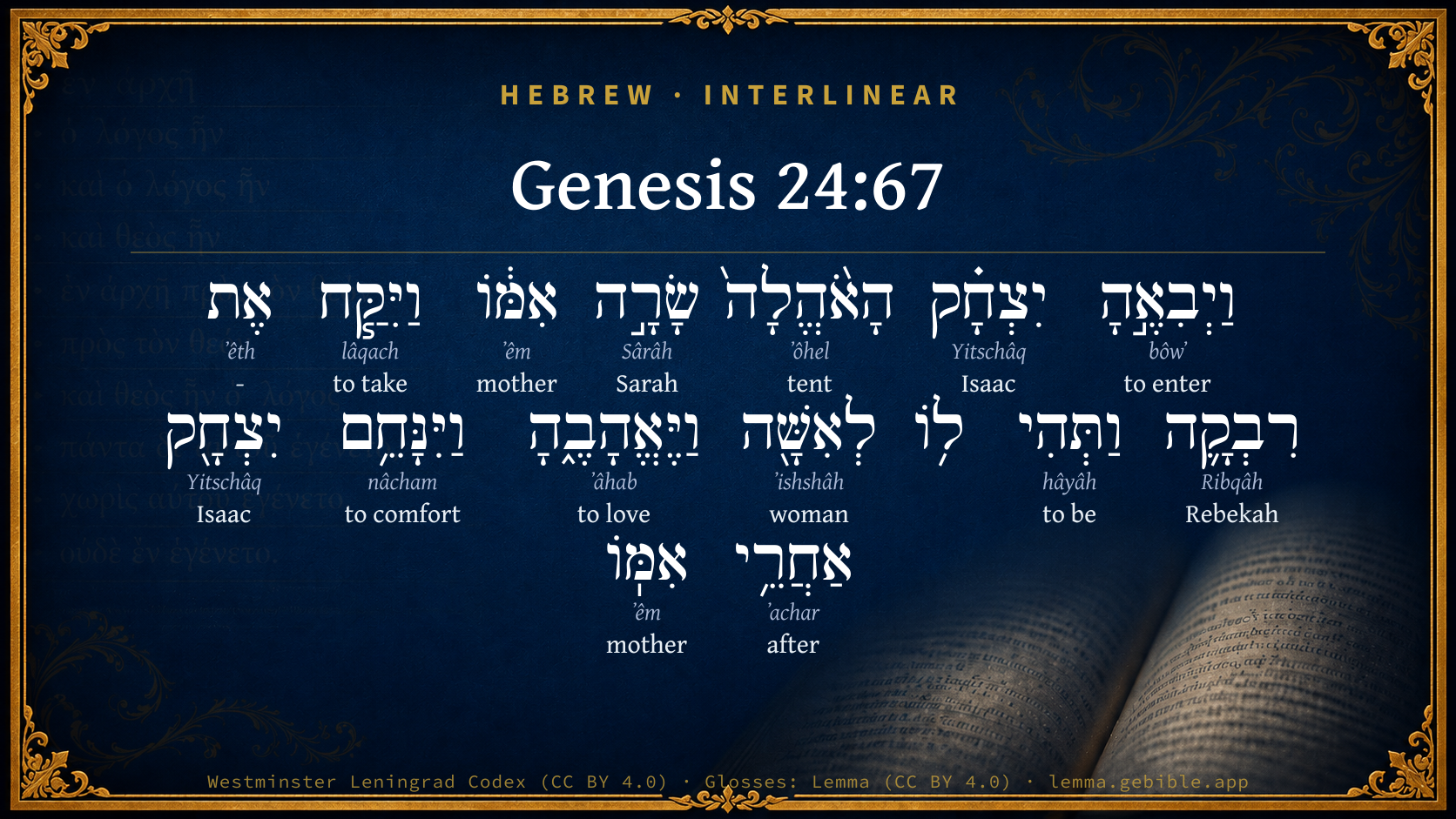
Genesis 24:67

Hebrew (Westminster Leningrad Codex) Genesis 24:67 appears in the Hebrew Old Testament. The text above is from the Westminster Leningrad Codex. Each word links to its Strong’s number, a concise gloss, and parsing drawn from the Open Scriptures Hebrew Bible morphology. Click any word for its full Brown-Driver-Briggs (BDB) entry.
Download image
Cite this verse

Genesis 24:67 (World English Bible). Public Domain. Lemma interlinear Bible study tool, https://lemma.gebible.app/v/genesis/24/67.

Show BibTeX & RIS
BibTeX
RIS
English Translation
Isaac brought her into his mother Sarah's tent, and took Rebekah, and she became his wife. He loved her. Isaac was comforted after his mother's death.
World English Bible · Public Domain
Download a study sheet

One document with this verse’s original text, its word-by-word gloss line, the meaning frame, cross-references with their text, attributed commentary, and full source and license credits — printable, and it pastes into notes with its structure intact.

This verse Autodidact and up

Study sheet (.html) Plain text (.txt)

A passage Seminary Student

Up to 50 verses in one chapter. A passage sheet keeps up to 6 commentary sources and 12 cross-references per verse, in the order this page ranks them, and says so on the sheet whenever that leaves anything out. Ask for a single verse and you get the Autodidact verse sheet above.

Everything on this page stays free to read, with no account — the sheet is a download of what is already on screen, not access to it.

Want to remove ads? Support Godless Engineer
Compare translations 3

The same verse in 3 English versions, stacked beneath the original-language interlinear above. Click any original word for its lexicon entry.

Each is an independent rendering of the whole verse — the interlinear is not word-aligned to these translations.

Highlighted words mark where these versions differ — a whole-verse word diff, not a word-by-word alignment.

  • World English Bible Public Domain
    Isaac brought her into his mother Sarah's tent, and took Rebekah, and she became his wife. He loved her. Isaac was comforted after his mother's death.
  • King James Version Public Domain
    And Isaac brought her into his mother Sarah's tent, and took Rebekah, and she became his wife; and he loved her: and Isaac was comforted after his mother's death.
  • unfoldingWord Literal Text CC BY-SA 4.0
    Then Isaac brought her into the tent of Sarah his mother, and he took Rebekah, and she became a wife to him. And Isaac loved her, and he was comforted after his mother.

unfoldingWord Literal Text — © unfoldingWord, licensed CC BY-SA 4.0. Word-aligned USFM3 via Door43 (git.door43.org/unfoldingWord/en_ult).

Versions to compare (up to 4)

3 of 4 selected

Show all 18 translations

Every available English version of this verse, each an independent rendering of the whole verse.

  • World English Bible Public Domain
    Isaac brought her into his mother Sarah's tent, and took Rebekah, and she became his wife. He loved her. Isaac was comforted after his mother's death.
  • Berean Standard Bible Public Domain
    And Isaac brought her into the tent of his mother Sarah and took Rebekah as his wife. And Isaac loved her and was comforted after his mother’s death.
  • Majority Standard Bible Public Domain
    And Isaac brought her into the tent of his mother Sarah and took Rebekah as his wife. And Isaac loved her and was comforted after his mother’s death.
  • King James Version Public Domain
    And Isaac brought her into his mother Sarah's tent, and took Rebekah, and she became his wife; and he loved her: and Isaac was comforted after his mother's death.
  • American Standard Version (1901) Public Domain
    And Isaac brought her into his mother Sarah's tent, and took Rebekah, and she became his wife. And he loved her. And Isaac was comforted after his mother's death.
  • Revised Version (1885) Public Domain
    And Isaac brought her into his mother Sarah’s tent, and took Rebekah, and she became his wife; and he loved her: and Isaac was comforted after his mother’s death.
  • Geneva Bible (1599) Public Domain
    Afterward Izhak brought her into the tent of Sarah his mother, and he tooke Rebekah, and she was his wife, and he loued her: So Izhak was comforted after his mothers death.
  • Douay-Rheims (1899) Public Domain
    Who brought her into the tent of Sara his mother, and took her to wife: and he loved her so much, that it moderated the sorrow which was occasioned by his mother's death.
  • Young's Literal Translation Public Domain
    and Isaac bringeth her in unto the tent of Sarah his mother, and he taketh Rebekah, and she becometh his wife, and he loveth her, and Isaac is comforted after `the death of' his mother.
  • Literal Standard Version CC BY-SA 4.0
    and Isaac brings her into the tent of his mother Sarah, and he takes Rebekah, and she becomes his wife, and he loves her, and Isaac is comforted after [the death of] his mother.
  • Unlocked Literal Bible CC BY-SA 4.0
    Then Isaac brought her into his mother Sarah's tent and took Rebekah, and she became his wife, and he loved her. So Isaac was comforted after his mother's death.
  • unfoldingWord Literal Text CC BY-SA 4.0
    Then Isaac brought her into the tent of Sarah his mother, and he took Rebekah, and she became a wife to him. And Isaac loved her, and he was comforted after his mother.
  • Darby Bible Public Domain
    And Isaac led her into his mother Sarah's tent; and he took Rebecca, and she became his wife, and he loved her. And Isaac was comforted after [the death of] his mother.
  • World Messianic Bible Public Domain
    Isaac brought her into his mother Sarah’s tent, and took Rebekah, and she became his wife. He loved her. So Isaac was comforted after his mother’s death.
  • Webster's Bible Public Domain
    And Isaac brought her into his mother Sarah's tent, and took Rebekah, and she became his wife; and he loved her: and Isaac was comforted after his mother's death.
  • Free Bible Version CC BY-SA 4.0
    Isaac took Rebekah into his mother Sarah's tent, and he married her. He loved her, and she brought him comfort after his grief over his mother's death.
  • Bible in Basic English Public Domain
    And Isaac took Rebekah into his tent and she became his wife; and in his love for her, Isaac was comforted after his father's death.
  • JPS Tanakh (1917) Public Domain
    And Isaac brought her into his mother Sarah's tent, and took Rebekah, and she became his wife; and he loved her. And Isaac was comforted for his mother.

Literal Standard Version (2020), Covenant Press — licensed CC BY-SA 4.0. Text via the HelloAO Bible API (eBible.org). Unlocked Literal Bible (unfoldingWord) — licensed CC BY-SA 4.0. Text via the HelloAO Bible API (eBible.org). unfoldingWord Literal Text — © unfoldingWord, licensed CC BY-SA 4.0. Word-aligned USFM3 via Door43 (git.door43.org/unfoldingWord/en_ult). Free Bible Version, Dr. Jonathan Gallagher — licensed CC BY-SA 4.0. Text via the HelloAO Bible API (eBible.org).

Word by word

More ways to search: Search by grammar → Find every occurrence → Compare this word →

Practice this passage: Drill this verse → Learn its vocabulary →

רִבְקָ֛ה
Ribqâh
H7259
“Rebekah”
Noun, Proper
Part of Speech
Noun
Type
Proper
Full BDB Definition

Origin: from an unused root probably meaning to clog by tying up the fetlock

TWOT: None

Rebekah = "ensnarer" - daughter of Bethuel, sister of Laban, wife of Isaac, and mother of Esau and Jacob
  1. וַיְבִאֶ֣הָ bôwʼ H935 “and · to enter · her” Conjunction + Verb, Hiphil, Sequential Imperfect, 3rd Person, Masculine, Singular + Suffix, Personal, 3rd Person, Feminine, Singular
  2. יִצְחָ֗ק Yitschâq H3327 “Isaac” Noun, Proper
  3. הָאֹ֨הֱלָה֙ ʼôhel H168 “the · tent · toward” Particle, Definite Article + Noun, Common, Masculine, Singular, Absolute + Suffix, Demonstrative
  4. שָׂרָ֣ה Sârâh H8283 “Sarah” Noun, Proper
  5. אִמּ֔וֹ ʼêm H517 “mother · his” Noun, Common, Feminine, Singular, Construct + Suffix, Personal, 3rd Person, Masculine, Singular
  6. וַיִּקַּ֧ח lâqach H3947 “and · to take” Conjunction + Verb, Qal, Sequential Imperfect, 3rd Person, Masculine, Singular
  7. אֶת ʼêth H853 “-” Particle, Direct Object
  8. וַתְּהִי hâyâh H1961 “and · to be” Conjunction + Verb, Qal, Sequential Imperfect, 3rd Person, Feminine, Singular
  9. לְאִשָּׁ֖ה ʼishshâh H802 “to/for · woman” Preposition + Noun, Common, Feminine, Singular, Absolute
  10. וַיֶּאֱהָבֶ֑הָ ʼâhab H157 “and · to love · her” Conjunction + Verb, Qal, Sequential Imperfect, 3rd Person, Masculine, Singular + Suffix, Personal, 3rd Person, Feminine, Singular
  11. וַיִּנָּחֵ֥ם nâcham H5162 “and · to comfort” Conjunction + Verb, Niphal, Sequential Imperfect, 3rd Person, Masculine, Singular
  12. יִצְחָ֖ק Yitschâq H3327 “Isaac” Noun, Proper
  13. אַחֲרֵ֥י ʼachar H310 “after” Preposition
  14. אִמּֽוֹ ʼêm H517 “mother · his” Noun, Common, Feminine, Singular, Construct + Suffix, Personal, 3rd Person, Masculine, Singular

About this verse

These counts appear in no published source. They are computed here, from the morphology-tagged text and Lemma’s own curated glosses. What Lemma adds →

16
words
13
distinct lemmas
Pentateuch
section

Shared distinctive vocabulary

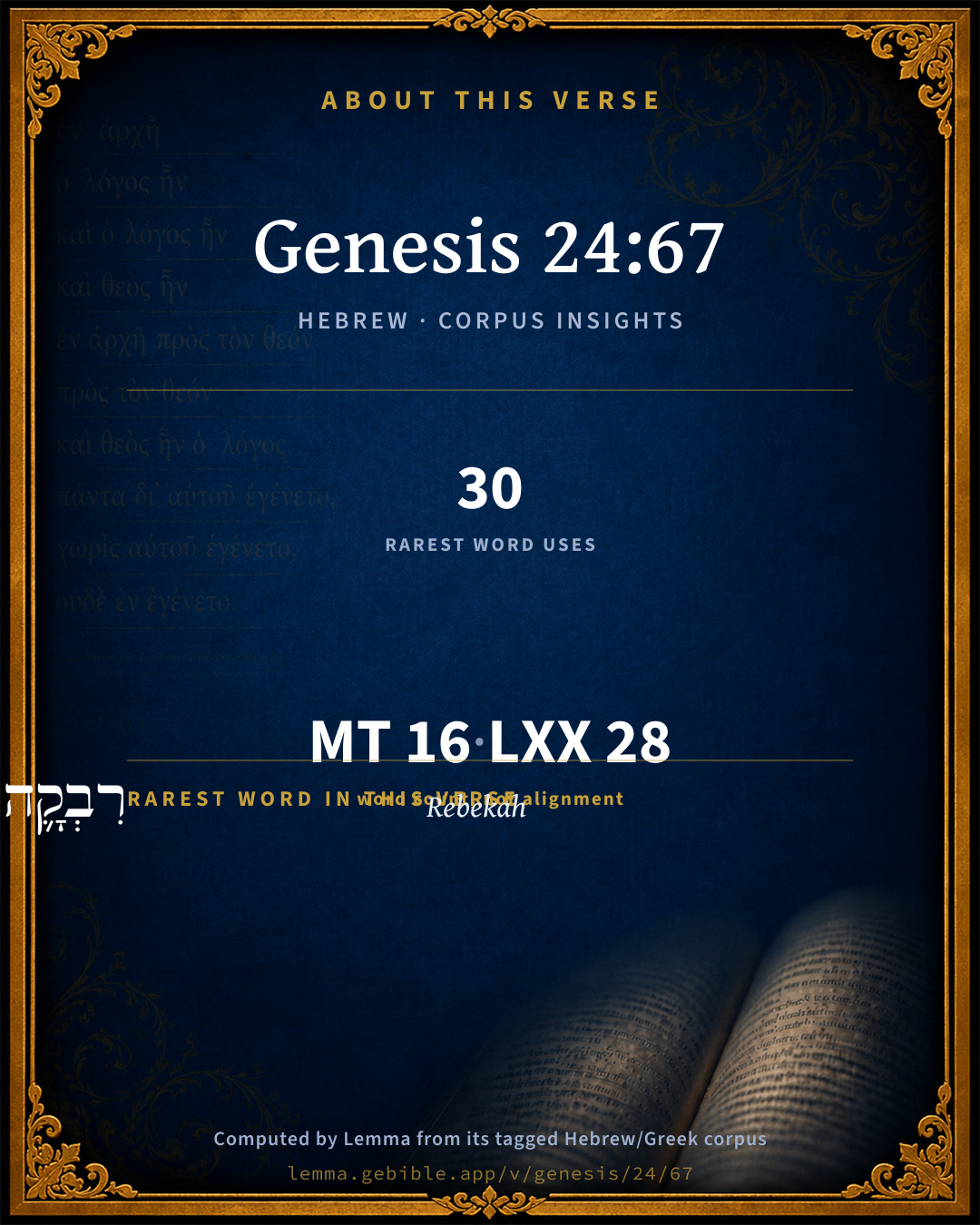
רִבְקָ֛ה Rebekah H7259 occurs in 29 verses of the Hebrew Bible. Also found in:

Grammatical profile

  • 5 verbs
  • 8 nouns
  • 2 prepositions
  • 1 particle

Verb forms

  • וַיְבִאֶ֣הָ Hiphil · Sequential Imperfect
  • וַיִּקַּ֧ח Qal · Sequential Imperfect
  • וַתְּהִי Qal · Sequential Imperfect
  • וַיֶּאֱהָבֶ֑הָ Qal · Sequential Imperfect
  • וַיִּנָּחֵ֥ם Niphal · Sequential Imperfect

Repetition

Words recur within this verse — often emphatic in Hebrew:

  • יִצְחָ֗ק Isaac H3327 ×2
  • אִמּ֔וֹ mother H517 ×2

Hebrew & Septuagint length

In English translation the verse runs 26 words from the Hebrew and 29 from the Septuagint (LXX English) — closely comparable.

A rough comparison of the two English renderings, which tokenize alike — not a word-level alignment.

Word counts can differ between the Hebrew and the Greek without any difference in meaning — e.g. the Hebrew direct-object marker אֵת has no separate Greek word, and Greek often adds the article ὁ.

In the original languages it is 16 Hebrew tokens and 28 Greek tokens — but the two are counted differently (Hebrew bundles its prefixes and suffixes into one token; the Greek is in lemma form), so that isn’t a like-for-like length.

Cross-references

14

Topical passages linked to Genesis 24:67 in the Treasury of Scripture Knowledge — connected by theme and wording, ordered by reader-vote popularity; previews shown in the World English Bible.

  • Song of Solomon 8:2 I would lead you, bringing you into my mother's house, Who would instruct me. I would have you drink spiced wine, Of the juice of my pomegranate.
  • Ephesians 5:22–33 Wives, be subject to your own husbands, as to the Lord.
  • Genesis 18:6 Abraham hurried into the tent to Sarah, and said, "Quickly make ready three measures of fine meal, knead it, and make cakes."
  • Genesis 18:9–10 They said to him, "Where is Sarah, your wife? He said, "See, in the tent."
  • Genesis 23:1–2 Sarah lived one hundred twenty-seven years. These were the years of Sarah's life.
  • Genesis 25:20 Isaac was forty years old when he took Rebekah, the daughter of Bethuel the Syrian of Paddan Aram, the sister of Laban the Syrian, to be his wife.
  • Genesis 29:18 Jacob loved Rachel. He said, "I will serve you seven years for Rachel, your younger daughter."
  • Genesis 37:35 All his sons and all his daughters rose up to comfort him; but he refused to be comforted. He said, "For I will go down to Sheol to my son mourning." His father wept for him.
  • Genesis 38:12 After many days, Shua's daughter, the wife of Judah, died. Judah was comforted, and went up to his sheep-shearers to Timnah, he and his friend Hirah, the Adullamite.
  • Isaiah 54:1–5 Sing, barren, you who didn't bear; break forth into singing, and cry aloud, you who did not travail with child: for more are the children of the desolate than the children of the married wife, says Yahweh.
  • 2 Corinthians 11:1–2 I wish that you would bear with me in a little foolishness, but indeed you do bear with me.
  • 1 Thessalonians 4:13 But we don't want you to be ignorant, brothers, concerning those who have fallen asleep, so that you don't grieve like the rest, who have no hope.
  • Genesis 2:22–24 He made the rib, which Yahweh God had taken from the man, into a woman, and brought her to the man.
  • 1 Thessalonians 4:15 For this we tell you by the word of the Lord, that we who are alive, who are left to the coming of the Lord, will in no way precede those who have fallen asleep.

Cross-references courtesy of OpenBible.info (CC BY 4.0).

Hebrew and Greek witnesses Masoretic Hebrew ↔ Greek Septuagint

The same verse in the two great witnesses to the Old Testament, shown verse-for-verse.

These are two independent witnesses, not word-aligned to each other, and the Septuagint is shown in lemma (dictionary) form.

Hebrew Genesis 24:67 Masoretic · Westminster Leningrad Codex

וַיְבִאֶ֣הָ יִצְחָ֗ק הָאֹ֨הֱלָה֙ שָׂרָ֣ה אִמּ֔וֹ וַיִּקַּ֧ח אֶת רִבְקָ֛ה וַתְּהִי ל֥וֹ לְאִשָּׁ֖ה וַיֶּאֱהָבֶ֑הָ וַיִּנָּחֵ֥ם יִצְחָ֖ק אַחֲרֵ֥י אִמּֽוֹ

Isaac brought her into his mother Sarah's tent, and took Rebekah, and she became his wife. He loved her. Isaac was comforted after his mother's death.

World English Bible · Public Domain

Greek LXX Genesis 24:67 Septuagint · lemma form

εἰςἔρχομαι δέ ισαακ εἰς ὁ οἶκος ὁ μήτηρ αὐτός καί λαμβάνω ὁ ρεβεκκα καί γίγνομαι αὐτός γυνή καί ἀγαπάω αὐτός καί παρακαλέω ισαακ περί σαρρα ὁ μήτηρ αὐτός

And Isaac went into the house of his mother, and took Rebecca, and she became his wife, and he loved her; and Isaac was comforted for Sarrha his mother.

LXX2012 (modern English Septuagint) · Public Domain

On this verse, The Cambridge Bible for Schools and Colleges discusses the Septuagint’s reading. Read the note in Commentary ↓

Hebrew: Westminster Leningrad Codex (CC BY 4.0). Greek: Septuagint (public domain); English from LXX2012 (modern English Septuagint) (Public Domain). How the Septuagint differs from the Hebrew →

Targum (Aramaic paraphrase)

2

The Targum is the ancient Jewish Aramaic paraphrase of the Hebrew Scriptures — an interpretive translation, not the Hebrew text itself. Onkelos (literal) and Pseudo-Jonathan (expansive) render the Torah, and Jonathan the Prophets. Coverage is partial: where no permissively-licensed English translation exists for a verse, only the Aramaic is shown. This is verse-level text, not a word-by-word alignment to the Hebrew.

  1. Targum Onkelos Torah (Genesis–Deuteronomy)
    וְאַעֲלַהּ יִצְחָק לְמַשְׁכְּנָא וַחֲזָא וְהָא תַקְּנִין עוֹבָדָהָא כְּעוֹבָדֵי שָׂרָה אִמֵּהּ וּנְסֵיב יָת רִבְקָה וַהֲוַת לֵהּ לְאִנְּתּוּ וּרְחִימַהּ וְאִתְנְחֵם יִצְחָק בָּתַר דְּמִיתַת אִמֵּהּ

    (no public-domain English translation for this verse)

    Targum Onkelos — Aramaic: “Onkelos Genesis” (public domain); “Onkelos Exodus” (public domain); “Onkelos Leviticus” (public domain); “Onkelos Numbers” (public domain); “Onkelos Deuteronomy” (public domain). English: “Sefaria Community Translation” (CC0 1.0 (public-domain dedication)); “J.W. Etheridge. The Targums of Onkelos and Jonathan Ben Uzziel on the Pentateuch. London: Longmans, Green, 1862” (public domain). Text via Sefaria.

  2. Targum Pseudo-Jonathan Torah (Genesis–Deuteronomy)
    וְאָעֲלָהּ יִצְחָק לְמַשְׁכְּנָא דְשָרָה אִמֵיהּ וּמִן יַד נַהֲרַת בּוֹצִינָא דִטְפַת בִּזְמַן דְמִיתַת שָרָה וּנְסֵיב יַת רִבְקָה וַהֲוָת לֵיהּ לְאִנְתּוּ וְרִחֲמָהּ בְּגִין דְחָמָא עוּבְדָהָא דְתַקְנָן כְּעוּבְדֵי אִמֵיהּ וְאִתְנְחָם יִצְחָק בָּתַר דְמִיתַת אִמֵיהּ

    And Izhak introduced her into the tabernacle of Sarah his mother, and thereupon the light (again) shined which had gone out at the time of Sarah's death. And he took Rivekah, and she was his wife, and he loved her; for he saw her works that they were upright as the works of his mother. And Izhak was consoled after his mother's death.

    Targum Pseudo-Jonathan — Aramaic: “Targum Jonathan on Genesis” (public domain); “Targum Jonathan on Exodus” (public domain); “Targum Jonathan on Leviticus” (public domain); “Targum Jonathan on Numbers” (public domain); “Targum Jonathan on Deuteronomy” (public domain). English: “The Targum of Jonathan ben Uzziel, trans. J. W. Etheridge, London, 1862” (public domain). Text via Sefaria.

Commentary

Notes on Genesis 24:67 from classic Christian and Jewish commentators (each source and its license shown beneath its notes). The classic Christian expositions comment on the surrounding passage and are grouped to its opening verse, so a note may address several verses; the Jewish commentaries on the Tanakh (Rashi and others) are per-verse, so they appear only where the commentator wrote on this verse.

Lemma curates 59 commentaries, every one of them public domain or Creative Commons licensed, each selected and text-cleaned for this edition rather than reprinted as found. About our sources →

Trapp's Complete Commentary

John Trapp

Gen 24:67 And Isaac brought her into his mother Sarah’s tent, and took Rebekah, and she became his wife; and he loved her: and Isaac was comforted after his mother’s [death].

Ver. 67. Isaac brought her into his mother’s tent.] There to rest till the marriage rites were performed; till he had got her goodwill; till their affections were knit, and in some sort settled; till they had pledged their mutual trust; sought God for a blessing, and performed such solemnities as the time required. Youth rides in post to be married: but in the end, finds the inn of repentance to be lodged in.

And took Rebekah.] Not as Shechem took Dinah, or Amnon Tamur, to deflower her; but as Boaz took Ruth, and David Abigail, to make her his wife by lawful wedlock.

And he loved her.] Not only as his countrywoman or his kinswoman, or a good woman, &c., but as his woman, with a conjugal love. And he had reason: for (1.) She was his wife, the proper object of his love; (2.) A wife of God’s providing; a mate meet for him; none in all the world so meet; (3.) She was love-worthy, because fair, courteous, virtuous: and as meat pleaseth us better in a clean dish, so doth virtue in comely persons, saith Hugo; (4.) She forgot her father’s house, and forsook all her friends for him, &c.

And Isaac was comforted.] If God takes away one comfort, he will give another. Cheer up, therefore.

John Trapp, A Commentary or Exposition upon All the Books of the Old and New Testament (1647–1656) — public domain. Text from a community e-Sword module.

Matthew Poole's English Annotations

Isaac brought her into his mother Sarah’s tent, partly to give her possession of it, and partly to consummate the marriage. Women then had their tents apart from men. See Gen 18:10; 24:67; 31:33.

Isaac was comforted after his mother’s death; a sorrowful sense whereof he yet had retained, though she died three years before this time.

Matthew Poole's English Annotations on the Holy Bible (1683–1685) — public domain. Text from a community e-Sword/MySword module.

The Biblical Illustrator

Joseph S. Exell

Gen_24:67

She became his wife

A primeval marriage

I.

ITS SIMPLICITY.

II. ITS PURITY.

III. ITS GODLINESS.

IV. IT ILLUSTRATES THE PRINCIPLE OF UNITY IN DIVERSITY. The characters of Isaac and Rebekah were most diverse. They were truly complements of each other, and when brought together made a complete whole. (T. H.Leale.)

A new home

I. THIS NEW HOME IS FILLED WITH LOVE. Isaac loved her, and it is but fair to infer that she loved him. This love is not mere romance or sentiment. It is better than a transient conceit, and is that kind which only deepens and strengthens, as the ideal and the fanciful vanish away. It stands the strain of trial, and falters not before affliction, and what is more wonderful yet, it seems to be only purified by the mutual revelation of every phase of character and every mood of temper, and all the relations and duties of the household. There may be such a thing as love at first sight, and if it be genuine it only gets more hallowed and more tender as the years roll; but if it is not genuine, if it be only a fancy, a dazzling flash, a temporary spell of lovely witchery, then you soon find either the divorce court in session or the domestic court disagreeing and contending with sensitive intolerance. In the case of the young couple before us, we find that their love, which seems to have been at first sight, was deep and fond and lasting, and that it was ennobled and blessed with that piety which, like a divine chemistry, made even lifes cares and annoyances a means of grace and gracious growth. What a beautiful spectacle this! Two frail natures on their way to the unknown land, maintaining a moral and life-long unity, proving a mutual blessing, constituting an affectionate representation of Christ and the Church, a bulwark for society, and a compound factor in the worlds destiny.

II. THIS HOME, AS TIME WORE ON, MADE UP FOR MUCH PAIN AND LOSS. Isaac was comforted after his mothers death. Comforted! The record is not that he forgot her. Ah! he could not possibly do that, and doubtless the bereaved Abraham and he frequently talked about the precious dead! But such was Rebekahs influence, such her delicate and efficient ministry, such her care and company, that the heart of her husband began to heal, and the shadow of the sepulchre to shorten. Every human home ought to be a place of comfort. It is rough enough outside. The especial shade of that which I desire you to see now is this filling the place of the dead, this making up, in a measure, for their loss. These practical hints I have given, are essential elements; but then there is something beyond and more! The home should not only be one of comfort, but COMFORTING! Death is a strange magician even to the believer. He cannot do any real harm to my loved one, and yet he makes me tremble and cry out, as I imagine, say my mother, cruelly smitten and changed. And the wand is still further powerful in making me forget all her blemishes, all her weaknesses, all her failings. I only think of the virtues, the excellences, the splendid qualities of head and heart, and my loss seems irreparable. In many a home there is need for a bright, fresh, loving, tender Rebekah; Heed for a hen]lug and restoring ministry. Your hand is like Gods when it wipes the tear off the cheek; your heart is Christ-like when it makes the grave ring with prophecies of resurrection; your effort is angelic when you whisper comfort in the moonlight, under the olives, to some prostrate, bleeding form at your feet. No matter what relationship the bereaved one in your home sustains to you, the thought of the text holds good--be a comfort; be neither indifferent nor intrusive; do not drawl a saintly lecture, nor grieve with a reckless folly; be all you can of that which is missed!

III. THIS PARTICULAR HOME HAD ITS TRIALS. It would be passing strange if it had not. It would straightway become one of the worlds wonders. If every heart knoweth its own bitterness, certainly every house has its own anxieties and adversities. Try to meet them with the grace of Him who was the friend and trust of Isaac. (J. R. Kerr.)

Rebekah: the chosen bride, wife, and mother

There are delineated here--

I. SOME TYPICAL VIRTUES OF MAIDENLY CHARACTER ESSENTIAL TO GOOD WIVES AND MOTHERS. Rebekahs name is significant. It means a cord with a noose at the end of it--that which can both catch and hold fast. An old Hebrew writer says, with a biting scorn and sarcasm--Not unfit as the name of a girl who ensnares men by her beauty. It is a most unworthy saying, and it misses the very point and meaning of the designation, as such sayings generally do. Rebekah means winning in character and fast in friendship. It is the opposite of the shallow, frivolous, and changeful butterfly beauty, as destitute of power as of sincerity. What was the attraction of Rebekah? what was the force by which she held those who yielded to her influence?

1. There was a deep religious basis on which her life was built up. You can never be what you ought to be unless you have possession of that pearl of great price, true religion, the friendship and favour of God. Commit thy way unto the Lord, young woman! Delight thyself in the Lord and He shall give thee the desires of thine heart.

2. There was in Rebekah calmness and self-control. Considering the general seclusion of Eastern women, there is a remarkable absence of excitement, flurry, and confusion in presence of the stranger and his attendants when she was accosted at the well. She had all her wits about her; had herself in hand, reined in and guided by true judgment; saying right words, doing right actions. This is a grace which comes of nature often, but may come of culture when nature has withheld the boon.

3. There was in Rebekah courteousness. There was a polish and refinement of manner about her which indicate the genial influence of true education. She was considerate of the rights and of the feelings of others; she endeavoured to put them at their ease; she tried to promote, and was pleased in their happiness.

4. Another grace in Rebekahs character was modesty. She was calm, ready-witted; but she was without forwardness, self-assertion, loudness. Nothing is lost to a true modesty, either of right or the respect of others. It is better to be retiring than self-demonstrative. Power is with the former and not with the latter.

5. Another point in her character was readiness to oblige. The stranger had not to ask twice; he received more than he asked. She was mindful to entertain strangers; ready to communicate; hospitable. Where need was she hastened to supply it. She had the happy art and faculty of making strangers feel at home. There was a wise sympathy in her heart which taught her what to do, and how to do it well.

6. And, last of all, she had great strength and decision. When she was asked whether she would go with the steward to Abrahams residence to be Isaacs wife, there was no hesitation about her, and no desire to tarry. She said, I will go. Isaac was a quiet, yielding, contemplative-natured man; she was his very counterpart and help-meet. Decision of character is essential to all noble life. There are innumerable failures and innumerable evils attendant upon its absence. They who lack moral strength are open to all manner of evil inducements and temptations. The fierce conflicts of the flesh can only be maintained through resoluteness. To hesitate is to be lost.

II. THERE ARE CERTAIN PRINCIPLES AND LESSONS ASSOCIATED WITH AND GROWING OUT OF REBEKAHS LIFE AND HISTORY WHICH NAY BE SUGGESTED FOR QUIET HOME THINKING.

1. The elevated distinction of the wife in the kingdom of God. Any woman would not do to be Isaacs wife. She had to be sent for from afar. Shehad to be richly endowed and beautiful. She had to be a woman of exalted character and capability. This was so because there was to be a typal life in the believing home, and because the regeneration of society was to go out from it. If women be not noble, homes cannot be pure and strong to withstand the deteriorating influence of the world on character and life. As the homes are, society must be. In Christianity the home virtues have a high, if not the highest, place. To rule the home a woman needs to possess abundance of grace.

2. The importance of strong-minded, strong-hearted, pious mothers in the kingdom of God. The great men of the Bible were all endowed with the greatness of their mothers. They owed to them what was best and brightest in their heart and lives. It was through them they achieved their successes. Never had women greater responsibilities thrust upon them than had the mothers of Moses, Jacob, Samuel, David, and Jesus Christ. Never did women more nobly fulfil their trust. It is of immense importance to a man, the first and most formative and lasting influence which moulds his character and directs the bent and tendency of his nature.

3. All social ties and relationships should be sanctified, consecrated, by prayer. The prayer of Eliezer, the prayer of Isaac--here called his eventide meditation--and the prayer of Rebekahs relatives, all suggest and convey the lesson that there is a religious aspect and element of those relationships of affection on which homes are to rest and be built up. If anywhere Divine direction should be sought, it is in connection with steps which are irrevocable--which once taken cannot be retraced.

4. The last word must be a word of caution. It is the temptation of the strong to be impatient of Divine delays. It was Rebekahs. (W. H.Davison.)

Isaacs marriage

In this tender manner is the admirable story closed. Who can forbear wishing them all happiness? The union of filial and conjugal affection is not the least honourable trait in the character of this amiable man. He brought her into his mother Sarahs tent; and was then, and not till then, comforted for his loss of her. Dutiful sons promise fair to be affectionate husbands: he that fills up the first station in life with honour, is thereby prepared for those that follow. God in mercy sets a day of prosperity over against a day of adversity. Now he woundeth our spirits by dissolving one tender union, and now bindeth up our wounds by cementing another. (A. Fuller.)

Lessons

1. Honourable and due reception is but due to a wife sent from God.

2. Solemn taking of a wife as well as consent, is requisite for perfecting marriage.

3. Conjugal love must follow in all marriages made by God.

4. A wifes comfort may supply a mothers loss. So God makes up creature losses with creature revivings sometimes. (G. Hughes, B. D.)

Rebekah a suitable wife for Isaac

Isaacs continence had its reward. In the suitableness of Rebekah to a man of his nature, we see the suitableness of all such gifts of God as are really waited for at His hand. God may keep us longer waiting than the world does, but He gives us never the wrong thing. Isaac had no idea of Rebekahs character; he could only yield himself to Gods knowledge of what he needed; and so there came to him, from a country he had never seen, a help-meet singularly adapted to his own character. One cannot read of her lively, bustling, almost forward, but obliging and generous conduct at the well, nor of her prompt, impulsive departure to an unknown land, without seeing, as no doubt Eliezer very quickly saw, that this was exactly the woman for Isaac. In this eager, ardent, active, enterprising spirit, his own retiring and contemplative, if not sombre disposition, found its appropriate relief and stimulus. Hers was a spirit which might indeed, with so mild a lord, take more of the management of affairs than was befitting; and when the wear and tear of life had tamed down the girlish vivacity with which she spoke to Eliezer at the well, and leapt from the camel to meet her lord, her active-mindedness does appear in the disagreeable shape of the clever scheming of the mother of a family. In her sons you see her qualities exaggerated: from her, Esau derived his activity and open-handedness; and in Jacob, you find that her self-reliant and unscrupulous management has become a self-asserting craft which leads him into much trouble, if it also sometimes gets him out of difficulties. But such as Rebekah was, she was quite the woman to attract Isaac and supplement his character. So in other cases where you find you must leave yourself very much in Gods hand, what He sends you will be found more precisely adapted to your character than if you chose it for yourself. You find your whole nature has been considered--your aims, your hopes, your wants, your position, whatever in you waits for something unattained. And as in giving to Isaac the intended mother of the promised seed, God gave him a woman who fitted in to all the peculiarities of his nature, and was a comfort and a joy to him in his own life; so we shall always find that God, in satisfying His own requirements, satisfies at the same time our wants--that God carries forward His work in the world by the satisfaction of the best and happiest feelings of our nature, so that it is not only the result that is blessedness, but blessing is created along its whole course. (M. Dods, D. D.)

.

The Biblical Illustrator, edited by Joseph S. Exell (c. 1880s–1900s) — public domain. Text from a community e-Sword module.

Tyndale Open Study Notes

Tyndale Open Resources

24:67 Isaac was 40 years old when he married Rebekah (25:20), so Abraham was 140 (21:5).

Tyndale Open Study Notes — © Tyndale Open Resources, licensed CC BY-SA 4.0. Text via the HelloAO Bible API.

Geneva Bible (1599)

Geneva Bible translators

Or, had left mourning for his mother.

Geneva Bible (1599) marginal notes — public domain. Text via Bolls.life.

Jamieson, Fausset & Brown

Robert Jamieson, A. R. Fausset & David Brown

And Isaac brought her into his mother's . . . tent--thus establishing her at once in the rights and honors of a wife before he had seen her features. Disappointments often take place, but when Isaac saw his wife, "he loved her."

Next: Genesis Chapter 25

Jamieson, Fausset & Brown — Commentary Critical and Explanatory on the Whole Bible (1871) — public domain (CC PDM 1.0). Text via the HelloAO Bible API.

Adam Clarke's Commentary

Verse 67. Sarah's tent] Sarah being dead, her tent became now appropriated to the use of Rebekah.

And took Rebekah, c.] After what form this was done we are not told or whether there was any form used on the occasion, more than solemnly receiving her as the person whom God had chosen to be his wife; for it appears from Ge 24:66 that the servant told him all the especial providential circumstances which had marked his journey. The primitive form of marriage we have already seen, Ge 2:23-24, which, it is likely, as far as form was attended to, was that which was commonly used in all the patriarchal times.

IN this chapter we have an affecting and edifying display of that providence by which God disposes and governs the affairs of the universe, descending to the minutest particulars, and managing the great whole by directing and influencing all its parts. This particular or especial providence we see is not confined to work by general laws; it is wise and intelligent, for it is the mind, the will, and energy of God; it steps out of common ways, and takes particular directions, as endlessly varied human necessities may need, or the establishment and maintenance of godliness in the earth may require. What a history of providential occurrences, coming all in answer to the prayer and faith of a simple, humble individual, does this chapter exhibit!

As Abraham's servant has God's glory only in view in the errand on which he is going, he may well expect the Divine direction. See with what simplicity and confidence he prays to God! He even prescribes the way in which the Divine choice and approbation shall be made known; and God honours the purity of his motives and his pious faith, by giving him precisely the answer he wished. How honourable in the sight of God is simplicity of heart! It has nothing to fear, and all good to hope for; whereas a spirit warped by self-interest and worldly views is always uncertain and agitated, as it is ever seeking that from its own counsels, projects, and schemes, which should be sought in God alone. In every place the upright man meets with his God; his heart acknowledges his Maker, and his Maker acknowledges him; for such a one the whole economy of providence and grace is ever at work.

Abraham's solicitude to get a suitable wife for his son is worthy of the most serious regard. He was well aware that if Isaac formed a matrimonial alliance with the Canaanites it might be ruinous to his piety, and prevent the dissemination of the true religion; therefore he binds his most trusty servant by a solemn oath not to take a wife for his son from the daughters of Canaan, but from his own kindred, among whom the knowledge of the true God was best preserved. Others had different rays of the light of truth, but Abraham's family alone had THE truth; and to the descendants of this family were the promises made.

How careful should parents be to procure alliances for their children with those who fear God, as so much of the peace and comfort of the children, and the happiness of their posterity, depend on this circumstance! But alas! how many sacrifice the comfort and salvation of their offspring at the shrine of Mammon! If they can procure rich husbands and wives for their daughters and sons, then all, in their apprehension, is well. Marriages of this kind may be considered as mere bargain and sale; for there is scarcely ever any reference to God or eternity in them. The Divine institution of marriage is left out of sight; and the persons are united, not properly to each other, in the love, fear, and according to the ordinance of God, but they are wedded to so many thousand pounds sterling, and to so many houses, fields, c. Thus like goes to like, metal to metal, earth to earth. Marriages formed on such principles are mere licensed adulteries. Let such contractors hear these awful words of God: "Ye adulterers and adulteresses, know ye not that the friendship of the world is enmity with God?" Jas 4:4. See Clarke on Ge 24:36.

Although under the patriarchal dispensation parents had a kind of absolute authority over their children, and might dispose of them as they pleased in general cases, yet it appears that in matrimonial connections they were under no compulsion. The suitable person was pointed out and recommended but it does not appear that children were forced, against the whole tide of their affections, to take those persons who were the objects of the parent's choice. Wilt thou go with this man? was, in all likelihood, deemed essential to the completion of the contract; and by the answer, I will go, was the contract fully ratified. Thus the persons were ultimately left to their own choice, though the most prudent and proper means were no doubt used in order to direct and fix it. Whether this was precisely the plan followed in primitive times we cannot absolutely say: they were times of great simplicity; and probably connections on the mere principle of affection, independently of all other considerations, seldom existed. And it must be allowed that matches formed on the sole principle of conveniency might as well be formed by the parents as by any others; and in Asiatic countries it was generally so, for there the female seldom presumes to have a choice of her own.

In all cases of this kind the child should invariably consult the experience and wisdom of the parents; and the parents should ever pay much respect to the feelings of the child, nor oppose an alliance which may be in all other respects suitable, because there may be a lack of property on one side of the intended match. If parents would proceed in this way, God would pour his blessing on their seed, and his Spirit upon their offspring.

Adam Clarke's Commentary on the Bible (1810–1826) — public domain. Text from a community e-Sword/MySword module.

John Calvin's Commentaries

67. And Isaac brought her into his mother Sarah’s tent. He first brought her into the tent, then took her as his wife. By the very arrangement of his words, Moses distinguishes between the legitimate mode of marriage and barbarism. And certainly the sanctity of marriage demands that man and woman should not live together like cattle; but that, having pledged their mutual faith, and invoked the name of God, they might dwell with each other. Besides, it is to be observed, that Isaac was not compelled, by the tyrannical command of his father, to marry; but after he had given his mind to her he took her freely, and cordially gave her the assurance of conjugal fidelity.

And Isaac was comforted after his mother’s death. Since his grief for the death of his mother was now first assuaged, we infer how great had been its vehemence; for a period sufficiently long had already elapsed. We may also hence infer, that the affection of Isaac was tender and gentle: and that his love to his mother was of no common kind, seeing he had so long lamented her death. And the knowledge of this fact is useful to prevent us from imagining that the holy patriarchs were men of savage manners and of iron hardness of heart, and from becoming like those who conceive fortitude to consist in brutality. Only care must be taken that grief should be duly mitigated; lest it burst forth in impious murmurings, or subvert the hope of a future resurrection. I do not however entirely excuse the sorrow of Isaac; I only advise, that what belongs to humanity, ought not to be altogether condemned. And although it was culpable not to be able to efface grief from the mind, until the opposite joy of marriage prevailed over it; Moses still reckons it among the benefits conferred by God, that he applies a remedy of any kind to his servant.

John Calvin's Commentaries (1540-1563) — public domain. Text from the Calvin Translation Society English edition (1840s-50s) via the Christian Classics Ethereal Library (ccel.org). Calvin's coverage is partial (roughly two-thirds of the Bible); uncommented books and verses are honest gaps, never fabricated. The 19th-century editor's footnotes and remarks are omitted so the notes are faithfully Calvin's own voice.

Ellicott's Commentary for English Readers

(67) Sarah’s tent.—So Leah and Rachel had each her own tent (Gen_31:33; but see on Gen_24:28).

A Bible Commentary for English Readers, edited by Charles John Ellicott (1878–1897) — public domain. Text from a community e-Sword module.

The Cambridge Bible for Schools and Colleges

gen. ed. J. J. S. Perowne

67. into his mother Sarah’s tent] The language of the Heb. text is here very obscure; and the original structure of it has probably been altered. Literally it means “into the tent Sarah his mother,” a grammatical impossibility. It can hardly be questioned that the words “Sarah his mother” are a gloss upon the word “tent,” which has found its way into the text.

The tent would be either Isaac’s, or the chief tent in the women’s quarters. Cf. Gen_31:33. This would explain the gloss.

after his mother’s death] Once more the text seems to be doubtful. The literal translation of the Heb. is “after his mother”: and the phrase is intolerably harsh. The versions have paraphrased the sentence. LXX καὶ παρεκλήθη Ἰσαὰκ περὶ Σάῤῥας τῆς μητρὸς αὐτοῦ, Lat. ut dolorem qui ex morte matris ejus acciderat temperaret.

The probability is that the text of J ran, “after his father’s death” (’aḥarey môth ’âbîv); but that, as the compiler decided to accept P’s account of Abraham’s death and burial (Gen_25:7-11), it was necessary to harmonize this passage; and this was done by the substitution of “his mother” (’immô) for “his father’s death” (môth ’âbîv).

The Cambridge Bible for Schools and Colleges (gen. ed. J. J. S. Perowne; Cambridge University Press, 1878–1918) — public domain. Text from a community e-Sword module.

Haydock's Catholic Bible Commentary

Mother’s death, which happened about three years before. (Menochius) --- Isaac was now forty years old, and yet he does not pretend to take a wife for himself; leaving the choice to his good father, and to God. (Du Hamel)

George Leo Haydock (1774–1849), Haydock's Catholic Family Bible and Commentary, 1859 edition — public domain. Excludes Psalms (Douay-Rheims chapter numbering differs from Protestant) and Deuterocanonical books (Catholic canon only).

Whedon's Commentary on the Bible

Daniel D. Whedon

67. Into his mother Sarah’s tent — The tent which had been her special apartment and home during many years of nomadic life. This tent had probably been removed after Sarah’s death to Beer-sheba. See on Gen_24:62.

Took… wife… loved — Under the circumstances and customs of that time, no other formal marriage ceremony was required than this leading her, in loving attachment, into the tent. Thus the vacant home place was filled with another mistress, and Sarah’s loss less keenly felt.

Daniel D. Whedon (gen. ed.), Commentary on the Old and New Testaments (1874–1909) — public domain. Text from a community e-Sword module.

The Pulpit Commentary

And Isaac receiving an account (ver. 66) from his father"s faithful ambassador of all things that he had donebrought her into his mother Sarah"s tent (which must have been removed from Hebron as a precious relic of the family, if by this time they had changed their abode), and took Rebekah, and she became his wife the primitive marriage ceremony consisting solely of a taking before witnesses. (vide Rth_4:13) And he loved her. And he had every reason; for, besides being beautiful and kindly and pious, she had for his sake performed a heroic act of self-sacrifice, and, better still, had been both selected for and bestowed upon him by his own and his father"s God. And Isaac was comforted after his mother"s death. Literally, after his mother; the word death not being in the original, as if the Holy Spirit would not conclude this beautiful and joyful narrative with a note of sorrow" (Wordsworth).

The Pulpit Commentary (1880–1919), ed. H.D.M. Spence-Jones & Joseph S. Exell — public domain. Text from a community e-Sword module.

Rashi

Rabbi Shlomo Yitzchaki (Rashi)

האהלה שרה אמו INTO HIS MOTHER SARAH’S TENT — He brought her into the tent and she became exactly like his mother Sarah — that is to say, the words signify as much as, [And he brought her into the tent] and, behold, she was Sarah, his mother). For whilst Sarah was living, a light had been burning in the tent from one Sabbath eve to the next, there was always a blessing in the dough (a miraculous increase) and a cloud was always hanging over the tent (as a divine protection), but since her death all these had stopped. However, when Rebecca came, they reappeared” (Genesis Rabbah 60:16).

אחרי אמו [AND ISAAC WAS COMFORTED] AFTER HIS MOTHER’S DEATH — It is natural that whilst a man’s mother is living he is wrapped up in her, but when she dies he finds comfort in his wife (Pirkei DeRabbi Eliezer 32).

Rashi on the Tanakh — English translations: “The Judaica Press complete Tanach with Rashi, translated by A. J. Rosenberg” (CC BY 4.0); “Pentateuch with Rashi's commentary by M. Rosenbaum and A.M. Silbermann, 1929-1934” (public domain); “The Metsudah Tanach series, Lakewood, N.J” (CC BY 4.0); and “The Book of Joshua, Metsudah Publications, 1997” (CC BY 4.0). Text via Sefaria.

Ramban (Nachmanides)

Rabbi Moshe ben Nachman (Ramban / Nachmanides)

AND ISAAC BROUGHT HER INTO HIS MOTHER SARAH’s TENT. The construct is missing here [for the noun ohel (tent) appears with the definite article, and in this form it cannot be used in construct with “his mother Sarah.” The verse then should be understood as if it were written, “and Isaac brought her into the tent which was the tent of his mother Sarah.”] There are many cases like this.The purport of the verse is to tell of the honor that Isaac bestowed upon his mother for from the time that Sarah died they did not take down her tent because they said, “Let not another woman come into the tent of the honorable mistress.” But when he saw Rebekah he brought her into that tent in her honor and there he took her as his wife. This is the meaning of the words, and he loved her, and he was comforted, indicating that he was deeply grieved for his mother, finding no comforter until he was comforted by his wife through his love for her. Otherwise, what reason is there for Scripture to mention a man’s love for his wife?But Onkelos explained: And Isaac brought her into the tent and, behold, she was like Sarah his mother. It is for this reason that Scripture mentions the love he had for her because it was on account of her righteousness and the aptness of her deeds that he loved her and was comforted by her. And so the Rabbis mentioned in Bereshith Rabbah, “Before Sarah died there was a blessing of miraculous increase in the dough. [After her death it stopped, and when Rebekah came the blessing reappeared.”]

Ramban (Nachmanides) on the Tanakh — English translation: “Commentary on the Torah by Ramban (Nachmanides). Translated and annotated by Charles B. Chavel. New York, Shilo Pub. House, 1971-1976” (CC BY 4.0). Text via Sefaria.

Radak

Rabbi David Kimhi (Radak)

ויביאה, when they arrived in Chevron he brought her to the tent of his mother Sarah. It was customary in those times for the man and his wife to have totally separate living quarters. When they would sleep together the man would go to his wife’s tent, as for instance when Leah said to Yaakov אלי תבא, “come to me,” i.e. “come to my tent” (Genesis 30,16) We also find that when Lavan searched for his teraphim that he is reported as conducting separate searches in Yaakov’s, tent as well as in Rachel’s tent and in Leah’s tent. (Genesis 31,33).

האהלה שרה, a construction similar to Numbers 34,2 הארץ כנען, or in Joshua 3,14 הארון הברית.

ויקח את רבקה, he took her to complete the marriage ceremonies as people do, i.e. they get married under a wedding canopy, a ceremony followed by a banquet.

ותהי לו לאשה ויאהבה, he discovered her many virtuous qualities including her chastity, qualities he had admired in his mother Sarah. Seeing that most husbands love their wives, the statement “he loved her,” here, must have an additional significance. The Torah writes this to tell us that Yitzchok loved the outstanding qualities of Rivkah. This is why the statement is followed by the line

וינחם יצחק אחרי אמו, after having mourned his mother for a suitable period. He was still mourning his mother after 3 years had elapsed since her death. Now that he recognised his mother’s qualities personified in his wife he was able to console himself over his mother’s death.

Radak on the Tanakh — English translations: “Sefaria Community Translation” (CC0 1.0 (public-domain dedication)); “Eliyahu Munk, HaChut Hameshulash” (CC BY 4.0); “Rabbi Mike Feuer, Jerusalem Anthology” (CC BY 4.0); and “R. David Kimhi on the first book of Psalms, Translated by R.G. Finch, London, 1919” (public domain). Text via Sefaria.

Lesson kit

Teaching starters — assembled from the data on this page, not authored interpretation. Every prompt links to the verse data it draws on. Edit before teaching.

Genesis, in the Pentateuch, opens this verse with 16 words (13 distinct Hebrew lemmas). Its most distinctive word is Ribqâh (“Rebekah”). A historical commentator’s framing appears above. Read the whole chapter for the surrounding context.

Discussion questions

  1. The word Ribqâh carries the sense “Rebekah.” How does it shape the verse?
  2. How does Genesis 22:23, which shares the word «Rebekah», read alongside this verse?
  3. What does the repetition of “Isaac” (2× in this one verse) do in this verse?
  4. These translations render this verse differently. What is at stake in choosing one wording over another?
  5. «וַיְבִאֶ֣הָ» is a Hiphil Sequential Imperfect verb. How does that grammatical form shape the action described?
  6. Compare how Trapp's Complete Commentary and Matthew Poole's English Annotations read this verse. Where do they agree or differ?

Things to notice

Reading settings

Reading text

Shown beneath each verse's original-language words.

Old Testament
Old Testament edition

Read the OT as the Masoretic Hebrew (MT) or the Greek Septuagint (LXX).

English shown for the Greek Septuagint (in the Hebrew ↔ Greek comparison).

Comparing translations? Open the Compare panel on any verse page to stack up to four side by side.