Genesis 44:14

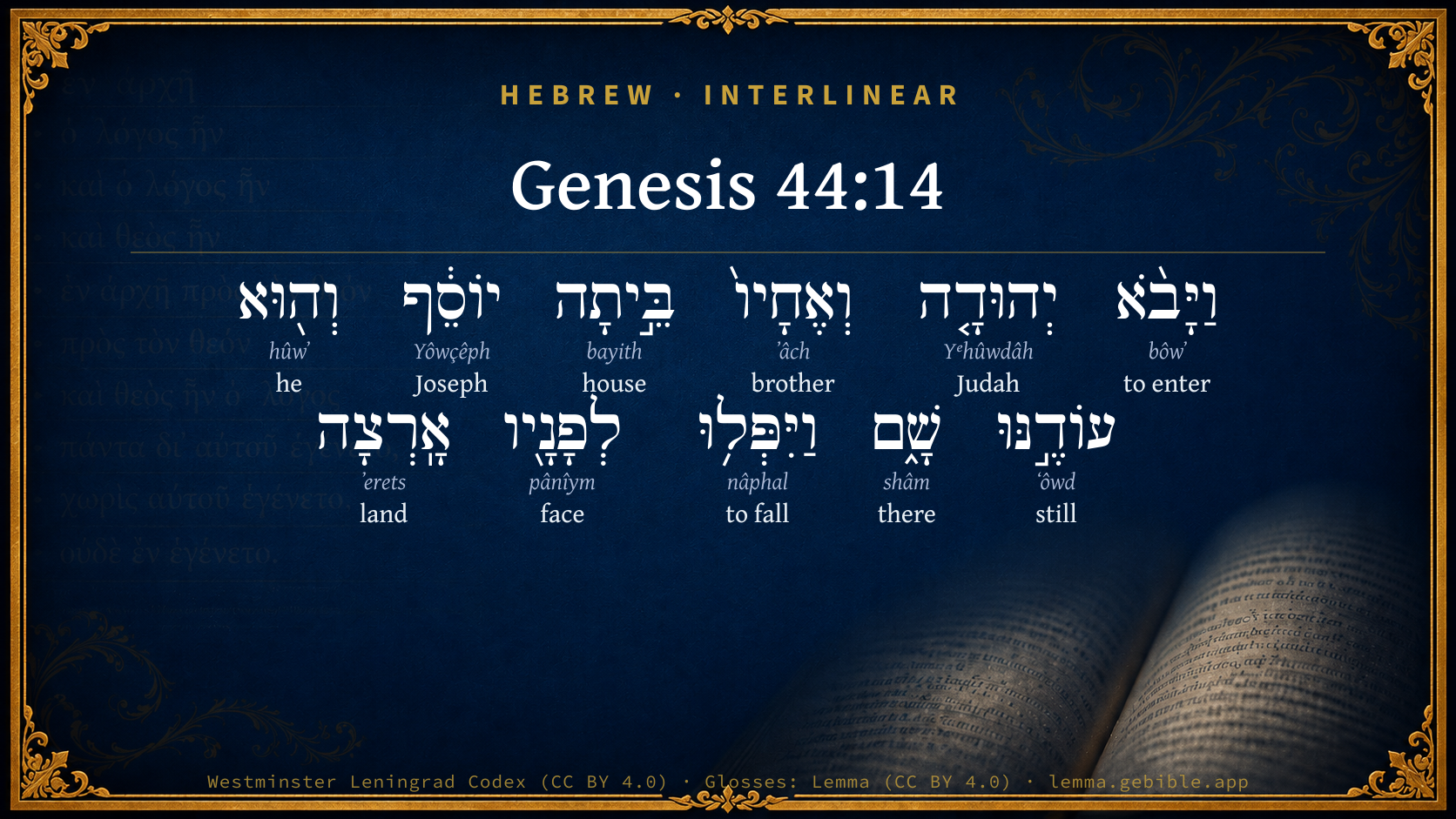
Hebrew (Westminster Leningrad Codex) Genesis 44:14 appears in the Hebrew Old Testament. The text above is from the Westminster Leningrad Codex. Each word links to its Strong’s number, a concise gloss, and parsing drawn from the Open Scriptures Hebrew Bible morphology. Click any word for its full Brown-Driver-Briggs (BDB) entry.
Download image
Cite this verse

Genesis 44:14 (World English Bible). Public Domain. Lemma interlinear Bible study tool, https://lemma.gebible.app/v/genesis/44/14.

Show BibTeX & RIS
BibTeX
RIS
English Translation
Judah and his brothers came to Joseph's house, and he was still there. They fell on the ground before him.
World English Bible · Public Domain
Download a study sheet

One document with this verse’s original text, its word-by-word gloss line, the meaning frame, cross-references with their text, attributed commentary, and full source and license credits — printable, and it pastes into notes with its structure intact.

This verse Autodidact and up

Study sheet (.html) Plain text (.txt)

A passage Seminary Student

Up to 50 verses in one chapter. A passage sheet keeps up to 6 commentary sources and 12 cross-references per verse, in the order this page ranks them, and says so on the sheet whenever that leaves anything out. Ask for a single verse and you get the Autodidact verse sheet above.

Everything on this page stays free to read, with no account — the sheet is a download of what is already on screen, not access to it.

Want to remove ads? Support Godless Engineer
Compare translations 3

The same verse in 3 English versions, stacked beneath the original-language interlinear above. Click any original word for its lexicon entry.

Each is an independent rendering of the whole verse — the interlinear is not word-aligned to these translations.

Highlighted words mark where these versions differ — a whole-verse word diff, not a word-by-word alignment.

  • World English Bible Public Domain
    Judah and his brothers came to Joseph's house, and he was still there. They fell on the ground before him.
  • King James Version Public Domain
    And Judah and his brethren came to Joseph's house; for he was yet there: and they fell before him on the ground.
  • unfoldingWord Literal Text CC BY-SA 4.0
    Then Judah and his brothers came to Joseph’s house, and he was still there, so they fell to the ground before him.

unfoldingWord Literal Text — © unfoldingWord, licensed CC BY-SA 4.0. Word-aligned USFM3 via Door43 (git.door43.org/unfoldingWord/en_ult).

Versions to compare (up to 4)

3 of 4 selected

Show all 18 translations

Every available English version of this verse, each an independent rendering of the whole verse.

  • World English Bible Public Domain
    Judah and his brothers came to Joseph's house, and he was still there. They fell on the ground before him.
  • Berean Standard Bible Public Domain
    When Judah and his brothers arrived at Joseph’s house, he was still there, and they fell to the ground before him.
  • Majority Standard Bible Public Domain
    When Judah and his brothers arrived at Joseph’s house, he was still there, and they fell to the ground before him.
  • King James Version Public Domain
    And Judah and his brethren came to Joseph's house; for he was yet there: and they fell before him on the ground.
  • American Standard Version (1901) Public Domain
    And Judah and his brethren came to Joseph's house; and he was yet there: and they fell before him on the ground.
  • Revised Version (1885) Public Domain
    And Judah and his brethren came to Joseph’s house; and he was yet there: and they fell before him on the ground.
  • Geneva Bible (1599) Public Domain
    So Iudah and his brethren came to Iosephs house (for he was yet there) and they fel before him on the ground.
  • Douay-Rheims (1899) Public Domain
    And Juda at the head of his brethren went in to Joseph, (for he was not yet gone out of the place, ) and they altogether fell down before him on the ground.
  • Young's Literal Translation Public Domain
    And Judah -- his brethren also -- cometh in unto the house of Joseph, and he is yet there, and they fall before him to the earth;
  • Literal Standard Version CC BY-SA 4.0
    And Judah and his brothers come to the house of Joseph, and he is yet there, and they fall to the earth before him;
  • Unlocked Literal Bible CC BY-SA 4.0
    Judah and his brothers came to Joseph's house. He was still there, and they bowed before him to the ground.
  • unfoldingWord Literal Text CC BY-SA 4.0
    Then Judah and his brothers came to Joseph’s house, and he was still there, so they fell to the ground before him.
  • Darby Bible Public Domain
    And Judah and his brethren came to Joseph's house; and he was still there; and they fell down before him to the ground.
  • World Messianic Bible Public Domain
    Judah and his brothers came to Joseph’s house, and he was still there. They fell on the ground before him.
  • Webster's Bible Public Domain
    And Judah and his brethren came to Joseph's house, (for he was yet there:) and they fell before him on the ground.
  • Free Bible Version CC BY-SA 4.0
    Joseph was still at home when Judah and his brothers arrived, and they fell to the ground before him.
  • Bible in Basic English Public Domain
    So Judah and his brothers came to Joseph's house; and he was still there: and they went down on their faces before him.
  • JPS Tanakh (1917) Public Domain
    And Judah and his brethren came to Joseph's house, and he was yet there; and they fell before him on the ground.

Literal Standard Version (2020), Covenant Press — licensed CC BY-SA 4.0. Text via the HelloAO Bible API (eBible.org). Unlocked Literal Bible (unfoldingWord) — licensed CC BY-SA 4.0. Text via the HelloAO Bible API (eBible.org). unfoldingWord Literal Text — © unfoldingWord, licensed CC BY-SA 4.0. Word-aligned USFM3 via Door43 (git.door43.org/unfoldingWord/en_ult). Free Bible Version, Dr. Jonathan Gallagher — licensed CC BY-SA 4.0. Text via the HelloAO Bible API (eBible.org).

Word by word

More ways to search: Search by grammar → Find every occurrence → Compare this word →

Practice this passage: Drill this verse → Learn its vocabulary →

יוֹסֵ֔ף
Yôwçêph
H3130
“Joseph”
Noun, Proper
Part of Speech
Noun
Type
Proper
Full BDB Definition

Origin: future of H3254

TWOT: None

Joseph = "Jehovah has added" - the eldest son of Jacob by Rachel - father of Igal, who represented the tribe of Issachar among the spies - a son of Asaph - a man who took a foreign wife in the time of Ezra - a priest of the family of Shebaniah in the time of Nehemiah
  1. וַיָּבֹ֨א bôwʼ H935 “and · to enter” Conjunction + Verb, Qal, Sequential Imperfect, 3rd Person, Masculine, Singular
  2. יְהוּדָ֤ה Yᵉhûwdâh H3063 “Judah” Noun, Proper
  3. וְאֶחָיו֙ ʼâch H251 “and · brothers · his” Conjunction + Noun, Common, Masculine, Plural, Construct + Suffix, Personal, 3rd Person, Masculine, Singular
  4. בֵּ֣יתָה bayith H1004 “house · toward” Noun, Common, Masculine, Singular, Construct + Suffix, Demonstrative
  5. וְה֖וּא hûwʼ H1931 “and · he” Conjunction + Pronoun, Personal, 3rd Person, Masculine, Singular
  6. עוֹדֶ֣נּוּ ʻôwd H5750 “still · his” Adverb + Suffix, Personal, 3rd Person, Masculine, Singular
  7. שָׁ֑ם shâm H8033 “there” Adverb
  8. וַיִּפְּל֥וּ nâphal H5307 “and · to fall” Conjunction + Verb, Qal, Sequential Imperfect, 3rd Person, Masculine, Plural
  9. לְפָנָ֖יו pânîym H6440 “to/for · face(s) · his” Preposition + Noun, Common, Both, Plural, Construct + Suffix, Personal, 3rd Person, Masculine, Singular
  10. אָֽרְצָה ʼerets H776 “land · toward” Noun, Common, Both, Singular, Absolute + Suffix, Demonstrative

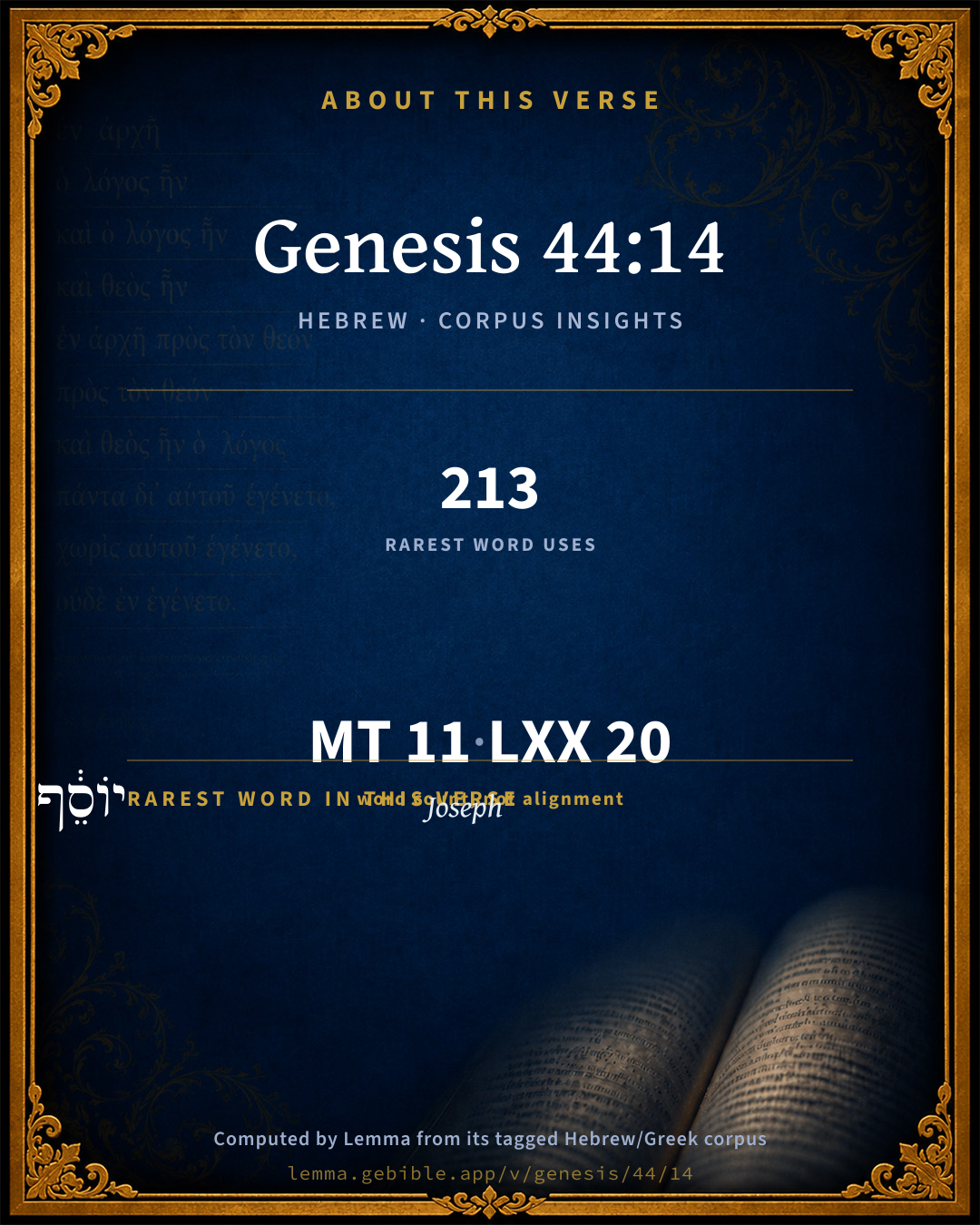
About this verse

These counts appear in no published source. They are computed here, from the morphology-tagged text and Lemma’s own curated glosses. What Lemma adds →

11
words
11
distinct lemmas
Pentateuch
section

Grammatical profile

  • 2 verbs
  • 6 nouns
  • 1 pronoun
  • 2 adverbs

Verb forms

  • וַיָּבֹ֨א Qal · Sequential Imperfect
  • וַיִּפְּל֥וּ Qal · Sequential Imperfect

Hebrew & Septuagint length

In English translation the verse runs 20 words from the Hebrew and 21 from the Septuagint (LXX English) — closely comparable.

A rough comparison of the two English renderings, which tokenize alike — not a word-level alignment.

Word counts can differ between the Hebrew and the Greek without any difference in meaning — e.g. the Hebrew direct-object marker אֵת has no separate Greek word, and Greek often adds the article ὁ.

In the original languages it is 11 Hebrew tokens and 20 Greek tokens — but the two are counted differently (Hebrew bundles its prefixes and suffixes into one token; the Greek is in lemma form), so that isn’t a like-for-like length.

Cross-references

5

Topical passages linked to Genesis 44:14 in the Treasury of Scripture Knowledge — connected by theme and wording, ordered by reader-vote popularity; previews shown in the World English Bible.

  • Genesis 43:16 When Joseph saw Benjamin with them, he said to the steward of his house, "Bring the men into the house, and butcher an animal, and make ready; for the men will dine with me at noon."
  • Genesis 43:25 They made ready the present for Joseph's coming at noon, for they heard that they should eat bread there.
  • Genesis 50:18 His brothers also went and fell down before his face; and they said, "Behold, we are your servants."
  • Philippians 2:10–11 that at the name of Jesus every knee should bow, of those in heaven, those on earth, and those under the earth,
  • Genesis 37:7–10 for, behold, we were binding sheaves in the field, and behold, my sheaf arose and also stood upright; and behold, your sheaves came around, and bowed down to my sheaf."

Cross-references courtesy of OpenBible.info (CC BY 4.0).

Hebrew and Greek witnesses Masoretic Hebrew ↔ Greek Septuagint

The same verse in the two great witnesses to the Old Testament, shown verse-for-verse.

These are two independent witnesses, not word-aligned to each other, and the Septuagint is shown in lemma (dictionary) form.

Hebrew Genesis 44:14 Masoretic · Westminster Leningrad Codex

וַיָּבֹ֨א יְהוּדָ֤ה וְאֶחָיו֙ בֵּ֣יתָה יוֹסֵ֔ף וְה֖וּא עוֹדֶ֣נּוּ שָׁ֑ם וַיִּפְּל֥וּ לְפָנָ֖יו אָֽרְצָה

Judah and his brothers came to Joseph's house, and he was still there. They fell on the ground before him.

World English Bible · Public Domain

Greek LXX Genesis 44:14 Septuagint · lemma form

εἰςἔρχομαι δέ ἰούδας καί ὁ ἀδελφός αὐτός πρός ιωσηφ ἔτι αὐτός εἰμί ἐκεῖ καί πίπτω ἐναντίον αὐτός ἐπί ὁ γῆ

And Judas and his brethren came in to Joseph, while he was yet there, and fell on the ground before him.

LXX2012 (modern English Septuagint) · Public Domain

Hebrew: Westminster Leningrad Codex (CC BY 4.0). Greek: Septuagint (public domain); English from LXX2012 (modern English Septuagint) (Public Domain). How the Septuagint differs from the Hebrew →

Targum (Aramaic paraphrase)

2

The Targum is the ancient Jewish Aramaic paraphrase of the Hebrew Scriptures — an interpretive translation, not the Hebrew text itself. Onkelos (literal) and Pseudo-Jonathan (expansive) render the Torah, and Jonathan the Prophets. Coverage is partial: where no permissively-licensed English translation exists for a verse, only the Aramaic is shown. This is verse-level text, not a word-by-word alignment to the Hebrew.

  1. Targum Onkelos Torah (Genesis–Deuteronomy)
    וְעַל יְהוּדָּה וַאֲחוֹהִי לְבֵית יוֹסֵף וְהוּא עַד כְּעַן תַּמָּן וּנְפָלוּ קֳדָמוֹהִי לְאַרְעָא

    (no public-domain English translation for this verse)

    Targum Onkelos — Aramaic: “Onkelos Genesis” (public domain); “Onkelos Exodus” (public domain); “Onkelos Leviticus” (public domain); “Onkelos Numbers” (public domain); “Onkelos Deuteronomy” (public domain). English: “Sefaria Community Translation” (CC0 1.0 (public-domain dedication)); “J.W. Etheridge. The Targums of Onkelos and Jonathan Ben Uzziel on the Pentateuch. London: Longmans, Green, 1862” (public domain). Text via Sefaria.

  2. Targum Pseudo-Jonathan Torah (Genesis–Deuteronomy)
    וְעַל יְהוּדָה וְאָחוֹהִי לְבֵית יוֹסֵף וְהוּא עוֹד כְּדוֹן תַּמָן וְנָפָלוּ קֳדָמוֹי עַל אַרְעָא

    And Jehuda and his brethren entered into Joseph's house. He was yet there; and they fell before him on the ground.

    Targum Pseudo-Jonathan — Aramaic: “Targum Jonathan on Genesis” (public domain); “Targum Jonathan on Exodus” (public domain); “Targum Jonathan on Leviticus” (public domain); “Targum Jonathan on Numbers” (public domain); “Targum Jonathan on Deuteronomy” (public domain). English: “The Targum of Jonathan ben Uzziel, trans. J. W. Etheridge, London, 1862” (public domain). Text via Sefaria.

Commentary

Notes on Genesis 44:14 from classic Christian and Jewish commentators (each source and its license shown beneath its notes). The classic Christian expositions comment on the surrounding passage and are grouped to its opening verse, so a note may address several verses; the Jewish commentaries on the Tanakh (Rashi and others) are per-verse, so they appear only where the commentator wrote on this verse.

Lemma curates 59 commentaries, every one of them public domain or Creative Commons licensed, each selected and text-cleaned for this edition rather than reprinted as found. About our sources →

Trapp's Complete Commentary

John Trapp

Gen 44:14 And Judah and his brethren came to Joseph’s house; for he [was] yet there: and they fell before him on the ground.

Ver. 14. They fell before him on the ground.] Humble submission, they knew, if anything, would make their peace, and procure their pardon -

“Sic ventos vincit, dumse submittit arundo.”

It is no hoisting up sail in a storm, no standing before a lion, &c. William the Conqueror often pardoned rebels, and received them into favour; as he held submission satisfactory for the greatest offences, and sought not to defeat them, but their enterprises. {a}

{a} Dan., Hist., fol. 51.

John Trapp, A Commentary or Exposition upon All the Books of the Old and New Testament (1647–1656) — public domain. Text from a community e-Sword module.

Keil & Delitzsch

C. F. Keil & F. Delitzsch

Result of the Test. - Gen 44:14-17. With Judah leading the way, they came into the house to Joseph, and fell down before him begging for mercy. Joseph spoke to them harshly: "What kind of deed is this that ye have done? Did ye not know that such a man as I (a man initiated into the most secret things) would certainly divine this?" נחשׁ augurari. Judah made no attempt at a defence. "What shall we say to my lord? how speak, how clear ourselves? God (Ha-Elohim, the personal God) has found out the wickedness of thy servants (i.e., He is now punishing the crime committed against our brother, cf. Gen 42:21). Behold, we are my lord's slaves, both we, and he in whose hand the cup was found." But Joseph would punish mildly and justly. The guilty one alone should be his slave; the others might go in peace, i.e., uninjured, to their father.

Keil & Delitzsch — Biblical Commentary on the Old Testament (1861–1891) — public domain (CC PDM 1.0). Text via the HelloAO Bible API. (Old Testament only.)

Tyndale Open Study Notes

Tyndale Open Resources

44:14 This time, the brothers did not bow politely (see 42:6-7; 43:26); they fell to the ground in desperation, fulfilling Joseph’s first dream for the third time (see 37:10).

Tyndale Open Study Notes — © Tyndale Open Resources, licensed CC BY-SA 4.0. Text via the HelloAO Bible API.

The Cambridge Bible for Schools and Colleges

gen. ed. J. J. S. Perowne

14. he was yet there] Joseph had not yet left his official dwelling.

fell before him] The third and last fulfilment of the dreams (Gen_37:7; Gen_37:9-10). See Gen_44:16.

The Cambridge Bible for Schools and Colleges (gen. ed. J. J. S. Perowne; Cambridge University Press, 1878–1918) — public domain. Text from a community e-Sword module.

John Gill's Exposition

And Judah and his brethren came to Joseph's house,.... Judah is particularly mentioned because he was the principal spokesman, and was chiefly concerned for the safety of Benjamin, being his surety:

for he was yet there; Joseph was yet at his own house, was not as yet gone to the granaries, to look after the affairs of the corn, and the sale and distribution of it, but was waiting for the return of his brethren, which he expected quickly:

and they fell before him on the ground; not only in a way of reverence, again fulfilling his dream, but as persons in the utmost distress and affliction, throwing themselves at his feet for mercy.

John Gill's Exposition of the Whole Bible (1746–1763) — public domain (CC PDM 1.0). Text via the HelloAO Bible API.

Haydock's Catholic Bible Commentary

Juda, mindful of his engagement, (chap. xliii. 9,) and perhaps more eloquent and bolder than the rest. (Menochius)

George Leo Haydock (1774–1849), Haydock's Catholic Family Bible and Commentary, 1859 edition — public domain. Excludes Psalms (Douay-Rheims chapter numbering differs from Protestant) and Deuterocanonical books (Catholic canon only).

Whedon's Commentary on the Bible

Daniel D. Whedon

14. Fell before him — Another fulfilling of Joseph’s dream. See on Gen_43:26.

Daniel D. Whedon (gen. ed.), Commentary on the Old and New Testaments (1874–1909) — public domain. Text from a community e-Sword module.

The Pulpit Commentary

Vers. 14-17. And Judah who is recognized as the leader in this second embassy to Egypt (Gen_43:8) and his brethren came to Joseph"s house; for he was yet there: no doubt, the result which he anticipated" (Murphy)and they fell before him on the ground. The expression indicates a complete prostration of the body. It was a token of their penitence, and a sign that they craved his forgiveness. And Joseph said unto them, in a speech not of "cruel and haughty irony" (Kalisch), but simply of assumed resentmentWhat deed is this that we have done! were ye not (or, did you not know?) that such a man as I can certainly divine? literally, divining can divine (vide on ver. 5). Though Joseph uses this language, and is represented by his steward as possessing a divining cup, there is no reason to suppose that he was in the habit of practicing this heathen superstition. And Judah said (acting throughout this scene as the spokesman of his brethren), What shall we say unto my lord? What shall we speak? or how shall we clear ourselves? (i.e. justify ourselves, or purge ourselves from suspicion). God (literally, the Elohim) hath found out the iniquity of thy servants: behold, we are my lord"s servants (literally, servants to my lord), both we, and he also with whom the cup is found. And he ( i.e. Joseph) said, God forbid that I should do so (vide ver. 9): but the man in whose hand the cup is found, he shall be my servant; and as for you, get you up in peace unto your father. Thus they were once more tested as to whether they could, as before, callously deliver up their father"s favorite, and so bring down the gray hairs of their father to the grave, or would heroically and self-sacrificingly offer their own lives and liberties for his protection (Rosenm Keil, Lange, Murphy, and others). How nobly they stood the test Judah"s pathetic supplication reveals.

HOMILIES BY W. ROBERTS Vers. 14-34.

The conversion of Judah.

I THE EVIDENCE OF IT.

1. The unexpected confession of guilt which he makes. "God hath found out the iniquity of thy servants.

2. The sensitive appreciation of the terrible blow which Benjamin"s loss would be to Jacob. "When he seeth the lad is not with us he will die.

3. The noble sacrifice he proposes to make for Benjamin. "Let thy servant abide instead of the lad, a bondman to my lord.

II THE CAUSE OF IT.

1. The memory of his old sin, which appears to have haunted his conscience.

2. The arrestment of Divine Providence, which in his Egyptian experience he suffered.

3. The inward operation of God"s grace upon his heart.

Learn

1. That no living sinner is beyond the reach of conversion.

2. That for the most part the work of conversion is gradually consummated; and

3. That when once it is completed it appears in a change of character and life. W.

The Pulpit Commentary (1880–1919), ed. H.D.M. Spence-Jones & Joseph S. Exell — public domain. Text from a community e-Sword module.

Kretzmann's Popular Commentary

Paul E. Kretzmann

Judah’s Heroic Behavior

v. 14. And Judah and his brethren came to Joseph’s house; for he was yet there, having waited for their return. Judah is now the leader among the brothers, a position which was later confirmed to him. And they fell before him on the ground, in speechless terror and abject surrender. This showed the spirit which now lived in them, as well as the fact that they had not permitted Benjamin to return alone and that they willingly placed themselves under the direction of Judah.

v. 15. And Joseph said unto them, in apparent indignation, What deed is this that ye have done? Wot ye not that such a man as I can certainly divine? He intimated that a man in his position and of his wisdom was able to discover the most carefully hidden things. Cf v. 5.

v. 16. And Judah said, What shall we say unto my lord? What shall we speak? Or how shall we clear ourselves? He felt that the circumstantial evidence against them was so strong as to oblige the ruler to decide against them. God hath found out the iniquity of thy servants; he and his brothers recognized in this strange shaping of events the judgment of God upon their former guilt, and their repentance was certainly genuine. Behold, we are my lord’s servants, both we and he also with whom the cup is found. Thus Judah includes all the brothers with himself as champions of Benjamin, whom they would not permit to enter slavery alone. Judah exhibited a wonderful self-denial, magnanimity, and generosity, even while he was struggling with despair.

v. 17. And he said, God forbid that I should do so; far be it from me to act upon this suggestion; but the man in whose hand the cup is found, he shall be my servant; and as for you, get you up in peace unto your father. This is the climax of the test which Joseph had proposed, for now the brothers could show whether they would take this opportunity to get rid of the second son of Rachel, as they had gotten rid of the first: Benjamin would remain in Egypt as Joseph’s slave, while the others would go scot-free.

v. 18. Then Judah came near unto him and said, stepping forward in his great agitation, O my lord, let thy servant, I pray thee, speak a word in my lord’s ears, and let not thine anger burn against thy servant; for thou art even as Pharaoh. His request was made in the greatest humility, in the full consciousness of his own unworthiness.

v. 19. My lord asked his servants, saying, Have ye a father, or a brother?

v. 20. And we said unto my lord, we have a father, an old man, and a child of his old age, a little one; and his brother is dead, and he alone is left of his mother, and his father loveth him. With unconscious, artless skill the love of Jacob for the one remaining son of his old age from his beloved Rachel is here pictured,

v. 21. And thou saidst unto thy servants, Bring him down unto me that I may set mine eyes upon him. The pleading here is less formal, and more fervent.

v. 22. And we said unto my lord, The lad cannot leave his father; for if he should leave his father, his father would die. From this we may conclude that the refusal of the brothers to bring Benjamin had caused their first imprisonment. It was the prospect of a favorable reception on the part of Joseph that had made the brothers consent.

v. 23. And thou saidst unto thy servants, Except your youngest brother come down with you, ye shall see my face no more, which was equivalent to telling them that they could purchase no more grain, unless they complied with this condition.

v. 24. And it came to pass, when we came up unto thy servant, my father, we told him the words of my lord.

v. 25. And our father said, Go again, and buy us a little food.

v. 26. And we said, We cannot go down; if our youngest brother be with us, then will we go down; for we may not see the man’s face, except our youngest brother be with us.

v. 27. And thy servant, my father, said unto us, Ye know that my wife, Rachel, whom only he really considered such in the full name of the word, bare me two sons;

v. 28. and the one went out from me, he was taken from Jacob in a violent manner, and I said, Surely, he is torn in pieces, that was the only conclusion he could reach from the evidence presented; and I saw him not since;

v. 29. and if ye take this also from me, and mischief, some harm or danger, befall him, ye shall bring down my gray hairs with sorrow to the grave. It was a masterly presentation of the love and devotion which now characterized the relationship in the family of Jacob. With these words Judah reached the conclusion of his plea, in a remarkably eloquent outburst.

v. 30. Now, therefore, when I come to thy servant, my father, and the lad be not with us; seeing that his life is bound up in the lad’s life, his soul was literally tied to the soul of Benjamin;

v. 31. it shall come to pass, when he seeth that the lad is not with us, that he will die; and thy servants shall bring down the gray hairs of thy servant, our father, with sorrow to the grave, to the realm of the dead.

v. 32. For thy servant became surety for the lad unto my father, saying, if I bring him not unto thee, then I shall bear the blame to my father forever.

v. 33. Now, therefore, I pray thee, let thy servant abide instead of the lad a bondman to my lord; and let the lad go up with his brethren. This entreaty was a wonderful exhibition of love, both for the aged father and for Benjamin, since it involved becoming a slave in Egypt without hope of redemption.

v. 34. For how shall I go up to my father, and the lad be not with me? Lest peradventure I see the evil that shall come on (find or strike) my father. This lofty and impressive, vivid and passionate prayer, culminating in the last touching appeal with its self-sacrificing offer, is one of the sublimest passages in the entire Old Testament, reminding us, incidentally, of the infinitely greater sacrifice which the Champion out of the tribe of Judah, who became surety for His brethren according to the flesh, made by giving His life for theirs.

Paul E. Kretzmann, Popular Commentary of the Bible (1921–1924) — public domain. Text from a community e-Sword module.

unfoldingWord translationNotes

Door43 World Missions Community

He was still there

"Joseph was still there"

they bowed before him

"they fell before him." This is a sign of the brothers wanting the lord to be merciful to them. (See: Symbolic Action)

Do you not know that a man like me practices divination?

Joseph uses a question to scold his brothers. AT: "Surely you know that a man like me can learn things by magic!" (See: Rhetorical Question)

translationWords

Judah

bow

divination

unfoldingWord translationNotes — © Distant Shores Media and the Door43 World Missions Community, licensed CC BY-SA 4.0. Source: git.door43.org/Door43/en_tn.

Rashi

Rabbi Shlomo Yitzchaki (Rashi)

עודנו שם HE WAS YET THERE — for he was waiting for them.

Rashi on the Tanakh — English translations: “The Judaica Press complete Tanach with Rashi, translated by A. J. Rosenberg” (CC BY 4.0); “Pentateuch with Rashi's commentary by M. Rosenbaum and A.M. Silbermann, 1929-1934” (public domain); “The Metsudah Tanach series, Lakewood, N.J” (CC BY 4.0); and “The Book of Joshua, Metsudah Publications, 1997” (CC BY 4.0). Text via Sefaria.

Lesson kit

Teaching starters — assembled from the data on this page, not authored interpretation. Every prompt links to the verse data it draws on. Edit before teaching.

Genesis, in the Pentateuch, opens this verse with 11 words (11 distinct Hebrew lemmas). Its most distinctive word is Yôwçêph (“Joseph”). A historical commentator’s framing appears above. Read the whole chapter for the surrounding context.

Discussion questions

  1. The word Yôwçêph carries the sense “Joseph.” How does it shape the verse?
  2. How does Genesis 43:16, which shares this passage’s theme, read alongside this verse?
  3. These translations render this verse differently; the difference is in the English rendering, not the original. What questions does that raise?
  4. «וַיָּבֹ֨א» is a Qal Sequential Imperfect verb. How does that grammatical form shape the action described?
  5. Compare how Trapp's Complete Commentary and Keil & Delitzsch read this verse. Where do they agree or differ?

Things to notice

Reading settings

Reading text

Shown beneath each verse's original-language words.

Old Testament
Old Testament edition

Read the OT as the Masoretic Hebrew (MT) or the Greek Septuagint (LXX).

English shown for the Greek Septuagint (in the Hebrew ↔ Greek comparison).

Comparing translations? Open the Compare panel on any verse page to stack up to four side by side.