Genesis 7:13

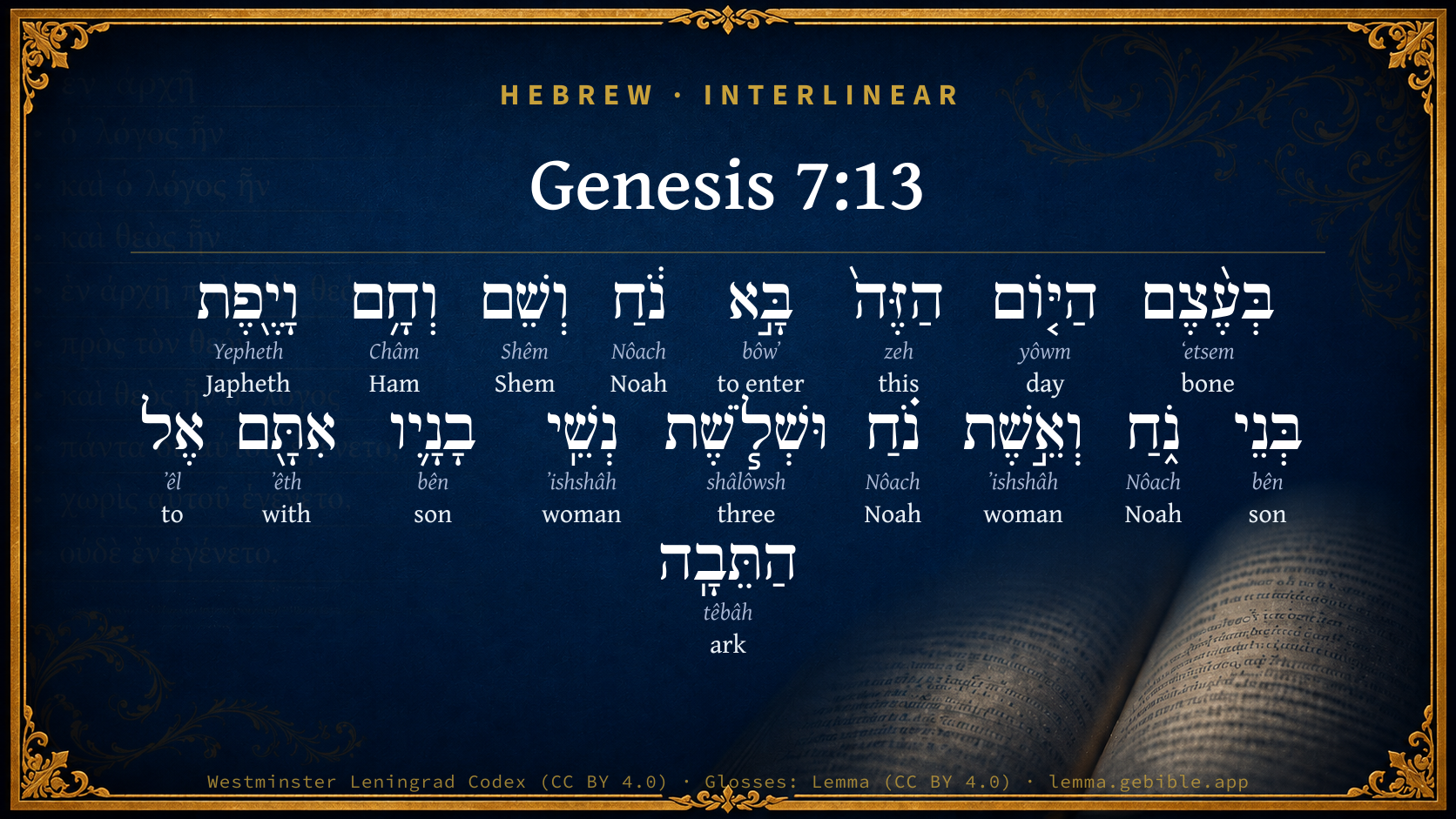
Hebrew (Westminster Leningrad Codex) Genesis 7:13 appears in the Hebrew Old Testament. The text above is from the Westminster Leningrad Codex. Each word links to its Strong’s number, a concise gloss, and parsing drawn from the Open Scriptures Hebrew Bible morphology. Click any word for its full Brown-Driver-Briggs (BDB) entry.
Download image
Cite this verse

Genesis 7:13 (World English Bible). Public Domain. Lemma interlinear Bible study tool, https://lemma.gebible.app/v/genesis/7/13.

Show BibTeX & RIS
BibTeX
RIS
English Translation
In the same day Noah, and Shem, Ham, and Japheth, the sons of Noah, and Noah's wife, and the three wives of his sons with them, entered into the ark;
World English Bible · Public Domain
Download a study sheet

One document with this verse’s original text, its word-by-word gloss line, the meaning frame, cross-references with their text, attributed commentary, and full source and license credits — printable, and it pastes into notes with its structure intact.

This verse Autodidact and up

Study sheet (.html) Plain text (.txt)

A passage Seminary Student

Up to 50 verses in one chapter. A passage sheet keeps up to 6 commentary sources and 12 cross-references per verse, in the order this page ranks them, and says so on the sheet whenever that leaves anything out. Ask for a single verse and you get the Autodidact verse sheet above.

Everything on this page stays free to read, with no account — the sheet is a download of what is already on screen, not access to it.

Want to remove ads? Support Godless Engineer
Compare translations 3

The same verse in 3 English versions, stacked beneath the original-language interlinear above. Click any original word for its lexicon entry.

Each is an independent rendering of the whole verse — the interlinear is not word-aligned to these translations.

Highlighted words mark where these versions differ — a whole-verse word diff, not a word-by-word alignment.

  • World English Bible Public Domain
    In the same day Noah, and Shem, Ham, and Japheth, the sons of Noah, and Noah's wife, and the three wives of his sons with them, entered into the ark;
  • King James Version Public Domain
    In the selfsame day entered Noah, and Shem, and Ham, and Japheth, the sons of Noah, and Noah's wife, and the three wives of his sons with them, into the ark;
  • unfoldingWord Literal Text CC BY-SA 4.0
    On that same day Noah and Shem and Ham and Japheth, the sons of Noah, and the wife of Noah and the three wives of his sons with them, went into the ark,

unfoldingWord Literal Text — © unfoldingWord, licensed CC BY-SA 4.0. Word-aligned USFM3 via Door43 (git.door43.org/unfoldingWord/en_ult).

Versions to compare (up to 4)

3 of 4 selected

Show all 18 translations

Every available English version of this verse, each an independent rendering of the whole verse.

  • World English Bible Public Domain
    In the same day Noah, and Shem, Ham, and Japheth, the sons of Noah, and Noah's wife, and the three wives of his sons with them, entered into the ark;
  • Berean Standard Bible Public Domain
    On that very day Noah entered the ark, along with his sons Shem, Ham, and Japheth, and his wife, and the three wives of his sons—
  • Majority Standard Bible Public Domain
    On that very day Noah entered the ark, along with his sons Shem, Ham, and Japheth, and his wife, and the three wives of his sons—
  • King James Version Public Domain
    In the selfsame day entered Noah, and Shem, and Ham, and Japheth, the sons of Noah, and Noah's wife, and the three wives of his sons with them, into the ark;
  • American Standard Version (1901) Public Domain
    In the selfsame day entered Noah, and Shem, and Ham, and Japheth, the sons of Noah, and Noah's wife, and the three wives of his sons with them, into the ark;
  • Revised Version (1885) Public Domain
    In the selfsame day entered Noah, and Shem, and Ham, and Japheth, the sons of Noah, and Noah’s wife, and the three wives of his sons with them, into the ark;
  • Geneva Bible (1599) Public Domain
    In the selfe same day entred Noah with Shem, and Ham and Iapheth, the sonnes of Noah, and Noahs wife, and the three wiues of his sonnes with them into the Arke.
  • Douay-Rheims (1899) Public Domain
    In the selfsame day Noe, and Sem, and Cham, and Japheth his sons: his wife, and the three wives of his sons with them, went into the ark:
  • Young's Literal Translation Public Domain
    In this self-same day went in Noah, and Shem, and Ham, and Japheth, sons of Noah, and Noah's wife and the three wives of his sons with them, unto the ark;
  • Literal Standard Version CC BY-SA 4.0
    On this very same day Noah, and Shem, and Ham, and Japheth, sons of Noah, and Noah’s wife, and the three wives of his sons with them, went into the Ark—
  • Unlocked Literal Bible CC BY-SA 4.0
    On that very same day Noah and his sons, Shem, Ham, and Japheth, and Noah's wife, and the three wives of his sons with them, entered into the ark.
  • unfoldingWord Literal Text CC BY-SA 4.0
    On that same day Noah and Shem and Ham and Japheth, the sons of Noah, and the wife of Noah and the three wives of his sons with them, went into the ark,
  • Darby Bible Public Domain
    On the same day went Noah, and Shem and Ham and Japheth, the sons of Noah, and Noah's wife, and the three wives of his sons with them, into the ark;
  • World Messianic Bible Public Domain
    In the same day Noah, and Shem, Ham, and Japheth—the sons of Noah—and Noah’s wife and the three wives of his sons with them, entered into the ship—
  • Webster's Bible Public Domain
    In the same day entered Noah, and Shem, and Ham, and Japheth, the sons of Noah, and Noah's wife, and the three wives of his sons with them, into the ark.
  • Free Bible Version CC BY-SA 4.0
    That was the actual day when Noah, his wife, and their sons, Shem, Ham, and Japheth together with their three wives went into the ark.
  • Bible in Basic English Public Domain
    On the same day Noah, with Shem, Ham, and Japheth, his sons, and his wife and his sons' wives, went into the ark;
  • JPS Tanakh (1917) Public Domain
    In the selfsame day entered Noah, and Shem, and Ham, and Japheth, the sons of Noah, and Noah's wife, and the three wives of his sons with them, into the ark;

Literal Standard Version (2020), Covenant Press — licensed CC BY-SA 4.0. Text via the HelloAO Bible API (eBible.org). Unlocked Literal Bible (unfoldingWord) — licensed CC BY-SA 4.0. Text via the HelloAO Bible API (eBible.org). unfoldingWord Literal Text — © unfoldingWord, licensed CC BY-SA 4.0. Word-aligned USFM3 via Door43 (git.door43.org/unfoldingWord/en_ult). Free Bible Version, Dr. Jonathan Gallagher — licensed CC BY-SA 4.0. Text via the HelloAO Bible API (eBible.org).

Word by word

More ways to search: Search by grammar → Find every occurrence → Compare this word →

Practice this passage: Drill this verse → Learn its vocabulary →

וָיֶ֖פֶת
Yepheth
H3315
“and · Japheth”
Conjunction + Noun, Proper
Part of Speech
Conjunction + Noun
Type
Proper
Full BDB Definition

Origin: from H6601

TWOT: None

Japheth = "opened" - the 3rd son of Noah whose descendants after the flood settled on the coastal lands of the Mediterranean spreading north into Europe and parts of Asia
  1. בְּעֶ֨צֶם ʻetsem H6106 “in/at · bone of” Preposition + Noun, Common, Feminine, Singular, Construct
  2. הַיּ֤וֹם yôwm H3117 “the · day” Particle, Definite Article + Noun, Common, Masculine, Singular, Absolute
  3. הַזֶּה֙ zeh H2088 “the · this” Particle, Definite Article + Pronoun, Demonstrative, Masculine, Singular
  4. בָּ֣א bôwʼ H935 “to enter” Verb, Qal, Perfect, 3rd Person, Masculine, Singular
  5. נֹ֔חַ Nôach H5146 “Noah” Noun, Proper
  6. וְשֵׁם Shêm H8035 “and · Shem” Conjunction + Noun, Proper
  7. וְחָ֥ם Châm H2526 “and · Ham” Conjunction + Noun, Proper
  8. בְּנֵי bên H1121 “sons of” Noun, Common, Masculine, Plural, Construct
  9. נֹ֑חַ Nôach H5146 “Noah” Noun, Proper
  10. וְאֵ֣שֶׁת ʼishshâh H802 “and · woman of” Conjunction + Noun, Common, Feminine, Singular, Construct
  11. נֹ֗חַ Nôach H5146 “Noah” Noun, Proper
  12. וּשְׁלֹ֧שֶׁת shâlôwsh H7969 “and · three” Conjunction + Adjective, Cardinal number, Masculine, Singular, Construct
  13. נְשֵֽׁי ʼishshâh H802 “women of” Noun, Common, Feminine, Plural, Construct
  14. בָנָ֛יו bên H1121 “sons · his” Noun, Common, Masculine, Plural, Construct + Suffix, Personal, 3rd Person, Masculine, Singular
  15. אִתָּ֖ם ʼêth H854 “with · them” Preposition + Suffix, Personal, 3rd Person, Masculine, Plural
  16. אֶל ʼêl H413 “to” Preposition
  17. הַתֵּבָֽה têbâh H8392 “the · ark” Particle, Definite Article + Noun, Common, Feminine, Singular, Absolute

About this verse

These counts appear in no published source. They are computed here, from the morphology-tagged text and Lemma’s own curated glosses. What Lemma adds →

18
words
14
distinct lemmas
Pentateuch
section

Notable vocabulary

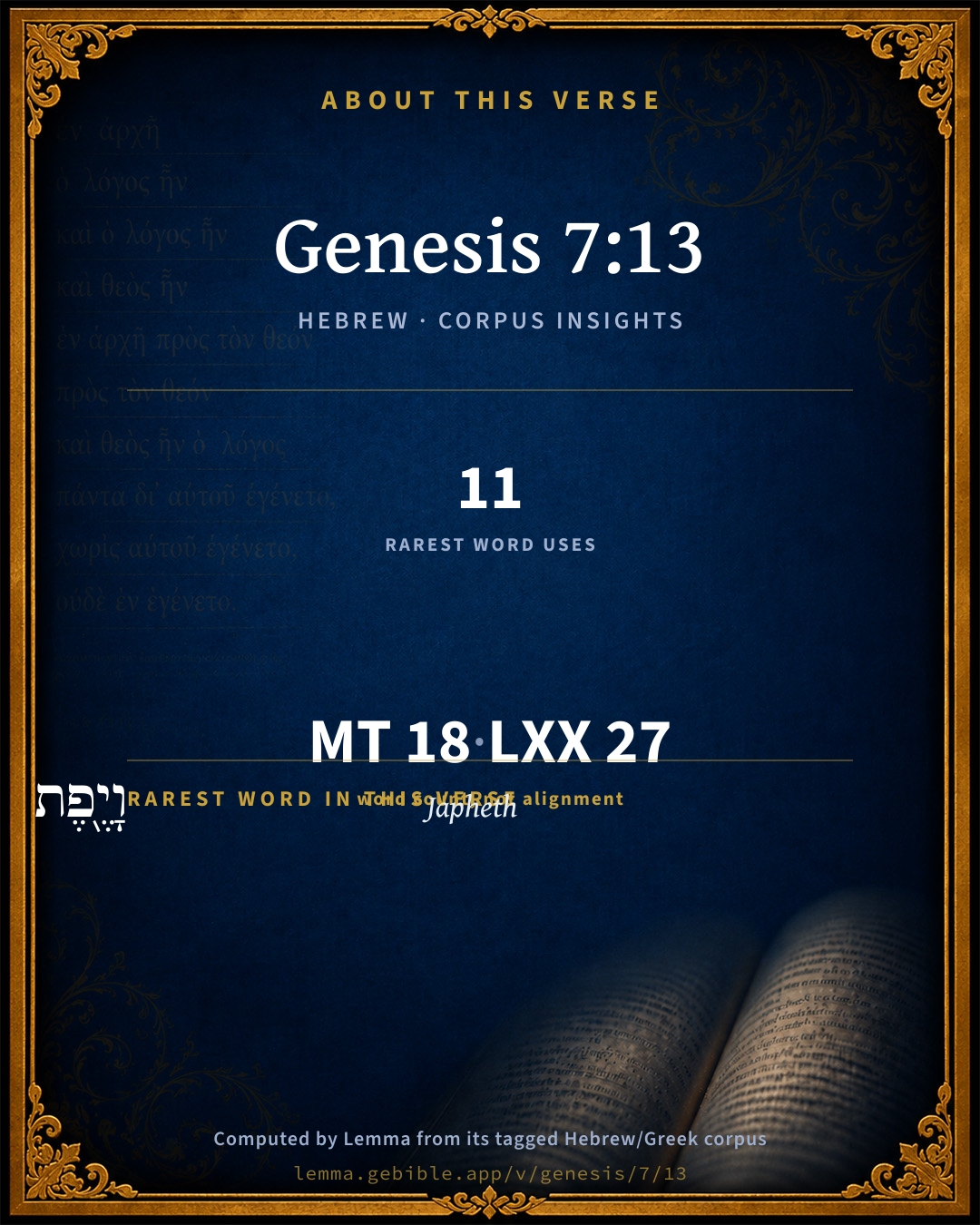
The rarest word here is וָיֶ֖פֶת Japheth H3315 — appearing just 11 times in the whole Hebrew Bible.

Shared distinctive vocabulary

וָיֶ֖פֶת Japheth H3315 occurs in 11 verses of the Hebrew Bible. Also found in:

Grammatical profile

  • 1 verb
  • 13 nouns
  • 1 adjective
  • 1 pronoun
  • 2 prepositions

Verb forms

  • בָּ֣א Qal · Perfect

Repetition

Words recur within this verse — often emphatic in Hebrew:

  • נֹ֔חַ Noah H5146 ×3
  • בְּנֵי son H1121 ×2
  • וְאֵ֣שֶׁת woman H802 ×2

Hebrew & Septuagint length

In English translation the verse runs 30 words from the Hebrew and 30 from the Septuagint (LXX English) — the same length.

A rough comparison of the two English renderings, which tokenize alike — not a word-level alignment.

Word counts can differ between the Hebrew and the Greek without any difference in meaning — e.g. the Hebrew direct-object marker אֵת has no separate Greek word, and Greek often adds the article ὁ.

In the original languages it is 18 Hebrew tokens and 27 Greek tokens — but the two are counted differently (Hebrew bundles its prefixes and suffixes into one token; the Greek is in lemma form), so that isn’t a like-for-like length.

Cross-references

13

Topical passages linked to Genesis 7:13 in the Treasury of Scripture Knowledge — connected by theme and wording, ordered by reader-vote popularity; previews shown in the World English Bible.

  • Genesis 6:18 But I will establish my covenant with you. You shall come into the ark, you, your sons, your wife, and your sons' wives with you.
  • Genesis 7:1 Yahweh said to Noah, "Come with all of your household into the ark, for I have seen your righteousness before me in this generation.
  • Genesis 5:32 Noah was five hundred years old, and Noah became the father of Shem, Ham, and Japheth.
  • Genesis 6:10 Noah became the father of three sons: Shem, Ham, and Japheth.
  • Genesis 7:7–9 Noah went into the ark with his sons, his wife, and his sons' wives, because of the waters of the flood.
  • Genesis 9:18–19 The sons of Noah who went forth from the ark were Shem, Ham, and Japheth. Ham is the father of Canaan.
  • Genesis 10:1–2 Now this is the history of the generations of the sons of Noah and of Shem, Ham, and Japheth. Sons were born to them after the flood.
  • Genesis 10:6 The sons of Ham: Cush, Mizraim, Put, and Canaan.
  • Genesis 10:21 To Shem, the father of all the children of Eber, the elder brother of Japheth, to him also were children born.
  • 1 Chronicles 1:4–28 Noah, Shem, Ham, and Japheth.
  • Hebrews 11:7 By faith, Noah, being warned about things not yet seen, moved with godly fear, prepared an ark for the saving of his house, through which he condemned the world, and became heir of the righteousness which is according to faith.
  • 1 Peter 3:20 who before were disobedient, when God waited patiently in the days of Noah, while the ark was being built. In it, few, that is, eight souls, were saved through water.
  • 2 Peter 2:5 and didn't spare the ancient world, but preserved Noah with seven others, a preacher of righteousness, when he brought a flood on the world of the ungodly;

Cross-references courtesy of OpenBible.info (CC BY 4.0).

Hebrew and Greek witnesses Masoretic Hebrew ↔ Greek Septuagint

The same verse in the two great witnesses to the Old Testament, shown verse-for-verse.

These are two independent witnesses, not word-aligned to each other, and the Septuagint is shown in lemma (dictionary) form.

Hebrew Genesis 7:13 Masoretic · Westminster Leningrad Codex

בְּעֶ֨צֶם הַיּ֤וֹם הַזֶּה֙ בָּ֣א נֹ֔חַ וְשֵׁם וְחָ֥ם וָיֶ֖פֶת בְּנֵי נֹ֑חַ וְאֵ֣שֶׁת נֹ֗חַ וּשְׁלֹ֧שֶׁת נְשֵֽׁי בָנָ֛יו אִתָּ֖ם אֶל הַתֵּבָֽה

In the same day Noah, and Shem, Ham, and Japheth, the sons of Noah, and Noah's wife, and the three wives of his sons with them, entered into the ark;

World English Bible · Public Domain

Greek LXX Genesis 7:13 Septuagint · lemma form

ἐν ὁ ἡμέρα οὗτος εἰςἔρχομαι νωε σημ χαμ ιαφεθ υἱός νωε καί ὁ γυνή νωε καί ὁ τρεῖς γυνή ὁ υἱός αὐτός μετά αὐτός εἰς ὁ κιβωτός

On that very day entered Noe, Sem, Cham, Japheth, the sons of Noe, and the wife of Noe, and the three wives of his sons with him into the ark.

LXX2012 (modern English Septuagint) · Public Domain

On this verse, The Cambridge Bible for Schools and Colleges discusses the Septuagint’s reading. Read the note in Commentary ↓

Hebrew: Westminster Leningrad Codex (CC BY 4.0). Greek: Septuagint (public domain); English from LXX2012 (modern English Septuagint) (Public Domain). How the Septuagint differs from the Hebrew →

Targum (Aramaic paraphrase)

2

The Targum is the ancient Jewish Aramaic paraphrase of the Hebrew Scriptures — an interpretive translation, not the Hebrew text itself. Onkelos (literal) and Pseudo-Jonathan (expansive) render the Torah, and Jonathan the Prophets. Coverage is partial: where no permissively-licensed English translation exists for a verse, only the Aramaic is shown. This is verse-level text, not a word-by-word alignment to the Hebrew.

  1. Targum Onkelos Torah (Genesis–Deuteronomy)
    בִּכְרַן יוֹמָא הָדֵין עָאל נֹחַ וְשֵׁם וְחָם וָיֶפֶת בְּנֵי נֹחַ וְאִתַּת נֹחַ וּתְלָתָא נְשֵׁי בְנוֹהִי עִמְהוֹן לְתֵבוֹתָא

    In that very day entered Noach, and Shem, Cham, and Yapheth, sons of Noach, and the wife of Noach, and the three wives of his sons with them, into the ark;

    Targum Onkelos — Aramaic: “Onkelos Genesis” (public domain); “Onkelos Exodus” (public domain); “Onkelos Leviticus” (public domain); “Onkelos Numbers” (public domain); “Onkelos Deuteronomy” (public domain). English: “Sefaria Community Translation” (CC0 1.0 (public-domain dedication)); “J.W. Etheridge. The Targums of Onkelos and Jonathan Ben Uzziel on the Pentateuch. London: Longmans, Green, 1862” (public domain). Text via Sefaria.

  2. Targum Pseudo-Jonathan Torah (Genesis–Deuteronomy)
    בִּכְרַן יוֹמָא הָדֵין עַל נחַ שֵׁם וְחָם וְיָפֶת בְּנֵי נחַ וְאִתַּת נחַ וּתְלַת נְשֵׁי בְּנוֹהִי עִמֵיהּ לְתֵיבוּתָא

    In that same day entered Noah, and Shem, and Cham, and Yapheth, the sons of Noah, and the wife of Noah, and the three wives of his sons with him, into the ark:

    Targum Pseudo-Jonathan — Aramaic: “Targum Jonathan on Genesis” (public domain); “Targum Jonathan on Exodus” (public domain); “Targum Jonathan on Leviticus” (public domain); “Targum Jonathan on Numbers” (public domain); “Targum Jonathan on Deuteronomy” (public domain). English: “The Targum of Jonathan ben Uzziel, trans. J. W. Etheridge, London, 1862” (public domain). Text via Sefaria.

Commentary

Notes on Genesis 7:13 from classic Christian and Jewish commentators (each source and its license shown beneath its notes). The classic Christian expositions comment on the surrounding passage and are grouped to its opening verse, so a note may address several verses; the Jewish commentaries on the Tanakh (Rashi and others) are per-verse, so they appear only where the commentator wrote on this verse.

Lemma curates 59 commentaries, every one of them public domain or Creative Commons licensed, each selected and text-cleaned for this edition rather than reprinted as found. About our sources →

Trapp's Complete Commentary

John Trapp

Gen 7:13 In the selfsame day entered Noah, and Shem, and Ham, and Japheth, the sons of Noah, and Noah’s wife, and the three wives of his sons with them, into the ark;

Ver. 13. In the self-same day.] Things are repeated, that they may be the better observed, and the greatness of the mercy the more acknowledged: that God should single out so few, and save them, &c.

John Trapp, A Commentary or Exposition upon All the Books of the Old and New Testament (1647–1656) — public domain. Text from a community e-Sword module.

Matthew Henry's Commentary

Here is repeated what was related before of Noah's entrance into the ark, with his family and creatures that were marked for preservation. Now,

I. It is thus repeated for the honour of Noah, whose faith and obedience herein shone so brightly, by which he obtained a good report, and who herein appeared so great a favourite of Heaven and so great a blessing to this earth.

II. Notice is here taken of the beasts going in each after his kind, according to the phrase used in the history of the creation (Gen 1:21-25), to intimate that just as many kinds as were created at first were saved now, and no more; and that this preservation was as a new creation: a life remarkably protected is, as it were, a new life.

III. Though all enmities and hostilities between the creatures ceased for the present, and ravenous creatures were not only so mild and manageable as that the wolf and the lamb lay down together, but so strangely altered as that the lion did eat straw like an ox (Isa 11:6, Isa 11:7), yet, when this occasion was over, the restraint was taken off, and they were still of the same kind as ever; for the ark did not alter their constitution. Hypocrites in the church, that externally conform to the laws of that ark, may yet be unchanged, and then it will appear, one time or other, what kind they are after.

IV. It is added (and the circumstance deserves our notice), The Lord shut him in, Gen 7:16. As Noah continued his obedience to God, so God continued his care of Noah: and here it appeared to be a very distinguishing care; for the shutting of this door set up a partition wall between him and all the world besides. God shut the door, 1. To secure him, and keep him safe in the ark. The door must be shut very close, lest the waters should break in and sink the ark, and very fast, lest any without should break it down. Thus God made up Noah, as he makes up his jewels, Mal 3:17. 2. To exclude all others, and keep them for ever out. Hitherto the door of the ark stood open, and if any, even during the last seven days, had repented and believed, for aught I know they might have been welcomed into the ark; but now the door was shut, and they were cut off from all hopes of admittance: for God shutteth, and none can open.

V. There is much of our gospel duty and privilege to be seen in Noah's preservation in the ark. The apostle makes it a type of our baptism, that is, our Christianity, Pe1 3:20, Pe1 3:21. Observe then, 1. It is our great duty, in obedience to the gospel call, by a lively faith in Christ, to come into that way of salvation which God has provided for poor sinners. When Noah came into the ark, he quitted his own house and lands; so must we quit our own righteousness and our worldly possessions, whenever they come into competition with Christ. Noah must, for a while, submit to the confinements and inconveniences of the ark, in order to his preservation for a new world; so those that come into Christ to be saved by him must deny themselves, both in sufferings and services. 2. Those that come into the ark themselves should bring as many as they can in with them, by good instructions, by persuasions, and by a good example. What knowest thou, O man, but thou mayest thus save thy wife (Co1 7:16), as Noah did his? There is room enough in Christ for all comers. 3. Those that by faith come into Christ, the ark, shall by the power of God be shut in, and kept as in a strong-hold by the power of God, Pe1 1:5. God put Adam into paradise, but he did not shut him in, and so he threw himself out; but when he put Noah into the ark he shut him in, and so when he brings a soul to Christ he ensures its salvation: it is not in our own keeping, but in the Mediator's hand. 4. The door of mercy will shortly be shut against those that now make light of it. Now, knock and it shall be opened; but the time will come when it shall not, Luk 13:25.

Matthew Henry's Commentary on the Whole Bible (1708–1710) — public domain (CC PDM 1.0). Text via the HelloAO Bible API.

John Calvin's Commentaries

13. In the self-same day entered Noah, and Shem, etc. A repetition follows, sufficiently particular, considering the brevity with which Moses runs through the history of the deluge, yet by no means superfluous. For it was the design of the Spirit to retain our minds in the consideration of a vengeance too terrible to be adequately described by the utmost severity of language. Besides, nothing is here related but what is difficult to be believed; wherefore Moses the more frequently inculcates these things, that however remote they may be from our apprehension, they may still obtain credit with us. Thus the narration respecting the animals refers to this point; that by the faith of holy Noah they were drawn from their woods and caverns and were collected in one place from their wandering courses, as if they had been led by the hand of God. We see, therefore, that Moses does not insist upon this point without an object; but he does it to teach us that each species of animals was preserved, not by chance, nor by human industry, but because the Lord reached out and offered to Noah himself, from hand to hand, (as they say,) whatever animal he intended to keep alive.

John Calvin's Commentaries (1540-1563) — public domain. Text from the Calvin Translation Society English edition (1840s-50s) via the Christian Classics Ethereal Library (ccel.org). Calvin's coverage is partial (roughly two-thirds of the Bible); uncommented books and verses are honest gaps, never fabricated. The 19th-century editor's footnotes and remarks are omitted so the notes are faithfully Calvin's own voice.

Ellicott's Commentary for English Readers

(13) In the selfsame day.—Heb., in the bone of this day. (See Note on Gen_2:23.)

A Bible Commentary for English Readers, edited by Charles John Ellicott (1878–1897) — public domain. Text from a community e-Sword module.

The Cambridge Bible for Schools and Colleges

gen. ed. J. J. S. Perowne

13. In the selfsame day] Observe that P represents the Flood as ommencing on the same day (cf. Gen_7:11) that Noah entered the ark. There is no account taken here of the interval of seven days, mentioned by J in Gen_7:4; Gen_7:10, preceding the catastrophe. For the expression “selfsame day,” a characteristic of P, cf. Gen_17:23; Gen_17:26; Exo_12:17; Exo_12:41; Exo_12:51. Lat. in articulo diei illius.

with them] LXX and Peshitto Syriac, “with him,” as in Gen_8:16; Gen_8:18.

13–16a (P). The Entrance into the Ark, according to P

The repetition of what has already been narrated in Gen_7:7-9 can hardly fail to strike the reader; and, without our recognition of the composite elements which are here interwoven, it would be unintelligible.

The Cambridge Bible for Schools and Colleges (gen. ed. J. J. S. Perowne; Cambridge University Press, 1878–1918) — public domain. Text from a community e-Sword module.

John Gill's Exposition

And they went in unto Noah into the ark,.... Noah went in first, and the creatures of themselves came to him, or were conducted by the ministry of angels; and they were delivered into his hands, and he placed them in the ark as was most convenient for them: it is very likely he went in and out as occasion required, for the better management and disposition of things; for he seems to be the last of all that went in, see Gen 7:16,

two and two of all flesh, wherein is the breath of life; they that went by sevens, yet being seven couples, as has been observed, as those which were only two or four, went by pairs: this is true of them all.

John Gill's Exposition of the Whole Bible (1746–1763) — public domain (CC PDM 1.0). Text via the HelloAO Bible API.

Matthew Poole's English Annotations

In the selfsame day on which the flood began by that terrible shower. Heb. In the body, or essence, or strength of the day, as Gen 17:26; Lev 23:14; Jos 10:27; q. d. Not in the dark or twilight, like one ashamed of his action, or afraid of the people, but when it was clear day, or about noon-tide, in the public view of the world.

Matthew Poole's English Annotations on the Holy Bible (1683–1685) — public domain. Text from a community e-Sword/MySword module.

Whedon's Commentary on the Bible

Daniel D. Whedon

13. The selfsame day entered — בא, might here be rendered in the pluperfect, had entered; that is, on that day the embarkation had ended. There may have been fearful portends of the approaching convulsion of nature while Noah was making his final preparations; but when the great rain actually began and the great deep burst over the barriers of the shore, Noah and his family, and the animals that were to be preserved, were safe in the ark.

Daniel D. Whedon (gen. ed.), Commentary on the Old and New Testaments (1874–1909) — public domain. Text from a community e-Sword module.

unfoldingWord translationNotes

Door43 World Missions Community

General Information:

Verses 13-18 repeat for a third time and give more detail about how Noah went into the ark with his family and the animals in Genesis 7:1-5. This is not a new event.

On that very same day

"On that exact day." This refers to the day that the rain started. Verses 13-16 tell what Noah did immediately before the rain began.

wild animal ... livestock ... creeping thing ... bird

These four groups are listed to show that every kind of animal was included. If your language has another way of grouping all the animals, you can use that, or you can use these groups. See how you translated this in Genesis 1:24.

creeping thing

This refers to animals that crawl on the ground, like rodents, insects, lizards, and snakes.

according to its kind

"so that each kind of animal will produce more of its own kind." See how you translated this in Genesis 1:24.

translationWords

Shem

Ham

Japheth

unfoldingWord translationNotes — © Distant Shores Media and the Door43 World Missions Community, licensed CC BY-SA 4.0. Source: git.door43.org/Door43/en_tn.

Rashi

Rabbi Shlomo Yitzchaki (Rashi)

בעצם היום הזה IN THE SELFSAME DAY — Scripture teaches you that the people of his generation said: “If we see him enter the Ark we will smash it up and kill him”. The Holy One, blessed be He, thereupon said, ‘‘I will let him enter before the eyes of everyone and we shall see whose word prevails” (Genesis Rabbah 32:8).

Rashi on the Tanakh — English translations: “The Judaica Press complete Tanach with Rashi, translated by A. J. Rosenberg” (CC BY 4.0); “Pentateuch with Rashi's commentary by M. Rosenbaum and A.M. Silbermann, 1929-1934” (public domain); “The Metsudah Tanach series, Lakewood, N.J” (CC BY 4.0); and “The Book of Joshua, Metsudah Publications, 1997” (CC BY 4.0). Text via Sefaria.

Radak

Rabbi David Kimhi (Radak)

בעצם היום הזה, on this very date, the 17th day of the second month, after Noach had entered the ark. How do we reconcile this statement with the verses 4-6 from which we deduced that Noach entered the ark already 7 days before the onset of the deluge? We must conclude that whereas the animals entered the ark at the beginning of the seven day period, Noach, who entered with them and made things comfortable for them, still commuted between the ark and his regular home. It is possible that even the animals and the birds still grazed in the vicinity of the ark, knowing that as soon as the rains would start their place was only inside the ark. They did not look forward to having to spend any more time than absolutely necessary for their survival inside the ark. On the seventh day, i.e. the 17th of the month, they all entered the ark for the last time prior to the earth having dried sufficiently after the deluge to enable them to disembark. As soon as everybody was inside, Noach locked the exit door, as well as the window which he had built into the roof of the ark, seeing the waters of the deluge would commence to descend on this very day.

Radak on the Tanakh — English translations: “Sefaria Community Translation” (CC0 1.0 (public-domain dedication)); “Eliyahu Munk, HaChut Hameshulash” (CC BY 4.0); “Rabbi Mike Feuer, Jerusalem Anthology” (CC BY 4.0); and “R. David Kimhi on the first book of Psalms, Translated by R.G. Finch, London, 1919” (public domain). Text via Sefaria.

Lesson kit

Teaching starters — assembled from the data on this page, not authored interpretation. Every prompt links to the verse data it draws on. Edit before teaching.

Genesis, in the Pentateuch, opens this verse with 18 words (14 distinct Hebrew lemmas). Its most distinctive word is Yepheth (“Japheth”). A historical commentator’s framing appears above. Read the whole chapter for the surrounding context.

Discussion questions

  1. The word Yepheth carries the sense “Japheth.” How does it shape the verse?
  2. How does Genesis 5:32, which shares the word «Japheth», read alongside this verse?
  3. What does the repetition of “Noah” (3× in this one verse) do in this verse?
  4. These translations render this verse differently; the difference is in the English rendering, not the original. What questions does that raise?
  5. «בָּ֣א» is a Qal Perfect verb. How does that grammatical form shape the action described?
  6. Compare how Trapp's Complete Commentary and Matthew Henry's Commentary read this verse. Where do they agree or differ?

Things to notice

Reading settings

Reading text

Shown beneath each verse's original-language words.

Old Testament
Old Testament edition

Read the OT as the Masoretic Hebrew (MT) or the Greek Septuagint (LXX).

English shown for the Greek Septuagint (in the Hebrew ↔ Greek comparison).

Comparing translations? Open the Compare panel on any verse page to stack up to four side by side.