
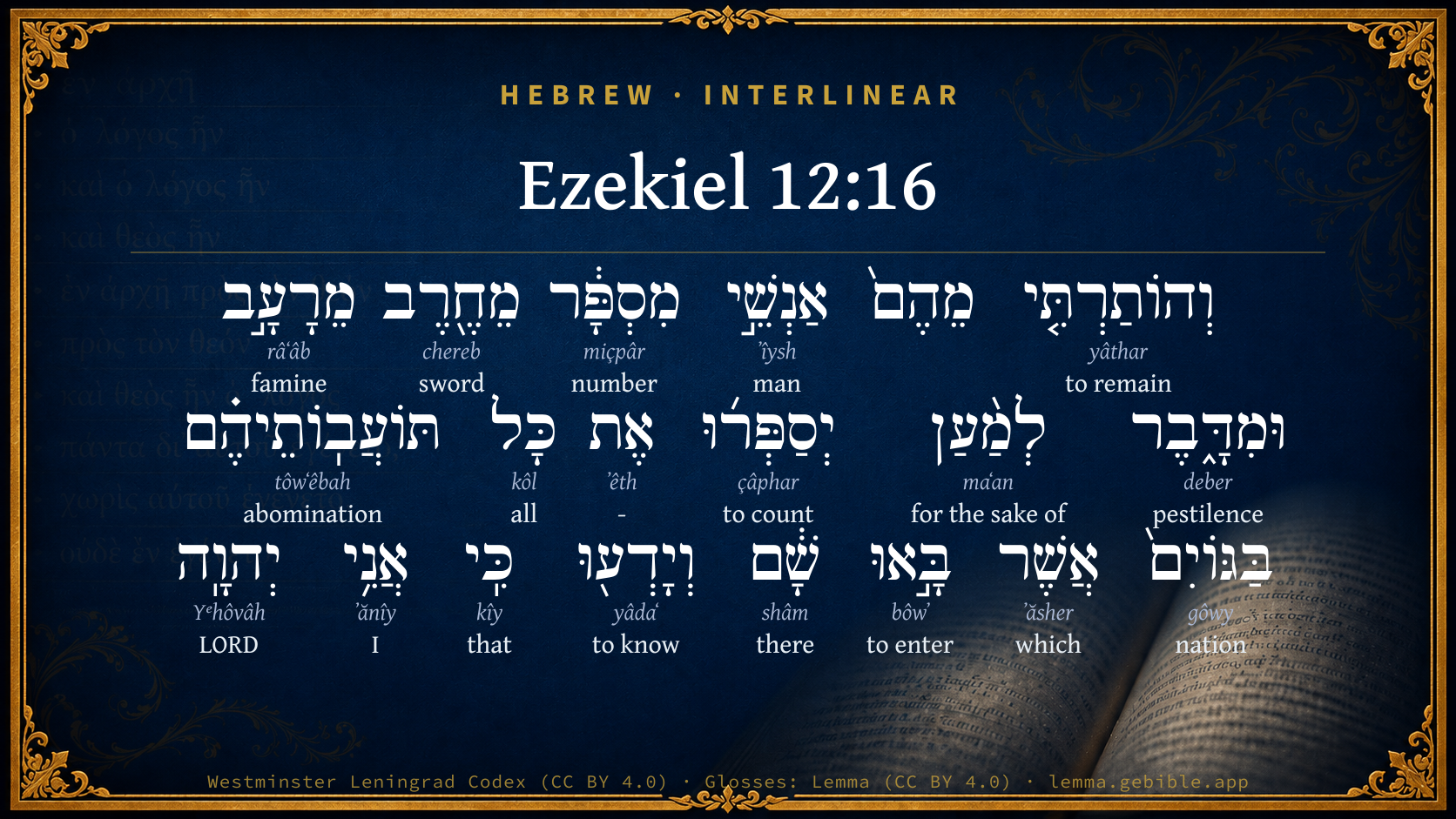
Ezekiel 12:16

Hebrew (Westminster Leningrad Codex) Ezekiel 12:16 appears in the Hebrew Old Testament. The text above is from the Westminster Leningrad Codex. Each word links to its Strong’s number, a concise gloss, and parsing drawn from the Open Scriptures Hebrew Bible morphology. Click any word for its full Brown-Driver-Briggs (BDB) entry.
Download image
Cite this verse

Ezekiel 12:16 (World English Bible). Public Domain. Lemma interlinear Bible study tool, https://lemma.gebible.app/v/ezekiel/12/16.

Show BibTeX & RIS
BibTeX
RIS
English Translation
But I will leave a few men of them from the sword, from the famine, and from the pestilence; that they may declare all their abominations among the nations where they come; and they shall know that I am Yahweh.
World English Bible · Public Domain
Download a study sheet

One document with this verse’s original text, its word-by-word gloss line, the meaning frame, cross-references with their text, attributed commentary, and full source and license credits — printable, and it pastes into notes with its structure intact.

This verse Autodidact and up

Study sheet (.html) Plain text (.txt)

A passage Seminary Student

Up to 50 verses in one chapter. A passage sheet keeps up to 6 commentary sources and 12 cross-references per verse, in the order this page ranks them, and says so on the sheet whenever that leaves anything out. Ask for a single verse and you get the Autodidact verse sheet above.

Everything on this page stays free to read, with no account — the sheet is a download of what is already on screen, not access to it.

Want to remove ads? Support Godless Engineer
Compare translations 3

The same verse in 3 English versions, stacked beneath the original-language interlinear above. Click any original word for its lexicon entry.

Each is an independent rendering of the whole verse — the interlinear is not word-aligned to these translations.

Highlighted words mark where these versions differ — a whole-verse word diff, not a word-by-word alignment.

  • World English Bible Public Domain
    But I will leave a few men of them from the sword, from the famine, and from the pestilence; that they may declare all their abominations among the nations where they come; and they shall know that I am Yahweh.
  • King James Version Public Domain
    But I will leave a few men of them from the sword, from the famine, and from the pestilence; that they may declare all their abominations among the heathen whither they come; and they shall know that I am the LORD.
  • unfoldingWord Literal Text CC BY-SA 4.0
    But I will spare a few men from among them from the sword, famine, and plague, so they may record all of their abominations in the lands where I take them, so they will know that I am Yahweh.”

unfoldingWord Literal Text — © unfoldingWord, licensed CC BY-SA 4.0. Word-aligned USFM3 via Door43 (git.door43.org/unfoldingWord/en_ult).

Versions to compare (up to 4)

3 of 4 selected

Show all 18 translations

Every available English version of this verse, each an independent rendering of the whole verse.

  • World English Bible Public Domain
    But I will leave a few men of them from the sword, from the famine, and from the pestilence; that they may declare all their abominations among the nations where they come; and they shall know that I am Yahweh.
  • Berean Standard Bible Public Domain
    But I will spare a few of them from sword and famine and plague, so that in the nations to which they go, they can recount all their abominations. Then they will know that I am the LORD.”
  • Majority Standard Bible Public Domain
    But I will spare a few of them from sword and famine and plague, so that in the nations to which they go, they can recount all their abominations. Then they will know that I am the LORD.”
  • King James Version Public Domain
    But I will leave a few men of them from the sword, from the famine, and from the pestilence; that they may declare all their abominations among the heathen whither they come; and they shall know that I am the LORD.
  • American Standard Version (1901) Public Domain
    But I will leave a few men of them from the sword, from the famine, and from the pestilence; that they may declare all their abominations among the nations whither they come; and they shall know that I am Jehovah.
  • Revised Version (1885) Public Domain
    But I will leave a few men of them from the sword, from the famine, and from the pestilence; that they may declare all their abominations among the nations whither they come; and they shall know that I am the LORD.
  • Geneva Bible (1599) Public Domain
    But I will leaue a litle nomber of them from the sworde, from the famine, and from the pestilence, that they may declare all these abominations among the heathen, where they come, and they shall knowe, that I am the Lord.
  • Douay-Rheims (1899) Public Domain
    And I will leave a few men of them from the sword, and from the famine, and from the pestilence: that they may declare all their wicked deeds among the nations whither they shall go: and they shall know that I am the Lord.
  • Young's Literal Translation Public Domain
    and I have left of them, a few in number, from the sword, from the famine, and from the pestilence, so that they recount all their abominations among the nations whither they have come, and they have known that I `am' Jehovah.'
  • Literal Standard Version CC BY-SA 4.0
    and I have left of them, a few in number, from the sword, from the famine, and from the pestilence, so that they recount all their abominations among the nations to where they have come, and they have known that I [am] YHWH.”
  • Unlocked Literal Bible CC BY-SA 4.0
    But I will spare a few men from among them from the sword, famine, and plague, so they may record all of their abominations in the lands where I take them, so they will know that I am Yahweh.”
  • unfoldingWord Literal Text CC BY-SA 4.0
    But I will spare a few men from among them from the sword, famine, and plague, so they may record all of their abominations in the lands where I take them, so they will know that I am Yahweh.”
  • Darby Bible Public Domain
    But I will leave a few men of them from the sword, from the famine, and from the pestilence; that they may declare all their abominations among the nations whither they shall come; and they shall know that I [am] Jehovah.
  • World Messianic Bible Public Domain
    But I will leave a few men of them from the sword, from the famine, and from the pestilence, that they may declare all their abominations among the nations where they come. Then they will know that I am the LORD.’”
  • Webster's Bible Public Domain
    But I will leave a few men of them from the sword, from the famine, and from the pestilence; that they may declare all their abominations among the heathen whither they come; and they shall know that I am the LORD.
  • Free Bible Version CC BY-SA 4.0
    But I will let a few of them survive war, famine, and disease so that they can tell the nations where they're exiled about all their disgusting sins. Then they will know that I am the Lord.”
  • Bible in Basic English Public Domain
    But a small number of them I will keep from the sword, from the need of food, and from disease, so that they may make clear all their disgusting ways among the nations where they come; and they will be certain that I am the Lord.
  • JPS Tanakh (1917) Public Domain
    But I will leave a few men of them from the sword, from the famine, and from the pestilence; that they may declare all their abominations among the nations whither they come; and they shall know that I am the LORD.'

Literal Standard Version (2020), Covenant Press — licensed CC BY-SA 4.0. Text via the HelloAO Bible API (eBible.org). Unlocked Literal Bible (unfoldingWord) — licensed CC BY-SA 4.0. Text via the HelloAO Bible API (eBible.org). unfoldingWord Literal Text — © unfoldingWord, licensed CC BY-SA 4.0. Word-aligned USFM3 via Door43 (git.door43.org/unfoldingWord/en_ult). Free Bible Version, Dr. Jonathan Gallagher — licensed CC BY-SA 4.0. Text via the HelloAO Bible API (eBible.org).

Word by word

More ways to search: Search by grammar → Find every occurrence → Compare this word →

Practice this passage: Drill this verse → Learn its vocabulary →

וּמִדָּ֑בֶר
deber
H1698
“and · from · pestilence”
Conjunction + Preposition + Noun, Common, Masculine, Singular, Absolute
Part of Speech
Conjunction + Preposition + Noun
Type
Common
Gender
Masculine
Number
Singular
State
Absolute
Full BDB Definition

Origin: from H1696 (in the sense of destroying)

TWOT: 399b

pestilence, plague - murrain, cattle disease, cattle-plague
  1. וְהוֹתַרְתִּ֤י yâthar H3498 “and · to remain” Conjunction + Verb, Hiphil, Sequential Perfect, 1st Person, Common, Singular
  2. אַנְשֵׁ֣י ʼîysh H376 “men of” Noun, Common, Masculine, Plural, Construct
  3. מִסְפָּ֔ר miçpâr H4557 “number” Noun, Common, Masculine, Singular, Absolute
  4. מֵחֶ֖רֶב chereb H2719 “from · sword” Preposition + Noun, Common, Feminine, Singular, Absolute
  5. מֵרָעָ֣ב râʻâb H7458 “from · famine” Preposition + Noun, Common, Masculine, Singular, Absolute
  6. לְמַ֨עַן maʻan H4616 “for the sake of” Preposition
  7. יְסַפְּר֜וּ çâphar H5608 “to count” Verb, Piel, Imperfect, 3rd Person, Masculine, Plural
  8. אֶת ʼêth H853 “-” Particle, Direct Object
  9. כָּל kôl H3605 “all of” Noun, Common, Masculine, Singular, Construct
  10. תּוֹעֲבֽוֹתֵיהֶ֗ם tôwʻêbah H8441 “abominations · their” Noun, Common, Feminine, Plural, Construct + Suffix, Personal, 3rd Person, Masculine, Plural
  11. בַּגּוֹיִם֙ gôwy H1471 “in/at the · nations” Preposition, Determined + Noun, Common, Masculine, Plural, Absolute
  12. אֲשֶׁר ʼăsher H834 “which” Particle, Relative
  13. בָּ֣אוּ bôwʼ H935 “to enter” Verb, Qal, Perfect, 3rd Person, Common, Plural
  14. שָׁ֔ם shâm H8033 “there” Adverb
  15. וְיָדְע֖וּ yâdaʻ H3045 “and · to know” Conjunction + Verb, Qal, Sequential Perfect, 3rd Person, Common, Plural
  16. כִּֽי kîy H3588 “that” Conjunction
  17. אֲנִ֥י ʼănîy H589 “I” Pronoun, Personal, 1st Person, Common, Singular
  18. יְהוָֽה Yᵉhôvâh H3068 “LORD” Noun, Proper

About this verse

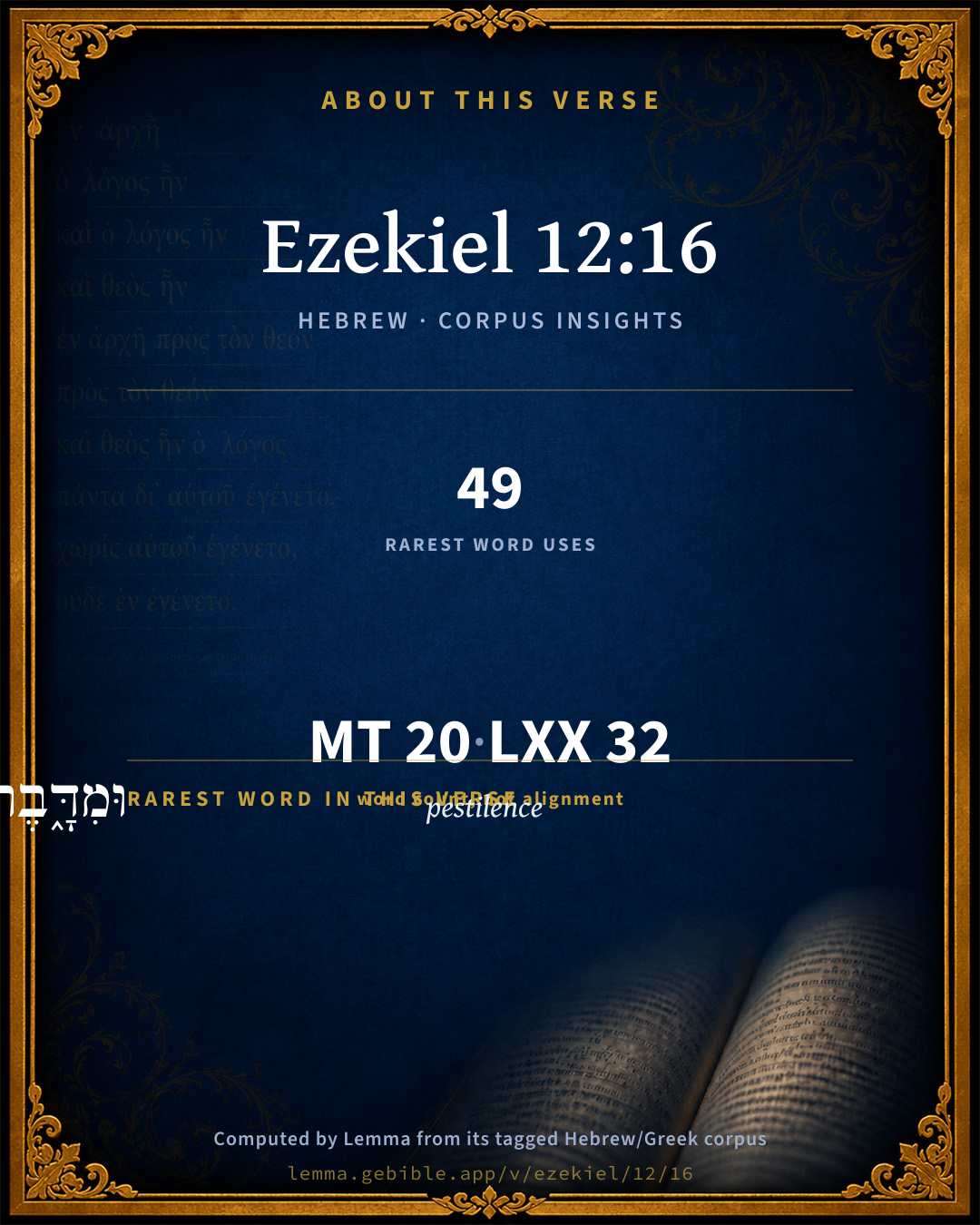
These counts appear in no published source. They are computed here, from the morphology-tagged text and Lemma’s own curated glosses. What Lemma adds →

20
words
19
distinct lemmas
Prophets
section

Shared distinctive vocabulary

וּמִדָּ֑בֶר pestilence H1698 occurs in 48 verses of the Hebrew Bible. Also found in:

Grammatical profile

  • 4 verbs
  • 9 nouns
  • 1 pronoun
  • 2 prepositions
  • 1 conjunction
  • 1 adverb
  • 2 particles

Verb forms

  • וְהוֹתַרְתִּ֤י Hiphil · Sequential Perfect
  • יְסַפְּר֜וּ Piel · Imperfect
  • בָּ֣אוּ Qal · Perfect
  • וְיָדְע֖וּ Qal · Sequential Perfect

Hebrew & Septuagint length

In English translation the verse runs 40 words from the Hebrew and 43 from the Septuagint (LXX English) — closely comparable.

A rough comparison of the two English renderings, which tokenize alike — not a word-level alignment.

Word counts can differ between the Hebrew and the Greek without any difference in meaning — e.g. the Hebrew direct-object marker אֵת has no separate Greek word, and Greek often adds the article ὁ.

In the original languages it is 20 Hebrew tokens and 32 Greek tokens — but the two are counted differently (Hebrew bundles its prefixes and suffixes into one token; the Greek is in lemma form), so that isn’t a like-for-like length.

Cross-references

22

Topical passages linked to Ezekiel 12:16 in the Treasury of Scripture Knowledge — connected by theme and wording, ordered by reader-vote popularity; previews shown in the World English Bible.

  • Jeremiah 22:8–9 Many nations shall pass by this city, and they shall say every man to his neighbor, Why has Yahweh done thus to this great city?
  • Ezekiel 6:8–10 Yet will I leave a remnant, in that you shall have some that escape the sword among the nations, when you shall be scattered through the countries.
  • Ezekiel 14:22–23 Yet, behold, therein shall be left a remnant that shall be carried forth, both sons and daughters: behold, they shall come forth to you, and you shall see their way and their doings; and you shall be comforted concerning the evil that I have brought on Jerusalem, even concerning all that I have brought on it.
  • Isaiah 1:9 Unless Yahweh of hosts had left to us a very small remnant, We would have been as Sodom; We would have been like Gomorrah.
  • Jeremiah 4:27 For thus says Yahweh, The whole land shall be a desolation; yet will I not make a full end.
  • Genesis 13:16 I will make your offspring as the dust of the earth, so that if a man can number the dust of the earth, then your seed may also be numbered.
  • Leviticus 26:40–41 "'If they confess their iniquity, and the iniquity of their fathers, in their trespass which they trespassed against me, and also that, because they walked contrary to me,
  • Deuteronomy 29:24–28 even all the nations shall say, Why has Yahweh done thus to this land? what means the heat of this great anger?
  • 1 Kings 9:6–9 But if you shall turn away from following me, you or your children, and not keep my commandments and my statutes which I have set before you, but shall go and serve other gods, and worship them;
  • Isaiah 6:13 If there are yet a tenth in it, It also shall in turn be eaten up: As a terebinth, and as an oak, whose stock remains, when they are felled; So the holy seed is its stock."
  • Isaiah 10:19 The remnant of the trees of his forest shall be few, so that a child may write them.
  • Isaiah 10:22 For though your people, Israel, be as the sand of the sea, [only] a remnant of them shall return: a destruction [is] determined, overflowing with righteousness.
  • Isaiah 24:13 For thus shall it be in the midst of the earth among the peoples, as the shaking of an olive tree, as the gleanings when the vintage is done.
  • Jeremiah 3:24–25 But the shameful thing has devoured the labor of our fathers from our youth, their flocks and their herds, their sons and their daughters.
  • Jeremiah 30:11 For I am with you, says Yahweh, to save you: for I will make a full end of all the nations where I have scattered you, but I will not make a full end of you; but I will correct you in measure, and will in no way leave you unpunished.
  • Ezekiel 36:31 Then shall you remember your evil ways, and your doings that were not good; and you shall loathe yourselves in your own sight for your iniquities and for your abominations.
  • Daniel 9:5–12 we have sinned, and have dealt perversely, and have done wickedly, and have rebelled, even turning aside from your precepts and from your ordinances;
  • Amos 9:8–9 Behold, the eyes of the Lord Yahweh are on the sinful kingdom, and I will destroy it from off the surface of the earth; except that I will not utterly destroy the house of Jacob," says Yahweh.
  • Matthew 7:14 How narrow is the gate, and restricted is the way that leads to life! Few are those who find it.
  • Matthew 24:22 Unless those days had been shortened, no flesh would have been saved. But for the sake of the chosen ones, those days will be shortened.
  • Romans 9:27 Isaiah cries concerning Israel, "If the number of the children of Israel are as the sand of the sea, It is the remnant who will be saved;
  • Romans 11:4–5 But how does God answer him? "I have reserved for myself seven thousand men, who have not bowed the knee to Baal."

Cross-references courtesy of OpenBible.info (CC BY 4.0).

Hebrew and Greek witnesses Masoretic Hebrew ↔ Greek Septuagint

The same verse in the two great witnesses to the Old Testament, shown verse-for-verse.

These are two independent witnesses, not word-aligned to each other, and the Septuagint is shown in lemma (dictionary) form.

Hebrew Ezekiel 12:16 Masoretic · Westminster Leningrad Codex

וְהוֹתַרְתִּ֤י מֵהֶם֙ אַנְשֵׁ֣י מִסְפָּ֔ר מֵחֶ֖רֶב מֵרָעָ֣ב וּמִדָּ֑בֶר לְמַ֨עַן יְסַפְּר֜וּ אֶת כָּל תּוֹעֲבֽוֹתֵיהֶ֗ם בַּגּוֹיִם֙ אֲשֶׁר בָּ֣אוּ שָׁ֔ם וְיָדְע֖וּ כִּֽי אֲנִ֥י יְהוָֽה

But I will leave a few men of them from the sword, from the famine, and from the pestilence; that they may declare all their abominations among the nations where they come; and they shall know that I am Yahweh.

World English Bible · Public Domain

Greek LXX Ezekiel 12:16 Septuagint · lemma form

καί ὑπολείπω ἐκ αὐτός ἀνήρ ἀριθμός ἐκ ῥομφαία καί ἐκ λιμός καί ἐκ θάνατος ὅπως ἐκ διαἡγέομαι πᾶς ὁ ἀνομία αὐτός ἐν ὁ ἔθνος ὅς εἰςἔρχομαι ἐκεῖ καί γιγνώσκω ὅτι ἐγώ κύριος

And I will leave of them a few men in number spared from the sword, and from famine, and pestilence; that they may declare all their iniquities among the nations whither they have gone; and they shall know that I am the Lord.

LXX2012 (modern English Septuagint) · Public Domain

On this verse, John Gill's Exposition discusses the Septuagint’s reading. Read the note in Commentary ↓

Hebrew: Westminster Leningrad Codex (CC BY 4.0). Greek: Septuagint (public domain); English from LXX2012 (modern English Septuagint) (Public Domain). How the Septuagint differs from the Hebrew →

Targum (Aramaic paraphrase)

1

The Targum is the ancient Jewish Aramaic paraphrase of the Hebrew Scriptures — an interpretive translation, not the Hebrew text itself. Onkelos (literal) and Pseudo-Jonathan (expansive) render the Torah, and Jonathan the Prophets. Coverage is partial: where no permissively-licensed English translation exists for a verse, only the Aramaic is shown. This is verse-level text, not a word-by-word alignment to the Hebrew.

  1. Targum Jonathan Prophets (Joshua–Malachi)
    וְאַשְׁאַר מִנְהוֹן גַבְרִין דְמִנְיַן מֵחַרְבָּא מִכַּפְנָא וּמִמוֹתָא בְּדִיל דְיִשְׁתָּעוּן יַת כָּל תּוֹעֲבָתְהוֹן בְּעַמְמַיָא דְאִתְגְלִיאוּ לְתַמָן וְיֵדְעוּן אֲרֵי אֲנָא יְיָ:

    (no public-domain English translation for this verse)

    Targum Jonathan — Aramaic: “Mikraot Gedolot” (public domain). English: “Sefaria Community Translation” (CC0 1.0 (public-domain dedication)); “London "Chaldee Paraphrase," 1871” (public domain). Text via Sefaria.

Commentary

Notes on Ezekiel 12:16 from classic Christian and Jewish commentators (each source and its license shown beneath its notes). The classic Christian expositions comment on the surrounding passage and are grouped to its opening verse, so a note may address several verses; the Jewish commentaries on the Tanakh (Rashi and others) are per-verse, so they appear only where the commentator wrote on this verse.

Lemma curates 59 commentaries, every one of them public domain or Creative Commons licensed, each selected and text-cleaned for this edition rather than reprinted as found. About our sources →

Trapp's Complete Commentary

John Trapp

Eze 12:16 But I will leave a few men of them from the sword, from the famine, and from the pestilence; that they may declare all their abominations among the heathen whither they come; and they shall know that I [am] the LORD.

Ver. 16. But I will leave a few men.] Heb., Men of number, a company scarce considerable in comparison of the many.

That they may declare all their abominations.] Give glory to God, take shame to themselves, and thereby do much good to those heathens hardened before by their evil behaviour. Vere magnus est Deus Christianorum, Truly, great is the God of the Christians, said one Calocerius, a heathen.

John Trapp, A Commentary or Exposition upon All the Books of the Old and New Testament (1647–1656) — public domain. Text from a community e-Sword module.

Tyndale Open Study Notes

Tyndale Open Resources

12:16 The unhappy few survivors would confess all their detestable sins to their captors, not necessarily in repentance, but in recognition that the Lord had acted justly in judgment against them.

Tyndale Open Study Notes — © Tyndale Open Resources, licensed CC BY-SA 4.0. Text via the HelloAO Bible API.

Geneva Bible (1599)

Geneva Bible translators

Which should bear his Name, and should be his Church, read Ezek. 11:16.

Geneva Bible (1599) marginal notes — public domain. Text via Bolls.life.

Jamieson, Fausset & Brown

Robert Jamieson, A. R. Fausset & David Brown

I will leave a few . . . that they may declare . . . abominations--God's purpose in scattering a remnant of Jews among the Gentiles; namely, not only that they themselves should be weaned from idolatry (see Eze 12:15), but that by their own word, as also by their whole state as exiles, they should make God's righteousness manifest among the Gentiles, as vindicated in their punishment for their sins (compare Isa 43:10; Zac 8:13).

Jamieson, Fausset & Brown — Commentary Critical and Explanatory on the Whole Bible (1871) — public domain (CC PDM 1.0). Text via the HelloAO Bible API.

John Calvin's Commentaries

Some think that God here speaks of the faithful, whom he had determined to preserve in the very midst of death. And certainly there is some mitigation of his former vengeance. But it is not in harmony with the rest to understand the faithful here, for he is speaking of the people in general. But as we have already seen that the slaughter of the city was such that God scattered the remnant to the four winds, and this the Prophet confirms. We must hold, then, first of all, that this promise was not directed peculiarly to the elect or to God’s Church, but rather that God is showing that exile will not be the end of woes to the captives, although they will not be directly cut to pieces. Their condition, indeed, might seem preferable, but God pronounces that he would be inexorable towards them. Although all should not perish by the sword, or famine, or pestilence, and some remnant should be left, that will happen, says he, not because I am going to be reconciled to them, but that I may spread their crimes among the Gentiles. For when he says, that they may narrate, he does not mean that they would be witnesses to their own sins, as the pious are accustomed, as we shall see elsewhere, to extol the mercy of God, and candidly to confess their faults before men. He does not mean that kind of confession which is a sign of repentance, but rather a real speech. For that exile uttered with a loud voice, that those men were abandoned whom God treated with such hostility. He had chosen the people, was the guardian of the city, and would have been their perpetual preserver, if their perverseness had not prevented it. Hence their being destitute of his aid, their being deprived of all their goods, their being treated tyrannically by their enemies, this made their extreme wickedness clearly appear. They narrated, then, not by words but by their actual position, their own sins to the Gentiles.

Now, therefore, we understand the intention of God: although some remained alive and unconcerned by either the sword, or famine, or pestilence, yet they were cursed, since their expulsion to a distance served no other purpose than that of spreading their disgrace and rendering them detestable, so flint the profane Gentiles acknowledged that they deserved vengeance for their wickedness. Therefore they shall narrate among the Gentiles all their abominations, and they shall know that I am Jehovah. Again he repeats that sentiment, that they should know too late what they had despised: since God had acted towards them as a father, and they had not acknowledged his favor; and at length they should be compelled to feel him as their judge, even to their eternal destruction.

John Calvin's Commentaries (1540-1563) — public domain. Text from the Calvin Translation Society English edition (1840s-50s) via the Christian Classics Ethereal Library (ccel.org). Calvin's coverage is partial (roughly two-thirds of the Bible); uncommented books and verses are honest gaps, never fabricated. The 19th-century editor's footnotes and remarks are omitted so the notes are faithfully Calvin's own voice.

Ellicott's Commentary for English Readers

(16) May declare all their abominations.—This they were to do, that the false impression that God was unable to protect His people might be removed from the minds of the heathen, and the truth that He was punishing them for their sins be made known. They should do it both by word of mouth (as in Jer_22:8-9), and also by their conduct (as in Eze_14:22-23). The word “few” is literally, as shown in the margin, men of number, i.e., men who can easily be numbered or counted; and in the very similar expression in the original for “declare,” there is a play upon the word, something like our “count” and “recount.”

They shall know, may grammatically refer either to the heathen, or to the Israelites in their dispersion; but the latter is so constantly the refrain of these prophecies (see Eze_12:20, e.g.), that it is also to be understood here.

A Bible Commentary for English Readers, edited by Charles John Ellicott (1878–1897) — public domain. Text from a community e-Sword module.

John Gill's Exposition

And say unto the people of the land,.... Of Chaldea, where the prophet now was; not the natives of the land, but the Israelites, who were captives in it; who were ready to murmur and repine at their own case, as miserable; and at that of the Jews at Jerusalem, as happy; and therefore they are taught by this sign, as well as by the following prophecy, that they were mistaken:

thus saith the Lord God of the inhabitants of Jerusalem; or to them, or "concerning" them (y); whom the captives in Chaldea thought lived so happily, and would continue so:

and of the land of Israel; or, "upon the land of Israel" (z); inhabitants on it; to this sense the Targum and Septuagint Version interpret it, and also Kimchi:

they shall eat their bread with carefulness, and drink their water with astonishment; meaning at the siege of Jerusalem, when they could not eat and drink in peace; but, while they were eating and drinking, were disturbed and put into fear and surprise by the besiegers; and also, hearing that their provisions would not hold out, were careful how they ate and drank, and were frightened with the thoughts of being reduced to extreme want:

that her land may be desolate from all that is therein; or, "from its fulness" (a); men and cattle, cities, towns, houses, vineyards, fields, fruits, and plenty of all good things. Jarchi expounds it of riches:

because of the violence of all them that dwell therein; not the violence of the Chaldeans, making a prey of all they met with, plundering cities and towns, and making forage of the fruits of the earth, by which means the land was desolate; but the rapine, oppression, and injustice of the Jews, which were the cause of all these calamities which came upon their country.

(y) "habitatoribus Hierosolymorum", Montanus, Starckius; "de habitatoribus", Piscator; "de habitantibus Hierosolymam", Cocceius. (z) , Sept. "super terram Israel", Calvin; "in terram Israelis", Junius & Tremellius, Polanus; so Ben Melech. (a) "a plenitudine sua", Pagninus, Montanus, Cocceius, Starckius.

John Gill's Exposition of the Whole Bible (1746–1763) — public domain (CC PDM 1.0). Text via the HelloAO Bible API.

Albert Barnes' Notes on the Bible

Few - literally, as in the margin; so few, that they can easily be counted Isa 10:19. The few who should escape destruction should make known to all among whom they should dwell how great had been the wickedness of the people, how just their punishment.

Albert Barnes' Notes on the Bible (1834–1885) — public domain. Text from a community e-Sword/MySword module.

Matthew Poole's English Annotations

But I will restrain the rage of the Chaldeans, and move them to some compassion towards some of the Jews, so that some, yet but few, shall remain; the sword shall not slay them, for 1 commission it, and it will not exceed its commission. I send the famine, but some I will feed; and the pestilence is my arrow, and hits but where I direct it.

A few men; including the women also.

That they may declare; either by relating those sins which were committed among them in Jerusalem, for which God was justly angry, and for which he punished them, though they were his own people. Or else, that though they should be silent, yet the very thing should speak itself, and their miseries should proclaim the wickednesses they had acted against God in their own land. Or, by their wicked practices which in captivity, and under the eye of the heathen, they commit, they will manifestly show to the heathen that God was just in all his severity.

They shall know; either the Jews, or rather here the Chaldean heathens.

Matthew Poole's English Annotations on the Holy Bible (1683–1685) — public domain. Text from a community e-Sword/MySword module.

Whedon's Commentary on the Bible

Daniel D. Whedon

16. I will leave a few — This is the “remnant” which represents the true Israel, and which shall show to the heathen the beauty of monotheism as compared with the “abominations” of idolatry and thus carry even into Chaldea the recognition of the true God (Eze_6:8-10; Eze_14:22-23; Eze_20:9, etc.).

Daniel D. Whedon (gen. ed.), Commentary on the Old and New Testaments (1874–1909) — public domain. Text from a community e-Sword module.

John Wesley's Explanatory Notes

Declare - By relating those sins, for which God was justly angry, and for which he punished them, though they were his own people. Thy - The Chaldeans. See how God brings good out of evil! The dispersion of sinners, who had done God much dishonour and disservice in their own country, proves the dispersion of penitents, who shall do him much honour and service in other countries!

John Wesley, Explanatory Notes Upon the Whole Bible (1754–1765) — public domain. Text via the GEBible commentary corpus.

Rashi

Rabbi Shlomo Yitzchaki (Rashi)

so that they will tell of all their abominations and they will say, “Because of our sins, we have suffered, since such-and-such things we did,” and I shall make known that I had not annihilated you for nothing.

Rashi on the Tanakh — English translations: “The Judaica Press complete Tanach with Rashi, translated by A. J. Rosenberg” (CC BY 4.0); “Pentateuch with Rashi's commentary by M. Rosenbaum and A.M. Silbermann, 1929-1934” (public domain); “The Metsudah Tanach series, Lakewood, N.J” (CC BY 4.0); and “The Book of Joshua, Metsudah Publications, 1997” (CC BY 4.0). Text via Sefaria.

Lesson kit

Teaching starters — assembled from the data on this page, not authored interpretation. Every prompt links to the verse data it draws on. Edit before teaching.

Ezekiel, in the Prophets, opens this verse with 20 words (19 distinct Hebrew lemmas). Its most distinctive word is deber (“pestilence”). A historical commentator’s framing appears above. Read the whole chapter for the surrounding context.

Discussion questions

  1. The word deber carries the sense “pestilence.” How does it shape the verse?
  2. How does Exodus 5:3, which shares the word «pestilence», read alongside this verse?
  3. These translations render this verse differently. What is at stake in choosing one wording over another?
  4. «וְהוֹתַרְתִּ֤י» is a Hiphil Sequential Perfect verb. How does that grammatical form shape the action described?
  5. Compare how Trapp's Complete Commentary and Tyndale Open Study Notes read this verse. Where do they agree or differ?

Things to notice

Reading settings

Reading text

Shown beneath each verse's original-language words.

Old Testament
Old Testament edition

Read the OT as the Masoretic Hebrew (MT) or the Greek Septuagint (LXX).

English shown for the Greek Septuagint (in the Hebrew ↔ Greek comparison).

Comparing translations? Open the Compare panel on any verse page to stack up to four side by side.