
Genesis 20:3

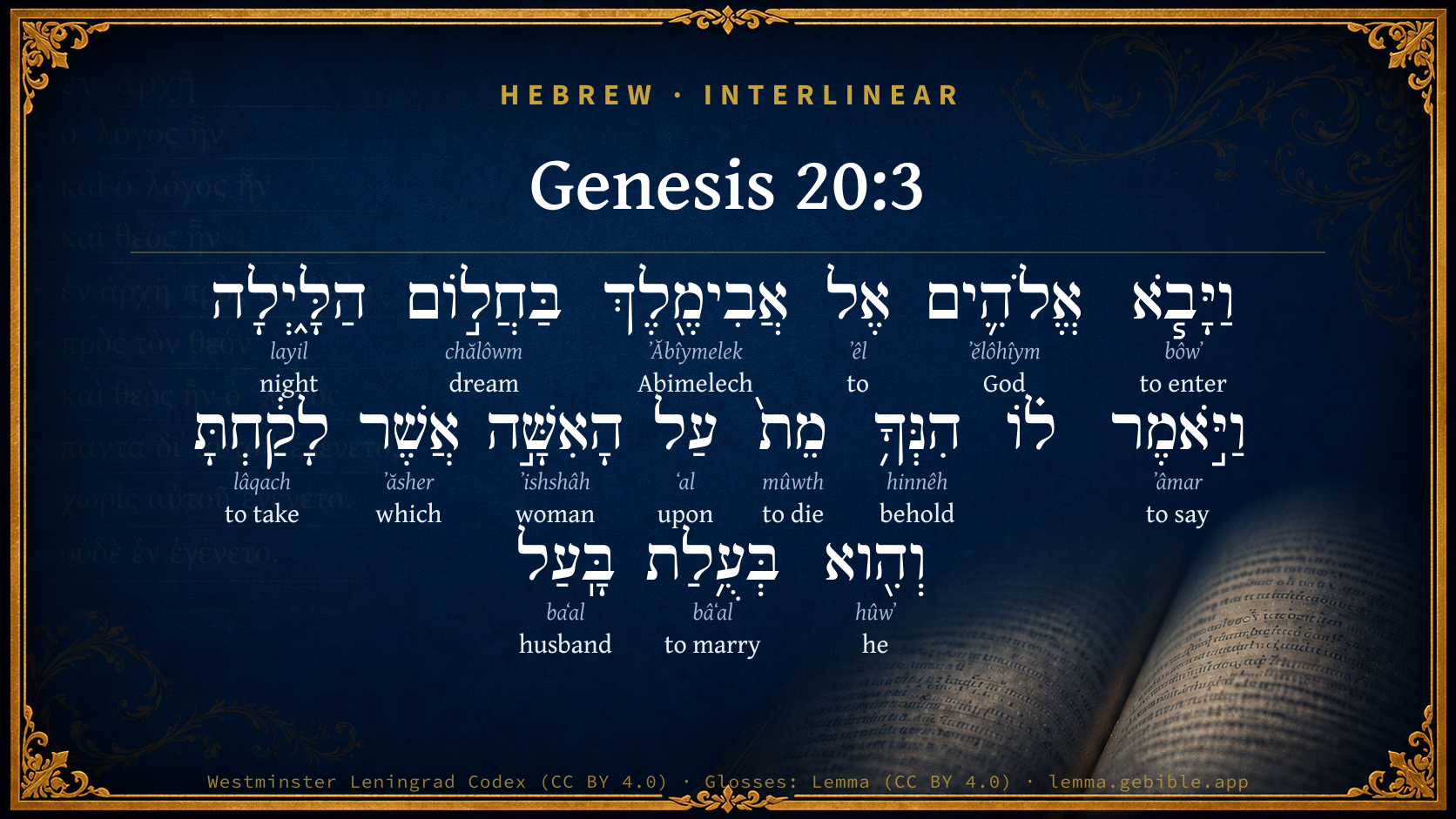
Hebrew (Westminster Leningrad Codex) Genesis 20:3 appears in the Hebrew Old Testament. The text above is from the Westminster Leningrad Codex. Each word links to its Strong’s number, a concise gloss, and parsing drawn from the Open Scriptures Hebrew Bible morphology. Click any word for its full Brown-Driver-Briggs (BDB) entry.
Download image
Cite this verse

Genesis 20:3 (World English Bible). Public Domain. Lemma interlinear Bible study tool, https://lemma.gebible.app/v/genesis/20/3.

Show BibTeX & RIS
BibTeX
RIS
English Translation
But God came to Abimelech in a dream of the night, and said to him, "Behold, you are a dead man, because of the woman whom you have taken. For she is a man's wife."
World English Bible · Public Domain
Highlights
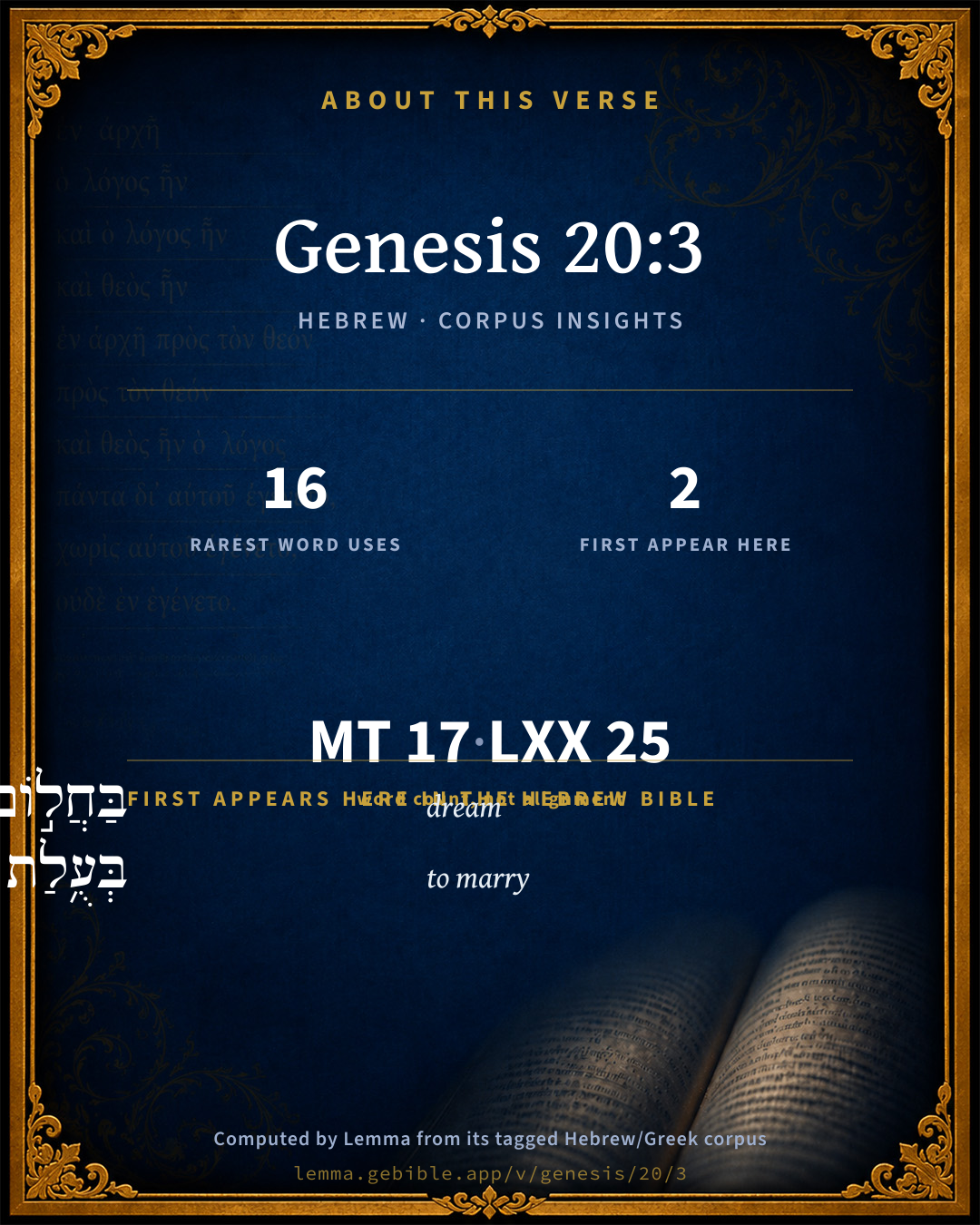
  • 2 first appearances in the Hebrew Bible
Full analysis ↓
Download a study sheet

One document with this verse’s original text, its word-by-word gloss line, the meaning frame, cross-references with their text, attributed commentary, and full source and license credits — printable, and it pastes into notes with its structure intact.

This verse Autodidact and up

Study sheet (.html) Plain text (.txt)

A passage Seminary Student

Up to 50 verses in one chapter. A passage sheet keeps up to 6 commentary sources and 12 cross-references per verse, in the order this page ranks them, and says so on the sheet whenever that leaves anything out. Ask for a single verse and you get the Autodidact verse sheet above.

Everything on this page stays free to read, with no account — the sheet is a download of what is already on screen, not access to it.

Want to remove ads? Support Godless Engineer
Compare translations 3

The same verse in 3 English versions, stacked beneath the original-language interlinear above. Click any original word for its lexicon entry.

Each is an independent rendering of the whole verse — the interlinear is not word-aligned to these translations.

Highlighted words mark where these versions differ — a whole-verse word diff, not a word-by-word alignment.

  • World English Bible Public Domain
    But God came to Abimelech in a dream of the night, and said to him, "Behold, you are a dead man, because of the woman whom you have taken. For she is a man's wife."
  • King James Version Public Domain
    But God came to Abimelech in a dream by night, and said to him, Behold, thou art but a dead man, for the woman which thou hast taken; for she is a man's wife.
  • unfoldingWord Literal Text CC BY-SA 4.0
    But God came to Abimelech in a dream the night and said to him, “Behold, you are dead because of the woman whom you have taken, because she is married to a husband!”

unfoldingWord Literal Text — © unfoldingWord, licensed CC BY-SA 4.0. Word-aligned USFM3 via Door43 (git.door43.org/unfoldingWord/en_ult).

Versions to compare (up to 4)

3 of 4 selected

Show all 18 translations

Every available English version of this verse, each an independent rendering of the whole verse.

  • World English Bible Public Domain
    But God came to Abimelech in a dream of the night, and said to him, "Behold, you are a dead man, because of the woman whom you have taken. For she is a man's wife."
  • Berean Standard Bible Public Domain
    One night, however, God came to Abimelech in a dream and told him, “You are as good as dead because of the woman you have taken, for she is a married woman.”
  • Majority Standard Bible Public Domain
    One night, however, God came to Abimelech in a dream and told him, “You are as good as dead because of the woman you have taken, for she is a married woman.”
  • King James Version Public Domain
    But God came to Abimelech in a dream by night, and said to him, Behold, thou art but a dead man, for the woman which thou hast taken; for she is a man's wife.
  • American Standard Version (1901) Public Domain
    But God came to Abimelech in a dream of the night, and said to him, Behold, thou art but a dead man, because of the woman whom thou hast taken. For she is a man's wife.
  • Revised Version (1885) Public Domain
    But God came to Abimelech in a dream of the night, and said to him, Behold, thou art but a dead man, because of the woman which thou hast taken; for she is a man’s wife.
  • Geneva Bible (1599) Public Domain
    But God came to Abimelech in a dreame by night, and said to him, Beholde, thou art but dead, because of the woman, which thou hast taken: for she is a mans wife.
  • Douay-Rheims (1899) Public Domain
    And God came to Abimelech in a dream by night, and he said to him: Lo thou shalt die for the woman thou hast taken: for she hath a husband.
  • Young's Literal Translation Public Domain
    And God cometh in unto Abimelech in a dream of the night, and saith to him, `Lo, thou `art' a dead man, because of the woman whom thou hast taken -- and she married to a husband.'
  • Literal Standard Version CC BY-SA 4.0
    And God comes to Abimelech in a dream of the night and says to him, “Behold, you [are] a dead man, because of the woman whom you have taken—and she married to a husband.”
  • Unlocked Literal Bible CC BY-SA 4.0
    But God came to Abimelech in a dream in the night, and said to him, “Behold, you are a dead man because of the woman whom you have taken, for she is a man's wife.”
  • unfoldingWord Literal Text CC BY-SA 4.0
    But God came to Abimelech in a dream the night and said to him, “Behold, you are dead because of the woman whom you have taken, because she is married to a husband!”
  • Darby Bible Public Domain
    But God came to Abimelech in a dream by night, and said to him, Behold, thou art [but] a dead man, because of the woman that thou hast taken; for she is a man's wife.
  • World Messianic Bible Public Domain
    But God came to Abimelech in a dream of the night, and said to him, “Behold, you are a dead man, because of the woman whom you have taken; for she is a man’s wife.”
  • Webster's Bible Public Domain
    But God came to Abimelech in a dream by night, and said to him, Behold, thou art but a dead man, on account of the woman whom thou hast taken: for she is a man's wife.
  • Free Bible Version CC BY-SA 4.0
    But God appeared to Abimelech in a dream and told him, “Listen! You're going to die because the woman you've taken is already married—she has a husband.”
  • Bible in Basic English Public Domain
    But God came to Abimelech in a dream in the night, and said to him, Truly you are a dead man because of the woman whom you have taken; for she is a man's wife.
  • JPS Tanakh (1917) Public Domain
    But God came to Abimelech in a dream of the night, and said to him: 'Behold, thou shalt die, because of the woman whom thou hast taken; for she is a man's wife.'

Literal Standard Version (2020), Covenant Press — licensed CC BY-SA 4.0. Text via the HelloAO Bible API (eBible.org). Unlocked Literal Bible (unfoldingWord) — licensed CC BY-SA 4.0. Text via the HelloAO Bible API (eBible.org). unfoldingWord Literal Text — © unfoldingWord, licensed CC BY-SA 4.0. Word-aligned USFM3 via Door43 (git.door43.org/unfoldingWord/en_ult). Free Bible Version, Dr. Jonathan Gallagher — licensed CC BY-SA 4.0. Text via the HelloAO Bible API (eBible.org).

Word by word

More ways to search: Search by grammar → Find every occurrence → Compare this word →

Practice this passage: Drill this verse → Learn its vocabulary →

בְּעֻ֥לַת
bâʻal
H1166
“married”
Verb, Qal, Participle Passive, Feminine, Singular, Construct
Part of Speech
Verb
Stem
Qal
Form
Participle Passive
Gender
Feminine
Number
Singular
State
Construct
Full BDB Definition

Origin: a primitive root

TWOT: 262

to marry, rule over, possess, own - (Qal) - to marry, be lord (husband) over - to rule over - (Niphal) to be married
  1. וַיָּבֹ֧א bôwʼ H935 “and · to enter” Conjunction + Verb, Qal, Sequential Imperfect, 3rd Person, Masculine, Singular
  2. אֱלֹהִ֛ים ʼĕlôhîym H430 “God(s)” Noun, Common, Masculine, Plural, Absolute
  3. אֶל ʼêl H413 “to” Preposition
  4. אֲבִימֶ֖לֶךְ ʼĂbîymelek H40 “Abimelech” Noun, Proper
  5. בַּחֲל֣וֹם chălôwm H2472 “in/at · dream” Preposition + Noun, Common, Masculine, Singular, Absolute
  6. הַלָּ֑יְלָה layil H3915 “the · night” Particle, Definite Article + Noun, Common, Masculine, Singular, Absolute
  7. וַיֹּ֣אמֶר ʼâmar H559 “and · to say” Conjunction + Verb, Qal, Sequential Imperfect, 3rd Person, Masculine, Singular
  8. הִנְּךָ֥ hinnêh H2009 “behold · you” Particle, Demonstrative + Suffix, Personal, 2nd Person, Masculine, Singular
  9. מֵת֙ mûwth H4191 “dying” Verb, Qal, Participle Active, Masculine, Singular, Absolute
  10. עַל ʻal H5921 “upon” Preposition
  11. הָאִשָּׁ֣ה ʼishshâh H802 “the · woman” Particle, Definite Article + Noun, Common, Feminine, Singular, Absolute
  12. אֲשֶׁר ʼăsher H834 “which” Particle, Relative
  13. לָקַ֔חְתָּ lâqach H3947 “to take” Verb, Qal, Perfect, 2nd Person, Masculine, Singular
  14. וְהִ֖וא hûwʼ H1931 “and · he” Conjunction + Pronoun, Personal, 3rd Person, Feminine, Singular
  15. בָּֽעַל baʻal H1167 “husband” Noun, Common, Masculine, Singular, Absolute

About this verse

These counts appear in no published source. They are computed here, from the morphology-tagged text and Lemma’s own curated glosses. What Lemma adds →

17
words
16
distinct lemmas
Pentateuch
section

Notable vocabulary

The rarest word here is בְּעֻ֥לַת to marry H1166 — appearing just 16 times in the whole Hebrew Bible.

First appearance in Scripture

These words make their first canonical appearance in the Hebrew Bible here:

  • בַּחֲל֣וֹם dream H2472
  • בְּעֻ֥לַת to marry H1166

Shared distinctive vocabulary

בְּעֻ֥לַת to marry H1166 occurs in 14 verses of the Hebrew Bible. Also found in:

Grammatical profile

  • 5 verbs
  • 6 nouns
  • 1 pronoun
  • 3 prepositions
  • 2 particles

Verb forms

  • וַיָּבֹ֧א Qal · Sequential Imperfect
  • וַיֹּ֣אמֶר Qal · Sequential Imperfect
  • מֵת֙ Qal · Participle Active
  • לָקַ֔חְתָּ Qal · Perfect
  • בְּעֻ֥לַת Qal · Participle Passive

Hebrew & Septuagint length

In English translation the verse runs 35 words from the Hebrew and 28 from the Septuagint (LXX English) — closely comparable.

A rough comparison of the two English renderings, which tokenize alike — not a word-level alignment.

Word counts can differ between the Hebrew and the Greek without any difference in meaning — e.g. the Hebrew direct-object marker אֵת has no separate Greek word, and Greek often adds the article ὁ.

In the original languages it is 17 Hebrew tokens and 25 Greek tokens — but the two are counted differently (Hebrew bundles its prefixes and suffixes into one token; the Greek is in lemma form), so that isn’t a like-for-like length.

Cross-references

15

Topical passages linked to Genesis 20:3 in the Treasury of Scripture Knowledge — connected by theme and wording, ordered by reader-vote popularity; previews shown in the World English Bible.

  • Genesis 20:7 Now therefore, restore the man's wife. For he is a prophet, and he will pray for you, and you will live. If you don't restore her, know for sure that you will die, you, and all who are yours."
  • Matthew 27:19 While he was sitting on the judgment seat, his wife sent to him, saying, "Have nothing to do with that righteous man, for I have suffered many things this day in a dream because of him."
  • Job 33:15 In a dream, in a vision of the night, When deep sleep falls on men, In slumbering on the bed;
  • Psalms 105:14 He allowed no one to do them wrong. Yes, he reproved kings for their sakes,
  • Genesis 28:12 He dreamed. Behold, a stairway set up on the earth, and the top of it reached to heaven. Behold, the angels of God ascending and descending on it.
  • Matthew 1:20 But when he thought about these things, behold, an angel of the Lord appeared to him in a dream, saying, "Joseph, son of David, don't be afraid to take to yourself Mary, your wife, for that which is conceived in her is of the Holy Spirit.
  • Genesis 31:24 God came to Laban, the Syrian, in a dream of the night, and said to him, "Take heed to yourself that you don't speak to Jacob either good or bad."
  • Genesis 37:5 Joseph dreamed a dream, and he told it to his brothers, and they hated him all the more.
  • Genesis 37:9 He dreamed yet another dream, and told it to his brothers, and said, "Behold, I have dreamed yet another dream: and behold, the sun and the moon and eleven stars bowed down to me."
  • Genesis 40:8 They said to him, "We have dreamed a dream, and there is no one who can interpret it." Joseph said to them, "Don't interpretations belong to God? Please tell it to me."
  • Job 4:12–13 "Now a thing was secretly brought to me, My ear received a whisper of it.
  • Jonah 3:4 Jonah began to enter into the city a day's journey, and he cried out, and said, "Yet forty days, and Nineveh shall be overthrown!"
  • Matthew 2:12–13 Being warned in a dream that they shouldn't return to Herod, they went back to their own country another way.
  • Ezekiel 33:14–15 Again, when I say to the wicked, You shall surely die; if he turn from his sin, and do that which is lawful and right;
  • Genesis 41:1–36 It happened at the end of two full years, that Pharaoh dreamed: and, behold, he stood by the river.

Cross-references courtesy of OpenBible.info (CC BY 4.0).

Hebrew and Greek witnesses Masoretic Hebrew ↔ Greek Septuagint

The same verse in the two great witnesses to the Old Testament, shown verse-for-verse.

These are two independent witnesses, not word-aligned to each other, and the Septuagint is shown in lemma (dictionary) form.

Hebrew Genesis 20:3 Masoretic · Westminster Leningrad Codex

וַיָּבֹ֧א אֱלֹהִ֛ים אֶל אֲבִימֶ֖לֶךְ בַּחֲל֣וֹם הַלָּ֑יְלָה וַיֹּ֣אמֶר ל֗וֹ הִנְּךָ֥ מֵת֙ עַל הָאִשָּׁ֣ה אֲשֶׁר לָקַ֔חְתָּ וְהִ֖וא בְּעֻ֥לַת בָּֽעַל

But God came to Abimelech in a dream of the night, and said to him, "Behold, you are a dead man, because of the woman whom you have taken. For she is a man's wife."

World English Bible · Public Domain

Greek LXX Genesis 20:3 Septuagint · lemma form

καί εἰςἔρχομαι ὁ θεός πρός αβιμελεχ ἐν ὕπνος ὁ νύξ καί εἶπον ἰδού σύ ἀποθνήσκω περί ὁ γυνή ὅς λαμβάνω οὗτος δέ εἰμί συνοἰκέω ἀνήρ

And God came to Abimelech by night in sleep, and said, Behold, you die for the woman, whom you have taken, whereas she has lived with a husband.

LXX2012 (modern English Septuagint) · Public Domain

On this verse, The Pulpit Commentary discusses the Septuagint’s reading. Read the note in Commentary ↓

Hebrew: Westminster Leningrad Codex (CC BY 4.0). Greek: Septuagint (public domain); English from LXX2012 (modern English Septuagint) (Public Domain). How the Septuagint differs from the Hebrew →

Targum (Aramaic paraphrase)

2

The Targum is the ancient Jewish Aramaic paraphrase of the Hebrew Scriptures — an interpretive translation, not the Hebrew text itself. Onkelos (literal) and Pseudo-Jonathan (expansive) render the Torah, and Jonathan the Prophets. Coverage is partial: where no permissively-licensed English translation exists for a verse, only the Aramaic is shown. This is verse-level text, not a word-by-word alignment to the Hebrew.

  1. Targum Onkelos Torah (Genesis–Deuteronomy)
    וַאֲתָא מֵימַר מִן קָדָם יְיָ לְוַת אֲבִימֶלֶךְ בְּחֶלְמָא דְלֵילְיָא וַאֲמַר לֵהּ הָא אַתְּ מִית עַל עֵיסַק אִתְּתָא דִּדְבַרְתָּא וְהִיא אִתַּת גְּבָר

    (no public-domain English translation for this verse)

    Targum Onkelos — Aramaic: “Onkelos Genesis” (public domain); “Onkelos Exodus” (public domain); “Onkelos Leviticus” (public domain); “Onkelos Numbers” (public domain); “Onkelos Deuteronomy” (public domain). English: “Sefaria Community Translation” (CC0 1.0 (public-domain dedication)); “J.W. Etheridge. The Targums of Onkelos and Jonathan Ben Uzziel on the Pentateuch. London: Longmans, Green, 1862” (public domain). Text via Sefaria.

  2. Targum Pseudo-Jonathan Torah (Genesis–Deuteronomy)
    וְאָתָא מֵימַר מִן קֳדָם יְיָ לְוַת אֲבִימֶלֶךְ בְּחֶלְמָא דְלֵילְיָא וַאֲמַר לֵיהּ הָא אַנְתְּ מַיִית עַל עֵיסַק אִנְתְּתָא דְאַנַסְתְּ וְהִיא מְבַעֲלָא לִגְבַר

    And a word came from before the Lord unto Abimelek, in a dream of the night, and said to him, Behold, thou diest, because of the woman whom thou hast carried away, and she a man's wife.

    Targum Pseudo-Jonathan — Aramaic: “Targum Jonathan on Genesis” (public domain); “Targum Jonathan on Exodus” (public domain); “Targum Jonathan on Leviticus” (public domain); “Targum Jonathan on Numbers” (public domain); “Targum Jonathan on Deuteronomy” (public domain). English: “The Targum of Jonathan ben Uzziel, trans. J. W. Etheridge, London, 1862” (public domain). Text via Sefaria.

Commentary

Notes on Genesis 20:3 from classic Christian and Jewish commentators (each source and its license shown beneath its notes). The classic Christian expositions comment on the surrounding passage and are grouped to its opening verse, so a note may address several verses; the Jewish commentaries on the Tanakh (Rashi and others) are per-verse, so they appear only where the commentator wrote on this verse.

Lemma curates 59 commentaries, every one of them public domain or Creative Commons licensed, each selected and text-cleaned for this edition rather than reprinted as found. About our sources →

Matthew Henry's Commentary

It appears by this that God revealed himself by dreams (which evidenced themselves to be divine and supernatural) not only to his servants the prophets, but even to those who were out of the pale of the church and covenant; but then, usually, it was with some regard to God's own people as in Pharaoh's dream, to Joseph, in Nebuchadnezzar's, to Daniel, and here, in Abimelech's, to Abraham and Sarah, for he reproved this king for their sake, Psa 105:14, Psa 105:15.

I. God gives him notice of his danger (Gen 20:3), his danger of sin, telling him that the woman is a man's wife, so that if he take her he will wrong her husband; his danger of death for this sin: Thou art a dead man; and God's saying so of a man makes him so. Note, Every wilful sinner ought to be told that he is a dead man, as the condemned malefactor, and the patient whose disease is mortal, are said to be so. If thou art a bad man, certainly thou art a dead man.

II. He pleads ignorance that Abraham and Sarah had agreed to impose upon him, and not to let him know that they were any more than brother and sister, Gen 20:6. See what confidence a man may have towards God when his heart condemns him not, Jo1 3:21. If our consciences witness to our integrity, and that, however we may have been cheated into a snare, we have not knowingly and wittingly sinned against God, it will be our rejoicing in the day of evil. He pleads with God as Abraham had done, Gen 18:23. Wilt thou slay a righteous nation? Gen 20:4. Not such a nation as Sodom, which was indeed justly destroyed, but a nation which, in this matter, was innocent.

III. God gives a very full answer to what he had said.

1. He allows his plea, and admits that what he did he did in the integrity of his heart: Yea, I know it, Gen 20:6. Note, It is matter of comfort to those that are honest that God knows their honesty, and will acknowledge it, though perhaps men that are prejudiced against them either cannot be convinced of it or will not own that they are.

2. He lets him know that he was kept from proceeding in the sin merely by the good hand of God upon him: I withheld thee from sinning against me. Abimelech was hereby kept from doing wrong, Abraham from suffering wrong, and Sarah from both. Note, (1.) There is a great deal of sin devised and designed that is never executed. As bad as things are in the world, they are not so bad as the devil and wicked men would have them. (2.) It is God that restrains men from doing the ill they would do. It is not from him that there is sin, but it is from him that there is not more sin, either by his influence upon men's minds, checking their inclination to sin, or by his providence, taking away the opportunity to sin. (3.) It is a great mercy to be hindered from committing sin; of this God must have the glory, whoever is the instrument, Sa1 25:32, Sa1 25:33.

3. He charges him to make restitution: Now therefore, not that thou art better informed, restore the man his wife, Gen 20:7. Note, Ignorance will excuse no longer than it continues. If we have entered upon a wrong course through ignorance this will not excuse our knowingly persisting in it, Lev 5:3-5. The reasons why he must be just and kind to Abraham are, (1.) Because he is a prophet, near and dear to God, for whom God does in a particular manner concern himself. God highly resents the injuries done to his prophets, and takes them as done to himself. (2.) Being a prophet, he shall pray for thee; this is a prophet's reward, and a good reward it is. It is intimated that there was great efficacy in the prayers of a prophet, and that good men should be ready to help those with their prayers that stand in need of them, and should make, at least, this return for the kindnesses that are done them. Abraham was accessory to Abimelech's trouble, and therefore was obliged in justice to pray for him. (3.) It is at thy peril if thou do not restore her: Know thou that thou shalt surely die. Note, He that does wrong, whoever he is, prince or peasant, shall certainly receive for the wrong which he has done, unless he repent and make restitution, Col 3:25. No injustice can be made passable with God, no, not by Caesar's image stamped upon it.

Matthew Henry's Commentary on the Whole Bible (1708–1710) — public domain (CC PDM 1.0). Text via the HelloAO Bible API.

Trapp's Complete Commentary

John Trapp

Gen 20:3 But God came to Abimelech in a dream by night, and said to him, Behold, thou [art but] a dead man, for the woman which thou hast taken; for she [is] a man’s wife.

Ver. 3. But God came to Abimelech in a dream.] Dreams are either natural or supernatural. Natural dreams are not much to be regarded. {Ecc 5:7} Diviners and dreamers we are forbid to hearken to. {Jer 27:9} Cicero confutes them that do, in his book De Divinatione. {a} What use there is of them is in physic, to discern our temperatures, - in divinity, our beloved sins. Supernatural dreams are sent by God and his angels; and that either to comfort us, as, {Mat 2:19} or to chasten us. {Job 7:13-14} And these are, first, usually repeated till they are regarded; as Pharaoh’s and young Samuel’s dreams: secondly, they do much affect us, and leave a certain persuasion, an inward sense of God’s presence in the soul; as Daniel’s, Joseph’s, and Pareus’s dreams. In the Calends of April, - saith he, in his domestical Diary, or Day Book, 1618, - I had a terrible dream at four of the clock in the morning. For I thought, I saw all Heidelberg in a thick smoke, but the prince’s palace all on a light fire. O Deus clementissime, averte sinistrum omen, et serva Sareptam tuam a vastatione hostium intus et foris .{ b} Thus that good man dreamed, and thus he prayed: but the decree was passed, and shortly after executed, according to his dream. There are also dreams diabolical. Eusebius tells us, that Simon Magus had his dream-haunting devils, ονειροπομπους, his familiars by whom he deluded men in their dreams, and drew them into the admiration of himself. These devilish dreams are either mere illusions, as that of Eliphaz is thought {c} to be no better. {Job 4:12; Job 4:16-17} Or else they tend to sin, as nocturnal pollutions, and other evil dreams; whereby the devil sometimes fasteneth that sin upon the saints when asleep, that he cannot prevail with them to commit while awake. As for Pilate’s wife’s dream, some divines think it was from the devil, seeking thereby to hinder the work of our redemption.

For she is a man’s wife.] Adultery, even in kings, is punishable by death. Emperors and Popes {d} have been cut off by the just hand of God, in, and for this filthy sin. Society, and the purity of posterity, could not otherwise continue among men, if this crime were not capital. At Geneva they punish fornication with nine days’ fasting; adultery with death. God appointed that such should be stoned. He stoneth them, howsoever, with the stone in the heart. {Hos 4:11 Pro 7:22} Hetfer the Anabaptist was put to death for this sin at Constance. {e} He being a learned man, and a preacher, insinuated himsef into the familiarity of many women of good rank and repute, and defiled them; when he came to execution, he confessed that he would many times have repented of that foul sin, but could not; so fast was he held in the devil’s bonds: and that now he was willing to die, and accept of the chastisement of his iniquity. Howbeit, it is an opinion held and maintained by the Anabaptists, that adultery is not to be punished by men, because the Scripture saith, "whoremongers and adulterers God will judge". {Heb 13:4} Others would prove the same from those words of our Saviour, to the woman taken in adultery, "Neither do I condemn thee". {Joh 8:11} But they may as well say, that inheritances are not to be divided between brethren, because Christ would not divide them, when required thereto. {Luk 12:14}

{a} Somnia ne cures, nam mens humana quid optat ,& c.

{b} Vidi Heidelbergam totam occulto incendio undiquaque fumigantem ,& c. - Philip. Par. in Vita Davidis Parei, operibus eius praefixa.

{c} Marbury Of Repent.

{d} Moritur Paulus IV nimio veneris usu ,& c. - Valentinian, Imp. - Heyl., Geog.

{e} Joh. Manlii, loc. com., pp. 322, 487.

John Trapp, A Commentary or Exposition upon All the Books of the Old and New Testament (1647–1656) — public domain. Text from a community e-Sword module.

Joseph Benson's Commentary

Gen 20:3. But God came to Abimelech in a dream — It appears by this that God revealed himself by dreams, which evidenced themselves to be divine and supernatural, not only to his servants the prophets, but even to those that were out of the pale of the church; but then usually it was with some regard to God’s own people.

Joseph Benson's Commentary on the Old and New Testaments (1811–1818) — public domain. Text from a community e-Sword module.

Tyndale Open Study Notes

Tyndale Open Resources

20:3-7 God gave Abimelech a stern warning against committing adultery; it was a capital offense (cp. Exod 20:14), viewed throughout the ancient Near East as a “great sin” (Gen 20:9).

20:3 that night God came . . . in a dream: God urgently intervened to stop Abimelech from violating Sarah’s purity shortly before God’s promise was fulfilled (18:10; 21:1-3).

Tyndale Open Study Notes — © Tyndale Open Resources, licensed CC BY-SA 4.0. Text via the HelloAO Bible API.

Geneva Bible (1599)

Geneva Bible translators

So greatly God detesteth the breach of marriage.

Geneva Bible (1599) marginal notes — public domain. Text via Bolls.life.

Jamieson, Fausset & Brown

Robert Jamieson, A. R. Fausset & David Brown

But God came to Abimelech in a dream--In early times a dream was often made the medium of communicating important truths; and this method was adopted for the preservation of Sarah.

Jamieson, Fausset & Brown — Commentary Critical and Explanatory on the Whole Bible (1871) — public domain (CC PDM 1.0). Text via the HelloAO Bible API.

Adam Clarke's Commentary

Verse 3. But God came to Abimelech] Thus we find that persons who were not of the family of Abraham had the knowledge of the true God. Indeed, all the Gerarites are termed גוי צדיק goi tsaddik, a righteous nation, Ge 20:4.

Adam Clarke's Commentary on the Bible (1810–1826) — public domain. Text from a community e-Sword/MySword module.

John Calvin's Commentaries

3. But God came to Abimelech in a dream by night. Here Moses shows that the Lord acted with such gentleness, that in punishing his servant, he yet, as a father, forgave him: just as he deals with us, so that, while chastising us with his rod, his mercy and his goodness far exceed his severity. Hence also we infer, that he takes greater care of the pious than carnal sense can understand; since he watches over them while they sleep. This also is to be carefully noticed; that however we may be despised by the worlds we are yet precious to him, since for our sake he reproves even kings, as it is written in Psalm 105:14. But as this subject was more fully discussed in the twelfth chapter, (Genesis 12:1) let the readers there seek what I now purposely omit. Whereas, God is said to have come, this is to be applied to the perception of the king, to whom undoubtedly the majesty of God was manifested; so that he might clearly perceive himself to be divinely reproved and not deluded with a vain spectre.

Behold, thou art but a dead man. Although God reproved king Abimelech, for the sake of Abraham, whom he covered with his special protection; he yet intends to show, generally, his high displeasure against adultery. And, in truth, here is no express mention of Abraham; but rather a general announcement is made, for the purpose of maintaining conjugal fidelity. ‘Thou shalt die, because thou hast seized upon a women who was joined to a husband.’ Let us therefore learn, that a precept was given in these words, to mankind, which forbids any one to touch his neighbor’s wife. And, truly, since nothing in the life of man is more sacred than marriage, it is not to be wondered at, that the Lord should require mutual fidelity to be cherished between husbands and wives and should declare that he will be the Avenger of it, as often as it is violated. He now addresses himself, indeed, only to one man; but the warning ought to sound in the ears of all, that adulterers — although they may exult with impunity for a time — shall yet feel that God, who presides over marriage, will take vengeance on them. (Hebrews 13:4.)

John Calvin's Commentaries (1540-1563) — public domain. Text from the Calvin Translation Society English edition (1840s-50s) via the Christian Classics Ethereal Library (ccel.org). Calvin's coverage is partial (roughly two-thirds of the Bible); uncommented books and verses are honest gaps, never fabricated. The 19th-century editor's footnotes and remarks are omitted so the notes are faithfully Calvin's own voice.

Ellicott's Commentary for English Readers

(3) God (Elohim) came . . . —From the use of this title of the Deity it has been said that this narrative is an Elohistic form of the Jehovistic narrative in Gen_12:10-20. But we have seen that even in the History of the Fall, where the writer in so remarkable a manner styles the Deity Jehovah-Elohim, he nevertheless restricts Eve and the serpent in their conversation to the name Elohim. With the same care in the application of the names, it is necessarily Elohim who appears to a heathen king; and had the title Jehovah been used it would have been a violation of the narrator’s rule. Moreover, the sole reason for calling that narrative Jehovistic is that in Gen_12:17 it is Jehovah who plagues Pharaoh for Sarah’s sake. But equally here, Gen_20:18, it is Jehovah who protects Sarah from Abimelech; in both cases it being the covenant- God, who saves his people from injury.

Thou art but a dead man.—Heb., thou diest, or art dying. Abimelech was already suffering from the malady spoken of in Gen_20:17, when Elohim appeared to him and warned him that death would be the result of perseverance in retaining Sarah. It was this malady which was the cause of the abstention spoken of in Gen_20:4; Gen_20:6.

A Bible Commentary for English Readers, edited by Charles John Ellicott (1878–1897) — public domain. Text from a community e-Sword module.

The Cambridge Bible for Schools and Colleges

gen. ed. J. J. S. Perowne

3. God came … in a dream] Scholars have noticed that E frequently describes Divine interposition by means of a dream. Cf. Gen_20:6, Gen_31:11; Gen_31:24, Gen_37:5; Gen_37:9, Gen_40:5 ff., Gen_41:1 ff., Gen_46:2.

art but a dead man] i.e. “shalt die.” This sentence is not literally fulfilled. Cf. Gen_2:17.

The Cambridge Bible for Schools and Colleges (gen. ed. J. J. S. Perowne; Cambridge University Press, 1878–1918) — public domain. Text from a community e-Sword module.

John Gill's Exposition

But God came to Abimelech in a dream by night,.... Put a dream into his mind, by which he cautioned him against taking Sarah to be his wife; so careful was the Lord that no wrong should be done to such a godly and virtuous person, to which she was exposed through the weakness of her husband. Aben Ezra wrongly interprets this of an angel, when it was God himself:

and said unto him, behold, thou art but a dead man, for the woman which thou hast taken; that is, God would punish him with death, unless he restored the woman, whom he had taken, to her husband; not for any uncleanness he had committed with her, but for taking her without her free and full consent, and without inquiring more strictly into her relation to Abraham, and connection with him, and for his impure and unlawful desires after her, if persisted in:

for she is a man's wife, or "married to an husband" (c); and therefore it was unlawful in him to take her to be his wife.

(c) "maritata marito", Pagninus, Montanus, Piscator, Schmidt.

John Gill's Exposition of the Whole Bible (1746–1763) — public domain (CC PDM 1.0). Text via the HelloAO Bible API.

Haydock's Catholic Bible Commentary

Abimelech. This was an usual title of kings in Chanaan, and a very good one, to remind them and their subjects, of their obligations, (Haydock) as it means "my father the king." The behaviour of the prince shews, that as yet all sense of duty and knowledge of the true God was not banished from the country. (Calmet) --- Shalt die, unless thou restore the woman, whom thou hast taken by force; on whose account I have already afflicted thee, (ver. 7, 17.) and thus prevented thee from touching her. This testimony was more requisite, that there might be no doubt respecting Isaac’s legitimacy. (Haydock)

George Leo Haydock (1774–1849), Haydock's Catholic Family Bible and Commentary, 1859 edition — public domain. Excludes Psalms (Douay-Rheims chapter numbering differs from Protestant) and Deuterocanonical books (Catholic canon only).

Matthew Poole's English Annotations

God then used to manifest his mind in dreams, not only to his people, but even to heathens for their sakes, or in things wherein they were concerned.

Thou art but a dead man, thou deservest a present and untimely death; and if thou proceedest in thy intended wickedness, it shall be inflicted upon thee, both for thy injustice in taking her away by force, and for thy intentions to abuse her, though not yet executed.

Matthew Poole's English Annotations on the Holy Bible (1683–1685) — public domain. Text from a community e-Sword/MySword module.

Whedon's Commentary on the Bible

Daniel D. Whedon

3. God came to Abimelech in a dream — It is interesting to note the use in this chapter of the divine names. Here it is God (Elohim without the article) who comes to him in a dream, and in Gen_20:4 he calls him Lord (Adonai.) Then in Gen_20:6, it is the God (Elohim with the article) who continues to speak with the Philistine king. In Gen_20:11 Abraham speaks timidly of the fear of God, (Elohim without the article,) and uses the same indefinite name again in Gen_20:13, as if accommodating himself to the notions of a heathen king. But in Gen_20:17 it is said that Abraham prayed unto the God, (Elohim with the article,) and God (Elohim without the article) healed Abimelech, etc.; and then, in Gen_20:18, it is finally declared that it was Jehovah, the covenant God of Abraham, who had interposed to preserve and honour the mother of the promised seed.

Behold, thou art but a dead man — Hebrews, behold thee dead! Probably first of all an allusion to the deadness of the “wombs of the house of Abimelech,” (Gen_20:18, note,) and also prospective of the certain death before him if he restored not the wife of Abraham, Gen_20:7.

For she is a man’s wife — Hebrews, and she mistress of a lord. Kalisch calls it “a pleonastic expression, the wife of a husband.”

Daniel D. Whedon (gen. ed.), Commentary on the Old and New Testaments (1874–1909) — public domain. Text from a community e-Sword module.

The Pulpit Commentary

But GodElohim; whence the present chapter, with the exception of Ver. 18, is assigned to the Elohist (Tuch, De Wette, Bleek, Davidson), and the incident at Gerar explained as the original legend, of which the story of Sarah"s abduction by Pharaoh is the Jehovistic imitation. But

(1) the use of Elohim throughout the present chapter is sufficiently accounted for by observing that it describes the intercourse of Deity with a heathen monarch, to whom the name of Jehovah was unknown, while the employment of the latter term in Ver. 18 may be ascribed to the fact that it is the covenant God of Sarah who there interposes for her protection; and

(2) the apparent resemblance between the two incidents is more than counterbalanced by the points of diversity which subsist between themcame to Abimelech in a dream the usual mode of self-revelation employed by Elohim towards heathen. Cf. Pharaoh"s dreams (Gen_41:1) and Nebuchadnezzar"s, (Dan_4:5) as distinguished from the visions in which Jehovah manifests his presence to his people. Cf. the theophanies vouchsafed to Abraham (Gen_12:7 Gen_15:1 Gen_18:1) and to, (Gen_28:13 Gen_32:24) and the visions granted to Daniel (Dan_7:1-28 Dan_10:5-9) and the prophets generally, which, though sometimes occurring in dreams, were yet a higher form of Divine manifestation than the dreamsby night, and said to him, Behold, thou art but a dead man, literally, behold thyself dying, or about to die suskeiv (LXX). Abimelech, it is probable, was by this time suffering from the malady which had fallen on his house (vide Ver. 17)for (i.e. on account of) the woman which thou hast taken; for she is a man"s wife literally, married to a husband, or under lordship to a lord (cf. Deu_22:22)

The Pulpit Commentary (1880–1919), ed. H.D.M. Spence-Jones & Joseph S. Exell — public domain. Text from a community e-Sword module.

John Wesley's Explanatory Notes

But God came to Abimelech in a dream - It appears by this that God revealed himself by dreams, which evidenced themselves to be divine and supernatural, not only to his servants the prophets, but even to those that were out of the pale of the church; but then usually it was with some regard to God's own people.

John Wesley, Explanatory Notes Upon the Whole Bible (1754–1765) — public domain. Text via the GEBible commentary corpus.

Radak

Rabbi David Kimhi (Radak)

ויבא אלוקים אל אבימלך בחלום הלילה, a similar mode of expression has been chosen by the Torah when reporting G’d as appearing to Lavan and warning him not to harm Yaakov (Genesis 31,24). The wicked who do not deserve a communication from G’d, sometimes experience such a visitation as a mark of honour for the righteous people who are the subject of such a visitation. Pharaoh of Egypt at the time when he had seized Sarah had not been granted even such a dream, but the plagues visited upon him and his servants had been used to indicate the displeasure of Avraham‘s G’d with Pharaoh’s conduct. The differences in G’d’s dealing with different people are described by Elihu in Job 33, 14-16, “for G’d speaks time and again- though man does not perceive it- in a dream at night, a night vision, when deep sleep falls upon men, while they slumber in their beds. Then He opens men’s understanding and by disciplining them leaves His signature.” The two methods G’d employs are either dreams or afflictions.

והיא בעלת בעל, she is out of bounds to you. Even the first human being had already been commanded not to commit adultery, as our sages derived from the words ודבק באשתו, meaning that he is to have intimate relations exclusively with his own wife. (Genesis 2,24) From all we read it is clear that the people of that time considered the sin of adultery so severe that they were prepared to kill the husband in order not to violate the commandment not to commit adultery. (compare the comment made by Avraham to Sarah in 12,12) They were aware of the sin of committing murder but considered it as a lesser sin. Our sages paid attention to the expression בעלת בעל as opposed to אשת איש, suggesting that according to Avimelech’s mores, a woman who had become married but whose marriage had not yet been consummated would not be included in the prohibition of being someone else’s wife. Girls who were merely betrothed would not be considered as out of bounds on account of their being betrothed. [a major difference between Jewish law and the Noachide laws. Ed.]

Radak on the Tanakh — English translations: “Sefaria Community Translation” (CC0 1.0 (public-domain dedication)); “Eliyahu Munk, HaChut Hameshulash” (CC BY 4.0); “Rabbi Mike Feuer, Jerusalem Anthology” (CC BY 4.0); and “R. David Kimhi on the first book of Psalms, Translated by R.G. Finch, London, 1919” (public domain). Text via Sefaria.

Ibn Ezra

Rabbi Abraham ibn Ezra

Elokim came. An angel appeared to him on Avraham’s behalf. Pharaoh was afflicted with severe plagues (12:17) whereas regarding Avimelech it is written only that Hashem “restrained every womb.” This is because Avimelech was less wicked than Pharaoh.

Ibn Ezra on the Tanakh — English translations: “Sefaria Community Translation” (CC0 1.0 (public-domain dedication)); “Yalkut, Sifsei Chachomim Chumash, Metsudah Publications, 2009” (CC BY 4.0); and “Commentary of Ibn Ezra on Isaiah - trans. by M. Friedlander, 1873” (public domain). Text via Sefaria.

Lesson kit

Teaching starters — assembled from the data on this page, not authored interpretation. Every prompt links to the verse data it draws on. Edit before teaching.

Genesis, in the Pentateuch, opens this verse with 17 words (16 distinct Hebrew lemmas). Its most distinctive word is bâʻal (“to marry”). A historical commentator’s framing appears above. Read the whole chapter for the surrounding context.

Discussion questions

  1. What does “to marry” (bâʻal) contribute to the verse as a whole?
  2. 2 words make their first appearance in Scripture here. What does this debut establish?
  3. How does Deuteronomy 21:13, which shares the word «to marry», read alongside this verse?
  4. These translations render this verse differently. What is at stake in choosing one wording over another?
  5. «וַיָּבֹ֧א» is a Qal Sequential Imperfect verb. How does that grammatical form shape the action described?
  6. Compare how Matthew Henry's Commentary and Trapp's Complete Commentary read this verse. Where do they agree or differ?

Things to notice

Reading settings

Reading text

Shown beneath each verse's original-language words.

Old Testament
Old Testament edition

Read the OT as the Masoretic Hebrew (MT) or the Greek Septuagint (LXX).

English shown for the Greek Septuagint (in the Hebrew ↔ Greek comparison).

Comparing translations? Open the Compare panel on any verse page to stack up to four side by side.