

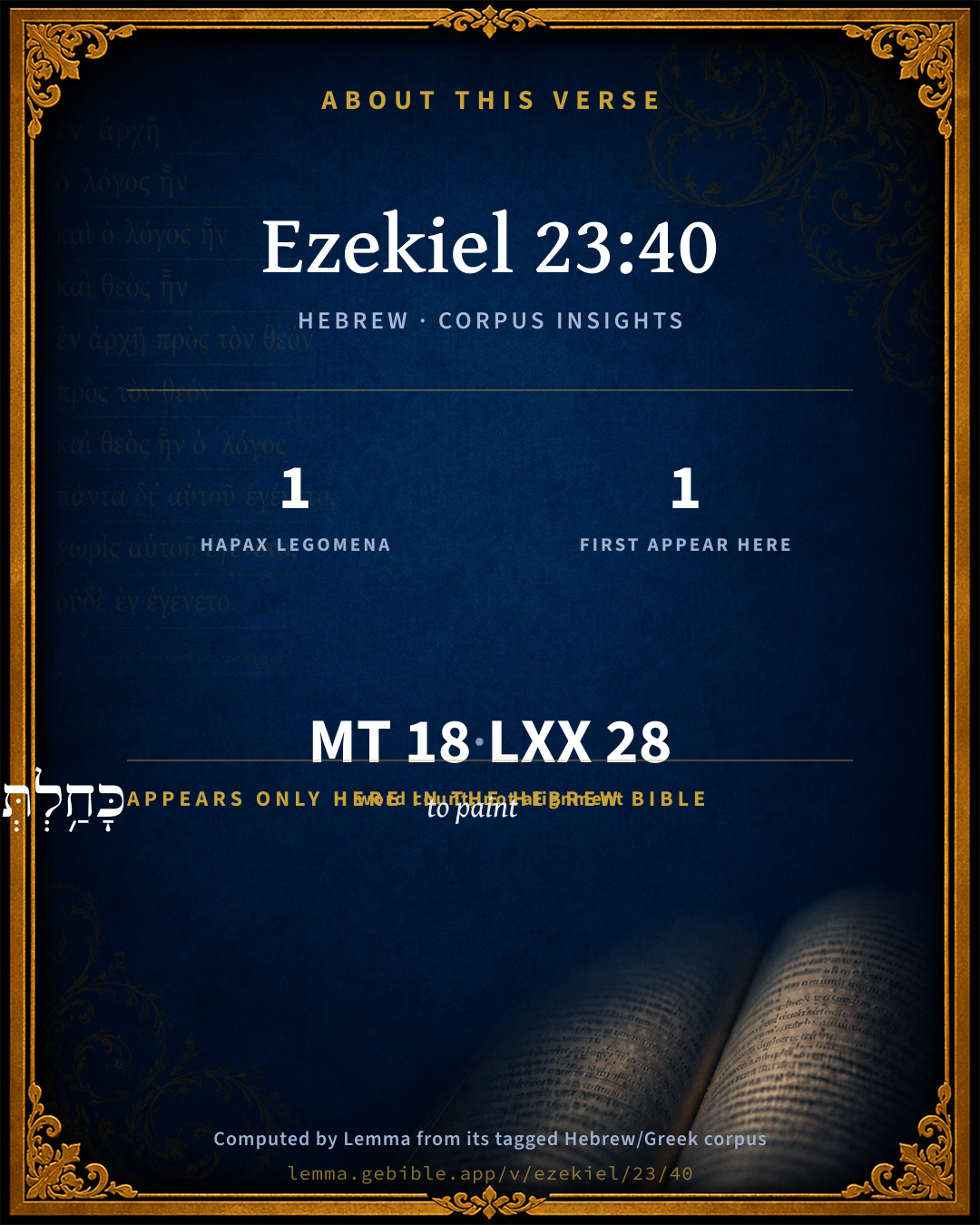
Ezekiel 23:40

Hebrew (Westminster Leningrad Codex) Ezekiel 23:40 appears in the Hebrew Old Testament. The text above is from the Westminster Leningrad Codex. Each word links to its Strong’s number, a concise gloss, and parsing drawn from the Open Scriptures Hebrew Bible morphology. Click any word for its full Brown-Driver-Briggs (BDB) entry.
Download image
Cite this verse

Ezekiel 23:40 (World English Bible). Public Domain. Lemma interlinear Bible study tool, https://lemma.gebible.app/v/ezekiel/23/40.

Show BibTeX & RIS
BibTeX
RIS
English Translation
Furthermore you have sent for men who come from far, to whom a messenger was sent, and, behold, they came; for whom you did wash yourself, paint your eyes, and deck yourself with ornaments,
World English Bible · Public Domain
Highlights
  • 1 hapax legomenon — only here in the Hebrew Bible
  • 1 first appearance in the Hebrew Bible
Full analysis ↓
Download a study sheet

One document with this verse’s original text, its word-by-word gloss line, the meaning frame, cross-references with their text, attributed commentary, and full source and license credits — printable, and it pastes into notes with its structure intact.

This verse Autodidact and up

Study sheet (.html) Plain text (.txt)

A passage Seminary Student

Up to 50 verses in one chapter. A passage sheet keeps up to 6 commentary sources and 12 cross-references per verse, in the order this page ranks them, and says so on the sheet whenever that leaves anything out. Ask for a single verse and you get the Autodidact verse sheet above.

Everything on this page stays free to read, with no account — the sheet is a download of what is already on screen, not access to it.

Want to remove ads? Support Godless Engineer
Compare translations 3

The same verse in 3 English versions, stacked beneath the original-language interlinear above. Click any original word for its lexicon entry.

Each is an independent rendering of the whole verse — the interlinear is not word-aligned to these translations.

Highlighted words mark where these versions differ — a whole-verse word diff, not a word-by-word alignment.

  • World English Bible Public Domain
    Furthermore you have sent for men who come from far, to whom a messenger was sent, and, behold, they came; for whom you did wash yourself, paint your eyes, and deck yourself with ornaments,
  • King James Version Public Domain
    And furthermore, that ye have sent for men to come from far, unto whom a messenger was sent; and, lo, they came: for whom thou didst wash thyself, paintedst thy eyes, and deckedst thyself with ornaments,
  • unfoldingWord Literal Text CC BY-SA 4.0
    You sent out for men who came from far away, to whom messengers had been sent—now behold. They indeed came, those for whom you bathed, painted your eyes, and adorned yourself with jewelry.

unfoldingWord Literal Text — © unfoldingWord, licensed CC BY-SA 4.0. Word-aligned USFM3 via Door43 (git.door43.org/unfoldingWord/en_ult).

Versions to compare (up to 4)

3 of 4 selected

Show all 18 translations

Every available English version of this verse, each an independent rendering of the whole verse.

  • World English Bible Public Domain
    Furthermore you have sent for men who come from far, to whom a messenger was sent, and, behold, they came; for whom you did wash yourself, paint your eyes, and deck yourself with ornaments,
  • Berean Standard Bible Public Domain
    Furthermore, you sisters sent messengers for men who came from afar; and behold, when they arrived, you bathed for them, painted your eyes, and adorned yourself with jewelry.
  • Majority Standard Bible Public Domain
    Furthermore, you sisters sent messengers for men who came from afar; and behold, when they arrived, you bathed for them, painted your eyes, and adorned yourself with jewelry.
  • King James Version Public Domain
    And furthermore, that ye have sent for men to come from far, unto whom a messenger was sent; and, lo, they came: for whom thou didst wash thyself, paintedst thy eyes, and deckedst thyself with ornaments,
  • American Standard Version (1901) Public Domain
    And furthermore ye have sent for men that come from far, unto whom a messenger was sent, and, lo, they came; for whom thou didst wash thyself, paint thine eyes, and deck thyself with ornaments,
  • Revised Version (1885) Public Domain
    And furthermore ye have sent for men that come from far: unto whom a messenger was sent, and, lo, they came; for whom thou didst wash thyself, paintedst thine eyes, and deckedst thyself with ornaments;
  • Geneva Bible (1599) Public Domain
    And howe much more is it that they sent for men to come from farre vnto whom a messenger was sent, and loe, they came? for whome thou diddest wash thy selfe, and paintedst thine eyes, and deckedst thee with ornaments,
  • Douay-Rheims (1899) Public Domain
    They sent for men coming from afar, to whom they had sent a messenger: and behold they came: for whom thou didst wash thyself, and didst paint thy eyes, and wast adorned with women's ornaments.
  • Young's Literal Translation Public Domain
    And also that they send to men coming from afar, Unto whom a messenger is sent, And lo, they have come in for whom thou hast washed, Painted thine eyes, and put on adornment.
  • Literal Standard Version CC BY-SA 4.0
    And also that they send to men coming from afar, || To whom a messenger is sent, || And behold, they have come in for whom you have washed, || Painted your eyes, and put on adornment.
  • Unlocked Literal Bible CC BY-SA 4.0
    You sent out for men who came from far away, to whom messengers had been sent—now behold. They indeed came, those for whom you bathed, painted your eyes, and adorned yourself with jewelry.
  • unfoldingWord Literal Text CC BY-SA 4.0
    You sent out for men who came from far away, to whom messengers had been sent—now behold. They indeed came, those for whom you bathed, painted your eyes, and adorned yourself with jewelry.
  • Darby Bible Public Domain
    And furthermore, they sent for men to come from far, unto whom a messenger was sent; and behold, they came: for whom thou didst wash thyself, paintedst thine eyes, and deckedst thyself with ornaments;
  • World Messianic Bible Public Domain
    “Furthermore you sisters have sent for men who come from far away, to whom a messenger was sent, and behold, they came; for whom you washed yourself, painted your eyes, decorated yourself with ornaments,
  • Webster's Bible Public Domain
    And furthermore, that ye have sent for men to come from far, to whom a messenger was sent; and lo, they came: for whom thou didst wash thyself, paint thy eyes, and deck thyself with ornaments,
  • Free Bible Version CC BY-SA 4.0
    They even kept on sending messengers for men to come from far away. When the men arrived, you would get yourselves ready for them by bathing, doing your eye makeup, and putting on your jewelry.
  • Bible in Basic English Public Domain
    And she even sent for men to come from far away, to whom a servant was sent, and they came: for whom she was washing her body and painting her eyes and making herself fair with ornaments.
  • JPS Tanakh (1917) Public Domain
    And furthermore ye have sent for men that come from far; unto whom a messenger was sent, and, lo, they came; for whom thou didst wash thyself, paint thine eyes, and deck thyself with ornaments;

Literal Standard Version (2020), Covenant Press — licensed CC BY-SA 4.0. Text via the HelloAO Bible API (eBible.org). Unlocked Literal Bible (unfoldingWord) — licensed CC BY-SA 4.0. Text via the HelloAO Bible API (eBible.org). unfoldingWord Literal Text — © unfoldingWord, licensed CC BY-SA 4.0. Word-aligned USFM3 via Door43 (git.door43.org/unfoldingWord/en_ult). Free Bible Version, Dr. Jonathan Gallagher — licensed CC BY-SA 4.0. Text via the HelloAO Bible API (eBible.org).

Word by word

More ways to search: Search by grammar → Find every occurrence → Compare this word →

Practice this passage: Drill this verse → Learn its vocabulary →

כָּחַ֥לְתְּ
kâchal
H3583
“to paint”
Verb, Qal, Perfect, 2nd Person, Feminine, Singular
Part of Speech
Verb
Stem
Qal
Form
Perfect
Person
2nd Person
Gender
Feminine
Number
Singular
Full BDB Definition

Origin: a primitive root

TWOT: 974

(Qal) to paint (eyes), adorn with paint
  1. וְאַ֗ף ʼaph H637 “and · also” Conjunction + Adverb
  2. כִּ֤י kîy H3588 “that” Conjunction
  3. תִשְׁלַ֨חְנָה֙ shâlach H7971 “to send” Verb, Qal, Imperfect, 3rd Person, Feminine, Plural
  4. לַֽאֲנָשִׁ֔ים ʼîysh H376 “to/for · men” Preposition + Noun, Common, Masculine, Plural, Absolute
  5. בָּאִ֖ים bôwʼ H935 “entering” Verb, Qal, Participle Active, Masculine, Plural, Absolute
  6. מִמֶּרְחָ֑ק merchâq H4801 “from · distant place” Preposition + Noun, Common, Masculine, Singular, Absolute
  7. אֲשֶׁ֨ר ʼăsher H834 “which” Particle, Relative
  8. מַלְאָ֜ךְ mălʼâk H4397 “messenger” Noun, Common, Masculine, Singular, Absolute
  9. שָׁל֤וּחַ shâlach H7971 “sent” Verb, Qal, Participle Passive, Masculine, Singular, Absolute
  10. אֲלֵיהֶם֙ ʼêl H413 “to · them” Preposition + Suffix, Personal, 3rd Person, Masculine, Plural
  11. וְהִנֵּה hinnêh H2009 “and · behold” Conjunction + Particle, Demonstrative
  12. בָ֔אוּ bôwʼ H935 “to enter” Verb, Qal, Perfect, 3rd Person, Common, Plural
  13. לַאֲשֶׁ֥ר ʼăsher H834 “to/for · which” Preposition + Particle, Relative
  14. רָחַ֛צְתְּ râchats H7364 “to wash” Verb, Qal, Perfect, 2nd Person, Feminine, Singular
  15. עֵינַ֖יִךְ ʻayin H5869 “eyes · your” Noun, Common, Both, Dual, Construct + Suffix, Personal, 2nd Person, Feminine, Singular
  16. וְעָ֥דִית ʻâdâh H5710 “and · to pass on” Conjunction + Verb, Qal, Perfect, 2nd Person, Feminine, Singular
  17. עֶֽדִי ʻădîy H5716 “ornaments” Noun, Common, Masculine, Singular, Absolute

About this verse

These counts appear in no published source. They are computed here, from the morphology-tagged text and Lemma’s own curated glosses. What Lemma adds →

18
words
15
distinct lemmas
Prophets
section

Notable vocabulary

1 hapax legomenon — a word that appears only here in the entire Hebrew Bible:

  • כָּחַ֥לְתְּ to paint H3583

First appearance in Scripture

This word makes its first canonical appearance in the Hebrew Bible here:

  • כָּחַ֥לְתְּ to paint H3583

Shared distinctive vocabulary

וְעָ֥דִית to pass on H5710 occurs in 10 verses of the Hebrew Bible. Also found in:

Grammatical profile

  • 7 verbs
  • 5 nouns
  • 1 preposition
  • 1 conjunction
  • 1 adverb
  • 3 particles

Verb forms

  • תִשְׁלַ֨חְנָה֙ Qal · Imperfect
  • בָּאִ֖ים Qal · Participle Active
  • שָׁל֤וּחַ Qal · Participle Passive
  • בָ֔אוּ Qal · Perfect
  • רָחַ֛צְתְּ Qal · Perfect
  • כָּחַ֥לְתְּ Qal · Perfect
  • וְעָ֥דִית Qal · Perfect

Repetition

Words recur within this verse — often emphatic in Hebrew:

  • תִשְׁלַ֨חְנָה֙ to send H7971 ×2
  • בָּאִ֖ים to enter H935 ×2
  • אֲשֶׁ֨ר which H834 ×2

Hebrew & Septuagint length

In English translation the verse runs 34 words from the Hebrew and 38 from the Septuagint (LXX English) — closely comparable.

A rough comparison of the two English renderings, which tokenize alike — not a word-level alignment.

Word counts can differ between the Hebrew and the Greek without any difference in meaning — e.g. the Hebrew direct-object marker אֵת has no separate Greek word, and Greek often adds the article ὁ.

In the original languages it is 18 Hebrew tokens and 28 Greek tokens — but the two are counted differently (Hebrew bundles its prefixes and suffixes into one token; the Greek is in lemma form), so that isn’t a like-for-like length.

Cross-references

10

Topical passages linked to Ezekiel 23:40 in the Treasury of Scripture Knowledge — connected by theme and wording, ordered by reader-vote popularity; previews shown in the World English Bible.

  • 2 Kings 9:30 When Jehu was come to Jezreel, Jezebel heard of it; and she painted her eyes, and attired her head, and looked out at the window.
  • Jeremiah 4:30 You, when you are made desolate, what will you do? Though you clothe yourself with scarlet, though you deck you with ornaments of gold, though you enlarge your eyes with paint, in vain do you make yourself beautiful; [your] lovers despise you, they seek your life.
  • Ezekiel 16:13–16 Thus was you decked with gold and silver; and your clothing was of fine linen, and silk, and embroidered work; you ate fine flour, and honey, and oil; and you were exceeding beautiful, and you did prosper to royal estate.
  • Isaiah 3:18–23 In that day the Lord will take away the beauty of their anklets, the headbands, the crescent necklaces,
  • Isaiah 57:9 You went to the king with oil, and did increase your perfumes, and did send your ambassadors far off, and did debase yourself even to Sheol.
  • Ruth 3:3 Wash yourself therefore, and anoint you, and put your clothing on you, and get you down to the threshing floor, but don't make yourself known to the man, until he shall have done eating and drinking.
  • 2 Kings 20:13–15 Hezekiah listened to them, and shown them all the house of his precious things, the silver, and the gold, and the spices, and the precious oil, and the house of his armor, and all that was found in his treasures: there was nothing in his house, nor in all his dominion, that Hezekiah didn't show them.
  • Esther 2:12 Now when the turn of every maiden was come to go in to king Ahasuerus, after it had been done to her as prescribed for the women twelve months (for so were the days of their purification accomplished, [to wit], six months with oil of myrrh, and six months with sweet odors and with the things for the purifying of the women),
  • Proverbs 7:10 Behold, there a woman met him with the attire of a prostitute, And with crafty intent.
  • Ezekiel 23:13 I saw that she was defiled; they both took one way.

Cross-references courtesy of OpenBible.info (CC BY 4.0).

Hebrew and Greek witnesses Masoretic Hebrew ↔ Greek Septuagint

The same verse in the two great witnesses to the Old Testament, shown verse-for-verse.

These are two independent witnesses, not word-aligned to each other, and the Septuagint is shown in lemma (dictionary) form.

Hebrew Ezekiel 23:40 Masoretic · Westminster Leningrad Codex

וְאַ֗ף כִּ֤י תִשְׁלַ֨חְנָה֙ לַֽאֲנָשִׁ֔ים בָּאִ֖ים מִמֶּרְחָ֑ק אֲשֶׁ֨ר מַלְאָ֜ךְ שָׁל֤וּחַ אֲלֵיהֶם֙ וְהִנֵּה בָ֔אוּ לַאֲשֶׁ֥ר רָחַ֛צְתְּ כָּחַ֥לְתְּ עֵינַ֖יִךְ וְעָ֥דִית עֶֽדִי

Furthermore you have sent for men who come from far, to whom a messenger was sent, and, behold, they came; for whom you did wash yourself, paint your eyes, and deck yourself with ornaments,

World English Bible · Public Domain

Greek LXX Ezekiel 23:40 Septuagint · lemma form

καί ὅτι ὁ ἀνήρ ὁ ἔρχομαι μακρόθεν ὅς ἄγγελος ἐκ ἀποστέλλω πρός αὐτός καί ἅμα ὁ ἔρχομαι αὐτός εὐθύς λούω καί στιβίζω ὁ ὀφθαλμός σύ καί κόσμος κόσμος

and whereas they did thus to the men that came from afar, to whom they sent messengers, and as soon as they came, immediately you did wash yourself, and did paint your eyes and adorn yourself with ornaments,

LXX2012 (modern English Septuagint) · Public Domain

On this verse, The Cambridge Bible for Schools and Colleges discusses the Septuagint’s reading. Read the note in Commentary ↓

Hebrew: Westminster Leningrad Codex (CC BY 4.0). Greek: Septuagint (public domain); English from LXX2012 (modern English Septuagint) (Public Domain). How the Septuagint differs from the Hebrew →

Targum (Aramaic paraphrase)

1

The Targum is the ancient Jewish Aramaic paraphrase of the Hebrew Scriptures — an interpretive translation, not the Hebrew text itself. Onkelos (literal) and Pseudo-Jonathan (expansive) render the Torah, and Jonathan the Prophets. Coverage is partial: where no permissively-licensed English translation exists for a verse, only the Aramaic is shown. This is verse-level text, not a word-by-word alignment to the Hebrew.

  1. Targum Jonathan Prophets (Joshua–Malachi)
    וְאַף אֲרֵי שְׁלַחְתְּ לְגַבְרַיָא דְאָתָן מֵרָחִיק דְאִזְגַד שְׁלִיחַ לְוַתְהוֹן וְהָא אֲתוֹ לַאֲתַר דְזַמִינְתְּ אַתְקִינְתְּ שׁוּקִין וּמַנִית פַּלְטוֹרִין:

    (no public-domain English translation for this verse)

    Targum Jonathan — Aramaic: “Mikraot Gedolot” (public domain). English: “Sefaria Community Translation” (CC0 1.0 (public-domain dedication)); “London "Chaldee Paraphrase," 1871” (public domain). Text via Sefaria.

Commentary

Notes on Ezekiel 23:40 from classic Christian and Jewish commentators (each source and its license shown beneath its notes). The classic Christian expositions comment on the surrounding passage and are grouped to its opening verse, so a note may address several verses; the Jewish commentaries on the Tanakh (Rashi and others) are per-verse, so they appear only where the commentator wrote on this verse.

Lemma curates 59 commentaries, every one of them public domain or Creative Commons licensed, each selected and text-cleaned for this edition rather than reprinted as found. About our sources →

Trapp's Complete Commentary

John Trapp

Eze 23:40 And furthermore, that ye have sent for men to come from far, unto whom a messenger [was] sent; and, lo, they came: for whom thou didst wash thyself, paintedst thy eyes, and deckedst thyself with ornaments,

Ver. 40. Ye have sent for men.] Ye have trusted to foreign forces and carnal combinations.

For whom thou didst wash thyself.] Omnino te comparas ut Thais impudentissima, ad pelliciendos et inescandos amatores; thou hast acted the whore to the life to inveigle thy paramours.

John Trapp, A Commentary or Exposition upon All the Books of the Old and New Testament (1647–1656) — public domain. Text from a community e-Sword module.

Albert Barnes' Notes on the Bible

The figure is that of a woman decked in all her beauty, sitting on a couch (not bed) at a banquet prepared for those whom she has invited. This further offence is not one of idolatry, but that of courting alliances with other powers which were not less readily made than broken.

Eze 23:40

That ye have sent - Better, “they (i. e., Israel and Judah) sent.”

Albert Barnes' Notes on the Bible (1834–1885) — public domain. Text from a community e-Sword/MySword module.

Joseph Benson's Commentary

Eze 23:40-42. And furthermore, ye have sent for men to come from far, &c. — Here the same thing which was spoken of in the former part of the chapter, is mentioned again in other words, namely, their courting the alliances of foreign nations, by complying with their idolatries: and this is set forth under the representation of the several arts which harlots used to recommend themselves to new lovers: compare Isa 57:7; Isa 57:9. For whom thou didst wash thyself — A custom generally practised by women in those countries, before they entertained their lovers. Paintedst thy eyes — It seems to have been their fashion in those days to draw strokes about their eyes, or to colour their eye-brows with black lead. And sattest upon a stately bed — Here the custom of sitting or lying upon beds, at the feasts made in honour of idols, or false gods, seems to be particularly spoken of, as may be inferred from the following words: whereupon thou hast set mine incense and mine oil — That is, whereupon thou hast offered up to idols that incense and oil which ought to have been offered up to me. It was usual, after a sacrifice to idols, for a table well spread to be placed before a couch, and a feast to be partaken of. The lectisternia of the Romans were borrowed from this eastern idolatrous rite, Livy, 5. 13. Houbigant thinks, that by the table here spoken of is meant the altar which Ahaz erected, after the similitude of that which he had seen at Damascus. And a voice of a multitude, &c. — The noise of festivity, and of people assembled together in jollity, was heard all around. It seems their loose mirth, at their meetings in honour of some of their idols, is here particularly meant. And with the men of the common sort were brought Sabeans, &c. — The prophet proceeds in comparing the idolatries of the Jews to the practices of lewd women, who prostitute themselves to all comers, even those of the meanest condition. Such were the Sabeans that came from the wilderness, that is, from Arabia, called the desert, where dwelt the posterity of Seba, mentioned Gen 10:7. Which put bracelets upon their hands, &c. — That is, upon the hands and heads of these two lewd women, Aholah and Aholibah. Bracelets and crowns were ornaments proper for brides, and were likewise presented by lovers to their mistresses: and therefore this may signify the compliance of the Jewish people with the grossest idolatries. Or the meaning may be, that Aholah and Aholibah, the inhabitants of Samaria and Jerusalem, put bracelets upon the hands, and beautiful crowns upon the heads, of such worthless idolaters as the Sabeans of the wilderness were; that is, courted their friendship and alliance with gifts.

Joseph Benson's Commentary on the Old and New Testaments (1811–1818) — public domain. Text from a community e-Sword module.

Geneva Bible (1599)

Geneva Bible translators

They sent into other countries to have such as should teach the service of their idols.

Geneva Bible (1599) marginal notes — public domain. Text via Bolls.life.

Jamieson, Fausset & Brown

Robert Jamieson, A. R. Fausset & David Brown

messenger was sent--namely, by Judah (Eze 23:16; Isa 57:9).

paintedst . . . eyes-- (Kg2 9:30, Margin; Jer 4:30). Black paint was spread on the eyelids of beauties to make the white of the eye more attractive by the contrast, so Judah left no seductive art untried.

Jamieson, Fausset & Brown — Commentary Critical and Explanatory on the Whole Bible (1871) — public domain (CC PDM 1.0). Text via the HelloAO Bible API.

Adam Clarke's Commentary

Verse 40. Thou didst wash thyself, paintedst thy eyes, and deckedst thyself with ornaments.] This is exactly the way in which a loose female in Bengal adorns herself to receive guests. She first bathes, then rubs black paint around her eyes, and then covers her body with ornaments.-WARD'S Customs.

Adam Clarke's Commentary on the Bible (1810–1826) — public domain. Text from a community e-Sword/MySword module.

Ellicott's Commentary for English Readers

(40) Paintedst thine eyes.—The figure is that of a lewd woman preparing herself for her paramour, and awaiting his arrival. Painting the eyes, or rather the lids and lashes, was an ancient custom, still preserved in the East. (Comp. 2Ki_9:30.)

A Bible Commentary for English Readers, edited by Charles John Ellicott (1878–1897) — public domain. Text from a community e-Sword module.

The Cambridge Bible for Schools and Colleges

gen. ed. J. J. S. Perowne

40. that ye have sent] Perhaps: and furthermore they sent. The change of person occurs later. The word “they sent” is wanting in LXX.

wash thyself] i.e. bathe thyself.

paintedst thy eyes] This refers to the practice of colouring the edges of the eyelids with a dark powder (stibium), which made the eye itself appear large and brilliant, 2Ki_9:30; Jer_4:30. The word kahal is Arab., and the root of Alcohol; the Heb. is pûch (Isa_54:11); Job’s daughter bore the name Keren-hap-puch, horn of paint.

40–44. These verses hardly refer to political alliances merely; Eze_23:41 suggests idolatrous worship. As the foreign gods came in, however, through intercourse with the nations which served them they are spoken of as being sent for by messengers (cf. Eze_23:16). The whole is presented under the figure of an harlot receiving men from all quarters. The passage has great resemblance to Isa_57:9 seq.

The Cambridge Bible for Schools and Colleges (gen. ed. J. J. S. Perowne; Cambridge University Press, 1878–1918) — public domain. Text from a community e-Sword module.

John Gill's Exposition

And furthermore, that ye have sent for men to come from far,.... From Egypt, Assyria, and Chaldea, to treat with them, and enter into alliances and confederacies with them, and to join them in their idolatrous practices; these Heathen nations did not send to the Jews, but the Jews to them; they did not court their friendship and alliance, but the Jews courted theirs:

unto whom a messenger was sent; to court their favour, and solicit a confederacy, and to desire that ambassadors might be sent to reside among them:

and, lo, they came; these Heathen courts listened to the proposal, and accordingly sent their plenipotentiaries and ambassadors to them, who came in their masters' name, and with their credentials; and for the reception of whom great preparations were made, as follows:

for whom thou didst wash thyself, paintedst thy eyes, and deckedst thyself with ornaments; just as harlots do to make themselves agreeable to their lovers; who use washes and paint, as Jezebel did, and dress themselves in their best clothes, and adorn themselves in the best manner they can. Harlots had their particular attire, by which they were known, Pro 7:10 and they not only used bagnios or baths, but washes for their face, to make them look beautiful; and particularly painted their eyes, to make them look larger; for large eyes in women, in some nations, were reckoned very handsome, particularly among the Greeks: hence Juno, in Homer (d), is called the ox eyed, as some translate it; or rather the large eyed Juno: and the Grecian women, in order to make their eyes large, made use of a powder mixed with their washes, which shrunk their eyebrows, and caused their eyes to stand out, and look fuller and larger; and such was the paint which Pliny, (e) calls stibium, and says, it was by some named "platyophthalmon", because in the beautiful eyebrows of women it dilated the eyes; and it seems that painting with something of this nature was used by the Jewish women, in imitation of the Heathens, for the same purpose, especially by harlots; hence the phrase of rending the face, or rather the eyes, with paint, Jer 4:30, so the Moorish women now, as Dr. Shaw (f) relates, to add a gracefulness to their complexions, tinge their eye lids with "alkahol", the powder of lead ore; and this is performed by first dipping into this powder a small wooden bodkin, of the thickness of a quill, and then drawing it afterwards through the eyelids, over the ball of the eye; and which is properly a rending the eyes indeed, as the prophet calls it, with powder of "pouk", or lead ore: so, for the gratifying these idolatrous ambassadors, idols were set up, altars built, and sacrifices prepared; and, in order to their public entry, and to show how acceptable they were, palaces were fitted up for them; and the streets through which they passed decorated, and all public marks of esteem and affection given them; to this the Targum seems to have respect, paraphrasing the words thus,

"and, lo, they came to the place thou hadst prepared; thou hast adorned the streets, and appointed palaces.''

(d) Iliad. 1. l. 550. (e) Nat. Hist. l. 33. c. 6. (f) Travels, p. 229. Ed. 2.

John Gill's Exposition of the Whole Bible (1746–1763) — public domain (CC PDM 1.0). Text via the HelloAO Bible API.

Haydock's Catholic Bible Commentary

Paint, with antimony. (Septuagint) See 4 Kings ix. 3.

George Leo Haydock (1774–1849), Haydock's Catholic Family Bible and Commentary, 1859 edition — public domain. Excludes Psalms (Douay-Rheims chapter numbering differs from Protestant) and Deuterocanonical books (Catholic canon only).

Matthew Poole's English Annotations

Sent for men: see Eze 23:16.

From far; from Chaldea.

A messenger was sent; an embassy from the king of Judah, with advice of his princes, no doubt.

They came: see Eze 23:17.

Wash thyself; after the manner of harlots, gottest all fine, clean, and delicate against thy paramours came; so idol temples built, altars beautified, sacrifices prepared, all to commend thyself to their alliance and help.

Paintedst thy eyes; like a decayed harlot, madest up thy defects with paint.

Deckedst thyself with ornaments; puttest on the rich clothing I gave thee, and with thy Husband’s bounty allured adulterers to thy bed; so Eze 16:13,14; thus was God abused and provoked.

Matthew Poole's English Annotations on the Holy Bible (1683–1685) — public domain. Text from a community e-Sword/MySword module.

The Pulpit Commentary

Ye have sent for men to come from far, etc. The words obviously refer to the embassies which had been sent from time to time by both Samaria and Jerusalem to Egypt, Assyria, and Babylon. The imagery of the earlier stage of the harlot"s progress is resumed, and we have a picture almost the counterpart of that in Pro_7:10-21. She takes her bath, paints her eyelashes with kohol, the black pigment still used in the East, as Jezebel had done. (2Ki_9:30) She decks herself with jewels, and sits on a divan (a sofa-conch, rather than bed), and prepares a table for a banquet. And on that table are the incense and the oil, symbols alike of wealth and worship, which Jehovah claims as his, and which she offers to her lovers. (comp. Eze_16:13, Eze_16:19; Hos_2:5, Hos_2:8)

Vers. 40 and 42The foreign and the common.

In Ver. 40 Israel is seen to be seeking distant foreign connections, like a faithless wife who goes far afield for companions in sin. In Ver. 42 the charm of the distant and the foreign is swallowed up in the vulgarity of sin, which is the same in essence all the world over.

I THE CHARM OF THE FOREIGN. The Jews were especially warned against foreign alliances, as they meant distrust in God, and as they led to the introduction of corrupting heathen influences. Nevertheless, the foolish people gave way to the fatal fascination of foreigners.

1. There is a charm in novelty. We are tempted to accept alien ideas just because they strike us with a certain freshness. Thus all sorts of earthly notions and practices have been imported into God"s Israel, the Christian Church, by have peculiarly wide and varied relations with the world, and Christianity claims all the earth as its domain. But the fatal charm is that of following the example of the various practices of mankind instead of impressing a Christian influence on the race. This was Israel"s mistake. Called to carry out a mission to the world, she succumbed to the spirit of the world. There is great danger lest the Church should follow her example in this respect. Indeed, this has happened already to a deplorable extent. A pseudo-liberalism claims to be following the zeit-geist, and so to be adapting Christianity to the world. This means unfaithfulness to Christ. St. Paul would be all things to all men, but only that he might win all men to Christ, never so as to surrender Christ to please the world. That is the part of a Judas.

II THE DISILLUSION OF THE COMMON. Israel and Judah cast wistful glances on the foreigner. But when they had accomplished their purpose and were indulging in revelry with a multitude of people who had adorned them with the barbaric magnificence of golden bracelets and crowns, what did it all amount to but the shame of a low, drunken debauch? Novelty in sin does not elevate the evil thing, which is essentially the same, however it may be clothed and decorated. The so-called refinement of vice is but a veneer on the surface which leaves the rottenness beneath untouched. Cosmopolitanism does not save from moral corruption. The whole world is essentially one in its sin. There is a horrible vulgarity about all wickedness. If we would be saved from this we must in a sense become a "separate people." We may and we should still sympathize with all our fellow-men, send the gospel to every nation and ourselves learn such lessons as a wide view of mankind may teach us. Yet for all the higher efforts of life the inspiration must be found in the retired and secret chamber of prayer.

The Pulpit Commentary (1880–1919), ed. H.D.M. Spence-Jones & Joseph S. Exell — public domain. Text from a community e-Sword module.

John Wesley's Explanatory Notes

Wash thyself - After the manner of harlots.

John Wesley, Explanatory Notes Upon the Whole Bible (1754–1765) — public domain. Text via the GEBible commentary corpus.

unfoldingWord translationNotes

Door43 World Missions Community

General Information:

Yahweh again refers to the cities of Jerusalem and Samaria as if they were two prostitutes. (See: Metaphor)

You sent out for men who came from far away, to whom messengers had been sent

These two phrases have the same meaning. This means that they sent messengers to men far away requesting for them to come to them. AT: "You sent messengers to men who came to you from far away" (See: Parallelism)

behold

"look" or "listen" or "pay attention to what I am about to tell you"

you bathed, painted your eyes, and adorned yourself with jewelry

These are things done by a woman to make her appear more beautiful to a man.

you bathed ... you sat

Here the word "you" switches to singular and refers to only one sister, but the situation is probably the same for both sisters. If one sister must be specified in your language, refer to Oholibah here. (See: Forms of You)

my incense and my oil

These are items used in worship to Yahweh.

translationWords

incense

oil

unfoldingWord translationNotes — © Distant Shores Media and the Door43 World Missions Community, licensed CC BY-SA 4.0. Source: git.door43.org/Door43/en_tn.

Rashi

Rabbi Shlomo Yitzchaki (Rashi)

And furthermore, that they would send [Heb. וְאַף כִּי.] And surely, worst of all is that they would send to bring to them [invite] some of the princes of the nations, their lovers, and these see the profanation with which they profane My sanctuary.

to whom an emissary is sent, etc. from Oholah and Oholibah to come to them.

and behold they came to the place where you bathed, daubed, etc. [Heb. לַאֲשֶׁר,] to which. Jonathan renders: לַאֲתַר, to the place, au lieu in Modern French. To the place that you designated for them, saying, “In such and such a place, we will come out to meet you, beautified by the bathing and the daubing.”

daubed [Heb. כָּחַלְתָּ,] a kind of dye named כָּחוֹל, with which they color their eyes, ecler in Old French, to brighten.

Rashi on the Tanakh — English translations: “The Judaica Press complete Tanach with Rashi, translated by A. J. Rosenberg” (CC BY 4.0); “Pentateuch with Rashi's commentary by M. Rosenbaum and A.M. Silbermann, 1929-1934” (public domain); “The Metsudah Tanach series, Lakewood, N.J” (CC BY 4.0); and “The Book of Joshua, Metsudah Publications, 1997” (CC BY 4.0). Text via Sefaria.

Lesson kit

Teaching starters — assembled from the data on this page, not authored interpretation. Every prompt links to the verse data it draws on. Edit before teaching.

Ezekiel, in the Prophets, opens this verse with 18 words (15 distinct Hebrew lemmas). Its most distinctive word is kâchal (“to paint”). A historical commentator’s framing appears above. Read the whole chapter for the surrounding context.

Discussion questions

  1. What does “to paint” (kâchal) contribute to the verse as a whole?
  2. This verse holds 1 word here found nowhere else in the Hebrew Bible. What might the rare word draw attention to?
  3. The word “to paint” first appears here in Scripture. What is being introduced at this debut?
  4. Job 28:8 shares the word «to pass on» with this verse. How do the two illuminate each other?
  5. “to send” occurs 2× in this one verse. What is the effect of the repetition?
  6. These translations render this verse differently; the difference is in the English rendering, not the original. What questions does that raise?
  7. The verb «תִשְׁלַ֨חְנָה֙» is Qal Imperfect. How does its form color the action?
  8. Reading how Trapp's Complete Commentary and Albert Barnes' Notes on the Bible read this verse, where do the two commentators agree and where do they part?

Things to notice

  • 1 word in this verse appears nowhere else in the Hebrew Bible.
  • 1 word makes its first canonical appearance in Scripture here.
  • This verse counts 18 Hebrew ↔ 28 Greek words.
  • These translations choose different wording for 29 words in this verse.
  • “to send” occurs 2× in this single verse.

Reading settings

Reading text

Shown beneath each verse's original-language words.

Old Testament
Old Testament edition

Read the OT as the Masoretic Hebrew (MT) or the Greek Septuagint (LXX).

English shown for the Greek Septuagint (in the Hebrew ↔ Greek comparison).

Comparing translations? Open the Compare panel on any verse page to stack up to four side by side.