Genesis 42:9

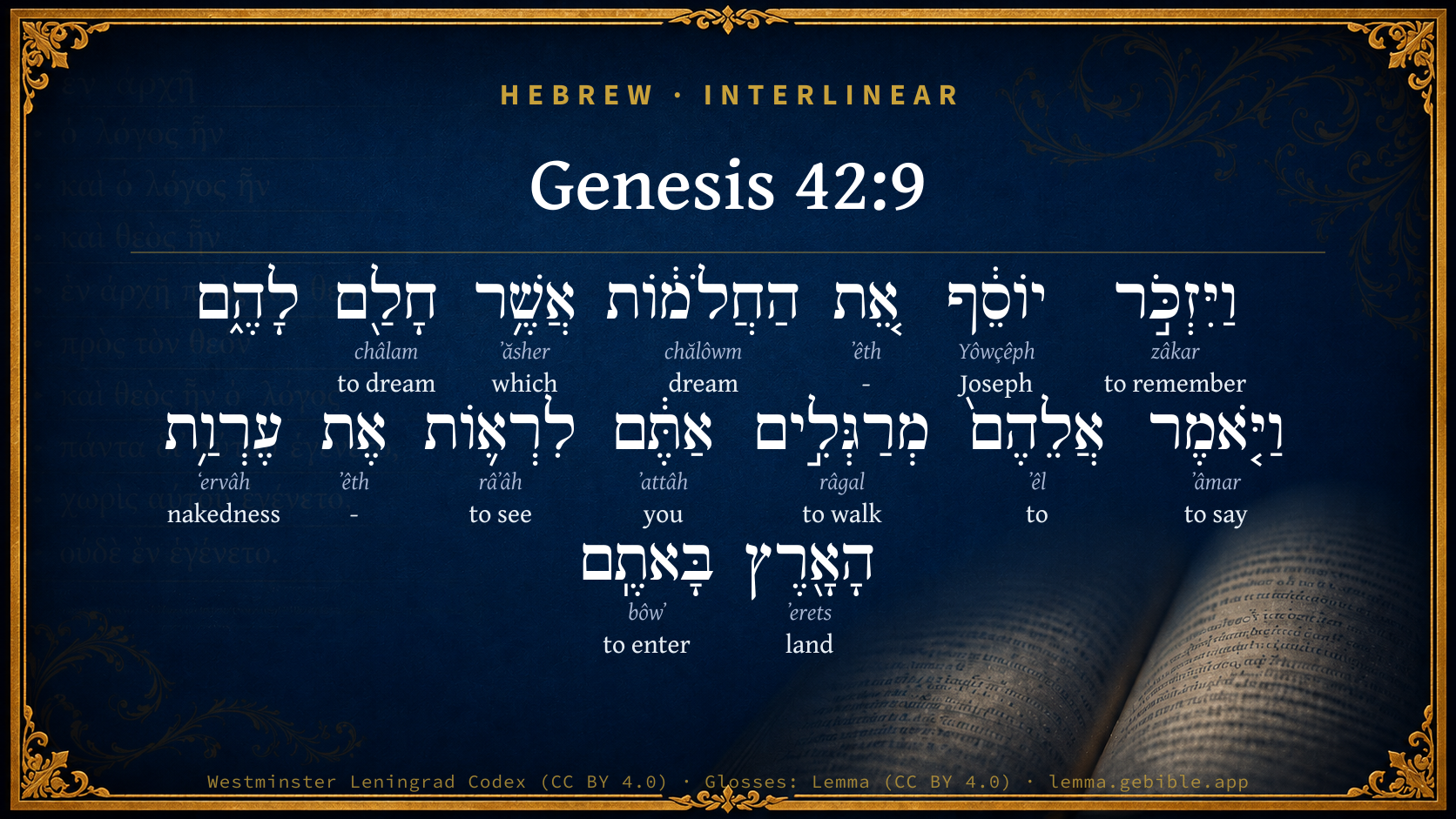
Hebrew (Westminster Leningrad Codex) Genesis 42:9 appears in the Hebrew Old Testament. The text above is from the Westminster Leningrad Codex. Each word links to its Strong’s number, a concise gloss, and parsing drawn from the Open Scriptures Hebrew Bible morphology. Click any word for its full Brown-Driver-Briggs (BDB) entry.
Download image
Cite this verse

Genesis 42:9 (World English Bible). Public Domain. Lemma interlinear Bible study tool, https://lemma.gebible.app/v/genesis/42/9.

Show BibTeX & RIS
BibTeX
RIS
English Translation
Joseph remembered the dreams which he dreamed about them, and said to them, "You are spies! You have come to see the nakedness of the land."
World English Bible · Public Domain
Highlights
  • 1 first appearance in the Hebrew Bible
Full analysis ↓
Download a study sheet

One document with this verse’s original text, its word-by-word gloss line, the meaning frame, cross-references with their text, attributed commentary, and full source and license credits — printable, and it pastes into notes with its structure intact.

This verse Autodidact and up

Study sheet (.html) Plain text (.txt)

A passage Seminary Student

Up to 50 verses in one chapter. A passage sheet keeps up to 6 commentary sources and 12 cross-references per verse, in the order this page ranks them, and says so on the sheet whenever that leaves anything out. Ask for a single verse and you get the Autodidact verse sheet above.

Everything on this page stays free to read, with no account — the sheet is a download of what is already on screen, not access to it.

Want to remove ads? Support Godless Engineer
Compare translations 3

The same verse in 3 English versions, stacked beneath the original-language interlinear above. Click any original word for its lexicon entry.

Each is an independent rendering of the whole verse — the interlinear is not word-aligned to these translations.

Highlighted words mark where these versions differ — a whole-verse word diff, not a word-by-word alignment.

  • World English Bible Public Domain
    Joseph remembered the dreams which he dreamed about them, and said to them, "You are spies! You have come to see the nakedness of the land."
  • King James Version Public Domain
    And Joseph remembered the dreams which he dreamed of them, and said unto them, Ye are spies; to see the nakedness of the land ye are come.
  • unfoldingWord Literal Text CC BY-SA 4.0
    Then Joseph remembered the dreams that he had dreamed about them, and he said to them, “You spies! You have come to see the nakedness of the land!”

unfoldingWord Literal Text — © unfoldingWord, licensed CC BY-SA 4.0. Word-aligned USFM3 via Door43 (git.door43.org/unfoldingWord/en_ult).

Versions to compare (up to 4)

3 of 4 selected

Show all 18 translations

Every available English version of this verse, each an independent rendering of the whole verse.

  • World English Bible Public Domain
    Joseph remembered the dreams which he dreamed about them, and said to them, "You are spies! You have come to see the nakedness of the land."
  • Berean Standard Bible Public Domain
    Joseph remembered his dreams about them and said, “You are spies! You have come to see if our land is vulnerable.”
  • Majority Standard Bible Public Domain
    Joseph remembered his dreams about them and said, “You are spies! You have come to see if our land is vulnerable.”
  • King James Version Public Domain
    And Joseph remembered the dreams which he dreamed of them, and said unto them, Ye are spies; to see the nakedness of the land ye are come.
  • American Standard Version (1901) Public Domain
    And Joseph remembered the dreams which he dreamed of them, and said unto them, Ye are spies; to see the nakedness of the land ye are come.
  • Revised Version (1885) Public Domain
    And Joseph remembered the dreams which he dreamed of them, and said unto them, Ye are spies; to see the nakedness of the land ye are come.
  • Geneva Bible (1599) Public Domain
    And Ioseph remembred the dreames, which he dreamed of them) and he sayde vnto them, Ye are spies, and are come to see the weaknesse of the land.
  • Douay-Rheims (1899) Public Domain
    And remembering the dreams, which formerly he had dreamed, he said to them: You are spies. You are come to view the weaker parts of the land.
  • Young's Literal Translation Public Domain
    and Joseph remembereth the dreams which he dreamed of them, and saith unto them, `Ye `are' spies; to see the nakedness of the land ye have come.'
  • Literal Standard Version CC BY-SA 4.0
    and Joseph remembers the dreams which he dreamed of them and says to them, “You [are] spies; you have come to see the nakedness of the land.”
  • Unlocked Literal Bible CC BY-SA 4.0
    Then Joseph remembered the dreams he had dreamed about them, and he said to them, “You are spies! You have come to see the undefended parts of the land.”
  • unfoldingWord Literal Text CC BY-SA 4.0
    Then Joseph remembered the dreams that he had dreamed about them, and he said to them, “You spies! You have come to see the nakedness of the land!”
  • Darby Bible Public Domain
    And Joseph remembered the dreams that he had dreamt of them; and he said to them, Ye are spies: to see the exposed places of the land ye are come.
  • World Messianic Bible Public Domain
    Joseph remembered the dreams which he dreamed about them, and said to them, “You are spies! You have come to see the nakedness of the land.”
  • Webster's Bible Public Domain
    And Joseph remembered the dreams which he dreamed of them, and said to them, Ye are spies; to see the nakedness of the land have ye come.
  • Free Bible Version CC BY-SA 4.0
    Joseph thought back to the dreams he'd had about them, and told them, “No! You're spies! You've come to discover our country's weaknesses!”
  • Bible in Basic English Public Domain
    Then the memory of his dreams about them came back to Joseph, and he said to them, You have come secretly to see how poor the land is.
  • JPS Tanakh (1917) Public Domain
    And Joseph remembered the dreams which he dreamed of them, and said unto them: 'Ye are spies; to see the nakedness of the land ye are come.'

Literal Standard Version (2020), Covenant Press — licensed CC BY-SA 4.0. Text via the HelloAO Bible API (eBible.org). Unlocked Literal Bible (unfoldingWord) — licensed CC BY-SA 4.0. Text via the HelloAO Bible API (eBible.org). unfoldingWord Literal Text — © unfoldingWord, licensed CC BY-SA 4.0. Word-aligned USFM3 via Door43 (git.door43.org/unfoldingWord/en_ult). Free Bible Version, Dr. Jonathan Gallagher — licensed CC BY-SA 4.0. Text via the HelloAO Bible API (eBible.org).

Word by word

More ways to search: Search by grammar → Find every occurrence → Compare this word →

Practice this passage: Drill this verse → Learn its vocabulary →

מְרַגְּלִ֣ים
râgal
H7270
“walking”
Verb, Piel, Participle Active, Masculine, Plural, Absolute
Part of Speech
Verb
Stem
Piel
Form
Participle Active
Gender
Masculine
Number
Plural
State
Absolute
Full BDB Definition

Origin: a primitive root

TWOT: 2113

to go on foot, spy out, foot it, go about, walk along, move the feet - (Qal) to be a tale-bearer, slander, go about - (Piel) - to slander - to go about as explorer, spy - (Tiphel) to teach to walk
  1. וַיִּזְכֹּ֣ר zâkar H2142 “and · to remember” Conjunction + Verb, Qal, Sequential Imperfect, 3rd Person, Masculine, Singular
  2. יוֹסֵ֔ף Yôwçêph H3130 “Joseph” Noun, Proper
  3. אֵ֚ת ʼêth H853 “-” Particle, Direct Object
  4. הַחֲלֹמ֔וֹת chălôwm H2472 “the · dreams” Particle, Definite Article + Noun, Common, Masculine, Plural, Absolute
  5. אֲשֶׁ֥ר ʼăsher H834 “which” Particle, Relative
  6. חָלַ֖ם châlam H2492 “to dream” Verb, Qal, Perfect, 3rd Person, Masculine, Singular
  7. וַיֹּ֤אמֶר ʼâmar H559 “and · to say” Conjunction + Verb, Qal, Sequential Imperfect, 3rd Person, Masculine, Singular
  8. אֲלֵהֶם֙ ʼêl H413 “to · them” Preposition + Suffix, Personal, 3rd Person, Masculine, Plural
  9. אַתֶּ֔ם ʼattâh H859 “you” Pronoun, Personal, 2nd Person, Masculine, Plural
  10. לִרְא֛וֹת râʼâh H7200 “to see” Preposition + Verb, Qal, Infinitive Construct
  11. אֶת ʼêth H853 “-” Particle, Direct Object
  12. עֶרְוַ֥ת ʻervâh H6172 “nakedness of” Noun, Common, Feminine, Singular, Construct
  13. הָאָ֖רֶץ ʼerets H776 “the · land” Particle, Definite Article + Noun, Common, Both, Singular, Absolute
  14. בָּאתֶֽם bôwʼ H935 “to enter” Verb, Qal, Perfect, 2nd Person, Masculine, Plural

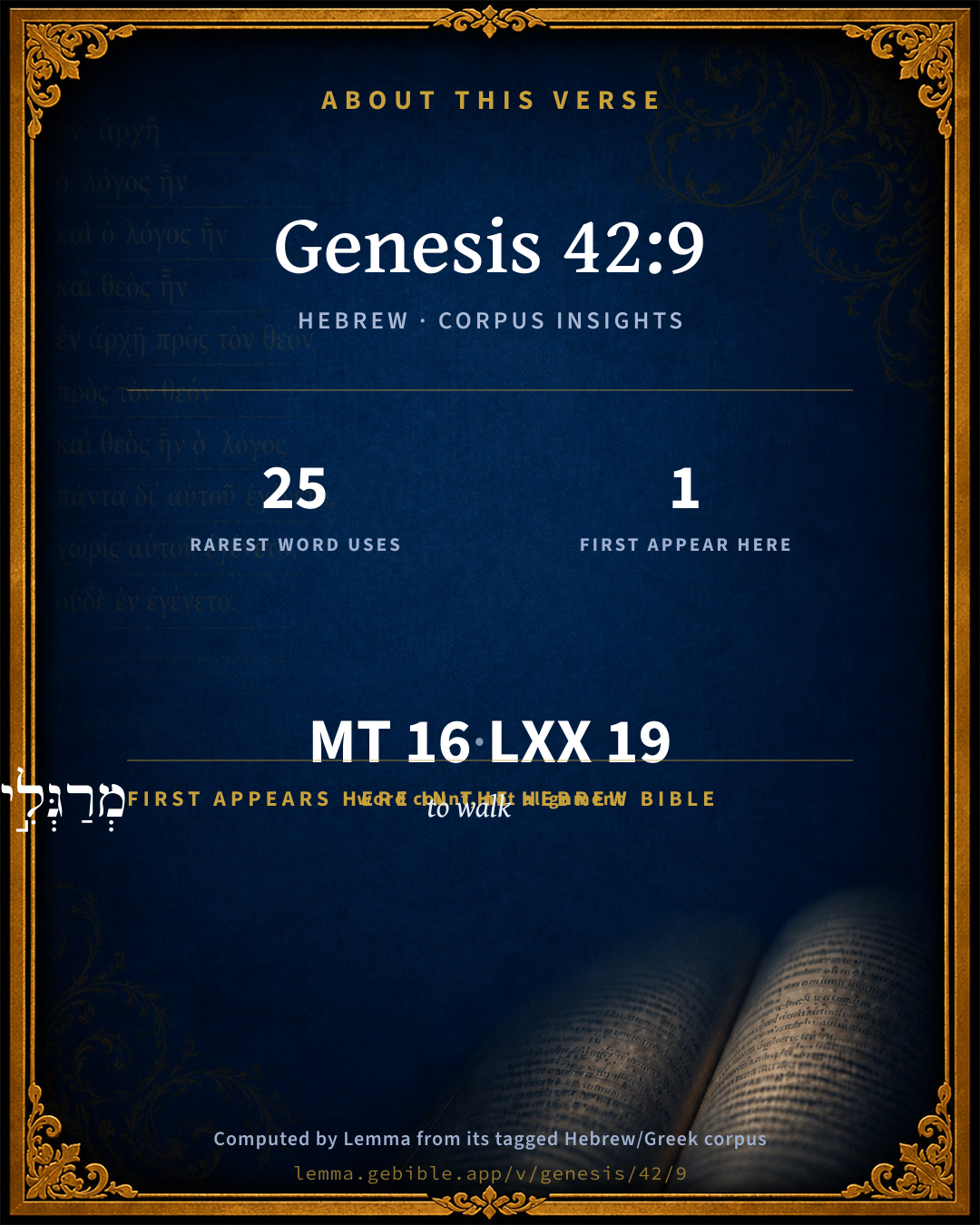
About this verse

These counts appear in no published source. They are computed here, from the morphology-tagged text and Lemma’s own curated glosses. What Lemma adds →

16
words
14
distinct lemmas
Pentateuch
section

Notable vocabulary

The rarest word here is מְרַגְּלִ֣ים to walk H7270 — appearing just 25 times in the whole Hebrew Bible.

First appearance in Scripture

This word makes its first canonical appearance in the Hebrew Bible here:

  • מְרַגְּלִ֣ים to walk H7270

Shared distinctive vocabulary

מְרַגְּלִ֣ים to walk H7270 occurs in 24 verses of the Hebrew Bible. Also found in:

Grammatical profile

  • 6 verbs
  • 4 nouns
  • 1 pronoun
  • 2 prepositions
  • 3 particles

Verb forms

  • וַיִּזְכֹּ֣ר Qal · Sequential Imperfect
  • חָלַ֖ם Qal · Perfect
  • וַיֹּ֤אמֶר Qal · Sequential Imperfect
  • מְרַגְּלִ֣ים Piel · Participle Active
  • לִרְא֛וֹת Qal · Infinitive Construct
  • בָּאתֶֽם Qal · Perfect

Hebrew & Septuagint length

In English translation the verse runs 26 words from the Hebrew and 26 from the Septuagint (LXX English) — the same length.

A rough comparison of the two English renderings, which tokenize alike — not a word-level alignment.

Word counts can differ between the Hebrew and the Greek without any difference in meaning — e.g. the Hebrew direct-object marker אֵת has no separate Greek word, and Greek often adds the article ὁ.

In the original languages it is 16 Hebrew tokens and 19 Greek tokens — but the two are counted differently (Hebrew bundles its prefixes and suffixes into one token; the Greek is in lemma form), so that isn’t a like-for-like length.

Cross-references

13

Topical passages linked to Genesis 42:9 in the Treasury of Scripture Knowledge — connected by theme and wording, ordered by reader-vote popularity; previews shown in the World English Bible.

  • Genesis 37:5–9 Joseph dreamed a dream, and he told it to his brothers, and they hated him all the more.
  • Exodus 32:35 Yahweh struck the people, because they made the calf, which Aaron made.
  • Genesis 42:16 Send one of you, and let him get your brother, and you shall be bound, that your words may be tested, whether there is truth in you, or else by the life of Pharaoh surely you are spies."
  • Genesis 42:30–31 "The man, the lord of the land, spoke roughly with us, and took us for spies of the country.
  • Genesis 42:34 Bring your youngest brother to me. Then I will know that you are not spies, but that you are honest men. So I will deliver your brother to you, and you shall trade in the land.'"
  • Numbers 13:2 Send you men, that they may spy out the land of Canaan, which I give to the children of Israel: of every tribe of their fathers shall you send a man, everyone a prince among them.
  • Numbers 13:16–20 These are the names of the men who Moses sent to spy out the land. Moses called Hoshea the son of Nun Joshua.
  • Joshua 2:1 Joshua the son of Nun sent out of Shittim two men as spies secretly, saying, Go, view the land, and Jericho. They went and came into the house of a prostitute whose name was Rahab, and lay there.
  • Joshua 6:23 The young men the spies went in, and brought out Rahab, and her father, and her mother, and her brothers, and all that she had; all her relatives also they brought out; and they set them outside of the camp of Israel.
  • Judges 1:24 The watchers saw a man come forth out of the city, and they said to him, Show us, we pray you, the entrance into the city, and we will deal kindly with you.
  • 1 Samuel 26:4 David therefore sent out spies, and understood that Saul was come of a certainty.
  • Luke 20:20 They watched him, and sent out spies, who pretended to be righteous, that they might trap him in something he said, so as to deliver him up to the power and authority of the governor.
  • Hebrews 11:31 By faith, Rahab the prostitute, didn't perish with those who were disobedient, having received the spies in peace.

Cross-references courtesy of OpenBible.info (CC BY 4.0).

Hebrew and Greek witnesses Masoretic Hebrew ↔ Greek Septuagint

The same verse in the two great witnesses to the Old Testament, shown verse-for-verse.

These are two independent witnesses, not word-aligned to each other, and the Septuagint is shown in lemma (dictionary) form.

Hebrew Genesis 42:9 Masoretic · Westminster Leningrad Codex

וַיִּזְכֹּ֣ר יוֹסֵ֔ף אֵ֚ת הַחֲלֹמ֔וֹת אֲשֶׁ֥ר חָלַ֖ם לָהֶ֑ם וַיֹּ֤אמֶר אֲלֵהֶם֙ מְרַגְּלִ֣ים אַתֶּ֔ם לִרְא֛וֹת אֶת עֶרְוַ֥ת הָאָ֖רֶץ בָּאתֶֽם

Joseph remembered the dreams which he dreamed about them, and said to them, "You are spies! You have come to see the nakedness of the land."

World English Bible · Public Domain

Greek LXX Genesis 42:9 Septuagint · lemma form

καί μιμνήσκω ιωσηφ ὁ ἐνύπνιον ὅς ὁράω αὐτός καί εἶπον αὐτός κατάσκοπος εἰμί κατανοέω ὁ ἴχνος ὁ χώρα ἥκω

And Joseph remembered his dream, which he saw; and he said to them, You⌃ are spies; to observe the marks of the land are you⌃ come.

LXX2012 (modern English Septuagint) · Public Domain

On this verse, The Cambridge Bible for Schools and Colleges discusses the Septuagint’s reading. Read the note in Commentary ↓

Hebrew: Westminster Leningrad Codex (CC BY 4.0). Greek: Septuagint (public domain); English from LXX2012 (modern English Septuagint) (Public Domain). How the Septuagint differs from the Hebrew →

Targum (Aramaic paraphrase)

2

The Targum is the ancient Jewish Aramaic paraphrase of the Hebrew Scriptures — an interpretive translation, not the Hebrew text itself. Onkelos (literal) and Pseudo-Jonathan (expansive) render the Torah, and Jonathan the Prophets. Coverage is partial: where no permissively-licensed English translation exists for a verse, only the Aramaic is shown. This is verse-level text, not a word-by-word alignment to the Hebrew.

  1. Targum Onkelos Torah (Genesis–Deuteronomy)
    וּדְכִיר יוֹסֵף יָת חֶלְמַיָּא דִּי חֲלִים לְהוֹן וַאֲמַר לְהוֹן מְאַלְלִין אַתּוּן לְמֶחֱזֵי יָת בִּדְקָא דְאַרְעָא אֲתֵיתוּן

    (no public-domain English translation for this verse)

    Targum Onkelos — Aramaic: “Onkelos Genesis” (public domain); “Onkelos Exodus” (public domain); “Onkelos Leviticus” (public domain); “Onkelos Numbers” (public domain); “Onkelos Deuteronomy” (public domain). English: “Sefaria Community Translation” (CC0 1.0 (public-domain dedication)); “J.W. Etheridge. The Targums of Onkelos and Jonathan Ben Uzziel on the Pentateuch. London: Longmans, Green, 1862” (public domain). Text via Sefaria.

  2. Targum Pseudo-Jonathan Torah (Genesis–Deuteronomy)
    וּדְכִיר יוֹסֵף יַת חֶלְמַיָיא דְחָלַם עֲלֵיהוֹם וַאֲמַר לְהוֹם אַלִילֵי אַתּוּן לְמֶחֱמֵי יָת עִרְיָת מַטְעִיתָא דְאַרְעָא אֲתֵיתוּן לְמֶחְמֵי

    And Joseph remembered the dreams he had dreamed of them. And he said to them, You are spies: to see the nakedness of the shame of the land are you come.

    Targum Pseudo-Jonathan — Aramaic: “Targum Jonathan on Genesis” (public domain); “Targum Jonathan on Exodus” (public domain); “Targum Jonathan on Leviticus” (public domain); “Targum Jonathan on Numbers” (public domain); “Targum Jonathan on Deuteronomy” (public domain). English: “The Targum of Jonathan ben Uzziel, trans. J. W. Etheridge, London, 1862” (public domain). Text via Sefaria.

Commentary

Notes on Genesis 42:9 from classic Christian and Jewish commentators (each source and its license shown beneath its notes). The classic Christian expositions comment on the surrounding passage and are grouped to its opening verse, so a note may address several verses; the Jewish commentaries on the Tanakh (Rashi and others) are per-verse, so they appear only where the commentator wrote on this verse.

Lemma curates 59 commentaries, every one of them public domain or Creative Commons licensed, each selected and text-cleaned for this edition rather than reprinted as found. About our sources →

Trapp's Complete Commentary

John Trapp

Gen 42:9 And Joseph remembered the dreams which he dreamed of them, and said unto them, Ye [are] spies; to see the nakedness of the land ye are come.

Ver. 9. And Joseph remembered the dreams.] Event is the best interpreter of divine oracles The disciples understood not many things at first that our Saviour said to them; as that. Joh 2:22; Joh 12:16 So John Baptist’s preaching wrought not for some years after it was delivered, and then it did. {Joh 10:41-42} The spouse either heard not, or heeded not that speech of her beloved, "Open unto me, my sister, my spouse," till some while after he was gone. {Son 5:2-6}

Ye are spies.] This, Joseph speaks not, assertive, but tentative; not seriously, but by a covert counsel; not as himself thought, but as the Egyptians suspected; or not absolutely, but conditionally; "ye are spies," unless you prove what ye have spoken. {a}

{a} Exploratores deputo homini merito mendacii vestri. - Aug.

John Trapp, A Commentary or Exposition upon All the Books of the Old and New Testament (1647–1656) — public domain. Text from a community e-Sword module.

Joseph Benson's Commentary

Gen 42:9. He remembered the dreams — But they had forgotten them. The laying up of God’s oracles in our hearts will be of excellent use to us in all our conduct. Joseph had an eye to his dreams, which he knew to be divine, in his carriage toward his brethren, and aimed at the accomplishment of them, and the bringing his brethren to repentance; and both those points were gained.

Joseph Benson's Commentary on the Old and New Testaments (1811–1818) — public domain. Text from a community e-Sword module.

Tyndale Open Study Notes

Tyndale Open Resources

42:9 You are spies! The brothers had considered Joseph a spy for their father and had treated him roughly (37:2, 14, 18-28). Joseph was putting them in a similar situation to see how they would respond.

Tyndale Open Study Notes — © Tyndale Open Resources, licensed CC BY-SA 4.0. Text via the HelloAO Bible API.

Geneva Bible (1599)

Geneva Bible translators

Hebrew, nakedness, or, filthiness.

Geneva Bible (1599) marginal notes — public domain. Text via Bolls.life.

Jamieson, Fausset & Brown

Robert Jamieson, A. R. Fausset & David Brown

Ye are spies--This is a suspicion entertained regarding strangers in all Eastern countries down to the present day. Joseph, however, who was well aware that his brethren were not spies, has been charged with cruel dissimulation, with a deliberate violation of what he knew to be the truth, in imputing to them such a character. But it must be remembered that he was sustaining the part of a ruler; and, in fact, acting on the very principle sanctioned by many of the sacred writers, and our Lord Himself, who spoke parables (fictitious stories) to promote a good end.

Jamieson, Fausset & Brown — Commentary Critical and Explanatory on the Whole Bible (1871) — public domain (CC PDM 1.0). Text via the HelloAO Bible API.

Adam Clarke's Commentary

Verse 9. Ye are spies] מרגלים אתם meraggelim attem, ye are footmen, trampers about, footpads, vagabonds, lying in wait for the property of others; persons who, under the pretence of wishing to buy corn, desire only to find out whether the land be so defenceless that the tribes to which ye belong (see Ge 42:11) may attack it successfully, drive out the inhabitants, and settle in it themselves; or, having plundered it, retire to their deserts. This is a frequent custom among the Arabs to the present day. Thus Joseph spake roughly to them merely to cover that warmth of affection which he felt towards them; and that being thus brought, apparently, into straits and dangerous circumstances, their consciences might be awakened to reflect on and abhor their own wickedness.

Adam Clarke's Commentary on the Bible (1810–1826) — public domain. Text from a community e-Sword/MySword module.

John Calvin's Commentaries

9. And Joseph remembered the dreams. When the boy Joseph had spoken of receiving obeisance, the absurdity of the thing impelled his brethren wickedly to devise his death. Now, although they bow down to him without knowing him, there is yet nothing better for them. Indeed, their only means of safety, is to prostrate themselves at his feet, and to be received by him as suppliants. Meanwhile, their conspiracy, by which they attempted to subvert the celestial decree, lest they should have to bear the yoke, was rendered fruitless. So the Lord forcibly restrains the obstinate, just as wild and refractory horses are wont to be more severely treated, the more they kick and are restive. Wherefore, there is nothing better than meekly to compose the mind to gentleness, that each may take his own lot contentedly, though it be not very splendid. It may, however, seem absurd, that Joseph should, at this time, have recalled his dream to mind, as if it had been forgotten through the lapse of years; which, indeed, could not be, unless he had lost sight of the promises of God. I answer, nothing is here recorded but what frequently happens to ourselves: for although the word of God may be dwelling in our hearts, yet it does not continually occur to us, but rather is sometimes so smothered that it may seem to be extinct, especially when faith is oppressed by the darkness of affliction. Besides, it is nothing wonderful, if a long series of evils should have buried, in a kind of oblivion, his dreams which indicated prosperity. God had exalted him, by these dreams, to the hope of great and distinguished authority. He is, however, cast into a well not unlike a grave. He is taken hence to be sold as a slave; he is carried to a distant land; and, as if slavery would not prove sufficiently severe, he is shut up in prison. And though his misery is in some degree mitigated, when he is released from his iron fetters, yet there was little, if any, prospect of deliverance. I do not, however, think that the hope entertained by him was entirely destroyed, but that a cloud passed over it, which deprived him of the light of comfort. A different kind of temptation followed; because nothing is more common than for great and unexpected felicity to intoxicate its possessors. And thus it happened, as we have recently read, that a forgetfulness of his father’s house stole over the mind of the holy man. He was not, therefore, so mindful of his dreams as he ought to have been. Another excuse may probably be alleged; that he, at the moment, compared his dreams with the event. And truly it was no common virtue to apply what was passing, thus immediately for the confirmation of the Divine oracle. For we readily perceive, that those dreams which so quickly recur to the memory, had not been obliterated through length of time. So the disciples remembered the words of the Lord after he had risen from the dead; because, by the sight of the fact predicted, their knowledge became more clear; whereas, before, nothing but transient sparks of it had shined in their hearts.

John Calvin's Commentaries (1540-1563) — public domain. Text from the Calvin Translation Society English edition (1840s-50s) via the Christian Classics Ethereal Library (ccel.org). Calvin's coverage is partial (roughly two-thirds of the Bible); uncommented books and verses are honest gaps, never fabricated. The 19th-century editor's footnotes and remarks are omitted so the notes are faithfully Calvin's own voice.

Ellicott's Commentary for English Readers

(9) Ye are spies.—This is the suspicion under which every traveller labours in the East; but in those days the whole Semitic race was especially looked upon in Egypt with distrust, and, as we saw in Gen_12:15. a chain of fortresses had been built to protect the land from their incursions. Such an arrival, therefore, as that of Joseph’s brethren would be a matter of state, worthy of the attention of the highest officials; and probably they had themselves come prepared to be assailed with the accusation of having political objects in view in their visit.

The nakedness of the land.—That is, its defenceless condition, from the want of fortresses and garrisons. Egypt was chiefly assailable on the side of Palestine, and was often at war with the Hittites there. So also the Hyksos, who subdued Egypt, were Semites from Palestine, and thus there was reason for looking closely at visitors from that quarter.

A Bible Commentary for English Readers, edited by Charles John Ellicott (1878–1897) — public domain. Text from a community e-Sword module.

The Cambridge Bible for Schools and Colleges

gen. ed. J. J. S. Perowne

9. Ye are spies] The pretext for this sudden accusation lies in the constant exposure of the Egyptians, on their eastern border, to raids and attacks from nomad hordes of Asiatics. Joseph’s words are therefore quite natural. LXX κατάσκοποι, Lat. exploratores.

the nakedness of the land] Referring not to the desolation produced by the famine (as Targum of Onkelos), but to the weak and unprotected parts of the frontier: so the Lat. infirmiora terrae: the LXX τὰ ἴχνη τῆς χώρας = “the tracks (?) of the country,” is perplexing. Symm. τὰ κρυπτά.

The Cambridge Bible for Schools and Colleges (gen. ed. J. J. S. Perowne; Cambridge University Press, 1878–1918) — public domain. Text from a community e-Sword module.

John Gill's Exposition

We are all one man's sons,.... Therefore not likely to be spies; it could hardly be thought that a single family should engage in such an affair; or that one man would, send his sons as spies, and especially all of them, it being a dangerous affair, and they being liable to be taken up and put to death; and as more families than one must be concerned in such an enterprise, it is reasonable to suppose, that if they had been spies they would have been of different families, and also not together, but in different parts of the kingdom, to observe the fittest place to enter in at and execute their design:

we are true men: that spoke truth when they said they came to buy corn; were honest, upright, and sincere in what they said, nor would they, nor durst they, tell a lie:

thy servants are no spies; this they expressed in the strongest terms, and with the fullest assurance they could, detesting the charge and character of being spies.

John Gill's Exposition of the Whole Bible (1746–1763) — public domain (CC PDM 1.0). Text via the HelloAO Bible API.

Haydock's Catholic Bible Commentary

You are spies. This he said by way of examining them, to see what they would answer. (Challoner) --- Aquila translates "vagrants" going from place to place, as if to discover the weakest parts. Joseph was a person in authority. It was his duty to guard against invasion. He knew how his brethren had treated Sichem, and how they had behaved to himself; and though he might not suppose, that they had any evil design upon Egypt, yet he had a right to make them give an account of themselves. (Haydock) --- He wished also to extort from them a true account respecting Jacob and Benjamin. (Menochius)

George Leo Haydock (1774–1849), Haydock's Catholic Family Bible and Commentary, 1859 edition — public domain. Excludes Psalms (Douay-Rheims chapter numbering differs from Protestant) and Deuterocanonical books (Catholic canon only).

Matthew Poole's English Annotations

This he saith, not because they were so, or he thought them to be so, but that he might search out the truth of their affair, speaking too much like a courtier or politician.

The nakedness of the land, i.e. the weak parts of it, and where it may be best assaulted or surprised.

Matthew Poole's English Annotations on the Holy Bible (1683–1685) — public domain. Text from a community e-Sword/MySword module.

Whedon's Commentary on the Bible

Daniel D. Whedon

9. Remembered the dreams — How strangely but clearly fulfilled! They had thought to put him out of their way, and said, “We shall see what will become of his dreams.” Gen_37:20. Now, behold, what comes of his dreams!

Ye are spies — This would be a very natural charge for Joseph to make in order to carry out his policy with his brethren. “The Egyptians were always most liable to be assailed from the east and north-east. The various Arab and Canaanitish tribes seem to have constantly made incursions into the more settled and civilized land of Egypt. Particularly the Hittites were at constant feud with the Egyptians. Moreover, the famous Hyksos invasion and domination may have been very nearly impending at this period.” — Speaker’s Com.

Nakedness of the land — In this time of dearth the land may have been in a comparatively exposed and defenceless condition.

Daniel D. Whedon (gen. ed.), Commentary on the Old and New Testaments (1874–1909) — public domain. Text from a community e-Sword module.

The Pulpit Commentary

And Joseph remembered (i.e. the sight of his brethren prostrating themselves before him recalled to his mind) the dreams which he dreamed (or had dreamed) of them (vide Gen_37:5) and said unto them, Ye are spies (literally, ye are spying, or going about, so as to find out, the verb lgr; signifying to move the feet); to see the nakedness of the land not its present impoverishment from the famine (Murphy), but is unprotected and unfortified state (Keil). Cf. urbs nuda praesidio (Cic., "Att.," 7:13); taurus nudatus defensoribus (Caes., "Bell. Gall.," 2:6); teicov ejumnwqh (Homer, "Iliad," 12:399)ye are come. The Egyptians were characteristically distrustful of strangers,AEgyptii prae aliis gentibus diffi-dere solebant peregrinis (Rosenm whom they prevented, when possible, from penetrating into the interior of their country (Wilkinson"s "Ancient Egyptians," vol 1.p. 328, ed. 1878). In particular Joseph"s suspicion of his Canaanitish brethren was perfectly natural, since Egypt was peculiarly open to attacks from Palestine (Herodotus, 3:5).

The Pulpit Commentary (1880–1919), ed. H.D.M. Spence-Jones & Joseph S. Exell — public domain. Text from a community e-Sword module.

John Wesley's Explanatory Notes

He remembered the dreams, but they had forgot them. The laying up of God's oracles in our hearts will be of excellent use to us in all our conduct. Joseph had an eye to his dreams, which he knew to be divine, in his carriage towards his brethren, and aimed at the accomplishment of them, and the bringing his brethren to repentance; and both those points were gained.

1. He shewed himself harsh with them: the very manner of his speaking, considering the post he was in, was enough to frighten them, for he spake roughly to them - He charged them with ill designs against the government, treated them as dangerous persons, ye are spies, protesting by the life of Pharaoh that they were so. Some make that an oath, others make it no more but a vehement asseveration; however, it was more than yea, yea, and nay, nay, and therefore came of evil.

2. They hereupon were very submissive; they spoke to him with all respect; nay, my Lord. They modestly deny the charge, we are no spies; they tell him their business, they came to buy food, they give a particular account of themselves and their family, ver. 13, and that was it he wanted.

3. He clapt them all up in prison three days.

4. He concluded with them at last, that one of them should be left as a hostage, and the rest should go home and fetch Benjamin. It was a very encouraging word he said, I fear God; q.d. You may assure yourselves, I will do you no wrong, I dare not, for I know that as high as I am, there is one higher than I. With those that fear God we have reason to expect fair dealing: the fear of God will be a check upon those that are in power, to restrain them from abusing their power to oppression and tyranny:

John Wesley, Explanatory Notes Upon the Whole Bible (1754–1765) — public domain. Text via the GEBible commentary corpus.

Keil & Delitzsch

C. F. Keil & F. Delitzsch

As the sight of his brethren bowing before him with the deepest reverence reminded Joseph of his early dreams of the sheaves and stars, which had so increased the hatred of his brethren towards him as to lead to a proposal to kill him, and an actual sale, he said to them, "Ye are spies; to see the nakedness of the land (i.e., the unfortified parts of the kingdom which would be easily accessible to a foe) ye are come;" and persisted in this charge notwithstanding their reply, "nay, my lord, but (ו see Ges. 155, 1b) to buy food are thy servants come. We are all one man's sons (נחנוּ for אנחנוּ, only in Exo 16:7-8; Num 32:32; Sa2 17:12; Lam 3:42): honest (כּנים) are we; thy servants are no spies." Cum exploratio sit delictum capitale, non est verisimile; quod pater tot filios uno tempore vitae periculo expositurus sit (J. Gerhard). But as their assertion failed to make any impression upon the Egyptian lord, they told him still more particularly about their family (Gen 42:13.): "Twelve are thy servants, brothers are we, sons of a man in the land of Canaan; and behold the youngest is now with our father, and one is no more (אימנּוּ as in Gen 5:24). Joseph then replied, "That is it (הוּא neut. like Gen 20:16) that I spake unto you, saying ye are spies. By this shall ye be proved: By the life of Pharaoh! ye shall not (אם, like Gen 14:23) go hence, unless your youngest brother come hither. Send one of you, and let him fetch your brother; but he shall be in bonds, and your words shall be proved, whether there be truth in you or not. By the life of Pharaoh! ye are truly spies!" He then had them put into custody for three days. By the coming of the youngest brother, Joseph wanted to test their assertion, not because he thought it possible that he might not be living with them, and they might have treated him as they did Joseph (Kn.), but because he wished to discover their feelings towards Benjamin, and see what affection they had for this son of Rachel, who had taken Joseph's place as his father's favourite. And with his harsh mode of addressing them, Joseph had no intention whatever to administer to his brethren "a just punishment for their wickedness towards him," for his heart could not have stooped to such mean revenge; but he wanted to probe thoroughly the feelings of their hearts, "whether they felt that they deserved the punishment of God for the sin they had committed," and how they felt towards their aged father and their youngest brother.

(Note: Joseph nihil aliud agit quam ut revelet peccatum fratrum hoc durissimo opere et sermone. Descendunt enim in Aegyptum una cum aliis emtum frumentum, securi et negligentes tam atrocis delicti, cujus sibi erant conscii, quasi nihil unquam deliguissent contra patrem decrepitum aut fratrem innocentem, cogitant Joseph jam diu exemtum esse rebus humanis, patrem vero rerum omnium ignarum esse. Quid ad nos? Non agunt poenitentiam. Hi silices et adamantes frangendi et conterendi sunt ac aperiendi oculi eorum, ut videant atrocitatem sceleris sui, idque ubi perfecit Joseph statim verbis et gestibus humaniorem se praebet eosque honorifice tractat. - Haec igitur atrocitas scelerum movit Joseph ad explorandos animos fratrum accuratius, ita ut non solum priorum delictorum sed et cogitationum pravarum memoriam renovaret, ac fuit sane inquisitio satis ingrata et acerba et tamen ab animo placidissimo profecta. Ego durius eos tractassem. Sed haec acerbitas, quam prae se fert, non pertinet ad vindicandum injuriam sed ad salutarem eorum poenitentiam, ut humilientur. Luther.)

Even in the fact that he did not send the one away directly to fetch Benjamin, and merely detain the rest, but put the whole ten in prison, and afterwards modified his threat (Gen 42:18.), there was no indecision as to the manner in which he should behave towards them - no "wavering between thoughts of wrath and revenge on the one hand, and forgiving love and meekness on the other;" but he hoped by imprisoning them to make his brethren feel the earnestness of his words, and to give them time for reflection, as the curt "is no more" with which they had alluded to Joseph's removal was a sufficient proof that they had not yet truly repented of the deed.

Keil & Delitzsch — Biblical Commentary on the Old Testament (1861–1891) — public domain (CC PDM 1.0). Text via the HelloAO Bible API. (Old Testament only.)

unfoldingWord translationNotes

Door43 World Missions Community

You are spies

Spies are people who secretly try to get information about a country to help another country.

You have come to see the undefended parts of the land

The full meaning can be stated explicitly. AT: "You have come to find out where we are not guarding our land so that you can attack us" (See: Assumed Knowledge and Implicit Information)

my master

This is a way to refer to someone to honor them.

Your servants have

The brothers refer to themselves as "your servants." This is a formal way of speaking to someone with greater authority. AT: "We, your servants, have" or "We have" (See: First, Second, or Third Person)

translationWords

dream

lord

servant

unfoldingWord translationNotes — © Distant Shores Media and the Door43 World Missions Community, licensed CC BY-SA 4.0. Source: git.door43.org/Door43/en_tn.

Rashi

Rabbi Shlomo Yitzchaki (Rashi)

אשר חלם להם WHICH HE HAD DREAMED OF THEM — להם means “about them”. He then knew that they (the dreams) were being fulfilled, for they (his brothers) had bowed down to him.

ערות הארץ means THE NAKEDNESS OF THE LAND — from which side it might easily be conquered. Of similar meaning are, (Leviticus 20:18) “He hath made naked (הערה) her fountain”; (Ezekiel 16:7), “naked and עריה) bare”. Indeed all forms of this root ערה signify “uncovering”). Onkelos renders it by “the breach (בדקא) of the land”, similar to (2 Kings 12:6), “the breach (בדק) of the house”— the defective places in the house — but he was not particular to translate according to the wording of the text (i.e. literally).

Rashi on the Tanakh — English translations: “The Judaica Press complete Tanach with Rashi, translated by A. J. Rosenberg” (CC BY 4.0); “Pentateuch with Rashi's commentary by M. Rosenbaum and A.M. Silbermann, 1929-1934” (public domain); “The Metsudah Tanach series, Lakewood, N.J” (CC BY 4.0); and “The Book of Joshua, Metsudah Publications, 1997” (CC BY 4.0). Text via Sefaria.

Ramban (Nachmanides)

Rabbi Moshe ben Nachman (Ramban / Nachmanides)

AND JOSEPH REMEMBERED THE DREAMS WHICH HE DREAMED OF THEM. [That is, he remembered the dreams which he dreamed] concerning them, and now knew that they had been fulfilled, for they had bowed down to him. This is the language of Rashi.In my opinion, the matter is the reverse. Scripture states that when Joseph saw his brothers bowing down to him, he remembered all the dreams which he had dreamed concerning them and he knew that in this instance, not one of the dreams had been fulfilled. He knew that it was inherent in their interpretation that according to the first dream, at first all his brothers would bow down to him, as it says, And, behold, we were binding sheaves, for “we” refers to all eleven of his brothers. The second time, in accordance with the second dream, the sun, the moon and eleven stars, Verse 9. would bow down to him. Now since he did not see Benjamin with them, he conceived of the strategy of devising a charge against them so that they would also bring his brother Benjamin to him, in order to first fulfill the first dream. It is for this reason that he did not wish to tell them at this time, I am Joseph your brother, and to say, Hasten and go up to my father, 45:9. and send wagons, as he did to them the second time, Verse 19. for in that case his father would undoubtedly have come at once. It was only after fulfillment of the first dream that he told them, I am Joseph your brother, etc., in order to fulfill the second dream. Were it not for this consideration, Joseph would indeed be regarded as having committed a great sin: bringing anguish to his father, leaving him for many days in the position of being bereft and mourning for Simeon and him. Even if it was his intention to cause his brothers minor anguish, how did he not have compassion for his elderly father? But he assigned each to its proper time in order to fulfill the dreams, knowing that they would truly be fulfilled. Also, the second matter, which he effected against them in connection with the goblet, is not to be interpreted as if his intention was to cause them anguish, but rather because he suspected that they might hate Benjamin as a result of their jealousy of him on account of his father’s love for him, just as they were jealous of Joseph. Perhaps Benjamin had sensed that they had harmed Joseph, thus causing a quarrel and hatred to erupt between him and his brothers. Therefore, Joseph did not wish Benjamin to travel with them until he had tested their love for him, lest they harm him.It is to this matter that our Rabbis in Bereshith Rabbah referred when they said: “Rabbi Chiya the son of Rabbi Abba said, ‘When you read the entire plea which Judah made in the presence of his brothers, until you reach the verse, Then Joseph could not refrain himself, [you can see that] there was in it an attempt to win the sympathy of Joseph, the sympathy of his brothers, and the sympathy of Benjamin. Joseph’s sympathy [would be gained since Joseph would think], ‘See how he is ready to give his life for Rachel’s children, etc.’”Similarly I say that all these acts of Joseph are accounted for by his wisdom in the interpretation of the dreams. Otherwise, one should wonder: After Joseph stayed in Egypt for many years and became chief and overseer in the house of a great lord in Egypt, how was it possible that he did not send a single letter to his father to inform him of his whereabouts and comfort him, as Egypt is only about a six-day journey from Hebron? Even if it were a year’s journey, out of respect to his father, he should have notified him, in which case even if the ransom of his person would be ever so costly, he would have redeemed him. But it was because Joseph saw that the bowing down of his brothers, as well as his father and all his family, could not possibly be accomplished in their homeland, and he was hoping that it would be effected in Egypt when he saw his great success there. This was all the more so after he heard Pharaoh’s dream, from which it became clear to him that all of them were destined to come there, and all his dreams would be fulfilled.

AND HE SAID UNTO THEM, YE ARE SPIES. This accusation requires some reason or some plausible explanation, for what did they do that he should so accuse them? People from every country came to him to buy grain, and they were “among those who came,” just as it says, To buy grain among those that came, for the famine was in the land of Canaan. Perhaps [the reason for the accusation was that] they had the appearance of men of stature and prominence, all of them clothed most gorgeously, whereupon he said to them, “It is not customary for prominent people as you to come to buy food, having as you do many servants.”It is possible that they were the first ones to come from the land of Canaan. This is the meaning of the verse, And the sons of Israel came to buy grain among those that came, for the famine was in the land of Canaan, meaning that now they were the first who came from there. So Joseph said to them, “You are spies, since no one has come from the land of Canaan to buy food.” This is the intent of the question, “Where have you come from?” which he addressed to them at the outset.

Ramban (Nachmanides) on the Tanakh — English translation: “Commentary on the Torah by Ramban (Nachmanides). Translated and annotated by Charles B. Chavel. New York, Shilo Pub. House, 1971-1976” (CC BY 4.0). Text via Sefaria.

Radak

Rabbi David Kimhi (Radak)

אשר חלם להם, for the dreams had really concerned the brothers, primarily. He realised now that they had hated him on account of his dreams; this is why when he remembered all that they had done to him instead of repaying them in kind, he only made them extremely uncomfortable for a while. [perhaps what the author means is that originally, Joseph had thought that the brothers resented his becoming a big shot in his dreams, whereas only now did he realise that what they really resented was the fact that they, the brothers, appeared as socially low ranking, slave like, in Joseph’s dreams. Ed.]

Radak on the Tanakh — English translations: “Sefaria Community Translation” (CC0 1.0 (public-domain dedication)); “Eliyahu Munk, HaChut Hameshulash” (CC BY 4.0); “Rabbi Mike Feuer, Jerusalem Anthology” (CC BY 4.0); and “R. David Kimhi on the first book of Psalms, Translated by R.G. Finch, London, 1919” (public domain). Text via Sefaria.

Lesson kit

Teaching starters — assembled from the data on this page, not authored interpretation. Every prompt links to the verse data it draws on. Edit before teaching.

Genesis, in the Pentateuch, opens this verse with 16 words (14 distinct Hebrew lemmas). Its most distinctive word is râgal (“to walk”). A historical commentator’s framing appears above. Read the whole chapter for the surrounding context.

Discussion questions

  1. How does “to walk” (râgal) shape what this verse is saying?
  2. This is the first place “to walk” appears in Scripture (first appears here). What does its debut here establish?
  3. How does Genesis 42:11, which shares the word «to walk», read alongside this verse?
  4. These translations render this verse differently. What is at stake in choosing one wording over another?
  5. «וַיִּזְכֹּ֣ר» is a Qal Sequential Imperfect verb. How does that grammatical form shape the action described?
  6. Compare how Trapp's Complete Commentary and Joseph Benson's Commentary read this verse. Where do they agree or differ?

Things to notice

Reading settings

Reading text

Shown beneath each verse's original-language words.

Old Testament
Old Testament edition

Read the OT as the Masoretic Hebrew (MT) or the Greek Septuagint (LXX).

English shown for the Greek Septuagint (in the Hebrew ↔ Greek comparison).

Comparing translations? Open the Compare panel on any verse page to stack up to four side by side.