
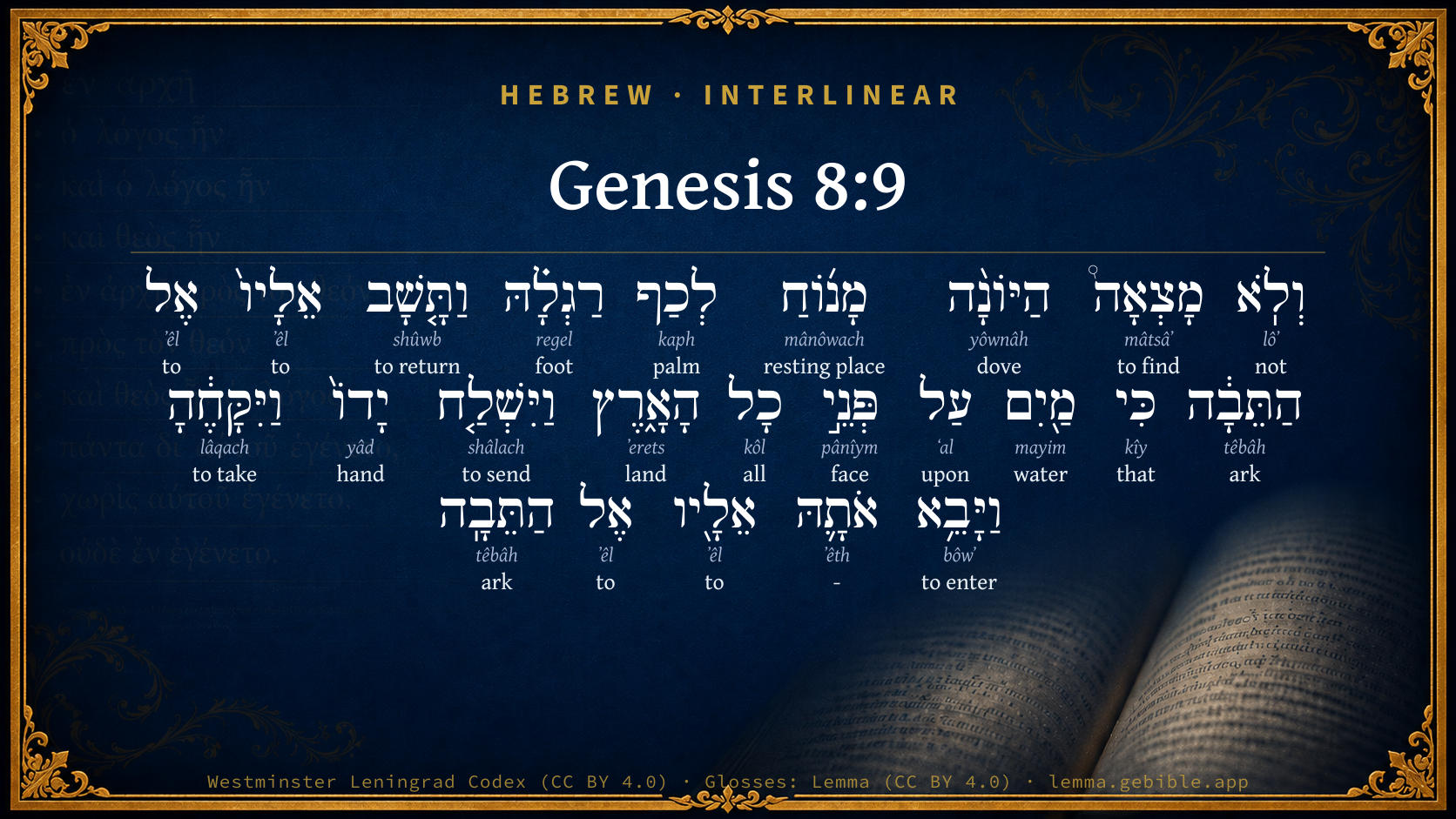
Genesis 8:9

Hebrew (Westminster Leningrad Codex) Genesis 8:9 appears in the Hebrew Old Testament. The text above is from the Westminster Leningrad Codex. Each word links to its Strong’s number, a concise gloss, and parsing drawn from the Open Scriptures Hebrew Bible morphology. Click any word for its full Brown-Driver-Briggs (BDB) entry.
Download image
Cite this verse

Genesis 8:9 (World English Bible). Public Domain. Lemma interlinear Bible study tool, https://lemma.gebible.app/v/genesis/8/9.

Show BibTeX & RIS
BibTeX
RIS
English Translation
but the dove found no place to rest her foot, and she returned to him into the ark; for the waters were on the surface of the whole earth. He put forth his hand, and took her, and brought her to him into the ark.
World English Bible · Public Domain
Highlights
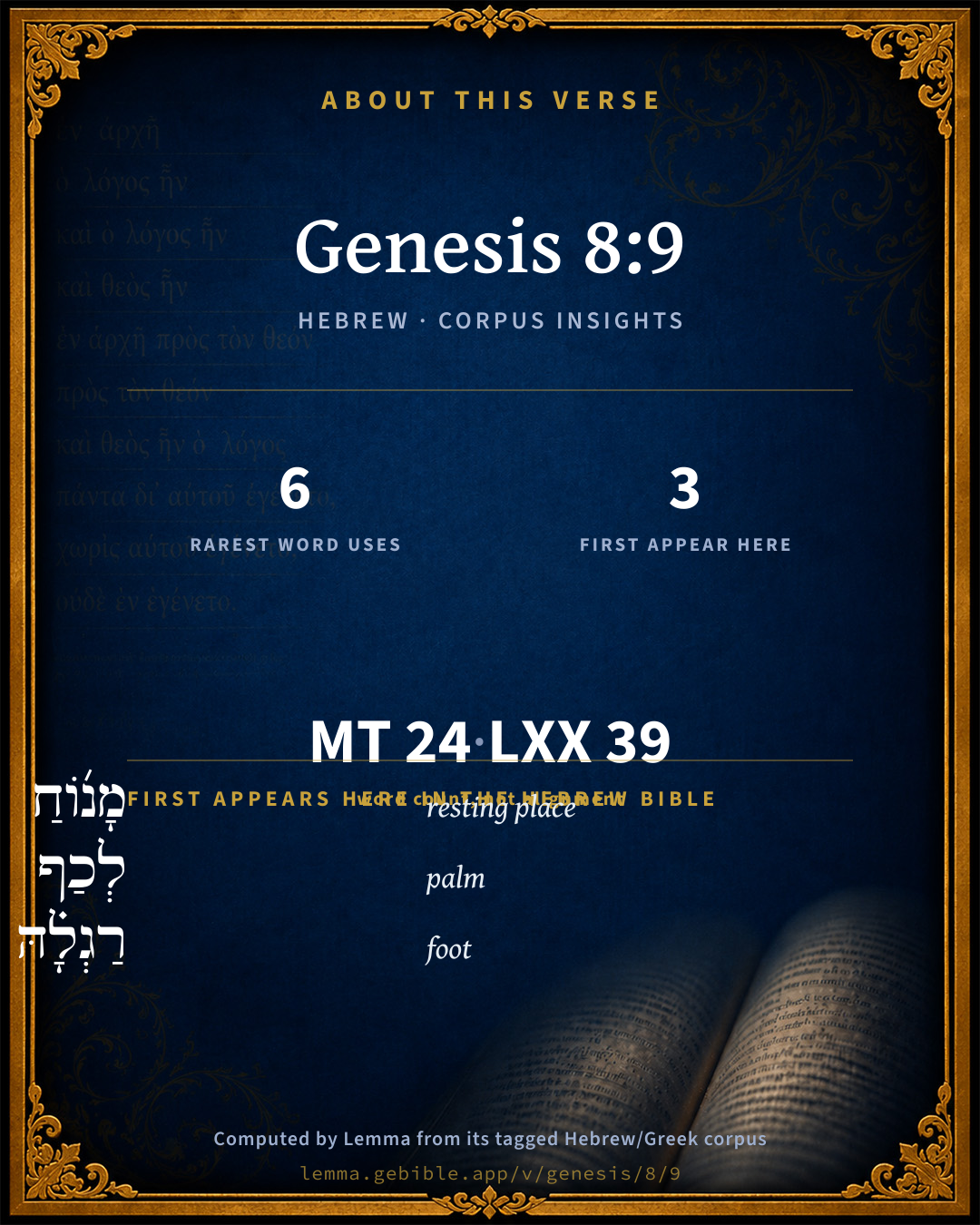
  • 3 first appearances in the Hebrew Bible
Full analysis ↓
Download a study sheet

One document with this verse’s original text, its word-by-word gloss line, the meaning frame, cross-references with their text, attributed commentary, and full source and license credits — printable, and it pastes into notes with its structure intact.

This verse Autodidact and up

Study sheet (.html) Plain text (.txt)

A passage Seminary Student

Up to 50 verses in one chapter. A passage sheet keeps up to 6 commentary sources and 12 cross-references per verse, in the order this page ranks them, and says so on the sheet whenever that leaves anything out. Ask for a single verse and you get the Autodidact verse sheet above.

Everything on this page stays free to read, with no account — the sheet is a download of what is already on screen, not access to it.

Want to remove ads? Support Godless Engineer
Compare translations 3

The same verse in 3 English versions, stacked beneath the original-language interlinear above. Click any original word for its lexicon entry.

Each is an independent rendering of the whole verse — the interlinear is not word-aligned to these translations.

Highlighted words mark where these versions differ — a whole-verse word diff, not a word-by-word alignment.

  • World English Bible Public Domain
    but the dove found no place to rest her foot, and she returned to him into the ark; for the waters were on the surface of the whole earth. He put forth his hand, and took her, and brought her to him into the ark.
  • King James Version Public Domain
    But the dove found no rest for the sole of her foot, and she returned unto him into the ark, for the waters were on the face of the whole earth: then he put forth his hand, and took her, and pulled her in unto him into the ark.
  • unfoldingWord Literal Text CC BY-SA 4.0
    But the dove did not find a resting place for the sole of its foot, so it returned to him in the ark, for the waters over the face of all of the earth. And he reached out his hand and took it and brought it to him into the ark.

unfoldingWord Literal Text — © unfoldingWord, licensed CC BY-SA 4.0. Word-aligned USFM3 via Door43 (git.door43.org/unfoldingWord/en_ult).

Versions to compare (up to 4)

3 of 4 selected

Show all 18 translations

Every available English version of this verse, each an independent rendering of the whole verse.

  • World English Bible Public Domain
    but the dove found no place to rest her foot, and she returned to him into the ark; for the waters were on the surface of the whole earth. He put forth his hand, and took her, and brought her to him into the ark.
  • Berean Standard Bible Public Domain
    But the dove found no place to rest her foot, and she returned to him in the ark, because the waters were still covering the surface of all the earth. So he reached out his hand and brought her back inside the ark.
  • Majority Standard Bible Public Domain
    But the dove found no place to rest her foot, and she returned to him in the ark, because the waters were still covering the surface of all the earth. So he reached out his hand and brought her back inside the ark.
  • King James Version Public Domain
    But the dove found no rest for the sole of her foot, and she returned unto him into the ark, for the waters were on the face of the whole earth: then he put forth his hand, and took her, and pulled her in unto him into the ark.
  • American Standard Version (1901) Public Domain
    but the dove found no rest for the sole of her foot, and she returned unto him to the ark; for the waters were on the face of the whole earth: and he put forth his hand, and took her, and brought her in unto him into the ark.
  • Revised Version (1885) Public Domain
    but the dove found no rest for the sole of her foot, and she returned unto him to the ark, for the waters were on the face of the whole earth: and he put forth his hand, and took her, and brought her in unto him into the ark.
  • Geneva Bible (1599) Public Domain
    But the doue found no rest for the sole of her foote: therefore she returned vnto him into the Arke (for the waters were vpon the whole earth) and he put forth his hand, and receiued her, and tooke her to him into the Arke.
  • Douay-Rheims (1899) Public Domain
    But she, not finding where her foot might rest, returned to him into the ark: for the waters were upon the whole earth: and he put forth his hand, and caught her, and brought her into the ark.
  • Young's Literal Translation Public Domain
    and the dove hath not found rest for the sole of her foot, and she turneth back unto him, unto the ark, for waters `are' on the face of all the earth, and he putteth out his hand, and taketh her, and bringeth her in unto him, unto the ark.
  • Literal Standard Version CC BY-SA 4.0
    and the dove has not found rest for the sole of her foot, and she turns back to him, to the Ark, for waters [are] on the face of all the earth, and he puts out his hand, and takes her, and brings her in to him, into the Ark.
  • Unlocked Literal Bible CC BY-SA 4.0
    but the dove found no place to rest her foot, and she returned to him in the ark, for the waters were still covering the whole earth. He reached out with his hand, and took and brought her into the ark with him.
  • unfoldingWord Literal Text CC BY-SA 4.0
    But the dove did not find a resting place for the sole of its foot, so it returned to him in the ark, for the waters over the face of all of the earth. And he reached out his hand and took it and brought it to him into the ark.
  • Darby Bible Public Domain
    But the dove found no resting-place for the sole of her foot, and returned to him into the ark; for the waters were on the whole earth; and he put forth his hand, and took her, and brought her to him into the ark.
  • World Messianic Bible Public Domain
    but the dove found no place to rest her foot, and she returned into the ship to him, for the waters were on the surface of the whole earth. He put out his hand, and took her, and brought her to him into the ship.
  • Webster's Bible Public Domain
    But the dove found no rest for the sole of her foot, and she returned to him into the ark; for the waters were on the face of the whole earth. Then he put forth his hand, and took her, and pulled her in to him into the ark.
  • Free Bible Version CC BY-SA 4.0
    But the dove couldn't find anywhere to land. So it came back to Noah in the ark because water was still covering the whole earth. He reached out his hand, picked up the dove, and took it back into the ark with him.
  • Bible in Basic English Public Domain
    But the dove saw no resting-place for her foot, and came back to the ark, for the waters were still over all the earth; and he put out his hand, and took her into the ark.
  • JPS Tanakh (1917) Public Domain
    But the dove found no rest for the sole of her foot, and she returned unto him to the ark, for the waters were on the face of the whole earth; and he put forth his hand, and took her, and brought her in unto him into the ark.

Literal Standard Version (2020), Covenant Press — licensed CC BY-SA 4.0. Text via the HelloAO Bible API (eBible.org). Unlocked Literal Bible (unfoldingWord) — licensed CC BY-SA 4.0. Text via the HelloAO Bible API (eBible.org). unfoldingWord Literal Text — © unfoldingWord, licensed CC BY-SA 4.0. Word-aligned USFM3 via Door43 (git.door43.org/unfoldingWord/en_ult). Free Bible Version, Dr. Jonathan Gallagher — licensed CC BY-SA 4.0. Text via the HelloAO Bible API (eBible.org).

Word by word

More ways to search: Search by grammar → Find every occurrence → Compare this word →

Practice this passage: Drill this verse → Learn its vocabulary →

מָנ֜וֹחַ
mânôwach
H4494
“resting place”
Noun, Common, Both, Singular, Absolute
Part of Speech
Noun
Type
Common
Gender
Both
Number
Singular
State
Absolute
Full BDB Definition

Origin: from H5117

TWOT: 1323e

resting place, state or condition of rest, place - resting place - rest, repose, condition of rest - coming to rest
  1. וְלֹֽא lôʼ H3808 “and · not” Conjunction + Particle, Negative
  2. מָצְאָה֩ mâtsâʼ H4672 “to find” Verb, Qal, Perfect, 3rd Person, Feminine, Singular
  3. הַיּוֹנָ֨ה yôwnâh H3123 “the · dove” Particle, Definite Article + Noun, Common, Feminine, Singular, Absolute
  4. לְכַף kaph H3709 “to/for · palm of” Preposition + Noun, Common, Feminine, Singular, Construct
  5. רַגְלָ֗הּ regel H7272 “foot · her” Noun, Common, Feminine, Singular, Construct + Suffix, Personal, 3rd Person, Feminine, Singular
  6. וַתָּ֤שָׁב shûwb H7725 “and · to return” Conjunction + Verb, Qal, Sequential Imperfect, 3rd Person, Feminine, Singular
  7. אֵלָיו֙ ʼêl H413 “to · him” Preposition + Suffix, Personal, 3rd Person, Masculine, Singular
  8. אֶל ʼêl H413 “to” Preposition
  9. הַתֵּבָ֔ה têbâh H8392 “the · ark” Particle, Definite Article + Noun, Common, Feminine, Singular, Absolute
  10. כִּי kîy H3588 “that” Conjunction
  11. מַ֖יִם mayim H4325 “water(s)” Noun, Common, Masculine, Plural, Absolute
  12. עַל ʻal H5921 “upon” Preposition
  13. פְּנֵ֣י pânîym H6440 “face(s) of” Noun, Common, Both, Plural, Construct
  14. כָל kôl H3605 “all of” Noun, Common, Masculine, Singular, Construct
  15. הָאָ֑רֶץ ʼerets H776 “the · land” Particle, Definite Article + Noun, Common, Both, Singular, Absolute
  16. וַיִּשְׁלַ֤ח shâlach H7971 “and · to send” Conjunction + Verb, Qal, Sequential Imperfect, 3rd Person, Masculine, Singular
  17. יָדוֹ֙ yâd H3027 “hand · his” Noun, Common, Both, Singular, Construct + Suffix, Personal, 3rd Person, Masculine, Singular
  18. וַיִּקָּחֶ֔הָ lâqach H3947 “and · to take · her” Conjunction + Verb, Qal, Sequential Imperfect, 3rd Person, Masculine, Singular + Suffix, Personal, 3rd Person, Feminine, Singular
  19. וַיָּבֵ֥א bôwʼ H935 “and · to enter” Conjunction + Verb, Hiphil, Sequential Imperfect, 3rd Person, Masculine, Singular
  20. אֹתָ֛הּ ʼêth H853 “- · her” Particle, Direct Object + Suffix, Personal, 3rd Person, Feminine, Singular
  21. אֵלָ֖יו ʼêl H413 “to · him” Preposition + Suffix, Personal, 3rd Person, Masculine, Singular
  22. אֶל ʼêl H413 “to” Preposition
  23. הַתֵּבָֽה têbâh H8392 “the · ark” Particle, Definite Article + Noun, Common, Feminine, Singular, Absolute

About this verse

These counts appear in no published source. They are computed here, from the morphology-tagged text and Lemma’s own curated glosses. What Lemma adds →

24
words
20
distinct lemmas
Pentateuch
section

Notable vocabulary

The rarest word here is מָנ֜וֹחַ resting place H4494 — appearing just 6 times in the whole Hebrew Bible.

First appearance in Scripture

These words make their first canonical appearance in the Hebrew Bible here:

  • מָנ֜וֹחַ resting place H4494
  • לְכַף palm H3709
  • רַגְלָ֗הּ foot H7272

Shared distinctive vocabulary

מָנ֜וֹחַ resting place H4494 occurs in 6 verses of the Hebrew Bible. Also found in:

Grammatical profile

  • 5 verbs
  • 11 nouns
  • 5 prepositions
  • 1 conjunction
  • 2 particles

Verb forms

  • מָצְאָה֩ Qal · Perfect
  • וַתָּ֤שָׁב Qal · Sequential Imperfect
  • וַיִּשְׁלַ֤ח Qal · Sequential Imperfect
  • וַיִּקָּחֶ֔הָ Qal · Sequential Imperfect
  • וַיָּבֵ֥א Hiphil · Sequential Imperfect

Repetition

Words recur within this verse — often emphatic in Hebrew:

  • הַתֵּבָ֔ה ark H8392 ×2
  • אֵלָיו֙ to H413 ×4

Hebrew & Septuagint length

In English translation the verse runs 45 words from the Hebrew and 44 from the Septuagint (LXX English) — closely comparable.

A rough comparison of the two English renderings, which tokenize alike — not a word-level alignment.

Word counts can differ between the Hebrew and the Greek without any difference in meaning — e.g. the Hebrew direct-object marker אֵת has no separate Greek word, and Greek often adds the article ὁ.

In the original languages it is 24 Hebrew tokens and 39 Greek tokens — but the two are counted differently (Hebrew bundles its prefixes and suffixes into one token; the Greek is in lemma form), so that isn’t a like-for-like length.

Cross-references

6

Topical passages linked to Genesis 8:9 in the Treasury of Scripture Knowledge — connected by theme and wording, ordered by reader-vote popularity; previews shown in the World English Bible.

  • Psalms 116:7 Return to your rest, my soul, For Yahweh has dealt bountifully with you.
  • Matthew 11:28 "Come to me, all you who labor and are heavily burdened, and I will give you rest.
  • Deuteronomy 28:65 Among these nations shall you find no ease, and there shall be no rest for the sole of your foot: but Yahweh will give you there a trembling heart, and failing of eyes, and pining of soul;
  • John 16:33 I have told you these things, that in me you may have peace. In the world you have oppression; but cheer up! I have overcome the world."
  • Isaiah 60:8 Who are these who fly as a cloud, and as the doves to their windows?
  • Ezekiel 7:16 But those of those who escape shall escape, and shall be on the mountains like doves of the valleys, all of them moaning, every one in his iniquity.

Cross-references courtesy of OpenBible.info (CC BY 4.0).

Hebrew and Greek witnesses Masoretic Hebrew ↔ Greek Septuagint

The same verse in the two great witnesses to the Old Testament, shown verse-for-verse.

These are two independent witnesses, not word-aligned to each other, and the Septuagint is shown in lemma (dictionary) form.

Hebrew Genesis 8:9 Masoretic · Westminster Leningrad Codex

וְלֹֽא מָצְאָה֩ הַיּוֹנָ֨ה מָנ֜וֹחַ לְכַף רַגְלָ֗הּ וַתָּ֤שָׁב אֵלָיו֙ אֶל הַתֵּבָ֔ה כִּי מַ֖יִם עַל פְּנֵ֣י כָל הָאָ֑רֶץ וַיִּשְׁלַ֤ח יָדוֹ֙ וַיִּקָּחֶ֔הָ וַיָּבֵ֥א אֹתָ֛הּ אֵלָ֖יו אֶל הַתֵּבָֽה

but the dove found no place to rest her foot, and she returned to him into the ark; for the waters were on the surface of the whole earth. He put forth his hand, and took her, and brought her to him into the ark.

World English Bible · Public Domain

Greek LXX Genesis 8:9 Septuagint · lemma form

καί οὐ εὑρίσκω ὁ περιστερά ἀνάπαυσις ὁ πούς αὐτός ὑποστρέφω πρός αὐτός εἰς ὁ κιβωτός ὅτι ὕδωρ εἰμί ἐπί πᾶς πρόσωπον πᾶς ὁ γῆ καί ἐκτείνω ὁ χείρ αὐτός λαμβάνω αὐτός καί εἰςἄγω αὐτός πρός ἑαυτοῦ εἰς ὁ κιβωτός

And the dove not having found rest for her feet, returned to him into the ark, because the water was on all the face of the earth, and he stretched out his hand and took her, and brought her to himself into the ark.

LXX2012 (modern English Septuagint) · Public Domain

Hebrew: Westminster Leningrad Codex (CC BY 4.0). Greek: Septuagint (public domain); English from LXX2012 (modern English Septuagint) (Public Domain). How the Septuagint differs from the Hebrew →

Targum (Aramaic paraphrase)

2

The Targum is the ancient Jewish Aramaic paraphrase of the Hebrew Scriptures — an interpretive translation, not the Hebrew text itself. Onkelos (literal) and Pseudo-Jonathan (expansive) render the Torah, and Jonathan the Prophets. Coverage is partial: where no permissively-licensed English translation exists for a verse, only the Aramaic is shown. This is verse-level text, not a word-by-word alignment to the Hebrew.

  1. Targum Onkelos Torah (Genesis–Deuteronomy)
    וְלָא אַשְׁכַּחַת יוֹנָה מְנַח לְפַרְסַת רַגְלַהּ וְתָבַת לְוָתֵהּ לְתֵבוֹתָא אֲרֵי מַיָּא עַל אַפֵּי כָל אַרְעָא וְאוֹשִׁיט יְדֵהּ וְנָסְבַהּ וְאָעֵיל יָתַהּ לְוָתֵהּ לְתֵבוֹתָא

    But the dove found no rest for the dividing of her foot, and she returned unto him into the ark, because the waters were upon all the earth; and he stretched forth his hand, and took her, and brought her to be with him in the ark.

    Targum Onkelos — Aramaic: “Onkelos Genesis” (public domain); “Onkelos Exodus” (public domain); “Onkelos Leviticus” (public domain); “Onkelos Numbers” (public domain); “Onkelos Deuteronomy” (public domain). English: “Sefaria Community Translation” (CC0 1.0 (public-domain dedication)); “J.W. Etheridge. The Targums of Onkelos and Jonathan Ben Uzziel on the Pentateuch. London: Longmans, Green, 1862” (public domain). Text via Sefaria.

  2. Targum Pseudo-Jonathan Torah (Genesis–Deuteronomy)
    וְלָא אַשְׁכַּחַת יוֹנְתָא נַיְיחָא לְפַרְסַת רִיגְלָהּ וְתָבַת לְוָתֵיהּ לְתֵיבוּתָא וְאוֹדָעַת אֲרוּם מוֹי עַל אַנְפֵּי כָּל אַרְעָא וְאוֹשִׁיט יְדֵיהּ וּנְסֵיבְתָּהּ וְאָעֵיל יָתָהּ לְוָתֵיהּ לְתֵיבוּתָא

    And the dove found no rest for the sole of the foot, and returned unto him to the ark; and he knew that the waters were (yet) upon the face of all the earth. And he reached out his hand, and took and brought her unto him into the ark.

    Targum Pseudo-Jonathan — Aramaic: “Targum Jonathan on Genesis” (public domain); “Targum Jonathan on Exodus” (public domain); “Targum Jonathan on Leviticus” (public domain); “Targum Jonathan on Numbers” (public domain); “Targum Jonathan on Deuteronomy” (public domain). English: “The Targum of Jonathan ben Uzziel, trans. J. W. Etheridge, London, 1862” (public domain). Text via Sefaria.

Commentary

Notes on Genesis 8:9 from classic Christian and Jewish commentators (each source and its license shown beneath its notes). The classic Christian expositions comment on the surrounding passage and are grouped to its opening verse, so a note may address several verses; the Jewish commentaries on the Tanakh (Rashi and others) are per-verse, so they appear only where the commentator wrote on this verse.

Lemma curates 59 commentaries, every one of them public domain or Creative Commons licensed, each selected and text-cleaned for this edition rather than reprinted as found. About our sources →

Trapp's Complete Commentary

John Trapp

Gen 8:9 But the dove found no rest for the sole of her foot, and she returned unto him into the ark, for the waters [were] on the face of the whole earth: then he put forth his hand, and took her, and pulled her in unto him into the ark.

Ver. 9. And the dove found no rest.] No more doth man’s soul (God’s turtle) till it rest in God. Domine , saith St Augustine, fecisti nos ad te, ideoque cor nostrum inquietam est, donec requieverit in te. Hic finis nostrae formationis , saith another, ut homo sit templum Dei, et Deus ara hominis . How oft doth the good soul cry, "Oh that I had the wings of a dove!" &c. {Psa 55:6} Or, if that "Oh" will not set him at liberty, she takes up that "Woe" to express her misery: "Woe is me that I sojourn in Mesech," &c. {Psa 120:5} {a}

{a} "My heart panteth," {Psa 38:10} סחרהר, as merchants run from country to country. - Bucholc.

John Trapp, A Commentary or Exposition upon All the Books of the Old and New Testament (1647–1656) — public domain. Text from a community e-Sword module.

The Biblical Illustrator

Joseph S. Exell

Gen_8:9-12

But the dove found no rest for the sole of her foot and she returned unto him into the ark

The doves return to the ark

I.

LOOK AT THE DOVE SETTING OUT UPON HER VOYAGE OF DISCOVERY. Why did she fly away?

1. Because she had wings. Natural instinct. So it is with us. Our soul has many thoughts and many powers which make the spirit restless. If we were without imagination, we might be content with the few plain truths which we have so well known and proved; but having an imagination, we are often dazzled by it, and we pant to know whether certain things which look like solid verities really are so. If we had no reason, but could abide entirely in a state of pure and simple faith, we might not be exposed to much of the restlessness which now afflicts us, but reason will draw conclusions, ask questions, suggest problems, raise inquiries, and vex us with difficulties. Therefore, because our souls are moved by so vast a variety of thoughts, and possess so many powers which are all restless and active, it is readily to be understood, that while we are here in our imperfect state, our spirits should be tempted to excursions of research and voyages of discovery, as though we sought after some other object of love besides the one who still is dearer to us than all the world besides.

2. Possibly there was another reason. This dove was once lodged in a dovecote. Yes, the dovecote still has its attraction. The best of men have still within them the seeds of those sins which make the worst of men so vile. I marvel not that the dove flew away from the ark when she recollected her dovecote, and I do not wonder that at seasons, the old remembrances get the upper hand with our spirit, and we forget the Lord we love, and have a hankering after sin.

3. Yet it would not be fair to forget that this dove was sent out by Noah; so that whatever may have been the particular motives which ruled the creature, there was a higher motive which ruled Noah who sent her out. Even so there are times when the Lord permits His people to endure temptation.

II. Now MARK THE DOVE AS SHE FINDS NO REST. No rest outside of Christ for intellect, heart, conscience

III. WHY THE DOVE COULD FIND NO REST FOR THE SOLE OF HER FOOT.

1. The dove had a will to find rest for the sole of her foot, but she could not. It is not from want of will that I am compelled to say I cannot find anything beneath these stars, nor within the compass of the skies, that can satisfy my souls desires; I must get my God and have Him to fill my large expectations, or I shall not be content. I mention these things because people are apt to suppose that Christians are all a set of melancholy dyspeptics, who put up with religion because there is nothing else that helps to make them to be so happily miserable, and therefore they take to it as congenial with their melancholy disposition; but it is not so; we are a cheerful, genial race, and yet for all that we are not resting the sole of our foot anywhere in earthly things.

2. Again, the reason why the dove could find no rest, was not because she had no eye to see. I know not how far a doves eye can discern, but it must be a very vast distance, perfectly incredible I should think. We see the dove sometimes mount aloft: we can see nothing, and yet she perceives her dovecote, and darts towards it. I know many Christians who are as quick in apprehension as refined in taste, and as ready to appreciate anything that is pleasurable as other men, and yet these men who are not fanatics, who are not shut up to a narrow range of things, but whose vision can take in the whole circle of sublunary delights, these men who have not only seen but even tasted, yet bear their witness that like the dove they can find no rest for the sole of their foot.

3. Moreover, the reason why the dove found no rest, was not because she had no wings to reach it. So the Christian has power to enter into the enjoyments of the world if he liked. Now, what was the reason then? It was not want of will, it was not want of eye, nor was it want of wing--what was it? The reason lay in this, that she was a dove. If she had been a raven, she would have found plenty of rest for the sole of her foot. It was her nature that made her unresting, and the reason why the Christian cannot find satisfaction in worldly things is because there is a new nature within him that cannot rest. Up! up! up! cries the new heart, what hast thou to do here?

IV. Being disappointed, WHAT DID THE DOVE THEN DO? When she found there was no contentment elsewhere, what then? She flew back to the ark. Josephus tells us that the dove came back to Noah, with her wings and feet all wet and muddy. Some of you have grown wet and muddy. You have been trying to find rest in the world, Christian, and you have got mired with it.

V. I want you now to turn your eye for a moment to THE VERY BEAUTIFUL SCENE, So it seems to me to be, at the end of her return journey. Noah has been looking out for his dove all day long. Mark that: pulled her in unto him. It seems to me to imply that she did not fly right in herself, but was too fearful, or too weary. Did you ever feel that blessed gracious pull, when your heart has been desiring to get near to Christ? Lord! pull me in. (C. H.Spurgeon.)

The homebound dove--a lesson of faith

God has designed but one resting place for the soul, and that is the restoration of peace between it and Himself. On Jesus breast we may lay our weary heads. Here at last the dove finds a sure perch.

I. AS IT WANDERED TO AND FRO, IT COULD FIND REST NOWHERE SAVE BY RETURNING TO THE ARK. There, and only there, was rest. Oh, weary soul, have you Bet come to that point? You will not come until you give up all confidence in your self-power.

II. When the dove came back, IT CAME WITHOUT ANYTHING. Bring no excuse.

III. God had provided but ONE ARK. Only one name under heaven given among men, whereby we must be saved.

IV. That ark had only ONE WINDOW AND THAT WINDOW WAS OPEN. A woman, who was striving to find rest for her soul, was sitting in her summer house, when in through an open door flew a bird. It was alarmed, and flew up toward the roof, and tried to get out at this window and at that. It flew from side to side until it panted with fright and weariness. The woman said, Poor bird, why do you not come down lower, then you would see this open door, and you could fly out easily? But the bird kept wounding itself against the closed windows and at every crevice. At last its wings grew tired, and it flew lower and lower until it was on a level with the open door, when quickly it escaped, and soon its song was heard in the trees of the churchyard near by. A new light dawned upon the mind of the woman: I, like that poor bird, through my pride and self-sufficiency, have been flying too high to see the door which stands wide open. Her heart was humbled, and soon she too was singing songs of gladness. (T. L.Cuyler, D. D.)

If we, cannot be as we would, we must be as we can

The ark to the dove was like a prison, a place of restraint, and not according to her kind, which was to fly abroad; yet, finding no rest, rather than she will perish, she returneth to the same again. It may teach us this, that better is a mischief than an inconvenience, if we cannot as we would, we must as we can. I speak it against all heathenish and unchristian like impatience. The heathens, rather than they would serve, they would kill themselves. And many in these days, rather than they will suffer what God imposeth, will do what God detesteth. Let it not be so. If we cannot be abroad and at liberty, because Gods judgment against sin hath taken away our footing in such or such sort, whilst it shall please Him let us be content; return, as the clove did, to the place appointed, and thank Him for mercy even in that, that yet there we live, and are not destroyed as others have been. (Bishop Babington.)

A quaint epitaph

The following quaint epitaph has reference to a little girl buried at the age of five months: But the dove found no rest for the sole of her foot, and she returned unto him into the ark. (Old Testament Anecdotes.)

An olive leaf

The olive leaf

I. Let us look at the profound, far-reaching SIGNIFICANCE OF THE GREEN LEAF in the mouth of the dove, as the first production of a new and regenerated world.

1. In the first plaice, the green leaf is the great purifier of nature. This is one of the most important offices which it was created to fulfil. In the early ages of the earth, long before man came upon the scene, the atmosphere was foul with carbonic acid gases, so poisonous that a few inspirations of them would be sufficient to destroy life. These formed a dense covering which kept in the steaming warmth of the earth, and nourished a rank and luxuriant vegetation. Gigantic ferns, tree mosses, and reeds grew with extraordinary rapidity, and absorbed these noxious gases into their own structures, consolidating them into leaves, stems, and branches, which in the course of long ages grew and decayed, and by subtle chemical processes and mechanical arrangements were changed into coal beds under the earth. In this wonderful way two great results were accomplished at the same time and by the same means--the atmosphere was purified and made fit for the breathing of man, and animals useful to man, and vast stores of fuel were prepared to enable future generations to subdue the earth and spread over it the blessings of civilization. And what the green leaves of the early geological forests did for the primeval atmosphere of the world, the green leaves of our woods and fields are continually doing for our atmosphere still. They absorb the foul air caused by the processes of decay and combustion going on over the earth, and by the breathing of men and animals, and convert this noxious element into the useful and beautiful products of the vegetable kingdom. They preserve the air in a condition fit for human breathing. These considerations will show us how significant it was that the first object of the new world that was about to emerge from the flood should be a green leaf. It was a symbol, a token to Noah that the world would be purified from the pollution of those unnatural sins which had brought death and destruction upon it, and would once more be fitted to be the home of a peculiar people zealous of good works. What the green leaf is in nature the leaves of the tree of life are in the spiritual sphere. The gospel of Jesus Christ, which the Heavenly Dove carries to the homes and the hearts of men, is the great purifier of the world.

2. In the second place, the green leaf is the source of all the life of the world. It is by its agency alone that inert inorganic matter is changed into organic matter, which furnishes the starting point of all life. Nowhere else on the face of the earth does this most important process take place. Everything else consumes and destroys. The green leaf alone conserves and creates. In this light how suitable it was that an olive leaf freshly plucked should have been the first object brought to Noah in the ark! For just as the green leaf is the means in the natural world of counteracting all the destructive forces that are reducing its objects to dust and ashes, and clothing its surface with vegetable and animal life, so the olive leaf in the mouth of the dove spoke to Noah of the undoing of the work of destruction caused by the flood, and of the raising up of a new and fairer creation out of the universal wreck. And just as all this beautiful world of life and joy is the product of the work of the green leaf, so all that mankind has achieved and enjoyed since the flood--the great results of civilization and the still greater results of redemption--arose out of the work of grace whose dawning the green leaf intimated, and whose operation it typified. For sin and grace are in constant antagonism--like the force of the fire that burns everything to ashes, and the force of the green leaf that builds up life and beauty out of the ashes; and God has suffered sin to continue because He knows that grace can conquer it, strip its spoils, and convert its ruins into higher and nobler forms of life.

3. In the third place, the green leaf is the best conductor of electricity--that most powerful and destructive of all the forces of the earth. A twig covered with leaves, sharpened by natures exquisite workmanship, is said to be three times as effectual as the metallic points of the best constructed rod. And when we reflect how many thousands of these vegetable points every large tree directs to the sky, and consider what must be the efficacy of a single forest with its innumerable leaves, or of a single meadow with its countless blades of grass, we see how abundant the protection from the storm is, and with what care Providence has guarded us from the destructive force. And was not that green leaf which came to Noah in the ark Gods lightning conductor? Did it not bear down harmlessly the destructive power of heaven? Did it not assure Noah that the wrath of God was appeased, that the storm was over, and that peace and safety could once more be enjoyed upon the earth? And is not He to whose salvation that leaf pointed--who is Himself the Branch--Gods lightning conductor to us? He bore the full force of the Fathers wrath due to sin; He endured the penalty which we deserved; and having smitten the shepherd, the sheep for whom He laid down His life are deathless and unharmed. He is now our refuge from the storm; and under His shadow we are safe from all evil.

4. In the fourth place, the green leaf is the source of all the streams and rivers in the world. It is by the agency of the leaf that water circulates as the life blood of the globe. And how appropriately in this light did the green leaf come to Noah as the earnest and the instrument of the rearrangement of a world which had been reduced to a desert by the punishment of mans sin! That leaf assured him that the old rivers would flow again; that the former fields would smile anew; that the forests would, as in previous times, cover the earth with their shadow; and that all the conditions of seed time and harvest, and of a pleasant and useful home for man, would be present as of yore. And is not the Heavenly Dove bringing to us in the ark of our salvation a leaf of the tree of life, whose leaves are for the healing of the nations, as a token that beyond the destructive floods of earth, beyond the final conflagration in which all things shall be burned up, the river of life will flow again; and amid the green fields of the paradise restored the Lamb shall lead us to living fountains of waters, and God shall wipe away all tears from our eyes?

5. In the fifth place, the green leaf is the type upon which the forms of all life are moulded, All organisms, whether animal or vegetable, are similar in their elementary structure and form; and the most complicated results are attained by the simplest conceivable means, and that without the slightest violation of the original plan of nature. Thoreau has said that the whole earth is but a gigantic leaf, in which the rivers and streams resemble the veins, and the mountains and plains the green parts: And did not He who sent the dove with the olive leaf to Noah thereby assure him that out of that leaf would be evolved the whole fair world of vegetable and animal life, which for a while had perished beneath the waters of the flood; that it would be reconstructed upon the old type and developed according to the old pattern? And did not He who developed this great world of life out of the single leaf develop all the great scheme of grace, all the wondrous history of redemption, out of the first simple promise to our first parents after their fall? Amid all the varying dispensations of His providence He has been without variableness or shadow of turning, unfolding more and more the germinating fulness of the same glorious plan of grace.

II. Of all the green leaves of the earth it was MOST FITTING THAT THE OLIVE LEAF SHOULD HAVE BEEN SELECTED as the first product of the new restored world. The olive tree spreads over a large area of the earth; it combines in itself the flora of the hills and the plains. It clothes with shade and beauty and slopes where no other vegetation would grow. It extracts by a vegetable miracle nourishment and fatness from the driest air and the barest rock; on it may be seen at the same time opening and full-blown blossoms, and green and perfectly ripe fruit. Each bough is laden with a wealth of promise and fulfilment; beauty for the eye and bounty for the palate. No tree displays such a rich profusion and succession of flowers and fruits. It is the very picture of prosperity and abundance. Its very gleanings are more plentiful than the whole harvest of other trees. It strikingly illustrates, therefore, the overflowing goodness of the Lord, to whom belong the earth and the fulness thereof. What the olive leaf began in Noahs case was consummated under the olive trees of Gethsemane. He who destroyed the antediluvian sinners by the flood endured the contradiction of greater and more aggravated sinners against Himself. He who sent the flood as a punishment for sin, now suffered it Himself in a more terrible form as an atonement for sin. The olive leaf of Noahs dove showed that Gods strange work was done, and that He had returned to the essential element of His nature, and love shone forth again. The olive leaves of Gethsemane, that thrilled with the fear of the great agony that took place beneath them, tell us that God so loved the world that He gave His only begotten Son, that whosoever believeth in Him should not perish, but have everlasting life. What sweeter message, what dearer hope, could come to us in our sins and sorrows than this! (H. Macmillan, D. D.)

Lessons

1. Gods delay of answer and His saints waiting are fitly coupled.

2. Gods gracious ones are of a contented, waiting and hoping frame.

3. Faith will expect from seven to seven, from week to week, to receive answers of peace from God.

4. After waiting, faith will make trial of lawful means again and again. It will add messenger to messenger (Gen_8:10).

5. Waiting believers shall receive some sweet return by use of means in Gods time.

6. He that sends out for God is most likely to have return from Him.

7. Visible tokens of Gods wrath ceasing sometimes He is pleased to vouchsafe to His.

8. It concerns Gods saints to consider His signal discoveries of grace, to know them, and gather hope and comfort from them. (G. Hughes, B. D.)

Servants good and bad

First, mark the often sending of the dove, when the raven goeth but once. It showeth the difference of a good servant and a bad. The first is often used, because he is faithful and true; the latter but once, because then he is found to be a raven, more heeding the carrions that his nature regardeth than performing his message which his sender desireth. The praise of these two fowls, how they differ in this place for their service we all see, and it should thus profit us as to prick us to the good and affray us from the evil. In some place or other we are all servants, as these fowls were, to God, to prince, to master, to some or other. Let us be doves, that they may often use us; let us not be ravens, that they may justly refuse us. Secondly, in the doves not returning any more let us mark a type of the saints of God, that having sundry times discharged the truth of their places, as the dove did, at last have their departure out of the ark--that is, out of this life and Church militant--and, finding rest for their foot in Gods blessed kingdom, return no more to the ark again, but there continue and abide forever. (Bp. Babington.)

The returning dove

Noah stayed upon this seven days, and then sent out the dove again, saith the text, which returned to him in the evening, bringing in her mouth an olive leaf which she had plucked, whereby Noah knew the waters were abated. This dove may note the preachers also of the Word again, who bring in their mouths some good tidings to the ark--that is, to the Church; and every good news may be compared also to an olive leaf, and the tellers to doves. That good news that the women brought to the disciples, that Christ was risen, was like an olive leaf in their mouths, and they like this dove in this place. So all others. Read 2Ki_7:1-20, of the good news of the lepers, and 2Sa_18:27. He is a good man, saith David, and cometh with good tidings. So good men and women have words of comfort in their mouths, when others have the poison of asps under their tongues; they have olive leaves to cheer up Noah and his company withal, when others have wormwood and gall to make their hearts ache with the bitterness thereof. Such does God make us evermore, and if this be regarded of us, we will endeavour it. (Bp. Babington.)

The Biblical Illustrator, edited by Joseph S. Exell (c. 1880s–1900s) — public domain. Text from a community e-Sword module.

Geneva Bible (1599)

Geneva Bible translators

It is like that the raven did fly to and fro, resting on the Ark, but came not into it, as the dove that was taken in.

Geneva Bible (1599) marginal notes — public domain. Text via Bolls.life.

The Cambridge Bible for Schools and Colleges

gen. ed. J. J. S. Perowne

9. no rest] Compare the Babylonian description, “the dove went to and fro; as there was no resting-place, it turned back.” Clearly the account in these verses implies that only water was visible: it represents an earlier stage than that in Gen_8:5 (P).

put forth his hand] The description is one of great beauty and simplicity. The dove trusted Noah: the ark was its only home. The dove was only for a short time absent from the ark.

The Cambridge Bible for Schools and Colleges (gen. ed. J. J. S. Perowne; Cambridge University Press, 1878–1918) — public domain. Text from a community e-Sword module.

John Gill's Exposition

But the dove found no rest for the sole of her foot, and she returned unto him into the ark,.... It being a creature that feeds upon seeds it picks off from the ground, and loving cleanness, it could find no place where it could alight, and have food to live upon, and retain its cleanness; for though the tops of the mountains were clear of the waters, yet they might be muddy and filthy with what the waters had raised up in them, or left upon them; and therefore it returned to Noah again, and not only like the raven unto the ark, but into it:

for the waters were on the face of the whole earth: there was no place dry, and so neither food nor footing for this creature; and which was an emblem of a sensible sinner, who finds no rest in anything short of Christ; not in worldly enjoyments; nor in external duties, not in hearing, reading, praying, fasting, nor in external humiliation and tears; nor in the law, and in the works of it; nor in natural descent, nor in education principles, nor in a profession of religion, and subjection to ordinances; only in Christ, where it finds rest from the burden and guilt of sin, and the tyrannical power of it; from the bondage, curse, and condemnation of the law, and from a sense of divine wrath and fear of it; and though not from afflictions, yet it finds rest in Christ amidst them:

then he put forth his hand and took her, and pulled her in unto him into the ark: she hovered about it, and got near the window, which Noah opened and took her in; which may represent the gracious reception sensible souls meet with from Christ, who apply to him; he kindly embraces them, and they find room in his heart and affections, fulness of everything they want, and security from all danger.

John Gill's Exposition of the Whole Bible (1746–1763) — public domain (CC PDM 1.0). Text via the HelloAO Bible API.

Haydock's Catholic Bible Commentary

Whole earth, excepting the mountains; so that the dove presently returned. (Haydock)

George Leo Haydock (1774–1849), Haydock's Catholic Family Bible and Commentary, 1859 edition — public domain. Excludes Psalms (Douay-Rheims chapter numbering differs from Protestant) and Deuterocanonical books (Catholic canon only).

Matthew Poole's English Annotations

The dove found no rest for the sole of her foot; because the tops of the hills which then appeared were either muddy and dirty, or unobserved by the dove, as not soaring so high; whence the doves are emphatically called the doves of the valleys, Eze 7:16.

He took her, and pulled her in; her former acquaintance with Noah, and her present necessity, making her more tractable.

Matthew Poole's English Annotations on the Holy Bible (1683–1685) — public domain. Text from a community e-Sword/MySword module.

Whedon's Commentary on the Bible

Daniel D. Whedon

9. No rest for the sole of her foot — The state of the earth is thus graphically and beautifully described. The delicate dove, the bird of the plains, finding no clean dry place on which to alight, and nothing fit for her food, instinctively returned to the window from which she was sent forth. The mountain summits were bare, but the desolate scene was as yet only a fit abode for the raven. May we not find here the origin of the heathen practice of bird divination?

Daniel D. Whedon (gen. ed.), Commentary on the Old and New Testaments (1874–1909) — public domain. Text from a community e-Sword module.

Ramban (Nachmanides)

Rabbi Moshe ben Nachman (Ramban / Nachmanides)

AND THE DOVE FOUND NO REST. It is not customary for fowl to rest on the tops of the high mountains on the earth which are bare of trees and surely not when the waters were on the face of the whole earth. Therefore, the dove found no rest suitable for her. But as soon as she saw the trees she went her own way for in their branches she would build her nest.

Ramban (Nachmanides) on the Tanakh — English translation: “Commentary on the Torah by Ramban (Nachmanides). Translated and annotated by Charles B. Chavel. New York, Shilo Pub. House, 1971-1976” (CC BY 4.0). Text via Sefaria.

Lesson kit

Teaching starters — assembled from the data on this page, not authored interpretation. Every prompt links to the verse data it draws on. Edit before teaching.

Genesis, in the Pentateuch, opens this verse with 24 words (20 distinct Hebrew lemmas). Its most distinctive word is mânôwach (“resting place”). A historical commentator’s framing appears above. Read the whole chapter for the surrounding context.

Discussion questions

  1. How does “resting place” (mânôwach) shape what this verse is saying?
  2. 3 words make their first appearance in Scripture here. What does this debut establish?
  3. How does Deuteronomy 28:65, which shares the word «resting place», read alongside this verse?
  4. What does the repetition of “ark” (2× in this one verse) do in this verse?
  5. The translations on this page render this verse differently — a whole-verse word diff, not a word-by-word alignment. What might account for the different wordings?
  6. «מָצְאָה֩» is a Qal Perfect verb. How does that grammatical form shape the action described?
  7. Compare how Trapp's Complete Commentary and The Biblical Illustrator read this verse. Where do they agree or differ?

Things to notice

Reading settings

Reading text

Shown beneath each verse's original-language words.

Old Testament
Old Testament edition

Read the OT as the Masoretic Hebrew (MT) or the Greek Septuagint (LXX).

English shown for the Greek Septuagint (in the Hebrew ↔ Greek comparison).

Comparing translations? Open the Compare panel on any verse page to stack up to four side by side.