
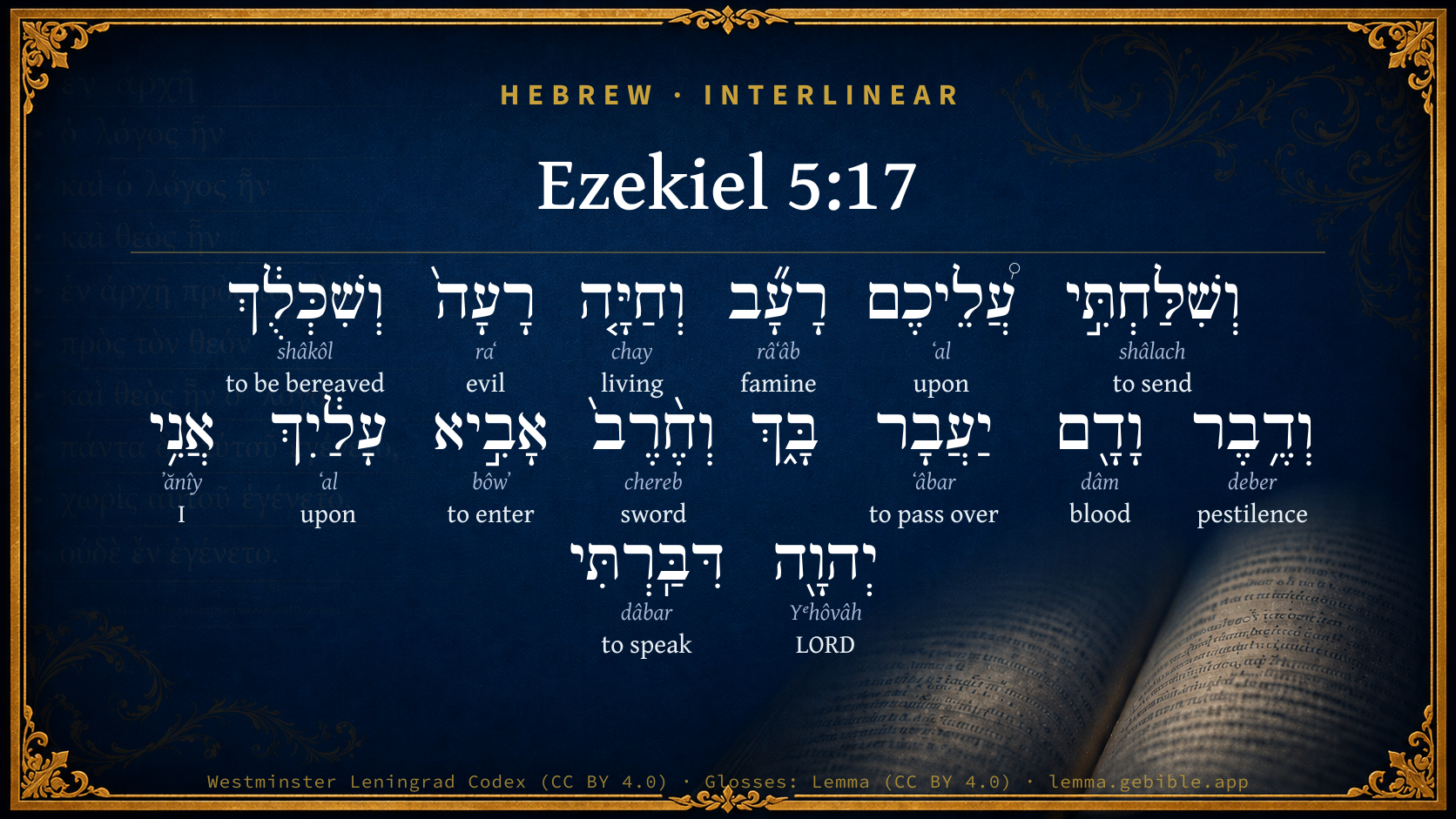
Ezekiel 5:17

Hebrew (Westminster Leningrad Codex) Ezekiel 5:17 appears in the Hebrew Old Testament. The text above is from the Westminster Leningrad Codex. Each word links to its Strong’s number, a concise gloss, and parsing drawn from the Open Scriptures Hebrew Bible morphology. Click any word for its full Brown-Driver-Briggs (BDB) entry.
Download image
Cite this verse

Ezekiel 5:17 (World English Bible). Public Domain. Lemma interlinear Bible study tool, https://lemma.gebible.app/v/ezekiel/5/17.

Show BibTeX & RIS
BibTeX
RIS
English Translation
and I will send on you famine and evil animals, and they shall bereave you; and pestilence and blood shall pass through you; and I will bring the sword on you: I, Yahweh, have spoken it.
World English Bible · Public Domain
Download a study sheet

One document with this verse’s original text, its word-by-word gloss line, the meaning frame, cross-references with their text, attributed commentary, and full source and license credits — printable, and it pastes into notes with its structure intact.

This verse Autodidact and up

Study sheet (.html) Plain text (.txt)

A passage Seminary Student

Up to 50 verses in one chapter. A passage sheet keeps up to 6 commentary sources and 12 cross-references per verse, in the order this page ranks them, and says so on the sheet whenever that leaves anything out. Ask for a single verse and you get the Autodidact verse sheet above.

Everything on this page stays free to read, with no account — the sheet is a download of what is already on screen, not access to it.

Want to remove ads? Support Godless Engineer
Compare translations 3

The same verse in 3 English versions, stacked beneath the original-language interlinear above. Click any original word for its lexicon entry.

Each is an independent rendering of the whole verse — the interlinear is not word-aligned to these translations.

Highlighted words mark where these versions differ — a whole-verse word diff, not a word-by-word alignment.

  • World English Bible Public Domain
    and I will send on you famine and evil animals, and they shall bereave you; and pestilence and blood shall pass through you; and I will bring the sword on you: I, Yahweh, have spoken it.
  • King James Version Public Domain
    So will I send upon you famine and evil beasts, and they shall bereave thee: and pestilence and blood shall pass through thee; and I will bring the sword upon thee. I the LORD have spoken it.
  • unfoldingWord Literal Text CC BY-SA 4.0
    I will send a famine and disasters against you so you will be childless. Plague and blood will pass through you, and I will bring a sword against you—I, Yahweh, have declared this.”

unfoldingWord Literal Text — © unfoldingWord, licensed CC BY-SA 4.0. Word-aligned USFM3 via Door43 (git.door43.org/unfoldingWord/en_ult).

Versions to compare (up to 4)

3 of 4 selected

Show all 18 translations

Every available English version of this verse, each an independent rendering of the whole verse.

  • World English Bible Public Domain
    and I will send on you famine and evil animals, and they shall bereave you; and pestilence and blood shall pass through you; and I will bring the sword on you: I, Yahweh, have spoken it.
  • Berean Standard Bible Public Domain
    I will send famine and wild beasts against you, and they will leave you childless. Plague and bloodshed will sweep through you, and I will bring a sword against you. I, the LORD, have spoken.”
  • Majority Standard Bible Public Domain
    I will send famine and wild beasts against you, and they will leave you childless. Plague and bloodshed will sweep through you, and I will bring a sword against you. I, the LORD, have spoken.”
  • King James Version Public Domain
    So will I send upon you famine and evil beasts, and they shall bereave thee: and pestilence and blood shall pass through thee; and I will bring the sword upon thee. I the LORD have spoken it.
  • American Standard Version (1901) Public Domain
    and I will send upon you famine and evil beasts, and they shall bereave thee; and pestilence and blood shall pass through thee; and I will bring the sword upon thee: I, Jehovah, have spoken it.
  • Revised Version (1885) Public Domain
    and I will send upon you famine and evil beasts, and they shall bereave thee; and pestilence and blood shall pass through thee; and I will bring the sword upon thee: I the LORD have spoken it.
  • Geneva Bible (1599) Public Domain
    So will I send vpon you famine, and euill beastes, and they shall spoyle thee, and pestilence and blood shall passe through thee, and I will bring the sworde vpon thee: I the Lord haue spoken it.
  • Douay-Rheims (1899) Public Domain
    And I will send in upon you famine, and evil beasts unto utter destruction: and pestilence, and blood shall pass through thee, and I will bring in the sword upon thee. I the Lord have spoken it.
  • Young's Literal Translation Public Domain
    And I have sent on you famine and evil beasts, And they have bereaved thee, And pestilence and blood pass over on thee, And a sword I do bring in against thee, I, Jehovah, have spoken!'
  • Literal Standard Version CC BY-SA 4.0
    And I have sent famine and evil beasts on you, || And they have bereaved you, || And pestilence and blood pass over on you, || And I bring a sword in against you, || I, YHWH, have spoken!”
  • Unlocked Literal Bible CC BY-SA 4.0
    I will send a famine and disasters against you so you will be childless. Plague and blood will pass through you, and I will bring a sword against you—I, Yahweh, have declared this.”
  • unfoldingWord Literal Text CC BY-SA 4.0
    I will send a famine and disasters against you so you will be childless. Plague and blood will pass through you, and I will bring a sword against you—I, Yahweh, have declared this.”
  • Darby Bible Public Domain
    And I will send upon you famine and evil beasts, which shall bereave thee of children; and pestilence and blood shall pass through thee; and I will bring the sword upon thee: I, Jehovah, have spoken.
  • World Messianic Bible Public Domain
    I will send on you famine and evil animals, and they will bereave you. Pestilence and blood will pass through you. I will bring the sword on you. I, the LORD, have spoken it.’”
  • Webster's Bible Public Domain
    So will I send upon you famine and evil beasts, and they shall bereave thee; and pestilence and blood shall pass through thee; and I will bring the sword upon thee. I the LORD have spoken it.
  • Free Bible Version CC BY-SA 4.0
    I will send famine and wild animals to attack you. You'll have no children left. Disease and killing will sweep over you, and I will bring armies to attack you. I the Lord have spoken.”
  • Bible in Basic English Public Domain
    And I will send on you need of food and evil beasts, and they will be a cause of loss to you; and disease and violent death will go through you; and I will send the sword on you: I the Lord have said it.
  • JPS Tanakh (1917) Public Domain
    and I will send upon you famine and evil beasts, and they shall bereave thee; and pestilence and blood shall pass through thee; and I will bring the sword upon thee. I the LORD have spoken it.'

Literal Standard Version (2020), Covenant Press — licensed CC BY-SA 4.0. Text via the HelloAO Bible API (eBible.org). Unlocked Literal Bible (unfoldingWord) — licensed CC BY-SA 4.0. Text via the HelloAO Bible API (eBible.org). unfoldingWord Literal Text — © unfoldingWord, licensed CC BY-SA 4.0. Word-aligned USFM3 via Door43 (git.door43.org/unfoldingWord/en_ult). Free Bible Version, Dr. Jonathan Gallagher — licensed CC BY-SA 4.0. Text via the HelloAO Bible API (eBible.org).

Word by word

More ways to search: Search by grammar → Find every occurrence → Compare this word →

Practice this passage: Drill this verse → Learn its vocabulary →

וְשִׁכְּלֻ֔ךְ
shâkôl
H7921
“and · to be bereaved · you”
Conjunction + Verb, Piel, Sequential Perfect, 3rd Person, Common, Plural + Suffix, Personal, 2nd Person, Feminine, Singular
Part of Speech
Conjunction + Verb
Stem
Piel
Form
Sequential Perfect
Person
3rd Person
Gender
Common
Number
Plural
Full BDB Definition

Origin: a primitive root

TWOT: 2385

to be bereaved, make childless, miscarry - (Qal) to be bereaved - (Piel) - to make childless - to cause barrenness, show barrenness or abortion - to miscarry - (Hiphil) miscarrying (participle)
  1. וְשִׁלַּחְתִּ֣י shâlach H7971 “and · to send” Conjunction + Verb, Piel, Sequential Perfect, 1st Person, Common, Singular
  2. עֲ֠לֵיכֶם ʻal H5921 “upon · you” Preposition + Suffix, Personal, 2nd Person, Masculine, Plural
  3. רָעָ֞ב râʻâb H7458 “famine” Noun, Common, Masculine, Singular, Absolute
  4. וְחַיָּ֤ה chay H2416 “and · living” Conjunction + Noun, Common, Feminine, Singular, Absolute
  5. רָעָה֙ raʻ H7451 “evil” Adjective, Adjective, Feminine, Singular, Absolute
  6. וְדֶ֥בֶר deber H1698 “and · pestilence” Conjunction + Noun, Common, Masculine, Singular, Absolute
  7. וָדָ֖ם dâm H1818 “and · blood” Conjunction + Noun, Common, Masculine, Singular, Absolute
  8. יַעֲבָר ʻâbar H5674 “to pass over” Verb, Qal, Imperfect, 3rd Person, Masculine, Singular
  9. וְחֶ֨רֶב֙ chereb H2719 “and · sword” Conjunction + Noun, Common, Feminine, Singular, Absolute
  10. אָבִ֣יא bôwʼ H935 “to enter” Verb, Hiphil, Imperfect, 1st Person, Common, Singular
  11. עָלַ֔יִךְ ʻal H5921 “upon · you” Preposition + Suffix, Personal, 2nd Person, Feminine, Singular
  12. אֲנִ֥י ʼănîy H589 “I” Pronoun, Personal, 1st Person, Common, Singular
  13. יְהוָ֖ה Yᵉhôvâh H3068 “LORD” Noun, Proper
  14. דִּבַּֽרְתִּי dâbar H1696 “to speak” Verb, Piel, Perfect, 1st Person, Common, Singular

About this verse

These counts appear in no published source. They are computed here, from the morphology-tagged text and Lemma’s own curated glosses. What Lemma adds →

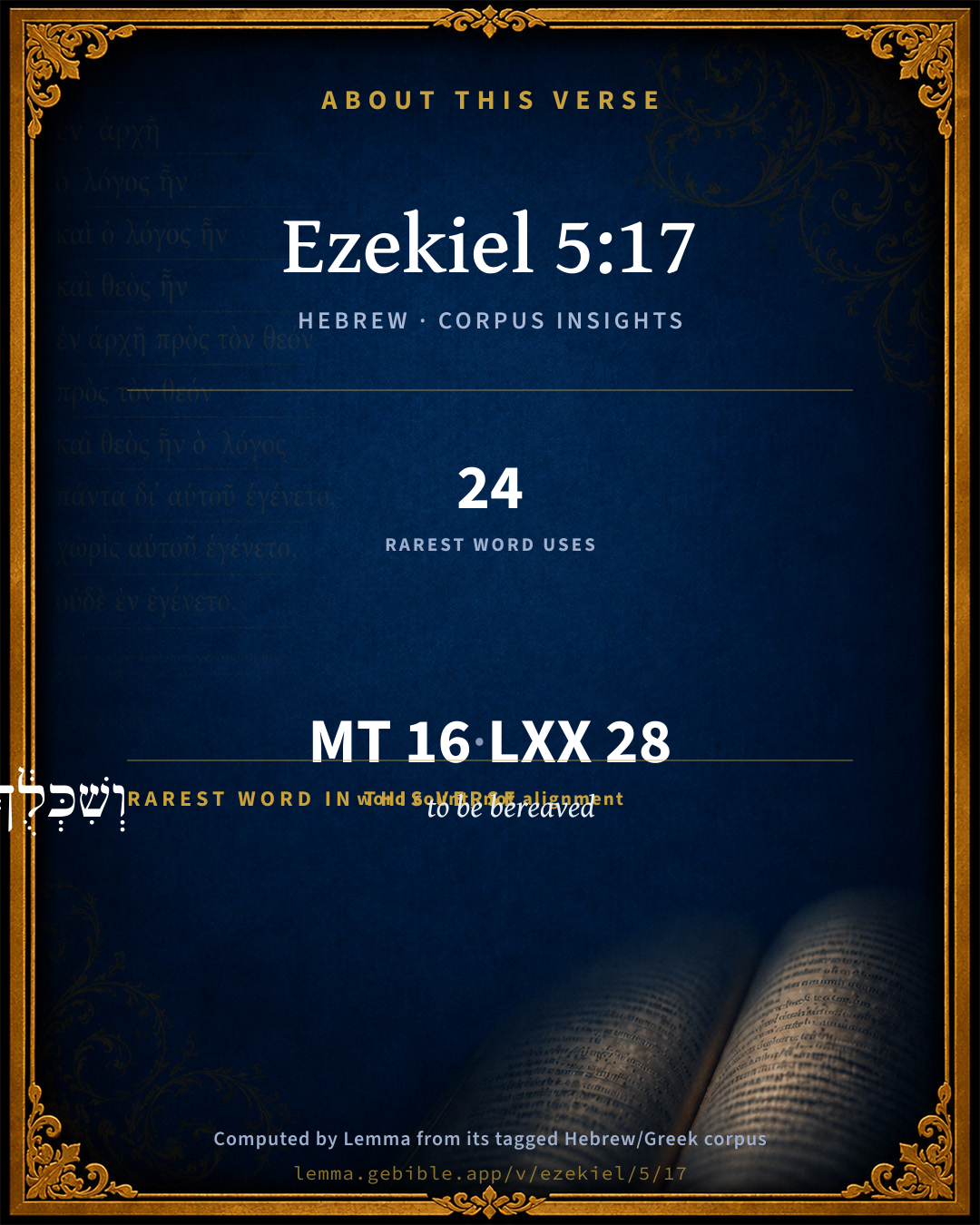
16
words
14
distinct lemmas
Prophets
section

Notable vocabulary

The rarest word here is וְשִׁכְּלֻ֔ךְ to be bereaved H7921 — appearing just 24 times in the whole Hebrew Bible.

Shared distinctive vocabulary

וְשִׁכְּלֻ֔ךְ to be bereaved H7921 occurs in 22 verses of the Hebrew Bible. Also found in:

Grammatical profile

  • 5 verbs
  • 6 nouns
  • 1 adjective
  • 1 pronoun
  • 3 prepositions

Verb forms

  • וְשִׁלַּחְתִּ֣י Piel · Sequential Perfect
  • וְשִׁכְּלֻ֔ךְ Piel · Sequential Perfect
  • יַעֲבָר Qal · Imperfect
  • אָבִ֣יא Hiphil · Imperfect
  • דִּבַּֽרְתִּי Piel · Perfect

Repetition

A word recurs within this verse — often emphatic in Hebrew:

  • עֲ֠לֵיכֶם upon H5921 ×2

Hebrew & Septuagint length

In English translation the verse runs 36 words from the Hebrew and 42 from the Septuagint (LXX English) — closely comparable.

A rough comparison of the two English renderings, which tokenize alike — not a word-level alignment.

Word counts can differ between the Hebrew and the Greek without any difference in meaning — e.g. the Hebrew direct-object marker אֵת has no separate Greek word, and Greek often adds the article ὁ.

In the original languages it is 16 Hebrew tokens and 28 Greek tokens — but the two are counted differently (Hebrew bundles its prefixes and suffixes into one token; the Greek is in lemma form), so that isn’t a like-for-like length.

Cross-references

24

Topical passages linked to Ezekiel 5:17 in the Treasury of Scripture Knowledge — connected by theme and wording, ordered by reader-vote popularity; previews shown in the World English Bible.

  • Ezekiel 38:22 With pestilence and with blood will I enter into judgment with him; and I will rain on him, and on his hordes, and on the many peoples who are with him, an overflowing shower, and great hailstones, fire, and sulfur.
  • Leviticus 26:22 I will send the wild animals among you, which will rob you of your children, destroy your cattle, and make you few in number; and your roads will become desolate.
  • Deuteronomy 32:24 [They shall be] wasted with hunger, and devoured with burning heat Bitter destruction; The teeth of animals will I send on them, With the poison of crawling things of the dust.
  • 2 Kings 17:25 So it was, at the beginning of their dwelling there, that they didn't fear Yahweh: therefore Yahweh sent lions among them, which killed some of them.
  • Ezekiel 14:15 If I cause evil animals to pass through the land, and they ravage it, and it be made desolate, so that no man may pass through because of the animals;
  • Ezekiel 14:21 For thus says the Lord Yahweh: How much more when I send my four sore judgments on Jerusalem, the sword, and the famine, and the evil animals, and the pestilence, to cut off from it man and animal!
  • Ezekiel 33:27 Thus shall you tell them, Thus says the Lord Yahweh: As I live, surely those who are in the waste places shall fall by the sword; and him who is in the open field will I give to the animals to be devoured; and those who are in the strongholds and in the caves shall die of the pestilence.
  • Exodus 23:29 I will not drive them out from before you in one year, lest the land become desolate, and the animals of the field multiply against you.
  • Jeremiah 15:3 I will appoint over them four kinds, says Yahweh: the sword to kill, and the dogs to tear, and the birds of the sky, and the animals of the earth, to devour and to destroy.
  • Ezekiel 5:12–13 A third part of you shall die with the pestilence, and with famine shall they be consumed in the midst of you; and a third part shall fall by the sword round about you; and a third part I will scatter to all the winds, and will draw out a sword after them.
  • Ezekiel 5:15 So it shall be a reproach and a taunt, an instruction and an astonishment, to the nations that are round about you, when I shall execute judgments on you in anger and in wrath, and in wrathful rebukes; (I, Yahweh, have spoken it;)
  • Ezekiel 6:12 He who is far off shall die of the pestilence; and he who is near shall fall by the sword; and he who remains and is besieged shall die by the famine: thus will I accomplish my wrath on them.
  • Ezekiel 14:19 Or if I send a pestilence into that land, and pour out my wrath on it in blood, to cut off from it man and animal;
  • Ezekiel 17:21 All his fugitives in all his bands shall fall by the sword, and those who remain shall be scattered toward every wind: and you shall know that I, Yahweh, have spoken it.
  • Ezekiel 17:24 All the trees of the field shall know that I, Yahweh, have brought down the high tree, have exalted the low tree, have dried up the green tree, and have made the dry tree to flourish; I, Yahweh, have spoken and have done it.
  • Ezekiel 21:3 and tell the land of Israel, Thus says Yahweh: Behold, I am against you, and will draw forth my sword out of its sheath, and will cut off from you the righteous and the wicked.
  • Ezekiel 21:32 You shall be for fuel to the fire; your blood shall be in the midst of the land; you shall be no more remembered: for I, Yahweh, have spoken it.
  • Ezekiel 22:14 Can your heart endure, or can your hands be strong, in the days that I shall deal with you? I, Yahweh, have spoken it, and will do it.
  • Ezekiel 23:47 The company shall stone them with stones, and dispatch them with their swords; they shall kill their sons and their daughters, and burn up their houses with fire.
  • Ezekiel 26:14 I will make you a bare rock; you shall be a place for the spreading of nets; you shall be built no more: for I Yahweh have spoken it, says the Lord Yahweh.
  • Ezekiel 30:12 I will make the rivers dry, and will sell the land into the hand of evil men; and I will make the land desolate, and all that is therein, by the hand of strangers: I, Yahweh, have spoken it.
  • Ezekiel 34:25–28 I will make with them a covenant of peace, and will cause evil animals to cease out of the land; and they shall dwell securely in the wilderness, and sleep in the woods.
  • Ezekiel 37:14 I will put my Spirit in you, and you shall live, and I will place you in your own land: and you shall know that I, Yahweh, have spoken it and performed it, says Yahweh.
  • Matthew 24:35 Heaven and earth will pass away, but my words will not pass away.

Cross-references courtesy of OpenBible.info (CC BY 4.0).

Hebrew and Greek witnesses Masoretic Hebrew ↔ Greek Septuagint

The same verse in the two great witnesses to the Old Testament, shown verse-for-verse.

These are two independent witnesses, not word-aligned to each other, and the Septuagint is shown in lemma (dictionary) form.

Hebrew Ezekiel 5:17 Masoretic · Westminster Leningrad Codex

וְשִׁלַּחְתִּ֣י עֲ֠לֵיכֶם רָעָ֞ב וְחַיָּ֤ה רָעָה֙ וְשִׁכְּלֻ֔ךְ וְדֶ֥בֶר וָדָ֖ם יַעֲבָר בָּ֑ךְ וְחֶ֨רֶב֙ אָבִ֣יא עָלַ֔יִךְ אֲנִ֥י יְהוָ֖ה דִּבַּֽרְתִּי

and I will send on you famine and evil animals, and they shall bereave you; and pestilence and blood shall pass through you; and I will bring the sword on you: I, Yahweh, have spoken it.

World English Bible · Public Domain

Greek LXX Ezekiel 5:17 Septuagint · lemma form

καί ἐκ ἀποστέλλω ἐπί σύ λιμός καί θηρίον πονηρός καί τιμωρέω σύ καί θάνατος καί αἷμα διαἔρχομαι ἐπί σύ καί ῥομφαία ἐπιἄγω ἐπί σύ κυκλόθεν ἐγώ κύριος λαλέω

So I will send forth against you famine and evil beasts, and I will take vengeance upon you; and pestilence and blood shall pass through upon you; and I will bring a sword upon you round about. I the Lord have spoken.

LXX2012 (modern English Septuagint) · Public Domain

On this verse, The Cambridge Bible for Schools and Colleges discusses the Septuagint’s reading. Read the note in Commentary ↓

Hebrew: Westminster Leningrad Codex (CC BY 4.0). Greek: Septuagint (public domain); English from LXX2012 (modern English Septuagint) (Public Domain). How the Septuagint differs from the Hebrew →

Targum (Aramaic paraphrase)

1

The Targum is the ancient Jewish Aramaic paraphrase of the Hebrew Scriptures — an interpretive translation, not the Hebrew text itself. Onkelos (literal) and Pseudo-Jonathan (expansive) render the Torah, and Jonathan the Prophets. Coverage is partial: where no permissively-licensed English translation exists for a verse, only the Aramaic is shown. This is verse-level text, not a word-by-word alignment to the Hebrew.

  1. Targum Jonathan Prophets (Joshua–Malachi)
    וַאֲשַׁלַח עֲלֵיכוֹן כַּפְנָא וְחַיְתָא בִישְׁתָּא וְיִתְכְּלוּנַיִךְ וּמוֹתָא וּקְטָלָא יַעְדוּן בִּיךְ וּדְקָטְלִין בְּחַרְבָּא אַיְתֵי עֲלָךְ אֲנָא יְיָ גְזָרֵית בְּמֵימְרִי:

    (no public-domain English translation for this verse)

    Targum Jonathan — Aramaic: “Mikraot Gedolot” (public domain). English: “Sefaria Community Translation” (CC0 1.0 (public-domain dedication)); “London "Chaldee Paraphrase," 1871” (public domain). Text via Sefaria.

Commentary

Notes on Ezekiel 5:17 from classic Christian and Jewish commentators (each source and its license shown beneath its notes). The classic Christian expositions comment on the surrounding passage and are grouped to its opening verse, so a note may address several verses; the Jewish commentaries on the Tanakh (Rashi and others) are per-verse, so they appear only where the commentator wrote on this verse.

Lemma curates 59 commentaries, every one of them public domain or Creative Commons licensed, each selected and text-cleaned for this edition rather than reprinted as found. About our sources →

Trapp's Complete Commentary

John Trapp

Eze 5:17 So will I send upon you famine and evil beasts, and they shall bereave thee; and pestilence and blood shall pass through thee; and I will bring the sword upon thee. I the LORD have spoken [it].

Ver. 17. Evil beasts, and they shall bereave thee.] Rob thee of thy children, destroy thy cattle, make thee few in number, and thy highway desolate, as was long before threatened. {Lev 26:22 2Ki 17:25}

I the Lord have spoken it.] I Jehovah, who will give being to my menaces as well as to my promises.

John Trapp, A Commentary or Exposition upon All the Books of the Old and New Testament (1647–1656) — public domain. Text from a community e-Sword module.

Jamieson, Fausset & Brown

Robert Jamieson, A. R. Fausset & David Brown

beasts--perhaps meaning destructive conquerors (Dan 7:4). Rather, literal "beasts," which infest desolated regions such as Judea was to become (compare Eze 34:28; Exo 23:29; Deu 32:24; Kg2 17:25). The same threat is repeated in manifold forms to awaken the careless.

sword--civil war.

Next: Ezekiel Chapter 6

Jamieson, Fausset & Brown — Commentary Critical and Explanatory on the Whole Bible (1871) — public domain (CC PDM 1.0). Text via the HelloAO Bible API.

Adam Clarke's Commentary

Verse 17. So will I send upon you famine and evil beasts, and they shall bereave thee] Wild beasts always multiply in depopulated countries. In England, wolves abounded when the country was thinly peopled, it is now full of inhabitants, and there is not one wolf in the land. Nebuchadnezzar and his Chaldeans may be called here evil beasts. He is often compared to a lion, Jer 4:7; Da 7:14; on account of the ravages made by him and his Chaldean armies.

Adam Clarke's Commentary on the Bible (1810–1826) — public domain. Text from a community e-Sword/MySword module.

John Calvin's Commentaries

Here God speaks generally concerning certain adversities — I will send evil upon them, he says, but immediately afterwards he adds the kind of evil, of which he had not yet spoken. Hence, under the name of evil he embraces all adversities, as if he had said that he intended to exact the penalty from the wicked, not in one or two ways only, but by those numberless troubles which surround us, and to which we are subject; so that there would be no bounds to his wrath, unless men should cease to provoke his anger. This is the reason, then, why he now speaks generally concerning evil; but as I have said he adds the kind of evil — An evil beast shall come upon thee, and so I will bereave thee Although only one form of evil is expressed, yet it is by no means doubtful that for the sake of example God mentions this, that they might understand that all injuries are in his hand. And these are numberless. If we look upwards, how many deaths hang over us from that direction? If we look at the earth, how many poisons? how many wild and fierce beasts, how many serpents, swords, pitfalls, stumbling-blocks, precipices, falls of houses, throwings of stones and darts? In short, we cannot stir a step without ten deaths meeting us. So God here speaks of wild beasts only for the purpose of showing that they were at hand, and that by them he would execute his judgments. Now, therefore, we understand why Ezekiel first spoke of the genus, and afterwards came to the species.

And at length he adds, I will bereave or deprive them, namely, that he will deprive fathers of their sons, and sons of their fathers; and he will do that, not only by cruel and savage beasts, but by various other ways. Again he repeats — pestilence and blood shall pass over thee. He had not spoken of blood before, unless under the name of the sword, which he repeats again: but he heaps together, as I have said, various forms of speech, so that those should be at length awakened who had been too slow, and were afterwards turning themselves willingly away from all sense of the wrath of God. Hence he says, pestilence and blood shall pass through thee. Then, I will bring a sword, says he, upon thee When he spoke of blood, he really intended a sword, but, as I have already said, this did not cause either the Israelites or Jews instantly to tremble at such threats. What, therefore, was in itself sufficiently clear and easy, ought to be impressed in various ways. With this view he adds again, I Jehovah have spoken For he turns away the Jews and Israelites from looking at himself, and shows them that he was not the author of the threats, but that he faithfully delivers what he had received from God’s hand, and what he was commanded to utter against them.

John Calvin's Commentaries (1540-1563) — public domain. Text from the Calvin Translation Society English edition (1840s-50s) via the Christian Classics Ethereal Library (ccel.org). Calvin's coverage is partial (roughly two-thirds of the Bible); uncommented books and verses are honest gaps, never fabricated. The 19th-century editor's footnotes and remarks are omitted so the notes are faithfully Calvin's own voice.

The Cambridge Bible for Schools and Colleges

gen. ed. J. J. S. Perowne

17. evil beasts] The three great plagues often specified are, famine, pestilence and sword (ch. Eze_14:13; Eze_14:17; Eze_14:19), to which a fourth is sometimes added, evil beasts (ch. Eze_14:15; Eze_14:21, Eze_33:27, Eze_34:25; Lev_26:22; Deu_32:24).

In the above verses the cumulative expressions are often wanting in LXX. e.g. Eze_5:11 the words “and with all thine abominations.” Differences of this kind do not affect the sense, and it is unnecessary to notice them in detail.

The Cambridge Bible for Schools and Colleges (gen. ed. J. J. S. Perowne; Cambridge University Press, 1878–1918) — public domain. Text from a community e-Sword module.

John Gill's Exposition

So will I send upon you famine, and evil beasts,.... Famine is repeated for the further confirmation of it; and "evil beasts" are added, by whom are meant, not the Chaldeans, comparable to such; but literally lions, wolves, hears, &c. which are threatened the Jews, in case of disobedience, Lev 26:22; and which sometimes were sent, Kg2 17:24;

and they shall bereave thee; that is, of her children, whom the evil beasts should destroy; they not being able to defend themselves against them, as men can:

and pestilence and blood shall pass through thee, and I will bring the sword upon thee; the pestilence, famine, sword, which is meant by blood, and evil beasts, are the Lord's four sore judgments; see Eze 14:21.

I the Lord have spoken it: who was able to perform it, and did, both at the destruction of Jerusalem by Nebuchadnezzar and by Titus.

John Gill's Exposition of the Whole Bible (1746–1763) — public domain (CC PDM 1.0). Text via the HelloAO Bible API.

Haydock's Catholic Bible Commentary

CHAPTER V.

Beasts. They usually take possession of abandoned countries. (St. Jerome) --- The Chaldeans may also be meant, chap. xvii. 3.

George Leo Haydock (1774–1849), Haydock's Catholic Family Bible and Commentary, 1859 edition — public domain. Excludes Psalms (Douay-Rheims chapter numbering differs from Protestant) and Deuterocanonical books (Catholic canon only).

Matthew Poole's English Annotations

Evil beasts; Heb. evil beast: either the king of Babylon, which, like a ravenous and insatiable beast, tore and devoured all. Or, literally, lions, bears, &c., which are one of his four sore judgments, Eze 14:21.

Bereave thee, of your children, friends, and your own life; when you flee to mountains and caves, for fear of the Chaldees, where you seek your safety you shall find your death, and be torn to pieces. Thy land shall be the common road and highway for pestilence and blood, as the Hebrew denotes, and they shall lodge in thy cities, in Jerusalem, as if they were the appointed receptacles for these guests. Here are the four sore plagues which God wastes nations with, all sent out against the Jews, and their commission signed from heaven with a witness, Ourself. I have spoken it, saith the Lord.

Matthew Poole's English Annotations on the Holy Bible (1683–1685) — public domain. Text from a community e-Sword/MySword module.

Whedon's Commentary on the Bible

Daniel D. Whedon

17. Evil beasts — With the famine of the siege and the blood of slaughter comes the plague of evil beasts (Eze_14:15; Eze_14:21; Eze_33:27; Eze_34:25). This shows the desolation of the land. The people have been carried away and their valleys have become the home of jackals and lions (2Ki_17:25).

I the Lord have spoken it — This is not, as some modern critics maintain, the utterance of an angry prophet. Ezekiel, dumb in the presence of these awful calamities, is only able to picture them in his sign language to the people, because the hand of the Lord is upon him and he has fed upon the word of the Lord (Eze_3:3; Eze_3:14).

Daniel D. Whedon (gen. ed.), Commentary on the Old and New Testaments (1874–1909) — public domain. Text from a community e-Sword module.

The Pulpit Commentary

Evil beasts, etc. These appear in like connection in Ezekiel"s favourite textbooks. (comp. Lev_26:6, Lev_26:22; Deu_32:24) They reappear in Eze_14:15, Eze_14:21. Historically, we have an example of the suffering thus caused in the lions of 2Ki_17:25, when towns and villages were deserted, and the unburied carcases of those who had died by famine, or pestilence, or the sword, were everywhere to attract them from afar. This was, of course, the natural and inevitable result. Pestilence and blood, etc. As this is followed by the work of the sword, "blood" probably points to some special form of plague, possibly dysentery, (Act_28:8, Revised Version) or carbuncles, like Hezekiah"s. (Isa_38:21) The same combination appears in Eze_14:19 Eze_28:23.

The Pulpit Commentary (1880–1919), ed. H.D.M. Spence-Jones & Joseph S. Exell — public domain. Text from a community e-Sword module.

John Wesley's Explanatory Notes

Bereave thee - Of your children, friends, and your own life. Pestilence and blood - Thy land shall be the common road for pestilence and blood. Tho' this prophecy was to be accomplished presently, in the destruction of Jerusalem by the Chaldeans; yet it may well be supposed to look forward, to the final destruction of it by the Romans, when God made a full end of the Jewish nation, and caused his fury to rest upon them.

John Wesley, Explanatory Notes Upon the Whole Bible (1754–1765) — public domain. Text via the GEBible commentary corpus.

Lesson kit

Teaching starters — assembled from the data on this page, not authored interpretation. Every prompt links to the verse data it draws on. Edit before teaching.

Ezekiel, in the Prophets, opens this verse with 16 words (14 distinct Hebrew lemmas). Its most distinctive word is shâkôl (“to be bereaved”). A historical commentator’s framing appears above. Read the whole chapter for the surrounding context.

Discussion questions

  1. What does “to be bereaved” (shâkôl) contribute to the verse as a whole?
  2. Genesis 27:45 shares the word «to be bereaved» with this verse. How do the two illuminate each other?
  3. “upon” occurs 2× in this one verse. What is the effect of the repetition?
  4. These translations render this verse differently; the difference is in the English rendering, not the original. What questions does that raise?
  5. The verb «וְשִׁלַּחְתִּ֣י» is Piel Sequential Perfect. How does its form color the action?
  6. Reading how Trapp's Complete Commentary and Jamieson, Fausset & Brown read this verse, where do the two commentators agree and where do they part?

Things to notice

Reading settings

Reading text

Shown beneath each verse's original-language words.

Old Testament
Old Testament edition

Read the OT as the Masoretic Hebrew (MT) or the Greek Septuagint (LXX).

English shown for the Greek Septuagint (in the Hebrew ↔ Greek comparison).

Comparing translations? Open the Compare panel on any verse page to stack up to four side by side.