
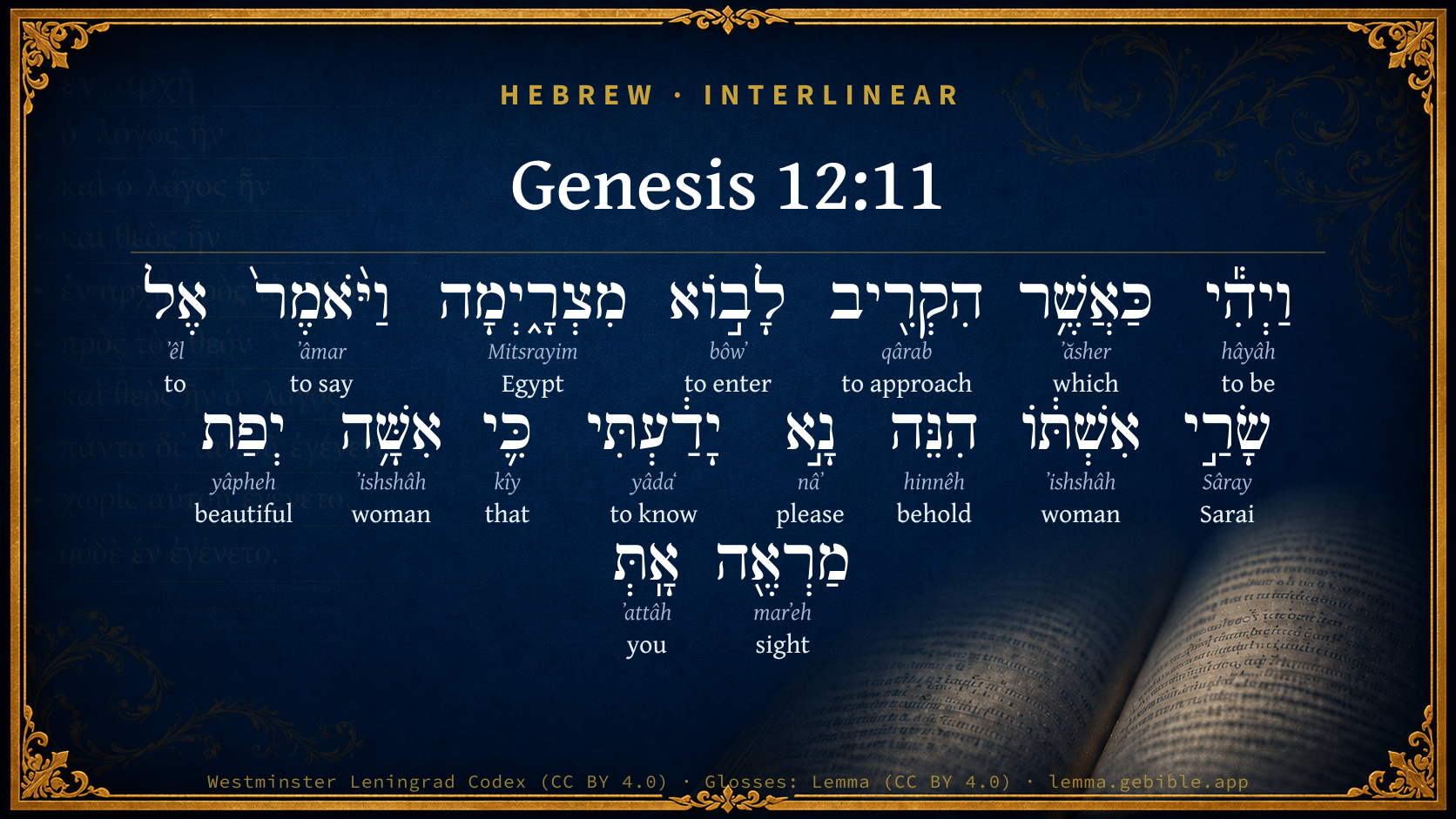
Genesis 12:11

Hebrew (Westminster Leningrad Codex) Genesis 12:11 appears in the Hebrew Old Testament. The text above is from the Westminster Leningrad Codex. Each word links to its Strong’s number, a concise gloss, and parsing drawn from the Open Scriptures Hebrew Bible morphology. Click any word for its full Brown-Driver-Briggs (BDB) entry.
Download image
Cite this verse

Genesis 12:11 (World English Bible). Public Domain. Lemma interlinear Bible study tool, https://lemma.gebible.app/v/genesis/12/11.

Show BibTeX & RIS
BibTeX
RIS
English Translation
It happened, when he was come near to enter into Egypt, that he said to Sarai his wife, "See now, I know that you are a beautiful woman to look on.
World English Bible · Public Domain
Highlights
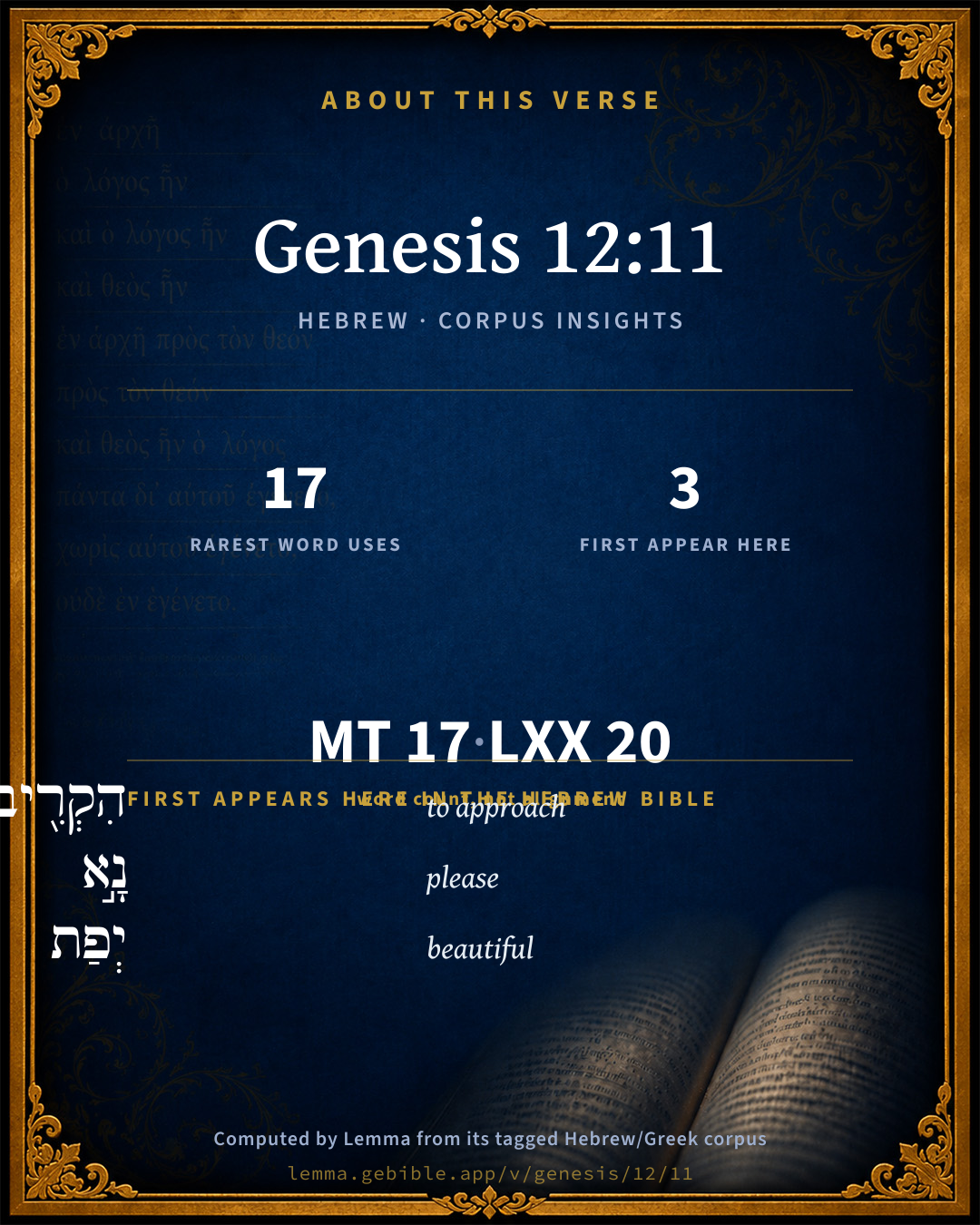
  • 3 first appearances in the Hebrew Bible
Full analysis ↓
Download a study sheet

One document with this verse’s original text, its word-by-word gloss line, the meaning frame, cross-references with their text, attributed commentary, and full source and license credits — printable, and it pastes into notes with its structure intact.

This verse Autodidact and up

Study sheet (.html) Plain text (.txt)

A passage Seminary Student

Up to 50 verses in one chapter. A passage sheet keeps up to 6 commentary sources and 12 cross-references per verse, in the order this page ranks them, and says so on the sheet whenever that leaves anything out. Ask for a single verse and you get the Autodidact verse sheet above.

Everything on this page stays free to read, with no account — the sheet is a download of what is already on screen, not access to it.

Want to remove ads? Support Godless Engineer
Compare translations 3

The same verse in 3 English versions, stacked beneath the original-language interlinear above. Click any original word for its lexicon entry.

Each is an independent rendering of the whole verse — the interlinear is not word-aligned to these translations.

Highlighted words mark where these versions differ — a whole-verse word diff, not a word-by-word alignment.

  • World English Bible Public Domain
    It happened, when he was come near to enter into Egypt, that he said to Sarai his wife, "See now, I know that you are a beautiful woman to look on.
  • King James Version Public Domain
    And it came to pass, when he was come near to enter into Egypt, that he said unto Sarai his wife, Behold now, I know that thou art a fair woman to look upon:
  • unfoldingWord Literal Text CC BY-SA 4.0
    And it happened that as he was about to enter Egypt, then he said to Sarai his wife, “Behold please, I know that you a woman beautiful in appearance.

unfoldingWord Literal Text — © unfoldingWord, licensed CC BY-SA 4.0. Word-aligned USFM3 via Door43 (git.door43.org/unfoldingWord/en_ult).

Versions to compare (up to 4)

3 of 4 selected

Show all 18 translations

Every available English version of this verse, each an independent rendering of the whole verse.

  • World English Bible Public Domain
    It happened, when he was come near to enter into Egypt, that he said to Sarai his wife, "See now, I know that you are a beautiful woman to look on.
  • Berean Standard Bible Public Domain
    As he was about to enter Egypt, he said to his wife Sarai, “Look, I know that you are a beautiful woman,
  • Majority Standard Bible Public Domain
    As he was about to enter Egypt, he said to his wife Sarai, “Look, I know that you are a beautiful woman,
  • King James Version Public Domain
    And it came to pass, when he was come near to enter into Egypt, that he said unto Sarai his wife, Behold now, I know that thou art a fair woman to look upon:
  • American Standard Version (1901) Public Domain
    And it came to pass, when he was come near to enter into Egypt, that he said unto Sarai his wife, Behold now, I know that thou art a fair woman to look upon:
  • Revised Version (1885) Public Domain
    And it came to pass, when he was come near to enter into Egypt, that he said unto Sarai his wife, Behold now, I know that thou art a fair woman to look upon:
  • Geneva Bible (1599) Public Domain
    And when he drewe neere to enter into Egypt, he said to Sarai his wife, Beholde nowe, I know that thou art a faire woman to looke vpon:
  • Douay-Rheims (1899) Public Domain
    And when he was near to enter into Egypt, he said to Sarai his wife: I know that thou art a beautiful woman:
  • Young's Literal Translation Public Domain
    and it cometh to pass as he hath drawn near to enter Egypt, that he saith unto Sarai his wife, `Lo, I pray thee, I have known that thou `art' a woman of beautiful appearance;
  • Literal Standard Version CC BY-SA 4.0
    and it comes to pass as he has drawn near to enter Egypt, that he says to his wife Sarai, “Now behold, I have known that you [are] a woman of beautiful appearance;
  • Unlocked Literal Bible CC BY-SA 4.0
    When he was about to enter into Egypt, he said to Sarai his wife, “See here, I know that you are a beautiful woman.
  • unfoldingWord Literal Text CC BY-SA 4.0
    And it happened that as he was about to enter Egypt, then he said to Sarai his wife, “Behold please, I know that you a woman beautiful in appearance.
  • Darby Bible Public Domain
    And it came to pass when he was come near to enter into Egypt, that he said to Sarai his wife, Behold now, I know that thou art a woman fair to look upon.
  • World Messianic Bible Public Domain
    When he had come near to enter Egypt, he said to Sarai his wife, “See now, I know that you are a beautiful woman to look at.
  • Webster's Bible Public Domain
    And it came to pass, when he had come near to enter into Egypt, that he said to Sarai his wife, Behold now, I know that thou art a fair woman to look upon:
  • Free Bible Version CC BY-SA 4.0
    As he approached Egypt and was about to cross the border, he said to his wife Sarai, “Look, I know what a beautiful woman you are.
  • Bible in Basic English Public Domain
    Now when he came near to Egypt, he said to Sarai, his wife, Truly, you are a fair woman and beautiful to the eye;
  • JPS Tanakh (1917) Public Domain
    And it came to pass, when he was come near to enter into Egypt, that he said unto Sarai his wife: 'Behold now, I know that thou art a fair woman to look upon.

Literal Standard Version (2020), Covenant Press — licensed CC BY-SA 4.0. Text via the HelloAO Bible API (eBible.org). Unlocked Literal Bible (unfoldingWord) — licensed CC BY-SA 4.0. Text via the HelloAO Bible API (eBible.org). unfoldingWord Literal Text — © unfoldingWord, licensed CC BY-SA 4.0. Word-aligned USFM3 via Door43 (git.door43.org/unfoldingWord/en_ult). Free Bible Version, Dr. Jonathan Gallagher — licensed CC BY-SA 4.0. Text via the HelloAO Bible API (eBible.org).

Word by word

More ways to search: Search by grammar → Find every occurrence → Compare this word →

Practice this passage: Drill this verse → Learn its vocabulary →

שָׂרַ֣י
Sâray
H8297
“Sarai”
Noun, Proper
Part of Speech
Noun
Type
Proper
Full BDB Definition

Origin: from H8269

TWOT: None

Sarai = "princess" - original name of Sarah the wife of Abram or Abraham
  1. וַיְהִ֕י hâyâh H1961 “and · to be” Conjunction + Verb, Qal, Sequential Imperfect, 3rd Person, Masculine, Singular
  2. כַּאֲשֶׁ֥ר ʼăsher H834 “like/as · which” Preposition + Particle, Relative
  3. הִקְרִ֖יב qârab H7126 “to approach” Verb, Hiphil, Perfect, 3rd Person, Masculine, Singular
  4. לָב֣וֹא bôwʼ H935 “to enter” Preposition + Verb, Qal, Infinitive Construct
  5. מִצְרָ֑יְמָה Mitsrayim H4714 “Egypt · toward” Noun, Proper + Suffix, Demonstrative
  6. וַיֹּ֨אמֶר֙ ʼâmar H559 “and · to say” Conjunction + Verb, Qal, Sequential Imperfect, 3rd Person, Masculine, Singular
  7. אֶל ʼêl H413 “to” Preposition
  8. אִשְׁתּ֔וֹ ʼishshâh H802 “woman · his” Noun, Common, Feminine, Singular, Construct + Suffix, Personal, 3rd Person, Masculine, Singular
  9. הִנֵּה hinnêh H2009 “behold” Particle, Demonstrative
  10. נָ֣א nâʼ H4994 “please” Particle, Exhortation
  11. יָדַ֔עְתִּי yâdaʻ H3045 “to know” Verb, Qal, Perfect, 1st Person, Common, Singular
  12. כִּ֛י kîy H3588 “that” Conjunction
  13. אִשָּׁ֥ה ʼishshâh H802 “woman” Noun, Common, Feminine, Singular, Absolute
  14. יְפַת yâpheh H3303 “beautiful of” Adjective, Adjective, Feminine, Singular, Construct
  15. מַרְאֶ֖ה marʼeh H4758 “sight” Noun, Common, Masculine, Singular, Absolute
  16. אָֽתְּ ʼattâh H859 “you” Pronoun, Personal, 2nd Person, Feminine, Singular

About this verse

These counts appear in no published source. They are computed here, from the morphology-tagged text and Lemma’s own curated glosses. What Lemma adds →

17
words
16
distinct lemmas
Pentateuch
section

Notable vocabulary

The rarest word here is שָׂרַ֣י Sarai H8297 — appearing just 17 times in the whole Hebrew Bible.

First appearance in Scripture

These words make their first canonical appearance in the Hebrew Bible here:

  • הִקְרִ֖יב to approach H7126
  • נָ֣א please H4994
  • יְפַת beautiful H3303

Shared distinctive vocabulary

שָׂרַ֣י Sarai H8297 occurs in 13 verses of the Hebrew Bible. Also found in:

Grammatical profile

  • 5 verbs
  • 5 nouns
  • 1 adjective
  • 1 pronoun
  • 1 preposition
  • 1 conjunction
  • 3 particles

Verb forms

  • וַיְהִ֕י Qal · Sequential Imperfect
  • הִקְרִ֖יב Hiphil · Perfect
  • לָב֣וֹא Qal · Infinitive Construct
  • וַיֹּ֨אמֶר֙ Qal · Sequential Imperfect
  • יָדַ֔עְתִּי Qal · Perfect

Repetition

A word recurs within this verse — often emphatic in Hebrew:

  • אִשְׁתּ֔וֹ woman H802 ×2

Hebrew & Septuagint length

In English translation the verse runs 31 words from the Hebrew and 27 from the Septuagint (LXX English) — closely comparable.

A rough comparison of the two English renderings, which tokenize alike — not a word-level alignment.

Word counts can differ between the Hebrew and the Greek without any difference in meaning — e.g. the Hebrew direct-object marker אֵת has no separate Greek word, and Greek often adds the article ὁ.

In the original languages it is 17 Hebrew tokens and 20 Greek tokens — but the two are counted differently (Hebrew bundles its prefixes and suffixes into one token; the Greek is in lemma form), so that isn’t a like-for-like length.

Cross-references

7

Topical passages linked to Genesis 12:11 in the Treasury of Scripture Knowledge — connected by theme and wording, ordered by reader-vote popularity; previews shown in the World English Bible.

  • Genesis 26:7 The men of the place asked him about his wife. He said, "She is my sister," for he was afraid to say, "My wife," lest, he thought, the men of the place might kill me for Rebekah, because she was beautiful to look on.
  • Genesis 12:14 It happened that when Abram had come into Egypt, the Egyptians saw that the woman was very beautiful.
  • Genesis 29:17 Leah's eyes were weak, but Rachel was beautiful and well favored.
  • Proverbs 21:30 There is no wisdom nor understanding Nor counsel against Yahweh.
  • Genesis 39:6–7 He left all that he had in Joseph's hand. He didn't concern himself with anything, except for the food which he ate. Joseph was well-built and handsome.
  • 2 Samuel 11:2 It happened at evening, that David arose from off his bed, and walked on the roof of the king's house: and from the roof he saw a woman bathing; and the woman was very beautiful to look on.
  • Song of Solomon 1:14 My beloved is to me a cluster of henna blossoms From the vineyards of En Gedi. Lover

Cross-references courtesy of OpenBible.info (CC BY 4.0).

Hebrew and Greek witnesses Masoretic Hebrew ↔ Greek Septuagint

The same verse in the two great witnesses to the Old Testament, shown verse-for-verse.

These are two independent witnesses, not word-aligned to each other, and the Septuagint is shown in lemma (dictionary) form.

Hebrew Genesis 12:11 Masoretic · Westminster Leningrad Codex

וַיְהִ֕י כַּאֲשֶׁ֥ר הִקְרִ֖יב לָב֣וֹא מִצְרָ֑יְמָה וַיֹּ֨אמֶר֙ אֶל שָׂרַ֣י אִשְׁתּ֔וֹ הִנֵּה נָ֣א יָדַ֔עְתִּי כִּ֛י אִשָּׁ֥ה יְפַת מַרְאֶ֖ה אָֽתְּ

It happened, when he was come near to enter into Egypt, that he said to Sarai his wife, "See now, I know that you are a beautiful woman to look on.

World English Bible · Public Domain

Greek LXX Genesis 12:11 Septuagint · lemma form

γίγνομαι δέ ἡνίκα ἐγγίζω αβραμ εἰςἔρχομαι εἰς αἴγυπτος εἶπον αβραμ σαρα ὁ γυνή αὐτός γιγνώσκω ἐγώ ὅτι γυνή εὐπρόσωπος εἰμί

And it came to pass when Abram drew near to enter into Egypt, Abram said to Sara his wife, I know that you are a fair woman.

LXX2012 (modern English Septuagint) · Public Domain

Hebrew: Westminster Leningrad Codex (CC BY 4.0). Greek: Septuagint (public domain); English from LXX2012 (modern English Septuagint) (Public Domain). How the Septuagint differs from the Hebrew →

Targum (Aramaic paraphrase)

2

The Targum is the ancient Jewish Aramaic paraphrase of the Hebrew Scriptures — an interpretive translation, not the Hebrew text itself. Onkelos (literal) and Pseudo-Jonathan (expansive) render the Torah, and Jonathan the Prophets. Coverage is partial: where no permissively-licensed English translation exists for a verse, only the Aramaic is shown. This is verse-level text, not a word-by-word alignment to the Hebrew.

  1. Targum Onkelos Torah (Genesis–Deuteronomy)
    וַהֲוָה כַּד קְרֵיב לְמֵיעַל לְמִצְרָיִם וַאֲמַר לְשָׂרַי אִתְּתֵה הָא כְעַן יְדָעִית אֲרֵי אִתְּתָא שַׁפִּירַת חֵיזוּ אָתְּ

    And it was that as he drew nigh to enter Mizraim he said to Sara his wife, Behold, now I know that thou art a woman beautiful in sight;

    Targum Onkelos — Aramaic: “Onkelos Genesis” (public domain); “Onkelos Exodus” (public domain); “Onkelos Leviticus” (public domain); “Onkelos Numbers” (public domain); “Onkelos Deuteronomy” (public domain). English: “Sefaria Community Translation” (CC0 1.0 (public-domain dedication)); “J.W. Etheridge. The Targums of Onkelos and Jonathan Ben Uzziel on the Pentateuch. London: Longmans, Green, 1862” (public domain). Text via Sefaria.

  2. Targum Pseudo-Jonathan Torah (Genesis–Deuteronomy)
    וַהֲוָה כְּמָא דְקָרֵיב לְמֵיעַל לִתְּחוּם מִצְרַיִם וּמָטוּ לְנַהֲרָא וּגְלִיאוּ בִּשְרֵיהוֹן לְמַעֲבַר וַאֲמַר אַבְרָם לְשָרַי אִנְתָּתֵיהּ הָא עַד כְּדוֹן לָא אִסְתַּכְּלִית בִּבְשָרִיךְ וּכְדוֹן יַדְעִית אֲרוּם אִנְתְּתָא שַׁפִּירַת חֵיזוּ אַנְתְּ

    And it was, as he approached to enter the limit of Mizraim, and they had come to the river, and were uncovering their flesh to pass over, that Abram, said to Sara his wife, Behold, until this I have not beheld thy flesh; but now I know that thou art a woman of fair aspect.

    Targum Pseudo-Jonathan — Aramaic: “Targum Jonathan on Genesis” (public domain); “Targum Jonathan on Exodus” (public domain); “Targum Jonathan on Leviticus” (public domain); “Targum Jonathan on Numbers” (public domain); “Targum Jonathan on Deuteronomy” (public domain). English: “The Targum of Jonathan ben Uzziel, trans. J. W. Etheridge, London, 1862” (public domain). Text via Sefaria.

Commentary

Notes on Genesis 12:11 from classic Christian and Jewish commentators (each source and its license shown beneath its notes). The classic Christian expositions comment on the surrounding passage and are grouped to its opening verse, so a note may address several verses; the Jewish commentaries on the Tanakh (Rashi and others) are per-verse, so they appear only where the commentator wrote on this verse.

Lemma curates 59 commentaries, every one of them public domain or Creative Commons licensed, each selected and text-cleaned for this edition rather than reprinted as found. About our sources →

Trapp's Complete Commentary

John Trapp

Gen 12:11 And it came to pass, when he was come near to enter into Egypt, that he said unto Sarai his wife, Behold now, I know that thou [art] a fair woman to look upon:

Ver. 11. Behold now, I know that thou art a fair woman.] And yet she was now sixty-five years of age; wherein she was a figure of "Jerusalem the mother of us all." {Gal 4:26 Son 1:15; Son 4:1} Sarai’s chief beauty was that of "the hidden man of the heart," as saith St Peter. {1Pe 3:4; 1Pe 3:6} But outward beauty is very lovely and attractive. Plato calls it the principality of nature; Aristotle, a greater commendation than all epistles. And being asked whether beauty were amiable, he answered, That’s a blind man’s question. {a} The poet could say, Gratior est pulchro veniens in corpore virtus -

That virtue hath a better grace

That shineth from a beauteous face.

Howbeit, Seneca saith, he was out in that saying; for that virtue needs no ornament more than she hath of her own, but beautifies herself sufficiently, and consecrates the body, wherein she dwells. {b} But by the leave of so great a philosopher, I am of the poet’s mind; and although I grant that favour without grace is but a gold ring in a swine’s snout, as Solomon hath it, or ornamentum in luto , as another (so it was in Alcibiades for a man, and in Aurelia Orestilla for a woman), yet surely, where they meet, they make a happy conjunction, and draw all hearts to them, as in Germanicus (for a man), in whom beauty and virtue strove for precedency; and Artaxerxes Longimanus, the son of Esther, who is said to have been of all men the most beautiful and most bountiful. {c} So in Esther (for a woman), who "obtained favour in the sight of all that looked upon her". {Est 2:15} And Aspasia Milesia, the wife of Cyrus, who deserved to be styled καλη και σοφη, fair and wise, as Aelian relateth {d} As on the other side in Vatinius, deformity of body strove with dishonesty of mind, adeo ut animus eius dignissimo domicilio inclusus videretur , saith Paterculus.

{a} Tυφλου το ερωτημς.

{b} Ipsa magnum sui decus est, et corpus suum consecrat. - Sen., epist. 67.

{c} Salvian. Cuias praeter formam nihil nunquam, bonus laudavit. - Salust. Kαλλιστος μεν το σωμα, αριστος δε την ψυχην εφυ. - Dio. Artaxerxes, omnium hominum pulcherrimus, ait Emil. Prob.

{d} Aelian Var. Hist., lib. xii. cap. 1.

John Trapp, A Commentary or Exposition upon All the Books of the Old and New Testament (1647–1656) — public domain. Text from a community e-Sword module.

Jamieson, Fausset & Brown

Robert Jamieson, A. R. Fausset & David Brown

Sarai's complexion, coming from a mountainous country, would be fresh and fair compared with the faces of Egyptian women which were sallow. The counsel of Abram to her was true in words, but it was a deception, intended to give an impression that she was no more than his sister. His conduct was culpable and inconsistent with his character as a servant of God: it showed a reliance on worldly policy more than a trust in the promise; and he not only sinned himself, but tempted Sarai to sin also.

Jamieson, Fausset & Brown — Commentary Critical and Explanatory on the Whole Bible (1871) — public domain (CC PDM 1.0). Text via the HelloAO Bible API.

Adam Clarke's Commentary

Verse 11. Thou art a fair woman to look upon] Widely differing in her complexion from the swarthy Egyptians, and consequently more likely to be coveted by them. It appears that Abram supposed they would not scruple to take away the life of the husband in order to have the undisturbed possession of the wife. The age of Sarai at this time is not well agreed on by commentators, some making her ninety, while others make her only sixty-five. From Ge 17:17, we learn that Sarai was ten years younger than Abram, for she was but ninety when he was one hundred. And from Ge 12:4, we find that Abram was seventy-five when he was called to leave Haran and go to Canaan, at which time Sarai could be only sixty-five; and if the transactions recorded in the preceding verses took place in the course of that year, which I think possible, consequently Sarai was but sixty-five; and as in those times people lived much longer, and disease seems to have had but a very contracted influence, women and men would necessarily arrive more slowly at a state of perfection, and retain their vigour and complexion much longer, than in later times. We may add to these considerations that strangers and foreigners are more coveted by the licentious than those who are natives. This has been amply illustrated in the West Indies and in America, where the jetty, monkey-faced African women are preferred to the elegant and beautiful Europeans! To this subject a learned British traveller elegantly applied those words of Virgil, Ecl. ii., ver. 18: -

Alba ligustra cadunt, vaccinia nigra leguntur.

White lilies lie neglected on the plain,

While dusky hyacinths for use remain.

DRYDEN.

Adam Clarke's Commentary on the Bible (1810–1826) — public domain. Text from a community e-Sword/MySword module.

John Calvin's Commentaries

11. He said unto Sarai his wife. He now relates the counsel which Abram took for the preservation of his life when he was approaching Egypt. Andy since this place is like a rock, on which many strike; it is proper that we should soberly and reverently consider how far Abram was deserving of excuse, and how he was to be blamed. First, there seems to be something of falsehood, mixed with the dissimulations which he persuades his wife to practice. And although afterwards he makes the excuse, that he had not lied nor feigned anything that was untrue: in this certainly he was greatly culpable that it was not owing to his care that his wife was not prostituted. For when he dissembles the fact, that she was his wife, he deprives her chastity of its legitimate defense. And hence certain perverse cavilers take occasion to object, that the holy patriarch was a pander to his own wife; and that, for the purpose of craftily taking care of himself, he spared neither her modesty nor his own honor. But it is easy to refute this virulent abuse; because, it may indeed be inferred, that Abram had far higher ends in view, seeing that in other things, he was endued with a magnanimity so great. Again, how did it happen, that he rather sought to go into Egypt than to Charran, or into his own country, unless that in his journeying, he had God before his eyes, and the divine promise firmly rooted in his mind? Since, therefore, he never allowed his senses to swerve from the word of God, we may even thence gather the reason, why he so greatly feared for his own life, as to attempt the preservation of it from one danger, by incurring a still greater. Undoubtedly he would have chosen to die a hundred times, rather than thus to ruin the character of his wife, and to be deprived of the society of her whom alone he loved. But while he reflected that the hope of salvation was centred in himself, that he was the fountain of the Church of Gods that unless he lived, the benediction promised to him, and to his seed, was vain; he did not estimate his own life according to the private affection of the flesh; but inasmuch as he did not wish the effect of the divine vocation to perish through his death, he was so affected with concern for the preservation of his own life, that he overlooked every thing besides. So far, then, he deserves praise, that, having in view a lawful end of living, he was prepared to purchase life at any price. But in devising this indirect method, by which he subjected his wife to the peril of adultery, he seems to be by no means excusable. If he was solicitous about his own life, which he might justly be, yet he ought to have cast his care upon God. The providence of God, I grant, does not indeed preclude the faithful from caring for themselves; but let them do it in such a way, that they may not overstep their prescribed bounds. Hence it follows, that Abram’s end was right, but he erred in the way itself; for so it often happens to us, that even while we are tending towards God, yet, by our thoughtlessness in catching at unlawful means, we swerve from his word. And this, especially, is wont to take place in affairs of difficulty; because, while no way of escape appears, we are easily led astray into various circuitous paths. Therefore, although they are rash judges, who entirely condemn this deed of Abram, yet the special fault is not to be denied, namely, that he, trembling at the approach of death, did not commit the issue of the danger to God, instead of sinfully betraying the modesty of his wife. Wherefore, by this example, we are admonished, that, in involved and doubtful matters, we must seek the spirit of counsel and of prudence from the Lord; and must also cultivate sobriety, that we may not attempt anything rashly without the authority of his word.

I know that thou art a fair woman to look upon It is asked whence had Sarai this beauty, seeing she was an old woman? For though we grant that she previously had excelled in elegance of form, certainly years had detracted from her gracefulness; and we know how much the wrinkles of old age disfigure the best and most beautiful faces. In the first place, I answer, there is no doubt that there was then greater vivacity in the human race than there is now; we also know, that vigor sustains the personal appearance. Again, her sterility availed to preserve her beauty, and to keep her whole habit of body entire; for there is nothing which more debilitates females than frequent parturition. I do not however doubt, that the perfection of her form was the special gift of God; but why he would not suffer the beauty of the holy woman to be so soon worn down by age, we know not; unless it were, that the loveliness of that form was intended to be the cause of great and severe anxiety to her husband. Common experience also teaches us, that they who are not content with a regular and moderate degree of comeliness, find, to their great loss, at what a cost immoderate beauty is purchased.

John Calvin's Commentaries (1540-1563) — public domain. Text from the Calvin Translation Society English edition (1840s-50s) via the Christian Classics Ethereal Library (ccel.org). Calvin's coverage is partial (roughly two-thirds of the Bible); uncommented books and verses are honest gaps, never fabricated. The 19th-century editor's footnotes and remarks are omitted so the notes are faithfully Calvin's own voice.

Ellicott's Commentary for English Readers

(11-13) Thou art a fair woman.—For the word yephath, rendered “fair,” see on Gen_9:27. Though its general meaning is beautiful, yet there can be no doubt that the light colour of Sarai’s complexion was that which would chiefly commend her to the Egyptians; for she was now past sixty, and though vigorous enough to bear a son at ninety, yet that was by the special favour of God. As she lived to the age of 127 (Gen_23:1), she was now about middle age, and evidently had retained much of her early beauty; and this, added to the difference of tint, would make her still attractive to the swarthy descendants of Ham, especially as they were not a handsome race, but had flat foreheads, high cheek-bones, large mouths, and thick lips. Twenty years later we find Abram still haunted by fears of the effects of her personal appearance (Gen_20:2), even when living among a better-featured race. From Gen_20:13 it appears that on leaving Haran Abram and Sarai had agreed upon adopting this expedient, which seems to us so strangely contrary to the faith which the patriarch was at that very time displaying. He abandons his birthplace at the Divine command, and starts upon endless wanderings; and yet, to protect his own life, he makes an arrangement which involves the possible sacrifice of the chastity of his wife; and twice, but for God’s interference, this painful result would actually have happened. Perhaps Abram may have depended upon Sarai’s cleverness to help herself out of the difficulty; but such a mixture of faith and weakness, of trust in God in abandoning so much and trust in worldly policy for preservation in a foreseen danger, cannot but make us feel how much of infirmity there was even in a character otherwise so noble.

A Bible Commentary for English Readers, edited by Charles John Ellicott (1878–1897) — public domain. Text from a community e-Sword module.

The Cambridge Bible for Schools and Colleges

gen. ed. J. J. S. Perowne

11. thou art a fair woman] According to Gen_17:17 (P), Sarai was 10 years younger than Abram; and from Gen_12:4 (P) Abram was at least 75 when he entered Egypt, and Sarai, therefore, 65. This kind of difficulty has led to explanations of a somewhat undignified character. The true explanation is that the ages of the patriarchs which belong to the brief and statistical narrative of P have no place in the narrative of J, in which Sarai is beautiful and childless (Gen_11:30).

The Cambridge Bible for Schools and Colleges (gen. ed. J. J. S. Perowne; Cambridge University Press, 1878–1918) — public domain. Text from a community e-Sword module.

John Gill's Exposition

And it came to pass, when he was come near to enter into Egypt,.... Just entering into it, having travelled from the mountain between Bethel and Hai, two hundred and forty miles (p); or when he "caused to come near" (q), either his camp, as Aben Ezra supplies it, or his tent, or his family, as others:

that he said unto Sarai his wife, behold now, I know that thou art a fair woman to look upon; though sixty five years of age, being ten years younger than her husband, see Gen 17:17 who was now seventy five years old, Gen 12:4 yet might still be a fair woman, having a good complexion and comely features, and having never bore children, and especially she would be reckoned so among the Egyptians, whose women were of a blackish, sallow, swarthy complexion.

(p) Travels of the Holy Patriarchs, &c. p. 56. (q) "quum admoveret, sub tentorium", so some in Vatablus; "familiam", Munster.

John Gill's Exposition of the Whole Bible (1746–1763) — public domain (CC PDM 1.0). Text via the HelloAO Bible API.

Haydock's Catholic Bible Commentary

Beautiful: having yet had no children, though she must have been 65 years old. Abram acts with prudence, and does not tempt God: if he had made known that the woman was his wife, he would have exposed his life to imminent danger, amid a cruel and lascivious people; and being convinced of the chastity of Sarai, he did not, in the least, apprehend that she would consent to any violation of her conjugal engagements. He did not, therefore, expose her virtue as the Manichees pretended. (St. Augustine, contra Faust. xxii. 33; City of God xvi. 19.) (Haydock; Calmet) --- The event proved the justice of Abram’s suspicions, and God’s interference shewed that he was not displeased with his concealing part of the truth. Who can be so simple as to suppose, that we are bound to explain all our concerns to a foe? Do not we every day act with the like caution as Abram did, when we have reason to fear danger? Do not we wish, when fleeing from an enemy’s country, that he should conclude we were taking a walk of pleasure? (Haydock)

George Leo Haydock (1774–1849), Haydock's Catholic Family Bible and Commentary, 1859 edition — public domain. Excludes Psalms (Douay-Rheims chapter numbering differs from Protestant) and Deuterocanonical books (Catholic canon only).

Matthew Poole's English Annotations

Quest. How could she be so fair, when she was above sixty years old?

Answ. She was so both comparatively to the Egyptians, and simply in herself, and that might be from divers causes:

1. From the greater vigour of nature in that age of the world.

2. Because her beauty was not diminished by child-bearing.

3. From God's singular providence, ordering it thus for Abram's trial, and for the manifestation of his special providence watching over him and his.

Matthew Poole's English Annotations on the Holy Bible (1683–1685) — public domain. Text from a community e-Sword/MySword module.

Whedon's Commentary on the Bible

Daniel D. Whedon

11. Thou art a fair woman — Sarai was sixty-five years of age when Abram left Haran, being ten years younger than he, but, considering the longevity of the patriarchs, we may assume that at that period of life she would retain much of her youthful beauty, appearing much as a woman of thirty in our time. To the more dusky Egyptians an Asiatic woman would appear especially beautiful. The Egyptians were not Negroes, as is shown by the monuments; they were tawny in color, with straight hair, and features more Asiatic than African, (Rawl. Herod., 2:104;) but there was still a strong contrast between them and the true Asiatics, whose women might, therefore, appear to them very fair. Abram’s fear was by no means groundless, for the Egyptian monarchs were unscrupulous in exercising their despotic power for the gratification of their desires. But we here meet with a manifestation of unbelief and of a lack of sensitiveness in regard to the marriage tie on the part of the father of the faithful, which, to a Christian, is startling. But we must, as Kurtz observes, “Consider what Abram could gain by pretending that Sarai was merely his sister. If she had been introduced as his wife, any one who wished to possess her could only attain this by violence, which would have greatly endangered Abram’s life. But if she passed for his sister, it seemed probable that overtures would be made, and thus time, in this case the one thing requisite, be gained. Besides, he probably hoped that Jehovah, who had destined his wife to be the mother of the promised seed, would vindicate the honour of his promise.” But while the narrative furnishes a faithful picture of Abram’s struggle into true faith through the heathen corruptions which surrounded him, it teaches us also lessons of the divine discipline, and at the same time furnishes valuable incidental evidence of the impartial truthfulness of a history that so frankly sets down most humiliating truths concerning the father of the chosen people. Overawed by the splendours of the Egyptian civilization and by the absolute power of the Pharaohs, his faith in God’s power wavers, and he resorts to a prevarication for the preservation of his life, which it seems he had preconcerted with Sarai at the commencement of his wanderings. Gen_20:13. Sarai was, it seems by Gen_20:12, his half sister, daughter of his father by another mother, and he tells a half truth by calling her simply his sister, thus weakly exposing her to save himself. Of course, the sin was not so great as it would be under the Gospel or even the Mosaic law, but the course of Providence by which its weakness and wickedness was revealed to Abram is detailed for our instruction, while God’s forgiving tenderness is also set forth in his remarkable interposition to rescue Sarai from her peril. Abram — reproved and punished, yet spared and forgiven, as one who yet walked in the twilight of revelation — is thus trained for fuller manifestations of the divine will, and thus in his weakness as well as his strength — in his sin as well as virtue — becomes an encouragement and warning to his children, the heirs of faith. In judging of the magnitude of this sin we are to remember that Abram was everywhere encompassed by idolatry, and where there is idolatry there is always sensuality and falsehood. Such a lapse is not to be wondered at in one who breathed such a tainted air, although privileged to receive direct revelations from God. In fact, how truthful to human nature is this incident! how unlike the artificial virtue of legendary saints and heroes!

Daniel D. Whedon (gen. ed.), Commentary on the Old and New Testaments (1874–1909) — public domain. Text from a community e-Sword module.

The Pulpit Commentary

Vers. 11-13. And it came to pass (literally, it was), when he was come near to enter into Egypt (that he had his misgivings, arising probably from his own eminence, which could scarcely fail to attract attention among strangers, but chiefly from the beauty of his wife, which was calculated to inflame the cupidity and, it might be, the violence of the warm-blooded Southrons, and) that he said unto Sarai his wife. The arrangement here referred to appears (Gen_20:13) to have been preconcerted on first setting out from Ur or Haran, so that Abram"s address to his wife on approaching Egypt may be viewed as simply a reminder of their previous compact. Behold now, I know that thou art a fair woman to look upon. Literally, fair of aspect (cf. 1Sa_17:42) Though now upwards of sixty-five years of age, she was still in middle life, (Gen_23:1) and her constitution had not been impaired by bearing children. Besides, the clear complexion of Sarah would render her specially attractive in the eyes of the Egyptians, whose women, though not so dark as the Nubians and Ethiopians, were yet of a browner tinge than the Syrians and Arabians. Monumental evidence confirms the assertion of Scripture that a fair complexion was deemed a high recommendation in the age of the Pharaohs (ride Hengstenberg"s "Egypt and the Books of Moses," p. 200). Therefore (literally, and) it shall come to pass, when (literally, that) the Egyptians notorious for their licentiousness (vide P. Smith"s " History of the World," vol. 1: Ge 6. p. 71)shall see thee, that (literally, and) they shall say, this is his wife: and they will kill me in order to possess thee, counting murder a less crime than adultery (Lyra). An unreasonable anxiety, considering that he had hitherto enjoyed the Divine protection, however natural it might seem in view of the voluptuous character of the people. But (literally, and) they will save thee alive for either compulsory marriage or dishonorable use. Say, I pray thee, translated in ver. 11 as "now;" "verbum obsecrantis vel adhortantis" (Masius)thou art my sister. A half-truth, (Gen_20:12) but a whole falsehood. The usual apologies, that he did not fabricate, but "cautiously conceal the truth" (Lyra), that perhaps he acted in obedience to a Divine impulse (Mede), that he dissembled in order to protect his wife"s chastity (Rosenm are not satisfactory. On the other hand, Abram must not be judged by the light of New Testament revelation. It is not necessary for a Christian in every situation Of life to tell all the truth, especially when its part suppression involves no deception, and is indispensable for self-preservation; and Abram may have deemed it legitimate as a means of securing both his own life and Sarah"s honor, though how he was to shield his wife in the peculiar circumstances it is difficult to see. Rosenm suggests that he knew the preliminary core-morass to marriage required a considerable time, and counted upon being able to leave Egypt before any injury was done to Sarah. The only objection to this is that the historian represents him as being less solicitous about the preservation of his wife"s chastity than about the conservation of his own life. That it may be well (not with thee, though doubtless this is implied, but) with me for thy sake (the import of which is declared in the words which follow); and my soul shall live because of thee. "No defense can be offered for a man who, merely through dread of danger to himself, tells a lie, risks his wife"s chastity, puts temptation in the way of his neighbors, and betrays the charge to which the Divine favor had summoned him "(Dykes).

The Pulpit Commentary (1880–1919), ed. H.D.M. Spence-Jones & Joseph S. Exell — public domain. Text from a community e-Sword module.

Rashi

Rabbi Shlomo Yitzchaki (Rashi)

הנה נא ידעתי BEHOLD NOW I KNOW — The Midrashic explanation is: Until now he had not perceived her beauty owing to the extreme modesty of both of them; now, however, through this event, he became cognisant of it (Midrash Tanchuma, Lech Lecha 5). Another explanation: Usually, because of the exertion of travelling a person becomes uncomely, but she had retained her beauty (Genesis Rabbah 40:4). Still, the real sense of the text is this: Behold, now the time has come when I am anxious because of thy beauty. I have long known that thou art fair of appearance: but now we are travelling among black and repulsive people, brethren of the Ethiopians (Kushim), who have never been accustomed to see a beautiful woman. A similar example is, (Genesis 19:2) “Behold, now, my lords, turn aside I pray you.”).

Rashi on the Tanakh — English translations: “The Judaica Press complete Tanach with Rashi, translated by A. J. Rosenberg” (CC BY 4.0); “Pentateuch with Rashi's commentary by M. Rosenbaum and A.M. Silbermann, 1929-1934” (public domain); “The Metsudah Tanach series, Lakewood, N.J” (CC BY 4.0); and “The Book of Joshua, Metsudah Publications, 1997” (CC BY 4.0). Text via Sefaria.

Ramban (Nachmanides)

Rabbi Moshe ben Nachman (Ramban / Nachmanides)

BEHOLD NOW, I KNOW, ETC. 13. SAY, I PRAY, THOU ART MY SISTER. I do not know why Abraham was more fearful for her now than before. And if we say, as Rashi explains, that it was because the Egyptians were black and repulsive, now, to Abimelech, king of the Philistines, he also said so, he as well as Isaac, 26:7. who lived in that land by command of G-d., Verse 3. Perhaps the Canaanites in that generation were steeped in idolatry but restrained from unchastity more than the Egyptians and the Philistines. But this is not correct. It is possible that Abraham and Sarah had no fear until they came into a royal city for it was their custom to bring the king a very beautiful woman and to slay her husband through some charge they would contrive against him.It appears to me correct that such was their procedure from the time they left Haran. At every place he would say, “She is my sister,” for so Abraham said, And it came to pass, when G-d caused me to wander from my father’s house, etc., 20:13. Scripture, however, mentions it only concerning those places where something happened to them on account of it. Thus Abraham now alerted Sarah as he had charged her from the beginning. Isaac, on the other hand, was not afraid in his country and in his city. Only when he came to the land of the Philistines did he adopt his father’s way.He [Abraham] said, That it may be well with me for thy sake, and that my soul live because of thee, meaning “as long as we are strangers in this land, until the famine will pass,” for Abraham came to live in the land of Egypt on account of the famine. When the famine passes, he would return to the land concerning which he had been commanded and which G-d had given to him and his children. He thus thought that they [he and his wife] would live through the famine and that relief and succor will come to them from G-d enabling them to return, or that it may be possible for them to flee to the land of Canaan when they will give them up.Now Rashi wrote, “ ‘Hinei na’ (Behold now), I know. A Midrash Agada: Until now he had not perceived her beauty on account of her modesty. Now, however, [he became cognizant of it] through an event. Another interpretation is that because of the exertion of travelling a person usually becomes uncomely, but she [Sarah] has retained her beauty. Still the plain sense of the text is this: ‘Behold, now the time has come to be anxious because of your beauty. I have long known that you are a woman of beautiful appearance, but now we are travelling among black people, brethren of the Ethiopians, who have never been accustomed to see a beautiful woman.’ A similar example [where the Hebrew word na does not denote a request, as it usually does, but means “now”] is found in the verse, Behold ‘na’ (now), my lords, turn aside, I pray you.”. Now since the request is covered by the second na (suru na — turn aside, I pray you), the first na (at the beginning of the expression) can no longer mean a request; rather it means “now.” All this is the language of the Rabbi [Rashi].This Midrash concerning the modesty between Abraham and Sarah is traditional and it has been adjoined to the verse, but there is no need for all these matters. The word na [hinei na — behold now] does not indicate only a newly arisen matter; it may be used with reference to anything which is presently in existence for it is a statement alluding to the present state of things. Behold now I know — from then until now — that thou art a woman of beautiful appearance. Of similar meaning is the verse, Behold ‘na’ (now), the Eternal hath restrained me from having children, meaning from my youth until this day. Likewise is the verse, Behold ‘na’ (now), I have two daughters, 19:8. for they were not born to him now. All [verses containing this expression] are to be interpreted in like manner.It would seem from the simple meaning of the verses that Sarah did not obligate herself to say so, [i.e., that she is Abraham’s sister], but when the Egyptians, who were wicked and sinners exceedingly, 13:13. saw her and they praised her to Pharaoh, she was taken to his house. They did not ask them at all whether she is his wife or his sister, and she remained silent and did not tell them that she is his wife. It was Abraham himself who told them that she is his sister, and therefore they did well by him for her sake. This is the intent of the verse quoting Pharaoh, which says, What is this that thou hadst done unto me? Why didst thou not tell me that she was thy wife? He [Pharaoh] accused him for when he saw the princes of Pharaoh taking her, he should have told Pharaoh that she is his wife. Again, he accused him for saying afterwards to the princes and the household of Pharaoh that she is his sister. But he did not at all accuse the woman for it is not proper that she contradict her husband, the suitable thing being for her to remain silent.

Ramban (Nachmanides) on the Tanakh — English translation: “Commentary on the Torah by Ramban (Nachmanides). Translated and annotated by Charles B. Chavel. New York, Shilo Pub. House, 1971-1976” (CC BY 4.0). Text via Sefaria.

Radak

Rabbi David Kimhi (Radak)

ויהי כאשר הקריב, not just he himself, but when he had brought his camp close to the Egyptian border. He was traveling slowly, in keeping with the pace of those animals that could not move quickly. Seeing that the word הקריב is in a transitive mode, the verse must refer to Avram’s entire entourage. We encounter the same construction when the Torah reports the pursuit of the Israelites by Pharaoh in Exodus 14,10, i.e. ויהי כאשר הקריב פרעה, when the reference is to Pharaoh and his army.

הנה נא ידעתי, even though the word נא generally describes a knowledge which one has just acquired, Avram did not want Sarai to think that he had only now discovered her good looks. He therefore used a formulation which indicated that he had been aware of her beauty ever since he had first met her. Similar constructions without the addition of ידעתי in the past tense are found in 19,2 הנה נא אדני, “now my lords,” or in 19,19 הנה נא מצא עבדך, חן, “now that your servant has found favour.” The comparison with these examples shows that the addition of the word ידעתי in our example had as its purpose to reassure Sarai that he had not only suddenly discovered that she was physically attractive.

Radak on the Tanakh — English translations: “Sefaria Community Translation” (CC0 1.0 (public-domain dedication)); “Eliyahu Munk, HaChut Hameshulash” (CC BY 4.0); “Rabbi Mike Feuer, Jerusalem Anthology” (CC BY 4.0); and “R. David Kimhi on the first book of Psalms, Translated by R.G. Finch, London, 1919” (public domain). Text via Sefaria.

Ibn Ezra

Rabbi Abraham ibn Ezra

Behold I now realize. In Canaan there were other women as beautiful as Sarah but not in Egypt, because physical appearance is affected by climate

Ibn Ezra on the Tanakh — English translations: “Sefaria Community Translation” (CC0 1.0 (public-domain dedication)); “Yalkut, Sifsei Chachomim Chumash, Metsudah Publications, 2009” (CC BY 4.0); and “Commentary of Ibn Ezra on Isaiah - trans. by M. Friedlander, 1873” (public domain). Text via Sefaria.

Lesson kit

Teaching starters — assembled from the data on this page, not authored interpretation. Every prompt links to the verse data it draws on. Edit before teaching.

Genesis, in the Pentateuch, opens this verse with 17 words (16 distinct Hebrew lemmas). Its most distinctive word is Sâray (“Sarai”). A historical commentator’s framing appears above. Read the whole chapter for the surrounding context.

Discussion questions

  1. How does “Sarai” (Sâray) shape what this verse is saying?
  2. 3 words make their first appearance in Scripture here. What does this debut establish?
  3. How does Genesis 11:29, which shares the word «Sarai», read alongside this verse?
  4. What does the repetition of “woman” (2× in this one verse) do in this verse?
  5. These translations render this verse differently. What is at stake in choosing one wording over another?
  6. «וַיְהִ֕י» is a Qal Sequential Imperfect verb. How does that grammatical form shape the action described?
  7. Compare how Trapp's Complete Commentary and Jamieson, Fausset & Brown read this verse. Where do they agree or differ?

Things to notice

Reading settings

Reading text

Shown beneath each verse's original-language words.

Old Testament
Old Testament edition

Read the OT as the Masoretic Hebrew (MT) or the Greek Septuagint (LXX).

English shown for the Greek Septuagint (in the Hebrew ↔ Greek comparison).

Comparing translations? Open the Compare panel on any verse page to stack up to four side by side.